Publisher’s version / Version de l'éditeur:
Occupational Health Review, 17, 2, pp. 3-11, 1965-07-01
READ THESE TERMS AND CONDITIONS CAREFULLY BEFORE USING THIS WEBSITE. https://nrc-publications.canada.ca/eng/copyright
Vous avez des questions? Nous pouvons vous aider. Pour communiquer directement avec un auteur, consultez la première page de la revue dans laquelle son article a été publié afin de trouver ses coordonnées. Si vous n’arrivez pas à les repérer, communiquez avec nous à [email protected].
Questions? Contact the NRC Publications Archive team at
[email protected]. If you wish to email the authors directly, please see the first page of the publication for their contact information.
NRC Publications Archive
Archives des publications du CNRC
This publication could be one of several versions: author’s original, accepted manuscript or the publisher’s version. / La version de cette publication peut être l’une des suivantes : la version prépublication de l’auteur, la version acceptée du manuscrit ou la version de l’éditeur.
Access and use of this website and the material on it are subject to the Terms and Conditions set forth at
Air-conditioning and comfort
Hutcheon, N. B.
https://publications-cnrc.canada.ca/fra/droits
L’accès à ce site Web et l’utilisation de son contenu sont assujettis aux conditions présentées dans le site
LISEZ CES CONDITIONS ATTENTIVEMENT AVANT D’UTILISER CE SITE WEB.
NRC Publications Record / Notice d'Archives des publications de CNRC:
https://nrc-publications.canada.ca/eng/view/object/?id=8e0f5ade-92e3-4182-9eb3-fc2b445e852e https://publications-cnrc.canada.ca/fra/voir/objet/?id=8e0f5ade-92e3-4182-9eb3-fc2b445e852e
NATIONAL R,ESEAR,CH COUNCIL CANADA
CONSEIL NATIONAL DE RECHER,C'HES
AIR.COIfDITIOIr.INC
ANd COMFORT
by N. B. HUTCHEONA N A T Y I E D
Reprinted fromOccupational Health Review, 'Vol.
17, No. 2, 1965,
Teehnical Paper No. 204 of the
Division of Building Research
OTTAWA
July 1965?j6?74
il':?|fr"1'frtl:.'
ocr 18 1965
N A T I O N A L R E 5 E A R C H C O U N C I L NRC 8625 Price 25 centsS t1,,5
C t/ ?' 1
LA CLIMATISATION ET LE CONFORT
I
Sommaire
L'auteur 6value les facteurs qui influerit sur les sensations thermiques de confort, y eompris le r6le que jouent les 6changes d'dnergie radiante qui se produisent entre les diverses surfaees des pidces. Il d6montre que la natures des pidces et leur utilisation, ainsi que la capacite et la souplesse des systdmes de climatisation et la r6partition de I'air dans les pidces, peuvent imposer des limitations d I'uniformit6 des conditions qui assurent le confort. On peut d6velopper des systdrnes de plus en plus efficaces i des cofits plus 6lev6s, mais ces systdmes d6pendent tou-jours des limitations inh6rentes aux caract6ristiques des pidces et d leur utilisation.
crsTr / rcrsT
AIR.COT{DITIOMNG
and ComJort
by N.B. HUTCHEON*
ABSTRACT: Factors that affect thermal sensations of comfort including the role of radiative energy exchanges between various surfaces in the room are discussed. It is shown that limitations in the uniformity of conditions influencing comfort
may be imposed by the nature of the room and its occupancy, by the system capability and controllability, and by the air distribution in the room. Systems can be designed for increasingly refined performance
at increased cost, subject always to the limitations inherent in the characteristics of the spacp and its occupancy.
The rapid technological advances in almost all fields involving man's physical welfare have been aehieved through intensive specialization. Conse-quently most of us benefit greatly from them with-out really knowing much abwith-out them. In addition we are subjected to the persuasive claims of com-mercial interests on every side in which the pres-entation of facts is too often secondary to the creation of wants and desires. It is only natural then that we hopefully exaggerate in our minds the capabilities of many things and are highly critical and even abusive when they fail to per-form as anticipated.
This situation is not confined to consumer goods; some aspects of it carry over inevitably to influence our judgments about systems and serv-ices provided for us by others. In the case of air-conditioning for human comfort the thermostat on the wall somehow manages to become a magic box which can adjust environment6l conditions to suit each individual perfectly under all conditions and at any time. At least this is a conclusion which the air-conditioning engineer is sometimes tempted to draw in dealing with the complaints and criticisms of the systems which he designs.
It is most important that those who have some responsibility for the environmental aspects of hurnan welfare, and particularly those who are concerned with the influence of physical environ-ment on people, should understand in a general way just what air-conditioning can and cannot do. This paper will be limited rnainly to considera-tions of comfort, and will attempt to deal with the broad interaction of the system, the space and the human subject.
Air-Conditioning ond Coniorl
Air-conditioning is defined as "the process of treating air so as to control simultaneously its
+Assistant Director, Division of Building Research, National Research Council, Ottawa, Canada.
temperature, humidity, cleanliness and distribu-tion to meet the requirements of the condidistribu-tioned space." In the case of air-conditioning for comfort, the requirements of the conditioned space will therefore be the physical well-being, and more specifically the comfort of the occupants as re-lated to these factors.
Comfort may be related to many things but pri-marily what we want to discuss in the context of air-conditioning are thermal sensations of comfort. Air temperature may be recognized as a dominant factor in this, but relative humidity and air motion must also be considered, as well as radiant energy effects which are characteristic of the surround-ings.
Comfort in this as in other contexts is a subjec-tive reaction. It can be measured in the final analysis only by the use of people as meters. This can be difficult enough when only one person is involved but becomes very cumbersome and difficult when useful generalizations about num-bers of people are wanted. People differ in their responses as between individuals and with time, and their reactions may be affected by a great many things. Consequently any systematic ap-proach to the determination of the effects upon thermal comfort of various factors involved in air-conditioning has always had to employ large numbers of subjects, with results treated on a statistical basis.
Attempts to relate various physiological meas= urements such as pulse rate, sweat rate, skin tem-perature and deep body temtem-perature to thermal sensations of comfort have not been successful. Although changes in body temperature or pulse rate provide useful scales for evaluating the effects of thermal stress under more extreme conditions, the body is able under conditions that are only slightly uncomfortable to maintain a balance be' tween heat production and heat loss without sig-occuPATIoNAL HEALTH REVIEW o !
nificant changes in any of the readily measurable indices which have been tried.
It is neither convenient nor necessary to pursue in detail the results of the numerous and often extensive studies related to comfort which have been carried out using people as the subjects or as the meters. A review of the subject can be found in the appropriate chapter of the 1963 Guide and Data Book (1) and a more complete listing of the pertinent literature can be found in a paper by Bruce (2).
Foctors Alf ecting Comf ort
Comfort may be regarded both physically and physiologically as a condition of thermal neutral-ity under which the body need not strain to reduce or to increase heat loss. We can, therefore, with profit examine the various physical factors that affect the body heat balance since these can also be expected to influence the subjective sensations of comfort.
The level of physical activity will of course be a major factor in comfort since this determines the rate of heat generation within the body. This may vary from 250 Btu/hr during sleep to 650 Btu/hr for light work. The extreme value for heavy work is likely to be about 2400 Btu/hr. The body attempts to maintain constant temperature and in doing so must dispose of heat in the various ways available to it. Some heat may be stored, or drawn from stprage, within the body with a cor-responding change in body temperature over short periods. Most of the heat, however, must be re-jected from the body surfaces through convection losses to the surrounding air, by radiation ex-changes with surrounding surfaces, by the evapo-ration of perspievapo-ration from the skin when required, and through the heat and water vapour added to the air involved in respiration.
The body involuntarily makes adjustments which influence these processes in attempts to in-crease or dein-crease the rate of heat loss as required. It can attempt to induce evaporation by pouring out perspiration on the skin when it is too warm. It can attempt tn vary convective and radiative losses by increasing or decreasing the peripheral blood circulation which raises or lowers skin tem-perature. Whether or not these measures are ef-fective depends on the temperature, moisture con-tent and motion of the air, and the temperature of the surrounding surfaces. The amount of cloth-ing becomes a major factor since it is interposed between the skin and the influence of the sur-roundings and becomes involved in the convective, evaporative and radiative losses for those areas of the body which are clothed.
4 C OCCUPATIONAL HEALTH REVIEW
The effects of varying the pertinent environ-mental factors can now be described. Increasing the air temperature tends to reduce convective and radiative losses and to increase evaporative losses under sweating conditions. If air ture rises above skin or clothing surface tempera-ture there will be a heat gain rather than a heat loss by convection, which must be offset by in-creased losses in other ways.
Perspiration and respiration components of the evaporative loss are dependent upon the rate at which water is actually evaporated. This depends in turn upon the degree of saturation of the air, which may be measured in terms of relative hu-midity. Thus, there can be no evaporative loss with air saturated at 98oF, regardless of the rate of perspiration unless the body temperature rises above normal. On the other hand, under condi-tions which lead to comfort, with only light activ-ity, the main evaporative loss is that from the lungs, with little or no contribution from perspira-tion at least until the upper limits of comfort are reached.
A net heat exchange by radiation takes place between any two surfaces when there is a dif-ference in temperature between them. In a room, the exterior wall and window surfaces may be appreciably higher than air temperature in sum-mer, while in winter the reverse situation may exist. Thus, the net radiation exchange between a body and the surrounding room surfaces can vary independently of the convective losses.
Air motion is another factor that can have a marked effect. Increased air speed over the body and clothing surfaces can increase convective losses and, when there is perspiration, the evapo-rative losses as well. Thus, under conditions of high temperature and high humidity, discomfort can often be greatly reduced by increasing the air flow. It is of more than passing interest to note that under these conditions even high air speeds can be pleasant. It is a common experience to re-ceive complaints in summer that the ventilation system has been turned off when in fact it has not, and some operators place ribbons in the entering air stream to provide visual evidence, thus forestalling such complaints. With cooler conditions, however, even small localized air circu-lation may give rise to complaints of drafts. Comlort lndex ond Effieclfue Temperdvre
Air temperature alone is not the only determin-ant of the thermal influence of room conditions and so should not be expected to correlate well with thermal sensations of comfort under all con-ditions. The other factors which have been
dis-cussecl can also influence the heat losses from the human body. Various attempts have been made to produce a single index which would ade-quately describe some or all of the pertinent con-ditions, so that all situations described by the same value of the index might be expected to produce the same comfort condition.
The comfort index most widely known and used on this continent is that developed by the Amer-iean Society of Heating and Ventilating Engineers many years ago. It took account in its basic form of air temperature, relative humidity, and air mo-tion only. Radiamo-tion effects were neglected, i.e., all surrounding surface temperatures were assumed to be al air temperature. Correlations were ob-tained from the reactions of a large number of zubjects. The subjects moved back and forth be-tween test rooms maintained at slightly different conditions and were asked to compare the sensa-tions of warmth. Those condisensa-tions producing the same thermal sensations of comfort were assigned the same value, this being taken as the air temper-ature at 100% relative humidity which produced the same sensation. The index thus obtained was called Effective Temperature, and in the final compilation in the well known Comfort Chart (1), only those values pertinent to an average or normal air movement from 15 to 25 ft. per minute, as normally found in rooms was used. Thus Effective Temperature as commonly used, com-bines only air temperature and relative humidity.
A marked influence of relative humidity was found. The value in summer at which 97% of. the subjects were comfortable was 71o Effective Tem-perature which corresponds to conditions of 82" at l0%,76" at 507o and 71' at 100% relative humidity. Correspondingly, the value for winter conditions at which the greatest proportion of subjects was comfortable was about 68' which can be obtained with 78' at 10% and 72o at 50% relative humidity.
These experiments served to show a significant difference in optimum conditions for comfort from winter to summer, of as much as 4 degrees. They showed also the wide variation in response of individuals, half of whom were comfortable in summer at as low as 71o with 50% relative humid-ity but half were still comfortable at as high as 82o at the same relative humidity. The marked in-fluence attributed to relative humidity is not supported by later work by the same Society.
More careful work at a later date (3) on a smaller number of subjects has failed to show any influence of relative humidity upon thermal sen-sations of comfort with light activities, and pro-longed exposure to the same conditions, for
tem-peratures and humidities at and below those normally considered comfortable. A dry bulb tem-perature of 77" was rated as comfortable, and no influence of relative humidity below 70% was found. Above 707o some influence was found, in-creasing with inin-creasing humidity. At 71' which was rated slightly cool, no effect of relative humid-ity was found below 90%, lh.e upper value for the tests. A temperature of B2o was rated slightly warm with a relative humidity effect beginning at 50% and increasing above this. The corresponding temperature for the same comfort at 90% was 79".
This work has not yet been extended as intend-ed, to cover other degrees of activity and to explore the subjective reactions to radiative effects. Al-though there is some resistance to the acceptance of these results in place of those of the earlier work which are widely known and have been used for many years, there is no reason to question them, at least in relation to the effects of relative humidity, for the conditions of the tests. It seems quite logical that there should be no great effect of relative humidity over those ranges of condi-tions at which the body has no need for active perspiration, but that for conditions of increasing warmth, relative humidity should become an in-creasingly important factor. The temperatures established for comfortable, slightly cool, and slightly warm may of course be different for other subjects in other areas.
It is now fairly certain that the reason for the differences lies in the time of exposure of the sub-jects to the conditions being examined. The later tests were for prolonged exposures (3 hr); those of the earlier work involved the reactions of sub-jects upon entering a room at one set of condi-tions from another at different condicondi-tions. The short time effect of relative humidity may readily be demonstrated wherever two rooms at the same temperature but at different humidities are avail-able. Upon moving from a higher to a lower hu-midity, clothing responds very quickly and begins to lose moisture, thus producing a cooling effect. This effect quickly dissipates as the clothing ad-justs its equilibrium moisture content to the new conditions. In the reverse direction, clothing takes on moisture, releasing heat which produces a short-time sensation of additional warm,th. There may be similar transient effects associated with moisture on exposed skin.
Although there is now no reason so far as opti-mum comfort is concerned to select one relative humidity in preference to another over a fairly wide range, one pnoposition favouring lower rela-tive humidities in summer air-conditioning has
been made. It has been pointed out that when there are occupants in a space such as a ballroom engaged in a range of activity from sitting to vigorous dancing, the best compromise for the comfort of all will be achieved by maintaining relative humidities on the low side, thus providing those who are active with a greater possibility to eliminate body heat by evaporation, without af-fecting the comfort of those who are sedentary.
While comfort conditions for sedentary subjects are not strongly dependent upon relative humid-ity it is usually desirable and often necessary to control it, at Ieast within limits. A more complete discussion of this is given in another paper (4). We must still regard it, therefore, as one of the factors along with air temperature and air move-ment which are to be controlied bv air-condition-ing.
Rodiofion Elfecls
The role of radiation effects has already been mentioned. They generally arise from the sur-rounding physical environment and are not direct-Iy under the control of the air-conditioning sys-tem. Thus they can introduce a very definite limit on the extent to which air-conditioning can pro-duce uniform comfort conditions and so must be explored before turning to a consideration of air-conditioning itself.
Let us consider first a simple case of a heated object similar to a human body located in the centre of a room in which all enclosing surfaces are at the same temperature as the air. Now if the room surfaces are all lowered by 1 degree without changing air temperature there will be an increase in the net radiative heat loss from the body. The body heat balance may be maintained as before if the air temperature is now raised, resulting in a compensating decrease in convective heat loss. The required increase in air temperature for these conditions may be taken to be roughly equal to the change in room surface temperature, that is, 1 degree.
The case just considered is greaily simplified, but does serve to illustrate that a thermal balance can be maintained if the air temperature is ad-justed to compensate for a change in the tempera-ture of the enclosing surfaces. Conversely, con-stant thermal balances cannot be maintained. un-der different radiation effects unless the convec-tive heat exchange can be adjusted to suit. This can be done by adjusting temperature as already indicated, but may also be done within limits by adjustments to air flow over the body.
Actual situations involving people can become much more complex than the case used for illus-6 C OCCUPATIONAL HEALTH REVIEW
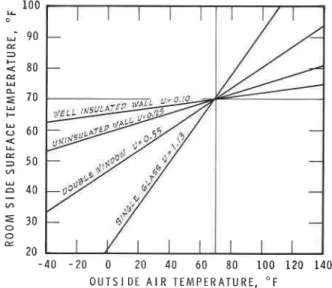
tration, both with respect to radiative and convec-tive effects. The enclosing surfaces of occupied spaces wiII seldom all be at one temperature. In addition, there may be concentrated radiating sources, including lights, radiators, and heaters of various kinds. The direct rays of the sun provide strong radiation effects, involving short-wave ra-diation. Window surfaces or blinds heated by the sun may be up to 30'F above air temperature and thus become important radiators of long-wave radiation. Correspondingly, glass surfaces in win-ter ean be as much as 30'F below room tempera-ture. But all exterior walls are also to a lesser degree, dependent on their over-all heat trans-mission characteristics, likely to be above air tem-perature at times in summer and below in winter. The relationship between outdoor temperature, the thermal characteristics of the enclosure and surface temperature, for room air temperatures held at 70'F and steady state heat transfer condi-tions are shown in Fig. 1.
- 4 0 - 2 0 0 2 0 4 0 6 0 8 0 1 0 0 1 2 0 1 4 0 O U T S I D E A I R T E M P E R A T U R E , " F
R o o m T e m p . 7 0 ' F . N o D i r e c t S u n . l 5 M P H W i n d O u t s i d e . U = 0 v e r a l l C o e f f i c i e n t 0 f H e a t T r a n s m i s s i o n B T U / H R F T T D E G F .
Figure l. Exterior wall and window surface ternperatures.
Interior walls, floors, and ceilings having no outdoor exposure will usually be within a degree or two of air temperature, and will exchange energy by radiation with heated or cooled exterior walls and windows and any hot or cold bodies in the room. When the bounding surfaces of a space are at different temperatures the calculation of ra-diation exchanges with an object in the space can become quite complicated. It is not enough to calculate the average surface temperature of the enclosure, although this gives a first rough ap-proximation, since the radiative exchange depends upon the areas and relative positions of the sur-faces involved. Thus the radiation exchange with
1 0 0 r "i 90 E E a o U 0 " ^ = r u U u . ^ o 0 U = ) v
E o o
= ? n o ' -e Z Ua body may vary with its position in the room when there is unbalanced radiation. The concept of mean radiant temperature is useful, this being the equivalent uniform surface temperature that would produce the same radiation exchange as the actual situation: even this becomes involved when the shape of the subject body is at all complicated.
The human body presents further complications. It may be clothed in various ways thus complicat-ing the pattern of surface temperatures presented. The areas and the shape exposed for radiation exchange as well as for convective exchange may vary markedly with different postures, while the temperatures of the body parts themselves may vary.
One of the more difficult aspects of this varia-bility of the human body is the determination of the tolerance it has in respect of thermal sensa-tions to variasensa-tions in condisensa-tions from part to part. We have spoken thus far in this discussion of radiation as if the body were highly conducting, thus having almost the same temperature throughout, so that we needed only to determine the heat balance regardless of the different condi-tions to which its various parts or sides might be exposed. The problem of cold feet on a cool floor is readily recognized, as is that of a warm head when standing under a radiant heating ceiling panel. A similar and more common situation may arise in the case of windows which give rise to different radiant exchanges on the side of the body facing them than on the other.
It will be a most difficult job to explore all the ramifications of comfort as a subjective reaction for these situations. There is the difficulty of using people as meters but, in addition, the situations presented are both physically and physiologically complex, offering no hope of simple relationships being found which will serve for a wide range of conditions. Delineation of the physics of these situations does provide a basis, ho'ffever, for recog-nition and evaluation of them.
A further analysis of the radiation condition posed by windows even without direct solar trans-mission effeck will serve to show the influence of unbalanced radiation effects upon comfort condi-tions throughout a room. A room formed by a typical building module 20 by 20 ft by 10 ft high with half of the exterior wall of glass has been taken as an example. Certain simplifying assump-tions have been made to permit heat balances to be ealculated. AII surfaces other than the glass area have been assumed to be at 75'F. The results are expressed as the change in room air tempera-ture from 75"F required to compensate for a 1 degree change in the window surface temperature,
i.e., to maintain the same heat balance on the body. Values have been calculated for three posi-tions along the centre line of the room, at 5, 10 and 15 ft from the window. They are:
Distance from window, ft 5 Change in air temperature required for
one degree change in window
temperature 0. | 5 0.072 0.o4)
Thus if we assume a maximum window surface temperature differing from 75o by as much as 30 degrees up or down, which is not unrealistic, the air temperature should be changed by 4 degrees at 5 ft from the window, but onty 1 degree at 15 ft from the window, being increased in winter for a cold window and decreased in summer for a hot window. If, however, the wall surfaces are assumed to follow air temperature, rather than remaining constant al75oF", the adjustment indicated would be only half of these values. The real case will involve some intermediate value. These results give some idea of the magnitude of the correction necessary from winter to summer, to maintain the same heat balance, as well as of the inevitable va-riation in effect for different distances from the window, assuming that the room must be at the same air temperature throughout.
These results as well as the earlier discussion of radiation effects are based on the assumption of equal coefficients for radiation and convection, that is, the same change in each per degree change in temperature. Thus a change in mean radiant temperature of lF degree will require a change in air temperature to compensate of lF degree also. A comfort code at present being considered calls for an adjustment of 1.4F degree in air tempera-ture for each lF degree change in mean radiant temperature. Clearly however these relationships are subject to considerable variation in specific cases, depending among other things on amount and disposition of clothing, and body posture as well as the areas, temperatures and orientations of the surrounding surfaces.
Air-conditioning can compensate for radiative effects if it can produce and maintain variation*q in air temperature throughout the space which are everywhere exacUy adjusted to the corresponding radiation variations. Some thought will show that this is hardly a practical proposition. Another pos-sibility would be the adjustment of air movement in a similar manner throughout the space in order to provide in this way the necessary compensating adjustments in convective heat transfer, but this is equally impractical. It is appropriate to examine the possibilities in reducing potential radiative ef-fects by compensating radiation sources. This is on the whole a much more manageable approach
OCCAPATIONAL HEALTH REVIEW o 7 l 5
than by convective compensation. The warm sur-face to be used to compensate for a cold one must present roughly the same field of view to the body at all probable locations. A window wall might thus be provided with suitably located compensat-ing surfaces which are heated in winter and cooled in summer. The use of radiant heating and cooling in an opposite waII would compound rather than relieve the variation in radiation effects. Cost and the burden of increased complexity both in equipment and in control are against this solution but it is technically feasible.
We cannot ignore what by now must be an ob-vious approach, namely to reexamine the sources of the variable radiation effects in the first in-stance. Hot sources can be shielded, thus forcing them to give off their heat by convective means where this is an appropriate alternative. Modern lighting loads are relatively high, and represent a substantial heat gain. A large proportion of this heat gain initiates as thermal radiation. The re-quirements for uniformity of light, which is also radiation, result in a measure of uniformity for the thermal radiation, at least in plan, if not ver-tically, in a room. Exterior walls may be insulated to raise their resistance to heat transfer and thus bring their interior surfaces closer to inside air temperature. This is desirable also for other rea-sons. We are left then, with windows as the most common source of radiative effects.
Windows are generally rather weak thermally, so that their inside surface temperatures vary markedly with variations in outdoor temperature. Further, they constitute in modern practice quite large proportions of the wall area and so become a substantial source of unbalanced radiation ef-fects. They allow direct transmission of solar energy which can result in radiation heat gains per unit of exposed area up to 10 times those in-volving heated or cooled surfaces.
The glass itself absorbs some solar energy and becomes heated so that it too becomes a source of heat gain by radiation. When glass is made heat absorbing, the absorbed solar radiation portion increases, and the glass can become quite hot. Blinds or drapes interposed on the inside of the window intercept direct solar radiation and be-come heated and produce radiation effects. Only reflecting surfaces or outside blinds or shades a^re capable of turning away a major portion of direct solar energy. Under winter conditions windows give rise to radiative cooling which can be offset in part by drapes and by the introduction of heat below them. They can also be a source of localized convective cooling in winter when air that is cool-ed at the window surface falls to the floor.
8 C OCCUPATIONAL HEALTH REVIEW
Ilre Bosic Air-Condirioning Problem
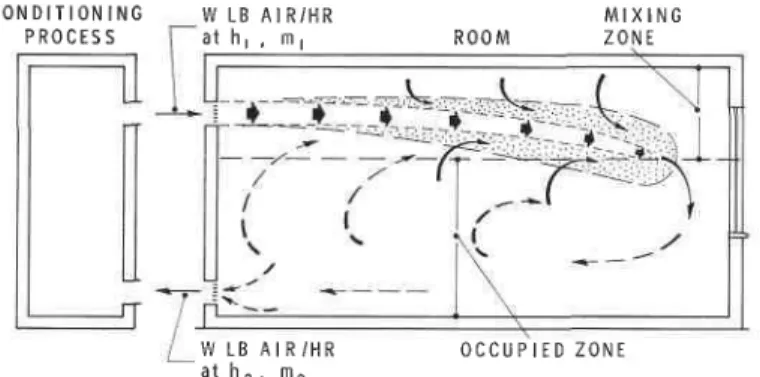
We may now turn to the air-conditioning proc-ess itself, or at least that part of it which involves the interaction with room conditions. The basic air-conditioning problem is illustrated in Fig. 2,
C O N D I T I O N I N G P R O C E S S W L B A I R / H Ra t h r , m l R O O M M I X I N G Z O N E W L B A I R / H R a t n 2 , m 2 O C C U P I E D Z O N E
Figure 2. The basic air distribution problern.
representing the most common situation in which a definite amount of air is drawn from the space and is replaced with an equal amount of condi-tioned air. The conditioning of the air which may include filtering and blending with a certain pro-portion of fresh air for ventilation is usually car-ried out external to the conditioned space. It is not proposed that the ways in which this can be carried out be discussed in any detail.
The room will have a heat gain, H, and a mois-ture gain, M, in unit time. These will result from occupants, lights, equipment, direct entry of solar energy, and any heat and moisture transmission through the enclosure of the space. If temperature and humidity are to be controlled, it is necessary to arrange for heat and moisture losses from the space which exactly balance the heat and moisture gains. This is arranged in the case under consider-ation through the entering and leaving air streams. The condition of the air in the occupied zone will be reflected closely in the condition of the air drawn from the space. The air entering must therefore be deficient in heat and moisture to just the right degree to balance the require-ments of the space. If the mass flow of air in and out is W lblhr and h and m are the heat and mois-ture contents of the air, respectively, for I lb of air, simple mass and energy equations can be written for the room as follows:
H : W ( h z - h r ) ( l ) M : W ( m z - m r ) Q )
Several most significant features of the air-conditioning problem are implicit in these equa-tions. They say in the first instance that the total heat gain of the space, H, must be balanced by the difference in the heat content of W lb of
leaving and entering air, and that the total mois-ture gain M must be balanced by the difference in the moisture content of W Ib of leaving and entering air. When H and M represent heat and moisture gains to the room, the entering air must be cooler and contain less water vapour than the leaving air. If under winter conditions there are heat and moisture losses from the room which must be made up, then the entering air must be warmer and contain more moisture than that in the room.
The amount by which the condition of the en-tering air differs from room air conditions is shown to be dependent on the magnitude of the heat and moisture loads (H and M) and on the rate of air circulated (W).
Under winter conditions involving mainly heat-ing it is not uncommon to employ air stream tem-peratures up to 150'F. Rooms with average heat requirements will have a rate of air circulation, W, corresponding to a volume change of 3 air changes per hr. In air-conditioning practice it is more common to employ 10 air changes or even more per hr. The primary conditioned air stream may correspondingly be at a temperature of 15' below room air temperature. In fact, the air change rate for eooling must be kept high in order to reduce the temperature differences.
Room Air Di*ribution
There is a very serious problem to be faced in the matter of air distribution throughout a space. The primary air stream will always differ marked-ly in conditions and so must not be allowed to enter directly the occupied zone which for human occupancy will extend to about 6 ft above the floor. The space above this height becomes essen-tial as a mixing zone in which the primary air stream must first be mixed with room air. This requires that the primary air be projected with sufficient velocity so that it will entrain room air by induced secondary eirculation in amounts up to 3 to 5 times its own volume preferably before it enters the occupied zone while at the same time providing the best possible distribution and move-ment of air throughout the occupied zone. This is not easy to accomplish and it constitutes one of the great challenges to the designer of the system. Clearly the uniformity in conditions that can be achieved in respect of air temperature, air move-ment, and relative humidity throughout the oc-cupied zone is greatly dependent on it.
The distribution of the air is accomplished by three factors: the velocity energy of the primary stream, by gravity effects due to differences in temperature, and by displacement due to the
gen-eral movement caused by the continuous over-all introduction and withdrawal of air. It becomes necessary to take account of all three in designing for adequate room air distribution. The supply registers must also be designed to assist in the scheme of air distribution selected. Their size, location, spacing, amount of air handled, and the direction given to the air are all important fac-tors.
Various discharge and exhaust locations are used, depending on circumstances. Radial ceiling diffusers are common, in which the primary air supply is projected generally downward from a central location in a flat cone, and the return air is drawn upward through the centre. These can be excellent for cooling yet poor for heating, since it may not be possible to project the heated air downward to the floor to break up the cool air collected there without creating objectionable air movement. Exhaust outlets located at floor level are desirable for heating conditions. When the same system must be used for both heating and cooling the problem can be very difficult. The occupancy or use of the room must always be taken into account. This will in part determine the heat and moisture loads as well as the loca-tions of these loads within the room. The room use may also influence the arrangement and loca-tion of air supply and exhaust grilles.
When, as is often the case, windows are a major source of both heating and cooling loads, it is common to provide air discharged vertically up-wards from either continuous or cabinet-type con-vectors located below the windows. Thus the ver-tical zone close to the windows becomes in part a mixing zone. This location is often satisfactory for heating with only natural upward convection, but in the case of cooling forced convection must be used. In one arrangement the energy of the primary air stream entering the unit under pres-sure is used to induce large volumes of room air from the floor for mixing before it is discharged vertically upward. Thus displacement is used along with discharge velocity to provide vertical circula-tion in the room which would otherwise have a cold zone at the floor and a hot zone at the ceiling due to gravity effects. Some units contain the heating and cooling coils necessary to provide par-tial conditioning of the primary air stream which has already been humidified or dehumidified as required in a central plant.
lhe Conditioning Process
There are various ways of providing a suitably conditioned air stream, appropriate to the require-ments of the space. The schematic box of Fig. 2,
marked Conditioning Process, is intended to de-note the sum total of the operations by which this can be accomplished. This may be performed in a central plant, in units external to the room, in units within the room as in the case of room air conditioners, or by a combination of central plant and room units as in the case of convectors or induction units. These will be discussed only broadly in relation to the extent to which they influence the ability to provide control within the space.
We may note that it is the function of the air distribution within the space to promote uniform-ity of air conditions within the space. This, in combination with the radiative exchange situa-tion provided by the room itself, will determine the uniformity of the thermal environment pro-vided. It is the function of the air-conditioning apparatus under the direction of a suitable con trol system to provide the required amount of air, conditioned so that the heat and moisture loads will be exactly offset at all times.
The most common forms of air-conditioning systems employ a relatively simple arrangement of heat exchangers which accomplish both cooling and dehumidifying. These heat exchangers, called coils, are cooled either with chilled water which has been cooled elsewhere, or by direct expansion of refrigerant in them. They are adjusted so that they cool the air being conditioned to the tempera-ture necessary to maintain a constant room tem-perature as sensed by a thermostat. The tempera-ture can only be controlled within the limits of accuracy inherent in the ability of the thermostat to sense room conditions, and the ability of the equipment to respond.
It is a characteristic of air containing water that, if. it is cooled below the dewpoint, water will be removed by condensation from it. Thus removal of water vapour from the air can be accomplished in a cooling coil. But it is also required, if humidity within the room must be controlled, that heat and moisture be removed in exactly the right propor-tions, as determined by the ratio of the heat and moisture gains. The simpler types of air-condi-tioning systems employing simple cooling cannot do this. They can however be designed for a typi' cal load so as to remove the predicted ratio of moisture to heat and are then subsequently oper-ated under the action of a thermostat to produce constant room temperature as closely as the sys-tem will permit. The amount of moisture removed and thus the relative humidity in the room is then determined by the load on the room in conjunc-tion with the cooling-dehumidifying characteris-tics of the system.
IO . OCCUPATIONAL HEALTH REVIEW
These relatively simple systems which are quite commonly used for comfort air conditioning thus can only provide very rough control of relative humidity within a room, within a fairly broad range which is determined by the load and by the extent to which the designer was able to predict the nature of the load in advance and to design equipment to suit.
When relative humidity must be controlled within definite limits it becomes necessary to pro-vide more complicated and also more expensive systems which are capable of adjusting the heat and the moisture in accordance with room re-quirements. Clearly there must then be devices for sensing both humidity and temperature, and there must be within the system the means for making the necessary adjustments independently. There are a great many possible arrangements, depending on the degree of control of both tem-perature and humidity which are required. Under summer conditions, cooling and dehumidifying are required together, while in winter, humidifi-cation usually is required along with heating. It is not uncommon to have heating provided in an independent system, while the air-conditioning plant provides summer conditioning and perhaps also ventilation and humidification in winter. A complete system for what is usually referred to as full air-conditioning must, however, be capable of providing all four functions when and as re-quired.
Sysfem Cop&ility ond Zoning
We now see that the designer ma'y not always choose to provide a type of system which is ca-pable of adjusting relative humidity closely. When conditioning for comfort only is involved it may be quite adequate to provide means to control tem-perature and to allow relative humidity to fluc-tuate over a range.
An important decision has also to be made about the need for the system to provide heating in one part of a building while providing cooling in another. On a more detailed scale it must be de' cided whether the system is to be capable of in-dependently adjusting conditions in each room of a building in accordance with its requirements. This can always be done if cost is no object. Usually, however, cost is important and one of the ways in which this can be reduced is to re-duce the number of independent conditioning ca-pabilities. When a number of rooms in a building can reasonably be expected to have almost identi-cal conditioning requirements, they may all be supplied with air that has been conditioned to the same degree in a single system. A thermostat plac-ed in one room may be usplac-ed to control the system
for all. If, fiowever, an unusual load exists in the room with the thermostat, the condition of the supply air will be adjusted to suit it and will be inappropriate for all other rooms. This can be re-lieved by thermostats in more than one room, the condition of the supply air being determined by the average response from them. Alternatively, the air exhausted from all the rooms may, after mix-ing but prior to conditionmix-ing, be taken to represent the average condition in all rooms, and controls inserted in it to respond accordingly.
This general approach in which groups of rooms or even major portions of a building having similar requirements are served in common by some por-tion of a system is known as zoning. Regardless of the basis on which it is employed it almost always represents some compromise between cost and the freedom to adjust conditions in individual roorns independently at all times. It follows that when close control of both temperature and hu-midity are required at all times, separate system functions must be established for each room, with consequent higher cost.
Sysfem Conlrol
Every system must be controlled in order that its capacity be properly matched at all times to the varying requirements of the room. There must be a device such as the thermostat or humidistat to sense the need for changes in the factnr being controlled. The system must also be capable of being adjusted and there must be the means to accomplish the necessary adjustments under the direction of the various sensing devices. Since con-trol is essentially a time-dependent operation, the rate of response of the sensing devices to a devia-tion in room condidevia-tions, the response of the system in introducing corrective changes and the response of the room conditions to these changes are of vital importance. Again, without going into detail, we may recognize still another characteristic of an air-conditioning system, that of control capa-bility which has a marked influence on the acapa-bility to maintain uniform conditions.
A thermostat, which is the primary room sens-ing device, responds to its own temperature. As in the case of other objects in the room it will respond thermally to air temperature, air mo-tion, and radiamo-tion, and may also be influenced by conduction exchanges with the wall on which it is located. It can only respond to the thermal conditions at its own location and signal to the correcting elements of the system. It can do nothing about thermal conditions elsewhere in the room.
Conclusion
We have seen that the ability of an air-condi-tioning system to control those factors that are likely to influence thermal sensations of comfort is dependent upon many things. The air-condi-tioning system can only influence those factors which are closely related to air temperature, air motion, and relative humidity. It cannot readily be made to compensate for differences in radia-tion effects throughout a room. Thus the varia-tions in radiation effects which are inherent in the room and its contents present the first set of limitations on the uniformity of conditions. Other limitations on system capability may be imposed in the interests of cost. The design of the air dis-tribution system for a room is critical, and the re-sults which can be obtained in this respect may be limited by the nature and distribution of the room loads, as well as by certain design limitations which may be imposed by the use requirernents. Finally there are limits imposed by the control-lability of the system.
No one of these features can be adjusted to compensate for deficiencies in the others; each in turn may timit the extent to which uniformity in conditions is possible. Thus, design for a given set of room requirements inevitably requires con-sideration, not only of the total system, but also of the building and its oacupancy.
The provision of even a highly favourable set of thermal conditions is unlikely ever to guarantee comfort for everyone. Fortunately, there is some tolerance in air temperature within which any individual doing no more than light work will be reasonably comfortable, and an even wider permissible tolerance in relative humidity. Systems are regularly designed to take advantage of these tolerances in the inevitable compromise between cost and performance. Systems can be designed for increasingly refined performance but only at substantially increased cost and subject always to the limitations inherent in the characteristics of the space and its occupancy.
REFERENCES:
l. Guide and Data Book 1963. Fundamentals and Equipment, Chapter E. American Society Heating, Refrigerating and Air-Conditioning Engineers. New York.
2. Bruce, W. Man and HisThermal Environment. National Research Council. Division of Building Research, Ottawa. February 1960.
N R C 5 5 t 4 .
3. Koch, W., Jennings, B. H. and Humphreys, C. M. Environ-mental Study Il-Sensation responses to temperature and humidity under still air conditions in the comfort range. Trans., American Society Heating, Refrigerating and Air-Conditioning Engineers, Vol. 66, 1960, p.264.
4. Hutcheon, N. B. Humidity and Buildings. National Research Council, Division of Building Research, Ottawa, September
r964. NRC 8r52.
This publication is being distributed by. the Oivision of Building Research of the National Research eouncil. It should not be reproduced in whole or in part, without permission of the original publisher. The Division would be glad to be of assistance in obtaining such permission.
Publieations of the Division of Building Research may be ob-tained by mailing the appropriate remittance, (a Bank, Express, or Post Office Money Order or a cheque made payable at par in Ottawa, to the Receiver General of Canada, credit National Research Council) to the National Research Council, Ottawa. Stamps are not acceptable.
A coupon system has been introduced to make paymenLs for publications relatively simple. Coupons are available in denominations of. 5,25 and 50 cents, and may be obtained by making a remittance as indicated above. These coupons may be used for the purchase of all National Research Council publications.
A list of all publications of the Division of Building Research is available and may be obtained from _ .the Publications Section, Division of Building --;,.-::Research, National Research Council, Ottawa,