MITLIBRARIES
*
/
N
*
UBKARES
Digitized
by
the
Internet
Archive
in
2011
with
funding
from
Boston
Library
Consortium
Member
Libraries
hb3i
\msmy
jy[415
Massachusetts
Institute
of
Technology
Department
of
Economics
Working
Paper
Series
Did
Mandatory
Unbundling
Achieve
Its
Purpose?
y
Empirical
Evidence from
Five
Countries
Jerry
Hausman
Gregory
Sidak
Working
Paper
04-40
Nov
1,2004
Room
E52-251
50
Memorial
Drive
Cambridge,
MA
02142
This
paper can be downloaded
without
charge from
the
Social
Science
Research Network
Paper
Collection
at
MASSACHUSETTS
INSTITUTEOF TECHNOLOGY
FEB
12005
Hausman Sidak Oxford vS 3:00
PM
Eastern11/08/04Did
Mandatory
Unbundling
Achieve
Its
Purpose? Empirical Evidence
from
Five
Countries
Jerry
A.
Hausmanf
J.
Gregory
Sidakf
tIn this article, we examine the rationales offered by telecommunications regulators
worldwide for pursuingmandatory unbundling. We beginbydefiningmandatoryunbundling,
with brief descriptions ofdifferent wholesaleforms and different retailproducts. Next, we
examinefourmajorrationalesforregulatory intervention ofthis kind: (I) competition in the
form oflowerprices andgreater innovationin retailmarkets isdesirable, (2)competition in
retail markets cannot be achieved with mandatory unbundling, (3) mandatory unbundling
enables future facilities-based investment ('stepping-stone' or 'ladder of investment'
hypothesis),and(4)competitioninwholesale access marketsisdesirable. Weproceedbytesting empirically the major rationales in the United States, the United Kingdom,
New
Zealand,Canada, and Germany. Foreach case study, we review themandator}' unbundling experience
with respectto retailpricing, investment, entrybarriers, andwholesalecompetition. Wereview
the lessons learnedfrom the unbundlingexperience. We also identify which rationales were
incorrect in theory and which rationales were correct in theoryyet were not satisfied in
practice. Forthesecondcategoryofrationales, weattempttoprovidealternativeexplanations forthefailureof mandatoryunbundlingtoachieveitsgoals.
I.
What
IsMandatory Unbundling?
3A. Different
Wholesale
Forms
41.
Mandatory Unbundling
at DifferentLevels oftheNetwork
42.
Mandatory Unbundling
Versus ServiceResale 5a.
Mandatory Unbundling
Versus Resale ofVoice
Services 6b. Line SharingVersus Bitstream
Access
ofData
Services 6B. DifferentResultingRetailProducts 8
1.
Voice
Services 8a.
Mass
Market
VersusEnterprise 8b. RuralVersus
Urban
102.
Data
Services 103. ExistingServices Versus
New
Services 11II.
Why
PursueMandatory Unbundling?
1 1A. Rationale 1:Competition inRetail MarketsIsDesirable 1
1
1. Innovation
and
Investment 122. Prices
and
Retail Margins 13B. Rationale 2: Competition in Retail Markets
Cannot
Be
Achieved
Without
Mandatory Unbundling
14| MacDonaldProfessorof Economics, MassachusettsInstituteofTechnology.
tt F.K. WeyerhaeuserFellowin
Law
andEconomicsEmeritus,AmericanEnterpriseInstituteforPublic PolicyResearch.Thisresearchwas commissionedby Vodafone.Theviews expressedhere are solely those ofthe authors and not those of
MIT
orAEI, neitherofwhich takes institutional2
Hausman
and Sidak1 .
A
Vertically IntegratedFinn
Generally PrefersItsOwn
Downstream
Affiliate 14
2. EntryBarriersPreventNaturalCompetition 15
C. Rationale 3:
Mandatory Unbundling
Enables Future Facilities-BasedInvestment 16
D. Rationale4: Competition inWholesale
Access Markets
IsDesirable 181.
A
Network
ofNetworks
182. Regulatory Withdrawal 19
E. Conclusion 19
III.
The Unbundling
ExperienceinFive Countries 20A. UnitedStates 21 1. Retail Competition 21 a. Pricing 21 b. Investment
22
2. Entry Barriers24
3. Stepping-StoneHypothesis 28 4.Wholesale
Competition 325. Other Observations abouttheProcess 33
B. United
Kingdom
331. RetailCompetition 36
a. Pricing 36
b. Investment 37
2. EntryBarriers 38
3. Stepping Stone Hypothesis
40
4. Wholesale Competition
40
5. Other Observations
About
the Process 42C.
New
Zealand44
1. Retail Competition
46
a. Pricing
46
b. Investment
47
2. EntryBarriers 48
3. Stepping Stone Hypothesis 50
4. Wholesale Competition 50
5. Other Observations abouttheProcess 50
D.
Canada
511. RetailCompetition 53
a. Pricing 53
b. Investment 55
2. EntryBarriers
56
3. Stepping Stone Hypothesis 5.8
4. Wholesale Competition 59
5. Other Observations abouttheProcess 60
E.
Germany
61 1 . RetailCompetition 62 a. Pricing62
b. Investment 62 2. Entry Barriers 633. Stepping Stone Hypothesis 65 4. Wholesale Competition 65 5. Other Observations
About
theProcess 66November
2004 Did Mandatory Unbundling AchieveItsPurpose? 3F.
Summary
66IV. Lessons
Learned
from
theUnbundling
Experience 68A.
The
RationalesThatWere
Not
CorrectinTheory
68B.
The
Rationales ThatWere
Correct inTheory Yet
Were
Not
Satisfied inPractice 69
Conclusion 70
I.
What
IsMandatory Unbundling?
In the 1990s,
mandatory
unbundlingbecame
the proposedremedy
of choice inregulatory
and
antitrust proceedings. Foradecade
ormore, thedominant
theme
inregulatory and antitrust law has been
what might
be called 'the spirit ofsharing.'For example, in the United States, the
Telecommunications
Act
of 1996 restson
the hypothesis that requiring a firm to share the use of its facilities with itscompetitors will enable the competitors eventually to build their
own
facilities,presumably
to the eventual benefit of consumers.The
mandatory
sharing offacilities is thus the segueto eventual competition
between
rival infrastructures orplatforms.
The
corollary ofthis assumption is that, but for this exactform
ofregulatory intervention, natural market forces cannot be counted on to produce
facilities-basedcompetition.1
Any
firmmay
chooseto unbundle or leasecomponents
ofitsnetwork
with athird party at a voluntarily negotiatedrate.
The
firm is also able to decide thescopeofunbundlingitwantstoundertake
—
how much
ofitsnetwork
toresell.The
term 'mandatory unbundling' describes an involuntaryexchange
between
anincumbent network
operator and a rival at a regulatedratewhere
the scope ofunbundling is determined
by
regulators. Determination of the access rate thusbecomes
the majorbone
of contentionbetween
incumbent
and entrant, as aregulatory access rate that is equal to the voluntarily agreed-upon access rate
cannotreally besaid to constitute'mandatory' unbundling.
When
formulatingthataccess rate,regulators havegenerally opted in favor ofa
measure
oftotal elementlong-run incremental cost
(TELRIC)
or total service long-run incremental cost(TSLRIC)
and
against ameasure
ofopportunity cost or optionvalue.21 .
Thenearestexampleinthe antitrust literaturewas anabandonedremedy inMicrosoftthat
wouldhave forced theincumbentoperatingsystem providertodiscloseitssourcecodeto rivals.See
J.GregorySidak,'AnAntitrustRuleforSoftwareIntegration', 18YaleJ.onReg. 1 (2001).
2. For a detailed analysis ofthe scope ofthe unbundling decision and the access pricing decisionbyatelecommunicationsregulator,see JerryA.Hausman/J. Gregory Sidak,'A
Consumer-WelfareApproachtoMandatory Unbundling of Telecommunications Networks', 109Yale L.J.
417 (1999). For areview ofunbundling in other contexts, see J. Gregory Sidak/Hal J. Singer,
'InterimPricingof LocalLoop UnbundlinginIreland: Epilogue', 4J.NetworkIndus. 119(2003);J.
Gregory Sidak/Allan T. Ingraham, 'Mandatory Unbundling, UNE-P, andtheCostofEquity: Does
TELRIC
PricingIncreaseRiskforIncumbent LocalExchangeCarriers?',20 YaleJ.Reg.389(2003);J. GregorySidak/HalJ. Singer,
How
CanRegulators SetNonarbitraryInterim Rates?The Case ofLocalLoopUnbundlinginIreland', 3J.NetworkIndus.273 (2002); Thomas M. Jorde/J. Gregory
Sidak/David J. Teece, 'Innovation, Investment, and Unbundling', 17 Yale J. Reg. 1 (2000). J.
Gregory Sidak/Daniel F. Spulber, 'The Tragedy ofthe Telecommons: Government Pricing of
UnbundledNetwork Elements UndertheTelecommunications Actof1996',97 Colum.L. Rev.
4
Hausman
and SidakIn this section,
we
definecommon
terms used inmandatory
unbundlingproceedings and identifyrelevantproduct marketsthat areaffected
by
unbundlingpolicy.
We
also analyze different wholesale forms ofmandatory
unbundling andthe resulting retail products, with a special emphasis on
new
versus existingproducts.
Although
we
rely extensivelyon
the U.S. experience to introduce thebasic concepts of
mandatory
unbundling, Part III of this reportexamines
theunbundling experience ofseveral other countries.
A. Different
Wholesale
Forms
Regulators
mandate
unbundling at various parts of an incumbent localexchange
carrier's
(ILEC)
network,including the loop,transport,andswitch.When
selectingwhich
elementstomake
availableto competitorsatregulated rates,regulators haveconsidered the effect of
mandatory
unbundling in conjunction with the potentialforresaleoffinal services.
1.
Mandatory Unbundling
atDifferentLevelsoftheNetwork
Mandatory
unbundling at a regulated ratemay
apply to various 'networkelements,'
which
are defined by the U.S.Telecommunications
Act
of 1996 as 'afacility or
equipment
used intheprovision ofatelecommunications service.'3The
Act
instructs theFCC
to consider whether 'the failure to provide access to suchnetwork elements
would
impair the ability of the telecommunications carrierseekingaccesstoprovidethe services thatitseekstooffer.'
4
Under
theAct, pricesfor
unbundled
network
elements(UNEs)
are basedon
the cost of providing theinterconnection or network element.5
The
FederalCommunications
Commission
(FCC)
interpreted that pricing rule as 'forward-looking, long-run, incrementalcost.'6 In practice, prices are 'based on the
TSLRIC
[total service long runincremental cost] of the network element . . .
and
will include a reasonableallocationof forward-lookingjoint and
common
costs.'7As
part ofits TriennialReview Order
ofits unbundling regulations, theFCC
explained that
ILECs
were
required toprovide accessto network elements 'totheextentthatthoseelementsare capableof being used
by
therequestingcarrier intheprovision ofa telecommunications service.'8
The
FCC
ordered allILECs
tomake
available atregulatedratesthe following
UNEs:
3. 47U.S.C.§153(29).
4. 47 U.S.C.§251(d)(2)(B).
5. 47 U.S.C. §252(d)(1) (stating that 'DeterminationsbyaStatecommission ofthejustand
reasonablerate forthe interconnectionoffacilitiesandequipmentforpurposesofsubsection(c)(2)of
section251,andthejustandreasonablerate fornetwork elementsforpurposesofsubsection(c)(3)of suchsection
—
'(A)shallbe—
'(i)basedonthecost(determined withoutreferencetoa rate-of-return or otherrate-based proceeding) ofproviding the interconnection ornetwork element (whicheverisapplicable),and'(ii)nondiscriminatory,and'(B)mayinclude areasonableprofit.').
6. Implementation ofthe Local Competition Provisions in the Telecommunications Act of
1996; Interconnection between LocalExchange Carriers and CommercialMobile Radio Service Providers,
CC
Docket Nos. 96-98, 95-185, First Report and Order, 11FCC.
Red. 15499, \620(1996) [hereinafterFirstReport
&
Order].7. Ibid,at1672
8. ReviewoftheSection 251 UnbundlingObligationsof Incumbent LocalExchangeCarriers,
ReportandOrder and Order onRemandand FurtherNotice of Proposed Rulemaking,
CC
Dkt.No.01-338, 20 August2003, at 42\ 59[hereinafter TriennialReview], rev'd, U.S.Telecom Ass'n v.
November
2004 DidMandatory Unbundling AchieveItsPurpose?(1) stand-alone copper loops
and
subloops for the provision ofnarrowband
and
broadband
services,(2) fiberloops for
narrowband
servicein fiberloop overbuildsituationswhere
the
incumbent
LEC
elects to retireexistingcopper loops,(3) subloops necessary to access wiring at or near a multiunit customer
premises,
(4)
network
interface devices (NID),which
are defined asany
means
ofinterconnecting the
ILEC's
loopdistribution plant to wiring at acustomerpremiseslocation,
(5) dark fiber,
DS3, and
DS1
transport, subject to a route-specific reviewby
thestates toidentify availablewholesalefacilities,
(6) local circuitswitchingserving the
mass
market,(7) sharedtransportonlytothe extentthat carriersareimpaired withoutaccess
to
unbundled
switching,(8) signaling
network
when
acarrierispurchasingunbundled
switching,and
(9) call-related databases
when
a requesting carrier purchasesunbundled
accesstothe
incumbent
LEC's
switching,(10) operations support systems
(OSS)
for qualifying services,which
consistsof pre-ordering, ordering, provisioning, maintenance and repair,
and
billingfunctionssupported
by
anILEC's
databasesandinformation,and(11) combinations of
UNEs,
including the loop-transportcombination(enhanced extendedlink, or
EEL).
9Based
onthisexhaustive list,itisreasonableto concludethat, at leastintheUnitedStates, virtually no
component
of an incumbent'snetwork
was
immune
from
unbundling obligations eight years after the passage ofthe
Telecommunications
Act.2.
Mandatory Unbundling
Versus ServiceResaleTo
introduce competition in the final service market, regulatorshave
made
network elements available for lease, or have
made
final services available forresale, orboth. In this section,
we
reviewthe choices oftheregulator intheUnitedStates and
New
Zealand withrespecttothatdecision.6
Hausman
and Sidaka.
Mandatory Unbundling
Versus Resale ofVoice
ServicesThe
Telecommunications
Act
allows for local service competition through threetypes ofentry: resale, leasing of
UNEs,
and investment in and ownership offullfacilities.10 Resale requires the least initial capital investment, but it limits the
entranttoresellingthe
ILEC's
products in their original form. Leasingsome
partsofthe network as
UNEs
provides an entrant greaterflexibility to develop servicesthan doesresale.
With
regardtothe resaleof telecommunication services,theAct
clearly states that prices are to be based
on
the retail price less any associatedmarketing,billing, collection, orother costs forgone
by
theILEC."
Accordingly,theresalepricingstandardset forth
by
theFCC
requires statecommissions
to: '(1)identify
what
marketing, billing, collection, and other costs will be avoidedby
incumbent
LECs
when
they provide services at wholesale; and (2) calculate theportion ofthe retail prices for those services that is attributable to the avoided
costs.'12 In practice, resale prices are determined either through avoided cost
studies or
by
default discountrates set forthby
theFCC.
13The
FCC
believedthatthis form ofpricing
would
induce competition in the telecommunications marketandincrease efficiencyinthearbitrationandnegotiation processes.
In its Triennial
Review Order
in 2003, theFCC
commented
that competitivelocal
exchange
carriers'(CLECs)
purchase oftotal serviceresale forvoice servicehaddeclined froma peak of almost5.4 million lines in
2000
tobelow
3.5 millionlines by mid-2002.14
By
contrast, thenumber
ofUNEs,
which
includes loopsacquiredseparatelyandinconjunctionwith switching (the'unbundled platform' or
UNE-P),
increasedfrom
1.5 millionto 11.5 millionover thesame
period.15Many
scholars in the United States attributethe massive substitution
from
resale towardUNEs
tothemispricingofUNEs.
16b. Line SharingVersus Bitstream
Access
of DataServicesBitstream access provides service-level (resale) entry to digital subscriber line
(DSL)
data provision.Under
the bitstreamapproach, the entrantbuys thecompleteservice fora high-speed link totheconsumer, and the serviceincludes delivery to
the firstdataswitch in the incumbent's network. Line sharing,
by
contrast, allowsthe entrant to acquire the high-frequency portion of the copper connection but
requiresitto
make some
investmentsininfrastructure.Mandatory
line sharingwas
attempted and thenabandoned
in the UnitedStates. Inthe
FCC's
LineSharingOrder
released in 1999, theFCC
directedILECs
to provide the high-frequency portion of the local loop
(HFPL)
to requesting10. 47U.S.C.§251.
11. 47 U.S.C.§ 252(d)(3)(stating that 'aStatecommissionshalldetermine wholesalerateson
the basis of retail rates charged to subscribers for the telecommunications service requested,
excludingtheportion thereofattributable to anymarketing, billing,collection, andother coststhat
willbeavoided bythelocalexchangecarrier.').
12. SeeFirstReport
&
Order,aboven6, at\908.13. Ibid
14. SeeTriennialReview, aboven8,at32J 41
.
15. Ibid
16. See, e.g., RobertW. Crandall/Allan T.Ingraham/Hal J. Singer, 'Do UnbundlingPolicies
Discourage
CLEC
Facilities-Based Investment?', 4 Topics in Economic Analysis&
Policy_
November
2004 Did Mandatory Unbundling AchieveItsPurpose? 7carriers as a
UNE.
17The Commission
found inthe LineSharingOrder
that '[t]herecord
shows
that lack ofaccesswould
materially raise the cost for competitiveLECs
toprovideadvanced
services [suchasDSL]
toresidential andsmall businessusers, delay broad facilities-based marketentry and materially limitthe scope
and
quality of competitorserviceofferings.'18In
May
2002, however,theU.S.CourtofAppeals
for the D.C. Circuit vacated the Line Sharing Order, finding that theCommission
had failed to give adequate consideration to existing facilities-basedcompetition in the provision of
broadband
services, especiallyby
cable systems.19In its
August 2003
TriennialReview
Order, theFCC
decided not to reinstate thevacated line-sharing rules because itdetermined that 'continued
unbundled
accessto stand-alonecopper loops
and
subloops enables a requesting carrier to offerandrecover its costs
from
all of the services that the loop supports, includingbroadband
service.'20The
FCC
rejected its prior finding that lackof
separate access to the highfrequency portion
would
cause impairment for four reasons. First, theFCC
explained that its earlier impairment finding
had
been
basedon
a notion thatbroadband
revenueswould
notjustifythe costofthewhole
loop. Afterconsideringrevenues
from
voiceand
video, theFCC
determined that such revenueswould
offset the costs associated with purchasing the entire loop.21 Second, the
FCC
explained that
CLECs
interested only inbroadband
could obtainbroadband
frequencies
from
otherCLECs
throughline-splitting, inwhich
oneCLEC
providesvoiceservice
on
thelow
frequencyportionofthe loopandtheotherprovidesDSL
on
the high frequency portion.22 Third, theFCC
noted thatthe difficultiesofcostallocation for different portions ofa single loop
had
ledmost
states to price thehigh frequency portion of the loop at approximately zero,
which
distortedcompetitive incentives.23 Fourth, the
FCC
recognized the substantial intermodal competitionfrom
cable companies,which
lessened any competitive benefitsassociatedwith linesharing.24
In its
March
2004
opinion, the D.C. Circuit Court of Appeals upheld theFCC's
decision to eliminate line sharing, concluding that theFCC
'reasonablyfound thatother considerations
outweighed
any impairment.'25With
respecttotheincentive
problem
raised by theFCC,
thecourt opined: '[I]t is of course true thatalternative cost allocations could have reduced the skew, but any alternative
allocation of costs
would
itself havehad
some
inescapable degree of17. Deploymentof Wireline Services OfferingAdvancedTelecommunications Capabilityand
Implementation ofthe Local Competition Provisions ofthe TelecommunicationsAct of1996,
CC
Dkt.Nos. 98-147, 96-98, ThirdReport andOrder in
CC
Dkt. No.98-147 and Fourth Report andOrderin
CC
Dkt.No. 96-98, 15F.C.C.Red. 3,696 (1999)[hereinafterThirdOrder].18. Ibid, at20,9161(5
19. U.S.TelecomAss'nv.FCC,290F.3d415,428-29 (D.C.Cir.2003).
20. SeeTriennialReview,aboven8, at 125atU199. 21. Ibid, atH 258
22. Ibid, at11259
23. Ibid, atH260
24. Ibid, atH 263. Interestingly, the chairman ofthe FCC, Michael K. Powell, didnot agree with the decisiontoterminatelinesharing, arguingthat'thecontinuedavailabilityoflinesharingand
thecompetitionthatflowedfromitlikelywouldhave pressured incumbentstodeploymoreadvanced
networks in orderto move from the negative regulatory pole to the positive regulatory pole, by
deployingmorefiber infrastructure.'SeparateStatementofChairmanMichael K.Powell,Dissenting
in Part,20February 2003, at1 (availableat http://hraunfoss.fcc.gov/edocs_public/attachmatch/DOC-231344A3.doc).
8
Hausman
and Sidakarbitrariness.'26
The
courtadded
that 'intermodal competition from cable ensuresthepersistenceofsubstantial competitioninbroadband.'27
Regulatorsinothernations have chosenbitstreamaccess overline sharing.For example, in
December
2003, theNew
ZealandCommerce
Commission
recommended
the designation of an 'asymmetricDSL
bitstream access service.'28The
agency
definedADSL
bitstream access service as 'a high speed IP accessservice
which
providesgood
performance, but could not typically supportextensive use of mission critical applications
which
require excellent real-timenetwork performance oravailability.'29
The
Commission
defined bitstream accessas a situation in
which
the incumbent's access link 'ismade
available to otheroperators,
which
are then ableto providehigh-speed servicesto end-consumers.'30The
agency concluded the netsocial benefitsfrom
bitstream access exceeded thenet social benefits of line sharing due to the lower total cost of providing the
unbundled
service (collocation costs are avoided in bitstream access).31
The
Commission
reasoned that, under bitstream access, entrants face a lower risk ofinvesting in
network
components
such asDSLAMs
thatmight
not be fullyutilized.32
We
discuss theNew
Zealand experience in greater detail in a latersection.
B. Different Resulting Retail
Products
As
we
describe in Part II,one
objective ofmandatory
unbundling is to increasecompetition in certain final services markets.
Below,
we
describe the relevantproductmarketsthatareaffectedby
mandatory
unbundling.1.
Voice
ServicesThe
voice services market is typically divided intotwo
markets: themass
marketfor
consumers
andthe enterprise marketforbusinesses.a.
Mass
Market
VersusEnterpriseUnbundling
rates andtherelativesizeofthoserateswithrespecttotheactual costsoffacilities-based entry influence a
CLECs
entry strategy acrossmass
marketsand enterprise markets.
Using
the United States as an example,CLECs
began
competing
withILECs
in the enterprise market for voice services in themid-1980s. Competitive access providers
(CAPs)
began
providing competitiveexchange
access service tolarger business customers inNew
York
inthe 1980s/3CLECs
self-provision facilities, lease facilitiesfrom
other competitive facilities26. Ibid, at46
27. Ibid
28.
New
Zealand Commerce Commission, Section 64 Review and Schedule 3 Investigationinto Unbundling the Local Loop Network and the Fixed Public Data Network, Final Report,
December 2003 (availableathttp://www.comcom.govt.nz/telecommunications/Hu/finalreport.PDF).
29. Ibid,atAppendix5
30. Ibid, at117
31. Ibid, at20
32. Ibid, at21
33. SeeTriennialReview,aboven8,at34J44.Forareview ofCAPs,seeDanielF.Spulber/J.
GregorySidak,Deregulatory TakingsandtheRegulatoryContract: The Competitive Transformation
November
2004 DidMandatory Unbundling Achieve ItsPurpose? 9providers, or purchase high-capacity
(DS1
and above) loops either asUNEs
orspecial-access services
from
theILECs.
34As
ofAugust
2003,CLECs
reportedabout 51 percent oftheircustomeraccess lines served
medium
and large businesscustomers/5
According
to the estimate ofone
regional Bell operatingcompany
(RBOC),
theCLECs'
share ofspecial-access revenueswas
at least 28 percent in 2002.36In contrasttothe enterprisemarket, the
mass
marketforvoice serviceswas
notserved extensively
by
CLECs
before 1996. Since the passage of theTelecommunications Act
in 1996, however, severalCLECs
began
to providecompetitive voice service to
many
residential customers in the United States.According
totheFCC,
by June 2003,the latestdateon
which
theFCC
reportssuchdata, 95.5 percent ofthe U.S. population lived in a zip (postal) code served
by
atleast
one
CLEC
providingsome
kind of service/7 Figure 1shows
the consistentincrease inthe percentage of households inzipcodes served by atleast
one
CLEC
(including cabletelephonyproviders) from
2000
to2003.Figure 1:PercentageofU.S.
Households
inZipCodes
withatLeast
One
CLEC
OC^paOOOOOOOOOOOOOOOOOOOOO
^ c 3 cb a. T1 > u £ -o i Js > c "5 a a. t; > o e J3 — ;= > c
^•<twOzo-iL.S<:5-'<w
ZC)-
>u-S<S"><wOzo-)ii_s<5->
Source:
FCC
Local Competition Bureau, Local Telephone Competition December 2003 Report, atTable 15 (available at
http://www.fcc.gov/Bureaus/Common_Carrier/Reports/FCC-State_Link/IAD/lcoml203.pdf)
34. SeeTriennialReview,above n8,at34 144.
35. FCC,LocalTelephone Competition:Statusasof31 December 2002,attbl.2(rel. 12June
2003) (available at
http://www.fcc.gov/Bureaus/Common_Carrier/Reports/FCC-State_Link/IAD/lcom0603.pdf)[hereinafter
FCC
Local Competition Report2002].36.
BOC
UNE
FactReport 2002, App.L,atL-l, L-2.37. FCC,LocalTelephone Competition:Status asof 30 June 2003,attbl. 15(rel.22December
2003) (available at
10
Hausman
and SidakAs
of June 2003,theCLECs
had
nearly27
million access lines, or 14.7percentof total U.S. access lines.38 Sixtytwo
percent ofCLEC
lines serve themass
marketforvoice services,
whereas
more
than 78 percent ofBOC
lines serve this group.39UNE-based
CLEC
expansion is expected to slow in the United States, asevidenced by
AT&T
andMCI's
announcements
that they are withdrawingfrom
theresidentialmarket, citingan adverseD.C. Circuit decision.
b. RuralVersus
Urban
Universal service obligations in the United States created a
complex
system ofcross-subsidies, in
which consumers
in urban areas subsidized the service ofconsumers
in rural areas.41The
degree towhich low
rates in rural areas aresupported by high ratesin urbanareas should, intheory, have a negative effect
on
UNE-based
competition in rural areas.Because
CLECs
prefer higher margins tolower margins,
and
because theCLEC
margin
is equalto the differencebetween
the retail rate and the access rate,UNE-based
CLECs
have tended to avoid ruralareas. Indeed,
CLECs
aremore
often found in urban than rural areas. Close to 26percent ofall zip codes, serving only 4.5 percent ofthe U.S. population, have
no
CLEC
presenceaccording toFCC
data.42Another
factor thatmight preventCLEC
entry in rural areas is that
many
ruralLECs
areexempt
from the unbundlingrequirementsofthe
Telecommunications
Act.432. DataServices
In the United States,
demand
for Internet access has spurred greaterdemand
forDSL
service. Line sharing,which
we
described above,was
not available for U.S.CLECs
until 2000.By
contrast,CLECs
could lease an entire copper line for dataservices as early as 1998.
As
of June 2003, about 7.7 millionDSL
lineswere
inservice.44
Of
thoselines,ILECs
were
themajor
providersofDSL
servicewith94.6percent of
DSL
lines, whileCLECs
accounted for 5.4 percent.45With
theelimination ofline sharing in the United States, the
CLECs'
share ofDSL
lines isnotexpectedtoincreaseatthe
same
rate.It bears emphasisthat
DSL
service doesnot constitute itsown
product market,as cable
modem
service is considered an extremely close substitute forDSL
service for a majority of
broadband
users.46As
ofDecember
2003, U.S. cablecompanies
offered cablemodem
service capability to 88.2 percent of U.S.households with a penetration rate of 16.8 percent. 7 In 2003, cable
companies
38. Ibid,atTable1
39. Ibid,atTable2
40. See,e.g.,BruceMeyerson,DetroitFreePress, 8October2004, *1
41. See,e.g., RobertW.Crandall/LeonardWaverman, WhoPaysforUniversal Service?: When
Telephone Subsidies Become Transparent, (Washington, DC: Brookings Institution 2000) 9-11.
[hereinafter WhoPaysfor Universal Sennce]
42 See
FCC
LocalCompetition Report2003,aboven 37,at tbls. 14, 15.43. 47U.S.C.§251(f)(1),(2).
44. See
FCC
LocalCompetitionReport2003,aboven 37,at tbl. 5.45. Ibid
46. See, e.g., Jerry A. Hausman/J. Gregory Sidak/Hal J. Singer, 'Cable
Modems
and DSL:BroadbandInternetAccess forResidentialCustomers', 91 Am. Econ.Ass'n Papers
&
Proceedings302(2001).
47. National Cable Television Association, Statistics
&
Resources (available atNovember
2004 Did Mandatory Unbundling AchieveItsPurpose? 1 1provided cable
modem
service to approximately 13.7 million subscribers,48which
was
nearly doublethenumber
ofDSL
subscribers.3. Existing ServicesVersus
New
ServicesFrom
anentrant's perspective, leasingsome
parts ofthenetwork
provides greaterflexibility to develop existing services than does resale, but it
may
result in lessflexibility to add
new
services than does full facilities ownership.The
unbundlingdecision cannot be
made,
however, without consideration ofhow
it affects anincumbent's incentive to invest in
new
services. In 2003, theFCC
decided toremove
all unbundling obligations forbroadband
platforms enabledby
thedeployment
offiber-to-the-home(FTTH)
loops.49These
platforms areexpected tocreate a variety of
new
services,which
willcompete
directly withcablebroadband
offerings and the
broadband
offerings providedby
satelliteand
wireless carriers.The
FCC
reasoned thatthethreatofmandatory
unbundling foranew
servicethatrequired a large sunk investment
would undermine
theILECs'
incentive todeployfibernetworks.50
II.
Why
PursueMandatory Unbundling?
In this section,
we
examine
the theoretical underpinnings ofmandatory
unbundling.
We
also survey the rationales offeredby
regulatory agencies insupportof
mandatory
unbundling. In general,mandatory
unbundlingwas
believedto,
among
other items, (1) generate competition in retail markets through greaterinnovation and investment and lower prices, (2) generate greater competition in
wholesale markets,
and
(3) encourage entrants to migratefrom
unbundling tofacilities-based approach.
Because
our focus ison
the benefits ofmandatory
unbundling,
we
do
not consider its regulatory costs, such as the difficulties inimplementation or
compliance
costs for operators.When
consideringunbundling,a regulator also should take account of a full range ofefficiency considerations,
includingallocative
(consumer
welfaregains associatedwithgreaterpenetrationatlowerprices),productiveefficiency(producersurplus associatedwithreductionsin
marginal costs),
and
dynamic
efficiency(how
welfare is generated anddistributedovertime).
A. Rationale 1:
Competition
inRetailMarkets
Is DesirableIn a static
model
that does not consider investment in future periods,consumers
benefit from
mandatory
unbundlingtothe extentthat such regulation lowersretailprices. In a
dynamic
model,mandatory
unbundling at regulatedrates runs theriskof decreasing investment
by
bothILECs
(by truncating returnsby
granting a 'free48. FCC, High-Speed ServicesforInternetAccess: Status asof30 June 2003,attbl.5 (rel.22
December 2003) (available at
http://www.fcc.gov/Bureaus/Common_Carrier/Reports/FCC-State_Link/IAD/hspd1203.pdf)[hereinafter
FCC
High-SpeedServices]49. SeeTriennialReview,above n8, at10.
50. Ibidat 125 f200('As explainedmorefullybelow,thisunbundling approach
—
i.e.,greater
unbundling for legacy copper facilities and more limited unbundling fornext-generation network
facilities
—
appropriatelybalancesourgoalsofpromotingfacilities-basedinvestmentand innovation againstourgoalofstimulatingcompetitioninthemarketfor localtelecommunicationsservices.').12
Hausman
and Sidakoption' to
CLECs)
51 andCLECs
(by increasing the relative return ofUNE-based
entry).Despite these factors, proponentsarguedthatthe netofeffect of
mandatory
unbundling
was
toincreaseinvestmentby
bothILECs
andCLECs.
1. Innovationand Investment
According
to its proponents,mandatory
unbundling at regulated rates encouragesinnovation and investment on behalf ofboth incumbents andentrants. In its Third
Order
implementing theTelecommunications
Act, theFCC
explained that apositive by-product of
mandatory
unbundling atTELRIC
was
greater innovationon behalf ofentrants
and
incumbents:Unbundling rules thatencourage competitors to deploy their
own
facilities inthe long run will provide incentives for both incumbents and competitors to
invest and innovate, and will allow the Commission and the states to reduce
regulationonceeffective facilities-basedcompetitiondevelops.52
The
more
competitorsinthe market, theFCC
reasoned, the greater the incentivetointroduce a
new
technology to gain a technological edge.With
the correctincentivesinplace,theneed forwholesaleregulation
would
disappear:The unbundling standards
we
adopt in this Order . . . seeks [sic] to createincentives forbothincumbents andrequesting carrierstoinvest andinnovatein
new
technologiesbyestablishingamechanism bywhichregulatory obligationsto provide access to network elements will be reduced as alternatives to the
incumbentLECs'network elements
become
availableinthefuture.53With
greater facilities-based investment, theFCC
reasoned, the market could oneday berelied
upon
todisciplineILEC
prices for local services.Although
itwas aware
ofarguments thatmandatory
unbundling at regulatedratesmight discourage
ILEC
investment, theFCC
believedthatotherfactors inthemarketplace
would
mitigatethesenegativeeffects:We
acknowledge that the incumbentLEC
argument that unbundlingmay
adverselyaffectinnovationisconsistentwitheconomictheory,butevents inthe
marketplacesuggestthatotherfactors
may
bedrivingincumbentLECs
to investin
xDSL
technologies,notwithstandingtheeconomictheory.54For example, investment
by
cablecompanies
incablemodem
servicewas
believedto be sufficient motivation for
ILECs
to invest inDSL
facilities.Although
thenegative investmenteffects might not
overcome
these other factors, itis not clearhow
mandatory
unbundling at regulated rates actually increases investmentby
ILECs.
One
theory isthat anILEC
would
have to respondto greatercompetition fromCLECs
by
investing innew
facilities. But to the extent that thosenew
investments
would
be subjectto unbundlingrules, thoseinvestments might notbe51. See Jerry A. Hausman, 'Valuation and the Effect of Regulation on
New
Services inTelecommunications',Brookings PapersonEcon.Activity: Microeconomics(1997).
52. See ThirdOrder,aboven 17, atH7.
53. IbidatH9n. 12
November
2004 Did Mandatory Unbundling AchieveItsPurpose? 13undertaken.55
Another
theory is that theILEC
will invest innew
accesstechnologiesthatpotentiallywill notbesubjecttounbundlingrules.
2. Prices
and
RetailMargins
When
aCLEC
obtains an access line at incremental cost, it is free to charge theenduser an
amount anywhere between
the incremental cost andthe retail price.A
CLEC
can chargebelow
incremental costifitcanbundletheaccess line withotherservices such as vertical services or long distance. Competition
among
CLECs
ispredicted in theory to discipline
CLECs
in their pricing behavior. Ifcompetitionamong
CLECs
is intense, then the retailprice offeredby
CLECs
shouldequal theaccess price for the
unbundled
loop plus the incremental cost of other inputs.Finally,
ILECs
must
respond to price cutsby
CLECs
with theirown
price cuts.The
equilibriumoutcome
ofthatgame
islowerprices.The
FCC
believedthat theTelecommunications
Act
encouragedtheagencytopromote
retailpricecompetition throughmandatory
unbundling:[T]he 1996 Actsetthe stage fora
new
competitiveparadigm inwhichcarriersin previously segregated markets are able to compete in a dynamic and
integrated telecommunications market that promises lower prices and more
innovative services toconsumers.56
Even
if themandatory
unbundling atTELRIC
never led to facilities-basedcompetition, the
FCC
reasoned,consumers
would
be better offto the extent thatprices for local services declined:
National requirements forunbundling allow [sic] requesting carriers, including
small entities,to take advantageofeconomiesofscale in network. Requesting
carriers, which
may
include small entities, should have access to the sametechnologies and economies ofscale and scope available to incumbent LECs.
Having such access will facilitate competition and help lower prices for all
consumers,including individualsandsmallentities.
57
Because
ILECs
enjoyeda costadvantage vis-a-visCLECs,
theFCC
argued, itwas
preferable
from
a social welfare perspective for retail prices to be basedon
theILECs'
costsand
noton
theCLECs'
costs.Because
ILECs
are subject tostate-sponsored price regulation, it
was
not clear that priceswould
decrease absentsubsidized
UNE
rates.Although
theFCC
was
concerned about stimulating retailcompetition for local telephone and
broadband
access services,most European
regulators focused exclusively
on
stimulating retail competition inbroadband
markets.
55. See
AT&T
Corp.v.IowaUtilitiesBd.,525U.S.366(1999) (Breyer,J., concurringinpartanddissenting inpart) ('asharingrequirementmay diminishthe original owner'sincentive tokeep
up orto improve the property by depriving the ownerofthe fruits ofvalue-creating investment,
research,orlabor.').
56. See ThirdOrder,above n 17, at1)2.
14
Hausman
and SidakB. Rationale 2:
Competition
in RetailMarkets
Cannot Be
Achieved
Without
Mandatory Unbundling
Even
ifcompetition in retail markets is desirable, itis still necessary toshow
thatcompetition
would
not occur in the absence ofmandatory
unbundling. In thissection,
we
explain thereasoning articulatedby
unbundling proponents as towhy
natural marketforces cannotdeliver the benefits of competitionin local services.
1.
A
Vertically IntegratedFirm
Generally Prefers ItsOwn
Downstream
Affiliate
In general, a vertically integrated firm prefers retail sales by its affiliated retail
division to sales
by
an unaffiliated retailer. This preference can be reversed,however, ifthe access price exceeds the retail margin.
Much
academic
work
hasbeen dedicated to analyzing the incentives
of
vertically integrated firms todeny
access to key inputs to unaffiliated
downstream
rivals.58 Ifa vertically integratedfirmcan solidify its market
power
in future periodsby
refusingtodeal withrivalsin a
downstream
market, then that firm has an anticompetitive reason for such arefusal to deal.59
A
vertically integrated firm mightalso refuse to deal with otherunaffiliated firmsinthe
downstream
marketasameans
toacquiremarketpower
inthatmarket.60
Although
no
ILEC
prefers unbundlingitsnetwork
elementsata regulatedrateto selling its servicesthroughits
own
retail division,some ILECs
havevoluntarilyunbundled
theirnetwork
elements to rivals at a commercially negotiated rate. Forexample, in January 1995, Rochester
Telephone
implemented
itsown
'Open
Market
Plan' for unbundling network services inNew
York.61Under
theOpen
Market
Plan,Rochester restructured itselfinto anetwork
servicescompany, which
retained the Rochester name, and a competitive
company,
FrontierCommunications
ofRochester,which
theNew
York
Public ServiceCommission
regulated as a
non-dominant
carrier. Rochester providedon
an unbundled,non-discriminatory basis the local loop, switching, and transport functions as a
wholesaler,at discounted(yetvoluntary) priceslower than itsstandardretailrates.
More
recently, duringa periodofregulatory uncertainty dueto litigationin theD.C. Circuit, several U.S.
ILECs
entered into voluntary agreements withCLECs
for
unbundled
access. In April 2004, BellSouthannounced
that it had signedcommercial
agreements with DialogicaCommunications,
Inc., InternationalTelnet, and
CI2
for pricingofand access to BellSouth's incumbent network.52 Inthe
same
month,AT&T
offered itsown
proposal for voluntary agreements.6358. See, e.g., Michael H. Riordan/Steven C. Salop, 'Evaluating Vertical Mergers:
A
Post-Chicago Approach', 63 Antitrust L. J. 513 (1995); J. Gregory Sidak/Robert W. Crandall, 'Is
StructuralSeparationofIncumbentLocalExchangeCarriersNecessaryforCompetition?', 19YaleJ.
Reg. 335(2002).
59. Dennis W. Carlton, 'A General Analysis of Exclusionary Conduct and Refusal to Deal:
Why
AspenandKodakAreMisguided'. 68AntitrustL.J.669 (2001).60. Ibid
61.
FCC
NewsRelease,Rochester TelephoneCorporationGrantedRule WaiverstoImplementits Open Market Plan, 7 March 1995 (available at http://www.fcc.gov/Bureaus/Common_Carrier/
News_ReIeases/1995/nrcc5030.txt).
62. TRDaily,29April2004,*1
November
2004 Did Mandatory Unbundling AchieveItsPurpose? 15
AT&T
suggestedthat thecommercial
rates be basedon
AT&T's
averageUNE-P
per-linecostinaparticular state as of
March
1,2004.64
According
to Deutsche Bank,AT&T
was
prepared in2004
to settle formonthly
costs $1 to $4 higher than its then-current rates determined underTELRIC,
implying an increasefrom $14
to $15 tonearer$17
to$18
per linepermonth.65BellSouth's
May
2004
offertoCLECs
would
providethatthetopend
forUNE-P
rateswould
not increaseby
more
than $7 permonth
above
rates then inplace.66 In April 2004,
SBC
offered allCLECs
access to theunbundled network
element platform
(UNE-P)
in its 13-stateincumbent
region fora fixed rate of$22
per
month
through theend of
2004.67 In thesame month,
Verizon offered allCLECs
arate of$20
to$24
per linepermonth,which
exceededitsthen-regulatedaverage
monthly
rateby
$1.50to$5.50.6SThese
voluntary negotiationswere
largely in response to the regulatoryvacuum
createdby
theD.C. CircuitvacaturoftheFCC's
TriennialReview
Order,which remained
in effect until June 15, 2004. In addition, federal regulatorsand
the
Bush
administrationhave
urged theRBOCs
and
such rivals asAT&T
tonegotiate access rates
on
theirown.
69On
August
20, 2004,theFCC
releasedasetof stop-gaprules thatrequired the
RBOCs
tocontinueleasingtheir lines toCLECs
atregulatedrates for sixmonths.70
As
ofthiswriting, theFCC
isdraftingnew
rulesfor governing access to local
phone
networks,which
should encourage facilities-based entry overUNE-based
entry.On
October 12, 2004, theSupreme
Court declinedtohearcases filedby
AT&T
Corp.,MCI
Inc., and anassociation ofstateutility regulators seeking to reinstate the original unbundling rules.71 Ifthe
FCC
cannot
meet
the six-month deadline, theRBOCs
would
be free to increase accessrates
by
asmuch
as 15 percent forexisting customerswho
purchase their servicethrough
CLECs.
2. EntryBarriersPrevent Natural Competition
In the United States, a
CLEC
is considered 'impaired'when
lack ofaccess to anincumbent
LEC
network
element poses a barrier to entry that is likely tomake
entryinto amarket 'uneconomic.'72Inits Triennial
Review
Order,theFCC
offeredthe following factors that contribute to entry barriers in the provision of local
telephone service: (1) scaleeconomies, (2) sunk costs, (3) first-moveradvantages,
(4) absolute cost advantages, (5) and barriers within the control of
ILECs.
7jThe
FCC's
explanation ofsunk
costs providessome
insight as to the regulator'sdecision-making:
Sunk costsincreasea
new
entrant'scost offailure. Potentialnew
entrantsmay
also fear that an incumbent
LEC
that has incurred substantial sunk costs willdroppricesto protectits investment in thefaceof
new
entry. In addition, sunk64. Ibid
65. DeutscheBankSecurities,
AT&T
Corporation,30April2004,at1.66. TRDaily, 5
May
2004,*167. TRDaily,20April2004,at *1 .
68. Comm.Daily,22April2004,*1
69. See,e.g.,JamesS.Granelli,,LA. Times,4
May
2004,CI70. See,e.g.,YukiNoguchi,,Wash.Post,21August2004,E2
71. See,e.g.,HopeYen,,Wash. Post,\2October 2004,*1
72. SeeTriennialReview,aboven8,at 9.
16
Hausman
and Sidakcostscan givesignificant first-moveradvantagestotheincumbent
LEC,
whichhasincurred these costs over
many
yearsand hasalready hadtheopportunitytorecoup
many
ofthese coststhroughitsrates.74
According
to itsproponents,mandatory
unbundling isnecessarytoovercome
suchbarriers.
The
corollary ofthis proposition is that, withoutmandatory
unbundling,facilities-basedinvestmentcannotoccur. Inits
May
2002
decisionvacating certainportions of the
UNE
Remand
Order, the D.C. Circuit concluded that theCommission
had
failed to adequately explainhow
a uniform national rule forassessing impairment
would
help to achieve the goals ofthe Act, including thepromotion offacilities-based competition. In particular, the Court stated that '[fjo
rely
on
cost disparitiesthat are universal asbetween
new
entrantsand
incumbentsin
any
industry is to invoke a concept too broad, even in supportof
an initialmandate, to be reasonably linked to the purpose of the Act's unbundling
provisions.'75
Opponents
ofmandatory
unbundling also cite the largesunk
cost of theILEC's
network, but for different reasons.They
argue that sunk costs imply thatregulators should abstain
from
appropriating the quasi-rents ofILECs,
which
undermines the incentive of
ILECs
to invest innew
technologies.76They
alsoargue that, tothe extent that
network
investment cannot be directedtoward other usesin theeventoflow
marketdemand,
largesunkcostsrequirethataccess pricesare set higher than
what
would
otherwisebe necessaryto induce investmentundera standard presentdiscounted valuecalculation.77
C. Rationale 3:
Mandatory Unbundling
Enables
Future
Facilities-BasedInvestment
Access-based competition is supposedly the stepping stone to facilities-based
competition. This proposition, or hypothesis, lies at the heart of regulatory
decisions on unbundling and access pricing that the
FCC
and
its counterparts inothernationshave
made
since themid
1990s.To
put themattermore
precisely,thequestionis whetherregulated access-based entry is asubstitute foror
complement
to the
same
firm's subsequent sunk investment in facilities. Figure 2 provides agraphical depiction of one possible rendition ofthe stepping-stone or 'ladder of
investment'thesis.
74. Ibid
75. SeeUSTA,aboven8, at427 (emphasisinoriginal).
76. Fora descriptionoftheroleofsunkcosts inaccess pricingand unbundling, see generally Hausman
&
Sidak,above n2.November
2004 DidMandatory Unbundling AchieveItsPurpose? 17CLECs
cross-priceelasticityof investmentin facilitieswith respectto access-basedentryFigure
2:The
Metamorphosis of Access-Based
Entry
from
Complement
to SubstituteCLECs
cumulative useof access-basedentry
over time
In the telecommunications industry, the
examples
of the stepping-stonehypothesis are
numerous.
For example,MCI
successfullymade
thetransitionfromreseller oflong-distance services tofacilities-based carrier.
The
leasingofselectedunbundled
elements at regulated prices is vigorously defendedby
CLECs
and
regulators asa
complement
tosubsequentfacilities-based entry,not asubstitute forit. Within the strata of regulated access-based entry options, regulators
may
consider
UNE-P
to be a stepping stoneto aCLECs
subsequent investment in itsown
switchesand
itsmore
limited relianceon
unbundled localloops.78In implementingthe unbundling rules, the
FCC
soughtto follow the intent of Congressby
creating an intermediate phase ofcompetition, duringwhich
some
new
companies
would
deploy theirown
facilities tocompete
directly with theincumbents:
Although Congress did not express explicitly a preference for one particular
competitive arrangement, it recognized implicitly that the purchase of
unbundled network elements would, at least in some situations, serve as a
transitionalairangementuntil fledgling competitorscould develop a customer
baseand completetheconstructionoftheir
own
networks.79The
FCC
thus sought to force the incumbents to allow others to access theirsystems, in the
hope
thatmandatory
unbundlingwould
create competitorswho
would
laterinvestin theirown
facilities.Inthelongrun, the
FCC
expectedthatentrantswould
buildtheirown
facilities because doingsowould enhance
the entrants' ability tocompete
more
effectivelywithincumbents:
78. Similarly, regulatorsmayconsidermandatoryroamingatregulated pricestobeastepping stonetoa wirelesscarrier'seventualinvestmentinbasestationsand spectruminanothergeographic
region. However, a component ofthe relevant infrastructure is radio spectrum, the allocation of
whichiscontrolledbythegovernment(atleastintheprimarymarket). Consequently,itisnot clear
wherethestepping stoneofmandatedaccess leadsinwireless.
1
8
Hausman
and SidakWe
fully expect that over time competitors will prefer to deploy theirown
facilitiesinmarketswhere itiseconomicallyfeasible todoso,becauseitisonly
throughowningand operatingtheir
own
facilitiesthatcompetitorshavecontrolover the competitiveand operational characteristics oftheir service, and have
the incentive to invest and innovate in
new
technologies that will distinguishtheirservicesfromthoseoftheincumbent.80
Thus,
mandatory
unbundlingwould
allowentrantsto deriverevenuefrom
offeringservices over the
unbundled
network elements, and then use that revenue toconstruct their
own
networks oncethe technology shifted.Of
course, ifthe accessrate
were
settoo low, thetransition to facilities-based competitorwould
not occur,as
CLECs
would
never find it intheir interests to invest intheirown
facilities. Ifaccess rates
were
setjustright,thistransition tofacilities-basedcompetitionwould
generate additionalsocial benefits,
which
aredescribedinthenextsection.D. Rationale4:
Competition
inWholesale
AccessMarkets
Is DesirableCompetition in the input markets was,
by
itself, desirable. In this section,we
review
how
input-level competition can, in theory, generate technologicalinnovation and incentives for gains in productive efficiency
and
can eventuallyleadtoregulatorywithdrawal.
1.
A
Network
ofNetworks
Facilities-based entry
by
CLECs
in the current periodmeant
that future entrantswould
not have todepend
exclusivelyon
ILECs
to obtain network elements.The
FCC
believedthatmandatory
unbundlingwould
expeditethis process:Moreover, in
some
areas,we
believethatthe greatestbenefitsmay
beachievedthroughfacilities-basedcompetition,andthattheabilityofrequestingcarriersto
useunbundlednetworkelements, including variouscombinations ofunbundled
networkelements, isanecessary precondition tothesubsequentdeploymentof
self-provisionednetworkfacilities.81
Intheory, facilities-based entry generates 'greater benefits' than
UNE-based
entrybecause the former signals a credible
commitment
to stay in the market. If anentranthas not
made
sunk investments in infrastructure, itcannotusesunk costs tomake
thatsignal.Nor
willthe incumbent face theprospectofdurable capacitythatsurvives the demise ofthe
company
that investedtocreate it. Moreover,facilities-based competition leads to technological diversity,
which
increases choice andmay
providenewer and
better services because theCLEC
does notdepend
on alegacynetwork.
The
FCC
envisioned that facilities-based entrantswould
spawn
anew
generation of
UNE-based
entrants,who
in subsequent periodswould
become
facilities-basedentrants:
In orderfor competitive networksto develop, the incumbent LECs' bottleneck
control over interconnection must dissipate.
As
the market matures and thecarriers providing services in competition with the incumbent LECs' local
80. Ibid,atH 7
November
2004 Did Mandatory Unbundling AchieveItsPurpose? 19exchange offeringsgrow,
we
believethese carriersmay
establish directroutingarrangements with one another, forming a network of networks around the
currentsystem.82
Thus, the
FCC
believed thatmandatory
unbundlingatTELRIC
would
evolve intovoluntary access arrangements.
Under
thisscenario,some
facilities-based entrantsmight chooseto
become
a purewholesalerofnetwork
elements, leaving the retailcomponent
tootherCLECs.
2. Regulatory
Withdrawal
Competition
among
facilities-basedproviderstosupplynetwork
elementstofuturegenerations of
CLECs
would
decrease the price ofthosenetwork
elements.The
nextgeneration of
CLECs
would, inturn, pass thosesavings alongto end users inthe
form
of lowerretailprices.At
some
point inthe process, the regulator could, intheory,
withdraw
and allowa competitivemarket
forinputs to discipline the priceofretailservice.
In practice, however, regulators are reluctant to relinquish their
power
tocontrol entry and allocate rents in a given market. This vision of
mandatory
unbundling also ignores the strategic use ofregulation
by
competitors.Given
thelarge rents at stake,it isnot realisticto believethattheregulatory machinery could
be dismantled very easily.Indeed, intheUnited States,thedegreeofregulationhas
increased since thepassage ofthe
Telecommunications
Act
of1996.83E.
Conclusion
In
summary, mandatory
unbundlingwas
basedon
the following rationales: (1)competition in retailmarkets is desirable, (2) competition in retail markets cannot be achieved without
mandatory
unbundling, (3)mandatory
unbundling promotesfuturefacilities-basedinvestment, and (4)competition inwholesaleaccess markets
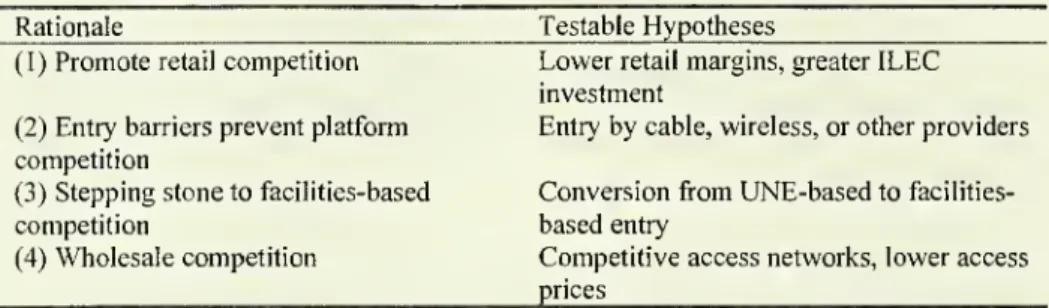
isdesirable. Fortunately, thereistestablehypothesisassociatedwitheachrationale.
Table 1
shows
thefourrationalesandtheirassociatedtestablehypotheses.82. Ibid, at 1 7 n. 12 (quoting Promotion of Competitive Networks in Local
Telecommunications Markets, Notice of ProposedRulemakingand Notice ofInquiryin
WT
Dkt.No.99-217 and Third Further Notice of ProposedRulemakingin
CC
Dkt.No.96-98,FCC
99-141,Iffl4,23(rel.7 July 1999)).
83. See,e.g.,J.GregorySidak,'TheFailureofGoodIntentions:TheWorldComFraudandthe
CollapseofAmericanTelecommunicationsAfter Deregulation',20 YaleJ.Reg.207 (2003) (showing
thattheaverage
FCC
appropriations increasedfrom $158.8million per yearin 1981-1995to$211.620
Hausman
and SidakTable 1: Rationalesfor
Mandatory Unbundling and
AssociatedHypotheses
Rationale TestableHypotheses
(1)Promoteretailcompetition
Lower
retailmargins,greaterILEC
investment(2)Entrybarrierspreventplatform Entrybycable,wireless,orotherproviders
competition
(3)Steppingstonetofacilities-based Conversionfrom
UNE-based
tofacilities-competition basedentry
(4)Wholesale competition Competitiveaccessnetworks,loweraccess
prices
Ifcompetition
among
CLECs
is robust (rationale 1 ), thenCLEC
margins shoulddisappear
and
consumers
should enjoy lower retail prices. Ifmandatory
unbundling is truly necessary for retail competition (rationale 2), then entry
barriers should prevent any firm
from
constructing arival platform. Ifmandatory
unbundling is a stepping stoneto facilities-based investment (rationale3), then
we
should observeindividual
CLECs
transitioningfrom
UNE-based
to facilities-basedapproaches over time. Finally, if
mandatory
unbundling promotes wholesale competition(rationale4), thenwe
should observefacilities-basedCLECs
acting aswholesalers of
network
elements. In the next section,we
use this analyticalframework
to assess theunbundling experience in fiveseparate countries.Because
mandatory
unbundling isarelatively recentphenomenon
inthe countriessurveyed,we
donotexamine
empirically whetherregulatorywithdrawalhas occurred.III.
The
Unbundling
Experience inFive CountriesThe
previous section consideredhow
mandatory
unbundling shouldwork
intheory.
With
the benefit of several years of experience,we
turnnow
to anevaluation ofthe extent to
which
the rationales formandatory
unbundlingwere
substantiated inpractice.
We
focus on the unbundling experience in the UnitedStates, the United
Kingdom,
New
Zealand, Canada, andGermany.
For eachcountry,
we
examine
whether any ofthe four primary rationales formandatory
unbundling at
TELRIC
was
substantiated in practice.We
relyon
datafrom
therelevantregulatoryagencythat
implemented
the unbundlingregime. Forexample,we
discusswhy
regulators inNew
Zealand did not adoptmandatory
unbundling.Each
section concludes with a review ofthe state offacilities-based competitionforlocaltelephone serviceasofearly2004.
In compilingthe country surveys,
we
observed a large variation inthe degreeto
which
economic
analysis informed the regulator's decision-making process. IntheUnited States, forexample, theprocess
was
informed by legal interpretationof
specific language (such asthe
meaning
of'impaired') orby engineering measuresof hypothetical operating costs. In
New
Zealand,by
contrast, the processwas
informed largely by
economic
analysis andby
international experience withmandatory
unbundling.Using
economic
methods, theNew
Zealand regulatorliterally assigned netwelfare gains toeach regulatory option and selected thepath
with the greatest net welfare gain.
To
be fair,New
Zealand had the benefit ofstudyingthe experienceofother nationsbeforeitdecidedontheoptimal regulatory
November
2004 DidMandatory Unbundling AchieveItsPurpose? 21despite the fact that the United States
now
hasmore
than six years of unbundlingexperience.
A.
United
StatesThe
Telecommunications
Act of 1996 ordered theFCC
to introduce competitioninto the local services market by forcing
ILECs
to provide entrants access to theILECs'
existing facilities at regulated rates. In 1999, theFCC
explained thatCongressdid notprovidetheagency
much
flexibilityintheexact form ofmanaged
competition: 'Congress directed the
Commission
toimplement
the provisions ofsection 251, and to specifically determine
which
network elements should beunbundled
pursuant to section 251(c)(3).7'84 Hence, theFCC
did nothave
thediscretionto rejector
embrace any
oftherationales formandatory
unbundling.The
only decisions left to the
FCC
concerned the extent ofmandatory
unbundling—
namely,
which
elementswould
be included inthe listofUNEs
and
theappropriatepricingofthose elements.
1. RetailCompetition
In this section,
we
review the unbundling experience in the United States withrespecttoretailpricingandinvestment.
a. Pricing
Retail competition triggered
by
mandatory
unbundling should manifest itself interms of lower retail prices.
Even
if price regulation of local servicesby
statePUCs
were
binding, the introduction ofUNE-based
competitioncould still reduceprice. In the United States, however,
mandatory
unbundling does not appear tohave decreased local service prices measurably
—
despite the fact thatCLECs
had
more
than 13 percent ofthe nation's access linesby
2003. Figure 3shows
theBureau
ofLabor
Statistics'(BLS)
Consumer
Price Index for local telephoneservices