Publisher’s version / Version de l'éditeur:
Canadian Acoustics / Acoustique Canadienne, 30, September 3, pp. 34-35,
2002-10-09
READ THESE TERMS AND CONDITIONS CAREFULLY BEFORE USING THIS WEBSITE.
https://nrc-publications.canada.ca/eng/copyright
Vous avez des questions? Nous pouvons vous aider. Pour communiquer directement avec un auteur, consultez la
première page de la revue dans laquelle son article a été publié afin de trouver ses coordonnées. Si vous n’arrivez pas à les repérer, communiquez avec nous à [email protected].
Questions? Contact the NRC Publications Archive team at
[email protected]. If you wish to email the authors directly, please see the first page of the publication for their contact information.
NRC Publications Archive
Archives des publications du CNRC
This publication could be one of several versions: author’s original, accepted manuscript or the publisher’s version. / La version de cette publication peut être l’une des suivantes : la version prépublication de l’auteur, la version acceptée du manuscrit ou la version de l’éditeur.
Access and use of this website and the material on it are subject to the Terms and Conditions set forth at
Using floor toppings to control flanking transmission
Nightingale, T. R. T.; Halliwell, R. E.; Quirt, J. D.
https://publications-cnrc.canada.ca/fra/droits
L’accès à ce site Web et l’utilisation de son contenu sont assujettis aux conditions présentées dans le site LISEZ CES CONDITIONS ATTENTIVEMENT AVANT D’UTILISER CE SITE WEB.
NRC Publications Record / Notice d'Archives des publications de CNRC:
https://nrc-publications.canada.ca/eng/view/object/?id=bf0e656e-5a54-43b3-8ae5-eb109485e7ef https://publications-cnrc.canada.ca/fra/voir/objet/?id=bf0e656e-5a54-43b3-8ae5-eb109485e7ef
Using floor toppings to control flanking transmission
Nightingale, T.R.T.; Halliwell, R.E.; Quirt, J.D.
A version of this document is published in / Une version de ce document se trouve dans : Canadian Acoustical Association Meeting, Charlottetown, P.E.I., Oct. 9-11, 2002, pp. 1-2
www.nrc.ca/irc/ircpubs
NRCC-45724
U
SING
F
LOOR
T
OPPINGS TO
C
ONTROL
F
LANKING
T
RANSMISSION
T.R.T. Nightingale, R.E. Halliwell, J.D. QuirtNational Research Council Canada, Institute for Research in Construction, Ottawa, Ontario, K1A 0R6 Canada
1. INTRODUCTION
The change in flanking sound insulation due to adding a floor topping is shown to be different for paths where energy propagates perpendicular to the joists, compared to those where energy propagates parallel to the joists. This paper summarises results presented elsewhere [1,2]. Floor vibration mappings reveal that a topping will change not only the power injected but also the propagation losses across the floor. The most effective toppings reduce input power and increase propagation losses relative to the bare floor. One type of topping exhibits significant improvement in the flanking sound insulation in one direction and a significant worsening in the other.
2. EVALUATION METHOD
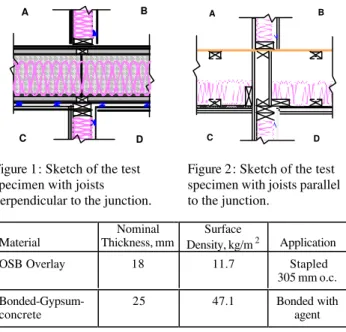
The magnitude of changes to the impact sound insulation for room pairs AB and AC are compared to show that in general the improvement for direct transmission will not match that for flanking transmission involving the floor surface. The change in impact sound insulation between room pair AB is examined for each of the toppings with the joists parallel to the junction (Figure 2), and perpendicular (Figure 1). The improvement for floor flanking paths can be strongly dependent on joist orientation.
A B
C D
A B
C D
Figure 1: Sketch of the test specimen with joists perpendicular to the junction.
Figure 2: Sketch of the test specimen with joists parallel to the junction. Material Nominal Thickness, mm Surface Density, kg/m2 Application
OSB Overlay 18 11.7 Stapled
305 mm o.c.
Bonded-Gypsum-concrete
25 47.1 Bonded with
agent
Table 1: Properties of the topping layers.
The oriented strand board (OSB) overlay consisted of adding a second layer of the subfloor material; it did not
extend under the partition wall. The gypsum-concrete was applied in place, allowing bonding to all surfaces contacted including the gypsum board of walls in rooms A and B. Procedures of ASTM E1007 were followed, although measurements between rooms A and B are nominally outside the scope. Normalised impact sound pressure levels (NISPL) were measured with the ISO hammer box located at the same four positions near the center of the floor in room A. The hammers impart power only into the floor surface, which is involved in all transmission paths to rooms B and C. Hence, the change in NISPL measured in rooms B and C with and without a topping indicates how well the topping controls flanking and direct transmission of impact sound.
3. DIRECT
VSFLANKING TRANSMISSION
Since the NISPL for room pair AC is controlled by direct transmission, the change in AC sound insulation can be compared to the change for AB, to assess the effectiveness of a topping to control direct and flanking transmission, respectively. Each topping was applied to the constructions of Figure 1 and Figure 2 to determine if orientation of the joists is an important factor.
Fastened 18mm OSB topping
-16 -14 -12 -10 -8 -6 -4 -2 0 2 4 6 8 63 125 250 500 1k 2k 4k Frequency, Hz
Change in Impact Sound Pressure Level,
dB
AC
Joists perpendicular to junction
AB
Joists perpendicular to junction AB
Joists parallel to junction AC
Joists parallel to junction
Improving Impact Sound Insulation
A B
C D
Figure 3: Change in NISPL due to 18 mm OSB overlay, as a function of the orientation of the joists shown in Figure 1 and 2.
Figure 3 shows the change in the receiver room NISPL due adding an 18 mm OSB overlay. It shows that the overlay reduced the NISPL (improved sound insulation) for both direct and flanking transmission. For frequencies above 200 Hz, regardless of the orientation of the joists, there is a greater reduction in NISPL for room pair AB than for AC. The overlay controls direct transmission less effectively than flanking transmission involving the floor surface. With the OSB overlay, the improvement for flanking transmission is not very sensitive to the orientation of the joists.
Figure 4 shows that for both direct and flanking transmission, adding the gypsum-concrete topping without an interlayer will increase the NISPL relative to the bare floor in the high frequencies. The most important feature however is the relation of the curves. In the frequency range 160–2000 Hz with the joists perpendicular to the junction, Figure 4 shows the topping attenuates floor flanking paths more than direct transmission though the floor. The opposite is true when the joists are parallel to the junction, since in the frequency range 400–2000 Hz the topping is better at controlling direct transmission than flanking transmission.
Bonded 25mm gypsum-concrete topping
-25 -20 -15 -10 -5 0 5 10 15 20 63 125 250 500 1k 2k 4k Frequency, Hz
Change in Impact Sound Pressure Level,
dB
AC
Joists perpendicular to junction A B
Joists perpendicular to junction A B
Joists parallel to junction AC
Joists parallel to junction
Decreasing Impact Sound Insulation
A B
C D
Figure 4: Change in NISPL due to applying bonded 25 mm gypsum-concrete topping as a function of joist orientation.
Changes in NISPL will differ because adding a topping changes not only power injected by the ISO hammer box, but also the propagation losses in the floor surface. Changing injected power should affect direct and flanking transmission similarly. However, for the highly-damped floors considered here, changes to propagation losses will affect flanking transmission more than direct transmission, because propagation determines the incident structural power at the flanking junction.
85 95 105 115 125 135 145 0 1 2 3 4 5 6 7 8
Distance from ISO Hammer Box, m
Surface Velocity, dB (arb)
Room A
No Topping Joists parallel to junction
No Topping
Joists perpendicular to junction
18mm OSB Overlay Joists parallel to junction
18mm OSB Overlay Joists perpendicular to junction
Room B junction
Figure 5: Surface vibration levels at 1 kHz measured along two orthogonal lines from the source with/without the OSB overlay.
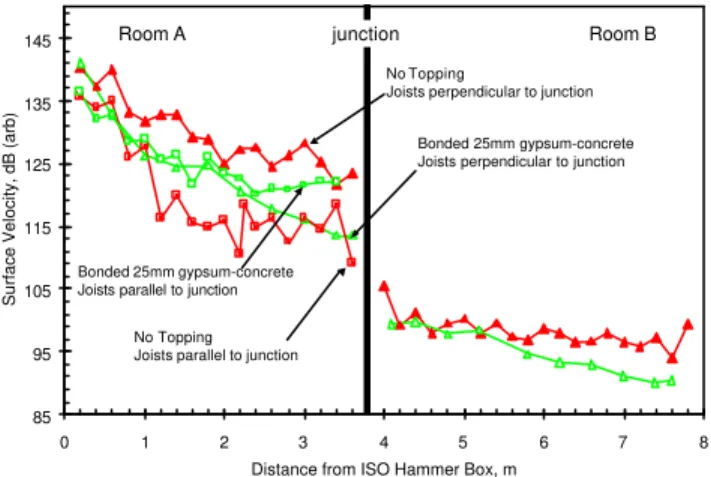
Estimates of the change in propagation losses can be obtained from velocity levels measured along two orthogonal lines from the source. One line is parallel to the joist orientation, while the other is perpendicular. Results
for the bare floor and the 18 mm OSB overlay, in Figure 5, indicate that for both joist orientations, the topping increased propagation losses in the exposed surface (i.e., there is a greater level difference between source and junction with the topping than without).
Figure 6 shows that adding the bonded gypsum-concrete topping applied to the same bare floor increases propagation losses when the joists are perpendicular to the junction. Here the vibration energy propagates parallel to the joists to reach the junction. The opposite is true when the joists are parallel to the junction, since to reach the junction, vibration energy must propagate perpendicular to the joists. Thus, the bonded topping is less effective when applied to flanking paths where the joists are parallel to the junction. This is consistent with the trends in the impact sound pressure levels shown in Figure 4.
85 95 105 115 125 135 145 0 1 2 3 4 5 6 7 8
Distance from ISO Hammer Box, m
Surface Velocity, dB (arb)
Room A
No Topping Joists parallel to junction
No Topping
Joists perpendicular to junction
Bonded 25mm gypsum-concrete Joists parallel to junction
Bonded 25mm gypsum-concrete Joists perpendicular to junction
Room B junction
Figure 6: Surface vibration levels at 1 kHz measured along two orthogonal lines from the source with/without gypsum-concrete.
4. CONCLUSIONS AND REFERENCES
Vibration maps indicate that adding a topping my increase or decrease propagation losses across the floor relative to the bare floor. The change in propagation loss was shown to be a function of the type of topping and the orientation of the joists in the floor to which it was applied. A topping that increases propagation losses relative to the bare floor will be more effective in controlling flanking transmission than direct transmission. The important implication is impact sound insulation improvements due to adding a topping when there is no appreciable flanking (i.e., using ASTM E492) should not be generalised to situations where flanking transmission across the floor surface is important.
1. R.E. Halliwell, J.D. Quirt, T.R.T. Nightingale, “Construction details affecting flanking transmission in wood framed multifamily dwellings,” Proceedings INTERNOISE 2002 2. T.R.T. Nightingale, R.E. Halliwell, J.D. Quirt, “Vibration
response of floors and the effectiveness of toppings to control flanking transmission”, INTERNOISE 2002
This work was supported by a consortium that included Canada Mortgage and Housing, Forintek Canada, Marriott International, Owens Corning, Trus Joist, and USG.