OCUMET OFFICE 9
EZJNT ROOM 36-412
ZSERCE LABORATORY OF ELECTRONICS
SSACHUSETTS INSTITUTE OF TECNOLOGY
I
AN ALGORITHM FOR SEGMENT DURATIONS
IN A READING MACHINE CONTEXT
THOMAS P. BARNWELL
III
LoRN
TECHNICAL REPORT 479
JANUARY 15, 1971
MASSACHUSETTS INSTITUTE OF TECHNOLOGY
RESEARCH LABORATORY OF ELECTRONICS
CAMBRIDGE, MASSACHUSETTS 02139
iI
The Research Laboratory of Electronics is an interdepartmental laboratory in which faculty members and graduate students from numerous academic departments conduct research.
The research reported is this document was made possible in part by support extended the Massachusetts Institute of Tech-nology, Research Laboratory of Electronics, by the JOINT SER-VICES ELECTRONICS PROGRAMS (U. S. Army, U. S. Navy, and U. S. Air Force) under Contract No. DA 28-043-AMC-02536 (E), and by the National Institutes of Health (Grants 5 PO1 GM15006-03 and GM14940-04).
Requestors having DOD contracts or grants should apply for copies of technical reports to the Defense Documentation Center, Cameron Station, Alexandria, Virginia 22314; all others should apply to the Clearinghouse for Federal Scientific and Technical Information, Sills Building, 5285 Port Royal Road, Springfield, Virginia 22151.
THIS DOCUMENT HAS BEEN APPROVED FOR PUBLIC RELEASE AND SALE; ITS DISTRIBUTION IS UNLIMITED.
MASSACHUSETTS INSTITUTE OF TECHNOLOGY
RESEARCH LABORATORY OF ELECTRONICS
Technical Report 479
January 15, 1971
AN ALGORITHM FOR SEGMENT DURATIONS
IN A READING MACHINE CONTEXT
Thomas P. Barnwell III
Submitted to the Department of Electrical
Engineering at the Massachusetts Institute
of Technology in August 1970 in partial
ful-fillment of the requirements for the degree
of Doctor of Philosophy.
(Manuscript received August 27, 1970)
THIS DOCUMENT HAS BEEN APPROVED FOR PUBLIC
RELEASE AND SALE; ITS DISTRIBUTION IS UNLIMITED.
Abstract
The purpose of this study was to devise an algorithm for the acceptable control of
segment durations in a reading machine.
The general experimental method was as
fol-lows: Subjects were asked to read lists of words and phrases from 3 X 5 cards.
The
results were recorded, and narrow-band and broadband spectrograms were produced
for each utterance with the use of a Kay sonograph.
By using segmentation rules, the
duration of each segment in each utterance was measured and tabulated.
From these
data, a model was devised which sought to predict the experimental results for each
subject individually.
Several interesting results were obtained from these studies.
First, it was
dis-covered that the duration of a vowel could be modeled as a function of the word-level
stress of the syllable in which the vowel appeared, the structural location of the word
in which the vowel appeared, the number of syllables in the word, the consonant
con-text of the vowel, the vowel's location in the phrase, and the proximity of any word or
syllable juncture.
Second, it was shown that, in general, consonants outside of
clus-ters do not vary much in duration.
Third, consonant durations could be shown to vary
greatly in clusters.
In general, no results were available for the behavior of liquids
or glides.
TABLE OF CONTENTS
I.
INTRODUCTION
1
II.
INTENSITY AS AN ACOUSTIC CORRELATE OF STRESS
4
III.
DURATION AS AN ACOUSTIC CORRELATE OF STRESS
8
IV.
FUNDAMENTAL FREQUENCY AS AN ACOUSTIC
CORRELATE OF STRESS
12
V.
ACOUSTIC CORRELATES OF INTONATION
18
VI.
INITIAL BIAS AND EXPERIMENTAL CONSTRAINTS
23
VII.
AN INITIAL EXPERIMENT WITH MULTISYLLABLE WORDS
27
VIII.
VOWEL DURATIONS IN SINGLE-SYLLABLE WORDS
31
IX.
AN INITIAL MODEL FOR SINGLE-SYLLABLE WORDS
37
X.
AN EVALUATION OF THE INITIAL MODEL
40
XI.
MULTISYLLABLE WORDS IN ISOLATION
44
XII.
THE QUESTION OF SYLLABLES
48
XIII.
STRESSED SYLLABLES IN MULTISYLLABLE WORDS
60
13. 1 Multisyllable Words in Isolation
60
13. 2 Independence of Structural Transforms
61
13. 3 Effect of Structure on Multisyllable Words
62
13. 4 An Over-all Model
64
XIV.
UNSTRESSED VOWELS IN MULTISYLLABLE WORDS
69
14. 1 Durational Model for /a/
69
14. 2 Durational Model for Other Unstressed Vowels
72
XV.
CONSONANT DURATIONS
75
XVI.
RESULTS OF ADDITIONAL STUDIES
78
16. 1 Extension of Structural Capabilities
78
16. 2 Liquids and Consonant Clusters
81
iii
CONTENTS
XVII. DISCUSSION AND CONCLUSIONS
85
17. 1 Fundamental Frequency
85
17. 2 Shortcomings of the Durational Model
85
17. 2. 1 Problems of Structure
85
17. 2. 2 Problem of Open Syllables
86
17. 2.3 Problems with Consonants
86
17. 2. 4 Expansion for Dipthongs, Liquids, and Glides
87
17.-3 Final Observations
87
APPENDIX A
Speech Synthesizer Hardware
89
APPENDIX B
The Stress Cycle
90
APPENDIX C
Rules for Segmenting the Acoustic Signal
93
APPENDIX D Input Word Lists
96
APPENDIX E
A Model Flow Chart
107
Acknowledgment
113
References
114
iv
I. INTRODUCTION
For several years, a reading machine, called the Foundation Reading Machine (FRM),
has been under development in the Cognitive Information Processing Group of the
Research Laboratories of Electronics. In its completed form, this machine would be
expected to take printed text as input, and give the spoken English equivalent of that
text as output.
The FRM is intended mainly as a research tool for the future
develop-ment of reading machines that would be cheap enough and effective enough to be supplied
to libraries as sensory aids for the blind.
With such machines the blind person would
have at his disposal an efficient method for obtaining a great deal of information that
is not now directly available to him.
A simple block diagram of the current operation of the FRM system is shown in Fig. 1.
On the far left are shown the scanner hardware and the character-recognition routines
that are used to obtain a copy of the input text for further processing.
The
character-recognition routines have been designed to be as independent as possible of the input
font, thereby giving a great deal of latitude to choice of texts.
Fig. 1. FRM hardware and software configuration.
Next is shown the grapheme-to-phoneme conversion routine. 2 This routine is designed to accept a copy of the printed text as input and to produce as output the associated pho-nemic string, complete with word boundaries and word-level stress markings. This routine works basically by stripping off the prefixes and suffixes of the input words and looking up the root words in a morph dictionary. The dictionary entry for each morph
contains the phonemic information, the word-level stress information, and certain parts of speech information.
1
Following the grapheme-to-phoneme routine the syntactic analysis program
3is
shown.
This program takes the parts of speech information and the word information
and attempts to deduce some of the sentence's surface structure.
In particular, this
program attempts to identify noun phrases and prepositional phrases, leaving the other
sentence elements as unbracketed constituents.
Once the phrases are identified, stress
levels are assigned to the various words using essentially the Halle-Chomsky
stress
rules (see Appendix B).
Now the phonemic information and the stress information is passed on to the prosodic
program, which uses this information to control the output speech's fundamental
fre-quency contour and, to a limited extent, its duration.
7This particular prosodic
program is, at present, fairly primitive, and represents one of the weak links in the
FRM.
Once the fundamental frequency contour is specified, the phonemic information is
passed on to the speech synthesis program.
5 '6 This program
7transforms the phonemic
information into output parameters which control a parallel terminal analog speech
syn-thesizer
6(see Appendix A).
The synthesizer, whose parameters are updated every
10 ms, then produces the output speech waveform. All of these routines are now
pro-grammed on a PDP-9 computer, and share the time of that machine through a
pri-ority interrupt system.
Because of this, the computer's time can be used quite
efficiently, and the whole system is capable of working in something approaching real
time.
The main point in trying to produce a reading machine of the FRM type is to try to
develop a machine that seeks sufficiency at a reasonable cost. Hence the machine should
not only accept a large set of varied inputs, have a fairly extensive vocabulary, and
pro-duce intelligible speech, but it should also do all of these things with the use of programs
requiring only a reasonable amount of computer storage and have running times
com-patible with real-time speech outputs.
This is very difficult to do, and algorithms
designed to work with the FRM must seek to include, at least at first, only those
ele-ments that are necessary for sufficiency.
For these reasons, the current system only
utilizes a limited parsing scheme. Likewise, present work is now in progress which
would augment the grapheme-to-phoneme conversion routine with direct letter-to-sound
(phoneme) correspondence rules, which, we hope, will permit handling a large
vocab-ulary with only a small increase in the size of the morph dictionary.
Nevertheless, minimum sufficiency arguments in the design of a reading machine
can be misleading.
For example, one might argue that if the output speech were
intel-ligible, then this should be sufficient.
This, unfortunately, is not the case, for though
the current speech output of the FRM can be argued to be intelligible, it definitely would
not be acceptable in a finished reading machine.
This is because the speech quality is
such that a subject listening to the output speech must work very hard to understand what
is being said.
Such a subject finds the speech difficult and confusing, and therefore finds
the task of listening to the FRM for an extended period of time very unpleasant.
Such
a situation is clearly not acceptable in a reading machine.
This problem probably arises for several reasons.
First, certainly, the phonemic
synthesis routines have never been perfected, and mistakes are made in the assignment
of the synthesizer control parameters.
Work is now progressing on the improvement
of the individual phonemes.
Likewise, the current synthesizer hardware (Appendix A)
is not capable of correctly producing certain speech sounds, in particular, most of the
fricatives.
This problem can only be solved by the modification of the terminal analog
synthesizer.
Although these are serious problems, they are probably not the most difficult. The
main problem probably arises because a listener expects a great number of often
redun-dant cues to occur in speech.
These cues not only include the segmental information,
but also information concerning stress, structure, and speaker attitude.
If these cues
are not present, or if they are incorrect, the perceived naturalness of the speech is
greatly affected, even though the listener may not need the information that the cues
are supplying.
Hence, the listener finds the speech strange, probably confusing, and
definitely unpleasant to try to understand.
To summarize the situation, it can be said that the FRM makes many errors in
seg-mental synthesis, and these should definitely be improved.
Errors of considerably
larger magnitude are made in the acoustic correlates of the supersegmental features,
however; in particular, such features as the segment durations, the fundamental
fre-quency contours, and the occurrence of pauses.
Particularly lacking is the overly
sim-6
plified model for segment duration, which simply lengthens stressed vowels.
This is
a situation that not only detracts from the naturalness of the speech but also probably
transmits incorrect stress or intonational information to the users of the reading
machine.
There is
general agreement among researchers that fundamental frequency contours,
segment durations, and pauses are in some way related to stress and intonation.
Like-wise, there is a great deal of evidence that these acoustic correlates are also affected
by other features, such as
phonemic context and phrasal or sentence position. It
was
therefore the purpose of this report to attempt to find, by controlled studies of natural
speech, a reasonable model for the relationship between stress, intonation, and the other
relevant features and such output correlates as fundamental frequency, pauses, and,
particularly, segment duration.
The reason for this was both to transmit to the users
of the FRM the structural information available from the parser, and to try to increase
the naturalness of the speech. Before discussing in
detail the experiments that were
performed, we
shall address the question of what are the acoustic correlates of stress
and intonation, and
attempt to rank their relative power in perception.
3
-II. INTENSITY AS AN ACOUSTIC CORRELATE OF STRESS
Classically, stress or "syllable prominence" has been identified as the perceived
"loudness" or "force of utterance" of a stressed syllable relative to other syllables of
an utterance.
Hence it would not seem unreasonable to begin by asking if intensity is
indeed a relevant acoustic correlate of stress.
Two experimental studies, one done by
Fry, and one by Morton and Jassem,9 which bear directly on the question of intensity
as an acoustic correlate of stress, will be discussed in some detail. We hope that these
studies will illustrate that, though intensity can be considered an acoustic correlate for
stress, it is possibly not as powerful a correlate as several others.
In the experiments done by Fry,
8the question of the intensity acoustic correlate was
examined both from a production and a perception viewpoint.
In his first experiment,
Fry had 12 American speakers read sentences containing words of the "digest" or
"con-tract" type, or words that had two forms, either a verb form or a noun form, depending
on whether stress occurred on the first or second syllable.
He then analyzed these
utterances using a Kay sonograph, and measured the various intensity ratios and
dura-tions. The intensities that Fry measured were peak intensities occurring in each
syl-lable, and he noted that the peak intensity for each always occurred in the vowel segment
of the syllable.
A summary of the intensity data for two test words, "object" and
"contract," is given in Fig. 2.
The reason that the data appear to be linear is
because Fry brought the over-all intensity levels to the same value for all speakers.
Several things are immediately worth noting in these data.
First, for both test
words, the data appear to fall into two groups, in which, as would be suggested by
the classical hypothesis, the higher relative intensity corresponds to the stressed
syllable.
Second, a clear boundary exists between the two regions in the "object"
test word, but there is definitely some overlap in the case of "contract."
Third,
the regional crossover points, if estimated, are vastly different from one word to
the other.
This was a generally observed phenomenon, with the crossover points
varying from -3 dB to +3 dB (v
1/v
2).
The fact that intensity data fall into regions would certainly appear to indicate
that intensity is at least a semiconsistent acoustic correlate of stress.
The
uncer-tainty of the crossover points, however, coupled with the fact that listeners had no
trouble identifying the words correctly, indicates that intensity cannot be the sole cue
used in the perception of the stress of these words.
Furthermore, the fact that
the crossover points did not all occur close to 0 dB (vl/v
2) indicates that it is not
simply the louder syllable that is heard as stressed.
This might be explained by the
fact that some vowels are inherently more intense than others, due mainly to the
dif-ferent couplings observed between the glottal source and the vocal tract for various
con-figurations of the vocal tract. Hence, the perceiver might be reacting to vowel intensities
relative to a known norm, rather than directly to the relative intensity of the two vowels.
In order to examine the effects of intensity on the perception of stress, Fry
4
10
20
INTENSITY OF VOWEL 1 (dB)
INTENSITY OF VOWEL 1 (dB)
Fig. 2.
Results of Fry's intensity experiments for two words.
-10
o
o PERMIT
.---
_ OBJECT
---
DIGEST
*-@
SUBJECT
---- a
CONTRACT
0
INCREASING RATIO V1/V2 (dB)
INCREASING RATIO V1/V2 (dB)
Fig. 3. Results of Fry's perception experiments on intensity.
5
20
CN > ._ I-,z
I-z
10
0
0
10
20
0
VI.-z
LU o z z u(D
z
U LU a.100
80
60
40
20
0
I
I I
I I
-10
0
10
10
'x---^ ' -I---
=rR:--rI
I
I
I
synthesized the 5 test words (object, subject, digest, permit, and contract), while
sys-tematically varying both the intensity ratios of the two syllables and the durations
of the vowels in each syllable.
The intensity ratios were -10, -5, 0, 5, and 10 dB
which, in most cases, covered the observed range of values in the first experiment. The
relative durations of the two syllables were also varied, where, in each case, the
observed range in the production experiment was divided into 5 representative parts.
Thus, a total of 25 synthesized words was recorded for each test word, and the resulting
tapes were played to subjects. Each subject was asked to identify the word that he heard
as either a noun or a verb. Hence, a 5 X 5 matrix of results was formed, the columns
showing the effect of varying intensity and the rows showing the effect of varying
dura-tion. Then, to examine the effects of intensity alone, an average was taken over the
rows.
The results for the entire test and the results for each test word individually are
shown in Fig. 3.
These tests should show to what extent, if any, the acoustic correlate of intensity is
used in the perception of stress. There are three points that should be made here. First,
as the intensity ratios increase, so does the percentage of noun judgments.
From this
it is fairly clear that intensity is indeed an acoustic cue in the perception of stress.
Second, the variation caused by the chosen intensity ratios was only 29%.
Hence, it
might be argued that though intensity seems to be a cue, by itself it is not enough to
cover the entire range.
In other words, in normal perception, other cues besides
inten-sity must also be used. Third, note that, in all cases, there is a slight bias toward
the "noun" judgment, i. e., stress on the first syllable.
This agrees with
observa-tions by Bolinger ° that in words of this type produced with a monotone, as was
the case here, there is a slight tendency to hear the first syllable as stressed.
A much more recent paper by Morton and Jassem
9has also sought to examine the
role of intensity (along with fundamental frequency and duration) in the perception of
stress. The methodology used in this experiment is in some ways considerably better
than that used by Fry.
First, in order that their results might not be biased by
"qual-ity," or the "intrinsically" higher intensities of some vowels, Morton and Jassem used
test words in which the two syllables were identical.
Second, so as not to produce
results limited to one vowel, they further decided to use 3 separate test words utilizing
3 separate vowels for all experiments.
The 3 test words chosen were /sisi/, /soso/,
and /s os /, and these were synthesized and recorded with systematic variations in
intensity, fundamental frequency, and duration. The variations used in the intensity
experiments were -9, -6, and -3 dB from the equal-intensity norm. The prepared tapes
were then played to 60 subjects (3 X 60 = 180 responses), each of which was asked if the
"word" he just heard had stress on the first syllable, stress on the second syllable, or
if he could not determine which.
"Difference numbers" were then calculated such that
D = number of stress on first syllable - number of stress on second syllable.
It was
noted that no substantial differences occurred because of the use of different vowels,
and that the difference numbers for the control tests were -3, 0, -3, 4, 1, and 1,
(i. e. , unsignificant).
The results for the intensity variation tests alone are shown in
Table 1.
It can be seen that the results of this more careful test pretty well agree with the
results of Fry, at least qualitatively.
First, intensity appears to be a consistent cue
Table 1. Results of Morton and Jassem's intensity experiments.
(180 responses.)
EFFECTS ATTRIBUTABLE TO INTENSITY ALONE - D SERIES
Intensity Ratios (dB)
-9
-6
-3
IN
-37
-17
-4
NI
62
47
1
I = INTENSITY VARIED
N = NORMAL INTENSITY (0 dB)
D = NUMBER OF SUBJECTS WHO CHOSE STRESS ON THE FIRST
SYLLABLE MINUS THE NUMBER OF SUBJECTS WHO CHOSE
STRESS ON THE SECOND SYLLABLE.
for stress, but, in addition, appears to be fairly weak. Here, as before, the tendency
to choose the first syllable as stressed in a monotone situation can also be seen.
Fur-thermore, note that intensity variation of -3 dB appears to have no significant effect on
the results.
So, by way of a summary, the following can be said about the role intensity plays
in the production and perception of stress.
Studies have shown that increased intensity
is definitely an acoustic correlate of stress. Strong evidence indicates, however, that
intensity cannot be the only acoustic correlate of stress, and must, in general, act in
conjunction with other correlates.
7
III.
DURATION AS AN ACOUSTIC CORRELATE OF STRESS
It is well known that vowel durations in English (see Appendix C) vary considerably as a function of context. For example, Peterson and Lehistell and Housel2 have shown
13
that, in general, vowels are longer before voiced consonants. Likewise, Denes showed experimentally that changing vowel durations can influence the perception of the following consonant as voiced or unvoiced. Mattingly5 also presents a model for duration which suggests that segment durations are longer before a pause. So it is clear that segment durations vary noticeably as a function of many things other than stress. Do vowel dura-tions, or, for that matter, consonant duradura-tions, vary in a stressed or unstressed con-text? If they do vary, are they perceived acoustic correlates of stress, and, if so, how
does duration as an acoustic correlate of stress rank with intensity? These are ques-tions that will be discussed with regard to the current literature.
The work of Fry ' and of Morton and Jassem9 has shed some additional light on these questions. Fry, in his production experiments, measured the durations of the two syllables in his test words for both noun and verb stress patterns. He observed, in each case, that only the vowel durations varied measurably. The results of those measure-ments for the test words "object" and "contract" are shown in Fig. 4. In the case of "object," two distinct groupings are evident, with the (relatively) longer syllable being the one receiving stress. A similar, but less clear-cut grouping is seen for "contract."
With the same reservations expressed here as for intensity, it would appear that an increase in duration is indeed a positive acoustic correlate of stress.
But what about the relative strength of the two cues, intensity and duration? The production experiments of both Fry8 and Jassem and Morton9 are relevant to this ques-tion. In Fry's production experiment, as discussed in Section II. both duration and intensity were varied in synthesized test words to get a 5 X 5 matrix of average subject response percentages. Now, in order to determine the effect of duration independent of intensity, Fry averaged his results over the intensities. His results are plotted in Fig. 5.
Likewise, Morton and Jassem varied their vowel durations, both independent of inten-sity variations, and concurrent with changes in inteninten-sity. The changes in duration for each vowel were taken to be +40%, +20%, -20%, and -40%. The results of these experi-ments are shown in Table 2. (Note that since the previous experiment showed that changes of -3 dB gave insignificant results, these changes are not included in Table 2.)
Two things are immediately evident from Fry's data. First, changes in duration appear definitely to influence the perception of stress, and second, the influence of dura-tion ratios, as shown by a response variadura-tion of 70%, seems to be somewhat greater than that of the intensity ratios. It is unfortunate that Fry does not present the data of
his unaveraged matrix, since there is no way of telling from the results that he pre-sented the particular effects of intensity and duration reinforcement and opposition,
Such is not the case with Morton and Jassem, but there does appear to be a definite
- 0 00
cP
oxx
x
X XX=OBject
x
x
X
o =obJECT
I
I
I
I
0.20
o c°
0 XK- KEY
0
0.10
O 0 0 -o o0 0 0 0 x X O xXX
X X
x X XX
-
KEY
0
x = CONtract
o =conTRACT
0.10
DURATION OF VOWEL 1
DURATION OF VOWEL 2
Fig. 4.
Results of Fry's duration experiments for two test words.
100
80
60
40
20
0
ON
;ITY
I
I
I I
2
O
BJECT
SUBJECT
DIGEST
PERMIT
CON TRACT
I
I
4
I
I
2
4
INCREASING RATIO V1/V2
INCREASING DURATION
RATIO V1/V2
Fig. 5.
Results of Fry's combined. duration and intensity experiments.
9
(N -... U0
LL0
z
0
0 ZD n0.20
0.10
0
0.20
i-Ln o LU0
0
ZD
z
O
z
U-LU I-Z, U LU 0l - -0 -0 "-Om
i
i
I
I--I ---__-·IIIULI··- I ___I
I
I
I
_
ITable 2. Results of Morton and Jassem's combined duration and intensity experiments.
D SCORES FOR STIMULI INVOLVING INTENSITY AND DURATION
Duration Changes Intensity Changes
-9N
-6N
N40
Q1
-84
-103
N20
-60
-79
0 N-20 N-40 Duration Changes -40N -20N 0 -37 -17 Q3 -39 -23 -22 70
-90
6
0
2
9
N-6
N-9
1
-10
Q
6
36
47 62 20 60 Q 44 49Intensity Changes
-9N
-6N
Q5
15
2
-44
-30
-37
-17
20N Q7 -60 -37 40N 27 380
8O
O
12 43N-6
N-9
-12
69
Q
11
41
47
62
53 62 Q8 54 90N = NORMAL (NO CHANGE).
D = NUMBER OF STRESS ON THE FIRST-SYLLABLE RESPONSES MINUS
NUMBER OF STRESS ON THE SECOND-SYLLABLE RESPONSES.
problem inasmuch as the -40% stimulus appears to be abnormal.
This point will be
ignored for the present, and considered later.
If we ignore the -40% stimulus and observe the case of no change in intensity, it
would appear that the +40% stimulus gives the expected results, namely, an increase
in the number of times it is considered stressed, but that all of the other results
seem biased toward stress on the first syllable.
This may be due to the effect
pre-viously discussed, in which the first syllable in a two-syllable utterance appears to be
preferred in a monotone environment. The results on the zero intensity change axis are
more clear-cut, however. First, in regions where the two factors operate in the same
direction, they clearly reinforce each other (Q
'
1Q
4' Q
5,
and QS).
Second, in regions
where the factors operate in opposing directions, a +40% change in duration is about
equivalent to, or outweighs, a -9 dB or -6 dB change in intensity.
Likewise, +20%
changes in duration are generally outweighed by either a -9 dB or a -6 dB change in
intensity. The data therefore present some quantitative idea of the equivalence of
dura-tion and intensity in opposidura-tion.
10
.
The problem introduced by the -40% change in duration is not so much one of opposi-tion to expected results as it is one of significance. Very few of the results obtained with the -40% change, in fact, are significant. Morton and Jassem hypothesized that,
for some unknown reason, some individuals in their test group showed a definite pref-erence for the shorter syllable where the -40% change occurred. This hypothesis was checked, and we found that of the 17 subjects checked, 9 preferred the longer syllable when a -40% change occurred, and 8 preferred the shorter. This result was very sig-nificant, but no reason for these individual preferences was obvious.
So, it can be stated that according to the data available, durational changes in the vowel segment of syllables represents a definite acoustic correlation for stress which
is as strong as, or stronger than, that of intensity. Furthermore, the available evidence indicates that where these two factors act in the same direction, they tend to reinforce each other.
11
111_ ___
__
I
IV. FUNDAMENTAL FREQUENCY AS AN ACOUSTIC CORRELATE OF STRESS
Traditionally, many observers have considered fundamental frequency, which
here-after will be called Fo, to be in no way related to the production or perception of stress.
They believed that fundamental frequency was used solely in the perception of intonation,
and that stress was marked by "loudness" or "force."
Many recent studies in the field,
however, appear to indicate that these opinions were grossly in error.
In fact, it would
appear that the opposite is true, and that Fo may play the dominant role in the
percep-tion of stress.
If this is indeed true, many questions are left to be answered.
What characteristics
of the Fo contour are used by the listener in his perception of stress? Is it the
absolute level of Fo, the jumps, the slopes, or the inflections of Fo, or some
com-bination of these things that are perceived as stress ? What about whispered speech,
where no Fo is present, but stress can still be clearly perceived? How does Fo rate
in power with the other acoustic correlates? It is questions such as these that will be
explored here.
First, it is worth while to note that the human being is capable of distinguishing very
small variations in fundamental frequency.
Flanagan
observed, in 1958, that subjects
could perceive Fo changes as small as 0. 3 Hz in a synthetic vowel environment. Hence
the human being appears to be well equipped physically to at least perceive variations
in Fo.
The question of the effect of step changes in Fo was explored, in 1958, by Fry.14
His approach was to take one test word that had either a noun or a verb form depending
on the placement of stress, namely "subject," and to synthesize it by using various
step changes in fundamental frequency between the two syllables. Fry used 16 step sizes,
ranging from 5 Hz to 90 Hz, while working from a reference frequency of 97 Hz.
In
addition to his Fo changes, Fry incorporated into his test words the variations in
dura-tion used in his previous experiments on intensity and duradura-tion as acoustic cues.
This was to check the relative power of the duration and Fo cues in the perception
of stress in this context.
The synthesized test words were then recorded and played
to subjects who were asked to make a "noun" or 'verb" judgment.
The results of these experiments are shown graphically in Fig. 6.
Three points
are worth immediate attention.
First, only the direction and not the magnitude of the
Fo changes appeared to have any effect on the data.
Hence a downward jump of 5 Hz
was roughly equivalent to a downward jump of 90 Hz.
This same kind of "all or nothing"
effect was also recorded by Morton and Jassen9 in their work with step Fo changes.
Second, the range of responses which could be produced by variations in duration was
somewhat reduced in the presence of Fo changes.
Note that here the range of values
is 55% compared with 70% where no Fo changes occurred.
Hence, it would appear that
step changes in Fo have the effect of reducing the effects of durational changes. Third,
an average difference of approximately 30% is observable between the "step-up" and
12
STEP - DOWN
STEP- UP
Fig. 6.
Results of Fry's step changes in
fundamental frequency as a
func-tion of durafunc-tion changes.
4 RATIO V1/V2 CONTOUR A FREQUENCY PATTERNS 130 Hz 97 Hz 130 Hz
Fig. 7. Two types of fundamental fre-quency contours that are most effective in marking stress.
CONTOUR B
97 Hz
1nn
CONTOUR A
,, CONTOUR B
Fig. 8. Results of Fry's experiments using inflected fundamental fre-quency contours. I I I 13 100 80 60 40 20 I-I z D 0 o z Z LLJ I-0w 0 0 2 INCREASING z iL :3 z 0 I-z LU OZ 0. . 80 60 40 20 0 2 INCREASING 4 RATIO V1/V2 I I I I I_ I_ _ _ _ I Iv'
l
I
"step-down" curves. This indicates quite clearly that the syllable with the higher Fo value has a definite tendency to be considered as stressed.
Hence, it would appear that simple step changes in Fo represent a fairly effective acoustic correlate for marking perceived stress. But immediately, two questions appear. Is this the most effective way to mark a syllable as stressed for a perceiver? and Is this the way it is done in real speech?
Light was shed on this first question by Fry's further work in the same study. In order to examine the effect of inflected Fo changes, as well as simple step changes, Fry again recorded the "subject" test word with its durational variations, but this time he used a group of inflected Fo changes. All Fo contours varied between 97 Hz and 130 Hz, and subjects were again asked to make the "noun"-"verb" decisions, this time in order to ascertain which type of Fo change was most effective in communicating stress. The two contours that Fry found to be most effective are shown in Fig. 7 and the results of the duration tests using these two contours are shown graphically in Fig. 8.
Looking at Fig. 8, we can see that the effects observed for simple step changes can also be seen, only greatly multiplied. The effect of these inflected changes in Fo is to reduce the effectiveness of durational changes to a mere 35%. Likewise, it can be seen that the effect of duration cannot bring the percentage of noun judgments below 50% in the case of contour A or above 50% in the case of contour B. Hence, it would appear that a properly inflected Fo contour is capable of practically swamping the effects of duration, and this would mark such a contour as a very strong acoustical correlate of
stress.
Fo contours of the type shown in Fig. 7a were subsequently used, in conjunction with variations in vowel durations, by Mattingly5 in an algorithm for the production of
pro-sodic features for synthesized speech. A stressed syllable nucleus was marked by a jump in Fo, followed by a sharp downward slope determined by the stressed syllable nucleus, Mattingly did his work for British English, and, as a result, the Fo contours that he produced exhibited a much greater over-all downward slope than that observed for American English. Although Mattingly's contours were capable of fairly consistently transmitting the correct stress markings to the listeners, they sounded fairly unnatural. The reason was, at least in part, that the proper Fo acoustic correlate, that is, the one or ones found in real speech, is probably not a jump in frequency followed by a downward slope, as shown in contour A. Hence it would be interesting to see what other types of Fo contours might be effectively used to mark stress.
Bolinger O made a series of studies, in 1958, in which he tried to test the hypothesis that Fo is always the main acoustic correlate of stress, and the way in which stress is normally marked in real speech is by rapid inflections in the Fo contour. According to
Bolinger, these inflections could be a sharp rise followed by a sharp fall, a simple sharp rise, or a simple sharp fall. Bolinger's experimental results, in general, were some-what weak, mainly because he tended both to use few subjects in his perception
experi-ments and to give qualitative rather than quantitative results. The effect of a simple
sharp inflected rise and a simple sharp inflected fall in Fo on the perception of stress has been studied elsewhere, however.
In particular, Morton and Jassem,9 in their study using the three test words "/soso/," "/sisi/," and "/s3s3/" investigated such a possibility. To do this, they synthesized their three test words with Fo contours superimposed over them. The Fo contours con-sisted in simply inflected rises and falls of 58%, 25%, and 9% from a base fundamental frequency of 120 Hz. The results were then played to 60 subjects (180 responses), who were given the option of choosing the first syllable as stressed, the second as
stressed, or neither as stressed. The D-numbers were then calculated, and the results are shown in Table 3.
Table 3. Results for Morton and Jassem's experiments using inflected fundamental frequency contours.
D SCORES FOR IDEMS INVOLVING CHANGES IN FUNDAMENTAL FREQUENCY
Percentage change 58% 25% 9% -9% -25% -58%
Frequency (Hz) 190 151 130 110 96 76
FN 140 141 46 40 114 104
NF -165 -146 -143 -92 -130 -112
N = NORMAL (NO CHANGE). F = FREQUENCY CHANGED.
D = NUMBER OF STRESS ON THE FIRST-SYLLABLE RESPONSES MINUS NUMBER OF STRESS ON THE SECOND-SYLLABLE RESPONSES.
Several things should be noted in these data. First, any syllable in which an
inflec-tion in Fo occurred showed a strong tendency to be marked as stressed by the subjects.
This would support Bolinger's hypothesis that any inflection in Fo, either up or down,
could be considered an acoustic cue for stress. Although both positive and negative
inflections gave fairly strong results, the D-numbers for a positive inflection were, in
general, noticeably larger than for the negative inflections.
Hence, it would appear that
upward inflections are better stress cues than downward inflections.
Second, it would
appear that inflections of 58% and 25% were more or less equivalent in their ability to
mark stress. This would agree with the results previously observed by Fry for step
changes in Fo, in which only the direction and not the magnitude of the Fo change
appeared to be important.
The current data, however, would indicate that, for inflected
changes, either direction is acceptable and roughly equivalent, as long as the change is
great enough to be perceived. This criterion, in the case of these experiments, seems
to be met by Fo changes somewhat greater than 9
(10 Hz).
So it would appear from a perception point of view that changes in Fo, particularly
inflected changes, form a very effective acoustic cue for stress.
In fact, from the
15
.·-·---available data, changes in Fo appear to be the strongest acoustic correlates of stress, and, when present, have a noticeable tendency to override the effects of the other cor-relates. But other studies seem to indicate that, in some cases, Fo need not be the main perceived acoustic cue for stress. Work by Meyer-Eppler 1 6 and Sharfl7 indicates that in whispered speech, where clearly no Fo cue could be used, there was a strong tendency for subjects to increase vowel durations and relative intensities. Meyer-Eppler also observed variations in the third formant which seemed to be influenced by the missing pitch contour. Hence it may be true that in the absence of an Fo contour subjects would rely more strongly on the other acoustic correlates of stress. No good study has been found on this subject, so the hypothesis needs to be strengthened.
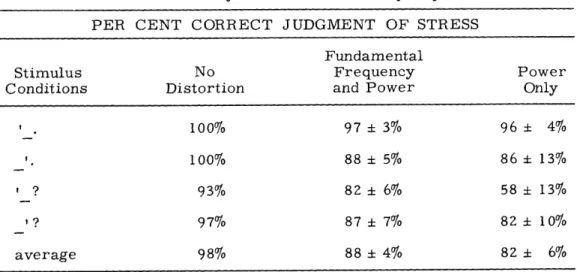
The concept of redundancy in the speech signal is not new. It is understandably true that in an average utterance there are acoustic cues acting in combination to produce stress. This was clearly pointed out, in 1966, in a study by O'Mally and Peterson.18 They took 15 two-syllable words with stress shifts according to noun or verb usage and recorded them in both forms on magnetic tape. The results were then passed through a device that effectively distorted the spectrum in such a way as to destroy the phonemic information. The intensity and duration information was retained, however, and they had an alternative loop by which Fo information could be added in, if desired. The recorded words, thus distorted, were played to 12 subjects, who were asked to choose which syllable was stressed. The results of this experiment are shown in Table 4. What
Table 4. Results of O'Mally and Peterson's study of perceived stress.
PER CENT CORRECT JUDGMENT OF STRESS
Fundamental
Stimulus No Frequency Power
Conditions Distortion and Power Only
100%
97 3% 96 4%.100%
88
5
86
13%o
, ? 93% 82 ± 6% 58 ± 13%
, ? 97% 87 7 82 10%
average
98%
88
4
82
6%
is immediately obvious from these results is that, in the presence of the Fo cues, sub-jects were able to do a very good job of placing the stress. What is also obvious is that they continued to do quite a good job when the effects of Fo were removed. Therefore, it would appear that, though Fo may be the major acoustic cue for perceived stress when it is available, the other acoustic cues are redundant enough to also supply the stress information.
Along this same line, Lieberman,
9in doing some production experiments on
sub-glottal pressure and Fo, noted that some of his subjects produced, in conjunction with
their Fo cues, consistent duration and intensity cues. This was not always the case,
and others of his subjects sometimes "left out" some correlates of stress.
This,
Lieberman observed, appeared to be individual differences among subjects.
These results, together with other studies presented thus far, seem to imply the
following.
From a perception point of view, Fo inflections appear to be a very powerful
perceived acoustic correlate of stress. In general, other acoustic correlates are
pres-ent, but to what degree they may vary from subject to subject and on the basis of
speaking condition and intent is not clear. In the absence of Fo cues, these other
acous-tic correlates serve as effective cues for stress. Such things as the subject's parsing
of a particular sentence, his semantic interpretation of an utterance, or his knowledge
of potential word stress may also influence his perception of stress.
17
V.
ACOUSTIC CORRELATES OF INTONATION
Linguistically, intonation can be defined as the perceived "pitch" of an utterance, and several common pitch contours are recognized by linguists. Of the several types of into-national contours identified, however, probably only two should be of real interest in the FRM context. This is because most types of intonational contours reflect not stress or syntactic information, but rather the speaker's emotions or attitudes. The correct use of such intonational contours would require some form of semantic analysis, which, at least for the present, is far beyond the scope of the Reading Machine.
There are, however, two intonational contours, the "high riser' and the "low fall," whose uses are syntactically determined. In particular, the "low-fall" contour normally denotes a factual statement, while the "high-rise" contour denotes either a question or a sentence breath group that is nonfinal. These contours might be very useful in the FRM, and it is appropriate to see what information is available from publications on the acoustic correlates of these quantities.
Traditionally, all elements of intonation, and, in particular, the two mentioned above, have been considered to have as their major acoustic correlate fundamental frequency. Other possible acoustic correlates for intonation have been mentioned from time to time (e. g., Meyer-Epplerl 6 indicated that the motion of the third formant might be related to intonation), but in general there is little experimental evidence to indicate either their role or their importance. Questions concerning the role of Fo in intonation, from both perceptual and production points of view have been studied more closely.
Evidence about the behavior of Fo from a production point of view may be found in two papers presented by Denes.2 1 In these studies, Denes had linguistically trained speakers produce low-fall, high-fall, low-rise, high-rise, fall-rise and rise-fall into-nations on simple vowels, CV, and VC combiinto-nations. Using a lowpass filtering tech-nique, Denes then collected data on the fundamental frequency contours of these utterances. From these tracings, Denes observed several interesting things. First, he noted that the Fo patterns observed for the intonational contours of interest did behave as their names implied. That is, that in the low-fall intonational contour, Fo generally fell at the end, while in the high-rise contour, Fo generally rose at the end. Second, he observed that, in general, all of his Fo contours began in very nearly the same region, and most of the variations occurred at the ends of the utterances. This is in agreement with Leiberman's idea that the basic underlying Fo contour in General American speech is nearly flat throughout and that variations occur only near the end. Third, he found that most of the Fo slope variations occurred in the vowel segments, and that Fo in the consonant segments either tended toward an intermediate value or, if at the end of an utterance, continued at a constant slope. This might agree with Bolinger's hypothesis that Fo variations are only "heard" in the vowel segments.
Evidence supporting the hypothesis that Fo contours also play an important role in the perception of intonation may be found in the previously discussed study of O'Mally
18
and Peterson. 5 In this study, they had subjects produce 15 words with noun-verb oppo-sition caused by stress placement, and also had the subject produce the words with a statement and a question intonation. The taped results were then fed into a device that destroyed the phonemic structure of the test words, but retained intensity, duration and, optionally, fundamental frequency. Twelve subjects were then asked to listen to the results, and to decide whether what they heard was a statement or question. The results of that study are shown in Table 5.
Table 5. Results of O'Mally and Peterson's study of intonation.
PER CENT CORRECT JUDGMENT OF INTONATION
Fundamental
Stimulus No Frequency Power
Conditions Distortion and Power Only
_.
100%
97
i3
92
8%
-'
100%
85 ± 10%
52
±17%
' ? 100% 91 ± 5% 41 15%
'?
o100%
83 ± 11%
58
17%
average 100% 89 ± 3% 59 ± 6%
Two important things emerge from these data. First, when subjects had Fo infor-mation available they had little trouble in identifying the correct intonation, the over-all judgments being correct 89% of the time. Second, the results when no Fo information was available show that the correct judgment was made only 59% of the time, or 9% above
random. These results clearly mark Fo as a very important acoustic correlate of into-nation.
A more quantitative study on the perception of statement and question intonations was made, in 1964, by Hadding-Koch and Studdert-Kennedy.23 The purpose of their
experiments was to determine whether a rising final Fo contour was always heard as a question, if a falling final Fo contour was always heard as a statement, and what effect,
if any, the rest of the Fo contour had on the perception of the final rise or fall. All work in this study was done for both American and Swedish subjects, but only the results for American subjects will be discussed here.
Hadding-Koch and Studdert-Kennedy began by choosing a phrase, in particular "for Jane," which was acceptable to both American and Swedish subjects. They then produced two series of Fo contours, the S and the H series, which they superimposed over their
synthesized test utterance. The S series was subdivided into three subseries, as shown in Fig. 9. All members of the S-series began at 250 Hz and rose to 370 Hz. From here, the three subseries fell to three different turning points, 220, 175, and 130 Hz, and,
19
TWO-CATEGORY INTONATIONAL JUDGMENTS (S-SERIES) u Vr, U I-U
z
Z Z 0, Z O r, cl: 80 40 -100 Sz \' ' ---t
' a _ ¢ . ¢ , -\ \,4 A QUEST j~~ ?~ ® STATEk ,z
100 200END POINT MINUS TURNING POINT (Hz)
Fig. 9. Results of Hadding-Koch and Studdert-Kennedy test on
intonation for the S series.
TWO-CATEGORY INTONATIONAL JUDGMENTS (H - SERIES)
v, u o 80 U z4 0 z 0 JESTION ATEMENT 100 0 100 200
END POINT MINUS TURNING POINT (Hz)
Fig. 10. Results of Hadding-Koch and Studdert-Kennedy test on intonation for the H series.
20
370 310 275 0 370 250 220 220 175 ,,, .~ 145 S3 130 370 370 310 275 250 20 220 17 175 145 S2 130 370 310 275 220 175 145 IS1 1301 370 310 310 275 250 220 220 175 145 H3 130 370 310 310 275 220 250 ,\_ 175 175 145 H2 130 I 7 I 310 275 220 175 145 I I n I .V I I S, S2 S, S, I ION MENT Nsubsequently, rose or fell to seven separate levels, ranging from 130 Hz to 370 Hz. The
H series was identical to the S series, except that the central peak value was 310 Hz
rather than 370 Hz. The purpose of these two series was to test the effect of turning
point and previous peak height or the perception of the statement and question
intona-tions.
Once the appropriate tapes were prepared, the results were played to 24 American
subjects, who were asked to judge whether utterances that they heard were statements
or questions. The results of these experiments are shown in Figs. 9 and 10.
The first, and most important, point to be made concerning these results is that,
for both the H series and the S series, the higher the final point, the greater the
per-centage of questions perceived. This is clearly what would be expected if a rising final
intonation is to be identified as a question. Additional interesting points can be seen if
the crossover points, the points where 50%o of the utterances are perceived as questions,
are considered.
The crossover point for S1, S2, and S3, respectively, are
approxi-mately 120, 40, and -50, and for Hi, H2, and H
3170, 110, and 70, respectively. Several
things can be noted from this. First, since the crossover point for S
3is negative, it
is clear that a falling Fo contour can be perceived as a question. Likewise, the fact
that all of the other turning points are positive indicates that rising final slopes can, in
fact, be perceived as statements.
Hence it is possible that what is perceived as a rising
intonation may in fact be only a change in the slope of the final Fo contour toward a rising
direction. Second, comparing the turning points within each subgroup brings another
matter to light. It would appear that the greater the turning point and hence the smaller
the downward slope, the greater the final rise needs to be to produce a perceived
ques-tion. In other words, if the Fo is sloping steeply near the end of an utterance, then only
a less steep downward slope or a small upward slope at the end is needed to produce a
question.
Likewise, if the Fo slope near the end is small, then a greater rise must be
imposed to produce a question.
Third, a comparison of the two series shows that, in
every case, the crossover points in the H series are greater than those in the S series.
The lower the central Fo peak, the greater must be the terminal rise to effect a
ques-tion intonaques-tion.
From the previous discussion of Fo as related to stress, it can be seen
that the higher rises in the center of the Fo contours can probably be identified as
stronger stress. Hence, another way to state this observation is the greater the
pre-ceding stress in an utterance, the less the final rise must be to impose a "question"
per-ception.
Perhaps, a further point should be made before concluding this discussion. That is,
data are available on the time of the ending Fo inflection for question and statement
into-nations. Both Denes
2 4and Lieberman,
1 9reporting from production experiments, report
that the average observed time for the final rise of a question intonation is between
150 ms and 200 ms. Hence we may note that the times of the phenomena that have been
discussed are relatively small compared with the average lengths of utterances.
In summary, then, it can be said that fundamental frequency seems to be a very
21
powerful acoustic correlate of intonation.
Likewise, it may be said, in general, that
the "high-rise" and "low-fall" intonations describe fairly well the shape of the Fo
contours involved.
Nevertheless, from a perception point of view, variations in
shapes and slopes do occur, and probably further study is needed before any form
for an intonational algorithm can be suggested.
22
VI. INITIAL BIAS AND EXPERIMENTAL CONSTRAINTS
Before describing the experiments that were performed, it is important to under-stand precisely what problem solution was investigated. Now, as was seen, stress and intonation have the demonstrable acoustic correlates intensity, segment duration, and fundamental frequency. The problem is to control some or all of these acoustic corre-lates from information available from the FRM. But which ones should be the subject of this report?
It is noteworthy that intensity appeared to be the weakest of the three correlates of interest. Likewise, Leiberman,l9 in his work on work prominence, fundamental fre-quency, and subglottal pressure, notes that at least one of his subjects did not consis-tently use intensity as a correlate of stress, and, indeed, often had lower intensities
on his stressed vowels. Hence it would appear that intensity is not really a strong cor-relate of stress, and it would not seem unreasonable to ignore it in the initial experi-ments.
Duration, on the other hand, would seem to be quite a strong correlate of stress. Likewise, it is well known that segment durations are affected by many other factors besides stress, such as phonemic context,l2 location in a phrase,5 and even possibly
26
position in a syllable. Each of these phenomena has been observed in isolation, but how they are interrelated in an actual sentence is not well understood. We thought that the effect of stress on durations, along with a study of the effects of the other relevant factors, would make a good problem, and it is indeed our main subject. In particular, we shall try to find a set of rules for the acceptable control of all segment durations from
information available from the FRM.
This does not imply that Fo is considered to be a weak correlate of stress. Quite the contrary, it is recognized that Fo is a strong correlate of stress, and, as has been shown, in some cases can be stronger than duration. Therefore, whenever possible, studies of Fo will be made simultaneously with duration in a hope of relating the two phe-nomena. Nonetheless, duration remains the major topic here.
With this major topic of interest, it is now in order to examine precisely what infor-mation is available from the FRM, and to try to determine precisely what constraints this places on the form of the problem solution. First, clearly, a complete phonemic string for the input sentence is available from the grapheme-to-phoneme translation routine. This provides the information necessary for understanding the contextual dura-tional effects. Likewise, if necessary, the grapheme-to-phoneme conversion routines are capable of providing word boundaries and probably even syllable boundaries, should they be required. Hence the information necessary to predict syllabic durational effects, if any, is available.
There is, however, a more subtle point connected with the FRM's phoneme string. It must be noted that a "phoneme" is not really an acoustic unit at all, but is generally defined in linguistic terms. This makes the phoneme" more abstract than physical. So
23