HAL Id: tel-00426903
https://tel.archives-ouvertes.fr/tel-00426903
Submitted on 28 Oct 2009HAL is a multi-disciplinary open access archive for the deposit and dissemination of sci-entific research documents, whether they are pub-lished or not. The documents may come from teaching and research institutions in France or abroad, or from public or private research centers.
L’archive ouverte pluridisciplinaire HAL, est destinée au dépôt et à la diffusion de documents scientifiques de niveau recherche, publiés ou non, émanant des établissements d’enseignement et de recherche français ou étrangers, des laboratoires publics ou privés.
Abdul Rahim Ahmad
To cite this version:
Abdul Rahim Ahmad. On-line Handwriting Recognition using Support Vector Machines and Hid-den Markov Models approaches. Human-Computer Interaction [cs.HC]. Université de Nantes, 2008. English. �tel-00426903�
É
COLED
OCTORALES
CIENCES ETT
ECHNOLOGIESDE L
’I
NFORMATION ET DESM
ATHEMATIQUESAnnée : 2008
Thèse de Doctorat de l’Université de Nantes
Discipline : Traitement du Signal et des Images Spécialité : Automatique et Informatique Appliquée
Présentée et soutenue publiquement par
Abdul Rahim AHMAD
le 29 Decembre 2008
à Universiti Teknologi Malaysia
« Reconnaissance de l’écriture manuscrite en-ligne par approche combinant systèmes à vastes marges et modèles de Markov cachés»
Jury
Rapporteurs : Jean-Marc OGIER Professeur, Universite de La Rochelle
Chee Peng LIM Professeur, Universiti Sains Malaysia Examinateurs : Sheikh Hussain SHAIKH SALLEH Professeur, Universiti Teknologi Malaysia
Patrick LE CALLET Professeur, Universite de Nantes
Marzuki KHALID Professeur, Universiti Teknologi Malaysia
Christian VIARD-GAUDI N Professeur, Universite de Nantes
Directeur de Thèse : Christian VIARD-GAUDI N Laboratoire : IRCCyN
Co-encadrant : Marzuki KHALID
Laboratoire : CAIRO, Universite de Technologie de Malaisie
DEDICATION
ACKNOWLEDGEMENTS
I would like to thank:
• God, for giving me interest to study, for giving me good health to be able to spend the time to study and for giving me the perseverance.
• My supervisors, past and present : o Prof. Marzuki Khalid (UTM).
o Prof. Christian Viard Gaudin (EPUN). o Prof. Dominic Barba (EPUN).
o Prof. Dr. Rubiyah (UTM).
• Universiti Tenaga Nasional (UNITEN) for providing me with the sponsorship for local study and later for full time 1 year study in Nantes.
• Universiti Teknologi Malaysia (UTM) the first partner university in the joint PhD program.
• Ecole Polytechnique de l’Universite de Nantes (EPUN) France, the second partner institution in the joint PhD program..
• The French Embassy of Malaysia, for providing the 12 months bourse for my study in France between 2001 to 2005.
• Professor Syed Abdul Kadir, Dean of College of Engineering, UNITEN, whom without fail, has supported my application for the leave to be away for the research study in EPUN.
• Dr. Mohd. Sharifuddin and Dr. Zainuddin, Dean and Deputy Dean of College of IT, UNITEN, similarly for supporting my application for the leave.
• Azizah, Alicia, Dr. Madan and Dr. Roslan for taking over or handling my teaching load in UNITEN while I was in France.
• My wife, Azian Muhamad Ariff for being patient and understanding about my struggle to complete the PhD.
• My children: Arifah, Afifah, Afiq and Atiqah for their patience to be without a father, while I am away in Nantes..
• Myself for believing that “I can do it”.
Lastly, thanks to the Malaysia students in France who were always willing to host me when I visited them during my break from study.
CHAPTER TOPIC
PAGE
DEDICATION i
ACKNOWLEDGEMENT ii
TABLE OF CONTENTS iii
LIST OF TABLES x
LIST OF FIGURES xii
LIST OF SYMBOLS AND ABBREVIATIONS xv
LIST OF APPENDICES xvii
CHAPTER 1 INTRODUCTION 1
1.1 Background 1
1.2 Limitations of Handwriting Recognition System 5 1.3 Overview of Handwriting Recognition System 7 1.4 Statistical Pattern recognition 10 1.5 Problems in Handwriting Recognition 11 1.6 Recognition Modeling. 14 1.6.1 Hidden Markov Model 14
1.6.2 Neural Network 16
1.6.3 Syntactic Modeling technique 17 1.6.4 Support Vector Machine 17 1.7 Scope and Objectives 20
1.7.1 Thesis Layout 21
CHAPTER 2 STATE OF THE ART IN HANDWRITING
RECOGNITION 24
2.1 Introduction 24
2.2 Pattern Recognition 24
2.2.1 Learning Approaches in Pattern Recognition
Systems 26
2.3 Developments in Speech Recognition 27 2.4 State Of The Art in Handwriting Recognition 29
2.4.1 Developments in Online Handwriting
Recognition 32
2.4.2 Developments in Offline Handwriting
Recognition 37
2.4.3 Issues in Preprocessing 38 2.4.4 Issues in Segmentation Stage 40 2.4.5 Issues in Word Recognition 42 2.4.6 Issues in Post Processing Stage 45 2.5 SVM in Speech and Handwriting Recognition 46 2.5.1 SVM in Speech Recognition 46 2.5.2 SVM with DTW Kernel in Character
Recognition 47
2.5.3 SVM as a Character Recognizer in a Hybrid
System 47
2.5.4 SVM in Multiple Classifier Methods 48 2.5.5 SVM in Non Roman Handwriting
Recognition 48
CHAPTER 3 HIDDEN MARKOV MODEL 51
3.1 Introduction 51
3.2 Theory of HMM 52
3.2.1 Discrete-State Markov Process 53 3.2.2 Extending Discrete-State Markov Processes
to Hidden Markov Models 54 3.2.3 Three Problems of HMM 56 3.2.4 A Solution to the Evaluation Problem – The
Forward Algorithm 57
3.2.5 A Solution to the Decoding Problem – The
Viterbi Algorithm 58
3.2.6 A Solution to the Training Problem – The
Baum-Welch Algorithm 60
3.3 HMM Model Topology 62
3.4 Using HMMs for On-line Handwriting Recognition 64 3.4.1 Modeling Letters 64
3.4.2 Modeling Words 65
3.4.3 Modeling Sentences 67 3.5 Discriminative Training of HMM 68
3.5.1 Maximum Mutual Information (MMI)
training 69
3.5.2 Minimum Classification Error (MCE)
training 72
3.6 Discrete vs. Continuous Density HMM 74 3.7 Hybrid of Neural Network and HMM 75
CHAPTER 4 SUPPORT VECTOR MACHINES 77
4.1 Introduction 77
4.2 Theoretical foundation 80 4.2.1 Statistical Learning Theory 80 4.2.2 Structural Risk Minimization 81
4.3 SVM Formulation 83
4.3.1 Linearly Separable Case 84 4.3.2 Optimality Condition 88 4.3.3 Linear Soft Margin and Non-Linear SVM 89 4.3.4 Variations of the SVM Objective Function. 90
4.4 SVM Implementations 91
4.4.1 QP Optimization 92
4.4.2 Multiclass SVM Implementation 96 4.4.3 SVM Posterior Probability Output 96 4.5 SVM Implementation Packages 98
4.5.1 SVMTorch 98
4.5.2 SVMLight 99
4.5.3 LIBSVM 100
4.6 Summary 100
CHAPTER 5 HYBRID SVM/HMM HANDWRITING
RECOGNITION SYSTEM 102
5.1 Introduction 102
5.2 Overview of the SVM based Character Recognizer 103 5.2.1 Signal Representation 104 5.2.2 Preprocessing and Normalization 106
5.2.3 Feature Extraction 107 5.2.4 Training and Recognition 108 5.3 The online Word Recognition System 110 5.3.1 Previous Systems 110 5.3.2 General Description of the Hybrid
SVM/HMM Word Recognition System. 112 5.3.3 Preprocessing and Normalization 114 5.3.4 Over Segmentation and Hypothesis
Generation 116
5.3.5 Feature Extraction 119 5.3.6 Overview of Hybrid SVM/HMM Training 120 5.3.7 Word Likelihood Computation 122 5.3.8 SVM/HMM Framework 124
5.4 Summary 128
CHAPTER 6 DATABASE AND EXPERIMENTAL RESULTS 129
6.1 Introduction 129
6.2 Databases 130
6.2.1 Data From UCI Repository 130 6.2.2 IRONOFF Online and Offline Databases 131 6.2.3 UNIPEN Online Character Database 134 6.2.4 IRONOFF-UNIPEN Databases 135
6.2.5 MNIST 136
6.3 Experiments in Selecting an SVM package 136 6.3.1 Comparing Training Time and Number of
Support Vectors 137
6.3.3 Comparing Training and Test Accuracies 138 6.4 Character Recognition Using SVM 140
6.4.1 Experiments on SVM for Character
Recognition 140
6.4.2 Character Recognition Summary 143 6.5 Experiences in Implementation of SVM in Other
Areas 144
6.5.1 SVM in Mathematical Expressions
Recognition 144
6.5.2 SVM in Electricity Fraud Prediction 146 6.6 Word recognition Using Hybrid SVM/HMM 147 6.6.1 A Word Recognition Example 148 6.6.2 Comparing Word Recognition Performance 152 6.6.3 Character Database Generation. 153 6.6.4 Training of Character SVMs 155 6.6.5 Recognition Result for Baseline Word
Recognition System 156
6.6.6 Retraining of SVMs 158 6.6.7 Incorporation of Junk Characters in
Retraining of SVMs 158
6.6.8 Result Comparisons with Hybrid of TDNN
and HMM approach. 160
6.6.9 Analysis of Errors 160
6.6.10 Conclusion 163
CHAPTER 7 CONCLUSIONS AND FUTURE RECOMMENDATIONS 165 7.1 Dissertation Contributions 165 7.2 Conclusion 166 7.3 Future Work 167 REFERENCES 168
LIST OF TABLES
Table 2.1 Summary of Online Handwriting recognition systems 35 Table 2.2 Offline handwritten word recognition systems 38 Table 4.1 Commonly used Kernels for SVM 90 Table 5.1 Comparison of the three handwriting systems developed 111
Table 5.2 The 68 Character HMMs 125
Table 6.1 Sample UCI Data Sets 130
Table 6.2 Handwriting Databases 131
Table 6.3 List of words in the IRONOFF lexicon 132 Table 6.4 Words in the Check Word lexicon (30 words) 133 Table 6.5 Words in the French Word lexicon (171 words) 133 Table 6.6 Words in the English Word lexicon (26 words) 134 Table 6.7 UNIPEN Benchmark Overview 135 Table 6.8 UNIPEN Train-R01/V07 Dataset 135 Table 6.9 Training Results for WBC data set (2 class) 137 Table 6.10 Training Result (number of Support Vectors) 138 Table 6.11 Training Accuracy (in %) 139 Table 6.12 Summary of Test Accuracy (in %) 139 Table 6.13 Detail Recognition performance of SVM on
IRONOFF-UNIPEN character database 141
Table 6.14 Comparing recognition performance between TDNN and
Table 6.15 Comparing recognition performance and number of parameters using MLP, TDNN and SVM for
IRONOFF-UNIPEN database 142
Table 6.16 SVM distance vs. probabilistic SVM based recognition
for IRONOFF and UNIPEN Databases 143 Table 6.17 Comparison of TDNN and SVM on isolated Mathematical
symbol recognition 145
Table 6.18 Fraud prediction Accuray 146 Table 6.19 Number of characters in generated character database 153 Table 6.20 Word Recognition accuracy of during segmentation 155 Table 6.21 Performance of the character SVMs 156 Table 6.22 Word recognition rates of base recognizer 157 Table 6.23 Improvements in Character and word recognizer for the
English Words 158
LIST OF FIGURES
Figure 1.1 Online vs. Offline handwriting system 3 Figure 1.2 Offline signal and Online signal 3 Figure 1.3 Categories of Handwriting Processing 4 Figure 1.4 Handwriting Recognition (Plamondon, 1989) 5 Figure 1.5 Problem with handwriting recognition systems 6 Figure 1.6 Example of constraints imposed in Palm Grafitti 7 Figure 1.7 Typical Handwriting Recognition System 8 Figure 1.8 Variations in handwriting style –random sample 12 Figure 1.9 Types of handwriting. Adapted from (Tappert, 1994) 13 Figure 1.10 Example of a 5 state HMM 15
Figure 1.11 Thesis Layout 23
Figure 2.1 A model of Pattern Recognition System 25 Figure 2.2 English word “writing”, written in small letters 33 Figure 2.3 English word “WRITING”, written in capital letters 33 Figure 2.4 (a) INSEG based segmentation (left) showing 3 hypothesis
σ3, σ4 andσ5 for INSEG method which are within slices
1-2 and 2-3. (b) OUTSEG based segmentation (right) which shows segment σ4 withinwindow3-6 and
overlapping windows σ5 and σ6 42
Figure 3.1 A 3-state markov process 54 Figure 3.2 A 3-state HMM with 2 observation symbols {0, 1} 56
Figure 3.4 HMM Modeling with emitting and non-emitting states 64 Figure 3.5 Concatenation of character HMM models to form a word
model 66
Figure 4.1 Finding the optimal decision hyperplane 84 Figure 4.2 Maximal Margin hyperplanes for two dimension examples 85 Figure 5.1 Handwritten Character Recognition System 104 Figure 5.2 Example portion of UNIPEN file showing the format for
online handwriting signal 105
Figure 5.3 Resampling of Online character signal 106 Figure 5.4 Direction features (above) and curvature feature (below) 108 Figure 5.5 The overall hybrid handwriting recognition system 112 Figure 5.6 Normalization steps in word preprocessing 115 Figure 5.7 The four Reference Lines 115 Figure 5.8 Oversegmentation of the word “un” based on minimum
and maximum y points 117
Figure 5.9 Character Hypothesis Generation: A simple example for offline in slicing and generating hypothesis using the
word “cts”, assuming 5 slices. 118 Figure 5.10 Result of recognition and Segmentation 119 Figure 5.11 Example of new x values for the hypothesis character.
Shown in the table - only the first 4 points. Y
coordinates remain. 120
Figure 5.12 Character level training for word recogntion system 121 Figure 5.13 Word Likelihood Computation – The best word is “cts”,
through slice combination 1 & 2 for char c, 3 &4 for char t and slice 5 for character s. Bold and large P(i)
indicates largest probability values for character i . 124 Figure 5.14 An example character HMM with N states 125
Figure 5.15 Word HMM formed by concatenating character HMM 126 Figure 5.16 Word Recognition Graph 127 Figure 6.1 Random examples from the IRONOFF Database 134 Figure 6.2 Comparison of TDNN and SVM on isolated symbol
recognition 145
Figure 6.3 The online signals of the word "hi" 148 Figure 6.4 The 6 Slices from the word "hi" 149 Figure 6.5 Trellis for probability score of each hypothesis and the best 151 Figure 6.6 Character Segmentation for the word “hi” 152 Figure 6.7 Distribution of characters in the generated cheque word
character database. Only a subset of lower case
characters are present. 154
Figure 6.8 Distribution of characters in the generated English word character database. Some character classes from
character lexicon are not present. 154 Figure 6.9 Distribution of characters in the generated french word
character database. All character classes in the
character lexicon are present. 154 Figure 6.10 Recognition accuracy during segmentation 155 Figure 6.11 Word recognition rates for base recognizer 157 Figure 6.12 Example error: reference line detection 161 Figure 6.13 Example error: reference line detection 162 Figure 6.14 Example error: wrong label. 162 Figure 6.15 Example error: preprocessing 163
LIST OF SYMBOLS AND ABBREVIATIONS ℜ Real Numbers t O Observation at time t ) | (O λ P Word likelihood ) | (x C
p Character or class likelihood
) |
( O
P λ Word posterior probability
) | (C x
P Character or class posterior probability
) (x
p Probability density function (PDF) of continuous random variable x
) (x
P Probability of a discrete random variable x
α Forward variable β Backward variable a Transition probability b Observation probability ) (x ϕ Kernel Mapping
ANN Artificial Neural Networks RBF Radial Basis Function SVM Support Vector Machine HMM Hidden Markov Models
MLP Multilayer Perceptrons MLE Maximum Likelihood Estimation
MCE Minimum Classification Error
DP Dynamic Programming
SEGREC Segmentation by Recognition
SDNN Space Displacement Neural Network TDNN Time Delay Neural Network
RNN Recurrent Neural Network
INSEG Input Space Segmentation OUTSEG Output Space Segmentation
PDA Personal Digital Assistant
IRONOFF IRESTE Online/Offline Isolated Handwritten Word Database UNIPEN Isolated Character Database collected by
UNIPEN foundation
IRONOFF-UNIPEN
Isolated Character Database which is a mixture of IRONOFF and UNIPEN character databases.
MNIST Isolated Handwritten Digit Database Modified from NIST database
LIST OF APPENDICES
APPENDIX A PUBLISHED PAPERS 192
APPENDIX B LAGRANGE MULTIPLIERS METHOD AND THE
KARUSH-KUHN-TUCKER THEOREM 194
1. Problem formulation and the Lagrange function 195 2. Saddle points of the Lagrangian and
Karush-Kuhn-Tucker points 195
INTRODUCTION
1.1 Background
Handwriting is one of the most important ways of communication. It was used since the Stone Age where symbols were drawn on stones in order to express or convey some meaningful information. Later, handwriting was done using pen and paper. Handwriting was used for personal benefits like writing reminders and notes for ourselves or for business purposes such as writing letters, statements and filling up forms. Thus handwriting then was by human to human for conveying information.
The handwriting of each individual is unique because the process of handwriting is a physical process, which involves the mind, skeleton and muscles, controlled by the brain. Even so, individual handwriting could also differ, based on the mood and the state of mind of the person writing. The handwriting among the different stock of people (Europeans vs. Asian or French vs. Malaysian) are normally different, due to the conditioning and training during the period of growing up. However, even though the same stock of people has similar handwriting, it is an accepted fact that no two people have the same style of handwriting.
Initially, in a modern computer, the most important device used to interface them to human is a keyboard. As computers are becoming ubiquitous and more people are using it, a more natural interface is needed. The most likely candidates could be voice or handwriting. Voice or speech recognition capability and handwriting
recognition capability built into a computer can simplify a lot of data entry, which was handled before by using keyboards. Handwriting recognition seems to be more practical than speech recognition because of the fact that in crowded rooms or public places one might not wish to speak to his or her computer due to the confidentiality or personal nature of the data. Another reason is that it might be annoying to others if someone keeps speaking to his or her machine. It is also already possible to have handwriting recognition in very small hand-held devices, while a speech recognition system is not yet suitable for use as a hand-held machine. However, on the contrary, in term of speed of data entry, speech system is apparently faster and it is much easier to dictate something than to write it.
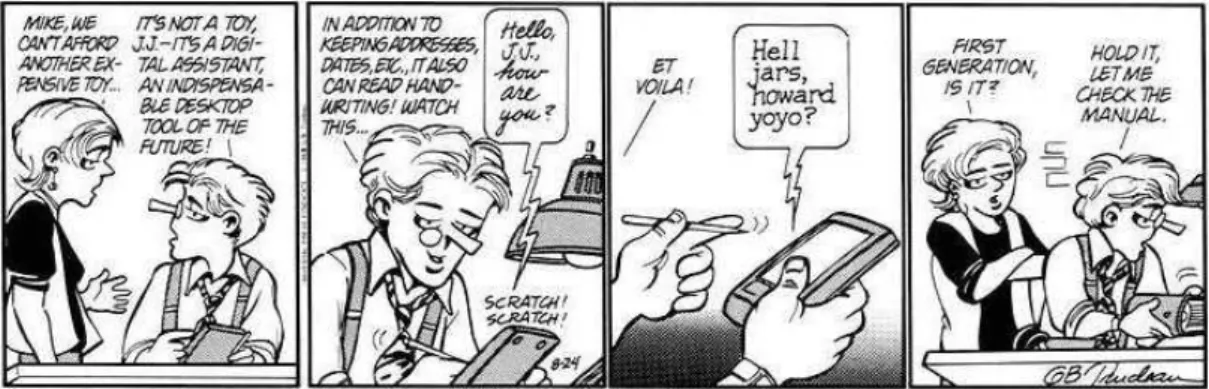
Pen-based interfaces in digital devices are popular lately and will play a more important role in human computer interfaces in the future. In personal digital assistant (PDA) which is a small handheld device, built-in pen-based handwriting recognition system is already used as an input method. The input method is interfaced to the applications in the PDA, such as personal agenda, address book and communication facilities. In personal computers, pen-based input device (pen or stylus and a pad) is sometimes used to replace the cumbersome mouse for handwriting capability and its small footprint.
Automatic handwriting recognition is the transcription of handwritten data into text in digital format, for use by the computer. The area has been under investigation since the 1950’s. Since then there has been steady research effort into the area. Two categorizations are possible; first, in term of processing domains, second, in term of usage categories. Handwriting recognition can be categorized into two domains; online recognition, used in the pen-based interface or offline, used in automated recognition system for processing cheques, forms and the like. Figure 1.1 shows the difference between the two domains. In online handwriting recognition, handwriting signals are captured from the pen traces on the surface of a writing pad. The signals are the input to the recognizer, which then gives out the text of the handwritten input. In off-line handwriting recognition, static images of words written are used instead in the process. A difference between the two is that on-line handwriting recognition requires fast and immediate processing while off-line recognition can be performed within quite a relaxed time constrain. However, recently, this might not
always be the case because it is possible to collect forms containing online handwriting and then to process them in a batch system.
Figure 1.1 Online vs. Offline handwriting system
In term of signals, online signals are normally the pen trajectories, recorded as the x and y coordinates of each point together with eventually the pressure and the time at each point, while offline signals are the image files recorded in a particular image format such as tiff or jpeg. Figure 1.2 below shows the differences between the two signals.
Figure 1.2 Offline signal and Online signal
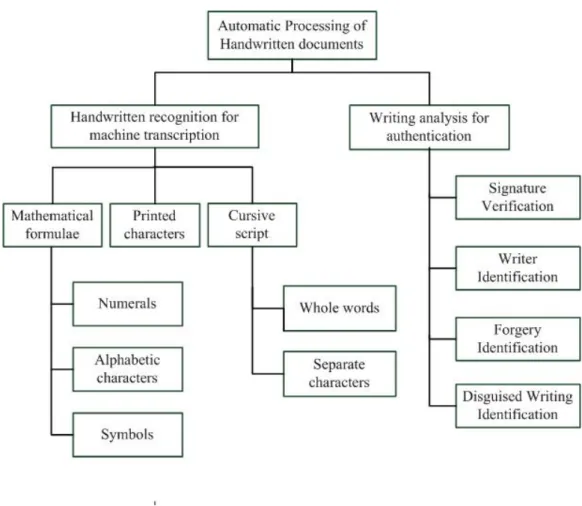
In the second categorization criteria, (Leedham, 1994) categorizes the automatic processing and recognition of handwriting into the categories as shown in Figure 1.3.
Figure 1.3 Categories of Handwriting Processing
As seen in the diagram, handwriting processing can be divided into two major groups: (a) handwriting recognition and (b) handwriting analysis. Handwriting recognition aims to produce output for machine transcription. It can involve handwritten mathematical formulae, printed characters or cursive handwriting. Handwritten mathematical formulae can consist of numbers and alphabets as well as various mathematical symbols. Printed characters and cursive script handwriting involves whole words or separate characters or combinations of partly cursive and separate characters. Handwriting analysis on the other hand aims at using handwriting for authentication. Among applications in this area are: signature verification, writer identification, forgery identification and disguised writing identification.
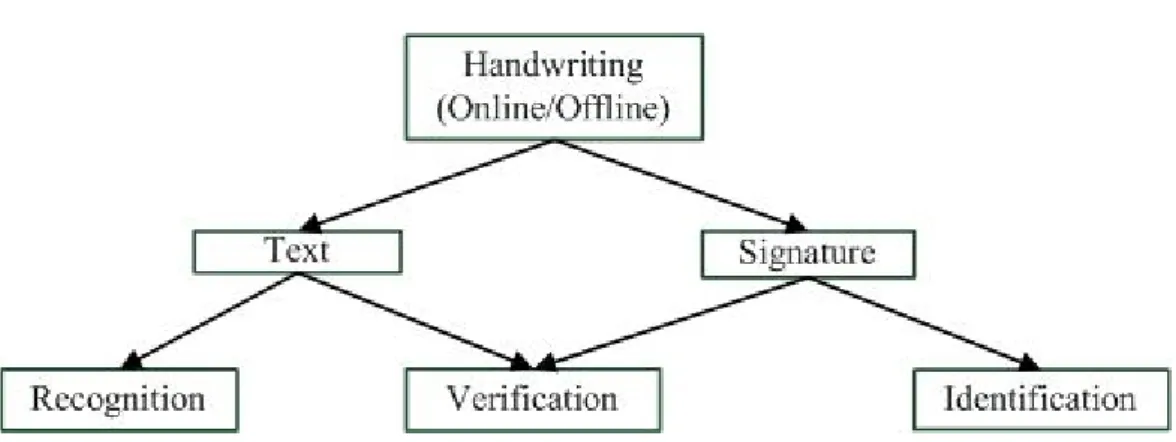
Another categorization is given by (Plamondon, 1989) in Figure 1.4, (a more simplified version of Figure 1.3). They divided handwriting into text and signatures. A common application in both text and signature is in using them for verification. In
signature verification, handwritten signature is checked whether it belongs to a particular writer or not and does not normally identify the symbolic classes of characters in the signature. Signature identification is a biometric technique for personal identification where genuine signature signed by an authorized person is compared with the input signature of a person to be identified.
Other pen computing related applications closely related to handwriting recognition is mathematical formula recognition where not just characters are recognized, their layout are also taken into account. Another one is in handwritten document retrieval, but here the so-called ink matching, does not identify the character classes. Finally, handwritten sketch recognition, is based mostly on non character data and typically ignores linguistic information.
Figure 1.4 Handwriting Recognition (Plamondon, 1989)
1.2 Limitations of Handwriting Recognition System
Although there are many applications of handwriting recognition in both online and offline domain, the technology is not fully matured. There are many improvements that can still be made to make handwriting recognition more widely accepted in computer based applications. In online handwriting, the input signal consists of a time sequence of strokes. A stroke is the writing from the time when
the pen is touched down (pen down) to the time it is lifted (pen up). The characters in the writing signal are usually written in sequence, one character being completed before beginning the next, and the characters typically follow spatial order, from left to right except in certain characters like dots (i’s and j’s) and crosses (t’s and x’s). In these cases, the underlying portion of a word is first written, and then the word is completed by writing the crosses and dots. The presence of these delayed strokes posed some problems which if not handled will not provide a good recognition of input handwriting (Figure 1.5).
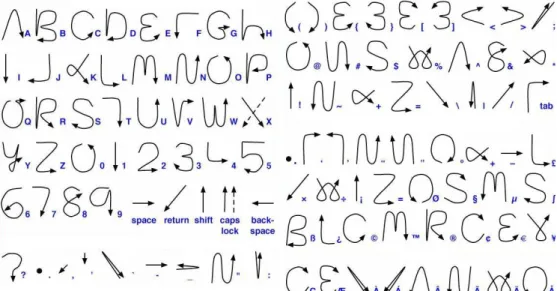
In some applications and devices, in order to provide good recognition performance, constraints need to be imposed to user input, such as in the way in which handwriting need to be done. An example is in the “Graffiti” system used in the Palm devices (Figure 1.6). Generally, there is no system that can be used in all environments. Each system is somewhat constrained to work in a particular target environment.
Figure 1.5 Problem with handwriting recognition systems
In many researches in handwriting recognition, other than constraining handwriting styles, those that work on unconstrained handwriting input, address only on a few specific areas such as writer dependent systems or systems that utilize only some special small lexicon. For example, they might only cater for the recognition of handwritten characters or numbers and recognition of words from a small specific lexicon. As constraints in the handwriting are reduced, the problem will become more complex because the recognition system needs to handle various limitations, thus, this will affect the recognition accuracy.
Figure 1.6 Example of constraints imposed in Palm Grafitti handwriting recognition system
1.3 Overview of Handwriting Recognition System
There are many different techniques for handwriting recognition. One generic model of handwritten word recognition system that can be used for our discussion is as follows. The description does not describe a standard but it is typical of most present recognition systems. Figure 1.7 gives a graphical summary of the description.
The input to the system is the word to be recognized which is a word image in the case of off-line and a series of captured information representing the pen trace (the strokes or characters) of the word in the case of an online system. The discussion is similar for both offline system and online system except that the nature of the corresponding implementation of each process might be a little bit different. The output of the system is a text representation of the input word signal presented to the system. In the model, there are three main components; the front-end module, the recognition module and the post processing module. Each module performs their required functions depicted as sub modules within the modules.
First, the unknown handwritten word presented to the system needs to be transformed into a form understandable to the recognition computation engine. The front-end module needs to extract information from the presented word in the most efficient form for presentation to and processing by the recognition module. In the front-end processing, the word signal, first needs to be preprocessed to remove undesired variability that will cause difficulties in the recognition process. Operations like reference lines detection and correction to some variations like rotation, size and slant are performed. Secondly, words are segmented into a sequence of basic recognition unit such as characters or parts of characters. Most systems will perform this step; however, there are some that do not. In that case, the word is treated as a whole and recognition is a global process where characters are not first recognized. Thirdly, the segmented preprocessed unit needs to be transformed into a compact feature representation. This process involves extracting discriminant features to build up a list of feature vectors to be used in the recognition stage.
The recognition module in the system involves using a trained module that recognizes basic individual units mentioned earlier and their concatenation in the formation of the word. The word recognition, as will be described in the next section, includes a comparison of the test pattern (the observed word) with each class reference pattern (words in the lexicon) and measuring a similarity score (in the form of distance or probability score) between the test pattern and the similarity pattern. The pattern similarity score is used to decide which pattern best matches the unknown pattern. The implementation of this recognition module in previous systems have been in a number of ways such as dynamic programming, hidden markov model, neural network, expert system, k-nearest neighbor and other combination of techniques. Normally, the process of recognition provides a list of N-best word hypotheses where N can lie between 1 and 10. The list can be further post processed to obtain a better list of word hypotheses. This approach taken during the stage of recognition falls under the category of statistical pattern recognition, the basis of which will be described in the following section.
The post-processing module is used to verify the N-best list and may also perform rejection of unlikely hypotheses. With the help of some source of
knowledge in the form of a language model, some improvements in recognition can be obtained. A language model can be the lexicon, which is a library or list of possible words for recognition, or the words that are allowed as input to the recognition system, but can also include some statistical or structural properties of a given language.
1.4 Statistical Pattern recognition
As mentioned in section 1.3, at the recognition stage, the problem of handwriting is largely statistical in nature. It can be described by the following, according to statistical pattern recognition concept.
The goal of word recognition is to find the most likely word representing the given handwriting signal or image. If O is the observation sequence of a word signal, and W is the word in the lexicon, then the recognition system must choose a word W that maximizes the probability that the word W was written given that the ^
observation sequence O was observed:
) | ( max arg ^ O W P W W = (Eq. 1.1) . ) | (W O
P is called the posterior probability. It is difficult to compute the above maximization. However, it can be simplified by using Bayes theorem, which states that: ) ( ) ( ) | ( ) | ( O P W P W O P O W P = (Eq. 1.2)
where the probability P(O|W) is the probability that the observation sequence O was observed if a word W was written or the likelihood of the observation. P(W) is the a priori chance of the word being written and P(O) is the evidence or
normalization factor which represents the unconditional probability of the input signal. P(O) can be defined as follow:
∑
= = K k k k PW W O P O P 1 ) ( ) | ( ) ( (Eq. 1.3)where Wk, k=1,2,…,K are the words in the lexicon and K is the total number of words. It is a scale factor that ensures that the posterior probabilities sum to unity. However, P(O) is normally omitted because this term is common across all words.
Therefore, ignoringP(O), for a given new word signal input O, classification is made by selecting the word corresponding to the largest value of P(W |O), that is:
) ( ) | ( max arg ) | ( max arg ^ W P W O P O W P W W W = = (Eq. 1.4)
Thus, the probability of the word being written is a product of the two probabilities. In short, this can be viewed as the discriminant function for a word, which is formed by joining the likelihood function and the prior probability. The process of finding these two probabilities and then, finding the resulting combined probabilities for all words in the lexicon and selecting the highest probability is what constitutes the recognition system. For a given input O, the probability of misclassification is minimized by choosing a word having the largest value of the product of the two probabilities.
1.5 Problems in Handwriting Recognition
Many researchers have conducted research in handwriting recognition in the last years. Although many problems have been solved, there are still many problems at hand. Despite the availability of computing power and progress made so far, the capability of handwriting recognition system is still incomparable to human recognition. As mentioned earlier, no two humans have exactly the same handwriting and even no two sets of handwritings of the same person for the same
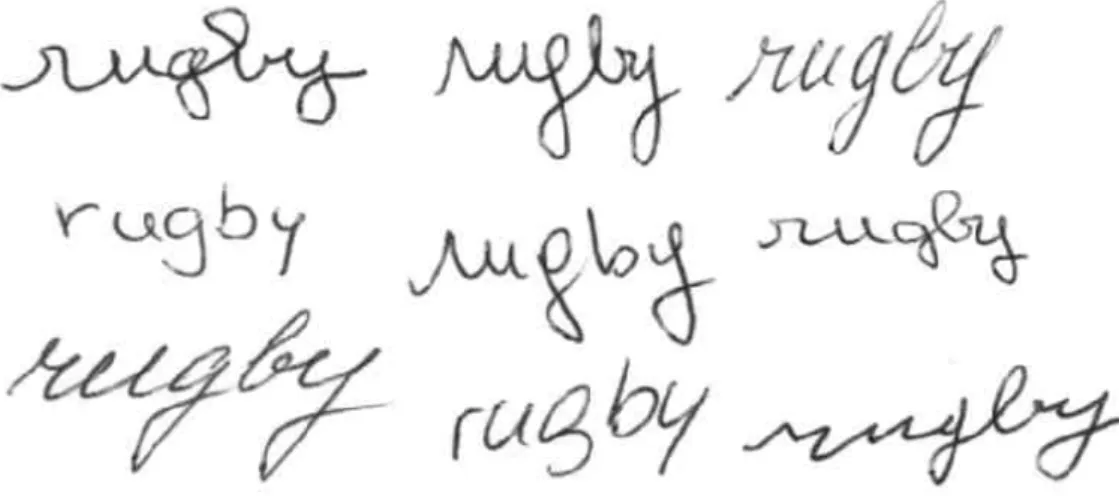
word are exactly the same. Between people, the variability can include the slant, the size of characters, the shape and how cursive or disjoint the characters in the handwriting are. Variations in handwriting can also be in term of the applications, even if for off-line handwriting applications such as form processing, handwritings are normally guided by boxes. Figure 1.8 shows a random sample of handwriting taken from IRONOFF database that demonstrates these differences. Figure 1.9 adapted from (Tappert, 1994) show further variations.
As mentioned in section 1.2, handwriting recognition can be performed by taking a word itself as a whole entity for recognition. This method has been used by a number of researchers. The model for recognition is the whole word model, which are trained to cater for variations and similarities within word such as co-articulation. Because the whole word is taken in training the system, segmentation is avoided. However, word model recognition is only applicable in cases where the lexicon is small.
Figure 1.8 Variations in handwriting style –random sample of handwriting taken from IRONOFF database
Figure 1.9 Types of handwriting. Adapted from (Tappert, 1994)
For larger sized lexicon, whole word recognition is unfeasible. This is because since each words are treated individually, the recognition information they contain cannot be shared among words, which means that the larger the size of the lexicons, the larger the recognition model is. Because of this limitation, many word recognition systems uses smaller units as the basic model, either a character or an entity smaller than a character (sometimes termed as pseudo character or grapheme). Model used for word recognition is the concatenation of the basic model at the character or sub-character level. In this way also, having larger lexicon does not mean a bigger number of word model. It simply means constructing the new word model from existing smaller sub-unit model.
Segmentation is then required to cut the words into smaller units. This creates another set of problems. Some words are written very cursively but some writers prefer to write disjoint characters when writing a word. Yet some, mix between cursive writing and disjoint without any particular order or rule, as can be seen in figure 1.8 and 1.9. In segmentation based word recognition system, the lexicon plays a very important role in the segmentation process itself as the recognition process determines the best and definitive segmentation points.
1.6 Recognition Modeling.
There are many different methods of training and modeling of a handwriting recognition system. A few of them of relevance to the thesis will be discussed here with the aim of comparing the pros and cons between them and eventually focusing on the method that have been used in this thesis. Among the existing methods are Hidden Markov Model (HMM), Neural Network (NN), Expert System, k-nearest neighbor and other techniques or combination of techniques. Some researchers divide these methods into two main descriptions; the syntactic, which involves describing character shapes in an abstract fashion and the statistics methods where the system learn from data directly without the implementer having to specify explicitly the structure or the knowledge into the system. HMM and NN falls under the statistical method. Support Vector Machine (SVM) which will be the focus of this thesis is another.
1.6.1 Hidden Markov Model
In many handwriting recognition systems, the basic modeling component for recognition is the Hidden Markov Model (HMM). This follows from its success in speech recognition. The ability to statistically model the variability of handwriting is its major strength. HMM uses Markov process, represented as a state machine to model the temporal evolution of handwriting. The probability distribution associated with each state in an HMM, models the variability in the handwriting.
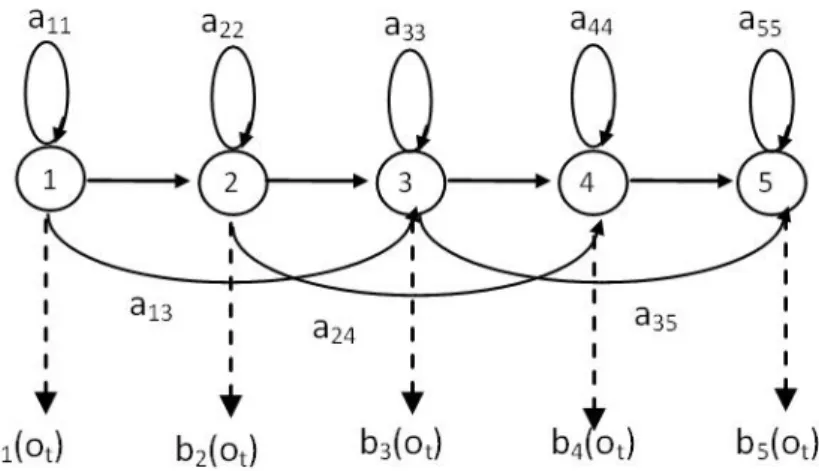
In this section, a very brief description of HMM is given, to facilitate explanations in this introductory chapter. Detail accounts will be given later in chapter 3. Figure 1.10 depicts a simple five state HMM. It can be attributed with the following parameters: N – the number of states in the model (5 states), probabilities of transition between states denoted by matrix A (consisting of probabilities a11, a12,
etc) and probability of emission or output denoted by matrix B (consisting of probabilities b1(ot), b2(ot), etc where o is the input observation). B represents the
Figure 1.10 Example of a 5 state HMM
HMM uses Bayes classifiers, which gives likelihood ratio for classification. The output probability distributions could be parameterized in either discrete or continuous distribution. The choice depends on the level of modeling accuracy needed and the amount of training data available. Continuous distribution is more accurate, with the disadvantage of complexity in modeling and computation. The most commonly used probability distribution function used in HMM is the multivariate Gaussian distribution as follows:
) ( ) ( 2 1 exp( ) 2 ( 1 ) ( ' 1 j t j j t j n t j o o o b μ μ π − − − =
∑
−∑
(Eq. 1.5)Where n is the dimension of the observation vector ot at time t and the
subscript j indicates that the Gaussian under consideration belongs to the jth state of the HMM.
∑
j
is the covariance matrix which normally is taken to be a diagonal matrix taking assumption that each feature components are independent of each other.
Using HMM, training is thus, estimating the parameters of the recognition model, using some parameter estimation model. One popular method is by using maximum likelihood estimation (MLE) to maximize the probability distribution that models the observation vector in the modified form of equation 1.5. The
Expectation maximization (EM) algorithm is normally used in the MLE procedure. MLE procedure however, lacks discriminative power because only in-class data is used in modeling a particular class model. Fitting Gaussian and applying Bayes rule for classification also does not give an optimal classifier. There is always some classification error because the decision threshold always occurs inside one of the classes, which could be due to some overlapping features in the feature space of the classes. To obtain discriminative power, HMM could be trained by including out of class data, using a number of optimization methods such as minimum mutual information (MMI) estimation or the minimum classification error (MCE); two issues that will be discussed in chapter 3 .
1.6.2 Neural Network
Neural network (NN) is a discriminative classifier in that all in class and out of class data are used in the training. NN body of literature is enormous because it has been used very widely in many areas. NN have been used in handwriting recognition system with success. However, compared to HMM, they require more computation. In addition, and of more importance, is that, they are not able to model time variations in handwriting signal, which is important for word recognition. They are static classifiers which require fixed size feature vector. Due to that, they are normally used only in character or digit recognition. There are also some other weaknesses of NN as a discriminative classifier, some of which are as follows.
a) In term of generalization property, NN is known to over fit data unless specific measures are taken to avoid that (Ganapathiraju, 2004). Although cross-validation can be done to avoid that, it is quite hard to achieve good generalization when only a limited amount of training data is available.
b) The optimization process in gradient-based NN learning is according to the principle of empirical risk minimization (ERM) using the back-propagation (BP) algorithm (Rumelhart, 1986). Though this guarantees good performance on the training data, performance on the test data is difficult to obtain.
c) Choosing Model Topology is another issue. In most connectionist system, the topology is needs to be fixed prior to training (Bodenhausen, 1993). Often, this requires some expert knowledge of the data. Learning the topology automatically is possible but quite time and resource consuming.
d) Training Convergence is considerably slower (as compared to ML estimation in HMM). In fact, NN training (for that matter, MLE training also) does not guarantee global optimum.
1.6.3 Syntactic Modeling technique
In Syntactic Modeling technique, handwriting recognition is based upon the idea that character shape can be described in an abstract fashion. Using expert system is one of the methods. Generally, an expert system incorporates human knowledge about the problem domain into stored knowledge. It basically consists of knowledge acquisition part that obtains knowledge and expertise from human experts in the form of rules, the knowledge representation part that provides methods used to represent human knowledge and expertise in the computer system and knowledge inferencing part that applies stored expertise to make decisions.
Syntactical handwriting recognition does not require a large amount of data for training, not as much as used in statistical handwriting recognition. The success of this method has largely been limited because of the complexity and ambiguity of handwriting styles and difficulty in formulating general and reliable rules as well as in automating the generation of these rules from a large database of characters and words. However, this approach has been revived recently with the use of fuzzy rules and grammars that use statistical information on the frequency of occurrence of particular features (Parizeau, 1995) (Malaviya, 1994) (Anquetil, 1997).
1.6.4 Support Vector Machine
A good classifier needs to have good generalization, minimum risk, better convergence properties and better discrimination power and possess a model
topology that does not have to be fixed a priori. This has led to the support vector machines (SVM) which is the focus of this thesis.
SVM had been proven to generalize well. SVM generalization properties allows for a bound on performance on a given test set to be part of the training process without having to actually test the system. Normally, empirical risk minimization (ERM) as used in NN is the most common optimization criteria used to estimate classifiers. However, using ERM, the solution is not unique. There are several configurations of the classifier that can achieve minimum risk specified in the ERM, on the training set (as seen in NN training). There is a need to decide on the configuration that has the least upper bound on the expected test set error. This is the principle of structural risk minimization (SRM). Support vector machines are based on this principle. With SRM, a classifier will have the least expected risk on the test set and therefore a good generalization.
This section introduces SVM but in chapter 4, the theoretical principles of SVM will be discussed in detail. In the simplest form, SVM is a linear binary (2-class) hyper plane classifier. For a linear case, SVM implicitly transform the non-linear data to a high dimensional non-linear space and construct a non-linear binary classifier in this space. This is done implicitly, without having to perform any computations in the high dimensional space. Because of this, data of high dimension or even sparse data pose no problem when implementing SVM. The eventual hyper plane in the high-dimensional transformed space actually results in complex decision surfaces in the input data space.
There have been many successful cases of using SVM in many problems, classical or new. In most cases, SVM consistently performed better than other non-linear classifiers. Initial use of SVM reported was in classification of handwritten digit. However, widespread usage of SVM was initially hampered by the unavailability of an efficient optimization method, which can handle large data efficiently and fast without consuming much of computer memory. With ongoing development of efficient optimization methods, SVMs now handle the problem. There are many applications of SVM up until now, in many areas, too many to list all. Randomly picked list follows: e-learning, text classification, handwritten
character recognition, handwritten character categorization, image clustering, speech recognition, speaker verification, forecasting, fraud prediction, protein structure prediction, land cover classification, intrusion detection, cancer prognosis, particle and quark-flavor identification in high energy physics, object detection, text categorization and time series prediction. A detail reference will be provided in chapter 4.
In speech recognition, SVM was used with HMM in the first SVM-based large vocabulary speech recognition system (Ganapathiraju, 2002). The hybrid system uses HMM to handle the temporal evolution of speech and SVM to discriminatively classify frames of speech. It was a first successful application of SVMs to continuous speech recognition. The system improves performance over traditional HMM-based systems. The hybrid system achieves a 10% improvement relative to an HMM system, which is significant.
Recent application of SVM in handwriting recognition was mainly at the character recognition level. Usually, SVM (with kernel) are designed to deal with data of fixed dimension. However, on-line handwriting data is not of a fixed dimension, but of a variable-length sequential form. In this respect, SVMs cannot be applied to HWR in a straightforward manner. (Bahlmann, 2002) uses a special SVM kernel for sequential data, the Gaussian dynamic time warping (GDTW) kernel that instead of the squared Euclidean distance in the usual Gaussian (RBF) kernel, it uses the dynamic time warping distance. Bahlmann achieved superior recognition rate in comparison to an HMM-based classifier.
The last two applications of SVM described earlier provide the motivation for us to research into using SVM for handwriting recognition at a higher level. The author has already used SVM for character recognition and have achieved more satisfactory result than Bahlmann in term of character recognition using SVM (Ahmad, 2004b). A further investigation into using SVM in a hybrid system of SVM and HMM similar to the work of Ganapathyraju is the objective of this thesis.
1.7 Scope and Objectives
The author has presented a brief description of the background of the issues and problems in handwriting recognition. A brief description of the tools used in handwriting recognition has also been given. Many problems are still not satisfactorily solved. Due to the wideness of the scope that falls in the arena of handwriting recognition, to tackle them all will require immense resources. Thus in this thesis, the focus is on a specific issue relating to improving the handwriting recognition system using new methods. The author has focused on the recognition aspect in a handwritten word recognition system. The aim is to investigate whether it is possible to increase the word recognition accuracy using segmentation based recognition method in the context of a hybrid system. Due to the emerging use of the learning method of Support Vector Machine (SVM) and the immense popularity of Hidden Markov Model (HMM), the author has chosen to investigate the effectiveness of using SVM in character recognition itself and its use in a hybrid environment of a segmentation based handwritten word recognition system. In this system, the discriminative property of SVM is exploited in tandem with the class representative property of a HMM.
The primary goal of this thesis is to propose a hybrid SVM/HMM handwritten word recognition system that caters for a medium sized lexicon. The system should be able to handle connected cursive handwritten words. The system borrows some ideas on existing systems based on discrete HMM and a hybrid of Neural network and HMM. Although the eventual aim is to adapt a simplified system based on word level discriminant training, in this thesis, emphasis is put in character level discriminant training, due to the difficulty in deriving correcting gradient from word level to character or sub-character level training. The final product is a working system which proven the concept and the tests done gives some ideas as to what are the problems and the recommendations in developing such a system.
The main contributions of this thesis are as follows:
b) Testing of SVM on major character database, proving the effect of various parameterizations in improving character recognition.
c) Adaptation of SVM for posterior probabilistic measures output.
d) Method for segmentation and feature extraction of character segments from online word signal.
e) Use of SVM in a hybrid situation with HMM in improving the discrimination ability of the overall recognizer.
f) Comparison of SVM/HMM hybrid implementation with other hybrid systems in handwriting recognition.
1.7.1 Thesis Layout
The main content of this thesis is divided into 7 chapters. This first chapter presents some background, the issues related to handwriting recognition and the scope, aim and contribution of this thesis. Chapter 2 presents the state of the art of handwriting recognition. Pattern recognition concepts and statistical pattern recognition issues are first introduced. Then speech recognition issues which had direct influence in handwriting recognition is discussed, followed by online and offline handwriting recognition issues. Online handwriting recognition using Support Vector Machine and Hidden Markov Model are then elaborated. Further issues on the use of SVM for character recognition are then discussed.
In Chapter 3, theoretical foundation of Hidden Markov Model (HMM) is discussed. After introducing Markov chain, HMM parameter estimation and training are presented. Forward-backward, Baum-Welch, Viterbi algorithms and the usage of HMM in discrete handwriting recognition system are discussed. The uses of HMM in hybrid handwriting recognition systems are then given some accounts.
SVM is discussed in Chapter 4. The theoretical foundation of SVM is presented here. Issues like Empirical Risk Minimization (ERM), Structural Risk Minimization (SRM) and the concept of maximal margin classifier are introduced. Aspects of SVM estimation and training are then discussed. For the adaptation of SVM in the hybrid system, SVM probabilistic output is discussed. Then, the use of SVM for handwritten character and word recognition is presented.
Chapter 5 provides an overall description of the online handwriting recognition system. After an overview, preprocessing is presented, followed with the training and recognition procedure in the SVM/HMM hybrid system. Chapter 6 outlines the experiments conducted and the experimental results. After providing some details about the overall databases in handwriting recognition and the ones used (UCI, MNIST, IRONOFF and UNIPEN), a description about the experiments conducted is given. Results for SVM Selection, the use of SVM in character recognition and the use of SVM in two other related areas that the author is involved in, namely mathematical symbol recognition and fraud prediction are discussed.
Word recognition results using the hybrid SVM/HMM system are then given in chapter 6 together with some ad hoc comparisons with the results of other comparable systems, namely the ANN/HMM offline system and the hybrid SVM/HMM used in speech recognition. Error analyses of the system are also given in this chapter. Finally, in chapter 7, a conclusion and suggestion for future work are given. Figure 1.11 summarizes the thesis layout in graphical form.
CHAPTER 2
STATE OF THE ART IN HANDWRITING RECOGNITION
2.1 Introduction
In this chapter, a review the developments in the field of handwriting recognition are made. First, an introduction to pattern recognition concepts and statistical pattern recognition issues is given. As developments in speech recognition have had direct influence on handwriting recognition, the author review some aspects of the developments in speech recognition research in relation to handwriting recognition research. Then a look into the developments in handwriting recognition is made, both online and offline including elaborating on a few issues addressed earlier in the first chapter. In both domains, much effort has been spent on the development of classification methods and algorithms. The most notable aim is to increase recognition accuracy or reduce error rate, while taking into consideration memory requirements and computation complexity. At the end of this chapter, a section is devoted towards discussing the perspective of the use of Support Vector Machine (SVM) in speech and handwriting recognition.
2.2 Pattern Recognition
Handwriting recognition is an application in the field of pattern recognition. Automatic recognition, description, classification and grouping of patterns are important problems in many engineering and scientific disciplines. (Watanabe,
1985) defines pattern as the opposite of chaos; an entity, vaguely defined that could be given a name, for example a fingerprint image, handwritten cursive word or human speech. Pattern recognition (PR) is the study of how machines can observe the environment, learn to distinguish patterns of interest from their background, and make sound and reasonable decisions about the categories of the patterns. The primary goal of pattern recognition depends on whether it is a supervised classification or unsupervised classification. In supervised classification, the input pattern is identified as a member of a predefined class. In unsupervised
classification the pattern is assigned to an unknown constructed class (Jain, 2000).
Handwriting recognition really falls under supervised classifications as handwriting examples are used in building the recognizer.
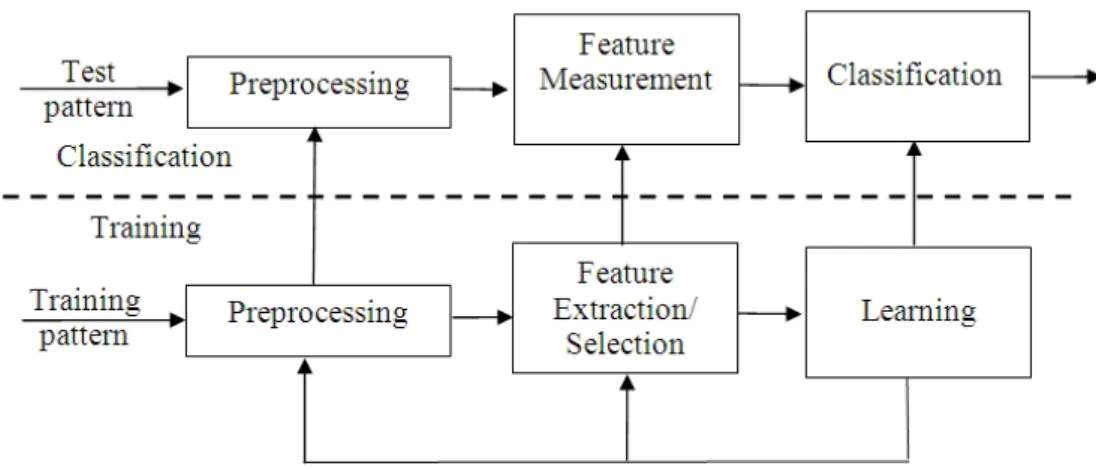
A model for pattern recognition is shown in Figure 2.1. As can be seen it is operated in two modes: training (learning) and classification (testing). A PR system needs to be trained to obtain a recognition or classification model for use during classification. In training mode, features representing input patterns are extracted and used for training to partition the feature space. Some feedback from the learning stage allows the optimization of the preprocessing and feature extraction or selection strategies involved. At the end of training, parameter values for the classifier are obtained. In classification mode, the trained classifier is used to classify the input pattern into one of the pattern classes.
Depending on complexity, some PR application might require extensive computation during training, especially in applications involving the processing of large data. There can also be huge data sets needed during the training stage of the systems. There are many approaches in PR but it is important to note that there is no single optimal approach for all and multiple methods and approaches might need to be combined and used in a single system. This applies to handwriting recognition as well. Figure 1.7, presented in chapter 1; match this model of pattern recognition system.
2.2.1 Learning Approaches in Pattern Recognition Systems
PR systems can use various approaches to learning. (Jain, 2000) summarizes four general approaches of pattern recognition. They are template matching, statistical classification approach, syntactic or structural matching and neural networks (Jain, 2000). Such approaches are neither necessarily independent nor disjointed from each other. Occasionally, a technique in one approach can also be considered to be a member of other approaches (Bortolozzi, 2005).
In template matching, a simple generic operation is used to determine the similarity between two entities of the same type (such as groups of pixels, shapes, curvatures, etc). A template or prototype of the pattern to be recognized is matched against the stored template. Matching techniques can be grouped into three classes: direct matching (Gader, 1991), deformable templates and elastic matching (Dimauro, 1997) and relaxation matching (Xie, 1988).
In Statistical Approach, the concern is with statistical decision functions and a set of optimal criteria, which determine the probability of the observed pattern belonging to a certain class. Many handwriting recognition approaches belong to this domain, such as : k-Nearest-Neighbor (k-NN) classifier (Mico, 1999), Bayesian classifier (Duda, 2001), Polynomial Discriminant classifier (Schurmann, 1996), Hidden Markov Model (HMM) (Rabiner, 1986b), Fuzzy set reasoning (Gader, 1996) and Support Vector Machine (SVM) (Burges, 1998).
In Syntactic approach, a pattern is viewed hierarchically. A complex pattern can be composed of simpler sub patterns, which are in turn built from yet simpler sub patterns (Fu, 1982). The simplest sub pattern is the primitive. Structure of a pattern can be compared with the syntax of a language where a pattern is viewed as a sentence of a language, primitives are viewed as the alphabet of the language, and the sentences are generated according to a grammar. Thus, a number of primitives and grammatical rules can be used to describe a collection of complex patterns where the grammar for each pattern class is inferred from training samples. In relation to handwriting recognition, structural methods can be categorized into two classes (Bortolozzi, 2005): grammatical methods (Shridhar, 1986) and graphical methods (Kim, 1998).
Finally, a Neural network (NN) can be viewed as a massively parallel computing systems with large number of processors and interconnections. Zhang (Zhang, 2000) gives a comprehensive review. NN models learn complex nonlinear input-output relationships using sequential training procedures in a network of weighted directed graphs of nodes and directed edges (with weights). The main advantages of neural networks is that it can be trained automatically using examples, gives good performance even with noisy data and can be implemented in parallel. The most widely studied and used neural network is the Multi-Layer Perceptron (MLP) (Bishop, 1996). The most popular neural network classifier and most frequently used traditional classifiers is the MLP trained with back-propagation (LeCun, 1998b). Other types of NN include Convolutional Network (CN) (LeCun, 1998a), Self-Organized Maps (SOM) (Zhang, 1999), Radial Basis Function (RBF) (Bishop, 1996), Space Displacement Neural Network (SDNN) (Matan, 1992b) and Time Delay Neural Network (TDNN) (Lethelier, 1995).
2.3 Developments in Speech Recognition
Speech recognition, also known as automatic speech recognition (ASR) converts spoken words to machine-readable input (transcript an acoustic speech signal into its equivalent textual form). It is used to interact with a computer, similar to textual input through a keyboard. It was supposed to replace, or reduce the reliability on, standard keyboard and mouse input. With that it should assist people who have little
keyboard skills or dyslexic people or people with physical disabilities that affect either their data entry, or ability to read or check what they have entered.
In ASR applications such as phone-based automated timetable information, or ticketing purchasing, the user makes contact with the system, and speaks in response to commands and questions. Most ASR breaks down the spoken words into phonemes and analyzes them to see which string of these units’ best fits an acceptable phoneme string or structure that the system can derive from its dictionary. Speech recognition technology is more mature compared to handwriting recognition technology. The technology of ASR and transcription has progressed greatly over the past decades. Research in ASR began in 1936, but it was not commercialized until the early 1980's when Hidden Markov Model (HMM) technology was introduced (Rabiner, 1986b). HMM has been the dominant approach to speech recognition since then. However in the late 1980’s, there seems to be a shift towards Neural Network, in particular Multilayer Perceptron (MLP) and Time Delay Neural Network (Weibel, 1989) as well as related method such as Learning Vector Quantization (LVQ) (Kohonen, 1988). This is due to their discriminative ability as compared to HMM which is trained with Maximum Likelihood Estimation (MLE) criteria. Anyhow, the introduction of an alternative optimization criterion such as the Maximum Mutual Information (MMI) (Bahl, 1992) and Minimum Classification Error (MCE) (Juang, 1992) in HMM improved the recognition accuracies in some systems which makes HMM still popular.
Today, speech recognition system which is based on single stand alone NN technology or HMM by itself is not common. Since early 1990’s, hybrid systems combining HMM and NN were widely popular. The hybrid system takes advantage of NN for its discrimination ability and HMM for its excellence in sequential modeling (Bengio, 1991) (Rigoll, 1998). A comprehensive survey on this hybrid method can be found in (Bourlard, 1998). HMMs and NNs combined are proven to improve classification capabilities.
2.4 State Of The Art in Handwriting Recognition
Various surveys have dealt with handwriting recognition from many aspects; online (Tappert, 1990), offline (Steinherz, 1999), machine-printed and cursive script handwritten characters (Guyon, 1996) (Plamondon, 2000). Many papers also reviewed or described their specific research in handwriting recognition emphasizing issues within the many components involved in the overall system as described in section 1.3, such as in preprocessing and segmentation, feature extraction, recognition modeling as well as post processing stage.
Research work in handwriting recognition started later than in speech recognition. The advent of the tablets in late 1950’s has resulted in active endeavor in handwriting recognition research lasting through the 1960’s. However, it ebbed in the 1970’s but was renewed in the 1980’s. In on-line handwriting recognition, the renewed interest was due to the availability of more accurate electronic tablets, more compact and powerful computers, and better recognition algorithms. In addition, combined tablets and flat screen displays brings input and output together, which further permits the use of electronic ink, that is the instantaneous display of the trace of the motion of the stylus tip directly under the stylus. During this period also, office automation work, coupled with usability and user friendliness has increased interest in more natural methods of entering data into machines. Researcher’s then, starts to more clearly understand the applications appropriate for handwriting recognition. In offline handwriting recognition, progress was similar. As the need for automation in the postal and banking industries increased, new developments were made in the field to cater for the needs. This is also aided by progress made in computer processor hardware, speed and memory capacity available in those machines.
During the last twenty years, there were much more development in handwriting recognition research. As mentioned earlier, this in part is very much due to the progress made in the speech recognition methods and algorithms, which have then been adapted into handwriting recognition. Usage of Hidden Markov Model (HMM) has been popular in handwriting recognition in similar context to speech recognition. HMMs gained growing interest in the handwriting recognition research community
because it was already in a mature state in the context of speech recognition. It is straightforward to transfer the HMM approach from speech recognition domain to the handwriting recognition, especially the on-line domain since pen-trajectory data can be viewed as a time series of samples similar to speech signal.
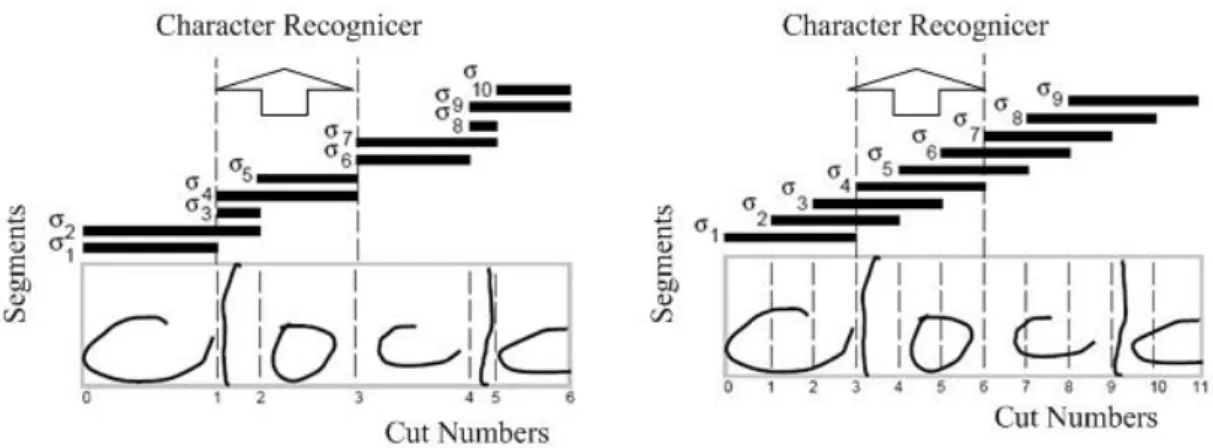
Literatures in handwriting recognition generally divide handwriting recognizers into whole word (segmentation free) or segmentation based. Whole word (or holistic approach) based does not involve segmentation where recognizer look at the whole word, while in segmentation based; words need to be segmented for recognition. Segmentation based word recognizer can either be based on classical analytical segmentation or they are segmented into characters based on the recognition results. In classical analytical segmentation, words are analytically segmented into characters. In segmentation based recognition, words are explicitly or implicitly segmented into characters by over segmenting them into smaller than character slices (or rather a primitive or can be called something else) and later determining the correct characters segmentation alignment using dynamic programming based algorithms. These issues are further discussed in section 2.4.4.
The earlier approach to recognition was based on classical analytical segmentation. In later work, researchers’ attempted the segmentation-free with great success; however, they are limited only to a very small lexicon. Then, segmentation approach was cleverly reapplied by taking into consideration that we need to know the word in order to segment it and we need to know the individual characters in the word, in order to recognize it, an idea called Syre’s paradox (Steinherz, 1999). That is when segmentation based recognition comes in. There are merits and disadvantages of either explicit segmentation or implicit segmentation which will be discussed later but in both cases, words are not actually presegmented. They are just cut at various places in the word based on certain criteria. The so called segmentation is the results of combining the slices at the right combination and the right points. To find the optimal segmentation points that form the best set of characters, combination of cuts are evaluated by a character classifier to score the combination. Finally, the word with the optimal score is generally found by applying Dynamic Programming or similar techniques.
Speech recognition were initially based purely on HMM with discrete or Continuous Mixture Densities (Rabiner, 1985). Later, hybrid system became popular. Similarly, in handwriting recognition system which is mainly segmentation based, a hybrid NN and HMM became very popular as NN being a discriminative classifier fits well into HMM structure which handles the temporal nature of handwriting to create a better recognition system. The ANN/HMM hybrid were used in recognition at the character level as well as word level. With proper language model, sentence recognition can be handled.
Also coming from successful usage in speech recognition, segmental modeling was later introduced in an attempt to achieve a more realistic modeling of the handwriting signal. In HMM, observation modeling is at the frame level, while in segmental modeling, a segment which is composed of several observations is modeled. In a way a segment corresponds to a homogeneous portion of the signal which typically can be a stroke in a character. Segment modeling allows automatic handling of different handwriting styles (Artieres, 2000). However, segment modeling requires more computation than the classic HMM. They are mainly used in the post processing stage and there are many possibilities of implementing the segment models which makes compromise between flexibility and robustness possible.
Many researches in handwriting recognition systems implementing the methods mentioned are targeted to small–scale and constrained applications where the vocabulary or the lexicon of words are small. For dealing with large vocabulary system, researchers need to handle crucial issues such as improving recognition speed and computational efficiency while maintaining good recognition accuracy. (Koerich, 2002). Speed and recognition accuracy are two aspects of mutual conflict, but have been tackled by using better search strategies, use of verification steps after the coding, better decoding algorithm and post–processing of the N–best candidate list.