MASSACHUSETTS INSTITUTE OF TECHNOLOGY
ARTIFICIAL INTELLIGENCE LABORATORY
Working Paper 118
August 1975
CONTROL, MULTIPLE DESCRIPTION, AND PURPOSE IN THE
VISUAL PERCEPTION OF COMPLEX SCENES:
A PROGRESS REPORT
Michael R. Dunlavey
Abstract
This memo describes a vision program for recognizing simple furniture comprising
assemblies of blocks, in which the same item may be composed in diverse ways. As such, it is
concerned with three theoretical issues, perceptual processing, supression of unwanted detail,
and segregation and interconnection of information.
The program's perteptual processing relies on an elaborate, redundant, alterable model
of the scene rather than on any clever process structure. This approach aids the
interpretation of incomplete, ambiguous portions of the scene as well
as
simplifies the
program. The model is capable of quantitative as well as qualitative alteration, by a
constraint-propogation
system and a system of frame-shift demons.
The hierarchical nature of the scene - assemblies of assemblies of blocks - is reflected
as hierarchy in the model. Each assembly is.represented as having an external aspect, by
which it relates to surrounding assemblies,.and an internal aspect, listing the parts and
relationships composing it. This imposes a natural supression of detail.
In addition to the vertical layering of the model there are horizontal subdivisions
adapted for different computational purposes.. There is a 20 section representing the image, a
30
section representing the shape, and a stability section representing the physical forces and
moments acting upon each unit. Each of the sections can be used through any of several
indirect reference frames corresponding to different spatial viewpoints. Many computations
on the model, such as stability analysis, spatial relationships, and visual matching, are greatly
simplified by first selecting the proper spatial viewpoints.
This report describes research done at the Artificial Intelligence
Laboratory of the Massachusetts Institute of Technology. Support for the
laboratory's artificial intelligence research is
provided i.n part by the
Advanced Research Projects Agency of the Department of Defense under Office
of Naval Research contract N88814-75-C-0643.
PAGE 2
1.8 Introduction
3
2.8 Hypothesis-Oriven Perception for Simple Scenes 5
2.1 System Outline S
2.2 Example - Perception of a Block-Pair 7
2.3 Adjustable Data Structure 8
2.4 Point-of-View Shift 12
2.5 Related Work 13
3.8 Perception of Nested Assemblies 17
3.1. Cross-Theory Connections 23
3.2 Occlusion Theory 24
4.8 Learning a Global Description 26
5.8 Complexity, Texture, and Figure-Ground 33
5.1 The Appearance of a Bolt 35
6.8 Organization and Representation 38
PAGE 3
1.8 Introduction
Scene analysis is the automatic recognition and description of the semantic contents of a visual image. Work in this field has acheived a moderate level of competence for simple scenes, usually consisting of a few
blocks or other polyhedral solids piled on a table (Winston). This paper describes progress on a scene analysis program for block assemblies which
are just complex enough to to demand a certain amount of "chunking" in the machine's memory of the scene.
The kind of assembly I am concerned with is the followings
Figure 1-1. A Table Made of Many Parts
This table contains ten blocks,intermediate subassemblies. That is, it and see all ten blocks (one is capture its similarity to any of the
too many to be described without even if a vision system could look at hidden), that description would not following tables:
Figure 1-2. Similar Tables Made Very Differently
These tables are composed of simple nested subassembliess rows, arches, and pedestals.
This problem was chosen to address not only problems of vision, -such as the relative order of high-level and low-level concept recognition and representation of spatial knowledge, but also more general problems of epistemology, such as suppression of unwanted detail, and the
interconnection of different kinds of models of the same thing.
The program's processing relies on the notion of an adjustable model of the semantic contents of the scene. The model can be created on the
PAGE
4
basis of very little visual evidence because when it is wrong it is adjusted quantitatively or qualitatively to accomodate more data. As such,
the model can be created quite early in the visual process and can act as a mechanism for conveying visual presupposition, to aid in interpreting ambiguous cues. This approach is necessitated by the accentuated ambiguity and occlupion characteristic of these complex scenes.
Suppression of unwanted detail is accomplished by modeling the scene as a roughly hierarchical collection of subassemblies. Each subassembly has an external aspect and an internal one. The external aspect represents the subassembly as a single object, acting as a first approximation to its global properties. The external aspect is the means by which the subassembly fits into the assembly of which it a part. The internal aspect describes the parts and relationships composing the subassembly.
The model of the scene, and of each of its subassemblies, is split into different sections serving different purposes. A 20 section models the image, while a 30 section models the physical shape and spatial relationships, and a Support section models the physical forces and moments acting upon the various blocks and subassemblies. These subsections of the model are in turn accessed via a system of indirect reference frames corresponding to the inherent symmetries.
The visual model is based on the idea that any subassembly has a first-order approximation in some simple known solid shape. A more sophisticated kind of global description can be built within this context, under the guidance of the viewer's purposes. For example, this scene:
Figure 1-3. New Phenomenon
-
One Arch Pulling Another
could be surprising to a perceiver who does not know the relation of being
"hooked-together". Understanding this example should mean building new
global descriptions for A and B in
which the "hooks", a previously unknown
concept, are emphasized.
To summarize the following sections, first the perception of a simple
pair of blocks is presented, covering most of the hypothesis-driven
ideology. Then I go into hierarchical structures. Next there is an
example of local-global representation-building organized by purpose.
Lastly there are a speculative section on texture and a philosophical
section on organization.
PAGE
5
2.8 Hypothesis-Driven Perception for Simple Scenes
Minsky's theory of Frame Systems (Minsky) offers strong advantages for a theory of perception, and this system attempts to exploit them. It does not need to see the whole scene, but only fragments of it, and occlusion is
no particular problem. At all times there is a detailed semantic model of the scene-which, although it may be different from the final model., is at least consistent. The rapport between the high-level semantic model and the low-level visual data is very close, without intervening layers of computation.
When a hypothesis is wrong, it is not discarded but is transformed in an orderly way into a more correct hypothesis, avoiding wasted effort. One tenet of the frame theory is that one may use dozens of different models linked in this way. My system restricts itself to a variety of two shapes, block and wedge, so that I could concentrate on assemblies. The issues
that arise with greater variety are discussed in the section on Organization.
2.1 System Outline
Input data, to keep the system simple, was restricted to the iso.lated vertices of a hand-coded line drawing. The data is examined by a program called the fovea, which reports only vertices contained within a movable diamond-shaped window. Each reported vertex consists of a point and the directions of its rays.
The basic operation. of the system is to take vertices, one by one, and
note their correspondence with points in an internal model of the scene. This process is punctuated by occasional modifications to the model to accomodate the data. Blocks appear out of nowhere, shrink and grow, sometimes split in two or turn into wedges. When the system can see no more vertices, it moves its window, looking for the far corners of objects whose dimensions are yet unverified.
The internal model for each block or wedge is a large actor (that is, a data object together with a procedure for accessing it) containing
parameters for all of its corner points, principal directions, and dimensions. It thinks of itself as a complete 3-0 model of the object except that the numbers stored in its points, directions, and dimensions are those of its 2-D isometric projection. Each parameter has not only its value but an authority-flag, to record whether the value is known with any certainty or is merely default. Although the block contains over a dozen different parameters, it can be adjusted as a unit due to a complex system of constraint equations for adjusting default parameters.
The process of matching vertices to points of each object is organized around two additional kinds of actors, matching-objects and
vertex-PAGE 6
matches. Each block or wedge model contains a set of vertex-matching-objects, one for each point, which can compare a vertex to that point. If
it finds a comparison, it constructs a vertex-match containing a comment about the quality or meaning of the comparison, such as "agree", "stretch" meaning the object should be stretched, "wedge" meaning it should be
changed into a wedge, or "cut-after" meaning it should be divided in two. Since each vertex will usually be comparable to more than one point in the
scene, the best vertex-match is chosen by sorting on the comment. The vertex-match also contains machinery to adjust or modify the model once it has been chosen. If it is to make a large change in the hypothesis, it uses tabular transfer rules to guide it, in setting up the parameters in' the new hypothesis.
It does not insist that hidden vertices or rays be invisible, and sometimes they're not, if the block is really going to be a wedge.
Although space does not permit greater detail, here is an outline of the contents of each type of actor:
Hypothesis Parameters
Value
Authority-Flag Irmediate Hard Link Parameter Names - Fixed Parameter Names - Variable Rotation Rules Current Transformation Constraint Equations Adjustment Mechanism Vertex-Hatching-Objects Suggestion Generator Vertex-Matching-Object Insides of Hypothesis
Mapping From Point and Ray Names of the Vertex to Point and Direction Names in the Hypothesis Procedure for Comparing Against Visual Vertex
Procedure for Generating the Coment Prototypical Vertex;Match
Vertex-Match
Insides of Vertex-Matching-Object Comment
Procedure to Carry Out Conment
Insides of Second Hypothesis. if any Transfer Rules
PAGE 7
2.2 Example - Perception of a Block-Pair
Operation of the system in perceiving an aligned pair of blocks is portrayed in Figure 2-1. The initial fovea placement is provided by the user. Vertices are processed singly in any order. The first vertex, since
there is no hypothesis to accept it, causes a neu block hypothesis to be created, complete with default points, lengths, and directions. The second vertex establishes its x length. At this point, the parameters for the block hypothesis are the following:
p a (point (3.00 2.00) nil) px a (point (3.50 2.50) nil) pxy * (point (2.25 2.50) nil) py = (point (1.75 2.00) nil) pz a (point (3.00 3.00) known) pxz a (point (3.50 3.50) known) pxyz
=
(point (2.25 3.50) nil) pyz a (point (1.75 3.00) nil) pax - (direction 0.79 known) pax- - (direction 3.93 known) pay = (direction 3.14 known) pay- = (direction 0.00 known) paz = (direction 1.57 known) paz- = (direction 4.7.1 known) plx - (length 0.71 known)ply - (length i.25 nil) plz
=
(length 1.00 nil)The first vertex established point pz and all the directions, and caused all the remaining points to be adjusted consistent with the first point, the directions, and the default lengths. The second vertex
established point pxz, causing three other points and the x length to be adjusted. The authority-flag of the x length became "known" because the two end points were known.
The third vertex matches against the same point as the second vertex, but with the comment "row-after". A second block is hypothesized, aligned with the first and butting up against it. The fourth vertex establishes
its x length and point pz. By proposing such pairs of blocks, I avoid the problem of hypothesized blocks intersecting in space. Of course this can't completely prevent it, but neither can people.
Having exhausted the visible vertices, the system asks all block or wedge hypotheses to generate suggestions. In the first block, since the g
length is unknown, suggestions are generated to look for points pxyz, pyz, pxy, and py, which would establish that length. Suggested locations to
look for them are. based on the default value of the y length and
perturbations of that value. A suggestion is taken, the fovea moved, and more vertices reported. The fifth vertex establishes point pxyz. The hypothesis is adjusted and the y length and point pyz become known. Due to
PAGE 8
global soft equality links placed between the respective y
and z lengths of
the two blocks, the second block is also stretched and adjusted. At thispoint, the parameters for the two blocks are as follouss
First Block Second Block
(point (point (point (point (point (point. (point (point (3.00 (3.50 (1.50 (1.00 (3.00 (3.50 (1.50 (1.00 2.00) nil 2.50) nil 2.50) nil 2.00) nil 3.00) kno 3.50) kno 3.50) kno 3.00) kno (direction 0.79 known) (direction 3.93 known) (direction 3.14 known (direction 0.00 known (direction 1.57 known (direction 4.71 known) (length 0.71 known) (length 2.00 known) (length 1.00 nil) 1) (point (3.75 2.75) nil) 1) (point (4.25 3.25) nil) i) . point (2.25 3.25) nil) I) (point (1.75 2.75) nil) Iwn) (point (3.75 3.75) known) own) (point (4.25 4.25) known) own) (point (2.25 4.25) nil) own) (point (1.75 3.75) nil) (direction 0.79 known) (direction 3.93 known) (direction 3.14 known) (direction 0.00 known) (direction 1.57 known) (direction 4.71 known) (length 0.71 known) <- - -) (length 2.00 nil) <- - -) (length 1.00 nil)
After processing the remaining vertices, all of for the T vertex, which is ignored), the uncertain z another suggestion, which is taken, and the scene is
which agree (except length generates finished.
2.3 Adjustable Data Structure
Each object in the data structure is an association list. For example, an hypothetical parallelogram is something like:
((etype . (parallelogram)) (eguts . <external description))
(erules . (rule set for external description>)
A reference anywhere within an object can be denoted by a path which is a list of symbols for directing a dounward search through a tree of association lists. Two functions manipulate the tree: (g* tree path) and
(s* tree path value) for getting and setting respectively. Non-present names in an a-list are treated as having the value nil, and an attempt to set a non-present name results in that name being added. An example of a path is ' (eguts 2d py value) which means the value of point py in the 2d portion of the external description.
p px pxy py pz pxz pxyz pyz pax pax-pay pay-paz paz-plx ply pIz
PAGE 9
The data structure for the parallelogram analogy would be -something like:
((etype parallelogrm)-(eguts
(2d (p ::p ((value 0.0 0.O)(auth)(level . 0))) (px . ::px ((value 3.0 0.0)(auth)(level . 0)))
(pxy . ::pxy ((value 3.0 2.5)(auth)(level . 0))) (py . ::py ((value 0.0 2.5)(auth)(level . 0)))
(plx . ::plx ((value . 3.0)(auth)(level . 1))) (ply . ::ply ((value . 2.5)(suth)(level . 1)))
(pax . ::pax ((value . 0.0)(auth)(level . 1)))
(pax- . ::pax- ((value 3..1415927)(auth)(level .1))) (pay . ::pay ((value . 1.57079635)(auth)(level . 1)))
(pay- . ::pay- ((value . 4.712389)(auth)(level . 1))))
(tO (q . :p)(qx . :px)(qxy . :pxy)(qy . :py) (qlx .-:plx)(qly . :ply)
(qax . :pax)(qax- . :pax-)(qay . :pay)(qay- . :pay-)) (tI (q . :px)(qx . :pxy)(qxy . :py)(qy . :p)
(qlx . :ply)(qly . :plx)
(qax . :pay)(qax- . :pay-)(qay . :pax-)(qay- . :pax)) (t2 (q . :pxy)(qx . :py)(qxy . :p)(qy . :px)
(qlx . :plx)(qly . :ply)
(qax . :pex-)(qax- . :pax)(qay . :pay-)(qay- . :pay)) (t3 (q . :py)(qx . :p)(qxy . :px)(qy . :pxy)
(qlx . :ply)(qly . :plx)
(qax . :pay-)(qax- . :pay)(qay . :pax)(qay- . :pax-))) (erules (list (g* fou '(eguts 2d)))
(p (px pax- plx)(sumvec ,px ,pax- plx)) (p (py pay- ply)(sumvec ,py ,pay- ,ply)) (px (p pax plx)(sumvec ,p ,pax ,plx)) (px (pxy pay- ply)(sumvec ,pxy ,pay- ,ply)) (pxy (px pay ply)(sumvec ,px ,pay ,ply)) (pxy (py pax plx)(sumvec ,py ,pax ,plx))
(py (p pay ply)(sumvec ,p ,pay ,ply)) (py (pxy pax- plx)(sumvec ,pxy ,pax- ,plx)) (plx (p px)(vmag (vdiff ,px ,p)))
(plx (py pxy)(vmag (vdiff ,py ,pxy))) (ply (p py)(vmag (vdiff ,py ,p))) (ply (px pxy)(vmag (vdiff ,px ,pxy))) (pax (p px)(theta-of (vdiff ,px ,p))) (pax (py pxy)(theta-of (vdiff ,pxy ,py))) (pay (p py)(theta-of (vdiff ,py ,p))) (pay (px pxy)(theta-of (vdiff ,pxy ,px)))
(pax (pax-)(nnorm (plus pi ,pax-))) (pax- (pax)(nnorm (plus pi ,pax))) (pay (pay-)(nnorm (plus pi ,pay-))) (pay- (pay)(nnorm (plus pi ,pay)))))
PAGE
18
1) The external description, eguts, has more than one section, or point-of-view. 2d is the standard section, and t8 through t3 represent the same data structure from four topologically equivalent logical points of view,. The funny notation involving ":" is a lisp reader hack to allow shared sublists. That is, (::x (hi there) :x) reads in as ((hi there)(hi there)) where the two (hi there)'s are eq. The "x" is just a dummy variable used at read time. So the paths (eguts 2d p) and (eguts ti qy) reference the same memory structure.
2) There are sets of rules sprinkled around the data structure, such as erules. A rule set begins with a form which can compute the subtrees in which the rule set applies. Each rule is of the form
(destination sources form) such as
(p (px pax- plx)(sumvec ,px ,pax- ,ply))
which says that point p can be computed from point px, direction pax-, and length pix, by eval'ing the form (sumvec ,px ,pax- ,ply) where ,px is the same as (g* foo '(px value)) where foo is the reference subtree.
3) The data structure is adjusted whenever some part of it changes. The adjustment process is to find all (subtree, rule) pairs and execute them according to the following criteria:
a) in the current update wave, there is a list of parameters which have been changed so far.
b) each (subtree, rule) pair has applicability and rank. Among the applicable rules, some highest ranking one is executed, then the
applicability of all is recomputed. This repeats until no more rules are applicable.
c) A rule is applicable if one of its sources has been changed and its destination has not, and the minimum level of its sources is not less than the level of its destination, where points have level 8, lengths and directions level 1, and anything whose auth is "known" is
considered to have level 2. After application, the auth of the destination becomes the minimum authority of the sources.
d) The rank of a rule is a function of the respective levels of its destination and sources, according to the formula:
rank = 2 x (min level of sources) + (level of dest) This means that changedness will propogate
from lengths to lengths, then from lengths to points, then from points to lengths, then .from points to points.
PAGE 11
This mechanism seems very ad-hoc, but it serves diverse purposes at least within this system. It also sounds incredibly complicated, but In principle it's a highly parallel operation, doing the bare minimum of actual computation on the data structure, so it need not be slow.
The purpose of this updating scheme is to allow that whenever information is dropped into one part of the data structure, its
ramifications are felt throughout, or at least for some distance. In past systems (notably Sketchpad) (Sutherland), iterative relaxation was used to achieve, this end, because no distinction was made between more and less
important parameters. In this system, that distinction imposes an ordering on updating rules so they need only be run once. An additional shortcoming of relaxation has also been avoided, namely the reliance on numerical
error. This allows some parameters to contain symbolic rather than numeric values. The notion of symbolic error is important within the theory of
frame systems, but the notion of numerical relaxation is not.
In fact, the notion of a parameter having a single value largely takes the place of the idea of a fixed relation. For example, in talking about blocks, I want to say:
in viewpoint tl, the r2 relationship of block bl to block b2 is "overhang"
In a relational data base this could be said: (tl r2 bl b2 overhang)
where in my system it might be said:
(irels (tl (bl (r2 (bl (value . overhang))))))
the difference being that changing the value, from "overhang" to say "align", makes the old value disappear. This trivial ability is very
cumbersome to achieve in more logic-oriented representations unless one can put properties on statements (as was attempted in Conniver).
If the block hypothesis is to be changed to a wedge, or block, an analogous process takes place, where there are essentially two cases to consider. If one expected to see the lower arrow vertex of the block, then one could see either
PAGE 12
or that,
or that.
ince a block hypothesis is really a parallelepiped hypothesis and Is not particularly disposed toward right parallelepipeds, these. three wedge cases suffice. No matter which vertex is actually seen, by selecting the right
logical point of view it can be reduced to one of these three cases.
2.4 Point-of-View Shift
A program for aggregating blocks into pairs has to take account of each of the twenty-four possible axes along which the second may approach the first. This is an instance of the general problem of how to handle symmetry.
I solved the problem by letting the parameters of a block be
referenced by two sets of names, fixed and variable. The fixed names all begin. with the letter "p" and the variable names with the letter "q". The contents of the variable names can be a permutation of the fixed names according to an appropriate transformation. This effectively shifts the
logical viewpoint that the program has of the block. Using this technique, the program can always assume that the second block lines up with the first along each one's X axis. For wedges, there is a. little more complexity because there are three classes of viewpoints instead of just one.
To illustrate, in the following parallelogram the symbolic origin has been shifted one corner to the right.
py qxy pxy qx
p gqy px q
Figure 2-2. Shift of Symbolic Reference System
This technique: is enormously useful, and shows up in various forms throughout this thesis.
PAGE
13
This is another aspect of Minsky's frames theory. The programs that deal with blocks represent knowledge that is invariant under change of viewpoint. So they refer to the parameters of the block from a high level,
through a level of indirect reference. Special constriants on individual parameters are not invariant and therefore refer directly to them.
2.5 Related Work
This system is most similar in spirit to those of Roberts (Roberts) and Grape (Grape) in that the problem is to find a model that can be verified using fragmentary data.
Roberts' system was the pioneering work in machine perception of solids, and my system studies only a subset of his domain. His work was not extendible because his description of each object consisted of a
homogeneous. transform of a prototype solid. It could only make analog, not structural adjustments to its hypotheses, nor could it represent
qualitative constraints, nor could it represent imagined intermediate results or use them to guide its processing.
Grape's is a more serious system than mine, and he has solved
technical problems associated with using real image data. However, we are both addressing the same organizational issues and my system embodies significantly different answers. His system relies on the notion of
standard views of objects rather than on whole ojects. A standard view is recognized on the basis of a signature (my word) of connected line segments and associated vertices. In other words, a signature. must be a large
enough subset of a standard view to distinguish it from other standard views, because a mistaken choice cannot be changed. This is not a picayune objection, but is characteristic of the content-free syntactic approach to perception. To make such a system see more types of objects, one must assemble a catalogue of subsets of standard views which grows much faster than the catalogue of object types.
My system differs from Grape's in that the model is much closer to being an actual 3-D model of the scene, stating what kinds of objects are present, simple relations among them, and their precise dimensions in the
image (despite occlusion). It can be more bold about hypothesizing the identity of objects on vertex evidence alone because there is no penalty for guessing wrong, as the hypothesis can be changed.
All three systems suffer from a poorly chosen vocabulary of basic models, namely blocks and wedges. Without going into detail, the problem
is that these objects are effectively "defined" in terms of their lines and vertices, and these definitions are too complex. The addition of more basic shapes so defined would make it more difficult for a perception
system to discriminate among them, even if it is able to change its mind. A solution for this, as previously mentioned, is to use descriptions
PAGE 14
organized around the notions of axis and section. (Agin) (Hollerbach)
A recent paper by Kuipers (Kulpers) discusses these same issues,
concentrating on formalizing the control aspects of frames for recognizing
blocks and wedges on the basis of vertex evidence.
PAGE 15
vi#,
bei,•
ircorpor•d.J into hLyyfote;s
5
a)
First
Vertev
franers m
block
hprothesis
y
.
known
-iw4gined-I...
6)
Second
vertex -f;xes
I Jxz.and
IIlx.
4
-J"
c)Third
maeoIhes
pC
w;ii
commedi
' row-dfj-Iw-r
fri'glerin
secewd
blor-k
mliie,4
wqth
first.
Figure 2-2. Visual Data and Hypotheses During Preception of a Block
Pair
PAGE 16
'--a
pCa
d)
Fovut
dt
4just secondblock.
e)
Unceekin
ply
of F,.irst
boc
sugaests
movi;n
Pfvea.
Pi4
1 verfaxAjusts
boik
6bck5.
f)A
fevr three mire vep-rices,(J.
is i3nored)--
Pvee
moves eu3n, findingpiz,
and so on.I_
Y
7!
L
.k
/.4
,r , ity
li ks ...--
-•.J/
,/PAGE 17
3.0 Perception of Nested Assemblies
The visual domain of nested assemblies of blocks accentuates the difficulties of blocks-world vision -- occlusion, ambiguous vertices, accidental alignments -- missing and ambiguous data in general. The approach taken is to rely heavily on an elaborate, redundant, alterable model of the scene rather than on any clever process structure.
The reader is asked to please bear with the lack of clarity of this section, as it has not been worked out as thoroughly as the previous one.
The model, or hypothesis, is a self-adjusting data structure into which morsels of information can be dropped, from the scene or from other
knowledge, and it will update itself to reflect that information. An
analogy is in Sutherland's Sketchpad program (Sutherland) in which a fairly complex scene containing geometric constraints could be built. That scene could then adjust itself, by a relaxation mechanism, to changes imposed by the user with his light pen. This effectively magnifies the input
information. A small change in the angle of a bar of a linkage results in an entire mechanism moving. My visual models have that -same property but are considerably more complex and are capable of adjustment structurally,
as well as numerically.
Sketchpad allowed hierarchical descriptions by.defining common
subassemblies. Instances could be connected to contextual objects by means of distinguished terminal points, so that as far as the context could see, an instance consisted only of a rigid set of terminal points. My
philosophy was that a subassembly instance should apipear to the context like some familiar simple object, with further elaboration only when needed.
The description for an assembly can be broken down vertically into the external and internal parts, and.horizontally into the 20, 30, and
stability theory descriptions.
Within this domain, there is a simple answer to. the question of how to represent the ways in which each kind of subassembly. relates to its
context. One thinks of each subassembly externally as having the shape of a single simple object of a kind already known, like a block or wedge, and internally as a network of parts and relations.
Each table can be described as an arch, i. e. a block-shaped top, and two block-shaped supporting subassemblies. To see such a table then is to build such a description to agree with the visual evidence.
There are nine principle ideas embodied in the structure of hypotheses:
1) Data Structure -- Each object, like a block or wedge, is represented by a redundant collection of parameters for its various points, dimensions,
PAGE
18
etc. Each parameter can hold a value and an authority flag indicating "known" or "default". Each parameter has a fixed name by which it can be referenced. Parameters are grouPed into two levels of invariance
-directions and lengths are invariant under rigid translation, and points are not.
2) Variable Naming System -- There is also a group of variable, names for parameters. By permuting the parameters to which these names refer, the same object can be thought of from different logical points of view.
3) Updating Links -- Each object contains a set of active links between its parameters such that a change made to one parameter can affect all. Some of these links come built-in, and others are added to carry the influence of context. These links refer to the parameters either directly, through the fixed names, or through the variable names qualified by a permutation. The execution order of these links is partial, those triggered by or
affecting upper level parameters having priority. This priority obviates the need for iterative relaxation.
4) Each object has access to a suggestion generator which works by seeing which high-level parameters are unknown, which visible parameters would determine them, and where to look for them. Suggestions are passed to the visual input device, in this case the fovea.
5) Updating links may be added to carry information between related object instances, for example to convey the expectation that adjacent objects have similar dimensions or height.
6) Assemblies of objects have two halves, the external and internal
descriptions. The external descriptions is the same as a simple object of some known type. The internal description is a configuration of objects. A set of special updating links, the hierarchy links, connects the
parameters of the external description to some of the. parameters of the internal description. The intention is that relations outside the assembly act upon it primarily through its external description which functions as a first approximation of its global properties.
7) The internal description of an assembly contains relationships among the components. A relationship has not so much a truth value as a descriptive va.lue or. quali-fier. The value of a relationship is periodically updated and tested for unacceptability. Some of these relationships are qualified by a particular logical point of view.
8) The entire internal contents of an assembly, including the hierarchy links, can be replaced by another configuration having similar external form. This is done upon suggestion of a frame-shift demon which is cued by the relationship values of the internal description.
9) Each unit is not just one collection of parameters and links, but three (in this system) representing different ways of thinking about the object.
PAGE 19
One represents the two-dimensional image, one represents the three-dimensional shape, and one represents the support points, moments, and
forces of the objects. These "theory slices" are interconnected by updating links which convey the 20-30 transform, occlusion expectations, and height assumptions.
.XTMRNAL
,isTgaNAL
(ushape-block (etype block) (eguts (2d (tO (p ... )(px .. ) . ) (ti ...)
;typical assembly description ;external type is a block ;external descriptions
(to
...
)
(ti
...
)
(support (center ...) (weight ...) (moment ... ) (wI ...) (ri ...) (w2 ...) (r2 ... ) (total-weight .. (total-moment .. (flinks (Zd-3d ...) (3d-2d ...) (3d-support ...) (support-3d ...)) (itype ushape-block) (iguts (bi (b2 (b3 (irels (2d (3d S(sul (etype block) ...) (etype block) ...) (etype block) ...)) (bl (rell (b2 align)) (rel2 (b2 overhang (b2) (b3 (rell (b2 overhang (rel2 (b2 align))) pport (bl ... ) (b2 (st bl) (sll (at (u v w))) (sZ b3) (sl2 (at (u v w)))) (b03 ...))) (hlinks (2d ...) (3d ((p)(bl eguts p)) ((px)(b eoguts px)) (support ...)));in the stability theory
;intrinsic weight & mement ;weight on & location of ;first support point
;likewise for second point
;due to things above also
.)))
;transfer links between theories :for the external description
;internal type is Oushape" ;internal description components
;are three objects of external ;type Oblock"
;internal descriptive relations ;in each of the theories I)))
)
;supporter at first point ;location of first point
;likewise for second point
;hierarchical links
;in each of the theories ;between external and internal ;descriptions
PAGE 21
The spatial relations, REL1 and REL2, are the keys to the identity of
the internal description. They refer to the relative arrangement of
corners of blocks:
REL1- overhang REL2- overhang al ign al ign indent indentEach relation is qualified by the transformation in which it applies. An external program can rename them in such a way as to be relative to any external framework, so as to match against another description.
On the basis of these relations, there can be transformations that change from one structure to another, like the following row-to-ushape transform:
(rul ;ty
(source row-block)
(state ((iguts bl exists) t)
((iguts b2 exists) t))
(complaint ((irels 3d tO bhi rel2 b2) (align overhang))) (destination ushape-block) (map (b2 . b2)(bl . bl)))
'pical transition demon ;from structure "row"
;can apply if bl.and b2 are seen ;if this relation which should be ;"align" is "overhang"
;suggest changing to "ushape* ;using this mapping of parts
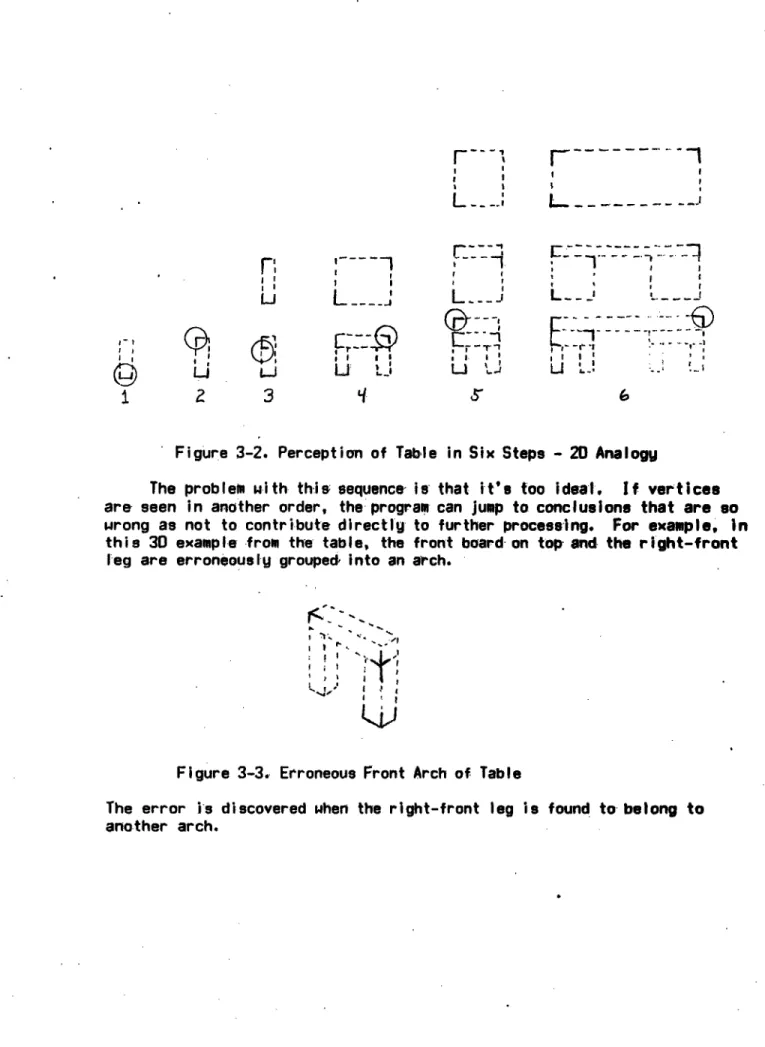
A straightforward scenario for perceiving a two-dimensional analogy of the table would be:
PAGE
22
L - -
!.
. .... "
LJ
L
F', .... @ I- -* F--Iq , I,...L u
|
1
2
3
9
6
Figure 3-2. Perception of Table in Six Steps - 20 Analogy
The problem with this sequence is that it's too ideal. If vertices
are seen in another order, the progrem can jump to conclusions that are so
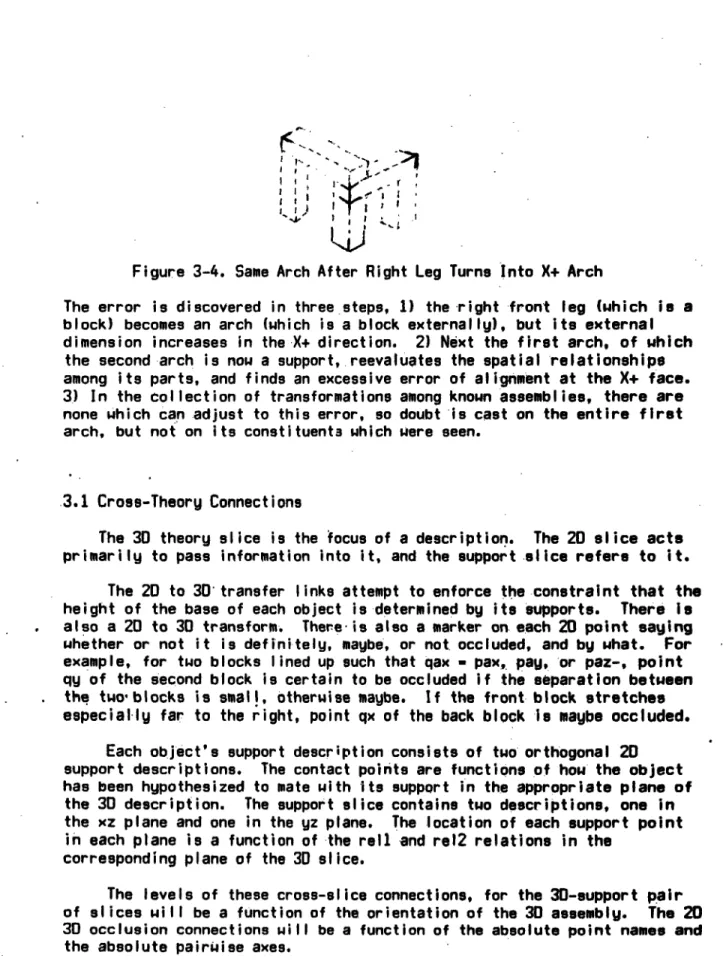
wrong as not to contribute directly to further processing. For example, in this 30 example from the table, the front board on top and the right-frontleg are erroneously grouped into an arch.
I .
Figure 3-3. Erroneous Front Arch of Table
The error is discovered when the right-front leg is found to belong to another arch.
PAGE 23
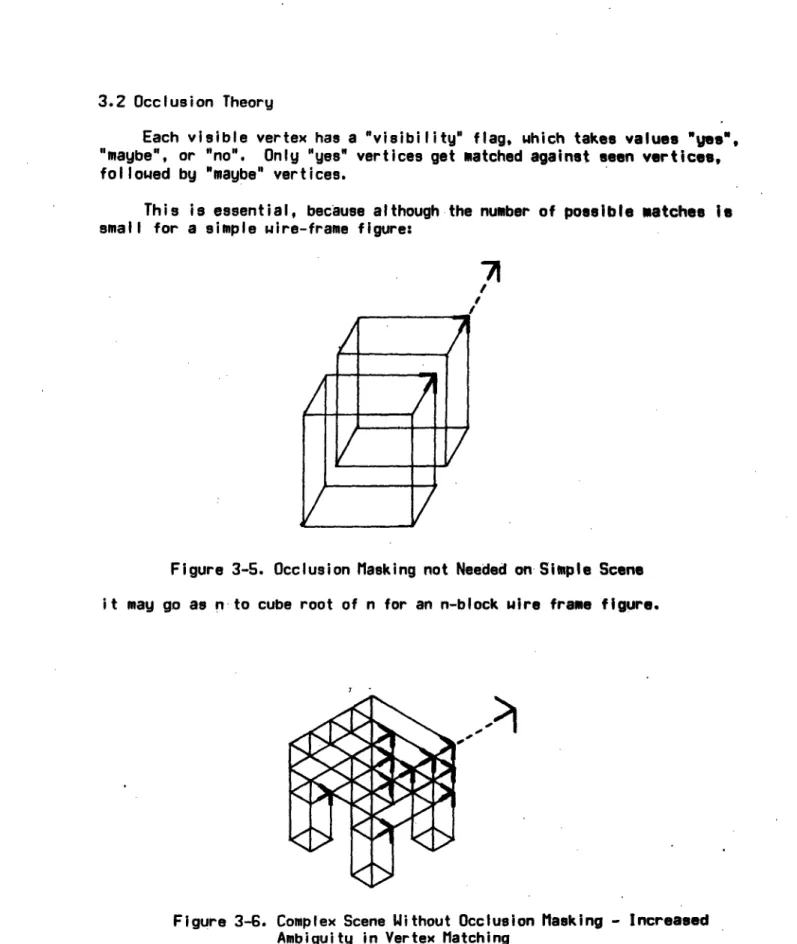
Figure 3-4. Same Arch After Right Leg Turns Into X+ Arch
The error is discovered in three steps, 1) the right front leg (which is a block) becomes an arch (which is a block externally), but its external dimension increases in the X+ direction. 2) Next the first arch, of which
the second arch is now a support, reevaluates the spatial relationships among its parts, and finds an excessive error of alignment at the X+ face. 3) In the collection of transformations among known assemblies, there are none which can adjust to this error, so doubt is cast on the entire first arch, but not on its constituents which were seen.
3.1 Cross-Theory Connections
The 30 theory slice is the focus of a description. The 20 slice acts primarily to pass information into it, and the support slice refers to it.
The 20 to 30 transfer links attempt to enforce the constraint that the height of the base of each object is determined by its supports. There is also a 20 to 30 transform. There is also a marker on each 20 point saying whether or not it is definitely, maybe, or not occluded, and by what. For example, for two blocks lined up such that qax - pax, pay, or paz-, point qy of the second block is certain to be occluded if the separation between the two blocks is small, otherwise maybe. If the front block stretches especial-ly far to the right, point qx of the back block is maybe occluded.
Each object's support description consists of two orthogonal 20 support descriptions. The contact points are functions of how the object has been hypothesized to mate with its support in the appropriate plane of
the 30 description. The support slice contains two descriptions, one in the xz plane and one in the yz plane. The location of each support point
in each plane is a function of the rell and rel2 relations in the corresponding plane of the 30 slice.
The levels of these cross-slice connections, for the 30-support pair of slices will be a function of the orientation of the 30 assembly. The 20 3D occlusion connections will be a function of the absolute point names and the absolute pairiise axes.
PAGE 24
3.2 Occlusion Theory
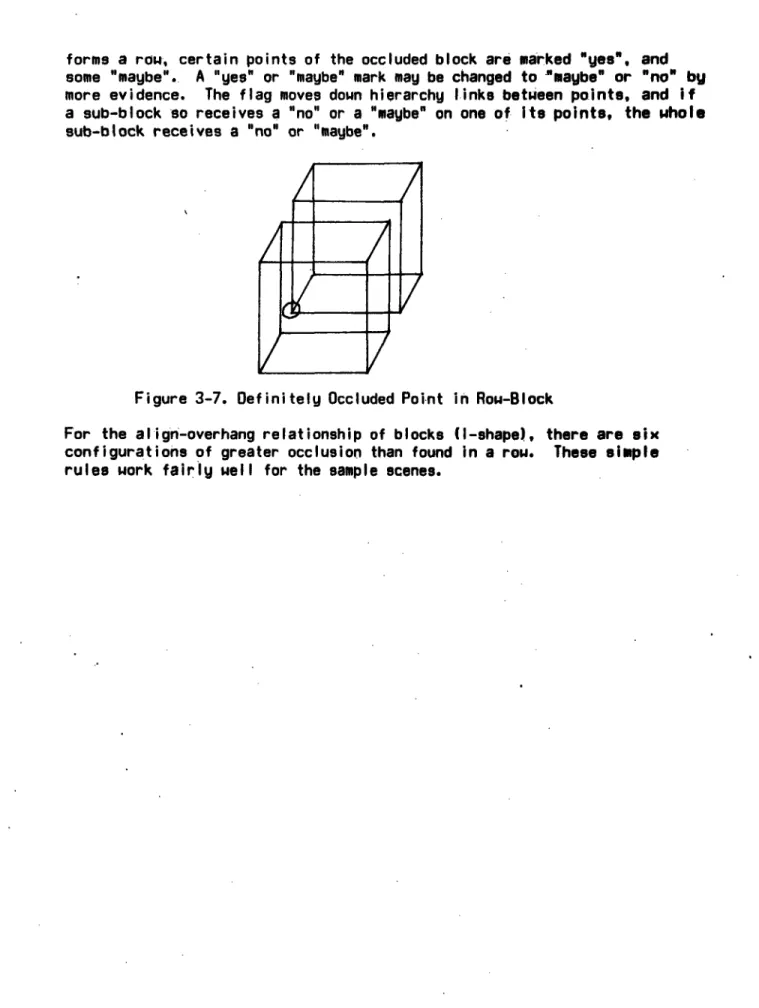
Each visible vertex has a "visibility" flag, which takes values "ges",
"maybe", or "no". Only "yes" vertices get matched against seen vertices,
followed by "maybe" vertices.
This is
essential, because although the number of possible matches Is
small for a simple wire-frame figure:
/1
/'
7
Figure 3-5. Occlusion Masking not Needed on Simple Scene it may go as n to cube root of n for an n-block wire frame figure.
~>1
Figure 3-6. Complex Scene Without Occlusion Masking - Increased Ambiguity in Vertex Matching
Occlusion information comes from the 20 theory slice. If.a pair of blocks
L /
/
/ -
PAGE 25
forms a row, certain points of the occluded block are marked "yes", and some "maybe". A "yes" or "maybe" mark may be changed to "maybe" or "no" by
more evidence. The flag moves down hierarchy links between points, and if a sub-block so receives a "no" or a "maybe" on one of Its points, the whole
sub-block receives a "no" or "maybe".
Figure 3-7. Definitely Occluded Point in Row-Block
For the align-overhang relationship of blocks (I-shape), there are six configurations of greater occlusion than found in a row. These simple rules work fairly well for the sample scenes.
PAGE
26
4.0 Learning a Global Description
I believe that a child at play, a scientist, or an inventor is learning concepts which help him to solve problems. The issues already discussed, local-global description, purpose, and perception, shed light on this process.
In this example, a learner, who is reasonably familiar with assemblies of blocks, learns the concept of a "hook", not by being told it, or by seeing repeated instances, but by inventing it to describe the important point of an experiment. I do not suggest how the experiment is proposed, but I do suggest how it could be understood.
I was led to seek this kind of example out of a great uncertainty as to what kinds of properties should be present in a global description. In other words, the problem is not so much finding the global description, as
finding which global description.
The point of this example is that the global description is made which pertains directly to the purpose of pulling. An auxiliary point is that,
to make this description, a new concept must be formulated, the "hook", along with descriptions of its form and use, and purpose in the guise of causality served to delineate that concept.
The learner is confronted with the following scene:
Figure 4-1. Surprise!
-
One Arch Can Pull Another
His perceptual process describes A and B as two rigid arches, each
block-shaped, with B to the right of A. He knows that B isn't reallu to the
right of A, but he doesn't know how else to describe it. This description
matches the "separating" entry point of the two-object-motion frame system
shown in
Figure 4-2, making him expect that B's motion will not cause A to
move. Since B's motion does cause A to move, which matches "pulling", he
(DEF TWO-OBJECT-MOTION-SYSTEM
(POSITIVES A Al (A IMM-OF A1)((A IMM-OF Al)
(Al SPACE-FOR B)
B B1 (B IMM-OF B1)((B IMM-OF 81)
(B1 SPACE-FOR A)
(A MOVES
S3)(B
MOVES S4)
((B
MOVES S4) C (A
MOVES.S3)))
(VARIABLES
(51
(LEFT
RIGHT))
(S2 (LEFT RIGHT))
(S3 (LEFT RIGHT))
(S4 (LEFT.RIGHT))
(Xl (SAME OPPOSITE))
(X2 (SAME OPPOSITE))
(C (CAUSE NOT-CAUSE)))
(CONSTRAINTS.
(S1 OPPOSI.TE S2)
(S3 SAME S4)
(S1 X1 S3)
(S2 X2 SA)
(X1 OPPOSITE X2))
(DEF SEPARATING
(DEFAULT (S1 LEFT) (S2 RIGHT)
(S3
RIGHT) (S4 RIGHT)
(Xl
OPPOSITE)(X2
SAME)
(C
NOT-CAUSE)))
(DEF PUSHING
(DEFAULT
(Si LEFT)(S2
(S3 LEFT)(S4
(Xl SAME)(X2
(C
CAUSE)))
SENSE S1)
SENSE S2)
RIGHT)
LEFT)
OPPOSITE)
(DEF PULLING
(DEFAULT (S1 LEFT) (S2 RIGHT)
(S3 RIGHT)(S4 RIGHT)
(XI OPPOSITE) (X2 SAME)
(C
CAUSE)))
(TRANSITIONS (SEPARATING (X1 SAME PUSHING)
(C
CAUSE PULLING))
(PUSHING (Xl OPPOSITE SEPARATING)
(X2
SAME PULLING))
(PULLING (C
NOT-CAUSE SEPARATING)
(X2 OPPOSITE PUSHING))))
Figure
4-2a.
PAGE
28
PAGE 29
The learner is not only surprised, but he recognizes this as a useful phenomenon because it fills a gap in his index of methods for making things move:
push -- (shoving algorithm) needs nothing extra pull -- (gluing algorithm)
needs glue, messy, irreversible
-- (stringing algorithm)
needs string and little holes in objects
-- (new algorithm)*
depends only on shape
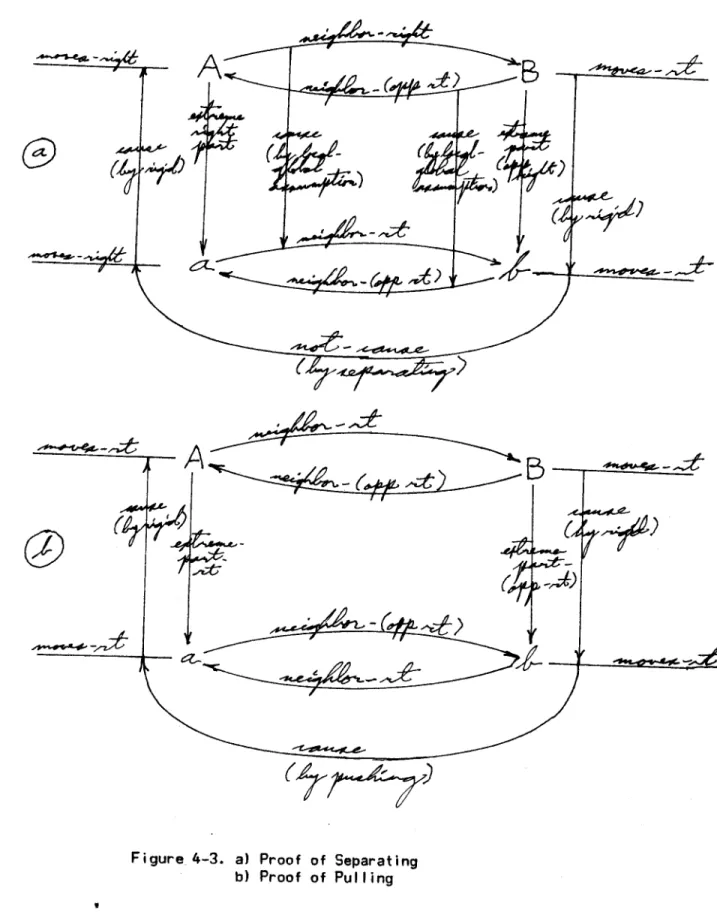
Next he does a causal analysis. That is, he makes proofs (See Figure 4-3) in which the causality is explicitly represented as links in the description (a la Schank). (Schank) First the learner proves that the event was possible by looking at the next lower level of detail. He compares this proof with a recalled proof of why the objects should separate. The difference lies in the relationship of the two blocks
forming the contact interface, which is opposite to what would normally be expected for contact among wholes.
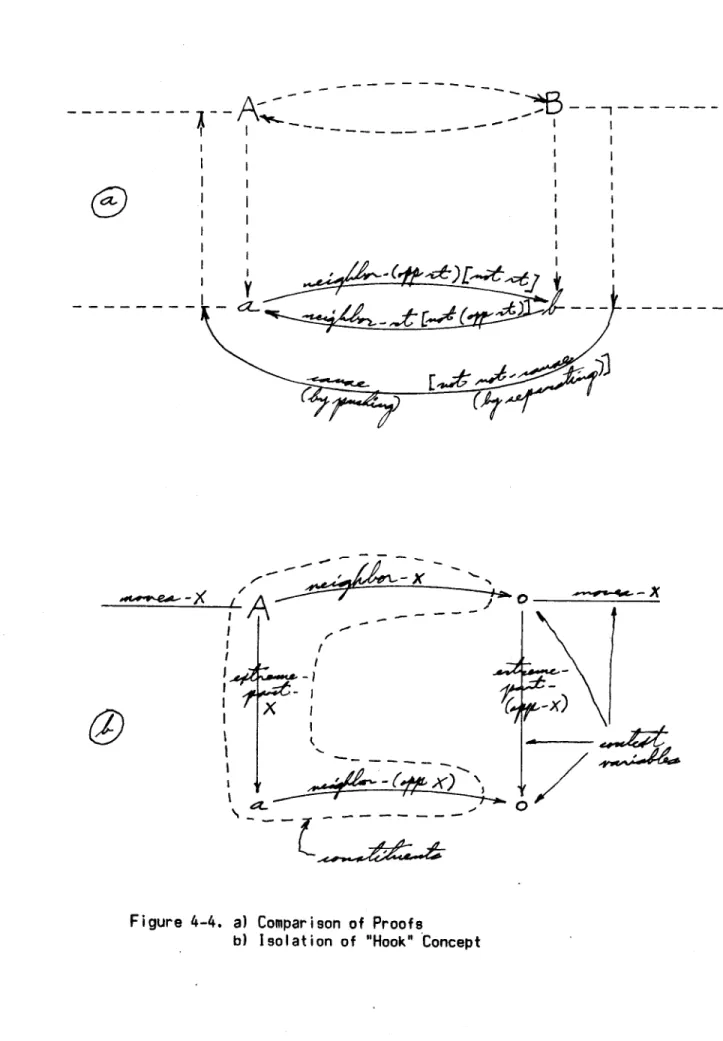
Finally he makes a proper generalization of this difference. The difference is divided so as to isolate the portions which belong to each side. Then, on each side, is a description that says that an extreme
block, rigidly fixed to its parent assembly, has space on the face opposite to its external face, to be occuoied by a block from another assembly. This statement forms the new concept corresponding to What humans call a "hook". (See Figure 4-4). If two objects have hooks, then in that sense they are the same as these two arches, and should therefore behave the same.
Note that the hook description makes explicit reference, via context variables, to the other hook with which it potentially mates. A context variable is an explicit reference to some item in the object's spatial context. It is variable because it can be filled either by a neighboring object or the space that object would occupy.
As always, the problem in learning is not how to remember an event but how to make the right generalized statement of what happened. (also how to
find the right things to learn.) The right'kind of statement to remember is one which captures the principle or crucial feature of the event as
separate from the irrelevant details. This scenario shows how the principle of an event can be found by analyzing it in terms of causal models of behavior, in which "purpose" takes the form of a chain of causation.
(%Aý4'E7
Figure 4-3. a) Proof of Separating b) Proof of Pulling
PAGE
30
(.
PAGE 31
0
!.
1JA-
(#-)*. ' 73
---I I I I-x
-- - I I , X -0-Figure 4-4. a) Comparison of Proofs
b) Isolation of "Hook" Concept
`1;E
c
I II ,e P•~c~f~2:
~ui~
R,
--K) \ 7~s oPAGE 32
This example of learning builds from Winston's program (Winston) in
tuo theoretically important respects:
Molecularism -- Winston's program learns on the basis of feature
differences which are more or less obvious. Blocks, wedges, and relations are considered atomic units without any fine structure. More realistic descriptions cannot ignore the lower details of shape, corners, edges, sides, axes, spaces, contact points, etc. In the presence of all this detail, differences are not so obvious, so purpose must be used to project the description down to a simpler one, or to emphasize the important
detailed features.
Indication -- In. inston's program, a training sequence of examples serves to indicate the constituents of the concept and then to emphasize certain single features, one per example. It is inherently difficult to indicate a conjunction of differences because there.usually are several differences
lying around anyway, and the program has no way to know that more than one was intended. In the scenario presented here, the causal chain serves to
indicate a conjunction of differences which might not otherwise seem
important. It is that causal chain which indicates the parts of the "hook" and emphasizes them.
PAGE 33
5.8 Complexity, Texture, and Figure-Ground
One direction for improvement of the system described here is to permit condensed, procedural description of really complex scenes. It is unreasonable to expect a perceiver to build a complete description of a brick wall, for example. A scene which tests the system's capacity is the
following row of twenty-two blocks:
Figure s-1. Row of Too Many Blocks
My
system would attempt to describe this as an assembly of twenty-two
blocks, having the overall shape of a single block. A better way to
represent this would be as a repetition of blocks having the overall shape
of a single block, something like a Fortran DO loop with end conditions.
Then, only as much of it
need be instantiated as is
the object of
attention:
~-
1
mO
LEJLJWLJL
[r1i liii I
11111 1
,~
Figure 5-2. Operation of a Procedural Model
The instantiation process for procedural descriptions is not difficult theoretically, as long as interconnections can be made in a relatively uniform manner. For example, a recent thesis by (Baumgart) describes a
m • X i b~cC~rZld~ m ~C~l~fiC X T'lr r I II II I I II I Lb 1L-~ L-~L _I -p~7~- +lurL~c
PAGE
34
system called Geomed in which procedures build and manipulate rather
detailed data structures. while maintaining strong global properties, like getting a torus to close on itself. This is the kind of thing I have in mind as procedurally described data structure, but it needs to be augmented with adjustability and ability to change structurally in response to the data. This.uill probably mean giving up the exact registration of 'different parts of the description.
The next question is "How could this kind of hypothesis get built?" MU system would first see two or three individual blocks, hypothesize the row and its overall shape, and procede to verify it.
Recent theoretical work by Marr (Marr) on computational models of the mamalian visual cortex is relevant to this point. He would say that before one sees blocks, one sees an elongated texture patch representing the
entire object, having a boundary of connected lines, where the texture consists of parallel line segments, i.e. that the initial guess at global form, or figure vs ground, arises not from the blocks, but from the lines. He proposes that simple shapes like blobs and stripes are found in this
way, and that the process is recursive, so that, for example, stripes of blobs can also be found. This would explain the square ve diamond
illusion:
Figure 5-3. Global-Prior-to-Local Perception
in which the principal axis, part of the global form, is derived prior to description of the. local entities, effecting their perception as diamonds or squares, respectively.
On the other hand, it is possible for the local perception to be prior to the global, as for example in noisy scenes like road maps. Usuall on a road map, of say Massachusetts, the name of each county is printed in
PAGE 35
N
0
R
ToL
v
o
0I
W#1
K
F ll
Ri
er
Figure 5-4. Local-Prior-to-Global Perception
To see what county it is, one has to look for one or two letters,
hypothesize where the rest of the word is, and then look for the remaining
letters.
5.1 The Appearance of a Bolt
The end of a threaded bolt is a good example of texture (the threads) superimposed on an overall shape. It is a good example of texture which could easily admit a procedural description.
The appearance of a small cylinder is fairly easy to characterize. It generally has one highlight, somewhat off-center. On either side of the highlight the intensity falls off smoothly to merge with the side patches. The side patch on each side reflects the immediate background, and it is light or dark accordingly. Then there is usually a shadou on the side opposite* the main highlight. Surrounding all this is the background level
PAGE
35
rFvI
Figure 5-5. Appearance of Simple Cylinder
A model of this would contain, at the top level, an axis direction, end points, and radius for the cylinder, direction of illumination,
distance to background, intensity and tilt of background, Belou this would be axial offset, brightness, and width of the highlight, matte brightness of the cylinder, brightness and position of side patches, position and width of shadow. Then there would be examiners for the various features, highlights, shadow, side patches, and ends.
To extend this model to a bolt, it is necessary to represent the thread texture. Looked at finely, threads look likes
I
I
PAGE 37
Figure 5-6. Appearance of Threads
Going across the axis, the top, face, and fillet of a thread each has an intensity profile which is similar to that of a simple cylinder. In
addition, all the tops tend to look alike, and so do the faces and fillets, so that profiles parallel to the axis would also be parallel, at least
locally. The threads are quite amenable to an iterative description. This iteration could move along the overall axis of the bolt. There can be local modifiers to the effect that the threads are more shiny at one end than at the other, for example.
PAGE
38
6.0 Organization and Representation
I have said that this system is primarily top-down. By this f mean that the information at the top decides what to do as a result of each morsel of evidence. This is because the morsels themselves are too unreliable, incomplete, and ambiguous to tell us directly what top-level objects there are. But this leads the system to a strange impasse; it cannot see things which it cannot guess at the top level, and it cannot distinguish a very wide variety of things on single vertex appearance alone. This may not be a complaint against frame systems in general so much as against first attempts to build them using feeble representations.
The top-down vs. bottom-up controversy seems to be really a matter of coherence vs. flexibility. To encapsulate the argument:
bottom-up: local
admits highly parallel processing go6d for detecting surprises
flexible - reports arbitrary conjunctions of simple features upward ambiguity increases with variety of scenes
top-domn: global
builds meaningful hypotheses great on ambiguous input
hard to incorporate much variety
Good straw men to compare these approaches are Waltz's system (Waltz) and
mine.
Waltz's system is flexible. It can process almost any polyhedral solid, with shadows, and label all the line segments as convex, concave, or occluding, for example the following:
Figure 6-1. Arbitrary Polyhedra
My system wouldn't have a prayer on these shapes because a) it can't imagine them, and b) even if it could, it couldn't distinguish them on single vertex appearances.
On the other hand, when Waltz's system has processed these drawings it still doesn't know what's there. All it has is a network of vertices and
PAGE 39
labeled lines. For example, it
can't tell you what the shape is,
and it
doesn't realize there is
a hole. Of course it
uasn't intended to do those
things, which.merely reinforces the argument.
My system, on the other hand, likes this kind of drawing:
Figure 6-2. Rou of Three Blocks
in
which two of the blocks, though obscured and having ambiguous T and PSI
vertices, are seen as clearly as the one in front, and the collection has
the overall shape of one big block. The drawing can be quite incomplete
because the system demands only the bare minimum of agreement with the
hypothesis. However, it
has trouble with a simple variant:
Figure 6-3. L-shape of two blocks
This configuration is seen either as a rou with an anomalous member or as an incomplete ushape. It is also seen as two blocks aligned at one corner. It is not seen as a coherent I-shape because that is not in its battery of basic shapes. For example, it can't tell you jhere the "inside corner" is. Although I-shape could be added once one figured out how it could go into combination with larger assemblies, it is not hard to. find harder examples.
These two systems represent extremes in the bottom-up vs. top-down tradeoff. However, there is a middle ground which can.be gotten by a better representation, namely generalized cylinders (Agin) (Hollerbach).
A generalized cylinder has an axis, which is some line segment in space, possibly bent, and one or more cross section shapes suspended on it. Simple variations of these basic features can represent a reasonably wide
variety of shapes.
The way' my system is presently organized, it goes directly from vertices to blocks (and thence to larger blocks):
PAGE 48
-- I t - 4-
.r,,
/-
# I - 4/
I,'
.
.. I//
__I
L
_k
Figure 6-4. Current organizatior
A better way to organize it would be to representation:
I
-I--- - "
I
-use cylinders as an intermediate
L
_4
Figure 6-5. Using Cylinders as Intermediate Representation
If this were then tied together with a Waltz-like system operating on the input, it would combine the best features of all.
PAGE 41
artificial and constrained visual world. It is
a little strange compared
to people vision where everyday objects can be identified on the basis of
local cues alone. For example, Piaget reports (Piaget) that children who
have difficulty distinguishing between a triangle and a trapezoid have no
trouble on a fountain pen, spoon, scissors, flower, etc. At this level,
comparing my vision system to a real one is
a bit like comparing the
alphabet of a Turing machine to a children's dictionary,. The blocks world
is
overly concerned with arrangement of features. This is
good because It
has to be tackled. However, real vision relies more heavily on the unique
content of individual micro-scenes, texture, color, shape, etc.
PAGE 42
References
1. Agin, G., Representation and Description of Curved Objects, Memo
AIM-173, Stanford Artificial Intelligence Project, October, 1972.
2. Baumgart, B., Geometric Modeling for Computer Vision, AIM-249, Computer
Science dept., Stanford University, October 1974.
3. Clowes, Mi., unpublished document, 1974.
4. Grape, G. R., Model-Based (Intermediate-Level) Computer Vision, Stanford
Artificial Intelligence Lab., Memo AIM-281, nay 1973.
5. Hollerbach, J. M., Hierarchical Shape Description of Objects by
Selection and Modification of Prototypes, MS Thesis, Electrical
Engineering Department, Massachusetts Institute of Technology, June
1974.
6. Kuipers, B., A Frame for Frames: Representing Knouledge for Recognition;
AI Memo 322, MIT AI Lab., Cambridge, Mass. March 1975.
7. Lozano, T., Parsing Intensity Profiles, Al Memo 329, MIT Al Lab.,
Cambridge, Mass. May 1975.
8. Marr, D., Analyzing Natural Images: A Computational Theory of Texture
Vision, Al Memo 334, MIT Al Lab., Cambridge, Mass. June 1975.
9. Minsky, M. L., A Framework For Representing Knouledge, MIT Artificial
Intelligence Lab. Al Memo 386, June 1974.
18. Piaget, J. and Inhelder, B., The Child's Conception of Space, M. M.
Norton & Co., New York, 1967.
11. Roberts, L. G., Machine Perception of Three-dimensional Solids, in
Optical and Electrooptical Information Processing, Tippett, J. T., et
al (ed.). MIT Press, 1965.
12. Schank, R., and Rieger, C., Inference and the Computer Understanding of
Natural Language, AIM-197, Computer Science Dept., Stanford
University, May 1973.
13. Sutherland, I.,
Sketchpad: A Man-Machine Graphical Communication
System, Tech. Report 296, MIT Lincoln Laboratory, Lexington, Mass.,
January 1963.
14. Waltz, D., Generating Semantic Descriptions From Drawings of Scenes
With Shadows, Al-TR-271, MIT AI Lab., Cambridge, Mass., November,
1972.
PAGE 43
Program for Understanding Natural Language, MIT Project MAC TR-84, Cambridge, Mass., February, 1971.
16. Winston, P., Learning Structural Descriptions From Examples, AI-TR-231, MIT Al Lab., Cambridge, Mass., September, 1978.