HAL Id: hal-03159965
https://hal.archives-ouvertes.fr/hal-03159965v2
Submitted on 26 May 2021
HAL is a multi-disciplinary open access
archive for the deposit and dissemination of
sci-entific research documents, whether they are
pub-lished or not. The documents may come from
teaching and research institutions in France or
abroad, or from public or private research centers.
L’archive ouverte pluridisciplinaire HAL, est
destinée au dépôt et à la diffusion de documents
scientifiques de niveau recherche, publiés ou non,
émanant des établissements d’enseignement et de
recherche français ou étrangers, des laboratoires
publics ou privés.
Shadow computation with BFloat16 to compute
numerical accuracy
David Defour, Pablo de Oliveira Castro, Matei Istoan, Eric Petit
To cite this version:
David Defour, Pablo de Oliveira Castro, Matei Istoan, Eric Petit. Shadow computation with BFloat16
to compute numerical accuracy. IEEE 28th Symposium on Computer Arithmetic (ARITH), Jun 2021,
Virtual Conference, France. �hal-03159965v2�
Shadow computation with BFloat16 to estimate the
numerical accuracy of summations
David Defour
LAMPS, Univ. of Perpignan France.
Email: [email protected]
Pablo de Oliveira Castro
and Matei Is¸toan
Universit´e Paris-Saclay, UVSQ, LI-PaRAD, ECR France
Email: {pablo.oliveira, matei.istoan}@uvsq.fr
Eric Petit
Intel Corp. Email: [email protected]
Abstract—In this article, we propose to exploit the new compu-tational capability offered by the Bfloat16 representation format to perform shadow computations and compute estimations of the relative error. We demonstrate and evaluate the assumptions under which shadow computation is valid for the summation problem.
I. INTRODUCTION
With the finite precision arithmetic available in today’s processors, results are subject to numerical errors which can come from rounding errors. It is difficult to estimate the numerical error of a computation without further investigation, or, when comparing two results, find the one which exhibits the smallest relative error.
Meanwhile, we are witnessing a generalization in the sup-port of low-precision floating-point formats in order to address new use-cases (ex: neural networks). Among them, Bfloat16 (or BF16) leads to a tremendous increase in processing power (8-32x peak FLOPS higher than Binary32). Furthermore, the Intel AMX implementation [1] can be used concurrently with the AVX FP32 units, which means that with careful software design, a shadow BF16 execution can have a low overhead. The BF16 FMA operation uses BF16 inputs and a Binary32 accumulator that can be saved to memory in either Binary32 or BF16. It has been demonstrated that the 32-bit accumulator is a low-overhead, critical feature to handle AI workloads [11], by avoiding absorption (swamping effect)
In this article, we are interested, regarding Binary32 and Bfloat16 computation for the summation problem, in:
• Predicting a result’s accuracy and detect potentially faulty execution using estimators.
• Given two computed results in Binary32, determining the one with the smallest relative error.
II. BIBLIOGRAPHY AND RELATED WORKS
The study of error and in particular of round-off error due to the use of floating-point arithmetic is an important field of numerical analysis. A posteriori error analysis take into account uncertainty and rounding error along with the main computation leading to a computational and memory overhead, slowing the observed computation.
Funding: This work was supported by the ANR-20-CE46-0009 InterFLOP
Stochastic arithmetic estimates the error distribution with a stochastic simulation of round-off effects, either applying random rounding at each step of the chain of computation [18] or through Monte-Carlo arithmetic [15]. It can help localizing numerical errors in post-mortem numerical analysis but is impractical for online error estimation.
Interval arithmetic is used to model uncertainty on input data, along with round-off error, in order to guarantee the results [12]. It has a contained memory and computational overhead, but suffers from the dependency problem potentially leading to large uninformative interval.
Error analysis on a sequence of operations can be done by devoting extra memory and computational resources to recom-pute with extra-accuracy, either by using dedicated arithmetic (ex: MPFR[4], double-double[7]), or compensation [5].
For each of the previously mentioned methods, beside the fact that the overhead in terms of resources can be large, none of them is able to provide numerical information, for an additional cost that is lower than the original computation. The application range of BF16 has been limited to specific fields, such as AI, due to the limited accuracy of the format. Recently, Henry et al.[6] leveraged BF16 to speed-up com-putations by splitting Binary32 operations into sub-operations and provide an accuracy analysis. They also propose to use it-erative refinement with BF16 as a pre-conditioner to accelerate convergence in a LU solver.
The concept of replicating a sequence of computations, also called shadow replication, has been used in the context of fault tolerance for green cloud computing [14]. The replication can be limited to intermediate data in the context of shadow memory, used for example for numerical debugging [13].
III. BACKGROUND
Our objective consists of using the extra computational capabilities offered by BF16, available in today’s proces-sors, to estimate the numerical error for the classical (non-compensated) summation problem. In this section, we present the BF16 format and how errors can be bounded.
A. Bfloat16
Bfloat16 corresponds to a 16-bit shortened version of the IEEE-754 32-bit single-precision floating-point format (i.e. Bi-nary32). The 16 least-significant bits of Binary32 correspond
solely to mantissa bits, which allows for fast conversion to and from Bfloat16. The description of the bit fields of both formats, Bfloat16 and Binary32, are given in Figure 1.
As we can observe, the difference between both formats lies in the fraction field, which is 7-bits long, as opposed to 23-bits in Binary32. This means that the representation range of both formats is almost equivalent.
sign exponent (8 bits) fraction (7 bits)
0 7
15
0 0 1 1 1 1 1 0 0 0 1 0 0 0 0 0 14 6 (bit index)
sign exponent (8 bits) fraction (23 bits)
0 23
31
0 0 1 1 1 1 1 0 0 0 1 0 0 0 0 0 0 0 0 0 0 0 0 0 0 0 0 0 0 0 0 0 30 22 (bit index)
Fig. 1: The Bfloat16 and Binary32 format
B. Rounding error analysis
We denote by 4f(x) and f(x) the rounding away from 0 and the rounding to nearest of x ∈ R, respectively, in the format f . Among the considered formats, in this article we use Binary64, Binary32 and Bfloat16, which are represented in the rest of the paper by b64, b32, bf 16.
In the interval of representable numbers, the output of floating-point operations is impacted by rounding, absorption and catastrophic cancellation errors. In the case of the sum sn = Pni=1xi of a vector xi of floating-point numbers, the real absolute error depends on the order of the partial sum-mations. However, there exist metrics which are independent of the order. In rounding to nearest, the approximated compu-tation csn of the true sum, can be bounded [8], independently of the order, for all summation methods without overflow as follows: |csn− sn| ≤ (n − 1)uf n X i=1 |xi| + O(u2f) (1)
with uf the machine precision (uf = 2−53; 2−24; 2−8 for b64, b32 and bf 16 respectively).
Rump introduced the unit in the first place concept (ufp) to perform elegant error analysis, such as in [16]. He pro-posed algorithms to compute estimations of the error for the summation and dot product problems. For the summation, the algorithm is: b s1= x1; cT1= |x1| for {k = 2; k ≤ n; k + +} do b sk = f(sk−1d + xk) c Tk = f( [Tk−1+ |xk|) end for
The computed estimator cTncorresponds to the accumulation of the absolute value of the xk for each step of the algorithm. Both sbk and cTk must use the same floating-point format. It can be used to derive a computable absolute error bound:
|csn− n X i=1 xi| ≤ (n − 1) · uf· ufp(cTn) ≤ (n − 1) · uf· cTn
This bound is known to be a pessimistic upper bound, especially when dealing with random data. Except for very particular cases, the real bound is lower [8]. Using probabilis-tic assumptions about the rounding error, a relaxed bound can be derived [9] which grows as √n.uf instead of n.uf for the worst case. In [10], the authors extended their work by proposing a bound depending on the data range distribution independently of n.
IV. PROPOSED STRATEGIES
Relative error, or approximation error is a useful metric to estimate the number of correct digits in a result. The question which we address is: how can we provide a computable relative error for a small overhead?
A. Reference relative error
In order to establish a fair comparison, we have to set a reference value, that we name Eref. Computing the relative error would require, in the case of the summation problem, computing the reference value using a long accumulator in order to avoid rounding errors, such as the one proposed in [3]. However, for problems of reasonable size and condition number (eg. N < 220 and C < 230), computing the reference value using Binary64 can be considered enough:
Eref =|sb32d−sb64|d
|sb64|d (2) withsfb corresponding to the computed sum in format f with rounding to nearest mode.
B. Mixed bound
Rump’s estimator (cTn) is only valid when both cTn and c
sn are computed with identical floating-point formats and rounding modes. It is straightforward to use BF16 to compute c
Tn, and only requires few modifications. The proof of Rump’s estimator is based on the monotonicity of rounding ([16], equation (3.9)) which states that if |x| ≤ X and |y| ≤ Y then | f(x + y)| ≤ f(X + Y ) for x, y, X, Y ∈ R.
We propose to alter Rump’s algorithm, to replace the computation of cTn by cBn computed as follow:
Bk= \B(k−1)+ 4bf 16(|pk|); cBk= b32(Bk); (3) This corresponds to loading BF16 approximations of |pk|, using rounding away from zero, accumulated in a Binary32 accumulator using rounding to nearest. This corresponds to what is usually available in BF16 hardware.
Theorem IV.1. If |x| ≤ X and |y| ≤ Y , then | b32(x+y)| ≤ b32(4bf 16(X) + 4bf 16(Y )) for x, y, X, Y ∈ R.
Proof. Rounding away from zero lets us have |x| ≤ 4bf 16(|x|). Upscaling does not involve rounding error, there-fore b32(4bf 16(x)) = 4bf 16(x). Thanks to the monotonic-ity of rounding, we get | b32(x + y)| ≤ b32(4bf 16(X) + 4bf 16(Y )).
Note that it is possible to consider performing everything in BF16 with rounding away from zero (including the accu-mulation), based on the fact that double rounding issues do not occur with directed rounding. This leads to | b32(x + y)| ≤ b32(4bf 16(X) + 4bf 16(Y )) ≤ 4bf 16(4bf 16(X) + 4bf 16(Y )). However, an inevitable drift from the real value happens, as it is usually observed with interval arithmetic, but emphasized here by the poor accuracy provided by BF16. We propose the following mixed bound Emixed, based on Rump’s estimator for the absolute value, using BF16 input values:
Emixed= (n − 1) · ub32· \ Bbf 16
|sb64|d (4) with sb64d computed in rounding to nearest and \Bbf 16 com-puted as in equation 3.
C. Fully computed bound
Equation 4 cannot be considered a fully computable bound as it requires |sb64|. We have to bound |d sb64|d−1 using the computed quantities (sb32d and \Bbf 16). One may use the fact that |S| ≥ |sdb32| − (n − 1)ub32\Bbf 16 to propose the following computed estimator: Ecomp= (n − 1) · ub32· \ Bbf 16 |sdb32| − (n − 1)ub32B\bf 16 (5)
This estimator is valid only if |sb32| > (n − 1)ub32d Bbf 16.\ D. Approximate estimator number 1
Equation 5 is a valid upper bound corresponding to the worst case scenario. As for other estimators, we can consider a more plausible one. In particular, we use the approximation |S| ≈ |sb32| to propose the Eapproxd estimator:
Eapprox= (n − 1) · ub32· \ Bbf 16
|sdb32| (6)
V. RESULTS
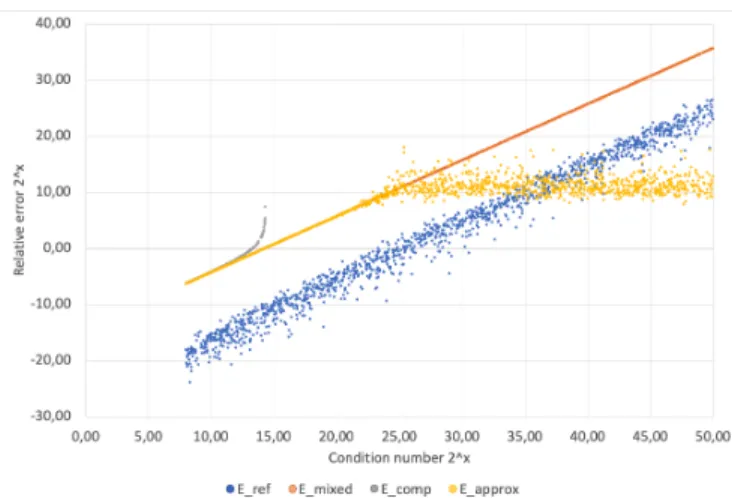
This section illustrates through some experiments how BF16 shadow computation can add numerical information on a main computation done in Binary32. To do so, we compare the four estimators on the summation problem. We have executed the naive summation for 5000 vectors of 400 floating-point numbers with condition numbers ranging from 26 and 250. We use a random generator inspired by the GenSum function in [17]. Results are reported in Figure 2, which represents the relative error in log scale according to the condition number. We observe that all four estimators are above (overestima-tion) the reference error (in blue) for problems of condition number less than 224. For problems of condition numbers greater than this bound, we observe that the mixed estimator follows through a straight line the real error. The bound Ecomp defined in equation 5 (in grey) presents a singularity for prob-lems of condition number greater than 214. This is due to the validity condition of the estimator (|sdb32| > (n−1)ub32B\bf 16). Finally, the approximate estimator (yellow) behaves as the
Fig. 2: Relative error for random vectors of size 400 for the four estimators according to the condition number.
mixed estimator for problems of condition numbers less than 224. With larger condition numbers, it saturates at an error 210. Even though this estimator is wrong in this case, it still indicates that all bits are lost in the result, which is an important information.
Fig. 3: Relative error for random vectors of size 40000 for the four estimators according to the condition number.
We have conducted tests on vector or larger size (Fig. 3). Previous conclusions stay relevant, we can observe that the differences for each estimators lies in the n factor (vector size parameter) leading to an upward shift of each plots.
A. Comparing numerical quality
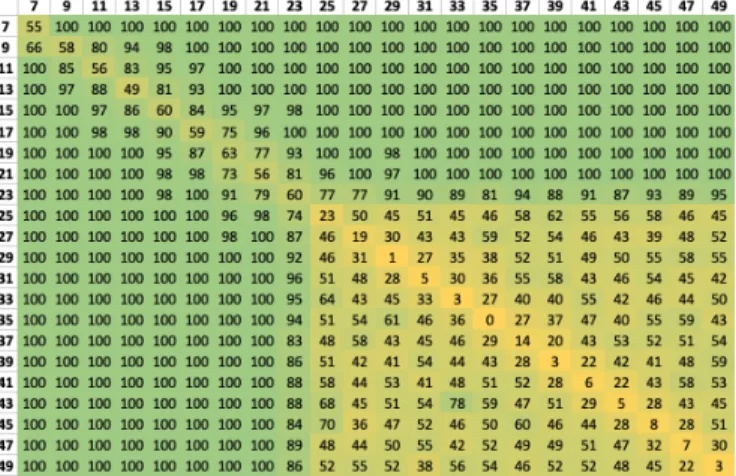
In this section, we illustrate how the approximated estimator Eapprox can be used to compare the numerical quality of two computed results. This could be useful, for example to detect the rise of computer zero during pivoting in LU factorisation [2] and make better selection. We have generated 105 random vectors of size 400. We counted the number of times the approximated estimator makes a correct prediction to determine which of two results presents the smallest relative error. Results are reported in Figure 4. It represents the
Fig. 4: Percentage of time that BF16 shadow computation make a correct prediction when comparing the relative error of two summation problems with condition number varying between 26 and 250.
percentage of correct predictions according to the condition number of both vectors, indicated in xy-coordinate.
We observe that the estimator correctly predicts which result is the most accurate as long as the difference is significant (diagonal) and the condition number for at least one vector is less than 223 (lower right square) . The difference has to be significant between the two vectors for problem of condition number less than 223as this corresponds to a sharp estimator (yellow line in fig. 2) and a reference relative error that may be better than expected (wide set of blue dots for a given condition number). For the lower right square, this corresponds to the place where the estimator predicts that all bits of accuracy are lost and cannot discriminate.
VI. CONCLUSION
In this article we proposed a computable estimator for the relative error in the case of the summation problem. This illustrates how BF16 computation resources can be used to add information on numerical quality to a Binary32 computation. Through tests, we have shown that the estimator follows the optimal bound for problems of condition number less than the number of bits available in the mantissa. When the condition number is larger, the estimator remains useful by indicating that all bits of information are lost. Finally, we have shown how the estimator successfully predicts which of two computed results is the most accurate, as long as the difference is significant. As future work, we plan to improve the theoretical ground of the proposed estimator and investigate if it attenuates the rise of computer zero during pivoting in LU factorisation.
REFERENCES
[1] Intel Architecture Instruction Set Extensions and Future Features Programming Reference - 319433-042 Decem-ber 2020.
[2] J. M. Chesneaux. The equality relations in scientific computing. Num. Algo., 7:129–143, 1994.
[3] S. Collange, D. Defour, S. Graillat, and R. Iakymchuk. Numerical reproducibility for the parallel reduction on multi- and many-core architectures. Parallel Computing, 49:83–97, 2015.
[4] L. Fousse, G. Hanrot, V. Lef`evre, P. P´elissier, and P. Zim-mermann. Mpfr: A multiple-precision binary floating-point library with correct rounding, 2005.
[5] S. Graillat, P. Langlois, and N. Louvet. Algorithms for accurate, validated and fast polynomial evaluation. October 01 2009.
[6] G. Henry, Ping Tak Peter Tang, and A. Heinecke. Leveraging the bfloat16 artificial intelligence datatype for higher-precision computations. In 2019 IEEE 26th Symposium on Computer Arithmetic (ARITH), pages 69– 76. IEEE, 2019.
[7] Y. Hida, X. S. Li, and D. H. Bailey. Algorithms for quad-double precision floating point arithmetic. In Proc. 15th IEEE Symposium on Computer Arithmetic, pages 155– 162. IEEE Computer Society Press, Los Alamitos, CA, USA, 2001.
[8] N. Higham. The accuracy of floating point summation. SIAM J. Sci. Comput., 14:783–799, 1993.
[9] N. J. Higham and T. Mary. A new approach to prob-abilistic rounding error analysis. SIAM J. Sci. Comput, 41(5):A2815–A2835, 2019.
[10] N. J. Higham and T. Mary. Sharper probabilistic back-ward error analysis for basic linear algebra kernels with random data. SIAM Journal on Scientific Computing, 42(5):A3427–A3446, 2020.
[11] D. Kalamkar et al. A Study of BFLOAT16 for Deep Learning Training, 2019.
[12] U. W. Kulisch. Mathematics and speed for interval arithmetic: A complement to ieee 1788. ACM Trans. Math. Softw, 45(1):5:1–5:22, 2019.
[13] M. O. Lam and B. L. Rountree. Floating-point shadow value analysis. In ESPT@SC, pages 18–25. IEEE, 2016. [14] B. N. Mills, T. Znati, and R. G. Melhem. Shadow computing: An energy-aware fault tolerant computing model. In ICNC, pages 73–77. IEEE, 2014.
[15] D. Stott Parker. Monte Carlo arithmetic: exploiting randomness in floating-point arithmetic. Technical Re-port CSD 970002, Department of Computer Science, University of California, Los Angeles, Los Angeles, CA, USA, 1997.
[16] Siegfried M. Rump. Error estimation of floating-point summation and dot product. BIT Numerical Mathematics, 52(1):201–220, March 2012.
[17] S.M. Rump. INTLAB - INTerval LABoratory. In Tibor Csendes, editor, Developments in Reliable Computing, pages 77–104. Kluwer Academic Publishers, Dordrecht, 1999. http://www.ti3.tuhh.de/rump/.
[18] J. Vignes. A stochastic arithmetic for reliable scientific computation. Math. Comp. Simul., 35:233–261, 1993.