HAL Id: hal-00001057
https://hal.archives-ouvertes.fr/hal-00001057v2
Submitted on 30 Jun 2005
HAL is a multi-disciplinary open access
archive for the deposit and dissemination of
sci-entific research documents, whether they are
pub-lished or not. The documents may come from
teaching and research institutions in France or
abroad, or from public or private research centers.
L’archive ouverte pluridisciplinaire HAL, est
destinée au dépôt et à la diffusion de documents
scientifiques de niveau recherche, publiés ou non,
émanant des établissements d’enseignement et de
recherche français ou étrangers, des laboratoires
publics ou privés.
Magnetic Field Enhanced Coherence Length in Cold
Atomic Gases
Olivier Sigwarth, Guillaume Labeyrie, Thibaut Jonckheere, Dominique
Delande, Robin Kaiser, Christian Miniatura
To cite this version:
Olivier Sigwarth, Guillaume Labeyrie, Thibaut Jonckheere, Dominique Delande, Robin Kaiser, et
al.. Magnetic Field Enhanced Coherence Length in Cold Atomic Gases. Physical Review Letters,
American Physical Society, 2004, 93, pp.143906. �hal-00001057v2�
ccsd-00001057, version 2 - 30 Jun 2005
Magnetic field enhanced coherence length in cold atomic gases
O. Sigwarth,1, ∗ G. Labeyrie,2 T. Jonckheere,1, † D. Delande,1 R. Kaiser,2 and C. Miniatura2 1
Laboratoire Kastler Brossel, Tour 12, Etage 1, 4 Place Jussieu, F-75005 Paris, France
2
Institut Non Lin´eaire de Nice, 1361 route des Lucioles, F-06560 Valbonne, France. (Dated: June 30, 2005)
We study the effect of an external magnetic field on coherent backscattering (CBS) of light from a cold rubidium vapor. We observe that the CBS enhancement factor can be increased with B. This surprising behavior shows that the coherence length of the system can be increased by adding a magnetic field, in sharp contrast with usual situations. This is mainly due to the lifting of the degeneracy between Zeeman sublevels. We find good agreement between our experimental data and a full Monte-Carlo simulation, taking into account the magneto-optical effects and the geometry of the atomic cloud.
PACS numbers: 42.25.Dd, 33.55.Ad, 32.80.Pj
During the last few years, ultracold atomic gases have become an ideal experimental and theoretical tool to in-vestigate quantum phase transitions. Well-known ex-amples are the Bose-Einstein condensation, degenerate Fermi gases and the Mott-Hubbard metal-insulator tran-sition [1]. Cold atomic gases also constitute extremely interesting samples to study weak and strong localiza-tion of waves in disordered media. Indeed, contrary to typical condensed matter samples (e.g. multiple scat-tering of electrons in metals or semiconductors), atoms interact very resonantly with light. Thus the scattering processes at work can be more finely controlled and an-alyzed, opening the way to new studies in localization phenomena. Of special interest is the so-called meso-scopic regime, where interefences between multiply scat-tered waves are not washed out by the disorder. Here the notion of coherence length Lφ is crucial since it sets the
characteristic length scale at which interference effects play a role in transport. For sample sizes L < Lφ, these
interference effects give rise to the so-called weak local-ization corrections of transport [2]. They originate from the interference between waves contrapropagating along loops in a scattering path. These interferences survive the configuration average and generally induce a nega-tive correction to the usual classical Drude-Boltzmann conductance, as evidenced in 2D-electron gases [3]. In optics, a related phenomenon is the coherent backscat-tering (CBS) effect [4]. Here the diffuse reflexion off the sample is enhanced around backscattering in a narrow angular range ∝ 1/(kℓ) ≪ 1 (k is the light wavevec-tor and ℓ the scattering mean free path) because of con-structive interferences between waves propagating along reversed paths. This interference effect is similar to the previous closed-loops interference and is maximum when the complex amplitudes of the reversed paths are exactly balanced. This is the case for time-reversal symmetric systems where, for a convenient choice of polarization channel, an enhancement factor close to 2 is observed [4]. These interferential corrections to transport are par-ticularly sensitive to any physical source of dephasing
susceptible to suppress interference. Some examples are inelastic scattering (electron-phonon interaction [2], sat-uration of an atomic transition [5]), spin-flip scattering [2] or internal degeneracies [6]. In this respect, the use of a magnetic field, which breaks time-reversal invari-ance, offers an efficient tool to investigate phase coherent effects [3]. In an electron gas, the loops of a diffusion path now enclose a magnetic flux which alters interfer-ence effects. As a consequinterfer-ence the coherinterfer-ence length is reduced as B is increased. These modifications of the weak localization corrections have been experimentally verified on magnetoconductance measurements [3]. In optics, one gets the same kind of results but evidenced in CBS studies. Adding an external magnetic field breaks the time-reversal symmetry, leading to unbalanced inter-fering amplitudes and consequently to a decrease of the enhancement factor [7, 8]. This is so because, by mod-ifying the refractive index of the medium, the magnetic field induces a Faraday effect which alters the phase dif-ference at propagation and, in turn, gradually destroys the CBS effect.
In this letter, we report the first study of the CBS enhancement factor with cold atoms subjected to an ex-ternal magnetic field B. We show an a priori surprising restoration of interference effects. Correspondingly, the coherence length is increased. This rather paradoxical re-sult stems from the existence of an internal structure of the atoms (a non-zero angular momentum, hence degen-erate, ground state) which is already responsible, at zero field, for unbalanced interfering amplitudes and reduced interference contrast [6, 9, 10]. The magnetic field breaks the degeneracy of the atomic ground state and splits the atomic resonance line (Zeeman effect). As B is increased, less and less Zeeman levels participate in the scattering process. At large enough fields, atoms behave as effec-tive non-degenerate two-level systems and full multiple scattering interference contrast is restored.
The paper is organized as follows. We first briefly de-scribe the experiment and our observations. We then discuss the basic physical ingredients and the principle
2 COLD ATOMS CCD (CBS) BEAM SPLITTER PROBE BEAM
B
kiFIG. 1: Principle of the experiment. An external magnetic field B is applied orthogonally to the incident wavevector ki.
A circularly-polarized laser beam is shined at the cold atomic cloud, and the backscattered far-field intensity distribution is recorded on a CCD (detection in the parallel helicity channel).
of the Monte-Carlo simulation. Then, we identify the various mechanisms at work, trying to give some simple physical pictures.
Our CBS experimental setup and its typical relevant parameters have been described in [6]. We have here added a pair of Helmholtz coils to produce a uniform ex-ternal magnetic field B perpendicular to the incoming light wavevector ki (Fig.1). The CBS probe is a weakly
saturating laser beam (linewidth less than 2MHz) with initial circular polarization ǫi, shined at the atomic cloud
while the magneto-optical trap (MOT) is off. It is quasi-resonant with the closed F = 3 → F′ = 4 transition of
the D2 line of Rb85 (wavelength λ = 780 nm, linewidth
Γ/2π = 5.9 MHz). The magnetic field is switched on slightly before the CBS probe is applied and the optical thickness at zero field is b = 31. During the measure-ments, for each value of B, the CBS laser is maintained at resonance with the Zeeman shiftedmF = 3 → mF′= 4
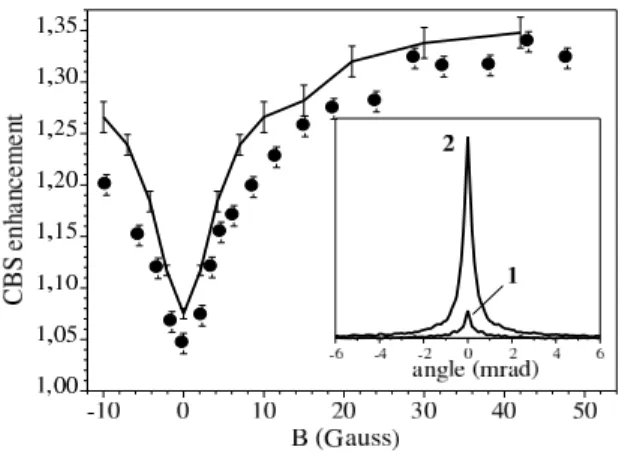
transition (quantization axis along B). This is an essen-tial feature to understand our results and the interpre-tation given below. The CBS signal is recorded in the so-called parallel helicity channel, where the detected he-licity is identical to the incident one. Results are shown in Fig.2, where the CBS enhancement factor α (peak to background ratio) is plotted as a function of B. It is observed that α, initially very small (≈ 1.05 for B=0), sharply increases with B and saturates around 1.33 above 30G. This behavior is obviously very different from the classical case, where α is reduced by the presence of B in all reported instances [8].
In the weak localization regime [11], a multiple scatter-ing path is depicted as a succession of sscatter-ingle scatterscatter-ing events (described by their scattering amplitudes) sepa-rated by average propagation in the effective medium (described by the refractive optical index). When a mag-netic field B is applied, the atomic energy levels are shifted by an amount ∆E = gmµB~, where g is the Land´e factor (respectively 1/3 and 1/2 for the ground and excited state considered here), m the magnetic quan-tum number and µ/2π = 1.4 MHz/G (Bohr magneton). The Zeeman splitting into a non-degenerate structure
af-FIG. 2: CBS enhancement factor of light on a cold Rb atomic cloud, measured in the parallel helicity channel h k h, as a function of the transverse magnetic field B (circles); it shows a dramatic increase at non-zero magnetic field whereas time-reversal symmetry is broken. For each B value, the laser is tuned to resonance with the mF = 3 → mF′ = 4 transition.
The solid line is the result of the Monte-Carlo simulation (no adjustable parameter). The inset shows two (angularly aver-aged) experimental CBS peak profiles for B=0 (1) and B=43 G (2).
fects both the properties of an individual scatterer and of the effective medium [12]. An essential difference be-tween usual scatterers and atoms is that atoms have an extremely resonant scattering cross-section (quality fac-tor ≃ 108). Hence few Gauss are enough to induce a
Zeeman shift comparable to the resonance linewidth Γ, and consequently a large modification of the scattering cross-section. This is also why the CBS enhancement factor displays dramatic changes, even at moderate B, in sharp contrast with published experimental results on standard scatterers which required magnetic fields in the Tesla range [8]. An additional complication with atoms is the existence of several Zeeman sublevels. The scat-tering process can induce a transition between different Zeeman sublevels (inelastic Raman scattering).
The scattering amplitude of an incident photon |kǫi onto the outgoing light state |k′ǫ′i by an atom whose
initial state |F m1i is changed to |F m2i is described by
the scattering tensor Tm1,m2:
ǫ′.Tm 1,m2.ǫ = F′ X m′=−F′ hF m2|d.ǫ′|F′m′ihF′m′|d.ǫ|F m1i δ + µB(gm1− g′m′) + iΓ/2 (1)
where d is the atomic dipole operator and δ = ω − ω0
is the detuning of the laser frequency ω from the zero-field atomic frequency ω0. The scattered photon has
a frequency ω′ = ω + gµB(m
1− m2) and polarization
∆k′Tm1,m2ǫ, where ∆k′ is the projector on the plane
sim-ply the detuning of the incoming laser from the (Zeeman shifted) |F m1i → |F′m′i transition.
In the presence of a magnetic field, the effec-tive medium displays well documented magneto-optical anisotropies [7, 13]: a polarization propagating along a given direction ˆr decomposes on two eigenmodes which propagate with a differential phaseshift (Faraday effect) and a differential attenuation (Cotton-Mouton effect). When atoms are uniformly distributed over the Zeeman ground states (a good approximation for atoms produced in a MOT) and when optical pumping is negligible [14], the complex refractive index matrix reads:
N (ω, ˆr) = 1 − 1 2kℓ0 Γ/2 δ + iΓ/2∆r ζ η 0 −η ζ 0 0 0 ζ + ξ ∆r (2) Here ℓ0 is the mean free path at zero field, ∆r is the
projector onto the plane transverse to ˆr and ζ, η and ξ are simple functions of φ = δ+iΓ/2iµB (ζ and ξ are even in B whereas η is odd). Their detailed expressions will be published elsewhere. ζ describes the normal extinction of the light in the medium, while η and ξ respectively describe the Faraday rotation and the Cotton-Mouton effect.
The scattering (1) and the index (2) matrices are the basic ingredients used in a Monte-Carlo simulation [9]. The enhancement factor at exact backscattering is ob-tained as α = 1 + Icoh/(Isingle+ Iinc) where Isingle is the
single scattering contribution, Iinc the diffuse
contribu-tion (incoherent intensity) and Icoh the multiple
scatter-ing interference contribution (coherent intensity). Our numerical accuracy limits calculations up to B ≈ 40G. Results are shown in Figs. 2 and 3. The calculated en-hancement factor is rapidly increasing from α = 1.07 at 0 G to α = 1.35 at 42 G, in good quantitative agree-ment with the experiagree-mental observation. This agreeagree-ment proves that our approach catches the most important physical mechanisms at work. In order to identify these mechanisms, we plot in Fig. 3(a), the ratio of the co-herent over incoco-herent signals as a function of B. At B = 0, the coherent intensity is much smaller than the incoherent one, featuring the CBS scrambling due to the atomic internal structure [6]. Then Icoh/Iinc increases
with B, featuring the restoration of the interference. As can be seen in Fig. 3(b), this is mainly due to the strong decrease of the incoherent intensity (crosses) even if the coherent intensity (circles) displays a small increase at small B. This decrease is related to the decrease of the atomic cross section: the optical thickness is lowered and multiple scattering is reduced. On the contrary, the co-herent intensity increases at small B, because the reduc-tion of the atomic degeneracy restores the interference. This phenomenon competes with the reduction of mul-tiple scattering: at large B, the coherent intensity de-creases, but more slowly than the incoherent one. Note,
however, that the CBS enhancement factor remains no-ticeably smaller than 2, even at large B, due to single scattering. The relative importance of single scattering is due to our specific cloud geometry [9].
At large magnetic field µB ≫ Γ, the Zeeman structure is sufficiently split and the mF = 3 → mF′ = 4 optical
transition remains the only one to be excited since the in-coming light has been set at resonance with it (δ = µB). Icoh/Iincthen approaches 1 because one can envision this
transition as being closed and isolated, yielding an effec-tive two-level system with no internal degeneracy. As a consequence, only left-circular photons with respect to B can be absorbed and emitted at each scattering and full interference contrast is restored. Note that the sin-gle scattering contribution cannot be removed by polar-ization analysis without removing the multiple scatter-ing contribution. We have also checked that the limit Icoh/Iinc → 1 is achieved independently of the
polariza-tion channel and of the relative orientapolariza-tion of B and ki.
This restoration of the multiple scattering interference contrast can be associated with an increase of the co-herence length Lφ as B is increased. Indeed, the
con-tributions of the various scattering orders p can be ex-tracted from the Monte-Carlo calculation. For each value of B, we found a roughly exponential decrease of the ratio Icoh(p)/Iinc(p) ≈ exp(−p/p0). The coherence length is simply
Lφ = p0ℓ where ℓ is the average scattering mean free
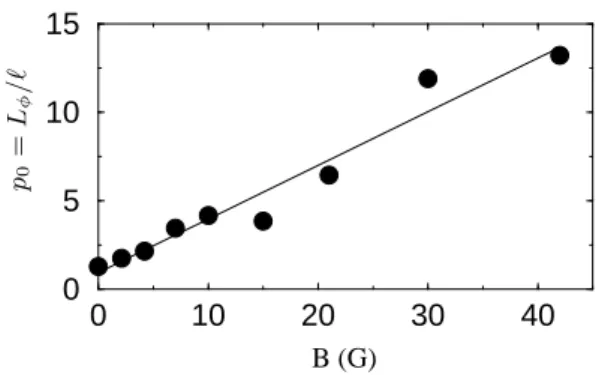
path calculated at B. As reported in Fig. 4, p0increases
roughly linearly with B. This is in sharp contrast with usual solid-state samples where Lφ is reduced because
of the Faraday effect which is proportional to the path length and to the magnetic field. In our case, the Fara-day effect can be shown to vanish at large B while, at the same time, the destructive impact of the Zeeman degen-eracy is removed, as previously discussed. The residual coherence loss is thus due to deviations from the two-level approximation, i.e. residual scattering amplitude due to atomic transitions involving other (detuned from reso-nance) Zeeman sublevels. From eq. (1), this amplitude scales as 1/B, yielding a coherence length proportional to B, in agreement with our numerical results. The meso-scopic regime is achieved when Lφ ≈ L, or equivalently
when p0 ≈ b. At large B, the optical thickness is b ≈ 5,
hence the mesoscopic criterion is fulfilled when B & 15G. Using our Monte-Carlo calculation, we have also quan-titatively studied the impact of magneto-optical effects at propagation (Eq.2) on the enhancement factor. They also appear to be negligible for µB < Γ (µB = Γ corresponds to B = 4.2 G in our experiment). For intermediate B, they cause the enhancement factor to be slightly lowered. In any case, they play no crucial role in the increase of α and can be neglected in a qualitative approach. This situation is very different from the classical one, where Faraday rotation is the keystone to explain the height and shape of the CBS cone [8].
4 0 10 20 30 40 B (Gauss) 0 0.2 0.4 0.6 0.8 1 0 10 20 30 40 B (Gauss) 0 0.5 1
Backscattered Intensity (a.u.)
(a) (b) Ico h / Iin c
FIG. 3: Results of the Monte-Carlo simulations. (a) shows the increase of the ratio of coherent over incoherent intensity with B. (b) Contribution of single scattering (triangles), in-coherent (crosses) and in-coherent (circles) multiple scattering to the total intensity in the backward direction. Lines are drawn to guide the eyes.
0 10 20 30 40 B (G) 0 5 10 15 p0 = Lφ / ℓ
FIG. 4: Plot of p0 = Lφ/ℓ versus B, as extracted from our
Monte-Carlo calculation, as a function of the magnetic field B. In sharp contrast with the usual behaviour, p0 increases
with B, roughly linearly (the solid line is drawn to guide the eye). This is due to the lifting of the Zeeman degeneracy. The points dispersion reflects the numerical accuracy.
the drastic modification of the scattering properties in-duced by the effective reduction of the internal structure. This effect has to be compared with the one observed in normal metal rings seeded with paramagnetic impurities [15]. There, at low fields, the Aharonov-Bohm (AB) oscil-lation amplitude is strongly reduced because of spin-flip scattering. This is equivalent to the observation of low CBS enhancement factors because of internal degenera-cies. At high fields and low temperatures (µB ≫ kBT ),
all impurities and electrons spins are aligned with B. As in our experiment, B freezes the internal degrees of free-dom of the scatterers. Electron spin fluctuations at scat-tering are then suppressed and full AB-oscillation ampli-tude is recovered.
In conclusion, we have observed a large increase of the CBS enhancement factor in the presence of a mag-netic field, which splits the degenerate atomic transition into several Zeeman components. At high magnetic field, most of them are out of resonance, leaving an effective two-level system where the two interfering paths have al-most equal amplitudes. Use of this magnetically-induced effective reduction of the atomic internal degeneracy may offer an interesting route in the quest of strong localiza-tion of light in cold atomic vapors.
We thank CNRS and the PACA Region for financial support. Laboratoire Kastler Brossel is laboratoire de l’Universit´e Pierre et Marie Curie et de l’Ecole Normale Sup´erieure, UMR 8552 du CNRS.
∗ Electronic address: [email protected]
† Now at: Centre de Physique Th´eorique, Campus de
Lu-miny, case 907, 13009 Marseille, France.
[1] M.H. Anderson et al., Science 269, 198 (1995); K.B. Davis et al., Phys. Rev. Lett. 75, 3969 (1995); B. De-Marco and D.S. Jin, Science 285, 1703 (1999); M. Greiner et al., Nature 415, 39 (2002).
[2] Mesoscopic Quantum Physics, E. Akkermans, G. Mon-tambaux, J.-L. Pichard and J. Zinn-Justin, Eds., Elsevier Science B.V. (North Holland, Amsterdam, 1995). [3] G. Bergmann, Phys. Rep. 107, 1 (1984).
[4] D. S. Wiersma, M. P. van Albada, B. A. van Tiggelen, A. Lagendijk, Phys. Rev. Lett. 74, 4193 (1995) ; Y. Bidel et al., Phys. Rev. Lett. 88, 203902 (2002).
[5] T. Chaneli`ere et al., to be published in Phys. Rev. E (2004).
[6] G. Labeyrie et al., Phys. Rev. Lett. 83, 5266 (1999); T. Jonckheere et al., Phys. Rev. Lett. 85, 4269 (2000). [7] A. S. Martinez and R. Maynard, Phys. Rev. B 50, 3714
(1994); B. A. van Tiggelen, R. Maynard, and T. M. Nieuwenhuizen, Phys. Rev. E 53, 2881 (1996).
[8] F. A. Erbacher, R. Lenke and G. Maret, Europhys. Lett. 21, 551 (1993); R. Lenke and G. Maret, Eur. Phys. J. B 17, 171 (2000); R. Lenke, R. Lehner and G. Maret, Europhys. Lett. 52, 620 (2000).
[9] G. Labeyrie et al., Phys. Rev. A 67, 033814 (2003); G. Labeyrie et al., Europhys. Lett. 61, 327 (2003).
[10] P. Kulatunga et al., Phys. Rev. A 68, 033816 (2003) ; D.V. Kupriyanov et al., Phys. Rev. A 69, 033801 (2004). [11] A. Lagendijk and B. A. van Tiggelen, Phys. Rep. 270,
143 (1996).
[12] G. Labeyrie et al., Phys. Rev. Lett. 89, 163901 (2002). [13] S. Franke-Arnold, M. Arndt, and A. Zeilinger, J. Phys.
B.: At. Mol. Opt. Phys. 34, 2527 (2001); G. Labeyrie, C. Miniatura and R. Kaiser, Phys. Rev. A 64, 033402 (2001).
[14] This assumption is likely to be correct if the incident light is kept resonant with the mF = 3 → mF′ = 4 transition
while increasing B, like in our experiment.