HAL Id: hal-01590891
https://hal.sorbonne-universite.fr/hal-01590891
Submitted on 20 Sep 2017HAL is a multi-disciplinary open access
archive for the deposit and dissemination of sci-entific research documents, whether they are pub-lished or not. The documents may come from teaching and research institutions in France or abroad, or from public or private research centers.
L’archive ouverte pluridisciplinaire HAL, est destinée au dépôt et à la diffusion de documents scientifiques de niveau recherche, publiés ou non, émanant des établissements d’enseignement et de recherche français ou étrangers, des laboratoires publics ou privés.
The Case | Epistasis and urolithiasis
Nathalie Tabibzadeh, Lynda Cheddani, Michel Daudon, Jean-Philippe
Haymann, Aurélie Toussaint, Caroline Silve, Emmanuel Letavernier
To cite this version:
Nathalie Tabibzadeh, Lynda Cheddani, Michel Daudon, Jean-Philippe Haymann, Aurélie Toussaint, et al.. The Case | Epistasis and urolithiasis. Kidney International, Nature Publishing Group, 2017, 92 (2), pp.523-524. �10.1016/j.kint.2017.01.026�. �hal-01590891�
Epistasis and Urolithiasis
Nathalie Tabibzadeh,
1,2,3Lynda Cheddani,
3Michel Daudon
1,2,3, Jean-Philippe Haymann,
1,2,3Aurélie Toussaint,
4Caroline Silve,
4,5,6Emmanuel Letavernier,
1,2,31
Sorbonne université- UPMC Paris 06, UMR S 1155, F-75020, Paris, France
2
INSERM, UMR S 1155, F-75020, Paris, France
3
Explorations fonctionnelles multidisciplinaires, AP-HP, Hôpital Tenon, F-75020, Paris,
France
4
Service de Biochimie et Génétique Moléculaire, AP-HP, Hôpital Cochin, Paris, France.
5
INSERM U1169, Université Paris Sud, Hôpital Bicêtre, Le Kremlin Bicêtre, France.
6
Centre de Référence des Maladies Rares du Métabolisme du Phosphore et du Calcium and
Filière de Santé Maladies Rares OSCAR, AP-HP, Paris, France.
AUTHOR INFORMATION
Correspondence:
Emmanuel LETAVERNIER, Service des Explorations Fonctionnelles Multidisciplinaires,
Hôpital TENON, 4 rue de la Chine, 75020 Paris (France). Phone 33 1 56 01 67 73; Fax 33 1
56 01 70 03 E-mail:
[email protected]
Disclosure statement: The authors declare no conflict of interest
Running Title: Epistasis and Urolithiasis Word Count: 749
The case
A 26-year-old woman was referred for recurrent urolithiasis. The first manifestation occurred 3 years before, followed by recurrent acute episodes. She underwent one ureteral stent placement, one shock wave lithotripsy, and at last a flexible ureteroscopy that allowed to retrieve all the remaining stones. She had no other medical history with the exception of paroxysmal tachycardia, poor dairy intake in her diet and did not take any medication interfering with calcium or phosphate homeostasis. Regarding her family history, her mother had also recurrent renal colic due to urolithiasis. Morphoconstitutional analysis revealed a stone made of calcium phosphate and to a lesser extent calcium oxalate, in concentric layers. According to infrared spectra analysis, the stone consisted mainly of calcium phosphate: 56% carbonated apatite, 20% octacalcium phosphate pentahydrate (OCP), 12% calcium oxalate monohydrate, 10% calcium oxalate dihydrate and 2% proteins.
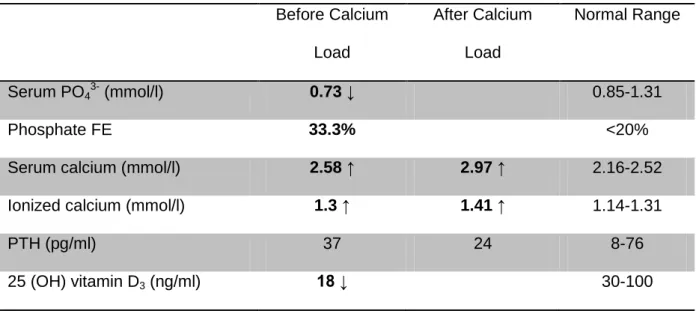
Her physical examination was normal. Biochemistry revealed increased serum calcium level at 2.59 mmol/l (N 2.16-2.52 mmol/l), low serum phosphate level at 0.7 mmol/l (N 0.8-1.4) mmol/l, parathyroid hormone (PTH) level in normal range at 46 pg/ml (N 8-76 pg/ml) and elevated calcitriol serum level at 87 pg/ml (N<67 pg/ml). Urine calcium excretion was increased at 8.2 mmol/24-hr (N<6 mmol/24-hr). Fasting urine pH was 5.9. An oral calcium load test (Pak test) was performed, the results of which are shown in Table 1. The test revealed increased serum calcium levels induced by the calcium load, with an adequately suppressed PTH level. A 99mTc Sestamibi parathyroid scintigraphy did not reveal any adenoma.
What is your diagnosis?
Nephrolithiasis revealing heterozygous mutation of SLC34A3 and CYP24A1 (respectively encoding for NPT2c and 25-(OH)-vit D3-24-hydroxylase).
The diagnosis
In this case, the first suspected diagnosis was primary hyperparathyroidism, according to hypercalcemia, hypercalciuria, renal phosphate leak and intermediate PTH levels. However, calcium load test evidenced appropriate PTH suppression. Moreover, parathyroid scintigraphy did not disclose a hyperfunctioning parathyroid tissue. The elevated level of calcitriol subsequently led us to suspect either a cause of elevated 1-alpha hydroxylase activity (granulomatous disease), which increases the production of calcitriol, or a decreased 25-(OH)-vit D3-24-hydroxylase activity, the enzyme promoting calcitriol degradation.1 There were no symptoms consistent with granulomatous disease. Furthermore, the more striking outlier was renal phosphate wasting, inconsistent with elevated calcitriol.
Kidneys stones consisting of OCP are uncommon since OCP is an unstable calcium phosphate crystalline phase. These stones are hallmarks of massive and recent calcium phosphate supersaturation. This situation is mainly encountered in pregnancy, which leads to rapid onset of hyperphosphaturia and hypercalciuria.2
The patient had a condition responsible for hypercalcemia, hypercalciuria and renal phosphate loss that did not prove to be primary hyperparathyroidism. We subsequently suspected a genetic disease underlying the clinical presentation. The patient was tested for mutations of genes coding for enzymes involved in vitamin D metabolism, and for proteins involved in renal phosphate handling.
Gene sequencing revealed heterozygous mutation and variant of CYP24A1 and SLC34A3 genes (respectively encoding for 25-(OH)-vit D3-24-hydroxylase and NPT2c).
3
The CYP24A1 mutation identified in patient DNA (c.1226T>C; p.Leu409Ser) has been previously described. Heterozygous CYP24A1 mutation carriers, while usually asymptomatic, may present an increased risk of kidney stones. The heterozygous variant of SLC34A3 (c.1357_1359del; p.DelPhe453;
(UMD-mutations than in the general population.
Epistasis, defined as the interaction between different genes, has become a topic of major interest in recent years. In this case, the patient is affected by negative epistasis, the combined deleterious effect of two harmful genetic variants, resulting in a phenotype greater than expected from individual mutations or variants. It gives new insights in interpreting phenotypes of complex diseases that are not fully explained by a monogenic disease. Thus we could hypothesize that the patient had a primary renal phosphate wasting caused by defective NPT2c function, inducing “appropriate” but moderate increase in calcitriol production.3 The second genetic defect affecting calcitriol degradation led subsequently to inappropriately high level of calcitriol, resulting in hypercalcemia, hypercalciuria and nephrolithiasis.1 The finding of a “normal” PTH was quite surprising since CYP24A1 mutation and high calcitriol serum levels are associated with suppressed PTH. One may hypothesize that heterozygous mutation would result in a less severe phenotype.
Another diagnostic feature of CYP24A1 mutation is low 24,25-(OH)2 vitamin D levels. Although we did not perform this test, it may be useful to screen appropriate phenotypes.
Overall, this observation may explain why single mutant allele carriers (of SLC34A3 gene for instance) may become symptomatic, when affected by a second gene mutation or variant.
References
1. Schlingmann KP, Kaufmann M, Weber S, et al. Mutations in CYP24A1 and idiopathic infantile hypercalcemia. N Engl J Med. 2011;365:410-21.
2. Meria P, Hadjadj H, Jungers P, et al. Members of the French Urological Association Urolithiasis Committee. Stone formation and pregnancy: pathophysiological insights gained from
morphoconstitutional stone analysis. J Urol. 2010;183:1412–6.
3. Dasgupta D, Wee MJ, Reyes M,et al. Mutations in SLC34A3/NPT2c are associated with kidney stones and nephrocalcinosis. J Am Soc Nephrol. 2014;25:2366-75.
Table 1 Before Calcium Load After Calcium Load Normal Range Serum PO43- (mmol/l) 0.73 ↓ 0.85-1.31 Phosphate FE 33.3% <20%
Serum calcium (mmol/l) 2.58 ↑ 2.97 ↑ 2.16-2.52
Ionized calcium (mmol/l) 1.3 ↑ 1.41 ↑ 1.14-1.31
PTH (pg/ml) 37 24 8-76
1,25(OH)2D3 (pg/ml) 87 ↑ 17-67
C-terminal FGF23 (RU/ml) 62 20.9-91.1
Serum creatinine (µmol/l) 61 45-80
Abbreviations: Phosphate FE: Phosphate Fractional excretion calculated as following: (urine
phosphate*serum creatinine)/(urine creatinine*serum phosphate) in standardized conditions; PTH, parathyroid hormone; FGF23, fibroblast growth factor 23. Values out of normal range are shown in bold.