HAL Id: hal-02886337
https://hal.archives-ouvertes.fr/hal-02886337
Submitted on 11 Sep 2020HAL is a multi-disciplinary open access archive for the deposit and dissemination of sci-entific research documents, whether they are pub-lished or not. The documents may come from teaching and research institutions in France or abroad, or from public or private research centers.
L’archive ouverte pluridisciplinaire HAL, est destinée au dépôt et à la diffusion de documents scientifiques de niveau recherche, publiés ou non, émanant des établissements d’enseignement et de recherche français ou étrangers, des laboratoires publics ou privés.
Rapid Aversive and Memory Trace Learning during
Route Navigation in Desert Ants
Antoine Wystrach, Cornelia Buehlmann, Sebastian Schwarz, Ken Cheng, Paul
Graham
To cite this version:
Antoine Wystrach, Cornelia Buehlmann, Sebastian Schwarz, Ken Cheng, Paul Graham. Rapid Aver-sive and Memory Trace Learning during Route Navigation in Desert Ants. Current Biology - CB, Elsevier, 2020, 30 (10), pp.1927-1933.e2. �10.1016/j.cub.2020.02.082�. �hal-02886337�
Rapid aversive and memory trace learning
1
during route navigation in desert ants
2
3
Short title: Aversive learning during route navigation
4
5
Authors and affiliation:
6
Antoine Wystrach*1, Cornelia Buehlmann2, Sebastian Schwarz1, Ken Cheng3, Paul Graham2 7
8
1 Centre de Recherches sur la Cognition Animale, CNRS, Université Paul Sabatier, Toulouse,
9
F-31062 cedex 09, France
10
2 School of Life Sciences, University of Sussex, John Maynard Smith Building, Falmer, 11
Brighton, Sussex BN1 9QG, U.K.
12
3 Department of Biological Sciences, Macquarie University, Sydney, NSW 2109, Australia
13 14
15
*Corresponding author and Lead Contact:
16
17
Antoine Wystrach
18
Université Paul Sabatier, Bat 4R3
19 118 route de Narbonne 20 31062 cedex 09, Toulouse 21 France 22 23 Manuscript
Summary
24
The ability of bees and ants to learn long visually guided routes in complex environments is
25
perhaps one of the most spectacular pieces of evidence for the impressive power of their
26
small brains. While flying bees can visit flowers in an optimised sequence over kilometres,
27
walking solitary foraging ants can precisely recapitulate routes of up to a hundred metres in
28
complex environments [1]. It is clear that route following depends largely on learnt visual
29
information and we have a good idea how visual memories can guide individuals along them
30
[2–6], as well as how this is implemented in the insect brain [7,8]. However, little is known
31
about the mechanisms that control route learning and development. Here we show that ants
32
(Melophorus bagoti and Cataglyphis fortis) navigating in their natural environments can
33
actively learn a route detour to avoid a pit-trap. This adaptive flexibility depends on a
34
mechanism of aversive learning based on memory traces of recently encountered stimuli,
35
reflecting the laboratory paradigm of trace conditioning. The views experienced before falling
36
into the trap become associated with the ensuing negative outcome and thus trigger salutary
37
turns on the subsequent trip. This drives the ants to orient away from the goal direction and
38
avoid the trap. If the pit-trap is avoided, the novel views experienced during the detour
39
become positively reinforced and the new route crystallises. We discuss how such an interplay
40
between appetitive and aversive memories might be implemented in insect neural circuitry.
41
RESULTS AND DISCUSSION
43
Ants can reshape their route to circumvent a trap. 44
We first let Australian solitarily foraging ants Melophorus bagoti shuttle back and forth
45
between their nest and a feeder full of cookie crumbs located 5 m away. For the outbound
46
trip, the ants had to walk through a long and narrow channel suspended 15 cm above the
47
ground that connected the nest directly to the feeder. For the way back to the nest, ants
48
loaded with a cookie crumb were free to navigate on the desert ground. After a day of
49
shuttling back and forth, all marked ants had established a fairly direct homing route to the
50
nest (Figure 1Ai). We then opened a pit-trap, previously buried inconspicuously into the
51
desert floor, creating a 2 m long, 10 cm wide gap perpendicular to the nest-to-feeder route.
52
During their first homing trial with the trap, all trained ants ran as usual along the first part of
53
the route and suddenly dropped into the trap. The trap was 10 cm wide and 10 cm deep (7
54
7 cm for Cataglyphis fortis) so that ants could see only the sky. The trap had slippery walls to
55
prevent the ants from escaping and contained small twigs, which desert ants naturally tend
56
to avoid as they impede walking. The trap offered a single possible exit formed by a 20 cm
57
wide board (5 cm for C. fortis) leading from the base of the trap to the second part of the
58
homeward route. The time the ants were trapped in the trap varied from one to tens of
59
minutes, but once out, all individuals showed no apparent problem in returning directly to
60
their nest (Figure 1Aii). We let ants shuttle back and forth with the trap open and recorded
61
their paths again after 24h. After such training, several ants (4 out of 14, 29%) displayed a
62
new route that circumvented the trap (Figure 1Aiii green trajectories). The tendency to detour
63
the trap on the right side may due to two factors: 1- the nest relocated its entrance slightly
64
on the right (as observed in [9]), so that the trap is not actually perpendicular to the
feeder-65
to-nest beeline, making detours slightly shorter to the right than to the left; 2-a high cluttered
66
region stands on the left of the setup, and desert ant species tend to be repelled by region
67
presenting a high skyline [10,11]. We replicated these experimentsat a larger scale (8 m route
68
and 4 m wide trap) with North African desert ants from Tunisia (Cataglyphis fortis) and
69
obtained similar results (13 out of 47, 28% avoided the trap after 24h) (Figure 1Bi,ii,iii). Note
70
that black objects were added around the experimental setup to visually enrich the barren C.
71
fortis environment (see STAR METHODS). 72
Why some ants did not learn to circumvent the trap may be due to different reasons. A good
73
proportion of those ants in both species did show modification of their routes by learning to
74
avoid the trap using alternative strategies such as jumping directly onto the exit stick (see red
75
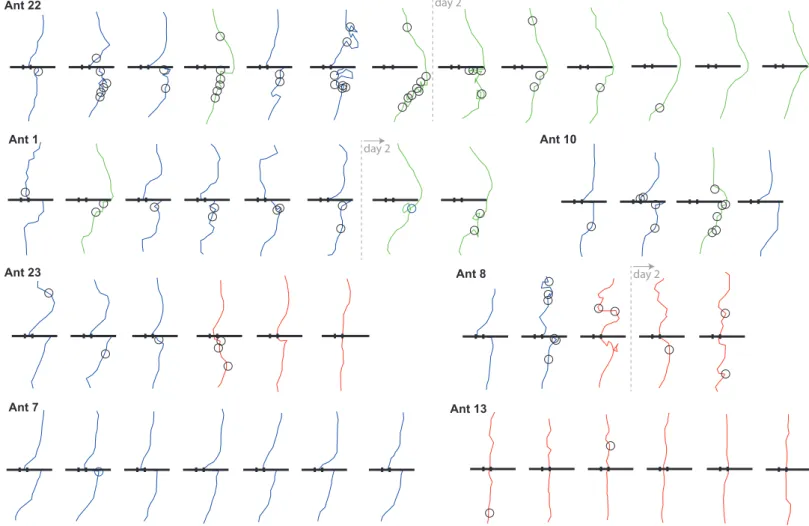
paths in SI1), or simply learning a quick route through the trap by systematically falling in at
76
the same spot and quickly reaching the exit stick with very little search (see Ant 7 in SI1).
77
Finally, some ants simply did not learn, perhaps because they performed too few training
78
trials within the 24h period. Our personal observations were that the specifics of how ants hit
79
the pit-trap influenced their ultimate strategy. Some ants fell by chance near the exit bridge
80
and so spent less time in the trap itself. These ants were more likely to develop a strategy that
81
depended on hitting the trap, but also knowing how to get out quickly. Future experiments
82
could investigate the possibility that a longer time of being trapped yields stronger aversive
83
memories. In any case, a simple categorisation of whether the ants circumvented the trap or
84
not is sufficient to show that such an effect is unlikely to happen by chance
85
(1st_trial_with_trap vs. 24h_with_trap: N(circumvented) /N(all ants) : 0/30 vs. 17/61, Fisher’s Exact 86
test p<0.001), and that there was no apparent difference in detour success between species
87
(24h_with_trap M. bagoti vs. C. fortis: N(circumvented) /N(all ants) : 4/14 vs. 13/47, Fisher’s Exact 88
test p=1).
89
90
New routes are based on learnt terrestrial cues. 91
Desert ants are well known to follow habitual routes guided by learnt terrestrial cues
92
although they also have access to their Path Integration (PI) system at all times [12,13], a
93
navigational strategy that is particularly pronounced in C. fortis [14]. We carried out several
94
manipulations to ask whether learnt terrestrial cues, rather than PI, were controlling the new
95
routes of our foragers.
96
Ants captured just before entering their nest and then re-released at the feeder are called
97
zero vector (ZV) ants because their PI state is zero at the onset of homing, and thus no longer
98
provides correct homeward information. Such ZV ants that had circumvented the trap during
99
their previous (full vector, FV) run were equally successful in their subsequent ZV run (Figure
100
1Biv) whereas ants that had fallen into the trap as FV ants still did so as ZV ants (previous_FV
101
circumvented vs. previous_FV fell: N(circumvented) /N(all ants) : 12/12 vs. 2/13, Fisher exact test 102
p<0.001), showing that guidance along the newly learnt route does not require PI.
103
Interestingly, ZV ants displayed turns before the trap even if they had failed as FV, showing
104
that the learning process itself has to do with views rather than the ant’s PI state. Note also
105
that 2 out of 13 ants fell as FV but avoided the trap as ZV, which further supports the
106
hypothesis of visual route learning. We know that the directional dictates of PI and learnt
107
visual guidance are integrated, even when pointing in different directions [15–18]. Thus, in
108
FV ants, the PI vector points directly to the nest and thus may bias the path towards the trap.
109
Therefore, the paths of ZV ants are more representative of the route as guided by terrestrial
110
cues. Nevertheless, the extent to which PI information may be associated with aversive
111
experiences should be more fully studied.
112
We further tested whether ants that had learnt a new route to circumvent the trap would still
113
follow it, if the trap was removed again. Five out of the six individuals tested displayed the
114
usual detour even though the trap had been removed (Figure 1Aiv; No_trap_initially vs.
115
trap_removed_again: N(circumvented) /N(all ants) : 1/20 vs. 5/6, Fisher exact test p<0.001). This 116
confirms that the detour does not depend on perceiving the trap, but on route memories.
117
Finally, we recorded a cohort of ants that had started their foraging life while the trap was
118
already in place. We did not control how many trials each ant produced but within a period
119
of 24h we observed that several individuals learnt routes that circumvented the trap (Figure
120
1Av). The proportion of ants that circumvented the trap was similar between these ants and
121
ants that had some route experience before the trap was set in place (24h_with_trap_naive
122
vs. 24h_with_trap: N(circumvented) /N(all ants) : 5/15 vs. 4/14, Fisher exact test p=1). This shows that 123
a route that circumvents a hidden trap will develop naturally, whether the trap is novel or has
124
been there for all of an ant’s foraging career.
125
The use of chemical trails, scent marks or other social information would be unlikely in these
126
highly visual solitary foraging ants, however we can further definitively rule them out, by
127
observing the typical idiosyncrasies of ants’ individual routes [19–21]: even though trials were
128
interleaved between individuals and spanning over different days, routes are remarkably
129
similar across subsequent trials of a same individual (Figure 2A, Figure S1) but they vary
130
substantially across individuals (Figure 1, Figure S1). We can be confident that ants were not
131
using social information, but private information based on learnt terrestrial cues. The nature
of these learnt terrestrial cues is not crucial for our purpose here, but based on past evidence
133
with desert ants, which run at high speed (>50cm/s) with the head and antenna lifted
134
upwards, we can be confident that it is mostly based on visual cues [9,19,22], typically the
135
recognition of familiar panoramic views [3,23,24]. To ease the reading, we will now refer to
136
these learnt terrestrial cues as ‘familiar views’.
137
138
How do ants reshape their routes? Evidence for aversive and memory trace learning. 139
To shed light on the processes that lead from an established route to a new route that
140
circumvents the trap, we tracked all successive trials of individually marked M. bagoti ants
141
from the first time they encountered the trap onwards. In addition to their paths, we recorded
142
the locations where ants stopped and scanned their surroundings. Scanning is a typical
143
behaviour in desert ant navigators (and particularly obvious in M. bagoti): the ant suddenly
144
stops and rotates on the spot, pausing in different directions successively [25]. Scans are
145
triggered when an ant experiences a decrease in visual familiarity [25], when multiple
146
directional cues are put into conflict [26,27], when running a route has not resulted in success
147
[4,27], or simply when naïve ants exit their nest for the first time [28–30]. In other words, the
148
occurrence of scanning reflects a directional uncertainty in an ant’s navigational system [25].
149
As described above, on the first run with the trap in place, ants rush along their direct
150
homeward route and fall into the trap. In subsequent trials, routes of most ants changed and
151
some eventually circumvented the trap. We supposed two potential mechanisms. First, it
152
could be that the negative event of falling into the trap triggers learning oriented behavioural
153
routines that occur immediately after the negative event. This was not the case. When ants
154
emerged from the trap, they rushed towards their nest as usual, and displayed neither more
155
scanning or meandering than before the trap was set (Second part of the route: Trial before
156
trap vs. Trial with first trap fall: mode = 0 scan/ant in both cases, glme #Scan: t=0.359 157
p=0.721; glme meander z=0.027 p=0.978; Figures 2Bi and 2Bii, see also Figures 1Aii and Bii)).
158
Second, ants could keep memory traces of the scenes experienced immediately before falling
159
into the trap, and change the valence of these recent memories given the current negative
160
experience of being trapped. In our paradigm, this would predict that ant behaviour will be
affected on the run subsequent to falling in the trap when in the area immediately before the
162
trap. Indeed, this is what we observed. Ants displayed a clear increase in scanning behaviours
163
in the region before the trap (mode and median = 2 scans/ant, Figure 2Biii), significantly more
164
than they had on their previous run (mode and median = 0 scan/ants, Figure 2Bii) before
165
falling into the trap for the first time (First part of the route: Trial with first trap fall vs. Trial
166
following first trap-fall: glme #Scan: t=4.186 p<0.001). Similarly, their paths showed 167
significantly more meandering as they approached the trap for the second time compared to
168
their previous run (First part of the route: Trial with first trap fall vs. Trial following first
trap-169
fall: glme meander: z=3.006 p=0.003). 170
Mechanistically, learning must be based on a memory trace because the US (i.e., being in the
171
trap) is experienced after the CS (i.e., the view of the surrounding scenery), and crucially, with
172
no time overlap: for being in the trap (US) prevents entirely the view of the scenery (CS), and
173
the trap is invisible from outside. Being exposed to the CS before the US with no time overlap
174
between both stimuli reflects the laboratory paradigm of ‘trace conditioning’ [31]. How long
175
is the delay between CS and US cannot be determined in our natural situation, although the
176
apparent increase of scanning behaviours up to 2 metres before the trap (Figures 2A, 2C)
177
suggests that the memory trace of the views may be kept for at least a couple of seconds. The
178
resulting aversive memory formed, however, lasts across days to trigger salutary avoidance
179
and scanning behaviours (Figure 2A, ‘day2’ grey arrow).
180
Aversive trace learning also provides an explanation for past results: ants repeatedly captured
181
at the same location and asked to repeat their visually guided route display turns and
182
avoidance behaviours before the capture point after a couple of trials only [27]. Being
183
captured likely provides a negative US and the views preceding the capture point become
184
aversive. This happens even though the ants were never allowed to reset their Path Integrator
185
by being put back to the nest [32], showing that such long term aversive memories can be
186
formed rapidly and without the need of the PI system.
187
188
Neural implications. 189
We now have a good idea of the neural underpinnings of learning in insects from studies of
190
the Mushroom Bodies (MB) [33–37], which are assumed to be the seat of the route visual
191
memories [8,38,39] (Figure 3). Each view experienced can be represented by a specific pattern
192
of activation of Kenyon Cells (KC) in the MB [7], and KCs project onto multiple output neurons
193
(MBONs) conveying different valences [40,41]. By modulating the synaptic weights between
194
the active KCs and specific MBONs, views can be thus be associated with positive or negative
195
valences, presumably inciting forward movements [7,8] or turns respectively (see also [42]).
196
To accommodate these principles of MB function our results simply require that 1- a trace (or
197
tag) must remain in the KCs neurons (or their output synapses) for at least a few seconds after
198
they have fired; and 2- A negative event (such as being trapped) must be able to change the
199
valence associated with the tagged neurons, so that familiar views perceived before falling
200
into the trap become less positive or aversive (Figure 3).
201
How and where exactly the tagging may happen remains unclear as several types of
202
modulatory neurons project to these mushroom body compartments [43,44]. Finally, if it is
203
now clear that being trapped or caught can constitute a negative reinforcement, what
204
constitutes positive reinforcement during route learning is still unclear: it could be reaching
205
the nest or running down the PI accumulated home vector [7]. Such positive reinforcement
206
might also involve the ‘tagged neurons’, so that not only the current but also the previously
207
experienced views that led to a positive outcome become associated to a positive valence. In
208
any case, it is clear that route reshaping here results from an interplay between avoidance
209
behaviour triggered by memory trace learning and appetitive learning based on positive
210
reinforcement (Figure 3).
211
CONCLUSION
212
We have demonstrated here how memory trace learning is adaptively applied to navigation
213
in natural habitats, where a negative experience labels specific locations in space that precede
214
the aversive event. Behaviourally, this allows an ant to solve a navigational problem by
215
efficiently reshaping its route through the world. Such route plasticity thus results from an
216
interesting interplay between aversive and appetitive visual memories, and between
217
avoidance learning (a form of negative reinforcement) and positive reinforcement, which
218
matches well our current understanding of insect learning circuits.
220
Acknowledgments
221
We would like to thanks Cody Freas and Jeanne Delor for help on the field, Cristian
222
Pasquaretta for statistical advice as well as the Centre for Appropriate Technology Limited
223
(CfAT Ltd, Alice Springs) for field facilities and letting us run experiments on their grounds.
224
The research was funded by the European Research Council (ERCstg: EMERG-ANT 759817)
225
to AW, a Fyssen Foundation fellowship to AW, the European Union’s Seventh Framework
226
Programme (FP7: PIEF-GA-2013-624765) to CB and a grant from the Australian Research
227
Council to KC (DP110100608). PG was funded in part by EPSRC grant EP/P006094/1.
228
229
Author contributions
230
Conceptualisation: A.W.; Methodology: A.W., C.B., S.S., P.G.; Formal analysis: A.W.
231
Investigation: A.W., C.B., S.S.; Writing - original draft: A.W., P.G.; Writing - review & editing:
232
A.W., C.B., S.S., K.C.; P.G.; Funding: A.W., C.B., K.C., P.G.
233
234
Declaration of interests
235
The authors declare no competing interests.
Main-text figure legends
237
Figure 1. Negative experience shapes ants’ routes. A. Australian desert ants (Melophorus
238
bagoti) or B North African desert ants (Cataglyphis fortis) were followed for a series of 239
homeward routes from a permanent feeder (F), with a pit-trap in place (solid line) or covered
240
over (dashed line). Two small dashes across the trap line indicate the escape board. Green
241
paths from ants that circumvent the pit-trap and blue paths from ants that fall into the trap.
242
(i) Control routes of ants between feeder and nest, without trap (A, n=20; B, n=16). (ii) The
243
first route after the installation of the pit-trap (A, n=15; B, n=15). (iii) Paths after the pit-trap
244
has been in place for 24 hours (A, n=14; B, n=47). (iv) and (v) show different conditions for the
245
two species. (Aiv) paths of M. bagoti ants that had previously learnt to circumvent the trap,
246
tested with the trap covered (n=6). (Av) the paths of ants that had begun their foraging life
247
(i.e., since naïve stage) with the trap in place and had 24 hours of foraging experience (n=15).
248
(Biv, v) paths of C. fortis ants tested as ZV ants (without useful path integration information,
249
as the path integrator no longer points towards the nest, but towards the feeder) that had
250
previously succeeded (Biv, n=12) or failed (Bv, n=13) to circumvent the trap as full-vector ants.
251
‘n’ refers to the number of ants tested.
252
Figure 2. Negative experience modifies the memory of the views experienced before the
253
trap. Individually marked ants of Melophorus bagoti were tracked for a sequence of runs
254
before and after the activation of the pit-trap. A. Sample sequence from a single ant.
255
Locations where the ant stops and scans the world are marked with a circle. As elsewhere in
256
the paper, paths are coloured coded: blue for ant paths that fall into the trap and green paths
257
that avoid the trap. See Figure S1 for more individual examples. B. For each ant the number
258
of scans was recorded before (bottom, blue) and after (top, red) the trap across three focal
259
trials. (i) Trial before the trap was activated; (ii) Trial with first trap-fall; (iii) Trial following first
260
trap-fall. From this we calculated the probability of an ant scanning (N(ants scan>0)/N(all ants)), and 261
the median number of scans, for each trial and route segment. Before the trap: (i) N=31
262
proba=0.45 Median=0 (ii)N=25 proba=0.40 Median=0 (iii) N=25 proba=0.80 Median=2. Star
263
indicate a significant increase in scan number (see text for detail). After the trap: (i)N=31
264
proba=0.35 Median=0 (ii)N=25 proba=0.40 Median=0 (iii) N=25 proba=0.32 Median=0. C. For
265
the same three focal trials, the location of scans is shown relative to the Feeder (F, (0,0)), Nest
(N, (0,5)) and Pit Trap (Black line, y=2.5). Darker areas represent higher scan numbers. Upward
267
arrows in left panels indicate route direction.
268
Figure 3. Overview of the appetitive and aversive learning experiences. A. illustrations of
269
the concept. Across a sequence of journeys for a typical ant we show the regions of operation
270
for aversive (red) and appetitive (green) learning. The aversive region is first formed by
271
memory trace learning on the trials where the ant encounters the trap. Over time a detour
272
develops, and the new route is maintained by appetitive processes. B. Picture of a Cataglyphis
273
fortis brain’s right hemisphere showing the optic lobes (OL) and Mushroom-Bodies (ML) 274
(modified from [45]) C. Mushroom-Bodies neural architecture derived from the insect
275
literature [8,46]. Visual information is sparsely projected via visual Projection Neurons (PNs)
276
to the Kenyon Cells (KCs). KC activity thus represents views that can be associated with the
277
Mushroom Body output neurons (MBONs) mediating appetitive or aversive valences. Such
278
associations result from the modulation of KC-to-MBON synapses; the modulation is
279
generated by the co-activation of KCs and dopaminergic neurons (DANs) relaying the valence
280
of the current situation. The resulting balance between aversive and appetitive MBON
281
activities can then control steering. D. The current study suggests memory trace learning as a
282
mechanism to explain the reshaping of routes. First, a trace of the KC activity must be kept
283
for a few seconds (top panel). Second, the co-activation of a dopaminergic neuron modulates
284
the KC-to-MBON synapses of these recently activated KCs (bottom panel). Note that
285
modulation consists of a synaptic depression, which explains why DANs of a given valence
286
modulate MBONs of the opposite valence. Thus an aversive situation, such as being trapped,
287
will be mediated by a DAN decreasing the connection strength between the recently activated
288
KCs and the appetitive MBON. These KCs will no longer activate the appetitive MBON, but still
289
activate the aversive MBON. In other words, the view experienced before the trap will
290
henceforth trigger an aversive response.
291
292
STAR Methods
293 294
LEAD CONTACT AND MATERIALS AVAILABLITY
Further information and requests for resources should be directed to and will be fulfilled by
296
the Lead Contact, Antoine Wystrach ([email protected]). This study did not
297
generate new unique reagents.
298 299
EXPERIMENTAL MODEL AND SUBJECT DETAILS
300
Two species were tested in this study: the Australian red honey ant, Melophorus bagoti and
301
the Saharan desert ant Cataglyphis fortis. Both species are highly thermophilic ants (Wehner,
302
1987; Christian & Morton, 1992) that forage solitarily on dead insects and plant materials
303
(Muser et al., 2005). Experiments with M. bagoti were achieved in January-March 2014, ~10
304
km south of Alice Springs, Australia, on the grounds of the Centre for Appropriate Technology,
305
in a semi-arid desert habitat characterised by red soil, grass tussocks, bushes, and trees of
306
Acacia and Eucalyptus species. Field experiments with C. fortis were performed in June-July
307
2015 in a flat salt pan (34.954897 N, 10.410396 E) near the village of Menzel Chaker, Tunisia.
308
By using two species of desert ants that belong to different phylogenetic tribes, we hoped to
309
investigate the generality of this route re-learning process.
310 311 METHOD DETAILS 312 Experimental set-ups 313
The experimental set-ups for the two species were similar, with a larger scale for C. fortis to
314
reflect their typically longer range of foraging (up to hundreds of meters for C. fortis and up
315
to 70 m in M. bagoti, personal observation) [14]. Measurements below are given for M.
316
bagoti, followed by C. fortis in brackets. Experiments were undertaken with a nest located in 317
an area cleared of grass but surrounded by bushes and trees (or artificially added large black
318
cylinders for C. fortis) providing rich visual information for navigation.
319
In both experimental set-ups, ants moved between their nest and a feeder full of cookie
320
crumbs 5 m (8 m for C. fortis) away. The ants’ nest was covered with an overturned bucket
321
that had the bottom removed, whose opening at ground level was connected to a straight
322
outbound channel (5 m long, 10 10 cm for M. bagoti; 8 m long, 7 7 cm for C. fortis) elevated
323
15 cm above the ground, which was always in place and thus belonged to the scenery. This
outbound channel suddenly ended above the feeder, into which ants would drop. The feeder
325
was a small plastic container sunk into the ground providing biscuit crumbs ad libitum. To
326
return to the nest, the ants climbed out of the feeder using a small ramp and walked on the
327
desert ground back to the nest. Removing the feeder ramp at critical times allowed us to
328
control which ants ran their homeward journey and when. Halfway along their homing route,
329
a plastic channel was buried inconspicuously into the desert floor, creating a 2 m long, 10 cm
330
wide (4 m long 7 cm wide for C. fortis) trap perpendicular to the nest-to-feeder route. The
331
trap was buried entirely so as to remain invisible to the ants. The trap had smooth walls and
332
was filled with twigs to hinder ant movement. Ants could leave the trap by using a single exit
333
formed of a stick bridge 20 cm wide (5 cm for C. fortis), connecting the bottom of the trap to
334
the second part of the route. A grid of lines (mesh width: 1 m) was set up by winding strings
335
around pegs (or by painting on the ground with C. fortis) and the ants’ homing paths before
336
and after introducing the trap were recorded on squared paper. During initial training the trap
337
was covered by a thin board, with desert sand scattered on top, so that the ants could shuttle
338 unimpeded. 339 340 Experimental protocols 341
For both species, ants that arrived at the feeder were marked with a dot of day-specific
342
enamel paint to ensure that ants were experienced before the trap was set. Only ants with at
343
least 24 hours experience were recorded. Once the trap was set, the ants’ first homing paths
344
after trap introduction were recorded as well as their paths 24 hours later.
345
With C. fortis a group of ants was recorded twice. Here, the ants performed their homing
346
route and just before they entered the nest they were taken and released again at the feeder
347
as zero-vector ants, to test whether PI could provide an alternative explanation to views. C.
348
fortis is well suited for this control as this species is known to strongly rely on PI (compared 349
to M. bagoti) [14].
350
With M. bagoti, an additional treatment was enacted. Successful ants that circumvented the
351
trap were marked and, once they return to the feeder again, tested with the trap covered
352
again (as in the initial training).
Another condition was tested with naïve M. bagoti ants. The trap was set in place and all ants
354
were marked for 5 consecutive days. After this period, all unpainted ants reaching the feeder
355
were considered ‘naïve’ and were painted with a specific colour. Naïve ants were free to
356
forage for 24 hours before being recorded.
357
Finally, some M. bagoti ants were marked with individual colour codes in order to obtain a
358
record of the evolution of individual routes. In this treatment, we recorded both the path and
359
the occurrence of the clear cut scanning behaviours typically observed in this species [25].
360
361
QUANTIFICATION AND STATISTICAL ANALYSIS
362 363
Paths were digitised using the software Graphclick. Meander was calculated as the mean
364
angular deviation in direction between successive 30 cm chunks of the ants’ paths. For the
365
‘Avoid vs. fell comparison’ we used Fisher’s Exact Test to look for differences between groups
366
in the ratio of ants that circumvented or fell into the trap. For the ‘Scan number and meander’
367
comparisons ants were followed individually across successive trials. We compared scan
368
number and meander across three situations: (i) Trial before trap; (ii) Trial with first trap-fall; 369
(iii) Trial following first trap-fall for two sections of the route, before the trap and after the
370
trap, separately. To analyse the number of scan per ants, we used a generalised linear mixed
371
effects model with ants as a random effect for count data. Given that the dispersion
372
parameter (null deviance / df = 2.67 for ‘first part of the route’ and 2.08 for ‘second part of
373
the route’) is above 2, we used a quasiPoisson distribution rather than a Poisson distribution
374
(glmmPQL from MASS library in R). For meander values, we scaled the data between 0
375
(Meander = 0deg) and 1 (Meander = 180deg) and used a generalised linear mixed effects
376
model for proportional data with ants as a random effect (family="beta", link="probit" ;
377
glmmTMB library in R).
DATA AND CODE AVAILABILITY 379
All data are available at: 380 https://github.com/awystrac/Rapid-aversive-and-memory-trace-381 learning_Current_Biol_2020/commits?author=awystrac 382 383 384
References list
3851. Collett, M., Chittka, L., and Collett, T.S. (2013). Spatial memory in insect navigation. Current 386
biology : CB 23, R789–R800. 387
2. Baddeley, B., Graham, P., Husbands, P., and Philippides, A. (2012). A model of ant route 388
navigation driven by scene familiarity. PLoS Comput Biol 8, e1002336. 389
3. Zeil, J. (2012). Visual homing: an insect perspective. Current Opinion in Neurobiology 22, 285– 390
293. 391
4. Collett, M. (2014). A desert ant’s memory of recent visual experience and the control of route 392
guidance. Proceedings of the Royal Society B: Biological Sciences 281. 393
5. Wystrach, A., Beugnon, G., and Cheng, K. (2012). Ants might use different view-matching 394
strategies on and off the route. The Journal of Experimental Biology 215, 44–55. 395
6. Schwarz, S., Mangan, M., Zeil, J., Webb, B., and Wystrach, A. (2017). How Ants Use Vision When 396
Homing Backward. Current Biology 27, 401–407. 397
7. Ardin, P., Peng, F., Mangan, M., Lagogiannis, K., and Webb, B. (2016). Using an Insect Mushroom 398
Body Circuit to Encode Route Memory in Complex Natural Environments. PLOS Computational 399
Biology 12, e1004683. 400
8. Webb, B., and Wystrach, A. (2016). Neural mechanisms of insect navigation. Current Opinion in 401
Insect Science 15, 27–39. 402
9. Wystrach, A., Schwarz, S., Schultheiss, P., Beugnon, G., and Cheng, K. (2011). Views, landmarks, 403
and routes: how do desert ants negotiate an obstacle course? Journal of Comparative Physiology 404
a-Neuroethology Sensory Neural and Behavioral Physiology 197, 167–179. 405
10. Heusser, D., and Wehner, R. (2002). The visual centring response in desert ants, Cataglyphis 406
fortis. Journal of Experimental Biology 205, 585–590. 407
11. Schwarz, S., Julle-Daniere, E., Morin, L., Schultheiss, P., Wystrach, A., Ives, J., and Cheng, K. 408
(2014). Desert ants (Melophorus bagoti) navigating with robustness to distortions of the natural 409
panorama. Insectes sociaux 61, 371–383. 410
12. Knaden, M., and Graham, P. (2016). The sensory ecology of ant navigation: from natural 411
environments to neural mechanisms. Annual review of entomology 61, 63–76. 412
13. Collett, T.S. (2019). Path integration: how details of the honeybee waggle dance and the 413
foraging strategies of desert ants might help in understanding its mechanisms. Journal of 414
Experimental Biology 222, jeb205187. 415
14. Cheng, K., Schultheiss, P., Schwarz, S., Wystrach, A., and Wehner, R. (2014). Beginnings of a 416
synthetic approach to desert ant navigation. Behavioural Processes 102, 51–61. 417
15. Collett, M. (2012). How Navigational Guidance Systems Are Combined in a Desert Ant. 418
Current biology : CB 22, 927–932. 419
16. Wystrach, A., Mangan, M., and Webb, B. (2015). Optimal cue integration in ants. 420
Proceedings of the Royal Society of London B: Biological Sciences 282. 421
17. Legge, E.L., Wystrach, A., Spetch, M.L., and Cheng, K. (2014). Combining sky and earth: 422
desert ants (Melophorus bagoti) show weighted integration of celestial and terrestrial cues. The 423
Journal of experimental biology 217, 4159–4166. 424
18. Wehner, R., Hoinville, T., Cruse, H., and Cheng, K. (2016). Steering intermediate courses: 425
desert ants combine information from various navigational routines. J Comp Physiol A 202, 459– 426
472. 427
19. Collett, T.S., Dillmann, E., Giger, A., and Wehner, R. (1992). Visual landmarks and route 428
following in desert ants. Journal of Comparative Physiology a-Sensory Neural and Behavioral 429
Physiology 170, 435–442. 430
20. Kohler, M., and Wehner, R. (2005). Idiosyncratic route-based memories in desert ants, 431
Melophorus bagoti: How do they interact with path-integration vectors? Neurobiology of 432
Learning and Memory 83, 1–12. 433
21. Mangan, M., and Webb, B. (2012). Spontaneous formation of multiple routes in individual 434
desert ants (Cataglyphis velox). Behavioral Ecology 23, 944–954. 435
22. Wehner, R. (2009). The architecture of the desert ant’s navigational toolkit (Hymenoptera: 436
Formicidae). Myrmecological News 12, 85–96. 437
23. Graham, P., and Cheng, K. (2009). Which portion of the natural panorama is used for view-438
based navigation in the Australian desert ant? Journal of Comparative Physiology a-439
Neuroethology Sensory Neural and Behavioral Physiology 195, 681–689. 440
24. Wystrach, A., Beugnon, G., and Cheng, K. (2011). Landmarks or panoramas: what do 441
navigating ants attend to for guidance? Frontiers in Zoology 8, 21. 442
25. Wystrach, A., Philippides, A., Aurejac, A., Cheng, K., and Graham, P. (2014). Visual scanning 443
behaviours and their role in the navigation of the Australian desert ant Melophorus bagoti. 444
Journal of Comparative Physiology A, 1–12. 445
26. Wystrach, A., Schwarz, S., Schultheiss, P., Baniel, A., and Cheng, K. (2014). Multiple sources 446
of celestial compass information in the central Australian desert ant Melophorus bagoti. Journal 447
of Comparative Physiology A, 1–11. 448
27. Wystrach, A., Schwarz, S., Graham, P., and Cheng, K. (2019). Running paths to nowhere: 449
repetition of routes shows how navigating ants modulate online the weights accorded to cues. 450
Animal cognition 22, 213–222. 451
28. Fleischmann, P.N., Grob, R., Wehner, R., and Rössler, W. (2017). Species-specific differences 452
in the fine structure of learning walk elements in Cataglyphis ants. Journal of Experimental 453
Biology 220, 2426–2435. 454
29. Jayatilaka, P., Murray, T., Narendra, A., and Zeil, J. (2018). The choreography of learning 455
walks in the Australian jack jumper ant Myrmecia croslandi. Journal of Experimental Biology 221, 456
jeb185306. 457
30. Müller, M., and Wehner, R. (2010). Path Integration Provides a Scaffold for Landmark 458
Learning in Desert Ants. Current Biology 20, 1368–1371. 459
31. Bouton, M.E. (2007). Learning and behavior: A contemporary synthesis. (Sinauer Associates). 460
32. Knaden, M., and Wehner, R. (2006). Ant navigation: resetting the path integrator. Journal of 461
Experimental Biology 209, 26–31. 462
33. Cohn, R., Morantte, I., and Ruta, V. (2015). Coordinated and Compartmentalized 463
Neuromodulation Shapes Sensory Processing in Drosophila. Cell 163, 1742–1755. 464
34. Bouzaiane, E., Trannoy, S., Scheunemann, L., Plaçais, P.-Y., and Preat, T. (2015). Two 465
Independent Mushroom Body Output Circuits Retrieve the Six Discrete Components of Drosophila 466
Aversive Memory. Cell Reports 11, 1280–1292. 467
35. Caron, S., and Abbott, L.F. (2017). Neuroscience: Intelligence in the Honeybee 468
Mushroom Body. Current Biology 27, R220–R223. 469
36. Withers, G.S., Day, N.F., Talbot, E.F., Dobson, H.E.M., and Wallace, C.S. (2008). Experience-470
dependent plasticity in the mushroom bodies of the solitary bee Osmia lignaria (Megachilidae). 471
Developmental Neurobiology 68, 73–82. 472
37. Devaud, J.-M., Papouin, T., Carcaud, J., Sandoz, J.-C., Grünewald, B., and Giurfa, M. (2015). 473
Neural substrate for higher-order learning in an insect: Mushroom bodies are necessary for 474
configural discriminations. PNAS 112, E5854–E5862. 475
38. Ehmer, B., and Gronenberg, W. (2002). Segregation of visual input to the mushroom bodies 476
in the honeybee (Apis mellifera). Journal of Comparative Neurology 451, 362–373. 477
39. Stieb, S.M., Muenz, T.S., Wehner, R., and Rossler, W. (2010). Visual Experience and Age 478
Affect Synaptic Organization in the Mushroom Bodies of the Desert Ant Cataglyphis fortis. 479
Developmental Neurobiology 70, 408–423. 480
40. Aso, Y., Sitaraman, D., Ichinose, T., Kaun, K.R., Vogt, K., Belliart-Guérin, G., Plaçais, P.-Y., 481
Robie, A.A., Yamagata, N., Schnaitmann, C., et al. (2014). Mushroom body output neurons encode 482
valence and guide memory-based action selection in Drosophila. eLife 3. 483
41. Aso, Y., and Rubin, G.M. (2016). Dopaminergic neurons write and update memories with 484
cell-type-specific rules. Elife 5, e16135. 485
42. Le Möel, F., and Wystrach, A. (2019). Opponent processes in visual memories: a model of 486
attraction and repulsion in navigating insects’ mushroom bodies. bioRxiv. 487
43. Perisse, E., and Waddell, S. (2011). Associative memory: without a trace. Current Biology 21, 488
R579–R581. 489
44. Liu, X., and Davis, R.L. (2009). The GABAergic anterior paired lateral neuron suppresses and 490
is suppressed by olfactory learning. Nature neuroscience 12, 53. 491
45. Stieb, S.M., Hellwig, A., Wehner, R., and Rössler, W. (2012). Visual experience affects both 492
behavioral and neuronal aspects in the individual life history of the desert ant Cataglyphis fortis. 493
Developmental neurobiology 72, 729–742. 494
46. Heisenberg, M. (2003). Mushroom body memoir: from maps to models. Nat Rev Neurosci 4, 495
266–275. 496
KEY RESOURCES TABLE
REAGENT or RESOURCE SOURCE IDENTIFIER
Experimental Models: Organisms/Strains
Melophorus bagoti Field site near Alice Springs (Australia) N/A
Cataglyphis fortis Field site near Menzel Chaker (Tunisia) N/A Key Resource Table
5m F F F F F Trap removed ZV avoided as FV ZV fell as FV 24h trap Melophrous bagoti Cataglyphis fortis A B F F F 1st trap i ii iii iv v 24h trap 1st trap i ii iii iv v 24h trap Naïve No trap No trap F F F N F N 8m Figure 1
0 1 2 3 4 5 0 5 10 15 20 First half of route 0 5 10 15 20 0 5 10 15 20 Second half of route Number of scans Number of ants
(i)Trial before trap (ii) Trial with first trap-fall (iii) Trial following first trap-fall
Number of ants N F N=31 N=25 N=25 0 1 2 3 4 5 0 1 2 3 4 5 0 1 2 3 4 5 0 1 2 3 4 5 0 1 2 3 4 5 1 1 1 1 1 1 meters 0 0.5 #scan / ant / 0.25 m meters
No trap Trap (first fall) Trap (second fall)
Spatial distribution of scans
(i)Trial before trap (ii) Trial with first trap-fall (iii) Trial following first trap-fall Individual ant example
trial 1 trial 13 Frequency of scans A B C F N F N day 2 0 5 10 15 20 0 5 10 15 20 0 5 10 15 20 F N F N F N 2 Figure 2
N F N F N F N F N F Appetitive learning
Aversive trace learning
1st fall 2nd fall 1st avoidance 2nd avoidance
no trap Trap (negative reinforcement) MBON (aversive) KCs PNs Optic lobes Mushroom bodies MBON (appetitive) Current view DAN (appetitive) KC Trace of recent activity KC Synaptic depression DAN (aversive) MBON (appetitive) B A D DAN (aversive)
Sharp turns and scanning behaviours Steering Being trapped C OL MB Figure 3
Ant 10 Ant 8 Ant 1 Ant 22 Ant 23 Ant 7 Ant 13 day 2 day 2 day 2