Atoms and Photons and
Quanta, Oh My!
Quanta, Oh My!
Ask the physicist about atomic, nuclear, and quantum physics
F Todd Baker
Professor Emeritus of Physics, Department of Physics and Astronomy, University of Georgia, Athens, USA
or transmitted in any form or by any means, electronic, mechanical, photocopying, recording or otherwise, without the prior permission of the publisher, or as expressly permitted by law or under terms agreed with the appropriate rights organization. Multiple copying is permitted in accordance with the terms of licences issued by the Copyright Licensing Agency, the Copyright Clearance Centre and other reproduction rights organisations.
Rights & Permissions
To obtain permission to re-use copyrighted material from Morgan & Claypool Publishers, please [email protected]. ISBN 978-1-6270-5939-8 (ebook) ISBN 978-1-6270-5938-1 (print) ISBN 978-1-6270-5941-1 (mobi) DOI 10.1088/978-1-6270-5939-8 Version: 20150601
IOP Concise Physics ISSN 2053-2571 (online) ISSN 2054-7307 (print)
A Morgan & Claypool publication as part of IOP Concise Physics
Published by Morgan & Claypool Publishers, 40 Oak Drive, San Rafael, CA, 94903, USA
For Geoff, Andy, Hannah and Adam. You all have made me proud to be your dad.
Preface x
Acknowledgements xi
Author biography xii
1
Let there be light!
1-11.1 Introduction 1-1
1.2 History 1-1
1.3 What are force fields? 1-5
1.4 Electric and magnetic fields 1-5
1.5 Maxwell’s equations 1-7
2
Quanta and photons, oh my!
2-12.1 Prologue 2-1
2.2 Introduction 2-2
2.3 Black-body radiation 2-2
2.4 The photoelectric effect 2-5
2.5 Compton scattering 2-7
2.6 de Broglie’s hypothesis 2-9
2.7 What’s waving? 2-12
2.8 The Heisenberg uncertainty principle 2-14
2.8.1 Introduction 2-14
2.8.2 The timbre of musical instruments 2-15 2.8.3 Fourier transforms and the uncertainty principle 2-16
3
Atoms, oh my!
3-13.1 Atomic sizes and masses 3-1
3.2 Atomic spectra 3-3
3.3 The discovery of the electron 3-4 3.4 Ernest Rutherford and the‘nuclear model’ 3-5 3.5 The Bohr model of the hydrogen atom 3-7
3.6 The modern atomic model 3-10
3.6.1 Solving Schrödinger’s equation for hydrogen 3-10 3.6.2 Spin and the Pauli exclusion principle 3-12
3.6.3 Atoms beyond hydrogen 3-15
4
Nuclear physics
4-14.1 Introduction 4-1
4.2 Discovery of the neutron 4-1
4.3 The nuclear force (the strong interaction) 4-3 4.4 Nuclear masses and binding energies 4-4
4.5 Nuclear systematics 4-5 4.6 Radioactivity 4-7 4.6.1 Introduction 4-7 4.6.2 Half-life 4-7 4.6.3 α-radiation 4-8 4.6.4 β−-radiation 4-10 4.6.5 β+-radiation 4-12 4.6.6 γ-radiation 4-13 4.6.7 Spontaneous fission 4-14 4.6.8 Effects of radiation 4-14 4.7 Nuclear fission 4-15 4.7.1 Introduction 4-15
4.7.2 How to cause fission 4-17
4.7.3 How to keep fission going 4-17 4.7.4 How to control fission 4-18
4.7.5 Nuclear reactors 4-19
4.8 Nuclear fusion 4-22
4.9 The standard model 4-24
5
Epilogue
5-15.1 Ask the psychic 5-1
5.2 Off the wall hall of fame 5-2
Appendices
A
The constants of electricity and magnetism
A-1B
Energy
B-1C
Elastic collisions
C-1E
The Schrödinger equation
E-1F
The Bohr model of hydrogen
F-1G
Detecting spin
G-1H
Chronology
H-1Preface
I am The Physicist! Since 2006 I have run a web site, www.AskThePhysicist.com, where I answer questions about physics. The site is not intended for answering highly technical questions; rather the purpose is to answer, with as little mathematics and formalism as possible, questions from intelligent and curious lay persons. For several years before my retirement from the University of Georgia I ran a similar Q&A site for the Department of Physics and Astronomy there. Over the last decade I have answered more than 5000 questions on line and uncounted more by brief email replies. I have found this very rewarding because it is an extension of my more than 40 years experience teaching and because I learn something new almost every day. The questions I receive reveal what aspects of physics interest people and what principles they do not grasp. They reveal a wide-spread thirst to understand how physics describes, on many levels, how our Universe works. It is gratifying that the site has on the order of 50–100 000 visits per month, far more than the number of questions asked; I interpret this to mean that there are many visits by people who simply like to read and learn.
This is the second book in the Ask the Physicist series. The first book, From Newton to Einstein, Ask the Physicist about Mechanics and Relativity, would provide an excellent foundation for this book; that is, it would be better if you read the two books in sequence. While it is certainly possible to get a lot out of this book without having read the first, be warned that some basic understanding of classical mechanics and the theories of special and general relativity are assumed for many concepts in this book.
Although this is a book about topics in ‘modern physics’, it is impossible to appreciate both the roots of quantum physics and its applications without having an understanding of the nature of light, or more generally electromagnetic radiation. And to understand the nature of light, an understanding of electricity and magnet-ism is needed. To that end, chapter1of this book will introduce the electromagnetic concepts required to understand the basics of light needed to understand the foundations of quantum physics.
The bulk of the book is devoted to chapters which will contain mainly categorized groups of Q&As from the web site, sort of a Best of Ask the Physicist. Enjoy and learn!
With the internet at my fingertips and a few classic texts I have held on to, I can usuallyfind the answer to any reasonable layman’s question in a few minutes. I am particularly indebted to the ROMEOs (retired old men eating out) with whom I frequently discuss interesting Ask the Physicist questions at our Wednesday lunches. I should also acknowledge the visitors to the site who have submitted scores of questions which have challenged me to seriously research the topic or brush up on some physics I have not thought about for years; I learn something new or relearn something old almost every day.
F Todd Baker
‘The Physicist’ is F Todd Baker. He received AB and MA degrees from Miami University and a PhD degree from the University of Michigan. His area of research is nuclear physics and he has published more than 70 articles in refereed journals as well as made numerous presentations at conferences and workshops. He has more than 35 years of college and university teaching experience. In 2006 he retired from the University of Georgia where he taught and performed nuclear physics research for 32 years. Previously he held a postdoctoral research associate position at Rutgers University and teaching positions at Carroll College (Wisconsin) and St Lawrence University. He now lives in Athens, Georgia with his wife Sara in a 100-year-old house mainly restored by him and decorated and landscaped by her. He has four beloved children aged 18–45 years. He enjoys bicycling around town, playing violin, cooking and baking, outdoor activities, DIY projects, film, music of many genres, working puzzles, reading mainly European murder mysteries and hanging out in coffee houses. His Curriculum Vitae may be seen atwww.ftoddbaker.com/cv.html.
Ask the physicist about atomic, nuclear, and quantum physics F Todd Baker
Chapter 1
Let there be light!
1.1 Introduction
The main emphasis of this book is to provide an accessible introduction to quantum physics, atomic physics and nuclear physics. But, to appreciate the roots of quantum physics an understanding of‘light’ is imperative. Although light is colloquially used to denote that to which our eyes are sensitive, it is now recognized that visible light is only a tiny fraction of a continuous spectrum also containing‘invisible light’. The entire spectrum is referred to as electromagnetic radiation. Often when physicists talk about light they are really talking about the whole spectrum, for example references to the speed of light. The task, then, before proceeding with the main topics of this book, is to provide a brief exposition of the history of our under-standing of the nature of light from the end of the 19th century. To accomplish this we will also have to acquire a basic understanding of electricity and magnetism.
1.2 History
Man has wondered for millennia what the nature of light is. Prior to the 17th century, before experimental methods were used, light was another aspect of philosophy. Most models, in one way or another, assumed light to be some sort of particle. Isaac Newton (1642–1726), in addition to his origination of Newtonian mechanics, studied the nature of light. He was thefirst to realize that white light was, in fact, a mixture of all the colors. This he demonstrated by using a prism to split sunlight into a rainbow. In 1704 Newton published his theory of light, Opticks, in which he postulated light to be composed of particles. This model choice was influenced by earlier particle theories, notably that of the French philosopher Pierre Gassendi (1592–1655), whose work Newton had studied in his youth. The particles corresponding to different colors Newton imagined to have different masses. Two aspects of particle theories are difficult to reconcile with the known properties of light. One problem is that, to understand refraction (the bending of light rays when entering a denser medium)
required that the light travel faster in the denser medium. Since, in Newton’s time, technology did not exist to accurately measure the speed of light anywhere, this could have been correct; in retrospect, we know the reverse is true. The second difficulty is in explaining the phenomenon of diffraction. If the shadow of a sharp straight edge is closely examined, it is seen that the shadow is not discontinuously sharp but slightly blurred. This is similar to the way water waves will pass through an aperture but spread after passing through—diffraction. Newton was able to argue that when the particles passed close to the edges they caused disturbances in the æther causing the particles, which normally traveled in straight lines, to be deflected. (The æther was the medium thought, from the time of Classical Greece, to permeate all space above the Earth.) Let us use a Q&A from AskThePhysicist.com to introduce an alternative view of what light might be—a wave.
Question: Whofirst measured the wavelength of light and how?
Answer: Credit is usually given to Dr Thomas Young (1773–1829). Most famous of his‘measurements’ is the so-called double slit diffraction experiment in which light strikes two closely spaced slits in an opaque sheet. Each slit acts like a source of waves and these two waves interfere with each other when they strike a screen some distance away. What interference means, essentially, is that the two waves add up to give a net disturbance at that point. So, if the two waves are both at a crest they add up to look twice as big (therefore bright) but if one is at a crest and the other is at a trough, they will cancel each other out and there will be no light. Young explained many well-known optical phenomena (such as the colored fringes you see from an oil slick) using the idea of interference; he and his ideas were, as often happens with revolutionaries, reviled by many of his contemporaries. Some 13 years after Young had described interference, Augustin Jean Fresnel (1788–1827) independently developed the notion of interference.
Although other prominent thinkers, e.g. Robert Hooke (1635–1703) and Christiaan Huygens (1629–95), proposed wave models to describe light, Newton’s reputation ensured that the particle theory would be most accepted during the 18th century. In 1799 when Thomas Young first presented his idea to the Royal Society that light was comprised of waves, not particles, he was ridiculed because Newton was so revered. However, he persevered and in 1803 he presented the results of his experiments which pretty much nailed it for the wave picture of light. The crucial experiment was the double-slit experiment as noted above. Because this experiment is crucial to the history of light and will be just as crucial to understanding the development of quantum physics, it warrants some detailed discussion here.
The crucial idea is that if there are two waves traveling in the same medium and they meet at some point, the disturbance at that point is the sum of the two waves. So, if one is at a crest and the other is at a trough, there will be no net wave there! This is called destructive interference and the two waves are said to be out of phase with each other. For this to work, the waves must be identical in shape, speed, wavelength and frequency. Wavelength is the distance between two adjacent crests and frequency is the rate at which crests pass you, crests per second; there is a simple relationship among speed (v), wavelength (λ) and frequency ( f ), v = λf. We usually think of the waves as having a simple undulating shape (sinusoidal, for readers familiar with trigonometry), but any shape is ok if it is periodic (repeats itself so we can identify a wavelength) and the shapes of the two waves are identical. Identical waves are called coherent. Now, it is a little tricky to make two coherent sources so that you can study their interference. But, there is a clever way to achieve this. Imagine water waves moving across the surface of a lake and you put up a wall to stop the waves. Now make two small openings in the wall and each will behave like a source coherent with the other. An example for water waves is shown in figure1.1. Note that there are directions where the propagating waves are very small (the dashed line shows one) and where they are very large (solid line). If this were light and there was a screen upon which the light was shining, you would see alternating dark and bright bands.
This is what Young did. Illuminating the slits with a single wavelength, the pattern shown in figure 1.2 results. So, if we could understand how the spacing between the spots is related to the wavelength, we could use this experiment to determine the wavelength of the light.
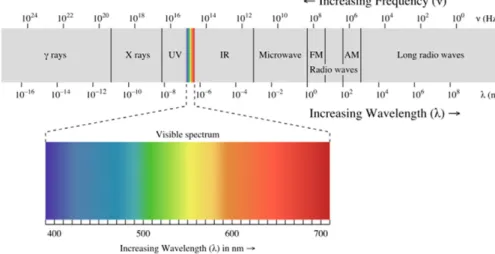
To understand how the spacing of dark and bright spots can be related to the wavelength of the waves, have a look atfigure1.3. Focus your attention on one spot on the screen, on the right of the figure; you can specify where this spot is by specifying either the distance y or the angleθ. The two slits, on the left, are separated from each other by a distance d and from the screen by a distance D. Your point on the screen is then illuminated by the rays, drawn in thefigure, from the slits. These two rays are of different lengths (unless y= 0) and the difference in path lengths is d sinθ. Now, suppose that this path difference is exactly one full wavelength as I have drawn. The two waves will arrive perfectly in phase and there will be a bright spot there. The same would be true if I chose an angle where exactly two, or three, or four, etc, wavelengths wouldfit; in every case the resulting spot would be bright. So, the condition for constructive interference is simply nλ = d sin θ where λ is the wavelength and n is any integer, 0, ±1, ±2, ±3,… The ± just means that this will happen both above and below the center of the screen. (It is not important to understand the details, but some approximations are made which depend on the distance to the screen being very large compared to the spacing of the slits. In the real world, this is almost always true. It also allows for a simplification that sin θ is approximately equal to y/D.) Now you see why Young is given credit for first measuring the wavelength of light—just measuring the positions of the bright spots allows you to deduce the wavelength. For example, for the fourth bright spot from the center you can writeλ = yd/(4D). It turns out that wavelengths of visible light are very small; the visible spectrum spans approximately from 400 nm (violet) to 700 nm (red), a nm (nanometer) being one billionth (10−9) of a meter.
Figure 1.2. Double-slit diffraction pattern for red light.
1.3 What are force fields?
Now that you understand that light has been demonstrated to be waves, the obvious question is‘what is waving?’ Alas, here is another detour which we are required to take since I must assume that you, the reader, are not really conversant with electric and magnetic fields, maybe not even the concept of a field. (A teaser: electric and magneticfields are what are waving!)
The easiest forcefield to visualize is the Earth’s gravitational field because we are all familiar with that. A large mass like the Earth will exert a force on some smaller mass which points straight toward the center of the Earth and becomes weaker as we move farther from the Earth; we know that the force is inversely proportional to the square of the distance from the center of the Earth. Figure1.4shows how we draw a picture which represents this idea and the same general idea applies to otherfields: the lines have arrows attached with the arrows showing the direction of the force felt in thisfield and the density of the lines tell you how big the force is (note that the lines become farther apart as you move out). The idea of afield was first conceived by Michael Faraday (1791–1867), a brilliant investigator of electromagnetism and, interestingly, almost entirely self-educated. It may seem that thefield is just a clever picture to depict what would happen if something sensitive to thefield (a mass in the case of gravity) is inserted. A better way to think aboutfields, though, is that the field actually represents a modification of the space around the source of the field. The field is ‘real’ and a field actually contains energy.
1.4 Electric and magnetic fields
Now, what we are really interested in here are electromagneticfields. Just as mass is the source of gravitationalfields, electric charge is the source of electric fields. And, electricfields behave like gravitational fields in that if you have a sphere of electric charge itsfield is radial (points either toward or away from the center of the sphere) and is inversely proportional to the square of the distance from the
center of the sphere. But perhaps the biggest difference between electric and gravitational forces is that there is only one kind of mass but there are two different kinds of electric charge. We find empirically that like kinds of charge repel each other (which never happens in gravity) and different kinds attract. We arbitrarily assign a sign of either plus or minus to the two kinds of charge to distinguish them and say that thefield of a positive charge points radially outward; the field of negative charges therefore points radially inward. This means that when you see an electricfield it tells you the direction in which a positive electric charge would move in this field; a negative charge would move opposite the field direction. So, the field lines in figure 1.5 could represent electric field lines if the Earth were negatively charged (it actually is). The assignment of the sign of electric charge wasfirst made (for no known good reason) by Benjamin Franklin (1705–90) such that the electron charge is negative and the proton charge is positive and of equal magnitude e= 1.6 × 10⁻¹⁹ coulombs (C). See appendix A for the formal definition of the coulomb.
In addition to the electricfield, another seemingly different field appears if electric charges are moving; this is the magneticfield. So, if you cause many electric charges toflow through a wire, as we do whenever we turn on an electric light, the moving charges constitute what we call an electric current and electric currents are the source of magneticfields. Figure1.5shows the magneticfield caused by a current-carrying wire. Since you are probably familiar with magnets and compasses which do not seem at all like they are caused by electric currents, figure 1.5 shows how a small compass or bar magnet would behave in thisfield: it aligns with the field so that the north pole of the magnet (shown in red) points in the direction of the field. You could think of the north pole of the magnet as a positive‘magnetic charge’ and the south pole as negative to see how this is really a different kind of field from the electric field; if you just put an electric charge at rest somewhere in the magnetic field, it would feel no force at all.
Although it does not concern us here, it should nevertheless be noted that electric and magnetic fields are really both just different aspects of a more overreaching concept, the electromagneticfield.
1.5 Maxwell
’s equations
During the 18th and 19th centuries many scientists studied the properties of electric and magnetic forces as well as the relations between the two. Around 1870 James Clerk Maxwell (1831–79) took all that was known about electromagnetism and condensed it into his four famous equations. A summary, in words, of the essence of Maxwell’s equations can be found in one of my Ask the Physicist answers:
Answer: The laws of electromagnetism are perfectly symmetric: a changing magnetic field causes an electric field and a changing electric field causes a magneticfield. The first of these is called Faraday’s law and the second is part of Ampere’s law. You seem to think that only a permanent magnet is magnetism. In fact, any moving electric charge causes a magnetic field. The most common source of magneticfields is simply an electric current. Here are some facts about electric and magneticfields:
• electric charges cause electric fields,
• electric currents (moving charges) cause magnetic fields, • changing magnetic fields cause electric fields, and • changing electric fields cause magnetic fields.
An amazing result derived from Maxwell’s equations was that they predicted the existence of waves of electric and magneticfields. (You may see a concise derivation at http://askthephysicist.com/thespeedoflight.pdf.) The speed c of these waves was found to be determined by only two well-known constants (see appendix A), the permittivity of free spaceε0and the permeability of free space μ0, c= 1/√(ε0μ0)=
3× 10⁸m s−1. Essentially, these constants quantify the strengths of electric and magneticfields.
So now,finally, we know what is waving—electric and magnetic fields. Figure1.6
shows a simple electromagnetic wave with its electric and magneticfields. Realizing that this shape is moving to the right, you can see that bothfields will be changing at any point of space and, in accordance with Maxwell’s equations, may be thought of as ‘causing each other’ and maintaining the flow of energy along the direction of propagation.
The entire electromagnetic spectrum is shown in figure1.7, demonstrating that only a tiny fraction of it is visible. To create electromagnetic waves, all that is needed
is an accelerated electric charge. The way a radio antenna works is to simply have electric currents running back and forth in a metal rod; in order to change the direction of the currents, the electrons must accelerate and the result is radio waves which propagate away from the rod. Similarly, an atom or molecule can act as an antenna because it is made up of electric charges which can be induced to oscillate. Finally, it should be noted that electromagnetic waves carry energy. This should not be surprising since we feel warmth when sunlight shines on us. The Sun is the source of virtually all energy on Earth. Fossil fuels are merely long-stored solar energy. The energy of an electromagnetic wave is proportional to the square of its electricfield. So a wave with twice the electric field of another carries four times the energy.
Figure 1.7. The spectrum of electromagnetic waves.
Ask the physicist about atomic, nuclear, and quantum physics F Todd Baker
Chapter 2
Quanta and photons, oh my!
2.1 Prologue
Question: Some time ago I found a quantum lecture series on the web. I thought that even if I didn’t ‘get’ all the math, I would still perhaps learn something. Well, the lectures were‘here is some math you will need for quantum mechanics’, ‘here is some more math you will need, etc’. I skipped ahead many lectures and found the next lecture was‘here is some MORE math you need, etc’. I am wondering this: is quantum mechanics something like the Ptolemaic system where the math works even though there is no REAL understanding of the underlying phenomena? Answer: No question—quantum mechanics is quite mathematical as are most advanced topics in physics. It’s the nature of the beast, I guess. But it should be possible to convey the essence of just about any topic in physics with minimal mathematics or even none. That, after all, is what I aim for at AskThePhysicist. com. So, is quantum mechanics comparable as a theory to the Ptolemaic description of the solar system? I would say certainly not. Originally Ptolemy postulated circular orbits for the planets and satellites which did a fairly adequate job for the 2nd century. But then there were more observations which were not described and one had to add epicycles to the Ptolemaic system, sort of circles on circles. It all became contrived to justfit the data and eventually was given up as a failed idea. Quantum mechanics, on the other hand, matured rather quickly from its sketchy origins (black body radiation, photoelectric effect, Bohr model, Compton scattering) to what today is called nonrelativistic quantum mechanics. If applied to experimental results over a time period of about 80 years, the theory has never failed to be correct. But just because it works wonderfully well does not mean we really understand it. I think most physicists would agree that we do not have an answer as to‘why it works’ or whether there is an underlying possibly more deterministic physics. Certainly Einstein was never comfortable with quantum mechanics. To compare it to the purely empirical Ptolemaic ‘theory’ really sells it short.
2.2 Introduction
Physicists were pretty smug at the end of the 19th century. The great successes in understanding electromagnetism, classical mechanics and thermodynamics had induced a state of complacency. There was a general feeling that very little was left to be understood and that the main task of physicists was to be making more accurate measurements of quantities already well understood. But exciting frontiers were just about to open and a century of amazing progress in understanding the world would result. Classical electromagnetism, briefly summarized in chapter 1, was to be at the heart of much of this totally new physics. Thefirst of the Ask the Physicist books, From Newton to Einstein, addressed the theories of relativity. In this book we will learn about the development of quantum physics and the topics it naturally spawned—atomic physics, nuclear physics and particle physics. The pivot point which launched quantum physics was the failure of classical physics to describe the glowing of hot objects.
If you are not familiar with the electron-volt (eV) as a unit of energy, you should read appendixDbefore proceeding. And, if you need a refresher on energy itself, see appendixB.
2.3 Black-body radiation
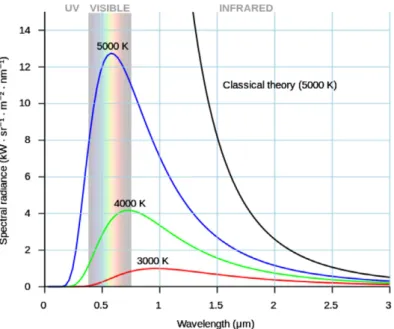
Recall from chapter 1 that Newton discovered that light from the Sun was a continuous spectrum of light, a rainbow of colors, which was later understood to be composed of waves of all wavelengths. But they are not all of equal brightness. Indeed, if careful measurements are made, it is found that all wavelengths present are distributed as shown by the curve labeled 5000 K infigure 2.1. If you are not
familiar with the Kelvin temperature scale, room temperature is about 293 K, so 5000 K is very hot. What is plotted is the intensity or brightness of glowing objects, specifically objects called black bodies. Note that the Sun, a pretty good approx-imation of a black body, is most intense around the color yellow meaning that its surface temperature is around 5000 K. The reason that we evolved to have eyes most sensitive to wavelengths near yellow is because, since the Sun has always been our primary source of light, most light we see has wavelengths near yellow. If we had evolved near a star whose temperature was closer to 4000 K, our eyes would probably have evolved to be most sensitive to infrared radiation.
Question: I have a question about black-body radiation. What exactly is a black body, and how can it theoretically emit infinite energy, and how is this related to black-body radiation?
Answer: A black body is a perfect absorber of radiation. Of course, there is no such thing, but many things are excellent approximations. One example which is very nearly a black body is a tiny hole in a cavity: radiation which enters the hole is highly unlikely tofind its way back out the hole. If you have a black body, it will also radiate energy which is called black-body radiation. So, if you want to study black-body radiation, look at the light coming out of the tiny hole in a hollow metal ball. It turns out that the spectrum has a continuous distribution of energies and is brightest at a wavelength which becomes smaller as the object becomes hotter; for example, red radiation is not‘as hot’ as blue radiation. Black-body radiation played a very important role in physics. At the end of the 19th century the nature of black-body radiation was well known and physicists were trying to explain it. It turns out that classical physics predicted a spectrum which contained an infinite amount of energy, obviously not possible (that must be what you are referring to). This was referred to as the‘ultraviolet catastrophe’ because the spectrum just became bigger without bound for small wavelengths. The problem wasfinally solved by Max Planck by proposing the first ever application of quantum physics.
This Q&A tells you what a black body is and, essentially, as is often the case in physics, it is an idealization, but one for which calculations can be conveniently performed. Stars turn out to be pretty good black bodies which is how we determine their temperatures. Shown in figure 2.1 are the shapes of measured black-body spectra at temperatures T of 5000 K, 4000 K and 3000 K. As you can see, the hotter the black body, the more energy is radiated but as it cools the radiation becomes redder. In fact, it was well known empirically that the power output of a black body is proportional to T4—twice the temperature gives 16 times more energy; this is the Stefan–Boltzmann law. Such nice data were a natural inspiration for the physics of the day to try to explain them. Although it is well beyond the scope of this book to describe the analysis based on Maxwell’s equations and statistical thermodynamics, it was a fairly straightforward task to calculate the energy spectrum for a black body and the result was called the Rayleigh–Jeans law; essentially the result was that the power P (rate of energy radiation) radiated by a black body at some temperature
and at a particular wavelengthλ was inversely proportional to the fourth power of the wavelength, P∝ 1/λ4. Of course this means that the smallerλ is, the larger P is so that at very short wavelengths the energy being radiated became infinite. The total power of radiation for any black body was predicted to be infinite by the physics of the day. There were no errors in this analysis, the best minds of the day all agreed that the analysis was correct. This could only mean that the physics was incorrect. Since short wavelengths are called ultraviolet, this failure was dubbed the ultraviolet catastrophe. Figure 2.1 shows the predicted behavior of the radiation curve for 5000 K, labeled‘classical theory’.
The model behind these calculations imagined that the electrons in the black body were oscillating and behaving like little antennas with all possible frequencies and an oscillating electric charge radiates electromagnetic waves and, when in equilibrium with its environment, also absorbs other electromagnetic waves and the population of oscillators at each frequency could be predicted by statistical considerations which were well understood from thermodynamics. Now, Max Planck (1858–1947), studying this problem, tried the following guess. Suppose that any oscillating charge in the black body could not oscillate with just any old energy; instead, an oscillator with frequency f could only have an energy which was En= hf, 2hf, 3hf, 4hf… where h is
some constant. Now, using h as an adjustable parameter, he found that he was able to perfectly describe the data at any temperature. He found that h= 6.6 × 10⁻³⁴J⋅ s = 4.1× 10⁻¹⁵eV⋅ s in order to fit the data. This was a revolutionary discovery; it was akin to saying that a 1 kg mass hanging on a spring could oscillate with an amplitude of 1 cm or 2 cm but that it would be physically impossible to have any amplitude between. For example, the frequency of yellow light of about 600 nm would have a frequency of about f= 3 × 10⁸/6× 10−7= 5 × 10¹⁴Hz; so the step between two energy states of the oscillator would be about hf= 6.6 × 10−34× 5× 1014 ≈ 3 × 10⁻¹⁹ J ≈ 2 eV. And we can now envision how such an oscillator could radiate energy, by dropping from one energy state (nhf ) to the next lowest state [(n− 1)hf ]; the radiation itself could be viewed as little bundles of energy hf but any particular oscillator would always radiate at the same frequency. Here is a startling thing—light is composed of particles, not waves? Newton was right after all? We will have more to say about this later in this chapter, but don’t count waves out yet. So, nobody took this notion of light particles seriously, not even Planck himself who said‘The theory of light would be thrown back not by decades, but by centuries, into the age when Christian Huygens dared to fight against the mighty emission theory of Isaac Newton…’. Quite simply, classical electromagnetism said that an oscillating electric charge would radiate away its energy with that frequency until all its energy was gone unless it absorbed some energy from the environment.
Planck’s hypothesis for solving the black-body problem represents the birth of what is today called quantum mechanics. The oscillators are said to be quantized and the particles of light are called photons. Here is thefirst indication that at very small sizes, comparable to the sizes of atoms, Newtonian mechanics and Maxwellian electrodynamics are wrong or at least incomplete. Recall from thefirst book of the Ask the Physicist series, From Newton to Einstein, that a similar situation was found
for objects traveling at very high speeds, comparable to the speed of light, requiring the development of the special theory of relativity.
2.4 The photoelectric effect
Imagine shining light on a piece of metal. There are electrons in the metal, of course. Light carries energy and it takes energy to extract electrons from a metal, so we would expect that light would cause electrons to be ejected from the metal. Imagine the electrons experiencing the wave; they respond to the electricfield by starting to move so with each passing wave front they move faster and faster and eventually have acquired enough kinetic energy to pop out of the metal. So, if you wait long enough, electrons should start popping out. Or, if you do not want to wait too long, just increase the intensity of the wave (brighter) which will cause the electron to experience largerfields to accelerate it up to speed. This ejection of electrons is called the photoelectric effect and it was indeed observed in the late 19th century. However, the behavior was not at all as expected: only very short wavelengths would cause electrons to be ejected, e.g. ultraviolet light would do the trick. But if you shone red light on the metal, no matter how intense or how long, electrons were never ejected. And, if the wavelength was capable of causing electron emission, it happened instantaneously no matter how low the intensity. This was a puzzle and, like black-body radiation, seemed to indicate a problem with electromagnetic theory.
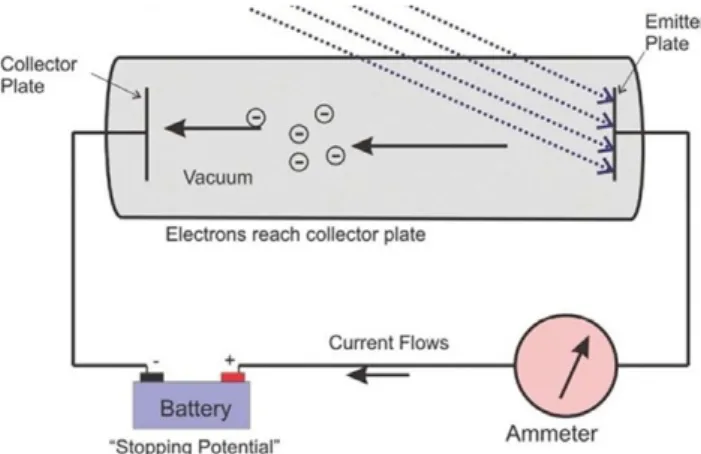
Figure2.2shows a schematic sketch of an experiment to observe the photoelectric effect. A glass tube contains two metal plates and is evacuated. Wires connected to each plate complete a circuit. Light strikes the emitter plate and electrons are ejected. Since the ejected electrons have kinetic energy, they move across the gap to the collector plate. The battery is not required at all; just by connecting the two plates by the wire a current wouldflow and be observable by the ammeter. The purpose of the battery is to determine the energies of the ejected electrons. Note that the battery is connected such that the collector plate is negative and the emitter plate is positive; this results in the electrons being repelled by the collector plate. So, as the voltage of
the battery is gradually increased, the electrons reach the collector plate with smaller and smaller speeds until eventually, they do not reach at all and the current ceases. This then allows the measurement of the energy of the ejected electrons. For example, if with a particular light frequency and intensity the current ceases when the battery voltage is 2.4 V, the maximum kinetic energy of electrons being ejected by that light is 2.4 eV. Furthermore, increasing the intensity, had no effect on this maximum kinetic energy, only on the amount of current whichflowed.
Question: I am trying to teach quantum physics for thefirst time. I am not sure what the link is between the photoelectric effect and Planck’s constant or how to link it meaningfully for the students.
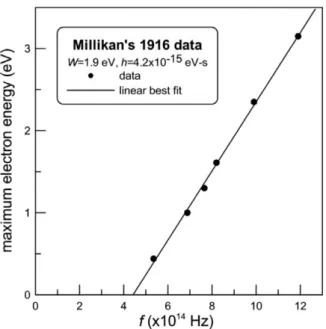
Answer: The graph in figure 2.3 shows photoelectric effect data. Plotting the maximum kinetic energy of the electrons as a function of the frequency f of the light which caused them to be ejected yields a straight line. But, to understand why the data behave like they do, you must assume that the energy given to the electrons is from photons, not try to understand it in terms of waves. Now, the photon gives all its energy to the electron and, since it takes a certain amount of energy, call it W, to remove an electron from the metal, then the kinetic energy K of the electrons must be K= hf − W where h is the slope of the line. It just so happens that h (the slope of the line) turns out to be Planck’s constant, and that is the link you seek.
In 1905 Albert Einstein proposed an explanation of the photoelectric effect. Following up on Planck’s work, Einstein suggested that the radiation was indeed composed of massless particles called photons and each photon had an energy
E= hf. In the photoelectric effect, each photon either interacted by giving all its energy to a single electron or else not at all. So, each electron acquires a kinetic energy of hf. But it takes energy to remove an electron from a metal, otherwise electrons would simply float away from the material in which they reside. That energy is called the work function of the metal (a pretty strange name!) which I will denote as W. Typically, W is on the order of 2–5 eV. Therefore the ejected electron has a kinetic energy of K= hf − W; note that this hypothesis finds that K is a linear function of f, so if measurements of K are made for several wavelengths and K is plotted as a function of f, a straight line should result. If Einstein’s idea is correct, it is evident why the photoelectric effect does not happen for red light: red photons have less than 2 eV of energy, so although they may give that energy to electrons, the electrons do not have enough energy to overcome the work function. The data collected in 1916 by the American physicist Robert Millikan (1868–1953) are shown in figure2.3; the equation of the best straight line through the data points is K= 4.2 × 10⁻¹⁵f − 1.9. This is just about the same as the value which Planck deduced from his analysis of black-body radiation and the separately measured work function for sodium is about 2.2 eV. Einstein and Millikan received the Nobel Prize in 1923 for this work.
So, it now begins to look like there really is something to this quantum business. This is just the beginning of more than 40 years of developing quantum mechanics as a formal theory, learning about the microscopic world—atoms and nuclei. The next section describes yet another early experiment indicating that light, in its interaction with matter, behaves like particles.
2.5 Compton scattering
Question: I am a high school physics teacher and am having some difficulty with part of the Compton effect. I am trying to come to grips with whether the collision between the x-ray and the electron is elastic or inelastic? From what I have been able tofind on the subject, when the x-ray collides with the ‘whole’ atom it results in an elastic collision and the x-ray leaves with the same frequency with which it came in with. On the other hand, when the x-ray collides with something closer to its own mass (an electron), it results in an inelastic collision and the x-ray is ejected with a lower frequency and energy. Any help you could provide would be greatly appreciated. I hate to think that I am not teaching it correctly and sending my students out into the world with misconceptions imparted to them by me. Answer: The Compton effect is elastic scattering of photons from some mass. Elastic does not mean that the energy of the incoming particle remains constant, it means that the sum of the energies of the incoming particle and the target remain constant. Assuming the target is at rest before the collision, after the collision it will recoil and carry away some of the energy which the photon brought in and the only place it can obtain this energy is from the photon. It is maybe easier to see this by thinking about classical particles. If a BB (photon) hits a bowling ball (whole atom), the bowling ball is almost at rest after being hit and therefore the BB has approximately the same energy (and speed) after the collision. If the BB
(photon) hits a marble (electron), the marble will be moving after the collision so the BB must have lost energy (and speed). Both processes are elastic. An inelastic collision is one in which the total energy before and after are not equal.
Photons, if they are indeed particles, should scatter from other particles. So, suppose that we have an electron and we ‘shine light’ on it; in other words, let us bounce the photons off of electrons and look at the scattered photons. What should happen is called an elastic collision, a collision in which both the total energy and the total linear momentum are conserved. Such an experiment was performed by American physicist Arthur Holly Compton (1892–1962) in 1923; he was awarded the Nobel Prize in physics in 1927 in recognition of this work.
Imagine a head-on collision between two balls of unequal mass, the heavier one at rest before the collision. If the collision is elastic, the heavier ball will be moving in the direction in which the lighter ball came in and the lighter ball will have bounced back in the opposite direction but with a speed slower than the speed it originally had. Therefore, if we were able to watch only the lighter ball, we could tell that it had collided with something because it would have different energy and momentum after the collision. For example, if the incident ball had a speed of v before the collision and had half the mass of the other ball, it would rebound backwards with speed v/3 and the ball originally at rest would move forward with speed 2v/3. These calculations assume that momentum is p= mv and energy is E =1
2mv 2
. The details are presented in appendixC.
How a photon would recoil from an electron is different from the two balls in the example above. This is because, since a photon has no mass but still has energy and momentum, momentum (mv) and energy (1
2mv
2) must be redefined using special
relativity. Similarly, the energy is no longer 1
2mv
2. As was shown in From Newton
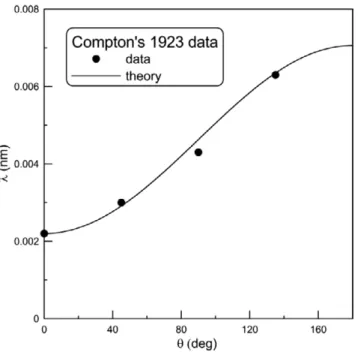
to Einstein, the relation among rest mass m, linear momentum p and energy E is E2= m2c4+ p2c2 where p= mv/√[1 − (v/c)2]. As also presented in appendix C, the result for a collision between a photon with wavelengthλ and a mass m at rest is λ′ − λ = [h/(mc)](1 − cos θ) where λ′ is the wavelength of the scattered photon and θ is the angle, relative to the incident photon, of scattering as shown in figure 2.4. The quantity h/(mc) is called the Compton wavelength and has a value of 2.43× 10⁻¹² m= 0.00243 nm for electrons; so for backscattered photons (θ = 180°, cos θ = −1) the change in wavelength of the radiation is twice the Compton wavelength, 0.00486 nm. Now, since the wavelengths of light are hundreds of nanometers, it would be extremely difficult to notice this small a change. X-rays, however, have wavelengths on the order
of 0.01–10 nm, so the change in wavelength should be observable, particularly for ‘hard’ x-rays which are below 0.2 nm. Even better would be γ-rays with yet shorter wavelengths. (As we shall see in later chapters, x-rays come from atoms and γ-rays come from nuclei.) Compton used x-rays of about 0.07 nm and γ-rays of about 0.0022 nm. The results of hisγ-ray experiment are shown in figure2.5.
Taking stock, three experiments have established that light is composed of particles called photons. But, how can that be? The wave nature of electromagnetic radiation had beenfirmly established by numerous experiments, not to mention the Maxwellian theory of electromagnetism, over more than a century. The situation seemed to be:
• if you look for a wave, you will find a wave, and • if you look for a particle, you will find a particle.
In other words, light is both a particle and a wave. This is different from either a particle or a wave. The phenomenon is a coexistence of both possibilities. This has come to be referred to as the wave–particle duality. This duality is very much at the heart of what would become quantum mechanics.
2.6 de Broglie
’s hypothesis
It would now be a logical question to ask whether, since it has been shown that light is both a wave and a particle, why wouldn’t we expect any particle to behave like a wave? This was the question addressed by a young French student, Louis de Broglie (1892–1987), in his 1924 doctoral dissertation. The idea is pretty simple. Because photons have energy E= hf = pc, the linear momentum p may be written p = hf/c.
But, since f /c= λ, de Broglie suggested that any particle with momentum p might also be a wave with wavelength λ = h/p. Today, this is called the de Broglie hypothesis and the wavelength of a particle is called the de Broglie wavelength.
Question: I have learned that every subatomic particle behaves like a wave and that it can be described using a wave equation, however, what exactly does it mean when they say waves? I know photons travel in waves, but how do protons, electrons, and other particles exhibit wave behavior?
Answer: It is one of the tenets of quantum mechanics that any particle is also a wave. Look for a particle, you willfind particle-like properties, look for a wave, you willfind wave-like properties. This was first proposed by Louis de Broglie in 1924 and he won the Nobel Prize for his hypothesis in 1929. It has subsequently been verified innumerable times in experiments. For one example of diffraction of protons by a sphere, see below.
Question: Is proton diffraction possible?
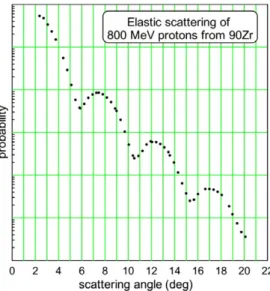
Answer: Any particle, including a proton, will behave like a wave if you look for it, and diffraction is possible for all waves. In fact, I can give you an example of proton diffraction which I myself measured. What is shown in figure 2.6is the differential cross section for 800 MeV protons elastically scattered from the nucleus
90Zr plotted as a function of the angle (in degrees) where the protons were
observed. Differential cross section is, essentially, the probability that the proton (wave) will scatter (diffract) to some angle. This is very much like the diffraction pattern you would observe for visible light striking a sphere—diffraction maxima and minima. In fact, you can qualitatively understand this diffraction pattern if you calculate the wavelength of the protons,λ = h/p ≈ 10−15m, and approximate the positions of the maxima by the double slit relation nλ = d sin θ where we
take d to be the diameter of the nucleus. Taking the two consecutive maxima at about 7.5° and 12.5°, λ ≈ d(sin 12.5° − sin 7.5°) = 0.086d = 10−15m. So, the
diameter of the90Zr nucleus would be about 11.6× 10⁻¹⁵m= 11.6 fm. As a check, the diameter of a nucleus with atomic weight A is well approximated as d≈ 2 × 1.25× A1/3fm, so for A= 90, d ≈ 11.2 fm, pretty good agreement for such a rough calculation. The experiment was performed at the Los Alamos Meson Physics Facility (LAMPF).
The example above exemplifies the difficulty faced by physicists trying to experimentally verify de Broglie’s hypothesis—particle waves often have incredibly short wavelengths. The 800 MeV protons in the example have a wavelength of about 1 fm which is smaller than the size of the atomic nucleus. Just try making a double slit with that spacing! Electrons, with their much smaller mass, have longer wavelengths for comparable velocities, but the electrons available in the 1920s had energies of up to a few hundred electron-volts with wavelengths on the order of 10−10m. But that is manageable because the spacing between atoms in a solid is about this size and in 1927 the definitive experiment was performed by Davisson and Germer who were able to demonstrate diffraction from a nickel crystal. The detailed analysis of reflection diffraction from the three-dimensional array of atoms in the crystal is not important for our purposes; suffice it to say that, again, diffraction similar to the Young double-slit experiment was responsible for verifying the wave nature of electrons. Davisson and de Broglie were awarded the Nobel Prize in 1929.
This may be a good time to ask the perennial question—what is the good of all this ‘pure science research’? Well, as the Q&A below illustrates, one of the most important instruments of the 20th century is the electron microscope. As explained below, optical microscopes are limited in what they can see because of diffraction. However, electrons behaving like waves have much shorter wavelengths than light and can therefore‘see’ much smaller objects. An electron microscope uses magnets to manipulate the rays of electrons in the same way that lenses and mirrors are used to manipulate rays of light.
Question: Why do electron microscopes get better pictures than regular light microscopes?
Answer: The problem with optical microscopes is that you cannot look at anything which is comparable to or smaller than the wavelength of the light. Visible light has wavelengths of a few hundred nanometers,~6 × 10⁻⁷m, so what you are looking at has to be bigger than that, a few microns maybe. The reason is diffraction, light does not just travel in nice straight lines when obstructions or apertures get to be on the order of the wavelength, e.g. light can be bent around a corner. If light does not go in nice straight lines, geometrical optics doesn’t work. On the other hand, we know that particles like electrons can behave like waves and their wavelengths are inversely proportional to their momentum. So, if we make an electron go fast enough it will have a wavelength much smaller than light and therefore let us‘see’ much smaller things.
2.7 What
’s waving?
It is now into the 1920s and evidence seems irrefutable that particles and waves are two sides of the same coin.
Question: How is it possible that light can be both a particle and a wave? I need to know, it’s ruining my whole life!
Answer: Ruining your whole life? How is it possible that my tie can be both red and green? That is just the way it is. I know that this is an unsatisfying answer, but science is based on measurements (experiments) and if you study light and look for a wave, you willfind one but if you look for a particle you will find that also. This is called the wave–particle duality and it is, essentially, a statement of experimental fact. And you can do experiments which unambiguously see both possibilities in the same experiment. The best known example is to do a double slit experiment with very low intensity. If the intensity is so low that there is, say only one photon per minute passing through, then it has to pass through one slit or the other, right? Wrong—you still obtain an interference pattern. So, you say, light is therefore a wave, not a particle. But, imagine that the screen detects the light using the photoelectric effect which cannot be understood unless you treat the light as a collection of photons. This detector will work perfectly well in displaying the interference pattern. This duality is not unique to light: any particle will exhibit wave properties; e.g. that is how an electron microscope works, by exploiting the wave properties of electrons. Maybe I shouldn’t have told you this since it may compound your life-ruining distress! Wave–particle duality is a reality of nature, that is all.
We are faced with the same question which 19th century physicists were faced with when it became clear that light was some kind of wave—what is doing the waving? Without going into detail, it turns out that by analogy with classical mechanics one may write an equation the solutions to which are called the wave functions. This equation is called the Schrödinger equation and the details become quite mathematical, so they are included only in appendix E. But the solutions of this equation for some particular physical system (say an atom or a Planck oscillator), are called the wave functions of the system. The wave function, on its own, really has no physical meaning. But if you take the square of the wave function, it tells you the probability of finding the particle at each location in space. The Schrödinger equation and its detailed solution are beyond the scope of this book, but we can look at a couple of simple cases to obtain theflavor of the wave function and its meaning. The real world is three-dimensional, so the most general wave function (squared) will give you the probability offinding the particle in some small volume around some point in space. It is much easier to understand the nature of the wave function if we let our space be one-dimensional. And such a space is not unphysical, just constrained; one simple example would be a particle confined to move along a straight line, for example a bead on a wire.
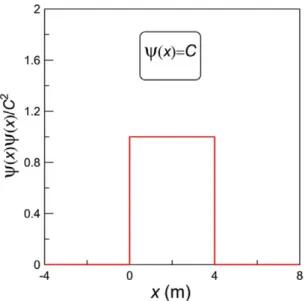
Suppose that the wave functionψ(x) has the simple form of a constant ψ(x) = C between the two points x= 0 and x = 4 m and is zero everywhere else. Just imagine a bead on a wire stretched between two walls separated by 4 m. As noted above, what is of interest is the square of the wave function ψ(x) × ψ(x) = C2; since this is the probability distribution, this means that it is equally probable to find the bead anywhere on the wire and it will never be found outside the walls. Then the square of the wave function is C2. There is no chance that you willfind the particle somewhere other than between 0 and 4 m. I have plottedψ(x) × ψ(x)/C2infigure2.7.
A little common sense now will allow us to determine what C has to be. The probability that the particle be between the walls is 1; the probability that it is between one end and the middle is1
2; the probability that it be in any 1 m distance along the
wire is1
4; etc. The preceding should tell you that what determines the probability P of
finding it in some region Δx along the wire is the area under ψ(x) × ψ(x) in that region, P= ψ(x) × ψ(x)Δx. Therefore, for this example, C2=1
4 or C= 1
2. (To check this,ψ(x) ·
ψ(x)Δx =1 2 ×
1
2 × 4 = 1 if Δx = 4 m.) This process is called normalization; requiring the
total area to be equal to 1 allows us to interpret the area as a probability.
The same reasoning as above applies to any wave function, not just a constant— the total area under ψ(x) × ψ(x) must be 1. If you know integral calculus, this is written as
∫
ψ ×ψ =–∞ ∞
x x x
( ) ( )d 1. An example of a more realistic wave function (called a Gaussian function) is shown in figure2.8. Here the particle is most likely to be near x= 0 and the likelihood of finding it gradually decreases to near zero beyond|x = 2|.
Now that we have an idea of what a wave function is, we can discuss one of the main consequences of wave–particle duality, the Heisenberg uncertainty principle.
2.8 The Heisenberg uncertainty principle
2.8.1 Introduction
Infigure2.8, the particle being described by the wave function is most likely to be found between x= −2 and x = 2. This statement alone leads you to appreciate that you do not know precisely where it is, only a probability of where you are likely to find it. But this uncertainty is not the famous uncertainty principle you have heard about for the following reason. When you make a measurement of where a particle is you are in fact causing it to have a wave function which is consistent with your measurement. But as you make better and better measurements you cause the wave function to become smaller and smaller until youfinally determine the position to any arbitrarily well-determined value. This turns out not to be so simple because there are really two things you do not know about a particle, its position and its speed (i.e. its momentum). The reality is that the more accurately you know one of these, the less accurately you know the other—you cannot simultaneously know both the momentum and position of a particle to arbitrary precision. Understanding this is what this section is about.
Question: I am really confused about what the Heisenberg principle actually states. Why can’t the position and momentum be measured together? Can’t we measure the position and momentum at any particular instant of time since physics can do anything?
Answer: Physics can do anything? Unfortunately, nature has put limits on how precisely certain things can be determined. The underlying reason for the uncertainty principle is the fact that there is really no such thing as a particle. Anything which you might think of as a particle has a dual reality, it is also a wave. In what way, for example, is an electron like a wave? Think of a very long wave with some frequency f. It turns out that the momentum of the wave depends
on f. The‘position’ of this wave train is uncertain, you will admit because it has some length where it exists. Now I said earlier that the wave has a frequency f, but in reality, it has a well-defined frequency only if the wave train is infinitely long. If you want to write an expression for thefinite wave, you find that it is really made up of an infinite superposition of frequencies; this is called a Fourier transform, decomposing some wave into simple sinusoidal functions. The most important contributor is the momentum corresponding to f, but there is a whole distribution of others. So, you see that the wave has uncertainty in both position and momentum. As I said above, infinite uncertainty in position will result in zero uncertainty in momentum. Similarly, if you try to pin down the position by making the wave train shorter and shorter, you find that the momentum distribution becomes larger and larger.
The essence of what is at the root of the uncertainty principle is contained in the answer to this question. To fully appreciate the connection between frequency and momentum, and how momentum and position are intertwined, we will digress briefly to talk about the mathematics involved in Fourier analysis of wave forms. It will not be as bad as it sounds.
2.8.2 The timbre of musical instruments
Have you ever wondered why you can tell the difference between the sounds of two musical instruments playing exactly the same note? Musicians call the quality which allows such a distinction timbre.
Question: A chromatic musical instrument can be used to play any key, but does it play them all equally well? In other words, will it sound better in certain keys? I have read a lot about the harmonic series and fundamental notes. I know that individual notes will have slightly varying timbres (harmonic series). But will the fundamental note have the richest harmonics?
Answer: I guess,first of all, we should say that ‘sound better’ is a subjective thing. The physics of musical instruments is a field unto itself and I certainly cannot cover it in a concise answer which is the modus operandi of this site. A few things are worth pointing out, though. First, terminology: the fundamental frequency is the lowest frequency present in the note, other frequencies present are called overtones, sometimes overtones are harmonics which are integer multiples of the fundamental frequency. Why does the same note played on a piano and a violin sound so different? It is determined by the timbre of the note played on each instrument and this is, essentially, the relative amplitudes of the fundamental and all the overtones produced by the instrument. The amazing thing is that many musical sounds which your brain perceives as some note contain much more of the overtones than of the fundamental, the frequency of the note which your brain is hearing. In fact, if you remove the fundamental entirely from the spectrum, your brain will still‘hear’ the note as the fundamental. That is why tiny speakers which cannot put out low frequencies, say f= 20 Hz, still sound like they have a
bass response. As an example,figure2.9shows the amplitudes of the overtones for a violin and a piano playing the note A3 (440 Hz). For these instruments playing this note, the overtones are all harmonics. Note that the violin has a much greater contribution from higher frequency overtones and a relatively damped mid-frequency response. Also note that both instruments have a fundamental amplitude smaller than some of the overtones. It becomes more complicated still if you consider time; if you look at the relative loudnesses of all the overtones, they change from when the note begins (say plucking a string) and when it ends (string stops vibrating). Finally, the overtone composition depends on how the instrument is played as well as the instrument itself.
Now, you are probably asking yourself, ‘what on Earth do pianos and violins have to do with photons and quanta?’ What Fourier analysis allows you to do is to represent any complex wave form (such as the sound wave from a musical instrument) as a sum of simple wave forms (sine functions). What we have done so far in this subsection, is show how a periodic function (one which identically repeats its shape after some period T forever) can be represented by a sum of overtones which are simple periodic functions of frequencies nf= n/T. In the next subsection we will generalize this to more localized (realistic) situations.
One more thing before we move on. For musical instruments it was useful to talk about time t and frequency f. However, for our purposes, it is more useful to look at how the wave looks in space, x, and decompose it in terms of simple wavelengthλ; so, instead of decomposing someψ(t) in terms of frequencies f, we will decompose someψ(x) in terms of wavelengths λ.
2.8.3 Fourier transforms and the uncertainty principle
Suppose that we now have a function which we wish to decompose into Fourier components, but it does not seem to be periodic. Take, for example, the wave
function in figure 2.7, a square function which is localized between x= 0 m and x= 4 m. Is this a periodic function? It does not repeat itself and so we are inclined to say that it is not periodic. On the other hand, we could say that it has an infinite period, so perhaps Fourier series could be generalized to include the situation of infinite wavelength which is what the wavelength of this wave is. Without going into detail, this can be performed mathematically and the only difference between this and the Fourier series is that rather than just the harmonics being the overtones, all frequencies are the overtones. The resulting distribution of wavelengths,φ(k) × φ(k), (where k= 2π/λ is called the wave number) contributing to make ψ(x) × ψ(x) of figure
2.7is shown by the thin curve infigure2.10,φ(k) × φ(k) where k = 2π/λ; also shown are calculations forφ(k) × φ(k) for reducing the width of ψ(x) × ψ(x) to 2 m (dashed) or 1 m (heavy line).
Now, what does it mean to reduce the width ofψ(x) × ψ(x)? Recall that the wave function (squared) represents the likelihood of finding the particle somewhere; so reducing the width of ψ(x) × ψ(x) means that the particle is confined to a smaller region of space so that the uncertainty of the location of the particleΔx becomes smaller. But look what simultaneously happens to φ(k) × φ(k): as we reduce the width of the box, the width of the distribution of k becomes larger. If we recall from section2.5that p= h/λ = hk/2π, then k = p/ℏ (ℏ = h/(2π))—k is just a different way to represent p, so the more accurately you know x, the less accurately you know p (i.e. the speed). It should be evident that this cuts the other way as well—the more accurately you know p, the less accurately you know x. This is the famous Heisenberg uncertainty principle which is the inescapable consequence of a particle having wave-like properties. It is tricky to make a quantitative equation expressing this principle because it requires a quantitative definition of uncertainty, e.g. how do you measureΔp in figure2.10? It is generally expressed as an inequality,Δx Δp ⩾ ℏ. Note that since ℏ ≈ 10−34 J· s is so small, you will never see the consequences in everyday life.
Onefinal thing. Momentum and position are called conjugate variables. There are other pairs of measureable quantities which are also conjugate and also have uncertainty principles associated with them. The most important such pair
for the purposes of this book is energy E and time t, ΔEΔt ⩾ ℏ. The following Q&As illustrate this version of the uncertainty principle.
Question: How does vacuum fluctuation cause the formation of a particle– antiparticle pair in a vacuum?
Question: I read an article about quantum mechanics and it mentioned particles ‘popping into existence’. Is the assumption that the particles are popping into existence from another invisible/unknown state of energy which exists, or is the claim that they are appearing out of‘absolute nothingness’ and violating the law of conservation of energy? If the currently held belief is that the particles are actually appearing out of pure nothingness, how is it being proven that there is nothing there in the first place? I’m not a scientist obviously but I would have thought that absolute nothingness could not possibly change state into matter, and that there must be a real and invisible force already present which is temporarily changing state into those particles. Surely there must have been some energy somewhere.
Answer: The answer to thefirst question is that vacuum fluctuation is the scientific term for the creation of a particle–antiparticle pair. The second question gets more into the physics of this kind of pair production. The conservation of energy is one of the most important laws of physics, however, the Heisenberg uncertainty principle allows it to be broken provided that it is violated for a short enough time.ΔEΔt ≈ ℏ, where ΔE is the amount by which conservation is violated, Δt is the time the violation lasts, and ℏ ≈ 6.6 × 10⁻¹³keV⋅ s where keV (kiloelectron-volt) is a unit of energy. The mass energy of an electron–positron pair is about 1000 keV, so if they are created out of nothing, they may exist forΔt ≈ 6.6 × 10⁻¹⁶s and then annihilate back to nothing. A proton–antiproton pair has 2000 times more energy and so could last for only aboutΔt ≈ 3.3 × 10⁻¹⁹s. So, there is no such thing as‘pure nothingness’ as you put it, but you will never actually find anything there because anything which‘pops into existence’ pops right back out again in almost no time. Such processes are called virtual pair production.
Question: Please can you explain to me the energy–time uncertainty principle and what areΔE and Δt in it?
Answer: Generally it is pretty easy to visualize what the uncertainty principle involving position and momentum means—you cannot simultaneously know the position and momentum of a particle to arbitrary accuracy. However, there are other pairs of conjugate variables for which the uncertainty principle occurs, two examples are angle–angular momentum and energy–time. The energy–time uncertainty principle is a little harder to get a grasp of, as you have found. There are two examples I can think of which are physical consequences ofΔEΔt ∼ h.
• As you know, one of the truths of classical physics is that the total energy of an isolated system must be conserved. However, in quantum mechanics it is perfectly OK for energy conservation to be violated, as long as you do it for a very short time. So, suppose a photon with energy E is suddenly emitted from
a charged particle. This violates energy conservation. But, if that photon disappears, is reabsorbed or absorbed by some other charged particle in a time on the order of Δt ∼ h/E, that is OK. This gives rise to the so-called vacuum polarization where particles pop into and out of existence even in completely empty space, so we do not really think of a vacuum as containing nothing.
• Another way to look at ΔEΔt ∼ h is that to know an energy absolutely perfectly, the measurement will take forever. So, the ground state of an atom has a well-defined energy because it never changes and is ‘available’ forever. So, apart from experimental uncertainties, you can measure the energy of a stable atom perfectly accurately. However, the excited state on an atom does not live forever, it decays and the decay is characterized by a half-life, τ½.
Therefore, if you measure the energy of such a state by measuring the energy of the emitted photon, after many measurements you will find a spread of energiesΔE = Γ ∼ h/τ½. Because an excited atom does not last forever, that
energy state does not have a specific energy and the spectral lines are not really perfectly sharp. Very short-lived states have very noticeable widths. Measuring the widths of states is often a more accurate way of measuring half-lives.
IOP Concise Physics
Atoms and Photons and Quanta, Oh My!
Ask the physicist about atomic, nuclear, and quantum physics F Todd Baker
Chapter 3
Atoms, oh my!
3.1 Atomic sizes and masses
The atomic composition of matter is one of the oldest conceptualizations in the human quest to understand the world. The Greek philosopher Democritus proposed that matter was composed of small, indivisible units he called atoms (from the Greek ατομον meaning uncuttable) around the 5th century BCE. The idea was also recorded by Indian philosophers around the 6th century BCE. These were philosophical ideas, not based on any measurements, and could therefore say nothing about the size, mass, or structure of atoms. In the 18th century, when chemistry wasfirst being studied seriously, the idea of atomism was resurrected as the only plausible foundation for chemistry. By the early 19th century chemists had pretty good quantitative measures of the size and mass of atoms.
Question: No one has ever seen the atom because it is really very, very, very small, then how is its size known? I mean, how do we know that an atom has a radius of 10−10m?
Answer: The size of an atom has been known for a long time, since the early 19th century. Avogadro’s number is NA≈ 6 × 10²³atoms per mole and tells you
how many atoms there are in a mole of a substance; density is easily measured. For example, carbon has an atomic number of 12 so a mole has a mass of 12 g. The density of carbon is about 2 g cm−3, so one mole of carbon occupies a volume of about 12/2= 6 cm3. Therefore the volume occupied by one carbon atom is V≈ 6/6 × 1023= 10−23cm3, so the size (diameter) of a carbon atom is about3√10−23≈ 2 × 10⁻⁸cm= 2 × 10⁻¹⁰m. Of course, today individual atoms can be‘imaged’, just not in the usual optical way; see the question below and figure 3.1.