Advantages of Silicon Photonics for Multi-socket Systems
The MIT Faculty has made this article openly available.
Please share
how this access benefits you. Your story matters.
Citation
Beamer, Scott et al. “Designing multi-socket systems using silicon
photonics.” Proceedings of the 23rd international conference on
Supercomputing. Yorktown Heights, NY, USA: ACM, 2009. 521-522.
© 2011 ACM
As Published
http://dx.doi.org/10.1145/1542275.1542360
Publisher
Association for Computing Machinery
Version
Author's final manuscript
Citable link
http://hdl.handle.net/1721.1/60376
Terms of Use
Attribution-Noncommercial-Share Alike 3.0 Unported
Advantages of Silicon Photonics for Multi-socket Systems
Scott Beamer, Krste Asanovi´c
Department of Electrical Engineering and Computer Science
University of California, Berkeley, California
{sbeamer, krste}@eecs.berkeley.edu
Christopher Batten, Ajay Joshi,
Vladimir Stojanovi´c
Department of Electrical Engineering and Computer Science
Massachusetts Institute of Technology, Cambridge, Massachusetts
{cbatten, joshi, vlada}@mit.edu
ABSTRACT
Future single-board multi-socket systems may be unable to deliver the needed memory bandwidth electrically due to power limitations, which will hurt their ability to drive per-formance improvements. Energy efficient off-chip silicon photonics could be used to deliver the needed bandwidth, and it could be extended on-chip to create a relatively flat network topology. That flat network may make it possi-ble to implement the same number of cores with a greater number of small dies for a cost advantage with negligible performance degradation.
Categories and Subject Descriptors: B.4.3 [Computer Systems Organization]: Processor Architectures[Parallel Ar-chitectures]
General Terms: Design, Economics, Performance Keywords: Silicon Photonics, Multi-socket
1.
INTRODUCTION
Given the difficulties of scaling uniprocessor performance further, most commercial microprocessor manufacturers have instead used increased transistor densities to integrate mul-tiple processor cores on one die [1]. To deliver further perfor-mance improvements, multi-socket systems have been used to increase the the computing power and memory capacity. These multi-socket systems will require increasing memory bandwidth to deliver realizable improvements in application performance. This bandwidth must come from not only con-nections to DRAM, but also from inter-socket links. Even if the bandwidth to these systems is not hampered by pin limitations, it will be restricted by power limitations from electrical off-chip signalling.
Silicon photonics could be used off-chip to solve this band-width problem, with its great potential for energy efficiency and bandwidth density. If photonics is used for the inter-socket links, it could also be extended on-chip closer to its destinations. In this work we present a scalable interconnect based on a monolithically integrated silicon photonics pro-posal, that is able to harness the technology’s potential to create an uniform network topology. With an approximately flat multi-socket interconnect, the penalty for communicat-ing between sockets is reduced, which may enable potential cost benefits from implementing the same aggregate die area over a greater number of smaller dies.
Copyright is held by the author/owner(s).
ICS’09,June 8–12, 2009, Yorktown Heights, New York, USA. ACM 978-1-60558-498-0/09/06.
2.
SILICON PHOTONICS POTENTIAL
Silicon photonics has emerged in recent years as an ap-pealing way to enable high bandwidths without excessive area or power requirements [3, 5, 6]. Due to the diversity in prospective photonic technologies, we selected a particular monolithically integrated silicon photonic proposal [2, 4] to base our design and its evaluation on.
Since photonics uses light rather than electricity to trans-mit data, transtrans-mitted bits must undergo conversion at both ends (electro-optical and opto-electrical) which adds a con-stant latency and energy penalty. Because those penalties are constant, photonics excels over a distance due to greater amortization. The most compelling advantages for silicon photonics over forecasted electrical interconnects are its high bandwidth density and energy efficiency for off-chip com-munication. On-chip the selected technology performs well under the same metrics, but only if it travels a non-trivial distance. Using a coupler, it is possible to guide light from off-chip fibers onto on-chip waveguides without retransmis-sion or modification. This enables seamless inter-chip links to be made, since if the constant conversion overhead is go-ing to be paid for off-chip links, it makes sense to traverse the remaining on-chip portion optically as well since it is nearly free [2].
For the selected technology, laser light is generated in bulk off-chip, and carried by fiber to splitters on-chip where it will be directed to the various links. Power is consumed by photonic links at the endpoints on-chip for signaling as well as the off-chip light source. Along the path from the transmitter to the receiver, there are various types of losses the signal incurs, and sufficient laser power must be applied to compensate. The optical critical path is the path with the most loss from the light source to the last receiver, and it dictates how much laser power the system will need.
3.
ARCHITECTURE
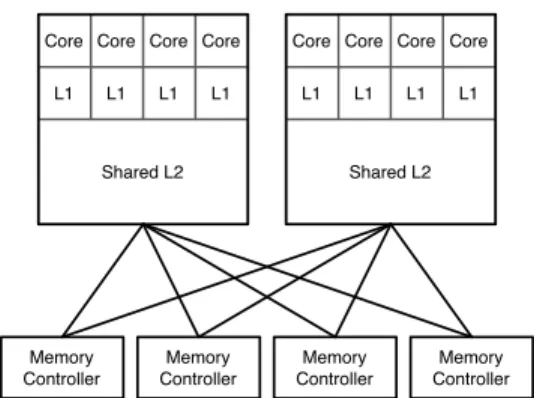
For this research we target single-board multi-socket sys-tems, and our design leverages the potential of photonics to produce a flat network. These boards could be connected to-gether by another network to create an even larger system, but within a board a core sees uniform memory performance. Since electrical interconnects are advantageous over short distances, we electrically join groups of cores (4–16) into clusters by shared L2 caches. These clusters are connected by dedicated photonic links to every memory controller (Fig-ure 1). Fully connected networks are often avoided because of their quadratic growth in resource consumption, but the
Core Core Core Core L1 L1 L1 L1
Shared L2
Memory Controller
Core Core Core Core L1 L1 L1 L1 Shared L2 Memory Controller Memory Controller Memory Controller
Figure 1: Topology for two clusters of four cores with four memory controllers
Clusters Memory Controllers Clusters Memory Controllers Die A Die B Star Coupler
Figure 2: Logical view of a two die system
energy efficiency and the bandwidth density advantages of silicon photonics make it tolerable for a small system. A memory controller may actually communicate with multiple DRAM channels, but from the point of view of the network it is simply a point of arbitration for access to that mem-ory. The links between the DRAM modules and the memory controllers are electrical because of the challenges involved with changing the DRAM interface, but future work could benefit greatly if these connections were photonic.
The simple network topology was not only chosen to make a flat network, but to also enable a single die design to be used in varying quantities to make a scalable range of sys-tems. A cluster’s memory bandwidth is uniformly spread across all the memory controllers, so in the maximum sup-ported system size there is one direct channel between each cluster and each memory controller. For systems with less populated sockets, each cluster will get the same total band-width, but it will have multiple channels to each memory controller. To enable this flexibility, the actual connections between memory controllers and clusters is done off chip (Figure 2) so the changes necessary for systems of different sizes are localized to small off-chip components. To simplify the packaging and assembly of all the point-to-point connec-tions, off-chip fibers are grouped into ribbons, which connect to a star coupler. The star coupler is a passive device that connects two groups of ribbons such that each ribbon has at least one fiber directly coupled with a fiber from every ribbon in the other group. Our design template is general enough that it is able to scale down to smaller dies while maintaining the same topology and nearly identical perfor-mance.
4.
INCENTIVES FOR DISINTEGRATION
Using a greater number of smaller dies to implement the same silicon area could have cost advantages. Smaller dies
should benefit from higher yield rates and increased toler-ance to process variation, since they could be binned on finer granularities. A single reusable design will also have a higher sales volume, which will reduce non-recurring engi-neering (NRE) costs. This disintegration is made worthwhile by photonics, because otherwise it will increase the number of electrical pins and power spent on the interconnect. For our design, smaller dies will allow the system to be more spread out, which will reduce the power density and make it easier to electrically attach DRAM. Fixed costs per die (testing, packaging, and assembly) will cause penalties for using dies that are too small, but the optimum die size for cost may be smaller than current commercial designs.
5.
RESULTS
Using our candidate technology, we evaluated the general design while varying the die size (16–256 cores/die) and the maximum supported system size (64–1024 cores). To scale to higher core counts will require a multi-hop network. The layout of each design was optimized to reduce the optical critical path loss because laser power can be the majority power consumer of a photonic interconnect. The area taken by the on-chip interconnect was always less than 10%, and the latency stayed roughly constant since the network topol-ogy stayed the same. Interestingly for the range of designs explored, independent of the total numbers of cores, systems with a modest number of dies (4–8) had the lowest optical power.
6.
CONCLUSION
Silicon photonics provides an appealing way to supply the bandwidth needed to drive multi-socket systems, and a range of scalable designs capable of supporting up to 1024 cores with uniform memory bandwidth was presented. In a relatively flat network like the one presented, silicon photon-ics sufficiently reduces the barrier to going off-chip such that future die sizes may be chosen by what is most cost efficient instead rather what is most reasonable to manufacture.
7.
REFERENCES
[1] K. Asanovic et al. The landscape of parallel computing research: A view from berkeley. Technical report, U.C. Berkeley, 2006.
[2] C. Batten et al. Building manycore processor-to-dram networks with monolithic silicon photonics. High Performance Interconnects, Jan 2008.
[3] N. Kirman et al. Leveraging optical technology in future bus-based chip multiprocessors. IEEE Micro, 27(6), Jan 2006.
[4] J. Orcutt et al. Demonstration of an electronic photonic integrated circuit in a commercial scaled bulk cmos process. Conf. on Lasers and Electro-Optics, 2008. [5] A. Shacham et al. Photonic noc for dma
communications in chip multiprocessors. IEEE Symposium High-Performance Interconnects, 15, Jan 2007.
[6] D. Vantrease et al. Corona: System implications of emerging nanophotonic technology. ISCA, Jan 2008.