HAL Id: hal-02186903
https://hal.archives-ouvertes.fr/hal-02186903
Submitted on 17 Jul 2019HAL is a multi-disciplinary open access archive for the deposit and dissemination of sci-entific research documents, whether they are pub-lished or not. The documents may come from teaching and research institutions in France or abroad, or from public or private research centers.
L’archive ouverte pluridisciplinaire HAL, est destinée au dépôt et à la diffusion de documents scientifiques de niveau recherche, publiés ou non, émanant des établissements d’enseignement et de recherche français ou étrangers, des laboratoires publics ou privés.
3-Aminoazepane Series
S. Cutri, A. Chiaroni, M. Bonin, L. Micouin, H.-P. Husson
To cite this version:
S. Cutri, A. Chiaroni, M. Bonin, L. Micouin, H.-P. Husson. Practical Asymmetric Synthesis of 1,2-Diamines in the 3-Aminoazepane Series. Journal of Organic Chemistry, American Chemical Society, 2003, 68 (7), pp.2645-2651. �10.1021/jo026711s�. �hal-02186903�
Practical Asymmetric Synthesis of 1,2-Diamines in the 3-Aminoazepane Series
S. Cutri, A. Chiaroni, M. Bonin*, L. Micouin* and H.-P. Husson
Laboratoire de Chimie Thérapeutique, UMR 8638 associée au CNRS et à l'Université René Descartes, Faculté des Sciences Pharmaceutiques et Biologiques
4, av de l'Observatoire, 75270 Paris cedex 06 (France)
A. Chiaroni
Institut de Chimie des Substances Naturelles, Avenue de la Terrasse, F-91198 Gif-sur-Yvette (France)
Abstract: A simple and versatile method for the enantio- and diastereoselective synthesis of
mono- or disubstituted 3-aminoazepanes is described. The key step involves a highly regio- and diastereoselective tandem ring-enlargement/alkylation or reduction process. This novel synthetic route provides enantiomerically pure constrained diamines interesting as scaffolds for medicinal chemistry.
Introduction
Vicinal diamines and their derivatives have been shown to play key roles in medicinal chemistry, coordination chemistry, and asymmetric catalysis.1 Among this family, constrained diamine systems continue to attract synthetic interest considering their wide potential as medicinal agents. Novel polyamino derivatives recently reported as potential contrast enhancement agents in MRI have displayed considerable improvement of in vivo stability and biodistribution relative to non-rigid Gadolinium (III) complexes.2 Various CNS receptor ligands3 and antitumor chiral cis-platin analogues4 have been developed in the
3-aminoazepane series. Although various synthetic pathways have been devised for the preparation of functionalized azepanes,5 a straightforward access to enantiopure polysubstituted 3-aminoazepanes, as general scaffolds for the elaboration of bioactive compounds, would be desirable.
In previous preliminary synthetic studies, we reported the asymmetric synthesis of optically pure trans-2-phenyl- and 2-furyl-3-aminoazepanes 3a,c from 2-cyano-6-oxazolopiperidine 1.6 The key-step involved a one-pot reduction and ring-enlargement process of intermediates 2 occurring in a totally regio- and diastereoselective manner (Scheme 1). Scheme 1 N NC O Ph N N OH Ph R1 H N R1 H2N H N R1 H2N R2 1 * * * 1. Reduction 2. N-deprotection 2 R1Li 3a R1 = Phenyl 3b R1 = 2-Furyl 4 2 7
We report in this article our full investigations in this field, as well as the generalization of this original ring-enlargement reaction for the diastereo- and enantioselective preparation of 2,7-disubstituted 3-aminoazepanes 4.
Results and Discussion
Synthesis of 2-substituted 3-aminoazepanes.
Multigram quantities of bicyclic imines 2 can be prepared in one step from 2-cyano 6-oxazolopiperidine 17 in yields ranging from 74 to 97% (Scheme 2).
Scheme 2a N N OH Ph R 2a R1 = Ph 2b R1 = n-Bu 2c R1 = 2-Furyl 2d R1 = 2-OMe-Ph 2e R1 =2- Py N NC O Ph 1 R1Li 88% 91% 95% 74% 97% a
Reagents and conditions : R1 = Ph, n-Bu, 2-Py : R1Li, Et2O, - 78 °C ; R1 = OMe-Ph,
2-Furyl: R1Li, TMEDA, THF, - 78 °C.
These stable compounds are key intermediates for the ring enlargement strategy. Under protic conditions, reaction of butyl or phenyl derivatives 2a,b with NaBH4 or NaBH3CN have been
reported to give piperidines 5 or morpholines 6 respectively in a high diastereoselective manner (Scheme 3).8 Scheme 3a H N R1 PHN * * N NMOM Ph 2 R1 7 8a R1 = Ph 91%
8b R1 = n-Bu see text
8c R1 = 2-Furyl 65% * N O Ph H2N R1 N 6 NH2 R1 OH Ph H 5a R1 = Ph 70% 5b R1 = n-Bu 66% N N OH Ph R1 R1 = aryl, alkyl P = (R)-CH(Ph)CH2OH a b c b H a
Reagents and conditions : (a) NaBH3CN, H+, THF, MeOH; (b) LAH, Et2O; (c) NaBH4,
MeOH.
Treatment of the same imines with LAH led to a completely different 1,2-diamine system. No trace of six-membered ring derivatives could be observed starting from aromatic conjugated imines 2a,c. However, in the butyl series an inseparable mixture of compounds
8b and 5b was obtained. The best conditions were found by adding LAH carefully to an ether
solution of the imine (20 °C, 3h; 8b/5b = 9/1). The different issues of reductions can be explained by chemoselective nitrogen activation. One the one hand, activation of the
secondary aminal nitrogen under protic conditions leads to a 6-membered ring, on the other hand activation of the piperidine nitrogen under Lewis acidic conditions leads to the ring enlargement. The lack of selectivity observed in the aliphatic series probably relies on the formation of a transient morpholine 6b, known to be reduced into piperidine systems by LAH. This morpholine was indeed isolated when LAH reduction of 2b was performed at low temperature (-78 °C).
Since the ring-enlargement proceeds by a two step reduction, isolation of the transient aminal should allow selective functionalization at the C-7 azepane position by a nucleophilic opening with a suitable organometallic nucleophile instead of a hydride. Before selective reductions trials, the alcohol function was first protected in order to avoid the formation of morpholine-type intermediates. Various aryl and alkyl imines 2a-e were thus prepared and protected as O-silylated compounds 10a-e in 70-90% yield (Scheme 4).
Scheme 4a N NHOTBDMS Ph R1 10 N NHOTBDMS Ph R1 11 9a-e b or H H N N OTBDMS Ph R1 2a-e a
a Reagents and conditions : (a) NaH, TBDMSCl, 94 % (R = Ph), 86 % (R = n-Bu), 81 % (R=
2-OMe-Ph), 95 % (R = 2-Py); (b) see Table 1.
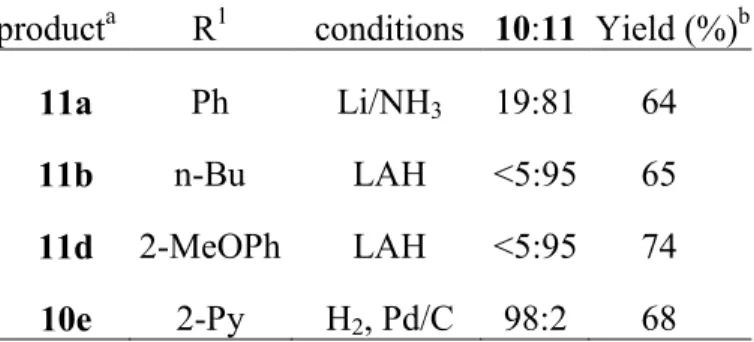
Table 1. Diastereoselective access to aminals 10 or 11.
producta R1 conditions 10:11 Yield (%)b
11a Ph Li/NH3 19:81 64
11b n-Bu LAH <5:95 65
11d 2-MeOPh LAH <5:95 74
10e 2-Py H2, Pd/C 98:2 68
a Major diastereomer. b Yield of diastereomerically pure compound.
Selective imine reductions proved to be particularly troublesome and highly dependent on their substitution patterns. Our first attempts to reduce 9a using LAH under
various experimental conditions led to either irreproducible results or the known desilylated azepane derivative 8a. More encouraging results were obtained using dissolving-metal conditions.9 Treatment of 9a with lithium in liquid ammonia afforded, in a first experiment, a mixture of aminals 10a and 11a in a 1/1 ratio. Careful optimization of the reprotonation conditions improved this ratio significantly in favor of the 11a isomer, leading to pure material in 64% yield (Table 1). The presence of a bicyclic aminal could be ascertained by typical NMR chemical shifts (a doublet at 4.58 ppm and a peak at 60.5 ppm observed respectively in the 1H and the 13C NMR spectra were attributed to the C-7 reduced position, two broad deshielded proton signals consistent with the searched bicyclic aminal system). Absolute configuration of the newly created asymmetric center was determined unambiguously by chemical transformation of 11a into O-silylated piperidine derivative 12a by acidic NaBH3CN reduction.7 In the 2-methoxyphenyl series, simple LAH reduction
afforded the corresponding aminal 11d with reasonable yield and high diastereoselectivity, without over-reduction into the corresponding azepane. Both methods failed when applied to the pyridinyl imine 9e reduction. LAH reduction led only to desilylation or degradation material whereas lithium or sodium in liquid ammonia gave an inseparable mixture of aminals 10e and 11e (60:40 ratio, 95 % yield). Pd-catalyzed hydrogenation in various solvents was therefore investigated. The hydrogenation of the imine in ethyl acetate afforded the corresponding aminals 10e and 11e as an equimolar mixture, whereas in methanol, the major derivative 10e could be isolated in a diastereomerically pure form. Finally, 11b could be obtained as a single diastereomer after LAH reduction.
In each case, 1H and 13C NMR spectra revealed characteristic signals of bridged bicyclic structures as shown above. However, the relative configuration of the newly created stereogenic center (C-7) could not be determined directly from the NMR data. This was achieved by correlation with the corresponding erythro (J =3.9-4.3 Hz) or threo (J =10.1-11.2 Hz) O-silylated aminoalkyl piperidines 12 after acidic NaBH3CN aminal reduction of
Scheme 5 11 a,d N Ph OTBDMS R1 NH2 12a erythro 12d erythro J2,3 = 4.3 Hz J2,3 = 3.9 Hz 10a,e NaBH3CN N Ph OTBDMS R1 NH2 12a threo 12e threo J2,3 = 11.2 Hz J2,3 = 10.1 Hz NaBH3CN H H
Since bicyclic aminals are believed to be intermediates in the one step ring enlargement process, their reduction with LAH should lead to the known azepanes 8. This was indeed the case, although this transformation required harsher reaction conditions than with the direct imine reduction. LAH treatment of aminal 11d in refluxing diisopropyl ether afforded in a diastereoselective manner the desilylated and demethylated azepane 8f with the desired azepane cyclic core 8d as a minor side product (8d/8f = 25/75).10
Scheme 6a N NHOTBDMS Ph R1 H 11b,d H N R1 HN HO Ph H N R1 H2N a b 8a : R = Phb 8b : R = n-Bu 98% 8c : R = 2-Furb 8d : R = 2-MeOPh 49% 8f : R = 2-HOPh 50% 8e : R = 2-Py 0% 3a : R = Ph 3b : R = Bu 3c : R = 2-Fur 3d : R = 2-MeOPh 3f : R = 2-HOPh 96% 95% 80% 95% 90% 10e
a Reagents and conditions : (a) LAH, iPr
2O or Et2O, reflux; (b) H2, Pd/C, MeOH-HCl for 8a,b,d,f or H5IO6 (2.6 eq), MeNH2, H2O, MeOH, then MeOH-HCl for 8c.
b From 2a,c via one step reduction (Scheme 3).
Using milder conditions (refluxing in diethyl ether), the desired product 8d was obtained as the major product (8d/8f = 80/20). Unfortunately, presence of a pyridine ring seemed to inhibit the ring-enlargement process. Finally, unprotected 2-substituted 3-amino
azepanes were obtained in good yield after hydrogenolysis or oxidative cleavage. Interestingly, using this two step process, diamine 8b could be obtained in good yield and total diastereoselectivity, without any 6-membered ring contaminants. Once again, the trans relative configuration of such azepanes could be ascertain by the typical H-2/H-3 coupling constant of 9 Hz.
Synthesis of 2,7-disubstituted 3-aminoazepanes.
During the ring enlargement process, a transient seven-membered imine was reduced by an hydride. However, the use a of Lewis acidic nucleophile should lead to the same reactive species from bicyclic aminals 10 or 11 and enable further functionalizations of the azepane at the C-7 position. Although the reactivity of such aminals is unknown, the related reaction of nucleophilic reagents, especially organomagnesium compounds, with oxazolidines is well documented.11
Scheme 7 N NHOTBDMS Ph R1 11a 10d H N R1 PHN * R2MgBr Et2O, R2 * P = (R)-CH(Ph)CH2OTBDMS 14
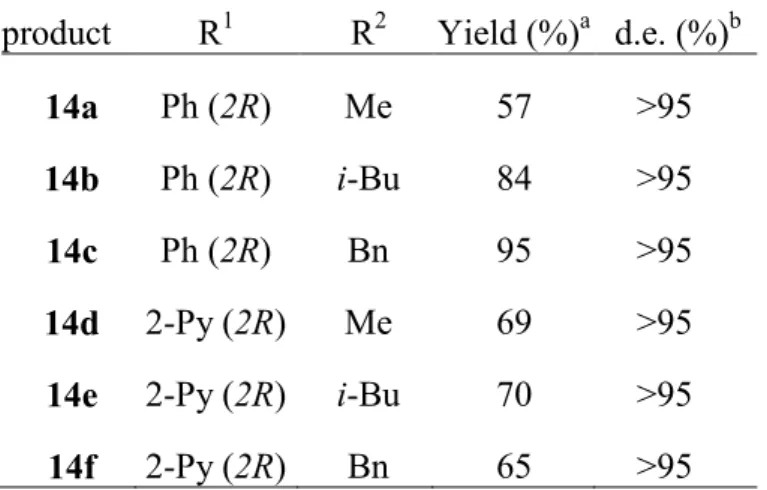
Table 2. Diastereoselective access to polysubstituted azepanes 14
product R1 R2 Yield (%)a d.e. (%)b
14a Ph (2R) Me 57 >95
14b Ph (2R) i-Bu 84 >95
14c Ph (2R) Bn 95 >95
14d 2-Py (2R) Me 69 >95
14e 2-Py (2R) i-Bu 70 >95
14f 2-Py (2R) Bn 65 >95
a Yield of diastereomerically pure compound.
Initial experiments were performed on phenylaminal 11a, using methylmagnesium bromide as a nucleophile and a Lewis acid (Table 2). The best results were obtained via refluxing 11a in ether with an excess of organomagnesium reagent (3.5 equiv.), leading to compound 14a in 57% yield as a single diastereomer. The formation of a ring-enlarged derivative could be ascertained by typical NMR data : 13C NMR spectrum displayed the three CH peaks at 49.5, 62.2, 62.8 ppm and one methyl signal at ppm as expected from the alkylation process. The 1H NMR spectrum showed a multiplet at 2.90 ppm for the C-7 proton and a doublet at 3.82 ppm for the C-2 proton.
The use of iso-butyl as well as benzyl Grignards as nucleophiles afforded exclusively ring-enlarged derivatives 14b,c in diastereomerically pure form. Interestingly, no reduction product arising from an hydride transfer with the branched organomagnesium reagent could be detected. Unlike the LAH reduction of aminals 11b,d, the ring-enlargement occurred without any O-desilylation. Final compounds 4a,b,c could be obtained after desilylation and hydrogenolysis. Scheme 8 H N Ph H2N a) BF3.OEt2 b) H2, Pd/C R2 H N Ph N H R2 14a : R2 = Me 14b : R2 = i-Bu 14c : R2 = Bn 4a : R2 = Me 4b : R2 = i-Bu 4c : R2 = Bn 70% 77% 81% TBDMSO Ph
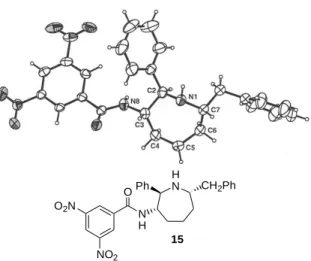
Following standard procedure, benzylazepane 4c was finally converted to crystalline benzamide 15, and its relative configuration was determined by X-ray crystallography analysis. The 3,7-cis configuration could be attributed to derivatives 4a,b by comparisons of their 1H and 13C NMR spectra.
H N Ph N H CH2Ph O2N NO2 O 15
Figure 1 : X-ray structure of derivative 15.
The same ring-enlargement reactions were then performed starting from pyridyl aminal 10e, in order to study the influence of each stereogenic center on the stereochemical outcome of this reaction. Compounds 14d,e,f were obtained in good yields as single diastereomers. Once again, a 3,7-cis configuration could be established for compound 14f by n.O.e experiments on its desilylated derivative, and attributed to the other compounds by comparisons of their 1H and 13C NMR spectra.
Alkylations are therefore totally diastereoselective. Surprisingly, the stereochemical outcome is independent of the C-2 stereogenic center configuration, unlike previous examples in the piperidine series.12 The 3,7-cis configuration could be explained by a mechanism involving an intramolecular delivery of nucleophile in an early transition state (Figure 2). N MgBr N OTBDMS Ph R1 * MgBr R
In summary, we have developed a simple and versatile method for the rapid elaboration of 2-mono- or 2,7-disubstituted 3-aminoazepanes. We have shown that bicyclic aminals are powerful synthetic intermediates in allowing a tandem ring-enlargement/alkylation process in a highly regio- and diastereoselective manner. This novel synthetic route leads to various enantiomerically constrained diamines interesting as scaffolds for medicinal chemistry. Application of this method to the preparation of biologically active compounds is currently underway in our laboratory.
Experimental section
General Methods. 1H NMR (300 or 400 MHz) and 13C NMR (75 MHz) were recorded in CDCl3 or CD3OD solution. IR spectra were recorded as thin film unless otherwise stated.
Mass spectral data were recorded in chemical-ionization (CI) mode. Tetrahydrofuran (THF) and ether (Et2O or iPr2O) were distilled from sodium/benzophenone immediately prior to use;
CH2Cl2, TMEDA, Et3N, MeOH, CHCl3 were distilled from CaH2. Compounds 1, 2a, 2b, 3a, 3c were prepared according to previously reported procedures.6,7,8
(1S, 5S) 2-[7-(2-Methoxyphenyl)-6,8-diazabicyclo[3.2.1]oct-6-e8-yl]-(2R)-phenyl-ethanol 2d. Anisole (4.28 mL, 39.5 mmol) was added to a cold (0 °C) mixture of
n-butyllithium (1.6 M in hexanes, 16.4 mL, 26 mmol) and TMEDA (3.96 mL, 26.3 mmol) in THF (20 mL) under an atmosphere of Ar. The reaction mixture was maintained at 20 °C for 45 min and then cooled to -78 °C. A solution of 2-cyano-6-phenyloxazolopiperidine (1) (2.0 g, 8.8 mmol) in THF (20 mL) was added and the reaction mixture was allowed to warm to room temperature and maintained overnight. The reaction mixture was cautiously diluted with a saturated, aqueous solution of NH4Cl, extracted with CH2Cl2 (2 x), and the combined
residue was purified by chromatography (CH2Cl2/MeOH 95/5) to provide imine 2d (yellow oil, 2.18 g, 74%). []D = + 46 (c 1.4, CH2Cl2); IR (neat) 3326, 2940, 1656, 1599 cm -1 ; MS m/z 337 (MH+); 1H NMR (CDCl3) 1.20-1.80 (m, 6H), 3.52 (t, J =4.8 Hz, 1H), 3.53 (s, 3H), 3.77 (dd, J =11.1, 4.3 Hz, 1H), 3.87 (dd, J =11.1, 5.2 Hz, 1H), 4.22 (t, J =2.9 Hz, 1H), 5.45 (t, J =2.6 Hz, 1H), 6.83 (d, J =7.4 Hz, 1H), 6.94 (td, J =7.7, 0.9 Hz, 1H), 7.21-7.33 (m, 5H), 7.37 (td, J =7.7, 1.7 Hz, 1H), 7.79 (dd, J =7.7, 1.8 Hz, 1H); 13C NMR (CDCl3) 17.0, 24.4, 26.0, 55.0, 65.1, 65.9, 68.0, 84.3, 111.2, 120.7, 121.6, 127.4, 128.3, 128.5, 130.6, 132.1, 141.1, 158.6, 172.2. (1S, 5S) 2-(7-Furan-2-yl-6,8-diazabicyclo[3.2.1]oct-6-en-8-yl)-(2R)-phenyl-ethanol 2c
(yellow oil, 2.47 g, 95%). []D = -11 (c 1.1, CH2Cl2); IR (neat) 3320, 2947, 1622 cm -1 ; MS m/z 297 (MH+); 1H NMR (CDCl3) 1.20-1.85 (m, 6H), 3.47 (t, J =4.7 Hz, 1H), 3.78 (dd, J =11.1, 4.2 Hz, 1H), 3.85 (t, J =2.9 Hz, 1H), 3.92 (dd, J = 11.1, 5.2 Hz, 1H), 5.50 (t, J =2.9 Hz, 1H), 6.46 (dd, J =3.4, 1.5 Hz, 1H), 6.67 (d, J =3.4 Hz, 1H), 7.25- 7.35 (m, 5H), 7.51 (t, J =1.5 Hz, 1H); 13C NMR (CDCl3) 16.7, 25.3, 25.4, 64.6, 65.8, 66.3, 86.2, 111.9, 114.4, 127.8, 128.4, 128.6, 140.2, 145.4, 162.4. (1S, 5S) 2R-Phenyl-2-(7-pyridi2-yl-6,8-diazabicyclo[3.2.1]oct-6-e8-yl)-ethanol 2e.
n-BuLi (21.9 mL, 1.6 M in hexanes, 35.1 mmol) was added to a stirred solution of 2-bromopyridine (4.48 mL, 46.8 mmol) in anhydrous Et2O (30 mL) at –70 °C under argon.
After 30 min a solution of 2-cyano-6-phenyl-oxazolopiperidine 1 (2 g, 8.77 mmol) in Et2O
(10 mL) was added. The mixture was stirred at –70 °C for 5 h. The reaction mixture was cautiously diluted with a saturated, aqueous solution of NH4Cl, extracted with CH2Cl2 (2 x),
and the combined organic layers were dried (MgSO4). The residue was purified by
chromatography (CH2Cl2/MeOH 95/5) to provide 2c (amorphous yellow solid, 2.61 g, 97%).
[]D = - 44 (c 1.1, CH2Cl2); IR (neat) 3330, 2945, 2871, 1609, 1586 cm -1
; MS m/z 308 (MH+); 1H NMR (CDCl3) 1.13-1.92 (m, 6H), 3.57 (t, J =5.4 Hz, 1H), 3.85 (d, J =5.4 Hz,
1H), 4.38 (t, J =2.9 Hz, 1H), 5.49 (t, J =2.5 Hz, 1H), 7.13-7.24 (m, 5H), 7.29 (ddd, J =7.7, 4.8, 1.5 Hz, 1H), 7.68 (td, J =7.7, 1.5 Hz, 1H), 7.96 (br. d, J =7.7 Hz, 1H), 8.53 (br. d, J =4.8 Hz, 1H); 13C NMR (CDCl3) 17.0, 24.7, 25.1, 64.0, 65.1, 66.4, 87.2, 122.1, 124.9, 127.6, 128.2, 128.4, 136.3, 139.8, 149.2, 151.3, 173.2.
General procedure for the preparation of O-silylated imines 9.
The preparation of imine 9a is representative. NaH (60% suspension in mineral oil, 614 mg, 15.4 mmol) was added at 0 °C under argon to a stirred solution of imine 2a (2.36 g, 7.71 mmol) in THF (94 mL). After 30 min at room temperature, ter-butyldimethylsilyl chloride (2.33 g, 15.4 mmol) was added. The resulting mixture was stirred for an additional 16 h at 20 °C. The reaction mixture was cautiously diluted with a saturated, aqueous solution of NH4Cl,
extracted with CH2Cl2 (2 x), and the combined organic layers were dried (MgSO4). The
residue was purified by flash chromatography (Cyclohexane/AcOEt 1/1, then 2/8, then AcOEt) to provide 9a as a yellow oil (3.04 g, 94%).
(1S, 5S) 8-[2-(tert-Butyl-dimethyl-silanyloxy)-(1R)-phenyl-ethyl]-7-phenyl-6,8-diaza-bicyclo[3.2.1]oct-6-ene 9a. Oil, []D = +10 (c 0.9, CH2Cl2); IR (neat) 2951, 2858, 1605 cm
-1 ; MS m/z 421 (MH+); 1H NMR (CDCl3) -0.22 (s, 3H), -0.17 (s, 3H), 0.71 (s, 9H), 1.11-1.78 (m, 6H), 3.32 (t, J =5.6 Hz, 1H), 3.63 (dd, J =10.3, 5.6 Hz, 1H), 3.82 (t, J =2.9 Hz, 1H), 3.88 (dd, J =10.3, 5.6 Hz, 1H), 5.54 (t, J =2.7 Hz, 1H), 7.14-7.37 (m, 8H), 7.61 (m, 2H); 13C NMR (CDCl3) -1.5, -0.5, 16.9, 24.8, 18.2, 25.9, 66.5, 68.0, 86.0, 127.4, 128.0, 128.4, 128.7, 130.9, 132.5, 142.8, 150.2, 171.8. (1S, 5S)7-Butyl-8-[2-(tert-butyl-dimethyl-silanyloxy)-(1R)-phenyl-ethyl]-6,8-diazabicyclo [3.2.1]oct-6-ene 9b (yellow oil, 2.65 g, 86%). []D = -18 (c 1.8, CH2Cl2); IR (neat) 2954,
2856, 1636 cm-1; MS m/z 401 (MH+); 1H NMR (CDCl3) -0.26 (s, 3H) , 0.20, (s, 3H), 0.70 (s, 9H), 0.83 (t, J =7.3 Hz, 1H), 1.10-1.80 (m, 10H), 2.13 (m, 1H), 2.27 (m, 1H), 3.24 (m, 2H), 3.57 (dd, J =10.2, 6.0 Hz, 1H), 3.84 (dd, J =10.2, 5.4 Hz, 1H), 5.27 (br.s, 1H),
7.02-7.36 (m, 5H); 13C NMR (CDCl3) -5.3, 14.1, 18.3, 18.5, 23.0, 24.4, 25.2, 26.1, 28.4, 31.2, 66.8, 68.2, 68.5, 85.4, 127.5, 128.5, 128.8, 128.9, 142.1, 177.2.
(1S, 5S) 8-[2-(tert-Butyl-dimethyl-silanyloxy)-(1R)-phenyl-ethyl]-7-(2-methoxy-phenyl)-6,8-diazabicyclo[3.2.1]oct-6-ene 9d (yellow oil, 2.81 g, 81%). []D = +72 (c 1.0, CH2Cl2);
IR (neat) 2951, 2855, 1600 cm-1; MS m/z 451 (MH+); 1H NMR (CDCl3) 0.17 (s, 3H), -0.10 (s, 3H), 0.77 (s, 9H), 1.20-1.90 (m, 6H), 3.47 (t, J =5.6 Hz, 1H), 3.53 (s, 3H), 3.68 (dd, J =10.2, 5.8 Hz, 1H), 3.94 (dd, J =10.2, 5.4 Hz, 1H), 4.13 (t, J =3.5 Hz, 1H), 5.56 (t, J =2.6 Hz, 1H), 6.81 (d, J =8.0 Hz, 1H), 6.96 (td, J =7.5, 0.9 Hz, 1H), 7.16-7.37 (m, 5H), 7.86 (dd, J =7.7, 1.8 Hz, 1H); 13C NMR (CDCl3) -1.5, 17.0, 18.3, 24.3, 25.9, 54.9, 66.4, 68.3, 68.8, 84.5, 111.3, 120.7, 122.4, 127.0, 128.0, 128.8, 130.4, 131.8, 142.4, 158.8, 171.9. (1S, 5S) 8-[2-(tert-Butyl-dimethyl-silanyloxy)-1R-phenyl-ethyl]-7-pyridin-2-yl-6,8-diaza-bicyclo[3.2.1]oct-6-ene 9e (yellow oil, 3.08 g, 95%). []D = -1 (c 1.4, CH2Cl2); IR (neat)
2950, 2927, 2855, 1607 cm-1; MS m/z 422 (MH+); 1H NMR (CDCl3) -0.19 (s, 3H), -0.16 (s, 3H), 0.75 (s, 9H), 1.06-1.85 (m, 6H), 3.37 (t, J =5.6 Hz, 1H), 3.64 (dd, J =10.3, 5.6 Hz, 1H), 3.90 (dd, J =10.3, 5.6 Hz, 1H), 4.13 (t, J =2.9 Hz, 1H), 5.67 (t, J =2.5 Hz, 1H), 7.12-7.26 (m, 6H), 7.88 (td, J =7.8, 1.7 Hz, 1H), 8.10 (d, J =7.8 Hz, 1H), 8.48 (dt, J =4.8, 0.9 Hz, 1H); 13C NMR (CDCl3) -1.5, 17.0, 18.2, 24.4, 24.6, 25.9, 66.4, 66.9, 68.1, 86.3, 122.3, 124.9, 127.2, 128.3, 128.5, 136.4, 140.6, 149.4, 152.0, 173.3.
Preparation of aminal 11a. NH3 (3.5 mL) was condensed at –78 °C under argon onto a
stirred solution of 9a (500 mg, 1.19 mmol) in THF (2.5 mL). After addition of small pieces of lithium (25 mg, 3.56 mmol), stirring was continued for 3 h. A solution of anhydrous tert-butanol (527 mg, 7.13 mmol) in THF (10 mL) was then added dropwise at – 40 °C. The reaction mixture was allowed to warm gradually to ambient temperature with stirring for the slow evaporation of NH3. After addition of solid NH4Cl (763 mg, 14.3 mmol), the reaction
mixture was filtered through a celite bed, the organic layers were dried over MgSO4 and
concentrated to give a mixture of diastereomers (11a/10a, 81/19). The residue was purified by chromatography (AcOEt/MeCN/NH4OH, 246/3/1) to provide the major compound 11a as
a yellow oil (321 mg, 64%).
(1S, 5S) 8-[2-(tert-Butyl-dimethyl-silanyloxy)-(1R)-phenyl-ethyl]-7R-phenyl-6,8-diaza bicyclo [3.2.1]octane 11a. Oil. []D = -5 (c 1.0, CH2Cl2); IR (neat) 3427, 2928, 2855, 1493
cm-1; MS m/z 423 (MH+); 1H NMR (CDCl3) -0.20 (s, 3H), -0.16 (s, 3H), 0.72 (s, 9H), 0.98-1.79 (m, 6H), 2.53 (br. s, 1H), 3.19 (br. s, 1H), 3.59 (m, 2H), 3.88 (dd, J =11.7, 7.6 Hz, 1H), 4.58 (d, J =5.8 Hz, 1H), 4.74 (br. s, 1H), 7.0-7.34 (m, 10H); 13C NMR (CDCl3) 1.4, -1.5, 16.4, 18.3, 26.0, 26.8, 33.5, 60.7, 62.0, 65.9, 69.2, 74.7, 125.8, 127.1, 127.5, 127.8, 128.4, 128.6, 141.6, 142.1. Preparation of aminal 11b,d.
The preparation of aminal 11d is representative. To a solution of imine 9d (500 mg, 1.11 mmol) in Et2O (25 mL) under argon was carefully added LiAlH4 (329 mg, 8.67 mmol). The
reaction mixture was stirred 3 h at room temperature then treated successively with aqueous NaOH (1N, 658 L) and H2O (987 L). After filtration through celite, the organic phase was
concentrated in vacuo. The residue was purified by flash chromatography (AcOEt/MeCN/NH4OH, 237/12/1) to provide 11d as a colorless oil (371 mg, 74%).
(1S, 5S) 8-[2-(tert-Butyl-dimethyl-silanyloxy)-(1R)-phenyl-ethyl]-(7R)-(2-methoxy phenyl)-6,8-diaza-bicyclo[3.2.1]octane 11d. Oil. []D = +12 (c 0.8, CH2Cl2); IR (neat)
3320, 2952, 2926, 1492 cm-1; MS m/z 453 (MH+); 1H NMR (CDCl3) -0.17 (s, 3H), -0.12 (s, 3H), 0.74 (s, 9H), 0.80-1.78 (m, 6H), 2.43 (s, 1H), 3.43 (br. s, 3H), 3.36-3.47 (m, 1H), 3.60-3.73 (m, 2H), 3.93 (br.s, 1H), 4.58 (d, J =4.1 Hz, 1H), 4.67 (br.s, 1H), 6.63 (d, J =7.3 Hz, 1H), 6.86 (t, J =7.3 Hz, 1H), 7.08 (td, J =7.6, 1.4 Hz, 1H), 7.17-7.38 (m, 5H), 7.97 (d, J =7.9 Hz, 1H); 13C NMR (CDCl3) -1.4, -1.5, 16.3, 18.3, 25.9, 29.8, 33.4, 54.9, 57.8, 60.3, 66.6, 69.1, 74.3, 109.5, 120.0, 127.0, 127.3, 128.1, 128.5, 128.8, 130.2, 141.7, 156.6.
(1S, 5S) 7R-Butyl-8-[2-(tert-butyl-dimethyl-silanyloxy)-(1R)-phenyl-ethyl]-6,8-diaza-bicyclo[3.2.1]octane 11b (colorless oil, 290 mg, 65%). []D = +6 (c 1.0, CH2Cl2); IR (neat)
2954, 2929, 2857, 1463 cm-1; MS m/z 403 (MH+); 1H NMR (CDCl3) -0.22 (s, 3H), -0.17 (s, 3H), 0.72 (s, 9H), 0.81 (t, J =7.1 Hz, 1H), 0.96-1.91 (m, 12H), 2.76 (br.s, 1H), 2.80 (br.s, 1H), 3.22 (dt, J =8.7, 5.3 Hz, 1H), 3.55 (m, 2H), 3.82 (dd, J =12.2, 7.7 Hz, 1H), 4.56 (br.s, 1H), 7.11-7.37 (m, 5H); 13C NMR (CDCl3) -1.6, -1.5, 14.1, 17.3, 18.2, 23.0, 25.9, 26.1, 30.4, 31.0, 32.4, 58.0, 59.6, 65.9, 69.0, 73.8, 127.2, 128.2, 128.5, 141.7.
Preparation of aminal 10e. A solution of 9e (929 mg, 2.20 mmol) in dry methanol (36 mL)
containing palladium catalyst (10% Pd/C, 186 mg) was stirred at room temperature under hydrogen atmosphere. After 48 h, catalyst was removed by filtration through celite and the solvent removed in vacuo. The residue was purified by flash chromatography (AcOEt/MeCN/NH4OH, 237/12/1) to provide 10e as a pale yellow amorphous solid (633 mg,
68%).
(1S, 5S) 8-[2-(tert-Butyl-dimethyl-silanyloxy)-(1R)-phenyl-ethyl]-(7R)-pyridin-2-yl-6,8-diazabicyclo[3.2.1]octane 10e. amorphous. []D = - 31 (c 1.4, CH2Cl2); IR (neat) 3299,
2929, 2857, 1592 cm-1; MS m/z 424 (MH+); 1H NMR (CDCl3) -0.15 (s, 3H), -0.13 (s, 3H), 0.78 (s, 9H), 1.51-1.94 (m, 7H), 3.21 (br. s, 1H), 3.38 (t, J =5.5 Hz, 1H), 3.44 (dd, J =10.2, 5.2 Hz, 1H), 3.80 (dd, J =10.2, 5.7 Hz, 1H), 4.15 (br.s, 1H), 4.98 (br.s, 1H), 6.61 (d, J =6.8 Hz, 1H), 6.92-7.06 (m, 4H), 7.10 (dd, J =7.5, 4.9, 1H), 7.46 (td, J =7.5, 1.8 Hz, 1H), 8.51 (d, J =4.9 Hz, 1H); 13C NMR (CDCl3) -1.5, -1.4, 17.7, 18.1, 25.8, 31.9, 33.0, 65.1, 65.2, 66.2, 69.2, 76.0, 121.4, 121.8, 126.7, 127.7, 128.2, 136.0, 141.5, 147.8, 162.3.
General procedure for the preparation of diamines 8b, 8d, 8f. The preparation of diamine 8d is representative. LiAlH4 (445 mg, 11.7 mmol) was carefully added at room temperature
to a solution of aminal 11d (1.32 g, 2.93 mmol) in Et2O (50 mL) under argon. The reaction
successively with aqueous NaOH (1N, 2.64 mL) and H2O (3.96 mL). After filtration through
celite and washing the residue several times with Et2O, the organic layer was concentrated in
vacuo. The residue was purified by flash chromatography (AcOEt/MeCN/NH4OH, 237:12:1)
to provide 8d as a colorless oil (488 mg, 49%).
(2R)-[(2R)-(2-Methoxy-phenyl)-azepan-3S-ylamino]-2-phenyl-ethanol 8d. Oil. []D = -62 (c 1.4, CH2Cl2); IR (neat) 3407, 2928, 1600 cm-1; MS m/z 341 (MH+); 1 H NMR (CDCl3) 1.42-1.92 (m, 9H), 2.79 (m, 1H), 2.95 (m, 1H), 3.15 (m, 1H), 3.33 (dd, J =11.6, 4.2 Hz, 1H), 3.84 (d, J =7.6 Hz, 1H), 3.86 (s, 3H), 6.91 (d, J =7.8 Hz, 1H), 6.98 (td, J =7.8-1.4 Hz, 1H), 7.08-7.30 (m, 6H), 7.34 (dd, J =7.5, 1.4 Hz, 1H); 13C NMR (CDCl3) 21.9, 31.0, 34.5, 49.8, 55.5, 63.2, 63.6, 66.0, 110.9, 121.1, 127.0, 127.3, 128.1, 128.3, 128.5, 133.6, 142.5, 156.7. HRMS calcd for C21H29N2O2 (MH+) : 341.2229, found : 341.2231.
2-[(2R)-Butyl-azepan-(3S)-ylamino]-(2R)-phenyl-ethanol 8b was prepared from compound 11b according to the previous procedure, although Et2O was replaced by i-Pr2O. Pure 8b was
obtained without any purification, as a colorless oil (833 mg, 98%). []D = -17 (c 1.0,
MeOH); IR (neat) 3425, 1636 cm-1; MS m/z 291 (MH+); 1H NMR (CDCl3) 0.84 (t, J =6.4 Hz, 3H), 1.12-1.63 (m, 12H), 2.14 (br.s, 3H), 2.34 (m, 1H), 2.47 (m, 1H), 2.54 (m, 1H), 2.97 (dt, J =13.2, 4.0 Hz, 1H), 3.40 (dd, J =10.6, 7.6 Hz, 1H), 3.58 (dd, J =10.6, 4.7 Hz, 1H), 3.70 (dd, J =7.6, 4.8 Hz, 1H), 7.05-7.33 (m, 5H); 13C NMR (CDCl3) 14.5, 22.1, 23.2, 29.4, 32.0, 32.3, 34.4, 49.0, 62.2, 63.3, 66.6, 127.4, 127.8, 128.9, 142.8.
(2R)-[(3S)-(2-Hydroxy-(1R)-phenyl-ethylamino)-azepan-2-yl]-phenol 8f was prepared
from compound 11d according to previous procedure, although Et2O was replaced by i-Pr2O.
The residue was purified by flash chromatography (AcOEt/MeCN/NH4OH, 237:12:1) to
provide compound 8f as a colorless oil (478 mg, 50%). []D = -17 (c 1.1, CH2Cl2); IR (neat)
3301, 2928, 1732 cm-1; MS m/z 327 (MH+); 1H NMR (CDCl3) 1.50-1.92 (m, 9H), 2.78 (m, 1H), 2.94 (m, 1H), 3.12 (dt, J =13.7, 4.3 Hz, 1H), 3.33 (dd, J =10.5, 6.7 Hz, 1H), 3.41-3.52
(m, 2H), 3.72 (d, J =7.9 Hz, 1H), 6.85 (td, J =7.8, 1.2 Hz, 1H), 6.92 (dd, J =7.8, 1.1 Hz, 1H), 7.11-7.35 (m, 7H); 13C NMR (CDCl3) 21.9, 31.0, 34.6, 49.8, 55.5, 63.2, 63.6, 66.0, 110.9, 121.1, 127.0, 127.3, 128.0, 128.2, 128.5, 133.7, 142.6, 156.8.
General procedure for the synthesis of 2,3-diamines 3a,b,d,f.
The preparation of diamine 3d is representative. Stirring under hydrogen atmosphere of compound 8d (645 mg, 1.90 mmol) in methanol (30 mL) in the presence of aqueous HCl (pH 2) and 10% Pd/C (129 mg) for 48 h at room temperature afforded a compound, which after filtration and concentration, was dissolved in ether and extracted three times with an aqueous 2N HCl solution. Aqueous layers were made basic (NaOH 6N) and then extracted with AcOEt. The organic layer were dried (Na2SO4) and concentrated to provide 3d as a colorless
oil (397 mg, 95%). (2R)-(2-Methoxyphenyl)-azepan-(3S)-ylamine 3d. Oil. []D = -42 (c 1.1, CH2Cl2); IR (neat) 3355, 2928, 1640 cm-1; MS m/z 221 (MH+); 1H NMR (CDCl3) 1.42-2.08 (m, 8H), 2.86 (m, 2H), 3.14 (m, 1H), 3.72 (d, J =9.4 Hz, 1H), 3.83 (s, 3H), 6.88 (d, J =7.5 Hz, 1H), 6.95 (td, J =7.5, 1.4 Hz, 1H), 7.22 (td, J =7.5, 1.5 Hz, 1H), 7.34 (dd, J =7.5, 1.4 Hz, 1H); 13C NMR (CDCl3) 22.0, 30.1, 36.3, 49.1, 55.5, 58.0, 66.1, 110.8, 121.1, 127.9, 128.9, 132.5, 156.9; HRMS calcd for C13H21N2O (MH+) 221.1654, found 221.1654.
(2R)-Butyl-azepan-(3S)-ylamine 3b was prepared from compound 8b (663 mg, 95%). It
proved to be air sensitive and was characterized in its bis hydrochloride form (prepared after standing in an HCl atmosphere for 0.5 h). []D = +3 (c 1.0, MeOH); IR (neat) 3418 cm-1; MS
(base) m/z 171 (MH+); 1H NMR (D2O, hydrochloride) 0.72 (t, J =6.9 Hz, 3H), 1.03-2.00
(m, 15H), 3.08 (m 1H), 3.24 (m, 1H), 3.35 (dt, J =11.9, 3.8 Hz, 1H), 3.48 (dt, J =11.9, 4.1 Hz, 1H); 13C NMR (CDCl3) 14.5, 22.3, 22.7, 26.3, 27.4, 31.4, 31.8, 47.9, 54.0, 61.8; HRMS calcd for C10H23N2 (MH+) 171.1861, found 170.1863.
2-[(3S)-Amino-azepan-(2R)-yl]-phenol 3f (Oil, 272 mg, 90%). []D = -85 (c 1.0, CH2Cl2);
IR (neat): 3352, 2929, 1588 cm-1; MS m/z 207 (MH+); 1H NMR (CDCl3) 1.60-1.90 (m, 6H), 2.80 (td, J =13.4, 3.4 Hz, 1H), 3.03-3.19 (m, 2H), 3.50 (d, J =8.7 Hz, 1H), 3.60 (br.s, 2H), 6.81 (td, J =7.8, 1.1 Hz, 1H), 6.87 (dd, J =8.8, 1.0 Hz, 1H), 7.07-7.20 (m, 2H); 13C NMR (CDCl3) 22.2, 28.4, 34.5, 47.6, 56.5, 71.5, 117.5, 119.2, 128.1, 128.8, 156.4; HRMS calcd for C12H19N2O (MH+) 207.1497, found 207.1499.
General Procedure for the preparation of trisubstituted azepanes 14a-c.
The preparation of diamine 14 a is representative. An ethereal solution of methyl magnesium bromide (3 M/Et2O, 2.71 mL, 8.12 mmol) was added at room temperature to a solution of
aminal 11a (976 mg, 2.31 mmol) in ether (40 mL) under argon. The reaction mixture was stirred for 3 h at reflux. The reaction mixture was cautiously diluted with a saturated, aqueous solution of NH4Cl, extracted with CH2Cl2 (2 x), and the combined organic layers were dried
(MgSO4). The residue was purified by flash chromatography (AcOEt/MeCN/NH4OH,
237/12/1) to afford 14a as a yellow oil (577 mg, 57%).
[2-(tert-Butyl-dimethyl-silanyloxy)-(1R)-phenyl-ethyl]-(7R-methyl-(2R)-phenyl-azepan-(3S)-yl)-amine 14a. Oil. []D = -16 (c 0.6, CH2Cl2); IR (neat) 3362, 2927 cm
-1 ; MS m/z 439 (MH+); 1H NMR (CDCl3) -0.21 (s, 6H), 0.70 (s, 9H), 0.97 (d, J =6.4 Hz, 3H), 1.10-1.85 (m, 8H), 2.90 (m, 1H), 3.01 (m, 1H), 3.23-3.38 (m, 3H), 3.82 (d, J =8.6 Hz, 1H), 7.10-7.35 (m, 10H); 13C NMR (CDCl3) -1.4, 18.4, 23.3, 23.4, 26.0, 36.6, 37.6, 49.5, 62.2, 62.8, 63.6, 68.0, 127.0, 127.1, 127.5, 127.8, 128.1, 128.8, 142.8, 145.1.
[2-(tert-Butyl-dimethyl-silanyloxy)-1R-phenyl-ethyl]-(7S-isobutyl-(2R)-phenyl-azepan-(3S)-yl)-amine 14b (Oil, 931 mg, 84%). []D = -16 (c 0.8, CH2Cl2); IR (neat) 3356, 2928,
1600 cm-1; MS m/z 481 (MH+); 1H NMR (CDCl3) -0.12 (s, 6H), 0.72 (d, J =6.2 Hz, 6H), 0.80 (s, 9H), 1.00-1.90 (m, 9H), 2.89 (m, 1H), 3.0 (td, J =8.7, 3.6 Hz, 1H), 3.30-3.46 (m, 3H), 3.75 (d, J =8.7 Hz, 1H), 7.18-7.40 (m, 10H); 13C NMR (CDCl3) 1.5, 18.4, 22.3,
23.2, 23.5, 24.6, 26.0, 36.3, 36.6, 46.4, 51.7, 62.4, 63.0, 63.7, 68.0, 127.0, 127.2, 127.7, 127.8, 128.1, 128.7, 142.8, 144.8.
[(7S)-Benzyl-(2R)-phenyl-azepan-(3S)-yl]-[2-(tert-butyl-dimethyl-silanyloxy)-(1R)-phenyl-ethyl]-amine 14c (Oil, 1.13 g, 95%). []D = +15 (c 1.1, CH2Cl2); IR (neat) 3415,
2926 cm-1; MS m/z 515 (MH+); 1H NMR (CDCl3) -0.20 (s, 6H), 0.75 (s, 9H), 1.20-1.90 (m, 8H), 2.53 (dd, J =13.3, 8.2 Hz, 1H), 2.62 (dd, J =13.3, 5.6 Hz, 1H), 2.90 (m, 1H), 3.03 (m, 1H), 3.27 (dd, J =13.1, 7.5 Hz, 1H), 3.38 (dd, J =13.1, 7.5 Hz, 1H), 3.76 (d, J =8.5 Hz, 1H), 6.87-7.40 (m, 15H); 13C NMR (CDCl3) -1.4, 18.4, 23.2, 26.0, 35.5, 36.9, 43.4, 56.3, 62.7, 62.8, 63.5, 68.0, 127.0, 127.1, 127.6, 127.8, 128.1, 128.3, 128.7, 129.3, 139.5, 142.8, 144.2. [2-(tert-Butyl-dimethyl-silanyloxy)-(1R)-phenyl-ethyl]-(7R-methyl-2-pyridin-(2R)-yl-azepan-(3S)-yl)-amine 14d (Oil, 739 mg, 69%). []D = -15 (c 0.8, CH2Cl2); IR (neat) 3424,
2929, cm-1; MS m/z 440 (MH+); 1H NMR (CDCl3) -0.15 (s, 3H), -0.13 (s, 3H), 0.80 (s, 9H), 1.10-1.50 (m, 6H), 1.30 (d, J =6.7 Hz, 3H), 2.05 (br.s, 2H), 2.75 (m, 2H), 3.54 (m, 1H), 3.54 (d, J =5.0 Hz, 1H), 3.67 (dd, J =7.6, 4.3 Hz, 1H), 3.78 (dd, J =13.5, 7.6 Hz, 1H), 7.01 (dd, J =6.6, 5.0 Hz, 1H), 7.10-7.33 (m, 6H), 7.51 (td, J =8.2, 1.7 Hz, 1H), 8.42 (br.d, J =5.0 Hz, 1H); 13C NMR (CDCl3) -1.3, 18.7, 20.1, 23.5, 26.1, 30.3, 30.7, 58.7, 58.9, 59.7, 64.9, 68.9, 121.2, 121.8, 127.2, 127.9, 128.2, 128.4, 136.4, 142.7, 149.1, 167.8. [2-(tert-Butyl-dimethyl-silanyloxy)-(1R)-phenyl-ethyl]-(7S-isobutyl-2-pyridin-(2R)-yl-azepan-(3S)-yl)-amine 14e (Oil, 822 mg, 70%). []D = -12 (c 0.8, CH2Cl2); IR (neat) 3412,
2928, 1468, 1434 cm-1; MS m/z 482 (MH+); 1H NMR (CDCl3) -0.15 (s, 3H), -0.13 (s, 3H), 0.75 (s, 9H), 0.82 (m, 7H), 0.90-1.60 (m, 6H), 1.51 (t, J =6.5 Hz, 2H), 2.17 (br.s, 2H), 2.73 (m, 2H), 3.55 (m, 1H), 3.55 (d, J =5.8 Hz, 1H), 3.67 (m, 2H), 6.99 (ddd, J = 7.5, 4.5, 1.3 Hz, 1H), 7.10-7.30 (m, 6H), 7.49 (td, J =7.5, 1.3 Hz, 1H), 8.41 (d, J =4.5 Hz, 1H); 13C NMR
(CDCl3) 1.3, 18.5, 20.0, 23.0, 25.0, 26.1, 30.4, 30.6, 47.2, 59.6, 59.7, 62.6, 64.0, 68.8, 121.7, 122.0, 127.2, 127.9, 128.1, 136.1, 142.6, 149.0, 166.3.
[(7S)-Benzyl-2-pyridin-(2R)-yl-azepan-(3S)-yl]-[2-(tert-butyl-dimethyl-silanyloxy)-(1R)-phenyl-ethyl]-amine 14f (Oil, 817 mg, 65%). []D = -11 (c 1.1, CH2Cl2); IR (neat) 3390,
3028, 2952 cm-1; MS m/z 516 (MH+); 1H NMR (CDCl3) -0.20 (s, 3H), -0.15 (s, 3H), 0.75 (s, 9H), 1.00-1.40 (m, 8H), 2.60 (m, 2H), 2.79 (dd, J =13.6, 8.6 Hz, 1H), 2.99 (dd, J =13.6, 5.7 Hz, 1H), 3.24 (dd, J =6.6, 4.5 Hz, 1H), 3.30 (m, 2H), 3.89 (dd, J =8.6, 5.7 Hz, 1H), 6.97 (ddd, J =7.6, 4.8, 1.5 Hz, 1H), 7.04-7.27 (m, 11H), 7.44 (td, J =7.6, 1.5 Hz, 1H), 8.34 (ddd, J =4.8, 1.7, 0.7 Hz, 1H); 13C NMR (CDCl3) 1.2, 18.4, 20.0, 26.0, 30.2, 30.5, 44.1, 59.3, 59.6, 63.7, 65.6, 68.4, 121.1, 121.9, 126.3, 127.0, 127.5, 127.9, 128.0, 128.4, 128.5, 129.5, 136.3, 139.0, 142.7, 148.8, 164.9.
General Procedure for the preparation of trisubstituted azepanes 4a-c
The preparation of diamine 4a is representative. BF3.Et2O (809 L, 6.6 mmol) was added to a
solution of azepane 14a (577 mg, 1.3 mmol) in CHCl3 (15 mL) under argon. The reaction
mixture was stirred 15 h at reflux, allowed to cool and treated with an aqueous saturated NaHCO3 solution. The organic layer were separated, dried on MgSO4 and the solvent was
evaporated. The crude product was then submitted to hydrogenolysis in methanol (15 mL) under H2 atmosphere in the presence of HCl (pH 2) and 10% Pd/C (76 mg) for 48 h, to afford
a compound, which after filtration and concentration, was dissolved in ether and extracted three times with aqueous HCl solution. Aqueous layers were made basic (6N NaOH) and then extracted with AcOEt. The organic layer was dried (Na2SO4) and concentrated to give 4a as a colorless oil (224 mg, 70%).
(7R)-Methyl-(2R)-phenyl-azepan-(3S)-ylamine 4a. Oil. []D = -18 (c 0.8, CH2Cl2); IR
(neat) 3363, 2924, 1644, 1600 cm-1; MS m/z 205 (MH+); 1H NMR (CDCl3) 1.08 (d, J =6.3 Hz, 3H), 1.17-2.15 (m, 9H), 3.05-3.10 (m, 2H), 3.55 (d, J =9.5 Hz, 1H), 7.17-7.40 (m, 5H);
13
C NMR (CDCl3) 23.5, 37.2, 39.2, 50.6, 58.0, 63.5, 127.3, 129.0, 145.1; HRMS (CI, MH+) calcd for C13H21N2 205.1705, found 205.1707.
(7S)-Isobutyl-(2R)-phenyl-azepan-(3S)-ylamine 4b (77% yield, Oil). []D = -20 (c 0.9,
CHCl3); IR (neat) 3367, 2951, 1666, 1602 cm-1; MS m/z 247 (MH+); 1 H NMR (CDCl3) 0.78 (d, J =6.3 Hz, 3H), 0.82 (d, J =6.3 Hz, 3H), 1.12-1.80 (m, 10H), 1.95 (m, 1H), 2.12 (m, 1H), 2.99 (m, 1H), 3.10 (td, J =9.5, 4.4 Hz, 1H), 3.49 (d, J =9.5 Hz, 1H), 7.20-7.38 (m, 5H); 13 C NMR (CDCl3) 22.3, 23.0, 23.1, 24.7, 35.6, 39.3, 46.1, 52.7, 57.8, 63.1, 127.3, 128.9, 144.7; HRMS (CI, MH+) calcd for C16H27N2 247.2174, found 247.2174.
(7S)-Benzyl-(2R)-phenyl-azepan-(3S)-ylamine 4c (81%, oil). []D = +67 (c 1.0, CHCl3);
IR (neat) 3359, 3025, 2926, 1673, 1601 cm-1; MS m/z 281 (MH+); 1H NMR (CDCl3) 1.17-2.17 (m, 9H), 2.63 (dd, J =13.6, 8.3 Hz, 1H), 2.70 (dd, J =13.6, 6.0 Hz, 1H), 3.06 (td, J =9.5, 4.5 Hz, 1H), 3.18 (m, 1H), 3.59 (d, J =9.5 Hz, 1H), 6.91-7.38 (m, 10H); 13C NMR (CDCl3) 23.0, 35.2, 39.5, 43.3, 57.5, 58.3, 63.1, 126.0, 127.4, 128.3, 128.6, 128.9, 129.3, 139.6, 144.3; HRMS (CI, MH+) calcd for C19H25N2 281.2018, found 281.2015.
Acknowledgment. S. C. wishes to thank the “Ligue Nationale contre le Cancer” for a grant. Supporting Information Available : 1H and 13C NMR spectra of all new compounds. X-ray structure determination and crystal data for compound 15. This material is free of charge via the Internet at http://pubs.acs.org.
References and notes
(1) Lucet, D. ; Le Gall, T. ; Mioskowski, C. Angew. Chem. Int. Ed. Engl. 1998, 37, 2581.
(2) Chong, H.-S.; Garmestani, K.; Bryant, L. H.; Brechbiel, M. W. J. Org. Chem.
2001, 66, 7745.
(3) a) Matecka, D.; Rothman, R. B.; Radesca, L.; De Costa, B. R.; Dersch, C. M.; Partilla, J. S.; Pert, A.; Glowa, J. R.; Wojnicki, H. E.; Rice, K. C. J. Med. Chem.
1996, 39, 4704; b) Hirokawa, Y.; Morie, T.; Yamazaki, H.; Yoshida, N.; Kato,
S. Bioorg. Med. Chem. Lett. 1998, 8, 619; c) Zhao, S.; Freeman, J. P.; Bacon, C. L.; Fox, G. B.; O'Driscoll, E.; Foley, A. G.; Kelly, J.; Farrell, U.; Regan, C.; Mizsak, S. A.; Szmuszkovicz, J. Bioorg. Med. Chem. 1999, 7, 1647.
(4) Rezler, E. M.; Fenton, R. R.; Esdale, W. J.; McKeage, M. J.; Russell, P. J.; Hambley, T. W. J. Med. Chem. 1997, 40, 3508.
(5) a) Meyers, A. I.; Downing, S. V.; Weiser, M. J. J. Org. Chem. 2001, 66, 1413; b) Chong, H.-S.; Ganguly, B.; Broker, G. A.; Rogers, R. D.; Brechbiel, M. W. J.
Chem. Soc., Perkin Trans. 1, 2002, 2080 and references herein; c) Kantorowski,
E. J.; Kurth, M. J. Tetrahedron, 2000, 56, 4317; d) Evans, A. P.; Robinson, J. E.
Org. Lett. 1999, 1, 1929.
(6) Cutri, S.; Bonin, M.; Micouin, L.; Froelich, O.; Quirion, J.-C.; Husson, H.-P.
Tetrahedron Lett. 2000, 41, 1179.
(7) Bonin, M.; Grierson, D. S.; Royer, J.; Husson, H.-P.; Org. Synth., 1992, 70, 54. (8) Froelich, O.; Desos, P.; Bonin, M.; Quirion, J.-C.; Husson, H.-P. J. Org. Chem.
1996, 61, 6700.
(9) Corey, E. J.; Imwinkelried, R.; Pikul S.; Xiang, Y. B. J. Am. Chem. Soc. 1989,
111, 5493.
(10) Such reductive demethylation has been previously described on ortho-substituted methoxyphenols : Kimura, K.; Tanaka, M.; Iketani S.-I.; Shono, T. J.
Org. Chem. 1987, 52, 836.
(11) a) For a general review on aminals preparation, see Pawlenko, S. ; Lang-Fugmann, S. In Houben-Weyl Methoden der Organische Chemie ; Hageman,
H. ; Klaman, D. Eds ; Georg Thieme Verlag : Stuttgart, 1992, E14a/3. Aminals as chiral auxiliary : b) Alexakis, A.; Mangeney, P.; Nelsen, N.; Tranchier, J. P.; Gosmini, R.; Raussou, S. Pure Appl. Chem. 1996, 68, 531; c) Jung, M.E.; Huang, A. Org. Lett. 2000, 2, 2659. Nucleophilic opening of oxazolidines: d) Bloch, R. Chem. Rev. 1998, 98, 1407; e) Enders, D.; Reinhold, U. Tetrahedron:
Asymmetry, 1997, 8, 1895; f) Steinig, A. G.; Spero, D. M.; Org. Prep. Proc. Int., 2000, 32, 205.
(12) Stevens, R. V. Acc. Chem. Res.,1984, 17, 289.
Table of Contents Graphic
N O Ph NC R1Li N Ph OH N R1 H N H2N R1 H N H2N R1 R2 * 2 steps 4 steps