doi:10.1017/S0021932011000666 First published online 29 Nov 2011
THE CHANGING PROFILE OF CONSANGUINITY
RATES IN BAHRAIN, 1990 –2009
SHAIKHA AL-ARRAYED* and HANAN HAMAMY† *Genetics Department, Salmaniya Medical Complex, Manama, Kingdom of Bahrain and †Department of Genetic Medicine and Development,
Geneva University Hospital, Geneva, Switzerland
Summary. Consanguineous marriage is traditional and respected in most communities of North Africa, the Middle East and West Asia, including Bahrain, with intra-familial unions accounting for 20–50þ% of all marriages. Significant secular changes in consanguinity rates have been reported in recent decades in different populations. Among parents of 14,237 newborns in Bahrain in 2008–2009, the total consanguinity and first cousin marriage rates over a period of four months in 2008 were 10.9% and 6.9% respectively, while during all of 2009 the rates were 11.4% and 6.8% respectively. The study confirms that over a ten-year period first cousin marriage rates in Bahrain have declined from 24% to nearly 7%. Although advice against cousin marriages was not attempted at any stage in the comprehensive community genetics programmes in Bahrain, increasing the literacy of the public and of the health care pro-viders on prevention strategies for genetic diseases could have contributed to this decline in consanguinity rate in Bahrain.
Introduction
According to the World Health Organization, a consanguineous marriage is defined as a marriage of a couple who are related as second cousins or closer. It is estimated that globally about 20% of the human population live in communities with a preference for consanguineous marriage, and that at least 8.5% of children have consanguineous parents (Alwan & Modell, 1997). The prevalence of consanguinity and rate of first cousin marriage can vary widely within and between populations and communities, depending on ethnicity, religion, culture, economy and geography. Populations in the Middle East, North Africa, South-West Asia and South India favour consanguineous marriages, where total consanguinity rates reach 20–50þ% of all marriages. Consan-guineous marriages are also practised among communities who have emigrated from highly consanguineous countries such as Pakistan, Turkey, North Africa and Lebanon to reside in Europe, North America and Australia (Hamamy & Alwan, 1994; Modell & Darr, 2002; Bittles, 2008; Hamamy et al., 2011).
Arab communities favour cousin marriage for many reasons including the idea that consanguinity strengthens family ties, that it is more favourable for the women’s status, that the husband and wife share the same social standards, and that it keeps the owned property within the family (Bittles, 2001). Factors that may have an influence on the consanguinity rates in Arab countries include, among others, the area of resi-dence of families within the country (urban/rural), the education levels of parents and their religion (Hafez et al., 1983; Al-Awadi et al., 1985; Khoury & Massad, 1992; Al-Arrayed, 1995; al-Gazali et al., 1997; Jaber et al., 2000; Rajab & Patton, 2000; Al-Arrayed, 2005b; El-Mouzan et al., 2007; Barbour & Salameh, 2009).
This study reports the consanguinity rates between parents of Bahraini newborns during 2008–2009 in comparison with the rates reported in previous studies in the same population from the years 1990 to 2006.
Methods
A newborn screening programme in Bahrain was started in May 2007. The nurses in the maternity units in Ministry of Health (MOH) hospitals have to fill in a form focusing on certain demographic data of the newborn, the mother and the father. The form includes a question about possible consanguinity among the parents of the newborn. Categories of consanguinity were divided into first cousin marriages, far relation and non-consanguineous. The category of far relation defined all marriages beyond first cousins including those beyond second cousins.
From 1st September 2008 to the end of December 2009, a total of 3989 newborns in 2008, and a total of 10,248 newborns in 2009 were included in this study. The con-sanguinity status among the parents of all newborns in the study was recorded and analysed. These numbers cover all the newborns delivered in the MOH maternity hospitals during that period, which amount to 75% of all Bahraini deliveries. It is noted that the number of all deliveries in Bahrain during the year 2009 was 17,841, including 13,487 Bahraini newborns and 4354 non-Bahraini newborns. Amongst the total deliveries, 11,561 newborns were born in MOH hospitals (65%), 29.5% were born in private hospitals and 5.5% were home deliveries. Private hospitals are a new addition to Bahrain’s health care facilities, which started their services during the past 5–8 years. Newborns delivered in private hospitals were not included in this study.
Comparison between the consanguinity rates among Shia’ and Sunni in Bahrain cannot be elicited in this study as the demographic data collected by the MOH and in the questionnaire sheets did not include questions on whether the parents were Shia’ or Sunni. However, it is generally thought that in Bahrain consanguineous marriages are common in the tribal population as well as among both Shia’ and Sunni affluent families. The data were computerized and the SPSS program was used for analysis. The results were compared with those of previous consanguinity studies done in Bahrain.
Results
A total of 3989 newborns were included in the period September to December 2008. In 3554 (89.1%) of the cases there was no consanguinity among the parents. First cousin marriages were reported in 275 couples (6.9%) and far relation marriages were reported in 160 couples (4%). The total consanguinity rate was 10.9% (Table 1).
Throughout the year 2009, the total number of newborns was 10,248. In 9081 newborns (88.6%), there was no consanguinity among parents. First cousin marriages were reported in 695 couples (6.8%), and far relation marriages were reported in 472 couples (4.6%). The total consanguinity rate was 11.4% (Table 2).
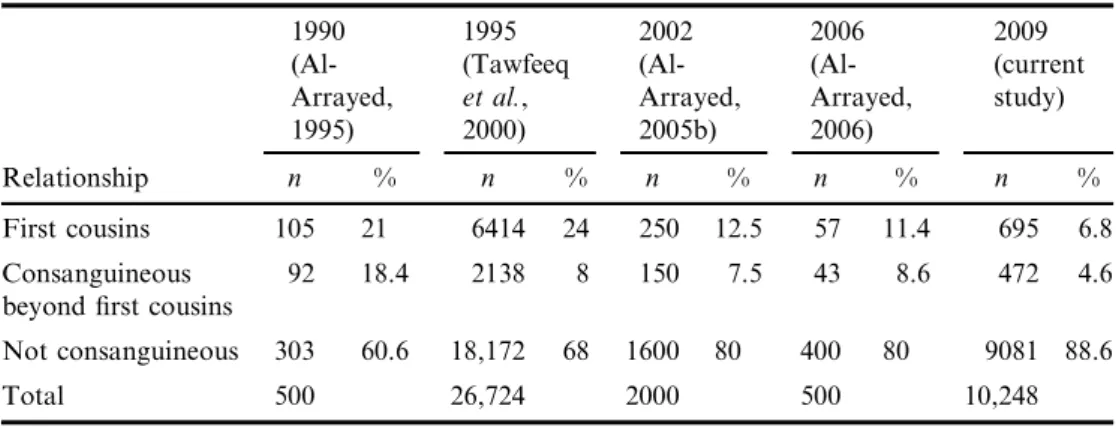
The results of four previous studies on consanguinity rates in Bahrain from 1990 to 2006 (Al-Arrayed, 1995, 2005b, 2006; Tawfeeq et al., 2000), as well as the results of this study, are presented in Table 3 and Fig. 1. A decline in both first cousin and total consanguinity rates was evident from 1990 to 2008–09. The only previous study involving more than 5000 families was the study done in 1995 (Tawfeeq et al., 2000; Al-Arrayed, 2006). Although the working definition for consanguineous marriages includes only second cousins and closer, reports on consanguinity rates may include marriages between third cousins or far relatives within the consanguineous category. Table 1. Consanguineous marriages among 3989 couples assessed during newborn
screening in Bahrain from 1st September 2008 to 31st December 2008
Month
First cousins
Consanguineous
beyond first cousins Non-consanguineous
Total n % n % n % September 58 7.4 37 4.7 686 87.8 781 October 64 4.4 37 2.5 1372 93.1 1473 November 73 8.6 47 5.6 726 85.8 846 December 80 9 39 4.4 770 86.6 889 Total 275 6.9 160 4 3554 89.1 3989
Table 2. Consanguineous marriages among 10,248 couples assessed during newborn screening in Bahrain from 1st January 2009 to 31st December 2009
Month
First cousins
Consanguineous
beyond first cousins Non-consanguineous
Total n % n % n % January 58 7 34 4 741 89 833 February 70 8.9 34 4.3 682 86.8 786 March 42 5.7 32 4.4 661 89.9 735 April 47 6.1 41 5.4 677 88.5 765 May 33 4.5 37 5.1 662 90.4 732 June 56 6.9 39 4.8 715 88.3 810 July 64 7.4 48 5.5 757 87.1 869 August 82 9 48 5.2 785 85.8 915 September 55 6.2 48 5.4 788 88.4 891 October 65 7 30 3.2 834 89.8 929 November 62 6.4 44 4.5 869 89.1 975 December 61 6. 37 3.7 910 90.3 1008 Total 695 6.8 472 4.6 9081 88.6 10,248
This would affect the total consanguinity rate but does not markedly alter the average inbreeding coefficient. Therefore, for comparison of consanguinity rates among popula-tions, two parameters are best used: the mean inbreeding coefficient (a) and marriages between first cousins. Due to variable definitions for far relatives in different studies done in Bahrain, we opted to use statistical analysis to compare only the first cousin marriage rates because this category was very well defined and reported in all studies. First cousin marriage rates showed a statistically significant decline ( p < 0.001) over a period of 10 years, as evident from the comparison of the results of this study on 10,248 families with the results of 1995 study on 26,724 families (Tawfeeq et al., 2000).
Discussion
The genetic unit at the Salmaniya Medical Centre was established in 1984, with the aim of studying genetic diseases and implementing a plan to reduce the prevalence
Table 3. Secular changes in consanguineous marriages in Bahrain, 1990–2009
1990 (Al-Arrayed, 1995) 1995 (Tawfeeq et al., 2000) 2002 (Al-Arrayed, 2005b) 2006 (Al-Arrayed, 2006) 2009 (current study) Relationship n % n % n % n % n % First cousins 105 21 6414 24 250 12.5 57 11.4 695 6.8 Consanguineous beyond first cousins 92 18.4 2138 8 150 7.5 43 8.6 472 4.6 Not consanguineous 303 60.6 18,172 68 1600 80 400 80 9081 88.6 Total 500 26,724 2000 500 10,248 0% 10% 20% 30% 40% 50% 60% 70% 80% 90% 100% 1990 1998 2002 2006 2008 2009 1st cousin
consanguineous beyond first cousins
not consanguineous
of these diseases, especially genetic blood diseases, in Bahrain. A comprehensive com-munity genetic programme was implemented that included intensive education and awareness campaigns and population screening programmes with subsequent genetic counselling (Al-Arrayed, 2005b). During this campaign, advice against cousin marriages was avoided, as recommended by the World Health Organization (WHO). The cam-paign included premarital counselling (PMC) with information on the risks of consan-guineous marriages if both partners are carriers of the same autosomal recessive gene and discussion of the option of prenatal diagnosis whenever feasible. The campaign continued for more than 20 years, and was successful in reducing the prevalence of genetic blood disease, specifically that of sickle cell anaemia, in the country by 70% over a period of 20 years (Al-Arrayed, 1997, 2005a, 2006; Al-Gazali et al., 2006).
Comparison of the results of this study with previous studies from 1990 to 2006 indicated that the consanguinity rates in Bahrain have declined over a period of 20 years, with first cousin marriage rates declining from 24% in 1998 to 6.8% in 2009. The first study on consanguineous marriages in Bahrain was conducted in 1990 on a group of 500 young married Bahraini women. The consanguinity rate was 39.4% in the studied generation (fathers and mothers) and 45.5% in the previous generation (grandfathers and grandmothers), indicating a high rate of consanguinity that showed a secular decline. The rate of first cousin marriage in the studied generation was 21% (Al-Arrayed, 1995). In 1995, and through a National Family Health Survey, a total of 4166 households were interviewed. This included 26,724 persons. Consanguinity and first cousin marriages rates were 32% and 24% respectively (Tawfeeq et al., 2000). The third study was the neonatal screening for haemoglobinopathies performed in 2002, where consanguinity rates and first cousin marriages among 2000 families were 20% and 12.5% respectively, indicating a substantial decline when compared with the rates reported in 1995 (Al-Arrayed, 2005b). The fourth figure came from the premarital counselling study in 2006. Consanguinity rates and first cousin marriages among 500 couples were 20% and 11.4% respectively, figures that are very similar to those reported in 2002 (Al-Arrayed, 2006).
The high level of literacy and education among the people in Bahrain in general, and the campaign to prevent genetic disease in particular, may have helped to achieve the observed decline in the rate of genetic blood diseases, and the rate of cousin marriages in the country. Apart from Bahrain, secular decline in the consanguinity rates has been noticed in other Arab populations such as among Jordanians (Hamamy et al., 2005) and Palestinians (Assaf & Khawaja, 2009; Sharkia et al., 2008). Several factors may contribute to this decline in the consanguinity rates, including the increasing higher female education levels, the declining fertility resulting in lower numbers of suitable relatives to marry, more mobility from rural to urban settings, and the improving eco-nomic status of families. On the other hand, social, religious, cultural, political and economic factors still play their roles in favouring consanguineous marriages among the new generations just as strongly as they did among the older generations in the Middle East and North Africa. In fact, consanguinity seems to be increasing in some Arab countries including Qatar (Bener & Alali, 2006) and Yemen (Jurdi & Saxena, 2003), possibly because of a belief that the social benefits of consanguineous marriages can outweigh the genetic risks. It is believed that the practice of consanguinity promotes family stability and has some social and economic advantages. The ongoing strong
preferential culture of close kin marriages in many societies, and among migrant com-munities in Western countries, merits an equivalently detailed assessment of the social and genetic benefits of consanguinity in future studies (Hamamy et al., 2011).
In all cases, reports on secular trends in consanguinity need to be treated with some caution because in countries where consanguinity is favoured, major regional and ethnic differences in prevalence are commonly observed (Bittles, 2008).
Conclusion
Consanguinity rates continue to decline in Bahrain as genetic education and awareness campaigns expand. It is expected that this decline in consanguinity rate could have a role in decreasing the rate of rare autosomal recessive disorders among future genera-tions in Bahrain.
References
Al-Arrayed, S. (1995) The frequency of consanguineous marriages in the State of Bahrain. Bahrain Medical Bulletin 17(2), 63–66.
Al-Arrayed, S. (2005a) Premarital genetic counseling: a new law in the Kingdom of Bahrain. Journal of Health, Social and Environmental Issues (Middlesex University) 6(2), 31–34. Al-Arrayed, S. (2005b) Campaign to control genetic blood diseases in Bahrain. Community
Genetics 8, 52–55.
Al-Arrayed, S. (2006) Genetic diseases in Bahrain. In Tadmouri, G. O., Taleb, Al Ali M. & Al Khaja, N. (eds) Genetic Disorders in the Arab World – Bahrain. URL: http://cags.org.ae/ cb25c5.pdf.
Al-Arrayed, S., Hafadh, N. & Al-Serasi, S. (1997) Premarital counselling: an experience from Bahrain. Eastern Mediterranean Health Journal 3, 415–419.
Al-Awadi, S. A., Moussa, M. A., Naguib, K. K., Farag, T. I., Teebi, A. S., el-Khalifa, M. & el-Dossary, L. (1985) Consanguinity among the Kuwaiti population. Clinical Genetics 27, 483–486.
Al-Gazali, L., Hamamy, H. & Al-Arrayad, S. (2006). Genetic disorders in the Arab world. British Medical Journal 333, 831–834.
Al-Gazali, L. I., Bener, A., Abdulrazzaq, Y. M., Micallef, R., Al-Khayat, A. I. & Gaber, T. (1997) Consanguineous marriages in the United Arab Emirates. Journal of Biosocial Science 29, 491–497.
Alwan, A. & Modell, B. (1997) Community Control of Genetic and Congenital Disorders. EMRO Technical Publication Series 24. WHO Regional Office for the Eastern Mediterranean Region, Egypt.
Assaf, S. & Khawaja, M. (2009) Consanguinity trends and correlates in the Palestinian Territories. Journal of Biosocial Science 41, 107–124.
Barbour, B. & Salameh, P. (2009) Consanguinity in Lebanon: prevalence, distribution and deter-minants. Journal of Biosocial Science 41, 505–517.
Bener, A. & Alali, K. A. (2006) Consanguineous marriage in a newly developed country: the Qatari population. Journal of Biosocial Science 38, 239–246.
Bittles, A. H. (2001) Consanguinity and its relevance to clinical genetics. Clinical Genetics 60, 89–98.
Bittles, A. H. (2008) A community genetics perspective on consanguineous marriage. Community Genetics 11, 324–330.
El-Mouzan, M. I., Al-Salloum, A. A., Al-Herbish, A. S., Qurachi, M. M. & Al-Omar, A. A. (2007) Regional variations in the prevalence of consanguinity in Saudi Arabia. Saudi Medical Journal 28, 1881–1884.
Hafez, M., El-Tahan, H., Awadalla, M., El-Khayat, H., Abdel-Gafar, A. & Ghoneim, M. (1983) Consanguineous matings in the Egyptian population. Journal of Medical Genetics 20, 58–60. Hamamy, H. & Alwan, A. (1994) Hereditary disorders in the Eastern Mediterranean Region.
Bulletin of the World Health Organization 72, 145–154.
Hamamy, H., Antonarakis, S. E., Cavalli-Sforza, L. L., Temtamy, S., Romeo, G., Ten Kate, L. P. et al. (2011) Consanguineous marriages, pearls and perils. Geneva International Con-sanguinity Workshop Report. Gentics in Medicine 13, 841–847.
Hamamy, H., Jamhawi, L., Al-Darawsheh, J. & Ajlouni, K. (2005) Consanguineous marriages in Jordan: why is the rate changing with time? Clinical Genetics 67, 511–516.
Jaber, L., Halpern, G. J. & Shohat, T. (2000) Trends in the frequencies of consanguineous marriages in the Israeli Arab community. Clinical Genetics 58, 106–110.
Jurdi, R. & Saxena, P. C. (2003) The prevalence and correlates of consanguineous marriages in Yemen: similarities and contrasts with other Arab countries. Journal of Biosocial Science 35, 1–13.
Khoury, S. A. & Massad, D. (1992) Consanguineous marriage in Jordan. American Journal of Medical Genetics 43, 769–775.
Modell, B. & Darr, A. (2002) Science and society: genetic counselling and customary consan-guineous marriage. Nature Reviews Genetics 3, 225–229.
Rajab, A. & Patton, M. A. (2000) A study of consanguinity in the Sultanate of Oman. Annals of Human Biology 27, 321–326.
Sharkia, R., Zaid, M., Athamna, A., Cohen, D., Azem, A. & Zalan, A. (2008) The changing pattern of consanguinity in a selected region of the Israeli Arab community. American Journal of Human Biology 20, 72–77.
Tawfeeq, N. et al. (2000) Bahrain National Family Health Survey, BFHS, 1995. Ministry of Health, Manama.