HAL Id: hal-01731566
https://hal.inria.fr/hal-01731566v3
Submitted on 20 Aug 2019HAL is a multi-disciplinary open access
archive for the deposit and dissemination of sci-entific research documents, whether they are pub-lished or not. The documents may come from teaching and research institutions in France or abroad, or from public or private research centers.
L’archive ouverte pluridisciplinaire HAL, est destinée au dépôt et à la diffusion de documents scientifiques de niveau recherche, publiés ou non, émanant des établissements d’enseignement et de recherche français ou étrangers, des laboratoires publics ou privés.
Maximum likelihood drift estimation for a threshold
diffusion
Antoine Lejay, Paolo Pigato
To cite this version:
Antoine Lejay, Paolo Pigato. Maximum likelihood drift estimation for a threshold diffusion. Scandi-navian Journal of Statistics, Wiley, 2020, 47 (3), pp.29. �10.1111/sjos.12417�. �hal-01731566v3�
Maximum likelihood drift estimation
for a threshold diffusion
Antoine Lejay
*and Paolo Pigato
†August 20, 2019
We study the maximum likelihood estimator of the drift parameters of a stochastic differential equation, with both drift and diffusion co-efficients constant on the positive and negative axis, yet discontinuous at zero. This threshold diffusion is called drifted Oscillating Brownian motion.
For this continuously observed diffusion, the maximum likelihood esti-mator coincide with a quasi-likelihood estiesti-mator with constant diffusion term. We show that this estimator is the limit, as observations become dense in time, of the (quasi)-maximum likelihood estimator based on discrete observations.
In long time, the asymptotic behaviors of the positive and negative occupation times rule the ones of the estimators.
Differently from most known results in the literature, we do not re-strict ourselves to the ergodic framework: indeed, depending on the signs of the drift, the process may be ergodic, transient or null recurrent. For each regime, we establish whether or not the estimators are consistent; if they are, we prove the convergence in long time of the properly rescaled difference of the estimators towards a normal or mixed normal distribu-tion. These theoretical results are backed by numerical simulations.
Keywords: Threshold diffusion, Oscillating Brownian motion, maximum likeli-hood estimator, null recurrent process, ergodic process, transient process, mixed normal distribution
AMS 2010: primary: 62M05; secondary: 62F12; 60J60.
Acknowledgement: P. Pigato gratefully acknowledges financial support from ERC via Grant CoG-683164. The authors are grateful to an anonymous reviewer for their useful suggestions.
*Université de Lorraine, CNRS, Inria, IECL, F-54000 Nancy, France;
†Weierstrass Institute for Applied Analysis and Stochastics, Mohrenstrasse 39, Berlin, 10117,
1 Introduction
We consider the process, called a drifted Oscillating Brownian motion (DOBM), which is the solution to the Stochastic Differential equation (SDE)
𝜉𝑡= 𝜉0+ ∫︁ 𝑡 0 𝜎(𝜉𝑠) d𝑊𝑠+ ∫︁ 𝑡 0 𝑏(𝜉𝑠) d𝑠, (1) with 𝜎(𝑥) = ⎧ ⎨ ⎩ 𝜎+ > 0 if 𝑥≥ 0, 𝜎− > 0 if 𝑥 < 0 and 𝑏(𝑥) = ⎧ ⎨ ⎩ 𝑏+∈ R if 𝑥≥ 0, 𝑏−∈ R if 𝑥 < 0. (2) The strong existence to (1) follows for example from the results of [29]. Separately onR+ and R−, the dynamics of such process is the one of a Brownian motion with drift, with threshold and regime-switch at 0, consequence of the discontinuity of the coefficients.
This model can be seen as an alternative to the model studied in [40], which is a continuous time version of the Self-Exciting Threshold Autoregressive models (SETAR), a subclass of the TAR models [49, 50].
The practical applications of such processes are numerous. In finance, we show in [32] that an exponential form of this process generalizes the Black & Scholes model in a way to model leverage effects. Moreover, the introduction of a piecewise constant drift such as the one in (2) is a straightforward way to produce a mean-reverting process, if 𝑏+ < 0 and 𝑏− > 0. In [32], we find some empirical evidence
on financial data that this may be the case. This corroborates other studies with different models [39, 42, 47, 48]. Option pricing for this model may be performed efficiently using analytic techniques as in [13, 36, 37].
Still in finance, the solution to (1) models other quantities than stocks. In [14], Eq. (1) with constant volatility serves as a model for the surplus of a company after the payment of dividends, which are payed only if the profits of the company are higher than a certain threshold. Similar threshold dividend pay-out strategies are considered in [2]. In these works, the behavior of the process at the discontinuity is referred to as “refraction”. SETAR models have also applications to deal with transaction costs or regulator interventions [53] and to interest and exchange rates [7, 10].
More general discontinuous drifts and volatilities arise in presence of Atlas models and other ranks based models [18]. SDE with discontinuous coefficients have also numerous applications in physics [43, 46], meteorology [16] and many other domains. In [47, 48], F. Su and K.-S. Chan study the asymptotic behavior of the quasi-likelihood estimator of a diffusion with piecewise regular diffusivity and piecewise affine drift with an unknown threshold. The quasi-likelihood they use is based on the Girsanov density where the diffusivity is replaced by 1. In particular, they provide a hypothesis test to decide whether or not the drift is affine or piecewise affine in the ergodic situation.
In [27], Y. Kutoyants considers the estimation of a threshold 𝑟 of a diffusion with a known or unknown drift switching at 𝑟. His results are then specialized to Ornstein-Uhlenbeck type processes. Also this framework assumes that the diffusion is ergodic.
In the present paper, we first derive the maximum likelihood estimators for the drift parameters 𝑏− and 𝑏+ from continuous-time observations. We then write a quasi-maximum likelihood estimator, as in [47, 48], and show that, for a process 𝜉 as in (1), these two estimators are actually equal. Then, we derive the corresponding estimators based on discrete observations, and show that as the observations become dense in time, the estimator converges to the one based on continuous observations. We study the asymptotic behavior of the maximum likelihood estimators as the time tends to infinity, in order to derive some confidence intervals when available. This article completes [31], where we estimate (𝜎−, 𝜎+) from high-frequency data. We use our estimators on financial historical data in [32].
Based on the maximum and quasi-maximum likelihood, our estimators of 𝑏± can be expressed as
𝛽𝑇± =±(±𝜉𝑇)∨ 0 − (±𝜉0)∨ 0 − 𝐿𝑇(𝜉)/2
𝑄±𝑇 ,
where 𝑄+𝑇 (resp. 𝑄−𝑇) is the occupation time of the positive (resp. negative) side of the real axis, and 𝐿𝑇(𝜉) is the symmetric local time of 𝜉 at 0. The occupation times 𝑄±𝑇 can be estimated from discrete observations of a trajectory of 𝜉 using Riemann sums. We also propose a new estimator of 𝐿𝑇(𝜉) from discrete observations, which
can be implemented without any previous knowledge of 𝜎±. Substituting in the formula above 𝑄±and 𝐿𝑇(𝜉) with these discrete counterparts, we obtain the
(quasi)-maximum likelihood estimators from discrete observations. Since all these quantities converge to their continuous-time versions as the observations become dense in time, the estimators for the drift coefficients converge as well.
The long time asymptotic regime of the process depends on the respective signs of the coefficients (𝑏−, 𝑏+). Using symmetries, this leads 5 different cases in which the process may be ergodic, null recurrent or transient and the estimators have different asymptotic behaviors. In some situations, the estimators are not convergent. In others, we establish consistency as well as Central Limit Theorems, with speed 𝑇1/2 or 𝑇1/4, depending again on the signs of 𝑏±. We summarize in Table 1 the various asymptotic behaviors. We are in a situation close to the one encountered by M. Ben Alaya and A. Kebaier in [4, 5] for estimating square-root diffusions, where several situations shall be treated. The works [27, 47, 48] mentioned above only consider ergodic situations. Non-parametric estimation of the drift in the recurrent case is considered in [3].
Finally, we develop in Section 7.1 a hypothesis test for the value of the drift which is based on the Wilk’s theorem, which relates asymptotically the log-likelihood to a 𝜒2 distribution with 2 degrees of freedom. Besides, we show in Section 7.2 the Local Asymptotic Normality (LAN [28, 30]) and the Local Asymptotic Mixed Normality (LAMN [23]) in the ergodic case and the null recurrent case with non vanishing drift. These LAN/LAMN properties are related to the efficiency of the operators. The Wilk’s as well as the LAN/LAMN properties are proved by combining the quadratic nature of the log-likelihood with our martingale central limit theorems.
Outline. In Section 2, we present the maximum and quasi-maximum likelihood
estimators, which are based on the Girsanov transform, and their discrete-time ver-sions. In Section 3, we characterize the different regimes of the process accordingly
𝛽𝑇+− 𝑏+ 𝛽𝑇−− 𝑏− (E) 𝑏+ < 0, 𝑏− > 0 ergodic ≈ √1 𝑇 √︂ 1−𝑏+ 𝑏−𝜎+𝒩 ≈ 1 √ 𝑇 √︂ 1− 𝑏− 𝑏+𝜎−𝒩 (N0) 𝑏+ = 0, 𝑏− = 0 null recurrent √1 𝑇𝛽 + 1 √1𝑇𝛽1− (N1) 𝑏+ = 0, 𝑏− > 0 null recurrent ≈ √1 𝑇𝜎+𝒩 + ≈ 1 𝑇1/4𝜎− √ 𝑏− √𝜎 + 𝒩− √ |𝒩 | (T0) 𝑏+> 0, 𝑏− ≥ 0 transient ≈ √1 𝑇𝜎+𝒩 ℛT0 as 𝑇 → ∞ (T1) 𝑏+ > 0, 𝑏− < 0 transient ≈ √1 𝑇𝜎+𝒩 ℛ + T1 as 𝑇 → ∞
Table 1: Asymptotic behavior of estimators, where𝒩 , 𝒩+and𝒩−are independent, unit Gaussian variables. The law of (𝛽1−, 𝛽1+) in case (N0) is given in (36). The r.v.s ℛT0 and ℛ+T1 follow the law in (33). Results of both sides in
(T1) are wrt to P+ (cf. Proposition 7), which intuitively can be thought as conditioning to the process diverging towards positive infinity.
to the signs of the drifts. Our main results are presented in Section 4. The limit theorems that we use are presented in Section 5. The proofs for each cases are de-tailed in Section 6. We present the Wilk theorem and the LAN/LAMN property in Section 7. Finally, in Section 8, we conclude this article with numerical experiments.
2 Maximum and quasi-maximum likelihood
estimators
In this section, we construct two estimators for the parameters (𝑏−, 𝑏+) of the drift coefficient of 𝜉. The maximum likelihood estimator based on continuous time obser-vations can be constructed if we assume to observe a continuous time path (𝜉𝑡)𝑡∈[0,𝑇 ].
A quasi-maximum likelihood estimator can also be constructed, and from the fact that 𝑏(·) and 𝜎(·) are constant above and below the threshold, it follows that these estimators are in fact the same one. Then, we construct the analogous estimator based on discrete time observations of the process. In the end we will see that, as observations become dense in time, the discrete time estimator converges to the one in continuous time.
2.1 The maximum and quasi-maximum likelihood estimator
based on continuous time observations
First, we propose and discuss the maximum likelihood estimator from continuous time observations.
Data 1. We observe a path (𝜉𝑡)𝑡∈[0,𝑇 ] on the time interval [0, 𝑇 ] of one solution
to (1), together with its negative and positive occupation times
𝑄−𝑇 = ∫︁ 𝑇 0 1𝜉𝑠<0d𝑠 and 𝑄 + 𝑇 = ∫︁ 𝑇 0 1𝜉𝑠>0d𝑠, (3)
as well as its symmetric local time 𝐿𝑇(𝜉) = lim 𝜖→0 1 2𝜖 ∫︁ 𝑇 0 1−𝜖≤𝜉𝑠≤𝜖d⟨𝜉⟩𝑠.
The question of the discretization of 𝑄±𝑇 as well as 𝐿𝑇(𝜉) is detailed in Sections 2.2 and 8.1. We define 𝑀±:= ∫︁ · 0 𝜎±1±𝜉𝑠≥0d𝑊𝑠 (4) and 𝑅±𝑇 := ∫︁ 𝑇 0 1±𝜉𝑠≥0d𝜉𝑠. (5)
The quantities 𝑀± are are continuous time martingales with ⟨𝑀±⟩ = 𝜎2±𝑄± and ⟨𝑀+, 𝑀−⟩ = 0. Moreover,
𝑅±𝑇 = 𝑀𝑇±+ 𝑏±𝑄±𝑇. (6)
Noticing that the occupation time is non decreasing, for the sake of simplicity we write
𝑄±∞:= lim
𝑇→∞𝑄 ±
𝑇 ∈ R+∪ {∞}.
The Girsanov weight of the distribution of (1) with respect the driftless (𝑏+ =
𝑏− = 0) SDE is 𝐺𝑇(𝑏+, 𝑏−) = exp (︃ ∫︁ 𝑇 0 𝑏(𝜉𝑠) 𝜎2(𝜉𝑠)d𝜉𝑠− 1 2 ∫︁ 𝑇 0 𝑏2(𝜉𝑠) 𝜎2(𝜉𝑠)d𝑠 )︃ . (7)
With the expression of 𝑄± and 𝑅± given by (3) and (5), this Girsanov weight can be expressed simply as 𝐺𝑇(𝑏+, 𝑏−) = exp (︃ 𝑏+ 𝜎+2𝑅 + 𝑇 + 𝑏− 𝜎−2𝑅 − 𝑇 − 𝑏2+ 𝜎+2 𝑄 + 𝑇 − 𝑏2− 𝜎2−𝑄 − 𝑇 )︃ .
A reasonable way to set up an estimator of (𝑏−, 𝑏+) is to consider 𝐺𝑇(𝑏+, 𝑏−) as
a likelihood and to optimize this quantity. This is how estimators for the drift are classically constructed [26, 35]. We also set the following function, defined similarly as in [47] as Λ𝑇(𝑏+, 𝑏−) = ∫︁ 𝑇 0 𝑏(𝜉𝑠) d𝜉𝑠− 1 2 ∫︁ 𝑇 0 𝑏(𝜉𝑠) 2d𝑠 = 𝑏+𝑅+𝑇 + 𝑏−𝑅−𝑇 − 1 2𝑏 2 +𝑄+𝑇 − 1 2𝑏 2 −𝑄−𝑇.
Such function can be interpreted as a quasi-likelihood function, and has the advan-tage wrt (7) of not involving the diffusion coefficient. This approach can be used also when a specific functional form for the diffusion coefficient 𝜎 is not specified.
Notation 1. To avoid confusion with the + and− used as indices, we write L𝑥M+:=
max{𝑥, 0} for the positive part of 𝑥 and L𝑥M− := max{−𝑥, 0} ≥ 0 for the negative part.
Proposition 1. Both the likelihood 𝐺𝑇(𝑏+, 𝑏−) and the quasi-likelihood Λ𝑇(𝑏+, 𝑏−)
are maximal at (𝛽𝑇+, 𝛽𝑇−) given by
𝛽𝑇+ = 𝑅 + 𝑇 𝑄+𝑇 = 𝑏++ 𝑀𝑇+ 𝑄+𝑇 and 𝛽 − 𝑇 = 𝑅−𝑇 𝑄−𝑇 = 𝑏−+ 𝑀𝑇− 𝑄−𝑇 .
Estimators (𝛽𝑇+, 𝛽𝑇−) can also be expressed as
𝛽𝑇± =±L𝜉𝑇M ± −L𝜉0M ± − 𝐿𝑇(𝜉)/2 𝑄±𝑇 . (8)
Proof. The equation∇Λ𝑇(𝑏+, 𝑏−) = 0 is solved for (𝛽𝑇+, 𝛽𝑇−) as above. Since 𝑄±𝑇 ≥ 0,
Λ𝑇(𝑏+, 𝑏−) is not only critical but also maximal at (𝛽𝑇+, 𝛽𝑇−) with 𝛽𝑇± = 𝑅±𝑇/𝑄±𝑇. With (6), we obtain 𝛽𝑇± = 𝑏±+ 𝑀𝑇±/𝑄±𝑇. The same holds for log 𝐺𝑇(𝑏+, 𝑏−).
By the Itô-Tanaka formula, L𝜉M + 𝑇 =L𝜉M + 0 + ∫︁ 𝑡 0 1𝜉𝑠≥0d𝜉𝑠+ 1 2𝐿𝑇(𝜉) and L𝜉M − 𝑇 =L𝜉M − 0 − ∫︁ 𝑡 0 1𝜉𝑠≤0d𝜉𝑠+ 1 2𝐿𝑇(𝜉). Hence (8).
2.2 An estimator based on discrete observations
Within the framework of Data 1, we constructed estimator 𝛽 in Proposition (1). In practice, however, one cannot observe the whole trajectory (𝜉𝑡)𝑡∈[0,𝑇 ]. We explain in
Section 8 how the quantities involved in the estimator expressed as in (8) can be approximated from discrete observations of the process. Hence, an approximation of the estimators 𝛽𝑇± may be constructed from the discrete observations (𝜉𝑖𝑇 /𝑁)𝑖=0,...,𝑁.
We now consider an alternative framework, in which we suppose from the begin-ning that the path is observed only on a discrete time grid.
Data 2. We observe of a path (𝜉𝑖𝑇 /𝑁)𝑖=0,...,𝑁 at discrete times.
Owing to the expressions for 𝐺𝑇(𝑏+, 𝑏−) and Λ𝑇(𝑏+, 𝑏−), we discretize the stochas-tic integrals as well as the occupation times. With 𝜉𝑖 := 𝜉𝑖𝑇 /𝑁 and Δ𝑖𝜉 = 𝜉𝑖+1 − 𝜉𝑖,
we set Q+𝑇,𝑁:= 𝑇 𝑛 𝑁−1 ∑︁ 𝑖=0 1𝜉𝑖≥0 and R±𝑇,𝑁 := 𝑁−1 ∑︁ 𝑖=0 1±𝜉𝑖≥0Δ𝑖𝜉 (9)
which are discretized versions of 𝑄±𝑇 and 𝑅±𝑇. We also define the discretized likelihood as G𝑇,𝑁(𝑏+, 𝑏−) = exp (︃𝑁−1 ∑︁ 𝑖=0 𝑏(𝜉𝑖) 𝜎2(𝜉𝑖) Δ𝑖𝜉− 1 2𝑁 𝑁−1 ∑︁ 𝑖=0 𝑏2(𝜉𝑖) 𝜎2(𝜉𝑖) )︃ . and the discretized quasi-likelihood as
Λ𝑇,𝑁(𝑏+, 𝑏−) = 𝑁−1 ∑︁ 𝑖=0 𝑏(𝜉𝑖)Δ𝑖𝜉− 1 2𝑁 𝑁−1 ∑︁ 𝑖=0 𝑏(𝜉𝑖)2.
We also define the following discrete-time approximation of the local time: L𝑇,𝑁 := 2
𝑁−1
∑︁
𝑖=0
1𝜉𝑖𝜉𝑖+1<0|𝜉𝑖+1|. (10)
Proposition 2. The likelihood G𝑇,𝑁(𝑏+, 𝑏−) and the quasi-likelihood Λ𝑇,𝑁(𝑏+, 𝑏−)
are maximal at (𝑏+, 𝑏−) = (β+𝑇,𝑁, β−𝑇,𝑁), with
β+𝑇,𝑁 := R + 𝑇,𝑁 Q+𝑇,𝑁 and β − 𝑇,𝑁 := R−𝑇,𝑁 Q−𝑇,𝑁. (11)
We also have the following discrete version of (8):
β±𝑇,𝑁 =±L𝜉M ± 𝑇 −L𝜉M ± 0 − L𝑇,𝑁/2 Q±𝑇,𝑁 . (12)
Proof. The fact that G𝑇,𝑁(𝑏+, 𝑏−) and Λ𝑇,𝑁(𝑏+, 𝑏−) are maximal at β±𝑇,𝑁 is trivial.
We note that 1𝜉𝑖≥0Δ𝑖𝜉 =L𝜉𝑖+1M + −L𝜉𝑖M + − 1𝜉𝑖𝜉𝑖+1<0|𝜉𝑖+1| so that R+𝑇,𝑁 =L𝜉M+𝑇 −L𝜉M+0 −1 2L𝑇,𝑁. (13)
Similarly, one can show that
R−𝑇,𝑁 =−L𝜉M−𝑇 +L𝜉M−0 +1
2L𝑇,𝑁. (14)
This proves (12).
Lemma 1. For any 𝑇 > 0, Q±𝑇,𝑁 converges in probability to 𝑄±𝑇 and
R±𝑇,𝑁 −−−→P 𝑁→∞ 𝑅 ± 𝑇 = ∫︁ 𝑇 0 1±𝜉𝑠≥0d𝜉𝑠 =± (︂ L𝜉𝑇M ±− L𝜉0M ±−1 2𝐿𝑇(𝜉) )︂ . (15)
In particular, β±𝑇,𝑁 converges in probability to 𝛽𝑇± as 𝑁 → ∞.
Remark 1. The result of Lemma 1 says that, for fixed 𝑇 , the approximation of the
continuous-time estimator 𝛽𝑇± given by β±𝑇,𝑁 becomes more accurate as 𝑁 increases. It would be interesting, from a practical viewpoint, to study the asymptotic behavior of these estimators as 𝑇 , 𝑁 jointly increase in a suitable way. This seems to be a very hard problem, even in the simplified setting with a constant volatility coefficient and drift as in the ergodic case (E). Indeed, the speed of the convergence in (15) can be obtained for fixed 𝑇 , but some sort of uniformity in 𝑇 of the convergences in Lemma 1 is needed to prove a joint result in 𝑇 , 𝑁 . Unluckily, even in this simplified case, the asymptotic behavior of the local time estimator depends on the very technical results of Jacod (see [21, Theorem 1.2]), which are not uniform in 𝑇 . Besides, they are proved using a Girsanov transform in order to eliminate the drift. As 𝑇 increases, the Girsanov weight degenerates and it is very difficult to control its behavior. In the general framework with 𝜎+ ̸= 𝜎−, this problem looks even harder
since the result in [21] does not directly apply.
Proof. As we are considering a convergence in probability, due to the Girsanov
theorem, we may assume that 𝑏+ = 𝑏− = 0. For the sake of simplicity, we assume that 𝜉0 = 0. The convergence of Q±𝑇,𝑁 to 𝑄±𝑇 follows from [33, Theorem 4.14, p. 3587].
We consider now only the convergence of R+𝑇,𝑁 to 𝑅+𝑇, the computations being the same for the “negative” part.
Besides, we know that 𝜉𝑡 = 𝜎(𝑋𝑡)𝑋𝑡, where 𝑋 is a Skew Brownian motion, i.e., the solution to the SDE 𝑋𝑡 = 𝑊𝑡+ 𝜃𝐿𝑡(𝑋), where 𝑊 is a Brownian motion, 𝐿𝑡(𝑋)
is the local time of 𝑋 at 0 and 𝜃 = (𝜎−− 𝜎+)/(𝜎−+ 𝜎+). The local times 𝐿(𝜉) and
𝐿(𝑋) are linked by (see [31])
𝐿(𝑋) = 𝜎++ 𝜎−
2𝜎+𝜎− 𝐿(𝜉). (16)
The density of the skew Brownian motion is
𝑝𝜃(𝑡, 𝑥, 𝑦) = √1 2𝜋𝑡exp (︃ −(𝑥− 𝑦) 2 2𝑡 )︃ + 𝜃 sgn(𝑦)√1 2𝜋𝑡exp (︃ −(|𝑥| + |𝑦|) 2 2𝑡 )︃ . Using this transform, with 𝑓 (𝑥, 𝑦) := 𝜎(𝑦)1𝑥𝑦<0|𝑦|,
L𝑇,𝑁 2 = 1 √ 𝑁 𝑁−1 ∑︁ 𝑖=0 1𝑁 𝑋𝑖𝑋𝑖+1<0 √ 𝑁|𝑋𝑖+1|𝜎(𝑋𝑖+1) = 1 √ 𝑁 𝑁−1 ∑︁ 𝑖=0 𝑓 (√𝑁 𝑋𝑖, √ 𝑁 𝑋𝑖+1).
Following [33], which adapts to the Skew Brownian motion some results of [21], we define 𝐹 (𝑥) := ∫︁ +∞ −∞ 𝑝𝜃 (1, 𝑥, 𝑦)𝑓 (𝑥, 𝑦) d𝑦. Hence, for 𝑥 < 0, 𝐹 (𝑥) = 𝜎+(1 + 𝜃) ∫︁ +∞ 0 1 √ 2𝜋exp (︃ −(𝑥− 𝑦) 2 2 )︃ 𝑦 d𝑦 = 𝜎+(1 + 𝜃)√ 2𝜋 exp (︃ −𝑥2 2 )︃ + 𝜎+(1 + 𝜃)𝑥Φ(−𝑥) with Φ(𝑥) =∫︀+∞ 𝑥 exp(−𝑧2)/ √ 2𝜋 d𝑧. Similarly, for 𝑥 > 0, 𝐹 (𝑥) = +𝜎−(1√− 𝜃) 2𝜋 exp (︃ −𝑥2 2 )︃ − 𝜎−(1− 𝜃)𝑥Φ(𝑥). Let us define 𝐶 := (1 + 𝜃) ∫︁ +∞ 0 𝐹 (𝑥) d𝑥 + (1− 𝜃) ∫︁ 0 −∞𝐹 (𝑥) d𝑥 = (1− 𝜃 2)𝜎−+ 𝜎+ 4 .
Injecting the value of 𝜃,
𝐶 = 𝜎−𝜎+
𝜎−+ 𝜎+. (17)
From [33, Proposition 2], using (16) and (17), 1 2L𝑇,𝑁 P −−−→𝑁 →∞ 𝐶𝐿𝑇(𝑋) = 1 2𝐿𝑇(𝜉). This, with (13), shows (15).
3 Analytic characterization of the regime of the
process
3.1 Scale function and speed measure
A well known fact [20, 24, 45] states that the infinitesimal generator (ℒ, Dom(ℒ)) of the process 𝜉 solution to (1) may be written as
ℒ𝑓 = 1 2𝜎 2(𝑥)𝑒−ℎ(𝑥) d d𝑥 (︃ 𝑒ℎ(𝑥)d𝑓 (𝑥) d𝑥 )︃ with ℎ(𝑥) = ∫︁ 𝑥 0 2𝑏(𝑦) 𝜎2(𝑦)d𝑦
for all 𝑓 ∈ Dom(ℒ) = {𝑓 ∈ 𝒞0(R) | ℒ𝑓 ∈ 𝒞0(R)}.
The process 𝑋 is fully characterized by its speed measure 𝑀 with a density 𝑚 and its scale function 𝑆 with
𝑚(𝑥) := 2
𝜎(𝑥)2 exp(ℎ(𝑥)) and 𝑆(𝑥) :=
∫︁ 𝑥
0 exp(−ℎ(𝑦)) d𝑦. (18)
3.2 The regimes of the process
The diffusion 𝑋 is either recurrent or transient. If lim𝑥→+∞𝑆(𝑥) = +∞ and
lim𝑥→−∞𝑆(𝑥) =−∞, then the process is (positively or null) recurrent. Otherwise,
it is transient [20, 24]. When 𝑏(𝑥) = 𝑏+ for 𝑥≥ 0, 𝑆(𝑥) = ⎧ ⎪ ⎪ ⎪ ⎪ ⎪ ⎪ ⎪ ⎨ ⎪ ⎪ ⎪ ⎪ ⎪ ⎪ ⎪ ⎩ 𝑥 if 𝑏+ = 0, 𝜎+2 2𝑏+ (︃ 1− exp (︃ −2𝑏𝜎+2𝑥 + )︃)︃ if 𝑏+ > 0, 𝜎+2 2|𝑏+| (︃ exp (︃ 2|𝑏+|𝑥 𝜎+2 )︃ − 1 )︃ if 𝑏+ < 0.
Similar formulas hold for 𝑏−. Hence, the process 𝜉 is transient if only if 𝑏+ > 0
or 𝑏− < 0.
A recurrent process is either null recurrent or positive recurrent. The process is positive recurrent if and only if 𝑀 (R) :=∫︀
R𝑚(𝑥) d𝑥 < +∞, in which case it is
actually ergodic. Therefore, the process 𝜉 is ergodic if and only if 𝑏+ < 0 and 𝑏− > 0.
Otherwise, the process 𝜉 is only null recurrent.
When the process is ergodic (𝑏+< 0, 𝑏−> 0), its invariant measure is
𝑚(𝑥) 𝑀 (R)d𝑥 = ⎧ ⎪ ⎪ ⎪ ⎪ ⎨ ⎪ ⎪ ⎪ ⎪ ⎩ 1 𝜎2+ × |𝑏+|𝑏− 𝑏−+|𝑏+|𝑒 −2𝑥|𝑏+| 𝜎2 + if 𝑥≥ 0, 1 𝜎2− × 𝑏−|𝑏+| 𝑏−+|𝑏+|𝑒 2𝑥𝑏− 𝜎2 − if 𝑥 < 0.
Therefore, the regime of 𝜉 depends only on the respective signs of 𝑏+and 𝑏−. Nine combinations are possible. As some cases are symmetric, we actually consider five cases exhibiting different asymptotic behaviors of 𝑄±𝑇, hence of the estimators. This is summarized in Table 2.
𝑏+ > 0 𝑏+ = 0 𝑏+ < 0
𝑏− > 0 transient T0 null recurrent N1 ergodic E
𝑏− = 0 transient T0 null recurrent N0 null recurrent N1
𝑏− < 0 transient T1 transient T0 transient T0
Table 2: Recurrence and transience properties of 𝜉.
E) Ergodic case 𝑏+ < 0, 𝑏− > 0.
N0) Null recurrent case 𝑏+ = 0, 𝑏− = 0. N1) Null recurrent case 𝑏+ = 0, 𝑏− > 0.
T0) Transient case 𝑏+ > 0, 𝑏− ≥ 0.
T1) Transient case 𝑏+ > 0, 𝑏− < 0.
Case T0 corresponds to two entries of table 2. The case 𝑏+ < 0, 𝑏− = 0 is symmetric to N1. Case 𝑏+ ≤ 0, 𝑏−< 0 is symmetric to T0.
4 Asymptotic behavior of the estimators
In this section, we state our main results on the asymptotic behavior of the occupa-tion times of the process and the corresponding ones of the estimators, for each of the 5 cases.
Proposition 3 (Ergodic case E). If 𝑏+< 0, 𝑏− > 0, then
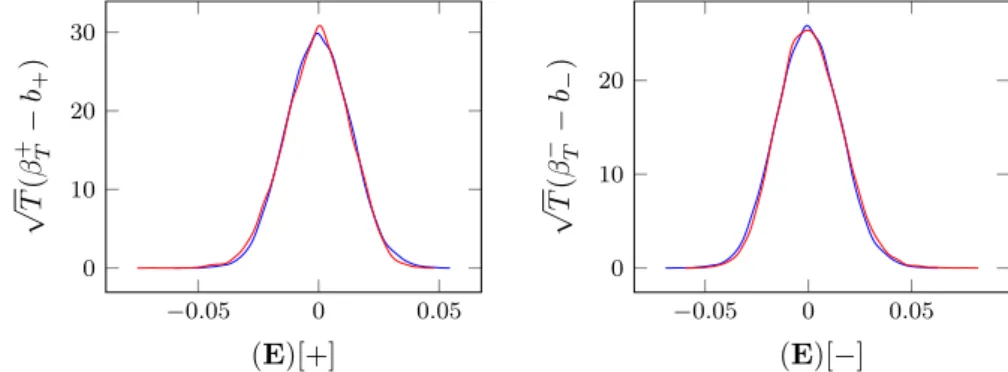
(︃ 𝑄+𝑇 𝑇 , 𝑄−𝑇 𝑇 )︃ a.s. −−−→𝑇 →∞ (︃ |𝑏−| |𝑏−| + |𝑏+| , |𝑏+| |𝑏−| + |𝑏+| )︃ . In addition, (𝛽𝑇+, 𝛽𝑇−)−−−→a.s. 𝑇→∞ (𝑏+, 𝑏−) and √ 𝑇 √︁ |𝑏−| + |𝑏+| (𝛽𝑇+− 𝑏+, 𝛽𝑇−− 𝑏−)−−−→law 𝑇→∞ ⎛ ⎝ 𝜎+ √︁ |𝑏−| 𝒩+,√︁𝜎− |𝑏+|𝒩 − ⎞ ⎠,
where 𝒩+ and 𝒩− are two independent, unit Gaussian random variables.
Proposition 4 (Null recurrent case with vanishing drift N0). Assume 𝑏+ = 𝑏− = 0.
Assume 𝜉0 = 0. Then (︃ 𝑄+𝑇 𝑇 , 𝑄−𝑇 𝑇 )︃ law = (Λ, 1− Λ) for all 𝑇 > 0,
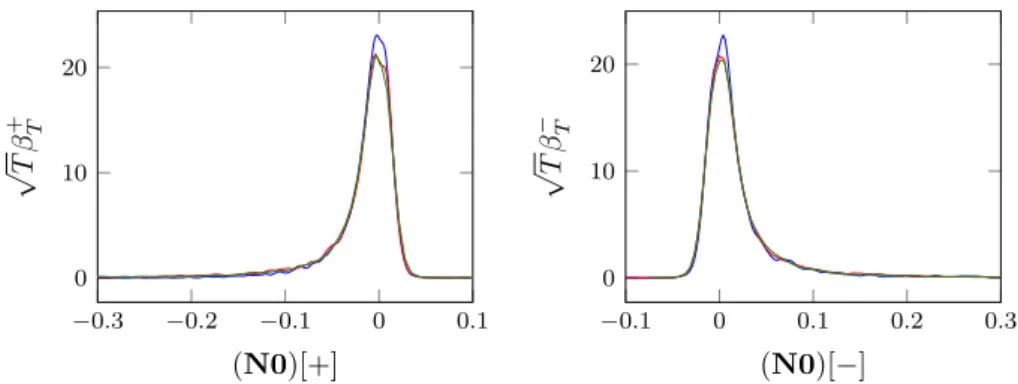
where Λ follows a law of arcsine type with density 𝑝Λ(𝑢) := 1 𝜋 1 √︁ 𝑢(1− 𝑢) 𝜎+/𝜎− 1− (1 − (𝜎+/𝜎−)2)𝑢 for 0 < 𝑢 < 1. Besides, √ 𝑇 (𝛽𝑇+, 𝛽𝑇−)law= (𝛽1+, 𝛽1−) (19)
where the explicit joint density of (𝛽1+, 𝛽1−) is given by (36) below. In particular, (𝛽𝑇+, 𝛽𝑇−) converges almost surely to (𝑏+, 𝑏−) = (0, 0).
Proposition 5 (Null recurrent case with non-vanishing drift N1). Assume 𝑏+ = 0,
𝑏− > 0. Then 𝑄+𝑇 𝑇 a.s. −−−→𝑇 →∞ 1 and (𝛽 + 𝑇, 𝛽𝑇−) a.s. −−−→𝑇 →∞ (𝑏+, 𝑏−).
In addition, there exists three independent unit Gaussian random variables𝒩−, 𝒩+
and 𝒩 such that
(︃ 𝑄−𝑇 √ 𝑇, √ 𝑇 (𝛽𝑇+− 𝑏+), 𝑇1/4(𝛽𝑇−− 𝑏−) )︃ law −−−→𝑇 →∞ ⎛ ⎝ 𝜎+ 𝑏−|𝒩 |, 𝜎+𝒩 +, 𝜎 − √ 𝑏− √︁ 𝜎+ · 𝒩− √︁ |𝒩 | ⎞ ⎠. (20)
Remark 2. This case exhibits two different rates of convergence. This is due to
the fact below the threshold that the particle is pushed up, but only behave like a Brownian motion when above. Below the threshold, we are in a similar situation as for the positive recurrent case, while above it is like the null recurrent case.
Proposition 6 (Transient case for upward drift T0). Assume 𝑏+ > 0, 𝑏− ≥ 0 so
that the process 𝜉 is transient and lim𝑇→∞𝜉𝑇 = +∞. Then 𝑄+𝑇/𝑇 converges almost
surely to 1 as 𝑇 → ∞ and 𝛽𝑇+ −−−→a.s. 𝑇→∞ 𝑏+ and √ 𝑇 (𝛽𝑇+− 𝑏+)−−−→law 𝑇→∞ 𝜎+𝒩 + (21)
for a unit Gaussian random variable𝒩+. Let ℓ0 be the last passage time to 0, which
is almost surely finite. Assume 𝜉0 = 0. We have
𝛽𝑇−1𝑇 >ℓ0 =ℛT01𝑇 >ℓ0 and lim 𝑇→∞𝛽 − 𝑇 =ℛT0 a.s. with ℛT0:= 𝐿∞(𝜉) 2𝑄−ℓ0 = 𝐿∞(𝜉) 2𝑄− ∞ . (22)
The density of ℛT0 is given by (33) below. The case 𝑏+ ≤ 0, 𝑏− < 0 is treated by
symmetry.
Proposition 7 (Transient case for diverging drift T1). Assume 𝑏+ > 0, 𝑏− < 0 so
that the process 𝜉 is transient. Assume that 𝜉0 = 0. Then there exists a Bernoulli
random variable ℬ ∈ {0, 1} such that
P(ℬ = 1) = 1 − P(ℬ = 0) = 𝜎−𝑏+ 𝜎+𝑏−+ 𝜎−𝑏+, P+ (︃ 𝑄+𝑇 𝑇 −−−→𝑇→∞ 1 )︃ = 1 and P− (︃ 𝑄−𝑇 𝑇 −−−→𝑇→∞ 1 )︃ = 1 with P+(·) = P(· | ℬ = 1) and P−(·) = P(· | ℬ = 0).
On the event {ℬ = 1} (resp. {ℬ = 0}), 𝛽𝑇+ (resp. 𝛽𝑇−) converges almost surely
to 𝑏+ (resp. 𝑏−) while 𝛽𝑇−− 𝑏− (resp. 𝛽𝑇+− 𝑏+) is the ratio of two a.s. finite random
In addition, for unit Gaussian random variables 𝒩+ and 𝒩−, √ 𝑇 (𝛽𝑇+− 𝑏+)−−−→law 𝑇→∞ 𝜎+𝒩 + under P +, (23) √ 𝑇 (𝛽𝑇−− 𝑏−)−−−→law 𝑇→∞ 𝜎−𝒩 − under P −. (24) In addition, lim 𝑇→∞𝛽 −
𝑇 =ℛ−T1 a.s. under P+ with ℛ−T1 =
𝐿∞(𝜉) 2𝑄− ∞ , (25) lim 𝑇→∞𝛽 +
𝑇 =−ℛ+T1 a.s. under P− with ℛ+T1 =
𝐿∞(𝜉)
2𝑄+∞ . (26)
The distribution of ℛ−T1 is that of of ℛ given (33) below. That of ℛ+T1 is found by
symmetry.
5 Auxiliary tools
In this section, we give first some results on a martingale central limit theorem that will be used constantly. To deal with the transient or null recurrent cases, we make use of some analytic properties of one-dimensional diffusions.
5.1 Limit theorems on martingales
The following result follows immediately from [34, Proposition 1, p. 148; Theorem 1, p. 150].
Proposition 8 (A criterion for convergence). Under the true probability P,
(i) as 𝑇 → ∞, 𝛽𝑇+ (resp. 𝛽𝑇−) converges a.s. to 𝑏+ (resp. 𝑏−) on the event {𝑄+∞ = +∞} (resp. {𝑄−∞= +∞}).
(ii) as 𝑇 → ∞, 𝑀𝑇+ (resp. 𝑀𝑇−) converges a.s. to a finite value on the event {𝑄+∞ <
+∞} (resp. {𝑄−∞ < +∞}). In other words, 𝛽𝑇± is not a consistent estimator on
{𝑄±
∞ < +∞}.
We now state an instance of a Central Limit theorem for martingales which follows from [8]. This theorem will be used to deal with the cases E, N1 and T1. Let us start by recalling the notion of stable convergence introduced by A. Rényi [22, 44].
Definition 1 (Stable convergence). A sequence (𝑋𝑛)𝑛∈N on a probability space
(Ω,ℱ, P) is said to converge stably with respect to a 𝜎-algebra 𝒢 ⊂ ℱ if for any bounded, continuous function 𝑓 and any bounded,𝒢-measurable random variable 𝑌 ,
E(𝑓(𝑋𝑛)𝑌 )−−−→
𝑛→∞ E(𝑓(𝑋)𝑌 ).
Proposition 9 (A central limit theorem for martingales). Let (Ω,ℱ, P) be the
un-derlying probability space of the process 𝜉 with a filtration (ℱ𝑡)𝑡≥0. If for some
constants 𝑐+, 𝑐− > 0, 𝑄+𝑇 𝑇 P −−−−→ 𝑇→+∞ 𝑐+ and 𝑄−𝑇 𝑇 P −−−−→ 𝑇→+∞ 𝑐−,
then for the martingales 𝑀± defined by (4), (︃ 𝑀𝑇+ √ 𝑇, 𝑀𝑇− √ 𝑇 )︃ ℱ∞−stably −−−−−−→𝑇 →∞ (𝜎+ √𝑐 +𝒩+, 𝜎−√𝑐−𝒩−), (27)
on a probability space (Ω′,ℱ′,P′) extending (Ω,ℱ, P) and containing two
indepen-dent unit Gaussian random variables 𝒩+, 𝒩−, themselves independent from 𝜉. In
addition, √ 𝑇 (︃ 𝑀𝑇+ 𝑄+𝑇 , 𝑀𝑇− 𝑄−𝑇 )︃ ℱ∞−stably −−−−−−→ 𝑇→∞ (︃ 𝜎+ √𝑐 +𝒩 +, 𝜎− √𝑐 −𝒩 − )︃ , (28) Proof. Set 𝑎𝑇 := [︃ 1/√𝑇 0 0 1/√𝑇 ]︃ and 𝑞𝑇 =⟨𝑀, 𝑀⟩𝑇 = [︃ 𝜎2+𝑄+𝑇 0 0 𝜎−2𝑄−𝑇 ]︃ . Thus, 𝑎𝑇𝑞𝑇𝑎′𝑇 = ⎡ ⎣ 𝜎+2 𝑄 + 𝑇 𝑇 0 0 𝜎2−𝑄 − 𝑇 𝑇 ⎤ ⎦−−−→P 𝑇→∞ [︃ 𝑐+ 𝑐− ]︃ . (29)
Theorem 2.2 in [8] yields (27). Besides, √ 𝑇𝑀 ± 𝑇 𝑄±𝑇 = 𝑇 𝑄±𝑇 × 𝑀𝑇± √ 𝑇 . (30)
If a sequence (𝑋𝑛)𝑛 converges ℱ∞-stably and a sequence (𝑌𝑛)𝑛 of ℱ∞-measurable random variables converges in probability, then (𝑋𝑛, 𝑌𝑛)𝑛 convergesℱ∞-stably.
Us-ing the property in (30) and (29) yields (28).
5.2 The fundamental system
Along with the characterization through the scale function and the speed measure, much information on the process can be read from the so-called fundamental system [12, 20, 45]: For any 𝜆 > 0, there exists some functions 𝜑𝜆 and 𝜓𝜆 such that
∙ 𝜓𝜆 and 𝜑𝜆 are continuous, positive from R to R with 𝜑𝜆(0) = 𝜓𝜆(0) = 1.
∙ 𝜓𝜆 is increasing with lim𝑥→−∞𝜓𝜆(𝑥) = 0, lim𝑥→∞𝜓𝜆(𝑥) = +∞.
∙ 𝜑𝜆 is decreasing with lim𝑥→−∞𝜑𝜆(𝑥) = +∞, lim𝑥→∞𝜑𝜆(𝑥) = 0.
∙ 𝜑𝜆 and 𝜓𝜆 are solutions to ℒ𝑓 = 𝜆𝑓.
In the case of piecewise constant coefficients with one discontinuity at 0, these solutions may be computed as linear combinations of the minimal functions for constant coefficients. Using the fact that 𝜑, 𝜑′, 𝜓 and 𝜓′ are continuous at 0,
𝜓𝜆(𝑥) = ⎧ ⎪ ⎪ ⎨ ⎪ ⎪ ⎩ exp (︂ 𝑥−𝑏−+ √ 𝑏2 −+2𝜎2−𝜆 𝜎2 − )︂ if 𝑥 < 0 𝜅+exp (︂ 𝑥−𝑏++ √ 𝑏2 ++2𝜎2+𝜆 𝜎2 + )︂ + 𝛿+exp (︂ 𝑥−𝑏+− √ 𝑏2 ++2𝜎+2𝜆 𝜎2 + )︂ if 𝑥≥ 0, (31) 𝜑𝜆(𝑥) = ⎧ ⎪ ⎪ ⎨ ⎪ ⎪ ⎩ 𝜅−exp (︂ 𝑥−𝑏−− √ 𝑏2 −+2𝜎−2𝜆 𝜎2 − )︂ + 𝛿−exp (︂ 𝑥−𝑏−+ √ 𝑏2 −+2𝜎−2𝜆 𝜎2 − )︂ if 𝑥 < 0, exp (︂ 𝑥−𝑏+− √ 𝑏2 ++2𝜎+2𝜆 𝜎2 + )︂ if 𝑥≥ 0 (32)
with 𝜅+:=−𝑏− 𝜎+2 + 𝑏+𝜎2−+ 𝜎−2√︁𝑏+2 + 2𝜆𝜎+2 + 𝜎2+√︁𝑏2−+ 2𝜆𝜎−2 2𝜎−2√︁𝑏2++ 2𝜆𝜎2+ , 𝛿+:=𝑏−𝜎 2 +− 𝑏+𝜎−2 + 𝜎−2 √︁ 𝑏2++ 2𝜆𝜎2+− 𝜎+2√︁𝑏2−+ 2𝜆𝜎2− 2𝜎2−√︁𝑏2++ 2𝜆𝜎+2 , 𝜅−:=−𝑏−𝜎 2 ++ 𝑏+𝜎2−− 𝜎−2 √︁ 𝑏2++ 2𝜆𝜎2++ 𝜎+2√︁𝑏2−+ 2𝜆𝜎−2 2𝜎2+√︁𝑏2−+ 2𝜆𝜎2− , 𝛿−:=𝑏−𝜎 2 +− 𝑏+𝜎−2 + 𝜎−2 √︁ 𝑏2++ 2𝜆𝜎2++ 𝜎+2√︁𝑏2−+ 2𝜆𝜎−2 2𝜎2+√︁𝑏2−+ 2𝜆𝜎−2 .
We also define the quantities [41]
̂︀ 𝜓(𝜆) := 1 2 𝜓′𝜆(0) 𝜓𝜆(0) = −𝑏−+ √︁ 𝑏2−+ 2𝜎−2𝜆 2𝜎−2 ≥ 0 and 𝜑(𝜆) :=̂︀ − 1 2 𝜑′𝜆(0) 𝜑𝜆(0) = 𝑏++√︁𝑏2++ 2𝜎+2𝜆 2𝜎+2 ≥ 0. In particular, ̂︀ 𝜓(0) = 0 and 𝜑(0) =̂︀ 𝑏+ 𝜎2+ when 𝑏− ≥ 0 and 𝑏+ ≥ 0.
5.3 Last passage time and occupation time for the transient
process
When 𝜉 is a transient process, the last passage time ℓ0 = sup{𝑡 ≥ 0 | 𝜉𝑡 = 0} of 𝜉 at 0 is almost surely finite. Its Laplace transform is (See (53) in [41]):
E0[exp(−𝜆ℓ0)] = ̂︀ 𝜓(0) +𝜑(0)̂︀ ̂︀ 𝜓(𝜆) +𝜑(𝜆)̂︀ .
Let us now assume that 𝑏+ > 0 and 𝑏− ≥ 0. This is the transient case T0 where
the process ends up almost surely in the positive semi-axis. Thus, 𝑄−ℓ 0 = 𝑄 − ∞ and 𝐿ℓ0(𝜉) = 𝐿∞(𝜉). Let us write ̂︀𝑏±:= 𝑏±/𝜎2 ±. From Corollary 5 in [41], E0[exp(−𝛼𝐿∞(𝜉)− 𝜆𝑄−∞)] = 𝜓(0) +̂︀ 𝜑(0)̂︀ 𝛼 +𝜑(0) +̂︀ 𝜓(𝜆)̂︀ = ̂︀𝑏+ 𝛼 +̂︀𝑏+−̂︀𝑏− 2 + 2𝜎12 − √︁ 𝑏2−+ 2𝜎−2𝜆 .
Let 𝑝𝐿∞(𝜉)(𝑡) be the density of 𝐿∞(𝜉). Setting 𝜆 = 0, we see that 𝐿∞(𝜉) is distributed according to an exponential distribution of ratê︀𝑏+. Thus, 𝑝𝐿
∞(𝜉)(𝑡) =̂︀𝑏+exp(−̂︀𝑏+𝑡). A conditioning shows that
E0[exp(−𝛼𝐿∞(𝜉)− 𝜆𝑄−∞)] = ∫︁ +∞ 0 exp(−𝛼𝑡)E0 (︁ exp(−𝜆𝑄−∞)⃒⃒ ⃒𝐿∞(𝜉) = 𝑡 )︁ 𝑝𝐿∞(𝑡) d𝑡.
By inverting the Laplace transform with respect to 𝛼, since 𝑝𝐿∞(𝑡) =̂︀𝑏+exp(−̂︀𝑏+𝑡), E0 (︁ exp(−𝜆𝑄−∞)⃒⃒ ⃒𝐿∞(𝜉) = 𝑡 )︁ = exp ⎛ ⎝−𝑡 ⎛ ⎝− ̂︀ 𝑏− 2 + 1 √ 2𝜎− ⎯ ⎸ ⎸ ⎷ 𝑏2− 2𝜎−2 + 𝜆 ⎞ ⎠ ⎞ ⎠.
Inverting the latter Laplace transform with respect to 𝜆, the density 𝑝𝑄−
∞(𝑠|𝑡) of 𝑄 − ∞ given{𝐿∞(𝜉) = 𝑡} is 𝑝𝑄− ∞(𝑠|𝑡) = 𝑡 𝜎−2√2𝜋𝑠3/2 exp (︃ 𝑡𝑏− 2𝜎2− − 𝑏2−𝑠 2𝜎2− − 𝑡2 8𝜎−2𝑠 )︃ . Hence, the distribution 𝑝(𝑄−
∞,𝐿∞(𝜉))(𝑠, 𝑡) of the pair (𝑄 − ∞, 𝐿∞(𝜉)) is 𝑝(𝑄− ∞,𝐿∞(𝜉))(𝑠, 𝑡) = 𝑡𝑏+ 𝜎+2𝜎−2√2𝜋𝑠3/2 exp (︃(︃ 𝑏− 2𝜎2− − 𝑏+ 𝜎2+ )︃ 𝑡− 𝑏 2 −𝑠 2𝜎2− − 𝑡2 8𝜎2−𝑠 )︃ . The density 𝑝ℛT0(𝑟) of the random variableℛT0:= 𝐿∞(𝜉)/2𝑄−∞ is then
𝑝ℛT0(𝑟) = 2 ∫︁ +∞ 0 𝑠· 𝑝(𝑄−∞,𝐿∞(𝜉))(𝑠, 2𝑟𝑠) d𝑠 = 𝑟𝑏+ 𝜎2+𝜎−√2 (︃ 2𝑟𝑏+ 𝜎+2 + (𝑟− 𝑏−)2 2𝜎−2 )︃−3/2 , 𝑟 > 0. The distribution of 𝐿∞(𝜉)/2𝑄+∞ when 𝑏− < 0, 𝑏+ ≤ 0 is found by symmetric
arguments.
Let us now assume that 𝑏+ > 0 and 𝑏− < 0. This is the transient case T1 where
the process can end up in both semi-axis. The Laplace transform is E0[exp(−𝛼𝐿∞(𝜉)− 𝜆𝑄−∞)] = ̂︀ 𝜓(0) +𝜑(0)̂︀ 𝛼 +𝜑(0) +̂︀ 𝜓(𝜆)̂︀ = ̂︀𝑏+−̂︀𝑏− 𝛼 +̂︀𝑏+−̂︀𝑏− 2 + 2𝜎12 − √︁ 𝑏2−+ 2𝜎−2𝜆 .
With analogous computations as before we get that the density 𝑝ℛ−
T1(𝑟) of ℛ − T1 is 𝑝ℛ− T1(𝑟) = 𝑟 𝜎−√2 (︃ 𝑏+ 𝜎+2 − 𝑏− 𝜎2− )︃(︃ 2𝑟𝑏+ 𝜎2+ + (𝑟− 𝑏−)2 2𝜎2− )︃−3/2 , 𝑟 > 0.
Considering also the previous case, we can write the following formula, holding for the density ofℛ = ℛT0 orℛ = ℛ−T1 in both cases T0 and T1:
𝑝ℛ(𝑟) = 𝑟 𝜎−√2 (︃ 𝑏+ 𝜎+2 + L𝑏−M − 𝜎−2 )︃(︃ 2𝑟𝑏+ 𝜎+2 + (𝑟− 𝑏−)2 2𝜎−2 )︃−3/2 , 𝑟 > 0. (33) Notice that this is the density of a positive random variable which is not integrable. This gives the limit behavior of the estimator 𝛽𝑇− of 𝑏−. The behavior of 𝛽𝑇+ in the corresponding cases can be found by symmetric arguments.
6 Proofs of the asymptotic behavior of the estimators
6.1 Asymptotic behavior for the ergodic case (E)
The ergodic case is the most favorable one. The process 𝜉 is ergodic, so that for any bounded, measurable function 𝑓 , 𝑇1 ∫︀𝑇
0 𝑓 (𝜉𝑠) d𝑠 converges almost surely to
∫︀
𝑓 (𝑥)𝑀𝑚(𝑥)(R)d𝑥.
With the explicit expression of 𝑀 that follows from (18),
𝑀 (R+) = −1 𝑏+, 𝑀 (R−) = 1 𝑏− and 𝑀 (R) = |𝑏+𝑏−| |𝑏−| + |𝑏+| . From the ergodic theorem, since 𝑄±𝑡 =∫︀𝑡
01±𝜉𝑠≥0d𝑠, 𝑄±𝑇 𝑇 a.s. −−−→𝑇 →∞ 𝑀 (R±) 𝑀 (R) so that 𝑄+𝑇 𝑇 a.s. −−−→ 𝑇→∞ |𝑏−| |𝑏−| + |𝑏+| and 𝑄 − 𝑇 𝑇 a.s. −−−→ 𝑇→∞ |𝑏+| |𝑏−| + |𝑏+| . (34)
The rate of convergence follows from Proposition 9 and (34).
6.2 Asymptotic behavior for the null recurrent case with
vanishing drift (N0)
When 𝑏− = 𝑏+ = 0, the process 𝜉 is an Oscillating Brownian motion (OBM, intro-duced first in [25], see also [31]). Supposing 𝜉0 = 0, using the scaling relation [31, Remark 3.7], for any 𝑇 > 0,
(︃ L𝜉𝑇M + √ 𝑇 , L𝜉𝑇M − √ 𝑇 , 𝐿𝑇(𝜉) √ 𝑇 , 𝑄+𝑇 𝑇 )︃ law = (L𝜉1M + ,L𝜉1M −, 𝐿 1(𝜉), 𝑄+1). Therefore, √ 𝑇 (︃ 𝛽𝑇+ 𝛽𝑇− )︃ = ⎛ ⎜ ⎜ ⎜ ⎜ ⎝ L𝜉𝑇M + /√𝑇 − 12𝐿𝑇(𝜉)/ √ 𝑇 𝑄+𝑇/𝑇 1 2𝐿𝑇(𝜉)/ √ 𝑇 −L𝜉𝑇M −/√𝑇 𝑄−𝑇/𝑇 ⎞ ⎟ ⎟ ⎟ ⎟ ⎠ law = (︃ 𝛽1+ 𝛽1− )︃ = ⎛ ⎜ ⎜ ⎜ ⎜ ⎝ L𝜉1M + −12𝐿1(𝜉) 𝑄+1 1 2𝐿1(𝜉)−L𝜉1M − 𝑄−1 ⎞ ⎟ ⎟ ⎟ ⎟ ⎠ .
We recall now that 𝑋 = Φ(𝜉) := 𝜉/𝜎(𝜉) is a Skew Brownian motion [11, 31]. An explicit formula for the density for the position a Skew Brownian motion, its local time and its occupation time is known [1, 13]. Since the transform Φ is piecewise linear, one easily recover the one of an OBM, its local and occupation times. Hence, the density of (𝜉1, 𝐿1(𝜉), 𝑄+1(𝜉)) is 𝑝(𝜉 1,𝐿1(𝜉),𝑄+1)(𝜌, 𝜆, 𝜏 ) = ⎧ ⎪ ⎪ ⎪ ⎪ ⎪ ⎨ ⎪ ⎪ ⎪ ⎪ ⎪ ⎩ (𝜆/2 + 𝜌)𝜆/2 2𝜋𝜎−𝜎3+(1− 𝜏)3/2𝜏3/2exp (︃ − (𝜆/2) 2 2𝜎2−(1− 𝜏) − (𝜆/2 + 𝜌)2 2𝜎2+𝜏 )︃ for 𝜌≥ 0, (𝜆/2− 𝜌)𝜆/2 2𝜋𝜎+𝜎3−(1− 𝜏)3/2𝜏3/2exp (︃ −(𝜆/2) 2 2𝜎+2𝜏 − (𝜆/2− 𝜌)2 2𝜎2−(1− 𝜏) )︃ for 𝜌 < 0. (35)
The change of variable in the density suggested by (𝛽1+, 𝛽1−, 𝑄+1) = (︃ L𝜉1M + − 𝐿1(𝜉)/2 𝑄+1 , 𝐿1(𝜉)/2−L𝜉1M− 1− 𝑄+1 , 𝑄 + 1 )︃ gives 𝑝(𝛽+ 1,𝛽 − 1,𝑄 + 1)(𝑎, 𝑏, 𝛿) = 2𝛿(1− 𝛿)𝑝(𝜉 1,𝐿1(𝜉),𝑄+1)(𝑎𝛿 + 𝑏(1− 𝛿), |𝑎𝛿 + 𝑏(1 − 𝛿)| − 𝑎𝛿 + 𝑏(1 − 𝛿), 𝛿) and then, since 𝑄+1 ∈ [0, 1],
𝑝(𝛽+ 1,𝛽 − 1)(𝑎, 𝑏) = ∫︁ 1 0 2𝛿(1− 𝛿)𝑝(𝜉1,𝐿1(𝜉),𝑄+1)(𝑎𝛿 + 𝑏(1− 𝛿), |𝑎𝛿 + 𝑏(1 − 𝛿)| − 𝑎𝛿 + 𝑏(1 − 𝛿), 𝛿) d𝛿. (36)
6.3 Asymptotic behavior for the null recurrent case with
non-vanishing drift (N1)
We consider 𝑏+ = 0, 𝑏− > 0. The particle is then pushed upward when its position
is negative. Yet the process is only null recurrent. The measure 𝑀 satisfies
𝑀 (R−) = 1
𝑏− and 𝑀 (R+) = +∞. (37)
Using 9) in [20, Section 6.8, p. 228] or [38, 51], with (37),
𝑄−𝑇 𝑇 a.s. −−−→ 𝑇→∞ 𝑀 (R−) 𝑀 (R) = 0.
Since 𝑄+𝑇 + 𝑄−𝑇 = 𝑇 , it holds that 𝑄+𝑇/𝑇 converges almost surely to 1.
Using Proposition 9 on 𝑀+ only, we obtain that
𝑀𝑇+ √ 𝑇 law −−−→𝑇 →∞ 𝜎 +𝒩+ (38)
for a Gaussian random variable 𝒩+ ∼ 𝒩 (0, 1) and then that √𝑇 (𝛽𝑇+− 𝑏+) −−−→law
𝑇→∞
𝜎+𝒩+.
The asymptotic behavior of 𝑄−𝑇 is more delicate to deal with as the process 𝜉 is only null recurrent. For this, we use the results of [15] which extends the one of D.A. Darling and M. Kac [9] on additive and martingale additive functionals.
The Green kernel with respect to the invariant measure 𝑀 of ℒ is given by [12, 20, 45] 𝑔𝜆(𝑥, 𝑦) := 1 𝑊𝜆 ⎧ ⎨ ⎩ 𝜓𝜆(𝑥)𝜑𝜆(𝑦) if 𝑥 < 𝑦, 𝜑𝜆(𝑥)𝜓𝜆(𝑦) if 𝑥≥ 𝑦 with 𝑊𝜆 = 𝜓 ′ 𝜆(0)𝜑𝜆(0)− 𝜓𝜆(0)𝜑′𝜆(0) 𝑆′(0) .
Using (31)-(32), 𝑊𝜆 = √ 2𝜆 𝜎+ + √︁ 𝑏2−+ 2𝜆𝜎−2 𝜎2− − 𝑏− 𝜎2− −−→𝜆→0 √ 2 𝜎+. (39)
On the other hand, it follows from (31)-(32) that
𝜓𝜆(𝑥)−−→
𝜆→0 𝜓0(𝑥) := 1 and 𝜑𝜆(𝑥)−−→𝜆→0 𝜑0(𝑥) := 1 for any 𝑥∈ R. (40)
For a measurable function 𝑓 :R → R+ such that ∫︀
R𝑓 d𝑀 < +∞, combining (39)
and (40) yields that √ 𝜆 ∫︁ R𝑔𝜆(𝑥, 𝑦)𝑓 (𝑥)𝑚(𝑦) d𝑦 −−→𝜆→0 𝜎+ √ 2 ∫︁ R𝑓 (𝑦)𝑚(𝑦) d𝑦, ∀𝑥 ∈ R.
The above convergence allows one to identify the parameters to use in the limit theorem we will use on (𝑀−, 𝑄−). We then define ℓ(𝜆) :=√2/𝜎+which is a constant function, and 𝛼 := 1/2, the exponent of 𝜆.
Let (ℳ𝑡)𝑡≥0 be a Mittag-Leffler process of index 𝛼 = 1/2 (it is the inverse of an increasing stable process of index 1/2). The process 2−1/2ℳ is equal in distribution to the running maximum of a Brownian motion, or equivalently, to the local time of a Brownian motion [15, Remark 2.9, p. 21].
From Theorem 3.1 and Corollary 3.2 in [15, p. 26], since ⟨𝑀−⟩𝑡 = 𝜎−2𝑄−𝑡, 𝑡 ≥ 0 and 𝑀 is continuous, (︃ √︁ ℓ(𝑛)𝑀 − 𝑛𝑡 𝑛1/4, ℓ(𝑛) 𝑄−𝑛𝑡 𝑛1/2 )︃ 𝑡∈[0,1] law −−−→𝑛→∞ (︁𝜎−√𝜈𝐵−(ℳ𝑡), 𝜈ℳ𝑡)︁ 𝑡∈[0,1] (41)
with respect to the uniform topology, where 𝐵 is a Brownian motion independent fromℳ and 𝜈 = ∫︁ R𝑚(𝑦)E𝑦 (︂∫︁ 1 0 1𝜉𝑠≤0d𝑠 )︂ d𝑦 = 𝑀 (R−) = 1 𝑏−.
From the reflection principle, the distribution of ℳ1 is the same as the one of a truncated normal distribution√2𝒯 where 𝒯 := |𝒢| with 𝒢 ∼ 𝒩 (0, 1). Setting 𝑡 = 1 in (41) and using the scaling property of the Brownian motion 𝐵−,
(︃ 𝑀𝑇− 𝑇1/4, 𝑄−𝑇 𝑇1/2 )︃ law −−−→𝑇 →∞ (︃ 𝜎− √𝜎 + √ 𝑏− √ 𝒯 · 𝒩−,𝜎+ 𝑏−𝒯 )︃
for a Gaussian random variable 𝒩− ∼ 𝒩 (0, 1) independent from 𝒯 . It remains to show the independence of 𝒩+,𝒩− and 𝒯 .
Since ⟨𝑀±⟩𝑡 = 𝜎±2𝑄𝑡± and ⟨𝑀+, 𝑀−⟩𝑡 = 0 for any 𝑡 ≥ 0, the Knight theorem [19, Theorem 7.3’, p. 92] implies that there exists on an extension of (Ω,ℱ, P) a 2-dimensional Brownian motion (𝐵+, 𝐵−) such that 𝑀𝑡± = 𝐵±(𝜎±2𝑄±𝑡) for any 𝑡 ≥ 0. Let us set 𝐵𝑛+(𝑡) = 𝑛−1/2𝐵+(𝑛𝑡) and 𝐵𝑛−(𝑡) = 𝑛−1/4𝐵−(√𝑛𝑡) for any integer 𝑛
and any 𝑡≥ 0. From the scaling property, (𝐵𝑛+, 𝐵𝑛−) is still a 2-dimensional Brow-nian motion which converges in distribution to a 2-dimensional BrowBrow-nian motion (𝐵∞+, 𝐵∞−) in the space 𝒞([0, 1], R2) of continuous functions.
For any 0 ≤ 𝑠 ≤ 𝑡 ≤ 1, 𝑄+𝑛𝑡 − 𝑄+𝑛𝑠 ≤ 𝑛(𝑡 − 𝑠) so that {(𝑄+𝑛𝑡/𝑛)𝑡∈[0,1]}𝑛≥1 is
tight in the space of continuous functions. Hence, {︁(𝑄+𝑛𝑡/𝑛)𝑡∈[0,1]
}︁
𝑛≥1 converges in
probability to the identity map 𝑡↦→ 𝑡 in the space of continuous function 𝒞([0, 1], R). Combining this result with (41), it holds that
{︂(︁
𝐵𝑛+(𝑡), 𝐵𝑛−(𝑡), 𝑛−1𝑄+𝑛𝑡, 𝑛−1/2𝑄−𝑛𝑡)︁ 𝑡∈[0,1]
}︂
𝑛≥1
is tight in𝒞([0, 1], R4) and then necessarily
(︃ 𝐵+𝑛(𝑡), 𝐵𝑛−(𝑡),𝑄 + 𝑛𝑡 𝑛 , 𝑄−𝑛𝑡 √ 𝑛 )︃ 𝑡∈[0,1] law −−−→𝑛→∞ (𝐵∞+(𝑡), 𝐵∞−(𝑡), 𝑡, 𝜈ℳ𝑡)𝑡∈[0,1] (42) in the space of continuous functions 𝒞([0, 1], R4). Being the inverse of a 1/2-stable process, hence a pure jump process,ℳ is independent from (𝐵∞+, 𝐵∞−) for the argu-ments presented in [15, p. 38] or [19, Theorem 6.3, p. 77].
For any 𝑡∈ [0, 1], owing to the definition of 𝐵𝑛+ and 𝐵𝑛−,
𝑀𝑛𝑡+ √ 𝑛 = 1 𝑛1/2𝐵 +(𝜎2 +𝑄+𝑛𝑡) = 𝐵𝑛+ (︃ 𝜎2+𝑄 + 𝑛𝑡 𝑛 )︃ and 𝑀 − 𝑛𝑡 𝑛1/4 = 1 √ 𝑛𝐵 −(𝜎2 −𝑄−𝑛𝑡) = 𝐵𝑛− (︃ 𝜎−2𝑄 − 𝑛𝑡 √ 𝑛 )︃ .
Using (𝑛−1𝑄+𝑛𝑡)𝑡∈[0,1]and (𝑛−1/2𝑄−𝑛𝑡)𝑡∈[0,1]as random time changes, we deduce from (42) and the results in [6, p. 144] that
(︃ 𝑀𝑛𝑡+ 𝑛1/2, 𝑀𝑛𝑡− 𝑛1/4, 𝑄+𝑛𝑡 𝑛 , 𝑄−𝑛𝑡 √ 𝑛 )︃ 𝑡∈[0,1] law −−−→𝑛→∞ (𝐵∞+(𝜎+2𝑡), 𝐵∞−(𝜎2−𝜈ℳ𝑡), 𝑡, 𝜈ℳ𝑡)𝑡∈[0,1]. By setting𝒩+:=𝐵∞+(𝜎+2)/𝜎+ ∼ 𝒩 (0, 1) in (38), 𝒯 :=ℳ1/√2 and𝒩−:=𝐵∞−(𝜎−2𝜈)/𝜎−√𝜈 ∼
𝒩 (0, 1), this proves (20) using 𝑡 = 1 in the above limit.
6.4 Asymptotic behavior for the transient case (T0)
We recall that we consider only 𝑏+ > 0 and 𝑏− ≥ 0.It is known that the last passage time ℓ0 to 0 is almost surely finite so that
𝑄−∞ < ∞ almost surely. Since 𝑄+𝑇 = 𝑇 − 𝑄−𝑇, we obtain that 𝑄+𝑇/𝑇 converges
almost surely to 1. The convergence results regarding 𝛽𝑇+ follows from Proposition 9 applied only to one component.
The asymptotic behavior of 𝛽𝑇− follows from Proposition 8(ii).
When 𝑇 > ℓ0 and 𝜉0 = 0, then 𝜉𝑇 > 0 and thus 𝛽𝑇− = 𝐿𝑇(𝜉)/2𝑄−𝑇. Yet the local
time 𝐿𝑇(𝜉) and the occupation times 𝑄−𝑇 are constant when 𝑇 > ℓ0. The result follows by the computations of Section 5.3.
6.5 Asymptotic behavior for the transient case generated by
diverging drift (T1)
When 𝑏− < 0 and 𝑏+ > 0, the process is also transient as 𝑆(+∞) < +∞ and 𝑆(−∞) > −∞. The scale function 𝑆 map R to (−𝛾−, 𝛾+) with 𝛾± =|𝜎±2|2𝑏±. From
the Feller test [24, Theorem 5.29], the process does not explode. Thus, as 𝜉0 = 0, it follows from [52] or [24, Proposition 5.5.22, p. 354] that
𝑝 :=P (︂ lim 𝑇→∞𝜉𝑇 = +∞ )︂ = 1− P (︂ lim 𝑇→∞𝜉𝑇 =−∞ )︂ = 𝛾− 𝛾−+ 𝛾+ = 𝜎−2𝑏+ 𝜎2+𝑏−+ 𝜎−2𝑏+.
Then event that {lim𝑇→∞|𝜉𝑇| = +∞} arise when the process starts an excursion
with infinite lifetime, thus after the last passage time to 0. We denote by 𝐴± the event {lim𝑇→∞𝑄±𝑇/𝑇 = 1}, so that 𝐴+∩ 𝐴− =∅. Hence, P(𝐴+) = 1− P(𝐴−) = 𝑝.
Using the same arguments as in the case T0, given 𝐴±, 𝛽𝑇± converges almost surely to 𝑏± while 𝛽𝑇∓ =±𝐿∞(𝜉)/𝑄∓ℓ0.
For the Central Limit Theorem, we apply Corollary 2.3 in [8] on 𝑀𝑇+/√𝑇 . As
𝑄+𝑇 > 0 a.s. as soon as 𝑇 > 0 since 𝜉0 = 0 and
{ℬ = 𝑝} = 𝐴+, a.s. for 𝑝 = 0, 1, it follows that for a normal distribution𝒩 ,
√︃ 𝑇 𝜎2+𝑄+𝑇 · 𝑀𝑇 √ 𝑇 ℱ∞−stably −−−−−−→ 𝑁→∞ 𝒩 under P(· | ℬ = 1). It follows that 𝛽𝑇+− 𝑏+=√𝑇𝑀𝑇 𝑄+𝑇 = 𝜎+ √︃ 𝑇 𝑄+𝑇 √︃ 𝑇 𝜎+2𝑄+𝑇 𝑀𝑇 √ 𝑇 ℱ∞−stably −−−−−−→ 𝑁→∞ 𝜎+𝒩 under P(· | ℬ = 1).
Hence the result.
7 Wilk’s theorem and LAN property
Owing to the quadratic nature of the log-likelihood, we easily deduce both a Wilk theorem, on which a hypothesis test may be developed, as well as the Local Asymp-totic Normality (LAN) property, which proves that our estimators are asympAsymp-totically efficient.
7.1 Wilk’s theorem and a hypothesis test
The log-likelihood log 𝐺𝑇(𝑏+, 𝑏−) can be computed from the data using (7). More-over, this function is quadratic in 𝑏+ and 𝑏−. We have then
∇ log 𝐺𝑇(𝑏+, 𝑏−) = ⎡ ⎢ ⎣ L𝜉𝑇M + 𝜎2 + − L𝜉0M + 𝜎2 + − 1 2𝜎2 + 𝐿𝑇(𝜉)− 𝑏𝜎+2 + 𝑄+𝑇 −L𝜉𝑇M − 𝜎2 − + L𝜉0M − 𝜎2 − + 1 2𝜎2 −𝐿𝑇(𝜉)− 𝑏− 𝜎2 −𝑄 − 𝑇 ⎤ ⎥ ⎦
and Hess log 𝐺𝑇(𝑏+, 𝑏−) =
⎡ ⎢ ⎣ −𝑄+𝑇 𝜎2 + 0 0 −𝑄 − 𝑇 𝜎2 − ⎤ ⎥ ⎦.

![Figure 2: (N1)[+], (T0)[+], (T1)[+] w.r.t P + , (T1)[ − ] w.r.t P − . SDE pa- pa-rameters:](https://thumb-eu.123doks.com/thumbv2/123doknet/13373028.404033/26.892.155.733.276.1006/figure-sde-rameters-.webp)
![Figure 3: (N1)[ − ]. SDE parameters:](https://thumb-eu.123doks.com/thumbv2/123doknet/13373028.404033/27.892.324.571.439.626/figure-n-sde-parameters-.webp)
![Figure 4: (T0)[ − ], (T1)[+] w.r.t to P − and (T1)[ − ] w.r.t to P + . SDE parame- parame-ters:](https://thumb-eu.123doks.com/thumbv2/123doknet/13373028.404033/28.892.189.700.273.468/figure-sde-parame-parame-ters-.webp)