HAL Id: lirmm-02366116
https://hal-lirmm.ccsd.cnrs.fr/lirmm-02366116
Submitted on 15 Nov 2019
HAL is a multi-disciplinary open access
archive for the deposit and dissemination of
sci-entific research documents, whether they are
pub-lished or not. The documents may come from
teaching and research institutions in France or
abroad, or from public or private research centers.
L’archive ouverte pluridisciplinaire HAL, est
destinée au dépôt et à la diffusion de documents
scientifiques de niveau recherche, publiés ou non,
émanant des établissements d’enseignement et de
recherche français ou étrangers, des laboratoires
publics ou privés.
Self-Robust Non-Volatile C-element for Single Event
Upset Enhanced Tolerance
Odilia Coi, Lionel Torres, Gregory Di Pendina
To cite this version:
Odilia Coi, Lionel Torres, Gregory Di Pendina. Self-Robust Non-Volatile C-element for Single Event
Upset Enhanced Tolerance. 21ème Journées Nationales du Réseau Doctoral en Micro-nanoélectronique
(JNRDM), Jun 2019, Montpellier, France. �lirmm-02366116�
Self-Robust Non-Volatile C-element for Single Event Upset Enhanced
Tolerance
Odilia Coi
1,2,3, Lionel Torres
1, Gregory Di Pendina
2 1LIRMM-CNRS University of Montpellier
161 Rue Ada Montpellier 34090, France
2
Univ. Grenoble Alpes, CNRS, CEA, Grenoble INP, INAC-Spintec
17 Rue des Martyrs, 38000 Grenoble, France
3
CNES Service Environnement et Composant nouveaux DCT/AQ/EC, France
1[email protected],
2[email protected]
Abstract
For embedded systems in harsh environments, a ra-diation robust circuit design is still an open challenge. As circuits become more and more complex and CMOS processes get denser and smaller, their immunity to-wards particle strikes decreases drastically. Due to its proven resistance to radiation effects and its inherent non-volatility, Spin-Transfer-Torque-based Magnetic Tunnel Junction (STT-MTJ) is considered as a serious promising candidate for high reliability electronic. The first radia-tion hardened STT-MTJ based Non-Volatile C-element is presented in this paper. This hybrid VLSI structure ad-dresses the problem of the non-volatile error occurrence by avoiding MTJs radiation induced magnetization rever-sal.
1. Introduction
Solar wind and flare, cosmic radiation and Van Allen Belt are some of the main sources of particles flux (pro-tons, electrons, alpha particles...) in space, involving en-ergy ranging from hundreds of KeV to millions of MeV. Since shielding technique shown important limitations and transistor scaling leads to a relevant impact of soft error even in terrestrial environment [5] a radiation-hard IC design becomes a real challenge. Physically, the inter-action of such particles with the active region of CMOS ends up in numerous undesirable events that could cause a failure or even destroy the transistor. A Single Event Tran-sient (SET) is an unwanted current pick, due to the ac-cumulation of electron-hole pairs separated and collected near the reverse biased junction of the device. When the collection of this charge overcomes the maximum value that can be tolerated from a memory node without
re-sulting in a bit-flip (Qcritic), a Single Event Upset
oc-curs (SEU). A Multi Event Upset (MEU) could occur in case that several close nodes have affected simultaneously
from the radiations. However, if the voltage pulse induced by the strikes does not exceed the breakdown voltage of the transistors, the failures are classified as non-disruptive since they can be corrected by reprogramming the circuit into its previous logic state. In the last decade, the evi-dence of the intrinsically MTJ robustness to radiation ef-fects leads them to be subject of robust design investiga-tion. Indeed, some design of hybrid latches have been proposed in [1], [6] and [3] as well as a magnetic radi-ation hard unit has introduced in [2 ] and [4]. However, when integrated in CMOS circuit, MTJ could be affected by radiation-induced errors, namely a bit- flip of the stored information, precisely because of the surrounding periph-eral circuits. Hence, specific hardening technique for MTJ must be investigated since they are still vulnerable to radi-ations. Dealing with this issue has become more and more urgent as, in the last years, the evolution of MTJ-based technologies allows smaller and smaller writing currents, making easier for a SEU to induce on the writing/reading transistors a charge transfer, resulting in a magnetic orien-tation reversal. In this paper, the first radiation hardened Non-Volatile C-element is presented with the aim to take advantage of the error filtering capability of the C-element and at the same time of the intrinsic MTJ robustness to radiation, with a special regard to the avoidance of non volatile errors.
2. Proposed Solution
C-element is a state holding circuit, which is transpar-ent when all its inputs are equal, and holds the previous output otherwise. Due to the use of MTJ, this unit com-bines together the capability to block a mismatch propa-gation and to store in the same unit the correct bit. The MTJ nano-pillar structure, consists of a thin insulat-ing barrier sandwiched between two ferromagnetic lay-ers: a reference layer with a fixed magnetization and a storage layer with a switchable magnetization. Depend-ing on the mutual magnetic orientation of the two layers
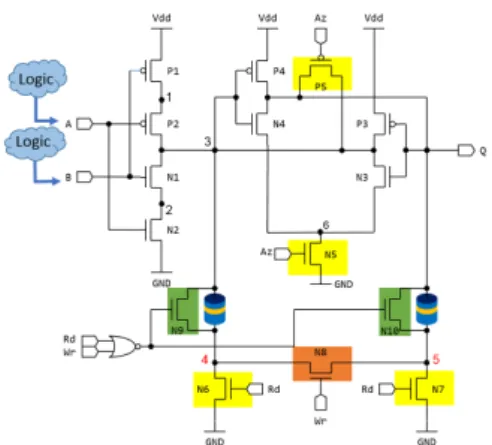
(parallel or anti-parallel) the resistance changes being ei-ther low-state or high-state allowing the storage of bit ”0” or ”1” respectively. In the NV C-element implementation MTJs are used to store the output state and its comple-ment while CMOS part takes part of the combinational part. In between the various C-element implementations the Single Inverter Latch (SIL) C-element results to be the most soft-error resilient due the lowest number of sensi-tive nodes with respect to the total. The first innovation we propose is to make the C-element non volatile: two MTJs and five transistors are employed for this purpose, as depicted in Fig. 1. The circuit level implementation consists of pull up transistors (P1, P2) pull-down transis-tors (N1, N2) inverter (P4, N4) and weak inverter (P3, N3). Read operation (involving N5, N6, N7 and P5) is achieved by equalizing the voltage of the output node and of its complement, (Az signal) hence sensing the value of the MTJs resistance (Rd signal). A second novelty con-sists in adding transistors N9 and N10 to avoid/reduce the occurence of non volatile errors.
Figure 1. Proposed radiation tolerant Non Volatile implementation of the C-element. The numbers in the circuit represent the sensitive nodes.
SEUs were injected into the sensitive nodes of the cir-cuit using a double exponential current pulse as depicted in Fig. 2. Error simulations shown that a charge of 100 fC in node 4 and/or in node 5 is already sufficient to reverse the storage layer magnetic orientation if N9 and N10 are removed. On the contrary, with the insertion of these two NMOS in parallel to each MTJ, a resistive partition path for the current pulse induced by the particle is obtained.
Hence, provided that Ron<<Rp, the quantity of current
flowing into the MTJs will not be enough to induce their switching.
Simulation results summarized in Table II show that the insertion of the two NMOS in parallel to the MTJs in-creases the circuit robustness to non-volatile errors up to 3 times with respect to the solution without the shunt path. As highlighted in Fig. 3, Q regains quickly (⇠ 1ns) its original value and the values stored in the MTJs are not
(a) (b) 0 100 200 300 400 500 600 0,0 0,2 0,4 0,6 0,8 1,0 1,2 1,4 QInj= 100 QInj= 120 QInj= 150 QInj= 200 QInj= 250 QInj= 300 QInj= 330 I inj ( mA) Time (ps) 0 50 100 150 200 250 300 0,0 0,5 1,0 1,5 2,0 2,5 QInj= 100 QInj= 120 QInj= 150 QInj= 200 QInj= 250 QInj= 300 QInj= 330 I inj ( mA) Time (ps) Τf=200 ps Τf=100 ps
Figure 2. Transient current pulse waveforms of the radiation particle strikes correspond-ing to different values of the simulated
in-jected charge for a fixed ⌧r= 10 ps.
affected at all.
Figure 3. Transient simulation waveforms of the SEU tolerant proposed non-volatile
C-element when Qinj=300 fC in node 4 and 5.
3. Conclusion
In this paper, an STT-MTJ based C- element with en-hanced SEU tolerance capability has been proposed. Er-ror injections in sensitive nodes of the circuit attested that only two nodes could lead to non-volatile errors and thus to SEU. A circuit level solution has been proposed and tested through simulations to avoid/ lessened their oc-curence. Concerning the CMOS part the radiation hard-ening achievement has to deal with trade-off involving transistor width and speed, in particular as Vdd is scaled down.
References
[1] J. K. Hass. Magnetic flip flops for space application. 2006. [2] W. Kang. A radiation hardened hybrid spintronic/CMOS nonvolatile unit using magnetic tunnel junctions. Journal of Physics D Applied Physics, 47(40):405003, January 2014. [3] Y. Lakys. Hardening techniques for MRAM-based
non-volatile latches and logic. 2012.
[4] J. Lopes. A SEU tolerant MRAM based non-volatile asyn-chronous circuit design. 2016.
[5] J. Wilkilnson. A cautionary tale of soft errors induced by SRAM packaging materials. 2005.
[6] D. Zhang. A novel SEU-tolerant mram latch circuit based on C-element. 2014.