HAL Id: hal-00747917
https://hal-mines-paristech.archives-ouvertes.fr/hal-00747917
Submitted on 4 Nov 2015
HAL is a multi-disciplinary open access
archive for the deposit and dissemination of
sci-entific research documents, whether they are
pub-lished or not. The documents may come from
teaching and research institutions in France or
abroad, or from public or private research centers.
L’archive ouverte pluridisciplinaire HAL, est
destinée au dépôt et à la diffusion de documents
scientifiques de niveau recherche, publiés ou non,
émanant des établissements d’enseignement et de
recherche français ou étrangers, des laboratoires
publics ou privés.
An integrated experiment coupling iron/argillite
interactions with bacterial activity
Camille Chautard, J.E. Lartigue, M. Libert, F. Marsal, Laurent de Windt
To cite this version:
Camille Chautard, J.E. Lartigue, M. Libert, F. Marsal, Laurent de Windt. An integrated experiment
coupling iron/argillite interactions with bacterial activity. ATALANTE 2012 International Conference
on Nuclear Chemistry for Sustainable Fuel Cycles, 2012, Montpellier, France. pp.641-646.
�hal-00747917�
1
An integrated experiment coupling iron/argillite interactions with bacterial activity
C. Chautarda*,b,c, J-E. Lartigueb, M. Libertb, F. Marsala, L. De Windtc
a IRSN, PRP-DGE/SEDRAN/BERIS, B.P. 17, 92262 Fontenay-aux-Roses Cedex, France b CEA, DEN/DTN/SMTM/LMTE, bât 307, 13108 Saint Paul Lez Durance Cedex, France c Mines-ParisTech, Geosciences Dpt., 77305 Fontainebleau Cedex, France
Abstract
In the context of the safety assessment of radioactive waste geological disposal in clayey formations, the evolution in time and space of clayey and metallic materials is of concern regarding their containment properties. Bacteria may induce localized corrosion processes and clay mineral alteration. Moreover, the presence of heterogeneities may favor preferential pathways or higher reactivity. Thus, the objective of the present work is to assess the influence of bacteria and heterogeneities on iron-clay reactivity. Two percolation cells are conducted in the presence of iron and argillite involving an artificial crack in biotic or abiotic conditions at 60 °C during one year. Two bacteria have been selected: a Sulphate Reducing Bacteria (SRB) and an Iron Reducing Bacteria (IRB). The reactivity of those cells is evidenced by the ongoing monitoring of water composition. First results clearly show that bacteria are able to survive in the biotic experiment. Moreover, the decrease of the flow rate observed in each cell could be explained by the clogging of the crack.
Keywords: Sulphate reducing bacteria; Iron reducing bacteria ; Argillite ; Hydrogen ; Iron ; Radioactive
waste ; Tournemire
1. Introduction
The concept of high-level radioactive waste (HLW) disposal cell developed by Andra in France involves metallic materials (containers, overpacks, liner) emplaced into a geological argillaceous formation [1]. The anoxic and saturated conditions prevailing in this medium will lead to the anoxic aqueous corrosion of these metallic materials and the release of aqueous iron, which may locally induce the alteration of the favorable confining properties of the argillaceous formation (low permeability, swelling capacities and high sorption capacities).
HLW disposal cell will involve the presence of heterogeneities, such as fractures of the Excavation Damaged Zone (EDZ) or remaining void spaces between components. These heterogeneities may induce preferential pathways for solutes and thus favor non homogeneous iron/argillite interactions [2, 9].
Moreover, the presence of microorganisms, has recently been evidenced in deep clayey environment [2]. Indeed, neither the introduction of microbial species during the construction and operational phases of the repository nor the survival of bacteria after its closure can be excluded [3]. Electron donors such as hydrogen gas produced by anoxic metallic corrosion and radiolysis phenomena or biodegradable organic matter contained in argillite will be available for bacterial development [4]. The presence of
* Corresponding author. Tel.: +3-344-225-3039; fax: +3-344-225-6272.
heterogeneities may provide space for bacterial growth. It is widely accepted that microorganisms may affect the corrosion process due to their influence (directly or indirectly) on the chemical characteristics (water composition, pH, redox potential) of the metal/environment interface [5]. More specifically, SRB may induce the production of a corrosive product (ferrous sulfide), which may lead to localized corrosion [6]. The IRB reduction of Fe(III) from iron oxides present on passive layers under anaerobic conditions may also impact corrosion, in re-exposing the metal surfaces to corrosion. Finally, the changes in the oxidation state of the structural iron in clay minerals due to the IRB activity may cause changes in chemical and physical properties of clay minerals (exchange capacities, specific area and swelling pressure) [7, 8].
In this context, the present study focuses on the effects of bacteria and heterogeneities on iron/argillite interactions in conditions that may prevail in a repository after the chemical and hydraulic transients. The experimental system chosen is a percolation cell involving iron that is chosen as a representative of the metallic components and Toarcian argillite of Tournemire which is an argillaceous media with similar properties to those of the Callovo-Oxfordian argillite studied by Andra as potential host rock.
2. Materials and methods
2.1. Iron materials
Zero valent iron is introduced in the experimental system as powder and as a solid cylindrical sample. The iron powder (Goodfellow, particle size <60 µm, BET specific surface area 0.13 m²/g) allows to increase iron/argillite reactivity, while the solid iron sample, measuring 3 mm in diameter and 15 mm in thickness, is used to simulate a solid iron/argillite interface.
2.2. Argillaceous material
The argillite rock comes from the Tournemire experimental platform (Aveyron, France). Samples were collected in the Toarcian formation and conserved at 4°C. No specific anaerobic conditions were applied during storage and machining. The mean mineralogical composition of the rock is silicate phases (86 %), carbonates (10 %), pyrite (3 %) and organic kerogen (<1%) [10]. The clay fraction is composed of illite/smectite mixed layer, illite, kaolinite, chlorite, quartz and detrital K-feldspar. For each experiment, clay-rock discs were machined to obtain two half cylinders of 42 mm diameter and 30 mm length, in order to obtain an artificial crack, and thus to simulate a fracture e.g. from the EDZ.
2.3. Synthetic water solution
The composition of the synthetic pore water was similar to this of the Tournemire formation [11]. Phosphorus and nitrogen, which are nutrients necessary for the bacterial growth, were added. The water was prepared by dissolving high purity chemicals in deionised water and sterilized after preparation by filtration (0.22 µm). The final pH was 7.5 which is in good agreement with pH measured in Tournemire pore water.
2.4. Cell culturing
Two anaerobic, thermophilic and hydrogenotrophic bacteria were selected: one IRB Thermotoga
(www.dsmz.de) [12] and one SRB Thermodesulfovibrio hydrogeniphilus [13]. Bacterial cultures were
done in batch reactor, at 60°C under anaerobic atmosphere N2/H2 (40/60). A synthetic medium similar to
the chemical composition of Tournemire synthetic solution was prepared. Bacterial inoculum was
prepared from the bacterial culture which was washed by centrifugation (4000 rpm, 20 min) and then
inoculated in Tournemire synthetic water to obtain the right volume to prepare the iron powder mixture
2.5. Experimental design
The experimental device (Fig. 1), described in [14], allows to reproduce anoxic and saturated conditions prevailing in disposal and was thus adapted to investigate iron-clay reactivity in presence of bacteria. Two percolation cells are being conducted in biotic and abiotic conditions at 60 °C during one year. The system was assembled under sterile and anaerobic conditions to avoid bacterial contamination and inhibition of bacterial activities due to the presence of oxygen. In a first step, metallic iron powder
was mixed with Tournemire synthetic water for the abiotic experiment, as well as bacterial inoculum
(centrifuged and washed three times) for the biotic one and then placed into a metallic ring. The argillite half cylinders were placed into an elastic membrane. Metallic and argillaceous samples were vertically confined between upper and lower drilled pistons, in addition to lateral containment applied by the elastic membrane, under water pressure (about 40 bars) in order to avoid any preferential pathway along the inner side of the cell. The cell enables water circulation by advection. Sampling solution at the iron-clay interface was made possible in order to follow bacterial development. The flow is monitored and controlled by an imposed gradient pressure between the bottom and the top of the cell.
2.6. Chemical analyses
Solution chemistry was monitored over time. Anions (Cl, PO4 and SO4) and cations (Na, K, Si, Sr, Mg,
Fe and Ca) were measured by ionic chromatography (IC) and inductively coupled plasma-atomic emission spectroscopy (ICP-AES), respectively.
2.7. Bacterial population measurement
The microbial activity was monitored by counting cell bacteria using a direct counting epifluorescence method (Backlight). This required the use of a mixture of two fluorochromes, which stain specific genetic material of the bacteria. The microscope was equipped of a specific lamp and two filters in order to examine and count the fluorescent bacteria.
3. Results and discussion
3.1. Flow rate
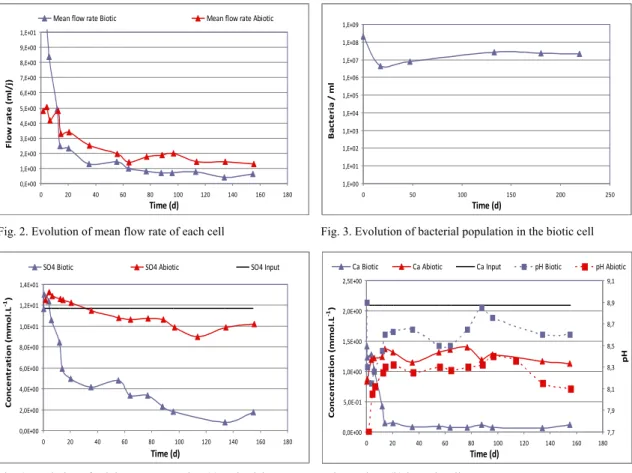
As showed in Fig. 2, the flow rate decreases as a function of time. Its stabilization is observed after two months of experiment. This could be explained by the clogging of the artificial crack due to mineral precipitation or swelling of clay minerals. The flow rate of the cell (1.2 ml/day) without bacteria is about
twice this measured in the biotic cell (0.7 ml/day). The Darcy’s law allows to evaluate the hydraulic
conductivity of the whole sample (assuming homogeneous properties) at 1.9 and 3.4 10-12 m/s for the
biotic and abiotic cells, respectively. This is in good agreement with Tournemire argillaceous value (10-12
to 10-14 m/s) [11]. This slight overestimation could be due to the presence of the artificial crack or to
3.2. Survival of bacterial population
A mixed IRB and SRB culture was introduced in the biotic cell, containing about 108 bacteria/ml.
After 150 days of experiment, the bacterial population fluctuates from 2 107 to 3 107 bacteria/ml. Both
IRB and SRB species are still present and alive. As showed on Fig. 4 (a), SO4 concentration seems to be
stabilized around the initial concentration in the abiotic cell whereas a significant decrease (about 50 %)
in the biotic cell is observed from 2.1 mmol.L-1.d-1 during the first hundred days to 0.9 mmol.L-1.d-1. This
consumption may be attributed to the SRB activities reducing sulphate into sulfide, which confirms that bacteria are able to grow under simulated disposal conditions (low permeability, high pressure and temperature conditions).
3.3. Bacterial reactivity and evolution of water chemistry
Figure 4 (b) presents the Ca concentration and pH evolution of the outlet sample in each cell. The evolution of the concentration of Ca, Mg and Sr (not shown), is quite similar in each cell. A strong decrease of those elements is observed in the biotic cell. It could result from carbonate mineral precipitation due to the increase of the pH, from 7.5 to 8.6 in the biotic experiment and to 8.2 in the abiotic one.
Silica is not present in the Tournemire synthetic solution but its concentration in the outlet sample
fluctuates around 0.3 mmol.L-1 in each cell. It may be attributed to silicate phase dissolution, such as illite
or K-feldspar, which is confirmed by a small increase of K concentration in the abiotic cell. Cl is not
reactive during the experiment while PO4 and iron concentrations are below the detection limit (10 and 1
µg.L-1, respectively). This may be due to the consumption of PO
4 by bacteria in the biotic experiment or
its precipitation as vivianite (Fe3(PO4)2:8H2O) which has already been observed with IRB [15]. Moreover,
the lack of iron in the outlet samples may also be explained by its strong immobilization as corrosion
products that usually form in anoxic conditions, such as magnetite (Fe3O4) and/or siderite (FeCO3).
4. Conclusion
The first results of biotic and abiotic experiments performed in the present work have shown that bacteria could survive in a system reproducing conditions that may prevail in HLW disposal cell (anoxic, high temperature, high pressure, nutrient poor). The reactivity of the biotic experiment is evidenced by
the specific evolution of the water composition (pH, Ca, SO4). The characterization of the solid phase
(MEB, MET, µRaman, µDRX) will be carried out at the opening of the cells after about one year of experiment in order to verify and complete these hypotheses.
Acknowledgements
We thank A. Martin-Garin from IRSN and his colleagues for their technical support.
References
1. Andra, Dossier argile 2005 : tome architecture et gestion du stockage géologique Rapport Andra, 2005.
2. Stroes-Gascoyne, S., Schippers, A., Schwyn, B., Poulain, S., Sergeant, C., Simonoff, M., Le Marrec, C., Altmann, S., Nagaoka, T., Mauclaire, L., McKenzie, J., Daumas, S., Vinsot, A., Beaucaire, C., and Matray, J.M., Microbial community analysis of
Opalinus Clay drill core samples from the Mont Terri Underground Research Laboratory, Switzerland. Geomicrobiology Journal, 2007. 24(1): p. 1-17.
3. Urios, L., Marsal, F., Pellegrini, D., and Magot, M., Microbial diversity of the 180 million-year-old Toarcian argillite from Tournemire, France. Applied Geochemistry, 2011, doi:10.1016/j.apgeochem.2011.09.022.
4. Libert, M., Bildstein, O., Esnault, L., Jullien, M., and Sellier, R., Molecular hydrogen: An abundant energy source for bacterial activity in nuclear waste repositories. Physics and Chemistry of the Earth, Parts A/B/C, 2011. 36(17–18): p. 1616-1623. 5. Videla, H.A. and Herrera, L.K., Understanding microbial inhibition of corrosion. A comprehensive overview. International
Biodeterioration & Biodegradation, 2009. 63(7): p. 896-900.
6. Mori, K., Tsurumaru, H., and Harayama, S., Iron corrosion activity of anaerobic hydrogen-consuming microorganisms isolated from oil facilities. Journal of Bioscience and Bioengineering, 2010. 110(4): p. 426-430.
7. Esnault, L., Réactivité géomicrobiologique des matériaux et minéraux ferrifères : conséquences sur l’évolution à long terme des matériaux d’un stockage de déchets radioactifs en milieu argileux, 2010, PHD Thesis, Université de Nancy-Henri Poincaré (France).
8. Kim, J., Dong, H.L., Seabaugh, J., Newell, S.W., and Eberl, D.D., Role of microbes in the smectite-to-illite reaction. Science, 2004. 303(5659): p. 830-832.
9. Baechler, S., Lavanchy, J.M., Armand, G., and Cruchaudet, M., Characterisation of the hydraulic properties within the EDZ around drifts at level −490 m of the Meuse/Haute-Marne URL: A methodology for consistent interpretation of hydraulic tests. Physics and Chemistry of the Earth, Parts A/B/C, 2011. 36(17–18): p. 1922-1931.
10. Tinseau, E., Bartier, D., Hassouta, L., Devol-Brown, I., and Stammose, D., Mineralogical characterization of the Tournemire argillite after in situ interaction with concretes. Waste Management, 2006. 26(7): p. 789-800.
11. Beaucaire, C., Michelot, J.L., Savoye, S., and Cabrera, J., Groundwater characterisation and modelling of water-rock interaction in an argillaceous formation (Tournemire, France). Applied Geochemistry, 2008. 23(8): p. 2182-2197.
12. Jeanthon, C., Reysenbach, A.L., Lharidon, S., Gambacorta, A., Pace, N.R., Glenat, P., and Prieur, D., Thermotoga Subterranea Sp-Nov, a New Thermophilic Bacterium Isolated from a Continental Oil-Reservoir. Archives of Microbiology, 1995. 164(2): p. 91-97.
13. Haouari, O., Fardeau, M.L., Cayol, J.L., Fauque, G., Casiot, C., Elbaz-Poulichet, F., Hamdi, M., and Ollivier, B., Thermodesulfovibrio hydrogeniphilus sp nov., a new thermophilic sulphate-reducing bacterium isolated from a Tunisian hot spring. Systematic and Applied Microbiology, 2008. 31(1): p. 38-42.
14. Dauzeres, A., Le Bescop, P., Sardini, P., and Coumes, C.C.D., Physico-chemical investigation of clayey/cement-based materials interaction in the context of geological waste disposal: Experimental approach and results. Cement and Concrete Research, 2010. 40(8): p. 1327-1340.
15. Dong, H., Fredrickson, J.K., Kennedy, D.W., Zachara, J.M., Kukkadapu, R.K., and Onstott, T.C., Mineral transformations associated with the microbial reduction of magnetite. Chemical Geology, 2000. 169(3-4): p. 299-318.
0,E+00 1,E+00 2,E+00 3,E+00 4,E+00 5,E+00 6,E+00 7,E+00 8,E+00 9,E+00 1,E+01 0 20 40 60 80 100 120 140 160 180 Time (d) Fl o w r at e ( m l/ j)
Mean flow rate Biotic Mean flow rate Abiotic
1,E+00 1,E+01 1,E+02 1,E+03 1,E+04 1,E+05 1,E+06 1,E+07 1,E+08 1,E+09 0 50 100 150 200 250 Time (d) B act e ri a / m l 0,0E+00 2,0E+00 4,0E+00 6,0E+00 8,0E+00 1,0E+01 1,2E+01 1,4E+01 0 20 40 60 80 100 120 140 160 180 Time (d) C o n ce n tr at io n ( m m o l. L -‐1)
SO4 Biotic SO4 Abiotic SO4 Input
0,0E+00 5,0E-‐01 1,0E+00 1,5E+00 2,0E+00 2,5E+00 0 20 40 60 80 100 120 140 160 180 Time (d) C o n ce n tr at io n ( m m o l. L -‐1) 7,7 7,9 8,1 8,3 8,5 8,7 8,9 9,1 pH
Ca Biotic Ca Abiotic Ca Input pH Biotic pH Abiotic
Table 1. Chemical composition of Tournemire synthetic water (25 °C) in mmol L-1
Na K Ca Mg NH4+ Cl- SO42- HCO3- PO43-
21.3 1.1 1.7 0.8 6 7.2 11.2 3.6 0.3
Fig. 1. Schematic view of the experimental cell
Fig. 2. Evolution of mean flow rate of each cell Fig. 3. Evolution of bacterial population in the biotic cell
Fig. 4. Evolution of sulphate concentration (a) and calcium concentration and pH (b) in each cell
Sampling for bacterial counting