HAL Id: hal-00301183
https://hal.archives-ouvertes.fr/hal-00301183
Submitted on 21 Apr 2004HAL is a multi-disciplinary open access
archive for the deposit and dissemination of sci-entific research documents, whether they are pub-lished or not. The documents may come from teaching and research institutions in France or abroad, or from public or private research centers.
L’archive ouverte pluridisciplinaire HAL, est destinée au dépôt et à la diffusion de documents scientifiques de niveau recherche, publiés ou non, émanant des établissements d’enseignement et de recherche français ou étrangers, des laboratoires publics ou privés.
Comment on ”Improving the seasonal cycle and
interannual variations of biomass burning aerosol
sources” by Generoso et al.
Y. Ji, E. Stocker
To cite this version:
Y. Ji, E. Stocker. Comment on ”Improving the seasonal cycle and interannual variations of biomass burning aerosol sources” by Generoso et al.. Atmospheric Chemistry and Physics Discussions, Euro-pean Geosciences Union, 2004, 4 (2), pp.2161-2166. �hal-00301183�
ACPD
4, 2161–2166, 2004 Comment on “Improving the seasonal cycle” Y. Ji and E. Stocker Title Page Abstract Introduction Conclusions References Tables Figures J I J I Back Close Full Screen / EscPrint Version Interactive Discussion
© EGU 2004
Atmos. Chem. Phys. Discuss., 4, 2161–2166, 2004 www.atmos-chem-phys.org/acpd/4/2161/
SRef-ID: 1680-7375/acpd/2004-4-2161 © European Geosciences Union 2004
Atmospheric Chemistry and Physics Discussions
Comment on “Improving the seasonal
cycle and interannual variations of
biomass burning aerosol sources” by
Generoso et al.
Y. Ji1and E. Stocker2
1
School of Computational Sciences, George Mason University, Fairfax, VA 22030-4444, USA
2
NASA/GSFC, Code 902, TRMM/TSDIS, Greenbelt, MD 20770, USA
Received: 12 January 2004 – Accepted: 5 April 2004 – Published: 21 April 2004 Correspondence to: Y. Ji ([email protected])
ACPD
4, 2161–2166, 2004 Comment on “Improving the seasonal cycle” Y. Ji and E. Stocker Title Page Abstract Introduction Conclusions References Tables Figures J I J I Back Close Full Screen / EscPrint Version Interactive Discussion
Abstract
Generoso et al. (2003) suggest a method for improving current inventories of aerosol emission from biomass burning based on the Along Track Scanning Radiometer (ATSR) nighttime hot spot product. In order to show the validity and representative of the nighttime burning product for such applications, Genoroso et al. (2003)
com-5
pared the ATSR nighttime products to the daily fire products from TRMM, AVHRR etc. in nine selected regions. Their analyses demonstrate that in most cases, the nighttime products show a seasonal cycle that is consistent with the daily observations. However, they noticed significant discrepancies in biomass seasonality between ATSR nighttime product and TRMM daily product in Sahel region. In a commentary paper, Giglio and
10
Kendall (2003) clarify that the origin of TRMM fire data used in Generoso et al. (2003) is from TRMM Science Data and Information System (Ji and Stocker, 2002). We thank Giglio and Kendall for such clarifications that provide an opportunity for us to clarify several issues on the applications of TSDIS fire data.
1. Nighttime hot spot
15
The TSDIS Visible and Infrared Scanner (VIRS) nighttime hot spots are detected based on a simple 315 K threshold on the 3.75 µm channel. VIRS 3.75 µm channel has a resolution of 2.1 km at nadir. Since the ATSR has a saturation brightness temperature of 312 K (Mutlow et al., 1994) and a resolution about 1 km, it is expected that the number of nighttime hot spot pixels would be significantly larger than that of VIRS
20
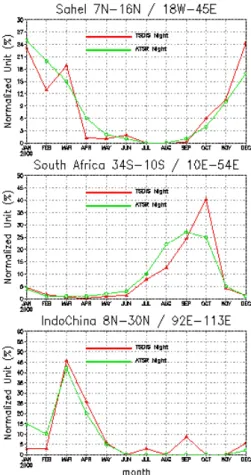
nighttime hot spot pixels. In Sahel region, the actual ratio is about 7. The time series of normalized nighttime fire count units for three selected regions (Fig. 1) demonstrate that TRMM and ATSR nighttime fire counts show consistent seasonality.
ACPD
4, 2161–2166, 2004 Comment on “Improving the seasonal cycle” Y. Ji and E. Stocker Title Page Abstract Introduction Conclusions References Tables Figures J I J I Back Close Full Screen / EscPrint Version Interactive Discussion
© EGU 2004
2. Daytime hot spot
In order to use daily hot spot products, the diurnal cycle must be carefully studied because a large number of false fire pixels may exist in the operational data in either burning season or off-fire season, especially over sand/vegetation mixed land cover (Ji and Stocker, 2002). False fire in off-fire season may impact the fire seasonality
5
significantly. We have looked into a number of fire regions for the past six years and found that in fire seasons, the fires are often observed during nighttime (Fig. 2). During an off-fire season, the satellite observation may show hot spots in daytime but not in nighttime (Fig. 2). Such a clean distinction gives a good opportunity to remove the daytime false alarm for the purpose of seasonality studies. For example, we have
10
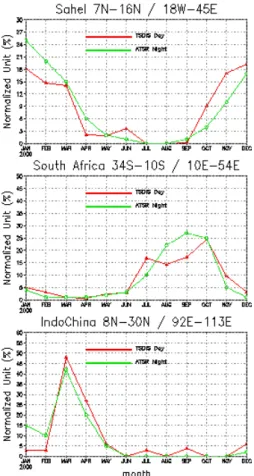
used 6 years TRMM data to define the maximum day/night hot spot ratios, and used these ratios to filter out the daytime false fire pixels. After such day/night screening, the discrepancies of seasonality between ATSR nighttime data and TRMM daily data noted in Generoso et al. (2003) are avoided (Fig. 3).
References
15
Generoso, S., Breon, F. M., Balkanski, Y., Boucher, O., and Schulz, M.: Improving the seasonal cycle and interannual variations of biomass burning aerosol sources, Atmos. Chem. Phys., 3, 1211–1222, 2003.
Giglio, L. and Kendall, J. D.: Commentary on “Improving the seasonal cycle and interannual variations of biomass burning aerosol sources” by Generoso et al., Atmos. Chem. Phys.
20
Discuss., 6019–6027, 2003.
Ji, Y. and Stocker, E.: An overview of the TRMM/TSDIS fire algorithm and products, Int. J. of Remote Sensing, 23, 3285–3303, 2002.
Mutlow, C. T., Llewwllyn-Jones, D. T., Zavody, A. M., and Barton, I. J.: Sea surface temperature measurements by the ATSR on the ERS-1 satellite: Early Results, J. Geophys. Res., 99,
25
22 575–22 588, 1994.
ACPD
4, 2161–2166, 2004 Comment on “Improving the seasonal cycle” Y. Ji and E. Stocker Title Page Abstract Introduction Conclusions References Tables Figures J I J I Back Close Full Screen / EscPrint Version Interactive Discussion
5
Fig. 1 Comparison between ATSR and TRMM nighttime fire counts (in normalized units) in Sahel area (upper), South Africa (middle), and Indo China (lower)
Fig. 1. Comparison between ATSR and TRMM nighttime fire counts (in normalized units) in
ACPD
4, 2161–2166, 2004 Comment on “Improving the seasonal cycle” Y. Ji and E. Stocker Title Page Abstract Introduction Conclusions References Tables Figures J I J I Back Close Full Screen / EscPrint Version Interactive Discussion
© EGU 2004 6
Fig. 2 Comparison of TRMM fire diurnal cycle in fire and non-fire seasons in Sahel area (upper), South Africa (middle), and Indo China (lower)
Fig. 2. Comparison of TRMM fire diurnal cycle in fire and non-fire seasons in Sahel area
(upper), South Africa (middle), and Indo China (lower).
ACPD
4, 2161–2166, 2004 Comment on “Improving the seasonal cycle” Y. Ji and E. Stocker Title Page Abstract Introduction Conclusions References Tables Figures J I J I Back Close Full Screen / EscPrint Version Interactive Discussion
7
Fig. 3. Comparison between ATSR and TRMM daytime fire counts (in normalized units) in Sahel area (upper), South Africa (middle), and Indo China (lower)
Fig. 3. Comparison between ATSR nighttime and TRMM daily fire counts (in normalized units)