HAL Id: hal-00008525
https://hal.archives-ouvertes.fr/hal-00008525
Submitted on 7 Sep 2005
HAL is a multi-disciplinary open access
archive for the deposit and dissemination of
sci-entific research documents, whether they are
pub-lished or not. The documents may come from
teaching and research institutions in France or
abroad, or from public or private research centers.
L’archive ouverte pluridisciplinaire HAL, est
destinée au dépôt et à la diffusion de documents
scientifiques de niveau recherche, publiés ou non,
émanant des établissements d’enseignement et de
recherche français ou étrangers, des laboratoires
publics ou privés.
EVOLUTION OF GALACTIC FIELD Be STARS
Juan Zorec, Yves Fremat, Lydia Cidale
To cite this version:
Juan Zorec, Yves Fremat, Lydia Cidale. EVOLUTION OF GALACTIC FIELD Be STARS. Societe
Francaise d’Astronomie et d’Astrophysique, 2005, France. �hal-00008525�
ccsd-00008525, version 1 - 7 Sep 2005
SF2A 2005
F. Casoli, T. Contini, J.M. Hameury, and L. Pagani (eds)
EVOLUTION OF GALACTIC FIELD BE STARS
Zorec, J.
1, Fr´emat, Y.
2and Cidale, L.
3 3Abstract. Galactic field Be stars were studied by taking into account the effects induced by the fast rotation on their fundamental parameters. Frac-tional ages τ /τMS (τMS= time spent in the MS) against stellar mass reveal
that: a) Be stars spread over the whole interval 0 < τ /τMS< 1; b) the Be
phenomenon in massive stars (M > 12M⊙) is present at smaller age ratios
than for less massive stars (M < 12M⊙); c) there is a lack of Be stars with
M < 7M⊙in the first half of the MS. Low mass fast rotators (M < 7M⊙),
called Bn stars, could be “becoming” Be stars.
1 Sample and Method
We studied 97 field galactic bright Be stars using the BCD system (Chalonge & Divan 1956, Zorec & Briot 1991) to avoid perturbations on the fundamental parameters due to the circumstellar disc. These parameters were treated for rota-tional effects (Fr´emat et al. 2005). From the observed parameters, called apparent, we obtain first the parent non-rotating counterparts (pnrc) which represent homo-logous stars without rotation. To enter the evolutionary tracks, we transform then the pnrc into averaged parameters over the whole stellar surface.
2 Results and Conclusions
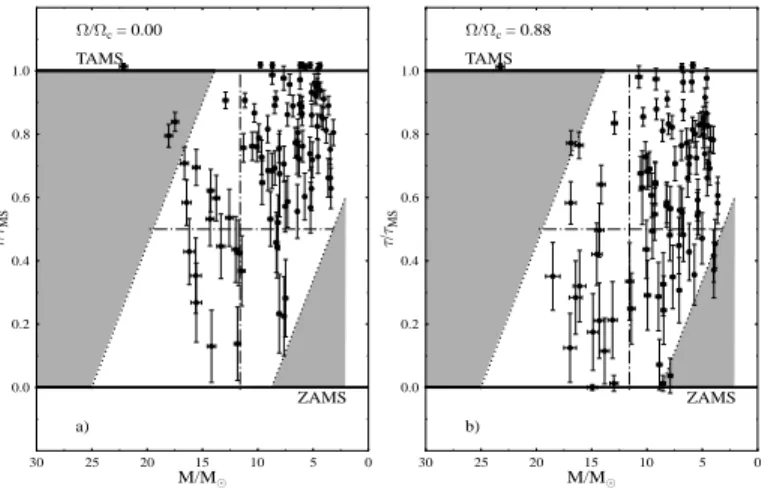
Figure 1a) shows the distribution of points (τ /τMS, M/M⊙) obtained using the
original or apparent fundamental parameters and the evolutionary tracks without rotation (Schaller et al. 1992). The plotted error bars correspond to measurement uncertainties. Figure 1b) shows the same type of distribution, but where
param-eters were corrected for rotational effects assuming rigid rotation with Ω/Ωcrit=
0.9 (Fr´emat et al. 2005) and models of stellar evolution with rotation calculated by
Meynet & Maeder (2000) with ZAMS equatorial velocity VZAMS= 300 km s−1. In
both diagrams of Fig. 1, points spread over the whole interval of age fractions 0∼<
1Institut d’Astrophysique de Paris, UMR7095 CNRS, Universit´e Pierre & Marie Curie 2Royal Observatory of Belgium
3Facultad de Ciencias Astron´omicas y Geof´ısicas, Universidad de La Plata, Argentina
c
2 SF2A 2005
τ /τMS
<
∼ 1, which suggest that the Be phenomenon may appear at whatever stage of the stellar evolution on the MS evolution phase. There is, however, a difference between the diagrams where rotation is taken into account and where it is not. If we were not aware of rotational effects, Fig. 1a would suggest that 86% of stars
are above the τ /τMS = 0.5 limit. Figure 1b shows, however, when fast rotation
of Be stars is taken into account, the fraction of stars in our sample above τ ≃
0.5τMS slumps to 62%. When we separate the stars into massive (M
>
∼ 12M⊙)
and less massive ones (M ∼ 12M< ⊙) another important result appears: we see in
Fig. 1b that the Be phenomenon in massive stars tends to appear on average at
smaller τ /τMS age fractions than in the less massive stars. There is also a striking
lack of low-mass Be stars (M ∼ 7M< ⊙) in τ /τMS < 1/2. These distributions can
be due to: i) higher mass-loss rates in massive objects, which reduce the surface fast rotation and inhibit the Be phenomenon rapidly; ii) circulation time scales to transport angular momentum from the core to the surface, which are longer the lower the stellar mass. Some of low-mass fast rotators, classified as Bn stars, could then be “becoming” Be stars.
30 25 20 15 10 5 0 M/M 0.0 0.2 0.4 0.6 0.8 1.0 /MS ... ... ... ... ... ZAMS TAMS / c= 0.00 a) 30 25 20 15 10 5 0 M/M 0.0 0.2 0.4 0.6 0.8 1.0 /MS ... ... ... ... ... ZAMS TAMS / c= 0.88 b)
Fig. 1.Age ratios τ /τMSof the studied Be stars against the mass. a) Parameters derived
using evolutionary tracks without rotation; b) parameters derived using evolutionary tracks with rotation
References
Chalonge, D., & Divan, L. 1952, Ann. Astrophys., 15, 201 Meynet, G., Maeder. A. 2000, A&A, 361, 101
Fr´emat, Y., Zorec, J., Hubert, A.M., Floquet, M. 2005, A&A, 440, 305 Schaller G., Schaerer D., Meynet G. et al. 1992, A&AS 96, 269 Zorec J., & Briot D., 1991, A&A 245, 150