HAL Id: hal-01794227
https://hal.archives-ouvertes.fr/hal-01794227
Submitted on 17 May 2018
HAL is a multi-disciplinary open access
archive for the deposit and dissemination of
sci-entific research documents, whether they are
pub-lished or not. The documents may come from
L’archive ouverte pluridisciplinaire HAL, est
destinée au dépôt et à la diffusion de documents
scientifiques de niveau recherche, publiés ou non,
émanant des établissements d’enseignement et de
Spatially resolved acyl transfer on surface by
organo-catalytic scanning probe nanolithography
(o-cSPL)
Julien Botton, Katharina Gratzer, Cyril François, Vincent Mesquita, Lionel
Patrone, Teodor Balaban, Sylvain Clair, Jean-Luc Parrain, Olivier Chuzel
To cite this version:
Julien Botton, Katharina Gratzer, Cyril François, Vincent Mesquita, Lionel Patrone, et al.. Spatially
resolved acyl transfer on surface by organo-catalytic scanning probe nanolithography (o-cSPL).
Chem-ical Science , The Royal Society of Chemistry, 2018, 9 (18), pp.4280 - 4284. �10.1039/c8sc00294k�.
�hal-01794227�
Spatially resolved acyl transfer on surface by
organo-catalytic scanning probe nanolithography
(o-cSPL)†‡
Julien Botton,aKatharina Gratzer, aCyril François,aVincent Mesquita,b
Lionel Patrone,bTeodor S. Balaban, aSylvain Clair, *bJean-Luc Parrain *a
and Olivier Chuzel *a
Groundbreaking research done in the area of nanolithography makes it a versatile tool to produce nanopatterns for a broad range of chemical surface functionalization or physical modifications. We report for the first time an organocatalytic scanning probe nanolithography (o-cSPL) approach. Covalent binding of an organocatalyst on the apex of an atomic force microscope (AFM) tip gives way to a system that allows the formation of locally defined acylated-alcohol patterns on self-assembled monolayers (SAMs). With resolutions comparable to those of other cSPL methods, this first example of o-cSPL holds promise for future applications of bottom-up nanolithography set-ups employing this novel technique.
Introduction
Over the last decades, the eld of nanolithography1has been
developed to control materials at the atomic level.2In addition
to optical nanolithography,3widely used in the semiconductor
industry, multiphoton techniques,4focused ion beam (FIB),5or
electron-beam (e-beam)6have also appeared as promising tools
to create two-dimensional (2D) nano-resolved patterns. More recently, nanoscale control has become possible by scanning probe microscopy (SPL),7–12as for example with atomic force
microscopy (AFM).13–15This emergence has initiated the
devel-opment of a wide variety of mask-free scanning-probe-based patterning methods, including dip-pen nanolithography, which has ascended as one of the most exible ways.16,17These
techniques open new perspectives in bottom-up approaches, notably for organic substrates. With selective chemical trans-formations of self-assembled monolayers (SAMs) remaining challenging to date,18,19 catalytic scanning probe
nano-lithography (cSPL)20has emerged as a promising and
comple-mentary tool among the various SPL techniques.21 The
pioneering contributors to the eld of cSPL have successfully focused their efforts on the use of catalytic probes coated with transition metals or their oxides.22–31Nevertheless, robustness,
reproducibly and leaching of catalyst material were weakly addressed in these studies. To extend the scope of cSPL using the large library of organometallic catalyzed reactions and to improve the above-mentioned points, our group has recently demonstrated that supported homogeneous catalysis could be a viable alternative.32Indeed, the immobilization of a catalyst
onto the apex of an atomic force microscope (AFM) tip allows performing selective covalent graing of molecular objects on surfaces. This approach ensures a high nanoscale control by conning the chemical reaction at the interface of the catalytic tip and the surface. In this context, we recently reported the use of an immobilized 1,4,7-triazacyclononane (TACN) ligated manganese complex allowing the extension of the eld of cSPL by performing a local epoxidation reaction. A second step of derivatization with piperazine or amine-based moieties was required to reveal the formation of nanostructures.33Despite its
intrinsic robustness, this catalytic system still suffers from some inherent drawbacks such as: (i) multi-step synthesis of the catalyst supported on the tip, (ii) the necessity of a post-functionalization step to “reveal” the topography of the new nanostructures, and nally, (iii) the impossibility to selectively gra more than one type of molecular objects during the “writing” process (catalysis and post-functionalization).
Aiming at simplifying the catalytic system even more, we hypothesized that an organocatalyst-supported AFM tip would constitute an attractive alternative. By avoiding the presence of any metal, potential “leaching” during the catalytic process is prohibited and more importantly, the stability of the catalytic system toward environmental parameters should be enhanced signicantly (e.g. to air oxidation, moisture.). Herein, as depicted in Fig. 1, we report the development of a new catalytic system for SPL, based on a readily accessible aminopyridine
aAix Marseille Univ, CNRS, Centrale Marseille, iSm2, Marseille, France. E-mail:
bAix Marseille Univ, CNRS, Univ Toulon, IM2NP, Marseille, France. E-mail: sylvain.
†This article is dedicated to the memory of our friend and colleague Professor Teodor Silviu Balaban.
‡Electronic supplementary information (ESI) available: Additional experimental data, blank experiments, DFT modeling, organic syntheses and procedures. See DOI: 10.1039/c8sc00294k
Cite this: Chem. Sci., 2018, 9, 4280
Received 18th January 2018 Accepted 16th April 2018 DOI: 10.1039/c8sc00294k rsc.li/chemical-science
Chemical
Science
EDGE ARTICLE
catalyst scaffold. Due to their high importance in biological phenomena and their useful synthetic applications, acyl trans-fer reactions34are among the most studied organic reactions in
homogeneous phase. Based on the nucleophilic addition of the substrate (alcohols, amines, thiols) on an electrophilic acyl-donor partner (carboxylic acids, anhydrides, acyl halides), many catalytic systems for this reaction have been developed over the last century.35
Historically, N,N-dimethyl-4-aminopyridine (DMAP) deriva-tives, acting as nucleophilic organocatalysts,36have been widely
used as they enhance the electrophilic potential of the acyl partner, hence allowing rapid access to complex scaffolds.37
Those catalysts have shown their stability toward air and moisture and their silica immobilized versions are known to be readily available,38making them promising candidates for cSPL.
We explored this approach by working on alcohol-terminated SAMs using myristic anhydride as the acyl source, demonstrating that SAMs can be locally acylated. The high degree of exibility of the catalytic system has been demon-strated by graing several distinctive patterns with a single tip as well as obtaining a high lateral resolution down to 45 nm, showing the potential of this AFM-driven organocatalysis.
Results and discussion
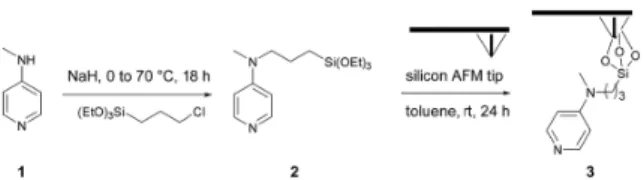
As part of a preliminary study, a homogeneous catalyst system was optimized at room temperature in chlorinated solvents (Table S1‡), requiring catalytic amounts of DMAP and stoi-chiometric amounts of myristic anhydride as acylating reagent and H¨unig's base (N,N-diisopropylethylamine, DIPEA) as a non-nucleophilic base, and as a sacricial proton sponge, to prevent any deactivation of the catalyst by trapping acidic by-products. The chosen catalytic system, is based on N-methyl-N-(3-(triethoxysilyl)-propyl)pyridin-4-amine 2. This system was then evaluated in o-cSPL using an aminopyridine-functionalized AFM tip 3. This catalytic probe was easily obtained in a two-step sequence by alkylation of N-methylpyridin-4-amine 1 with 3-chloropropyl-triethoxysilane, followed by its condensation on the AFM silicon tip (Scheme 1).‡ Whilst chlorinated solvents are the most commonly used for acyl transfer reactions in
homogeneous catalysis, dichloromethane or chloroform were found to be too volatile to ensure full completion of the cSPL process (Fig. S1‡). Aer solvent optimization, a local AFM-catalyzed acylation was conducted by introducing a 50 mM solution of myristic anhydride and H¨unig's base in a mixture of acetonitrile and dichloroethane (1 : 1) and by scanning a dened area in contact mode (writing mode). The modied area could be immediately observed in the topography image using AFM in tapping mode (reading mode).‡ To the best of our knowledge, this represents the rst example of cSPL using organocatalysis as activation mode (o-cSPL).
We evaluated the robustness of the process and the inuence of the different lithographic parameters on the local acyl transfer reaction from myristic anhydride as acylating reagent. The applied force (F), the scanning speed (Vscan) and the
inter-line distance (DIL) were varied over a certain range to produce
500 ! 500 nm2patterns as shown in Fig. 2 and 3.
The force parameter was evaluated rst, and an array of nanostructures was obtained, with a DILof 8 nm and a scanning
speed of 1 mm s"1(Fig. 2).
The applied force was incremented progressively from le to right with respective values of 200, 1000, 2000, 2900 and 3800 nN for the upper line and 4800, 5700, 6700, 7600 and 9600 nN for the line below. For forces below 1000 nN, the lithographic process led to partial graing. Forces above 1000 nN led to the formation of regular patterns allowing locally optimal dened acyl transfer reactions, especially, among the various attempts, with an apply force of 2900 nN. Moreover, the line prole (Fig. 2c) shows characteristic patterns with average heights of 1.9–2.1 nm, which match with the theoretical value of 1.78 nm calculated by DFT (Fig. S6 in the ESI‡). The high forces required are consistent with results obtained with related organometallic cSPL methodologies described previously.33
DILparameter was also evaluated. A DILof 4 nm did not show
any structuration at all (Fig. S2‡), and a DILof 16 and 32 nm led
to partial graing (Fig. S3 and S4‡).
Then, the inuence of the scanning speed on the catalytic process was investigated. The scanning speed was gradually increased from 0.25 to 10 mm s"1applying a force of 2900 nN
and a DILof 8 nm. This led to patterns of high density, resulting
in an optimal range for graing from 0.25 to 2.5 mm s"1(Fig. 3).
As previously, the line prole (Fig. 3c) shows characteristic patterns with an average height of 1.8 nm, which match very well with the theoretical value of 1.78 nm calculated by DFT (Fig. S6 in the ESI‡). It appears that the local acyl transfer is most efficient when the interaction between the catalytic tip and the surface is balanced by the proper lithographic parameters.
Fig. 1 Schematic representation of the interface between the SAM-coated substrate and the AFM catalytic tip.
Scheme 1 Two-step synthesis of catalytic AFM tip functionalized with an aminopyridine catalyst.
The exceptional broad range of applied forces for which acyl groups are graed on the surface, provides high robustness and stability to this “metal free” catalytic system and allows to tune it nely to prevent any undesired alteration of the surface.
To evaluate the full potential in nanolithography of this catalytic system, individual parallel lines were scanned 100 nm apart under optimized writing conditions. The applied load was 2900 nN and the scanning speed was 2 mm s!1 with two
passages by line procedure. The resulting patterns are pre-sented in Fig. 4. A line width of 45 " 5 nm (full width at half maximum) was achieved. Comparable to resolutions of 20– 50 nm of other cSPL or dip-pen nanolithography techniques, this limit of lateral resolution has shown that this new catalytic system exhibits a high potential for the nanostructuration of surfaces.
Finally, by consecutive graing of two different molecular objects close to one another, with the same catalytic AFM tip, we demonstrate the large potential of our catalytic system. As
shown in Fig. 5, patterns composed of two distinctive esters obtained from hexanoic anhydride and decanoic anhydride respectively, have been achieved by replacing the solution of one reactant by a fresh solution of another acyl donor to mimic
Fig. 2 Influence of the applied force (F) on the esterification reaction with myristic anhydride as acylating reagent (DIL¼ 8 nm, Vscan ¼ 1
mm s!1). The applied force was incremented progressively from left to the
right with respective values of 200, 1000, 2000, 2900 and 3800 nN for the upper line and 4800, 5700, 6700, 7600 and 9600 nN for the lower line. (a) Topography image in tapping mode after reaction. (b) Corre-sponding phase image. (c) Line profile (correCorre-sponding to the blue line in (a)) displaying an average height of 1.9–2.1 nm (theoretical calculated value of 1.78 nm in gas phase for a model, see Fig. S6 in the ESI‡).
Fig. 3 Influence of the scanning speed (Vscan) on the esterification
reaction with myristic anhydride as acylating reagent (F ¼ 2900 nN, DIL
¼ 8 nm). The scanning speed was gradually increased from left to right with respective values of 0.25, 0.5, 1.0 and 1.5 mm s!1for the upper line
and 2.5, 5.0, 7.5 and 10.0 mm s!1for the lower line of nanostructures.
(a) Topography image in tapping mode after reaction. (b) Corre-sponding phase image. (c) Line profile (correCorre-sponding to the blue line in (a)) displaying an average height of 1.8 nm (theoretical calculated value of 1.78 nm in gas phase for a model, see Fig. S6 in the ESI‡).
Fig. 4 Resolution limit, for the esterification reaction with myristic anhydride as acylating reagent, with F ¼ 2900 nN, Vscan¼ 2 mm s!1. (a)
Topography image in tapping mode of an array of covalently attached nanostructures by catalytic local acyl transfer. (b) Line profile (corre-sponding to the blue line in (a)) displaying a lateral resolution down to 45 " 5 nm (FWHM).
a chemical ow reactor for local nanolithography. To ensure that no contamination occurred, several washing and control steps were realized between two injections. Then, only in the presence of the solvent mixture, a control pattern was realized using the conditions of the graing procedure (F ¼ 2900 nN; DIL¼ 8 nm; Vscan¼ 0.5 mm s"1) to ensure the inertness of the
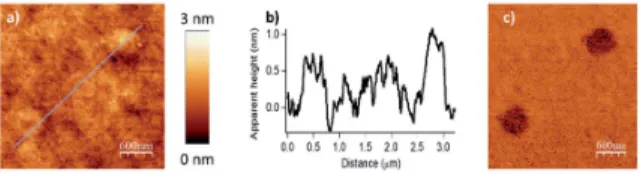
catalytic probe. The reactor was then rinsed with a solution of decanoic anhydride, emptied and reinjected with a fresh 50 mM solution of decanoic anhydride and H¨unig's base.§ Topo-graphical imaging of the consecutive acyl transfer reactions, unambiguously shows the presence of two distinct well-resolved objects on the surface. The line prole shows two characteristic patterns with an average height of 0.7 nm for the hexanoate ester pattern (Fig. 5b, le), and 1.1 nm for the decanoate ester pattern (Fig. 5b, right), which are well tting with the calculated values (0.75 nm and 1.26 nm in gas phase respectively, see ESI Fig. S7 and S8‡). This study clearly shows that this catalytic system is a powerful tool for the multiple functionalization patterning of surfaces.
Conclusions
An innovative o-cSPL approach relying on the functionalization of an AFM tip with an organocatalyst has been achieved for the rst time for the chemical nanostructuration of SAMs on Si/SiO2
under mild conditions. Our method of local acyl transfer allows to immediately observe topographical modications of the substrate with covalent nanostructures without any need for post-functionalization. The catalytic process shows a high degree of robustness and exibility leading to efficient multiple patterning of SAMs at the sub-100 nm scale. This time-efficient new nanolithographical process could exhibit great potential for high-throughput uses, as for example, toward mass-production through parallelization methods or alternative techniques.39–43Interestingly, we demonstrated that the
nano-lithography can be selectively conducted with two distinct molecular reagents in a same experiment via a simple home-made ow-through reactor – this opening the door to future efficient nanoprinting with a large diversity of molecular “inks”. One-pot surface multi-functionalization could pave the way to
the installation of different kind of molecular objects in close proximity potentially enabling communication between each other. All of that clearly establishes o-cSPL as a powerful tool for bottom-up nanolithography technologies.
Conflicts of interest
There are no conicts to declare.
Acknowledgements
The authors would like to thank ANR under grant no. 12 BS10 015 02 “CASPARES”, la r´egion Provence-Alpes-Cˆote d'Azur (PACA region council) for the project “Nanomosa¨ıque”, Aix Marseille University and the Centre National de la Recherche Scientique (CNRS) for nancial support.
Notes and references
§AFM experiments were carried out in a home-built Teon liquid cell allowing facile and complete replacement of the solution inside without any sample shi using exible plastic tubing and syringes (see ESI S8, Fig. S5‡). AFM measure-ments were performed in dichloroethane/acetonitrile (1 : 1) mixture (LC/MS quality, Fischer Scientic) inside a hermetic glass vessel under an air atmo-sphere saturated with dichloroethane/acetonitrile vapour in order to minimize solvent evaporation in the cell during long experiment times.
1 H. M. Saavedra, T. J. Mullen, P. Zhang, D. C. Dewey, S. A. Claridge and P. S. Weiss, Rep. Prog. Phys., 2010, 73, 036501.
2 G. M. Wallraff and W. D. Hinsberg, Chem. Rev., 1999, 99, 1801.
3 T. L. Andrew, H.-Y. Tsai and R. Menon, Science, 2009, 324, 917.
4 J.-F. Xing, M.-L. Zheng and X.-M. Duan, Chem. Soc. Rev., 2015, 44, 5031.
5 A. Joshi-Imre and S. Bauerdick, J. Nanotechnol., 2014, 2014, 1. 6 J. Van Oven, F. Berwald, K. Berggren, P. Kruit and C. Hagen,
J. Vac. Sci. Technol., B, 2011, 29, 06F305.
7 R. Garcia, A. W. Knoll and E. Riedo, Nat. Nanotechnol., 2014, 9, 577.
8 R. Garcia, R. V. Martinez and J. Martinez, Chem. Soc. Rev., 2006, 35, 29.
9 S. Kramer, R. R. Fuierer and C. B. Gorman, Chem. Rev., 2003, 103, 4367.
10 G. Y. Liu, S. Xu and Y. L. Qian, Acc. Chem. Res., 2000, 33, 457. 11 D. Wouters and U. S. Schubert, Angew. Chem., Int. Ed., 2004,
43, 2480.
12 D. Wouters, S. Hoeppener and U. S. Schubert, Angew. Chem., Int. Ed., 2009, 48, 1732.
13 R. Garcia and R. P´erez, Surf. Sci. Rep., 2002, 47, 197. 14 L. G. Rosa and J. Liang, J. Phys.: Condens. Matter, 2009, 21,
483001.
15 Q. Tang, S. Shi and L. M. Zhou, J. Nanosci. Nanotechnol., 2004, 4, 948.
16 R. D. Piner, J. Zhu, F. Xu, S. H. Hong and C. A. Mirkin, Science, 1999, 283, 661.
Fig. 5 Surface patterning with multiple molecular objects (F ¼ 2900 nN, DIL¼ 8 nm, Vscan¼ 0.5 mm s"1). (a) Topography image in tapping
mode of the esterification reaction with hexanoic anhydride as acyl-ating reagent (bottom left corner), then with decanoic anhydride as acylating reagent (right top corner). (b) The line profile shows two distinctive patterns with an average height of 0.7 nm for the hexanoate ester pattern (theoretical calculated value of 0.75 nm in gas phase for a model, see Fig. S7 in the ESI‡) and 1.1 nm for the decanoate ester pattern (theoretical calculated value of 1.26 nm in gas phase for a model, see Fig. S8 in the ESI‡). (c) Corresponding phase image.
17 D. S. Ginger, H. Zhang and C. A. Mirkin, Angew. Chem., Int. Ed., 2004, 43, 30.
18 R. Maoz, S. R. Cohen and J. Sagiv, Adv. Mater., 1999, 11, 55. 19 X. Liu, C. Carbonell and A. B. Braunschweig, Chem. Soc. Rev.,
2016, 45, 6289.
20 S. A. M. Carnally and L. S. Wong, Nanoscale, 2014, 6, 4998. 21 C. Carbonell and A. B. Braunschweig, Acc. Chem. Res., 2017,
50, 190.
22 W. T. Muller, D. L. Klein, T. Lee, J. Clarke, P. L. McEuen and P. G. Schultz, Science, 1995, 268, 272.
23 C. Blackledge, D. A. Engebretson and J. D. McDonald, Langmuir, 2000, 16, 8317.
24 J. J. Davis, K. S. Coleman, K. L. Busuttil and C. B. Bagshaw, J. Am. Chem. Soc., 2005, 127, 13082.
25 J. J. Davis, C. B. Bagshaw, K. L. Busuttil, Y. Hanyu and K. S. Coleman, J. Am. Chem. Soc., 2006, 128, 14135. 26 W. F. Paxton, J. M. Spruell and J. F. Stoddart, J. Am. Chem.
Soc., 2009, 131, 6692.
27 K. Zhang, Q. Fu, N. Pan, X. Yu, J. Liu, J. Luo, X. Wang, J. Yang and J. Hou, Nat. Commun., 2012, 3, 1194.
28 L. K. Blasdel, S. Banerjee and S. S. Wong, Langmuir, 2002, 18, 5055.
29 M. P´eter, X. M. Li, J. Huskens and D. N. Reinhoudt, J. Am. Chem. Soc., 2004, 126, 11684.
30 J. J. Davis and Y. Hanyu, Nanotechnology, 2010, 21, 265302. 31 X. Han, S. D. Bian, Y. Liang, K. N. Houk and
A. B. Braunschweig, J. Am. Chem. Soc., 2014, 136, 10553. 32 D. A. Valyaev, S. Clair, L. Patrone, M. Abel, L. Porte, O. Chuzel
and J.-L. Parrain, Chem. Sci., 2013, 4, 2815.
33 V. Mesquita, J. Botton, D. A. Valyaev, C. François, L. Patrone, T. S. Balaban, M. Abel, J.-L. Parrain, O. Chuzel and S. Clair, Langmuir, 2016, 32, 4034.
34 D. Zell and P. R. Schreiner, Comprehensive Organic Synthesis, Elsevier B.V., Amsterdam, Netherland, 2nd edn, 2014, vol. 6, pp. 296–354.
35 I. ˇCori´c, S. Vellalath, S. M¨uller, X. Cheng and B. List, Developing Catalytic Asymmetric Acetalizations, Topics in Organometallic Chemistry, ed. L. J. Gooßen, Springer, 2013, vol. 44, pp. 165–194.
36 R. Murugan and E. F. V. Scriven, Aldrichimica Acta, 2003, 36, 21.
37 R. P. Wurz, Chem. Rev., 2007, 107, 5570.
38 H.-T. Chen, S. Huh, J. W. Wiench, M. Pruski and V. S.-Y. Lin, J. Am. Chem. Soc., 2005, 127, 13305.
39 K. M. Carroll, X. Lu, S. Kim, Y. Gao, H.-J. Kim, S. Somnath, L. Polloni, R. Sordan, W. P. King, J. E. Curtis and E. Riedo, Nanoscale, 2014, 6, 1299.
40 H. Noh, G.-E. Jung, S. Kim, S.-H. Yun, A. Jo, S.-J. Kahng, N.-J. Cho and S.-J. Cho, Small, 2015, 11, 4526.
41 S. Lenhert, P. Sun, Y. H. Wang, H. Fuchs and C. A. Mirkin, Small, 2007, 3, 71.
42 L. Giam, A. Senesi, X. Liao, L. S. Wong, J. Chai, D. Eichelsdoerfer, W. Shim, B. Rasin, S. He and C. A. Mirkin, Proc. SPIE, 2011, 8031, 803103.
43 S. Wang, J. Hosford, W. P. Heath and L. S. Wong, RSC Adv., 2015, 5, 61402.