HAL Id: hal-03008160
https://hal.archives-ouvertes.fr/hal-03008160
Submitted on 16 Nov 2020
HAL is a multi-disciplinary open access
archive for the deposit and dissemination of
sci-entific research documents, whether they are
pub-lished or not. The documents may come from
teaching and research institutions in France or
abroad, or from public or private research centers.
L’archive ouverte pluridisciplinaire HAL, est
destinée au dépôt et à la diffusion de documents
scientifiques de niveau recherche, publiés ou non,
émanant des établissements d’enseignement et de
recherche français ou étrangers, des laboratoires
publics ou privés.
Hydrogenative Depolymerization of Nylons
Amit Kumar, Niklas von Wolff, Michael Rauch, You-Quan Zou, Guy Shmul,
Yehoshoa Ben-David, Gregory Leitus, Liat Avram, David Milstein
To cite this version:
Amit Kumar, Niklas von Wolff, Michael Rauch, You-Quan Zou, Guy Shmul, et al.. Hydrogenative
Depolymerization of Nylons. Journal of the American Chemical Society, American Chemical Society,
2020, 142 (33), pp.14267-14275. �10.1021/jacs.0c05675�. �hal-03008160�
Hydrogenative Depolymerization of Nylons
Amit Kumar
1δ, Niklas von Wolff
2, Michael Rauch
1, You-Quan Zou
1‡, Guy Shmul
3, Yehoshoa
Ben-Da-vid
3, Gregory Leitus
3, Liat Avram
3, David Milstein
1*
1Department of Organic Chemistry, 3Department of Chemical Research Support, The Weizmann Institute of Science,
Re-hovot 76100, Israel. 2Laboratoire d'Electrochimie Moléculaire, UMR 7591, CNRS/University of Paris, 75013 Paris, France.
ABSTRACT: The widespread crisis of plastic pollution demands discovery of new and sustainable approaches to degrade robust
plastics such as nylons. Using a green and sustainable approach based on hydrogenation, in the presence of a ruthenium pincer catalyst at 150 oC and 70 bar H
2, we report here the first example of hydrogenative depolymerization of conventional, widely used nylons, and polyamides in general. Under the same catalytic conditions, we also demonstrate the hydrogenation of a polyurethane to produce diol, diamine and methanol. Additionally, we demonstrate an example where monomers (and oligomers) obtained from the hydro-genation process can be dehydrogenated back to a poly(oligo)amide of approximately similar molecular weight, thus completing a closed loop cycle for recycling of polyamides. Based on the experimental and DFT studies, we propose a catalytic cycle for the process that is facilitated by metal-ligand cooperativity. Overall, this unprecedented transformation, albeit at the proof of concept level, offers a new approach towards a cleaner route to recycling nylons.
INTRODUCTION
Nylons are commonly used plastics with a global market of more than 8 million tons per annum, and is being expected to grow at the rate of 2.2% reaching up to 10.4 million tons, equiv-alent to 47.0 billion USD by 2027.1 Inevitably, the ubiquity of nylons and their non-biodegradable nature have resulted in the increased land and ocean pollution posing a severe threat to our ecosystem.2 Therefore, it is critical that efficient and sustainable technologies for the recycling of plastics such as nylons are de-veloped. The current plastic recycling technologies are mostly based on mechanical recycling ‒ converting one form of plastic to another by mechanical reprocessing (melting and re-extru-sion): for example, converting plastic bottles to fibres. How-ever, mechanical recycling produces poor quality of plastic and the number of times a plastic can be mechanically recycled is also limited.3 Distinct from mechanical recycling, chemical re-cycling involves depolymerization of a plastic to produce the monomer raw material from which the same virgin plastic can be made.3 Thus, only chemical recycling closes the loop of plas-tic production and is a sustainable mode of recycling. The re-ported chemical recycling methods for nylons are mainly based on pyrolysis, hydrolysis or aminolysis – all of which require harsh reaction conditions (such as temperatures ≥ 250-300 oC).4 Other methods based on glycolysis or amino-glycolysis do not result in the efficient regeneration of nylons from the degraded polymers.5 Thus, development of new, efficient and sustainable methods to depolymerize nylons for the purpose of recycling are highly desirable.
Catalytic hydrogenation is an atom-economic, green and sus-tainable route for organic transformations as (a) it does not pro-duce stoichiometric waste as in the case of conventional reduc-ing agents and (b) hydrogen gas can potentially be produced
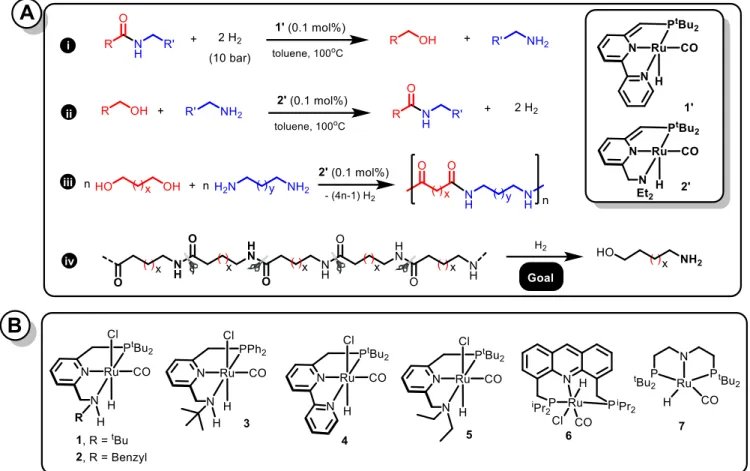
from renewable sources.6 In the past, we reported an efficient ruthenium pincer catalyst (1’) for the hydrogenation of amides via C–N cleavage to form alcohols and amines (Figure 1.A.i).7 Several other homogeneous catalysts based on ruthenium,8-17 iron18-21 and manganese22 have also been reported for the hydro-genation of amides to form alcohols and amines.23-24 Addition-ally, we also reported acceptorless dehydrogenative coupling of alcohols and amines to form amides catalyzed by ruthenium pincer complex 2’ (Figure 1.A.ii).25 In this direction, Guan26 and we27 independently reported the synthesis of polyamides via de-hydrogenative coupling of diols and diamines using the ruthe-nium pincer catalyst 2’ (Figure 1.A.iii). In order to develop a closed loop cycle, we envisioned that it might be possible to achieve the very challenging catalytic hydrogenative depoly-merization of polyamides to their monomers such as diols and diamines or amino alcohols (Figure 1.A.iv). Saito and cowork-ers have briefly mentioned an example of Ru-catalyzed hydro-genation of specialized, water soluble functionalized polyam-ides,although the structures of the polyamides and the hydro-genation products thereof were not reported.15 Hydrogenative depolymerization of polyesters and polycarbonates have also been reported earlier.28 However, we are not aware of any report on the catalytic hydrogenation of conventional nylons such as nylon 6, nylon 66, nylon 12 or related polyamides in general which are highly robust and resistant to solvents. We report here our findings on the depolymerization of nylons using a ru-thenium catalyzed hydrogenation process.
RESULTS AND DISCUSSION
A major challenge in the chemical reactivity of nylons is their resistance to solvents and reagents due to the multiple, strong intermolecular hydrogen bonding interactions between the polymer chains. We started our
Figure 1.A. (i) Hydrogenation of amides via C–N cleavage to form alcohols and amines; (ii) dehydrogenative coupling of alcohols
and amines to form amides; (iii) dehydrogenative coupling of diols and diamines to form polyamides and (iv) hydrogenation of polyamides via C–N cleavage to form monomers. Figure 1.B. Ruthenium complexes used in this study.
Table 1. Catalyst screening for the hydrogenative depolymerization of resins of nylon 6.
aCatalytic conditions: Nylon 6 (117 mg, 1 mmol relative to the mol wt of the monomer), complex (0.02 mmol), KOtBu (2-9 mg, 0.02-0.08 mmol) as specified, DMSO (2.5 mL), temperature 150 oC, reaction time 48 h and H
2 (70 bars). Conversion is based on the weight of soluble materials after hydrogenation (see SI). Monomer means aminoalcohol. The ratio of monomer:dimer:trimer has been esti-mated by the LC-MS. “Resins recovered” means complete recovery of resins with the shape and size intact. “Resins recovered (bro-ken)” means that the resins were broken to small pieces after reaction.
Entry complex (2 mol%)
KOtBu conversion Aminoalcohol
selec-tivity (yield%)
Oligoamide detection (monomer:dimer:trimer)
remark 1 1 8 mol% 77% 24% Yes (3:4:2) No resins recovered 4 2 8 mol% 80% 26% Yes (3:4:2) No resins recovered 5 3 8 mol% 66% 16% Yes (3:6:4) No resins recovered 6 4 2 mol% 30% Not detected Yes Resins recovered (broken) 7 5 2 mol% 22% Not detected Yes Resins recovered (broken) 8 6 2 mol% 0% Not detected No Resins recovered 9 7 0 mol% 0% Not detected No Resins recovered 10 1’ 0 mol% 22% Not detected Yes Resins recovered (broken) 11 2’ 0 mol% 18% Not detected Yes Resins recovered (broken)
investigation by searching for a solvent that would (a) be capa-ble of dissolving nylon 6 and (b) be compaticapa-ble with Ru pincer complex-catalyzed hydrogenation. We have previously re-ported that complex 1 (Figure 1.B) in the presence of two (or more) equivalents (relative to 1) of base is a highly active cata-lyst for the hydrogenation of esters and amides.29-30 Under the catalytic conditions using 1 (2 mol%), KOtBu (8 mol%), H
2 (60 bar), for 48 h at 135 oC, we screened several solvents (2.5 mL) for the catalytic hydrogenation of nylon 6 (1 mmol, commercial resins of size 2-3 mm, Mw = ~10,000). As ruthenium PNN complexes react with acids, resulting in their deactivation as catalysts,31 we avoided using acids such as formic acid or acetic acid as solvents even though they are known to dissolve nylons. No conversion of nylon 6 was observed when toluene, THF, 1,4-dioxane, water or DMF were used under the catalytic con-ditions described above and resins of nylon 6 were completely recovered unreacted, presumably due to the insolubility of ny-lon 6 in these solvents (Table S1, see SI). We then employed DMSO as a solvent as it can dissolve nylon 6 at elevated tem-perature (40 g per 100 mL at 130 oC).32 In addition to the ability of solubilizing nylons, DMSO has also been claimed as an en-vironmentally friendly solvent as it can be prepared from re-newable sources, exhibits lower toxicity compared to several other polar solvents and is biodegradable.33 Because of such unique properties, coupled with low cost, DMSO has been uti-lized in several industrial processes as a solvent or reagent.33 Encouragingly, in case of DMSO solvent, a mixture of a solu-tion and a white precipitate was obtained at the end of the hy-drogenation, suggestive of a partial solubilization or degrada-tion of nylon 6. Indeed, analysis of the reacdegrada-tion mixture by GC revealed the formation of 6-amino-1-hexanol in 14% yield. Ad-ditionally, some other signals suggestive of oligomers were ob-served by GC. HR-ESI-MS and MALDI-TOF spectrometry as well as NMR spectroscopy confirmed the presence of 6-amino-1-hexanol and oligoamides (dimer-tetramer). Additionally, Dif-fusion Ordered Spectroscopy (DOSY) showed that the average size of the formed oligoamides is approximately three times than that of 6-amino-1-hexanol. The conversion of nylon was determined by measuring the weights of the solid reaction mix-ture before and after the reaction, as nylon 6 has no solubility in DMSO at room temperature (see SI for details). Based on this method, the conversion of nylon 6 was determined to be 65%. Additional solvents such as anisole, hexamethylphosphoramide (HMPA), 1-butyl-3-methyl imidazolium octyl sulfate (BMIm-OctSO4), diglyme and meta cresol were also screened under the same catalytic conditions (Table S1, see SI) but we did not ob-tain any better results than when using DMSO.
Further, we optimized the catalytic conditions by varying base loading, temperature, pressure, reaction time, ruthenium complexes (see Table 1) and additives such as water, molecular sieves and Lewis acids (see SI for the Table of optimization). Best results were obtained using 1 or 2 (2 mol%), KOtBu (8 mol%), 70 bar of H2 and 150 oC (oil bath temperature) for 48 h, which resulted in 77% conversion of nylon 6 (resins) and for-mation of 6-amino-1-hexanol in 24-26% yield (Table 1 and Ta-ble 2, entry 1), the remaining being oligomers (dimer-tetramer). Since complexes 1 and 2 exhibited comparable catalytic activity
(Table 1), we used complex 1 for further studies as it is rela-tively easy to synthesize compared to complex 2.
One of the reasons for the lower yield of 6-amino-1-hexanol could be catalyst deactivation over time. Hence, in order to achieve better yields of 6-amino-1-hexanol, we attempted se-quential hydrogenation of nylon 6. After the first hydrogenation in DMSO under the optimized catalytic conditions, 2 mol% of complex 1 and 8 mol% of KOtBu were added back to the mix-ture and the autoclave was pressurized with 70 bar of H2 and heated at 150 oC for another 72 h. Following both hydrogena-tion steps, 99% of nylon 6 was depolymerized to form 6-amino-1-hexanol (37%) and a mixture of oligoamides (Table 2, entry 1b, see SI, section 9). We found that if not for a matter of solu-bility, then THF or 1,4-dioxane are better solvents than DMSO for hydrogenation of amides using complex 1 (see SI, section 14.4). Thus, we developed an additional approach in which after the first step of hydrogenation, we distilled off the DMSO and added 1,4-dioxane along with complex 1 (2 mol%), KOtBu (8 mol%) and H2 (70 bar) and the autoclave was heated at 150 oC for additional 72 h. Interestingly, this resulted in a higher yield of 6-amino-1-hexanol (48%) although a lower conversion of nylon 6 (80%) was observed compared to the aforementioned process when DMSO was used for both the steps, presumably due to a lower solubility of nylon 6 in dioxane (Table 2, entry 1c
, see SI, section 9).
In order to explore the generality of this depolymerization re-action, we attempted the hydrogenation of other nylons. A pow-der form of commercial nylon 6 (Mw ~11,000) was also depol-ymerized (85% conversion) under the optimized catalytic con-ditions (1, 2 mol% and KOtBu 8 mol%, 70 bar of H
2 and at 150 oC) to produce 6-amino-1-hexanol in 32% yield, the remainder being oligomers as observed for the hydrogenation of nylon 6-resins. Under the same catalytic conditions, but using complex
2, a slightly better yield of 6-amino-1-hexanol (36%) was
ob-served (Table 1, entry 2). Interestingly, when a catalytic combi-nation of 2 (5 mol%) and KOtBu (20 mol%) was used for 72 h, maintaining the remaining conditions, 99% conversion of nylon 6 was observed and 6-amino-1-hexanol was detected in 55% yield based on GC analysis, the rest being the oligomers (Table 1, entry 2d). The products were also confirmed by the HR-ESI-MS and NMR spectroscopy. LC-ESI-HR-ESI-MS was used to estimate the amount of formed oligomers, showing a ratio of monomer, dimer and trimer of 3:4:2 (see SI for yields of the formed oligo-mers estimated by the LC-ESI-MS).
Given the satisfactory result of the hydrogenative depolymer-ization of nylon 6, we explored the hydrogenation of other pol-yamides. Commercial resins of Nylon 12 (purchased from Sigma Aldrich) were also hydrogenated using the optimized catalytic condition to obtain a mixture of 12-aminododecan-1-ol and smaller 12-aminododecan-1-oligomers (dimer and trimer, Table 2, entry 3). Additionally, we also prepared some polyamides using the de-hydrogenative coupling route reported earlier by us27 and then attempted to depolymerize them. Under the optimized catalytic conditions, 60% conversion of nylon 66 was observed and 1,6-hexane diol and hexamethylene diamine were detected in 20% and 25%
aCatalytic conditions: Polyamide (1 mmol relative to the molecular weight of the monomer), complex 1 (0.02 mmol), KOtBu (0.08 mmol), DMSO (2.5 mL), H2 (70 bar), temperature 150 oC and reaction time 48 h. bTwo sequential hydrogenation steps both in DMSO (vide supra). cTwo sequential hydrogenation steps first in DMSO and second in 1,4-dioxane (vide supra). d2 (0.05 mmol) and KOtBu (0.2 mmol), 72 h, remaining conditions as abovea. eMolecular weight could not be determined.
yields, respectively (entry 4). A low molecular weight polyam-ide prepared by the dehydrogenative coupling of 1,4- phe-nylenedimethanol and 1,4-phenylenedimethanamine was hy-drogenated to afford 80% diol and 85% diamine (entry 5). Some other synthesized poly(oligo)amides with the combination of aliphatic and aromatic parts were also successfully hydrogen-ated to produce diols and diamines (entries 6-8). Further, we extended this concept to the hydrogenation of polyurethanes that is also a commonly used plastic and can be prepared from CO2.34 Thus, hydrogenation of polyurethanes (to diols, dia-mines and methanol) are beneficial not only for the recycling
purpose but also for the indirect conversion of CO2 to methanol. Under the same catalytic conditions (Table 1, entry 9), using complex 1 (2 mol%) and KOtBu (8 mol%), commercial resins of a polyurethane were hydrogenated to afford 1,4-butanediol (70%), 4,4'-methylenebis(cyclohexan-1-amine) (66%) and methanol (45%). With the recent growth in the notion of circu-lar chemistry (economy),35 we also demonstrated, as a proof of concept that the catalytic hydrogenation/dehydrogenation pro-cess can be utilized for the development of closed loop cycle for the polyamide synthesis/degradation. The monomers and ol-igomers obtained (after removal of DMSO) from the reaction
mixture described in Table 1, entry 5 were refluxed in 1,4-diox-ane solvent containing complex 5 (1 mol%) and KOtBu (1 mol%) for 48 h to produce the corresponding polyamide of 1600 mol. wt., similar to that used for hydrogenation (entry 5, also see SI, section 13).
Intrigued by the catalytic activity of the ruthenium pincer complexes 1 and 2 for the hydrogenation of polyamides, we ex-plored the mechanism of the hydrogenative depolymerization process. The excellent ability of DMSO to disrupt the hydrogen bonding in amides and peptides was reported earlier using NMR spectroscopy and DFT studies.36,37 We found that using complex 1 (2 mol%) and KOtBu (8 mol%), only a trace amount of DMSO gets hydrogenated under 70 bar of H2 in THF (150 oC, 24 h). We detected Me
2S only in a trace quantity under the reaction conditions of hydrogenation of nylons using DMSO as solvent. These experiments indicate that complex 1 is not a good catalyst for the hydrogenation of DMSO, availing the cat-alyst for the hydrogenation of polyamides in DMSO as solvent. Additionally, reaction of complex 1 with 4 equivalents of KOtBu in DMSO-d6 shows formation of a doubly-deprotonated anionic complex A reported by us earlier in THF.30 The 1H NMR spectrum in DMSOd6 exhibited a hydride signal [δ -18.19 (d, 2J
H,P = 27.0 Hz, 1H)] very close to that observed in THF-d8 [δ -18.45 (d, 2J
H,P = 28.0 Hz, 1H)] where the hydride is located trans to a vacant coordination site (Scheme 1.i).30 This indicates that DMSO is likely not coordinated to the ruthenium center, making the vacant coordinate site available for the hy-drogenation reaction.
In order to gain further mechanistic insight, we studied the reaction of nylon 6 (powder form, Mw = 11,000) with the in situ prepared complex A in DMSO-d6 using variable tempera-ture NMR spectroscopy (Scheme 1.ii). No reaction was ob-served when the temperature was gradually increased from 298 K to 360 K, but interestingly at 400 K, the hydride signal in the 1H NMR spectrum completely disappeared and the correspond-ing 31P{1H} NMR spectrum showed a mixture of species. This might indicate insertion of one of the carbonyl groups of nylon 6 into the Ru–H bond. Addition of H2 (5 bar) to the same NMR tube at 298 K resulted in the formation of multiple ruthenium hydride species in the 1H NMR spectrum featured by broad sig-nals at δ -5.56, -5.78, -10.30 and -11.34. The sigsig-nals at δ -5.56, -5.78 agree well with the ruthenium trans dihydride complex C that was independently prepared by the reaction of complex 1 with KOtBu and H
2 (Scheme 1.i, hydride signals at δ -4.73 (d, 2J
H,P = 14.9 Hz) and -5.12 (d, 2JH,P = 17.6 Hz) in THF-d8 and at δ -5.23 (d, 2J
H,P = 15.7 Hz) and -5.42 (d, 2JH,P = 16.0 Hz) in DMSO-d6). The 31P{1H} NMR spectrum of the reaction mix-ture after addition of H2 also showed a mixture of complexes, including a signal at δ 123.9, very close to that of complex C (δ 123.5 in THF-d8, δ 122.93 in DMSO-d6).
A similar observation was made upon reaction of complex A with N-benzyl benzamide (see SI, section 14.4). We also stud-ied the reactivity of complex A with a diamide (Scheme 1.iii). Reaction of an in situ prepared complex A in THF or toluene-d8 with N1,N2-bis(4-methoxybenzyl)oxalamide (4 equiva-lents) resulted in the formation of a mixture of complexes (See SI, section 14.5). Interestingly, a single crystal obtained from this reaction mixture revealed a diruthenium complex B (see SI, Figure S56) featuring N-H activation of both the amide groups. Significantly, both the C=O groups of the two amide moieties were found to coordinate to the two ruthenium centers, opening
the amine side-arm of the pincer ligand. Hemilability of the amine-side arms in case of PNNH pincer complexes of ruthe-nium and manganese were proposed a few times in catalytic (de)hydrogenation reactions.29,38-40 Notably, this is the first crys-tal structure providing direct evidence for the hemilability of a PNNH pincer complex relevant to catalysis. The size of com-plex B as a dimer was also confirmed in the solution by DOSY NMR spectroscopy.
Scheme 1. (i) Reaction of complex 1 with KOtBu and H 2, for-mation of complexes A and C; (ii) reaction of complex A with nylon 6 and H2; (iii) reaction of complex 1/KOtBu with the di-amide N1,N2-bis(4-methoxybenzyl)oxaldi-amide.
To get further insights into the mechanism, we employed DFT calculations at the ωB97M-V/def2-TZVPP/RIJCOSX/SMD//M06-L/def2TZVP/GD3/W06 level of theory. We suggest that the first step involves deprotonation of the precatalyst 1 at the benzylic position of the ligand P-arm to generate the dearomatized complex D (as observed experi-mentally).30 In depth experimental thermodynamic analysis showed that for a similar PNP-Ru complex, the dearomatized form can be in equilibrium with different Lewis or Brønsted ac-ids to undergo reversible re-aromatization.41 From a computa-tional point of view the amido N-H bond of a simple test amide seems not to be acidic enough to generate higher concentrations of F (+9.1 kcal/mol) nor to be a good chelate (E, +9.6 kcal/mol), in contrast to recent findings involving forma-mides.42 On the other hand, other deprotonated species such as N-arm dearomatized D’ (+5.9 kcal/mol) or N-H deprotonated
D’’ (-0.3 kcal/mol) should be accessible under the employed
re-action conditions.
Our calculations suggest that the hydrogenation reaction pro-ceeds via two connected catalytic cycles involving the dearoma-tized complex D and the trans dihydride complex C formed upon hydrogen activation of D. Importantly, although the reac-tion is run at high temperature, which was shown to disfavor the H2-splitting thermodynamics,41 formation of the dihydride spe-cies C is energetically downhill (-9.7 kcal/mol). This empha-sizes the importance of relatively high pressures to generate high concentrations of C in this challenging amide hydrogena-tion. Previously reported experimental and theoretical studies implicate an important role of proton relays and solvation for this step.43-45
Scheme 2. Proposed mechanism for the hydrogenation of amides using DFT calculations.
As the reaction proceeds, both alcohols and amines are gener-ated and are very likely involved in this step. Although not rate-determining and over-simplified, we wish to emphasize that we find the lowest barriers for H2-splitting from D’ (TS1A, 19.4 kcal/mol), with the test amide not acidic/basic enough to facili-tate this step (TS1B, 26.2 kcal/mol). In the first catalytic cycle, hydrogen activation step is followed by the hydrogenation of amide bond by the trans dihydride complex C to form hemi-aminal and regeneration of the dearomatized complex D. Given the experimental evidence for ligand hemilability in the pres-ence of the diamide in B (Scheme 1.iii), we probed if this would be a viable pathway for amide hydrogenation. However, we find a stepwise Noyori-type mechanism to be more favorable with hydride transfer (TS2A1, 24.1 kcal/mol) preceding proton transfer from the N-H group (TS2A2, 21.4 kcal/mol). Indeed, hydride transfer via ligand hemilability is around 9 kcal/mol higher in energy (TS2B, 33.0 kcal/mol).
An intriguing aspect of amide hydrogenation is the fate of the intermediate hemiaminal. We calculate its dissociation to the amine and aldehyde to be strongly favorable (DG = -7.1 kcal/mol). A common notion is thus, that the hemiaminal dissociates easily as also implied by a mechanistic proposal by Sanford and co-workers.46 Similarly, Prakash and co-workers could not detect any hemiaminal intermediate during CO2 hy-drogenation via formamides.47 In contrast, recent work from the Bernskoetter group indicates that hemiaminal dissociation is ki-netically hindered and relies on proton-relay catalysis to occur readily.48 This is in agreement with earlier DFT calculations from the same group, highlighting the TOF-limiting nature of this step, that is facilitated either by the employed iron complex, or via proton-relay by a solvent/reactant molecule.49 We were thus interested how these observations translate to our system. Again, the test amide seems not to be acidic enough to serve as efficient proton-relay for the generation of the labile zwitterion (TS3D1, 43.1 kcal/mol). Interestingly, for Fe and for Mo-com-plexes in the absence of alcohols,50 a C-N bond cleavage might
be promoted via an N-coordinated intermediate. In our case, such a pathway can be clearly ruled out due to very high barriers (TS3B and TS3C, 39.7 and 37.4 kcal/mol, respectively). On the other hand, C-N bond cleavage via O-coordination (TS3A, 30.7 kcal/mol), positions the leaving amido group for protona-tion by the side-arm CH2-group, as observed also for the reverse reaction in a PNP-Ru complex.42 Although significantly lower in energy than the other explored pathways, it would still be linked to an energetic span of around 40 kcal/mol. Anionic alkoxide species are amenable to expel very weak leaving groups (e.g. hydrides in the case of alcohol dehydrogenation).51 As amines are poor leaving groups, it might be suggested that basic conditions will favor C-N bond cleavage. This is at least in qualitative agreement with the above reported example of Beller’s anionic Mo-alkoxo complex,50 that can deprotonate the hemiaminal and facilitate subsequent C-N cleavage via H-bonding, or the example from the Bernskoetter group where the strongly basic co-catalyst TBD (1,5,7-triazabicyclo[4.4.0]dec-5-ene) generates the highest catalytic activity.48 In another Ru-catalyzed amide hydrogenation system, basic conditions were needed to promote C-N cleavage.52 Finally, an analogy to the cleavage to the hemiaminal might be the scission of C-N bonds in oxaziridines, which was shown to be base-catalyzed.53 In our case, indeed excess KOtBu is needed for a successful turnover. Moreover, as the reaction proceeds, the reaction medium will become more basic. The generated amines and alcohols could further provide a stabilizing H-bond network. A preliminary surface scan of the potassium salt of the hemiaminal showed that in the absence of an H-bonding network, the C-N cleavage is uphill in energy but without any sizeable transition state (see SI). Clearly a more profound analysis, possibly involving ex-plicit solvation, would be needed to assess with certainty the true nature of the C-N bond cleaving transition state in such am-ide hydrogenation reactions.
Finally, the aldehyde from the decomposition of hemiaminal gets hydrogenated by C to form alcohol and regenerates the
dearomatized complex D’’, that would again be in rapid equi-librium with D.
CONCLUSION
In conclusion, we report here the hydrogenative depolymeri-zation of conventional nylons such as nylon 6, other polyamides and a polyurethane. The reaction is catalyzed by ruthenium pin-cer complexes using DMSO as a solvent which plays a critical role in the process, by disrupting the hydrogen bonding of the polyamide and at the same time remaining uncoordinated to the metal-center, thus allowing the catalysis to occur. We also demonstrate an example where the diols and diamines obtained from the hydrogenative depolymerization process are used to synthesize the original polyamide via a ruthenium catalyzed de-hydrogenative coupling process, thus closing the loop of poly-amide production. DFT calculations confirm the important role of metal-ligand cooperativity where the hydrogenation of amide bonds take place via an outer-sphere mechanism. Methods for chemical recycling of nylons have been reported earlier, how-ever this is the first time that a process based on hydrogenation, which is a green, sustainable and atom-economic reaction, has been used to depolymerize conventional and robust nylons such as nylon 6. We believe that this unprecedented transformation, although not at a practical level yet, provides a new promising direction aimed at the highly desirable depolymerization of waste nylons, as well as hydrogenation of other polyamides.
ASSOCIATED CONTENT
Supporting Information. Supporting information is available free
of charge via the Internet at http://pubs.acs.org. Experimental details of catalytic hydrogenation, mechanistic stud-ies, NMR, GC, ESI-MS and X-ray data, and computational details, Crystallographic data for B.
AUTHOR INFORMATION
Corresponding Author
* [email protected] Present Addresses
δSchool of Chemistry, University of St. Andrews, KY169ST, UK; ‡Department of Chemistry, University of Cambridge, CB21EW, UK.
Notes
The authors declare no competing financial interest.
ACKNOWLEDGMENT
This research was supported by the European Research Council (ERC AdG 692775). D. M. holds the Israel Matz Professorial Chair of Organic Chemistry. A. K. is thankful to the Planning and Budg-eting Committee of Israel and Feinberg Graduate School for a (sen-ior) postdoctoral fellowship. Y.-Q. Z. acknowledges the Sustaina-bility and Energy Research Initiative (SAERI) foundation for a search fellowship. Computations were performed using HPC re-sources from GENCI-CINES (Grant 2019 AP010811227).
REFERENCES
1. (a) Kind, S.; Neubauer, S.; Becker, J.; Yamamoto, M.; Volkert, M.; Abendroth, G. v.; Zelder, O.; Wittmann, C. From zero to hero – Production of bio-based nylon from renewable resources using engineered Corynebacterium glutamicum. Metab. Eng. 2014, 25, 113-123. (b) Nylon Market Size, Share & Trends Analysis Report by Product (Nylon 6, Nylon 66), by Application (Automobile,
Electrical & Electronics, Engineering Plastics, Textile), by Region, and Segment Forecasts, 2020 – 2027, https://www.re- searchandmarkets.com/reports/4375423/nylon-market-size-share-and-trends-analysis. (c) Global Nylon Industry, https://www.re-portlinker.com/p03993523/Global-Nylon-Industry.html.
2. Geyer, R.; Jambeck, J. R.; Law, K. L. Production, use, and fate of all plastics ever made. Sci. Adv. 2017, 3, e1700782. 3. (a) The New Plastics Economy — Rethinking the Future of
Plas-tics,
https://www.ellenmacarthurfoundation.org/assets/down-loads/publications/NPEC-Hybrid_English_22-11-17_Digital.pdf,
(2016). (b) La Mantia, F. P. Mechanical Propoerties of Recycled Nylons. Macromol. Symp. 1999, 147, 167–172. (c) Ragaert, K.; Delva, L.; Geem, V. K. Mechanical and Chemical Recycling of Solid Plastic Waste. Waste Manag. 2017, 69, 24–58. (d) Singh, N.; Hui, D.; Singh, R.; Ahuja, I. P. S.; Feo, L.; Fraternali, F. Recycling of Plastic Solid Waste: A state of Art Review and Future Applica-tions. Compos. Part B Eng. 2017, 115, 409–422. (e) Rahimi, A.; García, J. M. Chemical Recycling of Waste Plastics for New Ma-terials Production. Nat. Rev. Chem. 2017, 1, 0046. (f) Lu, X.-B.; Liu, Y.; Zhou, H. Learning Nature: Recyclable Monomers and Polymers. Chem. Eur. J. 2018, 24, 11255-11266. (g) Coates, G. W.; Getzler, Y.D. Y. L. Chemical recycling to monomer for an ideal, circular polymer economy. Nat. Rev. Mater. 2020, 5, 501-516. 4. (a) Mihut, C.; Captain, D. K.; Gadala-Maria, F.; Amiridis, M. D. Review: Recycling of nylon from carpet waste. Polym. Eng. Sci.
2001, 41, 1457-1470. (b) Dimitis, S.; Andriotis, L. A.; Koutsidis, I.
A.; Louka, D. A.; Nianias, N. P.; Siafaka, P.; Tsagkalias, I.; Tsintzou, G. Recent Advances in the Chemical Recycling of Poly-mers (PP, PS, LDPE, HDPE, PC, Nylon, PMMA). material
recy-cling – trends and perspectives 2012. (c) Alberti, C.; Figueira, R.;
Hofmann, M.; Koschke, S.; Enthaler, S. Chemical Recycling of End-of-Life Polyamide 6 via Ring Closing Depolymerization.
ChemistrySelect, 2019, 4, 12638– 12642 and references therein. (d)
Corbin, T. F.; Davis, E. A.; Dellinger, J. A. Reclaiming ε-caprolac-tam from nylon 6 carpet. US Patent: US5169870A, 1991. (e) Com-mercial nylon-carpet recycling to ε-caprolactam or virgin nylons is operated by Shaw Industries (https://www.energy.gov/eere/amo/nylon-carpet-recycling), Aq-uafil (https://www.aquafil.com/where-we-are/usa/acr-1/) and DOMO chemicals ( https://www.domochemicals.com/en/markets-brands/econamid).
5. Datta, J.; Błażek, K.; Włoch, M.; Bukowski, R. A. New Ap-proach to Chemical Recycling of Polyamide 6.6 and Synthesis of Polyurethanes with Recovered Intermediates. J. Polym. Environ.
2018, 26, 4415-4429.
6. Rylender, P. N. Hydrogenation Methods. (Academic Press, 1985).
7. Balaraman, E.; Gnanaprakasam, B.; Shimon, L. J. W; Milstein, D. Direct Hydrogenation of Amides to Alcohols and Amines under Mild Conditions. J. Am. Chem. Soc. 2010, 132, 16756-16758. 8. Ito, M.; Sakaguchi, A.; Kobayashi, C.; Ikariya, T. Chemoselec-tive Hydrogenation of Imides Catalyzed by Cp*Ru(PN) Com-plexes and Its Application to the Asymmetric Synthesis of Paroxe-tine. J. Am. Chem. Soc. 2007, 129, 290-291. 9. Ito, M.; Kobayashi, C.; Himizu, A.; Ikariya, T. Highly Enanti-oselective Hydrogenative Desymmetrization of Bicyclic Imides Leading to Multiply Functionalized Chiral Cyclic Compounds. J.
Am. Chem. Soc. 2010, 132, 11414-11415.
10. Ito, M.; Ootsuka, T.; Watari, R.; Shiibashi, A.; Himizu, A.; Ikariya, T. Catalytic Hydrogenation of Carboxamides and Esters by Well-Defined Cp*Ru Complexes Bearing a Protic Amine Ligand.
J. Am. Chem. Soc. 2011, 133, 4240-4242.
11. Takebayashi, S.; John, J. M.; Bergens, S. H. Desymmetrization of meso-Cyclic Imides via Enantioselective Monohydrogenation.
J. Am. Chem. Soc. 2010, 132, 12832-12834. 12. John, J. M.; Bergens, S. H. A Highly Active Catalyst for the
Hydrogenation of Amides to Alcohols and Amines. Angew. Chem.
Int. Ed. 2011, 50, 10377-10380.
13. John, J. M.; Loorthuraja, R.; Antoniuk, E.; Bergens, S. H. Cat-alytic hydrogenation of functionalized amides under basic and neu-tral conditions. Catal. Sci. Technol. 2015, 5, 1181-1186. 14. Cabrero-Antonino, J. R.; Alberico, E. ; Drexler, H.-J.; Baug-mann, W.; Junge, K.; Junge, H.; Beller, M. Efficient Base-Free Hy-drogenation of Amides to Alcohols and Amines Catalyzed by Well-Defined Pincer Imidazolyl–Ruthenium Complexes. ACS Catal.
2016, 6, 47-54.
15. Miura, T.; Naruto, M.; Toda, K.; Shimomura, T.; Saito, S. Mul-tifaceted catalytic hydrogenation of amides via diverse activation of a sterically confined bipyridine–ruthenium framework. Sci. Rep.
2017, 7, 1586.
16. Shi, L.; Tan, X.; Long, J.; Xiong, X.; Yang, S.; Xue, P.; Lv, H; Zhang, X. Direct Catalytic Hydrogenation of Simple Amides: A Highly Efficient Approach from Amides to Amines and Alcohols.
Chem. Eur. J. 2017, 23, 546-548.
17. Kita, Y.; Higuchi, T.; Mashima, K. Hydrogenation of amides catalyzed by a combined catalytic system of a Ru complex with a zinc salt. Chem. Commun. 2014, 50, 11211-11213.
18. Jayarathne, U.; Zhang, Y.; Hazari, N.; Bernskoetter, W. H. Se-lective Iron-Catalyzed Deaminative Hydrogenation of Amides.
Or-ganometallics 2017, 36, 409-416.
19. Schneck, F.; Assmann, M.; Balmer, M.; Harms, K.; Langer, R. Selective Hydrogenation of Amides to Amines and Alcohols Cata-lyzed by Improved Iron Pincer Complexes. Organometallics 2016,
35, 1931-1943.
20. Rezayee, N. M.; Samblanet, D. C.; Sanford, M. S. Iron-Cata-lyzed Hydrogenation of Amides to Alcohols and Amines. ACS
Catal 2016, 6, 6377-6383.
21. Garg, J. A.; Chakraborty, S.; Ben-David, Y.; Milstein, D. Un-precedented iron-catalyzed selective hydrogenation of activated amides to amines and alcohols. Chem. Commun. 2016, 52, 5285-5288.
22. Papa,V.; Cabrero-Antonino, J. R.; Alberico, E.; Spanneberg, A.; Junge, K.; Junge H.; Beller M. Efficient and selective hydro-genation of amides to alcohols and amines using a well-defined manganese–PNN pincer complex. Chem. Sci. 2017, 8, 3576-3585. 23. Smith, A. M.; Whyman, R. Review of Methods for the Catalytic Hydrogenation of Carboxamides. Chem. Rev. 2014, 114, 5477−5510.
24. Chardon, A.; Morisset, E.; Rouden, J.; Blanchet, J. Recent Ad-vances in Amide Reductions. Synthesis, 2018, 50, 984−997. 25. Gunanathan, C.; Ben-David, Y.; Milstein, D. Direct Synthesis of Amides from Alcohols and Amines with Liberation of H2.
Sci-ence 2007, 317, 790-792.
26. Zeng, H.; Guan, Z. Direct Synthesis of Polyamides via Catalytic Dehydrogenation of Diols and Diamines. J. Am. Chem. Soc. 2011,
133, 1159-1161.
27. Gnanaprakasam, B.; Balaraman, E.; Gunanathan, C.; Milstein, D. Synthesis of polyamides from diols and diamines with liberation of H2. J. Polym. Sci. A 2012, 50, 1755-1765.
28. (a) Milstein, D.; Balaraman, E.; Gunanathan, C.; Gnanaprakasam B.; Zhang, J. Novel ruthenium complexes and their uses in processes for formation and/or hydrogenation of es-ters, amides and derivatives thereof US Pat. Ap., US20130281664A1, 2013. (b) Krall, E. M.; Klein, T. W.; Ander-sen, R. J.; Nett, A. J.; Glasgow, R. W.; Reader, D. S.; Dauphinais, B. C.; McIlrath, S. P.; Fischer, A. A.; Carney, M. J.; Hudson, D. J.; Robertson, N. J. Controlled hydrogenative depolymerization of polyesters and polycarbonates catalyzed by ruthenium(II) PNN pincer complexes. Chem. Commun. 2014, 50, 4884−4887. (c) Fuentes, J. A.; Smith, S. M.; Scharbert, M. T.; Carpenter, I.; Cordes, D. B.; Slawin, A. M. Z.; Clarke, M. L. On the Functional Group Tolerance of Ester Hydrogenation and Polyester
Depoly-merisation Catalysed by Ruthenium Complexes of Tridentate Ami-nophosphine Ligands. Chem. - Eur. J. 2015, 21, 10851−10860. (d) Westhues, S.; Idel, J.; Klankermayer, J. Molecular catalyst systems as key enablers for tailored polyesters and polycarbonate recycling concepts. Sci. Adv. 2018, 4, eaat9669−9676. (e) Han, Z.; Rong, L.; Wu, J.; Zhang, L.; Wang, Z.; Ding, K. Catalytic Hydrogenation of Cyclic Carbonates: A Practical Approach from CO2 and Epoxides to Methanol and Diols. Angew. Chem., Int. Ed. 2012, 51, 13041−13045. (f) Kumar, A.; Janes, T.; Espinosa-Jalapa, N. A.; Milstein, D. Manganese Catalyzed Hydrogenation of Organic Car-bonates to Methanol and Alcohols. Angew. Chem. Int. Ed. 2018,
57, 12076− 12080. (g) Zubar, V.; Lebedev, Y.; Azofra, L. M.;
Cavallo, L.; ElSepelgy, O.; Rueping, M. Hydrogenation of CO2 -Derived Carbonates and Polycarbonates to Methanol and Diols by Metal-Ligand Cooperative Manganese Catalysis. Angew. Chem.,
Int. Ed. 2018, 57, 13439−13443.
29. (a) Kumar, A.; Janes, T.; Espinosa-Jalapa, N. A.; Milstein, D. Selective Hydrogenation of Cyclic Imides to Diols and Amines and Its Application in the Development of a Liquid Organic Hydrogen Carrier. J. Am. Chem. Soc. 2018, 140, 7453-7457. (b) Kar, S.; Rauch, M.; Kumar, A.; Leitus, G.; Ben-David, Y.; Milstein, D. Se-lective Room-Temperature Hydrogenation of Amides to Amines and Alcohols Catalyzed by a Ruthenium Pincer Complex and Mechanistic Insight, ACS Catal., 2020, 10, 5511-5515. (c) Hu, P.; Fogler, E.; Diskin-Posner, Y.; Iron, M. A.; Milstein, D. A novel liquid organic hydrogen carrier system based on catalytic peptide formation and hydrogenation. Nat. Commun. 2015, 6, 6859. 30. Fogler, E.; Garg, J. A.; Hu, P.; Leitus, G.; Shimon, L. J. W.; Milstein, D. System with Potential Dual Modes of Metal–Ligand Cooperation: Highly Catalytically Active Pyridine-Based PNNH– Ru Pincer Complexes. Chem. Eur. J. 2014, 20, 15727-15731. 31. Balaraman, E.; Khaskin, E.; Leitus, G.; Milstein, D. Catalytic transformation of alcohols to carboxylic acid salts and H2 using water as the oxygen atom source. Nat. Chem. 2013, 5, 122-125.
32.
https://www.gaylordchemical.com/literature/dmso-solubility-data/.
33. (a) Byrne, F. P.; Jin, S.; Paggiola, G.; Petchey, T. H. M.; Clark, J. H.; Farmer, T. J.; Hunt, A. J.; Robert McElroy, C.; Sherwood, J. Tools and techniques for solvent selection: green solvent selection guides. Sustainable Chem. Processes 2016, 4, 1−24. (b) Vignes, R. Dimethyl sulfoxide (DMSO) , a new, clean, unique, superior sol-vent, ACS Annual Meeting, 2000. (c) Xiang, J.-C.; Gao, Q.-H.; Wu, A.-X. The Applications of DMSO. Solvents as Reagents in
Organic Synthesis: Reactions and Applications, 2017, 315-353.
34. Langanke, J.; Wolf, A.; Hofmann, J.; Böhm, K.; Subhani, M. A.; Müller, T. E.; Leitner, W.; Gürtler, C. Carbon dioxide (CO2) as sustainable feedstock for polyurethane production. Green Chem.
2014, 16, 1865−1870.
35. Keijer, T.; Bakker, V.; Slootweg, J. C. Circular chemistry to enable a circular economy. Nat. Chem. 2019, 11, 190−195. 36. Molchanov, S.; Gryff-Keller, A. Solvation of Amides in DMSO and CDCl3: An Attempt at Quantitative DFT-Based Interpretation of 1H and 13C NMR Chemical Shifts. The Journal of Physical
Chemistry A 2017, 121, 9645-9653.
37. Chand, A.; Chowdhuri, S. Effects of dimethyl sulfoxide on the hydrogen bonding structure and dynamics of aqueous N-methyla-cetamide solution. J. Chem. Sci. 2016, 128, 991-1001. 38. Kumar, A.; Espinosa-Jalapa, N. A.; Leitus, G.; Diskin-Posner, Y.; Avram, L.; Milstein, D. Direct Synthesis of Amides by Dehy-drogenative Coupling of Amines with either Alcohols or Esters: Manganese Pincer Complex as Catalyst. Angew. Chem. Int. Ed.
2017, 56, 14992-14996.
39. Espinosa-Jalapa, N. A.; Kumar, A.; Leitus, G.; Diskin-Posner, Y.; Milstein, D. Synthesis of Cyclic Imides by Acceptorless Dehy-drogenative Coupling of Diols and Amines Catalyzed by a Manga-nese Pincer Complex. J. Am. Chem. Soc. 2017, 139, 11722-11725.
40. Kumar, A.; Janes, T.; Espinosa-Jalapa, N. A.; Milstein, D. Man-ganese Catalyzed Hydrogenation of Organic Carbonates to Metha-nol and Alcohols. Angew. Chem. Int. Ed. 2018, 57, 12076-12080. 41. Mathis, C. L.; Geary, J.; Ardon, Y.; Reese, M. S.; Philliber, M. A.; VanderLinden, R. T.; Saouma, C. T. Thermodynamic Analysis of Metal-Ligand Cooperativity of PNP Ru Complexes: Implica-tions for CO2 Hydrogenation to Methanol and Catalyst Inhibition.
J. Am. Chem. Soc. 2019, 141, 14317−14328. 42. Bruffaerts, J.; von Wolff, N.; Diskin-Posner, Y.; Ben-David, Y.; Milstein, D. Formamides as Isocyanate Surrogates: A Mecha-nistically Driven Approach to the Development of Atom-Efficient, Selective Catalytic Syntheses of Ureas, Carbamates, and Heterocy-cles. J. Am. Chem. Soc. 2019, 141, 16486-16493. 43. Dub, P. A.; Gordon, J. C. Metal-Ligand Bifunctional Catalysis: The “Accepted” Mechanism, the Issue of Concertedness, and the Function of the Ligand in Catalytic Cycles Involving Hydrogen At-oms. ACS Catal. 2017, 7, 6635−6655. 44. Sinha, V.; Govindarajan, N.; de Bruin, B.; Meijer, E. J. How Solvent Affects C-H Activation and Hydrogen Production Path-ways in Homogeneous Ru-Catalysed Methanol Dehydrogenation Reactions. ACS Catal. 2018, 8, 6908−6913.
45. Smith, N. E.; Bernskoetter, W. H.; Hazari, N. The Role of Pro-ton Shuttles in the Reversible Activation of Hydrogen via Metal−Ligand Cooperation. J. Am. Chem. Soc., 2019, 141, 17350-17360.
46. Rezayee, N. M.; Samblanet, D. C.; Sanford, M. S. Iron-Cata-lyzed Hydrogenation of Amides to Alcohols and Amines. ACS
Catal. 2016, 6, 6377−6383.
47.Kar, S.; Sen, R.; Kothandaraman, J.; Goeppert, A.; Chowdhury, R.; Munoz, S. B.; Haiges, R.; Prakash, G. K. S. Mechanistic In-sights into RutheniumPincer-Catalyzed Amine-Assisted Homoge-neous Hydrogenation of CO2 to Methanol. J. Am. Chem. Soc. 2019,
141, 3160−3170.
48. Suàrez, L. A.; Jayarathne, U.; Balcells, D.; Bernskoetter, W. H.; Hazari, N.; Jaraiz, M.; Nova, A. Rational selection of co-cata-lysts for the deaminative hydrogenation of amides. Chem. Sci.,
2020, 11, 2225-2230.
49. Artus Sua ́ rez, L.; Culakova, Z.; Balcells, D.; Bernskoetter, W. ̀ H.; Eisenstein, O.; Goldberg, K. I.; Hazari, N.; Tilset, M.; Nova, A. The Key Role of the Hemiaminal Intermediate in the Iron-Cata-lyzed Deaminative Hydrogenation of Amides. ACS Catal., 2018, 8, 8751− 8762.
50. Leischner, T.; Artus Suarez, L.; Spannenberg, A.; ́ Junge, K.; Nova, A.; Beller, M. Highly selective hydrogenation of amides cat-alysed by a molybdenum pincer complex: scope and mechanism.
Chem. Sci. 2019, 10, 10566−10576.
51. Gusev, D. G. Revised Mechanisms of the Catalytic Alcohol Dehydrogenation and Ester Reduction with the Milstein PNN Complex of Ruthenium. Organometallics 2020, 39, 258− 270. 52. John, J. M.; Loorthuraja, R.; Antoniuk, E.; Bergens, S. H. Cat-alytic hydrogenation of functionalized amides under basic and neu-tral conditions. Catal. Sci. Technol. 2015, 5, 1181 −1186. 53. Rastetter, W. H.; Wagner, W. R.; Findeis, M. A. Mechanism of oxaziridine fragmentation by amines. J. Org. Chem. 1982, 47, 419-422.