Abstract Careful tracing of evidence at the site of a crime must be performed before suspects can be convicted of a crime or homicide. Fingerprints and ballistic control sam-ples are important evidence. A common method used to examine lead bullets is comparison of physical properties such as weight, dimensions, shape, and distinctive mark-ings. However ballistic investigations, for example com-parison of characteristic scratches and marks left on fired bullets, do not always give sufficient information. Ballistic abrasion patterns can change for a variety of reasons, e.g. deformation or mechanical strain. Sometimes only parti-cles remain in a victim’s body. In such cases trace-element composition and lead-isotope ratios can be compared with those of controls. Elemental composition of particles and deformed bullets have been compared with the elemental fingerprints and isotope ratios of potential bullet types found on suspects. The applicability of the method was studied for two different cases. Data interpretation and several limitations of the technique are also discussed in this paper.
Keywords Forensic · Bullet alloys · Inductively coupled plasma mass spectrometry (ICP–MS) · Trace elements · Lead-isotope ratio
Introduction
In crime investigation lead bullets are usually subjected to ballistic determinations which include determination of
tra-jectories, identification of calibre and bullet type, and com-parison of physical properties such as weight, dimensions, shape, and distinctive markings [1, 2, 3, 4, 5]. However ballistic investigations might not always be possible, e.g. if no samples for ballistic comparison can be produced be-cause the firearm could not be recovered or if the projec-tiles found were too deformed for comparison. Sometimes a projectile is totally crushed so that only bullet residues or particles remain in a victim’s body or at the scene of the crime. In such cases analysis of bullets and lead particles might provide useful information. Comparison of three properties might help with source identification: lead-iso-tope ratios, Sb/Pb ratio, and trace-element pattern.
Bullets are usually produced using different lead alloys. Three of the four stable lead isotopes are end products of the natural decay series. 204Pb is non-radiogenic, 206Pb orig-inates from decay of 238U, 207Pb from decay of 235U, and 208Pb from decay of 232Th. The relative abundance of the different lead isotopes depends on the age of formation of a Pb ore, the source of industrial lead. Lead-isotope ratios can be determined by use of mass spectrometric tech-niques such as TIMS or ICP–MS. Although multicollec-tor ICP–MS techniques are most accurate in isotope-ratio determination and enable the smallest differences to be dis-tinguished, quadrupole ICP mass spectrometers and single-detector magnetic sector field mass separation also enable determination of lead-isotope ratios.
Determination of minor and trace metals might give ad-ditional information. The concentrations in common am-munition can vary in wide ranges. Typical trace elements detected in bullet lead alloys are, e.g., Cu (0–1300µg g–1), As (0–1100µg g–1), Ag (3–75µg g–1), Cd (0–15µg g–1), Sn (0–1500µg g–1), Sb (0–20,000µg g–1), Te (0.1–70µg g–1), and Bi (1.5–1300µg g–1) [6].
In this study bullets and residues from two crimes were determined for metal composition and lead-isotope ratios. The significance of these determinations will be discussed, as will the limitations of this forensic tool. This paper also includes a comparison of the accuracy of isotope-ratio analysis performed by means of quadrupole and a single-detector magnetic sector field instruments.
Andrea Ulrich · Christoph Moor · Heinz Vonmont ·
Hans-Rudolf Jordi · Martin Lory
ICP–MS trace-element analysis as a forensic tool
DOI 10.1007/s00216-003-2434-8
Received: 31 October 2003 / Accepted: 20 November 2003 / Published online: 20 January 2004
S P E C I A L I S S U E PA P E R
A. Ulrich (✉) · H. Vonmont EMPA Swiss Federal Laboratories for Material Testing and Research,
Überlandstrasse 129, 8600 Dübendorf, Switzerland e-mail: [email protected]
C. Moor
Chemspeed Ltd, Rheinstrasse 32, 4302 Augst, Switzerland H.-R. Jordi · M. Lory
WD Wissenschaftlicher Dienst der Stadtpolizei Zürich, Zeughausstrasse 11, 8004 Zürich, Switzerland © Springer-Verlag 2004
Short description of the crimes investigated
Case 1: homicide CH 1997
A veterinarian’s wife was posted as missing by her hus-band. Alleged mail from her, sent from abroad, was iden-tified as fake. DNA analysis [7, 8] ideniden-tified saliva from her husband on the stamps. Blood traces were detected in their vacation flat by luminol chemiluminescence meth-ods [9, 10]. About a year later her cranium was found in a forest and identified from examination of teeth and DNA. Inside the head a completely deformed bullet of calibre 22 was found. No ballistic comparisons were possible because the projectile was deformed and a potential firearm was not recovered. However traces and marks on the deformed projectile were indicative of a special type of gun barrel. Both the victim’s husband and his brother were sports shooters. The husband owned four sports pistols of which only one came into question, but this was missing without trace. Clear identification of the ammunition type was not possible, because no bullet casing with stamping was found. The projectile could, however, be associated with a small group of bullets by means of marks and traces of squeezing and cladding (the projectile was coated with a thin layer of copper alloy to avoid lead deposits in the gun’s barrel). The bullet evidence was therefore compared by trace analysis and by lead-isotope ratio analysis with unused ammunition found in the possession of the suspects and with potentially similar types of ammunition from the WD (scientific police service) collection. The analysis might indicate whether one of the types of ammunition found or the reference ammunition from the WD collec-tion were from the same source as the deformed evidence. The minor and trace metal composition and lead-isotope ratios of the deformed bullet were compared with those from 11 different bullets.
Case 2: robbery homicide CH 2000
A robbery in a restaurant by two masked and armed delin-quents escalated after the interference of a diner. Seven shots were given fired inside and one outside the restaurant. Two persons were killed and three injured. It was neces-sary to investigate who fired the lethal shots. One aggres-sor used a revolver, calibre 38 Spl, with two types of am-munition marked .38 SPL and .38 SPL +P+. The second used a pistol calibre .357SEG (9 mm) and SIG P229 bullets. Beside ballistic investigations, reconstruction of trajectories and analysis of gun-shot residues (GSR) by SEM-EDX, especially by interleaf, particles and projectiles found in victims’ bodies and at the crime scene were compared by trace metal analysis and lead-isotope ratio measurements. One suspect declared he had not shot inside the restaurant but that he had fired one bullet by accident outside. The second suspect declared that both of them were guilty of firing the lethal shots inside. Comparison of results from analysis of unused ammunition with those from recovered particles should help to clarify which declaration was false.
Experimental
In case 1 an overview analysis was first performed for all samples by use of a Philips PW-1400 wavelength-dispersive X-ray fluores-cence spectrometer (WD-XRF). In both homicide cases the sam-ples were decomposed with nitric acid for determination of lead-isotope ratios and elemental composition. Acids of Suprapure quality (Merck) and ultra pure water (18.2 MΩcm), prepared by a Milli-Q Gradient A10 System (Millipore), were used for sample and standard preparation. Double-determinations were performed for each bullet sample from case 1 and for all three projectiles and particle A of case 2. The small amounts of the other particle sam-ples available in case 2 enabled only single determinations. Sur-face material from all large samples was discarded to avoid conta-mination. The other particles of case 2 were digested completely, because the amounts available were very small. Particle masses ranged between <10µg and about 6.7 mg.
Sample preparation in case 1
In case 1 the amount of sample available was sufficient. Therefore about 80 to 100 mg were digested by an open-digestion procedure in about 15 mL HNO3(65%, s.p.), with an final end volume of
50 mL. The standard reference material NIST 981 was similarly digested to correct for mass bias in ICP–MS in lead-isotope ratio analysis. Five reagent blanks were processed similarly to calculate detection limits (3×sigma). Because a white residue, possibly an insoluble Pb salt, maybe lead nitrate Pb(NO3)2, for which the
solu-bility product constant in water at 25 °C is 1.17×10⁻⁵[11], was
pre-sent on two of the samples (5 and 6), microwave digestion was also performed on these two samples (again double determina-tions) using an MLS 1200 Mega high performance microwave di-gestion unit. About 80 mg sample was digested in 10 mL HNO3
(65%, s.p.) and finally diluted to 50 mL. No residue was observed in the solutions.
All samples were diluted 1:20 for analysis of trace metals and 1:2000 for determination of lead-isotope ratios. Trace elements and lead isotopes were determined using a quadrupole-ICP–MS Elan 6000 (Perkin Elmer/Sciex).
Sample preparation in case 2
In case 2 the amounts of the bullets digested were adapted to the amounts of particles available. Therefore for the three bullet samples and for particles A sample amounts of about 3–4 mg (double de-terminations) were weighted directly into quartz vessels. The other particles were completely digested. All samples were decomposed with 1 mL nitric acid HNO3(65% Merck s.p.) and 0.5 mL peroxide
H2O2(30% Merck s.p.). NIST 981 for mass bias correction and
five reagent blanks for determination of detection limits (3×sigma) were decomposed similarly. All samples were smoothly heated in a water bath on a Schott Ceran hot-plate. All samples decomposed without leaving residues and the samples were finally diluted with ultrapure water to a volume of 10 mL.
The samples were diluted 1:100 for trace elements and 1:1000 for lead-isotope ratio ICP–MS determinations.
Analytical optimisation strategies and possible interferences Trace elements were determined using a quadrupole ICP–MS Elan 6000 (Perkin Elmer/Sciex). Lead-isotope ratios were determined using a magnetic sector field ICP–MS Element II (ThermoFinnigan). Both instruments were operated with standard hot plasma condi-tions. Quantification of matrix elements was performed in both cases with a radial ARL 3580 B ICP analyser.
In the quadrupole ICP–MS technique the formation of double-charged or polyatomic species with lead, which might interfere with isotopes of the same elements of interest or isotopes of a poten-tial internal standard element, is likely, because of the highly
con-centrated lead matrix. A resolution of 0.65–0.8 amu is usual in quadrupole techniques. Consequently careful optimisation for both methods and a calibration strategy were necessary. Previous inves-tigations should reveal if an appropriate internal standard element could be found or if matrix-matching or standard addition were more advantageous. Even if the second ionisation potential of lead (15.028 V) is relatively high and in the range of the first ionisation potential of argon (15.759 V), it is possible to form doubly-charged lead isotopes 206Pb which might interfere with the rhodium isotope 103Rh. Rhodium is one of the most preferred internal standards for
many applications in ICP–MS analysis. Solutions with high lead concentrations resulted in a slightly higher Rh intensity at mass 103, which indicated spectral interference with 103Rh. Indium or
yttrium as internal standard would be an option but calibration with matrix-matched solutions gave the best results. Therefore all subse-quent ICP–MS determinations in both semi-quantitative (Totalquant) and quantitative mode were performed with matrix matched cali-bration standards.
Before quantitative analysis semi-quantitative determination of the trace metals was performed. A Totalquant (TQ) method was especially optimized. A dual detector calibration was performed including all typical trace elements of bullet alloys such as lead, antimony, copper, etc. This dual detector calibration was also used for later quantitative determinations.
TQ enables spectral interpretation of a full mass spectrum by comparison with an internal response table which includes assign-ment of eleassign-ment intensities based on internal response factors and an interpretation of interferences based on implemented algorithms for numerical calculation of interference corrections. The response table is usually updated before analysis by determination of a blank and one standard solution. The result based on the information given for an element is usually based on all stable isotopes of this element. However a Totalquant method can be improved by selec-tion of specific isotopes for critical analyte elements (e.g. Ti, V, or Fe) and by use of specific equations for inter-element corrections of specific polyatomic interference which might not be implemented in the correction algorithm.
The thallium isotopes 203Tl (relative abundance 29.524%) and 204Tl (70.476%) occur near the lead isotopes. Tailing of large lead
peaks might interfere with determination of thallium. It was there-fore advantageous to use a tuning file with a higher custom resolu-tion of 0.3 amu for these isotopes while the rest of the mass range was set to a resolution of 0.67 to 0.72 amu. For the likewise adja-cent 209Bi, which might also be overlaid by a wide 208Pb peak, no
custom resolution was used. For bismuth also a 208Pb1H+
poly-atomic interference is possible.
For subsequent quantitative analysis selected elements were chosen. The final TQ results were in good accordance with results from quantitative determinations using ICP–MS and analysis of the matrix elements by ICP–OES and XRF.
Finally, isotope ratios were determined. Both ICP–MS instru-ments were specially optimized for this task. In the quadrupole technique the (Elan 6000) autolens function was enabled and the lens voltage was optimized for lead. The mass calibration was also especially optimized for lead determination and adjusted to higher resolution of about 0.5 amu in the tuning file. The magnetic sector field Element II instrument was specially optimized by disabling magnetic jumps during determinations.
Results and discussion
In the following text the results for cases 1 and 2 will be presented and discussed. The approach to data interpreta-tion was comparison of Sb/Pb ratios, lead-isotope ratios, and trace-metal patterns to show that a suspect bullet was sim-ilar to the lethal projectile or to particles found in a victim.
Results from case 1
The samples of case 1 included one deformed projectile found in the victim’s head. Twelve unused new bullets were compared with the lethal projectile. All samples were typ-ical sports ammunition, often used in sports gun clubs; all were available in Switzerland.
Four of these bullets (samples 2–4) were of the same type, Eley LR Pistol, calibre 22. Three of these Eley LR Pistol samples were found in the suspect’s flat and even came from the same box. The fourth bullet for the Eley LR pistol came from the collection of the “Wissenschaft-lichen Dienst” (WD).
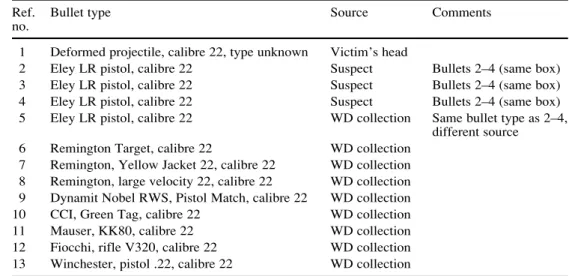
Samples 6–8 were produced by the same manufacturer (Remington). The three Remington samples and five other samples (9–13) were ammunition types which were also usually used in the suspect’s sports gun club. All these samples also came from the WD collection. Selection of samples was based on ballistic investigations of weight, marks of squeezing and cladding, and on the potential availability of the ammunition to the suspect. Therefore the number of potential bullet types could be limited to the se-lection of bullets analysed. Table 1 gives an overview of all the samples analysed in case 1.
Table 1 Analysed samples of
case 1 Ref. Bullet type Source Comments
no.
1 Deformed projectile, calibre 22, type unknown Victim’s head
2 Eley LR pistol, calibre 22 Suspect Bullets 2–4 (same box)
3 Eley LR pistol, calibre 22 Suspect Bullets 2–4 (same box)
4 Eley LR pistol, calibre 22 Suspect Bullets 2–4 (same box)
5 Eley LR pistol, calibre 22 WD collection Same bullet type as 2–4,
different source
6 Remington Target, calibre 22 WD collection
7 Remington, Yellow Jacket 22, calibre 22 WD collection 8 Remington, large velocity 22, calibre 22 WD collection 9 Dynamit Nobel RWS, Pistol Match, calibre 22 WD collection
10 CCI, Green Tag, calibre 22 WD collection
11 Mauser, KK80, calibre 22 WD collection
12 Fiocchi, rifle V320, calibre 22 WD collection
The main goal of the analysis was to investigate if some of the ammunition could clearly be excluded and which types might show the greatest similarity to the lethal projectile. The Sb/Pb ratio seemed to be a good in-dicator of bullet type, because antimony is a typical addi-tion to the alloy and the Sb content is usually specified within certain rages for a specific bullet type. The Sb con-tent affects the hardness properties and penetrating power of a projectile.
The lead-isotope ratio is another property which might be deemed to be constant if the ammunition manufacturer uses a constant source of raw material and adds no recy-cled material during the manufacturing process. A further property for comparison is the trace element pattern, which might be constant if a constant source of raw material was used.
Multiple digestions of each sample were performed and lead-isotope ratios and trace metal content were de-termined by ICP–MS. Multiple digestions of samples re-sulted in good agreement both for lead-isotope ratios and
for trace element concentrations. Only for low trace-metal concentrations was the variation slightly larger.
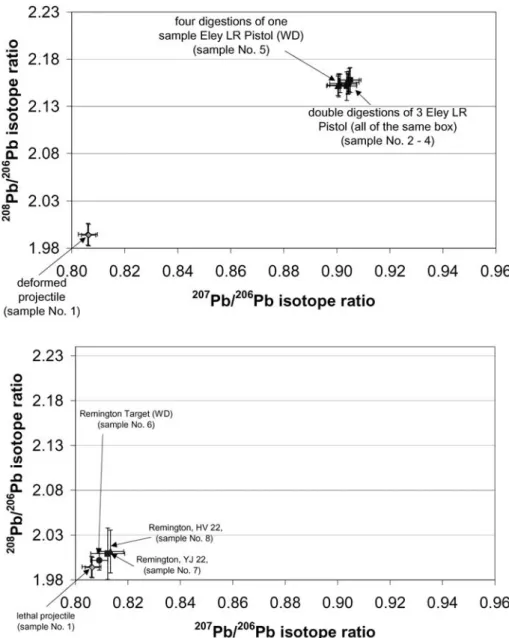
Figures 1, 2, and 3 show the lead-isotope ratios for the samples of case 1, determined by use of quadrupole ICP–MS. Figure 1 shows the isotope ratios for all Eley LR Pistol samples in comparison with the lethal and deformed sample 1. The isotope ratios of the three Eley LR Pistol samples from the same box (samples 2–4) varied only very slightly and within the error range of the method. For results from the double digestions the relative standard deviations (RSD) were between 0.33 and 1.4%. Averages from all double digestions of the three bullets resulted in the lead-isotope ratios 207Pb/206Pb=0.9029±0.00184 and 208Pb/206Pb=2.1541±0.00224.
Even the results for sample 5, which was also an Eley LR Pistol bullet type but came from a different source (WD collection), were in the same range as for the other three samples. The ratios were only slightly lower than those for samples 2–4. As mentioned above, four diges-tions (two with an open procedure and two by microwave) Fig. 1 Lead-isotope ratios of
the Eley LR pistol samples 2–4 (same box) and sample 5 (WD collection) in comparison with the lethal bullet, sample 1
Fig. 2 Lead-isotope ratios for
the Remington samples (6–8) in comparison with sample 1 (lethal projectile)
were performed for sample 5. The average isotope ratios from all four digestions of sample 5 were 207Pb/206Pb= 0.9007±0.00032 and 208Pb/206Pb=2.1527±0.00095. The iso-tope ratios for sample 5 were slightly lower for 208Pb/206Pb ratios but within the error range of the other three Eley samples. The isotope ratio pattern for the deformed pro-jectile, sample 1, was completely different from those for the Eley samples.
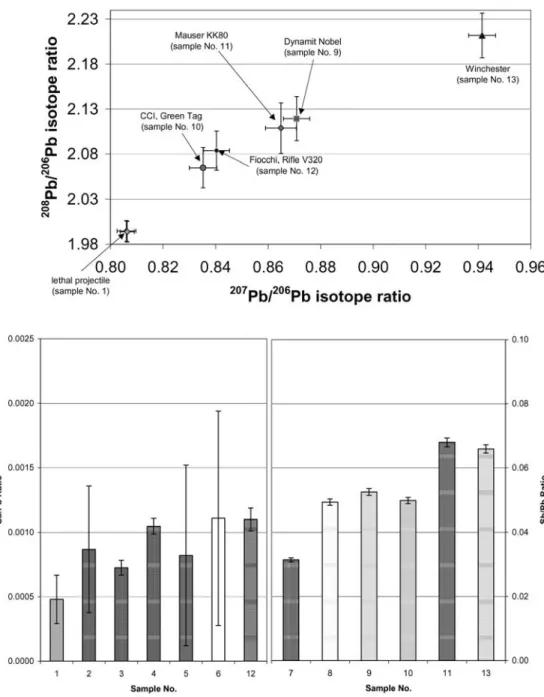
The good agreement among the Eley samples, including the sample from a different source, might indicate the ducer used a constant source of raw material during pro-duction over a long period. The assumption might be con-firmed if Sb/Pb ratios and trace-element patterns were also similar. Figure 4 shows the Sb/Pb ratios for all the samples compared with that for the lethal projectile. Two groups were readily distinguished, one with low antimony con-tent (left), which included the lethal projectile (sample 1)
and samples 2–6 and 12, and a second group with higher antimony content (right) which included samples 7–11 and 13. As expected, the antimony content of all the Eley sam-ples was in a similar low range – 0.07 to 0.1% (g/100 g).
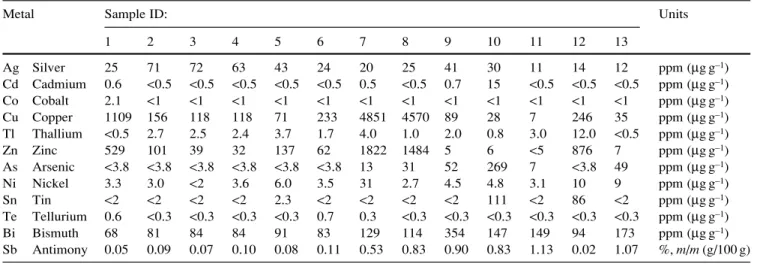
The trace element pattern for all the Eley samples also seems to be of similar magnitude, although for some ele-ments larger variations were observed even for samples from the same box (Fig. 5). Trace-element results for all samples are given in Table 2. The best similarity was that of samples 3 and 4 whereas for sample 2 (same box as sam-ples 3 and 4) deviations were about 30% higher for Cu and about 2.5 times higher for Zn. For the sample from the different source, sample 5 (WD), Zn was about 3.5 times higher and the Cu content was only about 60% that of samples 3 and 4. For Ag, Bi, and Tl agreement was very good among the samples from one box and even for sam-ple 5 levels were comparable, although the concentrations Fig. 3 Lead-isotope ratios for
samples 9–13 in comparison with the lethal projectile
Fig. 4 Antimony
deviated from those of the samples from one box. As, Co, and Cd content were below the detection limits for all samples.
Use of the trace-element pattern for comparison is, however, arguable, because levels of minor and trace ele-ments are usually not controlled during the manufacturing process and only specified to be less than a certain limit. The results found for trace metals in this study confirm findings of a two-year study on two ammunition alloys in which six elements were monitored by taking lot-wise samples from the alloys [12]. It was shown that even though antimony and bismuth varied only within a range of about 4 to 4.5%, much larger variations might occur for other minor and trace elements. For copper, tin, and ar-senic large variations up to 60%, 80%, and 42%, respec-tively, were observed whereas for silver slightly lower variations of about 17% were observed. Therefore the dis-tribution of minor and trace metals in different production lots of the same bullet type can vary widely [12, 13]. So if rigorous lot-wise packaging is not guaranteed, variations might occur within bullets in the same package. Some re-sults even demonstrated that within some production lots variations might occur for some trace metals.
In Fig. 2 results from the three different Remington samples are compared with those from the deformed lethal sample bullet (sample 1). The lead-isotope ratios for the three different types of Remington bullet (samples 6, 7, and 8) were almost in the same range and in the immedi-ate proximity of the isotope ratio for the lethal projectile (sample 1). Among the three Remington samples, the iso-tope ratios of which fitted very well with that of the lethal bullet, the results from sample 6 agreed best with those from sample 1. The high similarity of the lead-isotope ra-tios for all Remington samples might lead to the conclu-sion that the manufacturers might use a constant single source of lead raw material over a period of time.
Such a good agreement cannot be guaranteed because variations in raw material during production might occur, especially if lead ores or raw materials from different sources were used. Not calculable is the variation if large amounts of recycled material were added during produc-tion. Even during a production lot variations might arise if no clear lot-wise material separation is guaranteed when several raw material sources were used.
The isotope ratios for samples 9–13 of case 1 are given in Fig. 3; none matched well with those from sample 1.
According to the Sb/Pb ratios (Fig. 4) samples 7–11 and 13 can be excluded, because of the significantly higher antimony content – for the lethal projectile, sample 1, and reference samples 2–6 and 12 the Sb concentrations were relatively low. The antimony content or the antimony-to-lead ratio might be valued as a strong indicator of similar-ity. The antimony content has an influence on hardness, flight quality, velocity, and penetrating power of a bullet. Lead, a metal used since antiquity, is not a transition metal. Accordingly lead does not have bonding due to d elec-trons and because of this lead is low melting and not very hard. The atom radius is large and the valence electrons are held with moderate strength only. The hardness of a lead alloy can be increased by addition of antimony. There-fore the antimony content is usually monitored during manufacture and levels are more constant than those of other trace metals.
Fig. 5 Trace metal pattern for Eley LR pistol, calibre 22
Table 2 Trace elements determined in the samples of case 1
Metal Sample ID: Units
1 2 3 4 5 6 7 8 9 10 11 12 13 Ag Silver 25 71 72 63 43 24 20 25 41 30 11 14 12 ppm (µg g–1) Cd Cadmium 0.6 <0.5 <0.5 <0.5 <0.5 <0.5 0.5 <0.5 0.7 15 <0.5 <0.5 <0.5 ppm (µg g–1) Co Cobalt 2.1 <1 <1 <1 <1 <1 <1 <1 <1 <1 <1 <1 <1 ppm (µg g–1) Cu Copper 1109 156 118 118 71 233 4851 4570 89 28 7 246 35 ppm (µg g–1) Tl Thallium <0.5 2.7 2.5 2.4 3.7 1.7 4.0 1.0 2.0 0.8 3.0 12.0 <0.5 ppm (µg g–1) Zn Zinc 529 101 39 32 137 62 1822 1484 5 6 <5 876 7 ppm (µg g–1) As Arsenic <3.8 <3.8 <3.8 <3.8 <3.8 <3.8 13 31 52 269 7 <3.8 49 ppm (µg g–1) Ni Nickel 3.3 3.0 <2 3.6 6.0 3.5 31 2.7 4.5 4.8 3.1 10 9 ppm (µg g–1) Sn Tin <2 <2 <2 <2 2.3 <2 <2 <2 <2 111 <2 86 <2 ppm (µg g–1) Te Tellurium 0.6 <0.3 <0.3 <0.3 <0.3 0.7 0.3 <0.3 <0.3 <0.3 <0.3 <0.3 <0.3 ppm (µg g–1) Bi Bismuth 68 81 84 84 91 83 129 114 354 147 149 94 173 ppm (µg g–1) Sb Antimony 0.05 0.09 0.07 0.10 0.08 0.11 0.53 0.83 0.90 0.83 1.13 0.02 1.07 %, m/m (g/100 g)
Among the three Remington type samples, for which the isotope ratios were most similar to those of the lethal bullet, only for sample 6 (Remington Target, calibre 22) was the antimony content in the same range as for the de-formed projectile. For the other two Remington samples (7 and 8) Sb concentrations were much higher. As already mentioned, sample 6 was most similar to the lethal sample (sample 1) in lead isotope ratios. The trace metal content of sample 6 and the lethal projectile were also most simi-lar. Table 2 summarises results obtained for the trace ele-ments in all 13 samples.
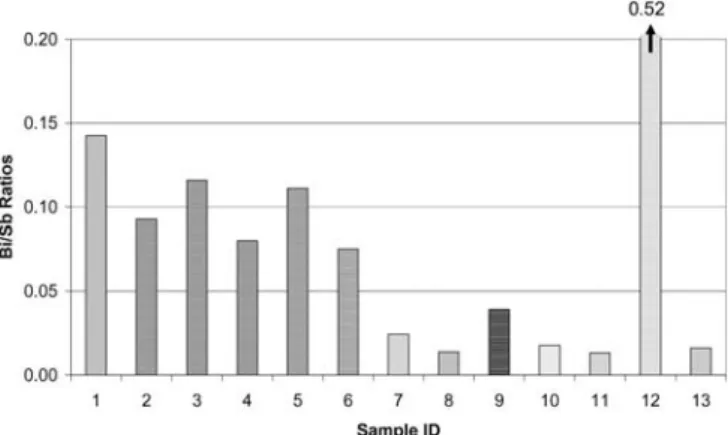
It has been found in other studies that Bi content seems to be often a more constant property within certain ranges [12]. Bismuth, a homologue from the same main group as antimony, might be included with Sb in the alloy. This hy-pothesis might be supported by a constant Bi/Sb ratio for the same sample types, or a constant ratio would again in-dicate a constant source of raw material.
Sb/Pb ratios were similar to Bi/Sb ratios, which are pre-sented in Fig. 6; again the two groups of sample were dis-tinguishable. Group 1 included samples 1–6 and 12, already in the same group for Sb/Pb ratios. The second group con-tained exactly the same samples as found for Sb/Pb ratios. The correlation between Bi and Sb led to the supposi-tion that arsenic, another homologue of antimony, might behave similarly. The results seem indicative of
correla-tion between arsenic and antimony. For samples with low antimony content, arsenic content was usually below the detection limit (DL) and even for most samples with higher antimony content the arsenic content was relatively low. Only for sample 10 (CCI, Green Tag) were arsenic concen-trations significantly higher. Figure 7 shows the arsenic to antimony ratios for the samples with higher antimony con-centrations.
Finally it can be concluded by interpretation of all the results that the samples can be divided into two groups of ammunition based on low or high antimony content of 0.02–0.1% (group 1) or 0.5–1.1% (group 2). Bismuth and arsenic concentrations seem to correlate with the antimony content (group 1, 68–94 ppm Bi, As<DL and group 2, 114–354 ppm Bi, 7–269 ppm As). The other trace metals varied in a wider range and no correlation trend was ob-served.
The group with high antimony concentrations, i.e. sam-ples 7–11 and 13, could be excluded from the list of po-tential projectiles with reasonable probability, because Sb is, in certain ranges, a more constant property.
For three bullet types, Eley LR Pistol (samples 2–5), Remington Target (samples 6) and Fiocchi, Rifle V320 (sample 12) the antimony concentrations were in a similar range to those of the lethal projectile. The lead-isotope ra-tios and trace element pattern of the Remington Target, calibre 22 (sample 6) were also most similar to those of the lethal projectile (sample 1). These results do not lead strictly to the conclusion that Remington Target was the type of the lethal projectile, because this would imply that trace metal pattern and isotope ratio were constant proper-ties.
Taking into account variations in the ammunition man-ufacturing process, for example variations in the melting and casting processes, or the possibility of the raw mater-ial causing variations in alloys, different sources of raw material, possible addition of recycled material or other factors, it could be only concluded that indistinguishable bullets might have come from the same source not that they definitely came from the same source. In addition it is quite possible that bullets with similar but distinguish-able composition could have come from the same source. Distinct identification is not advisable in absence of a unique indicator. Maybe in the future legal directives will regulate that every ammunition manufacturer must add a significant and easily determinable tracer to its products to act as a strong indicator for discrimination among dif-ferent types. Addition of one or a mixture of rare earth el-ements in appropriate amounts might be a possibility. The presence of such unique tracer elements might even en-able implementation of an ammunition data base. How-ever at present results be interpreted with caution and care because of the uncertainties described above.
Results from case 2
In case 2 results from three reference bullets, two found on one of the aggressors and a third recovered from the Fig. 6 Bi/Sb ratios for all samples of case 1
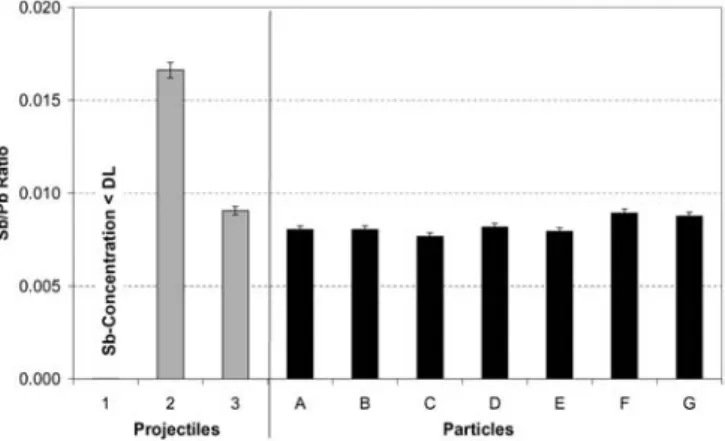
other, were compared with results from particle samples found in the victims’ bodies. The element pattern and iso-tope ratios should be used to investigate whether a posi-tive decision can be made whether one or both aggressors shot within the restaurant and who fired the lethal shots. Interpretation of the data in case 2 was easier than in case 1, because the suspects used different weapons and differ-ent ammunition which were clearly distinguishable. The number of potential bullets was also smaller and all refer-ence samples were recovered directly from the suspects. The results also showed clear differences and were in good accordance with findings from other tests such as trajec-tory and ballistic studies, SEM investigations of gun-shot residues, etc. The antimony-to-lead ratios for all samples are given in Fig. 8 and the lead-isotope ratios are pre-sented in Fig. 9. Both figures show a similar pattern. Re-sults from projectile 3, used by the first suspect, were more or less similar to those from the seven samples of parti-cles, which varied all around the same level. Sb/Pb ratios and lead-isotope ratios from projectiles 1 and 2, both used by the second aggressor, differed significantly from those found for the particles. Antimony was not detectable in
projectile 1 whereas the concentration of antimony in pro-jectile 2 was about twice as high as that in propro-jectile 3 and the seven samples of particles. This suggested that bullet type 3 and the particles came from the same source. Inter-pretation of results from analysis of minor and trace metals (Table 3) was more difficult, however, because of poorer detection limits and larger uncertainties than for similar analyses described for case 1. This was mainly because of the availability of only very small amounts of the particle samples. For most of the trace elements determined con-centrations were low or below detection limits. Therefore correlation of antimony with arsenic was not possible, be-cause even for projectile 2, for which the antimony con-tent was highest the arsenic concentration was below the detection limit. Also, no clear correlation of bismuth with antimony was apparent and the amounts of these elements varied over a wider range, especially in the particles. The sometimes large variations in the results obtained for the particles might be because of the greater risk of contami-nation with adherent blood or textile fragments. The par-ticles were recovered from victims’ sources bodies and had to be digested completely. The very small sample amounts precluded prior cleaning of the surfaces and no multiple digestions were possible. However, the likelihood that the particles originated from a bullet was high, because lead was definitely the dominant element.
Isotope ratio by quadrupole and magnetic sector field ICP–MS
Because two ICP–MS techniques were used for the deter-mination of lead-isotope ratios comparison of uncertainties was possible. Comparison of Figs. 1, 2, and 3 (results from quadrupole determinations of lead-isotope ratios in case 1) with Fig. 9 (magnetic sector field data) clearly shows that error ranges were lower for the second instrument. Visual comparison is possible because the same scaling was used for all four graphs. The errors of the quadrupole method Fig. 8 Antimony-to-lead ratio for the samples of case 2
Fig. 9 Lead-isotope ratios for
varied between ±0.003 and ±0.007 for the 207Pb/206Pb iso-tope ratios, which means the relative standard deviation (RSD) was 0.33–0.79%, and between ±0.009 and ±0.028 for the 208Pb/206Pb isotope ratios, i.e. the relative standard deviation (RSD) was 0.44–1.4%.
The uncertainties in isotope-ratio analysis with the magnetic sector field instrument were lower and ranged between ±0.0016 and ±0.0025 for the 207Pb/206Pb isotope ratios, which means RSD were 0.2–0.3%, and between ±0.0025 and ±0.0040 for the 208Pb/206Pb isotope ratios, which means RSD were 0.13–0.20%. Magnetic jumps were disabled during these determinations. Although, depend-ing on the variations in the ratios, it might be possible to measure useful data with a quadrupole-based instrument, occasionally the smaller uncertainty of a magnetic sector field instrument might be advantageous. Less uncertainty in the measured data should, however, not seduce the an-alyst into over-interpretation of results obtained from a very limited set of samples.
Qualitative comparison of isotope ratios just to answer the question “same source or different source?” could be done even without proper instrument calibration when the differences are large enough. It is, however, better practice to measure absolute ratios by normalising the measured raw ratios to an isotope-ratio standard. This is especially true in forensic (and other scientific) analysis when new samples or evidence might be found at a later time and compared with earlier determinations. Because of the con-sequences that might arise from such forensic analysis, it is obvious that the analyst has the highest responsibility to perform his work according to the state of the art.
Conclusion
ICP–MS analysis of lead-isotope ratios and trace metals in bullets and fragments offers an opportunity to support forensic investigations in addition to other tests. If a number of possible projectiles come under suspicion the method might enable exclusion of some, especially if the number of projectiles is limited and good, distinguishable, patterns are apparent. The strongest indicator of difference between bullet types seems to be high or low antimony concentra-tion, however, because levels of this element are usually monitored within certain ranges because of its effect on the properties of a bullet.
The usefulness of levels of other trace elements is more arguable, because minor and trace element content is usu-ally not controlled and only specified to be less than a cer-tain limiting value for a specific ammunition. Metallurgi-cal phenomena such as segregation, preferential oxidation, or stratification might occur, especially in large castings. In addition to variations in a single raw material the man-ufacturer might use more than one raw source or add re-cycled material during production. Concentrations of trace metals cannot, therefore, be a priori hypothesised to be constant. Even if trace element patterns for different sam-ples are similar, the amounts of some elements might vary within wider ranges, even for bullets from the same
pro-Table
3
Trace elements found in the samples of case 2 in g/100
g (%, m /m ) Projectile 1 P rojectile 2 Projectile 3 Particle A Particle B Particle C Particle D Particle E Particle F Particle G Sample amount (mg) – – – 6.65 3.53 4.91 0.51 0.25 Not weighable 0.42 Silver, Ag 0.04 0.005 0.01 0.006 0.006 0.006 0.003 0.01 nc a 0.006 Bismuth, Bi 0.02 0.04 0.02 0.16 0.04 0.06 0.05 0.04 nc 0.015 Cadmium, Cd <0.0002 <0.0002 <0.0002 0.003 <0.0002 <0.0002 <0.0002 0.001 nc <0.0002 Cobalt, Co <0.0002 <0.0002 <0.0002 <0.0002 <0.0002 <0.0002 <0.0002 <0.0002 nc <0.0002 Copper, Cu 0.06 0.12 0.16 0.09 0.06 0.08 0.7 0.2 nc 0.6 Tin, Sn <0.002 <0.002 <0.002 0.02 0.01 0.004 0.01 0.007 nc <0.002 Thallium, Tl 0.001 0.002 0.0005 0.01 0.003 0.001 0.001 0.002 nc 0.0004 Zinc, Zn 0.24 0.4 0.6 0.03 0.005 0.005 0.06 0.7 nc 0.05
duction lot. This was impressively shown for the four Eley LR Pistol bullets, for which agreement was good for elements such as bismuth or silver; for some elements, however, for example copper or zinc, variations were large even when the samples originated from the same package. Isotope ratios are less prone to the effects of contami-nation than trace metal content if variation in raw material occurs during manufacture. For lead-isotope ratios also, however, variations can occur, especially if a manufac-turer uses a variety of sources of raw materials. The effect might be increased if consequent production-lot-wise dif-ferentiation of raw material types is not guaranteed. The influence of recycled material which might be added dur-ing the process is unpredictable. Therefore it can only be concluded that two bullets which have a similar chemical signature might be of the same type, but not that they are definitely the same. Therefore all assumptions should be critical evaluated and conclusions carefully drawn. Acknowledgement We thank all the people involved in the
in-vestigations, in sample preparation, and in analysis at WD and EMPA. Last but not least we are very grateful to the CANAS or-ganising committee.
References
1. Selier K et al (2001) Wandballistik und ihre ballistischen Grund-lagen, 2nd edn. Springer, Berlin Heidelberg New York 2. Thali MJ et al (2001) Forensic Sci Int 123:54–57
3. Quatrehomme G, Iscan MY (1998) Forensic Sci Int 93:45–60 4. Nennstiel R (1999) Forensic Sci Int 102:121–132
5. Thali MJ et al (2001) Forensic Sci Int 123:54–57 6. Keto RO et al (1999) J Forensic Sci 44:1020–1026 7. Carey L, Mitnik L (2002) Electrophoresis 23:1386–1397 8. Williamson R, Duncan R (2002) Nature 418:585–586 9. Udilova N (1999) Vergleichende Untersuchung von Methoden
zum Nachweis von Superoxidradikalen in biologischen und Modellsystemen, Dissertation, Humboldt-Universität, Berlin 10. Ahmad FK et al (1998) Obstet Gynecol 92:131–136
11. Lide DR (1993–1994) (ed) Handbook of chemistry and physics, 74th edn, CRC Press, pp 8–49
12. Randich E et al (2000) Forensic Sci Int 127:174–191 13. Koons RD et al (2002) J Forensic Sci 47:950–958