Capturing Environmental Innovation through Industrial Cluster Programs in the United States
By
Zachary E. Postone
Bachelor of Arts in Political Science Swarthmore College
Swarthmore, PA (201 1)
Submitted to the Department of Urban Studies and Planning in partial fulfillment of the requirements for the degree of
Master in City Planning
at the
MASSACHUSETTS INSTITUTE OF TECHNOLOGY
June 2017
2017 Zachary E. Postone. All Rights Reserved
The author hereby grants to MIT the permission to reproduce and to distribute publicly paper and electronic copies of the thesis document in whole or in part in any medium now known or hereafter created. Author Certified by Accepted by MASSACHUSETTS INSTITUTE OF TECHNOLOGY
JUN 14 2017
LIBRARIES
ARCHIVES
Signature redacted___
1epartment of Urban Studies and PlanningMay 23, 2017
S ig nature red acted
U
Lecturer Jason Jackson Department of Urban Studies and Planning
n> *-Thesis Supervisor
Signature
redacted
P. Christopher Zegras Associate Pr essor, Department of Urban Studies and Planning Chair, MCP Committee
Capturing Environmental Innovation through Industrial Cluster Programs in the United States
By
Zachary E. Postone
Submitted to the Department of Urban Studies and Planning in partial fulfillment of the requirements for the degree of
Master in City Planning
ABSTRACT
In number of formerly industrial urban centers in the Midwest, networks of private and public stakeholders are working to cultivate clusters of water-related technology innovation. Advocates of these cluster-based strategies strive to increase local and regional competitiveness by
building links among relevant companies and local institutions, while also upgrading the conditions of the business environment that raise productivity and innovation. This study
examines the trajectory of two water technology cluster initiatives from their initiation in the mid-to-late 2000s to the present: The Water Council, based in Milwaukee, Wisconsin, and
Confluence, based in Cincinnati, Ohio.
Despite the central importance of geographic concentration and infrastructure inputs to the economic rationale behind clustering, processes of spatial planning and urban development have generally received limited attention in the study of cluster programs. In these two cases, I trace how abstract visions of cluster dynamics were translated into interventions through the planning and regulatory mechanisms-and their associated politics-governing the built environment in each location.
Using interviews and qualitative analysis of planning and administrative documents, I find that each cluster development program evolved in relation to the land and infrastructure assets accessible to key institutional partners. In Milwaukee, the process of identifying cluster priorities among levels of state and regional institutions produced a regionally driven initiative closely tied to redevelopment powers at the level of the City of Milwaukee. The result was that the cluster program developed toward an eco-industrial park and innovation district model that supported quality of life and attraction goals for both city and industry leaders. In Cincinnati, water innovation efforts were not translated into land redevelopment planning yet ultimately found a niche in the needs of regional utilities. The resulting strategy and set of spatial interventions evolved toward a network of test beds and sites along water bodies impacted by contamination, a geography corresponding to the assets of regional utilities and environmental resource
management entities.
Thesis Supervisor: Jason Jackson Title: Lecturer in Political Economy
ACKNOWLEDGEMENTS
While perhaps not immediately obvious to others, this project is a product of the many ideas and individuals I've had the opportunity to encounter at DUSP and beyond while at MIT, from systemic landscape design, to economic geography, community
development, industrial urbanism, industrial performance and logistics, and science and technology studies. I am grateful to have met so many incredible people who have stretched my thinking in new directions.
I want to thank my advisor, Jason Jackson, for enabling me to venture into unfamiliar
territory for my thesis topic and helping me to find structure in an open-ended
investigation. And many thanks to my reader, Professor Eran Ben Joseph, for reeling me in when I wandered too far and guiding me back to the core of my ideas. I also want to thank the interview participants I had the opportunity to meet with for taking the time to share their experiences.
I am grateful to have arrived at DUSP into such an incredible cohort, and thankful for
the special few who offered so much support and motivation throughout the thesis and throughout my time at MIT.
And lastly, I want to thank my parents Lisa and Norman, and my sister Ariel, for all of their love and encouragement.
TABLE OF CONTENTS
INTRO DUCTION AND OVERVIEW ... 5
Goals and outline ... 9
PART I. CLUSTER THEORY AND CLUSTER DEVELOPMENT... 12
Cluster theory: foundations, contributions, and critiques ... I 4 Foundations and contributions...I Critiques... 16
Cluster development policies and programs... 18
Literature and theory... 23
Theoretical fram ing ... 28
PART 2. COM PARATIVE CASE ANALYSIS ... 30
Clusters for environmental technology innovation ... 31
Case selection and introduction... 33
T he two cases ... 35
Methods ... 39
The W ater Council, W isconsin... 42
I. Spatial studies... 42
II. Spatial planning and developm ent... q 8 Confluence, Ohio ... 63
SSpatial studies... 63
II. Spatial planning and developm ent... 67
CONCLUSIONS ... 76
BIBILIO G RAPHY ... 79
APPENDICES ... 87
INTRODUCTION AND OVERVIEW
A number of formerly industrial urban centers in the Midwest-aiming to strengthen
their economic base, adapt to changing natural resource concerns, and tap into sectors with the potential for innovation-are cultivating industry clusters of water-related technologies. Advocates of these cluster-based strategies strive to increase local and regional competitiveness by building links among relevant companies and local
institutions, while also upgrading the conditions of the business environment that raise productivity and innovation among related businesses. Proponents of cluster-based approaches promote the potential to go beyond extractive, short-sighted economic development agendas to leverage local assets and benefit a broad array of stakeholders all while maximizing competitiveness in the 21" century economy.
While cluster-oriented economic development strategies are not new-proliferating widely throughout the 1990s alongside the popularity of scholarship on clusters by economist Michael Porter-the concept has received a new wave of attention in the wake of the Great Recession, a time of uncertainty, experimentation, and renewed "anxiety about the sources of future growth."' Economists, policy think tanks, and
community organizations have all engaged in exploring alternative models for securing a foundation of economic stability in response to changes brought on by globalization,2
prompting many to again flock to the idea of building wealth through dense,
geographically concentrated networks of related economic activity. Cluster development programs adopt Porter's descriptive analysis of how global competitiveness is created in the 2 1st century economy, and extend its implications to guide how local conditions can
be shaped proactively to foster growth.
' Mark Muro and Bruce Katz, "The New 'Cluster Moment': How Regional Innovation Clusters Can Foster the Next Economy" (Metropolitan Policy Program at Brookings, September 2010), 32.
2 Mario Davide Parrilli, Khalid Nadvi, and Henry Wai-Chung Yeung, "Local and Regional Development in Global
Value Chains, Production Networks and Innovation Networks: A Comparative Review and the Challenges for Future Research," European Planning Studies 21, no. 7 (July I, 2013): 967-88, doi: 10. 1080/09654313.2013.733849. 3 Muro and Katz, "The New 'Cluster Moment': How Regional Innovation Clusters Can Foster the Next Economy," 32.
This study examines the trajectory of two water technology cluster initiatives from their initiation in the mid-to-late 2000s to the present: The Water Council, based in
Milwaukee, Wisconsin, and Confluence, based in Cincinnati, Ohio. Both groups define water technology broadly, aiming to cultivate innovation at multiple points in the water use cycle. The Water Council includes under the water tech umbrella drinking and wastewater treatment systems, maintenance and equipment services, and water system
component manufacturing, among other categories.4 Confluence highlights the potential
for a range of innovations to increase water efficiency, address contamination in drinking and wastewater, and support green infrastructure.
Both programs evoke similar origin stories rooted in local legacy: one hundred years in the making, they represent a convergence of environmental factors, institutions, and a rich industrial heritage leading to today's emergent water innovation forefront.' Among cluster advocates in both regions, the theories of economist and strategist Michael Porter have had a powerful influence.7 These programs have nonetheless taken very different trajectories: related initial concepts of economic dynamism have been
developed through a constellation of stakeholders, relationships, resources, and chance in each location.
Infrastructure and the built environment make up an important part of a location's business climate, and it is proximity in a given place that, according to Porter, enhances
4 "Development Agreement: Reed Street Yards Project" (City of Milwaukee, September I, 2012), Exhibit C: Water Technology-Related Businesses.
s "Administrator Jackson, SBA Administrator Mills Announce Launch of Water Technology Innovation Cluster" (U.S. Environmental Protection Agency, January 18, 201 1),
https://yosemite.epa.gov/opa/admpress.nsf/Press%20Releases%2By%2ODate?OpenView.
6 A. Waits, M. Wilcox, and J. Enriquez, "Timeline: 100 Years of Water Research in Cincinnati" (Presented at
Confluence 2nd Anniversary Event, Cincinnati, OH, 2013); "Milwaukee Water Council," U.S. Cluster Mapping Project,
2014, http://www.clustermapping.us/content/milwaukee-water-council.
7 "Comprehensive Economic Development Strategy (CEDS) Content Guidelines: Recommendations for Creating an Impactful CEDS" (U.S. Economic Development Administration, 2015); "Harvard Business School Professor Michael Porter to Launch New U.S. Cluster Mapping Tool," Harvard Business School Newsroom: Press Releases, September
17, 2014, http://www.hbs.edu/news/releases/Pages/michael-porter-launching-cluster-mapping-tool.aspx; "Confluence: Water Technology Innovation Cluster -Ohio River Valley Region," Confluence, 2016,
https://www.watercluster.org/; "Why Milwaukee?," The Water Council, 2017, https://thewatercouncil.com/why-milwaukee/.
productivity and innovation.' Porter represents the structure of competitive advantage as a diamond, an interaction among four broad attributes: factor conditions, demand conditions, related and supporting industries, and firm strategy, structure, and rivalry.9
Yet despite the central role that location and geographic concentration play in cluster theory, its analytic frameworks tend to offer only the general implication that urban
development levers may be pushed and pulled for the benefit of cluster growth. Less attention has been given to understanding how cluster development is pursued through the openings and constraints-physical, institutional, and regulatory-of their regional urban development contexts.
Porter's cluster theory integrates a focus on process and interactions as well as an
emphasis on the role of location and proximity in innovation and competitiveness. In the study of cluster development programs, however, I suggest the importance of place and process are often insufficiently linked. Despite emphasis on the processes of collaboration
and interaction in cluster theory and practice, improvements to the built environment often remain treated as a general input, provided in greater or lesser quantities to affect the success of the cluster.
In these two cases, 1 trace how abstract visions of cluster dynamics were translated into interventions through the planning and regulatory mechanisms-and their associated politics-that govern the built environment in each location. I ask:
How do the activities of cluster advocates and the state actors that support them shape physical urban development to promote cluster growth? How are visions of cluster
configuration developed and planned, and through what processes are they given spatial form in their urban context?
I find that each cluster program evolved in relation to the land and infrastructure assets
accessible to key institutional partners, and that each program was partially defined
8 Michael E. Porter, On Competition, The Harvard Business Review Book Series (Boston, MA: Harvard Business School Publishing, 1998), 209.
9 Ibid., 166-182.
through the planning and regulatory processes that cluster advocates had to navigate. As cluster advocates sought to aggregate resources and support, their agenda of urban upgrading was not only tailored to fill gaps and reduce obstacles for firms, but also to fit into the unique geographic and planning environment of their core location.
In Milwaukee, the process of identifying cluster priorities among levels of state and regional institutions produced a regionally-driven initiative closely tied to redevelopment powers at the level of the City of Milwaukee. The tools of site-based, real estate-driven economic development and enhancement of amenities were used to advance the to the cluster development program. Cluster advocates negotiated investments to support the cluster through channels of long-term city processes such as sustainability planning and area plans. The result was that the cluster program developed toward an eco-industrial park and innovation district model that supported quality of life and attraction goals for both city and industry leaders.
In Cincinnati, while a separate set of regional-level cluster targets became linked with site revitalization efforts across Hamilton County, water innovation efforts emerged from different institutional origins and were not adopted by regional economic development institutions. Also lacking a direct connection to the land use and sustainability planning priorities in the city of Cincinnati, the water technology agenda was not paired with the planning levers related to urban revitalization in the area. Cluster influencers sought other venues and ultimately found a niche in the needs of regional utilities. The
resulting strategy and set of spatial interventions evolved toward a network of test beds and sites along water bodies impacted by contamination, and a geography corresponding to the assets of regional utilities and environmental resource management entities.
This study suggests that planning and management processes governing the built environment played a powerful role in shaping the trajectory of each initiative. Analyzing these cluster development initiatives through the lens of regional and sub-regional planning offers a helpful addition to investigations how clusters take shape and develop along particular pathways. Just as the development of cluster linkages is widely understood as a process-of collaborating and identifying shared needs and a diffusion of knowledge among related businesses and institutions-I suggest that factor upgrading in the local environment should be read in a similar way. The built environment provides
more than an input to cluster growth, and the geographic manifestation of clusters can also be understood as a result of actors seeking out opportunities across space,
negotiating planning processes alongside other agendas that coincide at a given place.
GOALS AND OUTLINE
This study aims to accomplish two things. First, I use case studies as a way to contribute descriptive detail to economic development agendas rooted in concepts of geographic concentration, clustering, and synergy that often escape a clear definition. I hope to show how aspirations of geographically concentrated innovation-particularly in the arena of environmental innovation-come in contact with systems of urban planning to mutually constitute agendas and spatial outcomes.
Second, the results of this study may help to inform practitioners and community groups as they navigate the task of defining new models incorporating supply chain linkages, environmentally oriented enterprises, and new visions of production in response to the challenges of current economic systems. I hope that this analysis can identify threads within a complex cross-sectoral concept that is often championed under a "win-win" or "triple bottom line" banner across interest groups. My intention is to explore the diversity of agendas and definitions within the notion of clustering, particularly in relation to planning institutions and the communities impacted such plans. I investigate the arrangement of resources, influence over processes, and decision points in the design of the cluster development programs.
While cluster development initiatives strive to generate economic growth outcomes, economic impact is not the focus of my study. Both of the initiatives profiled here are still in an early phase, and it is difficult to meaningfully gauge or compare long-term economic effects related to these cluster programs. As I treat cluster development
programs as a phenomenon that is now relatively distinct from the body of literature on cluster and agglomeration theory, this study also does not focus on debates over the validity of underlying economic mechanisms, empirical evidence for the effects of geographic concentration on productivity outcomes, or evaluation of potential risks of regional specialization
Rather, an orientation toward planning and the built environment is an opportunity to focus on outcomes related to the regional urban context instead of firm productivity or sector growth. This study is an effort to explore two emerging cases to identify processes and new questions that can inform cluster development from a planning perspective. It is primarily process-oriented, descriptive, and exploratory.
Within each case, limitations include the quantity of interviews, the fact that they were conducted all within a short window of time, and potential omissions and biases due to my inability to interview certain stakeholders during the research period and to access internal documents. Across cases, the challenge remains of direct comparison among a diverse range of cluster initiatives and definitions of clustering.
Part 1. Cluster Theory and Cluster Development
The first section begins with a brief overview of agglomeration theory leading to current cluster concepts and related terms, the key contributions of Michael Porter to
competition theory, and some of the main critiques leveled against cluster theory. I then move directly to more recent conversations that sidestep these theoretical debates to focus on cluster-based initiatives as a policy framework and phenomenon in their own right. I review how the process of factor upgrading is described in the literature on clusters and cluster policy, and I explore the extent to which cluster development initiatives have been explored in the field of planning and with a focus on the built environment. I also touch on the potential usefulness of alternative literature for approaching the study of cluster development networks from critical geography and urban political economy, and I conclude with my theoretical framing for the case study analysis.
Part 2. Comparative Case Analysis.
I begin the case study analysis with an introduction to federal-level efforts to support
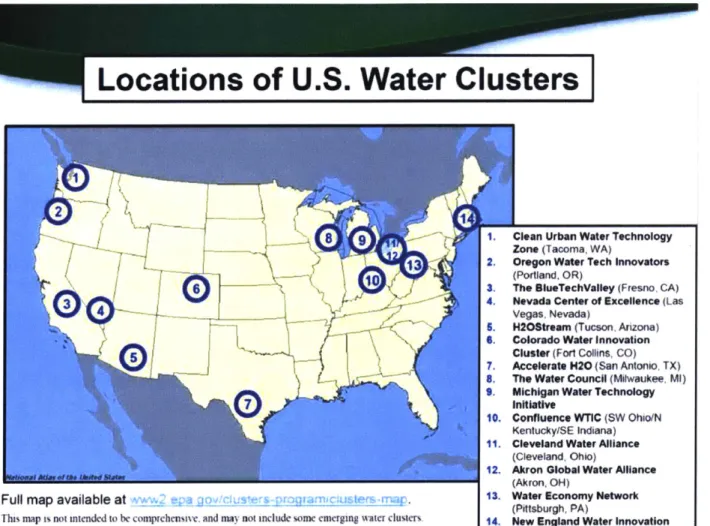
the regional cluster policy framework, including attempts the attempts by the EPA to cultivate a network among a wide range of water technology cluster programs initiated locally across the country. I include an explanation of my case selection and research methods. I then trace water technology cluster development trajectories in both Milwaukee and Cincinnati across two broadly defined domains or phases: First, I examine spatial studies: attempts to define the scope and nature of the target cluster
through regional analysis and planning processes, assessments and understanding of assets, and designation of regional advantages. Second, I look to spatial planning and
development: efforts to turn cluster visions to reality through codified strategies for
growth, strategic visions of urban form to serve economic outcomes, and rules and regulations implemented to enhance the cluster.
The final section concludes with recommendations for additional research and implications for practitioners.
Michael Porter-economist, strategist, and professor at the Harvard Business School-has been influential not only in the realm of economic theory but also in management and strategy thinking. His mark on the suite of cluster-oriented economic development policy approaches is significant: His consulting work has produced widely accepted methodologies for identifying potential clusters,'0 and has directly reshaped program design within the EDA and SBA. " Most recently, Porter worked with the EDA to develop the U.S. Cluster Mapping Tool, which was led by Harvard Business School's Institute for Strategy and Competitiveness and funded by the EDA." Both Porter's definition and recommendations to designate clusters using the Cluster Mapping Tool have been codified into the EDA's Comprehensive Development Strategy (CEDS)
requirements, among other administrative processes.3
Porter's work in the academic arena adopts much of prior theory related to
agglomeration but makes important contributions to competition theory, particularly the integration of location as a key factor and the incorporation of a dynamic view of learning, technology, and innovation. And while the mechanisms of agglomeration and productivity have remained a subject of longstanding debate in the academic literature, cluster-based development initiatives have now emerged as an established policy
framework, modeled from Porter's ideas but articulated into practice by public and private actors through the 1990s to the 2010s.
1' Mercedes Delgado, Michael E. Porter, and Scott Stern, "Defining Clusters of Related Industries," Journal of
Economic Geography 16, no. I (January 2016): 1-38, doi: 10. 1093/jeg/lbvO 17; Mercedes Delgado, Richard Bryden,
and Samantha Zyontz, "Categorization of Traded and Local Industries in the U.S. Economy" (U.S. Cluster Mapping Project, 2014); "U.S. Cluster Mapping: Mapping a Nation of Regional Clusters," 2014, http://clustermapping.us/. ""History of SBA's Involvement in Cluster Initiatives," U.S. Small Business Administration, 2016,
hftps://www.sba.gov/about-sba/Sba-initiatives/Clusters-initiative/history-sbas-involvement-cluster-initiatives; US Environmental Protection Agency, "Environmental Technology Innovation Clusters," U.S. Environmental Protection Agency, March 31, 2016, https://www.epa.gov/clusters-program; "Harvard Business School Professor Michael Porter to Launch New U.S. Cluster Mapping Tool."
12 "Harvard Business School Professor Michael Porter to Launch New U.S. Cluster Mapping Tool."
13 "Comprehensive Economic Development Strategy (CEDS) Content Guidelines: Recommendations for Creating an
Impactful CEDS," 6.
CLUSTER THEORY: FOUNDATIONS, CONTRIBUTIONS, AND CRITIQUES
Foundations and contributions
Porter's work is an elaboration on prior theories of agglomeration and competitiveness. This literature spanning economics, sociology, management, and geography contains a range of theoretical emphases from information transfer to distance-cost calculations and the role of trust within networks. Porter acknowledges cluster theory as the extension of
a long lineage of work on industrial location and economic geography fields, among antecedents such as innovation systems, agglomeration economies, and growth poles. In his own account, Porter begins with the work of Alfred Marshall, and then addresses how his work fits into management literature, urban economics and regional science, and existing studies of industrial districts.14 Porter interjects an emphasis on more recent
changes in the nature of agglomeration caused by globalization and the transition toward a knowledge-intensive economy. He argues that despite a rich literature on
agglomeration in economics in the first half of the 2 0th century, "location moved out of
the economics mainstream" with the rise of neoclassical economics, but in the late 1990s began to see renewed attention.5
Porter's work on clusters and competition, while building directly on these foundations, makes a number of departures and unique contributions. First, Porter's writings
integrate space as a key variable understanding the mechanisms that drive competition. Second, they incorporate a dynamic view of learning, technology, and innovation rather than treating technology as a relatively fixed or exogenous input.
Porter defines clusters using a diamond framework of competitive advantage16 that consists of factor conditions; demand conditions; related and supporting industries; and firm strategy, structure, and rivalry. Factor conditions include labor, land, natural resources, capital, and infrastructure" which must be specialized to meet industry needs,
and sustained through investment and upgrading. Porter suggests that the external economies of scale developed through clusters become a "collective asset, creating an
14 Porter, On Competition, 206-208.
15 Ibid. 16 Ibid., 166.
7Ibid., 172.
environment in which firms can easily and efficiently assemble knowledge, skills, and inputs" to increase productivity and innovation." As described in Porter's diamond (Fig.
1), factor or input conditions consist of "the location's position in factors of production,
such as skilled labor or infrastructure, necessary to compete in a given industry."19
Quality of the Business Environment
*
4
4
Many things natter tor competitiveness. buccessful economic
dvIopment is a proca of amoseuehs Wpadif, In which the business environment improves to enable Increasingly sophisticated ways of competing. This envronment is embodied
in four broad ares as captured in the diamond model.
Figure I - Porter's Diamond Model as described by Harvard Business School's Institute for Strategy and Competitiveness (ICIC 2017)
First, Porter's work argues for a new role and enhanced importance of location in competitiveness. While forms of agglomeration have always existed, Porter argues that some benefits of agglomeration economy "have been undercut by the globalization of supply sources and markets. Yet the modern, knowledge-based economy creates a far more textured role for clusters and the concentration of economic activity in space.' Porter claims that the role of location is a paradox: while globalization has reduced the importance of location in some aspects, the character of today's economy makes
'8Ibid., 329.
19"The Diamond Model," Institute For Strategy And Competitiveness (ICIC), Harvard Business School, 2017,
http://www.isc.hbs.edu/competitiveness-economic-development/frameworks-and-key-concepts/pages/the-diamond-model.aspx.
20 Porter, On Competition, 208.
locational factors even more central to dynamics of competitive advantage." Further, he argues that much of the management and related literature until the 1990s had engaged with similar themes but that "little of this thinking, however, has been connected to
location. It is as if linkages, transactions, and information flow took place outside time and space." Through this emphasis on clusters, Porter brings together an analysis of the microeconomics of competition and the role that location plays in fostering
competitive advantage, productivity and innovation.
Second, Porter's argument about innovation is rooted in the role of geographic concentration. While Porter's argument for the importance of clusters incorporates benefits that connect to both production chain efficiencies and external economies of scale, a sociological, network-oriented approach" to studying agglomeration is critical in his understanding of dynamism and competition. As he describes, "Cluster theory
bridges network theory and competition. A cluster is a form of a network that occurs within a geographic location, in which the proximity of firms and institutions ensures certain forms of commonality and increases the frequency and impact of interactions."" Ultimately it is the increase in productivity and innovation generated by this type of formation-the creation of collective assets and an environment of dynamic interaction, not cost minimization25-that drives competitiveness in the
2 1" century knowledge
economy.
Critiques
Porter's cluster theory has been criticized both in its theoretical foundations and its application as a proactive strategy for economic growth. Many articles examine the
2' Robert Huggins and Hiro Izushi, eds., Competition, Competitive Advantage, and Clusters: The Ideas of Michael
Porter (Oxford: Oxford University Press, 2012); Porter, On Competition; Michael E. Porter, "Location, Competition, and Economic Development: Local Clusters in a Global Economy," Economic Development Quarterly 14, no. 1
(2000): 15-34.
22 Porter, On Competition, 223.
23 Ian R. Gordon and Philip McCann, "Industrial Clusters: Complexes, Agglomeration And/or Social Networks?," Urban Studies 37, no. 3 (2000): 520; Mark Granovetter, "Economic Action and Social Structure: The Problem of Embeddedness," American Journal of Sociology 9 1, no. 3 (November 1, 1985): 481-510, doi: 10.1086/22831 I1.
24 Porter, On Competition, 226. 25 Ibid., 209, 260.
multitude of definitions of cluster-related concepts,26 and emphasize the eclectic nature
of his body of work, Others examine Porter's claim to scientific rigor and legitimization of existing business practices as potential roots of the widespread popularity of his
283
scholarship in practice. In an attempt to bring clarity to a wide range of related industrial cluster concepts as well as critiques of loose definitions within Porter's work, Gordon and McCann29 offer three models of processes underlying geographic
concentration. First, they describe what they call "pure agglomeration": This refers primarily to the work of Alfred Marshall on external economies of scale, talent pool of specialized labor, and knowledge spillovers among firms; as well as the world of Edgar M. Hoover distinguishing internal returns to scale within the firm, localization
economies within the sector, and urbanization economies across sectors.30 This body of literature focuses on the role of external economies of scale in firm productivity and posits the benefits of proximity in terms of the market access and an increased
probability of interaction, "reducing the incidence of missing markets"' Second, Gordon and McCann introduce the "industrial complex' model as a study of "how the
expenditure patterns and the spatial behavior of firms are interrelated."' This approach to geographic concentration focuses primarily on the spatial nature of transaction costs and firm motivations toward "cost-saving in relation to production links."33 Third, the authors outline the "social-network model," rooted primarily in sociology literature. Work in this category emphasizes the role of norms, culture, and non-economic decision making as it relates to the innovation process. As they clarify, "There is nothing
inherently spatial about the social-network model although it has explicit spatial
26 Sara C. S. Cruz and Aurora A. C. Teixeira, "The Evolution of the Cluster Literature: Shedding Light on the Regional
Studies-Regional Science Debate," Regional Studies 44, no. 9 (November 1, 2010): 1266,
doi: 10. 1080/00343400903234670.
27 Nicolai J. Foss, "The Evolution and Eclecticism of Porter's Thinking," in Competition, Competitive Advantage, and Clusters: The Ideas of Michael Porter, ed. Robert Huggins and Hiro Izushi (Oxford: Oxford University Press, 2012),
93-108.
28 Omar Aktouf, Miloud Chennoufi, and W. David Holford, "The Strategic Management Framework: A Methodological
and Epistemological Examination," in Competition, Competitive Advantage, and Clusters: The Ideas of Michael
Porter, ed. Robert Huggins and Hiro Izushi (Oxford: Oxford University Press, 2012), 75-91. 29 Gordon and McCann, "Industrial Clusters."
30 Ibid., 516-518. "' Ibid., 518. 32 Ibid., 519. 33 Ibid.
34 Granovetter, "Economic Action and Social Structure."
applications. This is because social networks are a form of durable social capital...,"'. Lastly Gordon and McCann also touch on scholarship focused on the concept of innovative milieux,36 "which attempts to relate questions of spatial clustering to the process of innovation."37
This typology is intended to address the dilemma that different types of clustering imply vastly different programs, implementation structures, and prescriptive measures to support cluster growth. Martin and Sunley take issue with cluster theory's
ambiguities in terms of defining the boundaries of clusters geographically and
sectorally.39 They suggest that clusters "are as much analytical creations as they are objectively real phenomena," that "the core meaning of clusters lies more in this image than in a coherent and carefully defined set of ideas,"1 and further that local leaders have sometimes "backed into cluster initiatives" from previously existing agendas.4 2
These criticisms of cluster theory and cluster development efforts question whether, in practice, cluster activities and policies meaningfully relate to the empirical-prescriptive economic principles underlying cluster theory-whether or not cluster initiatives
represent "real" or "true" clusters.
CLUSTER DEVELOPMENT POLICIES AND PROGRAMS
Despite ongoing debates about the merits and clarity of cluster economics, cluster-based development initiatives have emerged as a popular policy model for economic
development planning practitioners. Cluster-focused policies are now seen for their value as practical tools regardless of their direct relationship to conceptual origins43 -or
3 Gordon and McCann, "Industrial Clusters," 520.
36 Philippe Aydalot, David Keeble, and Groupe de recherche europ6en sur les milieux innovateurs, eds., High Technology Industry and Innovative Environments: The European Experience (London; New York: Routledge, 1988).
3 Gordon and McCann, "Industrial Clusters," 514.
38 Ibid., 515.
3 Ron Martin and Peter Sunley, "Deconstructing Clusters: Chaotic Concept or Policy Panacea?," Journal of
Economic Geography 3, no. I (January I, 2003): 5-35, doi: 10. 1093/jeg/3.1.5.
40 Ibid., 13.
4' Ibid., 29. 42
Ibid., 24.
43 Arkadiusz Michal Kowalski and Andrzej Marcinkowski, "Clusters versus Cluster Initiatives, with Focus on the ICT
Sector in Poland," European Planning Studies 22, no. I (January 2, 2014): 20-45,
potential theoretical inconsistencies-and have cohered into widely shared policy practices across many regional and local policy environments."
A 2007 OECD review of national and state cluster programs identifies three primary
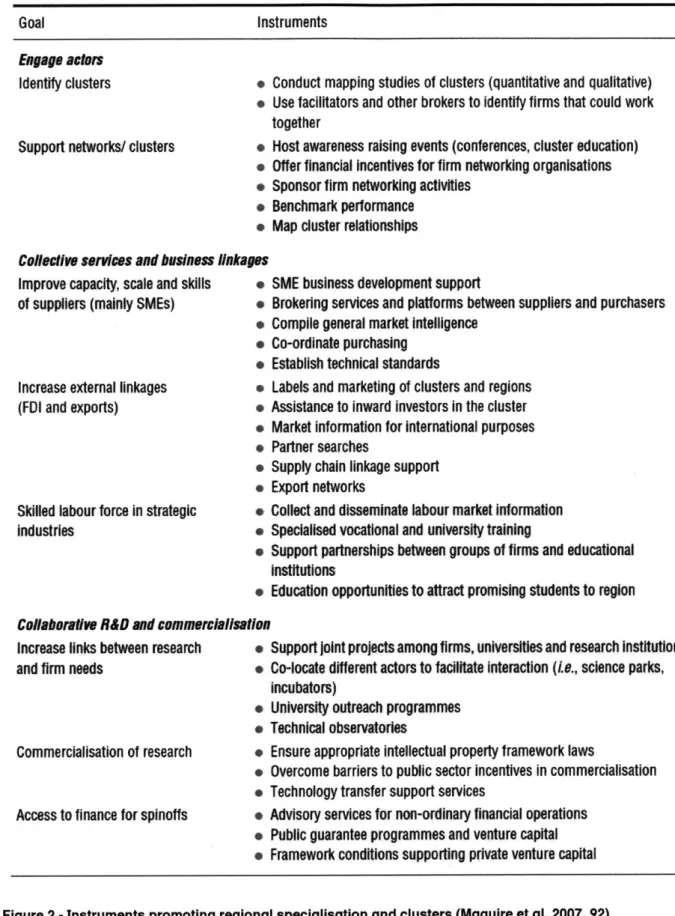
types of instruments used widely by policymakers and practitioners: first, engagement and convening of relevant stakeholders to identify potential clusters and support interconnections; second, the provision of collective services such as improvements to supplier linkages, external linkages such as foreign direct investment (FDI) and exports, and cultivation of skilled labor for strategic industries; and third, the facilitation of collaborative research and development (R&D) to better connect researchers and firm through co-location or streamlined commercialization pipelines.45
Another emphasis of cluster development policy advocates in the U.S. context is the need to increase vertical coherence of policy to align resources toward supporting regional clusters. Mills et al. see vertically linked strategies in the U.S. and "public sector support for cluster initiatives, formally organized collaborative efforts to facilitate cluster competitiveness and growth" to be "a relatively new phenomenon" in which "government can act as a catalyst to overcome financial, cultural, or institutional impediments to collaboration among organizations within a cluster."" This contrasts with the existing state of federal programs related to cluster and network development, which more generally "have evolved in a wildly ad hoc, idiosyncratic, and uncoordinated
fashion" and "remain inadequate to the task." The primary objective of this policy focus is to increase alignment and leverage resources toward strategic economic priorities that
can be best identified at the regional level.
Many U.S. metropolitan planning and cluster advocates tend to accept the mechanics of clusters as espoused by Porter to be representative of economic reality rather than theoretical abstraction. According to Muro and Katz, clusters "reflect the nature of the
4 Karen Maguire, Andrew Davies, and Organisation for Economic Co-operation and Development, eds., Competitive
Regional Clusters: National Policy Approaches, OECD Reviews of Regional Innovation (Paris: OECD, 2007), 132.
-5 Ibid., 92.
46 Karen G. Mills et al., "Clusters and Competitiveness: A New Federal Role for Stimulating Regional Economies"
(Citeseer, 2008), 6, http://citeseerx.ist.psu.edu/viewdoc/download?doi= 10. 1. 1.508.4623&rep=rep I &type=pdf.
47 Ibid., 3.
real economy" and that cluster frameworks therefore "highlight the real-world interactions, connections, transactions, and dealings of real firms after a period of delusion and over-simplification." Worded more strongly, clusters should be seen as a "simple economic fact."' This can bring government economic policy away from "the
world of ideal conceptions" and into the "messy and complicated world of how firms, industries, and national and regional economic systems actually work and perform." Muro and Katz argue that cluster development strategies at the regional level fill the "missing middle" between macro abstraction and the microeconomics of firm behavior and dig into the "messy, synergistic dynamics of practical business activity inside the
'black box' of innovation development."' In short, the network interactions described by Porter are perceived to be an accurate representation of true economic activity on the ground.
48 Muro and Katz, "The New 'Cluster Moment': How Regional Innovation Clusters Can Foster the
Next Economy," 5. 49 Ibid., I . 50 Ibid., 15. 5 ' Ibid., 18.
Goal
Engage actors
Identify clusters
Support networks/ clusters
Instruments
" Conduct mapping studies of clusters (quantitative and qualitative)
" Use facilitators and other brokers to identify firms that could work together
" Host awareness raising events (conferences, cluster education) " Offer financial incentives for firm networking organisations * Sponsor fIrm networking activities
" Benchmark performance
" Map duster relationships
CoNectie services and business linkages
Improve capacity, scale and skills of suppliers (mainly SMEs)
Increase external linkages (FDI and exports)
* SME business development support
o Brokering services and platforms between supplers and purchasers
* Compile general market intelligence * Co-ordinate purchasing
* Establish technical standards
0 0 0 0
Skilled labour force in strategic industries
Labels and marketing of clusters and regions Assistance to inward investors in the cluster Market information for international purposes Partner searches
Supply chain linkage support Export networks
* Collect and disseminate labour market information " Speclalised vocational and university training
" Support partnerships between groups of firms and educational institutions
" Education opportunities to attract promising students to region
Collaboratie R&D and commerclalisatlon
Increase links between research and firm needs
Commercialisation of research
Access to finance for spinoffs
* Support joint projects among firms, universities and research institutions
"
Co-locate different actors to facilitate interaction (L.e., science parks, incubators)" University outreach programmes
" Technical observatories
* Ensure appropriate intellectual property framework laws
* Overcome barriers to public sector incentives in commercialisation * Technology transfer support services
* Advisory services for non-ordinary financial operations * Public guarantee programmes and venture capital * Framework conditions supporting private venture capital
Figure 2 -Instruments promoting regional specialisation and clusters (Maguire et al. 2007, 92)
21
Leading cluster program advocates in the U.S. offer a critique of the general tendency to think in terms of economic development investment inputs as opposed to focusing on the process of collaboration and interlinking of resources. Mills, Reynolds and Reamer pose this as an information problem: "whether for business, workforce, economic, or technology development, federal programs typically aim to provide the "right" level of
economic inputs; by design, they assume that markets will then take full advantage of their ability."' This creates a policy gap in which economic inputs are not efficiently
used: "Inputs of land, labor and capital are important, but how those inputs-federally funded and otherwise-are mixed matters most. There is no right input-based formula for economic development. Economic competitiveness is very much about stoking the fires of inter-organizational collaboration, within clusters and beyond."3 Muro and Katz repeat the same argument that many public sector programs "assume too blithely that markets left to their own devices will then take full advantage of the inputs'
availability,"54 also pointing to the need to reducing friction in the complex
commercialization process. In short, this perspective targets market failure of imperfect information, arguing for processes of geographic concentration and regional institutional networking as a way to increase the matching and market interactions that contribute to economic dynamism.
In short, this body of work on cluster-based economic development moves from
descriptions of clusters to strategies for supporting them through proactive policy and programmatic levers. In fact, these strategies are well-suited for politics and
pragmatism: the fuzziness and eclecticism that brought criticism in academic spheres becomes a useful form of malleability and political positioning. Policy analysts suggest that the resurgent popularity of cluster ideas can be attributed partially to their "non-partisan concern with the mechanics of value-creation in local economies"55 and their ability to convene a broad based group of academic, public, and private partners
together with stakeholders in related industries.56 OECD analysis points to the appeal of
52 Mills et al., "Clusters and Competitiveness," 24-25. 53 Ibid., 24.
54 Muro and Katz, "The New 'Cluster Moment': How Regional Innovation Clusters Can Foster the Next Economy," 15.
55 Ibid., 4.
56 Elizabeth Redman, "Mobilizing Oregon Clusters: Private and Public Sector Partnering for Economic Growth"
a regional policy tool that can hold relevance for "both advanced regions with dense knowledge infrastructures and in none-core or formerly industrial regions,"7 as well as
the fact that targeted clusters can either be identified via quantitative methodologies or through more politically negotiated approaches that take into account the level of motivation among relevant stakeholders.' Lastly, as part of regional economic
development strategy, cluster development programs are often explicitly acknowledged for their local branding and "labelling" aspect as part of placemaking and attraction
efforts."
LITERATURE AND THEORY
The literature on cluster theory and cluster policy gives limited attention to the process of cluster upgrading, but Porter's writings and those of regional cluster development policy advocates do suggest some mechanisms. With regard to upgrading the built environment, Porter addresses these input factors in On Competition in two contexts: local rivalry and government intervention. First, Porter makes the case that localized rivalry among geographically concentrated firms is powerful "because it promotes improvement in all the other determinants," generating pressure toward "constant upgrading of the sources of competitive advantage."' Second, Porter discusses factor upgrading within the realm of government responsibility in enhancing clusters. In addition to ensuring stability, government should improve "the efficiency and quality of the general purpose inputs to business identified in the diamond" and also work to remove obstacles, constraints, and inefficiencies blocking cluster productivity, including both infrastructural and regulatory factors."'l This suggests broadly that from cluster theory, one could expect to observe upgrading in quality of the built environment, the provision of specialized infrastructure, and the enhancement of any environmental conditions-either physical and regulatory-that are hindering business activity.
57 Maguire, Davies, and Organisation for Economic Co-operation and Development, Competitive Regional Clusters,
42. 58 Ibid., 13, 84. 59 Ibid., 72. 60 Porter, On Competition, 181-182. 61 Ibid., 245, 247. 23
Writing by cluster development advocates tends also to focus on opportunities for government to enhance clusters by addressing undercapacity and removing constraints. To the extent that local policy levers such as planning, permitting, and zoning are addressed, they are treated generally as systems that should be managed "to benefit the physical infrastructure in which clusters exist."
Much of the empirical literature on industry clusters is focused on quantitative identification and categorization of clusters, assessing the impact of clustering on
economic outcomes such as productivity or innovation, or on evolutionary studies of clusters. This body of literature tends to give limited attention to the upgrading processes within proactive cluster development. Among empirical studies of clusters, some scholars have tracked industrial clusters and their evolution over time," including life cycle modeling of cluster evolution processes4 and surveys of larger pools of firms to
assess dynamics such as growth, entry, and exit." Other researchers study social network and institutional dynamics empirically through case studies emphasizing knowledge transmission within a specific cluster,6 6 social capital and social ties among firms in clusters,67 analyses of knowledge development and spillover effects,68 and comparative studies of social relations in regional institutions.9
Recent work by Porter and affiliated researchers use quantitative tools to identify sets of closely related industries by groupings of NAICS codes,70 and distinguish between
62 Muro and Katz, "The New 'Cluster Moment': How Regional Innovation Clusters Can Foster the Next Economy," 8. 63 Jennifer Paige Montana and Boris Nenide, "The Evolution of Regional Industry Clusters and Their Implications for
Sustainable Economic Development Two Case Illustrations," Economic Development Quarterly 22, no. 4 (November
I, 2008): 290-302, doi: 10. 1 177/0891242408324084.
64 Xm Xie, Sx Zeng, and Cm Tam, "Towards Continuous Innovation for Regional High-Tech Industrial Clusters,"
Innovation 13, no. 3 (December 1, 2011): 361-75, doi:I0.5172/impp.201 1.13.3.36 1.
65 Koen Frenken, Elena Cefis, and Erik Stam, "Industrial Dynamics and Clusters: A Survey," Regional Studies 49, no.
I (January 2, 2015): 10-27, doi: 10. 1080/00343404.20 14.904505.
66 Ana Paula Lisboa Sohn et al., "Knowledge Transmission in Industrial Clusters: Evidence from EuroClusTex,"
European Planning Studies 24, no. 3 (March 3, 2016): 511-29, doi: 10. 1080/09654313.2015.1053845.
67 Manuel Exp6sito-Langa and F. Xavier Molina-Morales, "How Relational Dimensions Affect Knowledge Redundancy
in Industrial Clusters," European Planning Studies 18, no. 12 (December I, 2010): 1975-92,
doi:10. 1080/09654313.2010.515817.
68 Lars H6kanson, "Epistemic Communities and Cluster Dynamics: On the Role of Knowledge in Industrial Districts,"
Industry and Innovation 12, no. 4 (December 1, 2005): 433-63, doi:10.1080/13662710500362047.
69 Michael Storper, "Regional 'Worlds' of Production: Learning and Innovation in the Technology Districts of France,
Italy and the USA," Regional Studies 27, no. 5 (January 1, 1993): 433-55, doi: 10.1080/00343409312331347675.
traded and local industrial clusters." Some researchers have worked on the development of new cluster identification methodologies using alternative techniques" and focused on improving identification capabilities in practice, which are often simplified due to lack of data at the local level." Other researchers have focused on assessing the impact of
cluster-based strategies on economic and employment outcomes,7 4 measuring growth in cluster-related sectors and assessing the cluster's economic impact, 7 and investigating the relationship between cluster-based economic development strategies and
metropolitan-level economic growth."
Other researchers have tried to make sense of the diversity and rapid proliferation of literature related to industrial clustering across disciplines through content and
bibliometric analyses. These reviews of the literature bolster the idea that planning and built environment factor conditions have received limited attention. Martinez-Fernaindez et al. conduct a multidisciplinary content analysis of publications from 1997-2006 and identify primary lines of research within the categories of cluster characterization, lifecycle, performance, policies, and specific realities.7 7 Hervas-Oliver et al. use
bibliometric methods to review literature from 1957-2014 and identify the subfields of:
7' Delgado, Bryden, and Zyontz, "Categorization of Traded and Local Industries in the U.S. Economy."
72 Jan Stejskal and Petr Hajek, "Competitive Advantage Analysis: A Novel Method for Industrial Clusters
Identification," Journal of Business Economics and Management 13, no. 2 (April I, 2012): 344-65,
doi: 10.3846/16111699.2011.620154; M. ArgOelles, C. Benavides, and I. Ferndndez, "A New Approach to the Identification of Regional Clusters: Hierarchical Clustering on Principal Components," Applied Economics 46, no. 21
(July 23, 2014): 2511-19, doi: 10. 1080/00036846.2014.904491; Christina M. L. Kelton, Margaret K. Pasquale, and
Robert P. Rebelein, "Using the North American Industry Classification System (NAICS) to Identify National Industry Cluster Templates for Applied Regional Analysis," Regional Studies 42, no. 3 (April I, 2008): 305-21,
doi: 10.1080/00343400701288316.
73 Edward J. Feser and Edward M. Bergman, "National Industry Cluster Templates: A Framework for Applied Regional Cluster Analysis," Regional Studies 34, no. I (February I, 2000): 1-19, doi: 10.1080/00343400050005844.
74 Colleen K. Chrisinger, Christopher S. Fowler, and Rachel Garshick Kleit, "Industry Clusters and Employment Outcomes in Washington State," Economic Development Quarterly 29, no. 3 (2015): 199-210; Elsie Harper-Anderson, "Measuring the Connection Between Workforce Development and Economic Development Examining the Role of Sectors for Local Outcomes," Economic Development Quarterly 22, no. 2 (May I, 2008): I 19-35,
doi: 10. 1 177/0891242408316308.
75 Jennifer H. Allen and Thomas Potiowsky, "Portland's Green Building Cluster: Economic Trends and Impacts,"
2007.
76 Rick Mattoon and Norman Wang, "Industry Clusters and Economic Development in the Seventh District's Largest
Cities," Economic Perspectives 38, no. 2 (2014): 52-67.
77 M' Teresa Martinez-Fern6ndez, Josep Cap6-Vicedo, and Teresa Vallet-Bellmunt, "The Present State of Research
into Industrial Clusters and Districts. Content Analysis of Material Published in 1997-2006," European Planning
Studies 20, no. 2 (February 1, 2012): 287, doi: 10. 1080/09654313.2012.650906.
evolutionary economic geography; global pipelines; cluster taxonomies; innovation and firm analysis; inter-firm networks, social capital and flows of knowledge; and network-position analysis and technological gatekeepers.78 Cruz and Teixeira also use bibliometric
techniques on literature from 1962-2007 and identify nine main topics: genealogical and evolutionary approaches to clusters; agglomeration economies; knowledge-based theories; systemic analysis and innovation systems; industrial policy and regional development policies (oriented toward assessing efficiency of policies in promoting new clusters); global networks and local clusters; networks and social approaches; institutional
approaches; and methods and measures." These results confirm the idea that literature on clusters often falls into the disciplinary domains from which the theory originated, including sociological orientations, knowledge-based concepts, evolutionary economics, and taxonomies of agglomeration.
A 2007 article by Gottlieb also reiterates the gap in the literature with regard to
regional and local planning. Gottlieb argues, referring to high technology industries, that "their spatial behaviour at smaller scales is less frequently explored. A discussion of proactive planning policies that is informed by an understanding of submetropolitan industry clustering is rarer still." He criticizes Porter, claiming that "when [Porter] 'scales down' his agglomeration argument to the central city.. .he says little or nothing about implementation tools like infrastructure or zoning." 0 Deutz and Gibbs also call
for the need to further integrate industrial ecology, cluster theory and regional development literature, particularly with respect to eco-industrial development."
Research from additional disciplines can introduce new angles for approaching cluster development. Porter's cluster theory and related policies do suggest a range of potential changes to the urban environment that could be expected, but offer little for thinking about what might lead to one outcome over another. Additionally, when comparing
78 Jose-Luis Hervas-Oliver et al., "Clusters and Industrial Districts: Where Is the Literature Going? Identifying
Emerging Sub-Fields of Research," European Planning Studies 23, no. 9 (September 2, 2015): 1827-72,
doi: 10. 1080/096543 13.20 15.1021300.
7 Cruz and Teixeira, "The Evolution of the Cluster Literature," 1271-1272.
80 Paul D. Gottlieb, "From Old Economy to New Economy: Spatial Planning in the County That Contains Cleveland,
Ohio," Planning Practice & Research 22, no. 2 (May I, 2007): 215, doi: 10. 1080/02697450701584394.
81 Pauline Deutz and David Gibbs, "Industrial Ecology and Regional Development: Eco-Industrial Development as
cluster development efforts to cluster theory, one runs into the strange tautology that these efforts are self-consciously modeled after theoretical mechanisms that inspired them-and therefore generally show a combination of features that could be plausibly mapped back onto their academic origins.
Scholars in urban political economy, critical geography, and science and technology studies offer interpretations that reframe cluster-based programs within a broader transition toward local entrepreneurialism, the municipal politics of urban development, and the paradigms that govern popular understandings of the market economy. Cluster theory's emphasis on factor conditions of the urban landscape, the role of government in cluster upgrading, and the value of city branding suggests that it is important to bring an urban political economy lens to gain a richer understanding of the process of cluster upgrading.
To the critique that cluster advocates use the term opportunistically and as a brand, scholarship such as the study of boosterism in the Midwest by Cronon"2 integrates city image and narrative of natural endowments into the economics of urban development and the politics of speculation. Harvey's writings on transitions from managerialism to entrepreneurialism in local development and urban governance 3 offer an alternative to clustering to understand the mechanisms driving flexible nonpartisan networks to seek resources for shared agendas at the local level. To the somewhat impenetrable circular relationship between cluster theory and cluster development programs, work by Scott on state simplifications' and by others on performativity and market-building practices"5 introduces a ways to understand reflexive processes between economic ideas and interventions. Lastly, in addition to the sociological literature within cluster theory, a valuable perspective could come from literature that focuses on institutions of urban
82 William Cronon, Nature's Metropolis: Chicago and the Great West, 3rd Edition (New York: Norton, 1992).
83 David Harvey, "From Managerialism to Entrepreneurialism: The Transformation in Urban Governance in Late Capitalism," Geografiska Annaler. Series B, Human Geography 71, no. I (1989): 3-17, doi: 10.2307/490503.
84 James C. Scott, Seeing like a State: How Certain Schemes to Improve the Human Condition Have Failed, Nachdr.,
Yale Agrarian Studies (New Haven, Conn.: Yale Univ. Press, 2008); James C. Scott, "State Simplifications: Nature, Space and People," Occasional Paper, no. 14 (2014): 82-122.
85 Daniel Breslau, "Designing a Market-like Entity: Economics in the Politics of Market Formation," Social Studies of
Science 43, no. 6 (2013): 829-51; Donald A. MacKenzie, Fabian Muniesa, and Lucia Siu, eds., Do Economists Make Markets?: On the Performativity of Economics (Princeton: Princeton University Press, 2007).
management and power dynamics within them, including concepts of venue shopping"6
as well as regime theory.87
THEORETICAL FRAMING
Based on this assessment of the literature, I extend the emphasis on process within cluster thinking to focus specifically on how the built environment is used to support cluster-related activity through planning processes. Planning and urban development are the processes that shape both inputs like infrastructure and govern the proximity and separation of activities across urban space. Just as linkages and transactions do not happen in a void, the processes of factor upgrading and geographic concentration don't occur across a smooth plane: Investments in the built environment are managed through bureaucratic procedures, and filtered through the boundaries and grids that divide land control. As cluster development efforts typically map only loosely onto the economic fundamentals of clustering and are mediated heavily through planning agendas,
understanding these programs must go beyond the microeconomics of competition and theories of industrial location to incorporate a broader approach to the politics of urban
planning and economic development.
Both process and physical outcomes are particularly important from planning perspective. Rather than focus only on productivity as the outcome of interest, the fields of urban planning, politics, and community development offer a chance to prioritize more highly the ways that economic growth can drive outcomes such as neighborhood revitalization, improved infrastructure, workforce development, and so forth.
In this section, I introduced the resurgence of cluster development policy frameworks and explored Porter's Diamond Model of competitive advantage with a focus on how location, proximity, and the built environment operate within cluster processes. I
86 Frank R. Baumgartner and Bryan D. Jones, Agendas and Instability in American Politics, American Politics and
Political Economy Series (Chicago: University of Chicago Press, 1993).
87 K. Mossberger and G. Stoker, "The Evolution of Urban Regime Theory: The Challenge of Conceptualization,"
Urban Affairs Review 36, no. 6 (July 1, 2001): 810-35, doi:10. 1 77/10780870122185109; Clarence N. Stone,
Regime Politics: Governing Atlanta, / 946- 1988, Studies in Government and Public Policy (Lawrence, Kan: University
reviewed the dominant streams within industrial cluster literature, and suggested an opportunity to further emphasize planning built environment factors as a formative element of the cluster rather than an input.
In the next section, I switch to a comparative case analysis of two water technology innovation clusters. I describe my rationale for focusing on environmental technology innovation and water technology specifically, as well as my reasoning for selecting the two cases included in my investigation.