Publisher’s version / Version de l'éditeur:
Journal of Polymer Science Part A: Polymer Chemistry, 40, 2002
READ THESE TERMS AND CONDITIONS CAREFULLY BEFORE USING THIS WEBSITE. https://nrc-publications.canada.ca/eng/copyright
Vous avez des questions? Nous pouvons vous aider. Pour communiquer directement avec un auteur, consultez la
première page de la revue dans laquelle son article a été publié afin de trouver ses coordonnées. Si vous n’arrivez pas à les repérer, communiquez avec nous à [email protected].
Questions? Contact the NRC Publications Archive team at
[email protected]. If you wish to email the authors directly, please see the first page of the publication for their contact information.
Archives des publications du CNRC
This publication could be one of several versions: author’s original, accepted manuscript or the publisher’s version. / La version de cette publication peut être l’une des suivantes : la version prépublication de l’auteur, la version acceptée du manuscrit ou la version de l’éditeur.
Access and use of this website and the material on it are subject to the Terms and Conditions set forth at
Fluorinated poly(arylene ether ketone)s bearing pentafluorostyrene
moieties prepared by a modified polycondensation
Ding, Jianfu; Liu, Fengshan; Day, M.; Zhou, M.
https://publications-cnrc.canada.ca/fra/droits
L’accès à ce site Web et l’utilisation de son contenu sont assujettis aux conditions présentées dans le site LISEZ CES CONDITIONS ATTENTIVEMENT AVANT D’UTILISER CE SITE WEB.
NRC Publications Record / Notice d'Archives des publications de CNRC:
https://nrc-publications.canada.ca/eng/view/object/?id=036db025-7e4b-4b16-b135-43144b8c41be https://publications-cnrc.canada.ca/fra/voir/objet/?id=036db025-7e4b-4b16-b135-43144b8c41bePentafluorostyrene Moieties Prepared by a Modified
Polycondensation
JIANFU DING,1 FUTIAN LIU,1 MEI LI,1 MICHAEL DAY,1 MING ZHOU2
1Institute for Chemical Process and Environmental Technology, National Research Council Canada, 1200 Montreal Road,
Ottawa, Ontario K1A 0R6, Canada
2
Institute for National Measurement Standards, National Research Council Canada, 1200 Montreal Road, Ottawa, Ontario K1A 0R6, Canada
Received 14 May 2002; accepted 29 August 2002
Published online 00 Month 2002 in Wiley InterScience (www.interscience.wiley.com). DOI: 10.1002/pola.10504
ABSTRACT: The polycondensation of decafluorobenzophenone with hexafluorobisphenol A was modified by the addition of a molecular sieve dehydrating apparatus to the refluxing reaction system. This modification promoted the polymerization and enabled the reactions to be conducted in milder conditions and completed in a shorter time, thereby depressing side reactions such as branching and crosslinking. The resulting fluorinated poly(arylene ether ketone)s (FPAEK) were free of gel particles and pos-sessed the designed molecular weights. This modified procedure was also suitable for introducing crosslinkable pentafluorostyrene (FSt) moieties into the polymers at the chain ends and/or inside the chain with the vinyl group of FSt being pendant. The resulting FSt containing fluorinated poly(arylene ether ketone)s (FPAEK-FSt) can then be thermally crosslinked at 100 °C in the presence of 1% benzoyl peroxide (BPO) or at 250 °C without any initiator. The glass-transition temperatures (Tg’s) of FPAEK
in-creased with increasing molecular weight and leveled off at about 147 °C for the polymer with a number-average molecular weight of 18,600 Da, whereas the values were not apparently affected by the addition of FSt units. However, crosslinking of the FPAEK-FSt resulted in an approximate 30 °C increase of the Tg. Spin-coating
FPAEK-FSt onto silicon wafers followed by crosslinking gave films with excellent thermal stability, physical strength, and adhesion to the substrate as well as good reproduc-ibility in terms of film preparation and optical properties. The refractive index and birefringence of the films measured at a wavelength of 1.55 m were 1.502 and 2.5 ⫻ 10⫺3, respectively.© 2002 Government of Canada. Exclusive worldwide publication rights in
the article have been transferred to Wiley Periodicals, Inc. J Polym Sci Part A: Polym Chem 40: 4205– 4216, 2002
Keywords: optical waveguides; fluorinated poly(ether ketones); crosslinking; poly-condensation; decafluorobenzophenone; hexafluorobisphenol A; pentafluorostyrene
INTRODUCTION
Polymers are emerging as very promising mate-rials for light transmission media of fiber optical telecommunication components. In addition to
their good compatibility with other materials and their broad range of adjustable properties, they offer a cost-effective approach for processing. Polymers also possess intrinsically high negative thermooptical coefficients1 (i.e., the variation of refractive index as a function of temperature, dn/
dT) and have low thermal conductivities as
com-pared with those of silica. These properties make polymers very attractive in waveguide-based in-tegrated optical systems,2– 4 particularly for
ap-Correspondence to: J. Ding (E-mail: [email protected])
Journal of Polymer Science: Part A: Polymer Chemistry, Vol. 40, 4205– 4216 (2002) © 2002 Government of Canada. Exclusive worldwide publication rights in the article have been transferred to Wiley Periodicals, Inc.
plications where optical interconnect, thermoop-tical function, thermal tunability, low-power con-sumption, and temperature compensation are required.
However, one of the most crucial issues regard-ing the applicability of conventional hydrocarbon-based polymers in these applications is the optical propagation loss at telecommunication wave-lengths (ca. 1550 nm). It is well known3–7that the
overtone absorption associated with the COH vi-bration contributes significantly to overall optical loss around 1550 nm. Fortunately, replacing COH bonds with C–F bonds can largely reduce the overtone absorption. Thus, a wide range of fluorinated polymers have been synthesized and tested for this application at these telecommuni-cation wavelengths.4,8 –13
Among the fluorinated polymers, fluorinated poly(arylene ether)s such as poly(arylene ether ketone) and poly(arylene ether sulfide) represent a series of promising materials that enable the balance of properties such as birefringence, glass-transition temperature (Tg), and adhesion by ad-justing the structure and fluorine content. The presence of the perfluorophenylene units in the main chains offers the polymers excellent me-chanical strength as well as good thermal and chemical stabilities. In addition, the presence of the ether groups makes the polymers highly flex-ible, facilitating their processability, and offers the potential to achieve low birefringence. Fur-thermore, the physical properties of fluorinated poly(arylene ether)s can be modified by introduc-ing different linkage groups (such as ketone, sul-fide, sulfone, oxadiazole, etc.) into the main chains.14This type of material has been
investi-gated for applications in the aerospace and elec-tronics industry15–20 where high performance is
required. In recent years, these materials have been evaluated for optical waveguide compo-nents.21–27
From a practical point of view, polymer mate-rials can suffer from batch-to-batch variability, which is highly undesirable for the large-scale manufacture of fine optical devices. Conse-quently, precise control is required in all process-ing steps from polymer synthesis to device fabri-cation to ensure quality products. The conven-tional synthesis of fluorinated poly(arylene ether)s is usually conducted by a nucleophilic ar-omatic substitution (SNAr) polycondensation be-tween decafluorodiphenyl compound and diphe-nol in N,N-dimethylacetamide (DMAc) with an excess of anhydrous potassium carbonate.14 –17
Although the condensation reaction occurs
mainly at the para position of the decafluorodi-phenyl compounds, giving a linear polymer, it can also occur at the ortho positions, leading to branched and even crosslinked polymers (see Scheme 1) that are detrimental to the processabil-ity and optical homogeneprocessabil-ity. These side reactions become more prevalent when activated monomers such as decafluorobenzophenone and decafluoro-diphenyl sulfone are used.20 Therefore, efforts
have been made to enhance the selectivity of the reaction at the para position. The majority of these attempts have focused on milder reaction conditions.20 –23However, only polymers from less
reactive monomers such as decafluorodiphenyl and decafluorodiphenyl sulfide21–23 have been
successfully prepared and applied as waveguide materials. In the case of the polymer from the more reactive monomer, decafluorobenzophe-none, the formation of gel particles was a problem when the conventional methodology described in the literature17,22 was used in our laboratories.
The processability and thermal stability of the polymers for device applications are very depen-dent on their crosslinking capabilities. It is there-fore necessary to introduce crosslinkable groups onto polymer chains. In the case of fluorinated poly(arylene ether)s, although many crosslink-able groups such as styrol, ethynyl, cinnamoyl, and acrylic are possible, only polymers bearing ethynyl groups or phenylethynyl groups at the chain end have been reported.21,22In these cases,
because the crosslinking occurs only at the chain ends, the theoretical crosslinking density of the cured polymer is limited. Furthermore, the ethy-nyl and pheethy-nylethyethy-nyl end-capped polymers re-quire curing temperatures as high as 250 and 350 °C, respectively. At these temperatures, yellow-ing and other undesirable side reactions of the polymer films are unavoidable.
This article reports a modified polycondensa-tion procedure for preparing fluorinated poly-(arylene ether ketone)s (FPAEK) from decafluoro-benzophenone (DFBP) and hexafluorobisphenol A (6F-BPA). This reaction produced white polymer powders with well-defined structures free of gel particles. In addition, this procedure is suitable for introducing crosslinkable pentafluorostyrene (FSt) moieties into the polymers. By controlling the reaction conditions, these units can be linked at the chain ends as well as inside the chain with the vinyl group of FSt being pendant. The ratio of end-cap to pendant FSt moieties is controllable. The resultant crosslinkable polymers exhibited excellent film-formation properties, crosslinking capability, improved thermal stability and
chem-ical resistance, low birefringence, and good repro-ducibility in optical properties. This procedure has also been successfully extended to prepare fluorinated poly(arylene ether)s, poly(arylene ether sulfide)s, poly(arylene ether sulfone)s, and poly(alkylene ether ketone)s. Details of these preparations will be reported elsewhere.28,29
EXPERIMENTAL
Materials
The chemicals FSt, 6F-BPA, DFBP, potassium carbonate, anhydrous DMAc, and benzene were all purchased from Sigma–Aldrich, Inc. and used as received except for the materials in the kinetic study. The 6F-BPA and DFPB used in the kinetic study were purified by recrystallization from tol-uene and isopropanol, respectively. Tetrahydrofu-ran (THF) was purified by distilling over a potas-sium/sodium alloy in the presence of benzophe-none.
Instrumentation
NMR spectra were recorded with a Varian Unity Inova spectrometer at a resonance frequency of
400 MHz for1H NMR, 100 MHz for13C NMR, and 376 MHz for19F NMR. Trace CFCl
3was used as
an internal standard for the19F NMR
measure-ments. Molecular weights [number average (Mn)
and weight average (Mw)] were determined by
size exclusion chromatography (SEC) with a Wa-ters 515 high-pressure liquid chromatogrphic (HPLC) pump coupled with a Waters 410 differ-ential refractometer detector and a Waters 996 photodiode array detector operating at a wave-length of 260 nm. A set of Microstyragel columns (100, 500, and 1000 Å) were used for the low-molecular-weight analysis, and another set of Mi-crostyragel columns (103, 104, and 105 Å) were used for the high-molecular-weight analysis. The instrument was calibrated with organic stan-dards and polystyrene stanstan-dards in THF (HPLC grade). Thermogravimetric analysis (TGA) and differential scanning calorimetry (DSC) were per-formed in a nitrogen atmosphere (50 mL/min) at a heating rate of 10 °C/min, with TA Instruments 2950 TGA and 2920 Modulated DSC, respec-tively. The decomposition temperature (Td) was
recorded when the weight loss of the sample reached 1% in TGA. The Tgwas recorded from the
second heating curve in DSC. The melting point range was recorded from the interval between the
Scheme 1. Polycondensation of decafluorobenzophenone with hexafluorobisphenol A under mild or severe conditions.
onset and the maximum of the endothermic peak obtained on the first heating cycle. Elemental analyses were conducted on a LECO, CHNS932 analyzer.
Reaction Apparatus
The equipment used for the condensation reac-tions consisted of a two-necked round-bottom flask equipped with a thermometer, a magnetic stirrer, and a reflux condenser. To remove water from the reaction efficiently, an adaptor was fit-ted between the reflux condenser and the flask. In the adaptor a thimble containing dried 3 Å mo-lecular sieves (ca. 20 folds in volume of water produced from the reaction) was added.
Synthesis of
Bis(2,3,5,6-tetrafluorostyrene)hexafluorobisphenol A Ether (BFSt-6F-BPA)
FSt (24.3 g, 125 mmol) and 6F-BPA (16.8 g, 50 mmol) were dissolved in a mixture of DMAc (140 mL) and benzene (105 mL). Twenty milliliters of 3 Å molecular sieves were added to the thimble, and K2CO3 (13.8 g, 100 mmol) was added to the solution. The system was then degassed and purged with argon with three freeze-thaw cycles and vacuum (5 mmHg). The solution was then heated to reflux and refluxed for 20 min at 113 °C under the protection of argon in the dark. The reaction mixture was then cooled to room temper-ature before filtration to remove the salts, rotary-evaporated at room temperature under vacuum to
remove benzene, and then poured into 3 L of acidic water (0.1% HCl solution) to precipitate the product. The white powder was collected by filtra-tion and washed twice with water before drying under high vacuum for 24 h. About 32.5 g of product were obtained in a yield of 95.0%.
mp: 103–115 °C.1H NMR (CDCl 3, ppm) ␦: 7.34 (d, J ⫽ 8.8 Hz, 4H), 6.96 (d, J ⫽ 8.8 Hz, 4H), 6.68 (dd, J ⫽ 18.0 Hz, J ⫽ 11.8 Hz, 2H), 6.12 (d, J ⫽ 18.0 Hz, 2H), 5.73 (d, J ⫽ 11.8, 2H).13C NMR (CDCl3, ppm) ␦ 63.7 [OC(CF3)2O], 121.8, 123.7
(OCHA and ACH2of vinyl), 113.7, 131.5, 140.3,
142.7, 143.9, 146.4 (phenyl of FSt), 115.2, 128.5, 131.9, 157.3 (phenyl of 6F-BPA), 124.1 (q, JCOF ⫽ 286 Hz, OCF3).
19F NMR (CDCl
3, ppm) ␦:
⫺64.7 (s, 6F), ⫺144.1 (m, 4F), ⫺155.8 (m, 4F). ELEM. ANAL. Calcd. for C31H14O2F14: C, 54.39%; H, 2.05%. Found: C, 54.25%; H, 2.01%.
Synthesis of Polymers in DMAc/Benzene (FPAEK1) and in DMAc/Benzene /THF (FPAEK2)
DFBP (2.172 g, 6.00 mmol) and 6F-BPA (1.950 g, 5.80 mmol) were dissolved in a mixture of DMAc (32 mL) and benzene (24 mL) [or a mixture of DMAc (16 mL), benzene (12 mL), and THF (28 mL) for FPAEK2] in a 100-mL flask. To obtain polymers with different molecular weights as shown in Table 1, the feed ratio of DFBP/6F-BPA was adjusted as noted. Five milliliters of 3 Å molecular sieve were added to the thimble, and K2CO3 (2.66 g, 12.0 mmol) was added to the so-lution. The system were degassed and purged with argon as described previously. The solution
Table 1. Polymerization Conditions and Characterization of the Polymers
Number Polymera
Reaction Conditions Mn(Da)
Mw/Mn Yield (%) Tgc (°C) Tdd (°C) DFBP/6F-BPA/FStb Temperature (°C) Time
(min) Designed Observed
1 FPAEK1 10/9/0 113 10 6,290 6,750 1.92 87.3 131.4 443 2 FPAEK1 20/19/0 113 10 12,870 13,130 2.38 89.0 145.5 443 3 FPAEK1 30/19/0 113 10 19,450 18,600 2.54 88.5 148.0 456 4 FPAEK2 30/19/0 83 100 19,450 18,450 2.83 85.4 149.2 440 5 FPAEK-FSt/L1 9/10/2 113 10 6,610 7,150 1.86 82.5 137.2 433/434 6 FPAEK-FSt/H1 15/20/6 113 10 12,520 9,600 2.51 85.8 140.0 437/436 7 FPAEK-FSt/H2 15/20/6 83 100 12,520 8,533 3.54 82.0 136.5 432/432
aSuffix “1” suggests that the polymer was prepared in DMAc/benzene (4/3 in volume), “2” means that the polymer was prepared in DMAc/benzene/THF (4/3/7 in volume), “L” means that FSt moieties were in low loading and only linked to the chain end, and “H” means that FSt moieties were in high loading and linked to the chain both at the chain ends and inside the chain.
bMole feed ratio. cFor FPAEK-FSt/H1, T
g⫽ 169.9 °C after the polymer film was cured at 100 °C for 30 min in the presence of 1% BPO, and Tg ⫽ 167.3 °C after the polymer film was cured at 250 °C for 1 h in air without adding any initiator.
dFor FSt containing sample, T
was then heated to reflux and refluxed for 10 min at 113 °C (or 100 min at 83 °C for FPAEK2) under the protection of argon. After cooling to room tem-perature, the solution was filtered and evapo-rated to remove the salts and benzene and then precipitated into 500 mL of acidic methanol (0.1% HCl solution). The resulting product was collected by filtration and washed with methanol twice and dried under high vacuum overnight. About 3.44 g of a white powder were obtained in a yield of 88.5%. 1H NMR (CDCl 3, ppm) ␦: 7.39 (d, J ⫽ 8.8 Hz, 4H), 7.01 (d, J ⫽ 8.8 Hz, 4H). 13C NMR (CDCl 3, ppm) ␦: 63.6 [OC(CF3)2O], 115.0, 115.5, 129.1,
131.9, 156.5 (phenyl of 6F-BPA), 123.9 (q, JCOF ⫽ 287 Hz, OCF3), 136.8, 140.1, 142.6, 143.9,
146.4, 156.5 (phenyl of DFBP), 176.2 (OCOO).
19F NMR (CDCl
3, ppm) ␦: ⫺64.6 (s, 6F), ⫺141.8
(m, 4F), ⫺152.1 (m, 4F).
Synthesis of Crosslinkable Polymers with Low FSt Content (FPAEK-FSt/L) and High FSt Content (FPAEK-FSt/H) (Schemes 2 and 3)
FSt (0.466 g, 2.44 mmol) and 6F-BPA (2.690 g, 8.0 mmol) were dissolved in a mixture of DMAc (16 mL) and benzene (12 mL) in a 100-mL round-bottom flask. The feed ratio was changed for FPAEK-FSt/L as shown in Table 1. Six milliliters
of 3 Å molecular sieves were added to the thimble, and K2CO3(2.66 g, 12.0 mmol) was added to the solution. The system was degassed and purged with argon as described for FPAEK before being heated to reflux at 113 °C. The solution was re-fluxed for 40 min (10 min for FPAEK-FSt/L) in the dark under the protection of argon. The reac-tion mixture was then cooled to room tempera-ture, and a degassed solution of DFBP (2.173 g, 6.00 mmol) in a 28-mL mixture of DMAc (16 mL) and benzene (12 mL) (or in 28 mL of THF for FPAEK-FSt/H2) was added. The solution was once again heated to reflux, refluxed for 10 min (100 min at 83 °C for FPAEK-FSt/H2) in the dark and under argon protection, and then cooled to room temperature. The product was precipitated and purified with the same procedure described for FPAEK. About 3.44 g of a white powder were obtained in a yield of 85.8%. 1H NMR (CDCl 3, ppm) ␦: 7.39 (d, J ⫽ 8.8 Hz, 4H), 7.01 (d, J ⫽ 8.8 Hz, 4H), 6.67 (dd, J ⫽ 18.0 Hz, J ⫽ 11.8 Hz, 2H), 6.11 (d, J ⫽ 18.0 Hz, 2H), 5.72 (d, J ⫽ 11.8, 2H).13C NMR (CDCl 3, ppm) ␦:
63.7 [OC(CF3)2O], 121.8, 123.7 (OCHA and
ACH2 of vinyl), 113.7, 131.7 (phenyl of FSt),
115.1, 115.5, 129.1, 131.9 (phenyl of 6F-BPA), 123.9 (q, JCOF ⫽ 288 Hz, OCF3), 136.7, 140.0, 142.6, 143.9, 146.5, 156.5 (phenyl of DFBP), 176.2 (OCOO).19F NMR (CDCl
3, ppm) ␦: ⫺64.7
(OCF3), ⫺141.9, ⫺152.1 (phenyl of DFBP),
⫺144.1, ⫺155.8 (phenyl of monosubstituted FSt), ⫺142.8, ⫺145.5, ⫺152.6 (phenyl of disubstituted FSt).
Thermal-Curing Properties of FPAEK-FSt
To study the thermal-curing properties, the poly-mer was mixed with 1% BPO in a CHCl3solution. Films were cast from the solution and dried under high vacuum at room temperature. The thermal-curing behaviors of the film samples were then examined by DSC, or alternatively these films were cured at 100 °C in a convection oven. The curing behaviors were also studied without initi-ator at 250 °C in air or in an inert atmosphere.
Film Preparation and Refractive-Index Measurements: FPAEK-FSt/H1
FPAEK-FSt/H1 was dissolved in cyclohexanone at a concentration of 40%. The solution was fil-tered through a 0.2 m Teflon membrane filter and spin-coated on a silicon wafer at a spin rate of 500 rpm for 1 min, followed by 2000 rpm for 1 min. Films with a thickness ranging from 7 to 12 m were obtained with different spin rates from 500 to 1000 rpm. The polymer films were then crosslinked under nitrogen at 150 °C for 30 min followed by another 30 min at 250 °C. The
refrac-tive index of the resulting films was then mea-sured by prism coupling and waveguiding tech-nology with a Metricon’s model 2010 system.
RESULTS AND DISCUSSION
Polycondensation of DFBP with 6F-BPA
The condensation reaction of decafluorodiphenyl compounds with diphenols is an important route for the preparation of fluorinated polyethers. The reaction is usually conducted in an aprotic polar solvent, such as DMAc, in the presence of a base, such as K2CO3 at high temperatures (usually higher than 160 °C). The reaction follows an SNAr mechanism, and hence the presence of an elec-tron-withdrawing linkage group of the decaflu-orodiphenyl compound activates the para- and
ortho-fluorines, whereas an electron donor group
deactivates these fluorines.14Therefore, the
reac-tivity of these compounds changes with the type of linkage groups in the sequence OOO ⬍ OSO ⬍ none ⬍ OCOO ⬍ OSO2O.
The activating effect of the ketone group in DFBP reduces the selectivity of the reaction at the para position, which is required for the for-mation of linear polymers. This effect leads to the formation of branching and even crosslinking structures. Small amounts of these structures can
cause the formation of undesirable microgels.20
The first preparation of FPAEK from DFBP and 6F-BPA was reported several years ago.16,17,22
However, no further information has appeared in the literature with respect to the application of this polymer for optical waveguides. The observed problem of microgel formation, noted in the intro-duction, may help to explain this apparent omis-sion.
Polycondensation Incorporating an Efficient Dehydrating Procedure
The formation of the linear polymers can be en-hanced by increasing the selectivity of the reac-tion at the para posireac-tions of DFBP. This can be facilitated with a less polar solvent (a mixture of DMAc/benzene at a volume ratio of 4/3) and a lower reaction temperature (the reflux tempera-ture of the mixtempera-ture is ca. 113 °C). However, this reaction condition is insufficient for obtaining a significant reaction rate with a conventional re-action apparatus (e.g., a Dean–Stark trap for wa-ter removal22). Consequently, a modification is made to the reaction apparatus. This involves the introduction of a thimble filled with a sufficient amount of molecular sieves such that when the condensed solvent passes through the molecular sieves the H2O produced during the reaction is
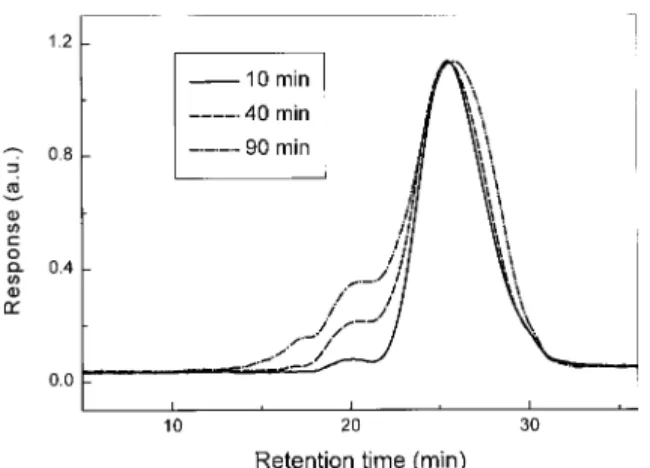
effectively and immediately removed. This tech-nique enhances the reaction, enabling it to be completed in 10 min at 113 °C. The completion of the reaction is confirmed by SEC analysis (see Figs. 1 and 2). Another advantage of this tech-nique is that the solvent composition does not change during the reaction, allowing the reaction
to proceed smoothly and in a well-controlled man-ner.
Table 1 summarizes the reaction conditions and the characterization data for the polymers prepared with this approach. In all cases, the reactions are complete in 10 min, and the molec-ular weights are very close to the designed values for all three FPAEK1 samples with Mnvalues in the range from 6750 to 18,600. The values of
Mw/Mn for the samples were below 2.6. In addi-tion no gel particles were found in any of the reactions. Examination of Figure 1 reveals the presence of a small high-molecular-weight shoul-der (⬃2%) in the SEC curve of the sample with the reaction time of 10 min. This shoulder has been attributed to the presence of branched poly-mers. As the reaction time increases, the amount of branch increases and reaches a value of about 20% at 90 min (Fig. 1). Consequently a reaction time of 10 –15 min is adopted for this reaction.
An investigation of Figure 1 reveals that the branching structures need not only be associated with the reaction between the phenol groups and
ortho-fluorines but could also be caused by other
factors. Figure 1 indicates that the molecular weight of the polymer reaches its highest value at 10 min. However, at a time longer than 10 min, significant increases in the branching structures are noted. Because the phenol in the reaction feed is not in excess, the majority of the phenol groups is rapidly consumed, and the polymer chains should be end-capped with DFBP moieties after 10 min. Therefore, the increase in the branching structures cannot be due to the reaction of the phenol groups. The most possible route appears to be an ether-exchange reaction involving ether linkages in the polymer chain with the
ortho-Figure 1. SEC curves for samples taken at different reaction time from the reaction under the same condi-tions for the preparation of FPAEK1.
Figure 2. SEC curves (low-molecular-weight col-umns) for samples taken at different reaction times from the preparation of FPAEK1.
fluorines. This hypothesis is based on the infor-mation in which ether groups have been shown to have a potential to cleave and undergo ether in-terchange in the presence of fluorine ions.30,31
The polymerization data in Table 1 indicate that the yields of the polymerization are less than 90% in all cases. These data are obtained after the polymers are washed with methanol. This proce-dure removes the low-molecular-weight materi-als. However, if the polymer is precipitated in water and washed with water, all the organic materials including polymers, small molecular weight oligomers, and residual starting materials are recovered with a yield of about 100%. The presence of low-molecular-weight materials in the water-precipitated samples was revealed by SEC analysis. The SEC diagrams depict a shoulder peak at 30.2 min (not shown). Further examina-tion of the composiexamina-tion of this shoulder peak with low-molecular-weight SEC reveals the presence of six peaks associated with low-molecular-weight species (see Fig. 2). These species are present in samples taken at 2, 5, and 10 min. The samples with a reaction time longer than 10 min (e.g., 15 and 20 min) give almost identical SEC curves to that obtained at 10 min, and these curves are not displayed in this figure. The first two peaks at the low-molecular-weight side are assigned to the starting materials, DFBP and 6F-BPA, by com-paring them with the SEC curves of DFBP and 6F-BPA. The molecular weights (MW) of the other four peaks are 910, 1270, 2030, and 2770 Da. The intensity of the first three peaks quickly de-creases to almost 0 within 10 min, whereas the intensity of the other three peaks remains almost unchanged after 2 min. This observation suggests that the species associated with the last three peaks are nonreactive. Combining this informa-tion with the knowledge of their molecular weights, the following structures were assigned to the last four peaks as the trimer with a phenol or pentafluorophenyl end cap (MW ⫽ 994 or 1020), the cyclic ether dimer (MW ⫽ 1316), the cyclic ether trimer (MW ⫽ 1974), and the cyclic ether tetramer (MW ⫽ 2632).
The material related to the peak of 1270 Da was separated and purified, the structure was then analyzed by 1H NMR and 19F NMR (not
shown), and confirmed to be a cyclic ether dimer. From Figure 2, the composition of the 10-min sample is estimated by a peak-resolving analysis, and the results are 0.3% (DFBP and 6F-BPA), 0% (910), 5.6% (1270), 2.7% (2030), and 1.1% (2770). On the basis of this analysis, the low-molecular-weight materials produced in this reaction mainly
consist of cyclic ether oligomers that contribute about 9.5% to the final product. The removal of the cyclic ethers by purification means that a yield of about 90% for the polymer is good if the formation of the cyclic ethers is accepted as un-avoidable.32
Low-Temperature Polycondensations
The use of the modified reaction apparatus means that not only a shorter reaction time can be used but also the reaction can be conducted at lower temperatures than those used previously. Conse-quently a lower boiling point solvent, THF is in-corporated into the DMAc/benzene mixture. The use of this solvent mixture, DMAc/benzene/THF (4:3:7 in volume), reduces the reflux temperature to 81– 83 °C and enables a polymer with an Mnof 18,450 Da to be produced in 100 min as indicated in Figure 3. This value is close to the designed value of 19,450 Da (sample FPAEK2 in Table 1). However, the Mw/Mn value of 2.85 is slightly higher than that of the polymer (2.54) obtained without THF in the reaction mixture. This value appears relatively constant for the first 60 min of the reaction, after which an increase is noted (Fig. 3).
The polycondensation usually follows an SNAr kinetics mechanism14 in which the formation of
the intermediate complex is assumed as the rate-controlling step. This leads to a second-order re-action kinetics and causes Mnto increase linearly with time.33 However, in this study with either
DMAc/benzene or DMAc/benzene/THF as the re-action media, Mn increases exponentially with time as shown in Figure 3. This phenomenon can
Figure 3. Time dependence of Mnand Mw/Mnon the
preparation of FPAEK2. The solid line represents the calculated curve obtained from the kinetic equation (eq 6).
only be explained by assuming that the formation of the phenoxide anion is the rate-determining step. On the basis of this assumption, the follow-ing kinetic equation can be derived for the time dependence of Mn:34
Mn⫽
共1 ⫹ r兲M0
共1 ⫺ r兲 ⫹ 2r exp共 ⫺ k1Ct兲
This equation was used to fit the experimental data as a solid line in Figure 3 with the relevant data for this reaction [r ⫽ 29/30, M0 ⫽ (336 ⫹ 362)/2] and to give a fitting constant k1C
⫽ 0.046 min⫺1. The result shows that the
sug-gested kinetics of the reaction agrees with the experimental data, confirming that the conver-sion of the phenol to the phenoxide anion is the rate-determining step for the whole reaction. This observation is consistent with other phenomena reported in this article. For example, the intro-duction of the dehydrating system to the reaction significantly increases the polymerization rate, allowing the reactions to be completed in a shorter time period and at a lower temperature (e.g., 1.5 h at ⬃80 °C). This dehydrating proce-dure can only affect the step for the formation of phenoxide anion in which H2O is produced.
Preparation of FSt Containing Fluorinated Poly(arylene ether ketone) (FPAEK-FSt)
Crosslinkable FPAEK was prepared by introduc-ing FSt moieties into the polymer chains at the chain ends or both at chain ends and inside the chain. This process is a two-step reaction con-ducted in one-pot. The first step involves reacting FSt with a large excess of 6F-BPA to produce the monosubstituted compound as shown in Scheme 2 or a mixture of monosubstituted and disubsti-tuted molecules as shown in Scheme 3. The latter can be obtained with a controlled ratio of mono-/ disubstitution with stoichiometric design and control of reaction time. DFBP is then added to the reaction mixture to obtain the polymer with the designed structure and molecular weight. If the first-step reaction is stopped when the mono-substituted product is formed, a polymer with FSt as an end group is prepared. When the reaction is allowed to proceed such that both mono- and dis-ubstituted compounds are formed, a polymer with FSt moieties as both end groups and pendant groups is obtained. During the reaction the for-mation of mono- and disubstituted products is monitored by 19F NMR (not shown). Therefore,
the reaction is easily controlled as designed.28
This allows the polymers with higher FSt content to be prepared.
1H NMR was used to determine the content of
FSt moieties as end groups and pendant groups in the final polymers. For this purpose, a model com-pound, BFSt-6F-BPA, was prepared and its 1H
NMR spectrum was shown in Figure 4. There are five peaks at 5.73, 6.12, 6.68, 6.96, and 7.34 ppm. They can be assigned to the vinyl protons of the FSt moieties and the aromatic proton of the 6F-BPA units as shown in Figure 4. Examining the
1H NMR spectra of FPAEK-FSt enables the
cor-responding proton peak found for the model com-pound to be identified for the polymer. Therefore, by comparing the integrating intensity of the vi-nyl proton peaks and the aromatic proton peaks, the FSt content in FPAEK-FSt can be calculated. The results give a value only 5–10% lower than that calculated from the feed ratio, indicating a good conversion of the FSt in the reaction.
The signal associated with the vinyl proton Ha
(see Fig. 4) is interesting because it can be used to determine the different substitution states of FSt. As the reaction time increases, a second Ha at
Figure 4. 1H NMR spectra of BFSt-6F-BPA and the
products of the reaction under the same condition as for the preparation of FPAEK-FSt/H1; the reaction times for the first step are 10, 40, and 60 min.
5.64 ppm and a third Ha at 5.51 ppm appear in
the spectra. The first, second, and third Hapeaks
correspond to the mono-, di-, and trisubstituted species of FSt with the structures illustrated as an inset in Figure 4. This assignment was con-firmed by19F NMR analysis.
On the basis of the integraing ratio of the vinyl proton peaks to the aromatic proton peaks, the conversion for the formation of the monosubsti-tuted FSt was calculated as 92% with 10 min of the first-step reaction. This suggests that the con-version of FSt to the monosubstituted species is almost complete within 10 min. At this point, only trace amounts of the disubstituted species are formed (on the basis of NMR analysis this value is less than 2%). Therefore, to produce FSt end-capped polymers, as illustrated in Scheme 2, a reaction time of 10 min for the first step is suffi-cient. When the reaction time for the first step is increased to 40 min, the amount of disubstituted species increases such that the molar ratio of mono-/disubstituted species reaches from 1 to 2. At this point in the reaction, traces of undesirable trisubstituted species start to appear. Fortu-nately, the conversion of the disubstituted to the trisubstituted species is very slow. Even when the reaction time is increased to 60 min, the total amount of the trisubstituted species is still less than 10%. Therefore, to achieve the polymer shown in Scheme 3, a reaction time of 40 min is required for the first step. With the molar entities shown in brackets under each starting material and intermediate in Scheme 2 (for FPAEK-FSt/L) and Scheme 3 (for FPAEK-FSt/H), these reactions produce polymers with Mn and mono-/disubsti-tuted FSt ratios close to the designed values as listed in Table 1.
In addition these results confirm that the para-fluorines of FSt have a higher reactivity than the
ortho-fluorines, and the first ortho-fluorine is
more reactive than the second one. Consequently, with a shorter reaction time for the first step, monosubstituted material can be achieved. This control is essential for the preparation of FSt end-capped polymer as illustrated in Scheme 2. In a similar manner, the molar ratio of the mono-/ disubstituted species can be controlled by varying the reaction time for the first-step reaction. This allows the desired polymers to be produced with independently adjustable FSt loadings and molec-ular weights.
Thermal Properties
Table 1 lists the Tg’s of FPAEK with different molecular weights and the FPAEK-FSt with both
low and high FSt loadings. DSC measurements of FPAEK with different molecular weights suggest that the Tg increases from 79.6 to 147 °C as the
Mn increases from 2470 to 18,450 Da. However, no obvious change is noted in the Tg as the FSt content is changed. The thermal crosslinking of the FPAEK-FSt at 100 °C in the presence of 1% BPO or at 250 °C without initiator results in about a 30 °C increase in the Tg. This increase is slightly lower for the polymers with low FSt load-ing. However, the Tg of the crosslinked samples appear to be independent of the thermal-curing conditions (i.e., low temperature with initiator or high temperature without initiator). This sug-gests that both crosslinking procedures give sim-ilar crosslinking structures. Films cured at the high temperatures show slight yellowing, even when the curing is conducted in a nitrogen atmo-sphere. This suggests that degradation may occur during the high-temperature curing. However, films cured at the low temperatures remained colorless and transparent. TGA analysis (Table 1) shows that all the polymers have Tdvalues higher than 430 °C. In addition, the Tdis not affected by the molecular weight of the polymers, the FSt content, and the degree of crosslinking.
The curing process of FPAEK-FSt/H1 was in-vestigated by DSC, and the results are repre-sented in Figure 5. The use of 1% BPO as an initiator in the polymer results in a large exother-mic peak that started around 90 °C and peaked at 140 °C. This result suggests that the crosslinking is fast and efficient at a temperature around 120 °C. However, when the same polymer sample is heated without any initiator, the exothermic peak was much smaller and started at about 240 °C
Figure 5. DSC curves of FPAEK-FSt/H1 showing the curing exotherms obtained in the presence or absence of initiator (1% BPO).
and peaked at about 280 °C. This finding suggests that in the absence of an initiator the crosslinking is slow, a high temperature and longer curing time are required to complete the crosslinking process. In practice, the samples were cured at 250 °C for 30 min to yield stable crosslinked films.
Optical Properties
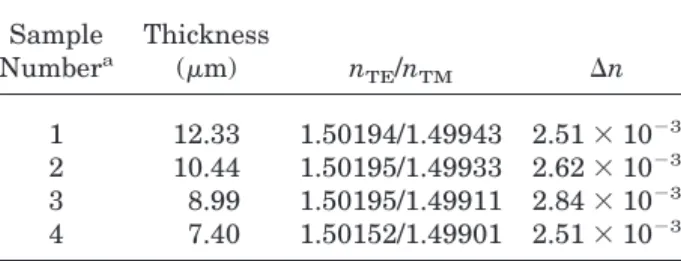
The optical properties were measured on high-quality films. These films were prepared by spin-coating a 40 wt % cyclohexanone solution of FPAEK-FSt/H1 on silicon wafers, followed by a thermal-curing procedure in an inert atmosphere at 250 °C for 30 min. The crosslinked films are insoluble in solvents such as acetone, THF, tolu-ene, and cyclohexanone. The films also adhere to the silicon substrates well, and no “flipping-up” was noted by soaking in acetone for 2 days. All the films obtained by this procedure were uniform in thickness and free from defects and possessed excellent reproducible optical properties. Table 2 provides a set of refractive-index data of films with different thicknesses. It shows that the de-viation of the data of the different films is less than 0.02%, with the exception of the thinnest sample. This performance is superior to many other polymer materials. This property is ex-tremely important in ensuring good quality con-trol and efficient manufacturing practice.
CONCLUSIONS
A modified reaction procedure was developed for the polycondensation of decafluorobenzophenone with hexafluorobisphenol A. This procedure al-lows the reaction to be conducted under milder reaction conditions at reaction rates faster than those obtained by conventional methods.
Conse-quently, side reactions such as branching and crosslinking were reduced, and the resulting poly-mers were free of gel particles and had low-mo-lecular-weight distributions. The reaction was also successfully used to introduce pentaflu-orostyrene moieties into the polymers both as end-cap groups and as pendant units. Conse-quently, the FSt loading density and molecular weight of the polymer can be adjusted indepen-dently by varying the feed ratio and the reaction time. The polymers can be crosslinked at 250 °C without initiator or at 100 °C in the presence 1% BPO. The FSt-containing polymers are also po-tentially UV curable. Therefore, they offer great potential for a direct-patterning process for the production of core structures in waveguides. For this application, FPAEK-FSt/H is an especially good candidate because of its good film-formation properties and higher crosslinking density. The authors thank Gilles Robertson for the NMR mea-surement and very helpful discussion and Floyd Toll for the microanalysis. Jiaren Liu and Zheng Shu are acknowledged for the refractive-index measurement.
REFERENCES AND NOTES
1. Diemeer, M. B. J. Opt Mater 1998, 9, 192–200. 2. Eldada, L.; Blomquist, R.; Shacklette, L. W.;
Mc-Farland, M. J. Opt Eng 2000, 39, 596 – 609. 3. Blythe, A. R.; Vinson, J. R. Polym Adv Technol
2000, 11, 601– 611.
4. Zhou, M. Opt Eng 2002, 41, 1631–1643.
5. Groh, W. Makromol Chem 1988, 189, 2861–2874. 6. Boutevin, B.; Rousseau, A.; Bosc, D. Fiber
Inte-grated Opt 1994, 13, 309 –319.
7. Eldada, L.; Shacklette, L. W. IEEE J Quantum Electron 2000, 6, 54 – 68.
8. Fluoropolymers 2—Properties; Hougham, G.; Cassidy, P. E.; Johns, K.; Davidson, T., Eds.; Klu-wer Academic/Plenum Publishers, 1999.
9. Takasaki, T.; Kuwana, Y.; Takahashi, T.; Ha-yashida, S. J Polym Sci Part A: Polym Chem 2000, 38, 4832– 4838.
10. Blomquist, R.; Eldada, L.; McFarland, M.; Nor-wood, R.; Poga, C.; Shacklette, L. W. Proc SPIE 1999, 3799, 266 –279.
11. Pitois, C.; Vukmirovic, S.; Hult, A.; Wiesmann, D.; Robertsson, M. Macromolecules 1999, 32, 2903– 2909.
12. Shah, H. V.; Hoeglund, A.; Radler, M.; Langhoff, C.; Smith, D. W., Jr. Polym Prepr (Am Chem Soc Div Polym Chem) 1999, 40, 1293–1294.
13. Bauer, J.; Dreyer, C.; Bauer, M.; Zawadzki, C.; Yilmaz, S.; Wirges, W.; Yao, H.; Keil, N. Polym Prepr (Am Chem Soc Div Polym Chem) 1999, 40, 1307–1308.
Table 2. Refractive-Index Data of Cured FPAEK-FSt/H1 Films Sample Numbera Thickness (m) nTE/nTM ⌬n 1 12.33 1.50194/1.49943 2.51 ⫻ 10⫺3 2 10.44 1.50195/1.49933 2.62 ⫻ 10⫺3 3 8.99 1.50195/1.49911 2.84 ⫻ 10⫺3 4 7.40 1.50152/1.49901 2.51 ⫻ 10⫺3
aThe films were spin-coated on silicon wafers from a 40% cyclohexanone solution, followed by a thermal-curing proce-dure in a nitrogen atmosphere as described in the experimen-tal section.
14. Smith, M. B.; March, J. March’s Advanced Organic Chemistry, 5th ed.; Wiley: New York, 2001; p 850. 15. Mercer, F.; Goodman, T.; Wojtowicz, J.; Duff, D. J Polym Sci Part A: Polym Chem 1992, 30, 1767– 1770.
16. Mercer, F. W.; Fone, M. M.; Reddy, V. N.; Goodwin, A. A. Polymer 1997, 38, 1989 –1995.
17. Goodwin, A. A.; Mercer, F. W.; McKenzie, M. T. Macromolecules 1997, 30, 2767–2774.
18. Hendricks, N. H.; Lau, K. S. Y.; Smith, A. R.; Wan, W. B. Mater Res Soc Symp Proc 1995, 381, 59 –70. 19. Miyatake, K.; Oyaizu, K.; Tsuchida, E.; Hay, A. S.
Macromolecules 2001, 34, 2065–2071.
20. Kimura, K.; Tabuchi, Y.; Yamashita, Y.; Cassidy, P. E.; Fitch, J. W., III; Okumura, Y. Polym Adv Technol 2000, 11, 757–765.
21. Lee, H.-J.; Lee, E.-M.; Lee, M.-H.; Oh, M.-C.; Ahn, J.-H.; Han, S. G.; Kim, H. G. J Polym Sci Part A: Polym Chem 1998, 36, 2881–2887.
22. Lee, H.-J.; Lee, M.-H.; Oh, M.-C.; Ahn, J.-H.; Han, S. G. J Polym Sci Part A: Polym Chem 1999, 37, 2355–2361.
23. Kim, J.-P.; Lee, W.-Y.; Kang, J.-W.; Kwon, S.-K.; Kim, J.-J.; Lee, J.-S. Macromolecules 2001, 34, 7817–7821
24. Ahn, J.-H.; Lee, H.-J.; Hwang, W.-Y.; Oh, M.-C.; Lee, M.-H.; Han, S. G.; Kim, H.-G.; Yim, C. H. IEICE Trans Electron 1999, E82-C, 354 –356. 25. Min, Y. H.; Lee, M.-H.; Do, J. Y. IEEE Photonics
Technol Lett 2000, 12, 1483–1485.
26. Kang, J.-W.; Kim, J.-P.; Lee, W.-Y.; Kim, J.-S.; Lee, J.-S.; Kim, J.-J. J Lightwave Technol 2001, 19, 872– 875.
27. Oh, M.-C.; Lee, M.-H.; Ahn, J.-H.; Han, S. G. IEEE Photonics Technol Lett 1998, 10, 813– 815. 28. Liu, F.; Ding, J.; Li, M.; Day, M.; Robertson, G.;
Zhou, M. Macromol Rapid Commun 2002, 23, 844 – 848.
29. Vuillaume, P.; Ding, J.; Day, M. Manuscript in preparation.
30. Carlier, V.; Jambe, B.; Devaux, J.; Legras, R.; McGrail, P. T. Polymer 1993, 34, 167–170. 31. Carlier, V.; Devaux, J.; Legras, R.; Bunn, A.;
McGrail, P. T. Polymer 1994, 35, 415– 422. 32. Chen, M.; Gibson, H. W. Macromolecules 1996, 29,
5502–5504.
33. Bulai, A. Kh.; Klyuchnikov, V. N.; Urman, Ya. G.; Slonim, Ya.; Bolotina, L. M.; Kozhina, V. A.; Gol’der, M. M.; Kulichihkin, S. G.; Beghishev, V. P.; Malkin, A. Ya. Polymer 1987, 28, 1349 –1357.
34. Kinetic consideration: In the polycondensation of monomers, AOA and BOB, the number of func-tional groups is assigned as NA and NB. At the
beginning of the reaction (t ⫽ 0) these numbers correspond to NA
0 and N B
0; therefore, the feed ratio
“r” is
r⫽NA0 / NB0 (1)
The Mnat any reaction time can be expressed as a
function of the degree of conversion [p ⫽ (N0⫺ N)/
N0] as35
Mn⫽M0共1⫹r兲/共1⫹r⫺2rp兲 (2)
where M0is the mass of the repeat unit. Supposing
the formation of phenoxide is the rate-determining step in this work, the rate equation of the polymer-ization can be expressed as
d关A兴
dt ⫽⫺k1关A兴关K2CO3]1/2 (3)
Because the solubility of K2CO3is very low in the
solution and the amount is in large excess, it can be assumed that the concentration of K2CO3is a
con-stant (CA[K2CO3]
1/2) during the reaction.
Integra-tion of the aforemenIntegra-tioned expression gives [A]
[A]0
⫽ exp共⫺k1Ct兲 (4)
Comparing this equation with the definition of p given previously, one obtains [A]/[A]0 ⫽ (1⫺ p);
then
p⫽1⫺exp共⫺k1Ct兲 (5)
Substituting for p in eq 2, the following expression can be derived to predict the reaction time depen-dence of Mn:
Mn⫽
共1⫹r兲 M0
共1⫺r兲⫹2r exp共⫺k1Ct兲
(6)
35. Ravve, A. Principles of Polymer Chemistry; Plenum: New York, 1995; p 283.