Analysis of Value Creation and Value Capture in
Market
By
Shailendra Yadav B.E. Mechanical Engineering
Panjab University, 1999 M.S. Mechanical Engineering
Tufts University, 2001
Microfluidics
SUBMITTED TO THE SYSTEM DESIGN AND MANAGEMENT IN PARTIAL FULFILLMENT OF THE REQUIREMENTS FOR THE DEGREE OF
MASTER OF SCIENCE IN ENGINEERING AND MANAGEMENT AT THE
MASSACHUSETTS INSTITUTE OF TECHNOLOGY JUNE 2010
L
f
r
t
s/zo4 o]ARCHNVES
02010 Shailendra Yadav. All rights reserved.
The author hereby grants to MIT permission to reproduce and to distribute publicly paper and electronic copies of this thesis document in whole
or in part in any medium now known or hereafter created.
Signature of Author:
A)
Certified by:Certified by:
Certified by:
System Design and Management January 14, 2010
LI'
Michael A. M. Davies
Seni r-'Cturer, Engineering Systems Division, Thesis Supervisor
Noubar Afeyan, PhD Senior Lecturer, Sloan School of Management, Thesis Supervisor
Todd Thorsen, PhD Technical Staff - L coln Laboratory, Thesis Supervisor
Accepted by:
Patrick Hale Director, System Design and Management Program MASSACHUSETTS INSTn/TF
OF TECHNOLOGY
JUN
16 2010
Acknowledgements
This thesis is a culmination of my professional interest and personal effort to bring clarity to business of microfluidics - an emerging and uncertain but potentially transformative technology in the life sciences. The motivation has its root in the hallmark process improvement efforts, of which I have had the privilege of being an integral part, at the Broad Institute. A four yearlong effort to optimize first generation sequencing process using microfluidics failed thrice. In the first two instances, the reasons were technical but in the last, also the most recent one, the reason was a mix of vendor's technology and market strategy. This piqued my interest to understand what and why of the microfluidics market. Quite humbly, this started as a simple hallway conversation. But, as it turns out, the interest followed me to System Design and Management (SDM) program, where it found its outlet in the form of well-deserved master's thesis. I am grateful to Pat Hale, Director of SDM program, for providing a rare opportunity through this program to gain firsthand experience in applying well-studied management frameworks and mental models for analyzing microfluidics market. Not only has this endeavor been deeply fulfilling but I also feel I have mastered the framework that will serve me well for the rest of my professional career.
The thesis journey began with a Technology Strategy course taught by Prof. Michael Davies in Spring 08. As he enthusiastically introduced our class to an array of powerful frameworks and demonstrated their utility through characterization of emerging mobile technologies, I knew I had found a set of tools for my thesis topic. I was very excited as he accepted my request to
co-advise my thesis. I would like to acknowledge his frequent critical feedback, pointed suggestions and unique insights that have significantly refined the material. Even though I missed almost every deadline I set for myself, I feel fortunate to have an advisor who has been supportive despite the fact. I would also like to thank my co-advisor Prof. Todd Thorsen, who gave me unrestricted access to his microfluidics laboratory in Department of Mechanical Engineering. In addition, he was instrumental in helping me define the scope and refine the technical aspects of this thesis. Without the key insights from Prof. Noubar Afeyan, the thesis would not have been
able to deliver -the main point and the strategic recommendations - as well as it does now.
I would also like to thank Robert Nicol, Director of Sequencing Operations, Broad Institute, who greatly helped me refine survey questionnaire and select thesis advisors. I would like to acknowledge Patrick Cahill, Director of Technology Exploration, my boss, who permitted me to attend two important conferences that gave me important access to opinion leaders, users and vendors in microfluidics. Without such access, the list of survey respondents would have been
extremely limited.
I would like to thank my wonderful girlfriend, Inku Subedi, who provided many critical comments and feedbacks that helped improve this thesis significantly. She also kindly gave me access to Brown University Library, where I actually wrote most of the draft. And, my brothers, Jeetendra Yadav and Sanjay Yadav, and sister-in-law, Brenda Yadav, for being patient as I spent most of the holidays writing my thesis.
Finally, I would like to thank my parents, Ram Akwal Yadav and Usha Yadav, for permitting my extended absence from the long-distance phone conversations and providing me with their blessings.
Table of Contents
List of Figures ... ... --.... ---...---.- 7
1 M icrofluidics M arket ... . 11
1.1 Overview of M arket Size ... 11
1.2 Current State of V alue Capture ... 12
1.3 M otivation for Further Study ... 15
2 M icrofluidics Technology... 16
2.1 Overview ... ... ---...---. 16
2.2 H istory... . ---. 17
2.3 System s V iew ... 19
2.4 Technology Innovation ... 23
2.5 Innovation Param eters... 23
2.6 Innovation Trends ... 25
2.7 Technology S-Curve ... 25
2.8 K ey Benefits...---.. .--- 27
3 D em and Opportunity ... 29
3.1 D em and Generation... 29
3.2 Custom er Segm ents... 30
3.3 Application Categories... 31
3.4 D iffusion and A doption... 33
3.4.1 K ey Factors in D iffusion and A doption... 33
3.4.2 Key Drivers of D iffusion and A doption ... 35
3.4.3 Rate of A doption... 36
4 Business Ecosystem ... . ... 39
4.1 Structure of Business Ecosystem ... 39
4.2 V alue Flow D iagram ... . ... 42
5 D ata Collection and Analysis... ... 44
5.1 Research M ethod and Im plem entation... 44
5.2 D ata Analysis ... ... 45
5.2.1 Participant Background... 46
5.2.2 Technology Param eters... 48
5.2.3 Applications ... ... . 52
5.2.4 Future of M icrofluidics ... ... ... 55
6 K ey Findings and Strategic Recom m endations ... 58
6.1 K ey Findings ... 58
6.2 Short-to-M edium Term Strategies ... 59
6.3 Long Term Strategies ... 61
Bibliography ... 63
Appendix... 66
I. Survey Questions and Responses (www.surveygizmo.com)... 66
1.1.1 Participant Background ... 66
1.1.2 Technology Param eters ... 70
1.1.3 Applications... 71
List of Figures
Figure 1. Literature Citations (US), 1997-2005, Source: Frost & Sullivan... 11
Figure 2. Gartner Hype Cycles, 2009, Source: www.gartner.com ... 13
Figure 3. M icrofluidics Scale... 16
Figure 4. A Typical Microfluidics Process Steps ... 17
Figure 5. Timeline of Key Enabling Technologies... 18
Figure 6. System Architecture of a Typical Product Using Microfluidics ... 19
Figure 7. Microfluidics Product Architecture Framework ... 20
Figure 8. System Architecture of RainDance RDT 1000 System ... 22
Figure 9. RDT 1000 Instrument and Disposable Chip (Courtesy:Raindance Technologies)... 23
Figure 10. Evolution of Key Innovation Parameters ... 24
Figure 11. Technology S-Curve... 26
Figure 12. Continuous and Droplet Microfluidics... 27
Figure 13. Positive Feedback Loop of Microfluidics technologies Demand Generation... 29
Figure 14. Customer Segments... 30
Figure 15. Microfluidics Applications... 31
Figure 16. Adoption Distribution Model, Everett Rogers, 1962 ... 37
Figure 17. Structure of Business Ecosystem... 40
Figure 18. Value Flow Diagram ... 43
Figure 19. Survey G roup... 46
Figure 20. R ole or T itle... 47
Figure 21. Decision-making Responsibility ... 47
Figure 22. Average Rank of Source of Microfluidics Expertise ... 48
Figure 23. Technology A reas... 49
Figure 24. Ranking of Microfluidics Benefits ... 49
Figure 25. Factors Driving Microfluidics Interest ... 51
Figure 26. Impact of Microfluidics Across Areas ... 53
Figure 27. Diffusion and Adoption of Microfluidics... 54
Figure 28. Ranking of Reasons for Failure of Microfluidics Benefits Capture... 54
Figure 29. Ranking Microfluidics Applications in Genomics ... 56
Figure 30. Top Ten Academic Players in Microfluidics... 56
Analysis of Value Creation and Value Capture in Microfluidics
Market
By
Shailendra Yadav
Submitted to System Design and Management on Jan 21, 2010 in partial fulfillment of the requirements for the degree of
Masters of Science in Engineering and Management
Abstract:
Advances in microfluidics in the last two decade have created a tremendous technological value which is shaping genomics; drug discovery; proteomics; and point-of-care diagnostics. The positive impact has resulted in faster analysis time, increased throughput and reduced cost
amongst other important benefits.
Yet, the life sciences end-users and the microfluidics players themselves are far from fully capturing the value. Author's own observation based on the experience at a leading genomics research institute, where multiple efforts to implement microfluidics technologies hardly succeeded, supports this fact. The failure to fully capture value has serious implications for the vendors developing microfluidics and the researchers employing these technologies. What are
the reasons for this failure? What could be done to increase the value capture?
Using well-established management frameworks, such as, s-curve, adopter's distribution model, the thesis studied the nature of value creation and value capture. Survey was used to quantify the impact and the diffusion and adoption of microfluidics technologies, as the respective indicators of value creation and value capture. The data support the insight obtained from the conceptual frameworks that microfluidics is still an immature technology. It also shows that immature technology is the primary reason for lack of full value capture rather than the lack of killer application or niche market - commonly reported reasons in the literature. As an immature technology, microfluidics is thus far still only in the hands of users who are innovators and early adopters - the academic laboratories and the research institutes. The application segments which have seen the most value capture are Genomics and Point-of-care diagnostics. The application segment which has seen the least value capture is Drug discovery. This thesis concludes with the recommendations for short and long term strategies for increasing value capture and accelerating the adoption of microfluidics.
Thesis Supervisors:
Michael A. M. Davies, Senior Lecturer, Engineering Systems Division Todd Thorsen, PhD, Technical Staff, Lincoln Laboratory
1 Microfluidics Market
1.1 Overview of Market Size
The tremendous potential of microfluidics technologies is driving the growth of microfluidics market. According to (Gomez 2008), the size of the market for life sciences application reached
$750 million in 2004. The market is expected to grow at a compounded annual growth rate of
13% to over $2 billion by 2010. (Gomez 2008) also states that the number of patents linked to microfluidics platform increased from under 25 in 1998 to over 350 in 2004. Based on the strategic analysis of biochips market in 2006 by Frost and Sullivan, the number of literature articles citing microfluidics technologies increased by an order of magnitude from about 10 in 1998 to about 740 in 2005 (Figure 1). The analysis predicted that the number will continue to increase in future as users follow proven experimental protocols employing microfluidics technologies.
Total Microfluidics/Lab-on-a-chip Market: Literature Citations (U.S.), 1997-2005
800 350 700 300 700-e 600 250 e 200 500 400--150 00100 100 50 0 -100 1997 1998 1999 2000 2001 2002 2003 2004 2005
Source Frost & Sulhivan
1.2 Current State of Value Capture
Although the data clearly shows the extremely positive outlook of microfluidics market, the literature review of microfluidics market has revealed a different reality.
(Whitesides 2006) argues that microfluidics has a bright future but it is still in its early stage of development and cites two main reasons for lack of mass adoption by the end-users:
" First, although there have been considerable technology developments as proof-of-concepts in several applications due to the work of many researchers in the academic laboratory, there is a significant lag in the commercial development of products for the end-users.
* Second, there is a clear lack of killer application' to bring about a major success even though he lists early diagnosis of disease and diagnosis of response to therapy among potential high value applications to drive the field.
On the other hand, (Haeberle and Zengerle 2007) note that a significant market for microfluidics tools already exist in the academic laboratory itself. According to them, the developers of these tools are the end-users themselves, in search of novel applications in pharmaceuticals, biotechnology and diagnostics industries. They also identify the emergence of microfluidics platforms - an integrated systems approach to the field that is, now as a result, driving several
spin-off companies.
The most recent study by (Mukhopadhyay 2009) cites Holger Becker of Microfluidics Chip Shop in Germany, who is also a microfluidics expert representing business issues in a Lab on a Chip journal. According to Becker, everyone predicted 10-15 years ago that a killer application would result in $100-300 million of total revenue. But, he describes the reality of that early prediction through Gartner Hype Cycle as shown in (Figure 2):
1 Killer application is defined in section 3.4.lin page 33
-" Technology Trigger occurred based on the early work by Andreas Manz - along with his colleagues - who is currently at University of Freiburg.
" This led to Peak ofInflated Expectations around late 90s, when microfluidics was widely predicted as a universal analysis platform.
* The peak followed by Trough of Disillusionment in early 2000 as microfluidics failed to deliver the promise it held since the hype began. But, at the moment, microfluidics is on the Slope of Enlightenment.
* Becker and other experts predict that in 5-10 years, it will reach the Plateau of Productivity. (Becker 2009) highlights the need for a killer application for commercial success of large capital intensive technology like microfluidics. He also notes that the success of microfluidics may be seen when niche market or killer application emerges during the plateau of productivity.
PL ATWW OF
001e ~ oro00 0 Vpugum
U.OPEOF ENUGNKEMENT TROUGH OF DORAUSONMENT TCHOLOGY IOWA MA UF0TY
Figure 2. Gartner Hype Cycles, 2009, Source: www.2artner.com
Furthermore, (Mukhopadhyay 2009) cites a range of perspectives by the following experts to broaden the discussion of the future of microfluidics:
" Andreas Manz hints at the likelihood of microfluidics having no major success in the
commercial market in the end even though it will continue to innovate in the academic laboratory.
" Based on his experience of watching four microfluidics companies, one of which is Raindance Technologies (www.raindancetechnologies.com), David Weitz at Harvard University points out that finding the right niche market has been the struggle of most of the companies and he re-emphasizes the importance of niche market for the success.
* Steve Soper at Louisiana State University is cautious about the optimism towards the clinical diagnostics application as a potential commercial market for microfluidics because of the lack of complementary technology. For instance, in case of cancer diagnostics, many molecular markers have not been approved by appropriate authorities like American Society of Clinical Oncology.
In addition, informal conversations with the microfluidics experts at Miniaturized Systems for Chemistry and Life Sciences (MicroTAS 2008) conference support the findings from the literature review. In addition, they also provide additional insights as described below.
" According to Todd Thorsen at Massachusetts Institute of Technology, Food and Drug Administration (FDA) regulation is one major obstacle in adoption of microfluidics by big pharmaceutical companies. This is because microfluidics devices are treated, in part, like medical devices. As such, they need to be validated in-house with biomarkers/reagents before being used to support drug discovery activities. The validation presents both technical and economic risks, which most companies are unwilling to take.
" Harold Craighead at Cornell University points out that one of the issues with microfluidics is the lack of killer application. He adds that for microfluidics to succeed the focus should not only be on the miniaturization but it should also be on new approaches to detection and analysis along with novel surface chemistries.
* Andrew Griffith at Institut de Science et d'Ingenierie Supramoleculaires (ISIS) also agrees that microfluidics has not yet found the killer application. He also thinks this I an important reason for the limited success of microfluidics.
1.3 Motivation for Further Study
In conclusion, the studies and interviews broadly inform the current state of microfluidics. They also offer a glimpse into the future through the experiences and the perspectives of the experts in the field. While everyone agrees on the tremendous value that has been created by the microfluidics technologies, almost all think that the commercial market remains far from fully capturing the value due to the lack of mass adoption by the end-users. While the studies present most up-to-date qualitative analysis, it doesn't provide quantitative data on value creation and value capture in the market. This thesis aims to fill this gap in the following ways. First, it will apply conceptual and analytical frameworks to study the microfluidics ecosystem to offer deeper insights into innovation, diffusion and adoption of microfluidics technologies. Second, it will collect and analyze data from the end-users to offer quantitative perspectives on the current state of diffusion and adoption. Finally, it will make strategic recommendations to increase the value capture for end-users and developers alike.
2 Microfluidics Technology
2.1 Overview
Microfluidics is an emerging area of study about theory and applications of low volume fluids for applications ranging from ink-jet printer to point-of-care diagnostics chip. The focus of this thesis, however, is limited to applications of microfluidics in life sciences. The scale of microfluidics volumes and sizes used in the most of the common applications today is shown in (Figure 3). PI ni pl ml I 10-12 10-9 106
i0o
4i00
Microfluidic Volume Range (100 pl - 10p) Microfluidic Channel Size Range (10 -200 Pm) A nm pm mm cm m km 10-10 10-0 10-6 10-3 10-2 100 10pFigure 3. Microfluidics Scale
Microfluidics is a highly interdisciplinary field which integrates material science, physics (fluid mechanics and optics, in particular), biology, chemistry and engineering to create a common enabling technology platform for a variety of applications. With important benefits (Section 2.8
Key Benefits) under its belt, this single enabling platform has created a tremendous value for the initial end-users with unique needs that cannot be met with current technology. Today, microfluidics-enabled applications are rapidly advancing the fields of genomics, drug discovery, proteomics and point-of-care diagnostics due to the unparalleled benefits offered by microfluidics technologies. The list of benefits includes cost reduction, scalability, and portability among many others. The technology is able to deliver aforementioned benefits by manipulating extremely low volume fluids inside the microfluidics components, such as pumps, channels, mixing units, etc as described in Section 2.3 Systems View. The manipulation of the fluids enables an important step in any biochemical assay - sample preparation. Sample preparation and detection steps (Figure 4), further enable applications ranging from screening for a drug candidate in a drug discovery process to obtaining one's genetic profile in a point-of-care diagnosis step.
Detec and
2IihIIat_
PumpM xlocuateAnalyze/~
jReagents jSga
Figure 4. A Typical Microfluidics Process Steps
2.2 History
Microfluidics became a popular technology in the life sciences community after the early work done by (Manz, Harrison et al. 1992) led to the explosion of patents, publications and further research into this area as noted by (Mukhopadhyay 2009). Although the technology has grown considerably in the last decade to address the needs of new applications in life sciences, the emergence of this technology have occurred much earlier in the form of capillary strips for
diabetes and pregnancy test in 50s (Haeberle and Zengerle 2007). The innovations in semi-conductor fabrication techniques in 60s, 80s and 90s were the key enabling technologies for the accelerated growth of microfluidics. The timeline of microfluidics development is shown in (Figure 5).
DNA
Separation
System (Caliperts ILabChip) Ink-Jet Printer (HP Thinklet)On-Strip Test Kits
(or dabetes and
pregnancy) 1960s IF 1970s Timeline 1980s 1950s E 0 U, 1990s
Figure 5. Timeline of Key Enabling Technologies
These enabling technologies led to the development of one of the most commercially successful microfluidics product, albeit outside the life sciences domain, HP ThinkJet inkjet printer (www.hp.com). Introduced in early 80s by Hewlett-Packard, the inkjet printer forever transformed the printing process from slow, low-quality and noisy dot-matrix printing into a fast, high-quality and quiet ink-jet printing. In the late 90s, life sciences market received the first commercially successful microfluidics product in the form of Caliper Life Sciences' LabChip System, 2100 Bioanalyzer (www.agilent.com). The product offered a single platform for DNA sizing, separation and quantification for DNA, RNA, proteins and cells (www.genome.gov). It
C) 0 L. 0~ ... MR-WRIMMMIMIRM W
also offered other significant benefits of speed, ease-of use, ready-to-use assays and kits over conventional gel technology.
2.3 Systems View
A microfluidics system is a key enabling technology in microfluidics based products. A microfluidics system is comprised of various types of microfluidics components, which are structurally and functionally connected to achieve unique goals of different applications. The high-level system architecture of a typical product using microfluidics is shown in (Figure 6). Most applications require some or all of the following indispensable functionalities - pumping (for delivering sample), mixing (for adding and mixing with reagents), incubating (for reaction to occur) and detecting (for reading and analyzing signals). The functionalities are provided by the respective microfluidics components: pump and channels; mixing unit; reaction unit; and detection optics.
A Typical Product Using Microfluidics
The system level operation begins inside the macrofluidics sub-system with an actuation of robotic arm, which picks up a sample from a reservoir. The injection pump then drives the sample and reagents into microfluidics sub-system. Inside the microfluidics sub-system, the sample and reagents flow through a network of channels. The mixing unit provides mixing operation prior to biochemical reaction inside a reaction unit, where the precise reaction volume is defined through high degree of flow control offered by precision pumps. After the reaction is complete, the detection sub-system collects the data using sophisticated optics and feeds them into analysis software for delivering the results of the analysis.
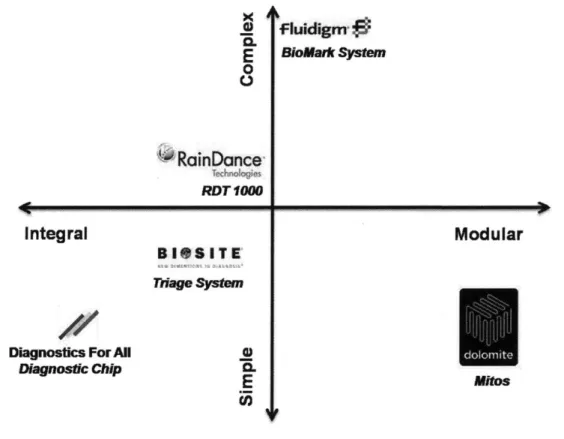
The architecture of microfluidics systems can be characterized by two factors - complexity and modularity, which segments products into each of the four quadrants of architectural framework
shown in (Figure 7). a Fiidigrrr E ioUar syster
RainDance-Techneigies RDT 1000 Integral Modular BIOSITE Thage SystemDiagnostics For All
U
Diagnostic Chsip o
E
Mit7s(Crawley 2008) defines complexity as "Having many interrelated, interconnected or interwoven elements and interfaces" modularity as a system comprising of modules, which according him are "collections of (1... n) parts which are defined by some intent to be a distinct system Consistent with this definition, Fluidigm's BioMark (www.fluidigm.com) is highly complex but moderately modular. The system has 9216 reactors, with interconnected fluidic lines, which run 9216 parallel Polymerase Chain Reactions (PCR) (www.genome.gov). It also has several modules - reactor, fluidics, optics, control software analysis software, and motion control. In contrast, DiagnosticForAll's diagnostic platform (www.dfa.org 2009) is simpler and embodies integral architecture. Although the exact number of assays wells is not disclosed, the published material on the website notes the device is very simple has only has a single module - paper chip.
To offer a deeper systems perspective of microfluidics product system, (Dori 2002)'s Object Process Methodology (OPM) tool is used to describe the architecture of Raindance Technologies' RDT 1000, a leading microfluidics product used for generating microdroplets containing libraries of DNA molecules in genomics application. As shown in (Figure 8), this characterization of the system architecture begins with the translation of product intent into a description of the problem, which is efficiently generating single molecule DNA libraries. The solution to address the problem includes the high-level concept, which maps the function -dropletizing - onto the form - DNA molecules. At a low-level, the concept represents stable
dropletizing of bulk DNA molecules using a small footprint microfluidic chip inside a microfluidics system. Finally, the solution is supported by imaging system, motion control
Problem
Solution
Context
Concept
I F Ii oaf dfc Cf~ IThe RDT 1000 instrument and disposable chip for targeted sequencing application are shown in (Figure 9).
Figure 9. RDT 1000 Instrument and Disposable Chip (Courtesy:Raindance Technologies)
2.4 Technology Innovation
Microfluidics has been on the path of continuous innovation since its emergence. This innovation can be captured by following key innovation parameters as shown in (Figure 10) and the innovation trends as described in Section 2.6 Innovation Trends.
2.5 Innovation Parameters
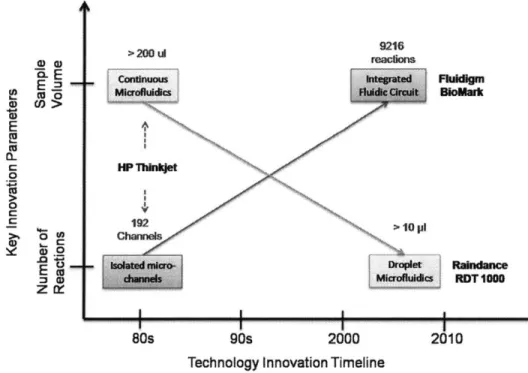
Microfluidics technologies innovation can be captured by two key innovation parameters, which have evolved over time as shown in (Figure 10).
1. Sample Volume - Microfluidics emerged with continuous bulk fluid flow, which enabled inkjet printing in Hewlett Packard ThinkJet. A typical sample volume required was > 200
pl (due to a large dead volume in the ink cartridge)2. However, with the advent of droplet microfluidics, the sample volume required is > 10 pil. This has enabled those applications requiring single molecule amplification or single cell analysis became possible (Teh, Lin et al. 2008). For instance, Raindance Technologies' RDT 1000 (www.raindancetechnologies.com) uses droplet microfluidics technologies to create libraries of single DNA molecule in droplets for sample preparation in the next generation sequencing.
2. Number of Reactions - A large number of reactions makes a parallel analysis possible. While isolated channels on silicon or glass enabled a handful of reactions, the Integrated Fluidic Circuit (IFC) architecture (www.fluidigm.com) enabled massively parallel reactions without increasing the space requirement. For instance, Fluidigm's BioMark system allows a user to run 9,216 quantitative PCR reactions in the same amount of time and footprint compared to a standard 384 well plate (www.sigmaaldrich.com).
0U) oE U E 0 0 (U 0 E Z >200 ti eacdons9216 Rudc1m EftMmi HP Tnket 192 >10 p1 RDT1000 ..... .... .... .... ... I .. ....- ...... ... 80s 90s 2000
Technology Innovation Timeline
2010
Figure 10. Evolution of Key Innovation Parameters
2 The dead volume is based on the piezoelectric ink-jet cartridge in Fujifilm Dimatix Printer and Cartridge (http://www.dimatix.com/files/printerfaqs.pdf)
2.6 Innovation Trends
There are two important innovation trends in microfluidics.
1. Fabrication Innovation - The ink jet printing in Hewlett Packard Thinkjet (www.hp.com) was enabled by silicon wet etching in 80s. On the other hand, in the 90s, the novel applications like digital PCR, gene expression and genotyping (www.genome.gov) have been enabled by multilayer soft lithography (Unger, Chou et al. 2000), using Fluidigm BioMark system (www.fluidigm.com; www.genome.gov)
2. Architectural Innovation - Microfluidics was a dominant technology in Hewlett Packard Thinkjet. But, microfluidics has gradually evolved into an "enabling technology" in new microfluidics based products. For instance, Illumina's Genome Analyzer System (www.illumina.com), a next generation sequencing product, uses microfluidic flowcell
chip - an enabling technology - for massively parallel sequencing reactions.
2.7 Technology S-Curve
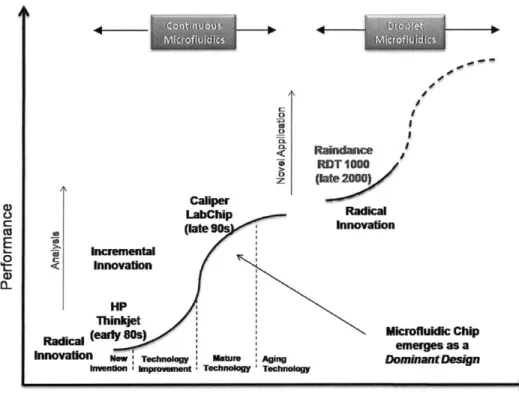
The innovation trajectory of microfluidics technologies can be represented by technology S-curve as shown in (Figure 11). The S-S-curve captures a radical innovation, which evolves over time as an incremental innovation. (Henderson and Clark 1990) have noted that the radical innovation requires new set of design and engineering principles, which has significant impact on the system components. Incremental innovation, on the other hand, is an improvement upon the existing component designs based on the same design concepts. Furthermore, (Bowden 2004) splits technology s-curve into four distinct phases. Any innovation begins with the new invention followed by significant technology improvement. Then there is a transition into the third phase, where technology matures and after a while, it ages into the fourth phase.
a)
21 Increnlenti 0 <a)ovto HP Thinkiet (al 80s) Radical Caliper LabChip (late 90V) al TimelineFigure 11. Technology S-Curve
The innovation in microfluidics technologies emerged with the radical innovation of continuous microfluidics - microfluidics of bulk sample and reagents (Figure 12). This is represented by the first S-curve. The innovation in semi-conductor fabrication technologies - in particular, silicon wet-etching - enabled the microfluidic inkjet cartridge. This led to the birth of inkjet printer at Hewlett Packard. The technology improved significantly and reached the mass market in the same decade. Driven by the needs of life sciences, microfluidics underwent significant improvement from a simple tool for enabling rapid printing to a powerful tool for biomolecule analysis. This led to a highly successful and a mature product known as Caliper LabChip system, which is used to perform separation and analysis of DNA. But, microfluidics has gone through more than one radical innovation. According to (Bowden 2004), multiple radical innovation are represented by corresponding sets of S-curves.
The second S-curve represents a second radical innovation - droplet microfluidics. As the name suggests, droplet microfluidics (Figure 12) is microfluidics of droplets, which encapsulate
< Raindance RDT 1000 Radkia Innovation Microfluidic Chip emerges as a ing Domzinant Design
individual biochemical molecule. This brings radically different applications, not realizable with continuous microfluidics, within the reach of microfluidics technologies. Targeted sequencing application is a good example, in which a target gene of interest is merged at a high speed with a PCR reagent for sequence enrichment application. By isolating a single gene inside a droplet, droplet microfluidics has eliminated the bias associated with PCR amplification when multiple genes are used during the amplification. Raindance Technologies' RDT 1000 is a commercial product which offers targeted application for genomics end-users.
DNA sample
Reagents
Bulk mix of DNA sample and reagents
E
ef
a
Figure 12. Continuous and Droplet Microfluidics
2.8 Key Benefits
The ongoing technological innovation has made microfluidics a powerful technology. As a common enabling platform for variety of applications in life sciences, microfluidics offers following key benefits.
1. Faster analysis time: Because of streamlined end-to-end process, along with highly integrated on-line detection system, microfluidics system is able to perform faster analysis compared to that of the conventional system. For instance, by automating sample preparation, Caliper LS's LabChip GX platform provides high resolution analytical data
approximately 50 times faster compared to that of manual gel based separation. Faster analysis time enables quick R&D turnaround time.
2. Higher throughput: Microfluidics systems offer highly scalable architecture that makes a significantly large number of parallel reactions possible compared to that of the conventional technology. For instance, it is possible conduct 23 times more quantitative PCR reactions using Fluidigm BioMark product compared to that of a standard 384 well plate. The parallelization reduces the variations typically seen in batch processing of samples.
3. Low sample/reagent volume: Through the use of micro-components, microfluidics has miniaturized reactions down to the volume ranging from few hundred nanoliters to a microliter. By reducing the volume of typical reactions in genomics assays, it is possible to reduce evaporation and other losses of valuable samples and reagents. This results into a potential volume reduction of up to 50% or more. This is very important where amount of sample available is highly limited (e.g. a rare tumor sample).
4. Reduced reaction cost: A lot of reagents used in important assays in genomics, proteomics and drug discovery are very expensive. Because of the reduction of reaction volumes, it is possible to perform large number of reactions at the same cost. The cost savings varies depending on the application.
5. Small Footprint/Portability: The miniature and light weight microfluidics components, along with highly scalable architecture, enable microfluidics to offer portability for mobile applications and small footprint for space-constrained laboratories.
6. Single cell/molecule analysis: Droplet microfluidics has enabled encapsulation of a single
cell in a droplet. This has an important implication for single cell assays, which was hitherto impossible to perform. For instance, it is now possible to determine the dosage requirements of a large number of drugs more accurately and at a significantly high-throughput for the treatment of a genetic disease like cancer.
3 Demand Opportunity
3.1 Demand Generation
As described in Chapter 1, the initial wave of publications and intellectual properties in microfluidics during early 90s set the expectations from this budding technology extremely high. The expectations were justified, in part, due to the demonstrated potential of this technology to transform the research, development, and commercialization of biomedicine through miniaturization of a range of applications in genomics, proteomics, and drug discovery. Specifically, microfluidics has enabled two areas, which as a part of positive feedback loop, are subsequently driving the demand generation of microfluidics technologies. The two drivers are shown in (Figure 13).
The first driver is the Process Improvements, which include projects to reduce cost, improve data quality and increase throughput in existing customer applications. A microfluidics system used in such process improvement projects is popularly known as a lab-on-a-chip system. As it became clear that microfluidics would permit the development of highly portable systems, the second driver - Novel Applications, like the point-of-care diagnostics, is driving the further demand.
3.2 Customer Segments
There are two major customer segments that are generating the demand for the microfluidics technologies as shown in (Figure 14). The first segment is industry, which comprise of tool vendors, who use microfluidics in two primary ways. First, it is used as an enabling technology inside a product that is intended for a specific application. For instance, Illumina uses microfluidic flow cell inside Genome Analyzer product for genome sequencing application (www.illumina.com). Second, it is used as a microfluidics platform inside a product. For instance, Raindance Technologies, which uses microfluidic chip, in conjunction with other sub-systems inside RDT 1000 as a platform technology for targeted genome sequencing and a host of other applications like bacterial screening.
/W
Figure 14. Customer Segments
The second customer segment, academia, comprises of research universities, independent research institutes and government. Academia is the "lead user" of microfluidics technologies. According to (Hippel 2005), a "lead user" is ahead of most of their peer users with respect to market trends. These lead users expect to benefit greatly from the solutions they develop for their needs. But the products that are developed by these lead users are highly likely to be adopted by their peers over the time. By the virtue of the volume of microfluidics applications being developed by a large number of researchers, this customer segment also significantly outweighs
industry in terms of microfluidics technologies development and adoption. The research universities usually develop their own microfluidics tools in-house for research and development. But they also purchase standard microfluidics products from tool vendors for standard applications like DNA quantitation and sizing. The independent institutes, on the other hand, typically only buy microfluidics products from tool vendors although some collaborate with academic labs for technology transfer and integration. For instance, while Broad Institute (www.broadinstitute.org) has purchased Illumina Genome Analyzer for genome sequencing, it has collaborated with Professor Todd Thorsen's laboratory3 at the Massachusetts Institute for Technology for genome sequencing sample preparation improvement.
3.3 Application Categories
Emerging applications are driving innovation in life sciences. There are four broad categories of applications that are being enabled by microfluidics technology as shown in (Figure 15).
Ce
0igotc
Figure 15. Microfluidics Applications
1. Genomics: The successful completion of Human Genome Project (www.genome.gov) in 2001 accelerated genome sequencing, genotyping, gene expression and DNA/RNA
analysis applications in genomics. Microfluidics is a key enabling technology in genome sequencing. For instance, microfluidic flowcell and picotiter plate have enabled millions of parallel sequencing reactions in next generation sequencing in Illumina Genome Analyzer and 454 Genome Sequencer (www.454.com)) respectively. Similarly, dynamic array chip has enabled 9,216 parallel reactions for genotyping and gene expression in Fluidigm BioMark (www.fluidigm.com).
2. Proteomics: Proteomics cover large-scale study of proteins to determine their structures and functions. The key proteomics applications are matrix-assisted laser desorption ionization (MALDI) mass spectrometry (Julie 2007), protein crystallization, enzyme-linked immunosorbent assay (ELISA) (Lequin 2005). Fluidigm BioMark is a microfluidics product which has enabled protein crystallization. In addition, there are ongoing developments in academia that support MALDI (Lee, Soper et al. 2009) and offer microfluidics alternative to ELISA (Dupuy, Lehmann et al. 2005) for increased cost and time savings.
3. Drug Discovery: Drug discovery is the first stage in a typical drug development process which eventually yields one drug - usually after a decade of development timeline and almost a billion dollar expenses - which offers cure for a target disease. One of the most critical steps at this stage is high-throughput screening (HTS) of millions of candidate drugs to pick a lead drug for further development. (Maerkl 2009) lists a number of approaches for performing HTS using microfluidics technologies. (Thorsen 2004) describes one specific approach using a silicon microfluidic array chip for high-throughput single cell assays.
4. Point-of-Care Diagnostics (POC): POC applications primarily include cheap and quick diagnosis of infectious or genetic diseases in decentralized hospitals or rural areas without sophisticated analytical systems. (Wei Yi 2007) notes POC applications are in need of portable automated microfluidics systems, which require least amount of sample to deliver the results quickly.
3.4 Diffusion and Adoption
The adoption of microfluidics technologies by the end-users in two customer segments (Section
3.2 Customer Segments) is necessary for microfluidics technologies to meet end-users' demand.
The rate of adoption by these end-users is reflected in the pattern of diffusion of microfluidics technologies. The diffusion of microfluidics technologies in the last decade can be best described
by probit adoption model, which is based on the premise that heterogenous users have different
goals and needs and the adoption occur at different times (Geroski 2000). With different application needs (Section 3.3 Application Categories) and priorities, microfluidics users will adopt microfluidics technologies at different times using probit model.
3.4.1 Key Factors in Diffusion and Adoption
There are then the following eight key factors - also the characteristics of a product - which influence the rate of adoption and diffusion of microfluidics technologies.
1. Availability of Application: Ultimately, the availability of application (for a new technology) is necessary for a technology to enter market and to succeed in terms of increasing sales. The ideal application is a killer application, which according to (Becker 2009) was coined in 1980s to describe applications in software industry with highly desirable properties described below:
* The sale of killer application results in increased revenue - in the range of hundreds of millions of dollars - with high margins quickly attained.
" A killer application drives underlying technology's adoption to gain bigger market share.
* A killer application not only benefits a single manufacturer but also, in fact, the whole market segment.
In addition, (Dasgupta 2002) describes the features of killer application as "A killer application has to be exceptionally appealing, amazingly useful and totally simple". While in software he lists Visicalc - the earliest spreadsheet program developed in 1979
- as an example, he also cites a telephone, email and radio as examples of other non-software killer applications.
2. Definition of Market: A niche market plays an important role in technology's success. (Shani and Chalsani 1992) defines niche market as a subset of a market with unique needs that can be met with a technology or a product. A niche market is of sufficient size, offers profitability for a company, and has a growth potential. But since this market requires specialized skills and resources to tap into, it poses a high barrier to entry. This
makes it unappealing to the competitors.
3. Maturity of Technology: The maturity of technology relates to its stage of development after the innovation occurs. The innovation occurs primarily in the form of conceptualization of an idea and proof-of-concept experiment. During the improvement phase, a technology typically moves, and often cycles through: alpha and beta stages before it enters the commercial market. The technology becomes mature once the improvement phase is over (Bowden 2004). Users are more likely to adopt a product which is mature.
4. Cost of Implementation: The cost of implementation of a novel technology includes the cost of purchase, testing and validation, training and opportunity cost. The higher cost to implement typically meets with resistance unless the value returned is significantly high.
5. Advantage over Current Technology: The new technology must have unique advantages
that would result into significant payoffs for the users. The uniqueness of advantages compared to that of current technology makes the technology highly favorable for adoption.
6. Adoptability: A new technology must be adoptable. The adoptability reflects users' willingness to adopt, which typically depends on the individual preference, group culture and the level of user innovativeness. Adoptability is critical in exploration, evaluation, and implementation of a new technology.
7. Challenges in Implementation: Implementation of new technology often poses both anticipated and unanticipated challenges. Overcoming such challenges can be costly, time consuming, and may even lead to unintended outcome, such as, total failure. Users are more likely to adopt a technology with fewer challenges that are well-understood and addressable.
8. User Friendliness: User friendliness refers to the ease of interaction with a new technology hardware and software. Users are typically resistant to behavior change. The technology with least amount of behavior change has the highest potential for adoption.
3.4.2 Key Drivers of Diffusion and Adoption
The diffusion and adoption of microfluidics technologies is driven by two important drivers (Section 3.1 Demand Generation) as shown in (Figure 13).
The first driver, Process Improvements, reflects a typical microfluidics user's exogenous needs -needs which arise in response to user expectations over time and broad societal shifts (Davies 2008). For instance, there is a need for generation of high quality biopharma process data in a short amount of time and at a lower overall cost by improving current drug discovery process. This process improvement need is driven by the following three factors: decreasing R&D budget due to stagnant government funding in recent years, decreasing number of successful drugs in the market in the last decade and increasing healthcare cost due to aging population.
The second driver, Novel Applications, on the other hand, reflects a typical microfluidics user's endogenous needs- needs which arise due to user's own changing beliefs in response to
technological innovation (Davies 2008). The need for novel applications is driven by the emergence of new possibilities. For instance, quick and cheap diagnosis of an infectious disease in a rural areas, which lacks centralized hospitals with sophisticated analytical systems.
3.4.3 Rate of Adoption
The key factors in Section 3.4.1 can be used to predict the likelihood of diffusion and adoption of microfluidics technologies. But, the actual rate of adoption (of microfluidics technologies), can be explained using the adopter distribution model (Figure 16) developed by Everett Rogers in
1957 for studying the diffusion of innovation in agricultural technologies (Rogers 2003). He
argued that his model is a universal process, which was later applied to cellular and internet technologies in 90s. According to him, the adopter distribution, which reflects the characteristics of a user, follows bell curve over a time and approaches normality. It can be divided into five categories - innovator (2.5%), early adopter (13.5%), early majority (34%), late majority (34%) and laggard (16%).
Innovators possess high degree of knowledge about the technology and take substantial risk in adopting an innovation. They are also comfortable with uncertainty.
Early adopters rely on the decision made by innovators to make their own decision about the adoption. They make well informed decisions based on the well-respected opinion leadership, most of which is available among early adopters themselves.
Early majority take long time to adopt an innovation and as such wait until the innovation is proved by the early adopters. They are the followers of innovation instead of being the leaders. They have some access to opinion leadership.
Late majority are skeptical about new innovation and adopt based on the economic necessity and peer pressures. The technology has to be improved beyond uncertainty stage for late majority to adopt.
Finally, the laggards may resist adoption until everyone before them has adopted an innovation. They have no access to opinion leadership and have very limited resources.
Or nn ue--Technolgy Adopter o 2.5% 13.5 316% 0~ 0 0 ~~~~~~~~~~~~~~~~~ . ... ... Time
Figure 16. Adoption Distribution Model, Everett Rogers, 1962
In case of microfluidics innovation, innovators are the majority of academic laboratories, which develop and adopt their own microfluidics technologies to launch new research directions or advance current research. They have significant amount of research fund and a dedicated group of scientific staff who extensively collaborate with peers in the field to enable novel science using microfluidics innovations. The innovators are also responsible for launching start-up companies, which develop their research projects for commercial market. For instance, Stephen Quake's laboratory4 at Stanford University has developed highly scalable and integrated large scale microfluidics integration platform to study novel areas like single cell analysis , chemical synthesis on a chip, proteomic biology and many more. Fluidigm, a start-up company, has developed microfluidics products for commercial market using the innovation from Quake's laboratory. There are several others leading innovators like George Whitesides at Harvard University5, David Weitz at Harvard University6, Richard Mathies at University of California Berkeley7, who are also the opinion leaders in the field.
4 http://thebigone.stanford.edu/
5
http://gmwgroup.harvard.edu/
6 http://www.seas.harvard.edu/weitzlab/
The early adopters are the research institutes with large budget and highly enthusiastic technology development groups, who are eager to adopt microfluidics innovation to advance their research. They attend conferences, where innovators present their work, and extensively network with the peers to evaluate the specific innovation to adopt. For example, Broad Institute's Genome Sequencing Platform is an early adopter of microfluidics technologies. It has recently adopted RDT 1000 from RainDance Technologies (www.raindancetechnologies.com) to prototype targeted sequencing as a part of its next generation sequencing process improvement efforts. There are early adopters like Stanford Research Institute, Biomedical Diagnostics Institute, Draper Laboratory, NASA Ames Research Center and many others that are adopting microfluidics technologies to advance their research programs.
Based on his work in 1991, (Moore 2002) has identified difficult-to-cross "chasm", which divides five adopters listed above in two distinct groups. The first group is the enthusiasts and visionaries. Almost all the microfluidics adopters fall into the first group. The second group is the pragmatist, which represents the mass market not yet captured by microfluidics. He asserts that crossing the chasm requires the following - identification and focus on a single target market, creating the whole product concept, positioning a product among the competition, building the market strategy to enter the market and penetrating the market widely through distribution channel with the right pricing. However, this assertion would have to presume that the technology is mature and is ready for adoption since early majority, by definition, waits until the innovation is proved to be successful. The literature survey does, in fact, strongly hint that the technology is immature. At the same time, it supports the previous analysis, which shows that the adoption of microfluidics innovation is only present in the first group - the enthusiasts. Finally, it also reports lack of killer applications or niche market - both of them are market related -as the reasons for the lack of mass adoption.
While Moore's analysis provides insight into important issues for crossing the chasm, it does not provide evidence to ascertain whether the lack of mass adoption is a technology or market related problem. In Chapter 5, research data will be used to uncover the exact reason for lack of mass adoption.
4 Business Ecosystem
The state of the microfluidics market is the result of the complex interaction among multiple stakeholders who have different, sometimes unique, needs and interests in microfluidics technologies, products and applications. It is easier to understand this interaction by drawing an analogy from nature. For instance, biological ecosystem is a complex system resulting from the interaction of multiple organisms with their environment. The ecosystem represents competition among organisms for survival and co-evolution of diverse species. It also represents dependency in the form of symbiosis, where the survival of at least one species is dependent on the other.
By using the nature analogy rather nicely, (Moore 1993) defines business ecosystem as "[a system in which] companies evolve capabilities around a new innovation, they work co-operatively and competitively to support new products, satisfy customer needs, and eventually incorporate the next round of innovations". (Lansiti and Levien 2004) continues this analogy by noting that business ecosystem is, "[a] loose network of suppliers, distributors, makers of related products or services, technology providers [that] affect, and are affected by, the creation and delivery of a company's own offerings" .
4.1 Structure of Business Ecosystem
As shown in (Figure 17), the structure of business ecosystem captures the architectural map of the stakeholders - their individual roles and niche areas - and also the flows of financial value and technological innovation. The stakeholders can be broadly grouped into two categories. The first group is the Users, who are the beneficiary of microfluidics technological innovation.
The second group is the Microfluidics players, which include: spin-off companies, solution companies and original equipment manufacturers (OEM). Microfluidic players are the competitors and complementors. They co-evolve in the business ecosystem to develop innovation into the products for the users.
LUniversityLaboratories
Drug Discovery Companies
Research institutes
0 (0 0-C 0Diagnostics
Government
End-users
BI@SITE
Point-of-Care
Diagnostics
fluidigmiA
'Acun;nc
Sn-oti Diagnostics For AllUniversity Laboratories
Weitz Quake Whitesides
Toolkit Companies
microni
M I CIOF U ~ f I $
fM Vendors (Fluidic, Motion Control, Optics,
Applications
Discovery
Drug-
Point-of-Care
Diagnostics
Users
Solutions Companies
Agiloet Technologies
Original Equipment Manufacturers (OEMs) are the providers of fluidic syringe pumps, motion control systems for liquid handling, electronics and optical systems. The innovation in OEM has enabled precision pumps that deliver highly controlled flow rates with positive feedback, advanced motion control systems with high precision, accuracy and repeatability, and the advanced optics with high-speed CCD camera with optical resolution. As complementors, OEMs provide components to all the other players in the ecosystem.
The Toolkit Companies offer microfluidics toolkits - micropumps, micro-valves and custom-designed microfluidic chips for a number of user applications. They provide toolkit directly to the users or other microfluidics players. For example, Dolomite microfluidics offer pumps, valves, connectors, accessories and standard droplet-generator module for droplet based analytical applications. On the other hand, Micronit, in addition to being a toolkit company, is developing products for point-of-care diagnostics and drug delivery.
The University Laboratories are the engines for radical microfluidics innovations that offer unique capabilities and enable novel applications not possible before. The breakthrough innovation typically enters the market through the spin-off companies that take the charge of commercializing it. For instance, the droplet merging and sorting capability developed in the David Weitz laboratory at Harvard University was licensed by RainDance Technologies to develop RDT 1000 platform for targeted sequencing for the genomics end-users. But the company has also started collaboration with drug discovery companies for drug screening applications.
The Solutions Companies, on the other hand, develop products based on their in-house innovation and microfluidics expertise developed over a long period of time. They source components from OEM vendors but provide specific microfluidics solutions directly to the end-users. For example, Caliper's LabChip system is one of the earliest and most successful microfluidics products for DNA/RNA sizing, separation, quantification and analysis.
Point-of-Care diagnostics (POC) companies develop products to address diagnostic end-users. On one hand, they license technology from university laboratory. For instance, a non-profit
company DiagnosticsForAll (www.dfa.org 2009), has licensed paper microfluidics technologies from Harvard University to develop a simple, easy to use, cheap and disposable diagnostic chip for the developing world. On the other hand, POC companies have also built their own diagnostic products using sourced components from OEM vendors and widely available microfabrication technologies.
4.2 Value Flow Diagram
The value flow in microfluidics business ecosystem is shown in details in value flow diagram (Figure 18). (Crawley 2008) defines value formally as "Value is delivered when the external process(es) acts on the operand in such a way that the needs of the beneficiary are satisfied at a
desirable cost". As identified in the previous section, Users are the primary beneficiaries but, value flow diagram clearly shows the existence of secondary beneficiaries - Microfluidics players. For instance, Toolkit companies, Solution companies, POC companies and Spin-off
companies have unique microfluidics component needs, which are fulfilled by OEM Companies. Similarly, Spin-off companies' have unique need for a technology, which is provided by the University Laboratories. This makes the University Laboratories the beneficiaries which also play the dual role of providers. POC companies also play this dual role by supplying diagnostic products to Diagnostics End-users and Government. On the other hand, OEM companies are the only providers which do not receive any benefit from anyone.
The value flow diagram also provides the evidence for the emergence of three major clusters based on two factors - common application(s) of interest and common beneficiaries. Cluster 1 represents Drug Discovery companies, University Laboratories and Research Institutes, which share common applications - proteomics. Cluster 2 represents Government and Diagnostic End-users which share common application - Point-of-Care Diagnosis. In addition, Cluster 2 also includes POC companies for the reason mentioned above. Cluster 3, on the other hand, represents Microfluidics players like Toolkit, Solution and Spin-off companies, which respectively provide microfluidics components, end-to-end solutions and specialized products to Users.
Cluster 1
Cluster 2