Building Mughal Burhanpur by
Rachel Pei Hirsch
Bachelor of Arts in Art History and French Studies Wesleyan University, 2015
Submitted to the Department of Architecture
in Partial Fulfillment of the Requirements for the Degree of Master of Science in Architecture Studies
at the
Massachusetts Institute of Technology May 2020
© 2020 Massachusetts Institute of Technology. All rights reserved
The author hereby grants to MIT permission to reproduce and to distribute publicly paper and electronic copies of this thesis document in whole or in part in any medium now known or
hereafter created. Signature of Author: ____________________________________________________________ Department of Architecture May 6, 2020 Certified by: ___________________________________________________________________ James L. Wescoat, Jr. Aga Khan Professor of Landscape Architecture and Geography Thesis Supervisor
Accepted by: __________________________________________________________________ Leslie K. Norford Professor of Building Technology Chair, Department Committee on Graduate Students
Thesis Supervisor
James L. Wescoat, Jr., PhD Aga Khan Professor of Landscape Architecture and Geography
and readers
Nasser Rabbat, PhD Aga Khan Professor of Islamic Architecture Director of the Aga Khan Program for Islamic Architecture Timothy Hyde, PhD Associate Professor of the History, Theory and Criticism of Architecture
Building Mughal Burhanpur by
Rachel Pei Hirsch
Submitted to the Department of Architecture on May 8, 2020
in Partial Fulfillment of the Requirements for the Degree of Master of Science in Architecture Studies
ABSTRACT
In 1601, the Mughal emperor Akbar (r. 1556-1605) successfully conquered Burhanpur, a major Sufi center and capital of the Khandesh Sultanate. A decades-long process of urban construction followed, transforming the city into a regional capital on the frontier of the Mughal Empire. However, the twenty-first-century challenges of reconstructing the seventeenth-century city have largely obscured Burhanpur’s significance, and isolated attempts at textual analysis or conservation fieldwork have provided only partial understandings of the city’s history. Responding to these challenges, this thesis proposes a method that privileges the experiential elements of understanding a city—whether gathered from textual accounts, personal observation, or visual evidence—and posits them within a larger discourse of travel and place formation. From this method emerges a reconstruction of a new Mughal capital that was built in a series of spatial and architectural developments carried out between 1601 and 1631. The function and form of these layers of construction shifted rapidly over the course of three decades based on the needs of the expanding Mughal Empire and the priorities of the individuals sustaining it. Taken together, this time-travel account reveals a previously unrecognized three-part urban process constituted by successive shifts in patronage that collectively created a legible Mughal city.
Thesis Advisor: James L. Wescoat, Jr.
Table of Contents
Acknowledgments 5
Chapter 1 7
Approaching Burhanpur: Methods and Sources
Chapter 2 23
Blessing Burhanpur: Saintly Appeals in a Pre-Mughal City
Chapter 3 34
Mughalizing Burhanpur: Symbolic Appropration of the City
Chapter 4 42
Expanding Burhanpur: Abdur Rahim’s Water System and New Urban Possibilities
Chapter 5 60
Ruling from Burhanpur: Shah Jahan’s Early Capital
Chapter 6 83
Writing Burhanpur: Concluding the Time-Travel Account
Acknowledgments
25 May 2019 IndoreI am sitting in my hotel room in Indore, where I have finally arrived after nearly forty hours of travel. I have nothing to report so far except an immense amount of gratitude and fatigue. The fatigue goes without saying—forty hours of travel is nothing to sneeze at. But I doubt many others have experienced a period of travel time (and the hours just before) with more goodwill, generosity, and love than I have. Between my friends Ayesha and Semine coming to my apartment to save the day by helping me pack, clean, and call a Lyft to the airport, running into my friend Swarnim unexpectedly during my layover in Munich, being offered a place to stay upon landing in Delhi so as not to be forced into spending a thirteen-hour layover at the airport, and eating a homecooked meal of poha and parathe, I am truly blessed. This is not to mention the help and patience of Jim Wescoat, who made sure I had a travel plan before I left in addition to imparting wisdom and guidance all throughout the development of this project, nor the kindness and support of Nasser Rabbat, nor the barrage of bon voyage texts from the people most dear to me: Shari, Andrea, Janaki, Chris, Lex, Maggie, Nick. I would also be remiss if I did not mention the last person I called before I boarded my flight out of Boston, my Dad, who as always, picked up and said everything I needed to hear. Thank you.
~ ~ ~
30 April 2020 Cambridge
As relieved as I am to have had the sense to jot down these first few notes of thanks when I began my journey, they fall short of what needs to be said now that I have reached its end. Prof. Wescoat, thank you for humoring countless hours of discussion, for providing feedback on numerous drafts, and for giving me room to work in my own way and in my own time. It is rare to have as wonderful a mentor as I have found in you. Prof. Rabbat, if it is rare to have one such mentor, I hate to think what the odds are of having two. Thank you for shaping me and my project into something better than we once were, and for reminding me to celebrate the moments in life worthy of celebration. Prof. Hyde, thank you
for your encouragement and for your incisive suggestions for building upon the time-travel account. As for my cohort—Ayesha, Nawaf, Semine, Zainab, and Reza (more or less)—I could not have asked for better people with whom to have gone through these two years. I am also grateful to MIT’s Aga Khan Program for Islamic Architecture for providing the travel grant that enabled my fieldwork in Burhanpur.
In Burhanpur, I have to thank the employees of Hotel Tapti Retreat, several of whom continue to ask about my well-being. Chotu, Lokesh, Raees and Rahul patiently answered my questions about Burhanpur, sent me videos of the city’s monuments, memorized my favorite meals, and kept me company as I typed up my fieldnotes. Karim and Sharif had the arduous tasks of driving me to nearly all of the sites I visited, walking around the sites in boiling heat, defending me from catcallers, and entreating shrine keepers to let me enter despite being a woman. They also showed me buildings I otherwise would not have known to visit and answered as many of my questions as they could. I would have been very lost—in all senses of the word—without them.
Margaret, you made me send you my location every day we were apart and then listened to me talk about Burhanpur every day when we were together in Lucknow. Thank you for both of those things, as well as for introducing me to Beecham House and reading drafts of this paper. Sourav, you are absolute sunshine and between you and Maggie I will always be in good company when discussing Mughal “peripheries.” Zehra, thank you for humoring my obsession with history and for making me feel at home. Brendan, for toiling through time travel and tintinnabulations with me, thank you.
Shari, you have been with me through it all, quite litrally since your birth, and I could not be more thankful. Dad, again, always, all of my love and gratitude.
Chapter 1
Approaching Burhanpur: Methods and Sources
“No one will deny that in questions of historical authenticity hearsay does not equal eye-witness; for in the latter the eye of the observer apprehends the substance of that which is observed, both in the time when and in the place where it exists, whilst hearsay has its peculiar drawbacks. But for these, it would even be preferable to eye-witness; for the object of eye-witness can only be actual momentary existence, whilst hearsay comprehends alike the present, the past and the future, so as to apply in a certain sense both to that which is and to that which is not (i.e. which either has ceased to exist or has not yet come into existence).”1
-Abu Raihan Muhammad ibn Ahmad al-Biruni (973-1048), Kitab fi Tahqiq ma lil-Hind The Bus Ride to Burhanpur
It is currently 102 degrees Fahrenheit and mostly sunny in Indore. In Burhanpur it is 108, but nearly every day following this one will be in the 110s. I have brought both not enough water for a five-hour bus ride in 100+ degree heat and too much water for a five-hour bus ride with no bathroom stops. Too tall to sit up in the top-bunk of a sleeper bus, I am lying on my side as we make our way from Indore, the capital of Madhya Pradesh, to Burhanpur, where I will spend the next several weeks looking at buildings constructed by rulers and officials of the Mughal Empire (1526-1857). I am in a wordless fight with the woman in the bunk below me as to whether to keep the window curtains opened or closed. It comes as no surprise that I am losing; it makes much more sense to block out as much of central India’s summer sun as possible. However, this bus ride is as close to the path the Mughal armies took on their southward marches as I will ever be able to recreate, so every couple of minutes I inch the curtains apart to get a better view of the land around me.
My goal for this trip is to collect as much information as I can about Mughal Burhanpur through methods available to me by temporarily being in a place. This form of eye-witness, as the
1 Edward C. Sachau, Alberuni’s India: An Account of the Religion, Philosophy, Literature, Geography, Chronology, Astronomy, Customs, Laws and Astrology of India about A.D. 1030 (London: Kegan Paul, Trench, Trubner & Co.,
tenth-eleventh century scholar-traveler al-Biruni might have called it, includes careful, critical, and noninvasive observation of the built and natural landscape, as well as documentation through voice recordings, photographs, sketches, and GPS maps. After I leave the city, I will combine the collected data with what al-Biruni might have termed hearsay: analyses of imperial chronicles and their associated paintings, travel accounts, Sufi hagiographies, and biographical treatises, as well as secondary sources and informal conversations with people around the city. Ultimately, I hope to extract enough information from my selected sources to reconstruct an understanding of the historical city of Burhanpur as it underwent incorporation into the Mughal Empire in the early seventeenth century.
We have just crossed the Narmada River, whose length totals 1,312 kilometers, making it the fifth-longest river in India. While the river valley has garnered significant attention over the last few decades as the contested site of the socially and ecologically disastrous Sardar Sarovar, a gravity dam initiated by former Prime Minister Jawarhalal Nehru and inaugurated by Prime Minister Narendra Modi in 2017, the region has long maintained a more positive geopolitical reputation. “Situated in the midst of the extremely dry or less fertile surroundings of Rajasthan and the western Deccan plateau,” historian Jos Gommans observes, “the Malwa-Khandesh region served as the essential springboard for further military operations towards the south, the more so because the hills provided it with excellent opportunities for fortified defence and storage.”2 Furthermore, it was through this region that one of the most widely traveled trade routes within the Mughal Empire ran, extending from Surat on the west coast to Agra in northern India (Figure 1).3
2 Jos J. L. Gommans, Mughal Warfare: Indian Frontiers and Highroads to Empire, 1500-1700, Warfare and History
(New York: Routledge, 2002): 28.
Burhanpur was a convenient trade center located at the midpoint of this route. The city is located on the southern boundary of the Satpura hills, making it the northernmost point of the geocultural region of India known as the Deccan and a critical point of access for the Mughals’ agenda of southward expansion (Figure 2). I am immediately reminded of this latter point while
Figure 1
Trade routes in Mughal India c. 1707 with the road from Surat to Agra running through Burhanpur highlighted in red
Based on Irfan Habib, An Atlas of the Mughal Empire: Political and Economic Maps with Detailed Notes,
squinting through the window to catch a glimpse of Asirgarh Fort, which the Mughal Emperor Akbar (r. 1556-1605) successfully sieged in 1601. This view, though dryer and less verdant than it likely would have been when Akbar marched through, is the same experienced by the emperor and his army as they approached the fort. I cannot make out much of the fort proper from the bus— only two minarets and some of its walls—but the scarped butte on which it sits is itself a spectacular sight. The hill is perfectly sculpted, as much a part of the fortress as are its built structures, and it is easy to imagine the awe it would have inspired in visitors and conquerors alike (Figure 3). On the final leg of the bus ride I see a memorial to the Maratha queen Lakshmibai, better known as the Rani of Jhansi (d. 1858), and some tombs on the outskirts of Burhanpur before finally arriving in the city.
Figure 2
Topographic map of South Asia
“India Geographic Map.” Accessed February 15, 2019. https://en.wikipedia.org/wiki/File:India_Geographic_Map.jpg
Reconstructing Mughal Burhanpur
Enmeshed in contemporary Burhanpur is a historical city that in as short a time span as four decades served as a Sultanate capital, Sufi pilgrimage site, trade center, cultural locus, and imperial Mughal capital. The fields surrounding Burhanpur prospered and the city flourished economically and culturally, attracting merchants, sheikhs, and artists. Despite the city’s significance, Burhanpur has long been overshadowed by the imperial capitals in the supposed Mughal heartland of northern India and has consequently been paid little scholarly attention. While studies on these northern capitals have contributed significantly to our understanding of Mughal architecture and urbanism, one wonders what lessons can be learned from a city on the imperial and historiographic periphery. What can historical Burhanpur tell us about the process of building a Mughal city and how can we best listen to its story?
Figure 3
To answer these questions I am proposing a method for carrying out architectural and urban inquiry—termed a time-travel account—that supplements historical analysis of the city with a record of a scholar’s own experience. Writing a time-travel account privileges the experiential elements of understanding a city—whether gathered from textual accounts, personal observation, or material evidence—as a way of generating a more prismatic understanding of it. Instead of an image of the city based on the imperial style of a single patron, which often dominates studies of cities such as Fatehpur Sikri and Shahjahanabad, the time-travel account exposes layers of construction as recorded by different people who experienced it.4 From this emerges an understanding of how knowledge about Burhanpur was generated, and in turn how the historical city itself was conceptualized.
The intention of the time-travel account is not to equate the twenty-first century experience of Burhanpur with the seventeenth-century experience of the city, but instead to acknowledge that a scholar’s own experience contributes to an evolving corpus of conceptualizations of Mughal Burhanpur. Like the European travel writers who made their way to Burhanpur four hundred years ago, I came to India to pursue an act of reconnaissance. While my goal for the collected information is different from the commercial aspirations that drove travelers such as William Finch and John Jourdain to Burhanpur in the seventeenth century and the later colonial ambition that characterized eighteenth- and nineteenth-century travel to India, I shared the intention of making detailed observations about a place that is foreign to me, selectively combining it with previously-made observations, and ultimately generating a new understanding of that place. In traveling to a
4 See for example:
Michael Brand and Glenn D. Lowry, Fatehpur Sikri: A Sourcebook (Cambridge, Massachusetts: Aga Khan Program for Islamic Architecture, 1985).
R Nath, Fatehpur Sikri and Its Monuments (Agra: The Heritage, Historical Research Documentation Programme, 2000).
city that has been largely neglected in contemporary urban studies of the Mughal Empire, I aimed to build on these earlier travels to shed greater light both on the historical city itself and on what such “peripheral” cities can tell us about Mughal construction more broadly.
From my time-travel account emerges a reconstruction of a Mughal capital that was manifested in a series of spatial and architectural developments carried out between 1601 and 1631. The function and form of these layers of construction shifted rapidly over the course of three decades based on the needs of the expanding Mughal Empire and the priorities of the individuals sustaining it. Initially, small, symbolic changes were rapidly applied to the urban fabric to appropriate the previous dynasty’s buildings and legitimizing mythologies. As subimperial officers—in particular the brilliant statesman Abdur Rahim—were sent to the city to govern the southern region of the Mughal Empire, Burhanpur changed from a symbolic affirmation of the empire’s expansion to a functioning space of civic activity that attracted increasing numbers of travelers, diplomats, and merchants. In the last stage of the process of building Mughal Burhanpur, Emperor Shah Jahan (r. 1628-1658) began to implement the architectural forms and symbolic motifs that would become hallmarks of both his reign and Mughal dynastic architecture more broadly, once again transforming the fabric and function of the city. Taken together, this time-travel account reveals a previously unrecognized three-part urban process constituted by successive shifts in patronage that collectively created a legible Mughal city.
Sources as Method
The idea for the time-travel account emerged from the nature of sources on the construction of Burhanpur. Scholars of Mughal architectural history have long bemoaned a dearth of contemporary architectural treatises and descriptions, and written accounts of Burhanpur in the
imperial chronicles are rare and brief.5 A wonderful exception in the Mughal textual corpus is a description of the city penned by Faizi (1547-1595), who served as poet laureate during Akbar’s reign and was sent to the Deccan on a reconnaissance mission for the emperor. While there, he penned what may have been the first travel account of Burhanpur. Historians Muzaffar Alam and Sanjay Subrahmanyam relay his description, noting that in Faizi’s view:
Burhanpur was no more than a small town (baghayat tang), but full of gardens and greenery (bustan). All cultivable land was made use of…and figs (injir) of high quality were to be found there, while firangi melons (papayas) were to be found hanging in bunches of twenty or thirty on the trunks of trees. Bananas in plenty were also to be found, while on the other hand Indian melons were imported into the area. The wind was a little hot in the month that he visited; in the day, a single layered garment was sufficient, and at night a light additional tunic was necessary. As for the water, he found it to be different from that in the neighbouring towns.6
Notably, the focus of Faizi’s descriptions are the city’s more natural elements—that is, its greenery, produce, climate, and water—with little in the way of an architectural description or an analysis of the city’s layout. In the second decade of the seventeenth century, European travelers began to visit and take note of Burhanpur’s built landscape. These later travelers hailed from regions geographically farther and more culturally distinct from Burhanpur than northern India. For these foreigners, every detail of their time away from home was worth noting. Historian Samuel Purchas describes the encyclopedic nature of English merchant William Finch’s travel account as “supplied in substance with more accurate observations of men beasts, plants, cities,
5 Writing on Mughal sources, architectural historian Chanchal Dadlani incisively observes, “…despite this emphasis
on a sense of an ordered and specific history, when Mughal texts reference buildings or cities, they tend to rely upon standard tropes rather than historically grounded observations or assessments. Additionally, Mughal architects did not write theoretical or reflective texts devoted to architecture or urbanism, like the treatises of Italian Renaissance architects or the autobiographies of the Ottoman chief architect, Sinan.”
Chanchal B. Dadlani, From Stone to Paper: Architecture as History in the Late Mughal Empire (New Haven: Yale University Press, 2018): 14.
deserts, castles, buildings, regions, religions, than almost any other; as also of waies, wares, warres.”7
Finch, who traveled to India on behalf of the English East India Company, arrived in the city on his way to Agra from Surat on February 8, 1610. An extract from his travel account demonstrates the aptness of Purchas’ observation. About Burhanpur he writes:
This citie is very great, but beastly, situate in a low, unholsome aire, a very sickly place, caused especially by the bad water. On the north-east is the castle on the rivers bank (comming from Surat), large and well fortified. By the castles side in the river lyeth an elephant of stone, so lively [i.e. lifelike] that a living elephant, coming one day to drinke, ranne against it with all his force and brake both his teeth. The head is painted red in the fore-head, and many simple Indians worship it. Some two cose forth of the citie is Can Cannas garden, called Loll bage, the whole way thereto being under shadie trees, very pleasant. Within it are divers faire walkes, with a stately small tanke standing square betweene foure trees, all shaded and inclosed with a wall; at the entrance without, a faire banketting house built aloft betweene foure trees.8
Although Finch’s commitment to detailed observation was considered unparalleled by Purchas, it in fact followed a tradition of reportage established in the fifteenth and sixteenth centuries that became the status quo for many later travel accounts. Art historian Jas Elsner and historian Joan-Pau Rubies have observed during this period a “transition from occasional to systematic empiricism in travel literature [that] first took place in the more practical field of political reportage. The reason is that ambassadors and spies were always responsible for accurate observation.”9 A prime example of this type of political reportage is Spanish ambassador Ruy Gonzalez de Clavijo’s (d. 1412) account of Samarkand, which was written with such meticulous
7 Samuel Purchas, Hakluytus Posthumus, Or, Purchas His Pilgrimes: Contayning a History of the World in Sea Voyages and Lande Travells by Englishmen and Others (Glasgow: James MacLehose and Sons, 1905): 1.
8 William Foster, Early Travels in India, 1583-1619 (Oxford: Oxford University Press, 1921): 138.
9 Jas Elsner and Joan-Pau Rubies, eds., Voyages and Visions: Towards a Cultural History of Travel (London: Reaktion
attention to detail to have had an “accumulative realistic effect” on its readers.10 Though writing two hundred years after Clavijo, Finch and his colleagues were similarly expected by the East India Company to report detailed observations of the major towns they visited as a form of mercantile reconnaissance. Written accounts initially intended to support diplomacy became a tool for bolstering European commerce and would be employed in increasingly more aggressive imperialist measures over the course of the following century.
Historian Colin Mitchell cautions that many of the travelers’ observations may in fact have been reproductions of conventional English literary paradigms intended to “familiarize” English readers with the Mughal Empire.11 As an “intermediary between a strange and mysterious Mughal reality and the contemporary readership of England,” Mitchell suggests such writing should be understood as an attempt to “‘realize’ an alien political and cultural entity.”12 While we must certainly bear in mind culturally-shaped subjectivity, literary scholar Mary Campbell argues that the early modern travel-writing genre was generally intended as a form of witness aimed at presenting the truth.13 The seventeenth century in particular saw a trend toward the solidifying of methods and structures of knowledge through empirical observation, which, Elsner and Rubies argue, “frame[d] the development of worldly curiosity by providing ever more detailed information, a system of cross-references to other sources, and hence the possibility for coherent criticism.”14 What we therefore have in early modern European travel accounts is a sustained
10 David Roxburgh, “Ruy Gonzalez de Clavijo’s Narrative of Courtly Life and Ceremony in Timur’s Samarqand,
1404,” in The “Book” of Travels: Genre, Ethnology, and Pilgrimage, 1250-1700, ed. Palmira Brummet (Leiden: Brill, 2009), 115.
11 C.P. Mitchell, “The Embassy of Sir Thomas Roe and Its Primacy in Seventeenth Century Mughal Historiography:
A Re-Evaluation” (M.A. Thesis, Montreal, McGill University, 1995): 37.
12 Ibid.
13 Mary B. Campbell, Witness and the Other World: Exotic European Travel Writing, 400-1600 (Ithaca: Cornell
method by which individuals could construct knowledge about a place, or in other words, a veritable tradition of humanistic scholarship.
Travel Writing and Architectural History
Despite the near-ubiquitous use of historical travel accounts and contemporary travel as source-methods in the field of Mughal architectural and urban history, scholars have not yet fully made a connection between these two source-methods, nor forged them into a tool of analysis. A residual Enlightenment insistence on objectivity and recent scholarly anxiety about Orientalist biases in personal observation have managed to occlude what is in fact a lineage of writing about a place. While some scholars, such as historian Corinne Lefevre, have lauded travel accounts for their ability to “offer their audience a clear and comprehensive account of the political customs of such exotic kingdoms,” writer William Dalrymple has observed that “if travel writing has in general had a fairly bad press from post-colonial writers and thinkers, then European travel narratives of the colonial world have a very bad press indeed.”15 He attributes this to a misutilization of literary scholar Edward Said’s Orientalist framework, noting that since the 1978 publication of
Orientalism, “…the exploration of the East—its peoples, habits, customs and past—by European
travelers has become the target for what has effectively become a major scholarly assault.”16 Just as influential in the field of South Asian art history has been art historian Partha Mitter’s Much
Maligned Monsters: A History of European Reactions to Indian Art, which was published just a
year before Orientalism and quickly became a canonical text in the discipline.17 Mitter’s
15 Corinne Lefevre, “State-Building and the Management of Diversity in India (Thirteenth to Seventeenth Centuries),” The Medieval History Journal 16, no. 2 (2013): 428.
William Dalrymple, “Preface,” in Visions of Mughal India: An Anthology of European Travel Writing, ed. Michael H. Fisher (New York: I.B. Tauris, 2007), vii.
16 Ibid., vii-viii.
17 Mitter states, “…throughout the greater part of this long period ideas about Indian art were much the same and they
admonishment of travel accounts as “far from being objective or truthful” generated lasting doubt in their utility and concomitantly in the experiences of contemporary traveling scholars themselves.18
Fortunately, there does exist scholarship on the significance of travel accounts to our reconstructions of Mughal, South Asian, and Islamic history more broadly. In Indo-Persian
Travels in the Age of Discoveries, 1400-1800, for example, Alam and Subrahmanyam discuss the
relationship between travel writing and the definition of an Indo-Persian cultural region. Likewise, historian Zayde Antrim’s “discourse of place,” a conceptual framework used in her 2012 monograph Routes and Realms, underscores texts that “did not simply reflect or explain territoriality, [but] produced it.”19 While Alam and Subrahmanyam throughout their book contribute substantial insights into the travel account as a historical genre, they refrain from extending the relationship between textual accounts and the definition of a cultural region beyond the travel account genre. Antrim, like Alam and Subrahmanyam, is transparent about her interest in textuality, noting that her project is “not a book about land per se,” but instead “about books, or rather about texts in a variety of forms…”20 In a departure from the duo’s interests in travel accounts, however, she eschews “privileging those works that seem to furnish the most reliable and straightforward evidence for the reconstruction of the physical environment of their era, such
disseminating information about Indian art on their return. Naturally they also had an overwhelming role in forming the early Western image of Indian art. It does not surprise us that these travelers believed in the essential truthfulness of their reports, which were of course unquestioningly accepted by their contemporaries. Yet, as a comparison of actual Indian sculptures with their early descriptions reveals at once, the early travel accounts were far from being objective or truthful. This is not to say that there was a deliberate conspiracy, for that would have made our task somewhat easier. It is simply that early travelers preferred to trust what they had been taught to expect instead of trusting their own eyes. The outcome of this was the universal use of certain popular European stereotypes for delineating Indian gods, whether in literature or in the graphic medium.”
Partha Mitter, Much Maligned Monsters: A History of European Reactions to Indian Art (Chicago: University of Chicago Press, 1992): 1.
18 Ibid.
19 Zayde Antrim, Routes and Realms: The Power of Place in the Early Islamic World (New York: University Press,
as geographical and travel literature, and affords equal weight to more historical, anthological, and artistic works.”21 By acknowledging the ability of a variety of sources to construct a place, Antrim offers a bridge between traveling and being in place, the travel account genre, and other forms of place-based writing.
While Antrim thus makes a valuable intervention by connecting different sources to the shared production of place-making, we have yet in this discussion to make the jump from writing about place to writing about the physical construction of a place.22 In their 1993 book Pivot of the
Punjab: The Historical Geography of Medieval Gujarat, architect Abdul Rehman and architectural
historian James Wescoat use a method that approaches the time-travel account by linking their surveys of Gujrat District to a tradition of English gazetteer writing. First noting the importance of the information provided by historical gazetteers, Rehman and Wescoat then make an effort to correct for their observation that these texts “lack a probing or comprehensive perspective on the factors involved in shaping and guiding the historical geography of the region.”23 In order to supplement the district survey tradition, they “systematically survey the historical, architectural, and archaeological heritage of an area;...identify some of their basic geographic patterns; and…discern some of the factors responsible for those patterns.”24 The combined results of their
21 Ibid., 3.
22 Naturally, additional writing about travel and the construction of place abound, particularly in the fields of
anthropology and geography. See for example, the work of James Duncan, Anne Feldhaus, Ann Gold, and Derek Gregory. Few if any of these writers, however, are concerned predominantly with architecture or urban construction. James S. Duncan and Derek Gregory, eds., Writes of Passage: Reading Travel Writing (London ; New York: Routledge, 1999).
A Feldhaus, Connected Places: Region, Pilgrimage, and Geographical Imagination in India. (Place of publication not identified: Palgrave Macmillan, 2016).
Ann Grodzins Gold, Fruitful Journeys: The Ways of Rajasthani Pilgrims (Prospect Heights, IL: Waveland Press, Inc., 2000).
23 Abdul Rehman and James L. Wescoat, Pivot of the Punjab: The Historical Geography of Medieval Gujrat (Lahore:
Dost Associates Publishers, 1993): 67.
“contemporary landscape experience” and the historical gazetteer information allow Rehman and Wescoat to more comprehensively reconstruct the historical region of Gujrat.25
In a conversation with former First Lady Jacqueline Onassis Kennedy, garden historian Elizabeth Moynihan relays another example of approaching the time-travel account.26 During their discussion, the First Lady recommends to Moynihan that she write about her experiences doing fieldwork on Mughal gardens. Although Kennedy describes these experiences as a great adventure, Moynihan insists that she “found focusing on history more appealing than writing about [her] personal experience” and included little about her fieldwork presence in her academic essays and monograph.27 It is not until Moynihan writes a memoir for an online archive of her work created by the National Museum of Asian Art that we are finally given a sense of how she set out to follow the route of the first Mughal emperor Babur (r. 1526-1530) into Hindustan: “gripped by Babur’s adventures, amused by his rowdy escapades with his friends, plagued by the gaps in the narrative, charmed by his descriptions of the flora and fauna of India, [and] impressed by his diplomatic skill and poetic gift…”28 In describing her experience as such, it becomes clear that Moynihan’s reconstruction of Babur’s gardens was at least in part the result of a twentieth-century attempt to understand Timurid gardens through Babur’s eyes. It was this shift in perspective that helped lead to the rediscovery of a garden built by Babur in Dholpur, India that had perhaps been lost for centuries prior, and to the excavation of the Moonlight Garden on the bank of the Yamuna River opposite the Taj Mahal. Moving us far beyond anxieties over travelers’ subjectivities and positivist
25 Ibid., 68.
26 Elizabeth Moynihan, “Discovering Babur’s Gardens: The Elizabeth Moynihan Collection in the Freer|Sackler
Archives,” Freer Sackler, accessed April 9, 2020, http://archive.asia.si.edu/explore/babur-gardens/default.php.
fallacies, Moynihan’s personal essay instead creates space for personal interpretation and, indeed, discovery.
Moving Forward
What is left after an evaluation of these methods is the need for one that supersedes discrete analyses of varying textual genres, paintings, and material remains and allows for new combinations of historical sources with the contemporary experiences of the scholar-traveler. Implementing such an approach opens the reconstruction of the historical city to a greater emphasis on process and diachronic analysis. Instead of looking to the completed city or building for what it can tell us about style and ideology, this method allows various conceptions of Burhanpur to generate prismatic and changing understandings of the city as it underwent the process of becoming Mughal. This reading allows us to see layers of the city’s construction over the course of a thirty-year period and sheds light on the multi-step process of creating a Mughal city as Burhanpur was incorporated into the empire.
The following chapters of this thesis trace the process of constructing Mughal Burhanpur from its conceptualization as a divinely ordained city under the command of the Faruqi Dynasty to its use as an imperial Mughal residence.29 In chapter two I introduce pre-Mughal Burhanpur and explore the legitimizing strategies used by Faruqi kings to justify their rule over the city. In chapter three, I look at the subsequent Mughal appropriation of the Faruqi urban landscape upon their
29 As it traces the process of building Mughal Burhanpur, this study takes into account developments in both the
urbanization and urbanism of the city. In a study of Mughal Lahore, architectural historian James Wescoat describes these respective concepts as the “processes of agglomerative settlement that established centers of political, economic, and social control” and the “culture of the urbanized place: that is, the human experience, meaning, and identity of the places inhabited.” Indeed, it is a central argument of this paper that Burhanpur necessarily underwent changes in both its spatial and interpretive dimensions in order to become a Mughal city.
James L. Wescoat, “Gardens, Urbanization, and Urbanism in Mughal Lahore: 1526-1657,” in Mughal Gardens:
Sources, Places, Representations, and Prospects, ed. James L. Wescoat and Joachim Wolschke-Bulmahn
conquest of the city. In chapter four I spatially analyze the architectural patronage of statesman Abdur Rahim and other subimperial officers, which expanded the city and increased its functionality as a civic center. Chapter five looks to the ways Emperor Shah Jahan conceptualized Burhanpur as a symbol of empire by implementing the imperial motifs that would come to define Mughal architecture up to the present day. The thesis concludes with a look at how the city was understood after the capital of the Deccan province was shifted away from Burhanpur to Aurangabad, and how the time-travel account contributes to our conception of Burhanpur and the field of Mughal architectural history and urban studies more broadly.
~ ~ ~
It is 104 degrees Fahrenheit when we finally pull in to Burhanpur’s bus stand at 7:30 pm. After realizing that Uber and Ola have yet to make it to Burhanpur, I hop on an autorickshaw and head to the Hotel Tapti Retreat, where I will eat, sleep, plan my fieldwork mornings, type up my notes, and talk to hotel employees for the next several weeks. I check in and make a plan to visit the first of what will end up being many more sites than originally expected. I then wolf down a dinner of saag paneer and roti and fall fast asleep.
Chapter 2
Blessing Burhanpur: Saintly Appeals in a Pre-Mughal City
It is said that in 1320 the master of the Chishti order of Sufi sheikhs Nizam al-Din Awliya’ (d. 1325) received a book from heaven stating that whomsoever he entrusted with the possession of any dominion would retain it forever.30 Upon reading this, Sheikh Nizam al-Din sent his successors away from Delhi, appointing “each one of them over every clime and domain, and each one over a realm and district.”31 Following Nizam al-Din’s orders, one of these disciples, Sufi Sheikh Burhan al-Din Gharib (d. 1344), found himself at a village on the bank of the Tapti River while traveling to his assigned dominion. Taken by the “very pleasant and delightful place,” he was overcome with a desire for the small settlement to be established as a city.32 Sheikh Burhan then made ablutions and led communal prayer while standing on a rock in the river, entering into an intimate conversation with God and entreating that “in this place a town by the name of Burhanpur become inhabited.”33
Soon thereafter, the Faruqi ruler Nasir Khan (r. 1399-2437) founded Burhanpur as a capital city from which to govern the eponymous Khandesh Sultanate (Figure 4). Nasir Khan and his successors built a palace-fort along the river overlooking the rock on which Sheikh Burhan stood, and patronized the shrines, tombs, and mosques that would make Burhanpur a political, religious, and cultural center. Later Faruqi kings circulated the story of Sheikh Burhan and similar Sufi narratives about the founding of the city to defend their right to rule Khandesh in the face of increasing territorial contestation. This chapter looks first to the urban landscape established by Burhanpur’s founders before analyzing the later Faruqi kings’ architectural patronage at the end
30 Carl W. Ernst, Refractions of Islam in India: Situating Sufism and Yoga (New Delhi: SAGE, 2016): 45. 31 Ibid.
32 Ibid., 47. 33 Ibid.
of the sixteenth century. Combining a Sufi legitimizing mythology with significant mosque construction towards the end of the sixteenth century, the later kings ultimately created the urban landscape appropriated by the Mughals upon their conquest of the city in 1601.
Figure 4
Map of India in 1525 with Khandesh marked in red
Early Faruqi Construction: Defensive Fortifications, Tombs, and Sufi Shrines
As a small kingdom situated between the powerful states of Malwa and Gujarat to the north and west and the Deccan sultanates to the south and southeast, Khandesh occupied a particularly vulnerable geographic position and the design of its capital city reflected a need for defensive fortification. Like many medieval cities, Burhanpur was sited near a defensive citadel, in this case Asirgarh Fort, which I had seen on my bus ride roughly twenty-five kilometers away from the city. It is difficult to determine which parts of Burhanpur’s walls were built by the Faruqis and which were built later, but the city was likely fortified with extensive ramparts soon after its conception.34
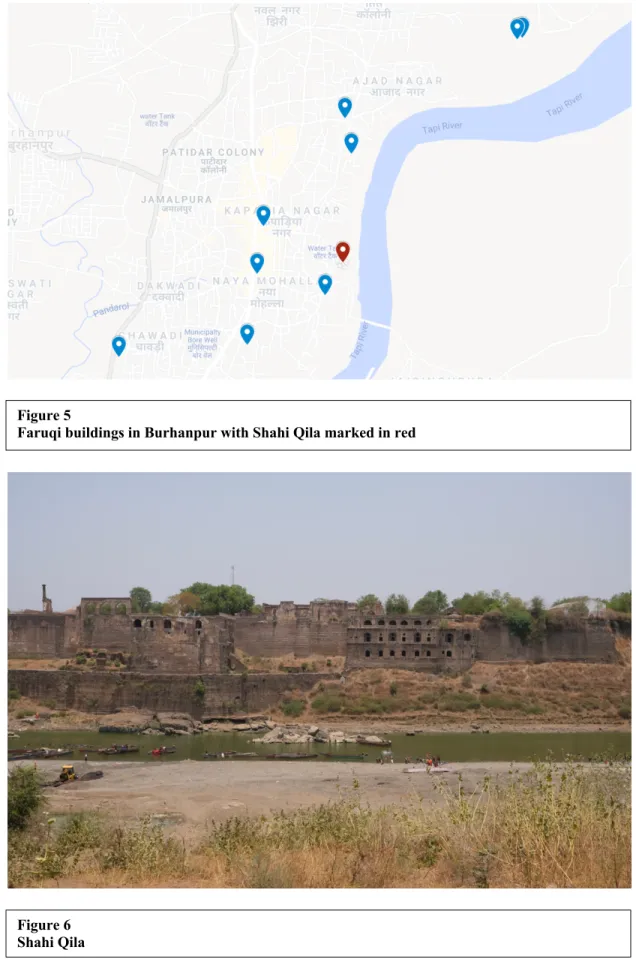
The nucleus of the walled city was a defensive palace-fort called the Shahi Qila (literally, King’s Fort). As with Burhanpur’s walls, it is difficult to differentiate the Faruqi palace construction from later additions, but its location along the Tapti River remained unchanged over time and it is from this point that the rest of the city was planned to the northwest (Figure 5). The current structure rises eighty feet above the riverbank over a span of seven floors and has several staircases leading to the river (Figure 6). Local guidebooks describe it as bhool bhoolauya, or labyrinth, and indeed, to stand on the riverbank—which itself is many meters from the dry riverbed—and to look up at the palace is to be faced with a feeling of total impenetrability.35 The deterring fact of the palace’s sheer height, which calls to mind the verticality of nearby Asirgarh Fort, is amplified by the complicated internal corridors, staircases, and interconnected rooms set across its many floors.
34 Many of the city’s extant gates were built by Maratha rulers in the eighteenth century, but all of the extant Faruqi
structures besides the tombs fall within their circumference suggesting the gates were initially conceptualized as part of the city’s original fortifications and later renovated.
Figure 5
Faruqi buildings in Burhanpur with Shahi Qila marked in red
Figure 6 Shahi Qila
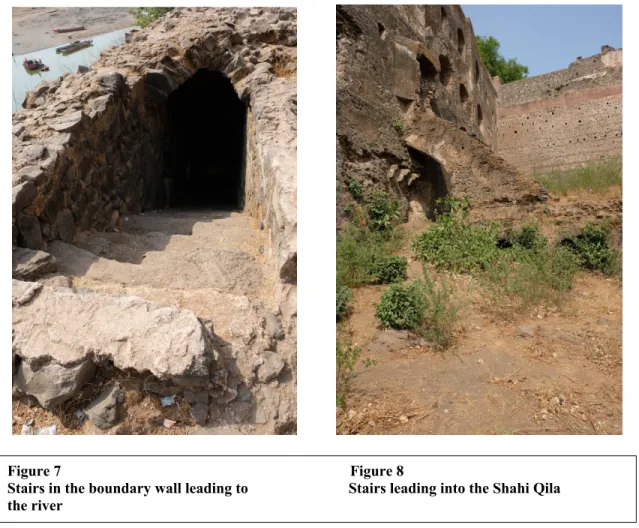
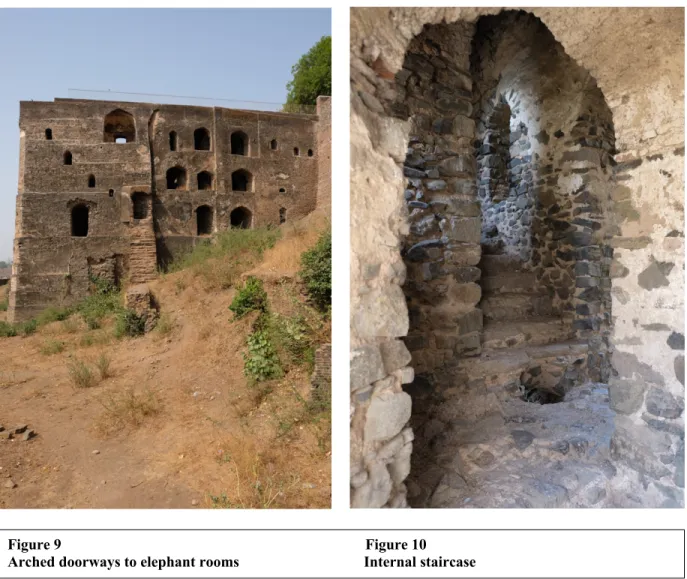
Although visitors usually enter the Shahi Qila from the entrance built by the Archaeological Survey of India on the palace’s west side, I noticed another way to approach the palace-fort one day when I descended the steps of the Raj Ghat to the Tapti’s riverbed. As I walked along a lower boundary wall around the palace, I encountered a set of stairs inside the wall leading down to the river and a separate staircase attached to the palace proper that grants access into the structure’s lower levels (Figures 7 and 8). This part of the palace is blocked off from the upper floors, preventing visitors who go in through the main entrance from descending into them. This is perhaps for good reason as it was admittedly not until I fell off the lower boundary wall that I found myself at the bottom of the external staircase leading into the castle. Had I climbed up these stairs in the sixteenth and seventeenth centuries, I would have come face to face with elephants
Figure 7 Figure 8
Stairs in the boundary wall leading to Stairs leading into the Shahi Qila the river
housed in large rooms with open archways when not used to defend the city (Figure 9). While some of the archways led to additional sets of stairs, others opened out onto a view of the river where one misstep would lead to a long fall to the riverbank (Figure 10).
But Burhanpur was hardly conceived in exclusively defensive terms and its surviving architecture demonstrates its residents’ funerary and religious concerns as well. To the northeast, it is possible to make out the tombs of the Faruqi kings Nasir Khan (d. 1437) and Adil Khan II (d. 1520). These tombs were built along the Utavali River, which, along with the Mohna constitute the two rivers that converge with the Tapti around Burhanpur. Throughout the city are a number of dargahs (tomb shrines) of Sufi sheikhs who visited Burhanpur in the fifteenth and sixteenth
Figure 9 Figure 10
centuries, including Shah Bajan (d. 1507) and Sheikh Bhikari (d. 1526), which are well-maintained and frequented still today. Across the river you can see the Zainabad masjid (mosque), serai (rest house), and extensive banana fields that make up a suburb named for another of Sheikh Nizam al-Din’s disciples, Sheikh Zayn al-Din Shirazi (d. 1371).
From the palace you can also see Sheikh Burhan’s rock, which was sculpted into the shape of an elephant when Akbar conquered the city. French traveler Jean de Thevenot records his view of the rock from the galleries at the top of the Shahi Qila, “where the king (when he is at Burhanpur) comes to look about him, and to see the fighting of elephants, which is commonly in the middle of the river; in the same place, there is a figure of an elephant done to the natural bigness…”36 The physical proximity of the rock to the castle would have served as an apt metaphor for the figurative closeness of the Faruqi rulers to the Sufi sheikhs from whom they claimed their right to rule, allowing the khans to easily point to material proof of their divine ordainment.
And what of the residential buildings, markets, and other structures required to make a city a city and a capital a capital? Here we can again turn to the observations of our seventeenth-century travelers for insights as to what may have existed and why these buildings did not survive. Sir Thomas Roe, Jean-Baptiste Tavernier and Jean de Thevenot all describe structures built of material less durable than that used to construct the city’s palace, shrines, and tombs. Roe, for example, observes “the whole Citty (which is veary great) being all builte of Mudd baser than any Cottage…”37 Tavernier likewise notes that Burhanpur’s “houses are for the most part covered with thatch.”38 Of these houses Thevenot further recounts they were “not at all handsome, because most
36 Guha, India in the Seventeenth Century, 121.
37 Sir Thomas Roe, The Embassy of Sir Thomas Roe to the Court of the Great Mogul, 1615-1619: As Narrated in His Journal and Correspondence, Issue 1 (London: Hakluyt Society, 1899): 91.
38 Jean-Baptiste Tavernier, Travels in India, from the Original French Edition of 1676, with a Biographical Sketch of the Author, Notes, Appendices, Etc., trans. Valentine Ball (London: Macmillan and Company, Limited, 1889): 51.
of them are built of earth.”39 While few if any of these structures have survived to the present day, their record in these travel accounts gives a sense of what existed in Burhanpur when the city was encountered by travelers at the beginning of the seventeenth century.
Rocks, Mosques, and Minbars
Towards the end of the sixteenth century, Faruqi kings promulgated the relationship between their dynasty and the city’s founding by Sufi sheikhs with even greater intensity to legitimize their rule. In another popular foundation story, Nasir Khan offers Sufi Sheikh Zayn al-Din Shirazi a donation for the upkeep of shrines in the Deccan city of Khuldabad, but the sheikh declines. The sheikh instead requests, “when you have built a city in the name of Shaykh Burhan al-Din, filled with mosques and minbars, make it your capital.”40 Nasir Khan obliges and the city of Burhanpur is founded soon after. As religion scholar Carl Ernst observes, “the whole thrust of this account is to demonstrate that the Sufis of Khuldabad not only blessed, but even ordered, the foundation of the capital cities of Khandesh.”41
However, the driving force of the sheikh’s request—the construction of a city filled with mosques and minbars—remained unfulfilled for more than a century after Nasir Khan’s death. It was not until the sixteenth century that the city’s first communal mosque was built. Construction on the city’s largest mosque, now known as the Jama Masjid, began as late as 1588. An inscription on the Idgah near Asirgarh Fort records that it too was renovated in 1588, a date that likewise marks the patronage of the fort’s Jama Masjid. Similarly, Burhanpur’s Kali Masjid has been dated
39 J.P. Guha, India in the Seventeenth Century, Being an Account of the Two Voyages to India by Ovington and Thevenot, to Which Is Added the Indian Travels of Careri: The Voyages of Thevenot and Careri (New Delhi:
Associated Publishing House, 1975): 121.
40 Carl W. Ernst, Eternal Garden: Mysticism, History, and Politics at a South Asian Sufi Center (Albany: State
to the reign of the last Faruqi ruler, Bahadur Khan, who ruled Khandesh from 1596-1601. The fulfillment of the sheikh’s request long after Nasir Khan’s death suggests that the myth was revitalized alongside later mosque patronage to reinforce the Faruqis’ political claims with significant religious infrastructure.
The desire to legitimize Faruqi rule was further manifested in the inscriptions written on these religious structures, such as one on the Asirgarh Idgah that reads:
Oh God! Bestow your mercy upon the king who constructed this building for us. He made the old building a new one; (so) keep his kingship as long as the empyrean…
This place is enlightened and is a namazgah. And it is wonderful in that it is approached from two sides
Before this, under such a shadow, light has shone forth from sun and moon. This auspicious edifice has been completed in the year nine hundred ninety-seven (A.H. 997 = 1588-89 A.D.);
in the reign of ‘Adil Shah the king, the work of the namazgah has been carried out. In the time of the just emperor, the place of worship has been completed.
Oh Lord! Protect this city till the sun and the moon endure.42
Appeals for the protection and continued longevity are mentioned several times in the inscription (e.g. “keep his kingship as long as the empyrean” and “protect this city till the sun and the moon endure”) and although such appeals may appear conventional, the inscription can be contrasted with earlier ones, such as that of the tomb of the fourth Faruqi king Mubarak Shah (d. 1457) built more than a hundred years before the Idgah’s renovation. The tomb inscription has no such supplication and emphasizes instead the superlative nature of the king (“noblest among the khans of the time and the bravest among the khaqans of the age, the one who attained the mercy of
42 S.A. Rahim, “Some More Inscriptions from Khandesh,” in Epigraphia Indica: Persian and Arabic Supplement
Allah”).43 Asking not for longevity of rule but for forgiveness (“may he be forgiven”), this inscription betrays no level of anxiety about the resilience of the Faruqi dynasty even as it records the death of one of its members.44 The same can be said for an inscription on the tomb of Faruqi nobleman Amir Yar ‘All (d. 1504), which focuses on God’s blessings and the nobleman’s status as a martyr and contains no appeal for the protection of the Faruqi Dynasty.45
Returning to the story with which we opened this chapter, we once again encounter Sheikh Burhan standing on a rock in the Tapti River and seeking approval from God for a city by the name of Burhanpur. Read again in the context of the later Faruqis’ appeal to religious legitimacy through mosque construction and inscription, the allure of the story’s promise of territorial perpetuity is
43 The inscription reads:
The death took place of the mighty, the just and the illustrious sultan, the noblest among the khans
of the time and the bravest among the khaqans of the age, the one who attained the mercy of Allah, the Beneficent Lord, namely Mu'lnu’l-Haq wa’s-Saltanat wa’d-Dunya wa’d-Din Mubarak Khan 'Adil, may he be forgiven, on the twelfth of the respected month of Rajab in the year (A,H.) eight hundred sixtyone 12th Rajab A.H. 861=5th
June 1457 A.D.).
When Thou hast opened the door of Belief, closest not the path of pardon in the face of the sinners on behalf of the Chosen and Selected (i.e. Prophet Muhammad)!
Ibid. 67
44 Ibid., 68.
45 The inscription reads:
The chief of Arabia and ‘Ajam (i.e. Persia), may the blessings and salutations of Allah be upon him and his descendants, has said, ‘A true believer is alive in both the worlds. 5 And (he), may peace and salutation be upon him, has said, ‘The true believers do not die but they (only) move from one house (this world) to another (the next world).
And (he), may salutations, blessings and respects be upon him, has said, ‘He whose last words (at the time of death) are ‘There is no god except Allah’ enters Paradise.’ And (he), may the blessings of Allah be upon him and his descendants and may He not deprive us of his generous favours, has said ‘A generous man is near Allah and near Paradise but far from Hell.’
He (i.e. Allah) has an angel (whose duty is) to shout every day, ‘Be born for death and build for destruction’ (i.e., he who is born dies and anything that is built is ultimately destroyed).
Verily, he answered to (the call of) the executor? of his Lord and happily accepted (the call of death) (and passed away) from the house of trouble and deceit (i.e. this world) to the house of rest and pleasure (i.e. next world), namely, the martyr who tested martyrdom and obtained the status of a martyr, the noble and the generous Amir, the like of whom is scarce during the revolutions of times as long as the revolving heavens revolve, one who took away all the reeds of perfection in the matter of generosity in the field of existence,
the unique of the age, the phoenix among the human beings, the incomparable one in the age for bestowing gifts, one who has succeeded to receive the mercy of Allah, the King, the Lord, the Friend, viz. the great and illustrious Amir Shuja‘uT-Millat wa’d-Daulat wa’d-Dunya wa’d-Dln, Yar ‘All, may Allah give him place in the gardens of His Paradise and pour upon him the heavy rains of His Mercy and Pleasure, on the twentyeighth of the month of…the year (A.H.) nine hundred and nine…18th January 1504 A.D.).
thrown into even greater relief. At its broadest level, there is the idea that Nizam al-Din Awliya was entrusted by God with the ability to distribute “every clime and domain…and realm and district,” suggesting that whoever controlled a region had been given the privilege of doing so by God.46 Furthermore, those in power resided in “a city and a dominion,” such as Burhanpur and the surrounding Khandesh Sultanate, because they had been commanded to do so.47 Lastly and perhaps most importantly is the statement made by God to “let anyone to whom Nizam gives dominion hold it safely until the resurrection, and give no change or alteration in that path.”48 In other words, whomever Nizam al-Din Awliya entrusted with a territory was entitled by God to retain it forever. As the Faruqis sought to maintain their claim to Burhanpur at the end of the sixteenth century, stories such as these created a mythological foundation for their capital city and their claim to dynastic perpetuity. Unfortunately, as they boasted of the city’s founding by Chishti sheikhs, they also created a nearly irresistible draw for the Mughals, who likewise shared a strong dedication to Sheikh Nizam al-Din and his descendants and were eager to stake their claim to the Deccan.
46 Ernst, Refractions of Islam, 45. 47 Ibid.
Chapter 3
Mughalizing Burhanpur: Symbolic Appropriation of the City
The intensity and the nature of the contestation experienced in Khandesh changed in the mid-seventeenth century, when an even greater threat than that of the neighboring kingdoms of Gujarat, Malwa, and the Deccan emerged in northern India. Applying enough military force to turn nearly every northern Indian kingdom first into vassals before fully incorporating them into the empire, the Mughals quickly turned their expansionist policies southward.49 The Mughal justification for their imperialist policy was largely steeped in a moral imperative, an example of which can be found in a description of Emperor Akbar’s conquest of Berar, the Deccan kingdom just north of Khandesh and the first to be incorporated as an official province into the Mughal Empire. Akbar’s court historian Abu’l Fazl describes Berar as “one of the southern countries,” which was in the possession of a ruler whose “feet [were] caught in the skirts of wickedness.”50 So misguided was Berar’s ruler, Abu’l Fazl continues, that “he fell into the dark ravine of madness, and realm and religion were endamaged.”51 It was within this context of political and, notably, religious mismanagement that Akbar’s generals invaded the kingdom of Berar, justifying their annexation with a deep-seated belief in the Beraris’ need for Mughal salvation. With this in mind, we might read the Faruqis interest in positing themselves as leaders of the faith with backing from popular Sufi sheikhs as a way of defending themselves from Mughal imperialist imperatives per the Mughals’ own terms.
Upon their official annexation of Khandesh in 1601, the Mughals made changes to Burhanpur’s urban landscape with a substantial focus on appropriating the legitimizing Sufi
49 Shireen Moosvi, “The Mughal Empire and the Deccan--Economic Factors and Consequences,” Proceedings of the Indian History Congress 43 (1982): 366.
relationship the Faruqis had worked so hard to forge.52 In addition to changing the name of the region from Khandesh to Dandesh after Akbar’s son Prince Daniyal and minting new coins to celebrate the victory over Asirgarh Fort, the Mughals codified the Sufi hagiographies previously propagated by the Faruqis. The river rock on which Sheikh Burhan stood was transformed into the shape of an elephant and pronouncements of Mughal victory were incised onto the Faruqi Jama Masjid and tombs. Doing so immediately transformed the Faruqi display of their relationship with prominent Sufi sheikhs into demonstrations of the Mughals’ divinely-ordained right to rule.
The Mughal appropriation of the city’s religious landscape was substantiated most poignantly by the codification of Fath al-Awliya, a biography of twenty-six Sufi saints of the Deccan. The book’s introductory text in particular testifies to the political and symbolic importance the Mughals placed on the patronage of Sufism. The introduction includes a panegyric of the Mughal emperor Jahangir (r. 1605-1627) and expressions of gratitude to God for the Mughals’ rule over northern India. It further remarks on the intertwined relationship of religion and politics with the Sasanian adage “religion and politics are twins.”53 The Mughal use of Chistiyya Sufism in their expansionist campaign into the Deccan is even more apparent when one reads Burhan al-Din Gharib’s characterization as “master of the entire dominion of the Deccan” together with the prayer for Jahangir’s realm to extend to the whole world.54 Like the Faruqi rulers who propagated the same myth for their own benefit, the Mughal Fath Awliya used Burhan al-Din’s position as the “one to whom Nizam al-Din [gave] dominion [to hold] safely until the
52 The Mughal attraction to Burhanpur was likely in part due to a preference for the Chishti Sufi lineage from which
Burhan al-Din and Zayn al-Din were descended. This preference, established in the late 1570s during Akbar’s reign, was demonstrated with numerous pilgrimages to Chishti shrines and the siting of Akbar’s capital Fathpur Sikri at the khanqah (Sufi meeting place and dwelling) of Sheikh Salim Chishti.
Muzaffar Alam, “The Mughals, the Sufi Shaikhs and the Formation of the Akbari Dispensation,” Modern Asian
Studies 43, no. 1 (2007): 162. 53 Ernst, Eternal Gardens, 209. 54 Ibid.
Resurrection” as a symbol of dynastic longevity and legitimacy during their own expansionist campaign.55
Within the city, the rock on which Sheikh Burhan first envisioned Burhanpur became another cornerstone of the Mughals appropriation of Faruqi mythology. Ernst observes that Fath
al-Awliya’ added to the earlier-circulated myths that the stone was known as the hat’hi k’harag
(elephant stone) and that when Akbar invaded the city he had the rock sculpted into the shape of an elephant to memorialize his conquest.56 Another addition to the story specifies that Sheikh Burhan prophesized the Faruqi dynasty could only survive so long as the stone was not changed into the shape of an elephant. For this reason, the author of Fath al-Awliya’ recounts that when Emperor Akbar:
…honored the region of Burhanpur and conquered the fortress of Asir, at that time he made that stone called the “elephant stone” into the shape of an elephant and made a statue from its internal meaning which had lacked external thought so that it would remain forever the chief memento (of his conquest).57
Architectural historian Ebba Koch further notes that the Burhanpur elephant sculpture was “part of a larger program of elephant sculptures decorating the gates of the great Mughal fortress palaces in imitation of the elephant gates of Indian rulers,” and that the gates of the major Mughal fort palaces at Agra, Fatehpur Sikri, and Delhi were likewise flanked by large sculptures of elephants.58 Akbar’s son Jahangir continued this sculptural tradition and commissioned several life-size elephant sculptures throughout his reign (Figure 11). Akbar’s transformation of the Tapti
55 Ibid. 56 Ibid., 228.
57 Ernst, Refractions, 48.
58 Ebba Koch, “Carved Pools, Rock-Cut Elephants, Inscriptions, and Tree Columns: Mughal Landscape Art as
Imperial Expression and Its Analogies to the Renaissance Garden,” in Gardens of Renaissance Europe and the Islamic
River rock into an elephant therefore drew on legible symbols and myths used by previous rulers that were incorporated into the Mughal visual vocabulary as deliberate expressions of sovereignty.
The rock in question was indeed sculpted into the shape of an elephant and seventeenth-century English visitors to the city noted their astonishment at the elephant rock in their travel accounts. William Finch, for example, writes, “by the castles side in the river lyeth an elephant of stone, so lively [i.e. lifelike] that a living elephant, coming one day to drinke, ranne against it with all his force and brake both his teeth. The head is painted red in the fore-head, and many simple
Figure 11
Elephant sculpture commissioned by Emperor Jahangir
Ebba Koch, “Carved Pools, Rock-Cut Elephants, Inscriptions, and Tree Columns: Mughal Landscape Art as Imperial Expression and Its Analogies to the Renaissance Garden,” in Gardens of Renaissance Europe
and the Islamic Empires: Encounters and Confluences, ed. Mohammad Gharipour (University Park: Penn
Indians worship it.”59 Likewise, Jean de Thevenot notes, “there is a figure of an elephant done to the natural bigness, it is of a reddish shining stone, the back parts of it are in the water, and it leans to the left side…and the gentiles besmear it with colours, as they do their pagodas.”60 The sculpted rock still stands today and can be approached from the bustling Raj Ghat’s steps leading down to the river. It was especially visible when I visited as a three-year drought had dried large expanses of the river and exposed its riverbed. Unlike when Thevenot visited, no part of the elephant rock was submerged in water and I was able to walk up to the celebrated sculpture itself. As when Finch and Thevenot encountered it, the rock was painted and offerings were being made to the Shiva linga (aniconic form of the god Shiva) situated at the rock’s base (Figure 12).
59 William Foster, Early Travels in India, 1583-1619 (Oxford: Oxford University Press, 1921): 138.
Figure 12
Just as the Tapti River rock was changed in a display of Mughal conquest, so too were the Faruqi religious buildings altered to demonstrate their appropriation by the Mughals. Perhaps the most symbolically charged of these incursions was Akbar’s inscription in the Jama Masjid, which had been constructed only a decade before his successful invasion. The inscription heavily emphasizes Akbar’s seizure of Burhanpur’s associated fort, Asirgarh, stating:
The Ilahi era is meant to commence from the time of accession of His Majesty, the emperor, the shadow of God, Akbar Badshah: The king who through the support of his young luck
conquered the fort of Asir. Asir has become prosperous; hence Nami (for the year of the conquest of the fort) composed, with one more year (the chronogram in the words): populated by God.
On the 11th of the month Farwardin of the Ilahi year 46 corresponding to the 25th Ramadan (A.H.) 1009, His Majesty the emperor with the audience-hall of sky, the shadow of God, made Burhanpur
the camping ground of the victorious standards and Bahadur Khan having presented himself was granted the favour of paying obeisance (and) the emperor pardoned his as well as his dependents’ lives. And the fort of Asir was conquered.
Jalalu’d-din Akbar, the victorious king who with the favour of his luck is conqueror of forts, reduced the fort of Asir. Therefore, Nami (for the chronogram of its date) said, ‘He took the lofty fort!’
The composer and engraver (of this) is Muhammad Ma’sum, whose pen-name is Nami, son of Sayyid Safa’i, a’t-Tirmidhi by origin and al-Bakkari by domicile and by death, and
related on mother’s side to Sayyid Shir Qalandar, son of Baba Hasan Abdal, a’s-Sabzwari by birth and al-Qandahari by domicile and by death. On the 12th of the month Urdibihisht of the year 46 corresponding to the 26th
Shawwal (A.H.) 1009, His Majesty set out for Lahore.
When the king conquered Khandesh and Dakan, he at once started for Hindustan (i.e. North India). Nami added one figure and then said (for the chronogram), ‘The exalted king started for Lahore!61
The inscription emphasizes the capacity of Akbar’s military prowess to overcome the Faruqi claim to religious ordainment. The last Faruqi ruler Bahadur Khan (r. 1596-1601) is pardoned, but he is also required to declare his deference to the Mughal emperor. Furthermore, Burhanpur’s largest
61 S.A. Rahim, “Some More Inscriptions from Khandesh,” in Epigraphia Indica: Persian and Arabic Supplement