HAL Id: cea-02329444
https://hal-cea.archives-ouvertes.fr/cea-02329444
Submitted on 23 Oct 2019HAL is a multi-disciplinary open access archive for the deposit and dissemination of sci-entific research documents, whether they are pub-lished or not. The documents may come from teaching and research institutions in France or abroad, or from public or private research centers.
L’archive ouverte pluridisciplinaire HAL, est destinée au dépôt et à la diffusion de documents scientifiques de niveau recherche, publiés ou non, émanant des établissements d’enseignement et de recherche français ou étrangers, des laboratoires publics ou privés.
Fast and accurate predictions of NMR parameters in
aluminosilicate glasses via Machine Learning
Ziyad Chaker, Mathieu Salanne, Jean-Marc Delaye, Thibault Charpentier
To cite this version:
Ziyad Chaker, Mathieu Salanne, Jean-Marc Delaye, Thibault Charpentier. Fast and accurate pre-dictions of NMR parameters in aluminosilicate glasses via Machine Learning. 14th international Conference on the Structure of Non-Crystalline Materials, Nov 2019, Kobe, Japan. �cea-02329444�
14th International Conference on the Structure of Non-Crystalline Materials
3-8 November 2019, Kobe, Japan
Fast and accurate predictions of NMR parameters in aluminosilicate
glasses via Machine Learning
*
Ziyad Chaker
1#, Mathieu Salanne
2, Jean-Marc Delaye
3,
Thibault Charpentier
1# 1NIMBE, CEA, CNRS, Université Paris-Saclay, CEA-Saclay, F-91191 Gif-sur-Yvette cedex, France 2CEA, CNRS, INRIA, Université Paris-Sud, Université de Versailles, F-91191 Gif-sur-Yvette cedex, France 3CEA, DEN, DE2D SEVT LCLT, F-30207 Bagnols-sur-Cèze, FranceKeywords: aluminosilicate glasses, NMR, MD simulation, machine learning
Nowadays, due to the intensive use of nuclear energy in our modern society, the treatment of radioactive wastes through vitrification becomes a thematic of central interest. In particular, the question of the efficiency, viability and durability resulting from such sequestration methods refers directly to our ability to understand and predict the structure and properties of these “nuclear glasses”. Many simulation methods from MD, DFT to aiMD are used to investigate in this sense. Nevertheless, severe limitations exist such as the accuracy of the potentials used (MD) or the speed and feasibility of the calculations (aiMD). In the framework of our project, we aim to develop a MAChine Learning Approach for the pREdiction of NMR parameters for oxide glasses (MACLAREN). We propose to apply the state-of-the-art machine learning (ML) methods [1, 2] to: (i) use ML to provide a systematic approach for analyzing experimental NMR data (disentangle the atomic structure to NMR signals relationships),
(ii) go beyond scalar predictions and predict different DFT observables such as total energy or atomic forces and (iii) accelerate the procedures already used in aiMD calculations (construct accurate ML force fields). The
MACLAREN project subscribes in a global perspective aiming at the amelioration of modeling tools hitherto available for nuclear glasses studies. We plan to incorporate ML optimized schemes and the outputs from many spectroscopic approaches (NMR, RAMAN, structure factor measurements) into a reverse Monte-Carlo routine (fpNMR [3]) currently being developed. The aim is to have
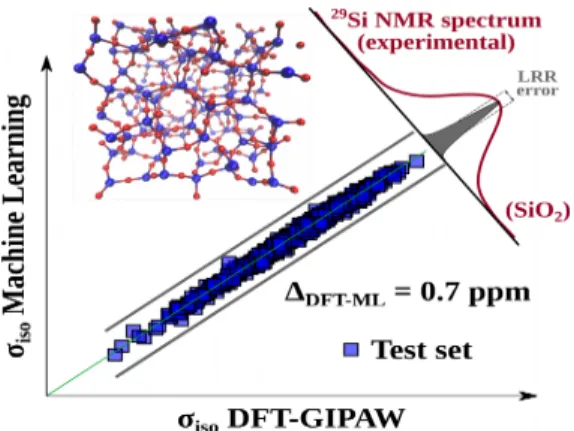
enough constraints to reach unprecedented accuracy in the establishment of the atomic structures of real samples (HRMC method, talk of T. Charpentier). We have already successfully designed ML procedures based on linear ridge regression [4] (LRR) combined with the smooth overlap of atomic positions [5] (SOAP) descriptors to predict the isotropic magnetic shielding (σiso) for different multicomponent relevant glass compositions. In our work, the ML predictions of σiso deviate, in best cases, from DFT-GIPAW calculations, by 0.7 ppm (as shown in Fig. 1) for 29Si (1.0 % of the calculated σ
iso total span) and 1.5 ppm for 17O (1.9 %) in SiO
2 glasses, 1.4 ppm for 23Na (1.5 %) in Na
2O-SiO2 and 1.5 ppm for 27Al (2.1 %) in Al2O3-Na2O-SiO2 systems [6]. The ongoing developments are focused on the construction of ML force fields (part-iii) to
validate the reliability of the simulated glass structures obtained via ML with those treated through the expensive aiMD simulations. With such ML schemes, many systems of high interest in the oxide glasses community, such as strontium aluminosilicate glasses [7] or borosilicate glasses [8], can be investigated much more efficiently.
References:
1) A. P. Bartók and G. Csányi, Int. J. Quantum Chem., 115, 16, 1051-1057 (2015).
2) A. S. Christensen, F. A. Faber and O. A. von Lilienfeld, preprint arXiv:1807.08811 (2018). 3) T. Charpentier, P. Kroll, and F. Mauri, J. Phys. Chem. C, 113, 18, 7917-7929 (2009). 4) D. Albanese et al., preprint arXiv:1202.6548 (2012).
5) A. P. Bartók, R. Kondor, and G. Csányi, Phys. Rev. B, 87.18: 184115 (2013).
6) Z. Chaker, M. Salanne, J-M. Delaye, and T. Charpentier, submitted to PCCP (June 2019). 7) T. Charpentier, et al., J. Phys. Chem. B, 122.41: 9567-9583 (2018).
8) E. Nicoleau, et al., J. Non-Cryst. Solids, 438: 37-48 (2016).
# Present address: NIMBE, CEA-Saclay, F-91191 Gif-sur-Yvette cedex, FRANCE.
Fig. 1. Machine learning prediction of NMR isotropic magnetic shielding (σiso) for 29Si nucleus in SiO2 glass
14th International Conference on the Structure of Non-Crystalline Materials
3-8 November 2019, Kobe, Japan
Please fill the corresponding author information. First Name: Ziyad
Surname: Chaker
Title (Please remain one.): 2. Dr.
Affiliation: NIMBE, CEA, CNRS, Université Paris-Saclay, CEA-Saclay, FRANCE E-mail address: [email protected]
Telephone number: +33 1 69 08 50 56 Presentation type (Please remain one.):
2. Oral
Preferred session (Please remain one.):
2. Data science in non-crystalline materials Status as a participant (Please remain one.):
2. General
Submission to Physica Status Solidi (b) Deadline 29 February 2020 (Please remain one.): 3. Probably no