Publisher’s version / Version de l'éditeur:
The Journal of Physical Chemistry A, 115, 4, pp. 357-373, 2010-12-23
READ THESE TERMS AND CONDITIONS CAREFULLY BEFORE USING THIS WEBSITE. https://nrc-publications.canada.ca/eng/copyright
Vous avez des questions? Nous pouvons vous aider. Pour communiquer directement avec un auteur, consultez la
première page de la revue dans laquelle son article a été publié afin de trouver ses coordonnées. Si vous n’arrivez pas à les repérer, communiquez avec nous à [email protected].
Questions? Contact the NRC Publications Archive team at
[email protected]. If you wish to email the authors directly, please see the first page of the publication for their contact information.
NRC Publications Archive
Archives des publications du CNRC
This publication could be one of several versions: author’s original, accepted manuscript or the publisher’s version. / La version de cette publication peut être l’une des suivantes : la version prépublication de l’auteur, la version acceptée du manuscrit ou la version de l’éditeur.
For the publisher’s version, please access the DOI link below./ Pour consulter la version de l’éditeur, utilisez le lien DOI ci-dessous.
https://doi.org/10.1021/jp109095d
Access and use of this website and the material on it are subject to the Terms and Conditions set forth at
A stark future for quantum control
Townsend, Dave; Sussman, Benjamin J.; Stolow, Albert
https://publications-cnrc.canada.ca/fra/droits
L’accès à ce site Web et l’utilisation de son contenu sont assujettis aux conditions présentées dans le site LISEZ CES CONDITIONS ATTENTIVEMENT AVANT D’UTILISER CE SITE WEB.
NRC Publications Record / Notice d'Archives des publications de CNRC:
https://nrc-publications.canada.ca/eng/view/object/?id=d29925d9-c779-4131-982c-c780d283056b https://publications-cnrc.canada.ca/fra/voir/objet/?id=d29925d9-c779-4131-982c-c780d283056bA Stark Future for Quantum Control
Dave Townsend,*,†Benjamin J. Sussman,‡and Albert Stolow‡
School of Engineering and Physical Sciences, Heriot-Watt UniVersity, Edinburgh, EH14 4AS, United Kingdom, and Steacie Institute for Molecular Sciences, National Research Council of Canada, 100 Sussex DriVe, Ottawa, Ontario, K1A 0R6, Canada
ReceiVed: September 23, 2010; ReVised Manuscript ReceiVed: NoVember 15, 2010
We present an overview of developments using the nonresonant dynamic Stark effect within the fields of time-resolved molecular dynamics and quantum control, drawing on examples from our own recent work. Particular emphasis is placed on the notion that “dynamics” and “control” are not distinct disciplines and that a clear synergy exits between these areas which has, up to now, been somewhat underexploited. The dynamic Stark effect is a universal interaction which we expect to have broad applicability.
Introduction
The static and dynamic behavior of electrons and atomic nuclei determines the properties of all molecular systems. The electromagnetic forces driving such behavior ultimately impose limits on the feasibility and rates of all molecular processes and therefore underpin all of chemistry (and, by extension, biology). A natural approach to exerting control over atomic and molecular systems is therefore through the application of externally applied electromagnetic fields. The electromagnetic fields created by modern lasers generate forces comparable to those that bind atoms and molecules and can do so on the natural time scales of their motions. Consequently, lasers offer an ideal tool for effecting control over molecular processes, and achiev-ing this goal has become one of the “grand challenges” within the field of chemistry over the past three decades.1-11
From a chemical point of view, an understanding of dynami-cal behavior may be formulated in terms of the various mechanistic pathways that connect an initial set of states (or reactants) to a final set of states (or products). The study of chemical dynamics is therefore often concerned with developing an understanding of the detailed evolution of the electronic and nuclear degrees of freedom as the reaction coordinate connecting reactants to products is traversed. Implicitly, this is the study of the electrical forces present in the system.
A commonly cited notion of chemical control centers around the desire to precisely manipulate the relative yields of the various product states that may be formed in a given reaction process, that is, to influence rather than just passively observe the dynamics. However, even in the absence of any control strategy, the dynamics of many molecular processes are not well understood. This has served as a strong motivating factor in the development of increasingly sophisticated or “differential” experimental techniques to study dynamical processes. As we shall discuss in more detail below, the use of externally applied electromagnetic control fields can also be used to further enhance the differential nature of these observation-based measurements, for example, by preparing a specific state before a measurement rather than starting with a thermal distribution. As such, the notions of observing and controlling molecular dynamics are strongly connected. Control may lead to improved observation
and hence better dynamical understanding. Improved under-standing of the system dynamics may then, in turn, ultimately lead to more refined strategies for control.
Observation
Our understanding of molecular structure and dynamics is based primarily on the Born-Oppenheimer (BO) approximation, which relies on the fact that nuclei are much heavier than electrons and therefore usually move more slowly. The nuclear motion (vibrations and rotations) may therefore be adiabatically separated from the motion of the electrons in the system, and this leads naturally to the concept of electronic energy land-scapes (potential energy surfaces) determined by fast-moving electrons, over which the much slower nuclear motion evolves. This adiabatic approximation is central to enabling the discussion of dynamical processes to be framed in terms of a language which includes the concept of well-defined vibrational energy states, and it has proved very successful in modeling the behavior of simple molecules. Even in these simple systems, however, the coupling between the nuclear and electronic degrees of freedom is often not negligible, especially when electronically excited states are being considered. In the excited states of larger and more complex systems, there is growing evidence that these breakdowns of the BO approximation are, in fact, the rule rather than the exception.12,13 They are also
known to be central to biological function in fundamentally important processes such as vision and photosynthesis.14-18
There is, therefore, a fundamental challenge to develop our understanding of non-BO dynamics for molecular systems and ultimately extend this to complex environments, such as solutions, bulk materials, liquid and solid surfaces, interfaces, and biological systems.
Deviations from the BO limit take on a variety of names when discussed within the field of molecular dynamics. Nonadiabatic processes, radiationless transitions, internal conversion, elec-tronic relaxation, curve crossing, and conical intersection may all, however, be interpreted as a coupling (i.e., energy transfer) between the electronic and nuclear degrees of freedom (as described by the initial BO picture) within the evolving chemical system. Over the past four decades or more, the development of techniques to probe the role of these processes with an ever-increasing level of detail has been central to furthering the understanding of chemical dynamics.
* To whom correspondence should be addressed.
†Heriot-Watt University.
‡National Research Council of Canada.
J. Phys. Chem. A 2011, 115, 357
10.1021/jp109095d 2011 American Chemical Society Published on Web 12/23/2010
“Zero-order” measurements such as the simple observation of product yields from a given chemical process are clearly insufficient to infer much dynamical information. With a little more effort on the part of the experimenter, however, improved “first-order” observations, for example, the energy partitioning among the internal degrees of freedom within the reactants and products, may begin to provide some degree of insight into the transit along the reaction coordinate, as illustrated, for example, in the classic “early” and “late” barrier pictures for chemical reactions.19,20In order to take this line of investigation further,
even higher-order, or increasingly differential, measurements are required. As a first step up this ladder of experimental complexity, one may begin to consider the angular direction in which various products are ejected, or scattered, with respect to a given frame of reference. In the laboratory frame, this is typically taken to be the polarization vector of a laser pulse that initiates a (unimolecular) photochemical process or the axis along which a (bimolecular) collision between reactant species takes place. As a next step, one may then begin to correlate energy- and angle-resolved information, investigating the varia-tion in product internal energy as a funcvaria-tion of scattering angle. The multiplexing advantages offered by the advent of position-sensitive, 2D imaging methods over the past two decades made such a task a readily viable experimental undertaking.21,22
Correlated measurements of this type begin to reveal many subtle details of the transit along the reaction coordinate connecting reactants to products. However, one may still go further in an attempt to develop an even more complete picture. In addition to the recoil velocity of the products, there are other vector properties present in the system, specifically, the various angular momenta in the products, that may exhibit significant
polarization anisotropy. The ability to not only measure this anisotropy but to correlate it with the recoil velocity offers a powerful probe of the overall dynamics.23-29Vector correlations
of rotational angular momentum polarization in molecular photofragments provide much information on the shape of the potential energy surfaces involved in the evolution from reactants to products. Observations of electronic angular mo-mentum polarization in atomic photofragments are perhaps even more powerful, yielding insight into the coupling (and associated phase shifts) between different potential energy surfaces in-volved in mediating the dynamics in molecular systems. This point is particularly apparent if one views the unpaired electrons in the recoiling photofragments as having previously formed part of the “fabric” of the potential energy surfaces in the system under study prior to dissociation. Finally, one may also consider photoelectron angular distributions (PADs) from photoioniza-tion. Such distributions are a superposition of many “partial waves” with different angular momenta, l, and the overall appearance of such distributions is highly sensitive to the amplitude and relative scattering phase of these various constitu-ent componconstitu-ents, in turn providing detailed information on the symmetry of the state from which ionization occurred.30-33
As a next step toward further improving the differential nature of dynamics experiments, one may begin to consider the possibility of making measurements in the molecular frame of reference rather than that of the laboratory frame. For the case of a simple photodissociation, these two frames are effectively commensurate, assuming that the time scale of fragmentation is fast compared to the period of molecular rotation, the so-called axial recoil limit. However, more sophisticated experi-mental approaches are often required to extract molecular frame information in many other types of processes. This includes systems that deviate from the axial recoil limit, systems that produce more than two fragments upon dissociation (including, for example, the cases of dissociative photoionization or photodetachment), and systems where dissociation is not a dominant mechanism. The use of multibody coincidence tech-niques34 has been successfully demonstrated as a route to
obtaining molecular frame measurements in some of these types of system.35-40A second strategy, which will form one of the
main themes for discussion in this article, is to try to “overlap” the molecular and laboratory frames of reference through the use of externally applied aligning or orienting fields.
The development of modern laser sources has enabled experimentalists to develop approaches that seek to interrogate dynamical processes in chemical systems with increasingly high levels of precision. Broadly speaking, these approaches may be broken down into two main categories, time-resolved and frequency-resolved measurements. In the case of the latter, one is able only to probe the products formed in the asymptotic region of the reaction coordinate, owing to the long temporal duration of the laser pulses relative to the typical time scales of reaction dynamics. However, the narrow line width laser sources used in such measurements often enable the products to be probed in a quantum-state-specific manner. This high level of spectroscopic resolution is a powerful tool for enabling the dynamics of a chemical event to be inferred. In the case of time-resolved measurements, one is effectively able to follow the evolution of the system dynamics in real time as the reaction coordinate is traversed, but there is always a trade off in terms of spectroscopic resolution as the broader bandwidth associated with so-called “ultrafast” laser pulses means that quantum-state-specific measurements are not usually possible. This trade off of energy versus time resolution means that a combination of
Dave Townsend is currently a lecturer at Heriot-Watt University in Edinburgh, with research interests in the area of time-resolved molecular spectroscopy and dynamics. Dave began his university career studying chemistry as an undergraduate at the University of Nottingham, where he then remained to undertake a Ph.D. with Prof. Katharine Reid, studying angle-resolved photoionization dynamics of polyatomic molecules. Fol-lowing on from this, he spent time as a postdoctoral researcher at the University of Oxford with Prof. Tim Softley, investigating the translational control of atomic and molecular Rydberg states, and then studied in the group of Prof. Arthur Suits at SUNY Stony Brook, using imaging methods to study vector correlations in molecular photodissociation. Between 2004 and 2007, he was a Visiting Fellow at the National Research Council of Canada in Ottawa.
Benjamin Sussman is a Research Officer in the Steacie Institute for Molecular Sciences at the National Research Council of Canada and a Research Fellow at Worcester College, University of Oxford. His research investigates the intersection of quantum control, quantum information, and photonics. He studied physics as an undergraduate at the University of Waterloo before obtaining his M.Sc. at the University of British Columbia. He graduated with a Ph.D. in Physics from Queen’s University in 2007.
Albert Stolowstudied chemistry and physics at Queen’s University. He then obtained his Ph.D. from the University of Toronto, studying under John C. Polanyi. Albert was then an NSERC postdoctoral fellow with Yuan T. Lee at the University of California, Berkeley, where he became interested in the dynamics of polyatomic molecules. In 1992, he joined the Femto-second Science Program of the Steacie Institute for Molecular Sciences (National Research Council of Canada) to begin research in the area of femtosecond dynamics based on time-resolved photoelectron spectroscopy. Albert is currently a Principal Research Officer within the Steacie Institute for Molecular Sciences and Program Leader of the Molecular Photonics Group. He is Adjunct Professor of Chemistry and Adjunct Professor of Physics at Queen’s University and Adjunct Professor of Physics at the University of Ottawa. His group’s research interests include ultrafast molecular dynamics and quantum control, nonlinear optical spectroscopy, molecular strong-field physics, and nonlinear microscopy of live cells. He is a Fellow of both the American Physical Society and the Optical Society of America, has won several prizes, including the Keith Laidler Award of the Chemical Society of Canada, and sits on the editorial boards of various international journals.
different experimental approaches (both time- and frequency-resolved) are often required to develop a complete mechanistic picture; that is, there is no “one size fits all” approach, and data from a number of different, complementary techniques (with different associated observables) are often necessary. In the case of both time-resolved and frequency-resolved measurements, there are a vast number of different experimental techniques that may be employed and observables that may be monitored. Reflecting this, the field of molecular dynamics has grown enormously to encompass the detailed study of many types of molecular processes with ever-increasing degrees of sophistica-tion. However, although hugely diverse in terms of scope and application, the vast majority of these dynamical studies are all bound together by one common feature, namely, that the observations are typically of a passive nature. In other words, the investigator sets a chain of dynamical events in motion and then either follows directly (time-resolved) or infers indirectly from the set of chemical outcomes (frequency-resolved) the mechanistic pathways connecting the set of initial and final states. While such studies are of huge importance in furthering our understanding of many fundamental processes, the next level of development within the field of molecular dynamics centers around the desire to move beyond this passive approach and into a regime where the dynamics are actively controlled.
Control
As discussed previously, electric forces underpin the dynamics of all chemical processes. In order to exert control over a chemical outcome, the use of additional, externally applied, electric fields is therefore a natural approach. This is not a new idea in many respects; the example of simple catalysis (for example, the case of adsorption on a metal surface) is one of externally applied fields (from the surface) being used to directly affect a chemical outcome by reducing the activation barrier along the reaction coordinate connecting the reactants to a specific set of products s the most commonly cited form of control when applied to molecular systems. However, externally applied static electromagnetic fields have also been used effectively as a form of “control” to enhance the otherwise passive observation of chemical processes, rather than modify the likelihood of a specific outcome per se. For example, the use of hexapole devices as well as so-called “brute-force” methods to select oriented neutral molecules has been employed in “stereodynamic” studies of bimolecular reactions.41-44This
is effectively a form of control applied to the rotational degree of freedom, as will be expanded upon later. Other types of approach have also been used to exert control over the translational degree of freedom of neutral atoms and molecules via electrostatic interactions.
The first and perhaps most famous example of translational control over neutral species was the Stern-Gerlach experiment,45
in which inhomogeneous magnetic fields were use to deflect a beam of silver atoms. Of the other, more recent approaches developed to control motion in neutral systems, perhaps the most well-known is the Stark decelerator developed by Meijer and co-workers,46,47
which has found application in the rapidly growing area of cold molecule physics.48A very similar idea has also been explored by
Softley and co-workers,49-52who have used the Stark effect as
a tool to control translational motion in atomic and molecular Rydberg states in a manner analogous to that of the Meijer group. An important yet subtle difference in this approach is that, owing to the much larger Stark shifts exhibited by moderately high lying electronically excited Rydberg states (typically with principal quantum numbers in the n ) 10-20
region), dramatically smaller field gradients (on the order of a few hundred V/cm rather than the kVs/cm required for ground-state systems) are all that is required to exert significant translational control. This increased magnitude of the Stark shift relative to that typically seen in ground electronic state configurations is a consequence of the linear rather than quadratic Stark shifts that result due to l degeneracy, as well as the inherently more polarizable nature of the loosely bound Rydberg electron. (There are no linear Stark shifts in nonde-generate states.) This issue of polarizability (both relative and absolute) will be an important consideration when we come, in subsequent sections, to examine the nonresonant dynamic Stark effect as a tool for control.
An alternative strategy to achieve control is through the use of externally applied coherent electromagnetic radiation, that is, laser light. This idea has been exploited for translational control using the Stark effect in a similar manner to that described above for static fields;53-55however, it is the use of
laser fields for the direct control of chemical reactions that will form the central basis for the remainder of the brief discussion outlined here. Perhaps the first operational approach to control-ling quantum states with external fields was given by Lamb in 1969.56 Lamb argued that a practical discussion of quantum
states should include a program for making them, and he offered such a method for producing arbitrarily shaped wave functions. The advent of intense, coherent laser sources extended the work of constructing arbitrary control, although initial hopes of achieving bond-selective chemistry through targeted resonant excitation of specific vibrational modes proved unsuccessful in the vast majority of cases, owing to the rapid statistical repartitioning of internal energy, the phenomenon commonly known as intramolecular vibrational energy redistribution (IVR).57,58More complex and subtle strategies for achieving
chemical control using laser fields were therefore needed. A renaissance in the field of laser control began in the 1980s with the work of Brumer and Shapiro,1,59who considered using
quantum interference effects to manipulate chemical reactions. This was first experimentally demonstrated by Gordon and co-workers.60If two different laser-induced transitions to a specific
target state occur with amplitudes A1)|A1|eiφ1and A2)|A2|eiφ2,
then the overall probability for populating that state is given by
The phases φ1 and φ2 may be independently controlled by
altering the laser phases, and hence, the overall transition can be influenced. This coherent control approach is similar in some respects to Young’s famous two-slit experiment where optical interference is observed due to multiple pathways to a screen; adding or subtracting a phase to one pathway has the effect of shifting the interference fringes. Within the coherent control approach, the “control” is mediated entirely by the laser phase that initiates a given photochemical event. The subsequent scattering phase then remains unaltered as the initially prepared reactant states evolve toward the products.
A second related approach to laser-induced control of photochemical processes was proposed by Tannor and Rice, who considered control over reactions that could form different reaction products in the ground electronic states of molecules.4,61
Activation barriers were circumvented via other electronically excited states, where the absence of these barriers allowed free movement of a wavepacket to a target region of the potential
P ) |A1|
2+
|A2|
2+
2|A1||A2| cos(φ1- φ2) (1)
energy surface from which a transition back to the ground electronic state was initiated. In a sense, this so-called pump-dump control strategy may be viewed as a multiplexed or wavepacket version of the Brumer-Shapiro approach, where broad bandwidth laser pulses were used in the former and narrow line widths in the latter.
A number of approaches have investigated the application of adiabatically varied resonant laser fields. Perhaps the most well-known of these is stimulated Raman adiabatic passage (STIRAP), which is typically utilized in a three-level lambda system, where a resonant field connects the ground state with the intermediate state and a second resonant field connects the intermediate state with the target state. The eigenstates of the rotating wave Hamiltonian can be solved analytically and have a solution that transfers population completely from the ground state to the target state. An alternative interpretation is that the resonant field that connects that intermediate and target state dresses the system so that the other laser field can directly transfer population into the dressed state that correlates with the target state. Bergmann and co-workers62present a detailed
introduction to this type of control strategy, and the reader is directed there for further information.
One of the most recent developments within the field of laser-based control has been the use of intense femtosecond laser pulses in conjunction with adaptive feedback-learning algorithms to optimize the yield of specific photoproduct channels.8,63,64
This approach exploits the large coherent bandwidth and very high field intensities intrinsic to such pulses and has been successfully demonstrated in the fragmentation-ionization of polyatomic molecules.9,10One challenge with the strong field
approach is that numerous, simultaneously occurring processes are potentially responsible for contributing to the observed final outcome.5 These potentially include high-order multiphoton
ionization, enhanced ionization,65,66nonadiabatic multielectron
ionization,67and Coulomb explosion,68multiphoton resonances
leading to propagation on multiple potential energy surfaces, dynamic Stark effects, adiabatic passage by light-induced potentials,69-71and bond hardening/softening.2,72-76In molecular
systems in particular, the theory describing these individual effects is not always well-quantified, and therefore, the challenge of modeling (or understanding in detail) a situation where all of these processes may contribute to the system dynamics is often insurmountable.
Control Interaction
A compelling approach for addressing all of the challenges outlined in the previous sections is the second-order nonresonant dynamic Stark effect (NRDSE). This is a universal interaction that is easily applied with modern laser technology. It exploits the response of a quantum system to the intensity envelope of a laser pulse rather than the oscillating electric field, that is, the effect is highly independent of the spectral content (optical frequencies) of the pulse. The second-order NRDSE operates via a polarizability interaction (often also referred to as a Raman interaction). In special cases, the linear nonresonant dynamic Stark effect may also be applied to the quantum control of molecular systems but requires dipole-allowed transitions between the controlled states.77Because all systems containing
electrons are inherently polarizable to some degree, the NRDSE approach to control may therefore, in principle, always be applicable and is the focus of the remainder of our discussion. The NRDSE approach requires limited a priori spectral knowl-edge of the system (Hamiltonian) under consideration because the only important issue in this regard is that the laser field is nonresonant with respect to any real transitions.
In previous publications, we have successfully demonstrated the use of the NRDSE as a tool for the control of molecular axis alignment78,79 and in the control of chemical branching
ratios.80,81It should be stressed here that these two effects are
identical in terms of the physical control mechanism; they simply act upon different degrees of freedom within the molecular system in question (rotations and vibrations, respectively). More recently, we have also used the Stark effect for transferring population in atomic gas ensembles.82In the following sections,
we shall explore this assertion in more detail.
DC Stark Effect
The static, or DC Stark, effect is a well-known physical phenomena that was first reported by Johannes Stark in 1914.83
In the presence of homogeneous electric fields, atomic spectral lines are observed to split into multiple components due to the applied field “mixing” quantum states of different orbital angular momentum quantum number, l. This is analogous to the Zeeman effect,84discovered several years earlier in 1897, that is induced
by a magnetic field and lifts the degeneracy of states with different magnetic quantum numbers, ml. The magnitude of the observed Stark effect splitting may exhibit a linear dependence with applied electric field strength for degenerate l states or, much weaker, quadratic dependence for nondegenerate l states. Formally, the general Hamiltonian for an atomic or molecular system in the presence of a static homogeneous electric field may be written as follows
where H0 is the field-free Hamiltonian with corresponding
eigenstatesψnand energy levels En. Within the electric dipole approximation, the interaction term, V, between the molecule and the laser field takes the form
where µ is the dipole moment operator and E is the function associated with the constant linear electric field. At the simplest level of interpretation, we can view the effect of the field as mixing the field-free eigenstates, producing a new distribution of energy levels within the system under investigation, and these new levels may be expressed as linear combinations of the field-free eigenstates
The extent of this mixing is dependent on the strength of the field (a stronger field means more mixing), and this gives rise to the concept of a Stark map that describes the energy levels in a quantum system as a function of field strength. Some good illustrative examples may be found in the work of Goodgame and Softley.85
Nonresonant Dynamic Stark Effect
Following eq 1, the semiclassical Hamiltonian for a quantum system in the presence of a time-dependent laser field of frequencyω may be written as
H ) H0+V (2) V ) -µ · E (3) ψField)
∑
i aiψiField-free (4) H(t) ) H0+V(t) (5)where
and the linear field E(t) is given by
where e(t) is the slowly varying pulse envelope. The derivation of the nonresonant dynamic Stark effect Hamiltonian can be developed from a number of approaches.79,86The most expedient
approach (which includes the strongest approximations) is to replace the dipole operator µ with its expectation value, as calculated from its Taylor series expansion
Here, R is the polarizability, which in effect represents an average contribution to the dipole moment from all states not directly participating in the field-system interaction (i.e., those states that are not resonantly dipole coupled by the field, often dubbed “nonessential” states). Dealing with these states in this way greatly simplifies the theoretical treatment of the interaction and leads to the concept of virtual states, which are often invoked in discussions relating to Raman spectroscopy. Fol-lowing eqs 6-8, we can now rewrite the interaction energy as
The field E is oscillating, and the second-order term can be expanded by taking the exponential representation of the cosine function in eq 7.
This is a purely classical approach, but a photon interpretation is already apparent. One photon absorption (v) corresponds to the term e-iωt
, and one photon emission (V) corresponds to the term eiωt. There are four terms formed from the product of the
exponentials. Vertical two photon excitations (VV,vv) arise from the terms oscillating at (2ωt. Raman-type excitations (vV,Vv) arise from the quasi-static terms, which are a product of terms oscillating atωt and -ωt. Raman transitions can be understood simply by considering that the excitation comprises a photon absorption and a photon emission and therefore depends on frequency differences (and therefore will depend on the pulse envelope) rather than the carrier frequency,ω.
Assuming that the system is unable to respond rapidly, we may develop the dynamic Stark effect potential further. The rotating wave approximation is taken by neglecting the rapidly oscillating (vertical two-photon) terms, which leads to the following
For the three-dimensional vector case, this is written as
where e(t) is the complex envelope of the field, that is, E(t) ) R[e(t)eiωt]. It is important to note that there are two limiting
cases of this interaction, the dipole limit and the Raman limit. In the dipole limit, the interaction follows the instantaneous electric field
However, in the Raman limit, the interaction only follows the pulse envelope squared
Which limit is applicable depends on the system matrix elements (i.e., selection rules) and the extent of any optical detunings (i.e., whether the field frequency is resonant with any real transitions in the system). Here, we are concerned exclusively with the Raman interaction. This choice gives the advantage of having extremely strong interactions due to the immense field strength of ultrafast pulses and yet is independent of the optical frequency (i.e., off-resonance) and therefore not atom- or molecule-specific. As an example, a system with a polarizability of R ) 10 Å3receives a 0.01 eV shift in a 7 × 10¹¹ W/cm2
field, easily accessible with modern ultrafast laser systems. As we will see later, although seemingly small, shifts of this magnitude can have a profound effect on the dynamics in such systems. The Raman interaction also benefits from the fact that the pulse envelopes (10-1000 fs) are conveniently on the time scale of dynamic molecular processes. Furthermore, we may readily exert a significant degree of control over the form of the envelope itself.
Applications: Molecular Alignment.Experiments designed to interrogate molecular dynamics often employ laser-based methods in order to probe reactant and/or product species. The polarization direction of the laser field therefore serves as a natural frame of reference if one is to make high-order differential measurements that seek to correlate various vector properties present in the products and/or reactants of a chemical process. Examples of such measurements include photoelectron angular distributions in ionization experiments32,87and studies
of product angular momentum polarization in photofragmen-tation studies.25,29 One inherent drawback is that the laser
polarization is always defined within the laboratory or space-fixed frame. However, the µ · E interaction between the molec-ular dipole moment and the laser field takes place in the molecmolec-ular frame of reference. As such, differential measurements made in the lab frame may be “smeared out” or averaged over all possible degrees of molecular frame alignment and/or orientation. Key dynamical information is therefore often obscured. A useful analogy in this regard is the difference between single-crystal and powder X-ray diffraction, the former yielding far greater structural details. In order to alleviate this problem and reveal deeper mechanistic insight into dynamical processes, it is clearly desirable to develop experimental methods that make the lab- and molecule-fixed frames of reference commensurate. This is illustrated, for example, in the case of our time-resolved work on the nitric oxide dimer, where photoelectron angular distributions recorded in the molecular frame of reference using coincidence detection techniques display a far richer structure than those recorded in the lab frame.38
V(t) ) -µE(t) (6) E(t) ) e(t) cos(ωt) (7) µ(E) ) µ0+ RE +... (8) V ) -
∫
Eµ(E) dE ) -µ0E -1 2RE 2+ ... (9) V ) -µ0E - 1 8Re 2(t)(eiωt+e-iωt)(eiωt +e-iωt) + ... (10) V ≈ -µ0E(t) - 1 4Re 2 (t) (11) V ≈ -µ0·E(t) - 1 4e*(t) · R · e(t) (12) Vdipole) -µ 0·E(t) (13) VRaman ) -1 4e*(t) · r · e(t) (14)
In many dynamics experiments, one is dealing with the preparation of excited electronic states, and it is well-known that the optical preparation of such states via resonant absorption will generate a degree of residual alignment in the sample under study via the µ · E interaction. This clearly goes some way toward bringing the lab and molecular frames together and does so in a way that is easily quantified (in terms of the relative, anisotropic populations of MJrotational sublevels) on the basis of well-established angular momentum coupling theory.88,89
However, this approach is clearly not applicable in instances where one wishes to work with isotropically aligned samples of ground-state molecules. Driven by this limitation, more general methods for inducing alignment using intense laser fields have begun to be developed. In addition, and as will be illustrated further shortly, these nonresonant methods may also be used in conjunction with the preparation of excited electronic states to further enhance the alignment present in these cases, considerably improving the degree of overlap between the molecular and lab frames in order to enhance the differential nature of many dynamics experiments.
Before proceeding further, it is important to make certain terms and definitions clear. From a quantum mechanical perspective, molecular alignment refers to a nonuniform, or anisoptropic, distribution of magnetic sublevels, MJ, in a given angular momentum state (which in a molecular system may contain contributions from electronic and spin components, as well as the angular momentum associated with the rotation of the nuclear framework). Because alignment is quantified by the second moment of the MJstate distribution, there is no difference in population between states with specific +MJand -MJvalues. In the case of orientation, however, which is described by the first moment of the MJstate distribution, specific +MJand -MJ states may now contain different populations. This is sometimes referred to as a preference for up versus down, but one must be careful in this regard as it is possible to generate an oriented distribution of angular momentum vectors (for example, through the absorption of circularly polarized light) that produces only an aligned distribution of molecular axes.
It is often convenient to characterize alignment in terms of an angle,θ, between an axis that is well-defined in the molecular frame and one that is well-defined in the lab frame. Generally, these are taken to be the principal symmetry axis of the molecule and the polarization direction of the laser light with which that molecule is interacting. Within the photodissociation dynamics community, alignment is generally quantified in terms of an anisotropy parameter, β.90,91 For the case of a single-photon
electric dipole interaction, this gives the following well-known expression for the photofragment angular distribution
Here, the P2(cosθ) term is the second Legendre polynomial
andβ is an anisotropy parameter, which is defined as an average over the distribution of angles χ between the axis of the transition dipole momentµ and a photofragment velocity vector.
As χ decreases from π/2 to 0, β increases from -1 (a perpendicular transition) to 2 (a parallel transition), with a value ofβ ) 0 denoting an isotropic distribution. In the case of prompt (i.e., axial recoil limited) dissociation of a single electronic state of a linear molecule,β is directly related to the distribution of molecular axes prior to dissociation. In the dissociation of more complex systems, there may be a number of electronic states participating in the dynamics, and in general, not all of these will exhibit linear geometries. A single value for β is still observed, and this arises as a result of the averaging of the recoil direction over the lab frame transition moment. With a little more effort on the part of the experimenter, however, the distribution of a molecular axis relative to the transition moment may still be inferred from theβ value that is obtained.
Within the strong-field alignment community, two different measures are typically used to quantify the average distribution of molecular axes. The first is the expectation value 〈cos2θ〉.
From eq 16, it can be seen that now we have a situation where 〈cos2θ〉 ) 1/3 defines an isotropic distribution, 〈cos2θ〉 ) 1
defines maximum alignment (all molecular axes parallel to laser polarization), and 〈cos2θ〉 ) 0 represents maximum
antialign-ment (where all molecular axes are perpendicular to the laser polarization direction). Clearly, if one is to use strong field alignment techniques to enhance dynamical observation, it is important that a quantitative measure of the induced alignment be obtained. Typically, this can be achieved, for example, using Coulomb explosion methods in conjunction with 2D fragment imaging.92,93This leads naturally to a second way of quantifying
alignment, which is to specify the expectation value 〈cos2ϑ〉,
where ϑ (sometimes also denoted asθ2D) is defined as the angle
between the laser polarization axis and the projection of the molecular alignment axis (or, more specifically, the projection of the velocity vector associated with a recoiling ion fragment following rapid Coulomb explosion of the molecule) onto the imaging plane. Within this coordinate system, 〈cos2ϑ〉 takes
values of 1 and 0 for the cases of maximum alignment and antialignment, respectively; however, an isotropic distribution now gives rise to 〈cos2ϑ〉 ) 0.5.94
Generation of rotational axis alignment through the applica-tion of infrared laser pulses broadly falls into three categories, (i) adiabatic alignment, where the electric field duration is significantly longer than the period of molecular rotation, (ii) dynamic, impulsive, or “kicked” alignment, for which the field duration is shorter than the rotational time scale, and (iii) the sudden truncation of an adiabatic pulse leading to the projection of an adiabatically evolving state back onto the field-free molecular eigenstates (the so-called switched wavepacket ap-proach). Very recently, a fourth approach using stimulated Raman emission was investigated, which will also be discussed briefly below.
The first detailed theoretical treatments of adiabatic alignment were developed by Freidrich and Herschbach95and Seidemann.96
In applying the NRDSE approach outlined earlier to the specific problem of rotational quantum states, we consider first the case of a diatomic rotor. Within the rigid rotor approximation, the field-free Hamiltonian is given by the expression H0)J2/2I,
where J2is the squared angular momentum operator and I is
the moment of inertia. The eigenstates of H0are the spherical
harmonic functions, YJ MJ(θ,φ), and the associated energy levels
are given by BJ(J + 1), where B is the rotational constant and J is the rotational quantum number. Importantly, under field-free conditions, the rotational Hamiltonian contains no potential energy term, and therefore, the molecule rotates freely in space. Upon application of a slowly varying, intense nonresonant (i.e.,
I(θ) ∝ 1 + βP2(cosθ) (15) P2(cosθ) ) 1 2(3 cos 2 θ - 1) (16) β ) 2〈P2(cosχ)〉 (17)
Raman coupling limit) laser field, as described in the previous section, the time-dependent Hamiltonian now takes the form
For a linearly polarized laser field, the Raman term in the above expression may now be averaged over one optical period to give the following
where the polarizability anisotropy, ∆R ) R|- R⊥represents
the difference in polarizability along and orthogonal to the symmetry axis. The angle between the symmetry axis and the light polarization defines the angleθ. The VRaman(θ) term in eq
19 gives rise to a potential minimum along the axis of laser field polarization, as experienced by the molecular axis with greatest polarizability. From a classical point of view, this field-induced potential forces the molecule to librate over a limited angular range, and the new eigenstates of the molecule in the field may be described as a linear combination of the field-free eigenstates.
These so-called “pendular” states will experience increased angular confinement as the field strength is increased. In addition, the more polarizable a given molecular system (in terms of the parameter ∆R), the greater the induced alignment because the VRaman(θ) potential well is deeper. Experimentally,
the adiabatic approach to alignment has been demonstrated for a number of different molecules.97The high degree of control
over molecular axis alignment that the method imparts is clearly a powerful tool for yielding enhanced differential measurements in certain types of dynamics experiments, for example, photo-dissociation. However, it may not be suitable for use in other types of experiments where the observable parameters will be influenced significantly by the presence of the externally applied laser field. Obvious examples of this are spectroscopy and diffraction. It is therefore desirable to generate the alignment under field-free conditions, and dynamic methods offer a route to achieving this goal.
Theoretical treatments of dynamical (or nonadiabatic) align-ment were first developed by Seideman96and Ortigoso et al.98
for the case of near-resonant and completely nonresonant laser fields, respectively. The concept was first demonstrated experi-mentally by Rosca-Pruna and Vrakking in the I2molecule,99
and the approach involves the use of an intense laser field that is of very short temporal duration compared to the time scale of molecular rotation. From a quantum mechanical perspective, the dynamical interaction between the molecule and the short, intense pulse induces a series of Raman transitions that effectively result in a rapid “ladder climbing” process that transfers rotational population from lower to higher J states. The results of a calculation illustrating this population transfer for typical experimental field intensities and pulse durations is shown in Figure 1 for the tert-butyliodide molecule at a molecular beam temperature of 1 K. As a consequence of this interaction, a large coherent superposition of high-J rotational
states is generated. The large uncertainty in the wavepacket angular momentum therefore means that a very high degree of confinement in the angular position becomes possible through the angular form of the uncertainty principle,100,101 and the
molecule is therefore highly aligned in the lab frame. The initially prepared wavepacket will then subsequently begin to evolve, initially dephasing but then experiencing revivals at periodically reoccurring times. Critically, these revivals will take place after the short kick pulse is over, and subsequent alignment is therefore generated under field-free conditions. Wavepacket manifolds of high-J states may be generated from any given low-J rotational state present in the sample prior to the application of the aligning pulse, but because there is no coherence between the low-J states in the initial thermal Boltzmann distribution, there is no coherence between the various wavepackets produced. This serves to significantly reduce the overall alignment produced in the sample due to thermal averaging effects. However, this issue may be overcome to a large extent by using molecular beam methods to generate as cold a beam as possible in order to reduce the spread in the initial J state distribution in the sample under study.
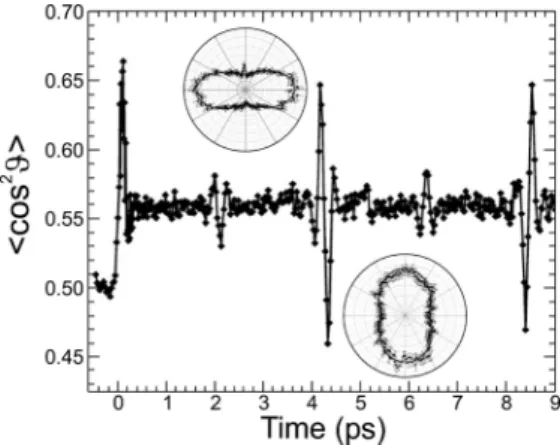
An example, adapted from the work of Corkum and co-workers,102 is presented in Figure 2, showing the revivals
obtained in the N2molecule using a 40 fs pulse with a peak
intensity of 5 × 10¹³W/cm2. The key features of this figure are
the initial lab frame alignment (〈cos2 ϑ〉 ≈ 0.67) generated
during the application of the aligning pulse and the subsequent
H(t) ) H0+VRaman ) J2 2I -1 4e*(t) · R · e(t) (18) VRaman(θ) ) -1 4e 2 (∆R cos2θ + R⊥) (19) |JMJ〉 )
∑
J aJM JYJMJ(θ, φ) (20)Figure 1. Open bars: relative population of the initial states of tert-butyliodide at a temperature of 1 K. Only the populations (including
MJdegeneracy) in the K ) 0 subset of states is shown. Full bars: relative population among the J states in the wave packet excited from the |JKMJ〉 ) |000〉 initial state by a laser pulse with an intensity of 6 × 10¹²W/cm2and a temporal duration of 1 ps. The figure is adapted
from Bisgaard, C. Z. Ph.D. Thesis, University of Aarhus, 2006.
Figure 2. Time dependence of the molecular alignment parameter 〈cos2
ϑ〉 in the N2molecule following interaction with a 40 fs laser pulse
with a peak intensity of 5 × 10¹³W/cm2. For the half revival at around
8 ps, the maximally aligned and antialigned distributions of molecular axes, obtained using Coulomb explosion imaging, are shown inset as polar plots. This figure is adapted (with permission) from ref 102.
field-free return to this value at multiples of 4.15 ps. The initial field-free alignment corresponds to a half-revival of the initially prepared rotational wavepacket and corresponds to a time of 1/(4B), where B is the rotational constant of the system under study. The 1/4, 3/4, and full revivals are also observed, and additional subsequent revivals also persist for many tens of picoseconds beyond the range of time delays plotted. It should also be noted that the alignment in between the revival structures does not return to a fully isotropic value (i.e., 〈cos2ϑ〉 ) 0.5),
as clearly evidenced by the height of the baseline before and after the initial aligning kick pulse is applied. This is a consequence of the ∆MJ ) 0 selection rules associated with the ladder climbing process (for the case of a linearly polarized pulse), giving rise to a residual nonstatistical distribution in the MJsublevels of the high-J rotational states that are prepared. This alignment persists on the typical time scales of the experiment but will ultimately decay due to collisional processes. Each revival producing maximal alignment is also followed shortly afterward by a minimum value of 〈cos2 ϑ〉, which
corresponds to maximal antialignment (internuclear axis per-pendicular to the laser field). The distributions of molecular axes, obtained directly by Coulomb exploding the N2molecules, are
included as polar plots in Figure 2 for the first onset of maximal alignment and antialignment.
The degree of alignment produced in experiments of this type may be further enhanced through the use of multiple kick pulses, precisely timed to arrive during full revivals of the initially prepared wavepacket.103-107 This generates an even broader
superposition of coherently prepared rotational states and hence leads to even greater angular confinement. Strategies involving multiple short pulses have also been proposed and demonstrated to reduce the coherent nature of the wavepacket and effectively “switch off” the field-free revivals in the alignment.108-111
Recently, Suzuki et al. have also demonstrated the use of pulse shaping in conjunction with feedback algorithms to optimize alignment.112
The dynamic alignment approach leads to a high degree of angular confinement in the lab frame at periodically recurring times after the laser pulse is over, that is, the lab and molecular frames of reference become very strongly overlapped under field-free conditions. In addition, these revivals may, in many cases, persist for a duration that exceeds the time scale of many dynamical processes. This gives rise to a window in which one is able to perform experiments on highly aligned molecular systems, offering an improved (i.e., more differential) measure-ment compared to that of an unaligned sample. A recent example is the case of nonadiabatic dynamics and subsequent dissociation in the CS2 molecule,113 where pump-probe time-resolved
photoelectron spectroscopy (TRPES)32,87was used in
conjunc-tion with single-particle counting-imaging36,38 to observe the
decay of the initially prepared1Σ u +
state in CS2at an excitation
wavelength of 201 nm. The initial geometry of this state is linear, but as the molecule bends (and descends to1B
2symmetry), it
is able to predissociate into CS(X1Σ+
) + S(1D
2) fragments.
Spin-orbit coupling also mediates dissociation into CS(X1Σ+
) +S(3P
J) fragments. These multiple dissociation pathways evolve over different electronic potential energy surfaces, and a detailed summary of the numerous dynamical investigations of this system undertaken to date may be found elsewhere.114 The
evolution of the photoelectron angular distribution resulting from ionization of the initially prepared excited state of the CS2
molecule as it begins to dissociate is expected to provide a sensitive probe of the complex system dynamics. However, as shown in Figure 3, the photoelectron angular distributions
(PADs) obtained in the lab frame for ionization into the vibrational ground state of the CS2
+
cation at a series of pump-probe time delays only exhibit these dynamical signa-tures very weakly due to the alignment averaging effects inherently present with this type of measurement. This is in spite of the fact that the pump step does generate some degree of residual lab frame alignment in the initially prepared 1Σ
u +
state (〈cos2θ〉 ) 0.55) through the µ · E interaction.
The application of a short (100 fs), intense (4 × 10¹²W/cm2)
nonresonant, 805 nm pulse was then incorporated into the experimental setup in order to enhance the degree of overlap between the lab and molecular frames. A significant degree of field-free excited-state alignment (〈cos2 θ〉 ) 0.74), which
persisted for ∼4 ps, was generated in the system, as shown in the middle section of Figure 3. Critically, this is significantly longer than the dissociation lifetime (<1 ps). By now timing the application of the 201 nm pump pulse to coincide with the full onset of this revival, the differential sensitivity of the probe ionization step (268 nm) is considerably improved. This may be clearly seen in the lower portion of Figure 3, where the associated PADs now display increased anisotropy and a greater angular variation as a function of pump-probe delay. At 100 and 900 fs, the PADs exhibit a local minimum along the molecular frame axis, whereas at 500 fs, there is a maximum in the photoelectron intensity along this direction. This may be attributed to changes in the electronic character of the molecular orbital from which the photoelectron is ejected. There is an optically dark 1Π
g +
state which lies at slightly higher energy
Figure 3. (Top) Polar plots showing photoelectron angular distributions at five different pump-probe time delays, ∆t, for an initially unaligned sample of CS2 molecules. (Middle) CS2 molecules are transiently
aligned by using a short (100 fs), nonresonant (805 nm) laser pulse to create a rotational wavepacket. The alignment dynamics around the half revival are monitored via the two-photon ionization yield (data points). To quantitatively estimate the degree of alignment, we simulated the ion yield as a function of delay using a direct integration of the time-dependent Schro¨dinger equation to propagate the rotational wavepacket (solid line). (Bottom) The photoelectron angular distribu-tions now obtained at five different pump-probe time delays for the prealigned CS2molecules. See main text for discussion.
than the initially linear1Σ u +
state. In a linear geometry, these two states do not interact. However, as the molecule bends, the Renner-Teller effect splits the1Π
g +
state into two components of 1A
2and 1B2 character, the latter of which is now able to
interact strongly with the initially excited state. The electronic orbital character of the excited-state wave function therefore evolves as the geometry of the molecule changes; the initially prepared state is predominantly of π* character, with state mixing (via the Renner-Teller interaction) introducing a σ* orbital contribution that increases as the geometry becomes increasingly nonlinear. This evolution of the orbital angular momentum character of the excited state is reflected in changes in the l wave composition of the PADs upon ionization at pump-probe delay times between 100 and 500 fs. The fact that the PADs at 900 fs display similar anisotropy to that observed at 100 fs may be attributed to a quantum beat phenomenon which results from the coherent preparation of two distinct vibrational states supported by the linear1Σ
u +
state potential. In future studies employing coincidence imaging methods, we hope to explore the dynamics of CS2photodissociation at an even
greater level of detail.
In addition to the enhancement of dynamical observations, kicked alignment methods have also been successfully employed as a tool to enhance high-harmonic generation within the rapidly growing field of attosecond science,115-117as well as for novel
applications such as orbital tomography,118a possible route to
isotope110and spin isomer119separation, the optical centrifuge,120-122
and transient grating spectroscopy.123-125
A third approach to the generation of alignment, known as the switched wavepacket (SWP) method, is effectively a hybrid of the adiabatic and kicked approaches. This strategy utilizes an intense laser field that undergoes a slow (adiabatic) rise to generate alignment, followed by a rapid (diabatic) switch-off that induces subsequent rotational revivals under field-free conditions. Experimentally, we have demonstrated the switched wavepacket approach in the alignment of the linear molecules CO2 and CS2 and the symmetric top molecule allene (1,2
propadiene).78,79More recently, the SWP concept has also been
employed by Sakai and co-workers in orientation studies on OCS.126 The setup for realizing this approach (summarized
graphically in Figure 4) utilizes a liquid jet plasma shutter to rapidly truncate a slowly rising laser pulse that generates an initial adiabatic alignment in a molecular sample, as discussed
previously. This is achieved by copropagating a picosecond Nd: YAG laser pulse at 1064 nm (the aligning pulse) with a much shorter, high-intensity 800 nm Ti:sapphire pulse of 150 fs temporal duration (the truncation or shutter pulse). Both beams are focused onto the liquid jet (ethylene glycol) with the femtosecond pulse timed to arrive just as the aligning pulse reaches maximum intensity. The relatively low intensity (∼1011
W/cm2) of the aligning pulse allows it to pass through the jet
unmodified; however, the intensity of the truncation pulse (∼1013
W/cm2) is sufficient to cause dielectric breakdown of the
ethylene glycol and generates a plasma which effectively serves to rapidly switch off the trailing part of the aligning pulse, suddenly projecting the field-dressed eigenstates of the molecule back onto the field-free basis set. This results in a coherently prepared wavepacket of rotational states that will dephase and then subsequently exhibit rotational revivals under field-free conditions in a manner similar to that in the kicked alignment process.
The experiments were carried out in a room-temperature gas cell, into which the rapidly truncated aligning pulse was focused. The gas cell was positioned between a pair of Glan-Taylor polarizers oriented at 90° with respect to each other (and at 45° to the alignment pulse). The overall setup is included in Figure 4. The detection of the alignment generated in the molecular sample contained within the cell was then determined by propagating an additional (probe) laser pulse (800 nm) through the cell plus polarizer arrangement. In the absence of the aligning pulse, transmission of the linearly polarized probe through the experimental setup onto a photomultiplier (via a monochroma-tor) is completely extinguished at the second polarizer. In the presence of the aligning pulse, however, a degree of lab frame axis alignment is produced in the sample contained within the cell. This induces macroscopic birefringence within the sample, and the probe beam polarization will therefore experience an optical rotation (the optical Kerr effect), the extent of which will be dependent upon the degree and direction of the sample alignment.79,127The probe pulse will therefore now propagate
through the second polarizer to some extent, and a nonzero signal will be detected at the photomultipler. By monitoring this signal as a function of the delay between the truncation pulse and the probe pulse, the evolution of the field-free revivals in the sample alignment may be monitored, as illustrated in Figure 5 for the case of CO2. Key features of note in Figure 5
Figure 4. Schematic of the experimental setup used in a switched wave packet experiment. An ethylene glycol jet is used in conjunction with an intense fs laser pulse to create a plasma shutter that produces a “switched” alignment pulse with a rise time of 150 ps and a fall time of 170 fs. This is then used to generate periodically recurring, field-free macroscopic alignment in a cell containing a gaseous sample. The induced alignment is probed by making use of the optical Kerr effect, as described in the main text.
are the steady overall decrease in revival intensity with time (a consequence of collisional decoherence in the cell) and the spacing of the revival peaks, which occur at 1/(8B) rather than 1/(4B) as a consequence of the nuclear spin statistics in CO2
giving rise to odd J-levels with zero statistical weight. The observed spacing in the revivals of 10.7 ps therefore corresponds to a value of B ) 0.39 cm-1, in agreement with values reported
from conventional spectroscopic measurements.128Upon closer
inspection, the intensities of the revival peaks also show a marked fluctuation from one revival to the next, and a pattern of intensities appears to repeat periodically. Because the revival structure reflects the field-free energy level spacing of the system under study, the origin of this behavior becomes more apparent upon taking the Fourier transform of the evolving optical Kerr effect signal versus time. This is also shown in Figure 5, and three distinct progressions of lines, all exhibiting the same line spacing but offset with respect to each other, are now clearly seen. These progressions correspond to the fundamental, sum, and difference frequencies associated with the allowed transi-tions in CO2, and a detailed discussion relating to the origin of
these features may be found elsewhere.79
Compared with microwave spectroscopy, the technique traditionally used to perform rotational spectroscopy of
ground-state molecules, the field-free alignment approaches demon-strated here have a number of appealing benefits; there is no requirement to tune either the aligning pulse or the probe pulse into resonance with the rotational transitions, no permanent dipole moment is required in the molecule under investigation, and no Doppler broadening is present.
All three of the approaches to generating molecular alignment outlined above clearly open up exciting new possibilities for enhancing the differential nature of experiments that seek to probe the complex dynamical processes that take place in molecular systems. However, one inherent limitation of these approaches is that the alignment generated is restricted to a single axis within the molecular system under study (the axis that exhibits the greatest polarizabiltiy). For linear rotors, this one-dimensional alignment is obviously sufficient, but for more complex molecules (symmetric top and asymmetric rotors), there is no alignment generated in the other two axes. However, in many dynamics experiments, this is clearly desirable in order to further enhance the differential nature of any measurement. Initial efforts to address this issue, both from theoretical and experimental standpoints, focused on the use of elliptically polarized pulses to generate three-dimensional alignment, using either the adiabatic129 or kicked130-132 approaches. From an
adiabatic perspective, one can view the process as the molecule minimizing its energy in the applied laser field by aligning the largest polarizability axis along the major axis of the field and the next largest polarizability axis along the minor axis of the field. Once these two axes are confined to some extent, the third axis must clearly also be confined (along the axis perpendicular to the polarization plane). However, there is a trade off between alignment of the first axis versus that of the second.
An alternative strategy to achieve 3D alignment is the use of multiple pulses with orthogonal polarizations.133,134 We have
successfully demonstrated this approach for the generation of field-free 3D alignment (FF3DA) in the SO2molecule.135Briefly,
we employed an initial 180 fs pulse with a central wavelength of 815 nm and an intensity of 2 × 10¹³ W/cm2 to align the
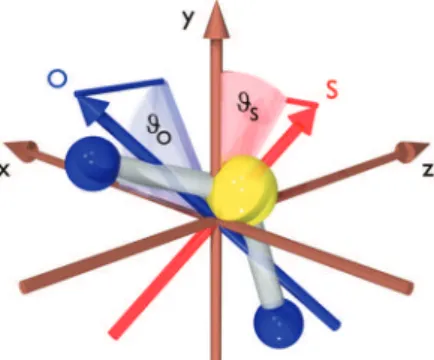
most polarizable axis in the system, which in this instance is along the O-O direction, as illustrated in Figure 6. For simplicity, we denote this the O-axis. Critically, the short duration of the aligning pulse means that maximum alignment initially induced in this axis occurs after the pulse is over. Rather than wait for a dephasing and subsequent revival of the alignment of this axis, a second, orthogonally polarized pulse of 50 fs duration (815 nm, 2 × 10¹³W/cm2) was applied only
a few hundred femtoseconds later to align the second most polarizable axis (which lies in the plane bisecting the O-S-O
Figure 5. (Top) Switched wavepacket optical Kerr effect signal from CO2as a function of probe delay time at 300 Torr and 300 K. At ∆t
< 0, the probe monitors the adiabatic alignment generated by the slowly rising edge of the aligning pulse. At ∆t > 0, the aligning pulse has been rapidly truncated, and field-free wavepacket revivals are seen with a spacing of 10.7 ps )1/8B. (Bottom) Fourier transform of the optical Kerr effect signal from CO2at 300 Torr and 300 K. Combs indicating
progressions of lines corresponding to the fundamental, difference, and sum frequencies are shown. Each progression consists of lines with a measured spacing corresponding to 8B, with B ) 0.39 cm-1.
Figure 6. Definition of angles ϑOand ϑS. The laboratory frame is
defined by the polarization direction of the two laser pulses (the z-axis) and the polarization directions of the two linearly polarized alignment pulses; the first pulse is polarized along the x-axis and the second along the y-axis.
bond angle and is denoted as the S-axis). A shorter pulse may be used in the second step due to the fact that rotation about the S-axis has a larger moment of inertia than rotation about the O-axis. By carefully adjusting the time delay between the application of the two aligning pulses, a situation where maximal 3D alignment is generated may be found. This was determined directly using multibody coincidence imaging of ion fragments produced following Coulomb explosion of SO2using a third
time-delayed laser pulse (815 nm, 50 fs, 5 × 10¹⁵W/cm2). As
shown in Figure 7, the optimal delay time for maximum FF3DA in the case of SO2was found to be 400 fs. The use of multiple
pulses with orthogonal polarizations offers a very flexible and general route to achieving 3D alignment in polyatomic mol-ecules because the duration, intensity, and time separation of the laser fields may be individually tailored to maximize the effect for any specific system of interest.
Recently, a hybrid approach has been developed for the generation and amplification of rotational coherence.136 This
technique simultaneously involves two very different limits of control, weak impulsive control (to exceed the random vacuum fluctuations) and strong pumping via stimulated Raman emis-sion. The approach prepares high-coherence rotational dynamics that are phase-stable with respect to ultrashort pulses. The rotational coherence is made phase-stable with respect to a separate source of ultrashort pulses by weakly seeding the vacuum fluctuations. The rotational amplification is achieved using a phase-independent nanosecond pump pulse to prepare the coherence in molecular hydrogen. The approach can be used to generate large amounts of rotational alignment and has been used to generate spectral broadening of femtosecond pulses.
As a final conclusion to this section, we note that the ability to produce field-free molecular axis orientation in molecular systems offers a route to enhancing the differential nature of dynamics experiments to an even greater extent. Very recently, several groups have made significant experimental progress toward this goal using a combination of intense laser fields in conjunction with static field devices.126,137,138This raises many
interesting prospects for application of these approaches in future generations of molecular dynamics experiments.
Applications: Photochemical Control. The NRDSE ap-proach also finds application in the area of chemical control, that is, the direct modification of product yields in a chemical reaction. As we stressed earlier, this is achieved through the same basic physical effect, with the only difference now being that it acts on the vibrational rather than rotational degree of freedom in the system under study. There is a long history of studies that have sought to investigate vibrational control using
strong laser fields using effects such as bond hardening and softening and adiabatic passage by light-induced potentials in order to mediate dissociation rates and position localization in molecular systems.2,69-77 A distinction between the various
techniques is whether or not the control is derived from resonant dipole interactions or nonresonant Raman interaction. Here, we consider only the use of the nonresonant Raman interaction alone (induced from adiabatically eliminated states) to perform the control. The technical details are outlined above, but for a more detailed discussion of the relation between the two approaches, the reader is directed toward the review by Shore139
and some of the recent publications by Sola´ and co-workers.140-143
As highlighted previously, there are, in general, a large number of competing high-order, nonlinear effects that may all potentially contribute to the overall system dynamics in the presence of an intense laser field (>1013W/cm2). In molecular
systems in particular, the theory describing these individual effects is not always well-quantified, and therefore, the challenge of modeling a system where all of these processes are contribut-ing to some degree in modifycontribut-ing the dynamics is often insurmountable. Such issues have given rise to the widespread use of feedback-based learning algorithms in order to provide shaped laser pulses that are tailored to achieving a specific product yield in a control experiment. While such approaches benefit from the fact that very little, if indeed any, a priori knowledge of the Hamiltonian for the system under the influence of a strong field is required, in the longer term, this is clearly an undesirable situation if one wishes to learn more about the underlying physics of the control interaction. Because the nonresonant dynamic Stark effect manifests itself as the field intensity is gradually increased, we may study its influence on a molecular system by choosing to work in a field intensity regime that induces Stark shifts of sufficient magnitude to exert an influence over the dynamics yet produces a negligible contribution from other strong field effects, such as multiphoton ionization. Typically, this is a regime on the order of 1012
W/cm2. Additionally, in the first instance, we chose to work
only with simple Gaussian pulse shapes. These steps greatly simplify the nature of the control interaction, making it far easier to develop a working model of the physics involved. As we will show, however, the control that can be produced under these conditions is very substantial, both in terms of magnitude and flexibility.
To illustrate the principle of dynamic Stark control (DSC) in regard to photochemical control, we begin by considering an arbitrary diatomic molecular system, AB, with three electronic states, the ground state (state 0) and two electronically excited
Figure 7. Time dependence of SO2molecular axis alignment for three different temporal delays between the two alignment pulses described in
the main text. Zero time is defined by the peak of the second alignment pulse. Experimental data points are shown along with the results of classical calculations (solid lines). The dashed line at 400 fs shows the maximum FF3DA achieved.