Publisher’s version / Version de l'éditeur:
Vous avez des questions? Nous pouvons vous aider. Pour communiquer directement avec un auteur, consultez la première page de la revue dans laquelle son article a été publié afin de trouver ses coordonnées. Si vous n’arrivez pas à les repérer, communiquez avec nous à [email protected].
Questions? Contact the NRC Publications Archive team at
[email protected]. If you wish to email the authors directly, please see the first page of the publication for their contact information.
https://publications-cnrc.canada.ca/fra/droits
L’accès à ce site Web et l’utilisation de son contenu sont assujettis aux conditions présentées dans le site LISEZ CES CONDITIONS ATTENTIVEMENT AVANT D’UTILISER CE SITE WEB.
Paper (National Research Council of Canada. Division of Building Research); no.
DBR-P-1122, 1983
READ THESE TERMS AND CONDITIONS CAREFULLY BEFORE USING THIS WEBSITE. https://nrc-publications.canada.ca/eng/copyright
NRC Publications Archive Record / Notice des Archives des publications du CNRC :
https://nrc-publications.canada.ca/eng/view/object/?id=a31587ae-66ad-4e33-87da-3387abd41903
https://publications-cnrc.canada.ca/fra/voir/objet/?id=a31587ae-66ad-4e33-87da-3387abd41903
NRC Publications Archive
Archives des publications du CNRC
This publication could be one of several versions: author’s original, accepted manuscript or the publisher’s version. / La version de cette publication peut être l’une des suivantes : la version prépublication de l’auteur, la version acceptée du manuscrit ou la version de l’éditeur.
For the publisher’s version, please access the DOI link below./ Pour consulter la version de l’éditeur, utilisez le lien DOI ci-dessous.
https://doi.org/10.4224/40001710
Access and use of this website and the material on it are subject to the Terms and Conditions set forth at
Post-flashover compartment fires
R e f
Ser
National Research Conseil national
T H .
I
$
Council Canada
de recherches Canada
N21d
no. 11:-
-~BrnG
POST-FLASHOVER COMPARTMENT F l RES
by T.Z. Harmathy and J.R. Mehaffey
ANALYZED
Reprinted from
Fire and Materials
Vol. 7, No. 2,1983
p. 49
-
61
BLDG. RES.
1 x 7
DBR Paper No. 1122
Division of Building Research
Dans c e t t e n o t e , q u a t o r z e modsles math'anatiques de feux c o n f i n k a y a n t a t t e i n t l e s t a d e p o s t ' e r i e u r
2
l'embrasement g & n S r a l s o n t c l a s s i f i ' e s s u r l a b a s e d e s q u a t o r z e a s p e c t s p r i n c i p a u x d e s modsles; d e s e x p r e s s i o n s d'ecrivent l a p o s s i b i l i t ' e de p r o p a g a t i o n p a r d e s t r u c t i o n e t convection; d e s e x i g e n c e s de r b i s t a n c e a u f e u pourl e s
p a r o i s du compartiment s o n t formul'ees e t d e s mesures pour 6 v i t e r l a propagation du f e u par convection s o n t propos6es.REVIEW PAPER
Post-flashover Compartment Fires
T. Z. Harmathy and J. R. Mehaffey
Ilivision of Building Research, National Research Council. Canada
Fourteen mathematical models of post-flashover compartment fires are classified on the basis of fourteen principal modelling aspects. Expressions are presented for the potential of fire to spread by destruction and convection. The assessment of the fire resistance requirements for the compartment boundaries is discussed and measures to counter the potential of fires to spread by convection are outlined.
INTRODUCTION knowledge or to offer unique concepts. Models that
are not referred to have been regarded as variants. It has been traditional to divide the course of a Efforts have been made to develop a classification compartment fire into pre-flashover and post-flashover scheme that covers the most important traits of all periods. I t is claimed that knowledge of the course of fourteen models.
fire during the pre-flashover period is important for
saving lives; and knowledge of its characteristics dur- Deterministic versus probabilistic ing the post-flashover period provides a basis for
designing measures to save property. Although this way of looking at compartment fires is oversimplified,
it is indcc~l true that major property losses are unlikely until after the fire has reached its post-flashover stage.
Research into the pre-flashover period of fires started with experimental studies of fire scenarios. The theoretical work that followed has already resulted in a fair understanding of the mechanism of fire growth. Among the dozens of publications that have appeared on this subject, those by Quintiere,' Pape and Water- man2 and Emmons3 present comprehensive reviews.
Although some of the mathematical models of pre- flashover fires may also cover the post-flashover pcriotl, thosc w11o are conccrnccl with thc structuriil safety ol' 1111ildi1)gs prefer lo use models developed explicitly for post-flashover fires. They yield informa- tion in forms more directly applicable to problems of structural safety. This paper will deal only with the latter models.
The models proposed during the past twenty-five years for predicting the characteristics of post- flashover compartment fires embrace a diversity of underlying assumptions and mathematical techniques. To someone not familiar with all models it may not always he clear whether a specific model is up-to-date or even applicable to the problem at hand.
The first part of this paper is a review of various models. The second part deals with the two basic modes of intercompartmental fire spread (convective and destructive), and with design techniques aimed at preventing spread.
1. MODELS OF POST-FLASHOVER COMPARTMENT FIRES
Fourteen mathematical models of post-flashover fires will be classified."" These models have been judged eithcr to represent important steps in the evolution of
CCC-0308-0501 Wiley Heyden Ltd, 1983
It is usual to classify models of post-flashover com- partment fires as either deterministic or probabilistic. Deterministic models rely on the laws of nature; prob- abilistic models rely on the laws of large numbers. Even those who prefer deterministic models realize that compartment fires are to some extent random processes. Yet they aver that probabilistic techniques should be used only in finding the most likely (or perhaps the most adverse) values of the 'misbehaving' input variables to the fire process. Once these input variables are defined, the process should, they believe, be analysed with the aid of the laws of physics and chemistry. In contrast, the advocates of probabilistic models view the entire fire as n random proccss and
employ prol~abilistic techniques in describil~g it. 'l'his paper deals with deterministic models only.
1.2 Utility
of models in designSome models of post-flashover fires were developed to aid the designer in the provision of structural fire safety. In one form or another, these models yield a complete set of quantitative information necessary in the design. Others are of more modest utility; they purpose either to illuminate selected aspects of the fire process or to achieve a better qualitative understand- ing of the entire process.
Summary. From the point of view of its utility in design for structural fire safety, a model can be regarded as either
( 1 ) C:omprehensivc, or (2) I~icornpletc or qualitative.
1.3 Interpretation of fire duration
It has been traditional to describe compartment fires as consisting of three periods: growth (or pre- flashover), full development and decay. Some models,
T. Z. HARMATHY AND J. R. MEHAFFEY though placing emphasis on the period of full develop-
mcnt (during which t hc fire process is characterized by quasi-c~eady-.itate conditions), take account in a simp- I~licd way or the existence of the other two periods. Othcr n~odcl\, because of the uncertaintics surround- ing t h c c,ncrgy evolution during thc growth period, ;t\\umc that all fuel energy is released after flashover, an assumption that always errs on the safe side. Among the latter, there are some that acknowledge the exl5tence of separate periods of full development and decay, whereas some lump the two together in an 'effective' post-flashover period.
Picturing post-flashover fires as divided into two period., is not an important aspect of mathematical modelling. From the point of view of the fire's destruc- tive potential (see discussion below) the post-flashover pcriod i s essentially the time during which heat is imparted to the compartment boundaries, in other wurdr. the timc during which the temperature
of
the tire gases is higher than the temperatureof
the com- partment boundaries. This period is, for all practical purposes, aver as soon as t h e burningof
the bulkof
the Fuel comes to an end, irrespective of how long some remnants continue to bum afterwards. (The rate of c r ~ ~ l i n c of the compartment boundary surfaces fol- Iowinc this period has been shown to have only a minor effect on the overall destructive potential of lire1'.\
In dealing with the destructive potential
of
fire itis
a permissible and safe practice to identify the fire with i t s post-flashover period and to regard it as unfolding under quasi-steady-state conditions during the period of full development.Summary. Fire duration is regarded in the various models as consisting of
(1) Three periods: full development plus (simplified) growth and decay, or
(2) Two periods: full development and (simplified) decay, or
(3) One 'effective' period, during which the fire gases transmit heat to the compartment boundaries. 1.4 Process variables
Process variables are the dependent variables that describe the fire process. It has been shown16 that during its period of full development a compartment fire can be satisfactorily described by five process variables:
their solution will yield time-dependent process vari- ables) or they may describe average coi~ditiorls for the post-flashover fire (and thus yield average values for the process variables). (Almost all models take advantage of the finding that U , is very nearly con- stant during the period of full development. Several models regard R and Q also as constants during the same period.) Clearly, if the latter formulation is elected the number of process variables must be in- creased by one, the effective duration of post-flashover fire, 7, i.e. the period over which the other five process variables are averaged.
The advantage of the latter approach is that the average values of the process variables can be expres- sed directly from an appropriate number of simultane- ous equations. If the former technique is used the process variables are obtained as functions of time from
a
complex ntlmerical follow-up technique. As the reproducibility of fires i s usually poor, some authors believe that the greatly increased effort resultingfrom
the numerical processing of a model may not be justified.
Summary. Process variables are treated in the various models as either
( I ) Functions
of
time, calculated from equations de- scribing momentary conditions: nr(2) Averages for the effective duration of post- flashover period, calculated
frum
cquations de- scribing average conditions.1.5 Characterizing destructive potential
The derivation of information that can form a basis for assessing the structural and thermal performance of compartment boundaries under adverse fire conditions is perhaps the most important aspect of the modelling of post-flashover compartment fires. As the evaluation of the heat flux that penetrates the boundaries (and thereby determines their temperature histories) is part
of
the mathematical modelling, any comprehensive model for assessing the characteristics of fire can be extended, at least in principle, for assessing the perfor- a mance of the boundaries as well. Yet the problem of thermal performance in itself, even without the burden of structural performance, is usually much too com- plex to be made part of the mathematical model. Models are therefore used mainly as tools for provid- ing information on the destructive potential of the fire. information that is then applied . .as
input rna
separate analysis of the perfnrmance of the ccmpartnicnt U,,: Rate of air flow into the compartment; boundaries.R : Rate of 'burning', i.e. rate of loss of fuel mass Opinion is divided on what this input information (due to pyrolysis and, possibly, char oxidation); should be. It has been traditional to regard the temp- Q : Rate o' of heat within the 'Ompart- erature history of the fire gases,
Tg(t),
(wherer
is time)ment; as the embodiment of destructive potential. Since the
T,: Temperature of fire gases; and temperature depends in large measure on the thermal 9: Heat flux penetrating the 'Ompartrnent properties of the compartment boundaries, the long-
aries. accevted vrocedure is to develop with the model a
Equations needed to develop information on the number
df
temperature history 'curves for the fire process variables can be formulated in two ways: they gases, each applicable to a particular type of ComPart- may describe momentary conditions (and therefore merit boundary only.POST-FLASHOVER COMPARTMENT FIRES: A REVIEW
Further studies suggested that the history of the hcat flux penetrating the compartment boundaries,
1 1 ( t ) , woulti be more appropriate for characterizing the
destructive potential of fires. It was thought that perhaps the functions q(t) and T,(t) together might be viewed as descriptors of the severity of fire. This
concept w w lllrther simplified hy suhstitutis
for
the functioy y(r) and T,(t) the ensemble ij, T,, and 7,wllcru '1; and ij arc values averaged ovcr the period T,
the cffechvu Jurgian of post-flashover fire. The pro- cess variables q, T, and 7 have heen referred to as fire
severity parameters.
More detailed inve~tigations'~ revealed that the q(t) function alone, or even a single parameter referred to as 'heat load' and obtained as the time integral of q(t), is sufficient for uniquely -characterizing the destructive potential of fires that
occur
in compartments made from the same materials. The final step in this de- velopment was the finding that 'normalizing7 the heat load yields a unique descriptor for the destructive potential of fires, regardless of the type of boundary materials.I6 (This concept is not applicable to unpro- tected steel (or aluminium) members. Knowing the temperature history of fire gases is, therefore, a pre- requisite to the design of unprotected steel members for satisfactory structural performance.)The normalized heat load, H , is defined as
for~ncd by a single material displaying a thermal incr- tia representing a surface-averaged value:16
where
The i subscripts relate to information pertinent to the ith boundary element of the compartment, and A
stands for boundary surface area (total, or with sub- script i, component).
Summary. The system (compartment on fire) is re- garded in the various models as either
(1) A 'well-stirred reactor'; or
(2) Consisting of a number of zones.
1.7 Mass balance over the ventilation opening
Five independent equations are needed for the calcu- lation of the five process variables. Among these equa- tions, the mass and heat balances over the ventilation opening are the most important. The mass balance is 1 '
H=-I q d t J(kpc) 0
U,= U , + R
(1) (4)
(Some models formulate the mass balance in a slightly
-
- where J(kpc) is the thermal inertia of the compart- different manner.)rnznt boundaries (k is thermal conductivity, p is den- where
sity and c is specific hcat). R = R , + R , (5)
Summary. In the various models the destructive and U, is the mass flow rate of fire gases (combustion tential of fire is quantified by and, possibly, pyrolysis products) from the compart- ment, R, is the rate of loss of fuel mass by the release (1) The temperature history of fire gases, T,(t); or
(2) The ensemble ij, T, and 7 ; or
( 3 ) The normalized heat load,
H.
1.6 Structure of the 'system'
The 'system', i.e. the compartment on fire, is looked upon in some models as a 'well-stirred reactor' in which the 'process of burning' takes place. This anal- ogy has been suggested by the relative spatial unifor- mity of some of the process variables during the period of full development. A closer e x a m i n a t i ~ n ~ . ' ~ reveals, however, that there are, in fact, various zones present in that seemingly uniform system and that some of the process variables assume recognizably different values within these zones.
It would appear that the well-stirred reactor model is perforce not applicable to fires that develop in compartments whose boundaries are formed by more than one material. Under such conditions one of the process variables, the heat flux penetrating the bound- aries, q, may become markedly non-uniform. Yet this problem alone would not justify resorting to zonal modelling. It can be overcome, as suggested in some models, by regarding the compartment boundaries as
of volatile pyrolysis products and R, is the rate of loss of fuel mass by the oxidation of the solid residue of pyrolysis, char. In general, R,>> R,; for non-charring fuels naturally R, = 0.
To derive an expression for U,, Kawagoe and Sekine4 and Thomas et ~ 1 . ~ ' assumed that the entry of fresh air and the departure of hot fire gases take place under the effect of a static pressure field induced by the temperature difference between the fire compart- ment and the outside atmosphere. (In some models Ua
is directly related to R on stoichiometric considera- tions.) Tacitly, they also assumed that the outside atmosphere is calm and the fire compart~nent fully isolated from the rest of the building. With the aid of auxiliary equations resulting from these assumptions
U , can be eliminated from Eqn (4) and a correlation obtained between Ua and R. In a somewhat simplified form, that equation is
where @ is the so-called ventilation parameter (the ventilation parameter is replaced in some models by an equivalent expression called the opening factor, A , J ( ~ ) I A )
@ = p a ~ v J(ghv) (7)
and p, is the density of atmospheric air, A v is the area
T. Z. HARMATHY A N D J . R. MEHAFFEY
of ventilation opening (window or door), h, is the height ol' vcntilation opening and g is the gravitational constant. Sincc R in Eqn ( 6 ) is usually much smaller
tl1;111 / I , , 110 ; t p p ~ ~ c i a b l e error results if ,U, is taken
simply as proportional to @. Most models take advan- tage of this approximation.
If thc outsidc atmosphere is not calm and the fire compartment is not fully isolated from the rest of the building, the flow rate of air may be significantly higher than the value yielded by Eqn (6). Fortunately, as will he shown later in this paper, the destructive potential of fire decreases with increasing air flow rate. As fire safety design is concerned with the most detri- mental conditions that might arise in the compart- ment, it is a safe practice to employ Eqn (6) in the rnodelling of post-flashover fires.
1.8 Expressing the rate of burning
As will be discussed in sections 1.9 to 1.11, a fair degree of understanding already exists concerning the mcchanisni of quasi-steady-state 'burning' of fuel dur- ing the period of full fire development. Some models formulate the rate of burning,
R, on the basis of such
bona fide knowledge. Others use some assumed law for describing R. Again, others regard the rate of burning of fuel (or, what is in essence the same, the rate of evolution of heat from the fuel) as input inforni;ttion to he developed from representative tests.l . ' i ~ ~ i t l l y , sonlc uhc a combination of hona fide knowl-
edge and some assumed law.
surface char has an important role in driving the pyrolysis reaction; this, in turn, provides volatile pro- ducts for the flaming combustion. Consequently, R is sensitive to the air flow past the fuel pile, but relatively insensitive to the radiant heat feedback to the pile- determined by the temperature of the environment. As non-charring fuels (most of the common plastics) do not have a 'built-in' heat supply (oxidizing char), their pyrolysis relies entirely on radiant heat feedback to the fuel surface. Their rate of mass loss by pyrolysis,
R,
is therefore sensitive to the temperature of the environment but insensitive to the rate of air flow past the fuel.Owing to these basic differences in the burning characteristics of fuels some models are, in a strict sense, applicable to charring fuels and others to non- charring fuels. For charring fuels it may be appropriate at this time to apply the term solely to cellulosics, since no other char-forming fuel has so far been used in compartment burn experiments. Naturally, the ap- plicability of models that use some assumed law or the results of some representative test for defining the rate of mass loss of fuel is not restricted to one or other type of fuel, although the models may have been developed originally for cellulosic fuel only.
Summary. With respect to type of fuel, a model may be applicable to
(1) Cellulosic (char-forming) fuels; or (2) Non-charring fuels; or
(3) Any type of fuel. Summary. In expressing rate of 'burning' the various
models rely on 1.10 Modewig the burning of cellulosic fuels
(1) Bona fide understanding of the mechanism of burning; or
(2) Assumed law; or
(3) The result of a representative test; or
(4) A combination of bona fide knowledge and as- sumed law.
1.9 Type of fuel for which Model is applicable
Confusion ha3 always existed about the interpretation of the word burning. Burning consists of two or three kinds of completely different reactions:
Pyrolysis of the fuel into volatile products and, possibly, char;
Combustion of the volatiles, a series of gas-phase reactions; and
(3) (Possibly) oxidation of char, a heterogeneous solid-gas reaction.
What is commonly referred to as rate of burning is (see Eqn (5)) the rate of loss of fuel mass due to pyrolysis and (possibly) the oxidation of char residue. The mechanism of mass loss depends largely on whether the fuel is char-forming or non-charring.'9,*' With char-forming fuels (cellulosics are the most im- portant) the heat that evolves from the oxidation of
It was among the earliest findings of fire sciencez0 that in compartment fires involving cellulosics the rate of loss of fuel mass (rate of burning),
R,
can be de- coupled from all process variables except the rate of entry of air,Ua.
Further, if the compartment is poorly ventilated, R is approximately proportional toU,
(or the ventilation parameter, @); if the compartment is well ventilated, R depends on some characteristics of the fuel bed.Because of the vagueness of the interpretation of the word burning, it has been usual to look at R as a kind of general 'rate of combustion' in the compart- ment and tacitly identify it with the rate of gas-phase combustion of the volatile pyrolysis products. Based upon this concept, the proportionality hctwccn R mid
Ua
(at low ventilations) was interpreted as the limita- tion of gas-phase combustion due to limited air supply. In reality, as pointed out in connection with Eqn ( 5 ) , R has nothing to do with the gas-phase reactions; it is to all intents the rate of loss of fuel mass due to pyrolysis. Thus the question arises, how can pyrolysis, a thermally activated process, be controlled by the rate of air flow?The following model has been suggested to explain the peculiarities of the rate of burning of cellulosic fuel in compartment fires.8 There exists in the compart- ment a zone where the char cover on the fuel surface undergoes intense oxidation and where the bulk of
POST-FLASHOVER COMPARTMEN'I' FIRES: A REVIEW
pyrolysis takes place. This zone, whose size is roughly proportional to the rate of air flow, moves slowly across the conlpartment as the fire progresses, from ncar the ventilation opening to the far end of the
compartment."
Under these circumstances the rate of loss of mass of the total fuel is approximately constant and equal to the rate of pyrolysis in the zone of intense char oxidation. If the flow rate of air is suffi- ciently large. the zone extends to the entire compart- ment and the rate of pyrolysis becomes controlled by the total surface area of the fuel (more exactly, by the surface of oxidizing char covering the total amount of fuel in the compartment).Hundreds of experimental data indicateX that this model of the burning of cellulosic fuel is reasonably accurate, as are the following semi-empirical equations developed from the model:
where cp is the specific surface of the fuel and G is the initial mass of fuel in the compartment. Fires to which Eqn (Xa) is applicable are referred to as ventilation- controlled and those to which Eqn (8b) is applicable as fuel-surface-controlled.
In an effort to give a more accurate account of the effect of air flow rate on the rate of loss of fuel mass in at least one model the 'porosity' of the fuel bed was taken into consideration as a geometric variable in addition to surface area of the
Lei.
As the assumption that the fire is always ventilation- controlled, irrespective of the value of @lpG (see Eqns (8a) and (8b)), will result in more severe design requirements at higher ventilations, several models neglect the changeover that takes place at @lcpG= 0.263.
Summary. The rate of 'burning' (rate of mass loss) of cellulosic fuel is considered in the various models as controlled by
(1) Ventilation or fuel surface area, depending on ventilation conditions; or
(2) Ventilation under any condition; or
(3) Ventilation, fuel surface area and porosity of fuel bed, depending on fuel geometry and ventilation conditions.
1.11 Constancy of the rate of burning of cellulosic fuels
Many experimental data seem to indicate that the rate of loss of fuel mass in compartment fires involving cellulosic fuels is approximately constant over a rela- tively long part of the period of full-fire development, in spite of the fact that the dimensions of the fuel decrease as fire progresses. To reflect this finding, relations that express the rate of loss of fuel mass, R,
i n terms of some geometric characteristic of the fuel (e.g. surface area) are customarily based on the pre- fire geometry of fuel rather than on instantaneous (variable) geometric traits. In some models, however,
the dimensions of the fuel are looked upon as variable quantities, thereby making R also a variable. This kind of modelling inevitably leads to the inference that a fire changes its character as it progresses, for exam- ple, that a ventilation-controlled fire will change into a fuel-surface-controlled fire at some stage during the period of full development.
Naturally, models that rely on the results of rep- resentative tests in defining the rate of burning cannot be classified solely on considerations discussed in this section.
Summary. The various models assume that the rate of 'burning' of cellulosic fuel during the period of full development is either
(1) Constant, determined by pre-fire conditions; or (2) variable, changing with the progress of fire.
1.12 Heat balance over the ventilation opening l'he second important equation used in the evaluation of the process variables is that for heat balance over the ventilation opening. It can be written in the follow- ing form:
R , A H , + R , A H , - R , A H , + U , H ,
-UpH,-qA-qRAv=O ( 9 )
where AH, is the heat of combustion of the volatile pyrolysis products, AH, is the heat of oxidation of char, AH, is the heat of pyrolysis, Ha is the enthalpy of air entering the compartment, H, is the enthalpy of fire gases leaving the compartment (which normally consists of contributions from sensible heat and latent heat carried by the unburned pyrolysis products usually present in fire gases) and q , is the rate of heat loss by radiation. If the enthalpy of air, Ha, is taken as the datum level for enthalpy (i.e. Ha = 0), the fourth term is eliminated from the equation.
The third and last terms in Eqn (9) are usually of negligible importance. Differences in the various mod- els are mainly due to the different formulation of the first two, the fifth and the sixth terms.
1.13 Stoicbiometry of combustion
The firs[ two terms represent the rate of heat evolu- tion from the fuel by the combustion of the gascous pyrolysis products and the oxidation of char. l h c s c reactions never proceed according to thc stoichio~iic~- ric relations. Some models do take account, in a simplified way, of the decrease in the values of AH, and AH, due to incomplete combustion, others do not. Some researchers believe that because the reproduci- bility of post-flashover fires is not high enough to justify the use of very refined modelling techniques, the interpretation of AH, and AH, is not a very important aspect of the quality of a model.
Summary. Combustion (including char oxidation, when applicable) is considered in the various models
.I'. Z. HARMATHY AND J. R. MEHAFFEY
as either In one model the problem of heat transmission to
the compartment boundaries is circumvented by as- (1) Imperfect (realistic); or suming that the surface temperature of the compart- (2) Taking place according to stoichiometric relations. ment boundaries is always equal to the temperature of
the fire gases.
1.14 Combustion outside the compartment
If R
<
U , / r (where r is the mass ratio of air to volatilepyrolysis products in a stoichiometric combustion) there exists, at least in principle, a possibility that the combustion of the volatiles takes place entirely within thc confines of the compartment. It can be showns that the condition R
<
U,/r is always fulfilled for cellulosic fuels, irrespective of the ventilation conditions. Yet even with these fuels the absence of combustion out- side thc ventilation opening is an exception rather than a rule. The reason is that the size of the compartment, especially its height, may not be sufficient to allow satisfactory entrainment of air into the fire plume. The reader is reminded that in Eqn (9) the possibility of combustion outside the compartment has been left open by a convenient definition of H, in the fifth term. With non-cellulosic fuels the conditions R<
UJrand R
>
U:,/r are both possible. If the latter condition holds, complete combustion of the vol;itile pyrolysis products in the compartment is, perforce, impossible and part of the volatiles will burn in the flame over the ventilation opening.The rate of flow of unburned volatiles from the compartment cannot yet be satisfactorily quantified. Neverlhcless, some models explicitly take account of
Ihc possibility of release of fuel energy outside the compartment in an empirical or semi-empirical fash- ion. Others disregard that possibility.
Summary. In the various models the coefficient of
heat transfer to the compartment boundaries is re- garded as
(1) Consisting of radiation and convection terms; or (2) Consisting of a radiation term only; or
(3) Infinite.
1.16 Thickness of compartment bomdaries
In expressing the heat flux penetrating the compart- ment boundaries, q, some models take account of the finite thickness of the boundaries. Other models re- gard the boundaries as semi-infinite solids. From the work of Griffith and HortonZ3 not only does it appear that the semi-infinite solid model is a reasonable ap- proximation but also that the boundaries can, under realistic conditions, be regarded as hornogcneous and consisting of the material used in the inner lining.
Summary. In the various models the compartment
boundaries are regarded as either (1) Finite-thickness slabs; or (2) Semi-infinite solids.
1.17 Thermal properties of the compartment bomd- aries
Summary. In the various models the possibility of
combustion of volatile pyrolysis products outside the In that use a Ilumerical technique compartment is either to provide information on the characteristics of fire the thermal urouerties of the comuartment boundaries can (1) Neglected; or
(2) Explicitly taken into account in an empirical fashion.
1.15 Heat transfer to the compartment boundaries
The heat flux penetrating the compartment bound- aries, q in the sixth term of Eqn (9), depends largely on the-nature of the heat exchange in the compart- ment. Some models consider q as controlled by a combined radiant-convective transfer mechanism be- tween the fire gases and the various compartment boundaries. others neglect the convective heat trans- fer. Although the real mechanism of heat transmission
in the compartment is somewhat more complex than suggested by the foregoing schemes, it is believed that either scheme is sufficiently accurate. The simpler, the second, is justifiable on the ground that heat transfer by radiation usually far outweighs transfer by convec- tion, and if the coefficient of heat transfer is suffi- ciently high, q is controlled by the thermal inertia of the boundaries rather than by the intensity of the heat supply to them.
be regarhe& in principle, as knctions of temperature. Nevertheless, not all such modeIs take advantage of this possibility, mainly hecause knowledge of the prup- enies of building materials at elevated temperatures is
inadequate. Naturally, models that treat the process variables as averages over an 'effective' period of fire duration take the thermal properties of the boundaries as constants, valid over the effective period. This latter concept has apparently some drawbacks as far as accuracy is concerned; yet it is capable of offering increased realism at little extra cost in those over- whelmingly frequent cases where the compartment boundries are formed by a number of different materi- als. All that is needed in such cases is to use as input information for the thermal inertia of the boundaries a value calculated from Eqn (2).
Summary. In the various models the thermal proper-
ties of the compartment boundaries are treated as either
(1) Functions of temperature; or
(2) Constants representing averages over the 'effec- tive' fire duration.
POST-FLASHOVER COMPARTMENT FIRES: A REVIEW
1 .I8 Application of classification scheme simplified manner) is that described in Reference 16.
That model will be outlined in a somewhat simplitied 'The application of the classification scheme (described formz4 deemed satisfactory for design considerations. in sections 1.2 to 1.6, 1.8 to 1.1 1, and 1.13 to 1.17) to
tllc fourtcur~ .;clcctcd ~ni~thcn~atical models4-" is sum- tilari~.ed in '1'at)lc 1 . Some aspects of the classification do not seem to apply to certain models; these are not referred to under the particular aspect of classification. On the other hand, some models seem to satisfy two alternatives under one or another particular aspect of the classification.
Table 1. Principal traits of models of post-flashover fires
Aspecta AspectD
of ~ r a l l ~ of Trait'
classl- of Model classi- of Model fication model ref, no fication model ref no.
1 4,6,7.8,9,10,13 1 8.16
1.2 16.17 1.10 2 4.6.13.17
2 5.11.12.14.15 3 9
aAspects and traits are not described here but are referred to by numbers. The code for this symbolism is provided in the summary appended to the sections bearing the appropriate aspect numbers.
2. COUNTERING THE SPREAD POTENTIAL
OF FIRES
Most mathematical models of post-flashover compart- ment fires were developed with the sole purpose of providing information on their potential to spread by the destruction of compartment boundaries, or perhaps (most unlikely) by conduction of heat through the boundaries. Observations over the years clearly showed, however, that spread by convection, i.e. by the advance of flames and hot gases (through an open door, broken window or any kind of wall or ceiling opening) is far more common than spread by destruc- tion. The only model capable of yielding information on the spread potential of fires by both destruction and convection (in the latter case in a somewhat
2.1 Building before the outbreak of lire
The spontaneous air currents in a building at the outset of fire are of vital importance to the course a fire will take. As they are, as a rule, more intense in tall buildings, to emphasize their role in the fire pro- cess the building in this paper is pictured as one of several storeys. spontaneous air currents are brought about by two factors: the temperature difference be- tween the building interior and the outside atmos- phere, and the air-leakage of the building envelope. Owing to the former, they are especially strong during the winter heating season.
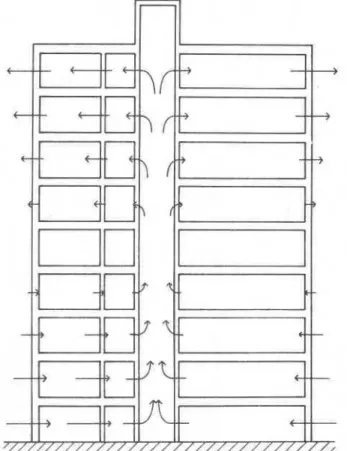
The intensity and direction of spontaneous air cur- rents in a nine-storey building are illustrated dia- gramatically in Fig. l , which shows the situation on a calm winter's day. If the geometry of the building is simple and the leakage characteristics of the building envelope are uniform with height, air will infiltrate into the building below its mid-height. After passing through one or two partitions, it may enter thc 'shafts' of the building (such as stairwells and elevator shafts), rise to the upper storeys and exfiltrate to the outside atmosphere.
The spread of fire tends to follow the path of air currents (see Fig. 1). If, on a calm winter's day. fire breaks out in a compartlncnt, l>clow tllc mid-1icigl11 of
Figure 1. Illustration of air currents in a nine-storey building.
T. 2. HARMATHY AND J. R. MEHAFFEY
the build~ng, it will probably enter the corridor first, then, if doors are open. tend to rise in the stairwells or clcvator shafts. I n the upper storeys, on the other hand, the spread will be mainly outward towards the build- ing envclopc. On reaching the envelope, flames cmer-ging from broken windows may ignite the ex- terior cladding if i t is combustihlc, or nlay break the windows above and set the compartment in the next storey o n firc.
may prevail in the building and augment the tire- induced air flow into the compartment. Fortunately, defining a design value for ventilation does not require stochastic consideration. As will be discussed later, the potential of fully developed fires for destructive spread is usually highest when the air flow rate is minimum. That minirnum, as pointed out earlier i l l .;cctio~~ 1.7, is
determined by the dimensions of the ventilation open- ing (see Eqns (6) and (7)).
2.2 Fire load 2.4 Char-forming and non-charring fuels
The principal difficulty in calculating the spread poten- tial of a fire is that two of the most important input variables, fire load and ventilation, are random vari- ables. Traditionally, the combustible contents of com- partments are quantified in terms of specific fire load, defined as the mass of conventionai combustibles (cel- lulosics) per unit floor area. (If non-cellulosics are present, their mass is converted into a calorifically equivalent mass of wood.) Surveys have indicated that the type of occupancy is the most important factor in the specific fire load. Yet even for similar occupancies its value may vary markedly in an unpredictable fashion.
Listed in Table 2 are data on the statistical median,
Ln, and standard deviation, a,,, for distributions of
That there must exist a substantial difference in the characteristics of compartment fires involving char- forming and non-charring fuels has already been made clear in sections 1.9 and 1 .lo. Among char-forming fuels, cellulosics are the only ones whose 'burning' behaviour in fully developed fires has so far been studied by experiments. Because, as statistical data indicate, cellulosics still make up the bulk o f fire load in
modern buildings, the discussion in this paper will be restricted to predominantly cellulosic fuels. It so hap- pens that fires of cellulosics are, as a rule, more destructive than fires of non-charring fuels and, there- fore, from the point of view of fire safety design the error resulting from that restriction is usually on the safe side. (Those interested in pool-fires of non- charring fuels are asked to refer to Reference 16.)
Table 2. Information on s~ecific fire load (in terms bf dorifi- cally equivalent mass of wood) L, Standard Occupancy (kg m ') deviation Dwelling 30.1 4.4 Office 24.8 8.6 School 17.5 5.1 Hospital 25.1 7.8 Hotal 14.6 4.2
specific fire load, based mainly on Swedish data." There have been suggestions that the design value of the specific fire load may be regarded as that applica- ble to either the 80th or 95th percentile of each building occupancy considered. If the latter, stricter, condition is accepted, the design value of the specific fire load, L, can be obtained as
There have also been suggestions that L be made dependent on the value of the building at risk.26 In assessing the spread potential of a fire, the total mass of combustibles in the compartment, i.e. the total fire load, G, is the sought-after information. It is
wllcre A , is thc floor area of thc compartment.
2.5 Theorem of uniformity of normalized heat load
Clearly, a good model must be capable of yielding quantitative information on the potentials of fires to spread by both destruction and convection. It was claimed in section 1.5 that the potential of fires to spread by destruction can be measured by the nor- malized heat load on the compartment boundaries. It has been shown2' that if the compartment boundaries are made up of a number of elements lined with different materials, the normalized heat load will be the same for all boundaries of the compartment, irre- spective of their thermal inertias (provided that their thermal inertias are not appreciably higher than that of concrete), and in addition equal to the normalized heat load applicable to the compartment as a whole. This important finding is referred to as the 'theorem of uniformity of normalized heat load'. It is expressed by the following equation:
where q, is the heat flux penetrating the ith boundary element,
Hi
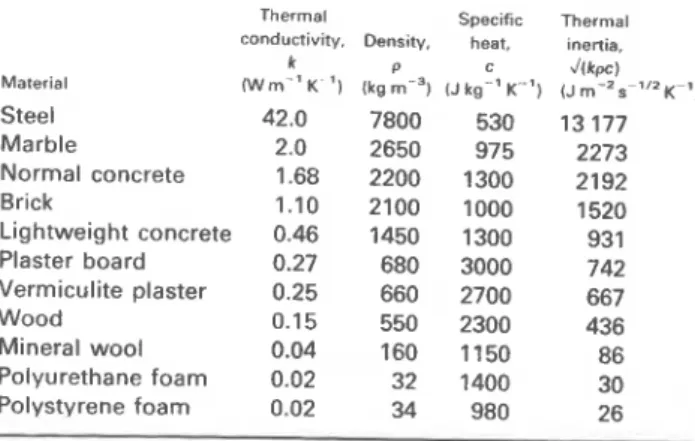
is the normalized heat load for the ith boundary element, and J(kpc) is to be interpreted as shown in Eqn (2). The thcr~nal incrtias of a nurnl)c~- ol'construction materials are listed in Table 3.
2.3 Ventilation of 61-
2.6 Potential for convective spread
Ventilation, i.e. rate of entry of air into a burning The commonest mechanism of fire spread is the spil- compartment, is also a random variable. Air currents ling out of the uncombusted products of pyrolysis
POSr-FLASHOVER COMPARTMENT FIRES: A REVIEW
Table 3. Representative values of thermal properlies of
selected construction materials (in moistweless
condition) for appropriate temperature intervals
Thermal Specific Thermal conductivity. Density, heat, inertia,
k P c J ( k p c ) Material (W m -' K 'I (kg m?) (J kg-' K-.') (J m-' s ' I 2 K-') Steel 42.0 Marble 2.0 Normal concrete 1.68 Brick 1.10 Lightweight concrete 0.46 Plaster board 0.27 Vermiculite plaster 0.25 Wood 0.15 Mineral wool 0.04 Polyurethane foam 0.02 Polystyrene foam 0.02
through thc. ve~itil:rtion openings, carrying flames into surrounding spaces. Irrespective of the nature of the lining materials in these spaces, fuels and conditions conducive to massive combustion of fuel outside the comp:irtrnerit boundaries present a very real danger from the point of view of fire spread. A factor has been introduced to characterize the convective spread potential of fire,'' denoted by and defined as the ratio
rate of heat evolution outside fire compartment
'
-total rate of heat evolution from fuel (1 3 )
2.7 Input variables in the model
As emph;~dzcd in section 2.4, onlv those (by no means uncommon) fires will he discussed in this paper that arc I'uclled predominantly hy cellulosics. i(eeping practical considerations in mind, a simplified model will he presented"" that offers two advantages over the more detailed one of Reference 16: first, it signifi- cantlv reduces the com~utational burden. and second. it offers explicit expressions for the destructive spread potential, H, and convective spread potential, p, and thereby allows direct insight into the dependence of the nature of fire on the input variables.
A complete set of the input variables needed in a rigorous modelling of the problem is listed in the original text.'6 In the simplified model, several of these input variables are treated as constants, charac- teristic of typical situations. The input variables in the simplified model are as follows:
G =fire load
A =total area of compartment boundaries Q =ventilation parameter
J(kpc) =overall thermal inertia of compartment boundaries
6 = fraction of energy of volatile combustible re- leased within the compartment.
Thc first four of these have already been defined by Eqns ( 1 I), (3), (7) and (2), respectively. The fifth remains to be defined.
As pointed out in section 1.14, for cellulosic fuels
the rate of air flow into the compartment is always sufficient to allow stoichiometric combustion of the volatile pyrolysis products inside the compartment. That complete comhustion does not usuallv lake place inside is due mainlv to the imperfect entrainment
of
air into the pyralvsis gases. It appears fmm an analysis
of
a
comprehensive experimental study conducted in~ ~ i ~ ~ i ~ M . 2 " that the height of the compartment, h,
.
is an important factor in the rate of entrainment of air, and in turn. in the fraction of comhustion energy released inside the compartment. The fc>llowing em- pirical expression has been recommended for use in the simplified model:s = {
0.79J ( h C 3 / @ )
1 whichever is less (14) It is readily admitted, however, that the uncertainty surrounding 6 is a weak point, not only in the simp- lified model discussed here but also in the most realis- tic models available at this time.
2.8 Expressions of the potential for h e spread
If all heat were released by the fuel within the com- partment and absorbed by the compartment bound- aries, the normalized heat load could be expressed by the following equation:
I G d H
H,,, = -
-
-
JTS\pc) A
where the subscript m has been affixed to H to indi- cate that it represents the conceivable absolute max- imum, and AH is the total heat of combustion of the fuel.
Fortunately, it has been found that the normalized heat load on the compartment boundaries is only 1 0 to 40 per cent of
H,.
Some of the fuel energy is released outside the compartment, but even of the portion released inside some will leave the compartment with the fire gases as sensible heat and some will be lost by radiation through the ventilation opening (see Eqn (8)). A multitude of calculations has indicated that the normalized heat load, in other words the potential of fire for destructive spread,Increases less than in proportion to the fire load; Decreases as the ventilation of the compartment in-
creases; and
Decreases as the thermal inertia of the boundaries increases.
These findings are reflected by the following equation, which has been derived by the empirical processing of the results of hundreds of
calculation^:^^
It is revealing to examine the normalized heat load in relations to its limiting value, as expressed by Eqn (15).
7'. Z. HARMATHY A N D J. R. MEHAFFEY
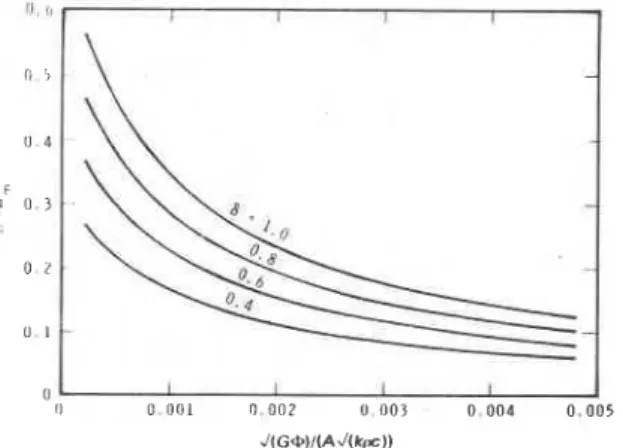
Figure 2. Normalized heat load imposed on compartment boundaries as a fraction of hypothetical maximum value.
Combining Eqns (15) and (16) and- using AH= 18.8 x 1 Oh J k g
'
(for cellulosics), the following equa- tion is obtained:An interesting feature of this equation is that in it the group
J ( ~ @ j l ( ~ J ( k ~ c ) )
appears t o be the dominant varii~ble. HIH,,, is plotted against this group with 6 as ;I p ; ~ ~ - : ~ ~ ~ l c l c ~ r i n big. 2. I t providcs insight into what In;ly Oc c:rllccl 'incfficicncy' of fircs I'rorii thc point ofview of spread by destruction.
To acquire support for an earlier statement, the reader is asked to regard @ in Eqn (16) not as the ventilation parameter (determined by the size of the ventilation opening according to Eqn (7)) but as a running variable characterizing the rate of entry of air into the compartment by any mechanism (e.g. by a strong pressure field arising in high buildings in the winter, as discussed in sections 2.1 and 2.3). It is clear from Eqn ( 1 6 ) that the destructive potential of fire (as characterized by H ) increases with a decrease in the value of @ (overall compartment ventilation). The most detrimental condition (the condition the safety designer is interested in) occurs at minimum ventila- tion (minimum value of @), which, as pointed out in section 1.7, occurs when the entry of air into the compartment takes place under the effect of a static pressure field, unaided by drafts. This is the reason why the ventilation parameter,
a,
as defined by Eqn (7), is indeed the appropriate ventilation descriptor to be used in Eqns (16) and (17).The potential of a fire of cellulosic fuels for convec- tive spread is obtained by deriving an explicit expres- sion for Eqn (13). It isI6
Clearly, if 5 = 1, p = 0, i.e. there is no combustion outside the compartment openings and the potential for fire spread by convection is zero. Again, by looking at @ as a running variable characterizing the actual air Row rate rather than as a fixed value specific for a given ventilation opening, one finds (see Eqn (14)) that with increase in @ (e.g. due to drafts) 6 decreases and increases. Clearly, using the ventilation parame- ter @ (a descriptor of minimum ventilation) will not
yield an adverse value for p, in other words for the potential of cellulosic tires to spread by convection. This finding, is somewhat disconcerting. Unfortunately no philosophical foundation exists for the use of the value of the p-factor in the fire safety design. (Eventu- ally, an agreed-upon multiple of @, possible 5@, may be used in the design to counter the potential of fires for convective spread.)
2.9 Standard 6re resistance test
Standard fire resistance tests are, in a sense, also fully developed compartment fires. A convenient feature of
standard test fires is that, unlike real-world fires, they have a unique temperature history. Detailed analysis has revealed2' that the normalized heat load for stan- dard test fires is more or less a function of the duration of the test only, provided that the test is performed in an 'ideal' high-efficiency furnace, i.e. in a furnace heated by 'black' combustion gases. If tests are carried out in real furnaces, the normalized heat load will also depend on such secondary factors as the size of fur- nace, its lining materials, the nature of the combustion products of the fuel and the test specimen.
The results of calculations performed in Reference 27 (related to five specimcn materials subjected to st;~ndartl tcsts i l l an itleal I'111.nacc) arc illustr;~tcd i n
Fig. 3 i l l the I'orm of H vcrsus T plots, wlicrc T C ~ C I ~ O I C S
the duration of test fire. ('l'he thermal properties of the five materials are among those listed in Table 3 ) . If the theorem of uniformity of normalized heat load had been strictly correct, a single H versus T curve would
have resulted for all five materials. Although this was not the case for specimens made from common con- struction materials, the theorem of uniformity of nor- malized heat load is apparently an acceptable approxi- mation.
It has been recomended2' that in designing for fire safety the curve in Fig. 3 pertaining to normal-weight concrete (a material with the highest thermal inertia among common building materials) be regarded as a unique representation of the relation between normalized heat load and fire test duration. That curve is reproduced separately as curve 1 in Fig. 4. For real furnaces the H versus T curve will follow a flatter
0 0 . 5 1.0 1 . 5 2 . 0 2 . 5
l enqth of exposure l o slandord h r e lest, r ( h l
Figure 3. H versus T relation for high-efficiency fire-test fur-
naces.
POST-FLASHOVER COMPARTMENT FIRES: A REVIEW
I
I I I I
1
2.11 Countering lire spread by convectionLength of exposure to standard test fire, rl h )
Figure 4. Unified correlations between H and 7 for standard fire tests. Curve 1: for high-efficiency furnaces; curve 2: for floor test furnace in DBR/NRC laboratory (estimated).
course. Curve 2 in the same figure relates to the floor test furnace at the National Research Council of Canada. Curve 2, inverted into a 7 versus H relation,
can be approximated by the following equation:
for 0.-: 11 -: ') x 1 0 ' s ' " K where 7, the length of expos-
ure to standard fire resistance, is given in hours.
2.10 Countering fire spread by destruction
For more than half a century it has been customary to determine the ability of building elements to withstand the destructive potential of fires by subjecting speci- mens to standard fire tests. If a specimen performs satisfactorily during the test, the length of the test, 7, is
assigned to the construction it represents its fire resis- tance rating, and that rating is regarded as determining the position of the construction on a 'resistance to destruction by fire' (fire resistance) scale.
The designer is now in a position to ascertain how long a specimen of a construction should be required to withstand a standard test fire to qualify the con- struction for use under the applicable real-world con- ditions. The procedure is as follows. Calculate (a) The dcsign fire load,
G,
using Eqns (10) and (1 1)and the information in Table 2;
(b) The ventilation parameter, Q, using Eqn (7); (c) The thermal inertia of the compartment bound-
aries, J ( k p c ) , using Eqn (2) and the information in Table 3;
(d) The normalized heat load, H, for the compart- ment, using Eqns (14) and (16) (by virtue of the theorem of uniformity of normalized heat load, Eqn (12), this same value is applicable to all
It was emphasized earlier that the potential of fires to spread by the destruction of compartment boundaries is only one aspect of the fire safety design. The princi- pal problem to be dealt with is usually the danger of fire spread by dispersion of uncombusted gaseous pyrolysis products into spaces surrounding the fire compartment.
Although the degree of the threat of convective fire spread can be characterized quantitatively by the p -
factor, there is as yet no established method of using its value in fire safety dsign. A possible approach would be to require extra safety measures for counter- ing the convective spread of fires whenever the design value of the p-factor exceeds a specified limit, say 0.4.
In spite of the apparent lack of a philosophy on how to deal with convective fire spread, in most situations commonsense considerations suffice. It is obvious that the danger of fire spread is more severe if uncom- busted volatiles have
a
means of entering the inside of the building, e.g. through a corridor. than if they leave through windows to the outside atmosphere. As Fig. G shows, spontaneous air currents in the lowur storeys of high-rise buildings during thc winter heating season will drive flamcs towardc the corridors. C(~nscq~~cntly. quipping rhc lowcr storcys of such huildi~~tjs withself-closing (loor\ m;~y prove t o he fhc hcst iilvcsfrnriit in lire sal'ety.
In the upper storeys of high-rise buildings the air currents will aid the movement of uncombusted pyrolysis products towards the building envelope. To prevent storey-to-storey spread of fire along the facade of the building, flame deflectors have been suggested. When activated by flames, they block the vertical passage of the flames.
Experience over the past several decades has made it clear that fire safety cannot be achieved, especially in high-rise buildings, without paying a lot more atten- tion to the problem of convective fire spread.
SUMMARY
Fourteen mathematical models of post-flashover fires have been classified on the basis of fourteen principal modelling aspects. The results are summarized in Table 1. Factors that determine the nature of fire in a compartment and two possible modes of fire spread in buildings are also addressed. The theorem of unifor- mity of normalized heat load is introduced and expres- sions for the potentials of fires to spread by destruc- tion and convection presented. A realistic way of assigning fire resistance requirements to compartment boundaries to counter the potential of fires to spread by destruction is described, and commonsense meas- ures to counter their potential to spread by convection are outlined.
individual boundary elements of - the compart-
ment); and finally NOMENCLATURE
(e) The required length of successful endurance of a
standard test fire, 7 (in hours), in other words, the A Surface area; without subscript: total surface
fire resistance requirement, using Eqn (19). area of compartment (m2)
T. Z. H A R M A T H Y A N D J. R. MEHAFFEY
Specilic heat (J kg
'
K I )Gravitational constant (m s - ~ ) 'I'o~al mass of fuel (total firc load) (kg)
I-(eight (m) Enthalphy (.I kg I)
Norrn;~lizctl hcat load (s'I2 K)
Latent hcat of combustion (or pyrolysis) (J kg-') 'I'hermal conductivity, (W m
- '
K-')Specific fire load, without subscript: design value (kg m 2,
Penetration heat flux, without subscript: overall valuc for compartment (W m-2)
y averaged over r (W m 2,
Rate of heat evolution in compartment (W) Mass ratio of air to volatiles in the stoichiometric combustion of volatiles
Rate of loss of fuel mass, without subscript: total rate of loss of fuel mass in pyrolysis (rate of 'burning') (kg s-')
Time (s)
Temperature (K) T averaged over T (K)
Mass flow rate (kg s-')
a, Standard deviation for specitic fire load (kg nl 21
p Density (kg mp3)
T Equivalcni duration of fire: length of standard
fire test (s (or h))
cp Specific surface of fuel (m2
kg.')
<D Ventilation parameter (kg s ') Subscripts Of atmospheric air By or of char oxidation Of compartment Of floor Of fire gases
Of or for the ith compartment boundary Mean (with
L)
Maximum (with H)
Of pyrolysis (with AH)
By radiation
Of volatile pyrolysis products; by release of vol- atile pyrolysis products
Of ventilation opening
Greek letters Acknowledgements
I l i i s paper was originally presented at the 6th 1ntcr1lation:rl Fire
heat evolution irom volatiles in the Protection Seminar, Karlsruhe, 1982, and is published with thc permission of the organizers of the symposium and with the ap- compartment proval of the Director of the Division of Building Research, Na-
p Factor of convective spread potential tional Research Council, Canada.
REFERENCES
1. J. Quintiere. Growth of fire in building compartments. In Fire Standards and Safety, ASTM STP 614. ed. by A. F. Robertson, American Society for Testing and Materials (1977). p. 131.
2. R. Pape and T. E. Waterman, Understanding and modeling preflashover compartment fires. In Design o f Buildings for Fire Safety, ASTM STP 685, ed. by E. E. Smith and T. Z. Harmathy. American Society for Testing and Materials (1979). p. 106.
3. H. W. Emmons, The calculation of a fire i n a large building. ASME paper, presented at the 20th Joint ASMEIAlchE National Heat Transfer Conference, Milwaukee, WI, 2-5 August 1981.
4 . K . Kawagoe and T. Sekine. Estimation of fire temperature-time curve in rooms. Building Research Insti- tute, Occasional Report No. l l (Tokyo), 1963.
5. K. Odeen. Theoretical study of fire characteristics i n en- closed spaces. Royal lnstitute of Technology, Division of Building Construction, Bulletin No. 10, Stockholm (1963). 6. S.-E. Magnusson and S. Thelandersson, Temperature-time curves for the complete process of fire development. A theoretical study of wood fuel fires in enclosed spaces. Acta Polytechnica Scandinavica, Civil Engineering and Building Construction Series, No. 65, Stockholm (1970). 7. Y. Tsuch~ya and K. Sumi, Computation of the behavior of
fire in an enclosure. Combustion and Flame 16, 131 (1971). 8. T. Z. Harmathy, A new look at compartment fires, Parts I
and II. Fire .Technology 8, 196, 326 (1972).
9. L. Nilsson, Time curve of heat release for compartment fires with fuel of wooden cribs. Lund Institute of Technol- ogy, Bulletin No. 36, Sweden (1974).
10. V. Babrauskas and R. B. Williamson, Post-flashover com-
partment fires. Fire Research Group Report No. UCB FRG
75-1, University of California, Berkeley (1975).
11. P. H. Thomas, Some problem aspects of fully-developed room fires. Fire Standards and Safety, ASTM Special Tech- nical Publication 614, Philadelphia (1976).
12. T. Tanaka, A mathematical model of a compartment fire. Building Research Institute, Research Paper No. 70, Tokyo (1977).
13. B. Bohm, Fully developed polyethylene and wood compart- ment fires with application to structural design. Laboraton/ of Heating and Air Conditioning, Technical University of Denmark, Lyngby, Denmark (1977).
14. M. L. Bullen and P. H. Thomas, Compartment fires with non-cellulosic fuels. Seventeenth Symposium (Interna- tional) on Combustion, The Combustion Institute, 1978, p. 1139.
15. V. Babrauskas and U. G. Wickstrom, Thermoplastic pool compartment fires. Combustion and Flame 34, 195 (1979).
16. T. Z. Harmathy, Fire severity: basis of fire safety design. Presented at International Symposium on Fire Safety of Concrete Structures, Fall Convention of the American Con- crete Institute, San Juan, Puerto Rico. September 1980. 17. U. Wickstrom, Temperature calculation of insulated steel
columns exposed to natural fires. Statens Provningsanstalt, National Testing Institute, Technical Report SP-RAPP
1981: 14, Boras, Sweden (1981).
18. T. Z. Harmathy, The possibility of characterizing the severeity of fires by a single parameter. Fire and Materials 4, 71 (1980).
19. T. Z. Harmathy, Mechanism of burning of fully-developed compartment fires. Combustion and Flame 31, 265 (1978).
20. P. H. Thomas, A. J. M. Heselden and M. Law, Fully