HAL Id: hal-02417819
https://hal.archives-ouvertes.fr/hal-02417819
Submitted on 18 Dec 2019HAL is a multi-disciplinary open access
archive for the deposit and dissemination of sci-entific research documents, whether they are pub-lished or not. The documents may come from teaching and research institutions in France or abroad, or from public or private research centers.
L’archive ouverte pluridisciplinaire HAL, est destinée au dépôt et à la diffusion de documents scientifiques de niveau recherche, publiés ou non, émanant des établissements d’enseignement et de recherche français ou étrangers, des laboratoires publics ou privés.
CRISTAL v2: new package for criticality calculations
Jm. Gomit, I. Duhamel, Y. Richet, A. Entringer, C. Magnaud, F. Malouch, .
Carmouze C
To cite this version:
Jm. Gomit, I. Duhamel, Y. Richet, A. Entringer, C. Magnaud, et al.. CRISTAL v2: new package for criticality calculations. Nuclear Criticality Safety Division Topical Meeting (NCSD 2017), Sep 2017, Carlsbad, United States. �hal-02417819�
CRISTAL V2: NEW PACKAGE FOR CRITICALITY CALCULATIONS
J.M. Gomit, I. Duhamel, Y. Richet
Institut de Radioprotection et de Sûreté Nucléaire (IRSN) BP 17 - 92262 Fontenay aux Roses Cedex, France
[email protected]; [email protected]; [email protected]
A. Entringer, C. Magnaud, F. Malouch
Commissariat à l’Energie Atomique et aux Energies Alternatives (CEA) CEA, Saclay, DEN/DM2S/SERMA, F-91191 Gif-sur-Yvette, France
[email protected]; [email protected]; [email protected]
C. Carmouze
Commissariat à l’Energie Atomique et aux Energies Alternatives (CEA) CEA, Cadarache, DEN/DER/SPRC, F-13108 Saint-Paul-lez-Durance, France
[email protected] ABSTRACT
A new release of the CRISTAL French criticality calculation package, named CRISTAL V2, has been developed and intensively validated by IRSN and CEA, in collaboration with AREVA. This package was designed to cover the needs of criticality practitioners in the fields of nuclear fuel cycle facilities and transportation of fissile materials.
Based on an optimized modular architecture in an updated software development environ-ment, the design of CRISTAL package V2 integrates new generation of cross-section librar-ies, new calculation schemes consistent with new applications, and up-to-date calculation codes capabilities. Four calculation routes are currently available allowing multi-group and continuous energy calculations.
The validation database is composed of more than 3000 critical experiments, in order to cov-er a wide range of configurations.
The CRISTAL V2 package also includes customer services covering a large scope of activi-ties like documentations, hotline, maintenance and training courses.
A significant promotion and an increased recognition referred both nationally and interna-tionally are foreseen, including the provision of the CRISTAL V2 package to the OECD / NEA Data Bank.
Key Words: CRISTAL, criticality calculations, multi-group, continuous-energy,
valida-tion
1. INTRODUCTION
The development, verification and validation of CRISTAL V2 criticality calculation package [1] has been carried out in a joint project between the IRSN (Institut de Radioprotection et de Sûreté Nucléaire), the Nuclear Energy Division of the Commissariat à l’Énergie Atomique et aux Énergies Alternatives (CEA/DEN), AREVA NC, AREVA NP and EDF (Électricité de France), taking into account the needs for a large variety of applications.
The CRISTAL V2.0 package consists of:
- the nuclear data library CEAV5.1.2 (developed by CEA) based on the JEFF-3.1.1 evaluation [2], - a set of specific calculation options implemented in procedure libraries named APROC and
APROC_CRISTAL (developed by CEA),
- the LATEC workbench (developed by IRSN) [3],
- neutron transport codes, APOLLO2.8 (developed by CEA) [4], MORET 5 (developed by IRSN) [5] and TRIPOLI-4® (developed by CEA) [6].
In the framework of the CRISTAL project, the calculation schemes were optimized on a criterion of computing time minimization while providing satisfying accurate results.
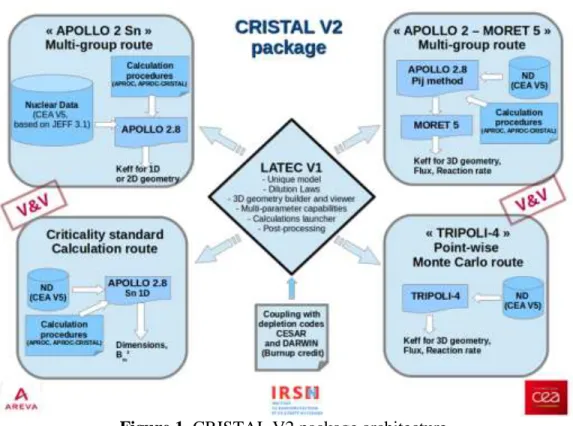
The architecture of the CRISTAL V2 package is presented on Fig. 1.
Figure 1. CRISTAL V2 package architecture
Based on modular architecture in an updated software environment, the design of the CRISTAL V2 package integrates responses to new criticality calculation issues through a Computer Assisted De-sign frontend interfaced to recent generation of neutron transport codes. The application field of this package is specifically devoted to criticality safety linked to the criticality risk prevention in the facilities receiving fissile materials and/or for transport operations of such materials.
2. LATEC GRAPHICAL WORKBENCH
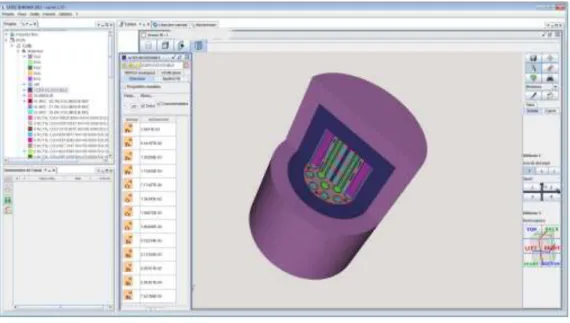
The LATEC user interface is basically a Computer Assisted Design graphical software intended to be used on user desktop (compatible with Windows, MacOS or Linux) [3]. A panel view example is presented in Fig.2.
Figure 2.Panel view of the LATEC workbench
The basic criticality modeling environment integrates a 3D geometry with a complete toolset for chemical mixtures of fissile or structural material (including dilution laws for powders, oxides… [10]). The virtual criticality model thus designed is then instantiated for one of the calculation route of the CRISTAL package, chosen independently. This powerful feature allows to switch easily be-tween a homogenized multi-group calculation (see Multi-group Route) and a detailed point-wise but slowest one (see Point-wise Monte Carlo Route) for example.
Beyond these modeling features, it also embeds a parametric and distributing computing engine to provide a consistent framework for criticality-safety design and assessment. Most of the parameters defined by user when building the model may be studied as variables, possibly interactive. This approach to nuclear safety promotes a “response surface” methodology above a “single point” cal-culation approach, which is considered as more likely to generate risk assessment errors.
Finally, LATEC is designed to allow skilled users or starters to achieve a consistent and reliable study in an industrial context. A quality insurance approach in the modeling process is therefore included to support the whole life cycle of a study.
Behind all these features designed to consolidate the safety assessment, the standard calculation tools are available to solve the neutron physics model here described by the end-user. We capitalize on the experience of previous versions of CRISTAL, updated to the latest scientific developments related to criticality calculations.
3. CRISTAL V2 CALCULATIONS
Four calculation routes are currently available, all using nuclear data issued from the JEFF-3.1.1 evaluation:
- a multi-group deterministic route (M.D. Route) based on multi-group (281 groups [7]) cross- sections using APOLLO2 Sn calculations [4],
- a multi-group Monte-Carlo route (M.M.C. Route) based on the APOLLO2 and MORET 5 [5] codes,
- a point-wise Monte Carlo route (P.W.M.C. Route) using the TRIPOLI-4® code [6],
- a criticality standard calculation route, based on iterative APOLLO2 Sn (multi-group determin-istic route) calculations.
3.1. Multi-group Routes
These routes are based on two main steps. A preliminary step is dedicated to the elaboration of mul-ti-group self-shielded cross-sections with the APOLLO2 code, for each medium or each lattice cell of the whole system to be calculated. In this step, all elementary units of the system (for example, homogeneous -solution, reflector, or heterogeneous -fuel pin in a lattice…) are described and an APOLLO2 (cell or multi-cell) calculation is performed. Here, the goal of the APOLLO2 calculation step is to obtain physically representative cross-section sets, with an accurate description of reaction rates in the real geometry (heterogeneous cell or multi-cell precise description). The Pij (Collision Probability Method) is used for the flux calculation, which itself can be used for a spatial homoge-nization of the self-shielded cross-sections sets.
An homogenization and the 20-group collapsing (for APOLLO2 Sn calculation route only) of the cross-sections sets can be performed, in order to give an equivalent homogeneous medium of the most heterogeneous part of the system (assembly with its water holes for example). A realistic spec-trum, calculated in the precise geometry, is used for this step.
In a second step, the homogenized self-shielded cross-sections, previously produced, are used by the MORET 5 multi-group (281 energy group) or by the Sn solver of APOLLO2 (collapsed on 20 energy groups) in order to evaluate the keff of the system and its associated standard deviation for the Monte Carlo route.
The MORET 5 code uses 281 energy group homogenized cross-sections. In this context, each of the elementary volumes is assumed to be homogeneous and is described, at the collision level, by an equivalent nucleus. The scattering anisotropy is described by using an arbitrary order of Legendre polynomial expansion representing the transfer cross-sections. This number depends on the order provided in the APOLLO2 library for the concerned cross-section (P5 for most of the isotopes available in APOLLO2 library).The spatial distribution of the sources for the first cycle can be de-scribed in any of the following ways: automatically throughout the entire system, volume by vol-ume, or as individual points.
The Sn solver solves the integro-differential form of the Boltzmann equation using discretized vari-ables. The finite difference scheme and the nodal method are implemented in APOLLO2.8,
depend-ing on the heterogeneity of the system, usdepend-ing mean (or linearly varydepend-ing) values of the flux in each spatial mesh. The anisotropy of the scattering is taken into account by the introduction of Legendre polynomials in the scattering cross-sections associated with a P3 modeling. The spatial mesh is also optimized in order to respect the criteria of its ratio with the mean free path, which must be con-sistent with the quadrature (S16 in general case, S32 for highly heterogeneous systems including absorbing structures).
3.2. Continuous Monte Carlo Route
The point-wise Monte Carlo route (P.W.M.C. Route) can be used as a reference calculation and also in some cases for industrial calculations. This route is based on the TRIPOLI-4® Version 8.1 point-wise Monte Carlo code used with the “cross-section probability tables” (PT). In the criticality mode, the Monte Carlo code is used to solve the keff eigenvalue equation, i.e., to find the fundamental mode and the associated fundamental keff eigenvalue. An initial (guess) neutron source is set for the first batch, and the equilibrium neutron distribution corresponding to the keff eigenvalue equation is then sought. For this purpose, the power iteration scheme is adopted, which means that at the end of each batch the secondary neutrons generated from fissions are used as a source for the next batch (in between batches, a normalization procedure is applied, as customary). After several such steps, when the distribution of fissions has converged, the neutron distribution obeys the fundamental mode of the keff eigenvalue equation. Then, the physical quantities of interest can be scored. The convergence criterion can be either defined by the user, or automatically set by the code by resort-ing to statistical tests so as to assess whether equilibrium has been reached.
3.3. Criticality Standard Calculation Route
A specific route is provided in CRISTAL V2.0 for criticality standard calculations, constituting an important new feature of this version; it includes improvements in ergonomics and an enlargement of the validated domain of applications.
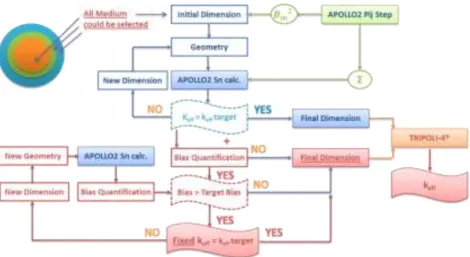
1D applications including several reflectors and moderator ratio ranges can be modeled and ana-lyzed. The dimensions corresponding to a target keff will be obtained with a given precision by an iterative process. The initial system is defined by the result of the infinite fissile cell calculation, using the material buckling and the target keff. A relationship gives the initial dimension of the un-known material in the system, in the view of the reflecting conditions. Then, the keff is calculated with the Sn solver, with iterations on the spatial dimension and discretization of the material, if the distance of the calculated keff with the target keff remains over the precision.
A specific module from the former version, dedicated to the numerical embedded inaccuracies of the Sn method, is available allowing obtaining amended values. However, the interaction between fissile and reflector media is not taken into account for the macroscopic cross-sections generation, which can lead to inaccuracies when calculating some heterogeneous configurations. To estimate this effect, a continuous-energy calculation can be done using TRIPOLI-4®, in order to check the corrected deterministic calculation results (Fig. 3). Thus, the LATEC workbench allows generating automatically the TRIPOLI-4® data file corresponding to the APOLLO2 result allowing the user to estimate the APOLLO2 Sn bias.
Figure 3. Criticality calculation scheme of the standard route
The criticality standard calculation route benefits the validation of the deterministic and the Monte Carlo routes of the CRISTAL V2 package.
3.4. Burnup Credit Calculation
Thanks to a dedicated panel in the LATEC workbench allowing selecting output files of interest, the CRISTAL V2 package could be easily coupled with the depletion code CESAR [8] (co-owned by CEA and AREVA NC) or the DARWIN package [9] (co-owned by CEA and EDF) allowing taking into account the “Burnup Credit” in the criticality safety studies.
4. NUCLEAR DATA AND CODES 4.1. Cross-section libraries
The multi-group nuclear data libraries provided within the CRISTALV2.0 package, processed by the GALILEE chain, are based on the European JEFF3.1.1 evaluation [2]. The JEFF-3.1.1 release contains neutron reaction data, thermal neutron scattering law data for transport calculations, as well as special purpose files with radioactive decay data, fission yields data, and activation data.
The GALILEE chain is based on the codes NJOY (LANL) [12] and CALENDF (CEA) [13]. It pro-duces consistent data for TRIPOLI-4® [6] and APOLLO2 [4] from any evaluation given in ENDF-6 format. A dedicated module carries out the interface between NJOY and CALENDF on one side and APOLLO2 on the other side. This chain also uses the code PREPANJ99 that generates auto-matically the data for NJOY and CALENDF and the library LIBNJ90 that provides a convivial ac-cess to ENDF, PENDF and GENDF NJOY formats.
The available multi-group libraries for APOLLO2 are the standard CEAV5.1.2 library at 281-energy group [7] for various temperatures beyond 273 K plus an additional specific library provid-ing the required data for an APOLLO2 transport calculation for 18 nuclides at 214 K. Those nu-clides are 19F, 1H, 16O, 236Pu, 237Pu, 238Pu, 239Pu, 240Pu, 241Pu, 242Pu, 243Pu, 232U, 233U, 234U, 235U, 236
U, 237U and 238U.
The CEAV5.1.2 library for TRIPOLI-4® is based on the same nuclear data as APOLLO2 and was generated with the same chain GALILEE [11]. The XDR format files of cross-sections are generat-ed by the TRIPOLI-4® version 8.1 from binary punctual section PENDF files at a defined tempera-ture. The CALENDF code generates the probability tables for the desired nuclides. These probabil-ity tables are calculated on an 11513 group mesh for an energy range going from 10-5 eV to 20 MeV, shared by APOLLO2. The available temperatures are 214 K (for the 18 nuclides mentioned above), 294 K and 300 K.
4.2. Deterministic transport code APOLLO2.8-3.C
The APOLLO2 [4] is a neutron transport code using deterministic methods. It is designed as a mod-ular structure, providing the users with specific tools to solve dedicated problems. APOLLO2 offers thus the possibility to perform reference calculations, with the maximum precision allowed by the available computers, as well as project routine calculations that run faster and require less precision. Physical, numerical and structural functions are built in the code as modules that perform specific tasks (geometry, self-shielding, flux solver, etc.) and can be viewed as operators that act on input objects to create output objects. This specific structure of the code also allows an easy implementa-tion of new methods and models. The multi-group isotopic library used in the code is obtained by processing the most recent nuclear evaluations, without any cross-section adjustment, making it fully application-independent.
The APOLLO2.8-3.C version is the up-to-date version of the code dedicated to criticality calcula-tion. It may be used within the CRISTAL V2.0 package through different approaches:
- For Monte-Carlo 3D calculations, APOLLO2 generates the cross-sections file that will be used in the MORET 5 neutron transport calculation code. All the generated self-shielded cross-sections are homogenized on the geometries given to APOLLO2.
- The APOLLO2 code uses its Sn solver to provide the effective multiplication factor after calcu-lating the homogenized self-shielded, and if required collapsed, cross-sections with collision probabilities method. The Sn solver is also used for criticality standard calculations.
The APOLLO2 code runs on all kinds of computers from such as personal computers or work-stations of all brands. Its development is done under strict quality control and its qualification relies on comparisons both to Monte-Carlo calculations and experimental measurements coming from numerous experimental programs.
4.3. MORET 5 Computer Code
The MORET code [5] is a simulation tool that solves the transport equation for neutrons using the Monte Carlo method. Initially designed to perform calculations to support criticality safety
assess-ments, it has been used in most studies of nuclear fuel cycle facilities and fissile material transport in France. The MORET 5 code allows users to model complex three-dimensional geometrical con-figurations based on combinatorial representation with predefined shapes and operators, use various evaluations and treatments for nuclear data (possibility to use multi-group cross-sections from dif-ferent lattice cell codes or point-wise ones from any evaluation (ace format)) to describe the materi-als, select the best adapted simulation method (from all available methods) related to their problem, define their own tallies and analyze the results. The use of the Version 5.B.1 of the MORET code applies only to the multi-group route with APOLLO2 homogenized cross-sections in the CRISTAL V2.0 package.
4.4. TRIPOLI-4® Computer Code
TRIPOLI-4® [6] solves the linear Boltzmann equation for neutrons, photons, electrons and positrons, with the Monte Carlo method, in any 3D geometry. TRIPOLI-4® has its own native geometry pack-age, allowing for both a pure surface-based representation, and a combinatorial representation with predefined shapes and Boolean operators (any combination of these two kinds of representations can be adopted).
The code uses ENDF format continuous-energy cross-sections, from various international evalua-tions including JEFF-3.1.1, ENDF/B-VII.0, JENDL4 and FENDL2.1. Its official nuclear data li-brary for applications, named CEAV5.1.2, is mainly based on the European evaluation JEFF-3.1.1. The probability tables for TRIPOLI-4® for the unresolved resonance range (URR), are generated using the CALENDF code, and given in a fourth file. CALENDF first converts resolved and unre-solved resonance parameters into temperature-dependent continuous-energy cross-sections. Then, the code generates on a user-specified energy grid “cross-section probability tables” (PT), based on Gauss quadrature, which represent those cross-sections. TRIPOLI-4® uses these tables in the unre-solved resonance range for each nucleus and the PT supersede the continuous-energy cross-sections available in the original PENDF file.
5. EXPERIMENTAL VALIDATION
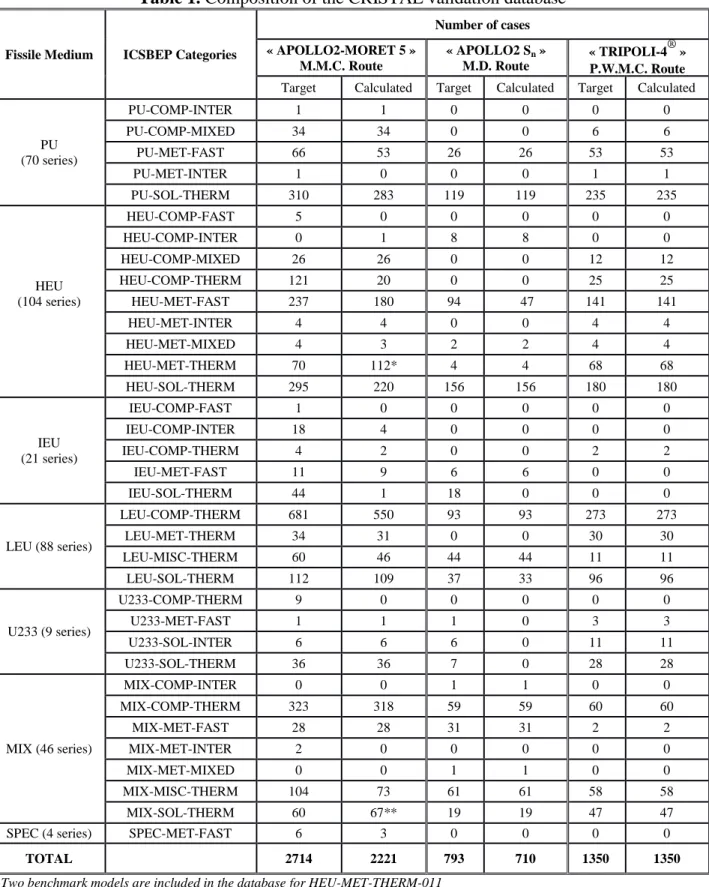
The CRISTAL V2.0 package benefits from a broad experimental validation database covering al-most all areas of criticality-safety applications, from fuel fabrication to reprocessing, including transportation. 3,127 critical experiments, corresponding to 342 series, either issued from the OECD/ICSBEP Handbook or performed in French facilities (confidential data) were selected for the CRISTAL V2.0 validation database. Currently, more than 2,300 experiments are already part of the validation database [14].
5.1. Validation Database
To define the CRISTAL experimental validation database, a technical working group of the CRIS-TAL Project has selected a set of experiments of interest according to the needs expressed by the users and the code developments entities. This work was done with intend to provide a sufficient set of experiments from various laboratories in order to avoid bias due to correlations between experi-ments and to avoid systematic errors in the experiexperi-ments. This work also contributes to the
identifi-cation of non-covered experimental needs.
The main sources of the benchmarks selection are, on the one hand, the OECD/ICSBEP Handbook [15] and, on the other hand, experiments performed by IRSN in the CEA Valduc facilities (Appa-ratus B, MARACAS), some of them with the financial support of the AREVA company, as well as experiments performed by CEA in Saclay (Alecto) and in Cadarache (Eole and Minerve reactors). Compared to the previous release of the CRISTAL package, the validation database has been ex-tended for the new V2.0 version, not only to take into account the new needs highlighted for the last few years, but also in order to enhance the consistency between the selected experiments of each route, to have a better statistic, to cover a larger diversity of laboratories and to investigate incon-sistencies detected in the CRISTAL V1 validation studies.
Finally, the CRISTAL V2.0 experimental validation database is composed of 3,127 critical experi-ments (342 series) amongst which 2,714 were selected for the APOLLO2-MORET 5 multi-group route; 793 for the APOLLO2-Sn multi-group deterministic route and 1,350 for the TRIPOLI-4® point-wise route (see Table 1).
5.2. Validation Process
First of all, the validation work consists in calculating the C-E value exclusively using recommend-ed calculation schemes and procrecommend-edures. C-E value is given by calculatrecommend-ed keff minus benchmarks keff, and its combined one standard deviation (𝜎 = √𝜎calculation2 + 𝜎benchmark2 ).
Calculation results are considered in good agreement with the benchmarks when the discrepancies are within the uncertainties margins (depending on the combined standard deviation and on the con-fidence interval).
Comparisons with other available experimental programs in the same field (similar media, materials and/or configurations) allow for highlighting eventual experimental biases.
In a second step, (C - E) discrepancies are analyzed in order to uncouple the different cause of cal-culation biases and so, have a feedback to the nuclear data and/or to the calcal-culation schemes by us-ing inter-code comparisons:
- Between the different CRISTAL V2 routes, with the benefit of a consistent evaluation process for the nuclear data libraries generation, and with possibility of using other cross-section librar-ies (as ENDF-B/VII.0) with the TRIPOLI-4® pointwise code,
- Using other available calculation results from international codes (MCNP, SCALE, MONK, etc…) using various libraries.
Table 1. Composition of the CRISTAL validation database
Fissile Medium ICSBEP Categories
Number of cases « APOLLO2-MORET 5 » M.M.C. Route « APOLLO2 Sn » M.D. Route « TRIPOLI-4® » P.W.M.C. Route
Target Calculated Target Calculated Target Calculated
PU (70 series) PU-COMP-INTER 1 1 0 0 0 0 PU-COMP-MIXED 34 34 0 0 6 6 PU-MET-FAST 66 53 26 26 53 53 PU-MET-INTER 1 0 0 0 1 1 PU-SOL-THERM 310 283 119 119 235 235 HEU (104 series) HEU-COMP-FAST 5 0 0 0 0 0 HEU-COMP-INTER 0 1 8 8 0 0 HEU-COMP-MIXED 26 26 0 0 12 12 HEU-COMP-THERM 121 20 0 0 25 25 HEU-MET-FAST 237 180 94 47 141 141 HEU-MET-INTER 4 4 0 0 4 4 HEU-MET-MIXED 4 3 2 2 4 4 HEU-MET-THERM 70 112* 4 4 68 68 HEU-SOL-THERM 295 220 156 156 180 180 IEU (21 series) IEU-COMP-FAST 1 0 0 0 0 0 IEU-COMP-INTER 18 4 0 0 0 0 IEU-COMP-THERM 4 2 0 0 2 2 IEU-MET-FAST 11 9 6 6 0 0 IEU-SOL-THERM 44 1 18 0 0 0 LEU (88 series) LEU-COMP-THERM 681 550 93 93 273 273 LEU-MET-THERM 34 31 0 0 30 30 LEU-MISC-THERM 60 46 44 44 11 11 LEU-SOL-THERM 112 109 37 33 96 96 U233 (9 series) U233-COMP-THERM 9 0 0 0 0 0 U233-MET-FAST 1 1 1 0 3 3 U233-SOL-INTER 6 6 6 0 11 11 U233-SOL-THERM 36 36 7 0 28 28 MIX (46 series) MIX-COMP-INTER 0 0 1 1 0 0 MIX-COMP-THERM 323 318 59 59 60 60 MIX-MET-FAST 28 28 31 31 2 2 MIX-MET-INTER 2 0 0 0 0 0 MIX-MET-MIXED 0 0 1 1 0 0 MIX-MISC-THERM 104 73 61 61 58 58 MIX-SOL-THERM 60 67** 19 19 47 47
SPEC (4 series) SPEC-MET-FAST 6 3 0 0 0 0
TOTAL 2714 2221 793 710 1350 1350
* Two benchmark models are included in the database for HEU-MET-THERM-011
** Seven experiments of a non ICSBEP series have been transferred to MIX-MISC-THERM, when evaluated for ICSBEP.
Further investigations could conduct to an extension of the validation database. 5.3. Main results
Validation studies highlight the effect of the approximations used in the multi-group routes and the nuclear data accuracy. The improvements in both nuclear data and calculation schemes allow im-proved agreement with experiments than the previous version V1.2.
Thus, the use of JEFF3.1.1 evaluation for 235U capture, 239Pu fission and 237Np and 232Th cross-sections leads to a significant improvement of calculated keff compared to the use of JEF2.2 in CRISTAL V1.2. Moreover, the use of the 281-group energy mesh and the new treatment of scatter-ing cross-sections of intermediate mass isotopes allow a bias reduction from 1% to 2.5 % for multi-group calculations for thick reflector compared to CRISTAL V1.2 using 172-multi-group energy mesh library. In addition, the new 281-group treatment of 238U combine with the JEFF-3.1.1 cross-sections conduct to a strong bias reduction of 1.4 % on average for the multi-group Sn deterministic route compared to CRISTAL V1.2.
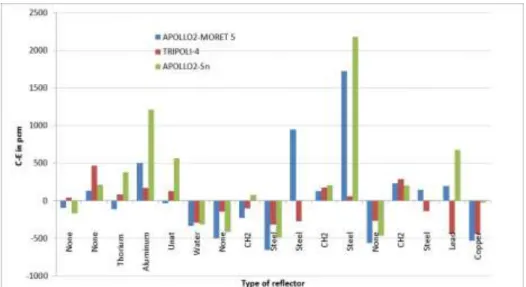
Finally, it is pointed out that the calculation results are generally in good agreement with the benchmark keff. Nevertheless, as can be seen on Fig. 4, significant over-estimations are still ob-served with the multi-group calculations routes for reflected configurations with thick structural materials (aluminum, steel, nickel), mainly in fast spectra.
Figure 4. Calculation-experiment (C-E) discrepancies for metallic plutonium configu-rations in fast spectra
Lastly, it must be emphasized that the validation work is still in progress. The validation database will be extended by adding available experiments involving specific isotopes, such as neptunium and thorium as well as structural materials (MIRTE program [16]) and poisoned fuel pins.
6. FEEDBACK AND CUSTOMERS SERVICES The CRISTAL V2 package is designed:
- To meet requirements of industrials and the technical safety concerning nuclear fuel cycle facili-ties and the transportation of fissile materials;
- To perform criticality studies (design and operation of wide range of nuclear facilities);
- To perform validation studies to provide validation results (use of experimental results to vali-date related computing routes, design and evaluation of experimental programs, use for interna-tional Working Group studies).
6.1. Feedback
The first version of the CRISTAL V2.0 was delivered to users in June 2015 following five years of development and validation works. Afterwards to take into account one year of user’s feedback, the released version V2.0.1 was distributed in June 2016 and a new one, called V2.0.2, is currently un-der development.
6.2. Customers services
The CRISTAL V2.0 package includes also customer services covering a range of areas of activity like documentation, hotline, maintenance and training courses.
A significant promotion and an increased recognition, referred both nationally and internationally, are foreseen, including the provision of the CRISTAL V2.0 package to the OECD / NEA Data Bank.
7. CONCLUSIONS
At the present time, CRISTAL V2.0 package represents a coherent system combining the best prop-erties of the APOLLO2.8, MORET 5 and TRIPOLI-4® codes. The LATEC workbench offers a high level of user-friendliness and flexibility. After significant efforts, the experimental validation offers an accurate and comprehensive database of experiments for criticality practitioners, which can choose over the four calculation routes developed in the CRISTAL V2.0 package, the well adapted one for the application case. The validation work pointed out that the calculation results are general-ly in good agreement with the benchmark keff, which ensure to the CRISTAL package a high level of performance for criticality-safety calculations.
Further developments are envisaged to include new tools, extend the validation data base and cover the future needs of users.
ACKNOWLEDGMENTS
Authors want to thank all people from IRSN, CEA, AREVA and EDF contributing to the CRISTAL project.
REFERENCES
[1] J.M. Gomit and al., “CRISTAL Criticality Package Twelve Years later and new Features,”
Proceeding of Int. Conf. on Nuclear Criticality and Safety (ICNC), Charlotte, USA, (2015).
[2] A. Santamarina and al., “The JEFF-3.1.1 Nuclear Data Library, Validation results from JEF-2.2) to JEFF-3.1.1”, JEFF Report 22, OECD/NEA, (2009).
[3] L. Heulers, F. Fernex, N. Leclaire, “LATEC - A generic workbench dedicated to criticality cal-culations,” Proc. of Int. Conf. on Nuclear Criticality and Safety, Edinburgh, Scotland, (2011). [4] R. Sanchez, I. Zmijarevic, M. Coste-Delclaux, E. Masiello, S. Santandrea, E. Martinolli, L.
Villate, N. Schwartz, N. Guller “APOLLO2 YEAR 2010,” Nuclear Engineering and Technolo-gy, VOL. 42 NO.5, (2010).
[5] L. Heulers, B. Cochet, Y. Richet, A. Jinaphanh, F. Bernard, “MORET 5 - Overview of a new continuous-energy Monte-Carlo transport code,” Proceeding of Int. Conf. on Nuclear
Criticali-ty and SafeCriticali-ty (ICNC), Edinburgh, Scotland, (2011).
[6] E. Brun, F. Damian, E. Dumonteil, F.X. Hugot, Y.K. Lee, F. Malvagi, A. Mazzolo, O. Petit, J.C. Trama, T. Visonneau, A. Zoia, “TRIPOLI-4 version 8 User Guide”, CEA-R-6316, (2013). [7] A. Santamarina, N. Hfaiedh, “The SHEM energy mesh for accurate fuel depletion and BUC
calculations”, Proc. Int. Conf on Criticality-safety (ICNC), Saint Petersburg, (2007).
[8] J.M. Vidal et al. “CESAR5.3: An industrial tool for nuclear fuel and waste characterization with associated qualification”, Proc. of Waste Management (WM) Conference, Phoenix (AZ), USA, (2012).
[9] L. San-Felice and al., “Experimental validation of the DARWIN2.3 package for fuel cycle ap-plications,” PHYSOR, Knoxville, USA (2012).
[10] F. Fernex, N. Leclaire, L. Heulers, “The additive volume density law implemented in the LATEC workbench to deal with fissile media that contain moderator elements” Proceeding of
Int. Conf. on Nuclear Criticality and Safety, Charlotte (NC), USA, (2015).
[11] M. Coste-Delclaux, “GALILEE: A Nuclear Data Processing System for Transport, Depletion and Shielding Codes”, Proc. Int. Conf. on Physics of Reactors (PHYSOR), Interlaken, Switzer-land, (2008).
[12] R. E. Macfarlane et al. , “NJOY99 nuclear data processing system” LA-12740-M, LANL, USA, 1994 : http://t2.lanl.gov/codes/njoy99/index.html
[13] J. C. Sublet, P. Ribon, M. Coste-Delclaux, “CALENDF-2005: User manual”, Report CEA-R-6131, (2006).
[14] E. Gagnier and al. “Experimental validation of CRISTAL V2.0 French Criticality Calculation Package” Proceeding of Int. Conf. on Nuclear Criticality and Safety (ICNC), Charlotte (NC), USA, (2015).
[15] International Handbook of Evaluated Criticality Safety Benchmark Experiments NEA/NSC/DOC(95)03, NEA Nuclear Science Committee, September 2013 Edition.
[16] N. Leclaire, I. Duhamel, F.X. Le Dauphin, J.B. Briggs, J. Piot, M. Rennesson, A. Laville, “The MIRTE experimental program : an opportunity to test structural materials in various configura-tions in thermal energy spectrum”, Nuclear Science & Engineering, vol. 178, p:1–17, (2014).