HAL Id: hal-02541199
https://hal.archives-ouvertes.fr/hal-02541199
Submitted on 13 Apr 2020
HAL is a multi-disciplinary open access
archive for the deposit and dissemination of
sci-entific research documents, whether they are
pub-lished or not. The documents may come from
teaching and research institutions in France or
abroad, or from public or private research centers.
L’archive ouverte pluridisciplinaire HAL, est
destinée au dépôt et à la diffusion de documents
scientifiques de niveau recherche, publiés ou non,
émanant des établissements d’enseignement et de
recherche français ou étrangers, des laboratoires
publics ou privés.
MACSE
Frédéric Delsuc, Vincent Ranwez
To cite this version:
Frédéric Delsuc, Vincent Ranwez. Accurate alignment of (meta)barcoding data sets using MACSE.
Scornavacca, Celine; Delsuc, Frédéric; Galtier, Nicolas. Phylogenetics in the Genomic Era, No
com-mercial publisher | Authors open access book, pp.2.3:1–2.3:31, 2020. �hal-02541199�
(meta)barcoding data sets using MACSE
Frédéric Delsuc
1Institut des Sciences de l’Evolution de Montpellier (ISEM), CNRS, IRD, EPHE, Université de Montpellier, Montpellier, France
https://orcid.org/0000-0002-6501-6287
Vincent Ranwez
2AGAP, Université de Montpellier, CIRAD, INRA, Montpellier SupAgro, Montpellier, France [email protected]
https://orcid.org/0000-0002-9308-7541
Abstract
Twenty years of standardized DNA barcoding practice have resulted in millions of sequences being produced for a handful of molecular markers in a wide range of fungi, animal and plant species. Despite some basic quality controls, reference barcoding data sets deposited in the Bar-code of Life Datasystem (BOLD) database are not immune to sequencing errors and undetected pseudogenes. Such database inaccuracies can significantly bias subsequent species delimitation and biodiversity estimation based on DNA barcoding. These potential problems are amplified in metabarcoding studies containing thousands of sequences produced using high throughput se-quencing technologies. Here, we propose a pipeline based on MACSE v2, an extended version of our codon-aware multiple sequence alignment software accounting for frameshifts and stop codons. The MACSE_BARCODE pipeline allows the accurate alignment of hundreds of thousands of protein-coding barcode sequences. Re-analyses of published data sets confirm that MACSE v2 is able to automatically detect most sequencing errors previously identified manually. The proposed alignment strategy hence alleviates the risk of incorrect species delimitation due the incorporation of sequencing errors or undetected pseudogenes. By applying the MACSE_BARCODE pipeline to mammal, ant, and flowering plant barcode sequences available in BOLD, we highlight several cases of database errors and provide curated reference alignments for the main protein-coding barcode genes. We anticipate our approach to be particularly useful for metabarcoding studies in which thousands of new sequences need to be compared to a reference database for subsequent taxonomic assignment. This might prove particularly helpful for diet characterization studies and large-scale biodiversity assessments through environmental DNA metabarcoding. The new MACSE_BARCODE pipeline is distributed as Nextflow workflows that are available from the MACSE project webpage (https://bioweb.supagro.inra.fr/macse/).
How to cite: Frédéric Delsuc and Vincent Ranwez (2020). Accurate alignment of (meta)barcoding data sets using MACSE. In Scornavacca, C., Delsuc, F., and Galtier, N., editors, Phylogenetics
in the Genomic Era, chapter No. 2.3, pp. 2.3:1–2.3:31. No commercial publisher | Authors open
access book. The book is freely available at https://hal.inria.fr/PGE.
1 FD was funded by the European Research Council via the ERC-2015-CoG-683257 ConvergeAnt project. 2 VR was supported by the CIRAD UMR AGAP HPC Data Center of the South Green Bioinformatics
platform (http://www.southgreen.fr/).
1
DNA (meta)barcoding and MACSE
Since the birth of molecular systematics in the mid 1960s (Zuckerkandl and Pauling, 1965; Sarich and Wilson, 1967) evolutionary biologists have used molecules to characterize species biodiversity and evolution. The concept of using DNA sequences to distinguish species and reconstruct their phylogenetic relationships based on a universal molecular marker has been adopted early on by microbiologists following the pioneering work of Carl Woese and collaborators on the 16S ribosomal RNA (16S rRNA) gene (Woese and Fox, 1977; Woese et al., 1990). The proposal of using a few standardized universal molecular markers for species identification via the so-called “DNA barcoding” approach has been later popu-larized by Hebert et al. (2003a). This approach has since been largely embraced by the molecular ecology community and has found many applications from large-scale species inventories (Hebert et al., 2004; Smith et al., 2005; Ward et al., 2005; Lahaye et al., 2008), to more global biodiversity assessments through metabarcoding thanks to the developments of high-throughput sequencing of environmental DNA (Taberlet et al., 2012; Ji et al., 2013; Bohmann et al., 2014).
In practice, almost two decades of DNA barcoding has resulted in the build-up of reference sequence databases of universal barcoding markers linked to biological specimens for fungi, animals, and plants. The Barcode of Life Datasystem (BOLD, Ratnasingham and Hebert 2007) version 4 now contains more than 8 million barcode sequences representing more than 300,000 species. The vast majority of these sequences are from the mitochondrial cytochrome
c oxidase I (COI, Hebert et al. 2003a) gene for animals and from the chloroplastic Ribulose-1,5-bisphosphate carboxylase/oxygenase (rbcL, Kress and Erickson 2007) and Maturase K
(matK, Dunning and Savolainen 2010) genes for plants. These protein-coding genes have been selected for their ability to discriminate species by showing a clear separation between intraspecific polymorphism and interspecific divergence (Hebert et al., 2003b; CBOL Plant Working Group, 2009). These reference databases offer a great resource and are routinely used to assess the taxonomic assignment of newly produced barcoding sequences in an ever-growing number of barcoding and metabarcoding projects. In light of their importance to the field, quality controls have been introduced for sequence deposit with recommendations on how to validate sequences to be included in the database. Despite these precautions, the BOLD database is not immune to sequencing errors leading to bad sequence quality and undetected pseudogenes (Stoeckle and Kerr, 2012).
One particular problem is the potential integration of nuclear copies of mitochondrial derived genes (numts, Lopez et al. 1994) in COI, which are known to be widespread in a number of animal groups (Bensasson et al., 2001). Practical solutions have been proposed for limiting the co-amplification of numts with mitochondrial barcoding markers (Moulton et al., 2010; Calvignac et al., 2011) but numts are difficult to detect in practice and they create obvious problems for species delimitation (Song et al., 2008). For protein-coding barcode genes, alignment to reference sequences, and detection of frameshifts and stop codons are part of the requirements for sequence deposition in BOLD. However, it has been shown that errors in barcoding sequences tend to be clustered at sequence extremities; this illustrates the potential problem of relying only on stop codon detection based on a short fragment within which frameshifts close to extremities will go undetected (Stoeckle and Kerr, 2012). Buhay (2009) highlighted the problems of quality control by examining sequences visually, but the huge number of new DNA barcoding sequences being produced –coupled with the development of metabarcoding– make visual detection and manual correction impossible. Voices have even been raised to question the ability of the DNA barcoding community to
embrace high-throughput sequencing (Taylor and Harris, 2012) while others have underlined the bioinformatic challenges associated with the rise of DNA metabarcoding (Coissac et al., 2012).
In this context, our multiple sequence alignment program MACSE (Ranwez et al., 2011), which accounts from frameshifts and stop codons, has been adopted early on by the DNA barcoding community. MACSE is indeed particularly suited to deal with protein-coding barcode sequences that are generally highly conserved at the protein level. Consequently, the first version of MACSE v1 was quickly introduced into metabarcoding bioinformatic pipelines as a denoising step, allowing the automatic detection of stop codons and frameshifts in sequences produced by error-prone sequencing technologies –such as 454 Life Sciences pyrosequencing (Yu et al., 2012; Ji et al., 2013; Ramirez-Gonzalez et al., 2013; Yang et al., 2014). This problem was later alleviated by the development of metabarcoding protocols based on Illumina short read sequencing (Liu et al., 2013). However, third generation long-read sequencing technologies, e.g. Pacific Biosciences and Oxford Nanopore, still suffer from relatively high error rates linked to homopolymers. Besides sequencing error detection, MACSE is also relevant as a tool to automatically spot numts and pseudogenes, all the more so as protein-coding markers present numerous advantages as barcoding markers compared to non-coding ones (Andújar et al., 2018).
MACSE is, however, much more than a protein-coding sequence denoising tool. It is first and foremost a multiple sequence alignment program that has recently been enriched with a toolkit of subprograms to handle protein-coding alignments (MACSE v2, Ranwez et al. 2018). A DNA barcoding application for which MACSE has been and could be particularly useful is diet assessment via metabarcoding (Pompanon et al., 2012). This kind of study typically requires thousands of newly produced barcoding sequences to be compared against a reference database such as BOLD to perform taxonomic assignment of prey items. In this case, as in most other metabarcoding applications (Leray and Knowlton, 2015), accurately aligning the newly produced sequences to the sequences of the reference database could be particularly valuable. MACSE has effectively been used for doing so in the context of the Moorea Biocode project, which aimed to create the first comprehensive inventory of all non-microbial life in a complex tropical ecosystem (Leray et al., 2013). Indeed, working from a multiple sequence alignment allows to leverage the power of phylogenetics for taxonomic assignment instead of relying on simple sequence similarity searches. The advantages of using alignments and phylogenetic trees have long been recognized in the microbiome field, in which the main dedicated pipelines based on 16S rRNA metabarcoding, such as MOTHUR (Schloss et al., 2009) and QIIME (Caporaso et al., 2010), are routinely used to performed taxonomic assignment based on curated databases of sequence alignments and phylogenetic trees with updated taxonomy such as Greengenes (DeSantis et al., 2006) and SILVA (Pruesse et al., 2007). Ultimately, with the availability of reference alignments and phylogenetic trees, taxonomic assignment could be based on probabilistic evolutionary placement as implemented in programs such as pplacer (Matsen et al., 2010), RAxML_EPA (Berger et al., 2011), and RAPPAS (Linard et al., 2019). Unfortunately, it is far from being the case in the DNA barcoding field, as no such reference alignments and trees exist. Indeed, if public sequence data can easily be downloaded from the BOLD database for the different taxonomic groups represented, the resulting files contain unaligned sequences consisting of a mix of different barcoding fragments and markers.
In this chapter, after illustrating the usefulness of MACSE v2 to deal with sequencing errors and numts in barcoding data sets, we present a new pipeline named MACSE_BARCODE, which aims at accurately aligning hundreds of thousands of protein-coding barcode sequences.
By applying MACSE_BARCODE to mammal, ant, and flowering plant sequences of the BOLD database, we provide high quality reference alignments of COI (mammals and ants), and rbcL and matK (flowering plants) as freely available resources for the DNA barcoding community.
2
Using MACSE to align protein-coding (meta)barcoding data sets
In this section, we provide a short overview of the features included in MACSE v2, with an emphasis on the subprograms and options that are particularly useful when dealing with protein-coding barcoding data. The MACSE_BARCODE pipeline is based on these subprograms and could be run in two command lines without a priori knowledge of the underlying details. However, getting familiar with the subprograms at the core of the barcoding pipeline will allow the user to understand what is in the blackbox and, thus, help with the interpretation of the results. A more detailed presentation of MACSE v2 can be found in Ranwez et al. (2020).
2.1
A quick overview of MACSE v2
MACSE v1 (Ranwez et al., 2011) was originally developed as a single program to align nucleotide sequences of protein-coding genes while accounting for frameshifts and stop codons. Its second version (MACSE v2, Ranwez et al. 2018) extended the initial release with a suite of subprograms and a Graphical User Interface (GUI). The main subprogram is
alignSequences, which is at the core of MACSE. The other subprograms constitute a rich
toolkit for handling alignments of protein-coding sequences. The current MACSE version v2.03 includes 14 subprograms that, for instance, allow: (1) refining an existing alignment (refineAlignment), (2) trimming an existing alignment (trimAlignment), (3) removing
non-homologous sequence fragments (trimNonnon-homologousFragments), (4) excluding nucleotides, codons, or sites involved in frameshifts and stop codons (exportAlignment), (5) merging two distinct alignments (alignTwoProfiles), and (6) enriching an alignment by sequentially adding sequences (enrichAlignment). These subprograms can thus be combined or sequentially executed to design simple alignment pipelines. All analyses in this chapter were performed using the command line version of the latest MACSE release (but note that the analyses that do not involve the metabarcoding pipeline could also be reproduced using the GUI, see Figure 1).
MACSE can be freely downloaded as a single jar file from its dedicated website (https: //bioweb.supagro.inra.fr/macse/). As it is written in the JAVA language, MACSE does not need installation and should run under any operating system (Windows, MAC OS, Linux), provided that the Java Runtime Environment (JRE) is installed on the computer. The MACSE website contains detailed documentation and tutorials presenting several examples of applications. Once downloaded, MACSE can be directly launched by double clicking on the macse_v2.03.jar file or by typing the following command in a terminal:
$ java -jar ./ macse_v2 .03. jar
In both cases, this should open the GUI version of MACSE (Figure 1). The “Programs” menu allows choosing from the different subprograms that were designed to align and manipulate protein-coding sequence .fasta files. Once a subprogram is selected, a brief description of this subprogram is provided and the different options are available from the different tabs corresponding to mandatory options, e.g. output file names, alignment parameters, etc. . . When an option field is selected by clicking on it, the related documentation
Figure 1 An overview of MACSE v2 Graphical User Interface (GUI) showing the list of available
subprograms in the “Programs” menu.
is displayed. Moreover, the corresponding command line appears at the bottom of the GUI and can be directly copied to the clipboard to run the same analysis via the command line and ensure the traceability of the analysis.
The following command launches the command line version of MACSE and prints a help message listing all valid subprograms with a one-line description for each of them:
$ java -jar ./ macse_v2 .03. jar -help
The -prog option allows users to specify the subprogram to be executed; without any further specification, the following command will print a basic help message for the
alignSequences subprogram describing its mandatory options:
$ java -jar ./ macse_v2 .03. jar -prog alignSequences
Adding the -help option will print a help message with more detailed information on the subprogram and the complete list of its available options:
$ java -jar ./ macse_v2 .03. jar -prog alignSequences -help
As MACSE is run through the Java virtual machine, the memory that Java is allowed to use can be increased via the -Xmx option. This is not a MACSE option per se, but it is definitely essential for dealing with relatively large data sets. The following command will for instance allocate 600 MB to the Java virtual machine to run the alignSequences subprogram:
The most basic usage of MACSE to align protein-coding sequences is to use the
alignSe-quences subprogram with a .fasta file containing protein-coding nucleotide sealignSe-quences. As alignSequences relies on amino acid translations to align sequences, the input nucleotide
sequences need to be all in the same forward direction (no reverse complement sequences) and should consist of an open reading frame (ORF) for most of their length (no UTR or intron fragments). The following command will align the 20 mammalian sequences of the
TMEM184a nuclear gene contained in the tmem184a.fasta file (available from the MACSE
online tutorial) with default parameters:
$ java -jar ./ macse_v2 .03. jar -prog alignSequences -seq tmem184a . fasta
This command will generate two .fasta files respectively containing the protein-coding nucleotide sequences aligned as codons and the corresponding amino acid alignment (Figure 2). In this example, MACSE detected frameshifts indicated by exclamation marks (‘!’) in both the dolphin (Tursiops) and the orang-utan (Pongo) TMEM184a nucleotide sequences. These frameshifts stem from the same two nucleotide deletions and likely correspond to sequencing or annotation errors of this gene in these two species. As MACSE allows aligning these protein-coding sequences by conserving the protein-coding frame, the incomplete codons containing the inferred frameshifts are directly translated into exclamation marks (‘!’) in the corresponding amino acid alignment.
Figure 2 Excerpts of the output nucleotide (“_NT”) and amino acid (“_AA”) alignments
of 20 mammalian sequences of the TMEM184a nuclear gene obtained with MACSE subprogram
alignSequences basic usage and visualized using SeaView (Gouy et al., 2010). Note the frameshifts
indicated by exclamation marks (‘!’) inferred by MACSE in the dolphin (Tursiops) and orang-utan (Pongo) codon sequences and in the corresponding amino acid alignment.
By default, the names of the output files are based on the input file name by adding the “_NT” and “_AA” suffixes for nucleotides and amino acids, respectively. Custom output file names can be specified using the -out_NT and -out_AA options. MACSE relies on amino acid translation and uses the standard genetic code by default. Other genetic codes could be specified using the -gc_def option following the NCBI nomenclature (https: //www.ncbi.nlm.nih.gov/Taxonomy/Utils/wprintgc.cgi). For instance, the invertebrate mitochondrial code is number 5. The following command allows aligning mitochondrial COI sequences of grasshoppers:
-prog alignSequences
-seq Grasshoppers_COI . fasta -gc_def 5
-out_NT Grasshoppers_COI_NT . fasta -out_AA Grasshoppers_COI_AA . fasta
If the data set contains sequences with different genetic codes, as it could be the case, for instance, in mitochondrial COI barcoding data from multiple animal phyla, they could be specified in a separated text file using the -gc_file option. This file should indicate, on each line, the sequence names with their corresponding genetic code numbers. The following command will allow aligning metazoan COI sequences extracted from Singh et al. (2009) including five different genetic codes:
$ java -jar ./ macse_v2 .03. jar -prog alignSequences -seq Singh2009_COI . fasta
-gc_file Singh2009_COI_gc_file . txt -out_NT Singh2009_COI_NT . fasta -out_AA Singh2009_COI_AA . fasta
A key feature of MACSE for aligning protein-coding barcoding data sets, which are by essence well conserved at the amino acid level, concerns the way “cost parameters” can be fine tuned, in particular the costs associated with frameshifts (-fs option) and stop codons (-stop option). As in most multiple sequence alignment software, the ratio between gap extension cost (-gap_ext option) and gap opening cost (-gap_op option) can be specified in MACSE. However, MACSE also allows adjustment of the relative cost of gaps appearing at the sequence extremities (-gap_op_term and -gap_ext_term options). By default, external gaps are less penalized as they often reflect the fact that a sequence was partially sequenced. Similarly, the occurrence of one or two missing nucleotides at the sequence extremities lead to incomplete codons; but such external frameshifts (-fs_term option) should not be as penalized as those occurring in the middle of a sequence. Moreover, when a data set contains a mix of functional and pseudogene sequences, or sequences of variable sequencing qualities (e.g. reference genome sequences and de novo assembled contigs), it might be relevant to assign different penalties for the frameshifts (-fs_lr option) and stop codons (-stop_lr option) appearing in the less reliable sequences. In such cases, MACSE allows the user to a
priori define two sets of sequences by providing two .fasta files as input instead of a single
one. The most reliable sequences are in the file provided by the -seq option, whereas the least reliable ones are in the file provided by the -seq_lr option. The default cost parameters usually work fine, but guidelines to help adjusting parameter costs for some specific types of sequence data sets are provided in the MACSE online documentation. The default values for each parameter can be explored through the GUI.
In the context of metabarcoding studies, one of the main challenges is to add thousands of newly generated barcoding sequences to a reference database for subsequent taxonomic assignment. MACSE v1 was successfully used to implement such an approach in the context of the Moorea Biocode project for characterizing coral reef fish gut contents based on COI metabarcoding (Leray et al., 2013). The newly developed enrichAlignment subprogram of MACSE v2 can now be used to sequentially enrich a reference alignment with newly generated sequences, possibly adapting the cost parameters for the latter. This subprogram also contains specific options to control the quality of the sequences to be added. For instance, the following command will sequentially enrich a reference alignment of COI arthropod sequences by adding only newly generated COI fragments obtained from fish gut content that
do not induce too many frameshifts (-maxFS_inSeq option), stop codons (-maxSTOP_inSeq option), and insertions (--maxINS_inSeq option):
$ java -jar ./ macse_v2 .03. jar -prog enrichAlignment
-align Moorea_BIOCODE_small_ref . fasta -seq Moorea_BIOCODE_small_ref . fasta -seq_lr noctural_diet_sample . fasta -gc_def 5 -fs_lr 10 -stop_lr 10 - maxFS_inSeq 0 - maxINS_inSeq 0 - maxSTOP_inSeq 1
In addition to the two usual output files –respectively containing the final enriched nucleotide (“_NT”) and amino acid alignments (“_AA”)– the enrichAlignment subprogram provides a tabular text file providing detailed statistics for each target sequence, including how many stop codons, frameshifts, and insertion events were required to align it with the reference alignment, and whether it has been added or not based on the specified criteria.
2.2
MACSE_BARCODE: An efficient metabarcoding alignment
pipeline
Metabarcoding analysis often requires dealing with several thousands of sequences. Such data sets are not directly tractable with the alignSequence subprogram of MACSE, nor by any other classical multiple sequence alignment program (see Chapter 2.2 [Ranwez and Chantret 2020]). However, they can be handled by sequentially adding each barcoding sequence to a reference alignment containing sequences of the targeted locus, as we successfully implemented in the Moorea Biocode project (Leray et al., 2013). Adding sequence one by one is not a second-best option; this strategy has been suggested to produce high quality alignments when dealing with thousands of sequences (Boyce et al., 2014). However, even this strategy could be time consuming when dealing with hundreds of thousands of sequences. Fortunately, at a low taxonomic scale, barcoding sequences are quite similar and contain few indels, if any. As a consequence, if the reference alignment captures most of the sequence diversity, most sequences can be aligned against it without inducing new gap sites in the alignment. This particularity allows the parallelization of the alignment process in which each sequence can be separately aligned to the reference alignment. All sequences that can be aligned to the reference alignment without insertion events can then be combined to build a large alignment containing most sequences of the input data set. This can easily be done using the
enrichAlignment subprogram of MACSE with the --maxINS_inSeq 0 option. The remaining
sequences can eventually be added afterwards using the same subprogram by relaxing the assumption of no insertion.
The proposed approach implemented in the MACSE_BARCODE pipeline consists of three steps. First, identifying a small subset of a few hundred sequences that best represent the barcoding data set diversity. Second, aligning these representative sequences to build a reference alignment. Third, using this reference alignment to align the thousands of remaining barcode sequences. Online documentation related to MACSE-based pipelines can be found at: https://bioweb.supagro.inra.fr/macse/index.php?menu=docPipeline/ docPipelineHtml.
2.2.1
Identifying a small subset of representative sequences
Barcoding data sets may contain non-homologous sequences, as well as reverse complement sequences. To correctly handle these cases, we rely on a carefully chosen reference nucleotide sequence that should translate perfectly into amino acids from start to end. Our pipeline to identify representative sequences (Figure 3) takes advantage of MMseqs2 (Steinegger and Söding, 2017) and takes three key inputs: (1) the fasta file of all barcoding sequences to be aligned, (2) the reference nucleotide sequence, and (3) the genetic code used for translating these sequences. Given these three inputs, the pipeline proceeds as follows:
Step 1: MMseqs2 easy-search is used to compare the translation of each barcode sequence in the six possible reading frames with the translation of the reference nucleotide sequence obtained with the translateNT2AA subprogram of MACSE v2. This produces a set of amino acid sequences similar to the reference, and a result table that summarizes all these comparisons in terms of amino acid similarity.
Step 2: MMseqs2 easy-cluster is used to cluster this set of amino acid sequences. The clusters are then sorted based on the number of sequences they contain. The centroid sequences of the largest clusters are identified and their nucleotide sequences are extracted to form the set of representative sequences. The clustering is performed using a strict criterion of 100% amino acid sequence identity. This script has two tuning parameters that control the number of representative sequences. The first one --in_minClustSize allows specifying the minimal number of sequences a cluster must contain to be considered (default value = 10). The second one --in_maxRepresentativeSeqs allows specifying the maximum number of relevant sequences in the output (default value = 100). Step 3: the output of the MMseqs2 easy-search step is processed to identify all input sequences that are homologous to the reference sequence and to reverse complement them using seqtk (https://github.com/lh3/seqtk), if needed.
The representative_seqs sub-pipeline is provided as a Singularity container (Kurtzer et al., 2017) and can be built from the receipt file available from the MACSE_V2_PIPELINES page (https://github.com/ranwez/MACSE_V2_PIPELINES/tree/master/MACSE_BARCODE), or directly downloaded from the Singularity official library (Sochat et al., 2017) using the following command:
$ singularity pull
--arch amd64 library :// vranwez / default / representative_seqs : v01
As for all our Singularity based pipelines (Ranwez et al., 2020), the help message can be obtained by launching them without parameters using the following command:
$ ./ representative_seqs_v01 . sif
To launch the identification of the representative sequences for the Magnoliophyta matK data set (see Section 3 below) the command line is:
$ ./ representative_seqs_v01 . sif
-- in_refSeq Magnolia_officinalis_NC_020316 .1 _matK_ref . fasta -- in_genetic_code 11
-- in_seqFile Magnoliophyta_BOLD_matK_107413seqs . fasta -- out_repSeq Magnoliophyta_matK_repSeq . fasta
-- out_homologSeq Magnoliophyta_matK_homologous . fasta -- out_listRevComp Magnoliophyta_matK_revComp . list -- in_minClustSize 10
Figure 3 Overview of the representative-sequences identification step of the MACSE_BARCODE
2.2.2
Aligning relevant sequences to get a representative alignment
The relevant nucleotide sequences identified at the previous step could be aligned using the OMM_MACSE pipeline. This pipeline was initially designed to be able to rapidly infer the thousands of CDS alignments of the 10th release of the OrthoMaM database (Scornavacca et al., 2019). This pipeline relies on the amino acid translations to align the coding sequences and includes several optional filtering steps and is more extensively described in Ranwez et al. (2020). It is also provided as a Singularity container and can be built from the receipt file available on our github page or directly downloaded from the Singularity official library using the following command:
$ singularity pull
--arch amd64 library :// vranwez / default / omm_macse : v10 .02
For this specific task, we advise to use the reference nucleotide sequence as the unique “reliable sequence” and to provide the subset of relevant nucleotide sequences as “less reliable sequences”. This should help to identify the correct reading frame in case some of the relevant sequences do not start on the first reading frame. We also suggest to avoid the pre-filtering, and alignment trimming steps to ensure that the reference sequence is preserved completely even if the relevant sequences correspond only to a specific sub-fragment:
$ ./ omm_macse_v10 .02. sif
-- in_seq_file Magnolia_officinalis_NC_020316 .1 _matK_ref . fasta -- in_seq_lr_file Magnoliophyta_matK_repSeq . fasta
-- out_dir REF_ALIGN_Magnoliophyta_matK -- out_file_prefix Magnoliophyta_matK -- genetic_code_number 11 -- no_prefiltering -- min_percent_NT_at_ends 0 -- java_mem 200 m
To simplify the process, we provide a Nextflow workflow called P_buildRefAlignment that chains these two first steps to directly build the alignment of representative sequences. Nextflow (Di Tommaso et al., 2017) enables scalable and reproducible scientific workflows using software containers allowing the adaptation of pipelines written in the most common scripting languages. It could easily be installed using the following linux commands:
$ curl -s https :// get . nextflow .io | bash
or
$ wget -qO - https :// get . nextflow .io | bash
To launch the P_buildRefAlignment workflow, the two previously described Singular-ity containers representative_seqs and omm_macse are needed and the “nextflow.config” file should be adapted to the computer environment.
Nextflow separates the workflow itself from the directive regarding the correct way to execute it in the environment. By default, if no “nextflow.config” file is provided, the workflow is launched as a single process on the current machine. One key advantage of Nextflow is that, by changing slightly the “nextflow.config” file, the same workflow will be parallelized and launched to exploit the full resources of a high performance computing (HPC) cluster. The key parameters to change in this configuration file are: (1) the “executor”, which could be “local” to run on a standard machine, “sge” or “slurm” to be launched on a HPC cluster or even run on the cloud, and (2) the “queue”, which specifies on which queue the job should
be run if a grid based executor is used. An example “nextflow.config” file is provided on the MACSE_BARCODE github page. For instance, the alignment of representative sequences for the Magnoliophyta matK data set could be directly built by just running the following command:
$ ./ nextflow P_buildRefAlignment .nf
-- refSeq Magnolia_officinalis_NC_020316 .1 _matK_ref . fasta -- seqToAlign Magnoliophyta_BOLD_matK_107413seqs . fasta -- geneticCode 11
-- outPrefix Magnoliophyta_matK
Note that, despite the care taken in the construction of this pipeline, the output reference alignment may still contain errors. We thus strongly advise to carefully check the resulting alignment, and to remove spurious sequences, if present, before using it as a reference alignment for aligning the remaining thousands of barcode sequences.
2.2.3
Aligning thousands of barcoding sequences using a reference
alignment
In order to align the remaining barcode sequences to the reference alignment (Figure 4), a second Nextflow workflow named P_enrichAlignment automatizes the two following steps for each sequence. First, each targeted barcoding sequence is compared with the reference alignment and its extremities are trimmed if they are not homologous to the reference alignment. This step allows removing 5’ or 3’ sequence extremities that do not correspond to the target barcoding locus and, if kept, would impede the sequence to be added without insertion events. Second, the trimmed version of each barcoding sequence is aligned with the reference alignment. The number of unexpected frameshifts, stop codons, and insertion events observed in the aligned sequence is counted and saved in a report .csv file, which allows to know exactly the reasons why each sequence has been kept, or not, in the final alignment. By default, the sequences present in the final alignment are those that can be aligned with the reference alignment while having at most two internal frameshifts (incomplete codons at 5’ and 3’ ends of a sequence are not penalized) and one internal stop codon (a stop codon as the final codon is not penalized). This corresponds to the following options of the enrichAlignment subprogram of MACSE -maxFS_inSeq 2 -maxINS_inSeq 0 -maxSTOP_inSeq 1. It is easy to spot these parameters in the Nextflow pipeline and to change them if needed. The only parameter that should not be changed is -maxINS_inSeq 0 as it is a prerequisite for the parallelization. Basically, this workflow (summarized in Figure 4) simply splits the large input data set in small subsets of 100 sequences that are treated in parallel (trimmed then aligned) before concatenating the obtained result files.
To execute this workflow, the previously computed reference alignment, the set of homologous barcode sequences to be aligned, and the genetic code to be used should be provided, as well as a prefix for the output file names using the following command:
$ ./ nextflow P_enrichAlignment .nf
-- refAlign Magnoliophyta_MATK_reference_alignment_NT . aln -- seqToAlign Magnoliophyta_MATK_homolog . fasta
-- geneticCode 11
-- outPrefix Magnoliophyta_MATK
Finally, if running the P_buildRefAlignment and P_enrichAlignment workflows separately is advisable to check the identification of the representative sequences and the construction of the reference alignment, we also provide a third Nextflow workflow named
Figure 4 Overview of the parallel enrich alignment step of the MACSE_BARCODE pipeline as
implemented in the P_enrichAlignment Nextflow workflow.
P_macse_barcode to execute the whole MACSE_BARCODE pipeline. This workflow
could be simply executed on the Magnoliophyta matK data set by providing the reference sequence, the initial set of barcode sequences to be aligned, the genetic code, and a prefix for
the output file names using the following command:
$ ./ nextflow P_macse_barcode .nf
-- refSeq Magnolia_officinalis_NC_020316 .1 _matK_ref . fasta -- seqToAlign Magnoliophyta_BOLD_matK_107413seqs . fasta -- geneticCode 11
-- outPrefix Magnoliophyta_matK
3
(Meta)barcoding case studies
3.1
MACSE automatically detects sequencing errors in COI sequences
3.1.1
Bad quality crayfish COI sequences
The first example data set (TK2006) is an alignment of 89 crayfish COI sequences produced by Taylor and Knouft (2006). This data set includes 24 poor quality sequences that have been flagged as “COI-like” by GenBank after submission as it has been pointed out by Buhay (2009), who later provided a manually curated alignment for these sequences. We used this data set to evaluate the capability of MACSE to automatically provide an accurate alignment of a set of sequences containing both correct and incorrect COI sequences. As was done manually by Buhay (2009), we used the COI sequence extracted from the complete mitochondrial genome of Cherax destructor (NC_011243) as a reference to automatically align the TK2006 data set using the alignSequences subprogram of MACSE. We used differential costs for frameshifts (-fs 30) and stop codons (-stop 30) for the reference sequence, and -fs_lr 10 and -stop_lr 10 for all other sequences considered as less reliable including “COI-like” sequences:
$ java -jar ./ macse_v2 .03. jar -prog alignSequences -gc_def 5
-seq Cherax_destructor_ref . fasta -seq_lr TK2006 . fasta
-fs 30 -stop 30 -fs_lr 10 -stop_lr 10
-out_NT TK2006_macse_NT . fasta -out_AA TK2006_macse_AA . fasta
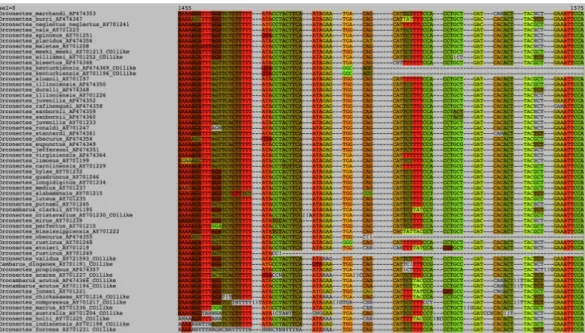
The resulting nucleotide and amino acid alignments can be visually inspected using SeaView, which handles the exclamation mark (‘!’) character used by MACSE to identify frameshifts and also allows coloring the alignment by codons (Figure 5).
The statistics on the number of frameshifts and stop codons inferred in each sequence of the resulting nucleotide alignment can be output in a .csv file (--out_stat_per_seq option) using the exportAlignment subprogram with the following command:
$ java -jar ./ macse_v2 .03. jar -prog exportAlignment -gc_def 5
-align TK2006_macse_NT . fasta
Figure 5 Excerpt of the crayfish COI nucleotide data set of Taylor and Knouft (2006) aligned by
MACSE and visualized by SeaView using codon colors. Note the numerous frameshifts (‘!’) inferred by MACSE in the bad quality “COI-like” sequences.
MACSE inferred 20 sequences containing frameshifts including 18 annotated as “COI-like”, but also two other sequences, Orconectes margorectus (AF474362) and O. propinquus (AF474357), containing frameshifts caused by additional nucleotides. Frameshifts in those sequences have probably gone unnoticed because they both occur close to the end of the sequences and do not lead to stop codons in the few nucleotides following the insertions. MACSE allows automatically spotting such cryptic cases. The worst “COI-like” sequence was O. australis (AY701204) that contains four frameshifts and an internal stop codon due to multiple missing and additional nucleotides. For six “COI-like” sequences, MACSE did not infer the presence of any frameshifts or stop codons: O. inermis (AY701201), O.
kentuck-iensis (AF474369 and AY701196), O. meeki meeki (AY701213), O. neglectus chaenodactylus
(AY701240) and O. pellucidus (AY701203). Careful visual inspection showed that most of these problems are likely stemming from sequencing errors rather than representing signs of pseudogenization (numts).
3.1.2
“COI-like” crustacean sequences in GenBank
The second example data set (BT2009) corresponds to the crustacean “COI-like” sequences harvested from GenBank and presented in Table 1 of Buhay (2009). This data set contains a mix of 54 “COI-like” complete and partial sequences. These sequences were manually assessed in great detail by Buhay (2009) including three sequences that were determined to likely not represent genuine COI sequences. We used this example data set to evaluate the capacity of MACSE to automatically detect sequencing errors that have been previously assessed by an expert eye. The trimNonHomologousFragments subprogram of MACSE allows identifying and trimming non homologous sequence fragments before further alignment. It could be used to identify entirely non-homologous sequences since such sequences will be trimmed along their entire lengths. A visualization of the result of this pre-filtering process can be output
in a .fasta file (-out_mask_detail option) in which the removed nucleotides are written in lowercase letters. The trimNonHomologousFragments subprogram also outputs a .csv file detailing the statistics of this pre-filtering process on each sequence (-out_trim_info option). This file contains the number of nucleotides and the proportion of each sequence that have been removed:
$ java -jar ./ macse_v2 .03. jar
-prog trimNonHomologousFragments -gc_def 5
-seq BT2009 . fasta
- out_mask_detail BT2009_trim_mask . fasta - out_trim_info BT2009_trim_stats . csv -out_NT BT2009_trim_NT . fasta
-out_AA BT2009_trim_AA . fasta
This non-homologous fragment-trimming step allowed to automatically detect the three se-quences that are likely not true mitochondrial COI sese-quences: Chthamalus dalli (AY795367),
Farfantepenaeus subtilis (AY344198), and Fenneropenaeus indicus (AY395245). Indeed,
MACSE automatically removed these sequences in their entirety. In addition, six other sequences were found to contain divergent fragments representing up to 30% of their length that were masked in the resulting output: Scopelocheirus schellenbergi (AY830432),
Paras-tacoides tasmanicus (AF482492), Orconectes indianensis (AY701198), Orconectes forceps
(AY701231), Liberonautes chaperi (AF399977), and Caligus sp. (EF452643). Most of these sequences were spotted as very low quality sequences by Buhay (2009) with sloppy 5’ or 3’ ends and lots of ambiguities.
In order to further assess the quality of the remaining 51 “COI-like” sequences, we aligned the masked sequences against the same reference COI sequence of Cherax destructor (NC_011243) previously used for the TK2006 data set. We used differential costs for frameshifts (-fs 30) and stop codons (-stop 30) for the reference sequence, and -fs_lr 10 and -stop_lr 10 for the less reliable “COI-like” sequences:
$ java -jar ./ macse_v2 .03. jar -prog alignSequences -gc_def 5
-seq Cherax_destructor_ref . fasta -seq_lr BT2009_trim_NT . fasta -fs 30
-stop 30 -fs_lr 10 -stop_lr 10
-out_NT BT2009_trim_macse_NT . fasta -out_AA BT2009_trim_macse_AA . fasta
The resulting nucleotide alignment was visually inspected using SeaView (Figure 6). The statistics on the number of frameshifts and stop codons inferred per sequence in these alignments were computed using the exportAlignment subprogram of MACSE:
$ java -jar ./ macse_v2 .03. jar -prog exportAlignment -gc_def 5
-align BT2009_trim_macse_NT . fasta
Figure 6 Excerpt of the crustacean “COI-like” data set assembled from GenBank by Buhay
(2009) trimmed and aligned by MACSE, and visualized by SeaView using codon colors. Note the numerous frameshifts (‘!’) inferred by MACSE in the bad quality sequences.
In all cases but three, MACSE correctly retrieved the problematic frameshifts and stop codons previously identified manually by Buhay (2009). The three exceptions concern sequences containing frameshifts occurring very close from sequence extremities (Orconectes
inermis AY701201 and Orconectes macrus AY701236) and an internal frameshift caused by
a 1-bp insertion compensated by a 1-bp deletion few nucleotides downstream (Orconectes
meeki AY701213).
3.2
MACSE alleviates the impact of numts in COI-based barcoding
species delimitation
Grasshoppers and crayfish are two invertebrate groups that are well known for presenting a high rate of nuclear integration of mitochondrial DNA (mtDNA) that gives rise to nuclear mitochondrial pseudogenes (numts). These numts are frequently co-amplified with the PCR targeted mtDNA sequences and could strongly impact barcoding analyses based on the mitochondrial COI marker. Song et al. (2008) studied the effect of numts on COI-based phylogenetic and barcoding analyses. They used PCR with universal arthropods barcoding primers to amplify COI in grasshoppers and crayfish. They showed that universal barcode PCR primers co-amplified numerous COI numts in both groups resulting in large overestimates of the number of species that can be delineated by COI barcoding. Their grasshopper data set (SG2008) contains 95 COI sequences including 88 co-amplified numts and their crayfish data set (SC2008) comprises 183 COI sequences with 101 co-amplified
numts. Numts accumulate frameshifts and stop codons because they become nonfunctional
after nuclear integration and are no longer under selective pressure to conserve the open reading frame. We used these two data sets to illustrate the efficiency of MACSE to identify numts based on the presence of frameshifts and stop codons as an automatic quality control step aimed at removing these pseudogene sequences before conducting downstream species delimitation analyses. The SG2008 and SC2008 data sets were aligned using the
reliable numts sequences and with default frameshift (-fs 30) and stop codon (-stop 30) costs for all sequences:
Grasshoppers:
$ java -jar ./ macse_v2 .03. jar -prog alignSequences -gc_def 5
-seq SG2008 . fasta -fs 30
-stop 30
-out_NT SG2008_macse_NT . fasta -out_AA SG2008_macse_AA . fasta
Crayfish:
$ java -jar ./ macse_v2 .03. jar -prog alignSequences -gc_def 5
-seq SC2008 . fasta -fs 30
-stop 30
-out_NT SC2008_macse_NT . fasta -out_AA SC2008_macse_AA . fasta
The statistics on the number of frameshifts and stop codons inferred for each sequence in the resulting alignments were computed using the exportAlignment subprogram of MACSE:
Grasshoppers:
$ java -jar ./ macse_v2 .03. jar -prog exportAlignment -gc_def 5
-align SG2008_macse_NT . fasta
- out_stat_per_seq SG2008_macse_NT_stat . csv
Crayfish:
$ java -jar ./ macse_v2 .03. jar -prog exportAlignment -gc_def 5
-align SC2008_macse_NT . fasta
- out_stat_per_seq SC2008_macse_NT_stat . csv
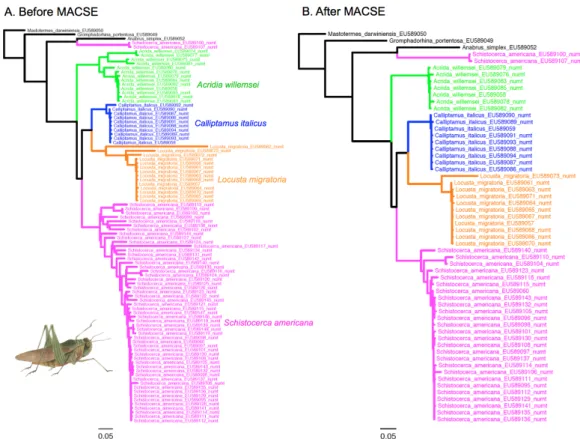
For the grasshoppers data set, MACSE detected 37 out of the 95 sequences containing at least one frameshift and/or stop codon, and 99 out of the 183 sequences for the crayfish data set. The potential numt sequences containing at least one frameshift and/or one stop codon were then removed from the resulting nucleotide alignments. Ambiguously aligned and highly incomplete codon sites were excluded using Gblocks (Castresana, 2000) with default relaxed codon parameters for both the complete and reduced MACSE alignments. Maximum likelihood (ML) phylogenetic inference was then conducted on the four resulting data sets with PhyML v3.1 (Guindon et al., 2009) using a GTR+G8 model and SPR branch swapping on a BIONJ starting tree. The ML phylograms obtained for the grasshoppers and crayfish data sets are presented in Figures 7 and 8, respectively.
In order to gauge the impact of automatically removing numts using MACSE on species delimitation, we applied the multi-rate Poisson Tree Process model (Kapli et al. 2017) on the four resulting ML phylograms using the mPTP server (http://mptp.h-its.org).
Figure 7 Maximum likelihood phylograms obtained before (A) and after (B) filtering the
grasshoppers data set of Song et al. (2008) using MACSE to detect numt sequences containing frameshits and/or stop codons. In this case, MACSE automatically removed 37 numts.
Figure 8 Maximum likelihood phylograms obtained before (A) and after (B) filtering the crayfish
data set of Song et al. (2008) using MACSE to detect numt sequences containing frameshits and/or stop codons. In this case, MACSE automatically removed 99 numts (in red).
For grasshoppers, mPTP delimited 20 species from the 95 sequences of the original data set, which included 88 numts. The number of delimited species was halved to 10 with the 58 sequences retained by MACSE that still included 51 potential numts, which did not contain any frameshift or stop codon. For crayfish, mPTP delimited 26 species from the 183 sequences of the original data set, which included 101 numts. Again, the number of delimited species dropped to 8 with the 84 sequences retained by MACSE that only included 3 potential numts, which did not contain any frameshift or stop codon.
3.3
MACSE_BARCODE accurately aligns thousands of metabarcoding
sequences
In order to illustrate the efficiency of the MACSE_BARCODE pipeline, we applied the two Nextflow workflows P_buildRefAlignment and P_enrichAlignment to barcode sequences publicly available for ants, mammals, and flowering plants, which were downloaded through the Taxonomy portal of the BOLD database v4 (http://v4.boldsystems.org/ index.php/TaxBrowser_Home) on March 3rd 2020 (Table 1).
BOLD sequences Homologous sequences per taxa per taxa and marker homologous to reference (reverse com-plemented) in final alignment with internal frameshifts with internal stop codons Mammalia COI 141,145 121,180 117,547 (6) 117,363 223 82 Formicidae COI 124,067 121,954 121,792 (33) 121,494 557 16 Magnoliophyta rbcL 339,948 121,989 121,598 (116) 121,302 825 346 Magnoliophyta matK 339,948 107,413 107,032 (614) 63,250 1,824 143
Table 1 Descriptive statistics of the four BOLD barcoding data sets on which the
MACSE_BARCODE pipeline has been applied to construct reference alignments.
3.3.1
Mammalian COI sequences in BOLD
As a first example, we aimed at constructing a reference alignment of COI barcode sequences for all mammals represented in the BOLD database. As mammalian COI sequences are well conserved at the scale of mammals, this first data set serves as an ideal first test case for our approach. Using the Taxonomy portal of the BOLD system v4 (http://v4.boldsystems. org/index.php/TaxBrowser_Home), we downloaded the 141,145 publicly available sequences in the Mammalia section. These raw sequences contain sequences from different molecular markers and also include gaps. Sequences corresponding to COI can thus be counted using the following command:
$ grep -c COI Mammalia_BOLD_141145seq_raw . fasta
This resulted in 121,180 COI sequences that were extracted and stored in a new fasta file using the following command:
$ grep -A1 COI Mammalia_BOLD_141145seq_raw . fasta > Mammalia_BOLD_121180seq_COI_raw . fasta
At this stage, gaps could be removed from all sequences and illegal characters such as pipes ‘|’ and spaces could be replaced with underscores “_” to ease further bioinformatic processing using for instance:
$ sed -e '/ >/!s/ -//g'
-e '/>/s /[| :(). ,;#]/ _/g' Mammalia_BOLD_121180seq_COI_raw . fasta > Mammalia_BOLD_121180seq_COI . fasta
Using the Homo sapiens (NC_012920) full length COI sequence as a reference sequence, the alignment of representative sequences for the Mammalia COI data set could be built using the P_buildRefAlignment workflow by running the following command:
$ ./ nextflow P_buildRefAlignment .nf
-- refSeq Homo_sapiens_NC_012920_COI_ref . fasta -- seqToAlign Mammalia_BOLD_121180seq_COI . fasta -- geneticCode 2
-- outPrefix Mammalia_COI
This generates a result folder RESULTS_REFA_Mammalia_COI containing a .fasta file of unaligned representative sequences (Mammalia_COI_repSeq.fasta) and the corresponding nucleotide (Mammalia_COI_final_align_NT.aln) and amino acid (Mammalia_COI_final _align_AA.aln) alignments. A .fasta file containing the barcode sequences identified to be homologous to the reference (Mammalia_COI_homolog.fasta) and a list of the names of the sequences that have been reverse complemented (Mammalia_COI_RevComSeqId.list) are also provided. In this case, 117,547 sequences (97.0%) were found homologous to the
COI reference sequence and only six sequences had to be reverse complemented to be aligned
(Table 1).
The final alignment of all homologous COI sequences could then be computed using the
P_enrichAlignment workflow by providing the previously computed alignment of
repre-sentative sequences as a reference alignment (Mammalia_COI_reference_alignment_NT.aln) and the set of homologous barcode sequences remaining to be aligned (Mammalia_COI_homolog .fasta), and executing the following command:
$ ./ nextflow P_enrichAlignment .nf
-- refAlign Mammalia_COI_final_align_NT . aln -- seqToAlign Mammalia_COI_homolog . fasta -- geneticCode 2
-- outPrefix Mammalia_COI
This produces a result folder RESULTS_ENRICH_Mammalia_COI containing the nucleotide (Mammalia_COI_alignAll_NT.aln) and amino acid (Mammalia_COI_alignAll_AA.aln)
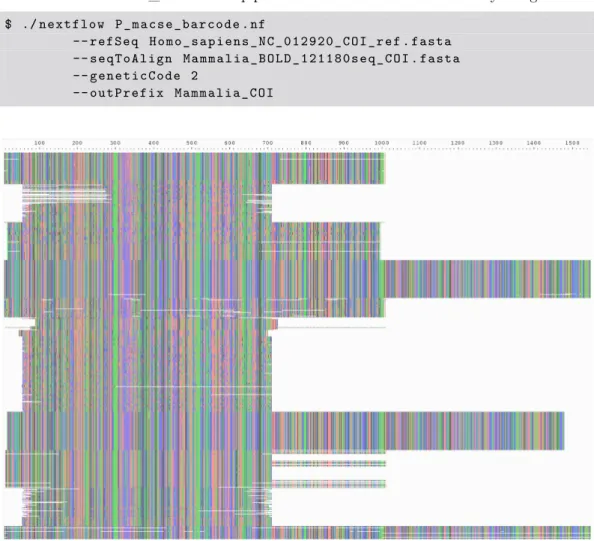
fi-nal alignments of all COI sequences, as well as versions of those alignments in which frameshifts (‘!’) have been removed (Mammalia_COI_alignAll_NT_exp_noFS.aln) and (Mammalia_COI_alignAll_AA_exp_noFS.aln). Moreover, statistics on the steps of sequence trimming (Mammalia_COI_preTrimingStat.csv) and alignment enrichment (Mammalia_COI _enrich_info.csv) are provided as .csv files so that the fate of each initial sequence can be monitored. Here, the final mammal COI alignment (Figure 9) contains 117,363 of the initial 121,180 sequences (96.9%). The alignment of 223 of these sequences required the inference of an internal frameshift and 82 sequences have been integrated in this final alignment while having an internal stop codon (Table 1). These sequences could easily have been excluded from the alignment, if needed.
These analyses have been run on a HPC cluster. According to Nextflow, the identifi-cation of the representative sequences and the generation of the reference alignment with
P_buildRefAlignment took only 8 minutes. The obtention of the final alignment with P_enrichAlignment required about 134 hours of CPU time but the final result was
The whole MACSE_BARCODE pipeline could also be executed directly using:
$ ./ nextflow P_macse_barcode .nf
-- refSeq Homo_sapiens_NC_012920_COI_ref . fasta -- seqToAlign Mammalia_BOLD_121180seq_COI . fasta -- geneticCode 2
-- outPrefix Mammalia_COI
Figure 9 Excerpt of the final Mammalia COI nucleotide alignment containing 117,363 sequences
produced by MACSE_BARCODE including both full-length (1,548 bp) and shorter COI fragments as visualized by AliView (Larsson, 2014).
3.3.2
Ant COI sequences in BOLD
As a second example, we considered COI barcode sequences from all ant specimens represented in the BOLD database. A total of 124,067 publicly available sequences were downloaded from the Formicidae section using the Taxonomy portal of the BOLD system v4. As for mammals, these raw sequences contain sequences from different molecular markers. So, sequences corresponding to COI have to be counted:
$ grep -c COI Formicidae_BOLD_124067seq_raw . fasta
The resulting 121,954 COI sequences were then extracted and stored in a new .fasta file:
$ grep -A1 COI Formicidae_BOLD_124067seq_raw . fasta > Formicidae_BOLD_121954seq_COI_raw . fasta
After gap removal and name cleaning, the alignment of representative sequences for the Formicidae COI data set was built with the P_buildRefAlignment workflow using the full length COI sequence of Solenopsis geminata (NC_014669.1) as a reference:
$ ./ nextflow P_buildRefAlignment .nf
-- refSeq Solenopsis_geminata_NC_014669_COI_ref . fasta -- seqToAlign Formicidae_BOLD_121954seq_COI . fasta -- geneticCode 5
-- outPrefix Formicidae_COI
In this ant COI data set, 121,792 sequences were considered to be homologous to the
COI reference sequence, and 33 sequences had to be reverse complemented to be aligned
(Table 1).
The final alignment of all homologous COI sequences was then computed using the
P_enrichAlignment workflow:
$ ./ nextflow P_enrichAlignment .nf
-- refAlign Formicidae_COI_final_align_NT . aln -- seqToAlign Formicidae_COI_homolog . fasta -- geneticCode 5
-- outPrefix Formicidae_COI
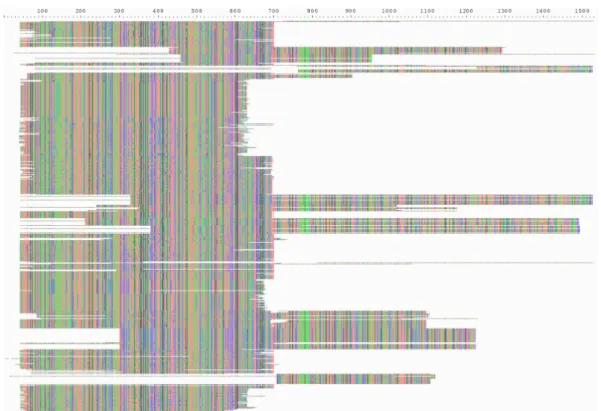
The final ant COI alignment (Figure 10) comprises 121,494 of the initial 121,954 sequences (99.6%). The alignment of 557 of these sequences required the inference of an internal frameshift and 16 sequences were integrated in this alignment while presenting an internal stop codon (Table 1).
3.3.3
Flowering plant rbcL sequences in BOLD
In this third example, we considered another taxonomic group and barcoding marker with the chloroplastic rbcL gene, which is the first official barcoding marker for flowering plants. The Taxonomy section of the BOLD system v4 public database contains 339,948 raw public sequences for Magnoliophyta. This included rbcL sequences but also other barcoding markers such as the chloroplastic matK gene. After counting rbcL sequences:
$ grep -c rbcL Magnoliophyta_BOLD_339948seq_raw . fasta
The resulting 121,989 rbcL sequences were extracted and stored in a new .fasta file:
$ grep -A1 rbcL Magnoliophyta_BOLD_339948seq_raw . fasta > Magnoliophyta_BOLD_121989seq_rbcL_raw . fasta
After gap removal and name cleaning, the reference alignment of representative sequences for the Magnoliophyta rbcL data set was built with the P_buildRefAlignment workflow using the Magnolia officinalis (NC_020316.1) full length rbcL sequence as a reference:
$ ./ nextflow P_buildRefAlignment .nf
-- refSeq Magnolia_officinalis_NC_020316 .1 _rbcL_ref . fasta -- seqToAlign Magnoliophyta_BOLD_121989seq_rbcL . fasta -- geneticCode 11
-- outPrefix Magnoliophyta_rbcL
In this flowering plant rbcL data set, 121,598 sequences were found homologous to the
rbcL reference sequence among which 116 sequences had to be reverse complemented to be
aligned (Table 1). The final alignment of all homologous rbcL sequences was then computed using the P_enrichAlignment workflow:
Figure 10 Excerpt of the final Formicidae COI metabarcoding nucleotide alignment containing
121,494 sequences produced by MACSE_BARCODE including both full-length (1,533 bp) and shorter COI fragments as visualized by AliView.
$ ./ nextflow P_enrichAlignment .nf
-- refAlign Magnoliophyta_rbcL_final_align_NT . aln -- seqToAlign Magnoliophyta_rbcL_homolog . fasta -- geneticCode 11
-- outPrefix Magnoliophyta_rbcL
The final flowering plant rbcL alignment (Figure 11) comprises 121,302 of the initial 121,989 sequences (99.4%). The alignment of 857 of these sequences required the inference of an internal frameshift and 346 sequences were integrated in this alignment despite the presence of an internal stop codon (Table 1). While this rbcL alignment has almost the same number of sequences (121,302) as the alignments obtained for mammals (117,363) and ants (121,494) using COI, it contains much more sequences comporting an internal frameshift (825 versus 223 and 557, respectively) or an internal stop codon (346 versus 82 and 16, respectively). This likely indicates that the sequences available for rbcL are of lower quality than those available for COI. The high number of sequences containing a stop codon is especially surprising as this should be something easy to check before including a sequence in the BOLD database. For instance, the amino acid sequence displayed on BOLD in the detailed record for the sequence GBVC3450-11, which is flagged as mined from GenBank, includes a stop codon without explicit warning (http://www.boldsystems.org/index.php/ Public_RecordView?processid=GBVC3450-11).
Figure 11 Excerpt of the final Magnoliophyta rbcL metabarcoding nucleotide data set containing
121,302 sequences produced by MACSE_BARCODE including both full-length (1,440 bp) and shorter rbcL fragments as visualized by AliView.
3.3.4
Flowering plant matK sequences in BOLD
For this last example, we considered the second official barcoding marker for flowering plants with the chloroplastic matK gene. The matK sequences were counted from the previously downloaded raw Magnoliophyta sequences from BOLD:
$ grep -c matK Magnoliophyta_BOLD_339948seq_raw . fasta
The resulting 107,413 matK sequences were extracted and stored in a new .fasta file:
$ grep -A1 matK Magnoliophyta_BOLD_339948seq_raw . fasta > Magnoliophyta_BOLD_107413seq_matk_raw . fasta
After gap removal and name cleaning, the reference alignment of representative sequences for the Magnoliophyta matK data set was built with the P_buildRefAlignment workflow using the Magnolia officinalis (NC_020316.1) full length matK sequence as a reference:
$ ./ nextflow P_buildRefAlignment .nf
-- refSeq Magnolia_officinalis_NC_020316 .1 _matK_ref . fasta -- seqToAlign Magnoliophyta_BOLD_107413seq_matK . fasta -- geneticCode 11
-- outPrefix Magnoliophyta_matK
In this flowering plant matK data set, 107,032 sequences were found homologous to the reference sequence, 614 of which had to be reverse complemented to be aligned (Table 1).
The proportion of sequences provided in the wrong orientation (0.5%) was much higher than for the other data sets (e.g. 0.005% for the mammal COI data set).
The final alignment of all homologous matK sequences was then computed using the
P_enrichAlignment workflow:
$ ./ nextflow P_enrichAlignment .nf
-- refAlign Magnoliophyta_matK_final_align_NT . aln -- seqToAlign Magnoliophyta_matK_homolog . fasta -- geneticCode 11
-- outPrefix Magnoliophyta_matK
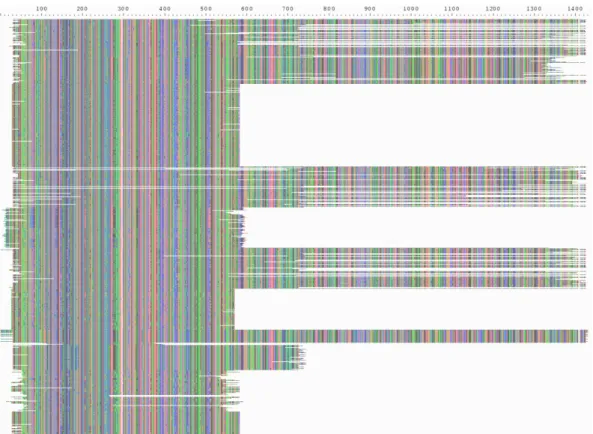
The final flowering plant matK alignment (Figure 12) comprises only 63,250 of the initial 107,413 sequences (58.9%). The alignment of 1,824 of these sequences required the inference of an internal frameshift and 143 sequences were aligned while presenting an internal stop codon (Table 1).
Figure 12 Excerpt of the final Magnoliophyta matK metabarcoding nucleotide alignment
con-taining 63,250 sequences produced by MACSE_BARCODE including both full-length (1,536 bp) and shorter matK fragments as visualized by AliView.
The fact that more than 40% of the initial matK sequences were excluded from the final alignment could reflect the limit of our approach, the poor quality of the sequences available in BOLD for this marker, or more likely a mix of both causes. In fact, many sequences were not inserted because their presence would induce many insertions relative to the reference alignment. This illustrates one limit of our current approach that is based on the conservation of the reference sequence in terms of both amino acid divergence and indel occurrence. Indeed,
Group, 2009). However, this could be alleviated by applying the MACSE_BARCODE pipeline at lower taxonomic levels such as the Family level at which matK sequences might be more conserved in length. Meanwhile, it seems that the sequences of this data set are of lower quality comparable to the other three data sets with a much higher proportion of the aligned sequences requiring the inference of at least one internal frameshift to be correctly aligned. To ensure that this was not an error of our pipeline, we extracted from the final
matK alignment the 1,940 sequences (out of a total of 63,250) that were included despite
presenting an internal frameshift or a stop codon. This allowed to confirm that, in most cases, the presence of the inferred frameshifts was accurate and that some stop codons appeared right in the middle of the sequences (Figure 13). Altogether, these observations indicate that numerous flowering plant matK sequences in BOLD seem to be of relatively poor quality or might represent interesting cases of biologically relevant shifts in translation reading frame, as recently uncovered in Orchidaceae (Barthet et al., 2015).
Figure 13 Excerpt of the final Magnoliophyta matK final amino acid alignment containing 63,250
sequences focusing on sequences presenting internal frameshifts (white ellipses) and stop codons (black ellipses) as visualized by SeaView.
4
Conclusion
The reference barcoding alignments produced with the MACSE_BARCODE pipeline can be downloaded from the MACSE webpage (https://bioweb.supagro.inra.fr/macse/ index.php?menu=downloadTuto). Future reference alignments for additional taxonomic groups available in the BOLD database will be distributed through the same webpage. The availability of these quality-controlled alignments for the main protein-coding barcode genes should leverage the power of phylogenetics for taxonomic assignment by allowing to implement probabilistic evolutionary placement in the ever growing range of metabarcoding applications.
Acknowledgements
The project was granted access to the INRA MIGALE bioinformatics platform (https: //migale.inra.fr/).
References
Andújar, C., Arribas, P., Yu, D. W., Vogler, A. P., and Emerson, B. C. (2018). Why the COI barcode should be the community DNA metabarcode for the metazoa. Molecular
Ecology, 27(20):3968–3975.
Barthet, M. M., Moukarzel, K., Smith, K. N., Patel, J., and Hilu, K. W. (2015). Alternative translation initiation codons for the plastid maturase MatK: unraveling the pseudogene misconception in the Orchidaceae. BMC Evolutionary Biology, 15:210.
Bensasson, D., Zhang, D.-X., Hartl, D. L., and Hewitt, G. M. (2001). Mitochondrial pseudogenes: evolution’s misplaced witnesses. Trends in Ecology and Evolution, 16(6):314– 321.
Berger, S. A., Krompass, D., and Stamatakis, A. (2011). Performance, accuracy, and web server for evolutionary placement of short sequence reads under maximum likelihood.
Systematic Biology, 60(3):291–302.
Bohmann, K., Evans, A., Gilbert, M. T. P., Carvalho, G. R., Creer, S., Knapp, M., Yu, D. W., and De Bruyn, M. (2014). Environmental DNA for wildlife biology and biodiversity monitoring. Trends in Ecology and Evolution, 29(6):358–367.
Boyce, K., Sievers, F., and Higgins, D. G. (2014). Simple chained guide trees give high-quality protein multiple sequence alignments. Proceedings of the National Academy of Sciences
USA, 111(29):10556–10561.
Buhay, J. E. (2009). “COI-like” sequences are becoming problematic in molecular systematic and DNA barcoding studies. Journal of Crustacean Biology, 29(1):96–110.
Calvignac, S., Konecny, L., Malard, F., and Douady, C. J. (2011). Preventing the pollution of mitochondrial datasets with nuclear mitochondrial paralogs (numts). Mitochondrion, 11(2):246–254.
Caporaso, J. G., Kuczynski, J., Stombaugh, J., Bittinger, K., Bushman, F. D., Costello, E. K., Fierer, N., Pena, A. G., Goodrich, J. K., Gordon, J. I., et al. (2010). QIIME allows analysis of high-throughput community sequencing data. Nature Methods, 7(5):335. Castresana, J. (2000). Selection of conserved blocks from multiple alignments for their use in
phylogenetic analysis. Molecular Biology and Evolution, 17(4):540–552.
CBOL Plant Working Group (2009). A DNA barcode for land plants. Proceedings of the
National Academy of Sciences USA, 106(31):12794–12797.
Coissac, E., Riaz, T., and Puillandre, N. (2012). Bioinformatic challenges for DNA metabar-coding of plants and animals. Molecular Ecology, 21(8):1834–1847.
DeSantis, T. Z., Hugenholtz, P., Larsen, N., Rojas, M., Brodie, E. L., Keller, K., Huber, T., Dalevi, D., Hu, P., and Andersen, G. L. (2006). Greengenes, a chimera-checked 16S rRNA gene database and workbench compatible with ARB. Applied and Environmental
Microbiology, 72(7):5069–5072.
Di Tommaso, P., Chatzou, M., Floden, E. W., Barja, P. P., Palumbo, E., and Notredame, C. (2017). Nextflow enables reproducible computational workflows. Nature Biotechnology, 35(4):316–319.
Dunning, L. T. and Savolainen, V. (2010). Broad-scale amplification of matK for DNA barcoding plants, a technical note. Botanical Journal of the Linnean Society, 164(1):1–9. Gouy, M., Guindon, S., and Gascuel, O. (2010). SeaView version 4: A multiplatform graphical user interface for sequence alignment and phylogenetic tree building. Molecular Biology
and Evolution, 27(2):221–224.
Guindon, S., Delsuc, F., Dufayard, J.-F., and Gascuel, O. (2009). Estimating maximum likelihood phylogenies with PhyML. Methods in Molecular Biology, 537:113–137.