Publisher’s version / Version de l'éditeur:
Construction Technology Update, 2011-06-01
READ THESE TERMS AND CONDITIONS CAREFULLY BEFORE USING THIS WEBSITE. https://nrc-publications.canada.ca/eng/copyright
Vous avez des questions? Nous pouvons vous aider. Pour communiquer directement avec un auteur, consultez la première page de la revue dans laquelle son article a été publié afin de trouver ses coordonnées. Si vous n’arrivez pas à les repérer, communiquez avec nous à [email protected].
Questions? Contact the NRC Publications Archive team at
[email protected]. If you wish to email the authors directly, please see the first page of the publication for their contact information.
NRC Publications Archive
Archives des publications du CNRC
Access and use of this website and the material on it are subject to the Terms and Conditions set forth at
Performance of solar shading devices
Laouadi, A.
https://publications-cnrc.canada.ca/fra/droits
L’accès à ce site Web et l’utilisation de son contenu sont assujettis aux conditions présentées dans le site
LISEZ CES CONDITIONS ATTENTIVEMENT AVANT D’UTILISER CE SITE WEB.
NRC Publications Record / Notice d'Archives des publications de CNRC:
https://nrc-publications.canada.ca/eng/view/object/?id=4183d543-859f-4ee1-93f4-9216e2b46c22 https://publications-cnrc.canada.ca/fra/voir/objet/?id=4183d543-859f-4ee1-93f4-9216e2b46c22NRC CONSTRUCTION
Performance of Solar Shading Devices
by Aziz Laouadi
Optimum window selection is dependent on the location of the building and the prevailing climate. For heating-dominated climates as in Canada, windows with high solar heat gain coeficients and low U-factors are appropriate choices. Solar shading devices can be used to further enhance window performance to varying degrees.
Shading devices have historically been used to decorate windows, provide privacy, and reduce glare and summer overheating. Recent studies by the NRC Institute for Research in Construction (NRC-IRC) sought to clarify the extent to which shading devices can reduce energy demand for heating and cooling, balance thermal loads to reduce peaks, and improve the thermal environment for people sitting near windows. The research also considered the potential risk for condensation on windows (especially conventional windows in old house construction), and excessive thermal stresses on glass in summer (especially for modern, high-performance windows).
Study Details
The NRC-IRC studies were done using the model houses of the Canadian Centre for Housing Technology (CCHT) for two types of house construction (insulation values for house envelopes and air leakage rates):
• Pre-1980 construction, which is leaky and typically uses conventional double-glazed units; and,
• Current construction based on the R-2000 standard, which is tight and typically uses low-e, double-glazed sealed units.
The study compared the performance of houses equipped with typical interior blinds (base case), with houses employing other shading devices. The performance of houses without shading devices was also included in the comparison.
The shading devices investigated were: • Interior, typical blinds
• Interior, relective blinds (with a surface that relects sunlight)
• Interior, relective roller screens • Between-pane, metallic relective blinds • Exterior insulating rollshutters
• Exterior screens
In addition, old construction was combined with high-performance windows, and current construction with conventional windows to represent renovated houses. Current construction was combined with super windows (such as triple-glazed units with low-e coatings) to represent cases of future low-energy or net-zero energy houses.
Following validation of some scenarios at the CCHT, estimates of energy savings for all the various window and shading combinations were developed using whole-building computer simulations for Ottawa, Montreal, Winnipeg, and Halifax. Peak cooling power demand and payback periods were also estimated based on local energy costs (Table 1) and material costs (Table 2).
This Update describes results of research on several types of window shading devices and their potential to reduce
heating and cooling energy consumption and improve conditions that affect occupant comfort. The information provides
guidance in the selection of shading devices for particular housing types and energy cost situations.
CONSTRUCTION
TECHNOLOGY UPDATE
No. 77, June 2011
Construction Technology Update No.77
Ottawa
Montreal
Winnipeg
Halifax
Type of heating
Natural gas
Electricity
Natural gas
Oil
Fuel cost
$0.045 per kWh
( $0.47 per m
3)
$0.077 per kWh
$0.035 per kWh
( $0.37 per m
3)
$0.103 per kWh
($1.09 per litre)
Electricity cost
$0.11 $ per kWh
$0.077 per kWh
$0.074 per kWh
$0.123 per kWh
1. Energy costs in effect in June 2009.
Table 1. Types and costs of fuels used for house heating1
Type of
shading device
Interior aluminum
blinds (1” slats)
Interior screens
Exterior screens
Exterior insulating
rollshutters
Total cost
$1,061
$2,182 to $8,454
$11,393
$15,332
Unit cost
$35 per m
2$72 to $282 per m
2$376 per m
2$506 per m
21. Costs are for economical brands priced in June 2009 to equip the CCHT research house.
Table 2. Cost of shading devices studied1
Interior typical blinds
These have either vertical or horizontal slats (Venetian blinds) and are made of various colours and materials (e.g., metal, plastic, wood). Blinds with metal slats were used as the base case and had the following characteristics:
• Slats: width = 25.4 mm; spacing = 20 mm; colour = grey (solar relectance = 42%);
• Air space between blinds and window is assumed partially open at the top, bottom and sides;
• Blind distance to window = 160 mm.
When open (slat angle = 0o, horizontal), typical interior blinds do not signiicantly affect the window view-out, daylight admission, solar heat gain (when sunbeam light is normal to the window plane) or heat losses.
When closed (slat angle = 75o), the blinds may reduce solar heat gains by 40% with high-performance windows and 50% with conventional windows, compared to unshaded windows. They have no noticeable effect on heat loss and on condensation on the interior window surfaces. This is because the air space between the blinds and the window is naturally ventilated at the side, top and bottom ends, and to a slight extent, through the deliberate openings left between the slats.
Compared to unshaded windows, typical interior blinds are not cost-effective in terms of heating energy savings, but they may reduce cooling energy use and cost, and on-peak cooling power demand by up to 12%.
Interior relective blinds
The characteristics of the interior relective (Venetian) blinds tested are as follows:
• Slats: width = 25.4 mm; spacing = 20 mm; colour = white (solar relectance = 70%); angle = (0o open, 75o closed); • Enclosed air space between blinds and window is assumed
partially open at the top, bottom and side sections; • Blind distance to window = 160 mm.
When open, interior relective blinds do not signiicantly affect view-out, daylight admission, solar heat gain (when sunbeam light is normal to the window plane) and heat loss. When closed, they can effectively reduce solar heat gain from 53% (with high-performance windows) to 63% (with conventional
NRC CONSTRUCTION
windows) when compared to unshaded windows. They have no noticeable effect on heat loss or condensation.
Compared to typical interior blinds, interior relective blinds are effective shading devices, particularly to reduce cooling energy use and cost (up to 15%), and on-peak cooling power demand (7% on average). However, they are not cost-effective compared to typical interior blinds.
Interior relective roller screens
Interior roller screens are common shading devices used to control solar heat gain and view-out (or privacy). They are made from various fabrics, colours and openness factors, and some may be relective. The characteristics of the relective roller screens studied are as follows:
• 0.5-mm PVC coated ibreglass yarns; • Screen openness factor = 4%;
• Colour: white with aluminium coating on the front surface (material front/back solar relectance = 77% and 71%); • Enclosed air space between screen and window is assumed
partially open at the top, bottom and sides: • Screen distance to window = 160 mm.
These shadings (the relective surface faces the outside) can cause glass breakage due to excessive temperature differ-ences between the centre and edge of glass, especially if they are mounted inside the frames of high-performance windows and the air space between the shade and the window is sealed. Therefore, the air space should be left open to ensure natural or forced ventilation.
The perforated screens provide an acceptable view-out through windows, particularly when the windows are not exposed to direct sunlight (e.g., north-facing windows). Direct sunlight (e.g., south-facing windows) slightly impairs the view through the windows owing to the light scattering effect of the screens (haze < 0.1).
Relective screens do not result in excessive risk of high glass temperatures and breakage if they are mounted on the walls of the window opening with a suficient air gap between the shad-ing device and the wall to allow for natural or mechanical venti-lation. However, they may increase the risk of condensation on the interior surfaces of the windows.
Compared to typical interior blinds, interior relective close-weave screens (with low-emissivity coating on the relective surface) are effective shading devices, particularly in reducing annual cooling energy use and cost (by up to 25%) and on-peak cooling power demand (by 13% on average), without a negative effect on heating energy use.
Between-pane metallic relective blinds
Between-pane blinds are sometimes used in commercial build-ings but rarely in houses. The study assessed the performance of windows with metallic relective, white (solar relectance of 70%) blind systems when the blinds are open (slats horizontal) and closed (slats rotated by 89o). The other characteristics of the between-pane relective blinds studied are as follows:
• Slats: width = 12.7 mm; spacing = 12.7 mm; angle = (0o open; 89o closed); and,
• Blinds placed in the middle of a 20-mm air space.
In an open position, the blinds do not signiicantly affect window performance, particularly view-out, daylight admission, solar heat gain (when sunbeam light is normal to the window plane) and heat loss. When closed, they effectively reduce solar heat gain from 68% to 83% compared to unshaded windows. For heat loss control, metal blinds are better when used with conventional windows (the U-factor is reduced by more than 15% compared to unshaded windows); they have no noticeable effect when they are used with high-performance windows. Metal slats may result in undesirable thermal bridging between the interior and the exterior window panes, particularly when the slats are horizontal.
Construction Technology Update No.77
Compared to typical interior blinds, between-pane relective me-tallic blinds are not energy-eficient or cost-effective devices. They increase the annual heating energy use and cost (by up to 16%), particularly when used with high-performance windows, despite their signiicant potential to reduce cooling energy use (by more than 40%) and on-peak cooling power demand (35% on average). When the indoor air temperature is ixed at 21oC, between-pane blinds increase the risk of condensation on the interior surfaces of both conventional and high-performance windows.
If metallic blinds have to be integrated in windows, they should be used with triple glazing, and drawn up when open (instead of drawn down with slats horizontal) to reduce the effect of thermal bridging and to increase the solar heat gain in winter. The use of blinds with plastic or ibreglass materials is recommended.
Exterior insulating rollshutters
Insulating rollshutters are not commonly used in Canadian resi-dences despite their potential to reduce energy use. The charac-teristics of the rollshutters studied are as follows:
• 6-mm insulated aluminum (1-mm aluminum alloy and 5-mm polyurethane insulation);
• Employed with side rails and rubber gaskets; • Enclosed air space between shutter and window is
assumed sealed;
• Shutter distance to window = 180 mm; • Colour = beige (solar relectance = 0.66).
Windows with exterior screens
Exterior screen shadings are not commonly used in Canadian residences. The characteristics of the screens studied are as follows:
• 0.53-mm PVC coated ibreglass yarns;
• Screen openness factor = 5%;
• Employed with side rails and rubber gaskets; • Enclosed air space is assumed not sealed due
to perforation;
• Screen distance to window = 180 mm; • Colour = charcoal (opaque material with solar
relectance = 5%).
When closed, exterior screen shadings are effective in reducing the potential for solar radiation damage to exposed skin and fur-niture, solar overheating in summer, and heat loss in winter. They also effectively control window glare without signiicantly im-pairing view-out during daytime. They may signiicantly reduce the risk of condensation on the interior surfaces of windows. Exterior screens may reduce solar heat gains by more than 80% compared to unshaded windows. When used with convention-al windows, these screens may reduce the window U-factor by 25% to 32%. When used with high-performance windows the U-factor reduction may vary from 12% to 24%. Exterior screens have effects similar to exterior rollshutters with regard to house energy use and condensation on the interior surfaces of windows.
Payback Periods
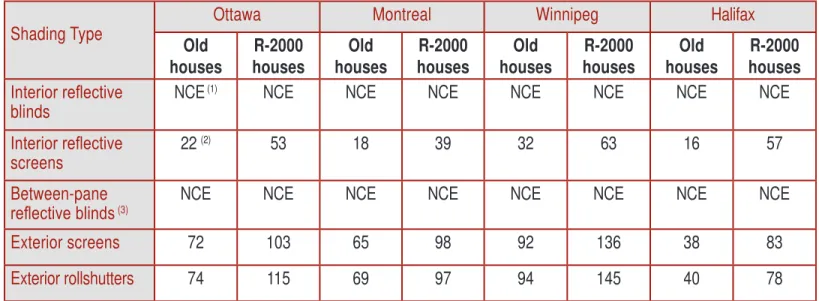
Payback periods for the shading devices studied are shown in Table 3. Although the payback periods are long, it is impor-tant to remember that shading devices are installed for many reasons in addition to energy savings. These include window decoration, control of privacy, glare and summer overheating, and furniture fading protection. So, where shading devices are desired, the payback periods can be reviewed to see where costs can be minimized.
NRC CONSTRUCTION
Peak Cooling Power Demand
Peak cooling power demand (the maximum power used by the cooling system – air conditioner and circulation fan – during the hottest day of the cooling season to maintain comfortable conditions indoors) is one of the criteria for the selection of an eficient fenestration system.
When compared with unshaded windows, typical interi-or blinds reduced on-peak (from 11 AM to 5 PM) cooling power demand by 9% (average) for old houses with conven-tional double clear windows, and by 7% (average) for R-2000
houses with double clear low-e windows. When compared with typical interior blinds in old houses, exterior rollshut-ters reduced on-peak cooling power demand by 30% on average, followed by between-pane relective blinds at 27%; exterior screens at 22%; interior relective screens at 13%; and interior relective blinds at 7%. For R-2000 houses, exte-rior rollshutters reduced the on-peak cooling power demand by
39% on average, followed by between-pane relective blinds at 35%; exterior screens at 33%; interior relective screens at 13%; and interior relective blinds at 7%.
Implications for Users
Shading devices are used for many reasons – many of them unrelated to energy savings. However, understanding how dif-ferent shading devices affect summer and winter energy use means more appropriate selections can be made. The energy savings and payback periods calculated in the study are based on capital and fuel costs in summer 2009. As fuel costs
con-tinue to increase and time-of use electricity prices become more common, the payback period for the more advanced shading devices will likely become shorter. The selection of a shading and window system often requires trade-offs between energy performance, cost, visual and thermal comfort, and aesthetic considerations. The results of this NRC-IRC research provide speciiers and purchasers of shading devices with additional information upon which to base decisions.
Shading Type
Ottawa
Montreal
Winnipeg
Halifax
Old
houses
R-2000
houses
Old
houses
R-2000
houses
Old
houses
R-2000
houses
Old
houses
R-2000
houses
Interior relective
blinds
NCE
(1)NCE
NCE
NCE
NCE
NCE
NCE
NCE
Interior relective
screens
22
(2)53
18
39
32
63
16
57
Between-pane
relective blinds
(3)NCE
NCE
NCE
NCE
NCE
NCE
NCE
NCE
Exterior screens
72
103
65
98
92
136
38
83
Exterior rollshutters
74
115
69
97
94
145
40
78
1. NCE means the shading device is not cost-effective (negative payback period) from an energy-saving standpoint. 2. Payback period is for the most economical product.
3. The cost of between-pane blinds is assumed to be equal to that of interior blinds.
Construction Technology Update No.77
Conclusions
The main points from the research can be summarized as follows:
• Windows with typical interior blinds (the most widely used shading devices in Canada) are not energy-eficient nor cost-effective in terms of annual energy savings compared to unshaded windows, but they may reduce cooling energy use and cost (by up to 12%), and on-peak cooling power demand (by up to 12%).
• Exterior insulating rollshutters and screens are the most effective shading devices for reducing heating and cooling energy use, on-peak cooling power demand, and the risk of condensation on the interior surfaces of windows. They also improve thermal comfort conditions near windows. • Exterior rollshutters and screens are more effective
when used with conventional windows than with high-performance windows. This means they are worth considering for renovating old houses with conventional windows.
References
Guidelines for Effective Residential Solar Shading Devices.
For more information refer to the full report available at: http://www.nrc-cnrc.gc.ca/obj/irc/doc/pubs/rr/rr300.pdf. Selecting Residential Window Glazing for Optimum Energy Performance, M.M. Armstrong, A.H. Elmahdy, M.C. Swinton and A. Parekh, Construction Technology Update No. 71, Institute for Research in Construction, National Research Council, September 2008.
Dr. Aziz Laouadi is a senior research oficer in the Indoor Environment program of the NRC Institute for Research in Construction.
Performance Indicators for Window and Shading Systems
While there are well-established performance measures for clear-glass windows, new measures are needed for window and shading systems.
View-Out Index (VOI)
VOI is the visibility through a fenestration system from inside to outside under given indoor and outdoor lighting conditions during daytime. VOI ≈ 1 applies to windows with clear glazing and VOI ≈ 0 applies to windows with fully translucent (no see-through) glazing.
Moisture Condensation Indicator
Some types of screens can lower window glass temperatures and therefore the possibility of increased condensation must be considered.
Light Diffusion Index
The light diffusion index indicates the visibility or privacy provided by a fenestration system. Windows with clear glaz-ing have values close to zero, whereas windows with fully translucent glazing (no see-through) have values close to 1.
Fading Transmittance
Fading transmittance indicates the ability of a window shading system to reduce the fading of fabric.