ABYSSAL MIXING FROM BOTTOM BOUNDARY EFFECTS IN MID-ATLANTIC RIDGE FLANK CANYONS
by
Rebecca Walsh Dell A. B., Harvard University, 2005
Submitted in partial fulfillment of the requirements for the degree of Master of Science
at the
MASSACHUSETTS INSTITUTE OF TECHNOLOGY and the
WOODS HOLE OCEANOGRAPHIC INSTITUTION June 2010
@ 2010 Rebecca Walsh Dell All rights reserved.
ARCHNES
MASSACHUSETTS INSTITU)TE OF TECHNOLOGY
JUN 28 2010
LIBRARIES
The author hereby grants to MIT and WHOI permission to reproduce and to distribute publicly paper and electronic copies of this thesis document in whole
or in part in any medium now known or hereafter created.
Signature of Author
.
a[ W" zv \ 7 \_Joint Program in OQ~nography/Applied Ocean Science and Engineering Massachusetts Institute of Technology and Woods Hole Oceanographic Institution 30 January 2010 Certified By Lawrence J. Pratt Thesis Supervisor Accepted By Karl Helfrich Chair, Joint Committee for Physical Oceanography Massachusetts Institute of Technology and Woods Hole Oceanographic Institution
Abstract
This paper begins to explore a previously neglected mechanism for abyssal ocean mixing using bottom boundary layer dynamics. Abyssal mixing and the associated upward buoyancy fluxes are necessary to balance the sinking of dense waters at high latitudes and to close the global overturning circulation. Previous studies have concentrated on the hypothesis that the primary mechanism for this mixing is break-ing internal waves generated by tidal flows over rough topography. However, intriguing observations, particularly from the Brazil Basin Tracer Release Experiment, suggest that mixing in the flank canyons of the Mid-Atlantic Ridge generated when strong mean flows interact with the many sills and constrictions within the canyons may repre-sent a dynamically important amount of abyssal mixing. The energy pathways and mechanisms of this mixing are much less clear than in the case of breaking internal waves. This study attempts to clarify this by suggesting an analogy with an idealized diffusive boundary layer over a sloping bottom. This boundary layer is characterized by up-slope flows powered by the buoyancy flux in the fluid far from the boundary. Here we explore the energy budget of the boundary layer, and find that the diffusive boundary layer provides flows that are generally consistent with those observed in submarine canyons. In addition, we derive the vertical velocity in the far-field fluid, analogous to an Ekman pumping velocity, that these boundary layers can induce when the bottom slope is not constant. Finally, we present both the-oretical and numerical models of exchange flows between the bottom boundary and the far-field flow when the bottom slope is not constant. These exchange flows provide a mechanism by which boundary-driven mixing can affect the overall stratification and buoyancy fluxes of the basin interior.
Acknowledgements
I would like to acknowledge the patient and stimulating support of my ad-visor, Larry Pratt, throughout this work. I also enjoyed great insight and assistance from conversations with Tom Peacock, John Toole, Raffaele Fer-rari, Rui Xin Huang, Jim Ledwell and Joe Pedlosky. Finally, I would like to thank my parents. During this work, I was supported by a NSF Graduate
1 Introduction
The hundreds of canyons on the bottom of the Atlantic ocean have seldom been carefully observed. However, what observations we do have show some interesting features, features that suggest that physical processes in these canyons may be rather more significant to the large-scale dynamics of the ocean basin than previously considered. First, they appear to have significant mean flows along the canyon axis, which contain more energy than the tidal frequency bands and often exceed the peak tidal velocities. These along-axis flows have been reported in both ridge-flank and ridge-crest canyons (Thurnherr et al., 2005; St. Laurent and Thurnherr, 2007; Thurnherr and Speer, 2003; Thurnherr et al., 2008). In the ridge-flank canyon at 22'S stud-ied as part of the Brazil Basin Tracer Release Experiment (BBTRE) and shown in Figure 1, a current meter mooring deployed for two years found a mean along-axis current of 1.7 cm s-1 going up the slope of the Mid-Atlantic Ridge (Toole, 2007), notably fast for the bottom of the ocean. Typical peak tidal velocities measured by the current meter mooring were on the order of 2 cm s-. Furthermore, the current measured by the mooring was strongly bottom-intensified and confined within the canyon, as shown by the red arrows in Figure 1. The largest mean velocities were within 200 m of the bottom, while above the canyon walls, which extend approximately 1000 m up from the canyon floor, the measured velocities were not significantly dif-ferent from zero. The current meter results are broadly corroborated by the dispersion of an inert tracer released in the BBTRE, which migrated approx-imately 2500 km along the canyon over the course of 14 months, suggesting a mean velocity of a few centimeters per second (Ledwell et al., 2000).
The second interesting feature of the flow in ocean bottom canyons is that they all seem to have highly enhanced levels of mixing, with reported levels of dissipation as high as 106 W kg- 1, and turbulent eddy diffusivities as high as 3 x 10⁻² m2 S-1 (Polzin et al., 1996; St. Laurent and Thurnherr, 2007). In the canyon studied in the BBTRE, the mean dissipation level was estimated to be 9.3 x 10⁻¹⁰ W kg 1 and the typical diffusivity was 4.3 x 10⁻³ m2
S-1
(Thurnherr et al., 2005), and the study participants believe that mixing in the canyon may have been systematically undersampled (St. Laurent, personal
2500-3000 54000 a4Wo 500 -21 -20 -19 -18 -17 -16 -15 -14 -13
Figure 1: Hydrography section from the Brazil Basin Tracer Release Exper-iment, with mean velocities measured by a current meter mooring. These data were taken along the Mid-Atlantic Ridge flank canyon at 22'S indi-cated in Figure 2. Shaded contours show density, the thick black line gives the high resolution multi-beam bathymetry along the canyon axis, and the faint white lines are the tops of the canyon walls. The higher wall is on the south side of the canyon. Notice how the lines of constant density curve down and intersect the topography along the ridge slope, implying a west-to-east pressure gradient. The red arrows show the mean velocity as measured by a current meter mooring deployed for approximately two years (Toole, 2007). Courtesy of Andreas Thurnherr.
communication). These values should be compared to the background levels in the ocean at mid-depth of 1010 W kg- 1 of turbulent dissipation, and a turbulent diffusivity of 10-5 m2 s-. Both the diffusivity and the dissipation rate are enhanced by an order of magnitude or more in the canyons.
A third notable feature of these canyon flows is the apparent coloca-tion of the highest levels of mixing and topographic sills that obstruct the along-canyon current. The often sparse data suggests that there may be spilling flows over these sills, and possibly even instances of hydraulic control
(Thurnherr et al., 2005; St. Laurent and Thurnherr, 2007).
The most obvious explanation for the mean flows is that there exists an exogenous pressure gradient driving them, for example a pressure gradient between the denser water of the Brazil Basin and the lighter water of the Gulf of Guinea in the case of the 22'S canyon. However, most of the ridge flank and ridge crest canyons terminate in dead ends, blocking such larger-scale flows. Moreover, strong mean flows have been observed in canyons in many
10'S
20'S
30'W S
Figure 2: Distribution of canyons in the South Atlantic. Each dot on the above figure represents a local depth maximum. The Mid-Atlantic Ridge flank canyons are clearly show as roughly horizontal stripes extending on both sides of the ridge crest, indicated by a black line. These canyons are on the order of 20 km wide and 1000 m deep. They are crosscut by sills every 30-50 km. The canyon studied in the Brazil Basin Tracer Release Experiment is indicated by a red arrow. It is not particularly noteworthy. Courtesy of Andreas Thurnherr.
different orientations and contexts. As a result, local processes within the canyons are thought to be a more likely explanation of the flows observed.
Thurnherr and others who study these canyons have proposed that the strong mean flows, the enhanced levels of mixing, and the strong topographic interactions at the sills are not independent, but instead that the flow is in some sense 'mixing-driven'. The general picture of a mixing-driven flow is described by Thurnherr, et al.: "A fraction of the kinetic energy of externally imposed turbulence .. .acts to increase the potential energy of the water col-umn, while the remainder is dissipated. In a sloping valley this potential energy made available by mixing can drive a (restratifiying) up-valley flow"
(2005). In the same paper, they point out that in the observed canyons "there is at least as much low-frequency [mean-flow] energy as tidal energy available for mixing." In Thurnherr's picture, the greater intensity mixing over the rough Mid-Atlantic Ridge relative to over the smooth-floored Brazil Basin (Polzin et al., 1997) causes the water column over the ridge to become more homogenized than the water column over the basin. This can be seen in Figure 1, as the isopycnals curve downward to the east and eventually intersect the bottom. This sets up a west-to-east pressure gradient, which in turn drives an up-slope flow. The flow goes down the pressure gradi-ent and not across it (as geostrophic balance would predict) because of the topographic constriction of the canyon walls; the canyon is narrower than the local Rossby radius of deformation. Then this up-slope, along-canyon pressure-driven flow interacts with the rough topography of the ridge, pos-sibly flowing over sills and obstructions in hydraulically interesting ways, to further enhance the mixing, reinforcing the dynamics of the system. As the mixing is enhanced, the up-slope flow accelerates, further enhancing mixing. This is an intuitively very appealing picture, but it raises some important questions, particularly: How can we describe the current as both the cause and the effect of the mixing? Is it possible for a flow to accelerate itself, or is this the fluid mechanical equivalent of perpetual motion?
This seeming paradox would be just a wet curiosity-albeit a rather in-teresting one-were it not for the passionate interest of physical oceanog-raphers in where and how mixing occurs in the deep ocean. The reason physical oceanographers care so much about abyssal ocean mixing is that it
is a crucial part of the overturning circulation of the ocean and of the ocean's energy budget. We know that dense water masses like the Antarctic Bottom Water (AABW) and North Atlantic Deep Water (NADW) are formed near the poles and sink to the ocean depths, where they spread throughout the ocean basins of the world. However, many of these basins are closed-they have an abyssal inlet but no outlet. For example, the Brazil Basin has an abyssal inflow through the Vema Channel, but no abyssal outflow. Addition-ally, these deep waters are isolated from fluxes of heat or freshwater. The only way to export mass from the closed basins to balance the bottom water flowing into them is a net vertical and diapycnal velocity. This upward trans-port of mass occurs primarily by mixing heavier, deeper water with overlying lighter water. Hogg, et al., used this principle to estimate the average mix-ing rate in the Brazil Basin from hydrographic data (1982). In the Atlantic, the heaviest water is AABW, and it must mix with the overlying NADW to export mass from the closed abyssal basins. We have had a reasonable estimate of the total rate of mixing upward, called the diapycnal diffusivity, averaged over all of the world's ocean basins and over all depths below about 1000 m, since the 1960s, when Munk estimated it to be 10-4 m2 s- , based on the mean density structure of the deep ocean (Munk, 1966). However, we also know that there is a high degree of spatial inhomogeneity in mixing rates, demonstrated most dramatically by the microstructure survey in the BBTRE that showed mixing enhanced by more than two orders of magni-tude over the rough-bottomed flank of the Mid-Atlantic Ridge compared to the smooth-bottomed Brazil Basin interior (Polzin et al., 1997). Polzin and his coauthors ascribe this mixing to the breaking of internal waves gener-ated by tidal flow over the rough bottom. However, a homogeneous internal wave field would not explain why the mixing inside the canyons is so much stronger-five times stronger-than above the equally rough flanks of the ridge. This is one reason why Thurnherr, et al., think the mixing is more likely caused by interactions between mean flows and topography inside the canyon.
Thurnherr, et al., suggest that if the data collected in the BBTRE are rep-resentative of the mixing rates found in other Mid-Atlantic Ridge canyons, the contribution of these canyon-related processes to the overall energy and
Region Area Dissipation (W kg-1) Mixing
Abyssal Plain 40% 0.9 x 10⁻¹⁰ 14%
Above MAR flank 45% 1.9 x 10⁻¹⁰ 33%
Inside Canyons 15% 9.3 x 10⁻¹⁰ 53%
Table 1: Relative contributions to abyssal mixing by various types of topog-raphy in the Brazil Basin. For each class of topogtopog-raphy, the area covered by that class is given, as is the mean diffusivity observed over that class of topography, and the percent of the total diffusivity in the Brazil Basin that represents. Data from Thurnherr, et al., (2005), Table 1, based on BBTRE microstructure surveys. These data reflect only mixing below 2000 m depth. Morris, et al. (2001) , divides the area into similar topographic classes to estimate the total mixing in the Brazil Basin, and finds results consistent with this and with heat budgets like those in Hogg, et al. (1982).
buoyancy budgets of the Atlantic ocean may be substantial. Table 1 gives es-timates of the approximate contributions to abyssal mixing of three different classes of area, separated by the topographic class each contains. Figure 2 shows the ridge-flank canyons throughout the tropical South Atlantic. Only about 15% of the interface between the AABW and NADW occurs inside these canyons, but the mixing rates inside the canyons are so enhanced that as much as half of the mixing across this interface may take place in these canyons. Extrapolating from sparse observations is dangerous, but the BBTRE canyon is in many ways indistinguishable from nearly 1000 other Mid-Atlantic Ridge flank canyons. Both its topographic and hydrographic properties appear to be representative. All slow-spreading mid-ocean ridges are characterized by flank canyons approximately 1000 m deep and approxi-mately 20 km wide. The mean slope of the Mid-Atlantic Ridge flanks is on the order of 10- 3 - 102. The along-canyon pressure gradient observed in the BBTRE canyon is similar to that in other canyons as indicated by two meridional WOCE sections (A15 and A16) along the western flank of the Mid-Atlantic Ridge. There is no obvious reason why this canyon should be unlike the other canyons seen in Figure 2.
If the BBTRE canyon is typical of ridge flank canyons, and the rough mixing estimates based on the BBTRE data shown in Table 1 are reason-able, mixing in abyssal canyons could have potentially large implications for the way we understand and model ocean dynamics. The topographic
mech-anisms involved in canyon-mixing, like overflows, constrictions, and possibly hydraulic control, are very different than the mechanisms we usually use to explain abyssal mixing, like the breaking of internal waves. If our un-derstanding of the mechanisms and location of deep ocean mixing changes, our understanding of the ocean's energy budget must change with it. Af-ter all, mixing is nothing more than converting kinetic and inAf-ternal energy into potential energy. As a result, the real interest in these canyons is in understanding how they fit into the ocean's energy budget. What are the sources of energy that drive the observed dynamics, and what mechanisms convert that energy to new forms? Is it sensible to think about the mean flow as 'mixing driven,' and is the mixing that is generated by the mean flow significant? How much of the total abyssal upwelling can be accounted for by up slope flow in the canyons? Most generally, how is abyssal stratification maintained, and are canyon processes important to it? These are the central questions that this study seeks to begin to answer.
Specifically, this study will try to gain insight into some simple mecha-nisms that may be relevant to it by studying some highly idealized topogra-phies. The main mechanism studied is diffusion-driven flow, first described by Phillips (1970) and Wunsch (1970) in the early 1970s. This is the best-established mechanism by which mixing can drive currents along sloping bottoms, a key feature of the observed canyon flows. We will explore the en-ergetics of these flows in section 2, followed by an extension of the boundary layer theory to varying slopes in section 3, and finally present some numerical experiments of idealized configurations performed using the Regional Ocean Modeling System (ROMS) in section 4.
2
Theory: Energetics of Boundary Layer
The first goal in understanding the energetics of the Mid-Atlantic Ridge canyon system described in the introduction is to understand the energetics of our idealized model system. We begin with diffusion-driven flow over a constant non-rotating slope, as described by Phillips (1970) and shown in Figure 3. We assume that the solid bottom boundary is not a source of
heat or salt for the fluid, that is that the bottom is insulating. Since heat and salt diffuse down gradients, if there is no flux of heat or salt from the boundary, the slope-normal gradient of their concentration must go to zero at the boundary. This no-flux boundary condition at the sloping boundary causes isopycnals to bend downward to intersect the slope at a right angle, as shown in Figure 3. This in turn creates a left-to-right pressure force because denser fluid is at the same depth as lighter, and this leads to an upslope flow.
This system is governed by incompressible Boussinesq dynamics, which means that we assume the changes in density are much smaller than some constant background density po. We make the assumption p = po every-where in our dynamical equations except in the density equation and the gravitational terms of the momentum (Navier-Stokes) equations. This gives the following momentum equation:
po ~ + po - VU = --VP + AV# + poV -(vVU) (1) at
#
is the gravitational potential, where g = V4 is the acceleration due to gravity. 5 is the departure of the density p from a constant reference den-sity po, andP
is the departure from the background hydrostatic pressure field Po = Psurface - pogz.pi
includes variations in density due to both the background stratification and the boundary layer effects. This version of the Navier-Stokes equations omits terms for rotation; this is applicable in canyons like the one observed in the BBTRE because the canyons are nar-rower than the local Rossby radius. The momentum equation (1) is coupled to a density equation:ap+
U
V - (KV )
(2)
at
This equation comes from combining the heat equation, the salt equation, and the conservation of mass under the Boussinesq approximation. We be-gin with a model system that has a constant stratification, constant slope, constant mixing coefficients K and v, and infinite extent in the along-slope direction. When Phillips first derived the solution for this case, he was imag-ining water flowing through fissures in rocks, where the relevant mixing
co-U
Figure 3: Definition of variables for theory section of paper. Key variables are a, the slope angle; 6 = ., the boundary layer thickness scale; ( , 17) the along-slope and slope-normal coordinates; and u, the along-slope velocity, indicated by the red arrow. The thin black lines are surfaces of constant density.
efficients would be the molecular viscosity vm and diffusivity Km. However, in the ocean, the background level of turbulence caused by winds and tides leads to a much higher rate of mixing. This enhanced mixing is customarily described using eddy mixing coefficients, veddy and Keddy. This simplification
discards any Stokes' drift that the turbulence might cause, but otherwise is thought to reasonably reflect the average influence of turbulence on scales larger than the individual eddies (Vallis, 2006). The following derivation is consistent either for molecular or for eddy mixing coefficients. When we com-pare its results to oceanic observations, or perform numerical experiments, we will use eddy mixing values for y and r,. One of the most interesting aspects of the dynamics posited by Thurnherr is that the mixing coefficients y and r, are themselves functions of the velocity field. However, the following theory requires that v and K have values that are known a priori, regardless of whether those are molecular or eddy values.
Under the simplifying assumptions of constant-slope, constant background stratification, and infinite extent, the most natural coordinates to use are an along-slope coordinate ( and a slope-normal coordinate 77, instead of hori-zontal and vertical coordinates. We associate an along-slope velocity u and a slope-normal velocity to to the coordinates ( , i7). In this case, the problem
reduces to a one-dimensional system that varies only in the slope-normal 'q direction. - = 0 for all the boundary layer variables. However, the
den-sity
y
and pressure P will still contain a term that varies with ( because the density and pressure vary with the background stratification. Since there is no along-slope variation in the along-slope velocity, the no normal flow boundary condition at the bottom boundary implies that the slope-normal velocity to = 0 throughout the domain. Because of this, and because u is independent of , the nonlinear advection terms are precisely zero, so it is not necessary to assume linearity in the constant-slope, constant-stratification case. Finally, we seek a steady-state solution, where a at = 0, and we assumethe mixing coefficients K and v are constant. This reduces our governing equations (1) to:
0 = - gi M + pov 2 (3)
0= - pg cos a (4)
Similarly, the density equation (2) reduces to:
u_ = + (5)
8(
(
2
a392Our boundary conditions are that the velocity must go to zero at the bot-tom (no-slip), the slope-normal density gradient must be zero at the botbot-tom boundary, and that the along-slope velocity and density perturbations in-duced by the boundary must decay as you move far from the boundary:
u,
= 0 at r=0 (6)u 0 as r 7 o (7)
N2poz, as 7-±oo (8)
9
Phillips solves this system by combining equations (3), (4), and (5), and ob-taining a single fourth-order, constant-coefficient ordinary differential equa-tion equaequa-tion for the density perturbaequa-tion. This in turn implies an
along-slope velocity, u:
u(rj) = 2,y cot ae-7 sin 7yq (9)
The along-slope velocity u depends on 1, the slope-normal coordinate, and a, the slope angle. It also depends on the thickness scale of the boundary layer, given by:
1
(42
s 4 (10)( N2 sin 2 a)
Higher rates of mixing v and r, are associated with thicker boundary layers. A typical theoretical velocity profile is shown by the dashed line in Figure 7. It features a strong up-slope bottom current with a small down-slope flow above it. The down-slope component has less than 5% the volume flux of the primary up-slope current. The density field that supports the velocity given in equation (9) is:
N2 N2 cos a
P = Po -Po - ( sin a
+
T cos a) - po e--77cos 70(11)
9 1_9
This density field is split into an average density, po, a background stratifi-cation p given in the second term and having buoyancy frequency N2, and a perturbation from that background stratification p' induced by the no flux condition at the boundary, given in the last term. p = p + p'. Wunsch simultaneously obtained essentially the same solution using boundary layer approximations, but it turns out that his asymptotic approximations are un-necessary in the case of the truly constant and infinite slope (1970). However, as the slope angle a approaches zero, the time scale and length scale required for the flow to adjust to a steady-state solution both go to infinity. The time scale T is given by the time required for diffusion to act across the thickness of the boundary layer:
62 -
-T ~ - ~ (12)
K N sin a
r is the Prandtl number, g. The adjustment length scale A is given by the boundary layer velocity scale and r:
For small angles, T ~ a-1 and A ~ a-3/2. As the slope angle a decreases, the boundary layer thickness 6 increases. If a continues to decrease, it will take longer and longer for diffusion to act across the increasing boundary layer thickness, so the boundary layer approaches a steady state more slowly. Though the solution presented in equations (9) and (11) is formally valid for all slope angles a, the solution is not expected to ever be observed for very small angles, because of the long space and time scales required to achieve steady state.
To construct an energy budget for this system, it's useful to begin with the full momentum equations used to derive the solution, the Boussinesq Navier-Stokes equations (1), and then apply our simplifying assumptions. These equations are multiplied by u, the velocity to make a kinetic energy budget:
1 - po - + po - VU _ = -VP + #V4 + poV - (VU) (14)
at
The kinetic energy is KE = Ipok -a. Some rearranging gives:
82
(KE) + u -V(KE) = -V -(p- u-V# + V - (vV(KE)) - F (15)
at
E is the dissipation of kinetic energy, that is its transformation into heat:
au 2 + a)2 aw2 a, 2
E = povVu: VU = pov+--
((ax )
(y - + +y(a) +
(
1)
(16)
In words, the time rate of change of kinetic energy is given by the combination of the kinetic energy advective flux divergence, the pressure work done by the flow, the conversion of potential energy into kinetic energy, the diffusive flux divergence of kinetic energy, and the dissipation of kinetic energy. We can similarly use the density equation (2) to derive a potential energy budget by taking
#.(2):
a(PE) + u - V(PE)- = p -V# + V - (K4V#) - KV# - V# (17)
at
! (KE) u - V (KE) -V - (Pi) -fii -V# V - (v(V(KE)) -vpoVh: VU -u - V(PE) V - (#Vfi) fil - V# -KV# - Vfi
Time Rate of Change of KE Advective Flux of KE
Divergence of Pressure Work Conversion of PE -+ KE Diffusion of KE
Viscous Dissipation (KE -± IE)
Time Rate of Change of PE Advective Flux of PE
PE Diffusion
Conversion of KE -+ PE
Conversion of IE to PE, or the Vertical Buoyancy Flux Table 2: Terms in general Boussinesq Kinetic and Potential Energy budgets.
Not all of these terms are relevant in a diffusive boundary layer. IE is internal energy, that is, heat.
potential energy is given by the combination of the potential energy advective flux divergence, the conversion of potential energy to kinetic energy, the diffusive flux divergence of potential energy, and the mixing-driven buoyancy flux. All of the terms in both the KE and PE budgets are summarized in Table 2.
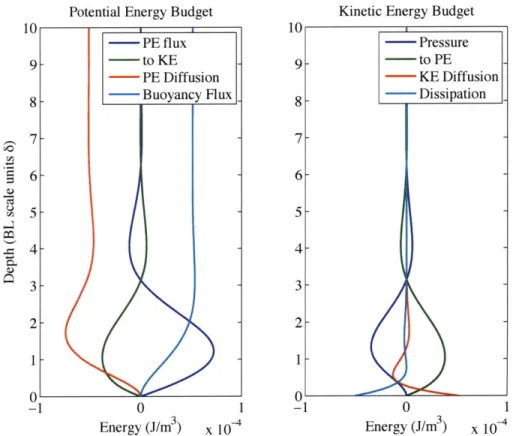
So far, this describes a local energy balance. The way in which the energy terms balance one another at different heights above the bottom is shown in Figure 4. Close to the bottom, where the velocity shear is largest, the primary balance is between viscous dissipation and the diffusion of kinetic energy, while the mass fluxes in the potential energy budget must go to zero at the bottom. Far from the boundary, those mass fluxes are the only non-zero terms. The green lines, equal and opposite in the two subplots, show the net conversion of potential energy to kinetic. To find the net effect of the various terms, consider an integral budget over a fixed volume, taken without loss of generality to be given by ( E (0, (1), and q E (0, 77f). We take
the limit as 77f -± oc to ensure that all boundary layer effects are captured
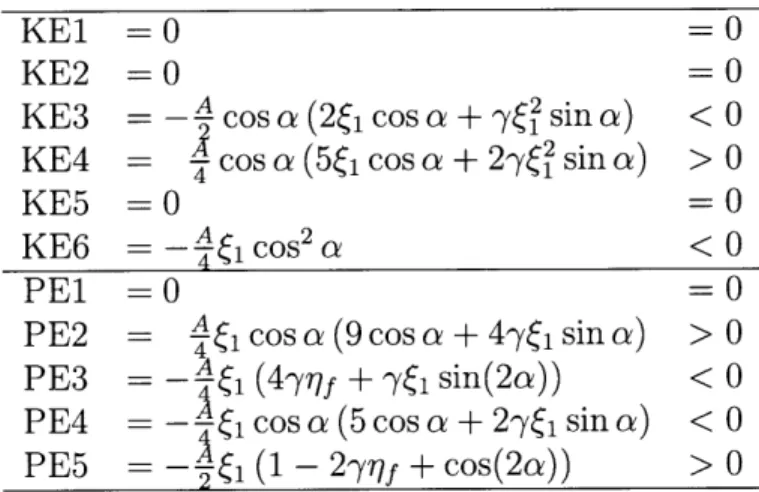
by our budget. This volume is similar to the box shown as a dashed line in Figure 6, but with a constant bottom slope. The results of the integral budget are in Table 3.
What we can see is that the energy in the boundary layer is generated as potential energy, then converted to kinetic energy, then dissipated. The only
KE1 KE2 KE3 KE4 KE5 KE6 PE1 PE2 PE3 PE4 PE5
Potential Energy Budget 6- -6-5- 5-4- -4-3- -3-2 2-1 -- 1
-o
0 -1 0 1 -1 0 1 Energy (J/m 3) x 104 Energy (J/m 3) X 10,4Figure 4: All terms contributing to the kinetic and potential energy budgets of a diffusive boundary layer over a sloping bottom. The vertical coordinate has units of the boundary layer thickness 6 = I defined in equation (10). The top of the boundary layer is defined as the zero-crossing of the boundary layer velocity, at r-y =gr. The terms and their physical interpretations are given in in Table 2. Note that the source of energy that drives the boundary layer is the buoyancy flux, which generates potential energy. This potential energy is transformed into kinetic energy, and the conversion is shown as the equal and opposite green lines in both plots. The parameter values used are typical to the best of our knowledge of submarine canyons: v, rK = 10-3 m2s1 ;
N2 =
10- S2 ; a = 0.02 rad. The integral contribution of each term to the
total energy budget is given in Table 3.
... .. ... ..... _ .- ._ ._ ._ -... ... ... :::: :: : :: :, _:_::- ... .... .... .... ....... ....... .... ... ... _.._ ... .... . ... .. .... .. .. .... .... .... .. ... .. .. ... .. .. .. .... ... ...
KE1 =0 =0
KE2 =0 =0
KE3 = - cos a (2(1 cos a + y( sin a) < 0 KE4 = cos a (5(1 cos a
+
2y sin a) > 0KE5 =0 =0
KE6 = - 1 cos 2 a < 0
PE1 =0 =0
PE2 = (1 cos a (9 cos a
+
4y1 sin a) > 0 PE3 = (1 (47y; + 71 sin(2a)) < 0PE4 = - 1cosa(5cosa+2yx1sina) <0
PE5 = - (1 (1 - 2 y7qf + cos(2a)) > 0
Table 3: Total contribution of various terms in the Boussinesq energy bud-get to the steady, constant slope diffusive boundary layer. Each term was obtained by integrating the general Boussinesq energy budget from ( = 0 to (1 and from 7 = 0 to r/f, then taking the limit as qf -+ oc. Note that there is no loss of generality associated with these limits of integration; they represent any section of the slope. The final column gives the sign of each term, indicating whether the associated physical process is a source or a sink of energy. The coefficient A = poN2 r,/-y.
kinetic energy source term is KE4, the conversion term from potential energy. Dissipation (term KE6) is a net energy sink, as is the pressure term (KE3). Pressure work is constantly being done on the flow as it moves through the stratified ambient.
The source of the potential energy is the mixing of density upward (or buoyancy downward, if you prefer), which happens throughout the fluid through the diffusivity ,. However, this generation of potential energy from the mixing up of dense fluid manifests itself in two ways: directly through the buoyancy flux term (PE5) and indirectly as an advective flux of PE (PE2). This advective flux term (PE2) expresses the tendency of the boundary layer flow to restratify the boundary region. In a closed system, an advective term could not be considered a source term; advection just moves energy around, but does not add to it or remove it from the system. However, this is an open system, which posits the existence of an infinite reservoir of stratified fluid, maintaining a fixed N2 everywhere in the domain outside the boundary
layer. In order to maintain this stratification, mass, and so potential energy, is constantly being fluxed from the infinite reservoir into the boundary layer
region. In steady state, this PE flux is exactly balanced by the diffusion of density, and the isopycnals remain stationary.
It is possible to calculate the efficiency F of the conversion between po-tential and kinetic energy directly using the integral forms of the terms in the energy equations, given in Table 3:
PE - KE PE4 5 cos2 a+ 21-y sinacos a
Total PE Sources PE2
+
PE5 47 - 5 cos2 a+
4 1y sin a cos a (18) For the parameter values shown in Figure 4, which are within oceanographic range, F ~ 0.5. F approaches a maximum value of 0.66 as a -± 0. This conversion efficiency only concerns the volume within the boundary layer, that is within a distance of 7r6 of the boundary. It is necessary to restrict the volume considered, because an infinite domain will generate an infinite amount of potential energy through the buoyancy flux in term PE5.It is here that the utility of the diffusion-driven flow model for under-standing canyon flows starts to become clear. When speculating about the upslope flows observed in the BBTRE, Thurnherr, et al. (2005), posit that mixing both drives and results from the flow, making it difficult to understand the energy source of the system. Using the energy budget just constructed, however, we can specify precisely what the energy flux into the system is, and where it comes from: buoyancy flux from diffusion of mass generates potential energy (term PE5); some of this potential energy is converted into kinetic energy (terms PE4 and KE4) and some of it diffuses away (term PE3). The velocity resulting from the pressure gradient tends to restratify the boundary layer, introducing an advective flux of potential energy (term PE2), while some of the kinetic energy is dissipated as heat or internal en-ergy (term KE6). The subsequent dynamics of the system now have a clear energy source: the buoyancy flux in term PE5.
Let's consider what is actually happening when we say that the buoyancy flux in term PE5 is driving the flow in the boundary layer. Outside of the boundary layer, where the velocities in our idealized system to go zero, the only non-zero terms in the momentum or energy equations come from the constant diffusion of density in the stratified far field. There is a continuous flux of density up (or of buoyancy down, if you prefer) in the far field, given
by KN2po. If N2 and K are constant, this flux is also constant, and it does not affect the stratification. However, approaching the bottom boundary, there will inevitably be a flux-divergence. Density will continue to mix upward, but at the boundary there is no mass coming from below to replace it. The upslope, and so upward, advective mass flux in the boundary layer replaces the mass being mixed up by diffusion in the interior. The way that the buoyancy flux in the interior controls the flow in the boundary layer can be seen very clearly if you integrate the density equation (2) from the boundary:
/ (u +i>' V (rVp)) dq (19)
Unlike in the derivation leading to the velocity field in equation (9), here it is not necessary to assume that the diffusivity K is constant. Divide through by
,
a constant depending on N2, to find total volume flux in the boundary layer is given by:00
Q
= ud7 = 9 . (rVp) = ro cot a (20)Jo poN2 sin a
The total volume flux
Q
in the boundary layer is determined by the diffusivity far from the boundary Kic. This is a general statement of the boundary layer flux, and it is independent of the structure of the diffusivity r. If we introduce a bottom-intensified mixing r(7), it might change the velocity structure of the boundary layer flow, it cannot change the total volume flux in it. However, it should be noted that for this argument to be truly satisfying, it should be the mass flux and not the volume flux that is exclusively determined by roc. The mass flux, which is derived in the next section, depends on Q and -y, the boundary layer thickness scale. -y is expected to vary depending on the structure of K(,q), for example if K is intensified close to the boundary. It is not solely determined by the topography and Ko, asQ
is. This may be an artifact of the Boussinesq approximation, under which we only consider some variations in density, but it does not appear to be possible to derive a closed-form solution for the velocity field without making this approximation. It would be possible to test numerically if the mass flux M varies when slope-normal variations in diffusivity are introduced, but that is beyond the scopeof the current study.
Phillips, et al., attempted to model bottom-intensified mixing K(r/) in the laboratory by oscillating a rough mat over a sloping bottom (1986). They found that bottom intensified mixing led to a recirculation, with a down-slope flow immediately overlying the up-down-slope boundary layer flow seen in the laminar case. Since the net boundary layer flux is constrained by the far-field buoyancy flux, this picture of a strong up-slope flow with its transport mostly cancelled by a somewhat weaker down-slope flow makes a great deal of intuitive sense.
It is difficult to compare the predicted flux to that observed in the 22'S canyon because almost nothing is known about the cross-canyon structure of the flow, and the current meter mooring had instruments deployed at only three depths in the bottom 1000 m of the water column. However, we can make a rough comparison of theory and observations, choosing a value of the diffu-sivity representative of either measurements in the interior of the canyon or the background level of mixing observed in the ocean thermocline:
Kcanyon 5 x 10--3 ms-2
Kthermocline 5 x 10 5m S-2
For a single typical ridge-flank canyon that is 30 km across, these yield along-slope fluxes:
Qcanyon 1.5 x 10⁵ m3 S-1 = .15 Sv
Qthermocline 1.5 x 10³
m3 S-1
A relevant comparison for these numbers is the total amount of upwelling required to close the global overturning circulation, estimated to be 25-30 Sverdrups (Wunsch and Ferrari, 2004), which matches the rate of deep wa-ter formation. There are on the order of 1000 canyons like this one in the global ocean, with bottom slopes in the range of 10-2 - 10-3, giving a total upwelling from 'canyon of 1 Sv, and one hundredth of that for Kthermocline.
This suggests that the advective upwelling flux from diffusion-driven flow in Mid-Atlantic Ridge canyons is not sufficient to close the overturning
circula-tion. However, the strong currents close to the bottom boundary may cause additional upwelling of mass through diapycnal mixing.
Qcanyon is consistent with a flow of order 1 cm s- over a depth of 500 m,
which is roughly what the current meter observed, while Qthermocline suggests a velocity much smaller than what was measured. One possible explanation for why the near-field diffusivity better matches the observations than ,oo
is that there may be a return flow down the canyon almost as large as the up-slope flow measured by the current meter, analogous to the down-slope recirculation of the type Phillips, et al., described in the laboratory. Such a flow could be passing unobserved in the gap of over 500 m between the two deepest sets of current meters (at about 4900m and 4650m depth) and the third current meter depth above the bottom (at about 4000m depth) on the BBTRE mooring. St. Laurent, et al. (2001), predicted just such a recirculation used the BBTRE hydrography and microstructure data, prior to the recovery of the current meter data. Unfortunately, it is unclear how reliable their estimate of the mean flow field is, as they predicted peak ve-locities an order of magnitude slower than those seen by the current meter. The diffusive boundary layer can also be compared to the observations in terms of the boundary layer thickness. Using the ranges of parameter values measured in the BBTRE, including scanyon, the theory suggest a scale thick-ness of 6 ~ 90-250 m, giving a boundary layer thickthick-ness of 67r ~ 300-800 m, consistent with what is observed in the slope of the isopycnals (Ledwell et al., 2000). Kcanyon provides a closer match between theory and observations, both in terms of boundary layer flux and boundary layer thickness.
The far-field constraint on the boundary layer given in equation (20) presents some problems when we shift our gaze from a laminar flow on a laboratory scale to turbulent, high Reynolds number flows like those in the ocean. We know that the mixing in the ocean is strongly bottom-intensified; we have direct observations of this, and the boundary-driven and topographic mixing mechanisms we're discussing are by their nature strongest near the boundary. Therefore, if we make a direct analogy between the two contexts, using the diffusivity measured in the canyons as a constant Keddy substituted
in for the molecular K in our boundary layer solution in equation (9), we
rates in the oceanographic far field mean less vertical density flux far from the boundary and therefore less density flux divergence near the boundary that the boundary layer mass flux must compensate for. It is important to recognize this shortcoming of the analogy between laminar and turbulent diffusive boundary layers. However, in the interests of simplifying the mech-anism, we do not deal with this shortcoming in the current study. Instead, both the theory and numerics use an enhanced but constant K to describe mixing processes, and the value of seddy is chosen to best match our limited observations.
We have spent some time discussing the energetics of a diffusion-driven flow. However, this boundary layer still lacks some key oceanographically relevant features. The slope-normal velocity is zero, so the boundary flow does not interact with the fluid in the far-field, and any enhanced mixing in the boundary layer cannot affect the stratification of the far field in an open domain. As a result, this boundary layer cannot be expected to play an important dynamical role in the larger circulation. To provide a mechanism for the coupling of the boundary layer to the bulk of the fluid, in the next section we will discuss the behavior of diffusive boundary layers over varying slopes.
3
Theory: Behavior of Boundary Layer over
Varying Topography
Previous studies of diffusion-driven flow (Phillips, 1970; Garrett et al., 1993; Peacock et al., 2004; Thorpe, 1987) have restricted their attention to bound-ary layers over constant slopes, and usually constant mixing coefficients K, v.
However, the slope of the ocean bottom varies at all scales, with potentially interesting consequences. The foremost among these consequences arises from the slope dependence of the flux in the boundary layer. As shown in equation (20), the volume flux is proportional to cot a. Varying topography means that the flux in the boundary layer also varies along-slope, which means that fluid must be exiting or entering the boundary layer at changes in slope. Like an Ekman layer, where variations in stress force a vertical
velocity, here variations in slope force a vertical velocity.
The first step in relaxing the restriction to constant slopes is to think about boundary layers over 'slowly varying' slopes. A slope can be thought to vary slowly if the slope is locally constant, that is if slope varies so slowly that the constant slope boundary layer solution can be used at each point along it. The criterion for slow variations is traditionally taken to be 6 << R, where
R is the radius of curvature of the slope. The bottom boundary of the
Mid-Atlantic Ridge does not vary slowly with respect to the turbulent boundary layer, as the high-resolution topographic measurements of the canyon depth shown in Figure 1; the bottom slope may be slowly varying with respect to the laminar boundary layer. In the slowly varying case, we can use the continuity equation to solve for the vertical velocity:
Bu 8w
-- + = 0 (21)
Taking the solution for a constant slope given in equation (9), and allowing the slope angle to vary as a(), we find:
(, I) =
j
0 (2,y cot ae-7 sin -y?) d7 (22)We can find the constant of integration by applying a no normal flow bound-ary condition: t = 0 at rj = 0. All of the terms in to( , TI) are proportional
to e-7 ' except that constant of integration, so outside the boundary layer, it is the only part of the slope-normal velocity that remains. It is given by:
Ba 1
= 'g)
= 89( sin s-n2a 2a (23)
The slope-normal velocity is proportional to the rate of change of the slope angle, so it is proportional to the second derivative or curvature of the topog-raphy. In the small-angle limit relevant to the ocean, we can convert 0" into a vertical velocity:
W () =- h (24)
W, is expressed in terms of a topographic height h(x), where a = h'(x). The
Vertical velocity W00 0.02 0.015 0.01 0.005-0 0 1 2 3 4 5
Figure 5: Vertical velocity induced over slowly varying topography. The model topography is shown in the lower panel, and the induced vertical velocity in the upper panel. Note the relationship of the induced vertical velocity to the curvature of the topography, as shown in equation (24).
this model, as you move toward the origin, the curvature of the topography increases, and so the velocity induced by the boundary layer increases. This vertical velocity, which exchanges fluid between the boundary layer and the far field has the potential to affect both the stratification and the circulation of the far field fluid. The effect on stratification is separate from the mod-ification of stratmod-ification by the broadly distributed downwelling needed to balance the up-slope volume transport in the boundary layer (Woods, 1991).
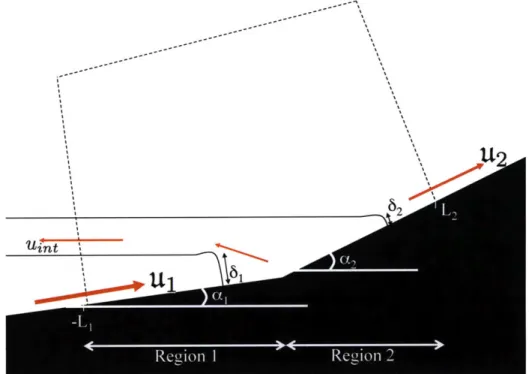
Consider a topography consisting of two regions of constant slope with slope angles ai and a2, as illustrated in Figure 6. Define ( = 0 as the location
of the change in slope. If ai < a2, the volume flux in slope Region 1 will be larger than that in slope Region 2. Near the intersection of the two regions, we expect some of the boundary layer flux in Region 1 to be forced out of the boundary layer. This fluid will form an intrusion at its depth of neutral buoyancy. The mass flux in the intrusion will depend on the mass flux in the
Uin
Figure 6: Schematic of dynamics of a diffusion-driven boundary layer over topography with two slopes. In Region 1, the slope has angle ai, forcing a velocity u1. Similarly, in Region 2, the slope has angle a2, forcing a velocity
u2. Since the total flux in Region 1 is larger than in Region 2, an intrusion
is formed as fluid is forced out of the boundary layer, shown by ui. The dashed line shows a hypothetical box that we can use to make mass, volume, and energy budgets.
boundary layers. The mass flux in a constant slope boundary layer is: oo
M = j pu dr/ (25)
Assuming a constant stratification, N, and using the density field given in equation (11), and velocity field given in equation (9), this gives a mass flux:
(5
N2N
M=PoQ 1- -- 2 cosa - -2sin a (26)
4 g7 g
Let's consider a mass budget for an imaginary box containing the break in the slope. The box is bounded by the bottom boundary, slope-normal lines at -L 1 and L2, and a horizontal line far enough away from the boundary to be unaffected by boundary layer processes. A box of this type is shown in Figure 6. The total mass balance is now given by:
Mi + M2 + MT + Mint = 0 (27)
Mi and M2 are the advective fluxes in the boundary layer on the left and right edges of the box from the bottom boundary layers in Regions 1 and 2.
MT is the diffusive flux across the upper boundary and Mint is mass flux in
the intrusion. We know what the first three terms are:
( 5 N2 N2
M1 = poQ 1I - cos ai + -L
1 sin ai
4g71 g
(
SN2NT
2M2 = -poQ2 1 - -- cosa 2 - -- L2sin a2
4 972 9
MT -Op (LI+L2) = po (LI+L 2)
Bz g
The mass flux in the intrusion can be inferred as the residual of the above three mass fluxes:
5N2 co5N2 x (8
Mint = PoQ2 1 - cos a2 PoQ1 1 - cos ai (28)
4972
4
g yThe mass that is diffused through the top of the box is balanced by the stratification dependence of the boundary layer fluxes. The mass flux can be nondimensionalized as M/po,, leaving N2
/gy
as the only other nondimen-sional parameter in the budget.It is also possible to predict the average density of the fluid in the intru-sion, Pint. It is given by:
Mint M1+ M2 + MT 5 N2
Q161Ccos
ai+
Q262 cos a2Qint Qi + Q2 4 9 Q1 + Q2
(29) Without loss of generality, we choose po to be the bottom density at the location of the change in slope. We can see immediately that Pint
<
P0,because the term indicated with an underbrace is always greater than zero if ai < a2. We can similarly bound Pint as always greater than the density at
the top of the boundary layer, where the top is taken to be r7 = -r, the zero-crossing of the along-slope velocity. The density at the top of the boundary layer is po(1 -- N2,6), and if one compares this to the size of Pint given in
9 COS a
equation (29), one finds after some rearranging that:
-Fo 5 7r6 5
Q1
- 61cosai) > Q2 s - -62cosa2 (30)(cosa 4 (COSa 4
Because the term in the parentheses is always positive, this inequality is always true for ai < a2, and Pint is bound by the densities spanned by the
thickness of the boundary layer.
Now that we have developed some expectations about the behavior of the bottom boundary layers in this geometry, we can test them numerically, as described in the next section.
4
Numerical Experiments
To test the ideas proposed in the previous section, we performed a series of numerical experiments using the Regional Ocean Modeling System (ROMS), developed by Shchepetkin and McWilliams (Shchepetkin and McWilliams,
2005). ROMS is a fully non-linear hydrostatic primitive equation model. It has a free surface, and so calculates the barotropic and baroclinic modes separately. ROMS uses topography-following coordinates, also known as o-coordinates. It was primarily for this reason that ROMS was selected, as o-coordinates can represent smooth, instead of step-like, topography and so more effectively represent bottom boundary layers. Additionally, ROMS is designed for realistic ocean modeling, so it will be easier to move to more oceanographically relevant configuratons as the research progresses. This includes the capability to run eddy-resolving models.
The numerical experiments presented here use a topography similar to that shown in Figure 6, consisting of two constant slope sections with slopes a1 and a2 with a smooth variation between them. In total, there were
60-100 vertical levels, depending on the slope angle and overall water depth in each model run. The vertical resolution increased monotonically as one approached the bottom boundary, with vertical grid spacing varying from about 0.5 m at the bottom to about 15 m at the top. For comparison, the boundary layer scale height 6 ranged from 6-40 m. We found that the free surface had a substantial effect even when the water depth was 10 x 6, so all the computations took 35 x 6 as their minimum depth.
Mixing in the model was represented as an explicitly specified eddy dif-fusivity K and eddy viscosity v. The eddy Prandtl number -4 = was as-sumed to be one. Using eddy mixing coefficients in this simple-minded way is physically problematic because it presupposes a source of energy to stir up turbulent eddies. It is also concerning because, as mentioned in Section 2, the eddy mixing coefficients in the ocean decline as one moves away from the boundary, and this is expected to have an effect on boundary layer dynam-ics. In spite of these concerns, however, using eddy mixing coefficients based on Kcanyon provides a good starting point-numerically straight-forward and physically and observationally plausible. Unfortunately, ROMS does not per-mit the user to precisely impose a no-slip bottom boundary condition, so the no-slip boundary condition was approximated using a strongly enhanced lin-ear bottom drag. The results were insensitive to the specific value of the coefficient of drag. No surface stress was applied.
model a boundary layer with no along-slope variation, we would like to have a domain that is infinitely large in the along-slope direction. However, be-cause the bottom boundary has a slope and there is an overall stratification, it was not possible to use periodic boundary conditions. Ultimately, the lateral boundary conditions that were most successful at reproducing the theoretical solution for a constant slope involved specifying the barotropic momentum at the inflowing boundary and specifying the full, depth-dependent, baro-clinic momentum at the outflowing boundary. In order to match the flow to this outgoing boundary condition, a long uninterrupted section of constant slope topography was inserted between the study region and the outflowing boundary. This section was typically 5000 m or longer, 2-10 times the length scale A for boundary layer development given in equation (13). In an effort to further reduce the effects of the lateral boundaries, the lateral grid spacing was 'telescoped,' increasing exponentially away from the test section. The lateral grid spacing varied from about 65 m to over 900 m.
Radiation conditions were used for the free surface and for the active trac-ers, namely heat and salt. Though the model included both active tractrac-ers, only temperature was used for stratification, and salinity was taken as con-stant throughout the domain. The stratification was not enforced at either boundary, but rather specified as an initial condition. For the parameter regions explored, the boundary layer was able to reach a steady state be-fore any significant changes had occurred in the stratification. There was no variation in the across-slope direction.
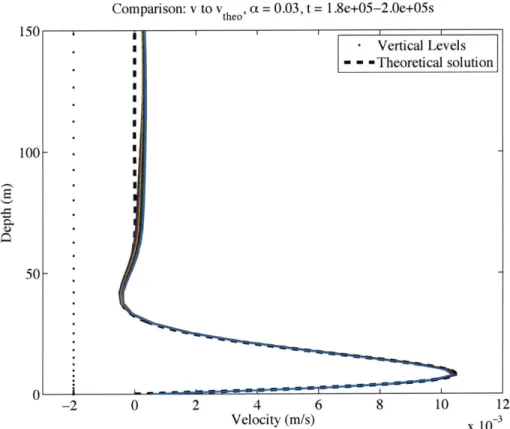
The velocity and density fields produced by the model over a constant slope are shown in Figures 7, 8 and 9. Both the boundary layer velocity and density fields agree with their predicted values to within 2% in the bound-ary layer. The theory-model mismatch is somewhat larger in the far field, but that is expected because the theory predicts zero anomalies outside the boundary layer. The boundary layer develops over the timescale T preditcted
in equation (12), and maintains a robust steady state.
Once the efficacy of the model was established for a constant slope, a series of fifteen runs were performed in the two-slope configuration, spanning a range of slope angles from a = 0.001 to a = 0.1. These runs are summarized
Comparison: v to vtheo, a = 0.03, t = 1.8e+05-2.0e+05s 150 1 1 - Vertical Levels -- -Theoretical solution - I . I 100 - 50-01 -2 0 2 4 6 8 10 12 Velocity (m/s) X
10-Figure 7: Diffusion Driven Flow over a Constant Slope. The dashed black line indicates the predicted theoretical solution for along-slope velocity, while the colored lines show profiles taken from the numerical solution over the course of several hours. These profiles were taken after more than ten times the adjustment timescale of the boundary layer had elapsed, when the model was at a steady state. The dots on the left side of the plot indicate height of the vertical levels of the grid. The bottom slopes up to the right of the figure.
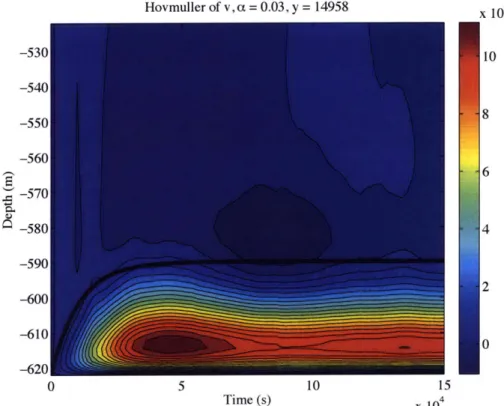
Hovmuller of v, a = 0.03, y = 14958 x 10 3 -530 10 -540 -550 8 -560 6 -570 -580 4 -590 2 -600 -610 0 -620 0 5 10 15 Time (s) X 10,
Figure 8: Hovmuller diagram, showing the development of the boundary layer as a function of time. The horizontal axis is time, while the colors show the along-slope velocity. The heavy black line shows the expected growth of the boundary layer thickness, using the time scale derived in equation (12).
Denisty Field, a = 0.026, t = 3.0e+05 -1050 2. 28.4 -1100 28.35 28.3 -1150 2. -28.25 1200 28.2 -1250 28.15 -1300 - 28.1 28.05 3000 3500 4000 4500 5000 5500 6000 6500 7000 7500 Distance (m)
Figure 9: Density field in units of o- = p - 1000 kg m-3. As expected, isopycnals are deflected downward to intersect the slope at a right angle. The density field matches theoretical predictions to within 2%.
-1000 -1050 =-1100 -1150 1 cm s-1 -1200 7-4 8500 9000 9500 10000 10500 11000 Distance (m)
Figure 10: Broken Slope, horizontal velocity section. In addition to the arrows, the background color indicates the horizontal velocity. Note the larger velocities to the left of the change in slope angle, and the counterflowing
intrusion flowing left from the change in slope angle.
be not oceanographically relevant. All of the numerical experiments had the basic dynamics described in the previous section, with an inflowing boundary layer of greater mass and volume flux than the outflowing boundary layer, leading to an intrusion of fluid into the far-field. The velocity field of a typical run showing all these features is shown in Figure 10.
The velocity-weighted average densities of the inflowing and outflowing boundary layers are compared to theory in Figure 11. These were calculated by dividing the mass flux by the volume flux in each boundary layer. All the densities are shown relative to po, which is defined as the bottom density at the change in topographic slope. Again, the agreement is generally satisfac-tory, though the inflowing boundary layer has a systematically higher density in the numerics than the theory would predict, with a discrepancy of approx-imately 10' kg m-3 . This may be a result of the low density anomaly from the intrusion that overlies the boundary layer in Region 1, seen in Figure 12. This anomaly reduces the vertical density gradient, so decreases density
Average Density in Boundary Layers 'E -0.1 - --0.3 4 --..--
P2~-0
-05--0.4 ---- P I(theo)-po p2(theo)-p -0.6 ' ' 3 4 5 6 7 8 9 10 11 12 13 14 15 16 Run NumberFigure 11: Average density of bottom boundary layers, comparing theory to numerics. The blue lines show the numerics (solid) and theory (dashed) for the average density in the boundary layer in region 1, while the red lines show the same comparison for the boundary layer in region 2. The inflowing (left) boundary layer density is systematically higher than predicted, possibly as a result of the low density anomaly of the fluid intrusion that overlies it.