COFs Meet Graphene Nanoribbons
Patrick Walter Fritz
1and Ali Coskun
1,*
2D covalent organic frameworks (COFs) have received considerable
attention because of their crystallinity, permanent porosity, and
tunability, yet they exhibit low in-plane conductivity. In this issue
of
Chem, Fischer and co-workers report an approach for growing
2D COF thin films featuring high in-plane conductivity for potential
use in organic electronics.
Chemists have been driven to continu-ously adapt and alter experimental pro-tocols in order to overcome challenges and achieve the ultimate goal: total
control over a chemical reaction.
Whereas control can be considered simply as anticipating the outcome of a reaction on the basis of the reactivity and structure of the reactants, these days control over a chemical reaction also refers to accurately predicting the
structure-property relationships of
target materials on the basis of pre-cisely tuned synthetic procedures. In fact, achieving total control has proved to be an elusive feat for chemists, and this was nicely highlighted in a book about R. Hoffman and his view on the
philosophy, art, and science of
chemistry:
Organic chemists are masterful at exercising control in zero
dimen-sions. . One subculture of
organic chemists has learned to exercise control in one dimen-sion. These are polymer
chem-ists, the chain builders.. But in
two or three dimensions, it’s a
synthetic wasteland.1
Especially in organic materials science— a field that is concerned with designing new materials for cutting-edge technol-ogies such as organic light-emitting di-odes (OLEDs), solar cells, and
batte-ries—complete control over the
morphology, structure, and chemical
nature of a material is crucial for estab-lishing a structure-property relationship. Although the first crystalline ‘‘organic’’
2D material—graphene—was first
discovered in 1962 with an electron
mi-croscope,2 it wasn’t until 2004 that it
was isolated from graphite via the
‘‘Scotch tape method.’’3Graphene is a
2D single-atom-thick hexagonal lattice
of sp2-bonded carbon atoms and
fea-tures highp-surface area, high electrical
and thermal conductivity, and
mechani-cal stability. Subsequently, several
studies have focused on the develop-ment of bottom-up synthetic strategies for the preparation of graphene on various surfaces and of graphene-derived materials ranging from gra-phene nanoribbons to gragra-phene nano-dots, endowing the resulting materials with new structural features. Despite the significant advances in this area, most preparations of these materials are based on sophisticated processes (such as chemical vapor deposition) or require multistep syntheses. A break-through in the area of 2D materials was made with the bottom-up synthesis of crystalline 2D materials named covalent organic frameworks (COFs), which were
first reported by Yaghi and co-workers4
in 2005, thus introducing a highly effec-tive and modular strategy for accessing this exciting class of 2D materials. The formation of COFs involves reversible dynamic covalent-bond formation un-der solvothermal conditions to induce crystallinity to the resulting materials.
COFs exhibited many of the intriguing physical properties previously found only in graphene—a layered crystalline
structure based on p-p stacking, high
surface area, and thermal stability. Notably, the nature of organic linkers used in the synthesis of COFs dictates the property and function of the result-ing material, an important advantage over other 2D materials. To date, a plethora of new COFs based on a variety of different synthetic strategies, cova-lent linkages, and dimensionality have been reported, and each affects the properties of the resulting COF in a very specific way. Because of the modu-larity and crystallinity of COFs, they have already found applications in mem-branes, heterogeneous catalysis, gas storage and sequestration, adsorbents, battery materials, OLEDs, and photoca-talytic water splitting. Whereas COFs feature a multitude of sought-after properties, especially in the field of organic electronics, an inherent prob-lem prevails: the charge-carrier
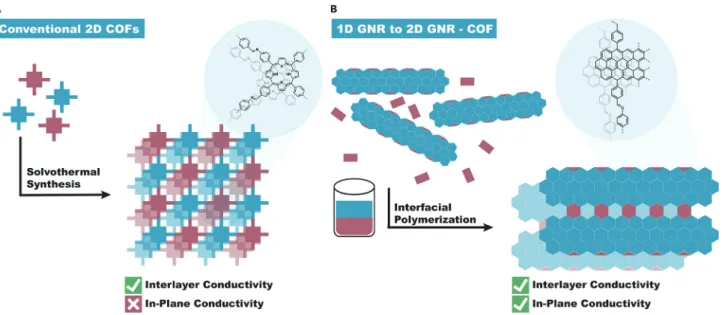
trans-port in COFs mainly occurs (Figure 1A)
by an interlayer hopping mechanism rather than in plane as a result of the types of linkages (e.g., imine, imide, and boroxine), giving rise to semicon-ductors with large band gaps, which are undesirable for advanced electronic
applications.5,6
Besides the ‘‘conventional’’ approach
toward COF synthesis—designing
small organic monomers of suitable functionality and polymerizing them un-der specific conditions—more recent publications have focused on the possi-bility of using functionalized 1D macro-molecular building blocks and their post-polymerization to form 2D COFs. Yaghi and co-workers recently demon-strated this approach by preparing 1D
1Department of Chemistry, University of Fribourg,
Chemin de Musee 9, Fribourg 1700, Switzerland *Correspondence:[email protected]
1
http://doc.rero.ch
Published in "Chem 6(5): 1046–1048, 2020"
which should be cited to refer to this work.
ribbons having unreacted, frustrated amine functional groups on the back-bone and linking them by reacting them with aldehydes or anhydrides in order to obtain imine- or imide-linked
2D COFs, respectively.7
In this issue of Chem, Fischer and
co-workers report the efficient growth of a 2D COF film from highly conjugated macromolecular building blocks, such
as graphene nanoribbons (GNRs),
through interfacial polymerization (
Fig-ure 1B).8 GNRs, which are essentially small strips of graphene, can be tuned through modification of their length, width, dopants, edge modification, or
functional groups, thus rendering
them interesting building blocks for COF synthesis. To achieve these pre-cise structures, however, a bottom-up synthetic approach based on a multi-step organic synthesis involving several cyclization reactions is usually
em-ployed.9 Conventionally, such GNRs
do not feature reactive functional groups, which are necessary for linking them together to form 2D materials. Hence, the authors used an acetal
pro-tected precursor in order to perform the Diels-Alder cycloaddition polymeri-zation and subsequent cyclodehydro-genation reaction to form the GNR before deprotecting in the final step,
resulting in aldehyde-functionalized
GNRs (CHO-GNR). In order to convert a highly conductive GNR macromole-cule into a 2D COF, they employed interfacial polymerization—a technique that is often used for preparing large thin films of conductive polymers for
electronic devices—to obtain the
desired polymer as relatively
large-area macroscopic films (>1,000 mm2),
as verified by optical microscopy anal-ysis. However, it should be noted that GNRs cannot be converted into COFs under conventional solvothermal reac-tion condireac-tions, presumably because of their low solubility and affinity to form aggregates. Accordingly, Fischer and co-workers grew the target GNR-COF films via Lewis-acid-catalyzed
interfacial polymerization (Figure 1B).
They prepared two solutions—one taining the reactants and the other con-taining the catalyst—and over the course of several days, a polymer film
formed at the interface; the authors could remove this film simply by dip-ping a suitable substrate into the solu-tion and coating it with the GNR-COF. The choice of reaction solvents enabled the polymerization reaction as well as protection of the amine precursors from oxidation. In order to showcase the enhanced conductivity of
GNR-COFs, the authors prepared an Al2O3
substrate patterned with Pt electrodes, and even without applying a gate bias, they could measure drain currents at a very low source drain bias. To achieve such thin layers of GNR-COF, they em-ployed a liquid-phase exfoliation by ul-trasonicating the GNR-COFs and
cast-ing them onto a Si/SiO2 support.
Subsequent atomic force microscopy measurements revealed that films with a thickness corresponding to bilayers or trilayers were obtained.
In a broader context, the combination of GNRs and COFs provides a first glimpse into the world of highly
conductive 2D materials featuring
structurally tunable mechanical, electri-cal, and optoelectronic properties.
Figure 1. Graphical Representation of the Synthetic Strategies for Conventional 2D COFs and 2D GNR-COF Films
(A) Porphyrin-based COF synthesized under solvothermal conditions. Magnification: imine linkages often employed in COF chemistry result in wide band gaps and low in-plane conductivity.
(B) Synthesis and structure of 2D GNR-COF and illustration of the formation of GNR-COF via interfacial polymerization. Magnification: imine-linked GNRs featuring extended conjugation result in improved conductivity.
2
Moreover, these highly conductive COFs can also find applications as
elec-trode materials in Li-ion batteries10and
in organic photovoltaics, organic elec-tronics, and photocatalysis.
1.Kovacs, J., and Weisberg, M. (2012). Roald Hoffmann on the Philosophy, Art, and Science of Chemistry, First Edition (Oxford University Press).
2.Boehm, H.P., Clauss, A., Fischer, G.O., and Hofmann, U. (1962). Das
Adsorptionsverhalten sehr du¨nner Kohlenstoff-Folien. Z. Anorg. Allg. Chem. 316, 119–127.
3.Novoselov, K.S., Geim, A.K., Morozov, S.V., Jiang, D., Zhang, Y., Dubonos, S.V., Grigorieva, I.V., and Firsov, A.A. (2004).
Electric field effect in atomically thin carbon films. Science306, 666–669.
4.Coˆte´, A.P., Benin, A.I., Ockwig, N.W., O’Keeffe, M., Matzger, A.J., and Yaghi, O.M. (2005). Porous, crystalline, covalent organic frameworks. Science310, 1166–1170.
5.Dogru, M., and Bein, T. (2014). On the road towards electroactive covalent organic frameworks. Chem. Commun.50, 5531–5546. 6.Joshi, T., Chen, C., Li, H., Diercks, C.S., Wang,
G., Waller, P.J., Li, H., Bredas, J.L., Yaghi, O.M., and Crommie, M.F. (2019). Local electronic structure of molecular
heterojunctions in a single-layer 2D covalent organic framework. Adv. Mater.31, e1805941.
7.Nguyen, H.L., Gropp, C., and Yaghi, O.M. (2020). Reticulating 1D ribbons into 2D covalent organic frameworks by imine and
imide linkages. J. Am. Chem. Soc.142, 2771– 2776.
8.Veber, G., Diercks, C.S., Rogers, C., Perkins, W.S., Ciston, J., Lee, K., et al. (2020). Reticular growth of graphene nanoribbon 2D covalent organic frameworks. Chem6, this issue, 1125–1133.
9.Jordan, R.S., Wang, Y., McCurdy, R.D., Yeung, M.T., Marsh, K.L., Khan, S.I., Kaner, R.B., and Rubin, Y. (2016). Synthesis of graphene nanoribbons via the topochemical polymerization and subsequent
aromatization of a diacetylene precursor. Chem1, 78–90.
10.Li, X., Wang, H., Chen, H., Zheng, Q., Zhang, Q., Mao, H., Liu, Y., Cai, S., Sun, B., Dun, C., et al. (2020). Dynamic covalent synthesis of crystalline porous graphitic frameworks. Chem6, 933–944.
3