E
Ennggiinneeeerriinngg SSyysstteem
mss D
Diivviissiioonn
Working Paper Series
ESD-WP-2005-05
B
UILDING
R
EAL
O
PTIONS INTO
P
HYSICAL
S
YSTEMS
WITH
S
TOCHASTIC
M
IXED
-I
NTEGER
P
ROGRAMMING
Tao Wang and Richard de Neufville
Massachusetts Institute of Technology
Engineering Systems Division
[email protected]
Building Real Options into Physical Systems
with Stochastic Mixed-Integer Programming
by
Tao Wang and Richard de Neufville Massachusetts Institute of Technology
Engineering Systems Division Direct correspondence to [email protected]
Prepared for the 8th Real Options Annual International Conference in Montreal, Canada June 2004
Abstract
The problem of building real options into physical systems has three features: real options are not as easily defined as financial options;
path-dependency and interdependencies among projects mean that the standard tools of options analysis tools are insufficient; and
the focus is on identifying the best way to build flexibility into the design – not to value individual options.
This paper suggests a framework for exploring real options in physical systems that especially addresses these two difficulties. This framework has two stages: options identification and options analysis. The options identification stage consists of screening and simulation models that focus attention on a small subset of the possible combination of projects. The options analysis stage uses stochastic mixed-integer programming to manage the path-dependency and interdependency features. This stochastic formulation enables the analyst to include more technical details and develop explicit plans for the execution of projects according to the contingencies that arise. The paper illustrates the approach with a case study of a water resources planning problem, but the framework is generally applicable to a variety of large-scale physical systems.
Keywords: real options, stochastic mixed-integer programming, physical systems, and
Building Real Options into Physical Systems
with Stochastic Mixed-Integer Programming
by
Tao Wang1 and Richard de Neufville2
The future is inherently unknown, but the unknown is not unmanageable. Engineers increasingly recognize the great value of real options in addressing intrinsic uncertainties facing large-scale engineering systems and, more importantly, are learning to manage the uncertainties proactively [de Neufville et al, 2004]. This paper is part of a series of explorations of how to build real options analysis into the physical design of engineering systems. This task requires us to adapt financial real options theory and develop new tools.
Introduction
Powerful and flexible analyses of options can be built on a simple binomial representation of the evolution of the value of an underlying asset. Developed by Cox, Ross, and Rubinstein [1979], this method has been widely adopted, for example by Luenberger [1998], who provides textbook examples to value investment opportunities. In another text, Copeland and Antikarov [2001] show how to use binomial trees to value real projects and indicate that this method provides solutions equal to those of the partial differential equations (PDE) approach, and is easy to use without losing the insights of the PDE model.
Most real options are not well-defined simple options. They can be compound or parallel. Compound options are often options on options, and the interactions between them are significant. For example, the opportunity to take a new product into mass production is an option on the R&D investment, whose value depends on the opportunity to proceed with R&D if the latter is exercised and successful. The methodology for valuing compound options is important for the application of real options to the development and deployment of technologies. Geske [1979] developed approaches to the valuation of
1 Doctoral candidate and research assistant, MIT Engineering Systems Division
compound options. Trigeorgis [1993a and 1993b] focused on the nature of the interactions of real options. The combined value of a collection of real options usually differs from the sum of separate option values. The incremental value of an additional option, in the presence of others, is generally less than its value in isolation, and declines as more options are present.
Parallel options are different options built on the same project, such as the several possible applications or target markets of a new product. Oueslati [1999] for example explored compound and three parallel options in Ford’s investment in fuel cell technology in automotive applications, stationary power, and portable power.
The real options concept has been successfully applied in the energy industry. Siegel, Smith, and Paddock [1987] valued offshore petroleum leases, and provided empirical evidence that options values are better than actual DCF-based bids. Since then, research on real options on energy has been a hot topic. Cortazar and Casassus [1997] suggested a compound option model for evaluating multistage natural resource investments. Goldberg and Read [2000] found that a simple modification to the Black-Scholes model provides better estimates of prices for electricity options. Their modification combines the lognormal distribution with a spike distribution to describe the electricity dynamics. Bodily and Del Buono [2002] examined different models for electricity price dynamics, and proposed a new mean-reverting proportional volatility model.
Stochastic integer programming is the most important tool this paper suggests to deal with the path-dependency problem of real options valuation. Bertsimas and Tsitsiklis [1997] provided a textbook introduction to integer programming. Birge and Louveaux [1997] discussed stochastic programming in detail. Ahmed, King, and Parija [2003] suggested using a scenario tree approach to model uncertainty, developed a multi-stage stochastic integer programming formulation for the problem, and outlined a branch and bound algorithm to solve the problem of capacity expansion under uncertainty.
Real options can be categorized as those that are either “on” or “in” projects (de Neufville, 2002). Real options “on” projects are financial options taken on technical things, treating technology itself as a ‘black box’”. Real options “in” projects are options
created by changing the actual design of the technical system. For example, de Weck et al (2004) evaluated real options “in” satellite communication systems and determined that their use could increase the value of satellite communications systems by 25% or more. These options involve additional positioning rockets and fuel in order to achieve a flexible design that can adjust capacity according to need. In general, real options “in” systems require a deep understanding of technology. Because such knowledge is not readily available among options analysts, there have so far been few analyses of real options “in” projects, despite the important opportunities available in this field.
Besides knowledge of technology, there are more difficulties facing the analysis of real options “in” projects:
1. Financial options are well-defined contracts that are traded and that need to be valued individually. But real options “in” projects are fuzzy, complex, and interdependent: To what extent is there a predetermined exercise price? What is the time to expire? Moreover, it is not obvious the usefulness to value each element that provides flexibility.
2. Real options “in” projects are likely to be path-dependent. For example, the capacity of a thermal power system at some future date may depend on the evolutionary path of electricity use. If the demands on the system have been high in preceding periods, the electric utility may have been forced to expand to meet that need, as it might not have done if the demand had been low. Real options for public services may thus differ fundamentally from stock options, whose current value only depends on the prices at that time. The evolutionary path of a stock price does not matter. Its option value is path-independent. This is not true for many real options.
3. Real options “in” projects are likely to be highly interdependent, compound options. Their interactions need to be studied carefully as they may have major consequences for important decisions about the design of the engineering system. The associated interdependency rapidly increases the complexity and size of the computational burden.
To develop a method for building real options “in” physical projects, the paper offers suggestions for addressing the above difficulties:
1. It proposes to identify candidate real options “in” projects by screening and simulation models. This is important because, in an interdependent system, it may not be obvious where flexibility in the system may be most valuable. The paper focuses on developing the most appropriate designs of flexibility and building up suitable contingency plans for dealing with future uncertainties. 2. To simplify highly complicated path-dependent problem, it divides the decision
time horizon into a small number of periods, then solves the path-dependent problem by a timing model using stochastic mixed-integer programming. This process also deals with compound options difficulty mentioned in point 3 above.
A case of a river basin in China illustrates the central ideas in this paper about real options “in” projects. It involves a set of possible hydropower station sites, reservoir capacities, and installed capacity alternatives. The first phase of analysis uses screening and simulation models to identify a subset of projects (with specified locations, reservoir capacities, and installed capacities) for consideration in the real options analysis. The second phase addresses the options for timing and choice of projects over 30 years given the uncertain development of energy prices, and of course subject to budget constraints and costs. The issue of whether to build any particular project in a certain period can be considered an option. The model for the analysis of these real options readily examines the set of compound options “in” projects. The final products of the analysis include a contingent developing strategy for the river basin development that provides significant improvement in performance (thanks to the use of flexible design and an implementation process that responds to actual situations) and a much improved valuation of the projects important for investors interested in the projects.
Analysis framework
The analysis for the case of water resources planning builds upon standard procedures described by Major and Lenton [1979]. These divide the process into:
a deterministic screening model that identifies the possible elements of the system that seem most desirable;
a simulation model that explores the performance of candidate designs under stochastic loads; and
The process of analysis for real options “in” water resources systems modifies these traditional elements. At a higher level, it divides the analysis into 2 phases as indicated in Figure 1:
options identification, and options analysis.
Screening
Model Simulation Model
Options Identification
Options Analysis
Timing Model
Execute and redesign when new information arrives
Figure 1: Process for Analysis of Real Options “in” Projects
Options identification
For real options “in” projects, the first task is to define the options. This is in contrast with financial options, whose terms (exercise price, expiration day, and type such European, American or Asian) are clearly defined. For financial options, the main task is to value the option and develop a plan for its exercise. For real options “in” projects, it is only possible to analyze the options to show their value and develop a contingency plan for the management of the projects, after the options have been identified. This first task for real options “in” projects is not trivial.
Screening model
The options “in” projects for an engineering system are complex. It is not obvious how to decide their exercise price, expiration day, current price, or even to identify the options themselves. An engineering system involves a great many choices about the date to build, capacity, and location, etc. The question is: which options are most important and justify the resources needed for further study?
To identify significant options “in” projects for further analysis, it is desirable to use a simple screening model. In water resources planning, this is a linear (or non-linear) programming model that optimizes the system assuming steady state, i.e. all projects are built all at once. It does not consider all the complexities of the system; it considers a large numbers of possibilities, screens out most of them, and focuses attention on the promising designs.
In detail, the screening model is a linear (or nonlinear) programming model:
Max:
∑
( − ) j j j j jY c Yβ
( 1 ) s.t. TY≥ ( 2 )t e EY≥ ( 3 )Yj are the design parameters. The objective function ( 1 ) calculates the net benefit, or the difference between the benefits and costs, where βj and cj are the benefit and cost coefficients. Usually we measure benefits in money terms, though sometimes we do so in other measures, e.g. species saved, people employed, etc. Constraints ( 2 ) and ( 3 ) represent technical and economic limits on the engineering systems, respectively.
Any parameter in the formulation could be uncertain. There are economic uncertainties in E, e, βj, or cj and technical uncertainties in T or t. After identifying the key economic uncertainties, we can use them as underlying to build up real options analysis as illustrated in the case example.
To identify the elements of the system that seem most promising for options, we execute a form of sensitivity analysis as follows:
1. run the screening model using a range of values for key underlying uncertain parameters, such as the price of electricity;
2. compare the resulting sets of projects that constitute optimal designs for each set of parameters used; and
3. the design elements that vary across the sets are these that may or may not be good real options;
4. conversely, the design elements that are included for all sets, that are insensitive to uncertainty, do not present interesting real options.
Simulation model
The simulation model tests several candidate designs from runs of the screening model. Its main purpose is to examine, under technical and economic uncertainties, the robustness and reliability of the designs, as well as their expected benefits from the designs. Such extensive testing is hard to do using the screening model. After using the simulation model, we find a most satisfactory configuration with design parameters
) ,..., ,
(Y1 Y2 Yj in preparation for the options analysis.
In standard water resources planning, the simulation model involves many years of simulated stochastic variation of the water flows, generated on the basis of historical records. This process leads to a refinement of the designs identified by the screening model. For the analysis of real options “in” water resources systems, we propose to modify this standard simulation process. Specifically, we will simulate the combined effect of stochastic variation of hydrologic and economic uncertain parameters.
If the time series of the water flow consisted of the seasonal means repeating themselves year after year (no shortages with regard to the design obtained by the screening model) and the price of electricity were not changing, the simulation model should provide the same results as the screening model. But the natural variability of water flow and electricity price will make the result (net benefit) of each run different, and the average net benefit is not going to be the same as the result from the screening model. The simulated results should be lower because the designs are not going to benefit from excess water when water is more than the reservoir can store. Thus occasional high levels of water do not provide compensation for lost revenues by occasional low levels of water. Due to these uncertainties, the economies of scale seemingly apparent under deterministic schemes are reduced.
Options analysis
After identifying the most promising real options “in” projects, designers need a model that enables them to value the set of options and develop a contingency strategy for their exercise. In contrast to standard financial options analysis, more characteristics are
required for the analysis of real options “in” projects, such as technical details and interdependency/path-dependency among options.
This paper proposes a model based on the scenarios established by a binomial lattice. In essence, it proposes a new way to look at the binomial tree, recasting it in the form of a stochastic mixed-integer programming model. The idea is to:
Maximize: binomial tree
Subject to: constraints consisting of 0-1 integer variables representing the exercise of the options (= 0 if not exercised, =1 if exercised)
Appendix I illustrates the use of this model to value binomial lattices. Such formulation is unnecessarily complicated for a simple financial option. But for complex and highly interdependent real options “in” projects, we can specify the relationship of options using the 0-1 integer variable constraints. Without integer programming, a binomial tree for a path-dependent real option “in” projects may be too messy to build. With technical, budget, and real options constraints, a stochastic mixed-integer programming model accounts for highly complex and interdependent issues, and delivers both a valuation of the options and a contingency strategy.
Stochastic mixed-integer programming and real options constraints
This section develops a general formulation for the analysis of real options “in” projects, especially these with path-dependency.
The stochastic mixed-integer programming assumes that the economic uncertain parameters in E, e, βj, or cj in objective function ( 1 ) and constraints ( 2 ) and ( 3 ) evolve as discrete time stochastic processes with a finite probability space. A scenario tree is used to represent the evolution of an uncertain parameter [Ahmed, King, and Parija, 2003]. Figure 2 illustrates the notation. The nodes k in all time stages i constitute the states of the world.
δ
i denotes the set of nodes corresponding to time stage i. The path from the root node 0 at the first stage to a node k is denoted by P(k). Any node k in the last stage n is a terminal node. The path P(k) to a terminal node represents a scenario, a realization over all periods from 1 to the last stage n. The number of terminal nodes Q corresponds to all Q scenarios. Note there is no recombination structure in this treerepresentation (each node except the root has a unique parent node). For example, we will break a binomial tree structure as in Figure 3, where S is the value of the underlying asset, u is up factor, and d is the down factor.
Terminal nodes q = 1 A path P(k ) q = 2 . . . . . . q = Q i = 1 … i = n - 1 i = n 0 k A scenario
Figure 2: Scenario tree
Suu Suu
Su Su
Sud
S rather than S Sud Sdu
Sd Sd
Sdd Sdd
Figure 3: Breaking path-independence of a binomial tree
A joint realization of the problem parameters corresponding to scenario q is denoted by
= q T q 1 q ω ... ω ω ,
where q i
ω is the vector consisting of all the uncertain parameters for time stage i in
scenario q. pq denotes the probability for a scenario q. The real options decision variables corresponding to scenario q is denoted by
= q T q R R ... 1 q R ,
where Riq is the decision on the option at time stage i in scenario q. 0 denotes no exercise and 1 denotes exercise.
At any intermediate stage i, the decision maker cannot distinguish between any scenario passing through the same node and proceeding on to different terminal node, because the state can only be distinguished by information available up to time stage. Consequently, the feasible solution Riqmust satisfy:
2 1 q i q i R R = ∀(q1,q2) through nodek,∀k∈
δ
i,∀i=1,...,nwhere q1 and q2 represent two different scenarios. These constraints are known as
non-anticipativity constraints.
To illustrate the use of the above approach, we apply it to some standard financial options. The formulation is:
Max
(
( 1))
1∑
∑
−⋅∆ ⋅ − =⋅
⋅
⋅
q i T r T i q i q i qE
R
e
p
( 4 ) s.t. E Sq K i q i = − (American call) or q i q i K S E = − (American put) ∀i,q ( 5 )∑
≤ i q i R 1 ∀ q ( 6 ) 2 1 q i q i R R = ∀(q1,q2) through nodek,∀k∈δ
i,∀i=1,...,n ( 7 ) } 1 , 0 { ∈ q i R ∀i,q ( 8 ) where q iS is the value of underlying asset at time stage i in scenario q, K is the exercise price, r is the risk-free interest rate, and ∆T is the time interval between two consecutive stages.
The objective function ( 4 ) is the expected value of the option along all scenarios. Constraint ( 5 ) can be any equations that specify the exercise condition. Constraint ( 6 ) makes sure that any option can only be exercised at most once in any scenario. Constraint ( 7 ) are the non-anticipativity constraints. We call constraints ( 6 ) and ( 7 )
real options constraints.
To illustrate and validate the above formulation, consider an example of an American put option without dividend payment. For this case, unlike similar call options, it may be optimal to exercise before the last period. The variables for this example are S = $20, K = $18, r = 5% per year, σ = 30%, ∆T = 1 year, and time to maturity T = 3 years. Up factor
u = 1.35, down factor d = 0.74. A standard binomial lattice gives the value of the options
as $2.20 as in Table 1.
Now considering the reformulated problem according to equations ( 4 ) to ( 8 ). Solve it using GAMS©, the maximum value of the objective function is also 2.20. The optimal solution of 0-1 variables is shown in Table 2. Since 1 means exercise, the result exactly corresponds to that of the ordinary binomial tree (Table 1). Note there is an exercise in scenarios 7 and 8 that is not at the last time point. This means the formulation can successfully find out early exercise points and define contingency plans for decision makers.
Table 1: Binomial tree for the example American put
Period 1 Period 2 Period 3 Period 4
Stock Price 20.00 27.00 36.44 49.19 Exercise Value -2.00 -9.00 -18.44 -31.19 Hold Value 2.20 0.69 0.00 0.00 Option Value 2.20 0.69 0.00 0.00 Exercise or not? No No No No Stock Price 14.82 20.00 27.00 Exercise Value 3.18 -2.00 -9.00 Hold Value 4.00 1.48 0.00 Option Value 4.00 1.48 0.00 Exercise or not? No No No Stock Price 10.98 14.82 Exercise Value 7.02 3.18 Hold Value 6.15 0.00 Option Value 7.02 3.18
Exercise or not? Yes Yes
Stock Price 8.13
Exercise Value 9.87
Hold Value 0.00
Option Value 9.87
Table 2: Stochastic programming result for the example American put Stock Price Realization Decision
Scenario i = 1 i = 2 i = 3 i = 4 Probability i = 1 i = 2 i = 3 i = 4 q = 1 S Su Suu Suuu 0.132 0 0 0 0 q = 2 S Su Suu Suud 0.127 0 0 0 0 q = 3 S Su Sud Sudu 0.127 0 0 0 0 q = 4 S Su Sud Sudd 0.123 0 0 0 1 q = 5 S Sd Sdu Sduu 0.127 0 0 0 0 q = 6 S Sd Sdu Sdud 0.123 0 0 0 1 q = 7 S Sd Sdd Sddu 0.123 0 0 1 0 q = 8 S Ds Sdd Sddd 0.118 0 0 1 0
Formulation for the real options timing model
The stochastic mixed-integer programming reformulation is much more complicated than a simple binomial lattice. It is like using a missile to hit a mosquito to value ordinary financial options. But such reformulations empower analysis of complex path-dependent real options “in” projects for engineering systems.
Technical constraints in the screening model are modified in the real options timing model. Since the screening and simulation models have identified the configuration of design parameters, these are no longer treated as decision variables. On the other hand, the timing model relaxes the assumption of the screening model that the projects are built together all at once. It decides the possible sequences of the construction of each project in the most satisfactory designs for the actual evolution of the uncertain future.
Yis the most satisfactory configuration of design parameters obtained by the “options identification” stage, it is a vector (Y1,Y2,...,Yj) corresponding to j design parameters.
The real options decision variable corresponding to scenario q is expanded to:
= q ij q i q j q R R R R ... : : ... 1 1 11 q R , q∈{0,1} ij R
q ij
R denotes the decision on whether to build the feature according to jth design parameter for ith time stage in scenario q. The objective function ( 1 ) corresponding to scenario q is denoted by f q(⋅). pqand fq(⋅)are derived from the specific scenario tree based on the appropriate stochastic process for the subject under study. The real options constraints ( 6 ) to ( 7 ) are concisely denoted by φ. Most importantly, the objective function is modified to get the expected value along all scenarios.
The real options timing model formulation is as follows.
Max
∑
⋅ ( ) q q q f p Rq,Y s.t. T ≥t q ij j q i R Y R Y : 1 1 and E ≥e q ij j q i R Y R Y : 1 1 i q, ∀ϕ
∈ q R } 1 , 0 { ∈ q ij R ∀q ,,i jIn short, the formulation has an objective function averaged over all the scenarios, subject to three kinds of constraints: technical, economic, and real options. By specifying the interdependencies by constraints, we can take into account highly complex relationship among projects.
Case study: Development of river-run hydropower stations
The case example concerns the development of a river basin involving decisions to build dams and hydropower stations in China. The developmental objective is mainly hydro-electricity production. Irrigation and other considerations are secondary because the river basin is in a remote and barren place.
Screening model
The screening model identifies initial configurations of design parameters for the river basin development, which are sites, reservoir storage capacity, and installed electricity generation capacity. The objective function is to maximize the net present value (NPV)
from the river basin development projects. The constraints include water continuity, reservoir storage capacity, hydropower production, and budget constraints. See Appendix II for details.
The key uncertain economic parameter here is the price of electricity, which may vary dramatically as China develops economically and moves toward market determination of prices. We should account carefully for this critical uncertain element in planning. If we optimize using expected electricity price, the problem usually leads to economies of scale arguments indicating that bigger is better. Unfortunately, given the uncertain economic elements, in many cases it does not pay to build as big as possible by exploiting economies of scale, since the demand is often insufficient to justify the biggest capacity. It may well be more attractive to build smaller projects with options thinking [Mittal, 2004]. This reality is a prime motive for studying real options in large-scale engineering systems. To identify the options worth investigating due to the uncertainty of electricity price, we run the screening model with different electricity prices ranging around the estimated current price of 0.25 RMB/KwH.
This example screening model involves 3 sites and 2 seasons. According to practice, it is run for a typical year with mean water flows for the dry and wet seasons, implying that all years are the same by setting the initial storage of season 1 equal to the final storage of season 2. (Once the screening model has determined optimal designs of the system, and thus reduced the number of variables, the subsequent simulation and timing models introduce the stochastic elements. This strategy allocates computational effort to where it is most productive.)
This example screening model involves 46 variables and 58 constraints. It contains only the most important considerations, yet has a fair amount of technical details, and shows how complex the interdependencies among real options “in” projects for large-scale engineering systems can be.
The optimization model was written in GAMS©, and the results are as in Table 3. “Optimal value” represents the optimal net benefit calculated by the objective function.
Vs and Hs represent the reservoir storage capacity and the installed electricity generation capacity for site s. Note that for the first site, the design with reservoir storage capacity
of 9600×106 m3 and installed electricity generation capacity of 3600 MW is robust since it is the best choice for any price scheme except when the price is extremely low. For the other two sites, the optimal design depends on the price of electricity. For case 1, no projects are built; for cases 2 and 3, site 3 is screened out. In a real application considering many more sites, there may be a great number of sites entered the screening models and most of them are screened out. Although current electricity price was 0.25 RMB/KwH at the time of the study, we cannot assume that the design that corresponds to this price is optimal, because this screening model does not consider the uncertainty of electricity price. Follow-on analysis is needed.
Table 3: Results from the screening model
Case Electricity Price
(RMB/KwH) H1 (MW) V1 (106m3) H2 (MW) V2 (106m3) H3 (MW) V3 (106m3) Optimal Value (106RMB) 1 0.09 0 0 0 0 0 0 0 2 0.12 3600 9600 1700 25 0 0 367 3 0.15 3600 9600 1700 25 0 0 796 4 0.18 3600 9600 1700 25 1564 6593 853 5 0.22 3600 9600 1700 25 1723 9593 1607 6 0.25 3600 9600 1700 25 1946 12242 2196 7 0.28 3600 9600 1700 25 1966 12500 2796 8 0.31 3600 9600 1700 25 1966 12500 3396 Simulation model
The example simulation model introduces stochastic considerations, both in electricity price and in seasonal flows. In that respect, it uses 60 years of 6-month flows to account for the aspects of over year storage not considered in the screening model. Using the simulation model reveals more aspects of the designs chosen by the screening model, especially the hydrologic reliability. The example simulation model does not look into the hydrologic reliability issue deeply, because its main purpose is to validate the identification of the real options.
The simulation model was constructed using Excel© and Crystal Ball©. All designs from the screening model in Table 3 were tested. The optimal design by the screening model
that corresponds to the current electricity price of 0.25 RMB/KwH is not necessarily the best design after various uncertainties enter the picture.
For cases 5 and 6 (electricity price = 0.22 RMB/KwH and 0.25 RMB/KwH), the simulation results are as Figure 4. Note that the expected NPV in both cases are substantially below those indicated in Table 3 (1138 vs. 1607 for case 5; 1098 vs. 2196 for case 6). As indicated before, this result is not unexpected since higher capacity designs often cannot be fully used (due to lower flows) yet cannot take advantage of higher flows (due to limited capacity). Note also that the lower capacity design (case 5) provides higher expected NPV than the higher capacity design (case 6) that appeared better in the deterministic design. This is a common, but not necessary, result.
The final design chosen is the design for case 5. It was analyzed further using real options “in” projects timing model. Each project in the design is an option. We have the right but not obligation to exercise it; in other words, we can choose whether to build a project at a specific time.
Frequency Chart Mean = 1138 .000 .009 .019 .028 .037 0 23.25 46.5 69.75 93 -1086 441 1969 3496 5024 2,500 Trials 0 Outliers
Forecast: Net Benefits
Figure 4a: Simulation result for electricity price = 0.22 RMB/KwH (case 5)
Frequency Chart Mean = 1098 .000 .008 .016 .024 .032 0 20 40 60 80 -968 417 1801 3185 4569 2,500 Trials 0 Outliers
Forecast: Net Benefits
Real options timing model
After applying the screening and simulation models, the next step is to relax their assumption that all projects are built at once, and study the development process from no project onwards. The key issues in the real options timing model is the order and timing of the construction of the projects, given various constraints.
The example real options timing model assumes that projects can be constructed during 3 time periods of 10 years. The calculation considers a 70-year life for each project.
As a baseline, consider the result of the timing model when the electricity price is deterministic, that is, when we do not consider the real options. (The Use of GAMS© to solve the timing model without real options considerations as described in Appendix III.) The timing model takes into account the transition process that projects, once built, gradually increase the production to full capacity. It recognizes that it takes time to build reservoirs and power plants and to fill up reservoirs. This deferral of benefits over many years has a huge impact on the NPV for large, capital-intensive projects. Thus, projects that appeared good in the screening or simulation model analyses may turn out to be less attractive when timing issues are considered.
The real options timing model incorporates uncertainty in the hydropower benefit coefficient (energy price). It gives a contingency plan in reaction to the actual realization of energy price. In this connection, we would again like to point out the path-dependent feature of this problem. Refer to Figure 3. For example, in the second stage, if electricity price goes up, a project is built; but if it goes down, no project is built. According to the formula for binomial tree, the middle point of the third stage has a price of Sud or Sdu, numerically the same, however, it is different for the following two paths leading into the point because of the hydrological conditions: first path, the price goes up in the second stage, and goes down the third stage with a project changing the water flow; the second path, the price goes down in the second stage, and goes up in the third stage with no project and the natural water flow.
For the example analysis, the movement of electricity price is assumed to follow a geometric Brownian motion (GBM). This is not necessarily the best model for electricity price: a mean-reverting proportional volatility model might improve the quality of analysis
[Bodily and Del Buono, 2002]. However, GBM is sufficient to illustrate the analysis framework and stochastic mixed-integer programming methodology. To use a different stochastic process, we only need to generate an appropriate scenario tree, and the analysis framework remains valid. In this example, we use the volatility of electricity price as
σ
e =6.96%, its current electricity price as 0.25 RMB/KwH, and its drift rate as µ = –0.33% per year [Wang, 2003].Compared to the timing model without real options considerations (Appendix III), the objective of the real options timing model is changed to:
Max
∑∑∑
∑∑ ∑∑
∑
∑∑∑∑
⋅ + − + − − = s q i i q is s s s s q s q i t i j s q i t q is i ist q PT q i q is q js ist q Pi q PVC R H V p R PVO P p PV R f R P p } )] ( ) ( {[ ] ) 1 ( [ 1δ
α
β
β
where∑
+ − = + = i i j j i r PV 10 1 ) 1 ( 10 (1 ) 1∑
= + = 70 31(1 ) 1 j j o r PV ) 1 ( 10 ) 1 ( 1 − + = i i r PVCLikewise, the constraints differ because this formulation adds the real options constraints:
∑
≤ i q is R 1 q s, ∀ 2 1 q is q isR
R
=
∀(q1,q2) through nodek,∀k∈δ
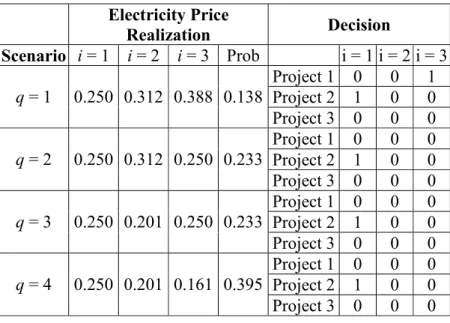
i,∀i=1,...,nUsing GAMS©, we obtain the results for the real options timing model as Table 4. For example, for the first scenario q = 1 that occurs with probability = 0.138: the electricity prices for the first, second, and third 10-year time period (i = 1, 2, and 3) are 0.250, 0.312, and 0.388 RMB/KwH, respectively. The real options decision variables for Project 2 in the first period and Project 1 in the third period are 1’s, and the other 7 real options decision variables are 0’s (we have 9 real options decision variables for each scenario, 3 projects times 3 periods each). Therefore, for scenario 1, the decision is to build Project
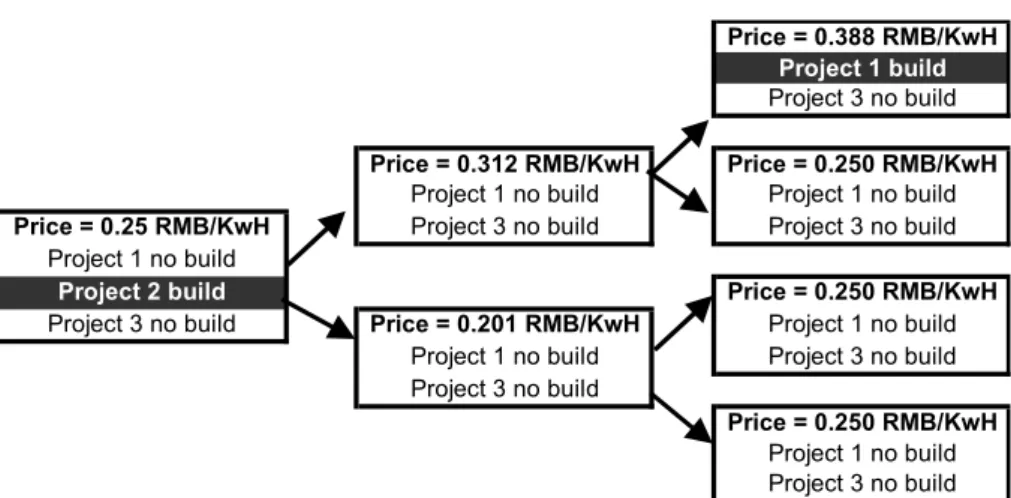
2 in the first period and Project 1 in the third period. The rest of Table 4 can be read in the same way. In summary, as in Figure 5, the optimal strategy or contingency plan is to build Project 2 in the first time stage whatever the electricity price is. And build nothing in the second stage. In the last stage, we only build Project 1 in the case that price is up for the second stage and up again for the third stage, for other cases, we build nothing.
Table 4: Results for real options “in” projects timing model (Current electricity price 0.25 RMB/KwH)
Electricity Price Realization Decision Scenario i = 1 i = 2 i = 3 Prob i = 1 i = 2 i = 3 Project 1 0 0 1 Project 2 1 0 0 q = 1 0.250 0.312 0.388 0.138 Project 3 0 0 0 Project 1 0 0 0 Project 2 1 0 0 q = 2 0.250 0.312 0.250 0.233 Project 3 0 0 0 Project 1 0 0 0 Project 2 1 0 0 q = 3 0.250 0.201 0.250 0.233 Project 3 0 0 0 Project 1 0 0 0 Project 2 1 0 0 q = 4 0.250 0.201 0.161 0.395 Project 3 0 0 0
The overall expected net benefit is 4345 Million RMB. This is almost 4 times bigger than the simulation result in Figure 4a. There are two reasons for it:
1. Timing model can eliminate the unprofitable projects, while the simulation model cannot. As a comparison, the timing model without real options considerations as in Appendix III suggests that only project 2 should be built in the first time period and that projects 1 and 3 should never be built, with an overall expected net benefit of 4239 million RMB.
2. Real options add additional value by building project 1 in favorable situation (electricity price high) and avoiding it in unfavorable situation (electricity price low). Refer to Figure 5. In this example, the added value is not enormous, but the principle is established.
Price = 0.388 RMB/KwH
Project 1 build
Project 3 no build
Price = 0.312 RMB/KwH Price = 0.250 RMB/KwH
Project 1 no build Project 1 no build
Price = 0.25 RMB/KwH Project 3 no build Project 3 no build
Project 1 no build
Project 2 build Price = 0.250 RMB/KwH
Project 3 no build Price = 0.201 RMB/KwH Project 1 no build
Project 1 no build Project 3 no build
Project 3 no build
Price = 0.250 RMB/KwH Project 1 no build Project 3 no build
Figure 5: Contingency plan
There are three important notes regarding the results:
1. This real options timing model provides a contingency plan (as Figure 5) depending on how events roll out, as well as the value of the system with real options. Using the real options timing model, we learn to build Project 2 in the first stage, and build Project 1 in the third stage given certain electricity price condition; if using the timing model without real options considerations, the decision is to build Project 2 in the first stage, and then build nothing else, surely missing something compared to the real options timing model.
2. This contingency plan takes into account the complex interdependencies among projects, in this case, through the water flows (for example, one dam in the upstream will store water and help downstream stations to produce more in dry season). Using conventional options analysis, it is hard to deal with such interdependencies. This example is simpler than real water resources planning; nevertheless, we can use exactly the same methodology, with more computation and other resources, to tackle much more complex real water resources planning problem.
3. The value of options is the difference between the optimal benefits from the timing model with and without real options considerations, 106 million RMB. Note the valuation of real options “in” projects looks not for an exact numeric result as valuation of financial options, but assesses whether flexible designs are worth. The cost to get the real options “in” projects is usually 0 as in this case study. This process about real options valuation is more about the process of designing flexibility itself rather than a specific value of optimal benefit.
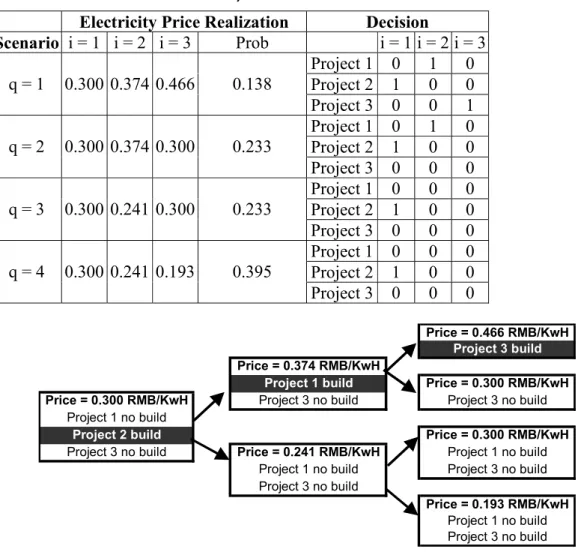
Before we finish our analysis, let us see how the optionality of the plan can be more significant if the current electricity price is higher. If we take the current electricity price as 0.30 RMB, the result is as Table 5. The contingency plan is to build Project 2 in the first stage, build Project 1 in the second stage if the price goes up, build Project 3 in the third stage if the price goes up both in the second and third stage. Refer to Figure 6. Note the path-dependent feature: in the third stage, for the same electricity price of 0.30 RMB/KwH, Project 1 can have been built or not, depending whether the electricity price in the second stage were high or low.
Table 5: Results for real options “in” projects timing model (Current electricity price taken to be 0.30 RMB/KwH)
Electricity Price Realization Decision
Scenario i = 1 i = 2 i = 3 Prob i = 1 i = 2 i = 3 Project 1 0 1 0 Project 2 1 0 0 q = 1 0.300 0.374 0.466 0.138 Project 3 0 0 1 Project 1 0 1 0 Project 2 1 0 0 q = 2 0.300 0.374 0.300 0.233 Project 3 0 0 0 Project 1 0 0 0 Project 2 1 0 0 q = 3 0.300 0.241 0.300 0.233 Project 3 0 0 0 Project 1 0 0 0 Project 2 1 0 0 q = 4 0.300 0.241 0.193 0.395 Project 3 0 0 0 Price = 0.466 RMB/KwH Project 3 build Price = 0.374 RMB/KwH
Project 1 build Price = 0.300 RMB/KwH
Price = 0.300 RMB/KwH Project 3 no build Project 3 no build
Project 1 no build
Project 2 build Price = 0.300 RMB/KwH
Project 3 no build Price = 0.241 RMB/KwH Project 1 no build
Project 1 no build Project 3 no build
Project 3 no build
Price = 0.193 RMB/KwH Project 1 no build Project 3 no build
Computational issues
A key consideration in solving a stochastic mixed-integer programming is whether a result is a global or local optimum. It is not simple to prove the result of an integer programming problem is a global optimum. And it may be hard to find a general solution for the real options timing model because of the special structure of the technical and economic constraints. Nevertheless, integer programming improves solutions to highly complex and interdependent real options that cannot be solved by ordinary binomial trees. When there is no dependency among nodes, it is possible to optimize on each node and roll back to get the option value. When dependency exists, this simple approach no longer works. A stochastic mixed-integer programming at least provides a local optimum better than the results from conventional approaches or human intuition.
Finally, a few words about the computational costs: for the example river basin development problem, the number of variables is 187, of which 36 are 0-1 discrete variables, and the number of constraints is 261. It takes a laptop (PIII 650, 192M RAM) less than 2 seconds to use GAMS© to figure out a solution.
Conclusion
By proposing a new way to formulate real options “in” projects, this paper attacks the possibility of building real options into the design of the physical facilities themselves. This generalizable solution will improve the design and planning of large engineering systems, such as manufacturing systems, commercial satellite systems, and logistics systems. It is not only in the sense of designing with full awareness of uncertainties, but also how to design options (flexibility) into systems to proactively manage inevitable uncertainties.
Three most important points in the paper are:
two stage analysis, identifying the most interesting real options “in” projects before analyzing them;
using stochastic mixed-integer programming to value real options as well as to find a contingency plan for excising the options. In the stochastic mixed-integer programming formulation, there are real options constraints added onto technical
constraints and economic constraints. Highly complex interdependencies among options can be specified using constraints; and
focusing on developing the most appropriate design of system flexibility and building up suitable contingency plan for dealing with future uncertainties, rather than valuing individual options.
Acknowledgements
The authors deeply appreciate the guidance of Denis McLaughlin and Gordon Kaufman in the formulation of this work, and anonymous Chinese friends for providing details to support the case study.
References
Ahmed, S., King, A.J., and Parija, G. (2003) “A Multi-stage Stochastic Integer Programming Approach for Capacity Expansion under Uncertainty,” Journal of Global
Optimization 26, pp. 3 – 24.
Bertsimas, D. and Tsitsiklis, J. (1997) Introduction to Linear Programming, Athena Scientific, Belmont, MA.
Birge, J.R. and Louveaux, F. (1997) Introduction to Stochastic Programming. Springer, New York, NY.
Bodily, S and Del Buono, M. (2002) “Risk and Reward at the speed of Light: A New Electricity Price Model,” Energy Power Risk Management, Sept., pp. 66 –71.
Cortazar, G. and Casassus, J. (1997) “A Compound Option Model for Evaluating Multistage Natural Resource Investment,” in Project Flexibility, Agency, and Competition (2000) pp. 205 - 223, edited by Brennan, M. and Trigeorgis, L., Oxford University Press, New York, NY.
Copeland, T.E. and Antikarov, V. (2001) Real Options - A Practitioner's Guide, TEXERE, New York, NY.
Cox, J., Ross, S., and Rubinstein, M. (1979) “Option Pricing: A Simplified Approach,”
Journal of Financial Economics, 7, pp. 263 - 384.
de Neufville, R. (2002) Class notes for Engineering Systems Analysis for Design, MIT engineering school-wide elective, Cambridge, MA.
de Neufville, R. et al. (2004) ”Uncertainty Management for Engineering Systems Planning and Design.” Monograph, Engineering Systems Symposium, MIT, Cambridge, MA. March. http://esd.mit.edu/symposium/pdfs/monograph/uncertainty.pdf
de Weck, O. et al. (2004) “Staged Deployment of Communications Satellite Constellations in Low Earth Orbit," Journal of Aerospace Computing, Information, and
Communication, March, pp. 119-136.
Geske, R. (1979) “The valuation of compound options,” Journal of Financial Economics, March, pp. 63 - 81.
Goldberg, R and Read, J (2000) “Dealing with a Price-Spike World,” Energy and Power
Risk Management, May, pp. 39 – 41.
Luenberger, D. (1998) Investment Science, Oxford University Press, New York, NY. Major, D. and Lenton, L. (1979) Applied Water Resource Systems Planning, Prentice-Hall, Englewood Cliffs, NJ.
Mittal, G. (2004) “Real Options Approach to Capacity Planning under Uncertainty,” Master of Science Thesis, Department of Civil and Environmental Engineering, MIT, Cambridge, MA.
Oueslati, S.K. (1999) “Evaluation of Nested and Parallel Real Options: Case Study of Ford's investment in Fuel Cell Technology,” Master of Science Thesis, Technology and Policy Program, MIT, Cambridge, MA.
Siegel, D., Smith, J., and Paddock, J. (1987) “Valuing Offshore Oil Properties with Option Pricing Models,” Midland Corporate Finance Journal, Spring, pp. 22 - 30.
Trigeorgis, L. (1993a) “The Nature of Options Interactions and the Valuation of Investments with Multiple Options,” Journal of Financial and Quantitative Analysis, Spring, pp. 1 - 20.
Trigeorgis, L. (1993b) “Real Options and Interactions with Financial Flexibility,” Financial
Management, Autumn, pp. 202 - 224.
Wang, T. (2003) “Analysis of Real Options in Hydropower Construction Projects: A Case Study in China,” Master of Science Thesis, Technology and Policy Program, MIT, Cambridge, MA.
Appendix I: Using mixed-integer programming to solve a binomial
lattice
By simple examples on financial options, we would illustrate the basic idea of using stochastic mixed-integer programming model to value options.
Important variables for options valuation are as follows
S: Current Stock Price K: Exercise Price T: Time to Expiration r: Risk free interest rate σ: Volatility
∆T: Time interval between nodes
Important Formulas for Binomial Tree Model include:
d u d e p e d e u T r T T − − = = = ∆ ∆ − ∆ σ σ
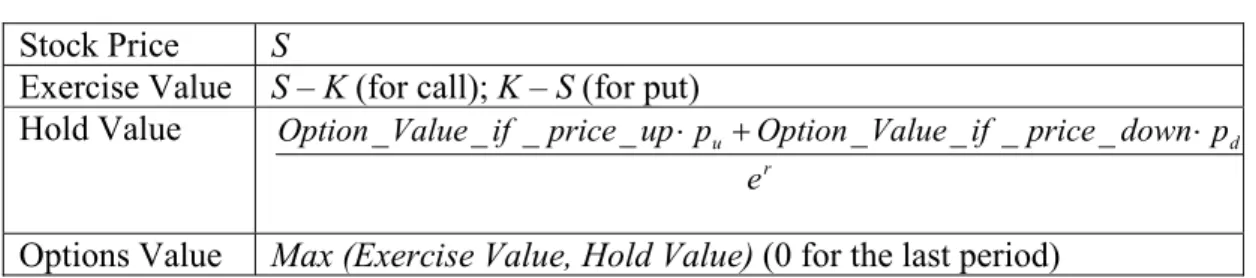
On each node of a binomial tree, the calculation is as Table 6. Note this is for the valuation of American options, and p is risk-neutral probability.
Table 6: Decision on each node of a binomial lattice Stock Price S
Exercise Value S – K (for call); K – S (for put) Hold Value r d u e p down price if Value Option p up price if Value Option_ _ _ _ ⋅ + _ _ _ _ ⋅
Options Value Max (Exercise Value, Hold Value) (0 for the last period)
Now we will compare an ordinary binomial tree and an integer programming binomial tree. The interesting part is to compare the option value from the binomial tree and the optimal value from the integer programming, as well as the “exercise or not” result for each node of the binomial tree and the value of 0-1 integer variables in the optimal
solution of the integer programming. The American option is of special interest because we want to examine if the integer programming can correctly identify the case of early exercise before the last period.
For example, the parameters for an American call option are S = $20, K = $21, T = 3 years, r = 5% per year, σ = 30%, ∆T = 1 year. The binomial tree is as Table 7, and the value of the options is $5.19.
Table 7: Binomial tree for the American call option
Period 1 Period 2 Period 3 Period 4
Stock Price 20.00 27.00 36.44 49.19
Exercise Value -1.00 6.00 15.44 28.19
Hold Value 5.19 9.34 16.47 0.00
Option Value 5.19 9.34 16.47 28.19
Exercise or not? No No No Yes
Stock Price 14.82 20.00 27.00
Exercise Value -6.18 -1.00 6.00
Hold Value 1.41 2.91 0.00
Option Value 1.41 2.91 6.00
Exercise or not? No No Yes
Stock Price 10.98 14.82 Exercise Value -10.02 -6.18 Hold Value 0.00 0.00 Option Value 0.00 0.00 Exercise or not? No No Stock Price 8.13 Exercise Value -12.87 Hold Value 0.00 Option Value 0.00 Exercise or not? No Node 11 Node 21 Node 22 Node 31 Node 32 Node 33
Now let us use Integer programming to value this binomial tree. The node im on a binomial tree is indexed in the following way: i represents the ith stage, m represents the
mth node for a specific stage. Because of the nice feature of recombination of a binomial
tree when there is path independence, the number of nodes at ith time point is exactly i, so m takes the number from 1 to i. Please refer to Figure 7.
At node im, let Sim denote the stock price,Eim denote the exercise value, Him denote the hold value, Vim denote the option value, Rimbe a 0-1 integer variable denoting whether the option is exercised at node im, 0 is not exercise and 1 is exercise. The number of stages is n.
The objective function is to get the maximum value of V11 at the beginning node. The option value Vim is specified by
) 1 ( im im im im im E R H R V = ⋅ + ⋅ −
Since the programming maximizes the value, its final result will satisfy that Vim is the maximum of Eim and Him.
The exercise value Eim for a call options is
K S Eim = im −
The hold value for the last time point is 0, or Hn,m =0. For i<n, the hold value
T r m i m i im e p V p V H = +1, ⋅ + ⋅+∆1, +1⋅(1− ) We are using continuous compounding here.
The stock price Sim at node im is defined by the following formula T m i im S e S = (+1−2 )σ ∆ 11
Complete formulation of the integer programming problem is as follows: Maximize V 11 ( 9 ) Subject to Vim = Eim ⋅Rim +Him ⋅(1−Rim) ∀i;m=1,...,i ( 10 ) K S Eim = im − ∀i;m=1,...,i ( 11 ) T r m i m i im e p V p V H = +1, ⋅ + ⋅+∆1, +1⋅(1− ) i m n i=1,..., −1; =1,..., ( 12 ) 0 ,m = n H ∀ m ( 13 ) T m i im S e S = (+1−2 )σ ∆ 11 ∀i;m=1,...,i ( 14 ) Solve the integer programming using GAMS, the maximum value of the objective function is 5.19. The values for 0-1 integer variables are as Table 8. Since 1 means exercise, the result is exactly correspondent to the ordinary binomial tree as Table 7.
oo
Table 8: Result of the stochastic programming for the American call option
Rij i = 1 i = 2 i = 3 i = 4
j = 1 0 0 0 1
j = 2 0 0 1
j = 3 0 0
Appendix II: Formulation of the screening model for river basin
development problem
The screening model for this problem can be described in the following mathematical programming: Max ))( ( s s s t s s s s st PP crf FC VC V
δ
Hβ
− + +∑∑
∑
( 15 )s.t. (Technical constraints Part I - Continuity constraints)
t st st st t s S E X k S ,+1− =( − ) ∀s,t ( 16 ) st t s st X F E = − ,1 +∆ ∀s,t ( 17 ) (Technical constraints Part II - Reservoir storage/capacity constraints)
0 ≤ − s st V S ∀s,t ( 18 ) 0 ≤ ⋅ − s s s yr CAPD V s∀ ( 19 ) 0 ) ( = − s st st A S
σ
∀s,t ( 20 ) (Technical constraints {Part III - Hydropower constraints}0 73 . 2 ⋅ ⋅ ⋅ ⋅ ≤ − s t st st st e k X A P ∀s,t ( 21 ) 0 ≤ − st t s st Y hH P ∀s,t ( 22 ) 0 ≤ − st s A AMIN ∀s,t ( 23 ) 0 ≤ − s st AMAX A ∀s,t ( 24 ) 0 2 ≤ − s s AMIN AMAX ∀s,t ( 25 ) 0 ≤ − s s CAPP H ( 26 ) (Budget constraints) B H V VC FC s s s s s s + ⋅ + ⋅ ≤
∑
(δ
) s∀ ( 27 )Table 9: List of Variables for the screening model
Variable Definition Units
yrs Integer variable indicating whether or not the reservoir is constructed at site s
Sst Storage at site s for season t 106m3 Xst Average flow from site s for season t m3/s Est Average flow entering site s for season t m3/s Pst Hydroelectric power produced at site s for season t MwH
Ast Head at site s for season t m
Hs Capacity of power plant at site s MW
VS Capacity of reservoir at site s 106m3
AMAXs Maximum head at site s m
AMINs Minimum head at site s m
Table 10: List of Parameters for the screening model
Parameter Definition Units Value
Qin,t Upstream inflow for season t m3/s (374,283) CAPDs Maximum feasible storage capacity
at site s 10
6m3 (9600, 25, 12500) CAPPs Upper bound for power plant
capacity at site s MW 3200)( 3600, 1700, ∆Fst Increment to flow between sites s
and the next site for season t m
3/s (212, 105) for site 3, others are 0 es Power plant efficiency at site s 0.7
kt Number of seconds in a season Million Seconds
15.552 ht Number of hours in a season Hours 4320 Yst Power factor at site s for season t 0.35 βP Hydropower benefit coefficient 103 RMB
/MwH 0.25
FCs Fixed cost for reservoir at site s B RMB (11.19,0,8.41) VCs Variable cost for reservoir at site s B
RMB/106m3 (4.49×10 -4, 0, 6.68 ×10⁻⁴) δs Variable cost for power plant at site s B RMB/MW (7.65×10⁻⁴,
1.85×10⁻³, 8.80 ×10⁻⁴)
r Discount rate 0.086
crf Capital recovery factor for 60 years 0.087 B Total Budget available 103 RMB 80,000,000
Above is a simplest version of a river basin planning screening model without losing the critical considerations, there will be much more details added for real planning. The objective function ( 15 ) is to maximize the annualized profit from electricity sales. Technical constraints include continuity constraints, reservoir storage and capacity constraints, and hydropower constraints. Besides the information from the lists of variables and parameters (Table 9 and Table 10), several notes: constraint ( 20 ) specifies the relationships between reservoir storage volume and head, they are decided by specific geological conditions for sites; constant 2.73 in constraint ( 21 ) is a conversion factor; constraints ( 23 ) to ( 25 ) are to limit marked head variation that is very inefficient for power production.
The calculation of the conversion factor in constraint ( 21 ) is as follows: Since 1 Joule = 1 N·m (or m2·kg/s2), and per m3 of water weighs 103 Kg, so per m3 of water can generate 103·g power (where g is the acceleration of gravity, equal to 9.81 m/s2). One more issue to think about is that the energy is counted in MwH, and the time unit in the formulation is “million seconds”, so we need a conversion factor:
3 2 6 6 2 3 3 73 . 2 10 min / 60 min/ 60 10 / 81 . 9 / 10 s m hour kg s hour s m m kg = ⋅ ⋅ ⋅ ⋅ ⋅
Appendix III: Formulation of the timing model without real options
considerations
The timing model has almost all 0-1 integer variables except for the flow variables representing stream flow at different points of the river basin and the energy variables representing the energy production, while the screening model has most continuous variables to decide reservoir capacity and power plant sizes that can take any real value within the constraints. In the timing model, the sizes of the projects have been decided. The remaining decisions are whether to construct a particular project within a specific period of time. Such decisions are appropriately represented by integer variables.
The calculation considers 70 years of life for each project. Different time span can be used, but the difference on results would be small. Complete formulation of the timing model: Objective function: Max } )] ( ) ( {[ ] [ ] ) 1 ( [ 1
∑∑
∑∑∑
∑
∑∑∑
⋅ + − + − − = i s i is s s s s i s t s t i is i ist P i j i is js ist P PVC R H V R PVO P PV R f R Pδ
α
β
β
Where∑
+ − = + = i i j j i r PV 10 1 ) 1 ( 10 (1 ) 1∑
= + = 70 31(1 ) 1 j j o r PV ) 1 ( 10 ) 1 ( 1 − + = i i r PVC Continuity constraints: 3 31 1 3 31 1 , 31 i i j j in i Q Y R c R X = +∑
− = 3 32 1 3 32 2 , 32 i i j j in i Q Y R c R X = +∑
− =∑
= − + ∆ + = i j i j i i X F Y R c R X 1 1 12 1 12 32 32 12 11 21 i i X X ≤ 12 22 i i X X ≤ Construction constraint:∑
≤ i is R 1 Hydropower constraints:∑
= ⋅ ⋅ ⋅ ⋅ = i j js st isi t s ist e k X A R P 1 73 . 2 0 ≤ − st t s ist F hH P Budget constraint: 1 ≤∑
s is RTable 11: List of variables for the timing model
Variable Definition Units
Xist Average flow from site s for season t for time period i m3/s Pist Hydroelectric power produced at site s for season t for time
period i MwH
Ris 0-1 variable indicating whether or not the project is built at site s for time period i
Table 12: List of parameters for the timing model
Parameter Definition Units Values
Qin,t Upstream inflow for season t m3/s (374,283) ∆Fst Increment to flow between sites s and
the next site for season t
m3/s (389, 154) for site 3, others are 0 es Power plant efficiency at site s 0.7
kt Number of seconds in a season Million Seconds
15.552
ht Number of hours in a season Hours 4320 Fst Power factor at site s for season t 0.35 βP Hydropower benefit coefficient 103 RMB
/MwH
0.25
βPi Hydropower benefit coefficient for time stage i in the real options timing model
FCs Fixed cost for reservoir at site s B RMB (11.19,0,8.41) VCs Variable cost for reservoir at site s B
RMB/106m3
(4.49×10⁻⁴, 0, 6.68 ×10⁻⁴)
s
H Capacity of power plant at site s MW (3600, 1700, 1723)
s
V Capacity of reservoir at site s 106m3 (9600, 0, 9593)
st
A Head at site s for season t m (262, 262; 280, 280; 240, 253)
st
Y Reservoir yield at site s for season t (the change of the flow if a reservoir is built)
m3/s (0, 0; 0, 0; -63.6, 63.6)
st
c Part of flow at site s season t to be used in the construction period to ensure a full reservoir of the next period
m3/s 0
f The ratio of average yearly power production during the construction period over the normal production level
0.226
δs Variable cost for power plant at site s B
RMB/MW
(7.65×10⁻⁴, 1.85×10⁻³, 8.80 ×10⁻⁴)
PVi Factor to bring 10-year annuity of benefit back to the present value as of year 0 (now)
(6.532, 2.863, 1.254)
PVOi Factor to bring the annuity from year 31 to year 70 back to year 0
(0.896, 0.943, 0.963)
PVCi Factor to bring cost in the ith period back to year 0
(1, 0.438, 0.192)
r Discount rate 0.086
s
yr Indicating whether or not the project is built
at site s (1, 1, 1)