READ THESE TERMS AND CONDITIONS CAREFULLY BEFORE USING THIS WEBSITE. https://nrc-publications.canada.ca/eng/copyright
Vous avez des questions? Nous pouvons vous aider. Pour communiquer directement avec un auteur, consultez la première page de la revue dans laquelle son article a été publié afin de trouver ses coordonnées. Si vous n’arrivez pas à les repérer, communiquez avec nous à [email protected].
Questions? Contact the NRC Publications Archive team at
[email protected]. If you wish to email the authors directly, please see the first page of the publication for their contact information.
NRC Publications Archive
Archives des publications du CNRC
This publication could be one of several versions: author’s original, accepted manuscript or the publisher’s version. / La version de cette publication peut être l’une des suivantes : la version prépublication de l’auteur, la version acceptée du manuscrit ou la version de l’éditeur.
Access and use of this website and the material on it are subject to the Terms and Conditions set forth at
An Analysis of Low-Earth Orbit Space Operations
Lapointe, Jean-François; Dupuis, E.; Hartman, L.; Gillett, R.
https://publications-cnrc.canada.ca/fra/droits
L’accès à ce site Web et l’utilisation de son contenu sont assujettis aux conditions présentées dans le site LISEZ CES CONDITIONS ATTENTIVEMENT AVANT D’UTILISER CE SITE WEB.
NRC Publications Record / Notice d'Archives des publications de CNRC:
https://nrc-publications.canada.ca/eng/view/object/?id=170d6d96-bff1-43a8-a5b4-a4cab8762114 https://publications-cnrc.canada.ca/fra/voir/objet/?id=170d6d96-bff1-43a8-a5b4-a4cab8762114
National Research Council Canada Institute for Information Technology Conseil national de recherches Canada Institut de technologie de l’information
An Analysis of Low-Earth Orbit Space Operations *
Lapointe, J.-F., Dupuis, E., Hartman, L., Gillett, R.
October 2002
* published Proceedings of the Joint Association of Canadian Ergonomists/Applied
Ergonomics (ACE-AE) Conference, October 21-23, 2002. Banff, Alberta, Canada. 5 pages (CD-ROM only). NRC 44997.
Copyright 2002 by
National Research Council of Canada
Permission is granted to quote short excerpts and to reproduce figures and tables from this report, provided that the source of such material is fully acknowledged.
AN ANALYSIS OF LOW-EARTH ORBIT SPACE ROBOT OPERATIONS LAPOINTE JEAN-FRANÇOIS
National Research Council of Canada, 1200 Montreal Road Campus, Building M-50, Ottawa, Ontario, Canada K1A 0R6. [email protected]
DUPUIS ERICK, HARTMAN LEO
Canadian Space Agency, St-Hubert, Quebec, Canada
GILLETT ROSS
MD Robotics, Brampton, Ontario, Canada
This paper presents the main results of an analysis of the activities of current low-earth orbit space robots. The analysis is presented in terms of the system, task, user interface, operator and training levels. The goal of this analysis is to find ways to improve the overall
performance of these complex human-machine systems.
The main results of this study are that the control interface, as well as the visualization and monitoring aspects of current low-earth space robot operations could be improved by using approaches such as direct manipulation interfaces, computer vision and virtual environment technologies.
Key words: space robots, human-machine interface, task analysis
ANALYSE DE L’OPÉRATION DES ROBOTS SPATIAUX EN BASSE ORBITE
Cet article présente les principaux résultats d’une analyse des activités des robots spatiaux opérant en basse orbite. Ces résultats sont décrits au niveau du système, de la tâche, de l’interface utilisateur, de l’opérateur et de la formation. Le but de cette analyse est d’améliorer la performance globale de ces systèmes humain-machine complexes.
Les principaux résultats de cette étude sont que l’interface de commande, ainsi que les aspects de visualisation et de surveillance des opérations de robotique spatiale courante pourraient être améliorés en utilisant des approches telles que les interfaces à manipulation directe, la vision artificielle et les technologies des environnements virtuels.
Mots-clés: robots spatiaux, interface humain-machine, analyse de tâche
INTRODUCTION
This paper describes the current state of space robot operations in low-earth orbit. The operations are described at the system, task, user interface, operator and training levels. The goal is to identify, and suggest solutions to improve the overall performance of these complex human-machine systems, while maintaining or improving their safety.
The results presented in this paper come from a collaborative space research project called ROSA (1) between the National Research Council of Canada, the Canadian Space Agency and the company MD Robotics.
We begin by a brief description of the current low-earth orbit space robot systems, with their main technical characteristics, followed by the descriptions of the different tasks they realize, the description of the operators (the astronauts) and of their training.
CURRENT OPERATIONS
Apart from the past ROTEX and ETS-7 experiments (3, 6), the operations of low-earth orbit space manipulators is currently limited to the use of the Shuttle Remote Manipulator System (SRMS, also known as Canadarm) and, since last year, the Space Station Remote
Manipulator System (SSRMS, also known as Canadarm 2).
Although those systems are perfectly operational, safe and reliable, the performance of future systems could be improved by taking a close look at the way things are done today,
especially from the human-machine interface point of view. We therefore decided to carry out this study. For data collection, we mainly used the literature review and semi-directed
interviews techniques. We interviewed many people, including designers and trainers of the systems, as well as one experienced operator.
Systems
The SRMS and the SSRMS (shown below in Figure 1) are about of similar size (15.2 m and 17.6 m respectively), but the SRMS has 6 degrees of freedom (dof) while the SSRMS has 7 dof and is a lot stronger. Both arms use a similar end effector or “tool” that is able to grab grapple fixtures (GF). The SRMS is fixed in the shuttle cargo bay while the SSRMS is
detachable. The SSRMS is also symmetrical which allows it to walk end over end in an inchworm like movement over the International Space Station (ISS) from one GF to another. It can also be moved when attached to one of the GFs of the mobile base system that travels along the ISS main truss rail. A more detailed description of those systems can be found in (4).
Figure 1 SRMS (left) and SSRMS (right)
Tasks
The SRMS and SSRMS are used mainly for ISS assembly, inspection, payload handling and extra-vehicular activities (EVA) support. The SSRMS will also be used for the service and maintenance of the ISS and the transport of payloads on the mobile base system. Although typical inspections last usually an hour, the other tasks commonly take several hours to complete.
For payload handling and especially for loading and unloading the shuttle cargo bay, the two arms can be used, either alone or together in a hand-off manoeuvre. In the latter case, the SRMS is used to un-berth the payload from the cargo bay and position it in free space in a position that allows the SSRMS to grapple it. The SSRMS then moves the payload to its final position or onto the MT/MBS for transportation. Loading payloads in the Orbiter cargo bay can be done in the reverse order. The payload handling capacities are frequently used for the ISS assembly and also sometime for the capture of free-flying satellites.
For EVA support, the manipulators typically serve as a mobile platform with one astronaut tied at the end of the arm. This is done most often because this is the only way or the most efficient way to accomplish the task.
Control Interfaces
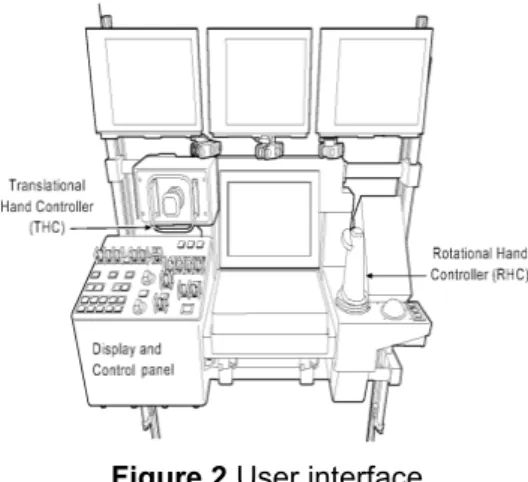
Although slightly different, the control interfaces of the SRMS and the SSRMS both use the same two 3-dof joysticks, for a total of 6 dofs controlling the position and rotation of the manipulators. The control interfaces both use rate control and can be operated in different modes. The two joysticks are used in conjunction with video display units (VDU) and one display and control (D&C) panel. The control interface used to control the SSRMS is shown in Figure 2. Pre-programmed movements are available but the operators currently prefer the human-in-the-loop control modes, which are:
Single Joint Mode: The operator moves the arm by controlling only one joint at a time. Manual Augmented Mode: In this mode, also known as coordinated or resolved mode, the
operator controls the translation and rotation of a particular Point of Reference (POR) on the arm, usually located at the tip of the end effector. The translations are done along a cartesian axis while the rotations are done along the yaw-pitch-roll axes.
Arm Pitch Plane Mode: This mode is available only on the SRRMS because of its particular
geometry and the presence of a seventh dof. It allows the operator to rotate the “elbow” around the axis defined by the wrist pitch and shoulder pitch reference frame. In this way, the operator can move the arm in a position that avoids collision with a potential obstacle, without the need to reposition the end effector, which keeps the same position and orientation during the movement of the rest of the arm.
For SRMS operations, the operator can look at the operations either directly through a window or through video cameras displayed on the video monitors. For SSRMS operations, direct views are seldom, if at all, available and the operator must rely solely on camera views. In the shuttle, the video cameras are located in the shuttle bay (four cameras, one on each corner) as well as on the SRMS (one fixed camera at the wrist joint and another optional camera mounted on a pan/tilt unit (PTU) on the elbow joint. On the ISS, there are fourteen cameras at fixed locations mounted on PTUs as well as four cameras on the SSRMS, one fixed at each end and two others mounted on the arm near the elbow, on PTUs.
While there is only one control station in the space shuttle, there will be two available on the ISS, one located in the U.S. Lab Destiny and the other in the Cupola. During operations, only one station is active at a time, the other being either in passive monitor mode or powered down. The active station has primary control of MSS functions, while the backup provides only the emergency stop, the control/display of additional cameras views, and feedback of function status. The stations are equipped with video monitors to display the selected camera views. The display and control panel is used for the selection of the cameras and the control of their PTUs when they are available. The operator can also control the focus and the zoom of the cameras.
Finally, the operators sometime use data coming from a manipulation package such as RBEV and others to supply synthetic images of the position of the arm. However, to ensure the safety of the operations, this information is always used as a secondary source of information and only the camera views are used as a primary source of information.
Operators
Since the arms are still operated directly from space, all of the operators are astronauts. Depending on their qualification and mission objectives, astronauts have basic training for the arm and sometimes mission specific training. Operators of the SRMS are trained by NASA at the Johnson Space Center in Houston, while operators of the SSRMS receive their generic operator training from CSA at the John H. Chapman Space Center in St-Hubert. The hands-on training for the SRMS is dhands-one both hands-on physical and virtual simulators, while hands-only virtual simulation is used for the SSRMS.
For actual SRMS and SSRMS operations in space, astronauts follow procedures that have normally been previously repeated on simulators. In principle, two operators are used to control the manipulators. The first uses the controls, while the other is monitoring the activities. In practice, one operator often does the job alone.
RECOMMENDATIONS
Since the video cameras provide the only views generally available from the worksite, most of the work time is used to choose the appropriate cameras and adjust them in order to provide optimum viewing for the operators. This is very important, since the visual cues represent the only information available to the operators for safe and efficient work. Given this constraint and since it is sometimes impossible to get a good view of specific parts of the worksite, other astronauts are often needed to assist the operators by providing visual cues, especially when large objects are manipulated in constrained spaces (4).
Another aspect of performance also related to camera selection and positioning is related to the training of the operators. Since many cameras are used to view the worksite, the operators have to remember their number and positions, in order to select and adjust them by using a menu-based GUI and the D&C panel.
Using models of the objects that are in space, virtual reality technology can improve the visualisation of the worksite, by providing the operators with on demand, unlimited, global and local views of the worksite, adjusted to their needs. This contrasts sharply with the actual limited set of observations points provided by video cameras and windows.
A virtualized model of the environment would also eliminate the need to remember the number and position of each of the cameras, since they would be visible at all times and could be chosen directly by picking them on the model. This single advantage could
significantly reduce the learning time. In addition to the current control modes available, a VR system could be used to control the arms by using coordinated position control where the operators just have to click on the GF to capture it with the end effector.
Such a system could also provide visual feedback, for example, by indicating the position of the GFs or of the video cameras and their field-of-views. Visual feedback could also be used to indicate an out-of-reach position or workspace limit of the manipulators.
Furthermore, the use of models of the environment allows for improved safety of operations, by using collision avoidance systems (2). Finally, such a system can also benefit from information coming from the current passive Artificial Vision Unit (AVU) (7) or from future active vision systems (8) in order to locate real objects and to register their size and position within the virtual environment.
In fact, this system could become a superset of the current human-machine interface by adding capabilities on top of current interfaces and taking into account actual limitations. Such a system allows for the exploration and the experimental comparison of different ways to present the information about the environment, as well as different ways to control space manipulators. Many challenges such as navigation methods to select the point of view and to switch between control modes must be taken care of to further improve the overall human-machine performance and safety of the space telemanipulation systems. We think that the use of direct manipulation interfaces has the potential to improve current interfaces.
CONCLUSION
The main results of this study indicate that the performance and safety of current low-earth orbit space manipulator operations, could be improved by working on the control interface, as well as the visualization and monitoring aspects with approaches such as direct manipulation virtual environment interfaces and computer vision techniques.
ACKNOWLEDGEMENTS
This work has been possible thanks to the support from PRECARN for the ROSA project.
REFERENCES
(1) Gillett, R. Greenspan, M., Hartman, L., Dupuis, E., Terzopoulos, D., "Remote Operations with Supervised Autonomy (ROSA)", Proc. of i-SAIRAS 2001, the 6th Int. Symp. on Artificial Intelligence and Robotics & Automation in Space, June 2001, 8 pages (CD-ROM only). (2) Greenspan, M., Burtnyk, N., “Obstacle Count Independent Real-Time Collision Avoidance”, Proceedings of ICRA 96, the IEEE International Conference on Robotics and Automation, Vol. 2, 1996, pp. 1073-1080.
(3) Hirzinger, G., Brunner, B., Dietrich, J., Heindl, J., “ROTEX: The First Remotely Controlled Robot in Space”, Proceedings of ICRA 94, the IEEE International Conference on Robotics and Automation, Vol. 3, 1994, pp. 2604-2611.
(4) Lapointe, J.-F., Boulanger, P., "Live Virtual reality System for the Control and Monitoring of Space Operations", Proc. of i-SAIRAS 2001, the 6th International Symposium on Artificial Intelligence and Robotics & Automation in Space, June 2001, 7 pages (CD-ROM only). (5) National Aeronautics and Space Administration (NASA), “Mission Control Center Status Report #7 STS-98”, NASA Shuttle Status, Johnson Space Center, February 10, 2001. http://spaceflight.nasa.gov/spacenews/reports/sts98/STS-98-07.html.
(6) Oda, M., “Experience and Lessons Learned from the ETS-VII Robot Satellite”, Proc. of ICRA 2000, the IEEE Int. Conference on Robotics and Automation, April 2000, pp. 914-919 (7) Pinkney H.F.L., MacLean, S.G., “Machine Vision in Space”, Canadian Aeronautics and Space Journal, Vol. 39, No. 2, June 1993, pp. 63-77.
(8) Samson, C., English, C., Deslauriers, A., Christie, I., and Blais, F., "Imaging and Tracking Elements of the International Space Station Using a 3D Auto-Synchronized Scanner", SPIE's 16th Annual Int. Symposium, Proceedings on Aerospace/Defence Sensing, Simulation, and Controls (AeroSense 2002), April 2002. 10 pages.