Anthills Built to Order:
Automating Construction with Artificial Swarms
by
Justin Werfel
S.M. Electrical Engineering and Computer Science
Massachusetts Institute of Technology, 2001
A.B. Physics
Princeton University, 1999
Submitted to the Department of Electrical Engineering and Computer
Science in partial fulfillment of the requirements for the degree of
Doctor of Philosophy in Computer Science
at the
MASSACHUSETTS INSTITUTE OF TECHNOLOGY
June 2006
c
Massachusetts Institute of Technology 2006. All rights reserved.
Author . . . .
Department of Electrical Engineering and Computer Science
May 12, 2006
Certified by . . . .
Radhika Nagpal
Assistant Professor of Computer Science, Harvard University
Thesis Supervisor
Certified by . . . .
H. Sebastian Seung
Professor of Computational Neuroscience
Thesis Supervisor
Accepted by . . . .
Arthur C. Smith
Chairman, Department Committee on Graduate Students
Anthills Built to Order:
Automating Construction with Artificial Swarms
by
Justin Werfel
Submitted to the Department of Electrical Engineering and Computer Science on May 12, 2006, in partial fulfillment of the
requirements for the degree of Doctor of Philosophy in Computer Science
Abstract
Social insects build large, complex structures, which emerge through the collective ac-tions of many simple agents acting with no centralized control or preplanning. These natural systems motivate investigating the use of artificial swarms to automate con-struction or fabrication. The goal is to be able to take an unspecified number of simple robots and a supply of building material, give the system a high-level specifi-cation for any arbitrary structure desired, and have a guarantee that it will produce that structure without further intervention.
In this thesis I describe such a distributed system for automating construction, in which autonomous mobile robots collectively build user-specified structures from square building blocks. The approach preserves many desirable features of the natural systems, such as considerable parallelism and robustness to factors like robot loss and variable order or timing of actions. Further, unlike insect colonies, it can build particular desired structures according to a high-level design provided by the user.
Robots in this system act without explicit communication or cooperation, instead using the partially completed structure to coordinate their actions. This mechanism is analogous to that of stigmergy used by social insects, in which insects take actions that affect the environment, and the environmental state influences further actions. I introduce a framework of extended stigmergy in which building blocks are allowed to store, process or communicate information. Increasing the capabilities of the building material (rather than of the robots) in this way increases the availability of nonlo-cal structure information. Benefits include significant improvements in construction speed and in ability to take advantage of the parallelism of the swarm.
This dissertation describes system design and control rules for decentralized teams of robots that provably build arbitrary solid structures in two dimensions. I present a hardware prototype, and discuss extensions to more general structures, including those built with multiple block types and in three dimensions.
Thesis Supervisor: Radhika Nagpal
Title: Assistant Professor of Computer Science, Harvard University Thesis Supervisor: H. Sebastian Seung
From Piled Higher and Deeper c
2005 Jorge Cham www.phdcomics.com Used with permission.
Acknowledgments
Mom and Dad come first.
I owe the next debt to the members of my committee: Yaneer Bar-Yam, Radhika Nagpal, Daniela Rus, H. Sebastian Seung, and Gerald Jay Sussman.
Yaneer encouraged me, at a time when I was ready to write up other work for the sake of finishing with graduate school quickly, to switch tracks to go ahead and explore this problem I’d long been most interested in. Without his advice, my research path would have been very different. He’s consistently shown interest in my progress and welfare beyond the call of duty.
Radhika took me on as her first graduate student when I was transitioning to this new topic, and has been most centrally involved in directing the course of the research described herein. Her comments were also particularly invaluable in the writing of this thesis.
Daniela has kept me grounded in the robotics side of things—not a bad thing for a thesis purporting to be about robots—and extended numerous considerations despite my not being an official member of her lab.
Sebastian was a significant influence on my decision to come to MIT in the first place; and he’s provided my home here, even after my research direction started diverging from his. His flexible advising style made it possible for me to explore a variety of very different topics during my graduate career.
Gerry gave me a place to work in the AI Lab (later CSAIL), and regularly chal-lenged the basis for my thinking by questioning my underlying approaches.
I would also like to thank a number of people who contributed to the work de-scribed herein, in a variety of ways. Jason Redi contributed to early discussions about the problem and approach. Jake Beal pointed out the opportunity for speci-fying functional constraints nested at multiple levels. Quinton Zondervan suggested the use of RFID tags to implement inexpensive labeled blocks. Carrick Detweiler and Iuliu Vasilescu provided much-needed help with simple electronics; Iuliu also provided invaluable help with the power analysis. Keith Kotay offered useful suggestions and discussions. Marty Vona suggested a simplification to the fabrication of the physical blocks.
Thanks go to both the Ericas, who made the journey more pleasant.
I am grateful to webcomics artists Pete Abrams, Rob Balder, Darren Bleuel, Jorge Cham, Shaenon Garrity, Jimmy Maidens, Stephen Notley, Mark Stanley, and Richard
Stevens for allowing me to reproduce their work as chapter headings.
There are countless friends and colleagues who have impacted my life during my time in graduate school. I regret that constraints of time and style prevent me from describing in full the ways you’ve enriched my life. Many thanks to all of you.
During the period I worked on the project I describe in this thesis, I was supported in part by funds from NSF training grant GM07484, NSF grant EIA-0130391, and a Packard Foundation Fellowship (to H.S. Seung). The ER1 was purchased with funds from NSF grants IIS-0426838, IIS-0513755, and/or ARO award W911NF-0510219.
Contents
1 Introduction 12
1.1 Challenges . . . 15
1.1.1 Swarms . . . 15
1.1.2 The global-to-local problem . . . 16
1.1.3 Mobile robots . . . 16
1.2 Tools . . . 16
1.2.1 Stigmergy . . . 17
1.2.2 Extended stigmergy . . . 18
1.3 Scope and overall strategy . . . 18
1.4 Contributions . . . 18
1.5 Organization of the rest of this dissertation . . . 19
2 Related Work 20 2.1 Construction . . . 21
2.1.1 Local-to-global models . . . 21
2.1.2 Collective construction . . . 22
2.1.3 Non-swarm approaches to automating construction . . . 23
2.2 Related problems . . . 23
2.2.1 Programmed self-assembly . . . 24
2.2.2 Self-reconfigurable modular robots . . . 25
2.2.3 Formation control . . . 26
2.3 Other practical issues . . . 27
2.3.1 Localization systems . . . 27
2.3.2 Underwater habitats . . . 28
3 Approach and Variants 29 3.1 Assumptions . . . 30 3.1.1 Robots . . . 30 3.1.2 Block attachment . . . 31 3.1.3 Implementation issues . . . 32 3.2 Algorithms . . . 34 3.2.1 General approach . . . 34 3.2.2 Inert blocks . . . 36 3.2.3 Distinct blocks . . . 40 3.2.4 Writable blocks . . . 42
3.2.5 Communicating blocks . . . 43
3.2.6 Considerations for multiple robots . . . 48
4 Experiments and analysis 53 4.1 Qualitative comparison . . . 53
4.2 Quantitative comparisons . . . 55
4.2.1 Total distance traveled along perimeter . . . 55
4.2.2 Opportunity to exploit parallelism . . . 58
4.2.3 Theoretical lower bounds on construction time . . . 59
4.2.4 Discussion: Continuous-valued positions . . . 62
4.3 Interference between robots . . . 63
4.3.1 Effects of interference . . . 64
4.3.2 Reducing interference . . . 64
5 Hardware 70 5.1 Overview . . . 70
5.2 Implementing low-level behaviors . . . 73
5.2.1 Perimeter-following . . . 73
5.2.2 Block attachment . . . 76
5.2.3 Block fetching . . . 76
5.2.4 Interactions with block labels . . . 77
5.3 Evaluation . . . 78
6 Functional heterogeneity 80 6.1 Functional constraints . . . 81
6.1.1 Prepatterned structures . . . 84
6.1.2 Adaptive patterns . . . 84
6.1.3 Regional constraints and multiple levels . . . 86
6.2 Adaptive constraint satisfaction . . . 87
6.2.1 Satisfiability . . . 87
6.2.2 Types of adaptive constraints . . . 87
6.2.3 Short- and long-term constraint satisfaction . . . 88
6.2.4 Considerations for multiple robots . . . 89
7 Three dimensions 90 7.1 Allowed attachment . . . 91 7.2 Block transportation . . . 94 7.2.1 Systematic search . . . 94 7.2.2 Random movement . . . 95 7.2.3 Gradient-based movement . . . 95 7.3 Experiments . . . 96 8 Other extensions 98 8.1 Disassembly . . . 98
8.2.1 Block error correction . . . 99
8.2.2 Other failure modes . . . 101
8.3 Deliberate holes . . . 102
8.3.1 Algorithm . . . 102
8.3.2 Non-algorithmic solutions . . . 105
8.4 Building open lattices . . . 105
9 Conclusions 107 9.1 Summary . . . 107
List of Figures
1-1 Termite mounds . . . 13
1-2 Ultimate goal for automated collective construction . . . 14
1-3 Previews of later topics . . . 19
3-1 Framework for construction problem . . . 30
3-2 Physical constraints on block placement . . . 32
3-3 Examples of inadmissible structures . . . 34
3-4 Sufficiency of shape map and separation rule . . . 36
3-5 Example construction simulation with inert blocks . . . 38
3-6 End-of-row sites and inside corners . . . 38
3-7 Robot procedure for indistinguishable blocks . . . 40
3-8 Example construction simulation with labeled blocks . . . 42
3-9 Face states for communicating blocks . . . 44
3-10 Example of communicating block algorithm . . . 46
3-11 Example construction simulation with communicating blocks . . . 47
3-12 Potential complication when one robot follows another very closely . 49 3-13 Example of communicating block algorithm for multiple robots . . . . 52
4-1 Experimental distance traveled along structure perimeter . . . 58
4-2 Maximum number of allowed attachment sites . . . 59
4-3 Comparison between writable and communicating blocks, in the large-swarm limit . . . 60
4-4 Three possible cases for block attachment . . . 60
4-5 Checkerboard tiling of the plane with odd/even distance from marker 61 4-6 Course of construction with labeled blocks . . . 62
4-7 Relaxing the assumption about discrete positions . . . 63
4-8 Time taken by N robots to build a n × n square structure . . . 65
4-9 Number of active robots vs. time using adaptive recruiting . . . 67
4-10 Fraction of structure perimeter occupied using adaptive recruiting . . 67
4-11 Number of active robots vs. perimeter length using adaptive recruiting 68 4-12 Number of active robots when fetching and attaching blocks takes longer 68 5-1 Hardware . . . 71
5-2 Process of adding one block to the structure . . . 72
5-3 Using bounding boxes to distinguish different situations . . . 74
5-5 Using bounding boxes in slices of field of view to evaluate angle from
wall and distance from block edge . . . 76
5-6 Configuration of camera and RFID reader . . . 78
6-1 Example construction simulation for a prepatterned structure . . . . 84
6-2 Example simulation for prepatterned structure with complex shape . 85 6-3 Examples of different adaptive structures built with the same low-level constraints . . . 85
6-4 Example of structure defined using multiple regions with different con-straints . . . 86
6-5 Example of structures using constraints with nested regions . . . 87
7-1 3-D restrictions on block placement . . . 91
7-2 Examples of violations of those restrictions . . . 92
7-3 Example construction simulation for a three-dimensional structure . . 93
7-4 Performance comparison for three schemes for transporting blocks along structure surface . . . 97
8-1 A structure in the process of disassembly . . . 99
8-2 Example of error correction . . . 100
8-3 The problem with incorporating deliberate holes into structures . . . 102
8-4 Allowed and disallowed attachment sites with an alternate algorithm for deliberate holes . . . 104
8-5 Examples of structures the alternate algorithm will and will not work on104 8-6 Structures built as open frameworks . . . 106 8-7 Isomorphism of square blocks to open framework with struts and hubs 106
List of Tables
3.1 Power requirements for communicating blocks . . . 47 3.2 Summary of memory and communication capabilities required of robots
and blocks for four variant approaches . . . 48 4.1 Best, worst, and average cases for total distance traveled along
List of Algorithms
1 Inert blocks . . . 37
2 Distinct blocks . . . 41
3 Writable blocks . . . 43
4 Communicating blocks . . . 45
5 Message-passing for communicating blocks and multiple robots . . . . 51
6 Functionally heterogenous, noncommunicating blocks . . . 82
7 Functionally heterogenous, communicating blocks . . . 83
From PartiallyClips c
2005 Rob Balder www.pclips.com Used with permission.
Chapter 1
Introduction
Social insects, such as ants and termites, are notable perhaps above all else for their building activities. Their structures can be huge (on the scale of several meters) and functionally complex, with features such as gardens, nurseries, royal chambers, and extensive systems for ventilation and for temperature and atmospheric regulation (Figure 1-1) [10, 13, 29, 61, 62]. All this is accomplished by creatures on the scale of millimeters, with 104
–105
neurons total to handle everything they need to do; they possess only local perception, and have no centralized control to coordinate their actions. From their collective behavior emerge these remarkable structures.
One important question is the scientific one of how these insects collectively build the structures they do. My focus is on the complementary engineering question, of how one could design and program a system in which an artificial swarm collectively builds particular desired structures.
The goal of automating collective construction, as I define it, is to be able to take an unspecified number of robots and a supply of building material, give the system a blueprint or other set of specifications for any arbitrary structure desired, and have a guarantee that the system will produce that structure without further intervention
Figure 1-1: Left: Cathedral termite mound in Australia’s Litchfield National Park. (Photo courtesy Ralf M¨uller.)
Right: Sketch of internal mound structure for two termite species, indicating air circu-lation and functional organization of architecture. (Image courtesy Dr. Jo Darlington, from [13].)
(Figure 1-2).
Such systems would have applications to construction projects, as well as to smaller-scale production:
• Construction is the one major human production activity from which automa-tion is still largely absent. Automaautoma-tion could bring significant benefits to tra-ditional construction, for which reported problems include low efficiency, high accident rates, low quality, and skills shortages [52, 66]. It could further be of great use in applications such as facilitating the production of low-cost housing. • Many reasons automation has not been more widely adopted in construction have to do with adapting robotic elements to traditional sites and techniques [66]. Thus there would particularly be a call for automation in settings difficult or dangerous for humans to work in.
Such settings include, for instance, other planets. To realize the goal of estab-lishing a human presence on the moon or Mars, it could be enormously helpful to be able to send robots on ahead first, to build a habitat to await the astro-nauts’ later arrival. It might be very useful if space stations, similarly, could be built in an automated way—and outer space would be an especially
ap-Figure 1-2: The ultimate goal for automated collective construction is to be able to give a set of robots a description of a desired structure (left), and know that it will reliably build that structure without further intervention (right).
propriate environment, due to the opportunity for three-dimensional weightless movement.
Underwater is another setting ripe for automated construction for the same reasons: it’s a difficult environment for people to work in, and one which allows weightless movement in three dimensions. Moreover, it’s far more accessible than extraterrestrial environments. Potential applications range from oil drilling stations to temporary research bases [1,32,33]; underwater, these would be closer to sites of interest, and insulated from storms and other such disturbances. Conceivably a way to easily build underwater habitats could help open up the oceans for colonization.
• In addition to building structures, mobile robots could act to maintain and repair them during their lifetimes. Further, robots could modify them according to changing circumstances, as termites modify their mounds to maintain internal homeostasis in a variable environment [53, 61, 62].
• On smaller scales, automated construction of desired structures could be applied to everyday artifacts, as for a different approach to rapid prototyping systems. In this thesis, I show how automating collective construction can be accomplished for solid two-dimensional structures; I demonstrate a hardware prototype, discuss extensions to structures with holes and three-dimensional structures, and introduce a more general principle (“extended stigmergy”) for coordinating swarm activities that can confer demonstrated advantages for construction and will likely be useful in other domains.
In the remainder of this chapter, section 1.1 discusses considerations making this a difficult problem, including difficulties associated with swarm systems and mobile robots, and the problem of finding low-level robot actions that will achieve a desired global result. Section 1.2 explains the principle of stigmergy used by social insects, and how it can be extended in artificial systems. Section 1.3 summarizes the approach I take to automating collective construction. Section 1.4 outlines the contributions of the thesis. Section 1.5 lays out the rest of the document.
1.1
Challenges
Automating construction with swarms of mobile robots presents challenges of algo-rithm design as well as of implementation issues.
1.1.1
Swarms
The philosophy of swarm systems is different from that where one or a few more complicated robots are used. Rather than having a centralized planner that assigns particular robots to perform particular tasks, the idea can be for robots to all take potentially independent actions that end up being consistent with the overall goal. Swarm robots should be simple, interchangeable, and expendable.
These factors have implications for algorithms. Approaches have to be robust to unspecified and potentially variable numbers of robots, which may act with no particular detailed timing or specified order. In a system with large numbers of robots, it is likely that some will break; others may be added to a system mid-task. No central coordination is available to monitor or direct the progress of a global task, or ensure that it progresses in a particular way. Individual robots may not have capabilities available to more complicated, non-swarm robots.
Together with these considerations, swarm systems can have a number of advan-tages over centralized or few-robot ones.
• Robustness: because no robot is assigned particular tasks, the system is robust to robot loss, typically without a significant effect on task completion.
• Decentralization: no coordination is necessary (or likely possible) between a central planning authority and all the agents, which would require high relia-bility of (possibly global) communication and/or long delays as information is physically carried over distances.
• Parallelism: if the overall task can be broken up into many independent sub-tasks, then members of the swarm can work on separate subtasks simultaneously and thus complete the overall task faster than a system forced to work more sequentially.
• Simplicity: simpler robots have fewer components or capabilities subject to potential failure, so any individual robot may be less likely to malfunction than
a more complex one. Also, simpler robots are easier to envision scaling down, toward the goal (common among futurists and works of science fiction) of micro-or nanoscale robots fmicro-or assembly and disassembly.
1.1.2
The global-to-local problem
The forward (local-to-global) problem for swarm construction is this: Given a set of rules for a construction team to follow, what will it end up producing? It may not be possible to predict what the team will generate by looking only at the ruleset itself. (This is the issue of “emergence” in complex systems.) However, it is straightforward to find out what the ruleset will do by having the team go ahead and execute it (potentially in simulation).
Conversely, the inverse (global-to-local) problem is this: Given a desired artifact, what ruleset will end up producing it? This problem, which has not previously been addressed in the construction domain, is the primary focus of this thesis.
1.1.3
Mobile robots
Mobile robots present a number of practical challenges. One of these is the problem of localization. Cues such as odometry and the use of landmarks can help, but estab-lishing pose (position and orientation) with accuracy or certainty is an active research area. For a swarm, that difficulty is compounded: it may be all the more difficult for many robots to establish all their poses, particularly if simplicity considerations limit their capabilities. Thus while it might be useful if all members of the swarm could share a common coordinate system, achieving that goal reliably may be problematic depending on the accuracy desired.
Another problem groups of mobile robots can encounter is with establishing and maintaining ad-hoc communication networks. Passing a message between specific individuals in a network with dynamic topology is nontrivial at best. Further, an ap-proach relying on communication may not scale up well with network size, depending on the details.
Manipulation of the physical world can also be a difficult task for mobile robots (compared, e.g., to assembly-line robots, which are fixed in place and which have items they are expected to manipulate brought to them in predictable locations). When the objects to be manipulated require precise positioning, as is the case in manufacturing or construction, this issue is especially pronounced.
1.2
Tools
One way social insects coordinate their actions is through modification of the shared environment. I use this approach in the algorithms described herein. Moreover, I extend it by increasing the capabilities of environmental elements, and show that so doing can improve the system performance in a variety of ways.
1.2.1
Stigmergy
The term “stigmergy” was coined by French biologist Grass´e in a 1959 paper [23]; he intended it to mean “the evocation of work by work”1
. The idea is that agents (termites, in his case) modify the environment, for instance by depositing pheromones or building material; other agents encountering those environmental modifications take other actions in response. Thus stigmergy describes a way of storing information in the environment, and using it as a means of indirect communication.
A way for agents to use such a tool in building is to take the approach of repeating the following steps:
1. Look at the state of the locally perceivable environment.
2. Based on that state and on the agent’s internal state, take an environment-modification action (e.g., deposit or pick up building material), an internal-state-modification action, and a movement action (e.g., take a step in a given direction).
That description is deliberately much like that for a Turing machine. The most significant differences are that there may be restrictions on environmental modifica-tion (e.g., conservamodifica-tion of building material); the environment may be two- or three-dimensional rather than a one-three-dimensional tape2
; and there are likely to be many agents acting on the environment simultaneously. The actions agents take based on external and internal state may be deterministic or probabilistic.
Limitations
From an engineering point of view, the use of stigmergy as described above has at least two major drawbacks.
One is the matter of specificity of design. Typically a given ruleset, which maps local configurations of building material onto rules for depositing or withholding ad-ditional material (or, more generally, onto probabilities of depositing), can give rise to a set of qualitatively similar structures if applied repeatedly to different building sites. However, the structures produced will generally not be identical, as a result of stochastic differences in chosen agent actions, in noisy actions executed by real-world agents, or in initial conditions. In the same way, two termite mounds built by the same species will look qualitatively similar without being identical. In most con-struction scenarios, by contrast, the goal is to produce a particular desired structure, reliably, independent of initial conditions or randomness.
Rulesets that invariably produce the same structure each time they are applied can be found. However, as noted above, the problem of finding one that produces the structure one wants is unsolved. There has been no general principle described for taking a particular desired structure and coming up with a set of low-level behaviors that building agents can follow to produce it.
1
See reference [51] for a bibliography of 150 papers that have since used the word, most of them in slightly different ways, with annotations on how many of them have used it.
2
1.2.2
Extended stigmergy
I introduce the term “extended stigmergy” to describe augmenting the basic notion of stigmergy by increasing the capabilities of environmental elements. In this construc-tion setting, those elements are the building blocks; the basic informaconstruc-tion they carry is the simple fact of their presence at a location [59, 60], and extensions include cases where they can store additional information, perform computations, and/or commu-nicate with physically attached neighbors. Benefits can include increased robustness and faster completion of a desired structure, as will be demonstrated.
This approach to improving the performance of the system, by improving the ca-pabilities of the building material, can be easier and more effective than by improving the capabilities of the robots.
1.3
Scope and overall strategy
The central goal of this thesis is to find solutions to the inverse problem of construc-tion: to start with a desired structure, and come up with a set of low-level agent behaviors that will reliably produce that structure.
That description, and the analogy to insects, might suggest developing a compiler which takes as input a desired high-level structure and generates as output a minimal set of (incomprehensible) low-level rules for agents to follow to produce it. That is not the approach of this work. Instead, the approach is to design fixed sets of rules for agents to follow such that, given an explicit representation of the desired high-level structure, they will produce it by following those rules in conjunction with that explicit representation. The resulting rulesets may not be minimal. However, they have the advantage of being understandable.
The overall strategy is for robots to repeat the following procedure: 1. Bring building material to the structure.
2. Figure out their location in a common structure-based coordinate system. 3. Find an acceptable place to attach material, based on the desired final shape
and on where material has already been attached. “Acceptable” involves not only the requirement that the structure ends up having the desired shape, but also that intermediate configurations of material not end up blocking robots from reaching places they need to go to complete the structure.
1.4
Contributions
This thesis makes the following contributions:
• It introduces schemes by which arbitrary structures can be automatically con-structed based on a high-level user-specified design. Algorithms presented here apply to solid two-dimensional structures with arbitrary perimeter, to a limited
Figure 1-3: Previews of topics to be discussed.
Left: A solid 2-D structure with complex perimeter, built from three types of blocks. Center: A solid 3-D structure (after [65]).
Right: A physical robot in the process of building a 3 × 3 square structure.
class of two-dimensional structures with deliberate holes, to structures built from functionally heterogenous blocks, to solid three-dimensional structures, and to structures built from struts assembled into an open latticework.
• It introduces the more general principle of extended stigmergy, and demon-strates the extent of its benefits (and costs) in this construction framework. • It presents a hardware prototype which can assemble arbitrary solid
two-dimen-sional structures.
1.5
Organization of the rest of this dissertation
Chapter 2 reviews related work. Chapter 3 explains the approach, demonstrates the system for 2-D solid structures, and introduces the use of extended stigmergy. Chap-ter 4 explores the extent to which that extended stigmergy is useful vs. costly here. Chapter 5 covers the hardware prototype and its performance. Chapter 6 consid-ers functionally heterogeneous building blocks. Chapter 7 describes the extension to three dimensions. Chapter 8 discusses other extensions, including issues such as disassembly and recovery from failures. Chapter 9 concludes and suggests future directions.
From Sluggy Freelance c
2001 Pete Abrams www.sluggy.com Used with permission.
Chapter 2
Related Work
Most work in artificial swarm frameworks focuses on tasks like exploration, for-aging, and object transportation—all activities that social insects perform, in well-studied ways that often inspire the artificial approaches. However, the relative dearth of work on building is striking, considering that one of the most notable activities of these insects is their construction of extensive and complicated structures.
Section 2.1 reviews work which does explicitly bear on automating construction. The bulk of such work addresses problems other than the one I focus on in this dissertation, that of automatically generating a specific structure starting from a high-level representation. Some studies focus on more purely scientific questions, modeling insect construction behavior or studying how features of low-level behaviors give rise to qualitative high-level results. Most work on artificial swarm construction either does not seek to produce particular structures, or assumes that an appropriate sequence of attachment steps is supplied as an input to the system. Also worth noting is work on automating construction that takes approaches not involving swarms of building agents.
The global-to-local shape-formation problem considered here is also related to analogous problems in a number of other domains, including programmed self-assembly, self-reconfigurable modular robots, and formation control, as described in section 2.2.
Section 2.3 briefly reviews practical issues for localization systems and underwater habitats, both of which bear on realization of construction systems like I describe.
2.1
Construction
Classic studies of insect-inspired construction are primarily concerned with local-to-global problems, starting with low-level rulesets and looking at characteristics of the resulting structures (§2.1.1). Most work on construction with artificial swarms has focused on different aspects of the problem, including communication, debris cleanup, minimalism, or hardware design (§2.1.2). Non-swarm proposals for automating con-struction have focused on centralized approaches, using one or a small number of active elements (§2.1.3).
2.1.1
Local-to-global models
A number of studies, primarily concerned with scientific questions, take the approach of defining a set of behaviors, simulating their use, and examining the structures that result. The study of this forward (local-to-global) problem has not yet led to solutions for the inverse (global-to-local) problem. Often physical constraints on agent movement are not taken into account in these studies.
Karsai and P´enzes [34] model the nest-building activity of social wasps, using agents with hand-designed behaviors, building combs whose cells are hexagonal cylin-ders. They show that a multiagent approach based on stigmergy alone, in which agent actions are based on locally perceived features of the structure in progress, can give rise to structures like those produced by real wasps.
Th´eraulaz and Bonabeau [59,60] consider a three-dimensional lattice-based model, likewise inspired by social wasps, in which stateless agents move randomly on a square grid and have a ruleset inducing them to deposit building material based on locally perceived configurations of existing material. Their main result is the experimental observation that, if a “coherent” structure is to emerge from the agents’ collective actions, construction must progress in a sequence of disjoint stages. In any such stage, all local configurations that trigger material deposit must be unique to that stage. Physical movement constraints are not considered; agents can move through one another and through the structure. Like that of Karsai and P´enzes, this approach uses the most basic sense of stigmergy for construction, in which the only information available to agents about the progress of construction is the local presence or absence of material.
They and others [10] have also studied more elaborate models incorporating pher-omones, with more complicated features such as air flow and anisotropic agent move-ment. These mathematical models are deterministic except for stochasticity in initial conditions, and also do not take into account physical constraints such as solid walls.
2.1.2
Collective construction
A number of researchers have studied construction-related issues involving the use of mobile robots and moveable building material. Most have not addressed the issue of automatically generating a particular desired structure, focusing instead on other aspects of the problem. In most cases, either the goal is not to form a particular structure, or the system is given a prespecified sequence of building steps to follow.
Matari´c’s group at USC focuses on the use of communication in collective tasks involving manipulation of the physical world. These include construction of linear walls of Velcro blocks of alternating polarity [67] or two-dimensional structures of different-colored blocks [31], as well as manipulation tasks requiring the explicit co-operation of multiple robots [19]. In the construction tasks, the requisite sequence of block placements is unique and specified by hand in advance.
Some researchers focus on minimalism, trying to achieve certain outcomes using robots with deliberately limited capabilities. Parker, Zhang and Kube [47] consider the problem of debris cleanup, a prerequisite to construction in littered environments. They demonstrate a collection of robots with only force and collision sensors, inspired by behavior of the ant Leptothorax tuberointerruptus [17]. These robots clear spaces in fields of debris by simply moving straight ahead, turning in a random direction when the force opposing their movement exceeds a threshold or when they collide with another robot. Melhuish et al. study minimalism in collective tasks like sorting [44] and construction [45]; in the latter, a collection of robots pushes pucks into a roughly linear wall, using as cues a white line on the floor at one end of their arena and a bank of lights at the other end.
Other researchers who have proposed systems for collective construction in this vein focus on hardware design. Terada and Murata [58] present a hardware system in which a mobile robot assembles structures of cubic blocks. The robot is confined to movement along the structure; blocks are passive, and locked together mechanically upon attachment by connectors manipulated by the robot. Everist et al. [14] describe a hardware system with the aim of eventual use in space, with free-flying robots assembling structures out of beams. Bowyer [11] proposes a scheme for a hardware system of terrestrial robots building with polymer foam, with the goal of building human-scale walls and arches.
Two studies describe simulated systems for swarm construction that do address the global-to-local problem. Both make assumptions likely to make physical implemen-tation problematic, and in both cases, the structures produced only approximate the desired design. Mason [42] describes a system where mobile agents rearrange build-ing material into roughly desired configurations, usbuild-ing artificial ‘pheromones’. The shape-encoding scheme is fairly low-level, making specifying desired shapes somewhat involved. Agents are assumed to be able to move through each other and through building material, and to be able to evaluate levels of pheromone with arbitrary pre-cision. I describe elsewhere [68] a system where mobile agents rearrange building material into desired arbitrary configurations, specified in a moderately high-level ge-ometric language. Agents are physically restricted in their movement by the presence of building material and of other agents. Agents move on a discrete grid and are
assumed to be able to localize themselves on that grid precisely; I have not shown to what extent those assumptions can be relaxed in that framework.
2.1.3
Non-swarm approaches to automating construction
Not every possible automated construction system must rely on the use of swarms. Other proposed approaches use more centralized methods, with single, more capa-ble robots or other more sophisticated mechanisms. In many cases, devices are not mobile, and may be on a scale larger than that of the building or artifact to be produced.
Khoshnevis et al. [35, 36] propose a “Contour Crafting” approach akin to large-scale rapid prototyping, in which a gantry is erected above a desired building site, and an extrusion nozzle and pair of trowels deposit and shape material, respectively. Extensions involving other manipulation attachments and relatively high-level pre-fabricated units are proposed to handle features like plumbing and electrical systems. Soar et al. [12,52] similarly propose using the equivalent of large-scale rapid proto-typing for construction. They further suggest using smaller-scale rapid manufacturing techniques to fabricate panels with desired features (insulation, ventilation, appro-priate textures on inner and outer surfaces, etc.), to be assembled on-site by human construction workers.
Another related issue is planning for assembly: e.g., automatic generation of a sequence of actions to put a given set of components together to assemble a given artifact. For instance, Wilson and Latombe [75] discuss issues associated with geo-metrical constraints on the ordering of operations for assembly or disassembly, and investigate the complexity of assembly sequences.
2.2
Related problems
Several areas of active research involve the global-to-local problem of finding low-level properties or behaviors that will produce a desired high-low-level configuration of elements. These areas include programmed self-assembly (§2.2.1), self-reconfigurable modular robots (§2.2.2), and formation control (§2.2.3).
In each of these areas, there is typically a single class of elements—tiles, modules, or mobile robots, respectively—all members of which have comparable capabilities.1
This uniformity distinguishes them from the construction problem, with its two classes of elements, mobile robots and building materials. The latter separation into two classes is an important one, as elaborated in the sections below. However, the global-to-local problem they share is an important similarity.
1
There may be multiple types of elements within that class, whose detailed properties can differ. For instance, different types of passive tiles may have edges with different binding properties [49], or two different types of modules might have complementary attachment hardware [39]. However, the higher-level capabilities of the different types are not substantially different.
2.2.1
Programmed self-assembly
Programmed self-assembly is the problem of designing a collection of elements with edge binding properties such that, when they mix randomly (e.g., driven by ambient fluid forces), they bind to form desired assemblies. The elements may be homogenous or heterogenous; their binding properties may be fixed or dynamic; and they may have a range of capabilities such as ability to detect binding events or exchange information with neighbors.
This problem is not directly suited to construction as stated, mainly because of the issue of element movement, and associated issues of spatial and temporal scale. Programmed self-assembly assumes that units move at random. Its ultimate concern is typically with the microscale, where ambient fluid forces are sufficient to provide that movement. As a result, applying it to housing-scale construction is unlikely to be straightforward. Moreover, without excess elements in sufficient density and enough agitation, it can take an undesirably long time for elements to reach all necessary sites through random movement.
However, there are important connections to the construction problem. As dis-cussed in Chapter 7, the problem of building a given structure can be decomposed into the subproblems of (1) deciding where units can be attached, and (2) getting them there. While programmed self-assembly’s answer to the latter subproblem may not apply well to construction, both frameworks share the same first subproblem. In par-ticular, self-assembling tiles which can change binding properties and communicate with attached neighbors have a great deal in common with the communicating blocks I will describe, where building blocks are equipped with embedded processors. In this respect, solutions to one problem may be applied toward the other. For instance, most systems for programmed self-assembly are subject to crystalline flaws, often as a result of not explicitly considering physical constraints on tile movement. The approach I present, in which a central concern is taking movement constraints into account to prevent such flaws, could then be useful for self-assembly of smaller-scale artifacts.
A number of studies in programmed self-assembly have considered tiles with dif-ferent levels of capabilities, experimentally or in theory, of which a sampling follows. Rothemund, Winfree, and others make passive tiles using DNA, with edge binding properties designed so as to stick together in certain patterns when mixed. These tiles may form algorithmically complex patterns such as Sierpinski triangles [49] or binary counting sequences [7].
Guo et al. [26] consider square tiles which can detect binding events, and when triggered by same, can change state and binding properties during the assembly process. They use a genetic algorithm to search for programs for such tiles.
Several researchers consider square tiles which, in addition to detecting binding events and changing state and binding properties, can also communicate state with attached neighbors. Jones and Matari´c [30] show how to derive tile programs which will reliably form particular target structures chosen from a certain class of two-dimensional shapes. Arbuckle and Requicha [2] show how to program tiles to form certain simple shapes, and suggest using such a system to build structures whose shape
is not fully prespecified but rather satisfies given functional requirements. Griffith et al. [24, 25] focus on the application of self-assembly to self-replication of ‘strings’ of square base units in two dimensions.
Other studies involve tiles with similar capabilities but other shapes. Klavins et al. describe theory [37] and hardware [8] for primarily triangular tiles, and detail a framework for automatic synthesis of tile programs to generate desired assemblies. White, Lipson, and others describe hardware designs for two-dimensional systems with square or triangular tiles [73], and a three-dimensional system with cubical blocks [74]. They show formation of specific structures, where the sequence of attachments is planned by hand in advance.
2.2.2
Self-reconfigurable modular robots
Self-reconfigurable modular robotics [50] asks the question of how a collection of mobile units can autonomously rearrange itself to achieve a desired configuration. Movement constraints typically allow units to move over a substrate of others, and require that all units be connected at all times. Often units are allowed to move through the structure, an operation that can be difficult to implement mechanically. One could imagine building structures out of modular robots—starting with a huge collection of modules, directing them to rearrange into the desired structure, and calling the construction problem solved. However, the separation into mobile and structural elements in construction is an important one. Once a structure is in place, it’s unnecessary for structural elements to have a capacity for movement. At that point, such a capability becomes a liability: not only would self-mobile blocks be far more expensive and complex than non-mobile ones, but they’re likely to be less good at their structural role than dedicated building materials would be—the latter will be more structurally sound, can more easily have insulating and other desired properties, and so on. Optimizing the building materials for their structural properties will make them more effective and cheaper, while mobile robots can be reused for another building project.
A number of researchers have developed self-reconfigurable systems that address global-to-local shape formation problems, and often demonstrate hardware capabil-ities that would be useful in systems like those I describe, including self-aligning connectors and communication links between physically attached modules.
Rus’s group at MIT has developed several modular robotic systems, with accom-panying reconfiguration algorithms. The Molecule [39] has planning algorithms to allow its two types of units (male and female) to rearrange into desired structures; units can travel through the structure on a scaffold of other units. The Crystalline robot [65] has cubic modules which can similarly travel through the structure in order to reconfigure into a desired shape. Kotay and Rus [40] have also described hand-designed algorithms for generic reconfigurable robots to perform locomotion and reconfiguration tasks, and shown how a variety of existing modular robots can be made to work with these algorithms.
Støy and Nagpal [55, 56] describe a scheme by which a set of modules can au-tomatically reconfigure into a desired shape whose scale depends on the number of
modules available. The approach is for some modules to form a scaffold which other modules move over and through. Information about where additional modules are needed is communicated in the form of a directional gradient that directs modules’ movement.
Yim et al. [64, 76] have introduced various self-reconfigurable systems and algo-rithms, including Telecubes, whose cubic modules can move in three dimensions (and through the structure) to form desired shapes.
Goldstein et al. [21, 22] have proposed a Claytronics system for dynamic three-dimensional object reproduction. The reconfiguration algorithm is based on stochastic motion of “holes” in the structure, which through random movement can transfer modules to desired locations. That approach is simple and decentralized but subject to subsets of modules becoming disconnected from the rest.
2.2.3
Formation control
Of the commonly studied topics using artificial swarms, the closest to construction is formation control. As with self-reconfigurable robots, the goal is for a collection of elements, all mobile, to achieve a desired configuration, sometimes in conjunction with other criteria. Movement constraints typically include maintaining minimum distances between all pairs of elements. Often globally available information or all-to-all communication is assumed. These factors can make it difficult to directly apply studies of formation control of mobile robots to the swarm construction problem. However, the abstract goal of both domains can be seen as similar.
Bah¸ceci, Soysal and Sahin [4] provide a review of several centralized and dis-tributed methods for formation control.
Formation control and flocking algorithms frequently rely on explicit communica-tion for coordinacommunica-tion. Sugihara and Suzuki [57] describe an approach to form shapes such as circles and polygons. User intervention is required to select robots to play special roles (e.g., the corners of the polygon), and every robot is assumed to know the position of every other. Fredslund and Matari´c [18] describe a scheme by which a set of robots can form a line of a desired shape, and move in formation, led by a “conductor” robot. Although the approach has robots broadcast identification infor-mation globally, robots need not know the position of others. McLurkin [43] describes algorithms for behaviors like clustering and leader-following, for a swarm of robots that use frequent communication.
With appropriate assumptions, analytical tools can be brought to bear on for-mation control algorithms. Spears and Gordon [54] describe an approach they call artificial physics or physicomimetics, in which agents calculate virtual forces based on their positions relative to others, and move as though acted on by those forces. Like real crystals, the resulting formations are subject to crystalline defects. ¨Ogren, Fiorelli and Leonard [46] similarly use artificial potential functions to maintain for-mations, along with “virtual leaders”, moving reference points used to govern the motion of the actual robots. Their analysis assumes global communication and a shared coordinate system. Feddema and others [15, 16] describe the design of coop-erative control algorithms by defining a global performance index, partitioning it so
that it reflects only local relationships, and taking the gradient of the result to obtain local control laws. The result may not globally optimize the original performance index, but interactions are local and analysis is tractable.
2.3
Other practical issues
Here I briefly review issues related to localization (§2.3.1) and to underwater struc-tures intended for human habitation (§2.3.2).
2.3.1
Localization systems
As discussed in the previous chapter, localization can be a very difficult task for mobile robots. Approaches that rely solely on the resources of individuals cannot avoid significant uncertainty or errors in position estimates. Odometry is notoriously unreliable. Sufficiently sophisticated inertial navigation systems, such as those used in submarines or strategic missiles, can give better estimates of relative movement [6]. However, the size and expense of such systems is not appropriate for artificial swarms, where individuals are meant to be simple, small, and cheap. Moreover, such dead-reckoning approaches require that the initial position be known with precision, which would interfere with ease of deployment. Perception of passive environmental features can be used to improve estimates, but considerable uncertainty is still typical.
Localization performance can be improved using active external cues, typically artificial landmarks in known locations that communicate their position to the robots. The best-known such example is probably the Global Positioning System (GPS) [20, 28, 48], in which satellites with known orbits transmit signals that a receiver can use to determine position to within about 15 meters. With differential GPS, using another receiver at a known location as an additional reference, the uncertainty can be reduced to less than 5 meters. With still more expensive systems with sufficiently high communication bandwidth broadcast from that fixed receiver, uncertainty in the centimeter range can be achieved.
Trying to use GPS in a swarm construction setting may present a number of problems. One issue is that GPS receivers rely on line-of-sight with the satellites; obstacles (including the building in progress itself) can occlude signals or give multi-path reflections, leading to potentially large errors in position estimates. Moreover, while GPS is suited to open terrestrial settings, it will not work underwater, where the satellite signals cannot reach, or in extraterrestrial settings where there are no satellites available. Thus GPS fails in settings arguably most suited for automating construction.
Other systems involving fixed beacons in known locations have been presented for localization in settings where GPS is unavailable, including indoors [48] and under-water [5]. These can suffer from the same problems of occlusion and multipath errors in settings with obstacles, which a construction project will necessarily contain. Also, many existing systems for underwater localization rely on the mobile robot broadcast-ing a signal to fixed reference units, an approach unlikely to scale up well to handle
large numbers of robots.
To deal with these problems of position estimation, as I describe in the next chapter, I have robots use the partial structure as a collection of landmarks, by reference to which they can determine their position in a shared discrete coordinate system. The only time robots need to know their location is when along the perimeter of the structure in progress, and then with no greater precision than the size of a block.
2.3.2
Underwater habitats
One potential application for automated construction systems I emphasize is under-water structures, particularly habitats assembled out of high-level prefabricated units each fulfilling a distinct functional role (Chapter 6). Previous studies of undersea habitats can inform future projects such as these, with regard to physical and psy-chological requirements, and other logistical considerations.
Allmendinger [1] and Jones [32] give extensive studies of manned underwater struc-tures and complexes, primarily for oil production but potentially for other applications such as oceanographic research stations. They discuss spherical and other hull shapes for underwater units; problems manufacturing and transporting large single-unit sys-tems could be addressed with multi-hull syssys-tems composed of smaller units—ideal for a system that assembles a large structure out of high-level prefabricated units. Large structures are particularly essential considering the wide range of facilities such a habitat would require, and taking into account the factor of necessary crew sizes for missions of more than a few days—with a crew size of six, the endurance limit is 14 days [1]; for longer missions, crews of 25 or more are preferred, and crews of 50 or more are still better to minimize total cost [32]. These studies also present hardware designs for features such as emergency escape capsules, transfer modules for getting crew in and out, and docking mechanisms.
In a separate study, Jones [33] describes considerations for where an underwater habitat might be located, including factors like currents and temperatures, and how it might be maintained. He also discusses issues important to underwater communi-cation and perception, including optical visibility and the locommuni-cation-dependent effects on it of turbidity, and frequency-dependent considerations for sonic communication and sonar.
From Freefall c
2001 Mark Stanley freefall.purrsia.com Used with permission.
Chapter 3
Approach and Variants
This chapter introduces the framework in which I consider the collective con-struction problem and describes the approach I take to addressing it. Algorithms described in this chapter will let an unspecified number of robots assemble arbitrary solid two-dimensional structures, according to high-level user-specified designs. No explicit communication between robots is necessary; robots use the partial structure for implicit coordination.
The problem framework can be summarized as follows (Figure 3-1). Building blocks are square and can be attached to each other on all four sides. A block-sized marker indicates where construction is supposed to start, acting as a seed around which the structure grows. Robots (in unspecified numbers) fetch blocks from else-where in the workspace, bring them to the growing structure, and travel along its perimeter for some distance before attaching their block. The heart of the algorith-mic problem is how and where robots decide to attach blocks, such that a desired structure ends up reliably produced.
Section 3.1 describes the assumptions made about robot capabilities and block attachment, and discusses how these assumptions are consistent with reduction to practice in a physical system. Section 3.2 describes the overall approach taken here, covers four specific algorithmic variants which depend on varying capabilities in build-ing blocks, and discusses considerations associated with multiple simultaneously ac-tive robots.
Figure 3-1: Framework for the construction problem as considered here. Left: Ele-ments in the environment are mobile robots (gray), movable building blocks (brown), and a marker where construction is to start (yellow). Right: The object is for robots to fetch blocks and attach them to form some specified structure starting at the marker.
3.1
Assumptions
This section collects the general assumptions I make about the capabilities of robots (§3.1.1) and blocks (§3.1.2). In the variant approaches described in sections 3.2.2– 3.2.5, additional capabilities may be assumed; these are described in each case as appropriate. Section 3.1.3 discusses issues related to the realization of a full system for automated construction.
3.1.1
Robots
I assume that robots have the following capabilities:
1. They can move in any direction in the plane, alone or while carrying a block, and avoid collisions.
2. They can follow the perimeter of the partially built structure.
3. They can find both unattached blocks and the structure in progress. (This could be achieved in a number of ways, for instance by following long-range beacons associated with the marker and with supplies of additional blocks; see discussion in §3.1.3 below.)
4. They can pick up unattached blocks once found, one at a time, and attach them to the structure.
The first three of these have repeatedly been demonstrated in a variety of autonomous robotic systems [3].
I do not assume that robots can communicate with one another. While such communication could be helpful, it’s preferable not to have to rely on it. In addition
to avoiding other problems associated with communication described earlier, that eliminates dependence on teams: robots are capable of building independently, and a single robot could still complete the construction task if the rest of the swarm became disabled.
It can also be useful for robots to have access to aspects of their internal state (to monitor battery power, overall correct functioning, etc.), in order to be able to respond accordingly (seek out a recharging station, leave the building site, travel to a designated location for repairs, etc.).
3.1.2
Block attachment
Materials that social insects use for building include things like mud, pulp, and wax [10, 29, 34, 62]: soft materials that come in variable-sized quantities. This factor contributes to the fact that no two termite mounds are identical, and to the lumpy, organic look of them. In human construction projects, we typically use rigid materials, and build regular shapes with right angles. That’s both a limitation and a benefit.
Rigid materials can be more difficult than soft ones to manipulate. Soft materials can be pushed into narrow spaces and plug up gaps, or can be deformed to be pushed out of the way. Rigid materials, by contrast, will bring heavier constraints on where and how they can be attached. For instance, it may be difficult to fit a block into a space exactly one block wide between two other blocks (Figure 3-2A).
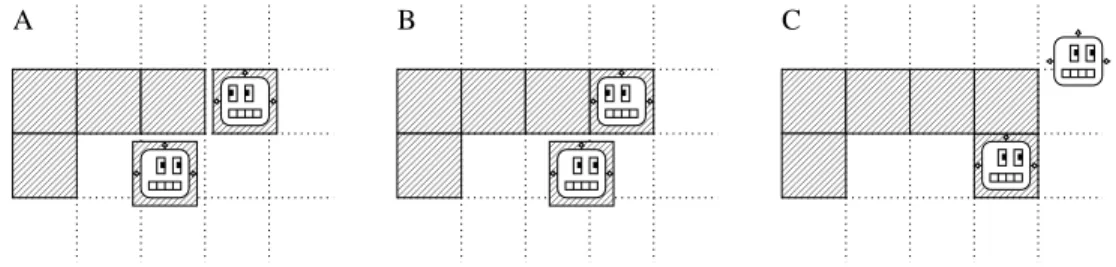
In everything that follows, I will make the conservative assumption that a space one block wide between two other blocks is too physically constrained to allow a block to be shoved into position. Disallowing that situation entirely will make it mechanically easier for robots to maneuver and attach their blocks. Another result of that restriction is that if such configurations are avoided, then so are more complicated gaps where a block might have to be moved down a long tunnel, where sites are entirely closed off and inaccessible, etc. (Figure 3-2B, C). The corollary of the restriction is the “separation rule”: separated blocks must never be attached in the same row (that is, with the same x- or y-coordinate) if all the sites between them are ultimately meant to be occupied. Otherwise, as blocks are added, eventually an unfillable one-block gap would result (Figure 3-2D).
An advantage of rigid materials is that they can be used to form regular shapes with reliable dimensions. An assembly of square blocks forms a grid with an implicit coordinate system. That coordinate system, and the landmarks represented by block edges, can be used for position reference.
A generally desirable quality in construction, and an important one if the structure is to be used for position reference, is for block alignment to be fairly precise. Ensuring precise alignment can be a nontrivial problem for simple mobile robots, for which manipulation of the physical world can in general be difficult. Rather than having to make robots capable of exact manipulation, a different approach, in keeping with the theme of extended stigmergy, is to improve instead the capabilities of the building material. Blocks can be equipped with self-aligning connectors (which may be either active [39] or passive [58]), so that a robot need only get a block close to an attachment site, and the connectors then ensure fine adjustment.
A
B C
D
Figure 3-2: Physical constraints on block placement. The desired structure here is a solid 5 × 5 square of blocks (diagonal shading). I assume that a block cannot be physically maneuvered into a constrained site like A. Eliminating such situations also eliminates more complicated problematic cases like those at B and C. To avoid unfillable gaps like A, separated blocks must never be attached in the same row (as they have in the bottom row) if all sites between them are meant to be occupied; otherwise later addition of blocks (light shading) will result in an unfillable gap (D).
3.1.3
Implementation issues
A number of issues fall strictly outside the domain of the algorithmic approach pre-sented here, but would need to be considered in real applications. Here I briefly discuss these issues and ways that they could be approached.
• Preparing the area for construction: It may be necessary to start the overall construction process by taking steps to prepare the workspace for construction. On land, this may involve clearing a space of material [47,68] or leveling an area. Some applications may call for robots to maintain models of their environment, in which case an initial stage of construction could involve surveying the area to map the terrain, note the locations of immovable obstacles, choose the best place for the structure, etc. [77, 78], on land or underwater. Here I will not consider these steps, and simply assume that there’s initially a clear workspace large enough to build in.
• Finding building materials: In some applications, robots may produce their own building material, for instance extruding foam from compressed tanks [11], or collect and use materials already present in the environment. In others, specialized building material may be supplied along with the robots. The latter is the approach taken here.
Supplied or scavenged building material could be scattered widely [42, 68] or localized to a small number of ‘caches’ deployed outside the primary workspace [69–71]. Robots may take a variety of approaches to finding materials, e.g., via random walk [42], by searching [68], or in the case of supplied caches, by following a long-range, low-bandwidth signal broadcast by each cache [69–71]. Finding the partial structure under construction may likewise be accomplished in any of these ways. Without restricting the domain to one of these choices, I
assume that unattached blocks are located far enough away from the structure so as not to interfere with the construction process, and that robots are capable of finding blocks and returning with them to the structure in progress.
• Starting the structure: The marker indicating where construction is supposed to start could be implemented in a number of ways and with a variety of features, depending on the application. It could be sufficient for the marker to be simply a block like any other; there could be more than one such block, if the system is intended to produce multiple objects, as in some self-assembly applications. The marker could be an active element; in such a case, a long-range beacon could be used to help robots find the structure in progress throughout the construction process, as noted above. In weightless settings like outer space and underwater, it could additionally provide an anchor, with potential further benefits such as providing power to active blocks, a repository near the structure for temporarily unwanted blocks, etc.
Realizability
Square blocks, assembled, form a grid. The algorithmic approach I describe takes a step further and abstracts elements to occupy discrete positions in a cellular grid-world. That will be useful for considering algorithmic problems at a higher level of abstraction, and later on, for simplifying simulation experiments.
In making that abstraction from a noisy world with continuous-valued positions, it is crucial to be careful that the system remains physically realizable. Otherwise the value of the abstracted system is questionable at best.
Physical robots in real-world environments are subject to a wide variety of internal and environmental perturbations; the system will need to be robust to such factors. The approach here is designed to minimize the effect or likelihood of problems that robots and blocks might encounter. It relies on simple basic capabilities that can be made robust and self-correcting.
Blocks can be taken to have discrete relative coordinates in the grid’s implicit coordinate system; the marker can be taken to be the origin. Robots’ precise positions are not important; robots only need to know their position when along the structure perimeter, and then only as precisely as the nearest block coordinate. The physical landmarks represented by blocks and their boundaries make it possible for robots to establish and maintain position estimates to that extent. Self-aligning connectors between blocks ensure the structure conforms to that grid.
These considerations make it safe to make the abstraction to the cellular-world model. Problems, from unexpected environmental influences to breakdown of some robots, need not prevent completion of a structure; temporary failures at any step can be corrected.
Chapter 5 presents a hardware prototype that demonstrates the feasibility of build-ing such a system in the real world.
000 000 000 111 111 111 000 000 000 111 111 111 000 000 000 111 111 111 000 000 000 111 111 111 000 000 000 111 111 111 000 000 000 000 111 111 111 111 000 000 000 000 111 111 111 111 000 000 000 000 111 111 111 111 000 000 000 000 111 111 111 111 000 000 000 000 111 111 111 111 000 000 000 000 111 111 111 111 000 000 000 000 111 111 111 111 000 000 000 000 111 111 111 111 000 000 000 000 111 111 111 111 000 000 000 000 111 111 111 111 000 000 000 000 111 111 111 111 000 000 000 000 111 111 111 111 000 000 000 000 111 111 111 111000000 000 000 111 111 111 111 000 000 000 000 111 111 111 111 000 000 000 111 111 111 000 000 000 111 111 111 000 000 000 111 111 111 000 000 000 000 111 111 111 111 000 000 000 000 111 111 111 111 000 000 000 000 111 111 111 111 000 000 000 000 111 111 111 111 000 000 000 000 111 111 111 111 000 000 000 000 111 111 111 111 000 000 000 111 111 111 000 000 000 111 111 111 000 000 000 000 111 111 111 111 000 000 000 000 111 111 111 111 000 000 000 000 111 111 111 111 000 000 000 000 111 111 111 111 000 000 000 000 111 111 111 111 000 000 000 000 111 111 111 111 000 000 000 000 111 111 111 111 000 000 000 000 111 111 111 111 A B
Figure 3-3: Examples of structures not allowed using the approaches described in this chapter. (A) a structure with deliberate holes; (B) a structure with an alley too narrow for perimeter-following.
3.2
Algorithms
In this section I describe four algorithms for the collective construction problem, using different levels of extended stigmergy. Each algorithm is sufficient to reliably produce structures with perimeters of arbitrary shape, specified according to an explicit high-level representation.
This chapter and the next three will consider only two-dimensional structures without deliberate internal holes. Also, because the approach I describe depends on perimeter-following, any desired concavities in a structure must be wide enough for two block-carrying robots to pass in opposite directions while following the perimeter (Figure 3-3). The extent to which the latter consideration limits admissible structures will depend on the implementation.
Section 3.2.1 first outlines the common approach. The next four sections then give the four specific algorithms: using inert, identical blocks (§3.2.2), blocks that are all distinct (§3.2.3), blocks that can store dynamic state (§3.2.4), and blocks that can communicate with physically attached neighbors (§3.2.5). These are introduced assuming a single robot; section 3.2.6 then discusses considerations for many robots operating simultaneously.
3.2.1
General approach
The critical aspect of construction on which I focus is how and when a robot decides to attach a block. It’s necessary both that the structure ultimately takes on the desired shape, and that ‘dead-end’ states are avoided, where sites that are meant to have blocks cannot be physically reached. This section considers these issues in turn. Specifying the shape
Let the shape to be constructed be given a lattice-based representation, with a coor-dinate system whose origin is the marker. Each site in this lattice specifies whether or not a block should be attached at the corresponding site in the structure. Call this lattice the shape map. Building a prespecified structure then means attaching blocks