Publisher’s version / Version de l'éditeur:
Journal of Coatings Technology, 51, 659, pp. 49-55, 1979-12
READ THESE TERMS AND CONDITIONS CAREFULLY BEFORE USING THIS WEBSITE. https://nrc-publications.canada.ca/eng/copyright
Vous avez des questions? Nous pouvons vous aider. Pour communiquer directement avec un auteur, consultez la première page de la revue dans laquelle son article a été publié afin de trouver ses coordonnées. Si vous n’arrivez pas à les repérer, communiquez avec nous à [email protected].
Questions? Contact the NRC Publications Archive team at
[email protected]. If you wish to email the authors directly, please see the first page of the publication for their contact information.
NRC Publications Archive
Archives des publications du CNRC
This publication could be one of several versions: author’s original, accepted manuscript or the publisher’s version. / La version de cette publication peut être l’une des suivantes : la version prépublication de l’auteur, la version acceptée du manuscrit ou la version de l’éditeur.
Access and use of this website and the material on it are subject to the Terms and Conditions set forth at
Residual stress in a solventless amine-cured epoxy coating
Croll, S. G.
https://publications-cnrc.canada.ca/fra/droits
L’accès à ce site Web et l’utilisation de son contenu sont assujettis aux conditions présentées dans le site
LISEZ CES CONDITIONS ATTENTIVEMENT AVANT D’UTILISER CE SITE WEB.
NRC Publications Record / Notice d'Archives des publications de CNRC:
https://nrc-publications.canada.ca/eng/view/object/?id=61241f24-d077-46a8-8a45-0958e3e0ed9e https://publications-cnrc.canada.ca/fra/voir/objet/?id=61241f24-d077-46a8-8a45-0958e3e0ed9eNational Research Council of Canada
,.-. - - -
Conseil national de recherches du Canada
RESIDUAL STRESS IN A SOLVENTLESS
AMINE-CURED EPOXY COATING
by S. G. Croll
Reprinted from
Journal of Coatings Technology Vol. 51, No. 659, December 1979 p. 49-55
DBR Paper No. 887
Division of Building Research
SOMMAIRE
Les contraintes rbiduelles mesureks par I'auteur dans un revetement d'e'poxy sans solvant, durci aux amines, augmentent avec I'e'paisseur du .rwtte~leht". Cela re'sulte probablement de la concurrence entre la densification produite par la r e h i o n de durcissement et le gonflement caustpar I'absorption de l'humidite' atmospheiique, celui-ci etant pre'dominant dans les revetements plus minces. La r6action de durcissement exothermique n'a aucune influence sur les contraintes internes ni sur la vitesse du durcissement du revetement parce qu'elle ne produit pas une augmentation mesurable de la tempe'rature. L'auteur confirme, par un calcul du transfert de chaleur, que I'accroissement de la tempgrature dans un revhement typique est minime.
Residual
Stress
in
a
Solventless
Amine-Cured Epoxy Coating
S.G. Croll
National Research Council of Canada*
' N A L
yZFD
Residual stress in a solventless, amine-cured epoxy coating has been measured and found to increase with coating thickness. The trend with thickness probably results from the competition between densification, produced by the curing reaction, and swelling by absorbed atmospheric moisture, which is prevalent in the thinner coatings. The exothermic curing reaction has no influence upon the internal stress nor upon curing rate of the coating because it does not produce a measurable temperature
increase. A heat transfer calculation confirms that
the temperature increase in a typical coating is very small.
INTRODUCTION
Residual internal stresses may have an adverse effect on the adhesive and cohesive properties of an epoxy system.1 Many such systems are solvent-borne and most of the previous work on residual stress has been performed on solvent-borne convertible coatings and adhesives.2.3 Reference (2) is a n extensive survey of Russian work in this field. Drying processes, whether by chemical change or solvent evaporation, involve a shrinkage of the coating or adhesive system. At some stage of drying, the coating solidifies and further shrinkage is constrained by adhesion to the substrate. Thus, internal stress arises in the now rigid polymer.
It was the purpose of this investigation to measure and become familiar with the appearance of internal stress without the complicating influence of solvent diffusion and evaporation or elevated curing temperatures. Information gleaned in this manner may help to clarify results gathered on more complicated formations and, thus, provide a means of reducing internal stresses.
EXPERIMENTAL METHODS AND RESULTS
The data presented are concerned with a solventless, cold-curing formulation of Epon@ 828 cured with 11 parts per hundred of reagent grade diethylenetriamine
'Building Materials Section, Divis~on of Building Research, Ottawa, K I A OR6, Canada. Epon is a registered trademark of Shell Chemical Co.
(DETA). The mixture was made in 0.025 kg batches, each stirred at high speed for 1 min, then allowed to stand for 20 min before coating. All experiments were carried out in a controlled environment of 23 +0.5OC and 50
+2% relative humidity (RH).
Measurement of Internal Stress
TECHNIQUE: The apparatus and technique were exactly
as described previously: a thin steel cantilever was coated on one side (underneath) with the liquid coating and its bending deflection measured as the coating dried and ~ h r a n k . ~
RESULTS: The measured residualinternal stress, amea,, is
plotted as a function of coating thickness in Figure 1, and as a function of time in Figure 2. The deflection of the cantilever proved to be quite sensitive to ambient humid- ity. If humidity increased, the deflection decreased, probably as a result of plasticization of the epoxy by absorbed water. Although the thicker coatings seemed to harden in about 4 hr., the data presented in Figure 1 were obtained after a period of one day when the stress ap- peared to reach its final equilibrium (residual) value.
ANALYSIS: AS may be seen in Figure 1, the internal
stress measured in this manner is a function of coat- ing thickness. In conventional mathematical analysis, it is assumed that stress is constant through the coating and one might expect it to be independent of thickness. Thus, the analysis must be reviewed in order to assess the signif- icance of the results.
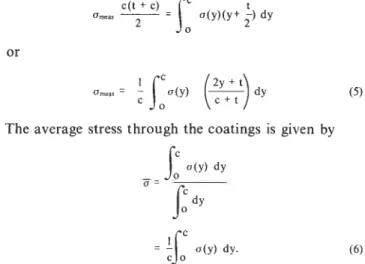
In conventional analysis,5 the stress, a, through the
coating is considered constant and the resultant bending moment per unit width, m, of coating is given by
where t = thickness of metal shim
c = coating thickness.
Deflection, d, a t a distance, t
,
along the bent cantilever -can also be expressed in terms of the bending moment, m,where E = Young's modulus of the metal shim and
v = Poisson's ratio of the metal shim.
S.G. CROLL
stress if different substrate thicknesses are used. The case where internal stress varies linearly within the coating has been analyzed in more and equations have been presented that permit the stress profile to be determined from the results on different substrate thicknesses. Such a procedure must be used cautiously, since the analysis is an approximation and the experimental error can easily be greater than 10%.
Mechanical Properties
I
L
C O A T I N G T H I C K N E S S . p mThe modulus of the cured resin was found by com- Figure 1-Measured residual internal stress as a function of
coating thickness pressing small cylinders 5 mm in diameter and 4 mm in
length. Graphite was used to lubricate their end faces and to reduce the friction ~ r o d u c e d as the cross section changed under increasing load. After loading to a strain of 5 x deformation was maintained constant while Combining equations (1) and (2) results in the con-
ventional expression for internal stress: stress was allowed to relax for two days, when it reached approximate equilibrium. The relaxed stress was used to calculate modulus because it more closely corresponds to
d E t 3
u =
3cP2 (t + c)(l - u ) (3)
This equation is an approximation4 that seems to be ade- quate for the experiment. In the moregeneral case, where stress varies through the coating, the bending moment is given by
the state in the coating at which internal stress has reached its final value.
The stress relaxation modulus was found to be 0.78 (k0.05) GPa. Young's modulus (i.e., at short times) was found to be 2.8 GPa (comparable to quoted values8) and Poisson's ratio was assumed to be 0.34 GPa.
Cylinders used for these experiments were prepared by casting in appropriately shaped PTFE molds. Before use, they were conditioned at 23OC and 50% R H for at least four weeks. Modulus measurements were taken in com- pression because the cast resin proved to be very brittle in tension. Mechanical testing in compression did not open cracks and precipitate brittle failure. There seemed to be
t
m = J~u(Y)(Y + d y (4) following the scheme of Kornum,6 where (y + i) is the distance from the neutral axis (Figure 3).
If internal stress varies through the coating, applying equation (3) will give a measure of the internal stress,
a,,,,, equivalent in equation ( 1 ) to no other effect of sample geometry or testing conditions.
Weight Gain During Cure
1
If equation (4) is combined with equation l(a), then a,,,,
represents It is known that epoxy resins and DETA absorb a n
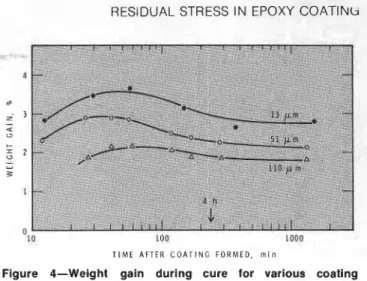
appreciable amount of water. This could very well affect the magnitude of the internal stress. Consequently, the weight change of coatings of varying thickness was moni- tored as a function of time during the curing process. The coatings were about 6 10-3m2 in area and typically weighed 0.4 gm, weighed on a balance capable of measur- ing 0.1 mg changes. Results are plotted in Figure 4.
The average stress through the coatings is given by
= u(y) dy.
C 0
Provided t is much larger than c, which is normally true, then the measured internal stress, a,,,,, is very close to the average internal stress,
a.
One can see, random experimental error permitting, that there should be a systematic change in the measured
TIME, h
Figure 2-Evolution of internal stress for various coating thicknesses
Temperature Rise During Cure
THIN COATINGS: The curing of Epon 828 by DETA is an exothermic reaction that can produce considerable temperature rise in a bulk mixture. Temperature changes in typical coatings were measured to determine whether there is a significant temperature increase that would influence internal stress behavior. One thermistor was supported (Figure 5) in a blackened insulating shield a fraction of a millimeter above the surface of the coating. Another was placed in thermal contact (via heat conduct- ing grease) with the substrate, 25 p m brass shim. The substrate was thin so that it would conduct heat to its thermistor more easily. The shield was blackened so that any heat escaping from the top of the coating was, to some extent, retained in the medium surrounding the top thermistor and not reflected back. The thermistors were connected to a strip chart recorder via a YSI (Yellow- stone Springs Instrument) Model 43 T D Telethermom- eter with a n output of 2.4 mVI°C. Thus, O.l°C tempera- ture change would be easily detected.
After the normal 20 min wait before coating, the 25- gram mixture was found to be at 40°C. After being trans- ferred via a metal spoon and spread in a thin coating, however, the maximum temperature increase recorded by the thermistors was about 1°C, which disappeared in about 10 min. There was no further apparent tempera- ture increase, even in coatings of 150 pm thickness, although the coatings were still liquid and undergoing the curing reaction.
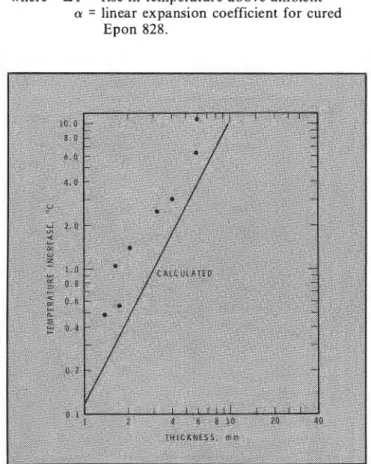
THICK COATINGS: The temperature rise in thick coat- ings,
>
1 mm, was appreciable and was measured by incorporating a thermocouple (36 SWG) in the epoxy mixture. The test samples were cured in aluminum foil cups 50 mm in diameter; the thermocouple was placed as close as possible to the center of the area and thickness of the mixture. Increases of a few degrees were detected. Figure 6 shows the results as a function of thickness. DISCUSSIONThe results in Figure 1 show, for Epon 828 and DETA at least, that residual internal stress is small at all coat- ing thicknesses. One would not expect it t o precipitate failure. It also shows that internal stress is a function of coating thickness, implying that it varies throughout the coating depth. Random experimental error masks any systematic trend there might be with substrate thickness.
Figure 3-Schematic diagram of bending cantilever experiment
RESIDUAL STRESS IN EPOXY COATlhcrj
I > p m
5: pr
! I n LL'
10 irmn : 1 I!. c
TIME A F T E R C O A T I N G F O R M E D , m i n
Figure 4-Weight gain during cure for various coating thicknesses
Stress varies rather slowly with thickness, so that one should expect the value obtained to be a good measure of average internal stress, although in thicker coatings the approximation will be less close.
Thin Coatings
Below a coating thickness of 50 to 60 pm, the stress appears to be negative, i.e., compressive, confirming Dannenberg's results.3 The cantilever deflected upwards, possibly because of swelling of the coating or-loss in weight. In fact, curing coatings actually gained weight (Figure 4), probably owing to water absorption. Thinner coatings gain proportionally more weight, because the water can diffuse through more of the coating before it cures and becomes comparatively impermeable. The compressive stress must be due to swelling by some means.
It was observed (Figure 2) that compressive stress de- veloped quickly and was the precursor of a positive stress in thicker coatings. As the maximum rate of curing in epoxies occurs initially,9 it might be supposed that com- pressive stress is due to thermal expansion of the epoxy or cantilever from the exothermic reaction. No such tem- perature increase was observed, however, and one would expect this stress to disappear upon cooling. In fact, the internal stress appears to be permanent and, so, a thermal origin for this stress is unlikely.
The swelling must be caused by water absorption. The thin coatings absorb about 3% of their weight by water, although it is not reflected in the magnitude of the stress. A value of 5 x lo4 P a (a reasonable value for compressive stress) corresponds to a linear strain of 4.2 x or a bulk strain (swelling) of 1.3 x This is a very small amount of swelling. It would occur while most of the mixture is still liquid and one would not expect the in- ternal stress to be equivalent t o the total volume of water absorbed. Possibly, there may be a viscous contribution to the development of the stress, since the initial rate of water absorption is rather rapid and the crosslinking mixture becomes very viscous quite quickly. No attempt to calculate viscous stress will be made here, however.
Thick Coatings
As coating thickness increases from about 60 pm, the value of residual stress is positive and increasing. One
S.G. CROLL
Figure 5-Detection of temperature increases in curing coating
might expect this to be a n effect produced by differential thermal expansion between the epoxy and the cantilever substrate. A positive internal stress would be produced because the epoxy would heat while a liquid and cool after solidifying when the reaction was complete. The thicker the coating, the hotter it would become, because the heat could not escape so easily. Thus the increase in stress with thickness would be explained.
In order to calculate the temperature rise necessary to produce this stress, the linear expansion of the cured epoxy was measured in a duPont 941 thermomechanical analyzer and found to be 5.4 x I O - ~ / " C at 23°C and 50% RH. For the steel substrate the value is 1.1 x
I O - ~ / " C . Assuming that the system hardens at a n ele- vated temperature, the thermal strain, E , produced upon
cooling is given by
t = ( Y A T (7)
where AT = rise in temperature above ambient
a = linear expansion coefficient for cured Epon 828.
Figure 6-Temperature rise in thick epoxy films due to exo- thermic cure, experimental and calculated values
The strain can be calculated from the internal stress by using, in this plane stress situation,
where E = modulus of Epon 828
v = Poisson's ratio of Epon 828.
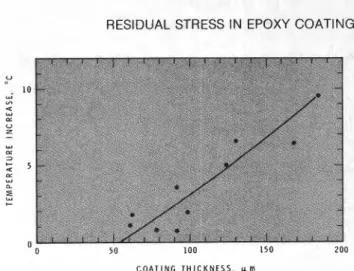
Using the values of E, v, and a! results in temperature
increases of a few degrees (Figure 7).
Although the temperature detection equipment was not sophisticated and no such temperature increases were noted, one of 6°C (- 120 pm) should have been detected. Table 1 gives the predicted temperature increase in these circumstances and confirms the experimental findings that temperature rise is negligible. The heat transfer anal- ysis is dealt with in the next section.
One must conclude that residual stress in room tem- perature-cured Epon 828 has nothing to d o with the exothermic nature of the curing.
Epoxy resins densify upon curing and residual stress would reflect the increase in density after solidification takes place. If water can diffuse only a finite distance into the coating before it cures completely, thicker coatings would show a greater average internal stress, because a smaller proportion would be swollen by water. This is confirmed by the plot of weight gained (water absorbed) during cure (Figure 4). Thicker coatings absorb propor- tionally less water. Competition between a finite water- swollen layer and the denser remainder of the coating produces the increase in stress with thickness.
Presumably, a t coating thicknesses below -50 pm, water can completely penetrate the epoxy in the time before cure, resulting in a compressive stress that is inde- pendent of thickness. The residual internal stress results from the change in density from the solidification point to the completely cured state. For such small values of stress, the corresponding change in density is very small. For example, a positive residual stress of 0.5 M P a
corresponds to a strain of 4.23 representing a
relative change in density of three times this value (bulk strain), i.e., 1.27 x which is very small. Such a change in density would be very difficult t o measure as a function of coating thickness.
Temperature Increase in Coatings
No measurable temperature increases resulting from exothermic curing were found experimentally, even in very thick coatings ( - 150 pm). An approximate heat transfer calculation is presented here to show that this is what one might expect. The analysis is one dimensional because the heat lost through the edges of a typical coating will be negligible compared t o that lost through the top and bottom surfaces.
The increase in temperature of the epoxy/unit time
/
unit volumeRESIDUAL STRESS IN EPOXY COATING
where C , = specific heat
p = density T = temperature
t = time
I
The heat conducted away in the x directionI
a2T
= K s
where K = thermal conductivity.
The conversion of Epon 828 by DETA is assumed here to be a first order reaction, i.e., the conversion is expo- nential in time. The detailed curing kinetics of such sys- tems is discussed el~ewhere,~ but this assumption pro- vides a reasonable approximation with which it is simple to deal.
The total heat produced, therefore, after a given time per unit volume
I
= A H p (1 - e-"').Differentiating gives the rate of supply of heat per unit volume
= A H p he-AL
where AH = heat of reaction
A = time constant governing the reaction. Strictly, A should increase with temperature for a ther- mally activated process, but, since the temperature rise is small, this complication is ignored. Thus, the increase in temperature is given by the equation
which is the normal heat diffusion equation, plus a term on the right side representing the internal heat source of the exothermic reaction. The solution of this equation is presented in Appendix A, together with the boundary conditions assumed.
t
The temperature rise, averaged over the thickness of the coating, is given as a function of time by
and the temperature rise in the middle of the coating by
where /3 and A' are combinations of the parameters used in equation (9) (Appendix A).
Figure 6 gives the rise in temperature necessary to ex- plain the measured (average) residual stress in the coat- ings. Table 1 gives the highest predicted temperature increase as a function of coating thickness from equation (10). As one can see, the predictions are about three orders of magnitude lower than the datain Figure 6. This confirms the experiments, which could not detect any temperature rise, even up to 150 pm thick coatings. This implies that there should be no acceleration in curing as a result of internal heating at these typical coating thicknesses.
C O A T I N G T H I C K N E S S . p m
Figure 7-Temperature rise necessary for residual stress to have thermal origin
The temperature increases recorded in the thick
(> 1 mm) coatings can be used to check the accu- racy of the analysis. Equation (11) can predict the highest temperature, during cure, in the center of the coating. The predictions are displayed in Figure 6 as the solid line. As may be seen, the prediction is a factor of two to three too small, but the disparity is acceptable considering the simplifications and boundary conditions assumed. Nevertheless, it still allows the analysis to confirm the experimental finding that tem- perature rise in coatings up to 150 pm thick is negligible.
CONCLUSIONS
The residual internal stress in this solventless, amine- cured epoxy system depends on the thickness of the coating. Variation is so slight that the measured stress probably represents average stress even in thicker coatings. Below 55 pm thickness, the stress is small and compressive and almost independent of thickness. Above this value it is tensile and increases gently with coating thickness. This variation is the result of two competing processes during cure: first, shrinkage due to structural change induced by conversion; and second, production of a slightly swollen layer due to absorption of water, etc., from the atmosphere. Indeed, the experimental results depended strongly on the ambient humidity, presumably owing to plasticization by absorbed water.
All of the recorded values of residual stress are quite small, particularly in thin coatings (< 55 pm), and
- - - --
Table 1-Predicted Temperature Increase as a Function
Of Coating Thickness [Equation (lo)] Coating Thickness,
Ccm
Temperature Rise, OC
S.G. CROLL
probably do not significantly influence the performance (2) Zubov, P.I. and Sukhareva, L.A., "Physicochemical Ways of
of this particular coating system, Epon 828 and DETA. Lowering Internal Stresses with the Formation of Polymer Coat-
ings," Colloid J. USSR, 38, No. 4, 587-598 (1977).
No temperature increase due to exothermic conversion
could be detected in coatings up to 150 pm thick, and this (3) Dannenberg, H., "Determination of Stresses in Cured Epoxy
is confirmed by calculation, using a simple heat transfer Resins," SPE J., 21, No. 7, 669-675 (1965).
analysis. Consequently, internal stress is not thermal in (4) Croll, S.G., "Internal Stress in a Solvent-Cast Thermoplastic origin and neither will the rate of cure be accelerated by Coating," JOURNAL OF COATINGS TECHNOLOGY, 50, NO. 638,
this means. 33-38 (1978).
Temperature changes could be detected in systems (5) Corcoran, E.M., "Determining Stresses in Organic Coatings
greater than 1 mm thick and these were used to check the Using plate Beam Deflection," JOURNAL OF PAINT TECHNOLOGY, heat transfer calculation, which proved to be within a 41, NO. 538, 635-640 (1969).
factor of two to three. (6) Kornum, L.O., NIF report T 9-75M, Scandinavian Paint and
Printing Ink Research Institute, 1975.
(7) Saarnak, A,, Nilsson, E., and Kornum, L.O., "Usefulness of the ACKNOWLEDGMENT Measurement of Internal Stresses in Paint Films," J. Oil Colour Chemist's Assoc., 59, No. 12, 427 (1976).
This paper is a contribution from the Division of (8) Lee, H. and Nevllle, K., "Handbook of Epoxy Res~ns", Chapter 6, Building Research, National Research Council of Can- McGraw-Hill Inc., New York, 1967.
ads'
and is with the of the Director of (9) Olcese, T., Spelta, O., and Vargiu, S., "Curing Kinetics of Epoxy the Division. Resins," J. Polymer Sci. Polymer Symposia, No. 53, 113-126(1975).
(10) Kanari, K. and Ozawa, T., "Thermal Conductivity of Epoxy References Resins Cured with Aliphat~c Amines," Polymer J., 4, 372-378
(1974). (1) Zubov, P.I., Kadyrov, M. Sh., Grozinskaya, Z.P.,and Smirnova,
Yu. P., "Effect of Internal Stresses on the Wear Resistance of (I I) Crank, J., "The Mathematics of Diffusion", Chapter 2, Clarendon Epoxy Coatings," Polymer Mech. USSR, I , No. 2,93-96(1965). Press, Oxford, 1967.
APPENDIX A
Solution of heat transfer equation (equation (9)) To simplify, the temperature variable can be recast as the sum of a constant and a changing component
a T
a Z ~
C p p - = K y + A H P h e - " T = To + AT(x, t)
a t a x
AT - 1 aAT
thus, -
This equation does not admit to heat loss through mass trans- a x 2 (I a t (A 2)
fer, i.e., convection. If some of the constants arecombined such
that Denoting the Laplace transform of AT(t) by ~ ( s ) , equation
K (A 2) becomes, when transformed,
(I=- , thermal diffusivity
PCP
--
a27
-- s r-
- ~ pa x z a
-
(Y(S + A) (A 3)AH
P = -, temperature rise if there is no heat loss,
CP Equation (A 3) is a simple differential equation with the solution
equation (9) can be rewritten as = Ce-qx + Detqx +
-
h as(s + A)
a 2 ~
1 a T-=--
-
Ape-"' where q = (sla) and C and D must be determined from thea x Z a a t (A boundary conditions.
BOUNDARY CONDITIONS
Choose x such that the middle of the coating is the origin (i) Assume that heat loss is identical through the top and bot-
(x = 0), then the top and bottom surfaces of the coating are at tom faces so that at x = f h, AT = 0, i.e., T = To, and similarly x = f h r = 0 at x = f h. This choice probably lowers the temperature
in the coating; one would expect a finite temperature gradient across the interface. It does, however, allow a n algebraic solu- tion to be obtained. In any case, it may compensate for the denial of heat loss by convection.
(ii) From (i), it follows by symmetry that a t the middle of the
a
ATa~
coating x = 0, - and, thus, - must be zero.
a x ax
Using the two conditions, C and D can be found quite readily
and the full solution is
Ap coshqx Ap
T = - -
-
+-s(s + A) cosh qh s(s + A) (A 4)
When transformed back, knowing the Inverse Transform" of
1 cosh qx
- and -
s + A s.coshqh
and using the convolution relation that
r
tJ
0 F ( t - u)G(u)du is the inverse Laplace TransformRESIDUAL STRESS IN EPOXY COATING
of f(s)
.
g(s) if f(s) and g(s) are the Transforms of F({) andG(t), respectively. Thus,
where
and equation (1 I) can be readily obtained by setting x = 0.
The average temperature change over the coating thickness is given by
the expression for the average temperature change over the coating thickness is obtained, i.e., equation (10).
This publication is being distributed by the Division of Building Research of the National Research Council of Canada. It should not be reproduced in whole or in part without permission of the original publisher. The Division would be glad to be of assistance in obtaining such permission.
Publications of the Division may be obtained by mailing the appropri- ate remittance (a Bank, Express, or Post Office Money Order, or a cheque, made payable to the Receiver General of Canada, credit NRC) to the National Research Council of Canada, Ottawa. KIA 0R6. Stamps are not acceptable.
A list of all publications of the Division is available and may be obtained from the Publications Section, Division of Building Research, National Research Council of Canada, Ottawa. KIA 0R6.