Publisher’s version / Version de l'éditeur:
Vous avez des questions? Nous pouvons vous aider. Pour communiquer directement avec un auteur, consultez la première page de la revue dans laquelle son article a été publié afin de trouver ses coordonnées. Si vous n’arrivez pas à les repérer, communiquez avec nous à [email protected].
Questions? Contact the NRC Publications Archive team at
[email protected]. If you wish to email the authors directly, please see the first page of the publication for their contact information.
https://publications-cnrc.canada.ca/fra/droits
L’accès à ce site Web et l’utilisation de son contenu sont assujettis aux conditions présentées dans le site LISEZ CES CONDITIONS ATTENTIVEMENT AVANT D’UTILISER CE SITE WEB.
Canadian Building Digest, 1981-11-01
READ THESE TERMS AND CONDITIONS CAREFULLY BEFORE USING THIS WEBSITE.
https://nrc-publications.canada.ca/eng/copyright
NRC Publications Archive Record / Notice des Archives des publications du CNRC :
https://nrc-publications.canada.ca/eng/view/object/?id=116ad64b-4411-4524-975d-c67611abb254
https://publications-cnrc.canada.ca/fra/voir/objet/?id=116ad64b-4411-4524-975d-c67611abb254
NRC Publications Archive
Archives des publications du CNRC
For the publisher’s version, please access the DOI link below./ Pour consulter la version de l’éditeur, utilisez le lien DOI ci-dessous.
https://doi.org/10.4224/40000692
Access and use of this website and the material on it are subject to the Terms and Conditions set forth at
Thermoplastic pipe
Canadian Building Digest
Division of Building Research, National Research Council Canada
CBD-220
Thermoplastic Pipe
Please note
This publication is a part of a discontinued series and is archived here as an historical reference. Readers should consult design and regulatory experts for guidance on the applicability of the information to current construction practice.
Originally published November 1981. A. Blaga
The principal plastic piping material, with respect to both quantity used and range of
applications, is thermoplastics. This class of materials includes many that differ significantly in their properties, characteristics and suitability for various uses. Thus, the designer and user should become familiar with the nature of these different materials to avoid misapplications. This Digest, which describes briefly the major thermoplastics used in piping, is a sequel to an earlier Digest explaining the general use of plastics as piping material1.
General
Thermoplastics are widely used, primarily because of their low cost and great ease of fabrication (usually by extrusion). This has fostered considerable laboratory and field experience and provided a wide body of general knowledge, technical data and
recommendations on the design, installation, use, limitations, and physical and chemical properties of common thermoplastic piping materials2-6.
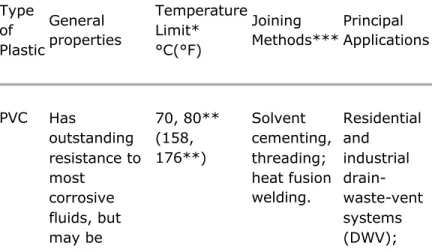
The most common thermoplastics used in piping systems are poly(vinyl chloride) (PVC), polyethylene (PE), acrylonitrile-butadiene-styrene (ABS) and polybutylene (PB). The typical properties and general characteristics and applications of thermoplastic pipe are summarized in Tables I and II.
Table I. General properties and applications of some thermoplastic pipe.
Type of Plastic General properties Temperature Limit* °C(°F) Joining Methods*** Principal Applications PVC Has outstanding resistance to most corrosive fluids, but may be 70, 80** (158, 176**) Solvent cementing, threading; heat fusion welding. Residential and industrial drain-waste-vent systems (DWV);
damaged by keytones aromatic and some chlorinated hydrocarbons. Has greater strength and rigidity than most other thermoplastic pipes. sewerage systems; potable water systems and well casings; industrial and chemical process piping; electrical conduit. CPVC Has same properties as PVC, but can be used at higher temperatures. 100 (212) Can be joined by the same methods as PVC Although it is suitable for the same piping applications as Type I PVC, because of higher cost CPVC is used mostly in hot fluid applications. PE Although it has relatively low mechanical strength, it exhibits very good chemical resistance; it is flexible at very low temperatures. 60, 90** (140, 194**) Insert fitting (metal and plastic) with clamps; heat fusion welding. Potable water systems, irrigation and sprinkler systems, drainage, corrosive chemical transport, gas distribution and electrical conduit. ABS The pipe is
rigid and has
70, 80** (158, Solvent cementing, DWV systems;
high impact resistance down to -40°C; resistant to household chemicals. 176**) threading (heavy wall only); variety of mechanical seal devices. potable water systems; irrigation, sewer systems, sewage treatment plants. PP Has outstanding chemical resistance and good high-temperature properties. 90** (194**) Heat fusion welding; threading. Chemical waste drainage systems, natural gas and oil field.
* Maximum operating temperature. ** Non-pressure piping.
*** Plastic pipes can also be joined by a variety of mechanical devices.
Poly(vinyl chloride) (PVC)
This plastic has the broadest range of applications in piping systems and its use has grown more rapidly than that of other plastics. PVC has good chemical resistance to a wide range of corrosive fluids, but may be damaged by ketones, aromatic and some chlorinated hydrocarbons (Table I). There are two principal types of PVC used in the manufacture of pipe and fittings, Type I and Type II (ASTM D 1784). Type I, also called unplasticized or rigid PVC, contains a minimum of processing aids and other additives and has maximum tensile and flexural
strength, modulus of elasticity, and chemical resistance; however, it is more brittle. It also has a maximum service temperature under stress of about 65°C (150°F), lower thermal expansion than Type II, and does not support combustion. Type II PVC, which is modified with rubber to render it less rigid and tougher, is also called high-impact, flexible or non-rigid PVC. It has lower tensile and flexural strength, lower modulus of elasticity, lower heat stability and less chemical resistance than Type I. The improvements made through research and the availability of product standards for special uses have increased its acceptance by designers, contractors and building code officials2-4. PVC pipe is available in both schedule number, which is
determined by the expression 1000 x P/S, where P is the service temperature and S, the allowable stress (both expressed in the same units) and standard dimension (SDR) sizes, obtained by dividing the outside diameter of the pipe by its wall thickness. It is used in drain-waste-vent (DWV) applications, in storm, sanitary, water-main, and natural gas distribution, and in industrial and process piping. The fastest growing application in North America is currently for municipal water and sewerage systems. PVC pipe is also used as a conduit for wiring (both electrical and communications).
The basic resin in this plastic is made by post-chlorination of PVC. CPVC has essentially the same properties as Type I PVC material, but has the added advantage of withstanding
temperatures up to 100° C (212°F), approximately 33 deg C (59 deg F) more than PVC plastic. Although it is suitable for the same piping applications as Type I PVC, the higher cost of CPVC restricts its use to that of conveying hot fluids. A plumbing system in which CPVC pipe of the same diameter as copper pipe is used for water distribution lines can handle 690 kPa (100 psi) working pressure at 82°C (180°F). Consequently, CPVC pipe is now replacing copper pipe in many areas of Europe and the U.S.A.
Polyethylene (PE)
Pipe made from PE has a relatively low mechanical strength (Table II), but exhibits good chemical resistance and flexibility and is generally satisfactory for use at temperatures below 50°C (122°F). The temperature limitation is, however, offset by good flexibility retention down to -55°C (-67°F). Polyethylene piping plastics are classified into three types on the basis of density: low density (Type I), medium density (Type II) and high density (Type III). The most popular are Types II and III. The mechanical strength, chemical resistance and temperature resistance increase with density, whereas creep diminishes as the density increases.
PE pipe is available in both schedule number and standard dimension (SDR) sizes. Its principal applications are: irrigation and sprinkler systems, drainage, chemical transport, gas distribution pipe and electrical conduit systems.
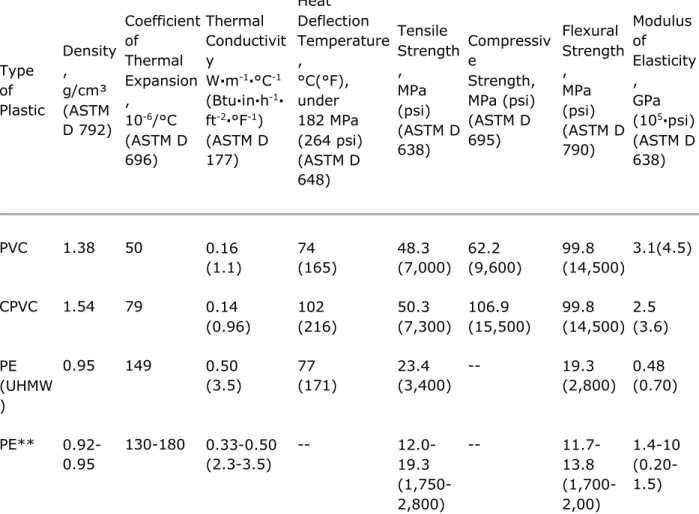
Table II. Typical properties* of common thermoplastic pipe materials.
Type of Plastic Density , g/cm³ (ASTM D 792) Coefficient of Thermal Expansion , 10-6/°C (ASTM D 696) Thermal Conductivit y W·m-1·°C-1 (Btu·in·h-1· ft-2·°F-1) (ASTM D 177) Heat Deflection Temperature , °C(°F), under 182 MPa (264 psi) (ASTM D 648) Tensile Strength , MPa (psi) (ASTM D 638) Compressiv e Strength, MPa (psi) (ASTM D 695) Flexural Strength , MPa (psi) (ASTM D 790) Modulus of Elasticity , GPa (105·psi) (ASTM D 638) PVC 1.38 50 0.16 (1.1) 74 (165) 48.3 (7,000) 62.2 (9,600) 99.8 (14,500) 3.1(4.5) CPVC 1.54 79 0.14 (0.96) 102 (216) 50.3 (7,300) 106.9 (15,500) 99.8 (14,500) 2.5 (3.6) PE (UHMW ) 0.95 149 0.50 (3.5) 77 (171) 23.4 (3,400) -- 19.3 (2,800) 0.48 (0.70) PE** 0.92-0.95 130-180 0.33-0.50 (2.3-3.5) -- 12.0-19.3 (1,750-2,800) -- 11.7-13.8 (1,700-2,00) 1.4-10 (0.20-1.5)
ABS 1.04 101 0.20 (1.4) 92 (198) 37.9 (5,500) 53.1 (7,700) 68.9 (10,000) 2.1 (3.1) PP 0.91 68 0.19 (1.3) 66 (151) 33.8 (4,900) 58.6 (8,500) 58.6 (8,500) 1.0 (1.5)
* These data represent average values; pipe materials differ in properties, depending on formulation and manufacturing process (6).
** Low, medium and high density (Type II and Type III).
Specialty PE Pipes
A relatively new development in PE piping is the introduction of ultrahigh molecular weight (UHMW) PE and cross-linked PE plastic piping materials. The UHMW PE has considerably higher resistance to stress-cracking but is more costly than conventional PE piping material. It offers an extra margin of safety when used in sustained pressure conditions in comparison with pipe made from lower molecular weight resin. It is suitable for certain applications in the chemical industry where stress-cracking resistance has been a limiting factor for the conventional PE pipe.
Cross-linked PE piping material, when compared to ordinary PE pipe, displays greater strength, higher stiffness and improved resistance to abrasion and to most chemicals and solvents at elevated temperatures up to 95°C (203°F). Pipe made from cross-linked PE also has high-impact resistance even at sub-zero temperatures. It is used in applications too severe for ordinary PE pipe. The joining technique used is threading.
Acrylonitrile-butadiene-styrene (ABS)
ABS plastic is a copolymer made from the three monomers described in the heading, and contains at least 15 per cent of acrylonitrile. It is a rigid plastic with good impact resistance at lower temperatures down to -40°C (-40°F) and can be used at temperatures up to 80°C (176°F). ABS is utilized mainly for drain-waste-ventilation (DWV) pipe and fittings but it is also used in solvent cement for installing pipe in various applications. ADS pipe can be joined by solvent welding or threading.
A new development in the ABS-DWV piping industry is the co-extruded foam-core ABS pipe. It consists of a foam core sandwiched between solid skins and can be used for sewer, conduit and duct pipe. The foam-core pipe, with its lower resin requirements, could make ABS more price-competitive with existing materials in these applications.
Polybutylene (PB)
Polybutylene piping has practically no creep and has excellent resistance to stress cracking. It is flexible, and in many respects similar to Type III polyethylene, but is stronger. Polybutylene plastic piping is relatively new, and thus far its use has been limited to the conveyance of natural gas and to water distribution systems. Its high temperature grade can resist temperatures of 105-110°C (221-230°F).
Polypropylene (PP)
Polypropylene-based piping is the lightest-weight plastic material (density = 0.90 g/cm³) and generally has better chemical resistance than other plastics. PP is used in some pressure piping applications, but its primary use is in low pressure lines. Polypropylene plastic pipe is used for chemical (usually acid) waste drainage systems, natural-gas and oil-field systems, and water
lines. The maximum temperature for non-pressure piping is 90°C (194°F). Pipe lengths are joined by heat fusion, threading (i.e., with heavy pipe) and mechanical seal devices.
Other thermoplastics
Other thermoplastics used in the manufacture of pipe include poly(vinylidene chloride),
poly(vinylidene fluoride), cellulose acetate butyrate (CAB), acetal homopolymer resins, rubber-modified systems, polytetrafluoroethylene (PTFE), and fluorinated ethylene-propylene (FEP) copolymer. All of these materials are relatively expensive and are used only for very special applications.
References
1. Blaga, A., Use of plastics as piping materials, Division of Building Research, National Research Council of Canada, Ottawa, 1981 (CBD 219).
2. Wyly, R. S. et al., Investigation of standards, performance characteristics and evaluation criteria for thermoplastic piping in residential plumbing systems, National Bureau of Standards (NBS), US Dept. of Commerce, NBS Building Science Series 111, Washington, D.C., 1978.
3. Crowder, J. R. and Rixon, R., Trial of plastic pipes for hot-water services, British Plastic 40, 1161, 1967.
4. Hucks, R. T., Jr., Performance of PVC pipe in water distribution systems, Modern Plastics 40 , 112, 1972.
5. Kent, A. D., Plastic pipe in buildings, Housing Note No. 26, National Research Council of Canada, Division of Building Research, Ottawa, 1973.