HAL Id: ensl-00175477
https://hal-ens-lyon.archives-ouvertes.fr/ensl-00175477
Submitted on 28 Sep 2007
HAL is a multi-disciplinary open access
archive for the deposit and dissemination of
sci-entific research documents, whether they are
pub-lished or not. The documents may come from
teaching and research institutions in France or
abroad, or from public or private research centers.
L’archive ouverte pluridisciplinaire HAL, est
destinée au dépôt et à la diffusion de documents
scientifiques de niveau recherche, publiés ou non,
émanant des établissements d’enseignement et de
recherche français ou étrangers, des laboratoires
publics ou privés.
Non-Gaussian and Long Memory Statistical
Characterisations for Internet Traffic with Anomalies
Antoine Scherrer, Nicolas Larrieu, Philippe Owezarski, Pierre Borgnat,
Patrice Abry
To cite this version:
Antoine Scherrer, Nicolas Larrieu, Philippe Owezarski, Pierre Borgnat, Patrice Abry. Non-Gaussian
and Long Memory Statistical Characterisations for Internet Traffic with Anomalies. IEEE
Transac-tions on Dependable and Secure Computing, Institute of Electrical and Electronics Engineers, 2007,
4 (1), pp.56-70. �ensl-00175477�
Non-Gaussian and Long Memory Statistical
Characterizations for Internet Traffic
with Anomalies
Antoine Scherrer, Student Member, IEEE, Nicolas Larrieu, Philippe Owezarski,
Pierre Borgnat, Member, IEEE, and Patrice Abry, Member, IEEE
Abstract—The goals of the present contribution are twofold. First, we propose the use of a non-Gaussian long-range dependent process to model Internet traffic aggregated time series. We give the definitions and intuition behind the use of this model. We detail numerical procedures that can be used to synthesize artificial traffic exactly following the model prescription. We also propose original and practically effective procedures to estimate the corresponding parameters from empirical data. We show that this empirical model relevantly describes a large variety of Internet traffic, including both regular traffic obtained from public reference repositories and traffic containing legitimate (flash crowd) or illegitimate (DDoS attack) anomalies. We observe that the proposed model accurately fits the data for a wide range of aggregation levels. The model provides us with a meaningful multiresolution (i.e., aggregation level dependent) statistics to characterize the traffic: the evolution of the estimated parameters with respect to the aggregation level. It opens the track to the second goal of the paper: anomaly detection. We propose the use of a quadratic distance computed on these statistics to detect the occurrences of DDoS attack and study the statistical performance of these detection procedures. Traffic with anomalies was produced and collected by us so as to create a controlled and reproducible database, allowing for a relevant assessment of the statistical performance of the proposed (modeling and detection) procedures.
Index Terms—Traffic statistical modeling, DoS attack, flash crowd, non-Gaussian long-range dependent process.
Ç
1
M
OTIVATIONT
HE Internet is becoming the universal communicationnetwork, conveying all kinds of information, ranging from the simple transfer of binary computer data to the real-time transmission of voice, video, or interactive informa-tion. Simultaneously, the Internet is evolving from a single best effort service into a multiservice network, a major consequence being that it becomes highly exposed to attacks, especially to denial of services (DoS) and distrib-uted DoS (DDoS) attacks. DoS attacks are responsible for large changes in traffic characteristics which may, in turn, significantly reduce the quality of service (QoS) level perceived by all users of the network. This may result in breaking of the service level agreement, with the Internet Service Provider being at fault, potentially causing major financial losses for them.
Detecting and reacting against DoS attacks is therefore a major issue that is continuously receiving numerous research efforts. However, this is also a difficult task and current intrusion detection systems (IDS), especially those based on anomaly detection from profile, often fail in detecting DDoS attacks efficiently. This can be explained via different lines of arguments. First, DDoS attacks can take a
large variety of forms so that proposing a common definition is in itself a complex issue. Second, it is commonly observed that Internet traffic under normal conditions presents per se, or naturally, large fluctuations and variations in its throughput at all scales [1], often described in terms of scaling [2], long memory [3], self-similarity [4], and multifractality [5]. Such properties significantly impair anomaly detection procedures by decreasing their statistical performance. Third, Internet traffic may exhibit strong, possibly sudden, however legitimate, variations (flash crowds, for instance, such as the notorious Slashdot effect) that may be hard to distinguish from illegitimate ones. Fourth, profile-based IDS generally do not rely on the use of rich enough statistical models that correctly account for the large variability of traffic. They are mainly based on monitoring simple traffic parameters, such as its throughput or packet rate, and most IDS make use of specific packet sequences known as attack signatures [6]. Alarms are raised whenever a threshold is reached [7], [8], [9], [10], often yielding a significant number of false positives [11], a major short-coming for their actual use. The current evolution of Internet traffic, allowing for a larger variety of traffic and diversity of communication, results in an increase of difficulties to design efficient IDS.
Recently, various Internet traffic monitoring projects have obtained important improvements in traffic modeling. Mostly, they have better taken into account the large variability and scaling properties mentioned above via the use of richer statistics of the traffic, such as correlation functions or spectra. This has significantly renewed IDS
. A. Scherrer, P. Borgnat, and P. Abry are with the Laboratoire de Physique, ENS de Lyon, 46 alle´e d’Italie, 69364 Lyon cedex 07, France.
E-mail: {antoine.scherrer, pierre.borgnat, patrice.arby}@ens-lyon.fr. . N. Larrieu and P. Owezarski are with LAAS-CNRS, 7 avenue du Colonel
Roche, 31077 Toulouse Cedex 4, France. E-mail: {nlarrieu, owe}@laas.fr. Manuscript received 5 Aug. 2005; revised 8 June 2006; accepted 12 Sept. 2006; published online 2 Feb. 2007.
For information on obtaining reprints of this article, please send e-mail to: [email protected], and reference IEEECS Log Number TDSC-0109-0805.
design strategies. For instance, Ye relied on a Markov modeling of the traffic time behavior [12]. Other authors have shown that DDoS attacks increase correlations in traffic and indicated that a robust detection technique can be based on this observation [13], [14]. Making use of traffic intercorrelation across different links, Lakhina et al. have proposed a method for detecting network wide anomalies using traffic matrices [15]. Hussain et al. have defined spectral density signatures for attacks [16]. Similarly, spectral estimation has been used for comparing traffic with and without attacks [17]. While spectral densities exhibit peaks around the Round Trip Time values for regular traffic, such peaks tend to disappear under attacks, and this observation can then be used for IDS design. Finally, Li and Lee used the wavelet technique developed in [18] to compute a so-called energy distribution; it was observed that this energy distribution presents peaks under attacks that do not exist for regular traffic [19]. Works in [20], [21] exploit the multiresolution nature of wavelet decompositions to track and detect traffic anomalies in a so-called medium range of scales.
The present contribution, conducted in the framework of the METROSEC (Metrology for Security) project (see http://www.laas.fr/METROSEC), continues along this re-search line. It is organized around two major goals: Internet traffic statistical modeling and attack detection. Mainly, it aims at analyzing the impact of anomalies on the (para-meters) of the statistical modeling as well as at determining discriminative profile signatures for traffic containing legitimate (e.g., flash crowds) and illegitimate (e.g., DDoS attacks) anomalies. First, a long-range dependent non-Gaussian stochastic process is introduced and argued for. Its definition and properties, together with numerical synthesis and parameter estimation procedures, are fully worked out in Section 3. Section 4 shows that this model describes, accurately and relevantly, both a wide variety of Internet traffic time series (available from major public international trace repositories) and traffic containing anomalies (generated by ourselves), be they legitimate or not. The originality of the proposed statistical modeling lies in its multiresolution nature (several aggregation levels !s are jointly analyzed). It provides us with robust statistics (the evolution of the model parameters with respect to !), jointly taking into account the marginal distributions and
the correlation structure of the aggregated traffic, thus opening the track to the second goal of the paper: anomaly detections.
The detection procedure proposed here is based on identifying changes in the model parameter evolutions and, hence, ruptures in the statistical modeling. Therefore, it is generic and robust as it does not depend on any specific anomaly or attack production mechanism. The detection procedure consists of computing quadratic distances between the statistics estimated from a sliding observation time window and those obtained from an a priori chosen reference window. Then, distances are thresholded to yield detections. A key issue in validating anomaly detection procedure lies in the assessment of its statistical perfor-mance. As it is difficult to have at our disposal traces containing a labeled and documented set of attacks that could be used to benchmark detection procedures, we have chosen to perform a collection of DDoS attacks and flash crowd anomalies, whose characteristics and parameters can be modified in a controlled and reproducible manner. Both regular data and data containing labeled anomalies are described in Section 2, together with the operating modes used to perform various DDoS attacks and flash crowd. From this database, we can evaluate the statistical perfor-mance (detection versus false alarm probabilities) and reliability of the proposed detection procedures. Though this approach may seem artificial or simplistic, we see this reference database production methodology as a manda-tory step for the reliable development and validation of an attack detection method. Detection procedures as well as their statistical performance are detailed in Section 5. Both regular data and data containing labeled anomalies are described in Section 2, together with the operating modes used to perform various DDoS attacks and flash crowd. Section 6 concludes with further developments under investigation.
2
D
ATA ANDE
XPERIMENTS2.1 Traffic without Anomalies
The model and analysis proposed hereafter are first illustrated on regular traffic (i.e., traffic presenting a priori no anomaly), fully described in Table 1. We use both standard data, gathered from major available Internet traces
TABLE 1 Regular Traffic
Description for the studied traces containing no anomaly. For each trace, T denotes the time duration (in seconds), # Pkts ð106
Þ the number of packets (in millions), and IAT the mean interarrival time (in ms).
repositories, and time series collected by us within the METROSEC research project. Therefore, we cover a significant variety of traffic, networks (Local Area Network, Wide Area Network, etc., and edge networks, core net-works, etc.) and links, collected over the last 17 years (from 1989 to 2006). For each repository, a large number of traces are available; we have focused here on a few that are representative of a collection of others. PAUG corresponds to one of the celebrated Bellcore Ethernet LAN traces, over which long-range dependence was first evidenced [22]. LBL-TCP-3is provided by the Lawrence Berkeley Labora-tory and was collected at LAN gateways. Multifractal models were validated for the first time in computer network traffic on these data [5], [23]. AUCK-IV constitutes high precision TCP/IP traces gathered at the Internet access point of the University of Auckland over a nonsaturated link and made available by WAND. We have also processed one of the CAIDA time series, another high timestamp precision, collected over a large backbone, kindly made available by CAIDA from their MFN network. UNC corresponds to data collected at the University of North Carolina in 2003. The METROSEC data were collected from late 2004 to early 2006 on the RENATER1 network using DAG systems [24] deployed in the framework of the METROPOLIS and METROSEC French research projects. 2.2 Traffic (or Traces) with Anomalies
To assess the relevance and performance of our data modeling and anomaly detection procedures, we need to have at our disposal a set of traffic containing labeled and documented anomalies. Because no such repository of reliable anomalies exists, we have created a database of legitimate (flash crowds) and illegitimate (DDoS attacks) anomalies, produced in a reproducible, accurate, and controlled manner. This section details the anomaly production methodology and characteristics.
2.2.1 DDoS Attack
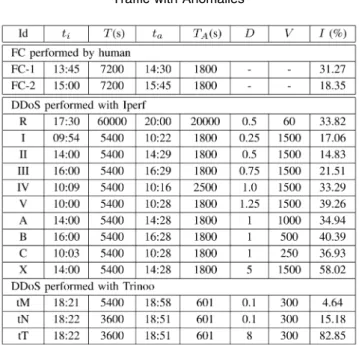
Experimental setting. We performed UDP flooding DDoS attacks using either IPERF [25] or Trinoo [26] (on computers with Linux distribution) to generate UDP flows with different throughputs. Compared to IPERF, Trinoo uses a “daemon” installed on each attacking site (four French research laboratories located in Mont-de-Marsan, Lyon, Nice, and Paris) and enabled us to create more complex and realistic attacks. The single computer target was located at LAAS in Toulouse. The traffic related to these attacks was transported via the French national network for education and research (RENATER). DDoS attacks were performed so as to be able to reproduce and modify their characteristics (duration, DoS flow intensity, packets length, and sending rate). In each case, traffic was collected by us (for a duration of 60 or 90 minutes, the attack mostly occurred during the second third) before, during, and after the DDoS so that regular traffic can be analyzed before and after each attack. The contribution of the attacks to the global throughput of the monitored link is highly variable, depending on the
attack parameters and ranging from a major impact on the global traffic profile (IV, V, and X) to attacks that are completely hidden in the global traffic (I and II). Attacks X and tT were, for instance, designed to be clearly dominant in the traffic, whereas attack tM was to be almost hidden. Attack parameters and characteristics are fully detailed in Table 2.
DDoS attack traffic characteristics. The LAAS is con-nected to RENATER with an 100 Mbps Ethernet link that has not been overflowed during attacks. Therefore, most of the conducted attacks have remained low in traffic volume so that they cannot be easily detected via simple statistics such as sample mean or variance estimates. Anyway, the goal of the detection procedures proposed in Section 5 is to detect anomalies even and mostly when their intensity level remains low, i.e., before they have a negative impact on the network QoS. Experiments were conducted to emulate this situation.
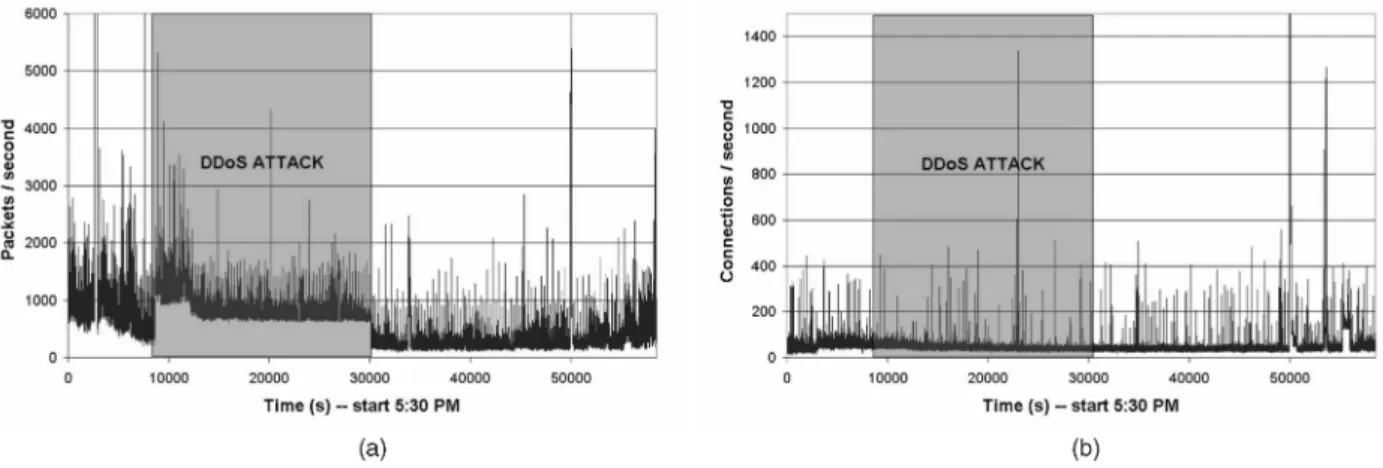
The plots illustrating the modeling of the DDoS were obtained from the reference DDoS, labeled R in Table 2. For instance, Fig. 1 shows, respectively, the numbers of packets and flows on the LAAS access link. While the former remains quite stable, the latter presents a significant increase (the packet rate is multiplied by almost 3 during the attack). But, this change remains in the range of the natural fluctuations of Internet traffic. However, note that
1. RENATER is the French network for education and research that interconnects academics and some industrial partners, see http:// www.renater.fr/ for topology and further informations.
TABLE 2 Traffic with Anomalies
Description of the studied traces containing anomalies. Run R stands for the reference attack and FC-1 and FC-2 for the flash crowd used to validate our model on traffic with anomalies. The Upper part, FC-1 and FC-2, flash crowd anomalies (FC-1 is plotted in 2 and used to validate our model on traffic with anomaly). In the middle part, DDoS attacks performed with IPerf in 2004 and 2005; run R stands for the reference attack (see Fig. 1). In the lower part, attacks performed with Trinoo in 2006. For each trace and attack, ti, ta, T , and TAstand, respectively, for
the starting times (in local time) and durations (in seconds) of the whole trace and of the anomalies. D, V , and I refer, respectively, to the controlled throughput of each attacking source (in Mbps), the length of each attack packet (in bytes), and the attack relative intensity (i.e., the ratio between the sum of all attack flows and the average throughput on the LAAS link during attack).
all of the modeling (see Section 4) and detection procedures (see Section 5) described here were applied to each and every time series reported in Tables 1 and 2 and it has been checked that satisfactory and consistent results were obtained.
2.2.2 Flash Crowd
Experimental setting. We created anomalies that are considered legitimate under the guise of flash crowds (FC) on a Web server. Our goal was to generate realistic FCs. This is why we chose not to use automatic programs or robots, but to involve human volunteers. To do so, we asked to a large number of people (mostly French academics but not only) to browse the LAAS Web site (http:// www.laas.fr). The LAAS Web site contains a large variety of files of all sizes, from simple html pages to movies, big reports, high definition pictures (of nano devices, etc.), movies (of autonomous robots, etc.), etc. There is every indication of heavy-tailed file sizes on this Web site as is largely expected. Participants were instructed to browse the Web server on their own, as they would do in the real world when visiting a Web site publishing a new set of information they would be interested in. Precise starting and stopping times were given. FC lasted 30 minutes or so. A detailed analysis of the IP addresses present in the LAAS incoming traffic enabled us to identify academic labora-tories and to find out that more than 100 people partici-pated. Information sent to us by participants enabled us to say that at least 50 more people took part in the FC from their individual and personal ISPs.
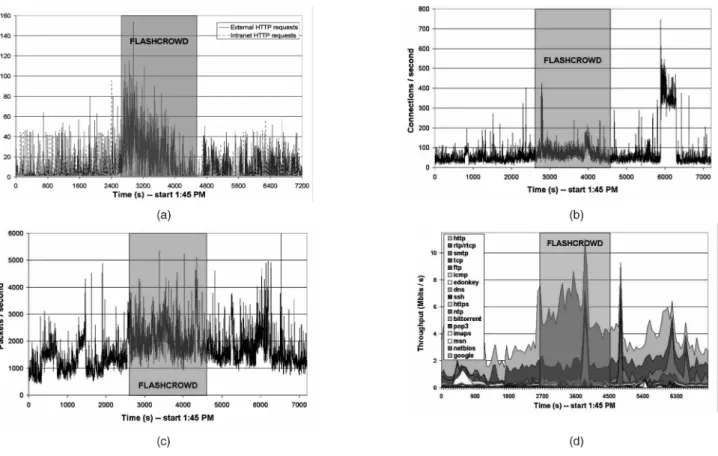
FC traffic characteristics. Illustrations are presented on FC-1 (see Table 2). Fig. 2a shows the number of (HTTP GET) requests received by the LAAS Web server, distinguishing between inner and outer requests. One can clearly see that most people started browsing the LAAS Web server precisely when instructed (important increase of the number of hits), but also that some of them did not participate for the entire 30 minutes. Fig. 2 shows, respectively, the numbers of flows and the packet rate on the LAAS access link. As expected, both plots show an increase in the average number of flows and in the average packet rate during the flash crowd.
Fig. 2c also shows increases in the average packet rate (20 minutes) before and (15 minutes) after the flash crowd experiment. To understand those increases, we have analyzed the different components of the traffic using the QoSMOS Traffic Designer tool [27] (see Fig. 2d). It revealed that the increase occurring round 2 p.m. (before the FC) and is caused by people inside LAAS browsing the Web right after lunch. Such a pattern has been observed systematically on all traces collected on the LAAS access link since then. The second peak after the experiment appears to be due to SMTP traffic. Two explanations can be given for why. First, many researchers at LAAS use Web-mail. Because the server was significantly slowed down during the flash crowd experiment, they had to stop sending e-mails until the Web server again started to work with satisfactory performance. Second, the gray listing mechanism (used for spam reduction) delays some e-mails and sends them all at a scheduled door opening. The nearest one took place at 3.15 p.m., just after the end of the flash crowd.
Note that the FC are used as examples of increase in traffic that are not attacks, and the peaks we just commented on are other occurrences of legitimate increase of the traffic. We will see in Section 5 that they would not be detected as attacks or anomalies by the detection procedure we propose based on the statistical model developed in the very next section.
3
N
ON-G
AUSSIANL
ONG-R
ANGED
EPENDENTP
ROCESSES3.1 The Gamma Arfima Model
3.1.1 Point Process versus Aggregated Traffic
Computer network traffic consists of IP packets arrival processes. Thus, a general description can be formulated in terms of marked point processes fðtl; AlÞ; l ¼ 0; 1; 2; . . .g,
where the tldenotes the arrival time stamp of the lth packet
and Alsome attributes of the packet (such as its payload, its
application/source/destination ports, etc.). It has long been observed that such arrival processes differ from simple standard Poisson or renewal processes, see, for instance, [28]. The interarrivals are not independent but display intricate correlation structures. It could be modeled using either nonstationary Point processes [29] or stationary
Markov modulated Point processes [30]. However, given the huge number of packets involved in any computer network traffic, these models would result in huge data sets. Therefore, one often prefers to work on byte or packet aggregated count processes, denoted W!ðkÞ and X!ðkÞ.
They consist of the number of bytes (respectively, packets) that live within the kth window of size ! > 0, i.e., whose timestamps lie between k!$ tl<ðk þ 1Þ!. Various traffic
models (including stationary or multifractal processes [31]) for X! and W!have been proposed in, e.g., [5], [32], [33],
[34], [35], [36], [37], and a review of traffic models can be found in, e.g., [4], [38]. However, it is commonly accepted that the marginal distributions and auto-covariance func-tions are the two major factors that affect the performance of the network and, hence, that need to be accounted for in priority. Thus, we mainly concentrate here on the joint modeling of the marginal distributions and covariance functions of X!ðkÞ (modeling W!ðkÞ gives equivalent
results not reported here for the sake of clarity).
3.1.2 Non-Gaussian Marginals: Gamma Distributions By definition, X!ðkÞ is a positive random variable (RV).
Hence, various works propose describing the marginals of aggregated traffic with classical positive RV distributions such as (one-sided) exponential, log-normal, Weibull, or gamma distributions [38]. Because of the packet arrival nature of the traffic, Poisson and exponential distributions are expected at small aggregation levels ! for the marginals of X!ðkÞ, while, for data aggregated at larger !s, Gaussian
laws are relevant approximations, as suggested by a central limit argument. However, none of them can satisfactorily
model traffic marginals for a wide range of (small and large) !s. A recurrent issue in traffic modeling lies in the choice of the relevant aggregation level !. This is an enduring question the answer to which involves the characteristics of the data themselves together with the goal of the modeling as well as technical issues such as real time, buffer size, and computational cost constraints. Therefore, it would be of great interest to have at our disposal a statistical model that may be relevant for a large range of values of !. In the present work, we choose to use Gamma distributions, "!;", to model aggregated traffic
because: 1) they naturally offer a smooth and continuous evolution from exponential to Gaussian laws and 2) the empirical studies reported here suggest that they are able to best capture the marginals of X! over a wide range of !s.
A "!;" distribution is defined for positive RV as:
"!;"ðxÞ ¼ 1 ""ð!Þ x " ! "!&1 exp &x " ! " ; ð1Þ
where "ðuÞ is the standard Gamma function (see, e.g., [39]). It has mean #¼ !" and variance $2¼ !"2. "
!;" laws are
stable under multiplication and addition. If X is "!;", then
%X is "!;%", showing that " mostly acts as a multiplicative,
or scaling, factor. For any two Xi and i¼ 1; 2 independent
RVs "!i;", their sum X¼ X1þ X2 follows a "!1þ!2;" law.
Therefore, the (inverse of the) shape parameter, 1=!, acts as an indicator of the distance from a Gaussian law. For instance, skewness and kurtosis (relative third and fourth moments) behave, respectively, as 2=pffiffiffiffi! and 3þ 6=!. Hence, ! is referred to as the shape parameter, controlling
Fig. 2. Flash Crowd. (a) Http requests, (b) connections, (c) packets, and (d) distribution of throughputs per second time series. (d) follows a top-down approach: The application on top generates the larger traffic.
the (smooth and continuous) evolution from exponential to Gaussian distributions.
3.1.3 Long-Range versus Short-Range Dependencies: ARFIMA Covariance
After the seminal work reported in [22], it has been commonly accepted that computer network traffic is characterized by a long memory or long-range dependence property (see [40], [41]) (LRD). It is usually defined by the behavior at the origin of the power spectral density fX!ð&Þ:
fX!ð&Þ ' Cj&j
&2d; j&j ! 0; with 0 < d < 0:5: ð2Þ
LRD constitutes a central property in traffic modeling as it is likely to be responsible for the decrease in both the QoS and the performance of the network (see, e.g., [42]). Incorporating it precisely into description models is there-fore a crucial issue. It would allow us to perform accurate and relevant network design (buffer size, etc.) and performance predictions (delay as a function of utility, etc.). LRD rules out the use of processes such as Poisson, Markov, or Auto-Regressive Moving Average (ARMA) processes, as well as other declinations such as Markov Modulated Poisson Processes [43]. Instead, canonical long-range dependent processes, such as fractional Brownian motion, fractional Gaussian noise [44], or Fractionally Integrated processes, have been widely used to describe and/or analyze Internet times series (see [4] and the references therein). It is also interesting to note that long memory can be incorporated directly into point processes using cluster point process models, yielding a fruitful description of the packet arrival processes, as pointed out in [45]. However, because of the many different network mechanisms and various source characteristics, short-term dependencies are also present and superimposed on this long memory property (this has been explored for VBR video traffic, see, for instance, [46]). Therefore, we use the covariance function (or spectrum) of the Auto-Regressive Fractionally Integrated Moving Average (ARFIMA, or arfima hereafter) process [40], a natural choice as it allows us to account for both short and long-range dependencies. The covariance function of an arfimaðP ; d; QÞ process, X, is fully defined via two polynomials of order P and Q, a fractional integration D&d, of order &1=2 < d < 1=2, and a power multiplicative constant $2. Its power spectral
density, or spectrum (Fourier transform of the covariance function), takes the following analytical form:
fXð&Þ ¼ $2'j1 & e&i2(&j&2d
j1 &PQq¼1)qe&iq2(&j2
j1 &PPp¼1*pe&ip2(&j2
; ð3Þ for &1=2 < & < 1=2. It is evident that, in the limit j&j ! 0, fXð&Þ ' $2'j&j&2dand (compared to (2)) that, for d2 ð0; 1=2Þ,
X is a long-range dependent process. Hence, the parameter d accounts for the long-range dependence property and measures its “strength.” Conversely, the polynomials P and Q (i.e., the ARMAðP ; QÞ contribution to the arfima process) can be used to fit the spectrum at high frequencies or, equally, the covariance function at fine scales, in an independent and versatile way. Hence, they model the short-range correlations.
3.1.4 Comments
To model aggregated Internet time series, we therefore propose using a stochastic stationary nonGaussian long-range dependent process: the Gamma (marginal) arfima (covariance) process. This models the benefits of a number of qualities and calls for a number of comments.
1. The specifications of the first and second order statistical properties described above do not fully characterize the process, because this model is not Gaussian. Room for further design to adjust other properties of the traffic remains available in the framework of the model. This difficult to achieve task is under investigation with respect to detection purposes.
2. The Gamma-arfima model is fully prescribed by a small number of parameters. For the analysis and the illustrations reported in the present work, we restrict ourselves to the use of arfima processes with polynomials P and Q of degree 1, hereafter labeled arfimað*; d; )Þ (* and ) are the sole coefficient of the normalized polynomials P and Q). Then, the "!;"-arfimað*; d; )Þ processes involve only five
para-meters that need to be adjusted from the data. As such, they are parsimonious models, a much desired property as far as robust, practical, efficient real-time on-the-fly network monitoring issues are concerned. 3. As is reported in the next section, the model fits Internet data for a large range of aggregation levels, !. Therefore, it contains a form of covariance with respect to changes in the chosen resolution of analysis.
4. Most of all, the proposed model accurately models not only traffic both with and without anomalies. Compared to other models, it proves useful to design anomaly detection procedures and to per-form classification.
3.2 Numerical Synthesis 3.2.1 Principles
The goal of this section is to present an original procedure that enables us to numerically synthesize sample paths (of any length) of stochastic processes with prescribed "!;"
marginals and arfimað); d; *Þ covariance. Our construction consists of a three step procedure, stemming from ideas in [47], [48] and extending them to the Gamma case.
1. X, a "!;" RV, can be obtained as X¼Pii¼2!¼1 Yi2,
where the Yis are zero-mean independent identically
distributed Gaussian random variables, with var-iance $2Y.
2. We can analytically relate the covariance of the process XðkÞ, +XðlÞ ¼ $2X,XðlÞ, to that of the YiðkÞ,
+YðlÞ ¼ $2Yi,YðlÞ. The computation is derived below.
3. We synthesize 2! zero mean Gaussian processes Yi,
with prescribed covariance +Yð-Þ ¼ $2Y,Yð-Þ, using
the so-called circulant embedded matrix method (see, e.g., [49] for a review).
Obviously, the procedure we propose here works only for integer !. An efficient approximation for noninteger !
can be obtained.
3.2.2 Derivation of the Key Result
First, one can easily obtain that IEX¼ !" ¼ 2!$2
Y and
$2
X¼ !"2¼ 4!$4Y; hence, $2Y ¼ "=2. Second, from the
canonical decomposition Yðk þ lÞ ¼ ,YðlÞY ðkÞ þ Zðk; lÞ one
can show that Zðk; lÞ is a Gaussian random variable, with IEZðk; lÞ ¼ 0; IEZ2ðk; lÞ ¼ $2
Yð1 & ,2YðlÞÞ;
and IEYðkÞZðk; lÞ ¼ 0: One can derive from these results that
IEY2ðkÞY2ðk þ lÞ ¼ $4
Yð1 þ 2,2YðlÞÞ:
Combining those findings with the fact that the Yiare i.i.d.
zero-mean Gaussian processes, tedious calculations not reported here lead to the following original and analytical result:
,X¼ ,2Y or +X¼ 4!+Y2: ð4Þ
3.2.3 Traffic Generators
The synthesis procedure described above can be extended to other types of marginals (log-normal, exponential, chi-squared, etc.) and covariances (fractional Gaussian noise (fGn), kinked fGn, etc.). Preliminary results are available in [50]. Other forms of statistical dependencies may be incorporated as well, including higher order statistics. Such synthesis procedures have been used for the validation of the analysis procedure, especially the estimation perfor-mance. Also, they constitute traffic generators for non-Gaussian long-range dependent traffic that can be used, for instance, to feed simulation platforms aiming at estimating QoS and network performance.
3.3 Practical Parameter Estimation
This section details the practical estimation procedures for the gamma-arfima parameters used on actual data. While the estimation of ! and " makes use of standard procedures, that of the arfima parameters is based on an original combination of techniques used for long-range and short-range correlations independently.
3.3.1 Gamma Parameter Estimation
Instead of the usual moment-based technique, ^"¼ ^$2=^#,
^
!¼ ^#= ^", where ^# and ^$2 consist of the standard sample
mean and variance estimators, we use maximum like-lihood-based estimates for the parameters ! and " [51]. The joint distribution of n i.i.d. "!;"variables can be obtained as
a product of n terms as in (1). Derivation of this product with respect to ! and " yields the estimates. It is important to note that the term ML standardly attributed to that method is used abusively here. Obviously, in our case, the X!ðkÞ are strongly dependent and hence do not satisfy the
i.i.d. assumption. It has been checked empirically from numerical simulations that this estimation procedure provides us with very accurate estimates even when applied to processes with long-range dependence [50].
3.3.2 Arfima Parameter Estimation
It is well known that the estimation of the long memory parameter is a difficult statistical task that has received a considerable amount of works and attention (see, e.g., [49] for an up-to-date review), and so has the joint estimation of both long and short range parameters of the arfimað*; d; )Þ process. Full maximum likelihood estimation based on the analytical form of the spectrum recalled in (3) is possible but computationally heavy. Here, we develop an original two step practically effective estimation procedure.
First, the long-range dependence parameter d is estimated using a standard wavelet-based methodology [52]. Let
j;kðtÞ ¼ 2&j=2 0ð2&jt& kÞ denote an orthonormal wavelet
basis, designed from the mother wavelet 0, and dXðj; kÞ ¼
h j;k; X0i the corresponding wavelet coefficients. For any
second order stationary process X, its spectrum fXð&Þ can be
related to its wavelet coefficients through [18], [53]: IEdXðj; kÞ2¼
Z
fXð&Þ2jj#0ð2j&Þj2d&; ð5Þ
where #0stands for the Fourier transform of 0and IE for
the mathematical expectation. When X is a long-range dependent process, with parameter d, (2) implies that IEdXðj; kÞ2' C22jd if 2j! þ1. It has been proven that the
time averages Sj¼ ð1=njÞPnk¼1j jdXðj; kÞj2 can then be used
as relevant, efficient, and robust estimators for IEdXðj; kÞ2.
Together with (5) above, this property leads to the following estimation procedure: A weighted linear regression of log2Sj against log22j¼ j, performed in the limit of the
coarsest scales, provides us with an estimate of d. The plots log2Sj versus log22j¼ j are commonly referred to as
logscale diagrams (LD). The full definition as well as the performance of this estimation procedure are detailed in [18], [53], [54].
Second, from this wavelet-based estimate ^d, we perform a fractional derivation of order ^d of X!. It removes the long
memory from the process so that only the ARMA component is left. A standard iterative procedure (based on a Gauss-Newton algorithm) [55] is then applied to estimate the ARMA parameters. Obviously, the major weakness of this two steps estimation procedure lies in the fact that if d is poorly estimated, so are the ARMA parameters. However, the estimation performance of the procedure is studied numerically in [50] using a synthetic "!;"arfimað*; d; )Þ process.
4
T
RAFFICM
ODELINGThe "!;"-arfimað*; d; )Þ analysis procedures are applied,
independently for different levels of aggregation, to the various traffic time series described in Section 2, containing anomalies or not. For the theoretical modeling of X!,
stationarity is assumed. We first check the consistency of the results obtained for adjacent nonoverlapping subblocks. Then, we analyze only data sets for which stationarity is a reasonable hypothesis. This approach is very close in spirit to the ones developed in [56], [57]. Then, we estimate the parameters of the model for each chosen !. Results are analyzed and interpreted.
4.1 Regular Traffic
We give here detailed results for the AUCK-IV series and for the Metrosec-ref1 series only. Similar results are obtained for the other series (see Table 1); they are not reported here and are available on request.
4.1.1 Covariances
Figs. 3 and 5, bottom row, compare, for the two chosen time series, respectively, the empirical LDs against their best fits obtained with the arfima covariance model. The latter are computed numerically from the combination of (3) and (5) with the estimated ^d, ^), and ^*. This numerical procedure has been developed in collaboration with Veitch et al., see [58]. The LD plots illustrate the relevance of the arfimað*; d; )Þ fits of the covariances of X!. As ! increases,
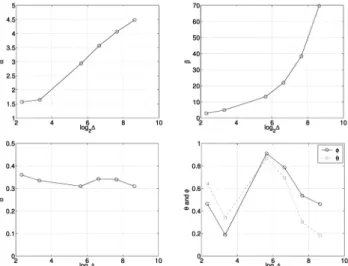
one can notice that the LDs almost correspond to coarser versions of the LD obtained at finer !s, shifted toward the upper scales. This is easily understood: Aggregating data mainly consists of smoothing out details at fine scales though leaving coarse scales unaffected. The plots also clearly show that the onset of long memory occurs around j¼ 10, i.e., around 1s, hence providing us with a character-istic time scale separating short from long correlation time scales. As may have been expected, aggregation does not cancel the long memory and does not alter it. It can be checked in Figs. 4 and 6, bottom left, where the ^d remain remarkably independent of !. This underlines that long-range dependence captures a long-time feature of the traffic that has no inner time-scale. The situation is very different for the short-time correlations that are cancelled out when the aggregation level increases, see the Figs. 4 and 6, bottom right: ^* and ^) significantly decrease as ! increases. One expects that they would be null (or identical) when the aggregation level ! becomes larger than the critical 1s time scale. Indeed, under aggregation, the covariance theoreti-cally converges to that of a fractional Gaussian noise that
turns out to be, practically, extremely close to that of an arfimað0; d; 0Þ [40].
To finish, let us note that, for some time-series (CAIDA), higher order for the ARMA part of the arfima model proved necessary to model the covariance.
4.1.2 Marginals
Figs. 3 and 5, top rows, show empirical histograms, obtained from the chosen time series, together with the "!;" fits. They illustrate the relevance of the "!;"
distributions to model the marginals of X!, for a wide
range of aggregation levels: 1ms $ ! $ 10s. The adequacy of the fits has been characterized by means of .2 goodness-of-fit tests. Gamma distributions usually
show a better adequacy compared to those obtained from exponential, log-normal, and .2 laws. For some of the Fig. 3. AUCK-IV. "!;"-arfimað*; d; )Þ fits for the marginals (top row) and covariances (bottom) for ! ¼ 10; 100; 400 ms (left to right); j ¼ 1 corresponds
to 10 ms.
Fig. 4. AUCK-IV. Estimated "!;"-arfimað*; d; )Þ parameters as a function
analyzed time series and some aggregation levels, one of the other laws may better adjust the data. However, the Gamma distributions are never significantly outperformed and, if a particular distribution performs better than Gamma for a given !, it does not hold over a wide range of !s. Conversely, the adequacy of the Gamma laws remains very satisfactory over wide ranges of !s; hence, they provide us with a scale-evolving characterization of the marginals of the traffic. "!;"laws, by variation of their
shape and scale parameters, offer a continuous and smooth evolution from pure exponential to Gaussian laws. These empirical facts are very much in favor of the use of Gamma laws to model computer traffic marginals, as is, from a theoretical point of view, their stability under addition property. Indeed, aggregation implies
X2!ðkÞ ¼ X!ð2kÞ þ X!ð2k þ 1Þ. Using stability under
ad-dition and assuming independence, one would expect that ! increases linearly with ! while " remains constant. Figs. 4 and 6, top row, show the evolution of ^! and ^" as a function of log2!, noted ^!! and ^"!. Significant
departures from these behaviors under I.i.d. hypothesis are observed. The analysis shows that ^!! does not
increase at small !, then grows roughly like log2! for
larger !, whereas ^"! behavior is close to a power-law
increase. These facts constitute clear evidence of the existence of dependencies in the data and tell us the evolutions of ! and " with ! mainly accommodate short range dependencies of X!.
4.1.3 Synthetic Time Series
Using the synthesis method described in Section 3.2, we produce numerical sample paths of the "!;"-arfimað); d; *Þ
for different !s. The parameters have been chosen so that they correspond to those measured on the AUCK-IV time series. Comparing Fig. 7 with Fig. 3, the plots illustrate that the marginals (top row) and covariances (bottom row) of the synthetic time-series match those of the data.
4.2 Traffic with Anomalies 4.2.1 DDoS Attack
Covariance.Fig. 8a presents the LDs for a 1 hour block of data during the DDoS Attackð! ¼ 1msÞ compared to those of 1 hour long regular traffic times series, recorded a couple of hours before and after the attack. The LD plots tell us first that an arfimað*; d; )Þ fits the traffic under DDoS attack equally satisfactorily. Other plots not presented here show that this is true for a wide range of aggregation levels.
Moreover, for the behaviors of the LDs at scales larger than 1s (j¼ 10 in Fig. 8a), no discrepancies can be detected between before/after and during the attack. In particular, the long memory parameter ^d remains astonishingly
Fig. 5. METROSEC-ref1. "!;"-arfimað*; d; )Þ fits for the marginals (top row) and covariances (bottom) for ! ¼ 10; 100; 400 ms (left to right). j ¼ 1
corresponds to 10 ms.
Fig. 6. METROSEC-ref1. Estimated parameters of "!;"-arfimað*; d; )Þ,
constant. It tell us that long memory is not created by the attack and is also totally insensitive to its occurrence. The only change that can be noticed on the LDs consists of a relative increase of the short-time component (at scales j from 4 to 7) after the attack. The reason is that the traffic series after attack was recorded at night, with a lower traffic load. The LD was shifted upward to show that the long memory parameter ^d (given by the slope) does not change, even when the load is smaller. Hence, DDoS attack cannot detect the from the LDs.
Marginals. Fig. 9, left column, illustrates, in two plots, that "!;" distributions adequately fit the marginals of the
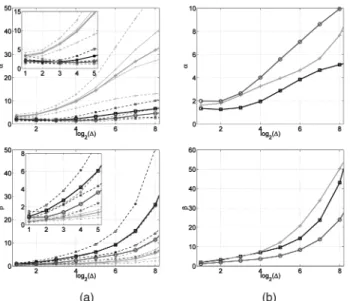
traffic under DDoS attack. Fig. 10, left column, compares the evolutions of the estimated ^! and ^" with respect to ! for traffic during and before/after the DDoS event. Estimations are performed over 15 minute-long nonoverlapping blocks of data. One sees that the functions of ^!!and ^"!observed
during the DDoS attack differ significantly from those corresponding to a regular traffic. The attack causes an immediate and sharp increase of ! starting from the finest
!s, whereas, under normal circumstances, ! remains constant or with only small variations up to !’ 20ms. The evolution is the inverse for ": It is decreasing from !’ 1ms to ! ’ 30ms during the DDoS attack, whereas it increases smoothly and regularly with ! under normal traffic. These evolutions can receive several interpretations. First, because, during the DDoS attack, a large number of packets are emitted at the highest possible rate, the probability observing 0 packet within a window of size ! decreases extremely fast to 0, even for small !s, a major discrepancy compared to marginals observed on regular traffic that smoothly go to 0 when X!! 0 (compare Figs. 3
or 5 to Fig. 9). It affects the shape of the marginals and,
Fig. 7. Synthetic data. "!;"-arfimað*; d; )Þ fits for the marginals (top row) and covariances (bottom) of synthetic data for ! ¼ 10; 100; 400ms (left to
right). The parameters correspond to those of AUCK-IV.
Fig. 8. Logscale Diagrams. For the (a) DDoS and (b) for the Flash Crowd. For both events, the curves are given during the anomaly (crosses) and before (squares) or after (circles) the anomaly, taken as references for normal traffic.
Fig. 9. Marginals. For (a) the DDoS Attack and (b) for the Flash Crowd (right), empirical histograms of X!and their "!;"fits of the marginals, for
hence, the value of the ! parameter, implying that ! grows slowly with ! for regular traffic and much faster under DDoS attack. Second, the accelerated increase of ! with respect to ! under DDoS attack indicates that the marginal distributions of the traffic under attack tend to Gaussian laws much faster than under regular circumstances. Both properties constitute major statistical features that differ-entiate traffic under DDoS attacks from regular traffic. 4.2.2 Flash Crowd
Marginals. Fig. 9b illustrates that "!;" distributions
ade-quately fit the marginals of the traffic under flash crowd for a wide range of aggregation levels (from 1ms to 1s). Fig. 10b illustrates that the ^!ð!Þ and ^"ð!Þ curves observed during the event do not depart significantly from those recorded under normal circumstances. It is consistent with the fact that the flash crowd does not involve any mechanism that forbids the 0 packet per window event as do DDoS attacks. Therefore, ^!ð!Þ does not enable to detect the FC.
Covariance. Fig. 8b shows the LDs for two 15 minute long blocks of data during the flash crowd ð! ¼ 1msÞ compared to those of 15 minute long blocks of regular traffic, recorded before and after. On this plot, one sees that the LDs undergo a significant change during the flash crowd. From octaves j¼ 8 to j ¼ 10, i.e., for scales of time ranging from 250ms to 1s, a strong peak of energy grows. Such a peak is never observed on traffic under regular circumstances and can therefore be used to detect and characterize FC. Obviously, arfimað*; d; )Þ fits (not shown here) will fail to simultaneously reproduce the short range dependences, the long-range dependences, and the energy peak. Goodness-of-fit tests between data and fitted models
yield rejection, also providing us with a relevant tool for designing a flash crowd detection procedure. Moreover, the LRD parameter d, when estimated from octaves j coarser than those corresponding to the energy peak, does not notably depart from the one estimated before/after the FC. It tells that long memory is neither caused by the flash crowd nor modified by its occurrence. At most, the energy peak acts as a masking effect in a subrange of time scales. 4.3 Discussions and Conclusions
Let us summarize and comment on our empirical findings. First, we have shown that the "!;"-arfimað*; d; )Þ model
accurately reproduces the marginals and both the short-range and long-short-range correlations of traffic time series. It holds for a wide range of different regular traffic collected on various networks, as well as for traffic containing legitimate and illegitimate anomalies such as DDoS attacks and flash crowds. Second, the fact that the proposed model is versatile enough to work equally well for a wide range of aggregation levels is a key feature. This offers an alternative answer to the enduring issue in traffic modeling about the choice of the relevant aggregation level !. Hence, choosing ! a priori is not easy. Therefore, using a process that offers an evolutive modeling with ! is of high interest. Moreover, the values of the parameters of the models obviously vary, possibly significantly, from one traffic to another. But, we are not interested in the values themselves, but rather in the evolution of these parameters with respect to !. The detection procedures, detailed in the next section, specifi-cally take advantage of the relevance of this multiresolution statistical description of the traffic.
5
DD
OS A
TTACKD
ETECTION5.1 Distance-Based Detection Procedure
As reviewed in the first section, real-time detection of anomalies in the traffic is a major issue of the Internet of today. Anomaly detection is roughly divided between profile-based methods and signature-based procedures (or other methods relying on analysis of the attack mechanisms [59] or on application-dependent analysis [60]). Previous sections have shown that, even if one remains at the packet level and works with aggregated time-series, a joint analysis of the statistical profile at various time-scales of the series is sensitive to changes caused by anomalies in the traffic. From these properties, we propose a detection procedure that exploits the multiresolution nature of our statistical modeling.
Because the developed analysis is not based only on simple statistics (mean and variance), we were able to empirically discriminate between legitimate (FC) and illegitimate (DDoS) changes in traffic. In this section, we are dealing with the detection of illegitimate anomalies because we have a wider database of DDoS attacks than of FC; hence, FC are used as a benchmark to test the behaviors of the detection procedures in the presence of a natural and long-lasting increase in the traffic (however, the small number of experiments do not allow yet us to assess a statistical method to detect them specifically).
The detection scheme is as follows: The time series under analysis are split into adjacent nonoverlapping time windows of length T , starting at time lT and labeled by l.
Fig. 10. Estimated "!;" parameters. Estimation of ^! (top) and ^"
(bottom) as a function of log2! (! in ms) (a) for the DDoS Attack and (b)
for the Flash Crowd. In both cases, the curves are given during the anomaly (crosses) and before (squares) or after (circles) the event as references for normal traffic. For the DDoS, the mean evolution (thick line) of the parameters on various 15 minute data blocks is drawn, superimposed with the extremal values taken during each period (dashed lines); for the sake of example, two typical evolutions over one block during the DDoS are shown (in thin lines) on the graph. A zoom for the small scales is shown as an inside-plot. For the FC event, of smaller duration, one estimation on a 15 minutes window is reported for each period (before, during, and after the event).
Independently for each time window l, one computes a distance between a statistical characteristic measured on window l and the same characteristic measured on an a priori chosen reference window. In a second step, one thresholds this distance to detect unexpectedly large deviations and, hence, anomalous traffic behaviors.
There exist a variety of distances that could be used (see, e.g., [61] for an exhaustive review). For instance, one could use a generic nonparametric distance, such as the Kullback divergence for the marginal distribution or the log-spectral deviation for the spectrum (covariances). However, it would not explicitly take advantage of the relevance of the multiresolution model proposed in Section 3. Therefore, we base the detection on a distance computed from the parameters of the model, especially ^!!ðlÞ and ^"!ðlÞ, for a
collection a dyadic scales !, going from a fine scale 21!0to
a large scale 2J!
0. A simple, yet robust, Mean Quadratic
Distances (MQD) is defined as (!0is left out for the ease of
notation): D!ðlÞ ¼ 1 J XJ j¼1 ^ !2jðlÞ & ^!2jðrefÞ ð Þ2; ð6Þ D"ðlÞ ¼ 1 J XJ j¼1 ^ "2jðlÞ & ^"2jðrefÞ $ %2 : ð7Þ
After the computation of the distance, one a priori choice is left: the threshold level (values under the threshold are deemed normal traffic and values above are considered anomalies). In the present work, a collection of threshold values is systematically explored so as to derive the statistical performance for the detection procedure. 5.2 Results and Statistical Performance 5.2.1 Results
In the results detailed below, the reference window consists of TRefminutes of traffic before the occurrence of the attacks
and therefore assumed to be regular traffic. We used both TRef¼ 1 min and TRef¼ 10 min for comparison and we set
!0¼ 1ms and J ¼ 10 in agreement with the results reported
in Section 4.
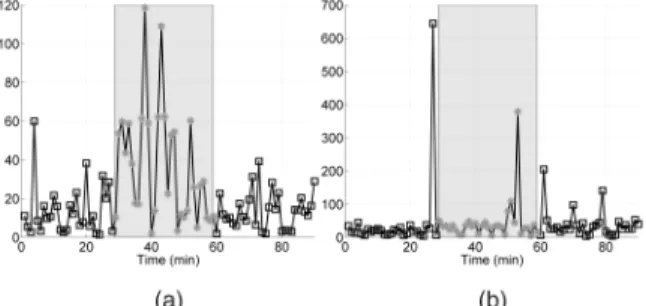
MQDs are depicted in Fig. 11 for traffic containing an attack (here, the Iperf-III run). In Fig. 11a, one sees that D!ðlÞ takes large values within time windows l containing
the attack. It clearly confirms that the occurrence of the
anomaly significantly alters the dependency of ! with respect to !; hence, it increases the MQD. Conversely, one observes that D"ðlÞ remains mostly stable and is not
significantly shifted by the occurrence of the attack. Remember that " is a scale parameter mostly sensitive to the intensity of the traffic. The attacks do not correspond to traffic increase with unchanged correlation structure, but rather to significant dynamical and statistical changes. The large values observed in the D"ðlÞ plot correspond to time
windows that do not satisfy the .2 goodness-of-fit test
because they contain both regular and under attack traffics, yielding aberrant estimates. Note that the large values occur at the start and stop times of the attack.
Conversely, for the Flash Crowd experiments, the traffic is not seen as a clear-cut anomaly. MQDs are plotted in Fig. 12 for FC-1 and we see no particular increase in these distances during the FC. This is because the statistical characterization of the FC by means of !! and "! is
insensitive to this kind of variation of traffic, which is mainly a small increase in the traffic but with exactly the same variability, as argued in Section 4.2. Hence, the multiscale characterization through !! and "! is mostly
unchanged and the distances D!ðlÞ and D"ðlÞ to the
reference traffic profile are not significantly different during the FC from those without anomaly.
5.2.2 Experimental Statistical Performance
The statistical performance of detection procedures is usually assessed in terms of Receiver Operational Char-acteristics (or ROC curves), consisting of the correct detection probability PD versus the false alarm probability
PF. Therefore, one plots the curves PD¼ fð%Þ versus
PF ¼ gð%Þ, parameterized by the threshold value %. They
are obtained empirically from our database as follows. Because we know which time window contains the attack and which does not, we are able to calculate for each detection level %, both PD and PF; the probability of
detection PD is the ratio of the number of windows
containing the attack whose distance is above the threshold to the total number of windows with anomaly; the probability of false alarm PF is the ratio of the number of
windows containing no attack whose distance is still above the threshold to the total number of windows without anomaly.
Plots PD versus PF and PD¼ fð%Þ and PF ¼ gð%Þ are
shown in Fig. 13, on the example of the Iperf-III run, as an illustration. The ideal set point (all attacks would be
Fig. 11. MQD for traffic containing a DDoS Attack. (a) D!ðlÞ and
(b) D"ðlÞ, computed on nonoverlapping 1 min time windows for run
Iperf-III. Time windows containing the attack are those in the gray area.
Fig. 12. MQD for traffic containing a legitimate FC anomaly. (a) D!ðlÞ and (b) D"ðlÞ, computed on nonoverlapping 1 minute time
windows for experiment FC-1. Time windows corresponding to the FC are those in the gray area.
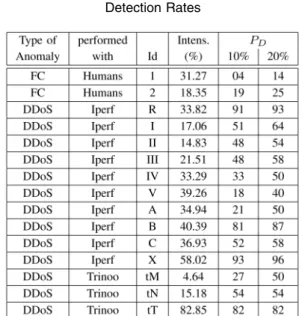
detected and no false alarm raised) is the left upper corner. The worst case is the diagonal, when the results do not significantly differ from those obtained at random. Fig. 13 clearly shows the efficiency of the proposed detection procedure. ROC curves were calculated for each and every trace containing anomalies, listed in Table 2. All plots can obviously not be displayed; instead, we report in Table 3 PD for two a priori chosen levels of false
alarm, set, respectively, to 10 percent and 20 percent. They are obtained by reading on ROC curves PD for the
chosen PF level.
5.2.3 Discussion
The results are satisfactory. In the worst cases, detection is possible with a better chance than at random. For illegitimate anomalies with high impact on the traffic (for instance, the runs IPerf-B, X, or Trinoo-T, see Table 2), the detection probability is really high. For attacks with very low intensity (such as IPerf-I, II, III, or Trinoo-M) and, hence, little impact on traffic volume profiles, detection rates, even if low at first sight, are encouraging as most traditional IDS based on simple mean and variance statistics would totally miss them. Moreover, let us mention that the use of the mean ^#!or variance ^$2!of X! as functions of !
yields curves that exhibit identical forms with or without anomaly (plots not reproduced here). Hence, sample mean and variance estimates are blind to anomalies.
The performance reported here uses only statistics over one minute. Obviously, better performance is expected from the use of a detection scheme over several minutes, combining the score functions over a past of a few windows, because, during anomalies, the probability of crossing the threshold on two successive window is much larger than it is for a single window. This trade-off between increased detection performance and increase of the delay in the alert time (a few minutes instead of 1) needs to be further explored.
An interesting feature of the detection method based on the multiscale marginal modeling ("!!;"! for !¼ 2
j! 0with
j¼ 1; . . . ; J) lies in its being able to differentiate between legitimate anomalies and illegitimate ones. For instance, the Flash Crowd anomalies, which consist of a regular increase of traffic, are not detected as attacks: The assigned detection probabilities are close to the false alarm rate—this is not detection, this is a false alarm! Further along the way, it gives the capability to classify between classes of anomalies, when combining this with other characteristics of the traffic (such as the arfima parameters that are not yet used in the
proposed attack detection scheme). Another perspective is to combine this detector which uses only the profile of the traffic with methods based on signature in a full-fledged IDS. It is an accepted fact that, to achieve good efficiency, one has to use both approaches jointly.
6
C
ONCLUSIONS ANDF
UTUREW
ORKSIn the present work, we have proposed a non-Gaussian long-range dependent process, the "!;"-arfimaðP ; d; QÞ process, to
model the first and second order statistics of aggregated computer network traffic time series. We have fully described operational parameter estimation procedures and we have defined original numerical synthesis proce-dures. We have shown from a large variety of standard reference traffic time series that the "!;"-arfimaðP ; d; QÞ
process constitutes a relevant versatile model and this is for a very large range of aggregation levels !. Moreover, its parameters are smoothly evolving with !, hence providing us with a useful statistical characterization of regular traffic. We have also shown that discrepancies from these reference behaviors with respect to ! enabled us to distinguish between traffic with and without anomalies and to further discriminate between legitimate (flash crowds) and illegiti-mate (DDoS attacks) ones. A detection procedure using this model and yielding satisfactory results, has been defined.
This work can be further developed along numerous directions. First, the numerical synthesis procedures can be used for traffic generation, performance assessment, and online traffic samples prediction, X!ðT þ -Þ for - > 0. In
that respect, the use of larger orders for P and Q as long as they are relevant may prove beneficial. This is under study. Second, thanks to the experimental platform being devel-oped within the METROSEC project, we intend to further explore the zoo of anomalies. Third, we are working on extending the proposed detection scheme to the use of other statistical distances (Kullback divergence, etc.) that should help in identifying changes in the traffic statistical
char-Fig. 13. Statistical performance. (a) Detection probability PD versus
false alarm probability PF, PD¼ fðPFÞ, and (b) PD¼ fð%Þ and PF ¼
gð%Þ for D!ðlÞ.
TABLE 3 Detection Rates
For each attack, detection probabilities obtained for a fixed False Alarm probability set at 10 percent (left) and 20 percent (right). We recall here the type and name of each run, and the intensity of the anomaly (computed as in Table 2).
acterizations and classifying them as legitimate or illegiti-mate. Our ultimate goal is to develop network-based (protocols, architectures, etc.) strategies to improve the robustness of the network against attacks and, thus, to help maintain the targeted level of QoS.
A
CKNOWLEDGMENTSThe authors acknowledge the help of CRI ENSLyon, and numerous colleagues from the METROSEC project for their help in conducting data collection and in performing anomalies. They gratefully acknowledge all of the people who freely agreed to take part in the scheduled flash crowd events analyzed here. They also gratefully acknowledge colleagues from the major Internet traces repositories for making their data available to us or for having performed the preformatting of some of the time series used here: S. Marron, F. Hernandez-Campos, and C. Park from UNC (USA) and D. Veitch and N. Hohn from CubinLab (Australia). This work has been supported by the French MNRT ACI Se´curite´ et Informatique 2004 grant, within the METROSEC project. The authors also thank the anonymous reviewers for their helpful comments.
R
EFERENCES[1] K. Park, G. Kim, and M. Crovella, “On the Relationship between
File Sizes, Transport Protocols, and Self-Similar Network Traffic,” Proc. Int’l Conf. Network Protocols, p. 171, 1996.
[2] P. Abry, Barananiuk, P. Flandrin, R. Riedi, and D. Veitch,
“Multiscale Network Traffic Analysis, Modeling, and Inference Using Wavelets, Multifractals, and Cascades,” IEEE Signal Processing Magazine, vol. 3, no. 19, pp. 28-46, May 2002.
[3] A. Erramilli, O. Narayan, and W. Willinger, “Experimental
Queueing Analysis with Long-Range Dependent Packet Traffic,” ACM/IEEE Trans. Networking, vol. 4, no. 2, pp. 209-223, 1996.
[4] K. Park and W. Willinger, “Self-Similar Network Traffic: An
Overview,” Self-Similar Network Traffic and Performance Evaluation, K. Park and W. Willinger, eds., pp. 1-38, Wiley (Interscience Division), 2000.
[5] A. Feldmann, A.C. Gilbert, and W. Willinger, “Data Networks as
Cascades: Investigating the Multifractal Nature of Internet WAN Traffic,” Proc. ACM SIGCOMM, 1998.
[6] V. Paxson, “Bro: A System for Detecting Network Intruders in
Real-Time,” Computer Networks J., vol. 31, nos. 23-24, pp. 2435-2463, 1999.
[7] J. Brutlag, “Aberrant Behavior Detection in Time Series for
Network Monitoring,” Proc. USENIX System Administration Conf., Dec. 2000.
[8] J. Hochberg, K. Jackson, C. Stallings, J.F. McClary, D. DuBois, and
J. Ford, “NADIR: An Automated System for Detecting Network Intrusion and Misuse,” J. Computer Security, vol. 12, no. 3, pp. 235-248, 1993.
[9] H. Javits and A. Valdes, “The SRI IDES Statistical Anomaly
Detector,” Proc. IEEE Symp. Security and Privacy, May 1991. [10] H.S. Vaccaro and G.E. Liepins, “Detection of Anomalous
Computer Session Activity,” Proc. IEEE Symp. Security and Privacy, pp. 280-289, May 1989.
[11] D. Moore, G.M. Voelker, and S. Savage, “Inferring Internet Denial-of-Service Activity,” Proc. Usenix Security Symp., 2001.
[12] N. Ye, “A Markov Chain Model of Temporal Behavior for Anomaly Detection,” Proc. Workshop Information Assurance and Security, June 2000.
[13] S. Jin and D. Yeung, “A Covariance Analysis Model for DDoS Attack Detection,” Proc. IEEE Int’l Conf. Comm., June 2004. [14] J. Yuan and K. Mills, “DDoS Attack Detection and Wavelets,”
technical report, Nat’l Inst. of Standards and Technology, 2004. [15] A. Lakhina, M. Crovella, and C. Diot, “Diagnosing Network-Wide
Traffic Anomalies,” Proc. ACM SIGCOMM, Aug. 2004.
[16] A. Hussain, J. Heidemann, and C. Papadopoulos, “A Framework for Classifying Denial of Service Attacks,” Proc. ACM SIGCOMM, 2003.
[17] C.-M. Cheng, H.T. Kung, and K.-S. Tan, “Use of Spectral Analysis in Defense against DoS Attacks,” Proc. IEEE Globecom Conf., 2002. [18] D. Veitch and P. Abry, “A Wavelet Based Joint Estimator of the Parameters of Long-Range Dependence,” IEEE Trans. Information Theory, special issue on multiscale statistical signal analysis and its applications, vol. 45, no. 3, pp. 878-897, Apr. 1999.
[19] L. Li and G. Lee, “DDoS Attack Detection and Wavelets,” Proc. Int’l Conf. Computer Comm. and Networks, Aug. 2003.
[20] P. Barford, J. Kline, D. Plonka, and A. Ron, “A Signal Analysis of Network Traffic Anomalies,” Proc. ACM/SIGCOMM Internet Measurement Workshop, Nov. 2002.
[21] J. Jung, B. Krishnamurthy, and M. Rabinovich, “Flash Crowds and Denial of Service Attacks: Characterization and Implications for CDNs and Web Sites,” Proc. Int’l World Wide Web Conf., May 2002. [22] W.E. Leland, M.S. Taqqu, W. Willinger, and D.V. Wilson, “On the Self-Similar Nature of Ethernet Traffic (Extended Version),” ACM/ IEEE Trans. Networking, vol. 2, no. 1, pp. 1-15, Feb. 1994. [23] J. Le´vy Ve´hel and R.H. Riedi, “Chapter Fractional Brownian
Motion and Data Traffic Modeling: The Other End of the Spectrum,” Proc. Fractals in Engineering ’97, J. Le´vy Ve´hel, E. Lutton, and C. Tricot, eds., Springer, 1997.
[24] J. Cleary, S. Donnelly, I. Graham, A. McGregor, and M. Pearson, “Design Principles for Accurate Passive Measurement,” Proc. Passive and Active Measurements Conf., Apr. 2000.
[25] “IPERF—The TCP/UDP Bandwidth Measurement Tool,” http:// dast.nlanr.net/Projects/Iperf/, 2005.
[26] “TRINOO—Distributed Network DoS Tool,” http://staff.wa shington.edu/dittrich/misc/trinoo.analysis, 2005.
[27] “QoSMOS Traffic Designer,” http://www.qosmos.net, 2005. [28] V. Paxon and S. Floyd, “Wide-Area Traffic: The Failure of Poisson
Modeling,” ACM/IEEE Trans. Networking, vol. 3, no. 3, pp. 226-244, June 1995.
[29] T. Karagiannis, M. Molle, M. Faloutsos, and A. Broido, “A Non Stationary Poisson View of the Internet Traffic,” Proc. IEEE INFOCOM, 2004.
[30] A. Andersen and B. Nielsen, “A Markovian Approach for Modelling Packet Traffic with Long Range Dependence,” IEEE J. Selected Areas in Comm., vol. 5, no. 16, pp. 719-732, 1998. [31] M. Crouse, R. Riedi, V. Ribeiro, and R. Baraniuk, “A Multifractal
Wavelet Model for Positive Processes,” Proc. IEEE-SP Int’l Symp. Time-Frequency and Time-Scale Analysis, Oct. 1998.
[32] N. Desaulniers-Soucy and A. Iuoras, “Traffic Modeling with Universal Multifractals,” Proc. IEEE Globecom Conf., 1999. [33] N. Hohn, D. Veitch, and P. Abry, “Multifractality in TCP/IP
Traffic: The Case Against,” Computer Networks J., 2005.
[34] S. Sarvotham, R. Riedi, and R. Baraniuk, “Connection-Level Analysis and Modeling of Network Traffic,” technical report, Electrical and Computer Eng. Dept., Rice Univ., 2001.
[35] M. Taqqu, V. Teverosky, and W. Willinger, “Is Network Traffic Self-Similar or Multifractal?,” Fractals, vol. 5, no. 1, pp. 63-73, 1997. [36] Z. Zhang, V. Ribeiro, S. Moon, and C. Diot, “Small Time Scaling Behavior of Internet Backbone Traffic: An Emprirical Study,” Proc. IEEE INFOCOM, Mar. 2003.
[37] K. Maulik and S. Resnick, “The Self-Similar and Multifractral Nature of a Network Traffic Model,” Stochastic Models, vol. 19, no. 4, pp. 549-577, 2003.
[38] B. Melamed, “An Overview of TES Processes and Modeling Methodology,” Performance/SIGMETRICS Tutorials, pp. 359-393, 1993.
[39] M. Evans, N. Hastings, and B. Peacock, Statistical Distributions. Wiley (Interscience Division), June 2000.
[40] J. Beran, Statistics for Long-Memory Processes. Chapman & Hall, 1994.
[41] G. Samorodnitsky and M. Taqqu, Stable Non-Gaussian Random Processes. Chapman & Hall, 1994.
[42] B. Tsybakov and N.D. Georganas, “Self Similar Processes in Communications Networks,” IEEE Trans. Information Theory, vol. 44, no. 5, pp. 1713-1725, 1998.
[43] S. Paulo, V. Rui, and P. Anto´nio, “Multiscale Fitting Procedure Using Markov Modulated Poisson Processes,” Telecomm. Systems, vol. 23, nos. 1/2, pp. 123-148, June 2003.
[44] I. Norros, “On the Use of Fractional Brownian Motion in the Theory of Connectionless Networks,” IEEE J. Selected Areas in Comm., vol. 13, no. 6, 1995.