HAL Id: halshs-02512788
https://halshs.archives-ouvertes.fr/halshs-02512788
Submitted on 21 Mar 2020
HAL is a multi-disciplinary open access
archive for the deposit and dissemination of
sci-entific research documents, whether they are
pub-lished or not. The documents may come from
teaching and research institutions in France or
abroad, or from public or private research centers.
L’archive ouverte pluridisciplinaire HAL, est
destinée au dépôt et à la diffusion de documents
scientifiques de niveau recherche, publiés ou non,
émanant des établissements d’enseignement et de
recherche français ou étrangers, des laboratoires
publics ou privés.
School aspirations and school dropout : involving parents
Dominique Goux, Marc Gurgand, Eric Maurin
To cite this version:
Dominique Goux, Marc Gurgand, Eric Maurin. School aspirations and school dropout : involving
parents. [Other] Feedback n°2, Institut des politiques publiques (IPP); Abdul Latif Jameel Poverty
Action Lab - Europe (JPAL - Europe). 2014. �halshs-02512788�
SCHOOL ASPIRATIONS AND SCHOOL
DROPOUT: INVOLVING PARENTS
Feedback
n°2
November 2014
Dominique Goux
Marc Gurgand
Eric Maurin
When interviewed, the great majority of parents of students in their
last year before senior high school state that their child will obtain
the baccalaureate (equiv. GCE-AL), even when their academic
results and their chances of success are in reality very poor. In
fact, among the students in the greatest difficulty and the most at
risk of dropping out, very few envisage the possibility of taking up
an apprenticeship or a short vocational course instead. That choice
reflects the low esteem in which that kind of training is held in
France
.
Through an experiment conducted among final year junior high
school (collège) classes in the Versailles district, we show that two
specific meetings between the school principal and parents of the
weakest students is enough to change family plans significantly
and to broaden perspectives on the envisaged directions for their
children. Such an adjustment to aspirations provokes a marked
reduction in dropout rates, due to successful schooling in
apprenticeship centres and vocational high schools in the region.
Two years after this simple intervention, the dropout rate of 20 per
cent among these students was brought back to 15 per cent.
Using the data from groups of friends within classes, we also show
that the intervention is accompanied by an improvement in the
academic integration of the weakest students. They interact more
with their classmates who have better marks: this change in
inter-pupil relations in the classrooms is without doubt one of the keys to
the success of the experimental policy.
•
The families of students in the final year of junior high school who have academic difficulties often
overestimate their chances of following their studies all the way to the baccalaureate and rarely envisage the
possibility of taking up apprenticeships or short vocational training courses.
•
A few meetings between the families of the weakest students and the school principals, conducted early in the
year, lead to changes in the plans of the young people and their families, and broaden their views of the
possible roads ahead.
•
As a consequence of these meetings, there is a 25 per cent decrease in the dropout rate, and the students
concerned succeed in short vocational training courses.
•
The intervention also affects social relations: the weakest students interact more with their more
academically-able classmates.
J-PAL, poverty action lab, is a network of academics around the world who use the random assignment evaluation
method. J-PAL's objective is to reduce poverty by ensuring that public policy is grounded on scientific evidence.
www.povertyactionlab.org
The Institute for Public Policy (IPP) was developed through a scientific partnership between
the Paris School of Economics and the Centre for Research in Economics and Statistics. The
aim of the IPP is to promote quantitative analysis and evaluation of public policy using
cutting-edge research methods in economics.
Feedback n°2 - November 2014
At the end of junior high school, students make an irreversible choice about which path they will follow inside a stratified
system with complex rules. Many repeat grades, fumble, then
end up abandoning their studies without having found their way. They thus find themselves in social situations quite often
fragile, with a much higher risk of becoming unemployed, poor or delinquent than young people with degrees or diplomas – a gap which is reinforced by the current crisis. The issues of academic pathways and dropout rates among adolescents are today seen as major problem in many developed countries, as factors of polarisation among youth and a threat to social cohesion.
This concern was behind an experiment in which school
principals supported students and families to prepare their pathways at the end of junior high school on the basis of a
collection of tools conceived by the Versailles education administration.
Unrealistic expectations
The experiment was carried out in 2010-2011 in 37 volunteer
junior high school in the Versailles académie, which teach a
significant proportion of students from very modest backgrounds. It targeted the students judged most at risk of dropping out, in general academically very weak students.
Unexpectedly, our enquiry reveals that three quarters of
families think that these students will gain their baccalaureate. In addition, 67.3 per cent express a desire for
the general, technological and professional stream and 10.4 per cent ask for grade repetition, or appeal the decision of the class council in the hope of ultimately accessing a pathway to preparation for the baccalaureate. Unfortunately, their chances of succeeding are objectively very weak. In our sample, the great majority of pupils do not gain their brevet (GCSE equiv.): nationally, only 8.2 per cent of pupils in this situation end up obtaining the baccalaureate. Most of the others obtain their brevet without distinction and we can also calculate from national data that only 30 per cent of these gain their baccalaureate. Thus the streaming plans of these students and their families reveal a serious gap between aspirations and academic capacities at the moment of making an important and often irreversible decision.
Given that only the best pupils are permitted to follow the
longest study routes, this system can create disappointment,
even real disengagement among many students, particularly if
they are not well informed about the alternative choices. Only 15 per cent of them spontaneously envisage the possibility of taking up an apprenticeship or a short vocational training course (CAP) at high school. This reflects the earlier observation about the low regard for vocational training in France, among families as well as among some national education actors, despite their outcomes in terms of employment.
Support parents early
The experimental policy consists of organising two meetings of
two hours each between the school principal and the parents
of pupils at risk of dropping out. As an integral dimension of the intervention, the principal personally contacted each family to invite them to participate. The meetings took place at the school, in the evening, between the end of January and the beginning of April; that is to say, well ahead of the period when preferences are to be stated, giving the young people and their families the time to make informed decisions about their choices.
Experts in the Versailles education authority sent out to school principals a guide for the meetings as well as a DVD featuring former college students talking about their experiences at high school or in learning centres.
The guide gives principals some indications of how to inform and advise families about the highly complex orientation system and about the not less complex mechanism of preferences and allocations. Above all, it invites them to discuss with each family their particular
expectations and the specific academic achievements of their child and, each time it is required, to help them to adjust the former in accordance with the latter.
The costs incurred by the program are essentially those of conception and production of the DVDs and the guides made available to the principals for identifying the target students, and managing the information meetings. They are, therefore, fixed costs, which do not change with the number of pupils involved in the programme.
Information meeting with footage of a former college student
An evaluation based on a controlled experiment
The heads of the schools first identified the students who could benefit from the policy: this preselection process created a list of 1,130 pupils in 179 final junior high school year classes. A group of 97 classes was then randomly drawn, among which the intervention would be trialled during the year 2010-2011.
Comparison of academic trajectories of these students with the 82 classes that served as the reference point allowed calculation of the causal effect of the meetings.
Indeed, the random draw assures that the two types of pupils, in the experimental classes and the control group classes, are in all ways similar initially and only differ later because of the intervention.
We had at our disposal a lot of data to monitor the pupils. In particular, we used the complete administrative data of the Versailles regional education authority describing the family preferences declared in June 2011, the initial allocation of places offered to students at the beginning of July 2011 and the effective enrolments at the beginning of the new school in
September 2011, including in the learning centres (CFA), then those of September 2012. These data allowed us to follow the pupils for several years and to identify the dropout rate. We also had the results of an enquiry into the involvement and expectations of parents, carried out in June 2011 among nearly all parents. Finally, an enquiry was made in order to identify friendship networks within classes at the beginning and the end of the year.
Family involvement and expectations
One of the first effects of the programme is to inform and involve the parents better, so that their aspirations become both
more realistic and more open and flexible. The enquiry
conducted among them in June 2011, at the end of the first
year of the experiment, revealed an increase in involvement.
Many more parents of the 97 classes chosen for the experiment participated in both information evenings and meetings organised by parent associations than did parents of the other classes. The parents of the experimental classes also claimed much more often to have interacted with other pupils' parents. This increase in involvement results in a good degree of information reaching more parents.
Finally, more involved and better informed, the parents of the
experimental classes formulate more realistic expectations.
In the absence of intervention, 77 per cent of parents expect that their children will obtain at least the baccalaureate, which is a very high proportion in view of the weak academic performance of these students, even if those hopes are more often carried for a vocational, rather than general and technological, baccalaureate. In the experimental classes, the proportion of parents who envisage the baccalaureate for their children remains high, but it is reduced by more than eight percentage points.
Streaming and allocation choices
At the end of the year, students and their families must choose definitively from among four possible future education directions, ranking them by order of preference. If the class council agrees, a student can ask to join the general and technological stream. Otherwise, the families have two possibilities, besides lodging an appeal:
- first, they can request grade repetition: each pupil has the right to repeat the final grade of college with the aim of improving their record and giving themselves the chance to take up the stream of their choice the following year.
- Second, they can choose to take up either a vocational path at high school or a CAP in the first year, listing four preferences of school and specialisation.
In this institutional context, appeal procedures and requests for
grade repetition are the most immediate symptoms of a
mismatch between the aspirations of young people and their families and the education directions/streams offered
by the system.
Comparing the applications of the preselected students in the experimental classes with those of the control group classes shows that the meetings were followed by a 30 per cent increase in requests for entry to a CAP (from 16 per cent to around 21 per cent), compensating mainly for a reduction in demands for grade repetition and in appeals. Thus, it seems that school leaders managed to convince families to adjust their ambitions rather than to pursue the riskiest strategies.
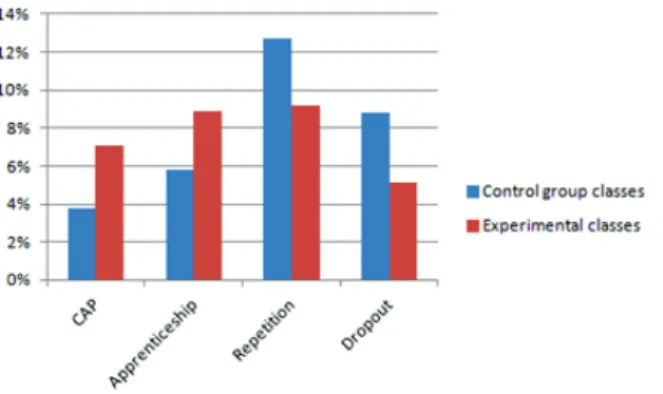
The actual situations at the beginning of the 2011 academic year match the change in applications in the spring of that year that resulted from the intervention. The proportion of
preselected pupils who begin at high school in the general and technological stream (ca 18 per cent) and in the vocational stream (ca 50 per cent) is not modified by the intervention. However, we do see a redistribution among the other situations (figure 1). Thus, for the students whose schooling remains strictly within the national education system, the situations are coherent with what the applications lead us to expect: they go more often to a CAP and repeat grades less often.
Feedback n°2 - November 2014
Symmetrically, the intervention led to a strong increase in
apprenticeships and a decrease in the dropout rate: the
proportion of those dropping out at the end of college fell by 40 per cent (from 8.8 per cent to 5.1 per cent). All these differences are statistically highly significant, which is to say that they are not random results arising from the sample studied, but reflect real differences between the two populations compared.
Intervention by the head of a school
Sustainable effects
We might fear that the young people and their families were encouraged to follow paths that they did not want to take up: which might then simply delay the dropout, when the students are disappointed in their stream or face the possibility of failing.
In order to know, we followed up the students in the second
year after the programme began, in 2012-2013.
The resulting data shows first that the young people who more frequently took up learning in a CAP or in an apprenticeship thanks to the intervention finished their first year successfully: they are more numerous in the second year of such a training course than those in the control group.
Moreover, the effect of the reduction of the dropout rate grows (going from 3.7 points in the first year to 5.1 points at the end of the second). We now add to the young people who dropped out at the end of the first year when the intervention took place those who dropped out after having transited through several education situations, because all of the extra reduction in drop-out rates in the second year comes from a very precise profile: the young who repeat their last year of college, then drop out. By reducing the grade repetitions (figure 1), the programme also reduced very significantly this type of profile in our population (2.3 per cent of those in the control group sample repeated then dropped out, while only 0.8 per cent of those in the experimental classes did so). If we look at the academic results at the beginning of the grade repetition, we see that they do not improve, which matches international data on grade
repetition. Thus, the programme helped some young people
to avoid an ineffective repetition that would simply have delayed their dropping out.
In sum, the dropout rate that totalled around 20 per cent of our preselected population at the end of two years was brought back to 15 per cent by the programme of invitation to two meetings, or in other words was reduced by one quarter. One part of this effect is immediate; another results from the reduction in dropouts. The young who thereby avoided dropping out engaged in short vocational training courses in which they pursue their schooling normally.
Effects on academic and social integration
The influence of class-mates has long been understood as a possible determinant of education choices. In this experiment, we observed that the friends of pupils preselected for the intervention who have a better school track record but who are not really good students either, change their behaviour when they are in the experimental classes, but not when they are in the control group classes (that is to say, when none of their class-mate friends are involved in the programme). Thus, they more often, to a highly significant extent, state a preference for going to a vocational high school and proportionally less often for taking up the general and technological stream, by a difference of about eight percentage points.
The social interactions revealed by the experiment do not stop there. This convergence of interest seems to go together
with a reinforcement of friendships ties. The students involved in the programme have much more stable friendship networks than the others, and this is a result of the programme. In the control group sample, 41 per cent of the class-mates identified as friends are still friends at the end of the year. This proportion is 10 points higher among the students of the experimental classes. The preselected students whose families were invited to the meetings lose fewer friends in the course of a year (12 percentage points fewer) and also gain fewer (-7 points). Even more importantly, this stability comes partly from the fact that unlike the comparable students in the control group, those who benefited from the programme kept more of the friendships with class-mates who have a
more promising academic futures. The natural tendency of the academically weak students in our study is progressively to lose some of their friends who have better academic results: in the control group the proportion of such friends drops from 78 per cent
to 70 per cent between the beginning and the end of the year. This reduction does not appear in the experimental group: the initial and final proportions of these friends remains at 77 per cent.
So, by changing the aspirations of young people at risk of
dropping out, the head of schools' interventions also have
the indirect effect of protecting social links: in doing so, they
maintain interactions between these young people, who influence each other and, in a way, bring closer together their plans for the direction of their future professional training.
Exchanges between parents during a meeting
A simple and effective measure
This experiment shows that it is possible to fight the dropout problem among the academically weakest students using a intervention that is simple in its basic principle and which essentially takes just a little of a head of school's time in holding a small number of meetings. It does this by informing pupils about an education pathway that is more accessible to them – short vocational courses and apprenticeships – and by avoiding ineffective grade repetition.
Traditional approaches to this question study the lack of ambition among good students of modest origins and reveal its long-term effects on academic, social and vocational careers.
But the aspirations of the weakest students have rarely if ever received serious attention. In a stratified system in which
academic performances constitute the criteria for orientation, first for access to general and technological high school then through the points system that determines the algorithm of place allocation to vocational high schools, we show that work on the schooling project organised by the school heads can prevent ruptures and keep weak students on a path to better social and vocational insertion.
What explains the effectiveness of such a simple measure? The
first lesson is that the aspirations of these pupils and their
families are often ill-informed despite being highly significant in
their choices of direction. The second lesson is that it is
possible to change these aspirations through working with the families before disappointments surface. The interaction with families, and not only with the students, is fundamental and confirms the results of another experiment that was conducted among first-year college classes. It is likely that the individual head of school is equally as important in the success of the intervention, because he or she has strong credibility and knows each of the students. It is also likely that social interactions increase the impact of this kind of intervention, through measures whose richness and complexity appear in our data, and which will be interesting to explore in greater detail in future.
References :
The full study « Aspirations scolaires et lutte contre le
décrochage » is available at
www.experimentation.jeunes.gouv.fr www.povertyactionlab.org
www.ipp.eu
This research was funded by le Fonds d’expérimentation pour la jeunesse (FEJ).
Authors:
Dominique Goux, [email protected] Marc Gurgand, [email protected] Eric Maurin, [email protected]
The authors wish to thank all the partners who participated in this evaluation.