PERCEPTUAL BARRIERS PREVENTING
SMALL BUSINESS OWNERS FROM
USING PUBLIC SUPPORT SERVICES:
EVIDENCE FROM CANADA
Josée Audet, Université Laval
Sandrine Berger-Douce, IAE Valenciennes
Etienne St-Jean, Université Laval
ABSTRACT
Given the economic importance of small and medium enterprises (SMEs), public authorities are seeking ways to improve support for SME owner-managers. Each year, considerable funds are budgeted to help small businesses, and the number of SME support organizations has steadily grown. Despite all these efforts, however, SME survival rates have barely improved, if at all. There may be a good reason for this: entrepreneurs and SME owner-managers do not make maximum use of the services available. Results from a survey of 70 SME owner-managers show that the main barrier is lack of knowledge about the agencies providing the services. On the one hand, many owner-managers do not seem to understand the utility or relevance of the services, while on the other they do not seem to know enough about the agencies working in their region. However, most of the owner-managers who had used the agencies felt the services they had received were appropriate to their needs. At first glance, the problem thus appears to lie more with the perceptions of certain owner-managers than with the nature or quality of the services themselves.
INTRODUCTION
Given the economic importance of small and medium enterprises (SMEs), public authorities are seeking ways to improve support for SME owner-managers. Each year, considerable funds are budgeted to help small businesses, and the number of SME support organizations has steadily grown. Despite all these efforts, however, SME survival rates have barely improved, if at all. There may be a good reason for this: entrepreneurs and SME owner-managers do not make maximum use of the
services available. For example, in a study of 104 startup entrepreneurs throughout Canada, Gasse and his colleagues found that barely one-third of respondents had made use of public support agencies during venture startup, when their firms were most at risk (2004). It is thus both essential and urgent to find out why government services and programs fail to reach their target client group, namely SME owner-managers. The purpose of this research is therefore to identify the factors likely to influence the decision of SME owner-managers to consult public support agencies. The study will begin with a review of the literature, highlighting the factors likely to influence the SME owner-manager’s decision to request help from public agencies. This will be followed by a description of the conceptual framework and methodology. The findings will then be presented and commented, and the paper will end with some suggestions for further research.
LITERATURE REVIEW
A certain number of factors appear to influence an SME owner-manager’s decision to consult a public agency or not. First, we must look at how the business owner’s attitude toward outside help impacts his relationship with public agencies. Next it may be helpful to consider owner-managers’ perceptions and degree of knowledge about the agencies and the services they offer. Lastly, the role the owner’s gender plays in interaction with public agencies may be important. The literature addressing these factors is listed below with our comments.
Many SME owner-managers appear to have a fairly negative perception of the professional advisors with whom they work. There are many reasons for this. They may, for example, believe the advice given is not practical enough or not tailored to their situation, that the advisors charge too much for the results they achieve, and do not understand small business (J. Curran, Jarvis, R., Blackburn, R.A., & Black, S., 1993; D. Devins, 1999; T.J. Zinger, Blanco, H., Zanibbi, L., & Mount, J., 1996). Sammut (1998) also noted that many venture creators refuse outside help on the basis that they prefer to remain absolutely independent (one of the principal reasons for venture creation), and also out of fear that the people around them may think they are incompetent (see also Curran and Blackburn (2000)). Similarly, Bloch (1997) asserts that, in France, support is linked to the concept of failure or difficulty, contradicting the self-image that entrepreneurs try to project. It is also important to note the somewhat contradictory results of a study carried out by Quebec’s Order of Chartered Administrators (2000). Here, a survey of 206 small business owner-managers revealed that 72% had a positive opinion of
consulting service providers. However, this was in stark contrast to the generally negative perception revealed during in-depth interviews with thirty owner-managers in the first phase of the same study.
When small business owner-managers decide to obtain outside help, the resource they call upon first is usually the accountant (E. Arginova & Michaelis, C., 2003; R.J. Bennett & Robson, P.J.A., 1999; N.K. Ho & Mula, J., 2004), followed by the banker and the lawyer. The popularity of the accountant is probably due to the primordial importance of financial management for small business survival. Public services do not seem to generate much enthusiasm among small business owner-managers, ranking systematically behind private support sources. According to the literature survey by Bennett and Robson (1999), between 25% and 34% of owner-managers use public support services, compared to nearly 80% who use accountants. In Canada, Gasse and his colleagues (2004) reported similar findings, while Good and Graves (1993) observed even lower rates of public service usage; barely 10% of the 160 entrepreneurs they questioned in Manitoba said they had used the services of a public support agency.
What do small business owner-managers think of public support agencies? If we rely on the findings described above, there would appear to be a fair amount of scepticism, given the very low usage levels. It is reasonable to think that the agencies may be the victims of the owner-managers’ general distrust of or aversion to the government apparatus. For example, according to a study by Good and Graves (1993), small business owner-managers blame most of their problems on the government, including paperwork and formalities, income tax and other tax requirements and policies that discriminate against small business. If they associate support agencies with the government, their perceptions are almost bound to be negative.
We might also wonder just how useful small business owner-managers think the services they are likely to receive will be. The handful of entrepreneurs from Good and Graves’ (1993) study who had consulted public agencies felt the advice they had received had been helpful in 44% of the cases where the firm had gone out of business, and in 52% of cases where the firm was still in business. According to another Canadian study of 90 small business owner-managers, half felt the available government programs did not meet their needs (T.J. Zinger, Blanco, H., Zanibbi, L., & Mount, J., 1996). This opinion is shared by owner-managers in Québec, but to a lesser extent; a recent study of 196 owner-managers from Québec found that one-third felt the assistance given by support agencies was inadequate and did not meet their needs (C. Borges, Simard, G., & Filion, L.J., 2005).
If we look at perceptions of service efficiency, opinions are still mitigated. For example, in a study of 2,474 small business owner-managers in Great Britain, respondents felt advice from accountants and customers had the greatest impact on results, ahead of advice from public support agencies. The situation appears to be somewhat different in the United States, in terms of the actual (not perceived) impact of services on business success. For example, Chrisman and McMullan (2004) studied a sample of American small firms that had used the services of public support agencies, and found they had a higher survival rate and better growth than firms that had not done so. The authors proposed that support agency use provided tacit and explicit knowledge that entrepreneurs could use to create a sustainable competitive advantage, thus explaining the positive impact on the firm’s performance. Obviously, it is difficult if not impossible to establish a direct causal link between agency services and business performance, since the other factors likely to have an impact on performance cannot be controlled.
Small business owner-managers have certain expectations of support agencies and their staff. It seems to be important for the agency staff to have understood the culture, goals, business context and working methods of the owner-manager. Service based on listening and dialogue is therefore required. As a learning method, it is preferable for advisors to draw upon the ideas of the owner-managers rather than provide prefabricated solutions to management problems (J.J. Chrisman & McMullan, E.W., 2004).
Owner-managers also expect services that meet their needs, which are numerous and vary according to the firm’s activity sector or development stage, and the owner-manager’s ambitions (R.G. Wyckham, Wedley, W., & Culver, E.W., 2001). Accordingly, support agencies need to segment their markets and shape their supply of services to meet the specific needs of different client groups.
Despite the large number of agencies and programs created to help small business, some owner-managers may not even be aware of their existence or the fact that programs are available to meet their needs. Good and Graves (1993) described 21 government support programs to a group of Canadian entrepreneurs and asked them if they had heard of the programs. Some 86% were aware of the basic start-up information program, but only 18% had heard of the government guaranteed loan program, with the average for all programs being around 39%. Argirova and Michaelis (2003) found that only 57% of owner-managers in their Scottish study knew about small business support programs, compared to 74% in England, 57% in Wales and 51% in Northern Ireland. In the United States, a study carried out in the State of Wisconsin revealed the existence of more than 400 business support
programs offering more than 700 services, although the entrepreneurs questioned for the research had only limited knowledge of them (P.D. Reynolds & White, S.B., 1997). In France, information on the myriad of available support programs seems to be hard to find (P. Albert, Fayolle, A., & Marion, S., 1994). Each program has its own interlocutor and its own trademark. Albert and his colleagues even suggested that the situation had fostered the development of a special category of venture creators, known as “prize chasers”, and consultants, known as “prize pimps”.
Women entrepreneurs often face structural barriers limiting their full participation in economic activity, the main ones being access to capital, networks, and social support (L. Stevenson & Lundström, A., 2002). Indeed, women are less likely to seek loans from financial institutions than men. (J.J. Madill, Riding, A.L., & Haines, G.H.J., 2006; Statistics Canada, 2001). Those who refuse to ask for financial assistance mainly justify their decision by saying that they don’t need it. Because most SME aid programs aim to provide financial assistance, it is worthwhile to consider whether women avoid them as much as they do financial institutions. This doesn’t, however, appear to be the case. A study that sampled a large number of American SMEs revealed that the probability a woman-owned SME would seek financial help from friends, family, or public organizations was significantly higher than for a man-owned SME (G.W. Haynes & Haynes, D.C., 1999). Moreover, data revealed that a greater proportion of their businesses’ liabilities consisted of loans from these same sources. The situation appears slightly different in Canada: government agency loans represented 4% of SME liabilities in 2000, both at businesses that were owned primarily by women and those primarily owned by men (Statistics Canada, 2001). This leads us to believe that women entrepreneurs do not hesitate to consult government support agencies, particularly to ask for financial help.
As regards advice, a study, from the U.S., shows that, proportionally speaking, women SME owner-managers consult public agencies more than men (Small Business Administration, Small Business Development Center and Minority Business Development) in seeking advice and information (M. Young & Brenner, C., 2000). In France, women seek advice less frequently than men (APCE, 2001) and, in 1998, 42.8% of these women had received no help whatsoever compared to 46% of men. However, the data gathered by Lambrecht et al. (2003) shows just the opposite. According to these authors, women entrepreneurs are more likely to seek advice compared to their male counterparts. As well, women recognize that public authorities have a role to play in providing financial assistance to SMEs. Without this aid, they would naturally be less inclined to seek help from a consultant.
CONCEPTUAL FRAMEWORK\
The literature survey highlights four factors that best seem to explain the propensity of owner-managers to consult support agencies. The first of these, and the key element, is the owner-manager’s attitude towards outside assistance. Many small business owner-managers hesitate to seek outside help in case they are perceived as incompetent. The second factor is the owner-manager’s perception of public support agencies, which will affect the decision to use their services or not. If the owner-manager perceives the agencies as being unable to help, he or she will not consult them. Thirdly, the use of support agencies is conditioned by the owner-manager’s knowledge of the agencies themselves and the services they offer. Clearly, an owner-manager who is unaware of an agency or service will not use it. Finally, there are gender related differences that lead to different uses of public services among SME owners.
The following research hypotheses were therefore tested in the field: H1: The natural resistance of small business owner-managers
to the idea of requesting outside help will prevent them from using the services of public support agencies; H2: Negative perceptions of public support agencies and their
services will prevent owner-managers from using the agencies’ services;
H3: Lack of knowledge of the services available from public
support agencies will prevent owner-managers from using those services;
H4: Women entrepreneurs will make more use of the services
available from public support agencies than male entrepreneurs.
RESEARCH METHODOLOGY
The sample was selected from the population of small business owner-managers in Gaspé, the largest town in the Gaspésie region of Québec (Canada) with 17,000 inhabitants. This magnificent coastal region, bordered by the St. Lawrence
Gulf and Estuary, is located at some distance from the major cities. Its economy still depends to a large extent on natural resources (forests, mines and fisheries), although the importance of tourism is increasing. Its natural resources are currently in decline, mainly as a result of overexploitation, and the region is one of the most economically disadvantaged in Québec, despite significant efforts to diversify the economy.
We selected this area for several reasons. First, preliminary studies by the Gaspésie-Magdalen Islands Research Chair reported under-use of public business support services. Second, the region is extremely disadvantaged economically, suggesting that its owner-managers and potential entrepreneurs would have much to gain by using the available services to try to reverse the current economic slump. Yet, they do not appear to do so, thus confirming the relevance of our research.
Respondents had to meet two principal conditions, first that their firm employed fewer than 250 people, and second, that it was located within the territory of the Town of Gaspé. In addition, the sample had to contain both owner-managers who had used support services and those who had not. There was no requirement as to the firm’s activity sector.
The Gaspé Economic Development Corporation, known by its French acronym SADC, supplied the researchers with contact information for all the region’s firms. The owner-managers of the 172 firms that met the selection criteria were contacted. Of this number, 64 refused to take part in the study, 48 could not be reached and 70 agreed to go ahead, 13 for personal interviews and 57 for a telephone survey. A total of 34 of the sample owner-managers had used support agency services in the past, and 36 had not.
An interview guide was drawn up for the personal interviews. It included a number of closed questions, followed by open questions to encourage respondents to explain their answers. The interviews lasted an average of 30 minutes each. They had a dual purpose: first, the information gathered would be used to perfect the telephone survey questionnaire, and second, it would be used to understand and interpret future statistical analyses. The telephone survey questionnaire was composed primarily of multiple-choice closed questions, with most of the variables being measured on a five-step scale. To measure the level of knowledge held by respondents about public agencies, they were asked to rate their level of knowledge of the three main agencies in their region on Likert-type scales (from 1 = I don’t know it at all to 5 = I know it very well). Then an index was created summing up the three scales (from 3 to 15).
To test the research hypotheses, a variance analysis was carried out with a 0 (Phi) test for the nominal variables and a Mann-Whitney U test for the scales or index variables. Such tests are superior to traditional 32and t tests when the sample
is small or when distribution normality is questionable.
PRESENTATION AND DISCUSSION OF RESULTS
The vast majority of the respondents owned their firms (77.1%), and most had created them. The overall level of managerial experience was high, with nearly two-thirds of respondents having over ten years of experience. Interestingly, only 53% of those who had used support agencies in the past had more than ten years of experience, compared to 80.6% of those who had never used an agency. The latter group was therefore more experienced, having been in business for longer. It is likely that when the more experienced respondents first began in business, business support services were less well developed, thus explaining the lower usage level. Once experienced, they had less need to consult. As far as gender is concerned, there were far more men (70%) in the sample than there were women.
The information obtained on the firms revealed that most had been in existence for more than ten years (74.3%) and employed fewer than five people; in fact, only 11.5% of the firms employed more than ten people. The sector with the highest representation was the general service sector (retail trade, hotels, personal services, etc.). The primary and secondary sectors accounted for 24.4% of the sample, which is fairly consistent with the general situation in the Gaspé Peninsula. There were no statistically significant differences between the two groups in terms of business profile.
H1: The natural resistance of small business owner-managers
to the idea of requesting outside help will prevent them from using the services of public support agencies.
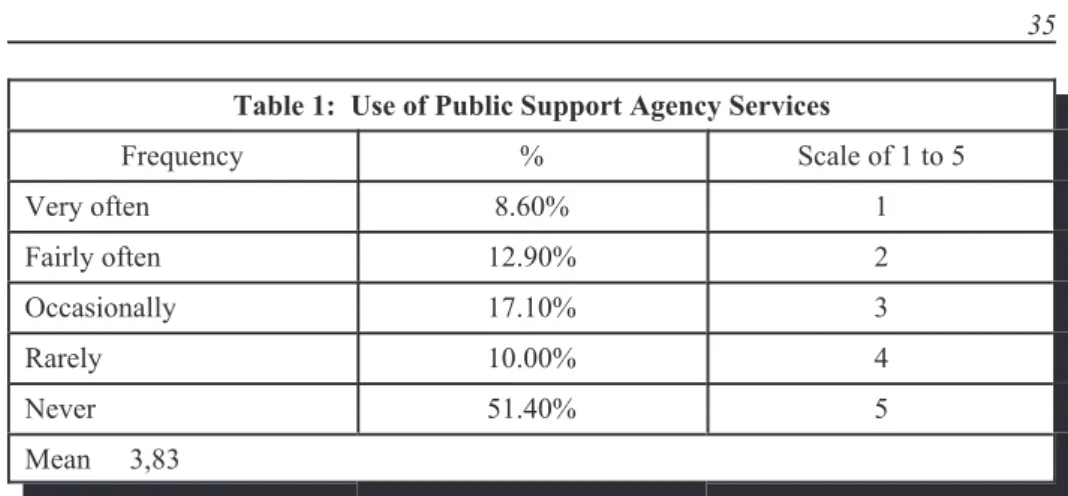
The data showed that most of the owner-managers had used outside help in the past. The accountant and banker were the resources most often consulted, confirming the findings from the literature review. Government agencies ranked only sixth, and more than half the sample (51.4%) had never used them (see Table 1 below). Of all the proposed services, lawyers and private consultants were ranked last, possibly due to the fact that most of the sample firms were very small and may not have had the need or the means to employ this type of resource.
Table 1: Use of Public Support Agency Services Frequency % Scale of 1 to 5 Very often 8.60% 1 Fairly often 12.90% 2 Occasionally 17.10% 3 Rarely 10.00% 4 Never 51.40% 5 Mean 3,83
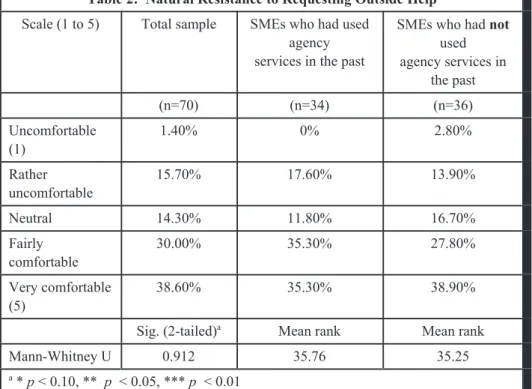
When asked how comfortable they were in requesting outside help, 38.6% of respondents said they were very comfortable and 30% said they were fairly comfortable (see Table 2 below). Very few said they were uncomfortable. There was no significant difference between the two groups. In other words, if the sample owner-managers did not use outside services, it was not because they were uncomfortable doing so. The hypothesis to the effect that natural resistance is an obstacle to the use of public support agency services is therefore rejected.
H2: Negative perceptions of public support agencies and their
services will prevent owner-managers from using the agencies’ services.
Overall, the respondents thought business support agencies were useful (see Table 3), and only a third thought they were not very or not at all useful. On the other hand, there was a statistically significant difference between the means of the two groups concerning the perception of utility. On a scale of 1 to 5 (1=very useful and 5=not at all useful), the mean was 2.3 for the respondents who had used agency services in the past and 3.1 for those that had not.
Table 2: Natural Resistance to Requesting Outside Help Scale (1 to 5) Total sample SMEs who had used
agency services in the past
SMEs who had not used agency services in the past (n=70) (n=34) (n=36) Uncomfortable (1) 1.40% 0% 2.80% Rather uncomfortable 15.70% 17.60% 13.90% Neutral 14.30% 11.80% 16.70% Fairly comfortable 30.00% 35.30% 27.80% Very comfortable (5) 38.60% 35.30% 38.90%
Sig. (2-tailed)a Mean rank Mean rank
Mann-Whitney U 0.912 35.76 35.25
a
* p < 0.10, ** p < 0.05, *** p < 0.01
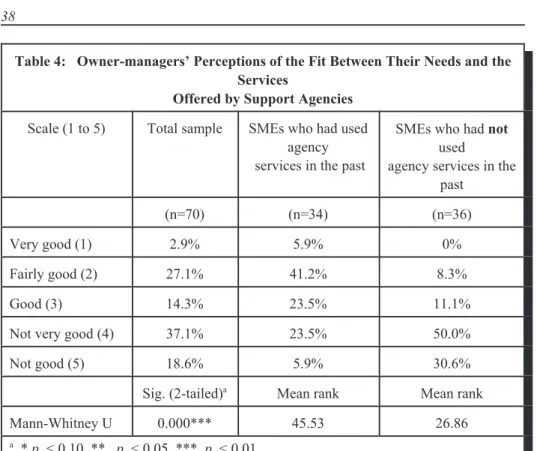
More than half the respondents thought the services offered by public support agencies were not very or not at all suited to their needs. The results were somewhat more mitigated among the group that had previously used agency services; only 30% of this group felt the services were not very or not at all suited to their needs. This result is similar to that obtained by Borges et al. (2005) with a sample of small business owner-managers from Québec who had previously dealt with support agencies. Borges’ sample was drawn from all the regions and cities of Québec, suggesting that the fact of being located in a remote region does not influence the owner-managers’ perception of the appropriateness of the services offered and received.
Table 3: Perceptions of Public Support Agency Utility
Scale (1 to 5) Total sample SMEs who had used
agency services in the past
SMEs who had not used agency services in the past (n=70) (n=34) (n=36) Very useful (1) 17.10% 26.50% 2.80% Useful (2) 37.10% 41.20% 13.90% Somehow useful (3) 12.90% 14.70% 16.70%
Not very useful (4) 28.60% 14.70% 27.80%
Not useful (5) 4.30% 2.90% 38.90%
Sig. (2-tailed)a
Mean rank Mean rank
Mann-Whitney U 0.004*** 45.23 28.86
a
* p < 0.10, ** p < 0.05, *** p < 0.01
Interestingly, the negative perception of service suitability was much more marked among respondents who had never used a support agency, more than 80.6% of whom felt the services offered were not very or not at all suited to their needs. In other words, the respondents had a very poor opinion of the programs and services available in their region. The difference between the two groups was statistically significant (see Table 4).
Based on the above results, the hypothesis concerning negative perceptions about support agencies and their services being an obstacle to their use appears to be confirmed.
Table 4: Owner-managers’ Perceptions of the Fit Between Their Needs and the Services
Offered by Support Agencies Scale (1 to 5) Total sample SMEs who had used
agency services in the past
SMEs who had not used agency services in the
past
(n=70) (n=34) (n=36)
Very good (1) 2.9% 5.9% 0%
Fairly good (2) 27.1% 41.2% 8.3%
Good (3) 14.3% 23.5% 11.1%
Not very good (4) 37.1% 23.5% 50.0%
Not good (5) 18.6% 5.9% 30.6%
Sig. (2-tailed)a Mean rank Mean rank
Mann-Whitney U 0.000*** 45.53 26.86
a * p < 0.10, ** p < 0.05, *** p < 0.01
H3: Lack of knowledge of the services available from public
support agencies will prevent owner-managers from using those services.
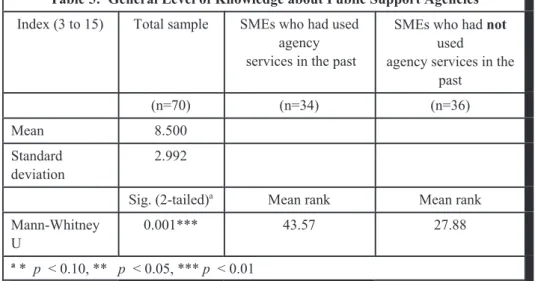
Table 5 shows that nearly 60% of the respondents who had never used a support agency knew very little or nothing at all about the agencies. In the sample as a whole, nearly half the respondents had very little knowledge about their region’s support agencies. This is a surprisingly high percentage, given the fact that the Gaspé area is small, and in principle everyone knows everyone else, at least in the small business community. An internal verification by Canada Economic Development (EDC) regarding its Gaspé-Magdalen Islands Economic Support Program revealed that very few entrepreneurs were even aware that EDC had an office in Gaspé (2004). This tends to confirm our findings. However, not all the Gaspé region entrepreneurs were in this position; on the contrary, most of those who
had used support agency services in the past were fairly well informed about the agencies and their services. Given the statistically significant difference between the two groups, hypothesis H3 is confirmed. In other words, lack of knowledge will prevent owner-managers from using the available services.
Table 5: General Level of Knowledge about Public Support Agencies Index (3 to 15) Total sample SMEs who had used
agency services in the past
SMEs who had not used agency services in the
past (n=70) (n=34) (n=36) Mean 8.500 Standard deviation 2.992 Sig. (2-tailed)a
Mean rank Mean rank
Mann-Whitney U
0.001*** 43.57 27.88
a * p < 0.10, ** p < 0.05, *** p < 0.01
H4: Women entrepreneurs will make more use of the services
available from public support agencies than male entrepreneurs
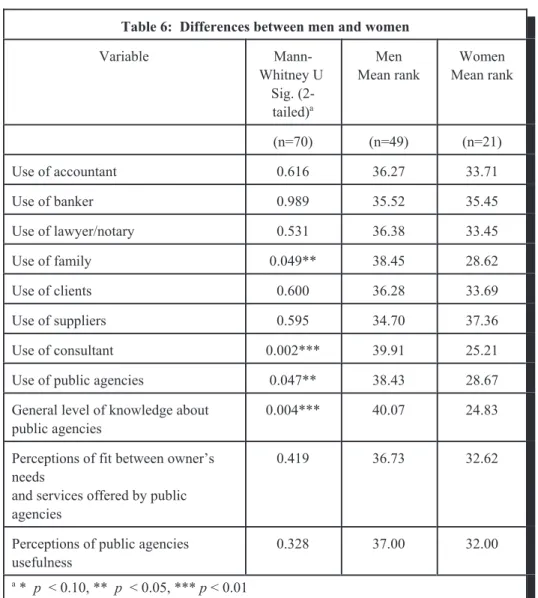
Our results show that contrary to our hypothesis, male entrepreneurs make more use of public support services than their female counterparts (see Table 6). This result confirms that of APCE (2001), which sampled men and women entrepreneurs in France, but runs counter to the bulk of the literature. In our sample, male entrepreneurs are also more aware of the programs available, which could explain why they use them more than women. Furthermore, they ask more for advice from family members and consultants. It is worth noting that there is no statistical difference between the perceptions held by male and female entrepreneurs with regard to public agencies, so it is not because women view agencies less favorably that they consult them less than men.
Table 6: Differences between men and women Variable Mann-Whitney U Sig. (2-tailed)a Men Mean rank Women Mean rank (n=70) (n=49) (n=21) Use of accountant 0.616 36.27 33.71 Use of banker 0.989 35.52 35.45 Use of lawyer/notary 0.531 36.38 33.45 Use of family 0.049** 38.45 28.62 Use of clients 0.600 36.28 33.69 Use of suppliers 0.595 34.70 37.36 Use of consultant 0.002*** 39.91 25.21
Use of public agencies 0.047** 38.43 28.67
General level of knowledge about public agencies
0.004*** 40.07 24.83
Perceptions of fit between owner’s needs
and services offered by public agencies
0.419 36.73 32.62
Perceptions of public agencies usefulness
0.328 37.00 32.00
a
* p < 0.10, ** p < 0.05, *** p < 0.01
QUALITATIVE DATA AND DISCUSSION OF RESULTS
The qualitative data collected during the interviews and telephone survey can now be used to qualify our findings. We saw earlier that nearly one-third of the respondents surveyed thought the support agencies were not very or not at all useful. In the interviews, the factors most frequently mentioned to support this negative
perception were the hierarchy-based structure of the agencies, the difficulty of deciding which agency to approach due to overlaps, program eligibility criteria that were too difficult to meet, and the time required to obtain a decision. Some respondents also felt the advisors working for the agencies were disconnected from the real world of small business. The clear preference expressed by some respondents for sources of support other than the government clearly confirms this negative perception.
As far as service utility is concerned, the respondents, rightly or wrongly, thought the services offered by support agencies were not relevant to their field of activity and were aimed mainly at start-up firms. The need mentioned most frequently was for business development support. Respondents also wanted easily accessible, efficient and fast services. Among the improvements proposed most frequently by respondents was the creation of a central agency or “single wicket” system. Other improvements included programs that were better suited to the situation prevailing in the regions, since current programs were perceived as being aimed at urban areas. Interestingly, these findings are consistent with the recommendations made by the Organisation for Economic Co-operation and Development (OECD) in its report on entrepreneurship and local economic development in its member countries (2003). Among other things, the OECD recommended (1) easy access to a single wicket where all the necessary documents and forms could be obtained during a single visit; (2) shorter waiting times and procedures for advisory services; (3) easy-to-understand contact directories and service guides; and (4) access to consultants with in-depth knowledge of the local community.
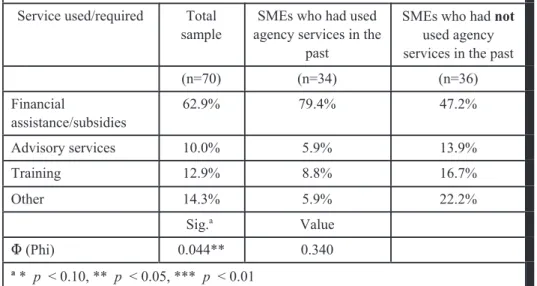
The question arises as to what needs government support services currently meet in the Gaspé region. In nearly 80% of cases, respondents had consulted agencies to request subsidies or financial assistance. Training ranked a distant second (see Table 7). When asked why they might eventually consider approaching a support agency, respondents who had never used agency services in the past said it would mainly be for financial assistance, although the percentage was significantly lower. This group was also much more interested in training and advisory services than the other group. In short, it would appear that the only services used to any extent by the region’s owner-managers at the present time are financing services. It is therefore hardly surprising that the agencies should be perceived as “subsidy providers” rather than as business development advisors. It seems likely that owner-managers wanting training or advice would not automatically think of approaching the region’s public support agencies.
Table 7: The Services Used or Required by Small Business Owner-managers Service used/required Total
sample
SMEs who had used agency services in the
past
SMEs who had not used agency services in the past
(n=70) (n=34) (n=36) Financial assistance/subsidies 62.9% 79.4% 47.2% Advisory services 10.0% 5.9% 13.9% Training 12.9% 8.8% 16.7% Other 14.3% 5.9% 22.2% Sig.a Value 0 (Phi) 0.044** 0.340 a * p < 0.10, ** p < 0.05, *** p < 0.01
This focus on financial assistance may also explain why, in our sample, women business owners largely did not consult public agencies. They probably did so for the same reason some of them don’t apply for credit from financial institutions: they don’t have the need. This does not necessarily mean that women entrepreneurs do not want public support agencies’ services or advice. In fact, many believe that services should be developed to meet the specific needs of women entrepreneurs. Recently, programs dedicated to women entrepreneurs have been developed, notably in the United States and Canada (L. Stevenson & Lundström, A., 2002). Orser and Riding (2006) recently estimated the results from an initiative of this type taken in 1995 by the federal government in Western Canada. The Women’s Enterprise Initiative aims to encourage the development and growth of businesses run by women, notably using aid programs (advice, training) and financial support. Given the results achieved, the authors believe that this program helps make up for women’s lack of experience, which may keep their businesses from growing as fast as those run by men. It is also noteworthy that the survival record of those businesses having benefited from these services was higher than that of similar businesses that did not receive such services. Although scientific studies measuring the effectiveness of women-specific programs are rare, it is nonetheless significant that in the two countries offering the most programs for women entrepreneurs, such businesses have shown the most growth in the last decade (L. Stevenson & Lundström, A., 2002).
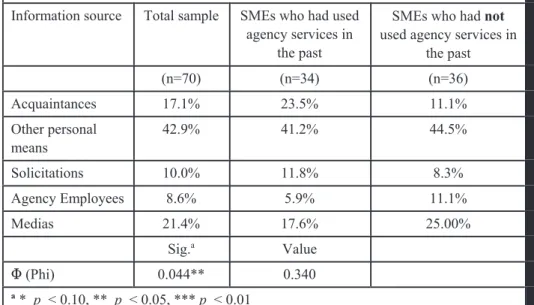
One of our hypotheses was concerned with target clients’ knowledge of support agencies, and we also checked to see how the owner-managers had learned of the agencies’ existence in their region. As Table 8 shows, they had mainly heard of the agencies in two ways, namely from acquaintances or through other personal means, or from the agencies’ promotional initiatives (media, employees or solicitation). The vast majority of owner-managers had learned about the agencies through their own means, and this may perhaps explain why so many people had not heard of them. If owner-managers have to take steps to obtain information about the agencies, the chances are that many will simply not bother because they do not have the time. The Gaspé region’s support agencies should therefore review their promotional and communication strategies, because the information is clearly not being circulated effectively. This problem does not appear to be unique to the Gaspé region. The above-mentioned OECD study (2003) found that many entrepreneurs in OECD member countries were unaware of the support services available to them. It highlighted the importance of good visibility for support agencies, since the large volume of support initiatives can be confusing. The study suggested using the local media to publicize the agencies and their programs, and also providing large numbers of access points in places likely to be used by businesspeople. In addition, other stakeholders working with entrepreneurs (e.g. bankers, lawyers, accountants, chamber of commerce representatives, etc.) should be encouraged to recommend public support services.
Another issue behind these results is SME owner-managers’ perception of the added value of support. Is public support—despite its benefits in terms of long-term survivability (OSEO, 2006)—really indispensable to all entrepreneur profiles? We must give a qualified answer if we consider the results of Léger-Jarniou (2005) in her study of entrepreneurs who voluntarily refused any help and reported no regret at having done so. The author concludes that questions need to be raised about the support role and a much closer look must be taken at customized services based on the client segmentation principle. In short, individualization must become the norm (p. p. 14). Support would no doubt gain credibility if it truly took SME owner-manager profiles into consideration. An immigrant woman entrepreneur is not likely to have the same needs as a man with lengthy professional experience and a wide network of business contacts. In recent years, more and more voices have been critical of support that is so standardized that it benefits no one and have called for a more personalized, user-friendly approach. The crucial issue is one of allocating financial resources to this new kind of support while ensuring that advisors, who all
too often simply apply one-size-fits-all methodologies that leave little room for personalizing their recommendations, have the qualifications they require.
Table 8: How Owner-managers Learned About Public Support Agencies Information source Total sample SMEs who had used
agency services in the past
SMEs who had not used agency services in
the past (n=70) (n=34) (n=36) Acquaintances 17.1% 23.5% 11.1% Other personal means 42.9% 41.2% 44.5% Solicitations 10.0% 11.8% 8.3% Agency Employees 8.6% 5.9% 11.1% Medias 21.4% 17.6% 25.00% Sig.a Value 0 (Phi) 0.044** 0.340 a * p < 0.10, ** p < 0.05, *** p < 0.01 CONCLUSION
As this paper shows, there do appear to be certain barriers that prevent SME owner-managers from making maximum use of the public support services available in their region. The main barrier appears to be lack of knowledge about the agencies providing the services. On the one hand, many owner-managers do not seem to understand the utility or relevance of the services, while on the other they do not seem to know enough about the agencies working in the region. This study was not intended to judge the utility of the available services, and we are therefore unable to comment on the accuracy of these perceptions. Interestingly, however, most of the owner-managers who had used the agencies felt the services they had received were appropriate to their needs. At first glance, then, the problem appears to lie more with the perceptions of certain owner-managers than with the nature or quality of the services themselves.
We have also noted that women heading SMEs are more reticent than men to consult public support agencies, perhaps because they do not have financial needs, but perhaps also because they are afraid that the support will not meet their specific needs. If such is the case, public authorities must do more than simply advertise the available aid—they must first develop a support network that addresses the specific needs of women, or at least in Canada, extend existing services (such as the Women’s Enterprise Initiative) to other parts of the country. Moreover, we must build on the experience of others, such as the United States (Langowitz, Sharpe, Godwyn, 2006) or the European Commission’s ProWomEn network.
Steps are required to ensure that more small firms are eventually able to take advantages of government services. This will certainly improve their chances of survival, and may even stimulate their development. This is not to suggest that small business support services are sufficient, alone, to bring about a recovery in an economically disadvantaged region. On the contrary, we share the view of Lichtenstein and Lyons, who said that “entrepreneurs do not start businesses because services are available; services are demanded and used as the result of the existence of entrepreneurs. Although services are necessary, they are not sufficient to transform a region’s economy into a dynamic force” (2001, p. p. 5). The challenge facing the public authorities is a sizeable one, but one that must be addressed.
Obviously, the research described here has its limitations. First, it does not include an objective assessment of the programs and services offered. Second, the opinions of support agency staff were not obtained. Third, the sample is limited to owner-managers in the Gaspé region of Québec (Canada), and it is therefore difficult to say how far its findings can be extended to small firms in general. However, the fact that the OECD’s recommendations for small business support programs (2003) are consistent with our findings does suggest that the problem, while perhaps not universal, is one that extends beyond the Gaspé region. All these limitations constitute avenues for future research to complete the findings of this study.
REFERENCES
Albert, P., Fayolle, A., & Marion, S. (1994). L'évolution des systèmes d'appui à la création d'entreprises. Revue Française de Gestion, (Nov.-Dec.), 100-112.
APCE. (2001). Les femmes et la création d'entreprise: Collection Focus.
Arginova, E., & Michaelis, C. (2003). Omnibus survey of small businesses in Scotland (Research Findings No. 7): Scottish Executive.
Bennett, R. J., & Robson, P. J. A. (1999). The use of external business advice by SMEs in Britain. Entrepreneurship and Regional Development, 11(2), 155-180.
Bloch, A. (1997). Psychopathologies entrepreneuriales. Dossier "L'art d'entreprendre", no.
5 Retrieved 02-03, 2007, from http://www.lesechos.fr/formations/entreprendre/
articles/article_5_5.htm
Borges, C., Simard, G., & Filion, L. J. (2005). Entreprendre au Québec, c'est capital ! (Cahier de recherche No. 2005-03). Montréal: Chaire d'entrepreneuriat Rogers-J.-A.-Bombardier - HEC Montréal.
Canada Economic Development. (2004). Audit of the Canada Support Program for the Economy of Gaspe and the Magdalen Islands. Retrieved Feb. 9, 2006, from h t t p : / / w w w . d e c - c e d . g c . c a / a s p / P u b l i c a t i o n s /Doc_verification.asp?LANG=EN&SEL_MENU=VERIF&FICHIER_RETOUR =doc_verification.asp
Chrisman, J. J., & McMullan, E. W. (2004). Outsider assistance as a knowledge resource for new venture survival. Journal of Small Business Management, 42(3), 229-244. Curran, J., & Blackburn, R. A. (2000). Panacea or White Elephant? A Critical Examination
of the Proposed New Small Business Service and Response to the DTI Consultancy Paper. Regional Studies, 34(2), 181-190.
Curran, J., Jarvis, R., Blackburn, R. A., & Black, S. (1993). Networks and Small Firms: Constructs, Methodological Strategies and Some Findings. International Small
Business Journal, 11(2), 13-25.
Devins, D. (1999). Supporting Established Micro Businesses: Policy Issues Emerging from an Evaluation. International Small Business Journal, 18(1), 86-96.
Gasse, Y., Tremblay, M., Menzies, T. V., & Diochon, M. (2004). La dynamique et les caractéristiques des entreprises émergentes: les premiers stades de développement. Paper presented at the Administrative Sciences Association of Canada, Quebec City.
Good, W. S., & Graves, J. R. (1993). Small business support programs: The views of failed versus surviving firms. Journal of Small Business and Entrepreneurship, 10(2), 66-76.
Haynes, G. W., & Haynes, D. C. (1999). The debt structure of small businesses owned by women in 1987 and 1993. Journal of Small Business Management, 37(2), 66-76. Ho, N. K., & Mula, J. (2004). Impact of advisers on small and medium enterprises' business
performance: A study of CPA interventions on Singaporean Chinese SMEs. Paper presented at the International Council for Small Business, Belfast, Ireland. Lambrecht, J., Pirnay, F., Amedodji, P., & Aouni, Z. (2003). Entrepreneuriat féminin en
Wallonie. Retrieved 19-02, 2007, from http://139.165.234.10/crdocpme/etudes/ EFW%20-%20RAPPORT%20FINAL%20-%20OK.pdf
Langowitz, N., Sharpe, N. & Godwyn, M. (2006). Women’s business centers in the United States: Effective entrepreneurship training and policy implementation. Journal of
Small Business and Entrepreneurship, 19(2), 167-182.
Léger-Jarniou, C. (2005). Quel accompagnement pour les créateurs qui ne souhaitent pas se faire aider ? Réflexions sur un paradoxe et propositions. Paper presented at the 4e Congrès de l'Academie de l'Entrepreneuriat, Paris.
Lichtenstein, G. A., & Lyons, T. S. (2001). The entrepreneurial development system: Transforming business talent and community economies. Economic Development
Quarterly, 15(1), 3-20.
Madill, J. J., Riding, A. L., & Haines, G. H. J. (2006). Women Entrepreneurs: Debt Financing and Banking Relationships. Journal of Small Business and
Entrepreneurship, 19(2), 121-142.
Organisation for Economic Co-operation and Development. (2003). Entrepreneurship and
Local Economic Development: Program and Policy recommendations. Paris:
Orser, B. J., & Riding, A. L. (2006). Gender-based Small Business Programming: The Case of the Women's Enterprise Initiative. Journal of Small Business and
Entrepreneurship, 19(2), 143-166..
OSEO. (2006). L'appui à la création: trois ans après. Regards de chefs d'entreprise. Paris: La Documentation Française.
Quebec Order of Chartered Administrators. (2000). Les besoins et attentes en services conseils de la PME au Québec. Retrieved August 25, 2005, from http://www.adma.qc.ca/clients/ADMA/ADMA.nsf/0/6F5A7B21A32CC2138525 6BC100625259/$file/pme.pdf
Reynolds, P. D., & White, S. B. (1997). The Entrepreneurial Process: Economic Growth,
Men, Women and Minorities. Westport, Conn.: Quorum Books.
Sammut, S. (1998). Une intermédiation effective PE en démarrage - environnement local, facteur de dynamisation du développement local. Paper presented at the 4th CIFEPME, Metz (France).
Statistics Canada. (2001). Survey on Financing of Small and Medium Enterprises. Ottawa: Statistics Canada.
Stevenson, L., & Lundström, A. (2002). Beyond the Rhetoric: Defining Entrepreneurship
Policy and Its Best Practice Components (Vol. 2). Stockholm: Elander Gotab.
Wyckham, R. G., Wedley, W., & Culver, E. W. (2001). The needs of small business owners: Perceptions of entrepreneurs and service providers. Journal of Small Business and
Entrepreneurship, 16(1), 21-39.
Young, M., & Brenner, C. (2000). Needed Information and Assistance for Women Entrepreneur: A comparison with Male Small Business Owners. Paper presented at the American Small Business Enterprises Conference.
Zinger, T. J., Blanco, H., Zanibbi, L., & Mount, J. (1996). An empirical study of the small business support network--The entrepreneurs' perspective. Revue Canadienne des