1
C L I M A +:
An Early Design Natural Ventilation Prediction Method
by
Alpha Yacob Arsano Bachelor of Science in Architecture
Ethiopian Institute of Architecture, Building Construction and City Development, 2013
Submitted to the Department of Architecture in Partial Fulfillment of the Requirements for the Degree of
Master of Science in Architecture Studies at the
Massachusetts Institute of Technology
June 2017
@ Massachusetts Institute of Technology. All rights reserved.
Signature of Author: _______________________________________________________
Department of Architecture May 25, 2016 Certified by: _____________________________________________________________
Christoph Reinhart Associate Professor of Building Technology Thesis Supervisor Accepted by: ____________________________________________________________
Sheila Kennedy Professor of Architecture Chair of the Department Committee on Graduate Students
2 THIS PAGE INTENTIONALLY LEFT BLANK
3
Committee
Thesis Supervisor: Christoph Reinhart
Associate Professor of Building Technology
Thesis Readers: Brandon Clifford
Assistant Professor in Architecture
Erik Olson
4
C L I M A +:
An Early Design Natural Ventilation Prediction Method
by
Alpha Yacob Arsano
Submitted to the Department of Architecture on May 25, 2016 in Partial Fulfillment of the Requirements for the
Degree of Master of Science in Architecture Studies
Abstract
One of the most widely discussed passive building design strategies is using natural ventilation for cooling. In addition to providing fresh air, which enhances occupant productivity and comfort, strategic implementation of natural ventilation in buildings reduces the energy needed for cooling. And this reduction in energy consumption significantly reduces carbon dioxide emissions. During the initial design phase, designers routinely use climate-file based analysis to evaluate the potential for comfort ventilation against other passive building strategies. Following this initial screening, it is customary to conduct detailed simulations to further develop design ideas. At this point, inconsistencies can arise between the early climate-file based analysis and later-stage simulations. Major differences arise from limitations of climate-file based analysis to account for influences of construction assemblies, building program, and occupant comfort preferences. This manuscript presents a building performance-based climate analysis method where quick, single-zone simulations are run in EnergyPlus. The ventilation cooling potential for a site and a building program is calculated using a series of Python scripts.
Thesis Supervisor: Christoph Reinhart
5
Acknowledgments
Thank you to Christoph Reinhart for your infectious excitement and uninterrupted support for the past two years. You are indeed a wonderful mentor.
Thank you to Brandon Clifford and Erik Olsen for taking the time to share critical ideas during my research. Thank you to Salmaan Craig, the learning from the lectures and the discussions in the Thermal Tectonics course helped shape the effort in this work.
Thank you to Carlos Cerezo, you have been very inspiring with your meticulous and beautiful work. It is a pleasure working with you.
A special thank you to Bradley Tran. You have always been by my side from the hectic work seasons to the most crazy-fun nights. Thank you for editing this document with your precise and sharp eyes.
Thank you to Francesca, Renaud, and Pierre. You have made spending endless number of hours in the BT lab enjoyable. I will never forget the special home cuisines and your culinary skills.
I am grateful to my Allston family, to Joan and Laura. I love you dearly. We will finally go for hiking after a year of planning.
A very special thank you to Saba Moges and Yacob Arsano for nurturing me with your parental but friendly advices in spite of the large geographical separation. I always feel your presence.
A very special gratitude to Lulit and Yosef for letting me make your home my home. The delicious Buna with the hilarious Saturday late night chats ware the recipe for recuperation.
A special thank you to my sister Yodit for being my sunshine. Although your most missed voice comes through the skype line only occasionally, you are always in my heart.
A special thank you to my brother Iskinder, also known as Isku the Great, for being a listener and an advisor on multiple personal and academic endeavors. Thank you for offering your proficiency and love for writing to groom this manuscript.
A special thank you to my sister Gelila, and to Nigus, for keeping me up to speed with Addis jocks. Thanks a lot for always looking out for me big sister.
I am very grateful for the funding sources for this work: MIT-Portugal Program, and the Massachusetts Institute of Technology.
Last, but by no means least, thank you for all students and faculty in the Building Technology lab. Thank you to Kathleen Rose for always making resources accessible and getting us together in the events you organize.
6 THIS PAGE INTENTIONALLY LEFT BLANK
7
Contents
Acknowledgements 5 List of Figures 9 Nomenclature 10 1. Introduction 121.1. Research Motivation and Objective 14
1.2. What Can Go Wrong in the Design Process of Naturally Ventilated Building? 15
2. Background 16
2.1. Thermal Comfort, Natural Ventilation, and Thermal Mass 18 2.2. Existing Tools, and Methods for Early Design Decision 27
3. C L I M A + 31
3.1. Method for Natural Ventilation Potential Prediction 32
3.1.1. Phase I- Using Climate Analysis 33
3.1.2. Phase II- Using Climate Box Simulation 40
3.2. User Interaction and Integration with Design Process 48
3.3. Results and Discussion 50
4. Mapping Natural Ventilation Globally 56
5. Concluding Remarks 58
5.1. Future Work 59
Appendix 61
A. Thermal Climate Zone Definition 61
B. Temporal Charts of the Selected 20 Climates 62
8 THIS PAGE INTENTIONALLY LEFT BLANK
9
List of Figures
Figure 1 A medium-sized reference commercial building ... 14
Figure 2 Comparison of predictions on overheated hours ... 15
Figure 3 Important dates in the development of thermal comfort guidelines and standards. ... 17
Figure 4 Acceptable operative temperature ranges for naturally conditioned spaces ... 19
Figure 5 Increases in acceptable operative temperature limits ... 20
Figure 6 Applications of Natural ventilation ... 21
Figure 7 Coupling of building insulation and thermal mass ... 22
Figure 8 Comparison of thermal mass buffering ... 23
Figure 9 Internal thermal mass ... 24
Figure 10 Natural ventilation integration with climate ... 25
Figure 11 Comparison of U-Values ... 26
Figure 12 The description of thermal comfort models ... 27
Figure 13 Climate Consultant’s Bioclimatic Chart ... 28
Figure 14 Components of the building bioclimatic chart of Climate Consultant ... 28
Figure 15 CBE Thermal Comfort Tool. ... 30
Figure 16 The effect of the rate of natural ventilation on thermal mass buffering ... 32
Figure 17 The components of CLIMA+ natural ventilation prediction method. ... 33
Figure 18 The coupling of natural ventilation and thermal mass ... 34
Figure 19 Phase I study for Phoenix. ... 36
Figure 20 Potential application of different natural ventilation methods in ... 37
Figure 21 compared for 20 selected climates. ... 38
Figure 22 The components of CLIMA+ natural ventilation prediction method. ... 40
Figure 23 The nine thermal climate zones defined by ASHRAE... 41
Figure 24 Single zone thermal zone ... 42
Figure 25 CLIMA+ user inputs ... 43
Figure 26 Occupancy schedules used for office and residence templates ... 43
Figure 27 Thermal model settings... 44
Figure 28 Building constructions ... 44
Figure 29 Building and occupant preferences ... 45
Figure 30 Temporal chart for a residence in Phoenix ... 46
Figure 32 CLIMA+ interface 1 ... 47
Figure 31 CLIMA+ interface 2 ... 47
Figure 33 Workflow of CLIMA+ with a 3D CAD design environment... 49
Figure 34 A comparison of predicted overheated hours ... 50
Figure 35 Office and residence occupied hours ... 51
Figure 36 A comparison of number of discomfort hours ... 52
Figure 37 Effect of thermal mass ... 53
Figure 38 The comparisons of temporal graphs... 55
10
Nomenclature
Adaptive Comfort Standard (ACS)
American Society of Heating and Air-Conditioning Engineers (ASHRAE) Chartered Institution of Building Services Engineers (CIBSE)
Intermediate Data Format (IDF)
American Society of Heating and Ventilating Engineers (ASHVE) EnergyPlus Weather Data (EPW)
The US Department of Energy (DOE) Climate zone (CZ)
Thermal mass (TM)
Mean outdoor air temperature (Trm(out))
Temperature, Kelvin (K) Temperature, Celsius (0C)
High ventilation- provides sufficient air change rates resulting in indoor air temperature following outdoor air temperature. Thermal mass buffering of indoor air temperature is restricted.
Low ventilation- provides low air change rates sufficient for fresh air, but indoor air temperature will remain higher than outdoor air temperature due to internal heat gains.
Climate or weather data- hourly, site-specific values of representative meteorological data, such as temperature, wind direction and speed, solar radiation, and relative humidity. For locations where climate data are not available, the designer shall select available weather or meteorological data that best represents the climate at the building site (ASHRAE 55-2013).
Adaptive model- a model that relates indoor design temperatures or acceptable temperature ranges to outdoor meteorological or climatological parameters. It is the method for determining acceptable thermal conditions in occupant-controlled, naturally conditioned spaces (ASHRAE 55-2013).
Thermal comfort- condition of mind that expresses satisfaction with the thermal environment and is assessed by subjective evaluation (ASHRAE 55-2013).
Acceptable thermal environment- a thermal environment that a substantial majority (more than 80%) of the occupants find thermally acceptable (ASHRAE 55-2013).
Operative temperature- the uniform temperature of an imaginary black enclosure and the air within it in which an occupant would exchange the same amount of heat by radiation and convection, as in the actual nonuniform environment. It is calculated in accordance with Normative Appendix A of ASHRAE 55-2013.
11
12
1 Introduction
1.1
Research Motivation and Objective
Thermal comfort is one of the fundamental aspects of indoor environmental quality that is strongly related to occupant satisfaction and energy use in buildings (Schiavon et al 2014). Many building science textbooks for designers and architects promote an hourly climate-file based analysis in order to understand whether natural ventilation is a valid design strategy to enhance thermal comfort. The analysis yields the number of comfort hours natural ventilation could add to a space over the course of the year using bioclimatic charts. These methods were first developed during the 1950s and have been implemented into digital design tools such as Climate Consultant and Ecotect Weather Tool.
Victor Olgyay was an important pioneer of thermal comfort representations. He used the concept of an Effective Temperature (ET) as the basis of his comfort diagram, the ‘Bioclimatic Chart’ (Schiavon et al 2014). This chart assumes the criterion that the perimeter of the comfort zone outlines the conditions in which an average person will not experience discomfort and it applies to moderate climate zones (Olgyay 1963). Givoni, author of ‘Building Bioclimatic Chart’, extended Olgyay’s representation to the psychrometric chart and added rules about passive heating and cooling strategies. The Building Bioclimatic Chart, which is implemented in Climate Consultant, is a widely used climate-file based tool that uses two components: thermal comfort area and ‘boundaries of climatic conditions within which various building design strategies and natural cooling systems can provide comfort’ (Givoni 1992).
Climate Consultant allows users to upload the standardized EPW format climate data, which are made available online by the US Department of Energy (Climate Consultant 6.0 Documentation).
13
All hours of the year are then plotted on the Building Bioclimatic Chart, where different design strategies are compared. However, it does not allow users to adjust the level of air movement and does not include Standard 55’s model for elevated air speed. The thermal comfort area reported in the Bioclimatic Chart is not consistent with ASHRAE 55 thermal comfort areas (Schiavon et al 2014). Furthermore, the underlying principle for Climate Consultant’s comfort ventilation calculates only for psychological cooling, and clearly states that ventilation does not reduce the dry bulb temperature (Climate Consultant 6.0 Documentation). On the contrary, thermal simulation tools such as EnergyPlus and CoolVent perform detailed building analysis to predict zone temperatures and airflow rates in naturally ventilated buildings, but they neglect psychological cooling effects due to indoor air movements.
Designers and their consultants interested in designing high-performance buildings tend to start their conceptual design with a quick, climate-file based analysis. If the required know-how is present within the team, they later switch to more detailed, whole-building simulation tools that can further evaluate the hourly indoor thermal comfort conditions for a particular building design. Based on the observations discussed above, this thesis carefully reviews the assumptions underlying these two analysis steps, evaluates their applicability to a variety of building types and climates, and proposes an improved workflow for design teams to use. The objective is to allow a design team to easily transition between an early climate-file based analysis to a detailed building design analysis without conflicting results.
14
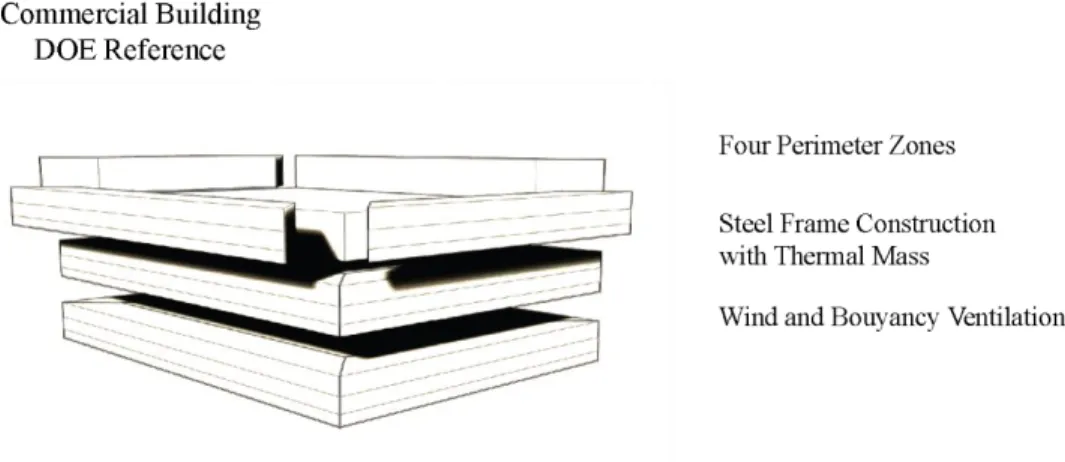
Figure 1 A medium-sized reference commercial building
selected for analysis among the 16 building types that represent approximately 70% of the commercial buildings in the U.S., according to the report published by the National Renewable Energy Laboratory titled U.S. Department of
Energy Commercial Reference Building Models of the National Building Stock (Energy.Gov).
1.2
What Can Go Wrong in the Design Process of Naturally Ventilated Building?
An expert in an international climate-engineering firm shared a story about one particular encounter with a client. The goal of the collaboration was to develop deeply integrated comfort and energy concepts for a project located in New England. The climate engineer presented high-performance building strategies that successfully eliminated mechanical cooling systems. However, the client countered the climate engineer’s proposal about eliminating the active cooling system by quoting the results from a building bioclimatic analysis method implemented in one of the most widely used tools called Climate Consultant. This story illustrates how an inconsistency between a quick climate-file based study and a thorough building performance analysis could arise and consequently result in design process challenges.The authors repeated the steps discussed in the story of the climate engineer using a medium-sized office reference building by the US Department of Energy (DOE) located in Phoenix. The DOE, in conjunction with three of its national laboratories, developed commercial reference buildings, formerly known as commercial building benchmark models. These modules provide a consistent baseline of comparison and improve the value of computer energy simulations using software such as EnergyPlus (Energy.Gov 2017).
15
Figure 2 Comparison of predictions on overheated hours
by Climate Consultant's building bioclimatic chart and building performance simulation using energy plus for a naturally ventilated building. The bioclimatic chart reported 1550 overheated hours while on the other hand post analysis of building simulation showed it is possible to achieve 100% comfort. The adaptive comfort model is used
in both cases.
The prediction of the number of overheated hours by Climate Consultant’s bioclimatic chart is compared with the number of overheated hours calculated using building simulation of the reference office building (see figure above). The prediction of overheated hours by the building bioclimatic chart considers cooling ventilation and thermal mass strategies. The energy simulation study showed that overheated hours can be reduced to zero with the application of ASHRAE 55 Adaptive Comfort Standard while Climate Consultant’s optimized result showed over 1,500 overheated hours.
The underlying principles and models used in Climate Consultant’s bioclimatic chart are discussed in detail in the background section. Additional overview is included on the CBE online tool that is written by the Center for the Built Environment at UC Berkeley. Advantages and limitations of these tools are then compared with the proposed method with CLIMA+.
16
2 Background
A tree doesn’t need a support system –it is a system. The shelter of the future will embody energy.
Michael Reynolds Comfort in Any Climate, 2001
17
18
2.1 Thermal Comfort, Natural Ventilation and Thermal Mass
Thermal comfort and natural ventilation have a long history in the built environment. Around 400 BC, Socrates had some thoughts on the climatic suitability of houses and on how to build to ensure thermal comfort. Vitruvius (1st century BC) also wrote about the need to consider climate in building design for reasons of health and comfort. This, however, had very little influence on the practice of architecture (Auliciems et Svokolay 2007).
Mechanical cooling became a possibility early 20th century (Auliciems et Svokolay 2007), and comfort became a 'product' produced by machines that ran on cheap energy (Nicole et al 2012). The result has contributed to a trend in buildings with increasing use of mechanical systems and related energy consumption.
In the early 1920s, Houghten and Yagloglou (1923) at the ASHVE (American Society of Heating and Ventilating Engineers) laboratories attempted to define the ‘comfort zone’. In England the motivation came from industrial hygiene: the limits of environmental conditions for work. Vernon and Warner (1932) and later Bedford (1936) carried out empirical studies among factory workers. Analytical work started in the US in the mid-1930s, where Winslow, Herrington and Gagge (1937) made a significant contribution. During and after World War 2, research activity increased and many disciplines became involved besides engineering, from physiology and medicine to geography and climatology. In architecture, Victor Olgyay (1963) was the first to collect findings from the various disciplines and interpret them for practical, architectural purposes (Auliciems et Svokolay 2007).
Good passive design can minimize the periods during which mechanical cooling may be needed and can also substantially reduce the size of the required cooling equipment, perhaps restricting its use to only critical locations (CIBSI 2015). A growing international consensus now calls for low-energy buildings. This means designers must first produce robust, passive structures that provide occupants with many opportunities to make changes to suit their environmental needs. Ventilation should be most preferred strategy and mechanical conditioning only used when the climate demands it (Nicole et al 2012). Recent studies have started recognizing the effects of air pollution and urban heat island on natural ventilation potential. Tong et al (2016) have shown that the energy savings and environmental benefits are affected greatly by ambient air pollution in China. In addition, the urban heat island effect can reduce the opportunities for night cooling in urban areas (CIBSI 2015).
19
Figure 4 Acceptable operative temperature ranges for naturally conditioned spaces
The allowable operative temperature limits may not be extrapolated to outdoor temperatures above and below the end points of the curves in this figure. If the prevailing mean outdoor temperature is less than 10 °C or greater than
33.5 °C, this option may not be used (ASHRAE 55-2013 in Figure 5.4.2).
The Adaptive Comfort Model promotes use of the comfort evaluation method using adaptive temperatures. Recent standards (European Standard EN 15251, ASHRAE 55) and guidelines (CIBSE) advise that comfort temperatures vary through the year as people adapt to changes in outside temperatures. Adaptive comfort temperatures are most appropriate to "free running" buildings where occupants have control over themselves and their environment. As comfort temperatures vary, heating and cooling set-points should be adjusted to maintain optimum comfort. This is in keeping with most peoples’ experience – a building at 24°C will feel cool in summer but hot during cooler periods of the year (Low Carbon Comfort 2014).
Adaptive comfort equations are provided in EN1525, CIBSE and ASHRAE Standards. The adaptive comfort temperatures are based on outside temperatures during the preceding few days. The allowable indoor operative temperatures shall be determined from the figure above using 80% acceptability limits or the following equations as provided in ASHRAE 55-2013.
Upper 80% acceptability limit (°C) = 0.31 Trm(out) + 21.3
Lower 80% acceptability limit (°C) = 0.31 Trm(out) + 47.9
The prevailing mean outdoor air temperature (Trm(out)) shall be based on no fewer than seven and
no more than 30 sequential days prior to the day in question. It shall be a simple arithmetic mean of all of the mean daily outdoor air temperatures of all days in the considered period.
20
ASHRAE 55-2013 permits weighting methods if the weighting curve continually decreases towards the more distant days such that the weight applied to a day is between 0.6 and 0.9 of that applied to the subsequent day. For this option, the upper limit on the number of days in the sequence does not apply. A weighted running mean of outdoor temperatures, Trm, is calculated based on the following equation given in CIBSI Guide A: Environmental Design:
Trm(out)= (1 - αrm) [Te(d-1) + αrm Te(d-2) + αrm2 Te(d-3) ...]
where αrm is a constant between 0 and 1 which defines the speed at which the running mean responds to outdoor temperature, Te(d-1) is the daily mean outdoor temperature (°C) for the previous day, Te(d-2) is the daily mean outdoor temperature (°C) for the day before that, and so on. The recommended value of αrm is 0.8 (CIBSI A: Environmental Design).
If operative temperature is greater than 25 °C, then increasing the upper acceptability temperature limits in Figure 4 by the corresponding change in temperatures is permitted. The following table is adopted from ASHRAE 55-2013 (Table 5.4.2.4).
Average Air Speed (Va)
0.6 m/s
Average Air Speed (Va)
0.9 m/s
Average Air Speed (Va)
1.2 m/s
1.2°C 1.8°C 2.2°C
Figure 5 Increases in acceptable operative temperature limits
in occupant-controlled, naturally conditioned spaces resulting from increasing air speed above 0.3 m/s.
21
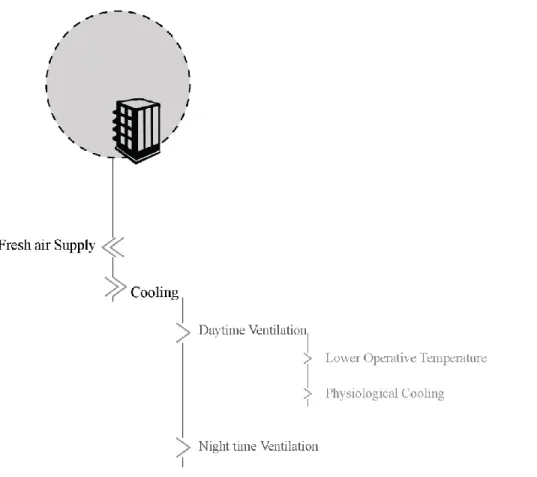
Figure 6 Applications of Natural ventilation
Natural ventilation has two benefits: for fresh air supply and comfort cooling. Comfort cooling with natural ventilation can take place during daytime or night time.
In buildings with operable windows and similar ventilation devices, free precooling can be used when outside air temperatures are below inside temperatures. In air-conditioned buildings, the use of natural ventilation can dramatically reduce the energy required to mechanically cool the space. In buildings with heating only, natural ventilation can significantly reduce peak indoor summer temperatures. (Low Carbon Comfort 2014).
On cool days, free cooling can meet all the cooling load. The space is ventilated to maintain a comfortable indoor operative temperature. On hot days, there may be limited free cooling available in the morning and no opportunity for pre-cooling earlier in the day. It may be possible to pre-cool during the preceding night (often referred to as night cooling), though this will often be ruled out on practical grounds due to security risks. Pre-cooling restricted to the morning-occupied period will still have a major energy benefit during warm weather and can typically be expected to reduce cooling energy by 30% (Low Carbon Comfort 2014).
Very often, peak temperatures in standard buildings will exceed the outdoor peak temperature by three or more degrees. At best, peak indoor temperature can be maintained at a degree or so below the peak outdoor temperature but this is only possible by means of night cooling combined with thermal mass (CIBSI 2015). Climatic conditions such as the diurnal temperature swings influence the effectiveness of night cooling. Additional discussion on the application of thermal mass to improve thermal comfort is presented in the third section of this document, CLIMA+ Phase I.
22
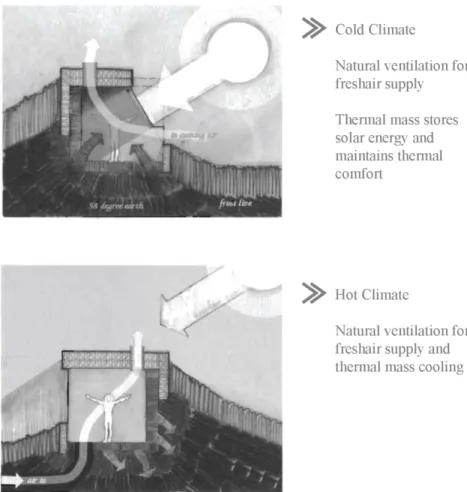
Figure 7 Coupling of building insulation and thermal mass
Michael Reynolds (2001) in his book ‘Comfort in Any Climate’ illustrated the coupling of building insulation and thermal mass to enhance heating and cooling strategies.
The air temperature inside a building depends on many factors, including the outdoor temperature, building geometry and internal heat gains from occupants, equipment and lighting (Holford et Woods 2006). Thermal mass in buildings plays a great role in buffering internal temperature from outdoor environmental fluctuations and building design can benefit from exploiting the potential of thermal mass to enhance thermal comfort. The specific role of effective thermal mass specifically in naturally ventilated buildings is explained in detail by Holford and Woods. They have shown that the effective thermal mass, which is in good thermal contact with the air is limited by the diffusion distance into the thermal mass over one diurnal temperature cycle. They have also shown the great applicability of thermal mass models using lumped methods and numerical integration of thermal diffusion for exact solutions.
23
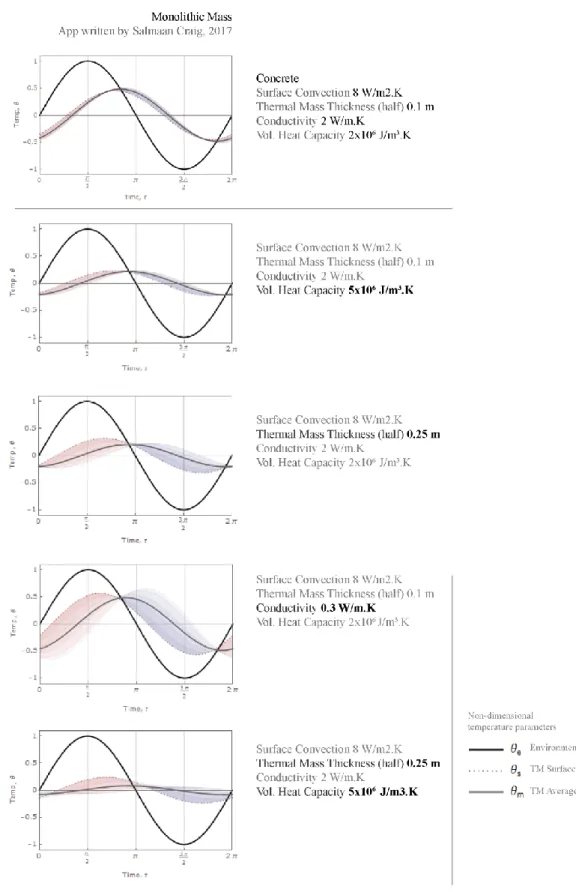
Figure 8 Comparison of thermal mass buffering
of a 10 cm thick concrete structure with other constructions having different thermal mass thickness and volumetric heat capacity.
24
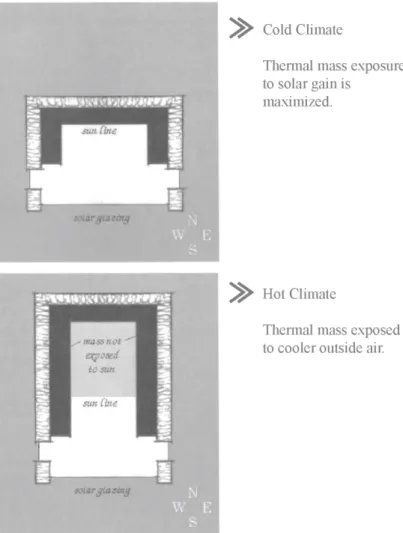
Figure 9 Internal thermal mass
Michael Reynolds (2001) illustrates deep and shallow room layouts of naturally ventilated spaces to regulate exposure to solar gain.
The thermal mass thickness within an interior space can be adjusted based on climatic conditions of the building’s location. The geometry of the room and integration of thermal mass in the interior surfaces can be designed to optimize heat energy storage by increasing solar gain in cold climates. On the contrary, thermal mass in a deep space that is shaded from solar radiation will be kept cooler than outdoor temperatures in hot climates.
25
Figure 10 Natural ventilation integration with climate
Michael Reynolds (2001) illustrates various passive strategies for naturally ventilated spaces in different climates in his book Comfort in Any Climate.
The climatic forces of wind (wind effect) and temperature (stack effect) drive natural ventilation. For this reason, natural ventilation is highly variable since, at any instant, both the pattern of airflow and the rate of ventilation will depend on the prevailing weather conditions (CIBSI 2015). A strategic design of buildings that integrates the methods such as natural ventilation, thermal mass, envelope insulation, and solar heat gain, will improve comfort in any climate.
26
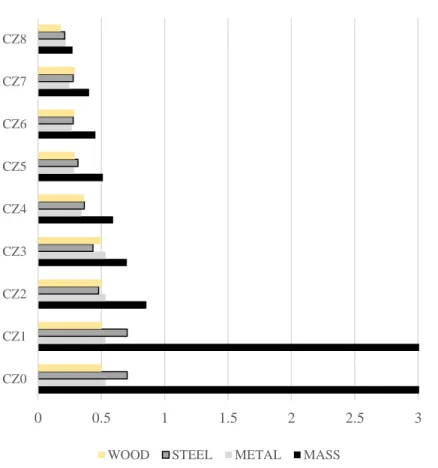
Building energy standards provide insulation requirements for different types of constructions and climate zones. Insulation requirements for mass construction is relatively lower than the requirements for steel, metal and wood constructions in all climate zones defined in ASHRAE 90.1 (see figure above). Such variation in the minimum required U-values indicates that the building construction standards accounted the potential benefit of thermal mass in meeting comfort requirements and reducing space conditioning energy loads.
0 0.5 1 1.5 2 2.5 3 CZ0 CZ1 CZ2 CZ3 CZ4 CZ5 CZ6 CZ7 CZ8
Above Grade Wall, Assembly Maximum Transmittance (U-Value) ASHRAE 90.1 (2016)
WOOD STEEL METAL MASS
Figure 11Comparison of U-Values The nine Climate Zones defined by ASHRAE
27
2.2 Existing Tools and Methods for Early Design Decision
Figure 12 The description of thermal comfort models
used in the architectural design strategies book Sun, Wind and Light, Climate Consultant, Ecotect, ASHRAE Thermal Comfort Tool and CBE Thermal Comfort Tool.
28
Figure 13 Climate Consultant’s Bioclimatic Chart
is shown for the climate of Phoenix. The number of comfortable hours are calculated and selected strategies are highlighted at the top left corner of the figure.
Figure 14 Components of the building bioclimatic chart of Climate Consultant
Climate Consultant is a simple to use, graphic-based computer program that helps users create more energy efficient and sustainable buildings (Milne 2009). It is extensively used in academic and professional work at an earlier design phase to better understand a given climate.
A summary of design strategies as a function of ambient conditions (climate) are reported based on Pschrometric-Bioclimatic Chart by Baruch Givoni and Murray Milne. The concept of a building bioclimatic chart combines Victor Olgyay’s bioclimatic chart (Olgyay 1993), the psychrometric chart, and passive heating and cooling rules.
29
Climate Consultant’s Psychrometric chart ventilation-cooling strategy is only attributed to physiological cooling effects achieved by air movement, which increase sweat evaporation from the skin, and it is clearly stated that the strategy does not reduce air temperature. This ventilation cooling potential prediction method only takes wind speed as a measure of effectiveness, and the approach does not fully represent the process that takes place in a naturally ventilated building. It assumes an ideal ventilation situation where the indoor temperature follows the outdoor. The temperature difference between the indoor and outdoor that drives buoyancy is neglected resulting in an underestimation of natural ventilation potential. Furthermore, the benefit of coupling natural ventilation and thermal mass is not sufficiently incorporated. Rather, thermal mass is calculated independently as a passive cooling strategy. Its effectiveness is defined with maximum dry bulb temperature difference that is as much as 16.7 °C above the comfort high and the dew point temperature limits at the top and bottom of the comfort zone (Climate Consultant 6.0 2016). Climate-file based analysis methods calculate ventilation cooling potential by estimating indoor air movement for direct physiological cooling. Results are shown on psychrometric charts where temperature and humidity values of analyzed hours are plotted. In the case of Climate Consultant, this method accounts for hours where there is sufficient indoor air velocity and zone of effectiveness is defined by a minimum air velocity to affect comfort, usually at least 0.2 m/s (Climate Consultant 6.0 Documentation). The underlying assumption is that with effective daytime cross-ventilation, the indoor air temperature tends to track the outdoor level along with higher indoor airspeed. Therefore, the temperature limit of comfort ventilation applicability is the comfort limit at the enhanced airspeed at any region or season (Givoni 1998). The quantitative effect of convective cooling was studied extensively by Givoni at the Institute for Desert Research of Ben Gurion University in Israel and at the University of California, Los Angeles (Givoni 1992). There are two important limitations of this method that could cause errors on cooling ventilation predictions. First, the comfort zone defined in Bioclimatic-based analysis do not align with comfort zones defined in ASHRAE Standards 55. Hence, when users switch to detailed studies using simulation tools and comfort standards, there is a high probability that the dynamic simulation results are inconsistent with design concepts developed during early stages. Second, extended comfort zones by the design strategies including cooling ventilation and thermal mass are shown to improve comfort in all instances. The influence of the different strategies on each other when implemented at the same time is not well explained. A very good example is the internal heat gain zone that is defined only by a balance point temperature below which heating is needed. This approach neglects the effects of internal heat gain during hours of high temperature when mechanical cooling is required. Furthermore, ventilation heat loss, which results in effective temperature reduction, is not considered with physiological cooling in the ventilation cooling strategy. Therefore, identifying comfort ventilation potential for building programs with different internal gains and envelope performances becomes challenging when using climate-file based analysis.
30
Figure 15: CBE Thermal Comfort Tool.
For the ASHRAE Standard 55-2010 Adaptive Comfort model (de Dear and Brager 1998), the comfort zone is represented with indoor operative temperature as ordinate and prevailing mean outdoor temperature as abscissa.
The CBE Thermal Comfort Tool for ASHRAE-55 (see figure above) is an application that provides a good alternative for cooling ventilation potential calculation. Designers can use this application during the programming and schematic design phases to assess different thermal control strategies including natural ventilation and elevated air speed (Schiavon et al 2014). However, users can only calculate results for a single point in time by defining indoor air temperature, mean radiant temperature, prevailing mean outdoor temperature and air speed. This requires users to know indoor and outdoor conditions before conducting the analysis, and users cannot run annual analysis in contrast to commonly used climate-file and simulation based methods.
31
3 C L I M A +
CLIMA+ is an integrated method proposed for predicting potential of natural ventilation that is quick to use in comparison to detailed energy-performance simulation methods that are undertaken by experts. It provides users with reliable recommendations by incorporating comprehensive evaluations of comfort conditions based on current standards and studies. The analytical computations in CLIMA+ are in two phases: using climate file and climate box simulation. The two methods consider the coupling of natural ventilation and thermal mass.
32
Figure 16 The effect of the rate of natural ventilation on thermal mass buffering
The result of thermal mass and natural ventilation coupling is regulated by the amount of natural ventilation rate permitted.
3.1 Method for Natural Ventilation Potential Prediction
CLIMA+ promotes two analysis phases. In the first phase, a quick climate data based natural ventilation prediction is reported based on selected parameters to represent natural ventilation and thermal mass coupling. In the second phase, an additional step with a quick simulation of a single-zone thermal model is used to predict overheated hours. These two phases are discussed in length in the following sub-sections.
33
Figure 17 The components of CLIMA+ natural ventilation prediction method. The highlighted section of the figure is showing Phase I.
3.1.1 Phase I- Using Climate Analysis
Climate-file based analysis is commonly used in the development of building strategies and prediction of building performance. The method is promoted largely in standards related to buildings and environment. ASHRAE 169: Climate Data for Building Design Standards provides recognized climatic data for use in buildings and related equipment standards (ASHRAE 169 2013). This standard provides a normative appendix that contains data for 5,564 U.S, Canadian, and international locations that can be used for climatic design and definition of climatic zones (ASHRAE 169 2013). Another standard CIBSI Guide A: Environmental Design provides the basic weather and solar data required for manual calculations of heating and cooling loads in the UK and Europe. In addition, CIBSI Guide A and ASHRAE 55 present comfort requirements using both the PMV/PPD method and the adaptive comfort approach for free-running buildings. However, these provisions do not layout a comprehensive methodology for predicting natural ventilation potential using a climate data.
The author developed a simplified numerical calculation method on outdoor hourly temperature and humidity to predict the potential of thermal mass and natural ventilation in improving thermal comfort. Four main parameters to approximate ventilation scenarios and thermal mass coupling are defined. These are the parameters to predict direct natural ventilation with physiological cooling, buoyancy ventilation, thermal mass buffering with high and low ventilation rates. A comparison of 20 different climates using the four parameters showed significant variations among different climatic conditions. The method is repeated for 2,450 cities and the natural ventilation potential predictions are mapped globally. The resulting interactive global map is hosted on the web for public access. Please visit http://www.mit.edu/~aarsano/
34
Figure 18 The coupling of natural ventilation and thermal mass
The two charts illustrate the coupling of natural ventilation and thermal mass based on the work of Holford and Woods.
Coupling Natural Ventilation and Thermal Mass
Holford and Woods (2006) had identified the following three important constituents and they are used in this manuscript to discuss the proposed methodology. The time for the heat exchange between the effective thermal mass and the air, the time for the natural ventilation to replace the air in the space with air from the environment and the period of the diurnal oscillations of the environment. Depending on the ventilation rate, the difference between the indoor and outdoor temperature can be calculated. The indoor air temperature becomes very close to the outdoor air temperature when high ventilation is permitted because internal heat loads are continuously removed and thermal mass buffering effect is reduced. On the other hand, when ventilation rate is
35
low, indoor air temperature will be mainly affected by internal heat gains and the interaction with the thermal mass.
The illustration in Figure 18 shows the coupling effect of natural ventilation and thermal mass using the tool written by Salmaan Craig with the Cumulative Distribution Function (CDF) based on the study presented by Holford and Woods. It is worth noting that Holford and Woods have neglected internal thermal gains in the main simplification of the work in order to derive insight into the principles of heat exchange in the building design.
The extended Adaptive Comfort Standard sets acceptable boundary conditions for thermal comfort taking into account effects of elevated air speed. Acceptable humidity level is defined based on the literature and standards review that is presented in section 2.1. The comfort conditions for multiple climates are then predicted using a python-script routine. The physical considerations underlying the four natural ventilation and thermal mass potential-prediction parameters are discussed in the following subsection.
Direct natural ventilation potential and physiological cooling
The outdoor hourly air temperatures are evaluated if they are within the upper and lower limits of the adaptive comfort range as provided in ASHRAE 55’s Adaptive Comfort Standard. Similarly, the hourly relative humidity (RH) values are evaluated if they are below 85%. This parameter assumes that the indoor air temperature closely follows the outdoor air temperature because high ventilation rate is promoted. The comfort hours by physiological cooling that are affected by elevated air speed are added in the direct natural ventilation potential predicted. ASHRAE 55-2013 permits the acceptable adaptive comfort range upper limit to be increased by 2.2 °C when the average air speed is 1.2 m/s for occupant-controlled, naturally conditioned spaces (ASHRAE 55 2013).
Buoyancy ventilation potential
The buoyancy ventilation potential is calculated based on the assumption that the indoor air temperature shall be kept at least 2k higher than the outdoor air temperature to maintain a minimum temperature difference that drives outdoor air to flow into the space. Hence, the 80% upper and lower acceptability limits given for indoor operative temperatures in the Adaptive Comfort Standard are reduced by 2 K. The adjusted acceptability limits are then used to evaluate whether the hourly outdoor air temperatures are within the expected temperature range so that buoyancy ventilation is enhanced. This parameter considers the hourly indoor operative temperature to remain above the outdoor air temperature. The natural ventilation air-change rate is regulated so that it removes only part of the heat gained due to internal loads and solar radiation.
Thermal mass buffering
An ideal thermal mass buffering would result in indoor air temperature following closely the mean outdoor temperature (Figure 18). The outdoor running mean temperature is considered as the predicted indoor operative temperature as a result of thermal mass buffering. This outdoor running mean temperature is also used in the Adaptive Comfort Standard and it is the average temperature of the past 7 to 30 days. A detailed calculation method for the outdoor running mean is provided in the ASHRAE and CIBSI standards and it is discussed in Section 2.1.
36
Holford and Woods have shown that temperature attenuation achieved with moderate and heavy constructions in naturally ventilated buildings would range between 6.7 and 26 hours for convection to affect mass temperature. This time lag caused by thermal mass is considered by representing the predicted indoor operative temperature by the outdoor running mean temperature rather than the mean temperature of a single day. This works for construction systems that have insulation as required by building energy standards such as ASHRAE 90.1. The internal thermal mass is exposed to the interior air temperature and is affected by outdoor air only during natural ventilation.
The parameter to predict the effectiveness of thermal mass buffering is defined as the number of hours where the predicted indoor operative temperature is within adaptive comfort range as a result of thermal mass buffering in the naturally ventilated building.
Figure 19 Phase I study for Phoenix.
Outdoor air temperature from climatic data is evaluated based on the adaptive comfort standards requirements. Thermal mass passive heating and cooling potential
When outdoor temperature is above or below acceptable thermal comfort limits, thermal mass can be used to condition indoor air by convection and radiation. In a given climate where outdoor dry bulb temperature goes lower than 10 °C, which is the lowest threshold defined by ASHRAE 55’s Adaptive Comfort Standard, thermal mass can be used to store solar energy or heat from other heat
Predicted indoor temperature With low ventilation rate
Adaptive comfort range Outdoor temperature Predicted indoor temperature With high ventilation rate
T e m pe ra tur e in 0 C
37
sources. Designing thermal mass for solar exposure in cold climates would help reduce heating energy loads and this potential is calculated by adding all hours where the outdoor running mean falls below the lower limit of adaptive comfort standard’s 80% acceptability range. Applying similar calculation method but for overheated hours, the potential of pre-cooled thermal mass is calculated by adding hours which are above the upper limit of adaptive comfort standard’s 80% acceptability range.
Limitation of CLIMA+ Phase I
The current model for climate file based prediction of natural ventilation considers the high or the low ventilation assumptions that are applied for all hours of the year. However most climates could have optimized solutions by combining both high and low ventilation rates depending on outdoor conditions of each hour or day. The four modes of coupling natural ventilation and thermal mass discussed in the section above will be studied further to optimize their integration in a given climate.
Potential extension of the adaptive comfort range
Adaptive comfort range Outdoor temperature Predicted ideal time for a different ventilation method
T e m pe ra tur e in 0C 1 2 1 31 41 51
Figure 20 Potential application of different natural ventilation methods in
for different times of a year based on outdoor temperature for the climate of Phoenix. Parts 1 and 5 have cold hours limiting potential ventilation hours. On the other hand, parts 2 and 4 have better potential for direct
38
Natural Ventilation Potential for 20 Selected Climates
The 20 different climates that are used to study the natural ventilation prediction parameters are selected from the commercial and residential reference buildings provided by the US Department of Energy (DOE). They represent climates ranging from extreme cold to extreme hot.
The predicted direct ventilation, buoyancy ventilation and thermal mass buffering for high and low ventilation scenarios are compared for the 20 selected climates. Direct ventilation and physiological cooling improve comfort in humid climates such as Miami and Mumbai where the diurnal temperature fluctuation is relatively small and most of hourly temperatures are within the adaptive comfort range. In this case, the indoor air temperature is considered to closely follow the outdoor temperature where by internal heat gain is continuously removed with free running ventilation. Temporal plots of the 20 climates are shown in Figure 19.
For the case of buoyancy ventilation, the primary driving force for air change rates is temperature difference of at least 2 K and such a difference is maintained by restricting natural ventilation rate. Temperate and cold climates such as Lisbon and San Francisco have better potential for buoyancy ventilation than direct ventilation.
0 2000 4000 6000 Kuwait Riyadh Mumbai Miami Houston Phoenix Tel Aviv Chicago El Paso Lisbon Boston Burlington Duluth Minot Los Angeles Boise Albuquerque Salem SanFrancisco Vancouver
TM Buffering (Low Ventilation) TM Buffering (High Ventilation)
0 2000 4000 6000 Kuwait Riyadh Mumbai Miami Houston Phoenix Tel Aviv Chicago El Paso Lisbon Boston Burlington Duluth Minot Los Angeles Boise Albuquerque Salem SanFrancisco Vancouver
Direct Ventilation with Physiological Cooling Buoyancy Humidity 0 2000 4000 6000 Kuwait Riyadh Mumbai Miami Houston Phoenix Tel Aviv Chicago El Paso Lisbon Boston Burlington Duluth Minot Los Angeles Boise Albuquerque Salem SanFrancisco Vancouver
TM Passive Cooling Potential TM Passive Heating Potential
Figure 21 compared for 20 selected climates.
39
Physiological cooling adds about 500 or more comfort hours in the hot to warm climates such as Riyadh, Mumbai, Miami, Houston and Phoenix. For climates where there are high daily temperature changes thermal mass buffers indoor air from the outdoor air fluctuations above and below the adaptive comfort range and increases number of comfortable hours. Thermal mass adds about a thousand comfortable hours in Albuquerque where significant number of hours with outdoor temperatures that are outside of the adaptive comfort limits.
Thermal mass buffering has different results when combined with high and low natural ventilation rates. In the case of Mumbai and Miami thermal mass buffering is effective when natural ventilation is not restricted. Annual temporal maps for these climates as illustrated in Figure 19 show that thermal mass buffering is the preferred strategy when indoor air temperature is close to the outdoor running mean temperature. On the other hand, in the colder and the temperate climates such as Lisbon and Albuquerque thermal mass buffering is effective with limited ventilation rate. In this case indoor air temperature is higher than outdoor air temperature and hence it is within the adaptive comfort range.
In hot climates such as Riyadh and Kuwait, that have cold winter seasons with temperatures below the adaptive comfort lower limit, thermal mass has the potential to reduce both heating and cooling energy loads. On the other hand, for predominantly hot to warm climates of Mumbai and Miami, thermal mass can be cooled to attenuate indoor air temperature and increase comfort hours. Cold and temperate climates benefit greatly from thermal mass by storing solar energy or other form of heat energy.
40
Figure 22 The components of CLIMA+ natural ventilation prediction method. The highlighted section of the figure is showing Phase II.
3.1.2 Phase II- Using Climate Box Simulation
This section presents an integrated method where a simplified simulation of a climate box is performed to calculate operative temperature for a generic well-ventilated single zone building. The predicted number of overheated hours for the climate zone is calculated based on the Adaptive Comfort Standard. An additional comfort improvement that is achieved with elevated air speed is also considered and it is termed as physiological cooling effect. The climate box (simulation thermal zone), the assumptions for the simulation and output results of the method are discussed in detail in the following subsections.
41
Non-geometric building template library
All non-geometric building information for construction, occupancy, internal heat loads, and conditioning are compiled in each template based on programmatic and climatic differences. A library that is populated with residence and office building templates is then created for the second phase of CLIMA+. The construction requirements for both residence and office are different in the different climate zones that are defined in ASHRAE 169 2013. Appendix B is a table with the number of heating and cooling degree-day limits given by the standard to define each thermal climate zone. Templates for the nine thermal climate zones are prepared to represent most climates based on the constructions specified in ASHRAE: Energy Standard for Buildings Except Low-Rise
Residential Buildings (ANSI/ASHRAE/IES Standard 90.1-2016).
The non-geometric building template is a JSON file format that is created using Archsim which is a Grasshopper plugin that uses the EnergyPlus engine in the 3D CAD working environment called Rhinoceros (Rhino, Archsim 2017). The template files are integrated with a geometric information that defines a thermal zone and intermediate data files (IDF) are created to run building performance simulation. The geometric abstraction implemented this phase of CLIMA+ is presented in the following subsection.
42
Climate box: best-case thermal energy model
As a first step, it is assumed that a user selects a specific climate file (same as for Climate Consultant) along with a program type such as office, residential etc. Information for the latter such as envelope materials and construction, conditioning schedules, internal loads, and ventilation ware stored in a template library and applied to a single-zone EnergyPlus model (Figure 4). This model is supposed to represent a “climate box”, i.e. the abstraction of a building rather than an actual architectural design. The climate box is 10m by 10m open plan with 3m floor to ceiling height and 30% window to wall ratio. Operable area ratio is 30% of opening area and discharge coefficient is 0.65 giving a net area of 1.8m2 for air exchange.
Ventilation Air Change Rate (ACH) of the zone is calculated using simple wind and stack equations implemented in Archsim based on EnergyPlus Input Output Reference (http://archsim.com/documentation-energy-modeling/natural-ventilation/). The upper setpoint is 33.5 oC as the Adaptive Comfort Standard works if the mean monthly outdoor temperature is between 10 oC and 33.5 oC (ANSI/ASHRAE Standard 55-2010). The lower natural ventilation setting is adjusted to 23 oC outdoor air temperature. Indoor air speed can not be more than 0.2 m/s for temperatures lower than 23 oC (ANSI/ASHRAE Standard 55-2010). Physiological cooling of elevated air speed can be implemented for temperatures above 23 oC where air speeds can go up
to 0.8 m/s for office spaces and 1.2 m/s for less sedentary activity spaces such as residence (ANSI/ASHRAE Addendum g 2016).
In addition to calculated ventilation and physiological cooling, a constant infiltration rate of 0.6 ACH is considered based on the base reference given in PNNL-18898 document prepared for the U.S Department of Energy (PNNL-18898 2009). This infiltration rate is equivalent to 50 lit/sec and sufficient to provide required fresh air supply for a maximum of 5 people with 10 lit/sec/person base standard.
The climate box, being a small and very open space, is supposed to yield the maximum ventilation cooling potential for a given program type and climate. Cross ventilation based on wind and buoyancy ventilation are both supported. Further study is being conducted to optimize physical definition of the climate-box and possibilities of providing user control on building parameters such as occupancy schedules while maintaining the simplicity of the method.
Figure 24 Single zone thermal zone
43
Thermal simulation
From a building physics standpoint, direct natural ventilation effects on comfort can be classified into two different phenomena: cooling ventilation by lowering operative temperature and cooling ventilation effected by moving air near an occupant inside a building.
Cooling ventilation by lowering operative temperature
This approach measures how much operative temperatures during overheated hours are reduced with cooling ventilation where indoor warmer air is replaced with outdoor cooler air. Air displacement calculation methods that naturally exchange inside air with outside air lead to comfort improvements if outside air is cooler than inside air. In the case of buoyancy driven ventilation, this temperature difference between inside and outside is required to initiate the air exchange in the first place. Once the temperature difference drops below 3 K the sensible cooling effect becomes quite small, even if air change rates as high as 5ACH can be maintained (CIBSI AM 10). Transient thermal simulation programs such as EnergyPlus consider temperature and air change rates. Effective reduction in overheating hours achieved by ventilation can be measured by comparing simulation results from low and high ventilation scenarios.
Cooling ventilation by the effect of moving air (physiological cooling)
Moving air has long been used to provide comfort in warm environments. Provision for indoor air movement was one of the wellsprings of traditional architectural design in warm regions, affecting building form, components, and equipment over millennia (Arens et al 2009).
Design strategies and annual results Building Program
Weather File
Figure 25 CLIMA+ user inputs
Users select the building program and upload weather file before running EnergyPlus thermal simulation.
44
Residence Office
Occupancy (no of people) 0.018 p/m2 0.062 p/m2
Equipment 5 W/m2 14 W/m2
Lighting set point 200 lx 500 lx Electrical lighting load 1W/m2 8 W/m2
Heating set point 20 oC 20 oC
Ventilation Buoyance and wind Buoyance and wind Figure 27 Thermal model settings
Residence and Office single zone thermal model settings for internal loads, conditioning and ventilation defined in simulation input files.
Envelope and thermal mass properties
ASHRAE 90.1 defines construction types based on energy performance requirements and the standard presented for the different climate zones applies for all building types except low-rise residential building. The envelope performances for all templates are defined by U-values as provided in ASHRAE 90.1.
Among the four construction types in the ASHRAE Energy Standard; mass, metal buildings, steel structures and wood framed; at the current stage of the method only envelope performance value of steel structure is used for the single zone model. The U-values range between 0.705 (climate zone 0) and 0.212 (climate zone 8).
For each of the functions, residence and office, 18 variants of single zone energy plus intermediate data files, IDFs are created. Envelope performance and thermal mass of the building highly influence the effectiveness of cooling ventilation. Consequently, the 18 variants presented are based on the 9 different envelope performances that are defined for each thermal climatic zone. For each of the 18 templates, four different thermal mass integration options that range from high mass (10 cm thickness) to low mass (without additional mass) are provided. The additional thermal mass is applied on the internal surface of the climate zone’s floor. For high thermal mass conditions, the additional 10 cm thermal mass has a volumetric heat capacity of 50 x 106 J/K.
Cold Average Hot
External Facade U-0.212 U-0.315 U-0.705 Glazing Triple-Pane Double-Pane Double-Pane Glass Coating Low-E Low-E Low-E
Shading Internal External External Slab Adiabatic Adiabatic Adiabatic Ceiling/roof Adiabatic Adiabatic Adiabatic
Figure 28 Building constructions for three different envelope performance options
45
Post processing of simulation results
Simulated results are evaluated based on the ASHRAE 55’s Adaptive Comfort Model and Elevated Air Speed standards to calculated number of hours that fall outside of the comfort limit (ANSI/ASHRAE/IES Standard 55-2010). In addition, indoor air humidity levels which are less than 20% and higher than 85% RH (relative humidity percentage) are counted towards hours of discomfort.
User inputs and strategy selection
To achieve sufficient simplicity while guaranteeing consideration of critical building parameters, all the zone input settings are predefined for the climate box as discussed in the above section. The user is able to run all prototypes that are defined in the IDF simulation files by selecting the program and uploading EnergyPlus weather data for the project’s location.
As mentioned above, there are two main categories of user inputs: building preferences and occupant preferences (Figure 6). Building preferences are given for envelope performance where three options are provided: cold, temperate and hot climates. Furthermore, these options can be used with base construction option for thermal mass or can be combined with high thermal mass option where additional construction layer is introduced to augment thermal capacity of the zone. Occupant preferences are defined for physiological cooling effects with elevated air speed and indoor humidity levels. Under the Graphical Elevated Air Speed Method (ANSI/ASHRAE Standard 55-2010), the required air speed for light, primarily sedentary activities may not be higher than 0.8 m/s—although higher air speeds are acceptable when using the SET Method (ANSI/ASHRAE Standard 55-2010, Section 5.2.3.2). In contexts where occupants are engaged in non-sedentary activities, most commonly in residences, have a wider tolerance for higher elevated air speed of a 1.2 m/s maximum threshold.
Envelope Thermal Mass Building Preference
Occupant Preference Indoor air speed Humidity
Figure 29 Building and occupant preferences
Designers can select building envelopes, thermal mass and indoor air speeds from provided options.
46
User interface and visualization of results
Once all the six simulations are completed for the selected program and climate data, the interface displays a temporal graph for the typology with the least number of overheated hours, giving a summary of selected envelope, thermal mass definition and indoor air speed. The number of overheated hours are shown in bold at the top-right corner of the chart. A comfort level rating highlighting the number with green, yellow or red marks the range from comfortable to very hot. Analysis result for the chosen set of building parameters is shown in a comprehensive time-based chart (Figure 28). The main graph in the upper section of the interface displays operative temperatures of all hours in dark dotted marks. Outdoor dry bulb temperature is shown in a light grey color shade at the background to give a good sense of outdoor condition in contrast to the indoor operative temperatures. The grey band going across all hours represents the adaptive comfort range as defined by the ASHRAE standard 55’s adaptive comfort model. The comfort band clearly shows when in the year thermal comfort is achieved with natural ventilation and when it is too hot. The two horizontal bands in the lower part of the graph summarize comfortable hours and relative humidity levels as shown in Figure 28.
Overheated hours and comfort rating
Outdoor temperature Adaptive comfort range Indoor operative temperature Temperature bar: shows hours outside of comfort rage Humidity bar: shows hours outside of comfort rage
Figure 30 Temporal chart for a residence in Phoenix
Most overheated hours are from May to September. Indoor humidity levels remain below 85% all year round.
47
Figure 32 CLIMA+ interface 2
showing natural ventilation prediction in the first phase using climate data. Figure 31 CLIMA+ interface 1
48
3.2 Integration with Design Process
The optimized template using CLIMA+ can be imported to Grasshopper by using Archsim’s Zone component. This optimized template can then be integrated with a new design geometry. The designer has the option to re-evaluate the performance of the design during the design process using CLIMA+. One of the buttons in the top left corner of the interface that has a CSV file icon is designed to import such type of EnergyPlus simulation result files (see Figures 30 and 31). The Building Performance Simulation (BPS) engine that is used by Archsim is EnergyPlus (Crawley et al., 2000). The journal paper by ANSI/ASHRAE (2011) has stated that EnergyPlus has been thoroughly validated and tested in practice so that whole buildings can be modeled reliably and in great detail (Archsim Primer). The first generation of BPS engines emerged in the eighties and nineties to overcome limitations of the until then common steady-state single room heat balance models. The purpose of “dynamic” models using computational heat transfer methods such as response functions or finite-difference methods was to model transient thermal-mass effects (Clarke, 2000).
Archsim Energy Modeling is a plugin that brings fully featured EnergyPlus simulations to Rhino/Grasshopper and thus links the EnergyPlus simulation engine with a powerful parametric design and CAD modeling environment. Archsim allows you to create complex multi-zone energy models, simulate them and visualize results all within the Rhino/Grasshopper environment. Archsim supports advanced daylighting and shading controls, ventilation modules such as wind and stack natural ventilation, airflow-networks, simple HVAC, photovoltaics and phase changing materials. It is typically used for rapid early design exploration where building shape, window to wall ratios, facade and glazing systems and passive approaches such as shading and natural ventilation potential are tested for their impact on the building environmental performance and comfort (Archsim Primer).
49
Workflow with 3D CAD Design Environment
Figure 33 Workflow of CLIMA+ with a 3D CAD design environment.
50
Figure 34 A comparison of predicted overheated hours
by Climate Consultants Psychrometric chart and the proposed method with CLIMA+
3.3 Results and Discussion
The authors have closely studied the cooling ventilation calculation methods used by climate-file based bioclimatic charts and simulation based calculations to predict potential of natural ventilation in a particular climate to achieve thermal comfort. The 20 different climates that are used to study the natural ventilation prediction parameters presented in the first phase of CLIMA+ are used in this section to compare results in the second phase.
Hours of discomfort calculations are based on the extended Adaptive Comfort Model (CBE Thermal Comfort Tool) where physiological cooling effect with elevated air speed is incorporated to the Adaptive Comfort Model. In addition, the authors have accounted discomfort in naturally ventilated zone caused due to high humidity where indoor air relative humidity is higher than 85%.
0 1000 2000 3000 4000 Kuwait Riyadh Mumbai Miami Houston Phoenix TelAviv Chicago ElPaso Lisbon Boston Burlington Duluth Minot LosAngeles Boise Alburquerque Salem SanFrancisco Vancouver
Climate Consultant and CLIMA+
51
Figure 34 compares Climate Consultant’s report on overheated hours and calculated results using
the proposed method for 20 different climates. Results from Climate Consultant, best residence and office scenarios consider high thermal mass strategy and cooling ventilation. The locations are selected mainly from the list of DOE’s prototypes for different climates ranging from Climatic Zone 1 (hot) to Climatic Zone 8 (cold) as referenced in ASHRAE’s construction standards. A few more climates including Kuwait and Mumbai are added to represent wider variety of climatic conditions.
Climate consultant considers the effect of comfort ventilation where by indoor air is completely replaced with outdoor temperature hence indoor air temperature follows outdoor air temperature. The underlying logic behind this climate-based analysis assumes that 100% heat and mass transfer has taken place between indoor air and incoming outdoor air. In addition, it accounts for Physiological cooling effect by evaluating wind speed from weather data and translating it into indoor air speed according to the guidelines given in ASHRAE Fundamentals 2005 (Climate Consultant Documentation: Natural Ventilation Cooling). This results in a perceived temperature reduction of 2.5 oC for air velocity of 0.82 m/s and 3.7 oC for air velocity of 1.60 m/s (Climate
0 1000 2000 3000 4000 Kuwait Riyadh Mumbai Miami Houston Phoenix TelAviv Chicago ElPaso Lisbon Boston Burlington Duluth Minot LosAngeles Boise Alburquerque Salem SanFrancisco Vancouver
CLIMA + overheated occupied hours
Office Occ BestOffice Residence Occ BestResidence
Figure 35 Office and residence occupied hours A comparison of overheated hours predicted by CLIMA+