HAL Id: inria-00529070
https://hal.inria.fr/inria-00529070v2
Submitted on 16 Nov 2010
HAL is a multi-disciplinary open access
archive for the deposit and dissemination of
sci-entific research documents, whether they are
pub-lished or not. The documents may come from
teaching and research institutions in France or
abroad, or from public or private research centers.
L’archive ouverte pluridisciplinaire HAL, est
destinée au dépôt et à la diffusion de documents
scientifiques de niveau recherche, publiés ou non,
émanant des établissements d’enseignement et de
recherche français ou étrangers, des laboratoires
publics ou privés.
Column generation for studying capacity and energy
trade-off in LTE-like network
Anis Ouni, Hervé Rivano, Fabrice Valois
To cite this version:
Anis Ouni, Hervé Rivano, Fabrice Valois. Column generation for studying capacity and energy
trade-off in LTE-like network. [Research Report] RR-7437, INRIA. 2010. �inria-00529070v2�
a p p o r t
d e r e c h e r c h e
ISRN
INRIA/RR--7437--FR+ENG
Column generation for studying capacity and energy
trade-off in LTE-like network
Anis Ouni — Hervé Rivano — Fabrice Valois
N° 7437
Anis Ouni
∗†, Hervé Rivano
‡†, Fabrice Valois
†Thème : 1 Équipes-Projets SWING
Rapport de recherche n° 7437 — October 2010 — 16 pages
Abstract: In this paper, we focus on broadband wireless mesh networks like 3GPP LTE-Advanced. This technology is a key enabler for next generation cellular networks which are about to increase by an order of magnitude the capacity provided to users. Such an objective needs a significative densification of cells which requires an efficient backhauling infrastructure. In many urban areas as well as under-developed countries, wireless mesh networking is the only available solution. Besides, economical and environmental concerns require that the energy expenditure of such infrastructure is optimized.
We propose a multi-objective analysis of the correlation between capacity and energy consumption of LTE-like wireless mesh networks. We provide a lin-ear programing modeling using column generation for an efficient computation of the Pareto front between these objectives. Based on this model, we observe that there is actually no significant capacity against energy trade-off.
Key-words: 3GPP LTE, capacity, energy, multi-objective analysis, joint rout-ing and schedulrout-ing.
∗Corresponding author - Partially supported by ANR VERSO ECOSCells †Université de Lyon, INRIA, INSA Lyon, CITI, F-69621, France
Génération de colonnes pour l’optimisation de
réseau de type LTE: vers l’étude de compromis
capacité-énergie
Résumé : Dans ce papier, nous nous intéressons aux réseaux maillés sans fil de haut débit de type 3GPP LTE-Advanced. Cette technologie est un facteur clé pour les réseaux cellulaires de nouvelles génération qui sont en évolution afin de répondre à la haut demande des utilisateurs. Un tel objectif néces-site une densification significative des cellules qui exige une infrastructure de transport efficace. Dans de nombreuses zones urbaines ainsi que les pays sous-développés, les réseaux maillés sans fil est la seule solution disponible. D’autre part, des exigences économiques et environnementales poussent à l’optimisation de la consommation énergétique de telle infrastructure.
Nous proposons une analyse multi-objectifs de la corrélation entre la capacité et la consommation d’énergie des réseaux maillés sans fil de type LTE. Nous proposons une modélisation en programmation linéaire utilisant la génération de colonnes pour un calcul efficace du front de Pareto entre ces objectifs. En se basant sur ce modèle, nous observons qu’il n’y a pas de compromis significative entre la capacité et l’énergie dans certain condition.
Mots-clés : Réseaux Radio Maillés, capacité, routage, consommation énergé-tique, programmation linéaire, ordonnancement.
1
Introduction
The 3GPP LTE-Advanced technology is a key enabler for next generation cellu-lar networks which are about to increase by an order of magnitude the capacity provided to users, e.g. for meeting the requirements of mobile multimedia ap-plications. Such an objective needs a significative densification of cells which requires an efficient backhauling infrastructure. In many urban areas as well as under-developed countries, Wireless Mesh Networking is the only available solution.
In this settings, improving the capacity of the network is one of the main research issues for Wireless Mesh Networks (WMNs) since the seminal work of Gupta and Kumar [1] has pointed out the critical behavior of this metric with the growth of the networks.
Besides, minimizing the energy expenditure and electromagnetic pollution of such infrastructure are main societal and economical challenges nowadays. The main contribution of this paper is to address the optimization of both network capacity and energy consumption.
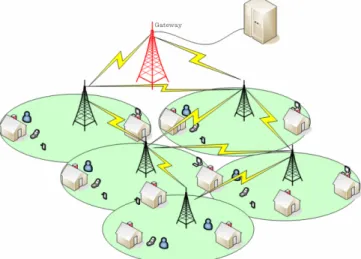
In our work, we consider a broadband WMN like 3GPP LTE-Advanced where two traffics are operated. The first one is between stationary or mobile clients and LTE base station (a.k.a. eNode B, BS). The second one is between the eNodeB’s, that create a wireless backhaul topology. Each BS collects the traffic generated by the clients and forwards it through multi-hop communica-tions toward some dedicated BS, called gateways (a.k.a. system architecture evolution gateway) that bridge the backhauling network to the core network (fig. 1). We assume that mobile-to-eNodeB and eNodeB-to-eNodeB traffic use different and independent resources. Our study focuses only on the backhauling network. We do not take into account the users requests but rather the flows aggregated by the eNodeB.
Figure 1: Wireless mesh network architecture: base stations collect the traffic from clients (mobile or static) and forward it to the core network.
In this work we investigate the trade-off between capacity maximization and energy consumption minimization. This issue has been well studied on a
4 Anis Ouni & Hervé Rivano & Fabrice Valois
point-to-point physical layer communication using Shannon theory [2, 3]. Our work pursues the same objective in network wide from the MAC and routing perspective. Our contribution is two-fold: (a) Developing a complete frame-work considering jointly capacity maximization with energy minimization. Our framework is extensible to cope with any energy consumption model and radio characteristics (interferences, fading, shadowing). (b) Finding an optimal sys-tem configuration and network engineering such as: capacity and energy trade-offs, optimal routing and scheduling, etc. To our knowledge, we are among the first to compute an optimal capacity of the backhaul with a minimum energy consumption.
The paper is organized as follows. Next, the related works are reviewed. Section 3 gives an overview about LTE physical layer fundamentals. A model for LTE resource allocation is given in Section 4, where we describe too the multi-objective framework based on a linear program and a column generation to solve it. Section 6 highlights key results and engineering insight obtained. We conclude the paper by giving future directions in Section 7.
2
Related work
Since the seminal work of Gupta [1], the evaluation of the capacity of wireless networks has received much attention and an important research effort. In [4], it is shown that the available capacity allocated to each node is reduced by a factor of 1
n, where n is the number of nodes. This result is extended in [5],
which evaluates the difference of capacity provided by an ad-hoc network or an hybrid network, using linear programming models. In [6], the regularity of the topology, the placement of gateways and the routing protocols are shown to have a limited impact on the capacity, which is directly bounded by a bottleneck around the gateways [7, 8].
Joint scheduling and routing optimization has been considered in many pa-pers on wireless mesh network. In [7] a joint scheduling, routing and power control strategy is proposed. The authors have developed a computational tools using column generation to maximize the minimum throughput among all flows. They have confirmed the usefulness of the power control on the per-formance of multi-hop wireless networks. Other results have been given about routing, scheduling and spacial reuse. A similar problem is considered in [9] where the authors focus also in the optimal network configuration to achieve a maximum of throughput.
Other studies have addressed the scheduling problem around an access point on 802.11 networks. A Round Weighting Problem (RWP) has been studied in [10] in order to determine the minimum number of rounds (a round is any set of pairwise disjoint edges). In [8], the authors study the problem of Routing and Call scheduling in 802.11 multi-hop wireless networks. They provide an optimal framework for determining optimal routing and scheduling needed by the traffic in the network. Our work is based on a similar trend of optimization techniques: a column generation algorithm isolates the routing and scheduling models from the computation of concurrent links activations. The main novelty of the models provided in Section 4 is the computation of time/frequency resource allocation accounting for the energy expenditure. Besides, we develop a muti-objective framework to address the tradeoff between capacity and energy consumption.
The optimization of energy consumption also has been well addressed in the literature especially in sensor networks where a sensor has a limited battery power. The energy expenditure in a node is typically dominated by the trans-mission unit. From the energy efficiency standpoint, the most effective solution is to put the wireless nodes in sleep mode [11]. Our model takes into account the idle consumption mode and calculates an optimal transmission number to minimize the overall energy consumption.
Some works focused on both the study of capacity and energy consumption. [2] studies energy, latency and capacity trade-offs existing in a multi-hop ad-hoc wireless network. The authors studied only a line topology with a simple en-ergy model. The work is an analytical study and don’t take into account a real interference model.
Some heuristic algorithms have been proposed in [12] to calculate the min-imum number of slots allocated to communications. A power control is used to minimize overall energy consumption. Our work is more general because we addressed also the routing problem and we take into account the demand of each node. Note also that the solutions found by our framework are optimal.
3
LTE basic description
In the following, we give a brief description of LTE Physical Layer features, focusing on the scheduling and resources allocation.
LTE radio transmission is based on Orthogonal Frequency Division Multiple Access (OFDMA) for downlink communications and Single Carrier Frequency Division Multiple Access (SC-FDMA) for uplink communications. OFDMA allows to exploit multiuser diversity and to provide more flexibility in radio resources allocation.
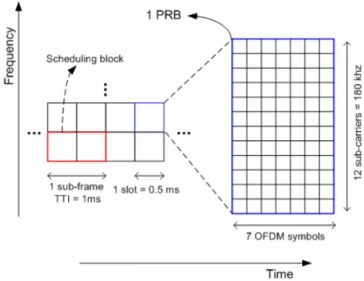
A LTE frame is divided in 20 time-slots where the duration of one time-slot is 0.5ms (TDD mode). Two adjacent time-slots are grouped into a sub-frame of length 1 ms, corresponding to a Transmission Time Interval (TTI). Each time-slot corresponds to 7 OFDM symbols, which is preceded by a cyclic prefix to avoid inter-symbol interference. The bandwidth corresponding to a slot (7 OFDM symbols) is subdivided into several blocks of 12 subcarriers, each of which is called Physical Resource Block (PRB). The smallest resource unit that can be allocated to a user covers a TTI of 1ms and a PRB (bandwidth of 180 khz), called scheduling bloc ’SB’ (fig. 2).
In LTE-Advanced, the communication between base stations is not yet stan-dardized. We assume that this communication is similar to those between base station and users. Nevertheless, the optimization models that we present fur-ther on are generic and can be applied to any synchronous slotted technology in which the resource is divided into time-frequency elements.
Given a bandwidth available for the backhauling network, the goal is to find an optimal schedule within a minimum time frame to maximize the capacity. Our framework allocates, for each base station, the optimal number of SB in order to send its own traffic and to route the traffic of the other nodes. rr
6 Anis Ouni & Hervé Rivano & Fabrice Valois
Figure 2: An illustration of resource element in LTE
4
Problem Formulation, routing and scheduling
4.1
Network model
The fixed infrastructure of the WMN can be model as a directed graph G(V,E) with N static nodes representing mesh points. The set of vertices V is decom-posed into two independent subsets: VBSis the set of base stations (NBS= |VBS|)
and Vg the set of gateways (Ng= |Vg|) where N = NBS+ Ng. Each base
sta-tion of VBS has an aggregated demand di that is to be routed to the gateways
through multi-hop paths. We assume that dv, the traffic demand of each BS v,
is static and known.
As aforesaid, a LTE network is slotted and synchronized. We consider steady state networks which are hence periodic, with a period length T. The through-put of the network is Pvdv
T , the ratio between the total traffic received at the
gateways, and the period length needed to collect it. Therefore, optimizing the throughput is minimizing the number of time slots used to activate the links transmitting the traffic. An insight of a throughput-optimal scheduling policy would be to pack as many links as possible in each time slot, that is maximizing the spatial reuse of system resources. This objective has to be mitigated with interference and energy consumption constraints.
4.2
Link description
Given a link (u, v) ∈ E, u is the sending node and v is the receiving node. (u,v,k) denotes a transmission between nodes u and v on PRB k. Such a communication has the following physical parameters.
• Ck
(u,v)is the capacity of the link (u, v) on the PRB k.
• Jk
(u,v) is the total energy consumed for communicating on the link and
PRB. u spends a transmitting cost jt(u, v, k) while v spends a receiving
cost jr(u, v, k): Jk(u,v)= jt(u, v, k) + jr(u, v, k).
4.3
Link scheduling and energy consumption
As aforesaid, throughput wise, the logical trend is to strengthen the spatial reuse of the links, up to interference constraints. We call a configuration a set F of transmissions that can be activated simultaneously in a time slot. The set of all possible configurations is noted F. This generic definition allows to consider any interference model like binary models (transmissions have to be pairwise non interfering, i.e. on non-conflicting links or on distinct PRBs), or Signal-to-Noise-and-Interference-Ratio (SINR) based models (a transmission can be active if the SINR at the receiving node is above a given threshold).
A link e = (u, v) is in a configuration F if and only if there exists at least a PRB k where (u, v, k) ∈ F . The capacity of the link e in the configuration F is ce(F)and equals to Pk,(u,v,k)∈Fcek.
A node v which is involved in no active transmission is said idle and is denoted v 6∈ F for sake of simplicity. The energy cost of an idle node v is Idle(v).
Each feasible configuration F has an energy cost j(F) taking into account the active transmissions and the idle nodes.
j(F) = P
(u,v,k)∈F
(jt(u, v, k) + jr(u, v, k)) + P v6∈F
Idle(v).
At each time, one (and only one) configuration is activated and W(F) de-notes the duration of activation of the configuration F. The total length of the period is hence T = PF ∈FW (F ) and the total communication cost is
P
F ∈FW (F )j(F ).
4.4
Routing
The activation of a configuration F during a unit of time provides to each link (e) a capacity ce(F ). The total link capacity through the period is hence
P
F ∈F,F 3ece(F )w(F ). This capacity is used to route the traffic from the mesh
routers to the gateways.
For each mesh node u, Pu denotes the set of all possible paths between u
and a gateway and P = ∪uPu. f(P) is the traffic flowing on the path P. The
traffic sent by a mesh router u is hence PPuf (P ). The flow over a link e is the sum of the traffic on the path going through e, PP3ef (P ). Obviously, this flow
has to be below the capacity of e.
Recall that the objective of the joint routing and scheduling is to provide enough capacity for the traffic demand of each mesh router to be routed to the gateway while minimizing the network period length and energy consumption.
4.5
Linear models
Our goal is to conduct a multi-objective study of the trade-off between capacity and energy consumption in mesh network optimization. This section is dedi-cated to the modeling of the joint routing and scheduling as linear programs, which allows for a very efficient computation of the Pareto fronts described in
8 Anis Ouni & Hervé Rivano & Fabrice Valois
section 6.3. A capacity oriented and an energy oriented version of the linear programs are provided. The first maximizes the capacity constrained by an energy budget. Let us call the following linear program the Master Problem to Maximize Capacity (MPMC): minX F w(F ) subject to ∀r ∈ Vr X P ∈Pr f (P ) = d(r) (1) ∀e ∈ E X P ∈P,P 3e f (P ) ≤ X F ∈F,F 3e ce(F )w(F ) (2) X F w(F )j(F ) ≤ J (3)
Equations (1)-(2) express the routing part of the problem as a flow from the mesh routers to the gateway that serves the traffic demand. Eq. (3) constrains the total energy expenditure of the network to a budget J while the objective is to minimize the period length, hence maximizing the capacity.
The following energy oriented version minimizes the total energy expenditure subject to capacity guarantee. The flow equations are the same as above while Eq. (4) upper bounds the period length, hence lower bounding the capacity. Let us call the following linear program the Master Problem to Minimize Energy consumption (MPME): minX F w(F )j(F ) subject to Equations (1)-(2) X F w(F ) ≤ T (4)
One can observe that the number of paths and possible configurations are exponential with the size of the network. These formulations are obviously not scalable as it is. Column generation is a prominent and efficient technique to cope with this situation. Based on sophisticated linear programing duality results, it allows to save the enumeration of the variable sets. The description of the column generation that we have implemented is described below. It is very similar to those presented in [8, 7].
5
Column generation
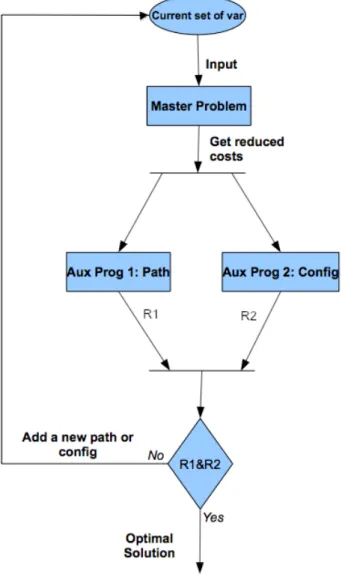
Column generation is a technique based on primal/dual process for solving linear programs with a huge number of variables. The idea of column generation is that, only a subset of variables are involved in an optimal solution. For this, one starts only with a sufficiently meaningful subset of variables (denoted basis of the restricted master problem: RMP) on which at least one solution is feasible. The next step is to add, iteratively, some promising variables that can improve the solution. Some new variables are generated by sub-programs called auxiliary programs which run over the dual values of the current solution of the RMP.
These variables are inserted in the master basis and a new solution of the RMP is computed. This process loops until no ameliorative column is found, in this case the duality theory ensures us that the solution of the problem is optimal (see fig. 3).
In our case, firstly, we resolve the MPMC and MPME with restricted sets of paths P0and configuration F0; P0and F0have to be carefully chosen to ensure
the existence of an initial feasible solution. Generally, we choose P0 containing
a shortest path from each base station to a gateway, and F0= {{e}, e ∈ E}.
Figure 3: The column generation process
5.1
Dual formulation
We present here the dual formulations associated to MPMC and MPME, de-scribed above. For each master program (MPMC and MPME), we associate two
10 Anis Ouni & Hervé Rivano & Fabrice Valois
constraints corresponding to the path and configuration variables in the dual program. We denote α(r), r ∈ VBS the dual variable associated with constraint
(1), λ(e), e ∈ E associated with constraint (2) and σ associated with constraint (3) for MPMC ((4) for MPME). O(P) denotes the source node of path P.
Dual formulation of MPMC:
maxX(α(r)d(r)) − σJ
subject to Equations ∀P ∈ P α(O(P)) ≤X
e∈P λ(e) (5) ∀F ∈ F X e X k (ckeλ(e) − j k eσ) ≤ 1 (6)
Dual formulation of MPME:
maxX(α(r)d(r)) − σT subject to Equations (5) ∀F ∈ F X e X k (c k eλe σ − jk e σ) ≤ 1 (7)
5.2
Auxiliary programs
The goal of auxiliary programs is to determine if there are paths and configura-tions that violate the constraints of the dual program. The column generation algorithm that we used involves two auxiliary programs. These programs are associated to the two constraints of dual formulation. The first program is as-sociated to the constraint (5) and aims to find a weighted path which does not respect this constraint: Is there a path which weight is lower than the dual variable associated to its source node ? If the minimum weighted path fits the constraint then all other paths do. If not, this path is selected to be added to the master problem.
All source Shortest Paths
Instead of computing the shortest path for each source iteratively, we use a linear program which computes these shortest paths simultaneously, with an un-capacited unitary multicommodity flow. In this formulation, each source node sends a unit of traffic (d(v) = 1) to access points Vg. K(r, g) is a binary variable
that indicates if the gateway (g) receives the traffic unit by the sender (r) or not. The constraint (9) forces that the flow is not splitted among several gate-ways. f(r, e) denotes the amount of flow sent by the source node (r) and routed through the link e. Finally, the flow conservation constraint (8) is respected at each node. minX r∈Vr X e∈E X k (ckeλe− jek)f (r, e) INRIA
X e∈Γ+(v) f (r, e) − X e∈Γ−(v) f (r, e) = 1, if v = r −k(r, g), if v ∈ Vg, ∀r ∈ Vr 0 if v ∈ Vr \ {r} (8) ∀r ∈ Vr X g∈Vg k(r, g) = 1 (9)
The second auxiliary program is associated to the constraint (6) for the dual formulation of MPMC ((7) for the dual formulation of MPME). This program aims at finding a configuration with negative reduced cost, that is such that F where Pe
P
k(c k
eλ(e)−jekσ) > 1. In this case if the maximum communication set
respects the constraint then all other configurations do. When the interference model is binary, computing a maximum weight stable set of the conflict graph allows to find such a configuration.
Maximum Weight Stable set: MWS
Given a transmission graph G = (V, E), each arc is weighted by Pk(c k eλ(e) −
jk
eσ). The problem is to find a configuration F ∈ F where Pe∈F
P
k(c k eλ(e) −
jekσ)is maximum on F. We present here the formulation to generate the
config-urations taking into account the interference model and the energy consumption model. We consider a binary interference model presented by the constraint (13) where a link e cannot be active in conjunction with a link e0 ∈ I
e(set of links
that interfer with e). The consumption model is already explained in section 4.3, it takes into account the cost in transmission, reception and idle state, con-straint (11)-(12). The concon-straints (10)-(12) mean that a node consumes at least the cost of idle mode.
maxX e∈E X k (ckeλe) − σ X u Pu Pu≥ X k Puk (10) Pu≥ Pidle(u) (11) Puk>= X v
(z(u, v, k)je(u, v, k) + z(v, u, k)jr(u, v, k)) (12)
∀e ∈ E, e0∈ Ie, k ∈ [1, K] z(e, k) + z(e0, k) ≤ 1 (13)
z(e, k) ∈ {0, 1}, ∀e ∈ E (14)
In the case of another type of interference model (e.g. SINR based) equation (13) might be replaced.
6
Result analysis and discussion
6.1
Scenarios and Model Parameters
Both the capacity-oriented and energy-oriented formulations, and the column generation algorithm have been implemented and tested using AMPL/CPLEX.
12 Anis Ouni & Hervé Rivano & Fabrice Valois
Due to the lack of space, only the main results are presented according to the various scenarios we have studied. For simplicity and without lost of generality, we assume that for each base station the average signal-to-noise ratio (SNR) equals to 22dB, and the noise power density is -174 dBm/Hz. All base stations operate at the same transmit power, and use the same modulation (4QAM). The channel attenuation is modeled by a path-loss with an exponent of 2.6 ( Line Of Sight channel model).
We consider grid network topologies and random one composed of {9, 24, 49, 121} nodes, where only one gateway is located in the network center. The upload traffic in the network is uniformly distributed among the nodes. A distance-2 binary interference model is considered: it means that two transmissions do not interfere if there are at least two hops.
6.2
Network capacity, Energy cost and scalability
We present, firstly, the evolution of the minimal energy consumption and the maximal capacity according to the network size (from 9 to 121 nodes) (see Fig. 4). It confirms the result of a decreasing capacity when the network size increases [6] whereas the energy consumption increases with the number of stations in the network. Adding new base stations increases the traffic load in the network, and thus, both the period length and the energy consumption increase. This explains the decreasing capacity and the increasing energy consumption.
Figure 4: Capacity and energy consumption evolution vs size of the network Fig. 5 presents the evolution of the capacity according to the number of PRB available to each base station. The capacity increases linearly with the number of PRB; each node can use, at the same time, all the PRB since it respects the interference constraint. This divides the period T by the total number of PRB and therefore increases the capacity linearly.
Figure 5: Capacity evolution vs PRB number
6.3
Capacity and energy trade-off
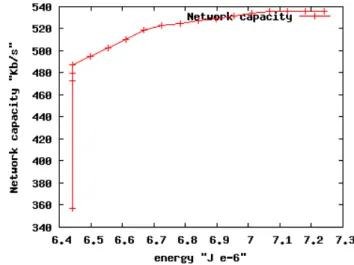
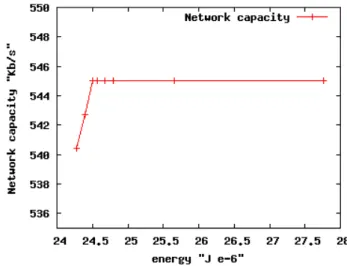
If the previous result highlights the behavior of the energy consumption and the capacity according to the network size, we can not conclude anything about a possible trade-off between energy and capacity. Nevertheless, in figure 6 we provide the capacity/energy Pareto front in the case of a random network topol-ogy (49 eNodeB’s). Note, that in this scenario, we do not take into account the idle energy consumption. First, we note the existence of a minimal value of energy required to meet the capacity constraint: it means that if less energy is available, the traffic demand can not be routed. Second, the capacity tends to an asymptotical boundary. Between those two points, the capacity increases slightly with the energy consumption.
14 Anis Ouni & Hervé Rivano & Fabrice Valois
Figure 7 is also focused on the capacity and energy trade-off but when the idle energy consumption is not negligible: it means, it adds a penalty or an additional constraint on energy consumption. To reduce the total cost of Idle consumption and therefore the total energy cost, it is preferable to activate a maximum link at the same time (maximum transmission set). This allows also to have the maximum capacity and finally we can conclude that both models have the same goal. This explains the lack of trade-off between capacity and energy in this case.
Figure 7: Capacity and energy trade-off, assuming Idle cost > 0.
7
Conclusion
This paper investigates on the trade-off between capacity and energy consump-tion of LTE-like wireless mesh networks. We have proposed a multi-objective study using a linear programing modeling of the joint routing and scheduling problem. Under a binary interference model with fixed transmit power, there is indeed no capacity/energy trade-off if the energy cost of an idle node is not negligible. This study has to be pursued taking into account power control ability. We nevertheless conjecture that a similar observation would rise since minimizing the energy consumption and intensifying spatial reuse seem to be compatible objectives. Dynamic traffic demand is also a key challenge to tackle once the correlations between the two objectives are known.
8
Acknowledgment
This work has been partially funded by ANR VERSO ECOSCells.
References
[1] P. Gupta and P. R. Kumar. The capacity of wireless networks. IEEE Transactions on Information Theory, vol. 46:388–404, March 2000. [2] J-M Gorce, R. Zhang, K Jaffrès-Runser, and C. Goursaud. Energy, latency
and capacity trade-offs in wireless multi-hop networks. In to appear in IEEE 21th Personal, Indoor and Mobile Radio Conference (PIMRC), Istanbul, Turkey, Sept 2010.
[3] D. Coudert, N. Nepomuceno, and H. Rivano. Power-efficient radio configu-ration in fixed broadband wireless networks. Special Section on Hot Topics in Mesh Networking. Computer Communications, v.33, n.8, 2010.
[4] J. Jun and M. L. Sichitiu. The nominal capacity of wireless mesh networks. IEEE Wireless Communications, vol. 10, no 5:p. 8–14, October 2003. [5] H. Rivano, F. Theoleyre, and F. Valois. A framework for the capacity
evaluation of multihop wireless networks. AHSWN, vol. 9, number 3-4, January 2010.
[6] A. Ouni, H. Rivano, and F. Valois. Capacity of wireless mesh networks: determining elements and insensible characters. In PlanNet’10, (WCNC’10 Workshop), Sydney, Australia, April, 2010.
[7] J. Luo, C. Rosenberg, and A. Girard. Engineering wireless mesh net-works: Joint scheduling, routing, power control and rate adaptation. In IEEE/ACM Transactions on Networking, April 2009.
[8] C. Molle, F. Peix, and H. Rivano. An optimization framework for the joint routing and scheduling in wireless mesh networks. Proc. 19th IEEE Interna-tional Symposium on Personal, Indoor and Mobile Radio Communications (PIMRC’08), Cannes, France, September 2008.
[9] A. Iyer A. Karnik and C. Rosenberg. Throughput-optimal configuration of wireless networks. In 44th Annual Allerton Conference on Communication, Control, and Computing, Sept 2006.
[10] J.-C. Bermond and J. Peters. Efficient gathering in radio grids with in-terference. In AlgoTel’05, pages pages 103–106, Presqu’île de Giens, May 2005.
[11] M.J. Miller and N.H. Vaidya. A mac protocol to reduce sensor network energy consumption using a wakeup radio. IEEE Trans. Mobile Computing, vol. 4, no. 3, pp. 228-242, May/June 2005.
[12] K. Bastian, V. Markus, and W. Dorothea. Energy efficient scheduling with power control for wireless networks. In WiOpt’10, Avignon, France, June 2010.
16 Anis Ouni & Hervé Rivano & Fabrice Valois
Contents
1 Introduction 3
2 Related work 4
3 LTE basic description 5
4 Problem Formulation, routing and scheduling 6
4.1 Network model . . . 6
4.2 Link description . . . 6
4.3 Link scheduling and energy consumption . . . 7
4.4 Routing . . . 7
4.5 Linear models . . . 7
5 Column generation 8 5.1 Dual formulation . . . 9
5.2 Auxiliary programs . . . 10
6 Result analysis and discussion 11 6.1 Scenarios and Model Parameters . . . 11
6.2 Network capacity, Energy cost and scalability . . . 12
6.3 Capacity and energy trade-off . . . 13
7 Conclusion 14
8 Acknowledgment 14
Centre de recherche INRIA Lille – Nord Europe : Parc Scientifique de la Haute Borne - 40, avenue Halley - 59650 Villeneuve d’Ascq Centre de recherche INRIA Nancy – Grand Est : LORIA, Technopôle de Nancy-Brabois - Campus scientifique
615, rue du Jardin Botanique - BP 101 - 54602 Villers-lès-Nancy Cedex
Centre de recherche INRIA Paris – Rocquencourt : Domaine de Voluceau - Rocquencourt - BP 105 - 78153 Le Chesnay Cedex Centre de recherche INRIA Rennes – Bretagne Atlantique : IRISA, Campus universitaire de Beaulieu - 35042 Rennes Cedex Centre de recherche INRIA Saclay – Île-de-France : Parc Orsay Université - ZAC des Vignes : 4, rue Jacques Monod - 91893 Orsay Cedex
Centre de recherche INRIA Sophia Antipolis – Méditerranée : 2004, route des Lucioles - BP 93 - 06902 Sophia Antipolis Cedex
Éditeur
INRIA - Domaine de Voluceau - Rocquencourt, BP 105 - 78153 Le Chesnay Cedex (France)