Component Based Software Reusability
by
Siva Kumar Dirisala
B.Tech, Civil Engineering
Indian Institute of Technology, Madras (1995)
Submitted to the Department of Civil and Environmental
Engineering
in partial fulfillment of the requirements for the degree of
Master of Science
at the
MASSACHUSETTS INSTITUTE OF TECHNOLOGY
June 1998
@ Massachusetts Institute of Technology 1998. All rights reserved.
A uth or ...
...
...
Department of Civil and Environmental Engineering
/I, ',
ay 19, 1998
C ertified by . ...
...
;..
...
Ce.iosky Pefia-Mora
Assistant Professor of Civil and Environmental Engineering
Thesis Supervisor
Accepted by...
...
Chairman,
Graduate Studiessman
Department
Committee
on
Chairman, Department Committee on Graduate Studies
J
Software Reusability
by
Siva Kumar Dirisala
Submitted to the Department of Civil and Environmental Engineering on May 19, 1998, in partial fulfillment of the
requirements for the degree of Master of Science
Abstract
With the growing interest for open architectures and standards, it is likely that reuse methods would be part of the software development life cycles. Reuse of software components requires the technology to build easily reusable components and sup-port systems for cataloging and retrieving the right components. Object oriented programming and component object models have made it possible to build easily reusable components. Component technologies like COM and JavaBeans make it possible to build large systems by seemlessly integrating several components based mainly on their interface instead of implementation details. However, it is still nec-essary to identify the right components that offer the required functional features. Technology for classifying and retrieving the correct components is still far from ex-pectation because earlier methods have used mainly either semantic information or textual information. Systems based on semantic information often required learning new specification languages while those based on textual information resulted in poor classification and retrieval. This research uses both types of information to make use of the complementary advantages of each and provides a better reuse support system. Performance from using textual information can be improved by making use of semantic knowledge derived from simple analysis on existing semantic information. Capturing design intent, which gives the functional features of a component, can be automated by using both types of information. A cost effective reuse technology is provided by mainly using the existing project information that is produced without reuse concern. While cost is an issue, it is also necessary to make the end user interface simple without imposing the additional burden of learning new specification languages or theorem proving techniques to retrieve components. This research presents a cost effective, easily usable and efficient reuse technology for automating the capture of design intent and retrieving multiple components to build large systems.
Thesis Supervisor: Feniosky Pefia-Mora
First and foremost I would like to thank Feniosky Pefia-Mora for his support, guidance and constant encouragement. The attitude I have experienced from him is even a
drop of creativity in an ocean of research is significant and this very thought was a
motivating force in my research efforts.
I would like to acknowledge the support received from the School of Engineering, the Department of Civil Engineering and NSF-CONACyT grant (Project Number IRI-9630021).
I would like to thank the Head of the Department, Prof. Rafael Brass and the administrative staff of the department who work behind the screens and make sure that the students' academic life runs smoothly.
Pursuing higher studies requires a stronger foundation of fundamentals and the credit in shaping my technical personality goes to my Alma mater Indian Institute of Technology, Madras (IIT-M).
My special thanks to my undergraduate classmate Niranjan Krishnan (Ninja) who helped me in coming to MIT and adjusting to US life. All those memorable weekend dinners with Battu, Ghost, KK, Ninja and Rugby made me feel like still studying in IIT-M instead of MIT.
Several friends at MIT helped in having a fun life abridge the academic and research pressures. Chandra B, Chandra P, Deepak, Gangs, JP, Neeraj, Pulp, Sri and Subbu are some of them.
Apart from academic and research advisors (who happened to be the same for me right from the beginning), it is nice to have advice from others and I always had OP, Ninja and Auroop for that.
Being in a friendly research group is very important and the DaVinci group has provided such an environment with people like Lucio, Kareem, Sanjeev, Chun-Yi and Yee-Sue. Thanks to Thomas, Nina and Gordon for tolerating my computer occupancy, being friendly and sharing the den, 1-270. Special thanks to Joan McCusker who takes care of all the administrative work of the IT group. I thank Petros, another IESL
labmate, for giving company several nights for doing assignments and doing our term project in Graphics course. He is one of the very nice guys I met in MIT.
I express my deepest love to my parents for helping me in being what I am today and always letting me do whatever I wanted to do. I would also like to express my deepest love to my sister and brother for their affection and source of encouragement.
1 Introduction 12
1.1 Software Reuse and the Advantages . ... 13
1.1.1 W hat can be Reused ... 13
1.1.2 Advantages of Software Reuse . ... . . . 14
1.2 Technology to Develop Reusable Software Components ... 15
1.2.1 Object Oriented Paradigm ... 15
1.2.2 Component Object Model . ... . 16
1.3 Software Development by Integrating Components . ... 16
1.4 Scope of the Research ... 18
1.5 Roadmap to the rest of the Thesis . ... . 20
2 Background 22 2.1 Semantic Approach ... ... 23
2.1.1 Parameterized Programming, OBJ Language ... 23
2.1.2 Structured Algebraic Specification, Clear Language ... 24
2.1.3 Partially Interpreted Schemas, PARIS . ... 25
2.1.4 Object Oriented Module Interconnection Language, MIL . . . 27
2.1.5 Summary of Semantic Approach . ... 27
2.2 Statistical Approach ... 28
2.2.1 Faceted Classification Scheme . ... 29
2.2.3 Summary of Statistical Approach ... 2.3 Hybrid Approach ...
2.4 Design Recommendation and Intent Model Extended for Reusability (D RIM ER ) . . . . 3 Requirements Analysis
3.1 Information in Software Projects . . . .
3.1.1 Classification of Information used in Software Projects . . . . 3.1.2 Observations ...
3.2 Information Search - A Case Study . . . . 3.2.1 Search for a TextBook/Journal in a Library . . . . 3.2.2 Observations ...
3.3 Retrieving Multiple Components . . . . 3.3.1 Retrieving and Ranking ...
3.4 Framework and Customization . . . . 3.5 Summary of Requirements ...
4 Conceptual Model
4.1 Existing Reuse Models ...
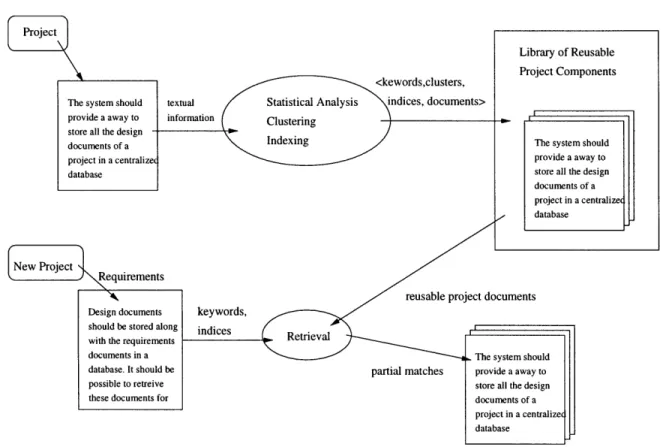
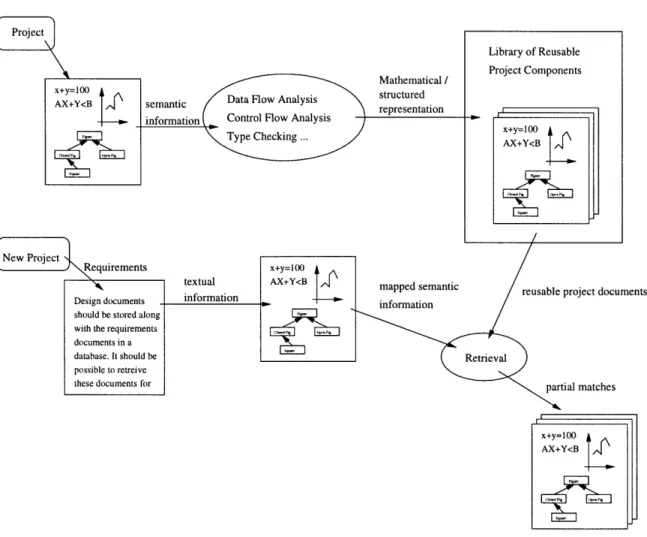
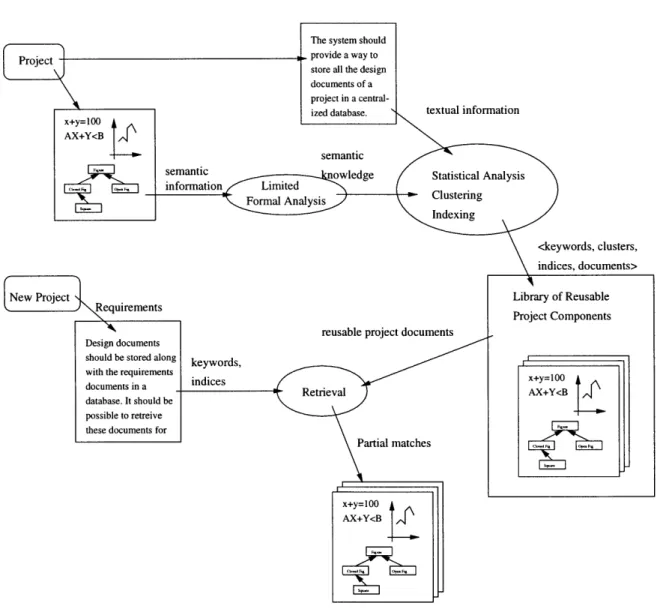
4.1.1 Reuse based on Available Textual Information . . . . 4.1.2 Reuse based on Available Semantic Information . . . . . 4.2 New Reuse Model ...
4.2.1 Reuse based on both Textual and Semantic Information. 4.3 Class Tree Provides Better Weights for Statistical Analysis . . .
4.3.1 Assum ptions ...
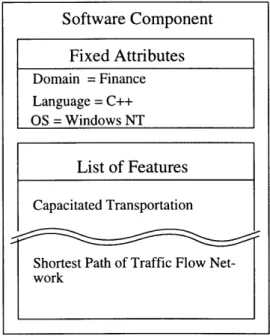
4.3.2 Class Tree . . . . 4.4 Creational Patterns Suggest Abstractions of Functional Features 4.5 Software Component Representation . . . .
4.5.1 Simple External Representation . . . .
50 .. . 51 . . . 51 . . . 52 .. . 54 . . . 54 . . . 55 .. . 56 .. . 56 . . . 58 . . . 59 . . . 60 32 32 33 37 38 39 42 42 43 44 46 46 47 48
4.5.2 Complex Internal Representation . . . . . 4.6 Multiple Software Component Retrieval . . . . 4.6.1 Reggia's Generalized Set Cover Algorithm 4.6.2 Multiple Software Component Retrieval. 4.6.3 Ranking the Retrieved Solutions . . . . 4.7 Summary of the Conceptual Model . . . .
5 Prototype Framework 5.1 Framework ... 5.1.1 Client .. 5.1.2 Server .. 5.2 Tools ... and Tools 6 Illustrative Examples 6.1 C lient . . . . 6.1.1 Specifying Constraints and Features . . . . 6.1.2 Selecting for Composibility, Relevancy or Reusability . . . . . 6.1.3 Online Software Component Browsing and Report Generation 6.2 Server . . . .
6.2.1 Adding New Software Component . . . . 6.2.2 Browsing and Modifying Existing Components . . . . 6.2.3 Browsing Existing Software Features . . . . 6.3 T ools . . . .
6.3.1 Chat Application ...
6.3.2 Analysis using Textual Information . . . . 6.3.3 Class Tree, a semantic analysis . . . . 6.3.4 Analysis using Textual Information and Semantic Information
7 Conclusions 7.1 Conclusions . . . . 81 81 82 86 90 91 92 93 94 95 95 95 97 97 101 101 I... ... ... ...
7.2 Future Research Directions ... 103
A OOP and Design Patterns 105 A.1 Object Oriented Programming (OOP) ... 105
A.2 Design Patterns ... 107
A.2.1 Creational Design Patterns ... . 107
B COM and JavaBeans 109 B.1 Component Object Model, COM ... 109
B.2 JavaBeans . .. . .. . .. ... . ... . .. . . . ... . .. . 111
C CORBA 113 D Generalized Set Cover Algorithm 115 D.1 Generalized Set Cover (GSC) ... ... 115
D.1.1 GSC Pseudo code ... 115
D.1.2 Minimum Cardinality Set Solution ... 117
1-1 Generic framework customization for specific domain applications 2-1 Parameterized List object representation using OBJ Language . . . .
2-2 Pseudo-Clear code for Group with Equivalence Relation . . . .
2-3 Schema Representation of Linked List iteration using PARIS . . . . .
2-4 Home-heating System module specified using MIL . . . .
2-5 Representation of Software Components using Faceted Classifying Schei 2-6 Search genaralization using wildcards . . . . 2-7 A sample Conceptual Schema Card . . . . 2-8 DRIM model adapted from [FPn94] ...
2-9 DRIMER web based system adapted from [Vad96] . . . . 3-1 Classification of Project Information . . . .
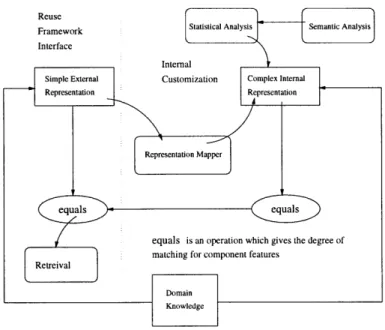
4-1 4-2 4-3 4-4 4-5 4-6 ne
Reuse from Textual Information . . . . Reuse from Semantic Information . . . . Reuse from both Semantic and Textual Information Class tree provides relative weights for the words . Software Component Representation . . . . Customization of Component Representation . . . .
4-7 Software components and features represented as bipartite graph . 4-8 Example of Set Covering ...
28 29 30 31 34 35 39 . . . . . 52 . . . . . 53 . . . . . 54 . . . . . 57 . . . . . 60 . . . . . 62 64 66
5-1 W eb Client ... 74
5-2 Reusable Software Component Server ... 78
6-1 Specifying constraints for the required software component ... 83
6-2 Specifying software features and relaxing the constraints ... . 84
6-3 Results and unavailable features . ... .. 85
6-4 Searching for unavailable features by relaxing constraints ... . 86
6-5 Search for better Composibility ... . . . .. . . 87
6-6 Search for better Relevancy ... 88
6-7 Search for better Reusability ... 89
6-8 Online browsing of individual components . ... 90
6-9 Report of selected components generated on the browser ... . 91
6-10 Adding a New Software Component . ... 92
6-11 Browsing Software Components ... 93
6-12 Browsing Software Features ... 94
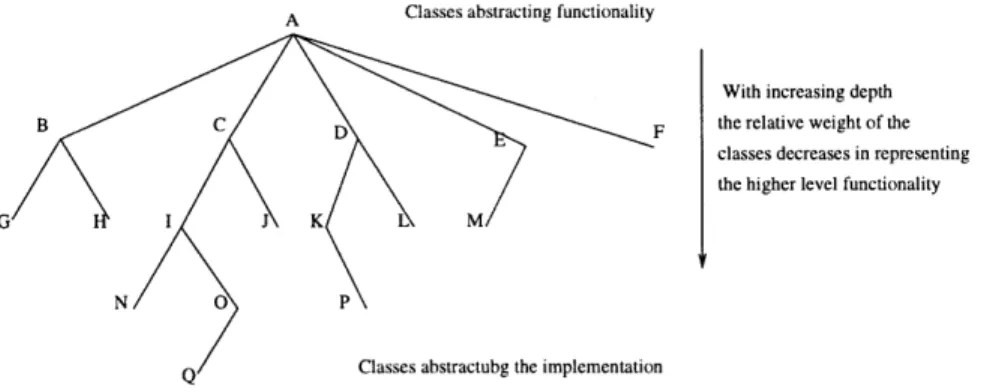
6-13 Class Tree of the Chat Server ... 97
6-14 Class Tree of the Chat Client . ... ... 97
A-1 Structure of Factory Method adapted from [GHJV95] ... . 108
B-1 VTable to implement COM binary standard . ... 110
C-1 Common Object Request Broker Architecture, CORBA adapted from [ORB 97] . . . . 114
D-1 Pseudo code for Reggia's GSC Algorithm . ... 116
D-2 Pseudo code for Genset used in GSC Algorithm . ... 117
D-3 Selection of disease/component for Minimum Cardinality Set Solution 117 D-4 Selection of disease/component for Light Weight Set Solution ... . 118
5.1 Software Component File Fields ... .. 76
5.2 D atafile . . . .. . 77
6.1 Constraint Attributes and valid values . ... 82
6.2 Results of Analysis using only Textual Information . ... 96
6.3 Relative Weights from the Class Tree of Chat Application ... 98
6.4 Results of Analysis using Textual and Semantic Information .... . 99
Introduction
Legal Regulations Enforce Recycling efforts, Open Standards Reinforce Reuse efforts
Presently, at the turn of this century there is an implicit industrial revolution for open architectures. This is especially true in the IT industry. Both the software vendors and the consumers are preferring open architectures, the former to compete against monopoly and the later to have flexibility in seeking services from various vendors. Organizations like Object Management Group, OMG [OMG], are working towards these open architectures and standardizing the software components in terms of well defined business objects, services and facilities [BOB97, COS97, CFA97].
As a result of this industrial revolution, software reuse is no more an expensive task and it will soon be a part of the software development lifecycles. This chapter reviews the benefits of software reuse, the existing technology for developing reusable software components, presents a couple of scenarios which illustrates the development of software systems by integrating well defined software components, defines the scope of this research and provides a road map to the rest of the thesis.
1.1
Software Reuse and the Advantages
Many software applications share certain common functionality like data manipula-tion, data presentamanipula-tion, and use certain common algorithms for implementing these functionalities. For example, in case of systems software, one could use the same back end of a compiler with several front end compilers for different languages. Applica-tions software is also being developed these days (by companies like 10Fold [TNF]) with a similar architecture by having a single horizontal framework (back end) and several vertical domain applications (front ends) built on top of it. The horizontal framework is reused in several domain applications as shown in Figure 1-1. With standards for the domain applications like the business objects from OMG [OMG], even the domain applications could be tailored from components of several vendors.
Domain Domain Domain Domain
1 2 3 4
Horizontal Framework
Figure 1-1: Generic framework customization for specific domain applications
1.1.1
What can be Reused
The final software artifact is not the only part of a software project that could be reused. It is possible to reuse all design documents, test plans along with the final source code. Infact, reusing the existing designs in the early phases of the software development process leads to reusing all the corresponding artifacts in the subsequent phases. This offers a significant reuse benefit.
However, in order to be able to reuse the design along with the final artifact design rationale and intent of use of the artifact are required. Capturing design rationale and intent is described in [PM94].
1.1.2
Advantages of Software Reuse
Reusing the existing software components has the following advantages
Reduction in the cost of product development
Similar to the reduction of price in hardware with technology and open architectures, the cost of developing software systems is also decreasing. Open architectures will improve the component reuse and accelerate the reduction of developmental cost.
Reduction in the duration of project
While it took years to complete projects earlier, the demand is in months. And with the horizontal framework and vertical domain applications many companies are promising to meet this demand. The change in business policies demands for constant upgrading and enhancing of applications software and with less time to deliver the product, the business strategies and processes will no more be limited by the software systems. It would be possible to buy the best components from multiple vendors and integrate them and depend on the integrated system for the business solution. Since the system is developed using already existing components, the time to develop it would be lesser.
Increase in the robustness of the product
Using a production tested and proven component will make the new system more robust and this makes the policy makers implement several business strategies more dynamically but with minimal risk.
1.2
Technology to Develop Reusable Software
Com-ponents
The above mentioned advantages of software reuse can be obtained only if it is possible to develop complex software systems by integrating the reusable components with a very little effort. This becomes possible if components could be integrated based on the interface they provide and not their implementation details.
If not for reuse, software has been developed from the beginning in a structured manner by using top down, bottom up and modular approaches mainly to make the design, implementation and maintainance of complex software systems tractable. With better understanding of software engineering and advent of object oriented lan-guages the focus has broadened to software reuse as well. Microsoft's Component Ob-ject Model, COM [COM95] (Appendix B) and Sun's JavaBeans [JBn97] (Appendix B) provide a model to develop software as components which can be integrated with one another very easily. Software reuse due to both object oriented paradigm and com-ponent object models is discussed below. While object oriented paradigm provides abstractions and reuse at object level, component object models provide abstractions and reuse at component level.
1.2.1
Object Oriented Paradigm
Object Oriented Paradigm, OOP, provides abstraction, encapsulation, inheritance and
polymorphism (all these terms are explained in detail in Appendix A). Abstraction
and encapsulation helps in analyzing and organizing a complex system into manage-able modules. Though these features do not directly contribute to the software reuse, they act as a means of identifying the isolated functionality and publishing the inter-face and hiding the implementation of the components. Inheritance makes it possible to design systems from general abstractions to specific instances. This provides for some software code reuse. A derived class can reuse the code from its parent class.
However, this is more like a glass box 1 type reuse because one has to understand the implementation details of the parent class before designing the derived class.
Poly-morphism is another very important feature of OOP that makes the behavior of the
system dependent on the objects at the runtime. This helps in writing generic flexible frameworks and customizing them as required by having a different implementation for the required interface and creating these instances.
1.2.2
Component Object Model
In Component Object Model the software component is viewed as a functional unit with a well defined interface. The components are integrated based on the interface they provide and without the need to understand the implementation details of the individual components. Hence, this is more like a black box type reuse. There are development environments like the JavaBeans' BeanBox tester [JBn97] that help in integrating and testing the Bean compliant software components.
While JavaBeans provide reuse of components developed in the same languages, distributed object environments like CORBA (Appendix C) and DCOM [DC098] makes it possible to integrate software components implemented in different languages and on different platforms.
1.3
Software Development by Integrating
Com-ponents
With the emerging open architectures in all industrial domains and reuse enabling technologies like COM, more and more companies will meet their IT needs by pur-chasing components from various vendors and seemlessly integrating them.
'Black box testing and Glass box testing are two types of software testing. Black box testing is not concerned with the implementation details. Whether or not input maps to the expected output according to the test plans is verified in this type of testing. Glass box testing on the other hand is done by going through the code covering all possible paths of execution.
Two examples are given below to illustrate the situations where software systems are developed by integrating existing components. The first example is in an industrial setting, the second is for developing a web page for personal use.
Example 1
Suppose Motawala, a chip manufacturing company, decides to automate their supply chain management, they have the option of developing the entire software themselves or buying the necessary software components from leading companies in supply chain management like 12 technology or Manugistics. If these companies develop their com-ponents in compliance with OMG's Manufacturing Business Objects, then Motawala could integrate any third party component along with the software from these com-panies. They need not wait for either of these companies to offer the lacking features in their existing products. However, after the integration if Motawala finds that the third party component is not offering good performance and finds yet another vendor offering a high performance component, they could just buy the component from this new vendor and integrate with their existing software. It is like plug and play for hardware.
Example 2
More and more homepages are coming up on the web and everyone wants to be as cre-ative as possible. But not everyone is a java [CH96] programmer or a Javascript [JS97] writer to make their own web pages attractive. However, there are several applets and script functions already written and available freely on the web [GAM, FRC]. These could offer functionality like menus, fancy buttons, toolbars or some sophis-ticated applets like .dvi (DeVice Independent format used to display LATEX[Lam86]
files) formatters. Hence, one could collect several such applet components on the web and prepare their web pages without really knowing the implementation details of these applets. All they need to know is what functionality the applets provide, what
parameters are passed to these applets and what their values should be.
The above examples shows that software development using existing components is by itself can be a new form of software development cycle with a component search phase in the initial stages of design and there will be a large growing interest for this kind of software development with open standards and enabling reuse technology.
1.4
Scope of the Research
Everyone in the industry acknowledge the above mentioned advantages offered by software reuse. However, most of the companies do not invest money in reusing software. They mainly follow the traditional software development life cycles. The management in companies consider reuse effort as an additional investment without realizing that they offer long term benefits there by amortizing the overall cost over several projects. This is mainly a culture and attitude issue [dJ96]. On the other hand technology is another issue. From the above description on the enabling technology for developing reusable components and the growing interest for open architectures and standards, the industry has the substantial knowledge in building reusable com-ponents and overcoming the cultural and attitude barrier towards software reuse.
However, there is a limited research in how to represent and store the reusable components in a library of reusable components and retrieve them when needed. As mentioned in the above example of creating an attractive web page, there are thousands of freely available applets on the web and in order to choose the right ones, there should be a systematic way of storing and retrieving these applets.
Software Engineers have used several reuse techniques. They have used statisti-cal and schematic techniques on informal textual documents (described in Chapter 2). They also have looked into defining formal means of representing the components using specification languages and performing semantic analysis for searching the com-ponents matching the given requirements. While one method offers ease of use the
other offers better classification and relevancy of search.
Also, earlier the main focus was on code reuse. However, over the years it has been realized that the experience gained in the projects during various stages of software development could also be reused. Capturing design rationale and intent is key to the success of reuse of higher level design concepts [PM94]. And with the component technology, once the right functional units are identified, it is just a matter of integrating them to build the required system.
Glass box type reuse requires understanding the design rationale of the existing components in order to be able to adapt the existing design. Design patterns (Ap-pendix A) which are conceptual design abstractions can act as building blocks to capture design rationale [Vad96]. On the other hand, black box type reuse requires no such understanding of the underlying design decisions and implementation details. Only knowing the functionality offered by the component may be required. The de-veloper expresses the functionality as the intent for developing. However, from the view of end user searching for reusable components, the intent is expressed as a set of functional features required by the system. Black box reuse is suitable for build-ing large systems that could be developed by integratbuild-ing existbuild-ing reusable software components built using component object models. This is because each of the well defined individual component abstracts certain functional features and in order to use these components it is only required to know the functionality that they offer. The implementation details are not necessary to integrate these components.
Automating the means of capturing the intent of use of a software component and using the appropriate components when needed has been the focus of the research. A hybrid approach of using information from both the informal specification documents and the structured design documents to extract the component features is proposed in this research. The drawbacks of using only either kind of information and how they are complementary are described. The proposed hybrid approach exploits this complementary nature.
The above examples in Section 1.3 suggests that large software systems could be built by integrating well defined software components. This requires identifying minimal set of components that could provide as much functionality as possible. Hence, instead of retrieving individual components for reuse, set cover algorithm is used to retrieve multiple components for composition based software development.
1.5
Roadmap to the rest of the Thesis
This chapter has introduced the growing interest for reuse, it's advantages, existing enabling technology to develop reusable components and scenarios for developing large software systems by composing several software components. It also mentioned that design rationale and intent are required for making use of existing designs and described the scope of the research which is mainly to automate the capture of design intent from the documents and retrieving multiple components for composition based software development. The remaining chapters review some of the research in this area, requirements analysis for the developed reuse model, conceptual reuse model, details of the system developed, couple of examples, conclusions and future research. The appendices complement the thesis by providing some technical details which help as a quick reference.
The chapters are organized as follows
Chapter 2 presents the related research. Models using informal design documents as well as formal documents are presented and their advantages and disadvantages are studied.
Chapter 3 gives the requirements analysis for the suggested framework and the developed software system.
Chapter 4 presents the hybrid approach of information reuse for capturing design intent and the use of setcover algorithm for component retrieval for composition based software development
Chapter 5 explains the software system developed in the research, the underlying design decisions and the organization of the framework.
Chapter 6 explains the intended use of the software system with a couple of examples.
Chapter 7 concludes the thesis by summarizing some of the ideas developed and understood in the research. Also, direction for the future research is presented.
Appendix A is a technical note on Object Oriented Paradigm and Design Patterns. Appendix B is a technical note on COM and JavaBeans.
Appendix C is a technical note on CORBA.
Background
Learn from the Past, plan for the Future
It has long been realized that reusability of software could be achieved by building systems from composing the existing software components. Various means of achiev-ing software reusability and the experiences and quantitative measures are present in [BP89, PDF93, Sar96]. Efforts have been made to provide better programming and specification languages that can support high levels of abstraction, interface be-tween modules and templates. These methods help in writing reusable components. However, the ability to reuse software components does not stop with the ability to implement them. Selecting the appropriate software components for reusing them in a given context and automating this process still remains as a challenging problem. The main issues involved are pertaining to the representation of a reusable software component in a catalog, the user interface for identifying the required components and the retrieval mechanisms.
Components have been represented from simple forms like a set of keyword tuples to complex forms like parameterized modules as described in Section 2.1 and 2.2. In this case, the representation details were obtained from informal textual specification
documents or from structured, detailed design documents. At the time of searching for a component, the required functionality is specified as a simple text expressed in natural language or by representing it in a specification language.
This chapter reviews several earlier research attempts which adopted some of the above mentioned methods for representing components and obtaining information from the user. These approaches are classified broadly as Semantic approach and
Statistical Approach. The definition of each of these approaches and their advantages
and disadvantages are presented.
2.1
Semantic Approach
Use of specification languages, module interface languages, logical programming lan-guages and compiler technologies is considered under this approach. A couple of examples are presented below and how they are difficult to use are mentioned.
2.1.1
Parameterized Programming, OBJ Language
OBJ is a language designed for Parameterized Programming [Gog89]. OBJ has four kinds of entity at its top level: objects, theories, views and reductions [Gog89]. A
theory defines the interface of a parameterized module, that is, the structure and
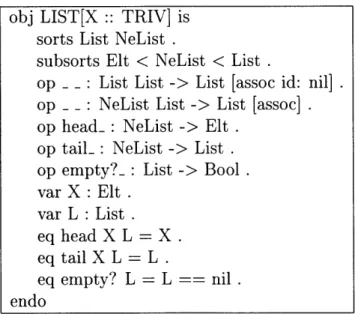
properties required of an actual parameter for meaningful instantiation. A view ex-presses that a certain module satisfies a certain theory in a certain way; that is a view describes a binding of an actual parameter to a requirement theory. Instantiation of a parameterized module with an actual parameter, using a particular view, yields a new module. Figure 2-1 is a an example code written using OBJ [Gog89].
LILEANNA is another parameterized programming language which has similar concepts of theories and views [Tra93]. This is a good example of a mechanism for writing reusable software since it does not commit the list implementation to a particular object type. However, this does not address the issue of identifying the
obj LIST[X :: TRIV] is sorts List NeList .
subsorts Elt < NeList < List.
op __ : List List -> List [assoc id: nil] op _ : NeList List -> List [assoc] op head_ : NeList -> Elt.
op tail_ : NeList -> List. op empty?_ : List -> Bool. var X : Elt. var L : List. eq head X L = X. eq tail X L = L . eq empty? L = L == nil. endo
Figure 2-1: Parameterized List object representation using OBJ Language
right parameterized module suitable to implement the required functionality.
2.1.2
Structured Algebraic Specification, Clear Language
Clear is a language is designed for Structured Algebraic Specification [Tra93]. From their experience on Raytheon project, the others have identified the problem of de-signing an Ada-based software system, for maximum reusability of its component modules within different systems has been identified [LM89]. The goal of Raytheon project was to design a modeling system having a catalog of reusable Ada modeling components and a means of connecting them into complete models. The authors realized that a central part of the problem of designing the catalog was the problem of rigorously specifying the allowable uses of each component, that is, specifying the class of contexts into which a given component could meaningfully fit, and the kinds of components that could fit within a given context.
Clear is a language for formal, well-structured specification of software compo-nents [LM89]. It provides formalisms for expression of algebraic theories, operators
for building new theories from combination of old theories, and the definition of theory
morphisms, which implement mappings between algebraic theories defined in terms
of theory-building expressions. The semantics of Clear are formally defined using category theory. The authors believe "that much of this mathematics can be hidden by a user-friendly interface to the library manager and by automated assistance in mathematical reasoning". Figure 2-2 shows an example of how to specify a pack-age that represents a group with equivalence relation on the data in a pseudo-Clear notation.
procedure E_CLASSPACKAGE (Element: Groupwith_EquivRel) = Element enriched by
data stores E_Class:
opns _*_ : EClass, E_Class = > EClass; axioms axioms for equivalence classes ; enden
Figure 2-2: Pseudo-Clear code for Group with Equivalence Relation
2.1.3
Partially Interpreted Schemas, PARIS
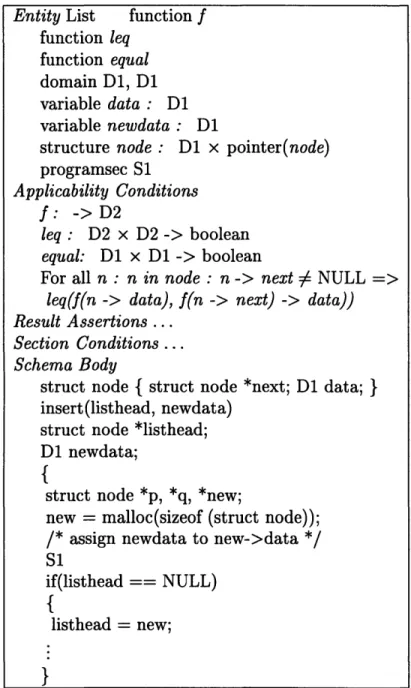
A partially interpreted schema is a program in which some parts remain abstract or undefined [KRT89]. These abstract entities can include both program sections and non-program entities such as functions, domains, or variables. For different inter-pretations of abstract entities in the schema, the results will be different programs performing different functions. PARIS has manual matching mode (also called shop-ping list mode) and automated matching mode. It uses Boyer-Moore theorem prover to carry out the verification. Figure 2-3 shows the schema for Linked List Insertion.
The following research directions that these authors mentioned are interesting * Adding more schemas into the library, for a variety of computational models. * Classifying all schemas within the library to increase searching efficiency.
Entity List function f function leq function equal domain D1, D1 variable data : D1 variable newdata : D1
structure node : D1 x pointer(node) programsec S1
Applicability Conditions f: -> D2
leq : D2 x D2 -> boolean equal: D1 x D1 -> boolean
For all n : n in node : n -> next = NULL =>
leq(f(n -> data), f(n -> next) -> data)) Result Assertions ...
Section Conditions ...
Schema Body
struct node { struct node *next; D1 data; } insert(listhead, newdata)
struct node *listhead; D1 newdata;
{
struct node *p, *q, *new;
new = malloc(sizeof (struct node)); /* assign newdata to new->data */
S1
if(listhead == NULL)
{
listhead = new;
}
* Defining additional keywords in the system's vocabulary.
* Developing a user-friendly interface to add more convenience for the user's for-mulation of a problem statement and to provide more interactive communica-tion during the process of matching and verificacommunica-tion. In particular, when the theorem prover fails to prove one of the two implications needed for a success-ful matching, the user should not have to be an expert in automatic theorem proving in order to understand the reason for the failure.
* Augmenting the theorem prover with facts in the problem domain of the schemas, especially with facts about temporal logic assertions.
2.1.4
Object Oriented Module Interconnection Language,
MIL
Module interconnection languages (MILs) were introduced in 1976 by DeRemer and Kron for "programming-in-the-large" [HW93]. Subsequently MILs have found impor-tance in software reuse, as the means of interconnecting components. MILs permit the description of components (or more generally "resources"), and the independent description of their interconnection [HW93].The specification explicitly identifies not just the methods it provides but also the methods it requires. Object specification is a template which has provides and requires while Object implementation is a tem-plate which has contains, external connections and internal connections. There are other usual constructs like variables and methods. Figure 2-4 gives an example of describing a home-heating system.
2.1.5
Summary of Semantic Approach
From the above mentioned cases, for adopting semantic approaches to reusability the user has to be an expert in using the system, have to learn a new language and map
object implementation home-heating contains control-clock; clock; temp-controller; controller; temp-guage; thermometer; space-heater; heater; external connections home-heating.read-temperature-setting = temp-controller.read-control-value; home-heating.set-temperature-setting = temp-controller.set-control-value; home-heating.set-beat = control-clock.set-beat; internal connections control-clock.trigger = temp-controller.clock; temp-controller.read = temp-guage.read-temp; temp-controller.on = space-heater.on; temp-controller.off = space-heater.off; end home-heating
Figure 2-4: Home-heating System module specified using MIL
the functional requirements into these language constructs. While the final retrieved components are more closer to what the user wants, there is a major burden on the user to learn a new specification language and represent the requirements using the specification language. This type of systems could not be useful especially for preliminary design. However, it should be noted that MIL languages which emphasize on the interconnection of modules rather than the specification of individual modules are still very useful once the user identifies the appropriate reusable components from the preliminary search.
2.2
Statistical Approach
Use of classification schemes based on syntactic clustering, statistical correlations is considered under this approach. It should be noted that semantic relations are
also used in this approach to representing a component. However, these relations are derived from the informal textual description while it is expressed using formal languages in the above approval. A couple of examples are presented below and how they provide poor performance is mentioned.
2.2.1
Faceted Classification Scheme
A classification scheme is a tool for the production of systematic order based on a
con-trolled and structured index vocabulary [PD89]. This index vocabulary is called the
classification schedule. Classification schemes can be either enumerative or faceted.
Faceted schemes were used in describing the software components. Software compo-nents can be described by (1) the function they perform, (2) the way they perform it, and (3) their implementation details [PD89]. Under this assumption, the components were represented as tuples describing the functionality and environment. Function-ality is represented as a < function, object, medium >. Classifying a component consists of selecting the sextuple that best describes the component. Some examples are shown in Figure 2-5
< add, integers, array, matrix - inverter, modeling, aircraft - manufacture >
< compress, files, disk, file - handler, DB - management, catalog - sales >
< compare, descriptors, stack, assembler, programming, software - stop >
Figure 2-5: Representation of Software Components using Faceted Classifying Scheme
The end user interface provided by this system is interesting. The user has to enter a sextuple as above. Generalization can be achieved by making any of the six attributes as wildcards. An example is shown in Figure 2-6
While the user could use the generalization technique to browse and refine his/her query, query expansion technique uses conceptual distances from the conceptual graph to provide queries of closely related terms. However, this could be automated by syn-onyms substitution. More importantly, the expressive power of the user to describe
substitute/backspaces/file/text-formatter/program-development/* substitute/backspaces/file/text-formatter/*/*
substitute/*/*/*/*/*
Figure 2-6: Search generalization using wildcards
the required system is limited to six attributes that could only describe smaller soft-ware components.
However, providing the user interface in terms of informally describing the func-tional requirements of the systems and not as mappings using specification languages makes the system easier to use. But the relevancy of the retrieved components might be lower.
2.2.2
Conceptual Schemas
Reusable conceptual components are defined as Generic Conceptual Units with associ-ated Meta-Conceptual Units, which provide guidelines for reuse in a given application [CA93]. Conceptual schemas are properly defined according to a selected model such as Entity-Relationship (E-R) model, or Object-Oriented (0-0) models. The authors used a meta-model whose meta-constructs allow the definition of the constructs of both the E-R and 0-0 models. The main meta-constructs used were Conceptual
Unit (CU), Structural Property (SP), Behavioral Property (BP) and Dependency (D)
[CA93]. In [CA93] these meta-constructs are defined as
Conceptual Unit (CU) it allows the definition of constructs used to describe ob-jects of the real world within the schema (e.g., entity, object class).
Structural Property (SP) it allows the definition of constructs used to describe a static feature of an object in a schema. SPs are expressed by means of attributes in both E-R and 0-0 models.
Behavioral Property (BP) it allows the definition of constructs used to describe
the behavior of an object in a schema. SPs are expressed by means of attributes in both E-R and 0-0 models.
Dependency (D) it allows the definition of constructs used to describe relationships between two or more CUs in a schema.
A schema appears to be a kind of document suitable for automatic indexing: it is structured at both syntactic and semantic levels, and even belongs to a well identifiable domain. Schemas in the Library are grouped and classified with respect to the domain they belong to. For schema indexing, each schema S is associated to a set of Schema Descriptors (SDs), extracted from the schema itself, according to the criteria that privilege their capability of representing the schema subject. Only the labels of the Conceptual Units (CUs) are used as schema descriptors. The procedure for extracting SDs from a given schema S is composed of the following steps:
* assignment of a weight W to each CU of S;
* definition of a threshold for selecting SDs from the weighted CUs. A sample Schema-card [CA93] is shown in Figure 2-7
Schema name: < string > Application name: < string > Domain name: < string >
Weighted Schema Descriptors: < listof (SDs, weight) >
Total No. of terms : < number > Model : < typeo
fmodel
>Schema code: < schemaidentifier > References: < textualdescription >
Figure 2-7: A sample Conceptual Schema Card
Similarity Coefficient, Structural and Behavioral Affinity and Hierarchy Affinity [CA93] are calculated by examining the SPs and BPs of CUs and used in the retrieval
process. The success of the above approach depends on assigning the appropriate weights to the conceptual units.
2.2.3
Summary of Statistical Approach
From the above mentioned cases, for using Statistical Approaches, the user need not be an expert in a new language and not much work is required for searching for appropriate components. However, this approach results in poor classification and retrieval. The performance depends on the appropriate statistical weights used. Hence, this approach could be used mainly during the preliminary design stage to select limit the search space. Since, the search results may not be highly relevant, the user than has to go through them manually.
2.3
Hybrid Approach
Both the Semantic and Statistical approaches have their own advantages and dis-advantages. While one provides more relevant solutions the other has some noise. While one requires substantial manual effort and technical expertise the other re-quires lesser manual effort and technical expertise. However, the interesting fact is that these approaches are complementary in nature.
During the preliminary design stage it is better to use the Statistical classification and retrieval approach to limit the search space. Also, with the use of component models which provide easy integration, the need for module interconnection languages and algebraic specification languages reduces. Once the user identifies the right com-ponents offering the required functionality, they could be easily integrated using suit-able editors like the JavaBean's BeanBox tester [JBn97]. Also, as mentioned in the Chapter 1, creating a fancy webpage using several individual applets does not require integrating them at code level. As long as the applets with required functionality are identified it is possible to make the webpage. Hence, using open architectures
and component object models, the focus shifts from spending time to integrate the individual components to identifying the right functional components. Coming up with better ways of using statistical classification approaches there by reducing the noise is the primary focus of the research.
Capturing and utilizing the Design Rationale and Intent is the means of reusing design at conceptual level [PM94]. The intent of the design could be best viewed from the end users as the features offered by the artifacts. How to extract these features from the software design documents is the primary concern. While it is possible to use either the semantic or the statistical method for this, for the above mentioned complementary nature of both these methods, a hybrid approach can be used which analyses both the informal textual specification documents and formal structured design documents. The user interface is similar to those provided in sta-tistical approaches since they are easier to use and less effort is needed from the end
user. However, the noise in retrieval is reduced by using the information from the analysis on the formal structured design documents. All these details are explained in the next three chapters.
2.4
Design Recommendation and Intent Model
Extended for Reusability (DRIMER)
DRIM is a model developed for capturing the design rationale and intent of the product development [PM94]. Figure 2-8 shows the DRIM model. DRIMER (DRIM Extended for Reusability) is an extended DRIM model for reuse of design concepts
augmenting design patterns with design rationale [Vad96]. DRIMER model assumed the use of Case Based Reasoning (CBR). However, as mentions in [MS93], "empirical studies indicate that these reuse tasks are difficult, even for experienced software engineers". Also, it mentioned "Most software reuse research has ignored the role of the software engineer. However, software engineers tend to be better reasoners
Legend
0- sub-part zero or more
< sub-class one to one derived
Figure 2-8: DRIM model adapted from [FPn94]
and have more experiences to recall than tool-based reuse mechanisms". Hence, with the present technology the ability for tools to automatically and efficiently adapt the software components to provide the required functionality is difficult. Also, most of the CBR Systems like Caspian [Pri97] require a set of indices so that they could retrieve partial matches or similar cases based on these indices. In Caspian, if these indices are numbers then the degree of matching is based on interpolation of the numerical values. Non numeric indices are usually a set of values belonging to a class (e.g., FilelnputStream and DataInputStream defined in the class InputStream) and the rank of matching varies based on perfect matching to belonging to the same
class. A software component cannot be however described using a few numeric and non-numeric attributes.
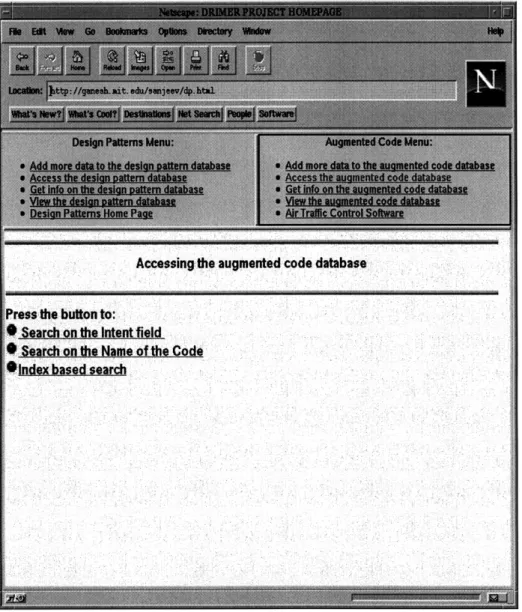
Figure 2-9 shows the web based system of DRIMER. DRIMER has a web based
Figure 2-9: DRIMER web based system adapted from [Vad96]
client interface which provides facility to query for components based on intent field, name of the code and also keywords serving as indices. It is also possible to retrieve design patterns using queries based on similar fields. There are a few shortcomings with this approach and also the software framework. They are
* While components could be retrieved based on keywords describing their func-tionality similar retrieval mechanisms for design patterns may have limited ap-plicability. This is because, from the requirements of a new product it is possible to identify the features that are required but it is not easy to find out whether or not a design pattern could be used unless one knows the pattern in the first place. Hence, searching for design patterns based on names and even intent is of limited applicability, the system provides as a database for components. Tools that could recognize the need for a specific design pattern based on the functional description of the software are needed.
* It is only possible to retrieve individual components based on the search fields. However, if the required functionality of the system is large it requires compo-sition of several smaller components. This compocompo-sition is not considered. * CGI scripts and HTML forms are used for processing and user interface
respec-tively. Using forms limits the user interaction capabilities. Even if sophisticated user interface is built using just the forms, the interface looses the intuition and ease of use.
This research focuses on capturing the design intent of software component and also addresses the last two shortcomings mentioned above.
Requirements Analysis
Besides other factors, incomplete understanding of the System results in Versions
Two most important factors considered in designing the reuse model are the cost of implementing an effective reuse technology and the ease of use of the technology. It is necessary to utilize as much of the already generated information during soft-ware projects as possible to minimize the cost and effort of reuse. To design a reuse technology that minimizes the cost of implementation it is necessary to understand and classify the kind of information generated during the software design projects. Classification of information based on availability and formality are proposed in the research presented by this thesis. A case study of obtaining required information from a library maintaining a catalog is presented. This is useful in coming up with the representation for a reusable software component. This case study also helps in understanding the kind of support one would expect from a tool during the prelimi-nary design stage. Retrieving multiple components whose composition gives as much of the required functionality as possible is required to increase the search relevancy.
As mentioned in Chapter 1, most of the application software in the commercial world is being built by developing a customized domain software on top of a
hor-izontal framework. This results in reusing the base framework for several domain applications. The same could be done even for the software reuse tools. Instead of developing a specific reuse framework for each individual domain like finance, manu-facturing and medicine, a general framework based on the above requirements analysis is developed and this could be customized to support reuse of software components of each individual domain.
3.1
Information in Software Projects
The following are some of the various kinds of documents generated during the soft-ware development life cycle
* User's Requirement Specification (URS) * System's Requirement Specification (SRS) * High Level Design documents (HLD) * Low Level Design documents (LLD) * Test Plans
* Programs
* Programmer's/Reference Manual * User's Manual
The research presented in this thesis proposes a classification of the above in-formation in order to be able to develop a cost effective and efficient reuse model. This information is classified as available and inherent information and, semantic and
textual information. This classification helps in studying the means of capturing the
Figure 3-1: Classification of Project Information
3.1.1
Classification of Information used in Software Projects
All the above mentioned documents contain various kinds of information related to
the software product. The entire information that is used in the software development process is classified in two different ways which is presented below. One is based on the availability of the information at the end of the project and the other is based on the formality of the information. Figure 3-1 shows the information classification.
Classification based on Availability
Information used in a project may or may not be documented and this classification is based on documentation of information.
Available Information: This is the information that is available in some document
or the other at the end of the project. This information is produced as a part of the need for the project, i.e., this information is required to be documented to implement the project without concerning it's reuse. Making use of available information for preparing reusable information reduces the cost and effort. One of the issues of
software reuse is the extra cost required to introduce it in the existing software life cycle models. Hence, if it is possible to design the reuse techniques based on the available information itself then such a technique could easily be integrated into the
existing software development practices.
Inherent Information: This is the information that is not available in any of the documents at the end of the projects. This is because this information is not documented as a part of the project and remains in the minds of the people involved in the project. This type of information is mainly related to the justification of the design decisions (the results of the decision are usually available in the available information)
and design rationale. It is the information used in obtaining the available information. Inherent information is very useful because of its meta information nature which helps in choosing one design over the other. But often this just remains in the minds of the people who participate in the project and seldom gets recorded. Making inherent information reusable requires additional cost of documenting such information. At the end of the project each person participated in the project (irrespective of his/her designation) could be asked to spend a couple days on documenting such inherent information. This could add to the overall cost of the present project. However, over a period of time this will reduce the cost of any new project.
Available information alone is not enough to define design rationale. Inherent information is also required. For example, inspite of identifying the existing design patterns in the design, it is also necessary to have information related to these patterns which helps in understanding the reason for choosing the particular design possibly among several alternatives. However, most of the design intent could be obtained from the available information. This information will be mostly available in the textual specification documents and user's manuals. Black box type reuse requires mainly classifying and retrieving components based on the functionality they offer (Chapter 1) and hence design intent which could be obtained from the existing documents could
be used for classification and retrieval. Glass box reuse on the other hand requires design rationale (Chapter 1) and hence the need for the inherent information. This type of reuse is possible only if there is an initial investment towards reuse.
Classification based on Formality
Information in the software projects might be represented using a formal or natural language. This another classification can be based on formality of information.
Semantic Information: Information that is represented using formal specification
language, mathematical formulae or design notations (like OMT or UML) falls un-der this category. Programs contain only semantic information. Also, HLD, LLD, Test Plans which are documents generated during the design contain mostly semantic information. Programmer's Manuals also contain some semantic information. This kind of information is mainly useful for semantic analysis described in chapter 2. However, most of the semantic analysis techniques propose a separate specification language making it necessary to express the reusable components in this language. Also, expressing the required functionality in the specification language has to be manually performed at the time of search for the components. Hence, both main-taining and searching for component results in additional activities apart from the normal activities in the software life cycles. It would be useful to develop tools that could use the existing semantic information itself eliminating the need to express the components in a new specification language.
Textual Information: Information that is represented using natural language falls under this category. URS, SRS and User's Manuals which are design documents gen-erated during the the software development contain textual information. This kind of information is mainly useful for statistical analysis described in chapter 2. As men-tioned in Chapter 2, since reuse tools developed using statistical analysis are easy to use, the aim of the research presented in this thesis is to represent reusable
com-ponents by extracting information from these documents and semantic documents. Semantic analysis on the semantic information is used to increase the classification accuracy and retrieval relevancy.
3.1.2
Observations
The following observations could be made from the above classification
* Minimizing the cost of implementation requires using only the available
in-formation as opposed to using inherent inin-formation which requires additional
documentation specifically for reuse.
* Maximizing ease of use requires statistical analysis on textual information as opposed using semantic approach which requires learning new specification lan-guage.
* Maximizing the relevancy of search requires semantic analysis on the available
semantic information as opposed to using statistical approach whose accuracy
depends on assigning the right weights.
Hence, the reuse technology should be based on available textual and available
semantic information and use both the statistical and semantic analysis.
Seman-tic analysis on the available semanSeman-tic information is performed only to increase the classification accuracy and search relevancy of the statistical analysis approach.
3.2
Information Search
-
A Case Study
This case study is mainly based on personal experience in searching for relevant research material. The user interface for the proposed reuse model is mainly motivated from the observations from this case study 1
'It should be noted that only the conventional online cataloging and search facilities are studied
3.2.1
Search for a TextBook/Journal in a Library
Searching for a reusable component has similarities with searching for a text book on a particular topic in a library. In a big university library like in MIT, with sev-eral floors and books covering different disciplines providing a facility to search for books is very important. Organization of the books and journals is crucial. Books are separated from Journals. Books belonging to a particular discipline are all placed at the same place. With in this structural layout, books related to the same special-ization are placed together. Each book is given a call number. An online catalog is maintained to make it easier for people to find out where the books are located.
When a person wants to search for a book he/she might have different levels of information about the book he/she wants. If the call number of the book or the ISBN is known it is very easy to locate the book. Even if the author name or the exact name of the book is known it is possible to precisely locate the book. This is same with journals. If the volume number and the publication of the journal is known it is easy to locate the journal. But several times a student wants to find out all the related books and journals that are of interest to his/her research. In such a situation he/she will not have a particular book/journal in mind but he/she is only interested in books with his/her research topic.
Initially the user might search for books with a few keywords. This gives the location of a couple of books having these keywords in their title. Then the user can go to the appropriate stacks and look into the listed books and select those books that are most appropriate to him/her. Also, many times some of these selected books gives references to new books relevant to the interested topic. While this keyword search does not retrieve only the relevant books, it does help the research student to start with something that eventually leads to the required books/journals. However, ways of improving search results should be provided to the cataloging system. Once the user browses through these books and picks up a few then the user goes through them and further limit his/her selection. This shows that while in the initial stage
![Figure 2-8: DRIM model adapted from [FPn94]](https://thumb-eu.123doks.com/thumbv2/123doknet/14134521.469521/34.918.113.771.163.710/figure-drim-model-adapted-from-fpn.webp)