
Publisher’s version / Version de l'éditeur:
Canadian Acoustics, 39, 1, pp. 1-10, 2011-07-01
READ THESE TERMS AND CONDITIONS CAREFULLY BEFORE USING THIS WEBSITE.
https://nrc-publications.canada.ca/eng/copyright
Vous avez des questions? Nous pouvons vous aider. Pour communiquer directement avec un auteur, consultez la première page de la revue dans laquelle son article a été publié afin de trouver ses coordonnées. Si vous n’arrivez pas à les repérer, communiquez avec nous à [email protected].
Questions? Contact the NRC Publications Archive team at
[email protected]. If you wish to email the authors directly, please see the first page of the publication for their contact information.
NRC Publications Archive
Archives des publications du CNRC
This publication could be one of several versions: author’s original, accepted manuscript or the publisher’s version. / La version de cette publication peut être l’une des suivantes : la version prépublication de l’auteur, la version acceptée du manuscrit ou la version de l’éditeur.
Access and use of this website and the material on it are subject to the Terms and Conditions set forth at
Speech privacy criteria for closed rooms in terms of Speech Privacy
Class (SPC) values
Bradley, J. S.; Gover, B. N.
https://publications-cnrc.canada.ca/fra/droits
L’accès à ce site Web et l’utilisation de son contenu sont assujettis aux conditions présentées dans le site LISEZ CES CONDITIONS ATTENTIVEMENT AVANT D’UTILISER CE SITE WEB.
NRC Publications Record / Notice d'Archives des publications de CNRC:
https://nrc-publications.canada.ca/eng/view/object/?id=84625f6c-b1c3-4505-a5f7-e93e63c11ced https://publications-cnrc.canada.ca/fra/voir/objet/?id=84625f6c-b1c3-4505-a5f7-e93e63c11ced
Spe e c h priva c y c rit e ria for c lose d room s in t e rm s of spe e c h priva c y
c la ss (SPC) va lue s
N R C C - 5 4 4 7 0
B r a d l e y , J . S . ; G o v e r , B . N .
J u l y 2 0 1 1
A version of this document is published in / Une version de ce document se trouve dans:
Canadian Acoustics, 39, (1), pp. 1-10, July-01-11
http://www.nrc-cnrc.gc.ca/irc
The material in this document is covered by the provisions of the Copyright Act, by Canadian laws, policies, regulations and international agreements. Such provisions serve to identify the information source and, in specific instances, to prohibit reproduction of materials without written permission. For more information visit http://laws.justice.gc.ca/en/showtdm/cs/C-42
Les renseignements dans ce document sont protégés par la Loi sur le droit d'auteur, par les lois, les politiques et les règlements du Canada et des accords internationaux. Ces dispositions permettent d'identifier la source de l'information et, dans certains cas, d'interdire la copie de documents sans permission écrite. Pour obtenir de plus amples renseignements : http://lois.justice.gc.ca/fr/showtdm/cs/C-42
Vol. 39 No. 1 (2011) Canadian Acoustics / Acoustique canadienne - 3
S
PEECHP
RIVACYC
RITERIA FORC
LOSEDR
OOMS INT
ERMS OFS
PEECHP
RIVACYC
LASS(SPC)
V
ALUESJ.S. Bradley and B.N. Gover
Institute for Research in Construction, National Research Council, Montreal Rd. Ottawa, K1A 0R6
A
BSTRACTThis paper describes a new set of speech privacy criteria in terms of Speech Privacy Class (SPC) values. SPC values can be used to specify the required speech privacy for new construction or to assess the speech privacy of existing closed rooms. The ASTM E2638 measurement standard defines SPC as the sum of the measured average noise level at the position of a potential eavesdropper outside the room, and the measured average level difference between a source room average and the transmitted levels at the same location. With a given combination of level difference and ambient noise level, the likelihood of transmitted speech being audible or intelligible can be related to the probability of higher speech levels occurring in the meeting room, based on the statistics of speech levels from a large number of meetings. For a particular SPC, there is a speech level for which transmitted speech would be at the threshold of intelligibility. The probability of higher speech levels occurring is the probability of a speech privacy lapse at that SPC value. A set of increasing SPC values corresponding to increasing speech privacy are proposed and for each SPC value, one can give the probability of transmitted speech being either audible or intelligible. This makes it possible to accurately specify speech privacy criteria for meeting rooms and offices, varying from conditions of quite minimal to extremely high speech privacy, with an associated risk of a speech privacy lapse which is acceptable for each situation.
R
ÉSUMÉCet article décrit un nouvel ensemble de critères de confidentialité des entretiens relié au degré de confidentialité verbale (Speech Privacy Class - SPC). Cette échelle de confidentialité peut servir à définir le niveau de confidentialité requis des nouvelles constructions ou d’évaluer la confidentialité de pièces fermées déjà existantes. La norme ASTM E2638 définit le SPC comme étant la somme du niveau de bruit moyen mesuré à l’emplacement d’une éventuelle écoute clandestine à l’extérieur de la pièce avec la différence de niveau moyen mesuré entre la moyenne d’une pièce source et les niveaux transmis au même emplacement. Pour une combinaison donnée de différence de niveau et de niveau de bruit ambiant, la probabilité d’audibilité ou d’intelligibilité du discours transmis peut être reliée à la probabilité de niveaux de discours plus élevés, ce qui se passe dans les salles de réunion, basé sur les statistiques de niveaux de discours d’un grand nombre de réunions. Pour une valeur du SPC, il existe un niveau de discours pour lequel le discours transmis serait au seuil de l’intelligibilité. La probabilité qu’un niveau de discours plus élevé se produise est égale à la probabilité d’une déchéance de confidentialité pour cette valeur du SPC. Un ensemble de valeurs plus élevées du SPC correspondant à une confidentialité accrue est proposé et pour chaque valeur, on peut donner la probabilité d’audibilité ou d’intelligibilité du discours transmis. Ceci permet de déterminer de façon précise des critères de confidentialité du discours pour les salles de réunion et les bureaux, allant des conditions minimales aux conditions extrêmes de confidentialité, avec un risque associé de perte de confidentialité acceptable pour telle ou telle situation.
1.
I
NTRODUCTIONThis paper describes a new set of criteria for rating the speech privacy of closed rooms. A closed room provides speech privacy when it is difficult for eavesdroppers outside the room to understand or in some cases to even hear speech from the room. The degree of speech privacy can vary from being able to understand some but not all of the words spoken in the room at positions outside the room, to cases where it is very rarely possible to understand any of the words. It is also possible to have even higher privacy where it is difficult, or even impossible, to hear any speech sounds from the adjacent closed room. Very high speech privacy is often referred to as speech security.
Although it is often desirable to have some degree of speech privacy, achieving very high privacy can be costly. Consequently, the amount of speech privacy should be designed to meet the needs of each particular situation. Usually the required degree of speech privacy is determined
by how sensitive the information is that is to be discussed in the room.
The likelihood of a speech privacy lapse can be described statistically and for a particular construction can be related to the probability of higher speech levels occurring in the closed room. Where more sensitive information is to be discussed, higher privacy is required to minimize the risk of the loss of more critical information.
In this paper, a set of speech privacy criteria is described that makes it possible to match the probability of a privacy lapse to the severity of the consequences of the loss of information in each situation.
2.
S
PEECHP
RIVACYB
ASICSThe intelligibility of speech decreases with decreasing speech-to-noise ratios at the position of the listener. Thus constructions that better attenuate the transmission of speech
Vol. 39 No. 1 (2011) Canadian Acoustics / Acoustique canadienne - 4 sounds will lead to reduced signal-to-noise ratios at
positions of potential eavesdroppers and hence to increased speech privacy. The question is how to weight the importance of the attenuation of speech sounds and the reslting signal-to-noise ratios as a function of frequency. There are many different ways to combine the influence of different frequencies in calculating signal-to-noise ratios, but our research [1] has shown that values of uniform-weighted, frequency-averaged, signal-to-noise ratios over speech frequencies (SNRuni32) best predict the audibility and
intelligibility of speech transmitted through various walls. SNRuni32 at the position of the listener is given by,
32 n 5000 160 f ts 32 uni {L (f) L (f)} 16 1 SNR − = − =
∑
(1)Where in each ⅓-octave band centred at frequency f, Lts = transmitted speech level,
Ln = ambient noise level,
-32 indicates that all {Lts(f) – Ln(f)} differences are
clipped to never be less than -32, at which point speech would be inaudible.
Figure 1 illustrates a plot of average speech intelligibility scores (over 19 listeners) versus SNRuni32 values from the
previous work [1]. The previous work also found SNRuni32
values corresponding to the thresholds of audibility and of intelligibility of transmitted speech sounds which are given in Table 1. These are the SNRuni32 values at which 50% of a
panel of attentive listeners could just detect speech sounds or could just understand at least one word of short low predictability test sentences. These threshold values can be used to set design goals for particular situations.
-25 -20 -15 -10 -5 0 5 0 20 40 60 80 100 S p e e c h In te lli gi bil ity, % SNRuni32, dB
Figure 1. Mean speech intelligibility scores versus
SNRuni32 values for speech sounds modified to simulate
transmission through walls, (R2 = 0.750, n=500) [1].
SNRuni32 Threshold
-16 dB Intelligibility -22 dB Audibility
Table 1. Thresholds of Intelligibility and of Audibility of
transmitted speech sounds [1].
Subsequent work showed that although the threshold of audibility was not affected, reflected sounds in rooms could affect the threshold of intelligibility [2]. However, these effects would not be significant for most meeting room type spaces with reverberation times of no more than about 0.5 s. In more reverberant situations, the threshold of intelligibility can be increased a few dB. In earlier speech privacy studies, the Articulation Index (AI) was used to rate the speech privacy of closed rooms [3]. Recently various speech privacy measures were compared [4], and the comparison of AI and SNRuni32 values is shown
in Figure 2. These results suggest Confidential Privacy (AI ≤ 0.05) is equivalent to an SNRuni32 value of about -14
dB. This would approximate the threshold of intelligibility in a slightly reverberant environment [2]. This illustrates approximate agreement between the old and the new approaches for rating speech privacy, However, Figure 2 also illustrates the limitation of AI values in that they approach asymptotically to 0 for low values indicative of high speech privacy. That is, AI values do not differentiate well among cases of high privacy and cannot be used to describe very high privacy where AI would be essentially zero.
-25 -20 -15 -10 -5 0 5 10 0.0 0.1 0.2 0.3 0.4 0.5 0.6 0.7 Open office Closed office-I Closed office-II Confidential Acceptable AI SNRUNI32 confidential acceptable privacy
Figure 2. Plot of AI values versus SNRuni32 values for
data from 3 previous studies. The horizontal solid and dash-dot lines indicate the confidential (AI = 0.05) and acceptable (AI = 0.15) speech privacy criteria respectively [4].
Acceptable privacy in Figure 2 refers to acceptable conditions in open plan offices [5,6].
3.
ASTM
E2638
M
EASUREMENTS
TANDARD To evaluate the speech privacy of a room we need to be able to estimate SNRuni32 values at locations outside the room. Anew procedure has been developed to do this and is described in the ASTM E2638 measurement standard [7]. The standard describes how to measure sound transmission from room average levels in the closed room to point receiver positions, usually 0.25 m from the outside of the
Vol. 39 No. 1 (2011) Canadian Acoustics / Acoustique canadienne - 5 room, in terms of frequency-averaged level differences
(LD(avg)). Ambient noise levels are also measured at the same points outside the room in terms of frequency-averaged noise levels (Ln(avg)). In both cases ‘(avg)’
indicates an arithmetic average over the speech frequency ⅓-octave band levels from 160 to 5000 Hz inclusive. The speech privacy of a closed room will increase as either LD(avg) or Ln(avg) increases. The sum of these two
quantities is defined as the Speech Privacy Class (SPC) which can be used to rate the speech privacy of closed rooms.
SPC = LD(avg) + Ln(avg) (2)
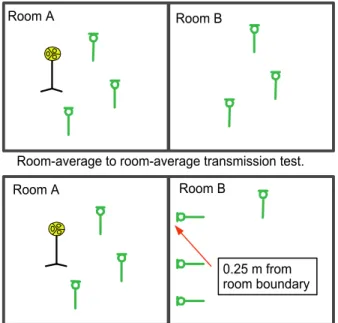
Conventional sound transmission measurements between rooms (e.g. ASTM E336, ISO140 Part V) assume diffuse sound fields in both spaces and measure the average transmission characteristics of the separating partition. Conventional transmission loss tests (illustrated in the upper part of Figure 3) are based on the measurement of room average levels in both adjacent spaces.
The new ASTM E2638 procedure measures level differences from room average levels in the source room to spot receiver positions, usually 0.25 m from the outside of the meeting room (see lower part of Figure 3). A room average source level is used to represent the possibility of the talker being at any point in the meeting room. This is achieved by measuring average test sound levels in the room using a combination of multiple source and microphone positions.
Room A Room B
Room A Room B
Room-average to room-average transmission test.
Room-average to spot receiver transmission test 0.25 m from room boundary
Figure 3. Comparison of ASTM E2638 method (lower)
to that of conventional sound transmission measurements (upper). In both cases room average levels are measured in the source room (Room A). Although room average levels are also measured in the receiving space for conventional transmission tests
(upper), the received levels are measured at spot receiver positions usually 0.25 m from the separating wall for the ASTM E2638 procedure (lower).
Spot receiver positions in the adjacent space 0.25 m from the wall represent a worst case scenario for speech privacy where an eavesdropper would be most effective if positioned close to the outside of the room. The ASTM E2638 procedure does not assume a diffuse field in the receiving space and produces measured level differences that will vary from one point to another to indicate the likely variations in the speech privacy of the room boundary. The measurements at spot receiver positions close to the outer wall of the room are little influenced by the acoustical properties of the adjacent space making it possible to measure into almost any adjacent space.
4.
S
PEECHL
EVELS
TATISTICS AND THEP
ROBABILITY OF AS
PEECHP
RIVACYL
APSE For a given situation (i.e. for a particular combination of LD(avg) and Ln(avg) values), the likelihood of a speechprivacy problem is related to the probability of higher speech levels occurring in the meeting room. If we can describe the statistical distribution of speech levels in typical meetings and meeting rooms, we can determine the probability of a speech privacy lapse in terms of the likelihood of speech levels exceeding either the threshold of audibility or the threshold of intelligibility at receiver positions in an adjacent space.
Information to describe the statistics of speech levels in meetings was obtained by placing data loggers around the periphery of meeting rooms for 24 hour periods. The data loggers recorded 10 s Leq values throughout 24 hour periods.
The 10 s Leq values recorded during meetings were used to
investigate speech levels in meeting rooms [8]. Table 2 gives a summary of the meetings and rooms measured. Few systematic effects of the variations in speech levels with the properties of the rooms and their occupants were found. In rooms with sound reinforcement systems, average levels were only about 2 dB higher than in rooms without sound amplification. The effect of sound reinforcement systems was minimal because speech levels were measured around the periphery of the rooms to represent speech levels incident on the room boundaries. This suggests that the sound reinforcement systems were adjusted to provide levels, at more distant locations in the larger rooms, that were similar to the speech levels found in smaller rooms without sound amplification.
Spot receiver positions in the adjacent space 0.25 m from the wall represent a worst case scenario for speech privacy where an eavesdropper would be most effective if positioned close to the outside of the room. The ASTM E2638 procedure does not assume a diffuse field in the receiving space and produces measured level differences that will vary from one point to another to indicate the likely variations in the speech privacy of the room boundary. The
Vol. 39 No. 1 (2011) Canadian Acoustics / Acoustique canadienne - 6 measurements at spot receiver positions close to the outer
wall of the room are little influenced by the acoustical properties of the adjacent space making it possible to measure into almost any adjacent space.
Meeting and room parameters Values
Number of meeting room cases* measured
32
Number of meetings measured 79
Number of people in each meeting 2 to 300 people Range of room volumes 39 to 16,000 m3 Range of room floor areas 15 to 570 m2
Table 2. Summary of meetings and meeting rooms
measured ( *includes 30 different rooms, 2 of which
were measured with and without sound amplification systems).
Average meeting speech levels were found to increase systematically with ambient noise levels. Ambient noise levels were measured in terms of Leq values when the rooms
were unoccupied and as L90 values when the rooms were
occupied. The two approaches gave very similar values [8]. The plot of increasing speech levels with increasing ambient noise levels (in terms of L90 values in this case) in Figure 4
is an example of the Lombard effect [9]. Low ambient noise levels in meeting rooms are important for good intelligibility in the room, but also so that speech levels are lower and less likely to cause speech privacy problems at points outside the room. This is a very important result indicating why it is so important to have very low ambient levels in meeting rooms. Consequently the practice of adding masking sound to meeting rooms is particularly problematic because it will decrease speech intelligibility within the room and decrease speech privacy to positions outside the room.
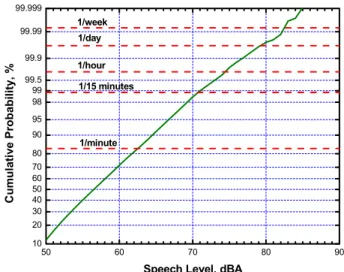
The statistical characteristics of speech levels in meeting rooms were determined by creating a cumulative probability distribution plot of the 10 s Leq values of speech levels
during all meetings. The distribution of all 110 773 Leq
values is shown in Figure 5.
From the probabilities of the occurrence of various speech levels in Figure 5, one can calculate the corresponding average time interval between occurrences of particular speech levels taking into account the 10 s duration of each Leq measurement of speech levels. Each probability
indicates the frequency of occurrence of all speech levels up to and including the corresponding speech level on the x-axis. For example, a 90% probability corresponds to a speech level of 64.5 dBA, indicating that 90% of the time 10 s speech Leq values would be no higher than 64.5 dBA.
Hence, 10% of the time this speech level would be exceeded. There are 360 intervals of 10 s duration in one hour and this would correspond to speech levels exceeding 64.5 dB in 36 of them. On average there would be a 60
min / 36 = 1.67 minute interval between times when the 64.5 dBA speech level is exceeded.
40 45 50 55 60 50 55 60 65 70 S/N=+10 dB Leq , d B A L90, dBA S/N=+15 dB
Figure 4. Meeting-average speech levels (Leq) versus
ambient noise levels in the meeting rooms (L90). The
solid diagonal line shows situations with a +10 dB speech-to-noise ratio and the dash-dotted line shows the more ideal conditions for good intelligibility of a +15 dB speech-to-noise ratio [8]. 50 60 70 80 90 10 20 30 40 50 60 70 80 90 95 98 99 99.5 99.9 99.99 99.999 1/15 minutes 1/minute 1/hour 1/day C u mul a ti v e Prob abil ity, %
Speech Level, dBA
1/week
Figure 5. Cumulative probability distribution of 10 s
speech Leq values for the combined data from 79
meetings. The labels on the horizontal dashed lines (1/minute to 1/week) indicate the frequency of
occurrence of the particular 10 s speech Leq values.
5.
S
PEECHP
RIVACYC
LASS(SPC)
C
RITERIA Speech privacy criteria can be given in terms of Speech Privacy Class (SPC) values (equation (2)). For each SPC value the probability of transmitted speech exceeding either the threshold of audibility or the threshold of intelligibility can be determined to describe the related likelihood of a privacy lapse. The audibility or intelligibility of speech can be related to the uniformly-weighted, frequency-averaged, signal-to-noise ratios (SNRuni32), defined in equation (1).Table 1 gives SNRuni32 values for the thresholds of audibility
Vol. 39 No. 1 (2011) Canadian Acoustics / Acoustique canadienne - 7 First we re-write equation (1) by replacing Lts(f) (the
transmitted speech level) by, Lsp(f)-LD(f), (the source room
speech level less the measured level difference from the average level in the room to the level at a receiver outside the room). 32 n 5000 160 f sp 32 uni {L (f) LD(f) L(f)} 16 1 SNR − = − − =
∑
(3)If we assume that the -32 dB clipping of the quantity in the curly brackets is usually not very important and can be neglected, then equation (3) can be simplified to equation (4).
SNRuni32 ≈Lsp(avg)−LD(avg)−Ln(avg) (4)
In equation (4) ‘(avg)’ indicates arithmetic averaging of the ⅓-octave band values over the speech frequencies from 160 to 5000 Hz inclusive. This can be rearranged to the following,
LD(avg)+Ln(avg)≈Lsp −SNRuni32 (5)
Finally, we usually want to design so that conditions meet or are below the threshold of intelligibility. From Table 1, this corresponds to an SNRuni32 of -16 dB or lower. The left side
of equation (5), (LD(avg) + Ln(avg)) is the Speech Privacy
Class (SPC). Substituting SNRuni32 = -16, we then have,
Lsp ≤SPC−16 (6)
This tells us that for each situation (i.e. SPC value) there is a corresponding meeting room speech level that when exceeded will lead to intelligible speech at points immediately outside the room. Lower speech levels would not be expected to be intelligible at points outside the room. If the corresponding meeting room speech level in equation (6) is quite high, it will not occur very often and the room will have a reasonably high degree of speech privacy. Using Figure 5 we can say how often a particular speech level will occur and hence from equation (6) and knowledge of the SPC value, we can say how often speech transmitted from the room is likely to be intelligible. We could alternatively use the more stringent criterion for the threshold of audibility (SNRuni32 = -22 dB) and describe how often
speech from the room would be just audible to an eavesdropper even though not intelligible.
SPC Time between intelligibility lapses Time between audibility lapses 60 0.32 min - 65 0.76 min - 70 2.87 min 0.62 min 75 18.03 min 2.09 min 80 2.28 hours 12.54 min 85 15.30 hours 1.53 hours 90 - 11.22 hours
Table 3. Summary of expected average time intervals
between intelligibility and audibility lapses for Speech Privacy Class, SPC, values from 60 to 90.
Average expected intervals between intelligibility and audibility lapses were calculated for a range of SPC values [8] and are included in Table 3. To help the reader estimate other intervals between various speech levels occurring, Figure 5 includes horizontal dashed lines to indicate various reference intervals (e.g. 1/minute to 1/week).
6.
SPC
V
ALUES ANDT
HEIRA
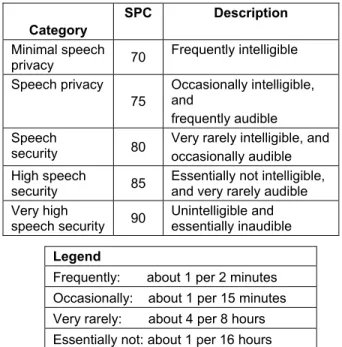
PPLICATIONUsing the procedure described above, the risks of exceeding the thresholds of audibility and of intelligibility were determined for a range of SPC values. These are given for 5 different SPC values at 5 point intervals in Table 4. How often transmitted speech would be audible or intelligible is described in words that are explained in the legend below the table. It is seen that the 5 SPC values correspond to a wide range of conditions from quite minimal speech privacy to extremely high speech privacy.
In practice the 3 SPC values 75, 80 and 85 are probably of most practical use for closed rooms. Values of 90 and higher would correspond to essentially inaudible speech and values of 70 and lower would suggest very little privacy for a closed room. The 5 point SPC intervals represent a suitable perceptually small but significant interval.
Speech privacy criteria would usually be determined by the most sensitive type of information to be discussed in the room. Proposed speech security criteria for use in Canadian federal government buildings would specify minimum SPC values of 75, 80 and 85 for rooms where Protected, Secret and Top Secret information is to be discussed respectively. For more sensitive information, unique analyses would be required for each case.
Category SPC Description Minimal speech privacy 70 Frequently intelligible Speech privacy 75 Occasionally intelligible, and frequently audible Speech security 80
Very rarely intelligible, and occasionally audible High speech
security 85
Essentially not intelligible, and very rarely audible Very high
speech security 90
Unintelligible and essentially inaudible
Legend
Frequently: about 1 per 2 minutes Occasionally: about 1 per 15 minutes Very rarely: about 4 per 8 hours Essentially not: about 1 per 16 hours
Table 4. Speech Privacy Categories (SPC) and the
Vol. 39 No. 1 (2011) Canadian Acoustics / Acoustique canadienne - 8 To rate the privacy of existing rooms one can measure
LD(avg) and Ln(avg) to determine the SPC of the room at
particular locations [10]. The resulting SPC value can be interpreted in terms of the SPC categories in Table 4.
7.
D
ESIGNING TOA
CHIEVE AS
PECIFICSPC
R
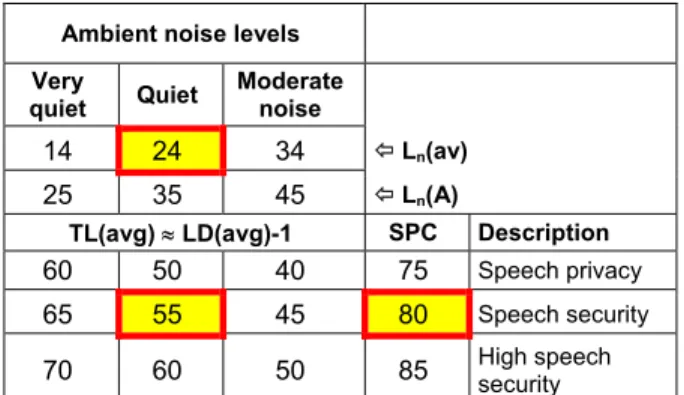
ATINGThis section describes how one can design to achieve specific SPC ratings from TL(avg) values and lowest likely Ln(avg) values. Table 5 shows how the intermediate levels
of privacy (SPC = 75, 80 and 85) relate to combinations of LD(avg) and Ln(avg). The three columns to the left of Table
5 give results for 3 different ambient noise levels referred to as “very quiet”, “quiet” and “moderate noise”. Ambient noise levels are given in terms of Ln(avg) values and are
also converted to approximate A-weighted levels (Ln(A)).
The conversion assumed a neutral noise spectrum decreasing at 5 dB per octave with increasing frequency. Below the ambient noise levels in Table 5, there are 3 rows of TL(avg) values (i.e. frequency-averaged transmission loss values). These have been empirically related to LD(avg) values [11],
TL(avg) ≈ LD(avg) -1 (7)
This relationship makes it possible to estimate the sound isolation of particular building elements from laboratory sound transmission loss test results. Finally, to the right of the TL(avg) values are the SPC values corresponding to the combination of the Ln(avg) values and the corresponding
TL(avg) values in each row (as per equation (7)).
The highlighted cells in Table 5 show the values of Ln(avg)
= 24 dB and an as-built TL(avg) = 55 combining to give an SPC = 80 which provides a high degree of speech privacy described as “Speech security”. In Table 4 this SPC value is described as corresponding to conditions where transmitted speech would be “Very rarely intelligible, and occasionally audible”. From an analysis of the relationship between TL(avg) and STC values obtained from laboratory measurements of wood and light weight steel stud wall constructions, TL(avg) = 55 is approximately equal to an STC rating of 51. However, this is only a very approximate relationship, and the STC values are included in Table 5 only to help readers relate to the new TL(avg) values. These results suggest that with an as-built SPC rating of 80, quite high speech privacy can be achieved using relatively common constructions.
Of course the degree of speech privacy is also influenced by the ambient noise levels at the receiver position. In the above example a little higher noise level could provide very high speech privacy, but much quieter conditions would make it very difficult to achieve high speech privacy. For existing buildings it is usually possible to measure the actual ambient noise levels in spaces adjacent to meeting
rooms. Such measurements should be over a long enough time interval to be able to indicate the lowest likely ambient levels when the room is in use. When lowest likely ambient noise levels cannot be measured, we can estimate them from previous measurements of noise levels in spaces adjacent to meeting rooms over 24 hour periods. When the lowest likely ambient noise level is taken to be the lowest 1 percentile level, the values shown in Table 6 were found for the day, evening and night periods [12].
Ambient noise levels Very quiet Quiet Moderate noise 14 24 34 Õ Ln(av) 25 35 45 Õ Ln(A)
TL(avg) ≈ LD(avg)-1 SPC Description
60 50 40 75 Speech privacy
65 55 45 80 Speech security
70 60 50 85 High speech security
Table 5. Combinations of TL(avg) and Ln(avg) for some
SPC values of 75, 80 and 85. Period Level, dBA Level, Ln(avg) Day (8:00 to 17:00) 35 24 Evening (17:00 to 24:00) 30 19 Night (24:00 to 8:00) 25 14
Table 6. Estimates of lowest likely ambient noise levels
in spaces adjacent to meeting rooms for 3 different time-of-day periods [12].
8.
W
HYN
OTU
SESTC
R
ATINGS?
The SNRuni32 measure was developed from listening tests in
which subjects rated the audibility and intelligibility of speech modified to represent transmission through walls [1]. Equations (3), (4) and (5) show that this leads to the recommendation to use LD(avg) values to rate the attenuation of speech sounds from meeting rooms to adjacent spaces. Equation (7) shows the approximate conversion from LD(avg) values to TL(avg) making it possible to predict privacy at the design stage. The success of the TL(avg) measure can be confirmed from the results of a second series of listening tests in which the speech was modified to simulate transmission through 20 different walls [13]. The walls included STC ratings from 34 to 58 representing a wide range of sound insulation conditions. In the experiment, ambient noise levels were held constant and the only source of variation was the varied transmission loss, TL(f), of the 20 simulated walls. With noise levels, Ln(avg), and speech source levels, Lsp(avg), held constant,
equation (5) indicates that variations in transmitted speech levels are related only to LD(avg) values and consequently, according to equation (7), also to TL(avg) values.
Vol. 39 No. 1 (2011) Canadian Acoustics / Acoustique canadienne - 9 Figures 6 and 7, from the results of [13], compare how well
speech intelligibility scores were related to STC and TL(avg) values. Figure 6 shows that the intelligibility of transmitted speech was not well related to the STC ratings of the walls (R2 = 0.510). By comparison, Figure 7 shows that the same speech intelligibility scores were much better predicted by TL(avg) values (R2 = 0.853).
TL(avg) values are more accurate predictors of the assessed speech privacy provided by a wall. Using STC values to predict speech privacy could easily lead to costly over design of the sound attenuating properties of the wall, or perhaps to even more costly outcomes due to failure to achieve adequate speech privacy.
When TL(avg) values were plotted versus STC values for 74 types of stud walls, the resulting plot in Figure 8 shows a statistically significant relationship (R2 = 0.720, n = 74) but with substantial scatter (RMS variation in TL(avg) values about the mean trend of ±3.05 dB). That is, for a given STC value there is a substantial range of possible TL(avg) values.
30 35 40 45 50 55 60 0 20 40 60 80 100 Speech I n telligib iity, % STC
Figure 6. Mean speech intelligibility scores versus STC
ratings of 20 walls (R2 = 0.510) [13]. 35 40 45 50 55 60 65 0 20 40 60 80 100 Spe ech Intel ligibiity, % TL(avg), dB
Figure 7. Mean speech intelligibility scores versus
TL(avg) ratings of 20 walls (R2 = 0.853) [13].
The solid lines on the graph represent possible speech privacy requirements in terms of either STC or TL(avg).
The vertical line corresponds to conditions with STC 52, which has been a commonly used STC requirement for adequate speech privacy. The horizontal line, corresponding to TL(avg) values of 57 dB, represents a possible speech privacy recommendation using the new approach. The 11 data points that are plotted as open circles, or in one case as an ‘X’, are the conditions with TL(avg) values within 1 dB of 57 dB. It is seen that they correspond to STC values varying from 46 to 57. In some cases an STC 52 wall might provide adequate speech privacy, but in many cases it would not. It is important to select walls in terms of a desired TL(avg) value because it is much more likely to provide the expected degree of speech privacy.
30 35 40 45 50 55 60 65 70 45 50 55 60 65 70 75 TL(a v g) STC TL(avg) = 57 STC = 5 2
Figure 8. Plot of mean TL(avg) versus mean STC for
each of the 74 types of gypsum board walls.
One can similarly more accurately assess speech privacy using ambient noise levels in terms of Ln(avg) values rather
than A-weighted ambient noise levels. In previous research, [1,13] A-weighted signal-to-noise ratios have been found to be much less accurate predictors of the intelligibility of speech than SNRuni32 values based on Ln(avg) values.
9.
C
ONCLUSIONSThe new SPC values provide a uniform system for rating all categories of speech privacy from very minimal privacy to extremely high speech security. SPC values can be measured to evaluate existing facilities or can be predicted for new facilities from laboratory tests of building elements. Of course to accurately predict the sound transmission from a meeting room to adjacent spaces in a real building, all sound paths must be considered. Flanking sound transmission via paths such as a common floor slab can severely limit the maximum possible sound isolation of a meeting room.
Although the procedures were developed for rating the speech privacy of meeting rooms, they could also be applied to other situations such as in health care facilities where speech privacy is often desired. To describe the risk of
Vol. 39 No. 1 (2011) Canadian Acoustics / Acoustique canadienne - 10 privacy problems in other situations such as health care
facilities, it would be necessary to assess the probability of various speech levels occurring in those environments.
A
CKNOWLEDGMENTSThe work reported here is from various projects jointly funded by the Royal Canadian Mounted Police, Public Works and Government Services Canada, and the National Research Council.
R
EFERENCES1. Gover, B.N., and Bradley, J.S., “Measures for assessing architectural speech security (privacy) of closed offices and meeting rooms”, J. Acoust. Soc. Am. vol. 116, (6) 3480-3490 (2004).
2. Bradley, J.S. and Apfel, M., and Gover, B.N., “Some Spatial and Temporal Effects on the Speech Privacy of Meeting Rooms”, J. Acoust. Soc. Am., 125, (5) 3038-3051 (2009).
3. Cavanaugh, W.J., Farrell, W.R., Hirtle, P.W., and Watters, B.G., “Speech Privacy in Buildings”, J. Acoust. Soc. Am. 34 (4), 475-492 (1962).
4. Bradley, J.S., “Comparisons of Speech Privacy Measures”, Proceedings Inter Noise 2009, Paper #191, (Ottawa, August 2009).
5. Warnock, A.C.C., “Acoustical privacy in the landscaped office”, J. Acoust. Soc. Am., vol. 53, 1535-1543 (1973). 6. CSA Standard Z412-00, “Guideline on Office
Ergonomics, (2000).
7. ASTM E2638-10, “Standard Method for Objective Measurement of the Speech Privacy Provided by a Closed Room”, ASTM International (formerly American Society for Testing and Materials), West Conshohocken, PA, U.S.A.
8. Bradley, J.S. and Gover, B.N., “Speech Levels in Meeting Rooms and the Probability of Speech Privacy Problems”, J. Acoust. Soc. Am. 127 (2) 815-822(2010). 9. Junqua, J.C., "The influence of acoustics on speech
production: A noise-induced stress phenomenon known as the Lombard reflex," Speech Commun. 20, 13-22 (1996).
10. Fortier, Claude, “Speech Privacy Class measurements in Real Office Buildings according to the new ASTM 2638 standard and related STC values”, Proceedings Inter Noise 2009, Paper #171, (Ottawa, August 2009). 11. Bradley, J.S. and Gover, B.N., “Validation of
Architectural Speech Security Results”, IRC Research Report, RR-221, March 2006. URL: http://www.nrc-cnrc.gc.ca/obj/irc/doc/pubs/rr/rr221/rr221.pdf
12. Bradley, J.S. and Gover, B.N., “Speech and Noise Levels Associated with Meeting Rooms”, NRC-IRC Research Report RR-170 (2004). http://www.nrc-cnrc.gc.ca/obj/irc/doc/pubs/rr/rr170/rr170.pdf
13. Park, H. K., Bradley J.S. and Gover, B.N., “Evaluating Airborne Sound Insulation in Terms of Speech Intelligibility”, J. Acoust. Soc. Am. Vol. 123 (3) 1458-1471 (2008).
![Figure 1 illustrates a plot of average speech intelligibility scores (over 19 listeners) versus SNR uni32 values from the previous work [1]](https://thumb-eu.123doks.com/thumbv2/123doknet/14132119.469171/5.918.472.836.497.782/figure-illustrates-average-speech-intelligibility-scores-listeners-previous.webp)
![Figure 6. Mean speech intelligibility scores versus STC ratings of 20 walls (R 2 = 0.510) [13]](https://thumb-eu.123doks.com/thumbv2/123doknet/14132119.469171/10.918.477.826.314.591/figure-mean-speech-intelligibility-scores-versus-ratings-walls.webp)
