Decoupling Algorithms from the Organization of
Computation for High Performance Image Processing
by
Jonathan Ragan-Kelley
B.S., Stanford University (2004)
S.M., Massachusetts Institute of Technology (2007)
Submitted to the Department of Electrical Engineering and Computer Science in partial fulfillment of the requirements for the degree of
Doctor of Philosophy A
MAAH SETT INSTIlT
at the E
MASSACHUSETTS INSTITUTE OF TECHNOLOGY
JUN 10 2014
June 2014
BRA RIES
© Jonathan Ragan-Kelley. Some Rights Reserved.
This work is licensed under the Creative Commons Attribution-NonCommercial-NoDerivs 3.0
United States License. To view a copy of this license, visit http://creativecommons.org/licenses/by-nc-nd/3.0/us/
The author here by grants to MIT the permission to reproduce and to distribute publicly paper and electronic copies of the thesis document in whole or in part in any medium now known or hereafter
created.
Signature redacted
A uthor ... ...artment c in ring and Computer Science May 21, 2014
Signature redacted
Certifiedby... D... C ertified by ... Accepted by... Professor Aesis SupervisorSignature redacted...
Saman Amarasinghe Professor hSiqnature redacted
U
Jeslie A. Kolodziejski esi uper vsDECOUPLING ALGORITHMS
from
the
ORGANIZATION of
COMPUTATION
for
HIGH PERFORMANCE
IMAGE PROCESSING
i
The design and implementation of
the Halide language and compiler
Jonathan Ragan-Kelley
June
2014Submitted in partial fulfillment of the requirements for the degree of Doctor of Philosophy
ABSTRACT
Future graphics and imaging applications-from self-driving cards, to 4D light field cameras, to pervasive sensing-demand orders of magnitude more computation than we currently have. This thesis argues that the efficiency and performance of an application are determined not only by the algorithm and the hardware architecture on which it runs, but critically also by the organization of computations and data on that architecture. Real graphics and imaging applications appear embarrassingly parallel, but have complex dependencies, and are limited by locality (the distance over which data has to move, e.g., from nearby caches or far away main memory) and synchronization. Increasingly, the cost of communication-both within a chip and over a network-dominates computation and power consumption, and limits the gains realized from shrinking transistors. Driven by these trends, writing high-performance processing code is challenging because it requires global reorganization of computations and data, not simply local optimization of an inner loop.
Existing programming languages make it difficult for clear and composable code to express optimized organizations because they conflate the intrinsic algorithms being defined with their organization. To address the challenge of productively building efficient, high-performance programs, this thesis presents the Halide language and compiler for image processing. Halide explicitly separates what computations define an algorithm from the choices of execution structure which determine parallelism, locality, memory footprint, and synchronization. For image processing algorithms with the same complexity-even the exact same set of arithmetic operations and data-executing on the same hardware, the order and granularity of execution and placement of data can easily change performance by an order of magnitude because of locality and parallelism. I will show that, for data-parallel pipelines common in graphics, imaging, and other data-intensive applications, the organization of computations and data for a given algorithm is constrained by a fundamental tension between parallelism, locality, and redundant computation of shared values. I will present a systematic model of "schedules" which explicitly trade off these pressures by globally reorganizing the computations and data for an entire pipeline, and an optimizing compiler that synthesizes high performance implementations from a Halide algorithm and a schedule. The end result is much simpler programs, delivering performance often many times faster than the best prior hand-tuned C, assembly, and CUDA implementations, while scaling across radically different architectures, from ARM mobile processors to massively parallel GPUs.
ACKNOWLEDGMENTS
Halide represents the ongoing work of numerous people. Above all others, Andrew Adams is at least as responsible for Halide as I am. Andrew was my day to day collaborator from the inception of the project through its first two years, coauthored both the SIGGRAPH [74] and PLDI [75] papers on which I drew heavily in writing this thesis, wrote most of the tutorial material included as appendices to this thesis, and at this point is responsible for significantly more of the code in Halide's implementation than I. Now at Google, Andrew leads ongoing Halide development, where Zalman Stern is a also a prolific contributor. Other coauthors on those papers were also instrumental to the work presented in this thesis: Sylvain Paris, Connelly Barnes, and Marc Levoy, as well as Fredo Durand and Saman Amarasinghe. Connelly Barnes built the prototype autotuner used for all autotuned results presented here, using the Petabricks autotuner as a starting point [8]. Jason Ansel and I built the still-in-progress production version using his OpenTuner framework [9]. Sylvain Paris implemented the Snake pipeline in Halide, as well as the hand-optimized local Laplacian pipeline to which I compare. Jim McCann implemented both the C++ and Halide versions of the multi-scale interpolation pipeline. Eric Chan of Adobe wrote and optimized the version of local Laplacian filters in Camera Raw, and helped me prototype and test the Halide-based replacement for comparison. The energy and scaling data in Chapter 2 was compiled and distilled by John Brunhaver, Mark Horowitz, and Bill Dally. The Darkroom language and hardware compiler, referenced as related ongoing work in my conclusion, are led by James Hegarty, John Brunhaver, and Zach DeVito.
I have been fortunate to spend most of the past decade working with and learning from Fredo Durand and Saman Amarasignhe. Since I first considered coming to MIT and worried about being the only systems researcher in a graphics group far more connected to computer vision than compilers or computer architecture, Fredo has constantly impressed me with the ease, speed, clarity, depth of insight, and enthusiasm with which he attacks any problem that catches my interest, no matter how far afield it seems from his better-known areas of interest in applications and algorithms. And, since he first served on my SM committee, Saman has been the perfect complement. Thanks to their patience, wisdom, and inspiring example, I leave MIT an immeasurably better researcher, presenter, writer, and teacher than when I even imagined possible when I arrived. In addition to Fredo and Saman, Charles Leiserson invested significant time helping me better present and distill the ideas in this thesis, and gave invaluable feedback on multiple drafts as the third member of my committee, without which I would not have been able to produce a document of nearly the quality you see here.
CONTENTS
Abstract i Contents v 1 Introduction 1
1.1 The state of the art 2
1.2 A motivating example 4
1.3 The Halide solution 9 1.4 Dissertation Overview 16
2 The Opportunity and Challenge of Image Processing 19 3 Representing image processing algorithms 25
3.1 The Halide Language of Algorithms 25
4 Performance Tradeoffs and the Organization of Computation 35
4.1 Algorithms 35
4.2 Organization of computation 38
4.3 Summary 44
5 Schedules: Modeling the organization of computation 47
5.1 Understanding scheduling as loop synthesis 52 5.2 Scheduling iteration domains 61
5.3 Scheduling GPU Execution 62
6 Organizing image processing pipelines with Halide schedules 63
6.1 Scheduling a single pair of functions 63
6.2 Finding good schedules 72
7 An algebra of schedules 77
7.1 Representing schedules 77
7.2 Schedule transformations 81
8 Compiling Scheduled Pipelines 85 8.1 Lowering and Loop Synthesis 85
8.2 Bounds Inference 87
8.3 Sliding Window Optimization and Storage Folding 88 8.4 Flattening 89
8.5 Vectorization and Unrolling 90
8.6 Back-end Code Generation 91 9 Results & Evaluation 95
9.1 Image processing Applications in Halide 95
9.2 Automatic scheduling using autotuning 104
9.3 Deployment 106
lo Related Work 109 ii Conclusion 121
11.1 Limitations & future work 124
References 127
Appendices
A Writing Halide Programs 137
A.1 Basics 137
A.2 Input images 139
A-3 Debugging, part 1 141 A.4 Debugging, part 2 142
A.5 Scheduling, part 1 143
A.6 Realizing over shifted domains 151
A.7 Multi-stage pipelines 153
A.8 Scheduling, part 2 156
INTRODUCTION
Image processing matters: it underlies, and is a dominant cost, in many of the most important applications of computation to the physical world. Image processing algorithms and ap-plications constantly evolve and improve, but it is difficult to extract the required performance and efficiency from image processing code.
Image processing pipelines' combine the challenges of sten-cil computation and stream programs. They are composed of large graphs of many different operations, most of which are stencil computations. They also contain non-stencil stages, including complex reductions, and stages with global or data-dependent access patterns. These pipelines are simultaneously wide and deep: each stage exhibits data parallelism across the many pixels which it must process, and whole pipelines consist of long sequences of different operations, which in-dividually have low arithmetic intensity (the ratio of compu-tation performed to data read from prior stages and written to later stages). For example, an implementation of one re-cent algorithm, local Laplacian filters [67, 1o], is a graph of approximately ioo different stages, including many different stencils and a large data-dependent resampling. Because of their complex structure, the performance difference between a naive implementation of a pipeline and an optimized one is often an order of magnitude. Efficient implementations re-quire optimization of both parallelism and locality, but due to the nature of stencils, there is a fundamental tension between parallelism, locality, and introducing redundant recomputa-tion of shared values. Optimizing image processing pipelines
under these competing pressures is extremely challenging, time-consuming, and expensive.
I argue that the root of this challenge is that traditional programming languages conflate the definition of image pro-cessing algorithms, and their composition into larger pipelines
1 Throughout this thesis, and in much of the literature surround-ing Halide, we refer to "image processing pipelines." By this we mean the largely feed-forward pixel processing common in low-level
image processing for computational photography and computer vision. We do not mean only strict
single-producer, single-consumer data flow, but rather general graphs of computation over arrays of pixels. In Halide, we even allow a limited form of recursion (cycles) within these graphs (discussed further in Chapter 3).
(or applications), with the way their computations and data are organized on the underlying machine. This makes it hard to write algorithms, compose them into larger pipelines and applications, organize them for efficient execution on a given machine, or reorganize them to execute efficiently on different architectures.
I argue that the right way to program image processing pipelines is to decouple the definition of the algorithm from its organization on the underlying machine. Based on this philosophy, this thesis presents Halide, a new language which explicitly separates the definition of image processing algo-rithms from the concerns of their organization, and a compiler which synthesizes efficient code implementing an algorithm given an organization on a particular machine.
1.1 THE STATE OF THE ART
Image processing and computational photography algorithms require highly efficient implementations to be used in practice, especially on power-constrained mobile devices. This is not a simple matter of programming in a low-level language like C. The performance difference between naive C and highly optimized C is often an order of magnitude. Unfortunately, optimization usually comes at the cost of programmer pain and code complexity, as computation must be reorganized to efficiently exploit the memory hierarchy and parallelism.
For image processing, the global organization of execu-tion and storage is critical. Image processing pipelines are both wide and deep: they consist of many data-parallel stages
that benefit hugely from parallel execution across pixels, but stages are often memory bandwidth limited-they do little work per load and store. Gains in speed therefore come not just from optimizing the inner loops, but also from global program transformations such as tiling and fusion that ex-ploit producer-consumer locality down the pipeline. The best
choice of transformations is architecture-specific; implemen-tations optimized for an x86 multicore and for a modern GPU often bear little resemblance to each other. Programmers are thus forced to choose between high-performance and simple, modular, and portable code. Worse, production-quality code requires a proliferation of specialized versions of each core
algorithm, each targeted to a different architecture or fused into a different pipeline2.
To understand the challenge of efficient image processing, consider a 3 x 3 box filter implemented as separate horizontal and vertical passes. The first stage, bh, computes a horizontal blur of the input by averaging over a 3 x i window:
bh(x, y) = (in(x - 1,y) + in(x,y) + in(x + 1,y))/3
The second stage, bv, computes the final isotropic blur by aver-aging a 1 x 3 window of the output from the first stage:
bv(x, y) = (bh(x, y - 1) + bh(x, y) + bh(x, y +1))/3
We might write this in C++ as a sequence of two loop nests:
void blur(const Image &in, Image &bv) {
Image bh(in.widtho, in.heighto); for (int y = 1; y < in.height(; y++)
for (int x = 0; x < in.widtho; x++)
bh(x, y) = (in(x-1, y) + in(x, y) + in(x+., y))/3;
for (int y = 0; y < in.heighto; y++)
for (int x = 0; x < in.widtho; x++)
bv(x, y) = (bh(x, y- ) + bh(x, y) + bh(x, y+J))/3;
}
On a 3.5ghz quad core Intel Core i7-3770, this organization takes 50 ms/megapixel to process a 30 megapixel image.3 An
efficient implementation on a modern CPU requires SIMD vectorization and multithreading. But once we start to exploit parallelism, the algorithm becomes bottlenecked on memory bandwidth. Simply parallelizing and vectorizing this version improves performance by 6x, relative to a theoretical com-bined parallel speedup on this machine of 32X.
Computing the entire horizontal pass before the verti-cal pass destroys producer-consumer loverti-cality-horizontally blurred intermediate values are computed long before they are consumed by the vertical pass-doubling the storage and memory bandwidth required. Exploiting locality requires in-terleaving the two stages, for example by tiling and fusing the loops. Tiles must be carefully sized for alignment, and efficient fusion requires subtleties like redundantly computing values on the overlapping boundaries of intermediate tiles. The re-sulting implementation is 2.5 x faster still, but together these
optimizations have fused two simple, independent steps into a single intertwined, non-portable mess:
2. For example, there are at least four different implementations of the bilateral filter in the codebase of Adobe Photoshop [69].
3. Compiled with Halide-a GCC 4.9-compiled version of this exact code is actually slower.
void fast-blur(const Image &in, Image &bv) {
__m128i one-third = _mm_set1_epil6(2J846);
for (int yTile = 0; yTile < in.heighto; yTile += 3') {
__m128i a, b, c, sum, avg; __m128i bh[(256/8)*(32+2)];
for (int xTile = 0; xTile < in.widtho; xTile += 2,6) {
__m128i *bhPtr = bh;
for (int y = -1; y < 32+1; y++) {
const uint16_t *inPtr = &(in(xTile, yTile+y));
for (int x = 0; x < 256; x += 8) {
a = _mm-loadu-sil28((__m128i*)(inPtr-1));
b = _mm-loadu-sil28((__m128i*)(inPtr+1));
c = _mmloadsil28((__ml28i*)(inPtr));
sum = _mmaddepil6(_mmaddepi16(a, b), c);
avg = -mmmulhi-epil6(sum, one-third);
_mmstoresil28(bhPtr++, avg);
inPtr += 8;
}}
bhPtr = bh;
for (int y = 0; y < 32; y++) {
__m128i *outPtr = (__m128i *)(&(bv(xTile,
for (int x = 0; x < 256; x += 8) {
a = _mm-load-si28(bhPtr+(2*"56)/8);
b = _mmload-si128(bhPtr+256/8);
c = _mm_1oad_si28(bhPtr++);
sum = _mmaddepi16(_mmaddepi16(a, b),
avg = _mm-mulhi-epil6(sum, one-third);
_mmstoresi128(outPtr++, avg);
yTile+y)));
C);
Figure 1.1: breadth first
-each function is entirely eval-uated before the next one.
1.2 A MOTIVATING EXAMPLE
I argue that the complexity in optimizing even this simple two-stage blur algorithm is all about reorganizing its computations and intermediate data. To understand what I mean, let's have a more systematic look the ways this example can be organized. A natural way to think about organizing this pipeline is from the perspective of the output stage (by): how should it compute its input (bh)? There are three obvious choices for this pipeline.
First, we could compute and store every required point in
bh before evaluating any points in bv. Applied to a 6 megapixel (3k X 2k) image, this is equivalent to the loop nest:
allocate bh[2048] [3072]
for all y = 0 to 2048 for all x = o to 3072
bh[x, y] = in[x - 1,1] + in[x, y] + in[x + 1,y]
allocate bv[2046] [3072] for all y = 1 to 2047
bv[x,y] = bh[x,y-1] +bh[x,y] + bh[x,y+i]
This is the most common strategy in hand-written pipelines, and what results from composing library routines together: each stage executes breadth-first across its input before passing its entire output to the next stage. There is abundant paral-lelism, since all the required points in each stage can be com-puted and stored independently, but there is little producer-consumer locality, since all the values of bh must be computed and stored before the first one is used by bv. As before, with-out parallelism, the organization takes 50 ms/megapixel; fully parallelized and vectorized, it takes 8 ms/megapixel.
At the other extreme, the bv stage could compute each point in bh immediately before the point which uses it. This opens up a further choice: should points in bh which are used by multiple points in by be stored and reused, or recomputed independently by each consumer?
Interleaving the two stages, without storing the intermedi-ate results across uses, is equivalent to the loop nest:
allocate bv[2046][3072] for all y = 1 to 2047 for all x = 0 to 3072 allocate bh[-1..1] for all i = -1 to 1 bh[i] = in[x-i,y-1+i]+in[x,y-1+i]+in[x+1,y-1+i] bv[x,y] = bh[o] + bh[1] + bh[2]
Each pixel can be computed independently, providing the same abundant data parallelism from the breadth-first strategy. The distance from producer to consumer is small, maximizing locality. But because shared values in bh are not reused across iterations, this strategy performs redundant work. This can be seen as the result of applying classical loop fusion through a stencil dependence pattern: the body of the first loop is moved into the second loop, but its work is amplified by the size of the stencil.
The two stages can also be interleaved while storing the values of bh across uses:
allocate bv[2046] [3072] allocate bh [3] [3072] for all y = -1 to 2047
for all x = o to 3072
Figure 1.2: total fusion -values are computed on the fly each time that they are needed.
InlIurK Outz
Figure 1.3: sliding window -each function is entirely evaluated before the next one.
Strategy Breadth-first Fullfusion Sliding window Tiled Sliding in tiles
Span Maximum reuse
(iterations) distance (ops)
> 3072 X 2046 > 3072 X 2046 3072 > 3072 X 2046 > 3072 X 2048/8 3072 X 2048 x 3 3 x 3 3072 X (3 + 3) 34 x 32 x 3 3072 X (3 + 3) Work amplification 1.0 x 2.OX 1.0x 1.o625x 1.25x
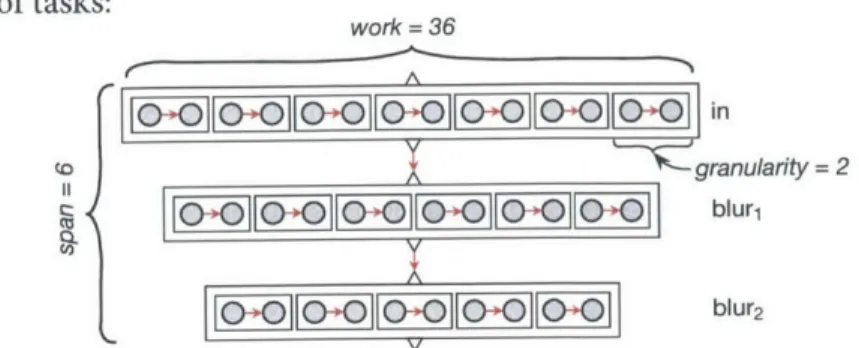
Figure 1.4: Different points in the choice space in Figure 6.2 each make different trade-offs between locality, redundant recomputation, and par-allelism. Here we quantify these effects for our two-stage blur pipeline. The span measures the constraints on parallel execution, by counting the sequential critical path assuming infinite parallel processors. The Max.
reuse distance measures locality, by counting the maximum number of
operations that can occur between computing a value and reading it back. Work amplification measures redundant work, by comparing the number of arithmetic operations done to the breadth-first case. Each of the first three strategies represent an extreme point of the choice space,
and is weak in one regard. The fastest schedules are mixed strategies, such as the tiled ones in the last two rows.
bh[x, (y + 1) mod 3] = in[x - 1, y +1] +in[x, y + 1] +in[x + 1, y + 1] if y < bv[x, 1: continue y] = bh[x,(y -1) mod 3] +bh[x, y mod 3] +bh[x, (y +1) mod 3]
Figure 1.5: tiles - overlap-ping regions are processed
in parallel, functions are evaluated one after another.
This interleaves the computation over a sliding window, with bv trailing bh by the stencil radius (one scanline). It wastes no work, computing each point in bh exactly once, and the maximum distance between a value being produced in bh and consumed in bv is proportional to the stencil height (three scanlines), not the entire image. But to achieve this, it has introduced a dependence between the loop iterations: a given iteration of by depends on the last three outer loop iterations
of bh. This only works if these loops are evaluated
sequen-tially. Interleaving the stages while producing each value only once requires tightly synchronizing the order of computation, sacrificing parallelism.
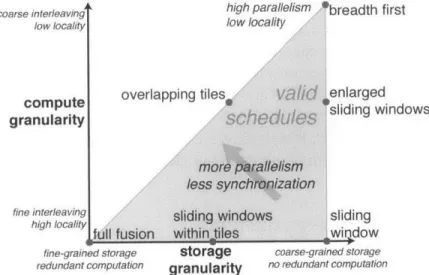
Each of these strategies has a major pitfall: lost locality, re-dundant work, or limited parallelism (Figure 1.4). In practice,
the right choice for a given pipeline is almost always some-where in between these extremes. For our two-stage example, a better balance can be struck by interleaving the computation
of bh and bv at the level of tiles: allocate bv[2046][3072] for all ty = o to 0 32 for all tx = 0 to 3072 32 allocate bh[-1..33][32] for y = -1 to 33 for x = o to 32 bh[x, y] = in[tx x 32 + X - 1, ty x 32 + y]
+in[txx 32+x,tyx 32+y]
+in[tx x 32 + X + 1, ty x 32+ y] for y = 0 to 32
for x = 0 to 32
bv[tx x 32 + x,ty x 32 +y] = bh[x,y - 1]
+bh[x, y]
+bh[x,y +1]
This trades off a small amount of redundant computation on tile boundaries for much greater producer-consumer locality, while still leaving parallelism unconstrained both within and across tiles. (In the iterated stencil computation literature, the redundant regions are often called "ghost zones;' and this strategy is sometimes called "overlapped tiling" [58, 91].) On a modern x86, this strategy is iox faster than the breadth-first strategy using the same amount of multithreaded and vector parallelism. This is because the lack of producer-consumer locality leaves the breadth-first version limited by bandwidth. This difference grows as the pipeline gets longer, increasing
the ratio of intermediate data to inputs and outputs, and it will only grow further as the computational resources scale exponentially faster than external memory bandwidth under Moore's Law (Cf. Chapter 2).
The very fastest strategy we found on this architecture interleaves the computation of the two stages using a sliding window over scanlines, while splitting the image into strips of independent scanlines which are processed in parallel:
allocate bv[2046] [3072] for all ty = o to 048 allocate bh[-1..1][3072] for y = -2 to 8 for x = 0 to 3072
--Figure 1.6: sliding window within tiles -tiles are evaluated in parallel using sliding windows.
bh[x, (y + 1) mod 3] = in[tx x 32 + x - 1, ty x 8 + y +1] +in[tx x 32 + x, ty x 8 + y + 1] +in[tx x 32 + x + 1, ty x 8 + y + if y < o: continue for x = 0 to 3072 bv[x, ty x 8 + y] = bh[x, (y - i) mod 3] +bh[x, y mod 3] +bh[x, (y + 1) mod 3]
Relative to the original sliding window strategy, this sacri-fices two scanlines of redundant work on the overlapping tops and bottoms of independently-processed strips of bh to in-stead reclaim fine-grained parallelism within each scanline and coarse-grained parallelism across scanline strips. The end result is 10% faster still than the tiled strategy on one bench-mark machine, but 10% slower on another. The best choice
between these and many other strategies varies across different target architectures. The ideal balance depends on the compu-tational characteristics of the stages, and the architecture of the target machine.
Real pipelines are both wide and deep.
There are also global consequences to the decision made for each stage in a larger pipeline, so the ideal choice of organi-zation depends on the composition of stages, not just each individual stage in isolation. The most critical choices in the organization, both for locality and for the granularity and co-herence of parallelism, relate to the interaction between stages. The blur algorithm explored so far is highly simplified for clar-ity; with only two stages, it is wide (each stage operates over many pixels), but not deep. Real image processing pipelines
are both wide and deep: they have tens to hundreds of stages,
connected in a large graph of dependencies. Consider the fast local Laplacian filters algorithm [1o]. The algorithm can be decomposed into roughly loo stages connected in a complex graph:
P CP LUT look-up table UP upsample
DDA A ADD: addition
DOWNI IUP DW UPt+ DOWN downsample
1, +
/7 DDA ADD
DOWN UP DOWN U
The algorithm uses 8 pyranwd levels DOA data-dependent access
CI Y DDA c Y (aiiCO
Even a clean, reference C++ version is over 300 lines of code. A hand-optimized version used in Photoshop is thousands of lines long, and represents only a single step in the much larger Camera Raw pipeline. As a result of this scale, the overall space of choices for organizing the interaction among all the stages in a real algorithm is enormous. This is also why libraries of optimized code cannot deliver efficient performance when building real image processing pipelines: individually opti-mized subroutines do not compose into an optiopti-mized whole, since they cannot reorganize computation for locality or par-allel execution across function boundaries.
1.3 THE HALIDE SOLUTION
I believe the right way to program image processing pipelines is to separate the intrinsic algorithm-what is computed-from the concerns of efficiently organizing it for machine execution-decisions about storage and the ordering of computation. I call these choices of how to map an algorithm onto resources in space and time a schedule. This is the core design philosophy of the Halide language. In the Halide approach, the programmer specifies an algorithm and its schedule separately. This makes it easy to explore various optimization strategies without ob-fuscating the code or accidentally modifying the algorithm itself.
A language of image processing algorithms
Functional languages provide a natural model for separating the what from the when and where. Divorced from explicit storage, images are no longer arrays populated by procedures, but are instead pure functions that define the value at each point in terms of arithmetic, reductions, and the application
4. However, they are easier to
ana-lyze when they are.
of other functions. A functional representation also allows us to omit boundaries, making images functions over an infinite integer domain.
Concretely, Halide models image processing algorithms as a rooted directed acyclic graph (DAG) of image functions. Most image functions are pure functions of their arguments (coordinates in their domain), other functions, input images, and scalar parameters. Edges in the graph correspond to caller-callee dependencies that pass pixel data between image func-tions. The root of the graph is the output of the pipeline.
For example, Halide would model the two-stage box filter algorithm with simple two-function pipeline, exactly as we sketched it before:
bh(x, y) = in(x - 1, y) + in(x, y) + in(x + i, y)
bv(x,y) = bh(x,y- 1) + bh(x,y) + bh(x,y +1)
That is, as a graph of 2D functions, bh is defined at any point
x, y as the sum of three points in the input, while the output, bv, is defined at any point x, y as the sum of three points in
bh.
Functions may call other functions at arbitrary, dynamic coordinates-accesses need not be constant, affine, or other-wise constrained4. Functions may also be iteratively re-defined at potentially dynamic locations in their domain via a series
of update definitions, which are implicitly layered on top of
the initial definition. This allows efficient expression of op-erations not easily modeled as statically-unrolled chains of pure gather stages-things like histograms, reductions, and scans-but this model of computation is still intentionally restricted. In particular, recursion is only allowed within a single function, using update definitions, and the recursion is bounded to a fixed depth before it begins by an explicit
re-duction domain. As a result, Halide's language of algorithms
is not Turing-complete, but is amenable to extensive analysis and transformation.
A language of schedules
In the Halide representation, the algorithm only defines the value of each function at any point; a schedule specifies spec-ifies the organization of computation over all points in all functions.
Halide's schedules specify the organization of computation as a loop nest over the required regions of all functions in an algorithm. They specify the storage and communication of intermediate data as an allocation granularity within this loop nest for each function's results, and the linearized mapping of each function's domain into addresses within its allocation. Halide represents schedules as a set of four choices for each function in the algorithm:
. the domain order, or order in which points in the domain of the function are evaluated, including row- vs. column-major orders, tiling, and the exploitation of parallelism and mapping onto SIMD execution units;
. the storage order, or layout of the buffer into which the eval-uation of a function is stored;
. the computation granularity at which points in the domain of one function are evaluated relative to points in the domain of the others that depend on it, which interleaves their execution; . the storage granularity of intermediate storage for function
results, which dictates whether a value is recomputed, or from where in the memory hierarchy it is loaded, at each point a function is used.
For example, the naive row-major, breadth-first organization of the simple blur algorithm is specified by the following choices: bh: domain order:
y
-+ x x parallel y parallel storage order: y -+ xcompute at: root granularity store at: root granularity
bv: domain order: y -+ x x parallel y parallel storage order: y -> x
5. In the blur examples, the fact that bh must be computed before
bv, and the minimum required
regions of bh needed by by at any given granularity of interleaving, are implied by the definition of the algorithm in -* bh -- bv; they
are not specified by the schedule.
compute at: root granularity
store at: root granularity
which describes the organization:
allocate bh parallel for bh.y
parallel for bh.x
compute bh(bh.x, bh.y) using in allocate by
parallel for bv.y parallel for bv.x
compute bv(bv.x, bv.y) using bh
Given these order and granularity choices, the size of the re-gions computed for each function, and the dependence order between producers and consumers, are dictated by and in-ferred from the algorithm5. Required regions are modeled con-servatively as simple multidimensional intervals (axis-aligned
bounding boxes of the dimensionality of the function). With
region definitions symbolically expanded, the simple blur or-ganization becomes:
/ thl' reiup ired region ofi is a parameter to III(, pipiiine
bh.y.min = bv.y.min - 1 bh.y.max = bv.y.max + 1
bh.y.extent = bh.y.max - bh.y.min bh.x.min = bv.x.min
bh.x.max = bv.x.max
bh.x.extent = bh.x.max - bh.x.min allocate bh [bh.y.extent] [bh.x.extent] parallel for bh.y = bh.y.min to bh.y.max
parallel for bh.x = bh.x.min to bh.x.max
compute bh( bh.x, bh.y) using in([bh.x -1, bh.x+1], bh.y)
allocate bv [bv.y.extent] [bv.x.extent] parallel for bv.y = bv.y.min to bv.y.max
parallel for bv.x = bv.x.min to bv.x.max
compute bv(bv.x, bv.y) using bh( bv.x, [bv.y - 1, bv.y + 1])
Halide schedules describe semiperfect loop nests.
Conceptually, each function is computed by a perfectly-nested loop[41] which scans points in the required region of its do-main. Because required regions are axis-aligned bounding boxes, the bounds of different dimensions of a function's main cannot be interdependent; the bounds of the whole
do-main must be fixed before entering its loop nest. However, the overall organization is a sequence of loop nests which com-putes the required regions of all functions. In general, the
granularity at which a function is evaluated-its computation
granularity-is specified as a level in the loop nest evaluating
the domains of its callers. As a result, the loop nest for each function may be inserted at any level of the loop nests of its caller functions, creating an imperfect loop nest over all re-gions of all functions. The end result is that Halide's schedules are restricted to a subset of all possible orders of execution over the required regions of each function which we call semiperfect
loop nests.
Formally, we define a semiperfect loop nest as a sequence of statements where:
. The collection of loops and statements which compute the domain of any single function form a perfectly-nested loop with respect to each other6. That is, each block is either a sequence of non-loop statements with a single entry and single exit, or one perfectly-nested loop containing exactly one block as its body.
. The loop nests for each function are interleaved at any gran-ularity and in any order which respects producer-consumer dependence between functions.
. The allocation of the buffer into which a function's results are stored are at a granularity which encloses where the function's loop nest is interleaved.
A tiled and interleaved organization of the simple blur algo-rithm, like that used in the hand-optimized C++ implementa-tion shown earlier, is specified by the schedule:
bh:
domain order:
y -+x
compute at: bv.xo store at: bv.xo
by:
domain order: split y yo, y by 8
split x -+ xo,xi by 8
6. Ignoring statements and loops which compute other functions.
yo -* xo -) yi -+ xi
yo :parallel
This separately describes a local perfect-loop nest over the required region of each function:
for bh.y
for bh.x
compute bh(bh.x, bh.y) using in
and
parallel for bv.yo for bv.xo
for bv.yi for bv.x
compute bv(bv.xo x 8 + bv.xi, bv.yo x 8 + bv.yi) using
bh
Finally, the compute and storage granularities chosen for bh
define the levels in the loop nest of by at which the computation and storage of the first function should interleaved, giving the semiperfect loop nest which computes the entire pipeline:
allocate bv parallel for bv.yo
for bv.xo allocate bh for bh.y
for bh.x
compute bh(bh.x, bh.y) using in
for bv.yi for bv.x
compute bv(bv.xo x 8 + bv.xi, bv.yo x 8 + bv.yi) using
bh
Halide makes this space of schedule choices a first-class part of the language, directly expressible in code. For example, the complete optimized blur algorithm and organization is
Func halide-blur(Func in) {
Func bh, bv;
Var x, y, xo, yo, xi, yi;
bh(x, y) (in(x-1, y) + in(x, y) + in(x+i, y))/-; bv(x, y) = (bh(x, y-1) + bh(x, y) + bh(x, y+!))/3;
bv.tile(x, y, xo, yo, xi, yi,
.vectorize(xi, 8).parallel(yo);
bh.computeat(bv, xo).vectorize(x, 8);
return bv;
}
This generates nearly identical machine code, and identical performance, to the hand-optimized C++.
Halide's schedules only model a subset of all possible organizations.
Halide's schedules only model part of the space of all possible organizations of computation and storage in image processing pipelines expressible as Halide algorithms. In particular, they only express some possible interleavings of the computations in an algorithm. Computations can only be interleaved as allowed by semiperfect loop nests, expressible through the space of meaningful domain order and computation granular-ity choices for each function in an algorithm. Computation cannot be interleaved at finer granularity than the evaluation of a function at a point in its domain. Finally, the required region of each function is tracked conservatively as a multi-dimensional interval, which may include points not actually required to compute the output of the pipeline.
These constraints restrict the space of possible organiza-tions representable in Halide, but they provide a model which
is simple, from which it is easy to generate fast code, whose
meaning and performance is reasonably easy to understand, which can express most commonly-used patterns in optimized
image processing code, and which naturally maps to GPU and SIMD multicore programming models.
Code generation from scheduled algorithms
Once the programmer has specified an algorithm and a sched-ule, our compiler combines them into an efficient
implemen-tation. Optimizing execution for a given architecture requires modifying the schedule, but not the algorithm. The
repre-sentation of the schedule is compact and does not affect the correctness of the algorithm, so exploring the performance of many options is fast and easy. The schedule can be written separately from the algorithm, by an architecture expert if nec-essary. Halide can most flexibly schedule operations which are data parallel, with statically analyzable access patterns, while still allowing the reductions, scans, and bounded irregular access patterns that occur in image processing.
1.4 DISSERTATION OVERVIEW
The rest of this thesis motivates, explains, and evaluates the design and implementation of the Halide language as follows: " Chapter 2 provides broader context for the problem of organiz-ing computation for efficiency in image processorganiz-ing pipelines. . Chapter 3 describes Halide's language for functional algorithm
specification.
. Chapter 4 explores the problem of organizing computation in image processing pipelines.
. Chapter 5 describes Halide's model for the organization of computation, and its embodiment in the language of schedules. . Chapter 6 demonstrates the application of Halide schedules
to describe and explore the space of optimized organizations in real image processing pipelines, and discusses methods for finding efficient schedules for Halide algorithms.
. Chapter 7 presents an algebraic view of Halide's schedule space. . Chapter 8 explains how the Halide compiler translates func-tional algorithms and optimized schedules into efficient ma-chine code for x86 and ARM, including SSE and NEON SIMD instructions, and CUDA GPUs, including synchronization and placement of data throughout the specialized memory hierarchy.
. Chapter 9 evaluates Halide implementations of a range of ap-plications composed of common image processing operations such as convolutions, histograms, image pyramids, and com-plex stencils. Using different schedules, we compile them into optimized programs for x86 and ARM CPUs, and a CUDA GPU. For these applications, the Halide code is compact, and
performance is state of the art. It additionally evaluates an auto-tuner for automatically scheduling programs using stochastic search, and discusses several cases of the adoption and deploy-ment of Halide in the real world.
. Chapter lo puts Halide in the context of related work in pro-gramming languages, compilers, and image processing. . Chapter 11 discusses and analyzes our experience with Halide,
and suggests directions for future work.
. A deeper, example-driven introduction to using the Halide language is provided as an appendix.
THE OPPORTUNITY AND
CHALLENGE OF IMAGE
PROCESSING
Image processing matters for much more than just photog-raphy: from self-driving cars, to high throughput gene se-quencing, to neural scanning and connectomics, today most complex sensing uses imaging under the hood [79, 86, 5]. Im-age sensors offer a simple, high resolution building block for
digitizing the physical world, including both spatial and spec-tral information, while image processing and computer vision let us analyze and comprehend the captured data in numerous ways. As a result, imaging is used for everything from
local-ization and tracking to human-computer interaction to vital sign monitoring, traffic analysis, mapping, bar code scanning, and industrial defect detection [46, 80, 59, 55, 78].
The resulting explosion of sensors offers an enormous op-portunity to build graphics and imaging applications orders of magnitude richer than any we have today; however, doing so will require exponentially more computation. For example, replacing video with real-time 4D light fields, imaging the con-nectome of a complete human brain, and building machines which pervasively understand the visual world all require or-ders of magnitude more computational power than we have today. Orders of magnitude more energy efficiency will let us leverage cheap, high data rate cameras for everything from human-computer interaction to search, and move powerful image processing and analysis into our glasses and clothing where it will transform how we see, think, remember, and are entertained. Always-on cameras will passively monitor our vital signs and health every moment of our lives. Even existing applications-from Instagram and Photoshop, to object detec-tion and recognidetec-tion, to Microsoft Kinect, to personal genome
130 100
2013 2017 2021 2025
Figure 2.1: Projected ASIC logic density (millions of 4-input NAND gates per mm2)
(Source: ITRS Report, 2013 [1]).
sequencing-all demand extremely high performance to cope with the rapidly rising resolution, frame rate, and sheer
num-ber of image sensors, as well as the increasing complexity of imaging and vision algorithms. At the same time, the cameras, mobile devices, and data centers on which these applications run require extremely high efficiency to stay within thermal limits, or to last more than a few minutes on battery power.
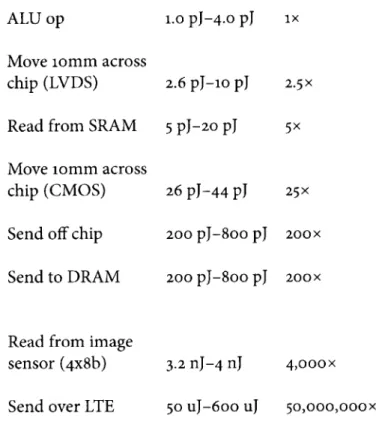
Unlike other domains of low-power, high-throughput com-putation, the answer cannot simply be traditional hardware specialization: while radio basebands and video CODECs implement slow-changing standards which can be built into custom hardware, image processing algorithms are rapidly evolving and diverse, requiring high performance software implementations. Neither can we simply ship pixels to the cloud for processing: it takes a cellular radio four orders of magnitude more energy to transmit each pixel than a sensor spends to capture it (Figure 2.2).
Future imaging systems need large capacity for software-controlled image processing, as close to the image sensor as possible. The good news is that the transistor scaling trends we have come to call "Moore's Law" are alive and well: we can expect more than an order of magnitude increase in density over the next decade (Figure 2.1); the challenge will be in keeping tens of billions of transistors busy.
Performance requires complex tradeoffs between parallelism, locality, and the total amount of
computation.
One of the major challenges is exposing more and more par-allelism for future hardware to exploit [81]. Superficially, this seems easy: imaging algorithms are enormously data-parallel, which should make them easy to scale on highly parallel hard-ware. The real challenge is that their millions of data-parallel
computations are not independent-they need to be able to communicate with each other, and to share data over time through memory. Real imaging and vision algorithms have complex dependencies, and are limited by locality (the dis-tance over which data has to move, e.g., from nearby caches or far away main memory) and synchronization. The same hard-ware trends which have pushed us from uniprocessors to lots of parallel cores have made communication and data
movement-1.0 pJ-4.0 pJ 1x
Move iomm across
chip (LVDS) 2.6 pJ-io pJ 2.5x Read from SRAM 5 pJ-20 pj 5x
Move iomm across
chip (CMOS) 26 pJ-44 pJ 25x
Send off chip 200 pJ-8oo pj 200X
Send to DRAM 200 pJ-8oo pJ 200X
Read from image
sensor (4x8b) 3.2 nJ-4 nJ 4,000x
Send over LTE 50 uJ-600 uJ 50,000,000x
Figure 2.2: Energy cost of different operations on 32-bit values in a leading 45nm foundry process. Communication and storage are signifi-cantly more expensive than computation, and their cost is proportional to the distance data is moved.
both within a chip and over a network-dominate the cost of computation, and limit the gains realized from shrinking transistors. Today, relative to the energy cost of doing some arithmetic operation on a piece of data, loading or storing that data in a small local SRAM like a cache can be several times more expensive; moving the result io millimeters across the chip is an order of magnitude more expensive; and moving it to or from off-chip RAM is three to four orders of magnitude more expensive than computing the value in the first place (Figure 2.2). This disparity is only growing over time.
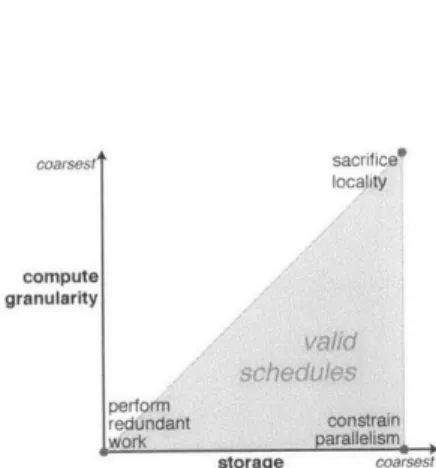
Because of the inversion in the cost of communication and computation, it can often be most efficient to make surprising tradeoffs, like redundantly recomputing values used in multi-ple places instead of storing and reloading them from memory. In this way, there is a tension between locality and the total amount of computation performed: it is possible to improve
parallelism locality
tradeoff space
redundant work
Figure 2.3: Parallelism, locality,
and redundant work are often in tension, and must be traded off with each other to maximize the overall efficiency of an algo-rithm on a particular architecture.
locality by redundantly recomputing values. Further, we find that this fundamental tension exists between all three factors we want to minimize for performance and efficiency:
. order constraints, which limit parallelism; - data movement, which reduces locality; . and the total amount of work performed.
We can sacrifice parallelism to tightly couple producers and consumers; we can save and reload values from far away to avoid redundant work; or we can recompute values near in-dependent consumers to avoid moving them long distances. The only thing we can not do in the presence of nontrivial dependencies among operations is simultaneously minimize all three.
Optimization is challenging because these are not discrete tradeoffs. The best strategies balance them all in different ways in different parts and at different granularities of an overall sys-tem. The ideal balance depends on the interaction between the individual algorithms, the hardware architecture onto which they are being mapped, and the larger pipeline into which they are composed. The best tradeoffs for a given pipeline on a given architecture are rarely obvious, and finding them often requires extensive experimentation.
Tradeoffs between parallelism, locality, and redundant computation are determined by the organization of computation.
We argue that, driven by these tradeoffs, the efficiency and performance of an application are determined not just by the algorithm and the hardware architecture on which it runs, but critically also by the organization of the computations and data on that hardware. For algorithms with the same complexity-even the exact same set of arithmetic operations and data-executing on the same hardware, the order and gran-ularity of execution and placement of data can easily change performance by an order of magnitude because of locality and parallelism.
Consider a simple loop nest which computes a 2D grid of values. Because of locality, switching from column-major
to row-major execution order can change performance by an order of magnitude:
for x = 0 to width do for y =0 to height do
for y = 0 to height do for x = 0 to width do
f [x,y] =... f [x,y]=...
end for end for
end for - end for
I argue that these are, in fact, the same algorithm, reorganized to compute its values and access memory in a different order.
This simple reorganization is well known, and something many compilers will do today. In this thesis, I will model and exploit a much wider range of organizations. Especially in multi-stage algorithms like image processing pipelines, the difference in efficiency between different organizations comes not from the optimization of individual stages in isolation, but from the global interleaving of computations and data. For ex-ample, computing each stage completely before the next-even with the optimal inner loop, spread over thousands of threads on a GPU-destroys producer-consumer locality, repeatedly pushing intermediate data to and from main memory.
Exploring the space of potential optimizations is challeng-ing because makchalleng-ing different tradeoffs requires globally reor-ganizing the computations and data throughout a pipeline. In a traditional language, this means rewriting all of the code. Even once you find an efficient organization, you can rarely reuse it in a new context: because locality requires interleaving operations and data across stages, libraries of even the best optimized subroutines do not compose into efficient pipelines; and the best organization of a given pipeline varies enormously across common architectures, from mobile multicores to server GPUs. This challenge is combinatorial: the complexity scales with the combination of individual algorithms, pipelines, and target architectures. As a result, efficient image processing code is hard to write, modify, port across architectures, or com-pose into new pipelines. Worst of all, the sacrifices program-mers must make to the gods of performance and efficiency-in the form of painfully complex, manual reorganization of com-putations and data, for each system and each architecture-will only grow more dear as the trends driven by "Moore's Law" scaling demand ever more extreme transformations for parallelism and locality just to keep each new generation of hardware busy.
Halide defines a new way of programming to
address these challenges.
To address this, we propose a new programming language with a unique programming model. Halide decouples choices of organization from the definition and composition of algo-rithms. Halide defines image processing algorithms as pure graphs of pure functions from pixel coordinates to values. This defines the by which to compute each pixel value, but excludes all choices of the order of computation of pixels within each function, and their storage and communication through mem-ory. Halide then describes the organization of the algorithm separately from their arithmetic definition. It elevates organi-zation to a first-class feature in the programming model, using an explicit co-language of schedules. Schedules are defined by annotating functions used in a pipeline with a handful of basic primitives; complex organizations are described by composing multiple primitive annotations in different ways.
The explicit separation of algorithm definition from organi-zation dramatically simplifies the definition and composition of image processing pipelines. The ability to describe numer-ous complex organizations of a single algorithm by composing a handful of scheduling primitives makes exploring the enor-mous space of organizations to find efficient implementations on different architectures dramatically faster and easier than it is in traditional languages used for high performance im-age processing software. The end result are simpler programs, which can match or exceed the performance of state-of-the-art hand-tuned implementations, while being portable and scalable across a wide range of architectures with different balances of parallelism, locality, and recomputation vs. storage cost.
REPRESENTING IMAGE
PROCESSING
ALGORITHMS
The Halide language is best thought of in two parts: a language
of algorithms, and a complementary language of schedules.
This chapter describes Halide's representation of image pro-cessing algorithms. To simplify analysis, and to maintain the flexibility to apply many different schedules to a given algo-rithm, we define a new domain-specific representation for image processing algorithms. The language of algorithms is explicitly designed to omit specification of the order of eval-uation and the allocation and layout of intermediate storage. This gives both the programmer and the compiler extreme flex-ibility in scheduling when and where these functions should be computed and stored. This representation also dramatically simplifies common image processing algorithms relative to alternatives like C and CUDA, and simplifies the composition of large algorithms from many parts.
3.1 THE HALIDE LANGUAGE OF
ALGORITHMS
Halide represents image processing operations in a simple functional form. In a traditional imperative language, "images" are represented as mutable arrays, passed between subroutines which explicitly iterate over pixels. In Halide, images are in-stead functions from coordinates to values; pixels are defined by how they are computed, not by where they are stored. We represent images as pure functions defined over an infinite integer domain, where the value of a function at a point
repre-sents the color of the corresponding pixel. Imaging pipelines are specified as chains or graphs of functions. Functions may
either be simple expressions in their arguments, or a sequence of iterative updates applied over a bounded domain. The ex-pressions which define functions are side-effect free, and are much like those in any simple functional language, including: . arithmetic and logical operations;
. if-then-else expressions;
. references to named values, which may be the free variables in a function's definition, Uniform values, or expressions defined by a functional let construct;
. calls to other functions, including loads from external images or scalar calls to external C ABI functions.
For example, we can define a two-dimensional function
f:
f (x, y) = x + yf
is defined in terms of the free variables, x and y, mapping its two-dimensional domain. These variables, bound on the left-hand side of the definition, may be used in the expression on the right-hand side to define the value at the corresponding coordinate. Their range is not specified, and the function may be evaluated anywhere in its infinite domain. Points in the function are free to be evaluated, cached, duplicated, or thrown away and recomputed without affecting their meaning.Image processing algorithms are built by composing func-tions together into graphs, using first-order function applica-tion. For example, we can compute an (unnormalized) 3 x 3
box filter of the input in with a simple two-stage pipeline:
bh(x, y) = in(x -1, y) + in(x, y) + in(x +1, y)
bv(x, y) = bh(x, y - 1) + bh(x, y) + bh(x, y + 1)
Each function is defined over its own infinite domain, and the algorithm does not specify the regions to be computed. Rather, the compiler automatically analyzes the dependence between functions (using a bounds analysis, discussed in Chap-ter 8); given the output region a program wants to compute, all intermediate bounds are inferred. This is important for two reasons:
1. It leaves the compiler free to compute more of a given function than is required, which is often useful to improve alignment or simplify control flow, and can be controlled by the schedule. 2. It dramatically simplifies the algorithm code, eliminating most
complex indexing and explicit boundary handling.
Types
The core types of the language are:
. Func, a pure function, defining image values over some do-main.
. Var, a free variable in the domain of a function.
. Expr, an expression defining the value of a function in terms of the free variables which make up its domain, as well as constants, and the application of other functions.
. Image, an immutable reference to an external memory buffer, visible to the algorithm as a function which may be applied only over the finite domain given by the image's dimensions. . Param, a runtime variable parameter, providing a scalar
argu-ment to the algorithm.
All expressions are unambiguously typed as floating point, or signed or unsigned integer values, of a specific bit width,
or Tuples of these atomic types. In the current
implementa-tion, only the most commonly supported widths are allowed'. Boolean values, as returned by logical expressions, are of type
UInt(i). The types of all intermediate expressions are inferred
from their operands using type promotion rules similar to C, and may be controlled by explicit arithmetic cast operations .2
Expressions may only describe these simple scalar numeric types, or static tuples thereof; there are no pointers, references, or more complex data structures like lists or trees. The core Halide model allows only simple first-order functions, with-out recursion: functions simply map from integer coordinates to a scalar or statically-sized tuple result. Higher-order func-tions, general recursion, and dynamically-sized tuples are not allowed.
This representation is simpler than most functional lan-guages, but it is sufficient to describe a wide range of image processing algorithms. These constraints enable extremely flexible analysis and transformation of algorithms during com-pilation. In this representation, all applications of a callee are statically analyzable, and they are always free to be evaluated before any applications of a caller (properties we will exploit
1. 16, 32, & 64-bit floating point
8, 16, 32, & 64-bit signed and
un-signed integer
2. The exact type promotion rules
are more conservative than C about implicitly widening data types, since this often impairs vectorized code quality.
to efficiently and flexibly schedule the execution of generated code). Constrained versions of more advanced features such as higher-order functions are added as syntactic sugar, but they do not change the underlying representation.
Iterative functions
In order to express operations like histograms, convolution by dynamically-sized kernels, summations, and scans [12], Halide also needs to express iterative or recursive computations. To do so, we introduce two additional primitives to the language: Beyond their initial pure definition, functions may have one or more recursive update definitions, which redefine the value at points given by an output coordinate expression in terms of prior values of the function. Their initial pure definition is treated as the initial valuefunction, which specifies a value at each point in the output domain as a pure function of its input coordinates. All updates must be applied before the function may be used by any other function. The value of the function is defined at any point as the result of any updates which affect that point, applied in the order of their definition, to the initial value.
. Beyond pure variables, updates may be defined in terms of
an iteration domain of one or more dimensions. An update
defined with an iteration domain is iteratively evaluated and reapplied for every point in the domain. The programmer specifies a minimum value expression and an extent expression for each dimension of the iteration domain, as well as the relative order of the dimensions. The bounds of the iteration domain must be defined prior to the function in which it is used, and cannot depend on the function's value.
For example, we can compute the sum of all values over an entire image:
IterDom r(o, in.width(, o, in.heighto) s()=o
so+ = in(r.x, r.y)
Update definitions may also include pure variables, as well as iteration domain variables. For example, we can convolve an image by a variable-sized box: