Chemo-Mechanics of Lithium-Ion Battery Electrodes
by
Claudio V. Di Leo
B.S., Massachusetts Institute of Technology (2010) M.S., Massachusetts Institute of Technology (2012) Submitted to the Department of Mechanical Engineering in partial fulfillment of the requirements for the degree of
Doctor of Philosophy
at the
Massachusetts Institute of Technology
June 2015
ARCHIES
MASSACHUSETTS INSTITUTE OF TECHNOLOLGYJUL 3
0
2015
LIBRARIES
@
Massachusetts Institute of Technology 2015. All rights reserved.
Signature redacted
A u th o r ...
Department of Mechanical Engineering
Certified by ...
A
May 22, 2015Signature redacted
Lallit Anand
Rohsenow Professor of Mechanical Engineering
Thesis Supervisor
A ccepted by ...
Signature redacted
David E. Hardt
Chairman, Department Committee on Graduate Students
3
Chemo-Mechanics of Lithium-Ion Battery Electrodes
by
Claudio V. Di Leo
Submitted to the Department of Mechanical Engineering on May 22, 2015, in partial fulfillment of the
requirements for the degree of Doctor of Philosophy
Abstract
Mechanical deformation plays a crucial role both in the normal operation of a Lithium-Ion battery, as well as in its degradation and ultimate failure. This thesis addresses the theoret-ical formulation, numertheoret-ical implementation, and application of fully-coupled deformation-diffusion theories aimed at two different classes of electrode materials: (i) phase-separating electrodes, and (ii) amorphous Silicon electrodes, which are elaborated on next.
Central to the study of phase-separating electrodes is the coupling between mechanical deformation and the Cahn-Hilliard phase-field theory. We have formulated a thermody-namically consistent theory which couples Cahn-Hilliard species diffusion with large elastic deformations of a body. Through a split-method, we have numerically implemented our theory, and using our implementation we first studied the diffusion-only problem of spinodal decomposition in the absence of mechanical deformation. Second, we studied the chemo-mechanically-coupled problem of lithiation of isotropic spheroidal phase-separating electrode particles. We showed that the coupling of mechanical deformation with diffusion is crucial in determining the lithiation morphology, and hence the Li distribution, within these particles. Amorphous silicon (a-Si), when fully lithiated, has a theoretical capacity ~ 10 times larger than current-generation graphite anodes. However, the intercalation of such a large amount of Li into a-Si induces very large elastic-plastic deformations. We have formulated and numerically implemented a fully-coupled deformation-diffusion theory, which accounts for transient diffusion of lithium and accompanying large elastic-plastic deformations. We have calibrated our theory, and applied it to modeling galvanostatic charging of hollow a-Si nanotubes whose exterior walls have been oxidized to prevent outward expansion. Our predictions of the voltage vs. state-of-charge (SOC) behavior at various charging rates (C-rate) are in good agreement with experiments from the literature. Through simulation, we studied how plastic deformation affects the performance of a-Si-based anodes by reducing stress, thus enabling higher realizable capacities, and introducing dissipation.
Finally, in order to design a-Si-based anodes aimed at mitigating failure of the solid electrolyte interphase (SEI), we have formulated and studied a continuum theory for the growth of an SEI layer - a theory which accounts for the generation of growth stresses.
Thesis Supervisor: Lallit Anand
5
Acknowledgments
First and foremost I would like to thank Professor Anand, who has mentored me from my undergraduate research through my doctoral work. Beyond imparting me with great tools for conducting research in solid mechanics, Professor Anand has taught me to always conduct research at the highest standard, and to value quality and integrity above all. His teachings will continue to inspire me throughout my career. I would also like to thank my thesis committee members, Professor David Parks, Professor Martin Bazant, and Professor Yang Shao-Horn, for their invaluable suggestions and guidance throughout my research.
A great thanks to Ray Hardin, our administrator extraordinaire, who throughout my
years has provided all of the necessary support to ensured that I could focus on producing the best research possible. I would also like to thanks Pierce Hayward and Leslie Reagan for their support.
In my time at MIT I have had the pleasure of working with incredibly talented individuals. Vikas Srivastava, who was my undergraduate mentor, and continues to be a good friend. Shawn Chester and David Henann, who were teaching assistants when I first learned solid mechanics, and who continue to inspire me to this day. Kaspar Loeffel, Mary Cookson, Tony Tran, Jacques Luk-Cyr, Haowen Liu, Jafar Albinmousa, and many other students, postdocs, and faculty who have passed through the lab in my years here. Finally, Elisha Rejovitzky, who has been my closest collaborator. Our heated discussion have been invaluable to my learning.
I would like to thank my parents, Helga and Bruno, who have shown me unwavering support throughout all my years at MIT. When I was five years old, on a visit to Boston from Peru, my parents brought me to see MIT. I fell in love with the university, and I told them that one day I would study here. Since that day they have been working relentlessly to support my education, they make dreams come true.
This thesis is dedicated to my wife Lea, she inspires me to be a better person. Thank you for standing by me. Finally, to my daughter Alice, dream big, and thank you for waking me up at 5am so that I can get to work early.
Contents
List of Figures 13 List of Tables 15 1 Introduction 17 1.1 Background . . . . 17 1.1.1 Phase-separating electrodes . . . . 181.1.2 Amorphous Silicon electrodes . . . . 18
1.2 Brief sum m ary . . . . 19
1.2.1 Modeling phase-separating electrode materials . . . . 19
1.2.2 Modeling amorphous Silicon electrodes . . . . 20
1.2.3 Modeling growth of a solid electrolyte interphase . . . . 21
I Modeling phase-separating electrode materials 22 2 Introduction 23 3 A Cahn-Hilliard-type phase-field theory for species diffusion coupled with large elastic deformations. 29 3.1 Balance law for the diffusing species . . . . 30
3.2 Basic kinem atics . . . . 30
3.3 An additional variable cR . . . . .
32
3.4 Macroscopic and microscopic force balances derived via the principle of virtual p ow er . . . . 32
3.4.1 Macroscopic force and moment balances . . . . 34
3.4.2 Microscopic force balances . . . . 36
3.5 Free energy imbalance . . . . 37
3.6 Constitutive theory . . . . 38
3.7 Species flux . . . . 39
3.8 Isotropic m aterials . . . . 40
3.8.1 Isotropic free energy . . . . 40
3.8.2 Constitutive equation for the chemical distortion rate L . . . . . 41
3.8.3 Isotropic m obility . . . . 41
3.9 Sum m ary . . . . 41
3.9.1 Constitutive equations . . . . 42
3.10 Specialization of the constitutive equations . . . . 44
3.10.1 Free energy . . . . 44
3.10.2 Stress . . . . 46
3.10.3 Chemical potential . . . . 46
3.10.4 Microforces. Governing equation for the micromorphic concentration &c 47 3.10.5 Species flux . . . . 47
3.11 Governing partial differential equations. Boundary conditions . . . . 48
3.11.1 Partial differential equations . . . . 48
3.11.2 Boundary and initial conditions . . . . 49
3.12 Numerical Implementation of the theory . . . . 50
4 Simulations for the special case of spinodal decomposition by diffusion in the absence of mechanical deformation 53 4.1 Two-dimensional simulations of phase-separation . . . . 56
4.2 Three-dimensional simulations of phase-separation . . . . 57
5 Coupled chemo-mechanical simulations of lithiation of a spheroidal elec-trode particle 63 5.1 Lithiation under a slow ramp of jiext . . . . 66
5.2 Lithiation under a step change in 4ext . . . . 67
6 Concluding remarks 73
II Modeling amorphous Silicon electrodes
75
7 Introduction 77 8 Diffusion-deformation theory for amorphous silicon anodes 81 8.1 K inem atics . . . . 828.2 Frame-indifference . . . . 84
8.3 Balance of forces and moments . . . . 85
8.4 Balance law for the diffusing species . . . . 86
8.5 Balance of energy. Entropy imbalance. Free energy imbalance . . . . 87
8.6 Constitutive constraint between J' and cR . . . . .. . .. . . . . .. 89
8.7 Constitutive theory . . . . 90
9
8.7.2 Dissipative constitutive equations . . . . 91
8.8 Isotropy . . . . 92
8.8.1 Isotropic free energy . . . . 92
8.8.2 Plastic flow rule for isotropic materials . . . . 94
8.9 Summary of the constitutive theory . . . . 95
8.9.1 Constitutive equations . . . . 95
8.10 Specialization of the constitutive equations . . . . 97
8.10.1 Swelling ratio JS . . . . 97
8.10.2 Free energy . . . . 98
8.10.3 Stress. Chemical potential . . . . 99
8.10.4 Species flux . . . 100
8.10.5 Plastic flow rate P . . . . 100
8.11 Summary of the specialized constitutive theory . . . 102
8.11.1 Constitutive equations . . . 102
8.12 Governing partial differential equations. Boundary and initial conditions 105 8.13 Electrode/electrolyte interfacial reaction kinetics. Butler-Volmer equation 106 8.14 Numerical implementation of the theory . . . 110
9 Calibration of the material parameters in the theory 113 9.1 Chem ical properties . . . 113
9.2 Elastic properties . . . 114
9.3 Plastic Properties. Reaction Constant . . . 114
10 Modeling a hollow double-walled a-Si nanotube anode 121 10.1 Typical simulation output . . . 122
10.2 Comparison between our simulation results and the experiments of Wu et al. (20 12) . . . 123
10.3 Role of plastic deformation on the electrochemical response of the a-Si anode 124 11 Concluding remarks 131
III Modeling growth of a solid electrolyte interphase
133
12 Introduction 135 12.1 Introduction . . . 13512.2 Substrate curvature experiments of Mukhopadyay et al. (2012) . . . 136
12.3 Modeling of lithiation/delithiation of anode particles . . . 138
13 Theory and simulation capability for the growth of a solid electrolyte in-terphase 141 13.1 Numerical modeling of SEI deposition . . . ... 142
13.2.1 K inem atics . . . 143
13.2.2 Free energy imbalance . . . 146
13.2.3 Energetic constitutive equations . . . 147
13.2.4 Dissipative constitutive equation . . . 148
13.2.5 Specialization of the constitutive equations . . . 148
13.3 Summary of a theory for lithium intercalation coupled with large elastic de-form ation . . . 150
13.3.1 Constitutive equations . . . 150
13.4 Governing partial differential equations. Boundary conditions . . . 151
13.4.1 Numerical implementation of the theory . . . 152
14 SEI formation on the surface of a flat anode undergoing cyclic lithiation and delithiation 155 14.1 Material parameters . . . 157
14.2 Simulation results . . . 158
15 SEI formation on the surface of spherical and spheroidal graphite particles undergoing cyclic lithiation and delithiation 163 15.1 Simulation results for SEI growth on a spherical anode particle . . . 165
15.2 Simulation results for SEI growth on a spheroidal anode particle . . . 166
16 Concluding remarks 173 17 Conclusion 175 17.1 Sum m ary . . . 175
17.2 O utlook . . . 177
Bibliography 181 A Numerical methodology for Part I: Modeling phase-separating electrode materials. 189 A .1 Introduction . . . 189
A.2 Variational formulation. Residuals . . . 189
A .3 Tangents . . . 192
A .4 Sum m ary . . . 195
B Split methods for solving the Cahn-Hilliard equation 199 B. 1 Cahn-Hilliard diffusion theory derived using the principle of virtual power. . 202 B.2 Micromorphic Cahn-Hilliard diffusion theory derived using the principle of virtual pow er . . . 207
B.3 Summary of the theoretical framework . . . 212
B.4 Numerical implementation . . . 213
11
B.6 Steady-state morphologies in three dimensions . . . 220
B.7 Numerical methodology . . . 221
C Numerical methodology for Part II: Modeling amorphous Silicon elec-trodes 237 C.1 Introduction . . . 237
C.2 Variational formulation. Residuals . . . 238
C .3 Tangents . . . 240
C.4 Summary . . . 242
C.5 Time integration procedure . . . 243
List of Figures
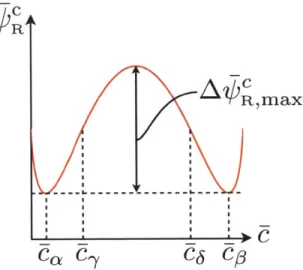
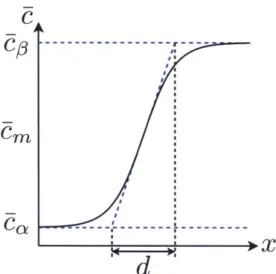
Typical double-well chemical free energy . . . . Schematic of a phase front . . . . Phase-separation morphology in two-dimensions . . . . The difference E - 0 in two-dimensions for various values of / . . Convergence of I - | as a function of . . . ..
(a) Front-width d versus /. (b) Convergence of d as a function of /3
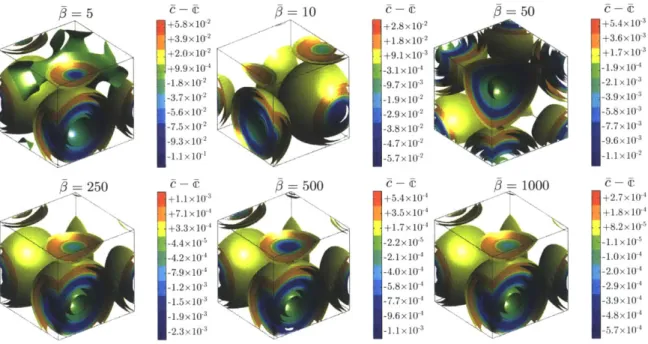
Phase-separation morphology in three-dimensions . . . . The difference E - c in three-dimensions for various values of 3 .
. . . . 54 . . . . 56 . . . . 59 . . . . 59 . . . . 60 . . . . 60 . . . . 61 . . . . 61
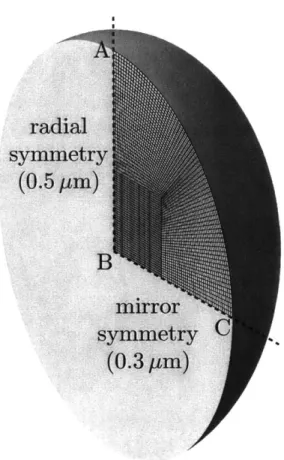
5-1 Spheroid geometry and finite-element mesh used in computation . . . .
5-2 Simulations of lithiation of Spheroidal particles under a slow ramp of the
external chemical potential . . . .
5-3 (a) Applied electrochemical potential, and (b) Applied voltage, both versus
state-of-charge . . . . 5-4 Simulations of lithiation of Spheroidal particles under a step of the external
chem ical potential . . . .
9-1 Variation of the elastic constants in LiSi . . . . 9-2 Geometry and simulation domain used in the substrate curvature simulations 9-3 Fit of our substrate curvature simulations to the published experimental
re-sults for (a) the nominal stress and (b) the voltage . . . .
9-4 Comparison of our simulated stress jumps produced by varying the C-rate to the published experimental results . . . .
69 70 71 72 119 119 120 120
10-1 Geometry and simulation domain for modeling hollow double-walled nanotubes126
10-2 Simulation of a hollow double-walled nanotube anode . . . 126
10-3 Comparison between simulated hollow double-walled nanotubes and the
pub-lished experim ents . . . 127 10-4 Simulated plastic dissipation in hollow double-walled nanotubes . . . 128
10-5 Simulations of hollow double-walled nanotubes with and without plasticity . 129 13 4-1 4-2 4-3 4-4 4-5 4-6 4-7 4-8
12-2 A schematic of the observed plate-curvature changes in the experiments of Mukhopadyay et al. (2012) . . . 139
13-1 Idealization of SEI growth as a two-step process . . . 153
14-2 Schematic of the prescribed flux used in simulating galvanostatic charging/dis-charging . . . 160 14-3 Experimental curvature versus time data of Mukhopadyay et al. (2012)
com-pared with corresponding results from finite element simulation . . . 161 15-1 Geometry and finite-element mesh of the spherical and spheroidal particles
used in the simulations . . . 168
15-2 Simulation results for SEI growth on a spherical anode particle . . . 169 15-3 Schematic of SEI growth on a lithiated graphite anode followed by delithiation
of the anode... ... 170
15-4 Simulation results for SEI growth on a spheroidal anode particle . . . 171
B-1 One-dimensional simulation used in studying mesh refinement . . . 228 B-2 Convergence of the steady-state concentration profile with mesh refinement . 228
B-3 Simulation domains, and initial condition, for one- two- and three-dimensional simulations of spinodal decomposition . . . 229 B-4 Spinodal decomposition in one, two, and three dimensions. . . . 230
B-5 The difference Z - d at steady-sate in one, two, and three dimensions . . . . 231 B-6 Convergence of E - e with increasing penalty modulus / . . . 232
B-7 (a) Variation of d with /. (b) Convergence of Idmicro - deiassicf/dclasic with 232
B-8 (a) Evolution of the chemical chem, interfacial inter, and penalty pe" nor-malized energies with time. (b) Convergence of the micromorphic formulation chemical chem and interfacial 0inte normalized energies to those computed
using the classical formulation . . . . 233 B-9 steady-state phase separation morphologies in three dimensions . . . . 234 B-10 Evolution of the simulation time steps At as a function of the simulation time
List of Tables
5.1 Material properties used in simulating phase-separation in spheroidal particles 64 9.1 Material properties for our fully-coupled elastic-plastic deformation-diffusion
model for amorphous Silicon anodes . . . . 118 14.1 Material parameters for SEI, graphite, and quartz used to fit the experiments
of Mukhopadyay et al. (2012) . . . . 158
Chapter 1
Introduction
1.1
Background
The development of Lithium-Ion batteries (LIBs) with improved capacity, life, safety, and cost, is of major importance for a wide range of industries - from large-scale stationary energy storage systems in renewable energy plants, to portable power systems for sustainable electric vehicles. The development of simulation-based tools for the design, life-prediction, optimization, and diagnosis of LIBs for various applications is then of crucial importance and remains at large an unsolved research question.
Lithium-ion batteries are assemblies of several cells which themselves are multilayered systems containing many anode/separator/cathode units saturated with an electrolyte. The anode and cathode layers (each ~ 100 pm thick) are separated by a thin (20 Am) microporous polymeric membrane which prevents physical contact between the anode and cathode while enabling ionic transport. The electrolyte consists of a lithium salt (e.g., LiPF6) in a mixed organic solvent (e.g., etheylene carbonate-dimethyl carbonate).
The electrodes themselves are composite materials of active particles embedded in a polymeric binder (e.g., PVDF) which contains a conductivity enhancer (e.g., carbon-black). At the heart of a LIB are the active particles within the electrodes. Some representative chemistries for the two electrodes are:
(i) For the negative electrode (anode): graphite in particulate form (mesocarbon mi-crobeads); and
(ii) For the positive electrode (cathode): a lithium-metal-oxide in particulate form (e.g.,
LiCoO2; LiMn204; LiFePO4).
Mechanical deformation plays a crucial role both in the normal operation of a battery, as well as in its degradation, at virtually all length scales discussed above. For example, during normal operation, stress can have a significant effect on the electrochemical behavior of the
cell, while plastic deformation mechanisms can introduce unwanted dissipation. Mechanical failure, through for example fracture of the active particles or delamination of the active particles from their conductive matrix, can lead to degradation, capacity loss, and ultimately the failure of the battery.
A complete understanding of LIBs will invariably require multi-scale modeling of the
various components described above, however in this thesis the research focus is at the single
active particle level. In this thesis, we have focused on studying the coupled
diffusion-deformation behavior of two different classes of electrode materials: (i) phase-separating electrodes, and (ii) amorphous Silicon electrodes, which are discussed in the following sub-sections.
1.1.1 Phase-separating electrodes
Several Li intercalation compounds of interest in battery applications exhibit phase-separation into Li-rich and Li-poor phases (cf., e.g., Bruce et al., 2008; Tang et al., 2010). Central to the study of diffusion-deformation problems in such electrode materials is understanding the coupling between mechanical deformation and the resulting phase separation behavior as modeled through the Cahn-Hilliard phase-field theory (Cahn and Hilliard, 1958, 1959). Specifically, it is important to understand how mechanical deformation can affect the dis-tribution of Li content within the particle during charging/discharging. This disdis-tribution of Li, in turn, will affect the build up of stresses in the particle which might lead to its failure through fracture.
1.1.2 Amorphous Silicon electrodes
When fully lithiated a-Si has a theoretical gravimetric capacity - 10 times larger than
current-generation graphite anodes. However, the intercalation of such a large amount of Li into the a-Si induces very large elastic-plastic deformations - with volume changes of approximately 300% (Obrovac and Krause, 2007). Two major mechanisms by which the large deformations of the anode negatively affect its performance are:
a) Fracture of the anode particles. The large stresses that develop in the anode due to inhomogeneous volume changes associated with large gradients of Li-ions in the anode can lead to fracture of an anode particle. The formation and propagation of cracks in turn lead to degradation of the performance of the battery, and significantly limit its lifetime.
b) Failure of the solid electrolyte interface (SEI). During operation of a Li-ion battery, a passivating film, known as the solid electrolyte interface (SEI), forms on the surface of the anode. Due to the large volumetric changes associated with the lithiation of Si anodes, the SEI is placed under large tensile stresses, which in turn cause it to fail. Repeated failure and growth of the SEI leads to capacity fade of the battery.
19
Fracture of anode particles has been successfully mitigated through the use of nano- and micro-dimensioned particles (cf. He et al., 2011; McDowell et al., 2012; Berla et al., 2014).
In order to mitigate failure of the SEI due to the large volume changes associated with lithiating a-Si anodes, various research groups have proposed the use of novel "engineered" anodes which restrict the deformation incurred by the SEI during cyclic lithiation.
However, restriction of the expansion of a-Si during cycling leads to the generation of very large stresses, forcing the a-Si anode to deform plastically. The elastic-plastic deformation of the Si anode, resulting from the mechanical restrictions engineered into the structure, will have a significant effect on the electrochemical performance of the anode, which at present is largely unexplored, and is the focus of this part of the part of the thesis.
Finally, in order to design engineered a-Si nanostructured anodes aimed at mitigating
SEI failure, we must also consider the concurrent growth and stress generation within the SEI layer. In order to understand stress generation within the SEI layer, a part of this thesis
is also focused on formulating a continuum theory for the the growth of an SEI layer - a theory which accounts for the generation of the attendant growth stresses (cf. Mukhopadyay et al., 2012).
1.2
Brief summary
This thesis is comprised of three major parts:
(i) Modeling phase-separating electrode materials; (ii) Modeling amorphous Silicon electrodes; and
(iii) Modeling growth of a solid electrolyte interphase.
Each part is discussed in more detail in the following sections, and publications in peer-reviewed journals related to each part are listed.
1.2.1 Modeling phase-separating electrode materials
We formulate a unified framework of balance laws and thermodynamically-consistent con-stitutive equations which couple Cahn-Hilliard-type species diffusion with large elastic de-formations of a body. The traditional Cahn-Hilliard theory, which is based on the species concentration c and its spatial gradient Vc, leads to a partial differential equation for the concentration which involves fourth-order spatial derivatives in c; this necessitates use of basis functions in finite-element solution procedures that are piecewise smooth and glob-ally C'-continuous. In order to use standard C-continuous finite-elements to implement our phase-field model, we use a split-method to reduce the fourth-order equation into two second-order partial differential equations (pdes). These two pdes, when taken together with the pde representing the balance of forces, represent the three governing pdes for chemo-mechanically-coupled problems. These equations are amenable to finite-element solution methods which employ standard C0-continuous finite-element basis functions.
We have numerically implemented our theory by writing a user-element subroutine for the widely-used finite-element program Abaqus/Standard. We use this numerically imple-mented theory to first study the diffusion-only problem of spinodal decomposition in the absence of any mechanical deformation. Next, we use our fully-coupled theory and numerical-implementation to study the combined effects of diffusion and stress on the lithiation of a representative isotropic spheroidal-shaped particle of a phase-separating electrode material. Importantly, we demonstrate that the elastic stiffness of the material can have a signif-icant impact on the morphology of the phase front which forms inside the particle during lithiation. Specifically, we showed that increasing the elastic stiffness can change the dis-tribution of Li from a "core-shell" type disdis-tribution, to a "planar-front" disdis-tribution. This change in Li distribution has important consequences in determining potential fracture sites, since the "planar-front" type of distribution predicts a tensile maximum principle stress on the exterior surface of the particle during lithiation, while the "core-shell" structure always predicts compressive stresses on the exterior surface during lithiation.
- Di Leo, C.V. Rejovitzky, E. Anand, L., 2014. A Cahn-Hilliard-type phase-field theory for species diffusion coupled with large elastic deformations: Application to
phase-segragating Li-ion electrode materials. Journal of the Mechanics and Physics of Solids
70, 1-29.
1.2.2
Modeling amorphous Silicon electrodes
We have formulated a fully-coupled diffusion-deformation theory, which accounts for tran-sient diffusion of lithium and accompanying large elastic-plastic deformations. We have numerically implemented our theory by writing a user-element subroutine for the widely-used finite-element program Abaqus/Standard. The material parameters in the theory have been calibrated to experiments of galvanostatic cycling of a half-cell composed of an a-Si thin-film anode deposited on a quartz substrate, which have been reported in the litera-ture. We show that our calibrated theory satisfactorily reproduces the mechanical response of such an anode - as measured by the changes in curvature of the substrate, as well as the electrochemical response - as measured by the voltage versus state-of-charge (SOC) response.
We have applied our numerical simulation capability to model galvanostatic charging of hollow a-Si nanotubes whose exterior walls have been oxidized to prevent outward expansion; such anodes have been recently experimentally-realized in the literature. We show that the results from our numerical simulations are in good agreement with the the experimentally-measured voltage versus SOC behavior at various charging rates (C-rates).
Through our simulations, we have identified, and quantified, two major effects of plasticity on the electrochemical performance of a-Si anodes:
9 First, for a given voltage cut-off, plasticity enables lithiation of the anode to a higher SOC. This is because plastic flow reduces the stresses generated in the material, and
21
* Second, plastic deformation accounts for a significant percentage of the energy dissi-pated during the cycling of the anode at low C-rates.
Hence, plasticity can have either (a) a beneficial effect, that is, a higher SOC for a given voltage cut-off; or (b) a detrimental effect, that is significant energy dissipation at low C-rates.
- Di Leo, C.V. Rejovitzky, E., Anand L., 2015. Diffusion-deformation theory for amor-phous silicon anodes: the role of plastic deformation on electrochemical performance.
International Journal of Solids and Structures. In Press.
1.2.3
Modeling growth of a solid electrolyte interphase
We have formulated a continuum theory for the growth of an SEI layer - a theory which accounts for the generation of the attendant growth stresses. The theory has been numeri-cally implemented in a finite-element program. This simulation capability for SEI growth is coupled with our previously published chemo-mechanical simulation capability for interca-lation of Li in electrode particles. We have calibrated the material parameters in our theory
by simulating SEI growth on graphite anodes which have been deposited on a stiff substrate.
We show that our simulation tool - with suitable choices for the material parameters - can reproduce the experimentally measured substrate curvature versus state-of-charge, including reproducing the "irreversible" stresses due to SEI growth
The evolution of the stress state within the SEI layer and at the SEI/anode-particle interface for spherical- and spheroidal-shaped graphite particles is studied. This knowledge of the local interfacial stresses provides a good estimate for the propensity of potential delamination of an SEI layer from an anode particle.
- Rejovitzky, E., Di Leo, C.V., Anand, L., 2014. A theory and simulation capability for growth of a solid electrolyte interphase layer at an anode particle in a Li-ion battery.
Modeling phase-separating electrode
materials
Chapter 2
Introduction
Several Li intercalation compounds of interest in battery applications exhibit phase-separation (cf., e.g., Bruce et al., 2008; Tang et al., 2010), and central to the study of coupled diffusion-deformation problems in such electrode materials is the Cahn-Hilliard phase-field theory (Cahn and Hilliard, 1958, 1959; Cahn, 1961). As background, first consider the classical Cahn-Hilliard theory for species diffusion and phase segregation which is uncoupled from the mechanical problem. Let E E [0, 1] denote a normalized species concentration, /R(', VE) the free energy per unit reference volume, and let the functional
T()=
jB
?/)(El Vz) dvR (2.1)denote the total free energy of the region of space occupied by the body B. Then classically, for theories in which the free energy depends on VZ, the chemical potential [ is defined as
the variational derivative of the functional I(Z):
de -- - (_ - Div _ . (2.2)
A widely-used specific form for the free energy is the following separable energy first proposed by Cahn and Hilliard
AR
c, V) = + ACH IVC2 AH > 0. (2.3)
Here, Oc(E) represents the coarse-grain chemical free energy, a double-well potential whose wells (the "binodal points") define the phases; the second term which depends on the con-centration gradient represents an interfacial energy, with ACH a gradient energy coefficient
with units of energy per unit volume times a length squared. For the free energy (2.3), the
chemical potential, using (2.2), is
__=__ - ACHZ
-d~c R (2.4)
where A is the Laplace operator. Next, species balance requires that
E -DivjR, (2.5)
with the species flux
jR
related to the chemical potential y through the constitutive equationjR = -r ^(E)Vp, (2.6)
where rfn(e), the species mobility, is a nonlinear and positive function. Using (2.4) and (2.6) in (2.5) yields the classical Cahn-Hilliard diffusion equation,
C = Div (rm(5)V (d d() ~ CH A ) (2-7)
Two mechanisms dominate the evolution of a solution to the Cahn-Hilliard equation: a minimization of the chemical energy
'V{(e)
drives the solution to binodal points and separates the phases, while minimization of the interface energy (1/2)ACHIVeI 2 effectively coarsens the phases.The Cahn-Hilliard equation (2.7) involves fourth-order spatial derivatives of the con-centration Z. For recent reviews and discussions of numerical solution techniques for the Cahn-Hilliard equation, cf., e.g., Wells et al. (2006), Kuhl and Schmidt (2007), and Gomez et al. (2008). As noted by Gomez et al. (2008), traditional numerical methods for dealing with higher-order operators on very simple geometries include finite differences and spectral approximations. However, for practical engineering applications, simple geometries are not very relevant, and more geometrically flexible techniques such as the finite-element method
- which might allow for arbitrary two- and three-dimensional geometries - need to be utilized.
In the context of the finite element method, the fourth order equation (2.7) typically requires basis functions that are piecewise smooth and globally C1-continuous, but there are only a very limited number of two-dimensional finite elements possessing C1-continuity appli-cable to complex geometries, and none in three-dimensions. Instead of using C-continuous functions, the most common manner to solve this equation using finite elements, has been with split-methods (also known as mixed-methods) which in addition to the primal variable
E, introduce an extra degree of freedom (cf., e.g., Wodo and Ganapathysubramanian, 2011).
We discuss next one such method proposed by Ubachs et al. (2004).1
'Gomez et al. (2008) have developed a new numerical analysis technique for the Cahn-Hilliard diffusion problem based on an isogeometric analysis. In this thesis we do not discuss the isogeometric analysis
proce-25
In contrast to the standard derivation of the Cahn-Hilliard equation discussed above, Ubachs et al. (2004) introduced another variable a, which they call a nonlocal species
con-centration, and took as the governing partial differential equation for their diffusion problem,
the equation
c = Div (fin()Vp), with ft dE + 3(5 - c), / > 0, (2.8)
where the nonlocal field t is evaluated by solving another Helmholtz-type partial differential equation,
-2A- = C, f > 0, (2.9)
in which f is a parameter with units of length. Note that using (2.9) we may eliminate the factor (E - i) in (2.8)2 to obtain
p~1 d 4 _ -LA A with A =/3?2 > 0. (2.10)
dc
This expression for the chemical potential is similar to the Cahn-Hilliard relation (2.4), except that in (2.10) one has the Laplacian of the nonlocal field ze and two parameters 3 and f, instead of the Laplacian of the local field AE and a single parameter ACH.
Equations (2.8) and (2.9), being partial differential equations, require boundary con-ditions. The boundary conditions for (2.8) are standard. For (2.9) Ubachs et al. (2004) introduced boundary conditions on either the value of e or its normal derivative. In their calculations they used a homogeneous Neumann-type boundary condition of the form
(Vl) -nR = 0 on the external boundary &B of the body,
where nR denotes the outward unit normal to the external boundary &B of the body B.
The resulting problem then consists of two coupled second-order partial differential equations
(2.8) and (2.9), which are solved using finite element methods which employ standard C0
-continuous finite element basis functions.
Such a theory, which uses a nonstandard variable i in order to introduce nonlocal effects, has met with substantial operational success when modeling microstructure evolution in two-phase alloys.(cf., e.g., Ubachs et al., 2004). However, from a physical point of view the "derivation" of the important partial differential equation (2.9) for the variable e in Ubachs et al. (2004) is not entirely satisfactory.
9 In particular, it is not clear whether (2.9) is a balance law, a constitutive equation, or
a combination of the two. Also, it is not clear how to arrive at such an equation based on classical thermodynamic arguments.
dure, but restrict our attention to the widely-used finite-element solution methods which employ standard C0-continuous finite-element basis functions.
On the other hand - following the formulation of micromorphic theories of continua2 _ if from the outset one introduces 4 as an additional kinematical variable in the theory, then it is possible to develop a thermodynamically consistent theory in a systematic fashion using the principle of virtual power, in which the important relation (2.9) represents a microforce
balance supplemented by thermodynamically consistent constitutive equations.
Remark.
It is also possible to split the fourth-order Cahn-Hilliard equation without introducing the additional kinematical variable 4. In this case, the first second-order partial differential equation is still given by conservation of mass through
c = Div (ra(e) Vp), (2.11)
and the second second-order partial differential is simply the equation for the chemical po-tential (2.4), viz.
d ) (2.12)
Using the principle of virtual power, (2.12) may also be shown to represent a microforce balance supplemented by thermodynamically consistent constitutive equations.
These two distinct ways of deriving the Cahn-Hilliard equation using the principle of virtual power, and subsequently computing using standard finite element procedures, are studied extensively in Appendix B, where for simplicity and clarity we neglect the mechanical
deformation effects and consider only the diffusion problem as governed by the Cahn-Hilliard
equation.
The study in Appendix B also serves to determine how accurate numerical solutions to the Cahn-Hilliard equation using the nonlocal field C, as governed by (2.8) and (2.9), are when compared to numerical solutions using the split method as governed by (2.11) and
(2.12). E
This part of the thesis is organized as follows. In Chapter 3 we develop a thermodynam-ically consistent framework for coupling a Cahn-Hilliard-type phase-field theory for species diffusion with large elastic deformation. First, in Sections 3.1 through 3.8 we develop a rea-sonably general framework which is summarized in Section 3.9. In Section 3.10 we specialize our general framework and in Section 3.11 we summarize the governing partial differential equations and boundary conditions for our theory. Finally, in Section 3.12 we briefly discuss the numerical implementation of our theory. The theory was numerically implemented by writing a user-element subroutine for the commercial finite element program Abaqus (2010). In Chapter 4, using our numerical capability, we study the diffusion-only problem of spinodal decomposition with the aim of determining an appropriate value for the modulus 3 in (2.9) for the split-method used in this work. This is also studied in detail in Appendix B.
2Cf., e.g., Forest (2009) and Anand et al. (2011) for recent discussions in the context of other gradient
27
Finally, in Chapter 5, we use our fully-coupled theory and numerical implementation to study the combined effects of diffusion and stress on the lithiation of a representative spheroidal-shaped particle of a phase-separating electrode material. We finish in Chapter 6 with some concluding remarks.
Chapter 3
A Cahn-Hilliard-type phase-field
theory for species diffusion coupled
with large elastic deformations.
In the development of the theory in this Chapter - for clarity of the physical units of the various quantities introduced - we find it useful to formulate our theory in terms of the actual species concentration ca, given in terms of moles per unit reference volume, rather than in terms of a normalized species concentration e E [0, 1] used thus far in the introductory Chapter 2. Also, we employ a variable cR with units of moles per unit reference volume, and its gradient VcR - with the latter being chosen to represent a measure of the inhomogeneity of the microscale species concentration. For want of a better terminology, we call CR the "micromorphic concentration."
In this Chapter, limiting our consideration to isothermal conditions, we develop a rea-sonably general theory. An extension of this theory for anisothermal conditions is fairly straightforward, an example of which can be found in our previous work Di Leo (2012) and Di Leo and Anand (2013) where the theory is derived in the context of hydrogen diffusion in metals.'
Notation: We use standard notation of modern continuum mechanics (Gurtin et al., 2010). Specifically: V and Div denote the gradient and divergence with respect to the material point X in the reference configuration, and A = DivV denotes the referential Laplace operator; grad div, and div grad denote these operators with respect to the point
x = X(X, t) in the deformed body; a superposed dot denotes the material time-derivative.
Throughout, we write Fe- = (Fe)-1, Fe-T = (Fe)-T, etc. We write tr A, sym A, skw A, Ao,
10ur previous work Di Leo (2012), also uses a non-local variable, similar to <, however related to the equivalent plastic strain, rather than to the concentration. There the non-local variable is used to formulate a gradient plasticity theory for sole purpose of numerical regularization of shear bands.
and sym0A respectively, for the trace, symmetric, skew, deviatoric, and symmetric-deviatoric parts of a tensor A. Also, the inner product of tensors A and B is denoted by A: B, and the magnitude of A by IAl = vA: A.
3.1
Balance law for the diffusing species
Let cR(X, t) denote the total number of moles of the species per unit reference volume. Changes in CR in a part P are brought about by the diffusion of the species across its
boundary OP. The diffusion is characterized by a flux jR(X, t), measured in number of moles
per unit area per unit time, so that
-- jR nRdaR
represents the amount of species entering P across OP per unit time. Thus the rate of change of the species in P is given by
IP
CR vR = - jR * R daR R ( 3. )for every part P. Bringing the time derivative in (3.1) inside the integral and using the
divergence theorem on the integral over aP, we find that
J
aR + DiviR ) dVR = 0- (3.2)Finally, since P is arbitrary, this leads to the following local balance law for CR,
6R = -DivjR- (3-3)
3.2
Basic kinematics
Consider a macroscopically-homogeneous body B with the region of space it occupies in a fixed reference configuration, and denote by X an arbitrary material point of B. We denote
by P an arbitrary part (subbody) of the reference body B with nR the outward unit normal on the boundary OP of P.
A motion of B is a smooth one-to-one mapping x = x(X, t) with deformation gradient,
velocity, and velocity gradient given by
31
We base the theory on a multiplicative decomposition of the deformation gradient
F = FeFc. (3.5)
Here, suppressing the argument t:
(i) FC(X) represents the local distortion of the material neighborhood of X due to the insertion (extraction) of the chemical species; and
(ii) F (X) represents the subsequent stretching and rotation of this coherent chemically distorted material neighborhood, and thereby represents a corresponding elastic dis-tortion.
We refer to FC and F' as the chemical and elastic distortions, respectively. We write
def
J = detF > 0, (3.6)
and hence, using (3.5),
JJeJc, where Je4 det Fe>0 and Jc 'f det F" > 0, (3.7)
so that F' and FC are invertible.
The right and left polar decompositions of F1 are given by
Fe = ReUe = VeRe, (3.8)
where Re is a rotation, while Ue and Ve are symmetric, positive-definite right and left stretch tensors with
Ue = vFeTFe and Ve = \FeFeT
Also, the right elastic Cauchy-Green deformation tensor is given by
Ce = Ue2 = FeT Fe.
Next, by (3.4)3 and (3.5)
with
L = Le + Fe LcFe-l,
Le = #e Fe-1 LC =
#cFC~1
where Lc represents a distortion rate due to insertion (extraction) of the chemical species. We assume that Lc is given by
LC = 6RA, with A =
A(c).
(3.9)
(3.10)
(3.11)
(3.12)
Finally, using (3.4), (3.12), and (3.13), we may write (3.11), for future use, as
(Vi)F- 1 =
#"Fe~
+ dR (FeAFe-1). (3.14)3.3
An additional variable c.
Next, we introduce another scalar cR, which we refer to as the "micromorphic concentration", measured in moles per unit volume.
e The variable c, serves as an additional kinematical degree of freedom in developing a gradient theory for species diffusion. Specifically, in contrast to the traditional Cahn-Hilliard theory which is based on cR and VcR, here we develop a theory which depends on cR, CR, and the gradient VCR.
3.4
Macroscopic and microscopic force balances
de-rived via the principle of virtual power
Following Germain (1973) and Gurtin (2002), we formulate the macroscopic and microscopic force balances of the theory based on a nonstandard version of the principle of virtual power. Consider an arbitrary part P of the body B. The virtual-power principle is based on a fundamental power balance between the internal power Wint(P) expended within P, and the
external power Wext (P) expended on P. Specifically, we allow for power expended internally by
(a) a stress Se power-conjugate to Fe;
(b) a scalar microscopic force ir power-conjugate to 6R; (c) a scalar microscopic force p power-conjugate to eR;
(d) a vector microscopic force . power-conjugate to the gradient VbR; and take Wint(P) to be given by
Wint(P) = J(S*: e + 7R R+ +VR )dvR, (3.15)
P
where, Se, r, 7p and are defined over the body for all time. We also allow for power to be
expended externally by
(a) a traction tR(nR) (for each unit vector nR) that expends power over i on the boundary of the part;
33
(b) a body-force bR that also expends power over j; 2 and
(c) a scalar microscopic traction ((nR) (for each unit vector nR) that expends power over
R on the boundary of the part; and take Wext(P) to be given by
Wext(P) = tR(nR) kdaR + JbR jdvR + J (nR> RdaR. (3-16)
aP P OP
The balance equations and traction conditions of the theory - presumed not known in advance - are derived using the principle of virtual power. Assume that, at some arbitrarily-chosen but fixed time, the fields x, F, F', Fc, A, cR, and eR are known, and consider the fields j, F, and 6R as virtual velocities to be specified independently in a manner consistent with (3.14); that is, denoting the virtual fields by j, F', and aR to differentiate them from fields associated with the actual evolution of the body, we require that
(V)F-' = eF ~1 + aR(FeAFe-1). (3.17)
Further, also considering 6
R to be a virtual velocity, and denoting the virtual counterpart of CR by iR, we define a generalized virtual velocity to be a list
V = (i, Pe-, aR, ER) consistent with (3.17).
In the statement of the principle of virtual power (to be delineated below), we need the notion of a macroscopic rigid generalized virtual velocity V. Recall that if the macroscopic
motion of a body is rigid, then
P = f2F, (3.18)
where at any time t, Q is a spatially-constant skew tensor. Accordingly, we presume that each fixed time t, for a macroscopic rigid virtual velocity V, the corresponding virtual F obeys
F = QF, (3.19)
with Q a constant skew tensor on B, together with
R 0 F c = 0, and ER = 0, (3.20)
so that
Pe = PF-. (3.21)
Hence, using (3.19) we have
Fe = QF'. (3.22)
2 Since time scales associated with species diffusion are usually considerably longer than those associated
Accordingly, we refer to a macroscopic virtual field V as rigid if it satisfies
(Vj) = P = OF,
with Q a spatially constant skew tensor, together with
R 0, and R =0. Then, writing Wext(P, V) = Wint(P, V) = jtR(nR) daR + J(S-Pe+ 7R +I
j
bp jdvR laj )CR + VCR ) dvR, ((nR) 'R daR,}
(3.25)respectively, for the external and internal expenditures of virtual power, the principle of
virtual power consists of two basic requirements:
(V1) Given any part P,
Wext (P, V) = Wint(P, V) for all generalized virtual velocities V.
(V2) Given any part P and a rigid virtual velocity V,
Wint(P, V) = 0 whenever V is a rigid macroscopic virtual velocity.
To deduce the consequences of the principle of virtual power, assume that (3.26) and are satisfied. Note that in applying the virtual balance we are at liberty to choose consistent with the constraint (3.17).
3.4.1 Macroscopic force and moment balances
Let CR = 0 and CR = 0, so that (Vj)(Fc)- = Pe. For this choice of V, (3.26) yields
(3.26) (3.27) (3.27) any V aP tR(n)-jda +j R R = which, by defining may be rewritten as Se: e dvR jP TR LSeFc T J tRR) R j(TR: v (3.23) (3.24) j(SeFC--T ): Vk jdvR, (3.28) (3.29) Pe = nFe, ) j R ')dR, (3.30 I(R: '
35
and using the divergence theorem we may conclude that
j
(t,(n,) - TRnR) RdaR + (Div TR + bR) dv = 0.'P fP
Since this relation must hold for all P and all j, standard variational arguments yield the traction condition
tR (nR) = TRnR, (3-31)
and the local macroscopic force balance
Div TR+ bR = 0, (3.32)
respectively.
Next, we deduce the consequences of requirement (V2) of the principle of virtual power. Using (3.24) and (3.25)2, requirement (V2) of the principle of virtual power leads to the requirement that
j(SeFeT): Q dvR = 0. (3.33)
Since P is arbitrary, we obtain that (SeFeT): 1 = 0 for all skew tensors Q, which implies that SeFeT is symmetric:
SeFeT = FeSeT. (3.34)
Moreover, (3.34) and (3.29) imply that
TRFT = FTTR. (3.35)
* In view of (3.32) and (3.35) the stress T,, represents the classical Piola stress, with
(3.32) and (3.35) representing the local macroscopic force and moment balances in the
reference body.
As is standard, the Piola stress TR is related to the symmetric Cauchy stress T in the
deformed body by
TR = JTFT , (3.36)
so that
T = J~1TF T. (3.37)
It is convenient to introduce two new stress measures:
* The elastic second Piola stress,
T* e e F e-'TFe--T, (3.38)
* The Mandel stress,
which in general is not symmetric.
Using (3.29), (3.36) and (3.5) we find that = JTFe-T
Thus, using the definitions (3.38) and (3.39) we find that
Fe-iS e = JcTe and F'S' = jcMe.
3.4.2 Microscopic force balances
To discuss the microscopic counterparts of macroscopic force balance, consider first a gener-alized virtual velocity with i = 0 and ER = 0. Choose the virtual field CR arbitrarily, and
let
Fe - eA.
Then
S : Re (F eSe): A= -(JcMe: A)aR, (3.42)
where we have used the relationship (3.41)2.
yields the first microscopic virtual-power relatii
Using (3.42) the power balance (3.27) then
JcMe: A)) CRdVR (3.43)
P
to be satisfied for all CR and all P. This yields the first microscopic force balance
7r = Jce A. (3.44)
Next, consider a generalized virtual velocity with j = 0 and R = 0. Choose the virtual
field iR arbitrarily, then the power balance (3.26) yields the second microscopic virtual-power
relation
(3.45)
((nR) RdaR
J
(R + VCR dvRaP P
to be satisfied for all iR and all P. Equivalently, using the divergence theorem,
J(
(n) - -nR )6RdaR + 9PI
P (Div - p) RdVR = 0, me Ce
- JeeTrTp-T (3.39) (3.40) (3.41)37
and a standard argument yields the microscopic traction condition
((nR) = -nR (3.46)
and the second microscopic force balance
Div - p = 0. (3.47)
The converse assertion - that (3.31), (3.32), (3.44), (3.46) and (3.47) imply the principle of virtual power - follows upon reversing the foregoing arguments.
Finally, using the traction conditions (3.31) and (3.46), the actual external expenditure of power (3.16) may be written as
Wext(P) = J(TRnR) *daR + JbR. j dVR +
J(C
nR)fi RdaR. (3.48)OP P aP
Also, using (3.41), and (3.10), the stress power S: Fe may be alternatively written as
S: Fe = (JcTe): (FT Pe) = !(JcTe):
ae.
(3.49) Thus, the corresponding internal expenditure of power (3.15) may be written asWint(P) = ((JcTe): de + 7dR + PaR + -
vNa)
dvR. (3.50)3.5
Free energy imbalance
Let 'OR denote the Helmholtz free-energy per unit reference volume, and consider a material region P. Then, consistent with our omission of inertial effects, we neglect kinetic energy, and take the free-energy imbalance under isothermal conditions as
dvR < WeXt(P) -
jxt
,LR * nRdaR, (3.51)where t represents the chemical potential of the diffusing species. Thus, since Wext(P) =
)Wi',t(P), upon recalling (3.50) and applying the divergence theorem to the term in (3.51) involving an integral over the boundary aP of P, we obtain
which upon use of the balance law (3.3), and using the fact that (3.52) must hold for all parts P, gives the local form of the free energy imbalance as
(JcT): &e - ~ IPCR - VR + jR -V/ < 0 (3.53)
where we have written
def
Pfet = P + 7r (3.54)
for a net chemical potential.
For later use we define the dissipation density D > 0 per unit volume per unit time by
= (JCTe): O& + /1't 6R + P&R + ' V(iR - JR V/I - /R > 0- (3-55)
2 _
Remark. For brevity we have not discussed invariance properties of the various fields
appearing in our theory. However, such considerations are straight-forward and extensively elaborated upon in the context of a similar diffusion-deformation theory by Anand (2012). Here, we simply note that all quantities in the free energy imbalance (3.53) and (3.55) are invariant under a change in frame.
3.6
Constitutive theory
Guided by the free energy imbalance (3.53) we consider constitutive equations for the free
energy OR, the stress T , the net chemical potential pIet, the microstresses p and (, and the
species flux jR of the form:
R R R) VCR), Te - T (Ce CR, CR1, VCR), Pnet = Anet (C, e) R R ) (.6 P= p(C', CR, VCR), (= (C'R, CR, VCR), JR jR ,CR, CR, VCR, V -L) It is convenient to introduce the notation
39
Substituting the constitutive equations (3.56) into the free-energy imbalance (3.53), we find that it may then be written as
[kR(A) 1 e Ic
+
[ORa(A) -net] R +[
OC R ] .58aCe 2 aCR aR
A) (3.58)
+ - ( R
+
JR(AVp). V -m0.This inequality is to hold hold for all values of Ce, CR, CR, and VCR- Since de, R, CR, and V6R appear linearly, their "coefficients" must vanish, for otherwise Ce, 6R, iR, and VeR may
be chosen to violate (3.58). We are therefore led to the thermodynamic restriction that the free energy determines the stress TI, the chemical potential P, the scalar microstress p, and the vector microstress ( through the "state relations"
Te -- 1
(2
A R aR OCR >(3.59) ObR(A) S= CR O/R(A) VC Rand we are left with the following reduced dissipation inequality
D= -JR(A) -Vpu > 0. (3.60)
Remark. Combining the constitutive equations (3.59)2 for P with the first microforce balance (3.44), we obtain the following constitutive equation for the chemical potential
-4= OR(A) _ JcMe :A. (3.61)
OCR
3.7
Species flux
Henceforth we neglect the dependence of jR on the microfields cR and VCR, and assume that
where M is a mobility tensor. Using (3.62) the dissipation inequality (3.60) may be written as
VpL - M(Ce, cR)VIL
0,
(3.63)
which is a requirement that the mobility tensor M be positive-semidefinite.
3.8
Isotropic materials
Next we restrict our attention to isotropic materials, an idealization that leads to several simplifications in the constitutive equations.
3.8.1 Isotropic free energy
To begin with, the free energy function 4R(Ce, cR, CR, VCR) is then an isotropic function of its arguments. An immediate consequence is that the free energy function has the
represen-tation3
OR (C, CR, CRVCR) = OR 'CeC R, CR, IVCRI) (3-64)
with
Ice = (11(Ce)J2(Ce) , 13(Ce))
the list of principal invariants of Ce. Next, the spectral representation of Ce is
3
Ce =
S
wfri e r', with w' = g 2 (3.65)i=1
where (ri, r , re) are the orthonormal eigenvectors of Ce and Ue, and (A , A , A ) are the positive eigenvalues of Ue. Let
3
Ee flnUe=Er r, e e eA
E In UE ri 9 r, with E - , (3.66)
i=1
denote the logarithmic elastic strain. With the logarithmic elastic strain defined by (3.66), for isotropic materials we henceforth consider a free energy of the form
/R =R (Ee ,cR, CR VCR (3-67)
with lEe a list of principal invariants of E', or equivalently a list of principal values of E .
Then, straightforward calculations (cf., e.g. Anand and Su, 2005) show that the Mandel
3
In addition to a dependence of the free energy on the list (Ice, CR, CR, JVCR 1), there is a possible
depen-dence on the joint invariants (VCR) .Ce(VCR) and (VCR) . Ce2(VCR), but for brevity we do not include them here.