HAL Id: hal-00297521
https://hal.archives-ouvertes.fr/hal-00297521
Submitted on 4 Aug 2005
HAL is a multi-disciplinary open access
archive for the deposit and dissemination of
sci-entific research documents, whether they are
pub-lished or not. The documents may come from
teaching and research institutions in France or
abroad, or from public or private research centers.
L’archive ouverte pluridisciplinaire HAL, est
destinée au dépôt et à la diffusion de documents
scientifiques de niveau recherche, publiés ou non,
émanant des établissements d’enseignement et de
recherche français ou étrangers, des laboratoires
publics ou privés.
Solubilization of particles in sediment traps: revising the
stoichiometry of mixed layer export
A. N. Antia
To cite this version:
A. N. Antia. Solubilization of particles in sediment traps: revising the stoichiometry of mixed layer
export. Biogeosciences, European Geosciences Union, 2005, 2 (2), pp.189-204. �hal-00297521�
Biogeosciences, 2, 189–204, 2005 www.biogeosciences.net/bg/2/189/ SRef-ID: 1726-4189/bg/2005-2-189 European Geosciences Union
Biogeosciences
Solubilization of particles in sediment traps: revising the
stoichiometry of mixed layer export
A. N. Antia
Leibniz-Institut f¨ur Meereswissenschaften, Res. Div. Marine Biogeochemistry, D¨usternbrooker Weg 20, 24105 Kiel, Germany Received: 28 February 2005 – Published in Biogeosciences Discussions: 5 April 2005
Revised: 16 June 2005 – Accepted: 13 July 2005 – Published: 4 August 2005
Abstract. Sinking particles, once caught in sediment trap jars, release dissolved elements into the surrounding medium through leaching from their pore fluids, chemical dissolution and the activity of free exoenzymes. This results in an in-crease in dissolved elements in the trap jar supernatant. El-emental fluxes as traditionally measured by sediment traps underestimate total export when this particle-associated dis-solved flux is not considered. The errors introduced are vari-able and alter both the absolute levels of flux as well as the stoichiometry of export. These errors have been quantified and corrections applied for samples from sediment traps in the North Atlantic based on measurements of excess dis-solved carbon, nitrogen, phosphorus, silica and calcium in the supernatant of the collection cups. At the base of the winter mixed layer, on average 90±6% of phosphorus fluxes are found as excess phosphate whereas for carbon and ni-trogen dissolved concentrations account for 30 (±8)% and 47(±11)% of total fluxes respectively. Excess dissolved sil-ica is on average 61 (±17)% of total biogenic silsil-ica flux. Little (<10%) of calcium is solubilized. The proportion of dissolved to total flux decreases with trap deployment depth. Calculations of the C:N:P ratios for particles only are well above the Redfield ratios of 106:16:1 (Redfield et al., 1963), although the mid-water dissolved N:P and N:Si values as well as the C:N:P ratios of remineralisation along isopycnals conform to the Redfield ratios at this site. Accounting for dissolved fluxes of all these elements brings the stoichiome-try of export in agreement with the Redfield Ratio and with other geochemical estimates of winter mixed layer export. A factor of 3 to 4 higher ratios of organic: inorganic carbon ex-port also implies that the net atmospheric CO2sequestration by the biological pump is about 50% higher at this site when the dissolved elemental fluxes are considered. Solubilization is thus a process that should be accounted for in protocols used to measure vertical fluxes with sediment traps.
Correspondence to: A. N. Antia
1 Introduction
The biogenic production of particles in the surface ocean leads to incorporation of major and minor elements into or-ganic material or on matrices that, after coagulation and ag-gregation sink out of the upper mixed layer and transport these elements to the deep sea and sea floor. The propor-tion in which these elements leave the surface mixed layer determines their relative residence times at the surface and their deep-water stoichiometry. Since Redfield et al. (1963) pointed out the relative constancy of the ratios of carbon, ni-trogen and phosphorus (C, N and P) in organic matter and dissolved inorganic N:P in the deep sea, this concept has been widely used to estimate fluxes of one element based on those of the others (e.g. MacCready and Quay, 2001). Indeed, this ratio is so accepted as being the “norm” that deviations in the so-called “Redfield ratios” of particles in surface waters are interpreted as “overproduction” of carbon, or an elevated efficiency of the biological pump (K¨ortzinger et al., 2001a; Engel et al., 2002). In the mesopelagial, changes in these ratios in sinking particles with depth are taken to reflect the remineralisation time and length scales of different elements (Honjo et al., 1982; Honjo and Manganini, 1993). Among the other bio-active elements, silicon (specifically the N:Si ratio in upwelled water) determines the contribution of di-atoms to new production, thus influencing species succession in a way that is important for particle export. Additionally, the ratio of inorganic carbon (primarily calcium carbonate) to organic carbon in particles exported from the winter mixed layer determines the efficiency of net atmospheric CO2 se-questration (Antia et al., 2001). Both silica and carbonates are thought to play a prominent role in ballasting material to accelerate its sinking speed (Armstrong et al., 2002; Klaas and Archer, 2002), so their contribution to sedimenting parti-cles can potentially alter the efficiency of bulk export. For all these reasons, being able to accurately determine the fluxes of different elements and their ratios to each other is impor-tant in studies of ocean biogeochemistry.
190 A. N. Antia: Revising the stochiometry of mixed layer export Sediment traps, more correctly called particle interceptor
traps, have been used for several decades to quantify and characterize the flux of elements from the surface to the deep sea. Despite uncertainties in the efficiency with which traps collect the true settling flux, they are still the sole means by which time-series sampling of sinking particles is done in the mid-ocean. Valuable insights into the close coupling of sur-face processes with mesopelagic and benthic fluxes as well as novel information on the vertical fluxes of major and mi-nor elements has emerged from trap studies, contributing to our understanding of ocean biogeochemical cycles. Almost simultaneous with the enthusiasm in deploying traps in nu-merous environments came the sobering realization that they fell short of collecting the “true” sinking flux (e.g. Gardner, 1980, 2000; Buesseler, 1991; Gust et al., 1992, 1996). Of the many issues addressed, hydrodynamic biases (resulting from current speeds, trap tilt and trap geometry) appear to be a major problem, causing under- or over-collection of parti-cles and sorting of partiparti-cles based on size or other properties (Gust et al., 1996). In practice, though, the general accep-tance was that once particles were caught, they could be well measured using conventional protocols for particulate anal-yses. Although the possible errors due to particle solubi-lization were pointed out early on (for example by the US GOFS Working Group on Sediment Trap Technology and Sampling; Knauer and Asper, 1989), this practice has per-sisted, largely due to a paucity of information quantifying the potential problem, and the differing deployment configu-rations and sites where traps are used.
A number of studies have reported solubiliza-tion/degradation of organic carbon (Gardner et al., 1983; Noji et al., 1999; Honjo et al., 1995), and nitrogen (Hansell and Newton, 1994; K¨ahler and Bauerfeind, 2001) amino acids (Lee and Cronin, 1984; Lee et al., 1992), fatty acids (K¨ortzinger et al., 1994), phosphate (Knauer et al., 1984; von Bodungen et al., 1991), dissolved inorganic nitrogen (primarily ammonium, Knauer et al., 1990; von Bodungen et al., 1991), silica (von Bodungen et al., 1991; Bauerfeind et al., 1997; Antia et al., 1999), metals (Knauer et al., 1984; Pohl et al., 2004) and particulate barium (Dymond and Collier, 1996). Despite finding that solubilization can account for a substantial proportion of the measured particulate flux, to date there has been no systematic analysis of the corrections that may need to be applied to arrive at values of the entire flux arriving in the trap. As important as errors in the absolute levels of flux are changes in the ratios of the elements to each other, as mentioned above.
When compiling existing data from the literature on dis-solved compounds in trap supernatant, it became apparent that while some studies had looked at individual compounds no comprehensive data existed in which the major elements were measured for a single set of samples. The aim of this study is thus to measure the degree of solubilization of major elements (carbon, nitrogen, phosphorus, silica and calcium) from particles captured by sediment traps at different depths
from long-term moorings in the North Atlantic and assess how this process affects the measurement of the stoichiome-try of export.
2 Materials and methods
Conical, 0.5 m2 aperture Kiel-type sediment traps were de-ployed on 3 moorings at the European continental margin at depths between 600 m and 4000 m. Details of mooring deployment and sample processing are given in Antia et al. (1999). Sedimentation rates of particulate organic carbon and nitrogen (POC and PON) and particulate biogenic silica (PSi) presented here are available from the OMEX database (http://www.bodc.ac.uk/projects/omex.html). Particulate or-ganic phosphorus (POP) was measured after filtration, ox-idation and colorimetric determination after Grasshoff et al. (1999).
Seawater from ca. 1000 m depth at the mooring sites, with borax-buffered mercuric chloride (final concentration 0.14%) added as a poison, was used to fill the trap jars prior to deployment. Dissolved carbon, nitrogen, phospho-rus and silicate were measured in this water and these values were used as background concentrations. After recovery and transport to the laboratory, sample cups were placed upright and particles allowed to settle to the bottom of the cups be-fore further analyses. Supernatant water from above the par-ticle pellet was carefully pipetted out, filtered through sterile 0.45 µm polycarbonate filters and stored at 4◦C in the dark. Samples were processed in the order in which they were ex-posed in the traps so that, including time of deployment and time between recovery and processing, all samples had been in the poisoned jars for at least 5 months and up to 1 year before analysis.
The supernatent was analyzed for the following variables: nitrate, nitrite, ammonium, silicate and phosphate, dissolved organic carbon (DOC) and nitrogen (DON) and dissolved calcium. NO2, NO3, NH4, PO4, SiO4 were analyzed us-ing the manual methods described in Grasshoff et al. (1999). Samples were diluted 1:10 before nitrate analyses to keep the level of mercuric chloride below 0.02%, so as not to com-promise the efficiency of the cadmium reductor. DOC and DON were analyzed using the high temperature catalytic ox-idation (HTCO) method and dissolved calcium using Induc-tively Coupled Plasma Atomic Emission Spectrometer (ICP AES) analyses. Dissolved organic phosphorus was measured in 119 samples as the increase in phosphate concentration af-ter treatment with a strong oxidizing agent (Oxisolv, Merck). The excess dissolved concentration of each element in su-pernatant was calculated as the difference between the mea-sured value and the background value in water used to fill the sample cups. Total fluxes were calculated from the sum of dissolved and particulate fluxes of each element. In several cases and in particular for phosphorus, mean fluxes showed large variations due to extreme outliers in the data. These
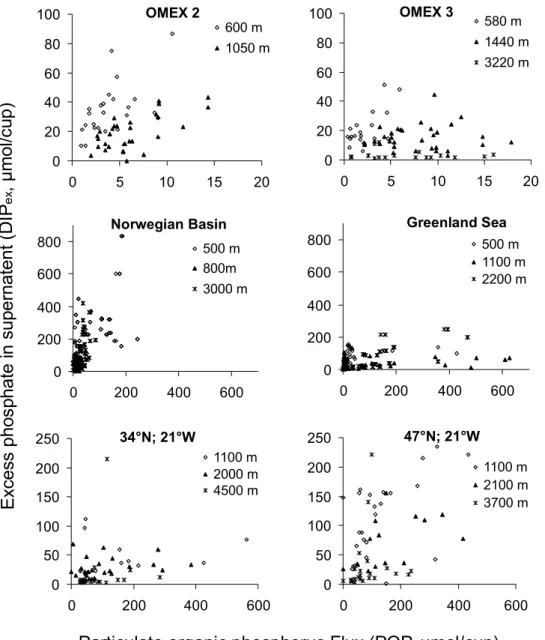
A. N. Antia: Revising the stochiometry of mixed layer exportFigure 1: Relationship between particulate organic phosphorus (POP) and excess dissolved 191
phosphate (DIPex) in sediment trap cups at different sites and depths as listed in Table 1.
Particulate organic phosphorus Flux (POP, µmol/cup)
E
xc
es
s
ph
os
ph
at
e
in
s
up
er
na
te
nt
(
D
IP
, µ
m
ol
/c
up
)
e x 0 20 40 60 80 100 0 5 10 15 20 600 m 1050 m OMEX 2 0 20 40 60 80 100 0 5 10 15 20 580 m 1440 m 3220 m OMEX 3 0 200 400 600 800 0 200 400 600 500 m 800m 3000 m Norwegian Basin 0 200 400 600 800 0 200 400 600 500 m 1100 m 2200 m Greenland Sea 0 50 100 150 200 250 0 200 400 600 1100 m 2000 m 4500 m 34°N; 21°W 0 50 100 150 200 250 0 200 400 600 1100 m 2100 m 3700 m 47°N; 21°W 26Fig. 1. Relationship between particulate organic phosphorus (POP) and excess dissolved phosphate (DIPex)in sediment trap cups at different
sites and depths as listed in Table 1.
were defined as values lying outside of three standard devia-tions from the mean and discarded from calculadevia-tions. Gener-ally 0, 1 or 2 outliers per set of 21–40 values were identified and eliminated.
Measurements done on the OMEX traps are compared to literature values taken from trap deployments in other en-vironments. Data from the Greenland and Norwegian Seas were provided by the Special Research Project (313) of the University of Kiel and are available under http://www.ifm. uni-kiel.de/jgofs/dm/. Data from traps in the Southern Ocean are reported in Trull et al. (2001) and were obtained from Bray et al. (2000). The sources of other data are given in the caption of Table 1.
3 Results
3.1 Excess phosphorus in supernatant
For all elements examined, moderate to substantial excess dissolved concentrations in supernatent were found. This was most pronounced for phosphorus, with a mean of 90±6.4% of the total phosphorus in trap jars found as ex-cess phosphate (DIPex) in supernatent at 600 m at the OMEX 3 site (Fig. 1a, Table 1). Excess dissolved organic phos-phorus could not be detected, with a mean measured con-centration of 1.04±2.7 µM. With increasing trap depth the proportion of DIPex to total phosphorus found in the cups
192 A. N. Antia: Revising the stochiometry of mixed layer export
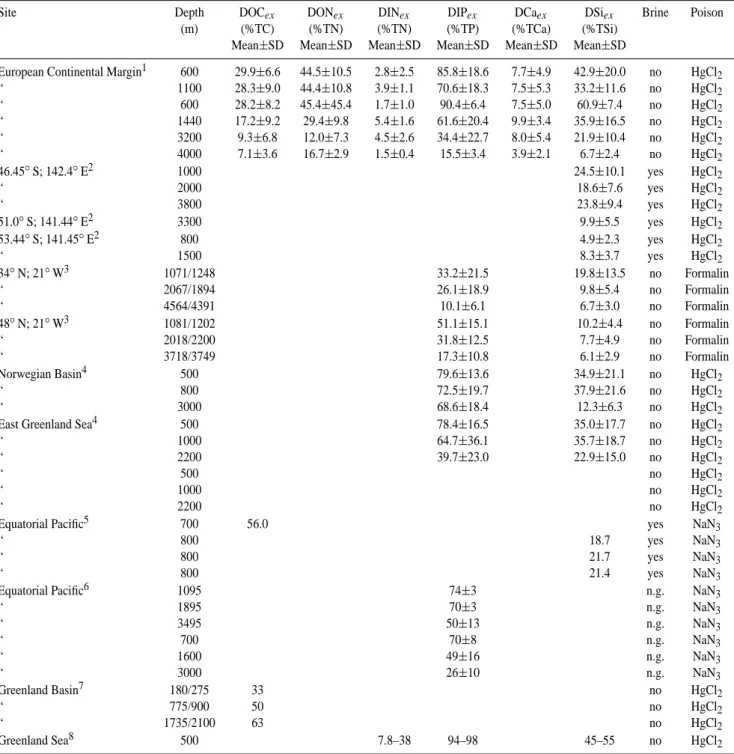
Table 1. The percentage contribution of excess dissolved organic carbon (DOCex), dissolved organic- and inorganic nitrogen (DONex,
DINex), dissolved inorganic phosphorus (DIPex), dissolved calcium (DCaex) and silicic acid (DSiex) to total (particulate + dissolved)
carbon, nitrogen, phosphorus, calcium and silica fluxes (TC, TN, TP, TCa and TSi, respectively) in sediment traps below the winter mixed layer.
Site Depth DOCex DONex DINex DIPex DCaex DSiex Brine Poison
(m) (%TC) (%TN) (%TN) (%TP) (%TCa) (%TSi) Mean±SD Mean±SD Mean±SD Mean±SD Mean±SD Mean±SD
European Continental Margin1 600 29.9±6.6 44.5±10.5 2.8±2.5 85.8±18.6 7.7±4.9 42.9±20.0 no HgCl2 “ 1100 28.3±9.0 44.4±10.8 3.9±1.1 70.6±18.3 7.5±5.3 33.2±11.6 no HgCl2 “ 600 28.2±8.2 45.4±45.4 1.7±1.0 90.4±6.4 7.5±5.0 60.9±7.4 no HgCl2 “ 1440 17.2±9.2 29.4±9.8 5.4±1.6 61.6±20.4 9.9±3.4 35.9±16.5 no HgCl2 “ 3200 9.3±6.8 12.0±7.3 4.5±2.6 34.4±22.7 8.0±5.4 21.9±10.4 no HgCl2 “ 4000 7.1±3.6 16.7±2.9 1.5±0.4 15.5±3.4 3.9±2.1 6.7±2.4 no HgCl2 46.45◦S; 142.4◦E2 1000 24.5±10.1 yes HgCl2 “ 2000 18.6±7.6 yes HgCl2 “ 3800 23.8±9.4 yes HgCl2 51.0◦S; 141.44◦E2 3300 9.9±5.5 yes HgCl2 53.44◦S; 141.45◦E2 800 4.9±2.3 yes HgCl2 “ 1500 8.3±3.7 yes HgCl2 34◦N; 21◦W3 1071/1248 33.2±21.5 19.8±13.5 no Formalin “ 2067/1894 26.1±18.9 9.8±5.4 no Formalin “ 4564/4391 10.1±6.1 6.7±3.0 no Formalin 48◦N; 21◦W3 1081/1202 51.1±15.1 10.2±4.4 no Formalin “ 2018/2200 31.8±12.5 7.7±4.9 no Formalin “ 3718/3749 17.3±10.8 6.1±2.9 no Formalin Norwegian Basin4 500 79.6±13.6 34.9±21.1 no HgCl2 “ 800 72.5±19.7 37.9±21.6 no HgCl2 “ 3000 68.6±18.4 12.3±6.3 no HgCl2
East Greenland Sea4 500 78.4±16.5 35.0±17.7 no HgCl2
“ 1000 64.7±36.1 35.7±18.7 no HgCl2
“ 2200 39.7±23.0 22.9±15.0 no HgCl2
“ 500 no HgCl2
“ 1000 no HgCl2
“ 2200 no HgCl2
Equatorial Pacific5 700 56.0 yes NaN3
“ 800 18.7 yes NaN3
“ 800 21.7 yes NaN3
“ 800 21.4 yes NaN3
Equatorial Pacific6 1095 74±3 n.g. NaN3
“ 1895 70±3 n.g. NaN3 “ 3495 50±13 n.g. NaN3 “ 700 70±8 n.g. NaN3 “ 1600 49±16 n.g. NaN3 “ 3000 26±10 n.g. NaN3 Greenland Basin7 180/275 33 no HgCl2 “ 775/900 50 no HgCl2 “ 1735/2100 63 no HgCl2 Greenland Sea8 500 7.8–38 94–98 45–55 no HgCl2
1This study and Antia et al. (1999);2Data from Bray et al. (2000), reported in Trull et al. (2001);3Honjo and Mangannini (1993);4Special
Research Project (SFB313), Universtiy of Kiel, available at http://www.ifm.uni-kiel.de/jgofs/dm/.5Dymond and Collier (1989);6Dymond and Collier (1999);7Noji et al. (1999);8von Bodungen et al. (1991) n.g.=not given
decreased substantially, accounting for 61±20.4%, 34±23% and 15±3.4% of total phosphorus at 1440 m, 3220 m and
4000 m respectively. Site-specific differences in dissolved phosphorus fluxes between these traps and literature values
A. N. Antia: Revising the stochiometry of mixed layer export 193 were small (Table 1), with a similar proportion of total
phos-phorus as DIPexat two sites in the Norwegian Sea and East Greenland Sea (ca. 80% at 500 m, decreasing to 68 and 40% at 3000 m and 2200 m respectively; von Bodungen et al., 1991). Lower DIPexconcentrations were found in the tem-perate north Atlantic at 34◦N and 48◦N along 21◦W, de-creasing from 30–50% at 1000 m to 17% at 3700 m and 10% at 4500 m. Weak linear correlations between particulate or-ganic phosphorus and DIPexwere found at all sites (Fig. 1).
Since samples were processed a minimum of 5 months after sample retrieval a time-course of increase in dis-solved elemental concentrations in supernatent could not be investigated. After the initial analyses in 1994, splits and su-pernatent were stored at 4◦C in the dark and reanalyzed in 2004 for selected variables. During this long-term storage particulate organic phosphorus showed no decrease, indicat-ing that further degradation or leachindicat-ing did not occur. For particulate organic phosphorus measured in 1994 (POP1994) and the measurements repeated in 2004 (POP2004) the fol-lowing relationship was found:
POP1994= 0.09 (±0.07)+1.03(±0.28) POP2004; n= 136, r2=0.89.
3.2 Excess silicate in supernatant
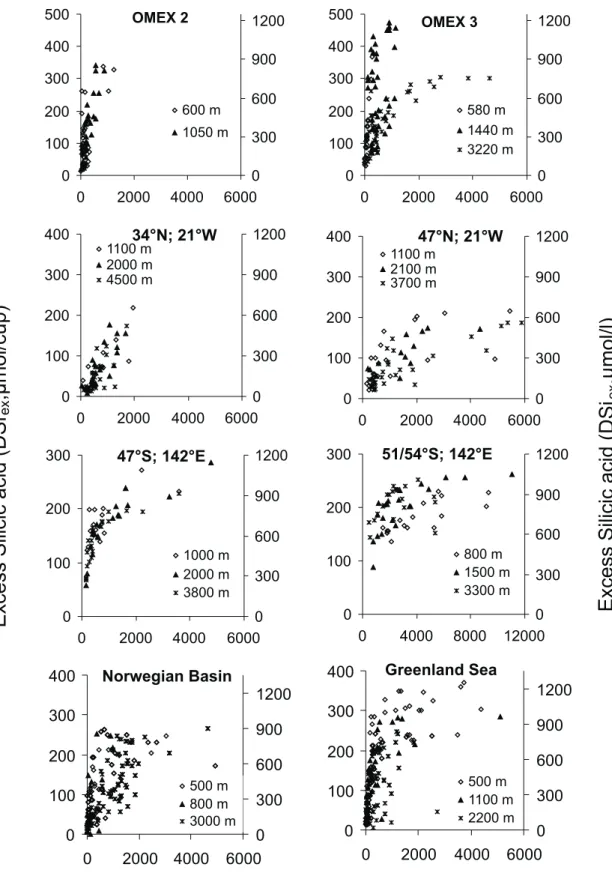
High excess dissolved silicate (DSiex)concentrations were found in all traps studied (Fig. 2). Maximum DSiexvalues in supernatent of ca. 1000–1200 µM (at which concentration silicate saturates in seawater at ca. 2◦C and pH 8, Rickert et al., 2002) were seen, with the initial slope of PSi to DSiex decreasing with increasing water depth. Maximal losses of SiO2to the dissolved phase at the 500 m horizon amounted to between 61 (±7.4)% at the OMEX 3 site and 35 (±21.1)% in the Norwegian Sea. Below 3500 m a relatively constant fraction (6.1–6.7%) of the total siliceous flux was found as DSiex(OMEX 4 at 4000 m; 34◦N, 21◦W at 4500 m; 47◦N, 21◦W at 3700 m). Remarkably low dissolution of SiO2into supernatent (<5 to 10%) was seen in traps from the Southern Ocean at 51◦S and 53◦S, up to an order of magnitude lower than the other sites at similar depth.
3.3 Excess nitrogen in supernatant
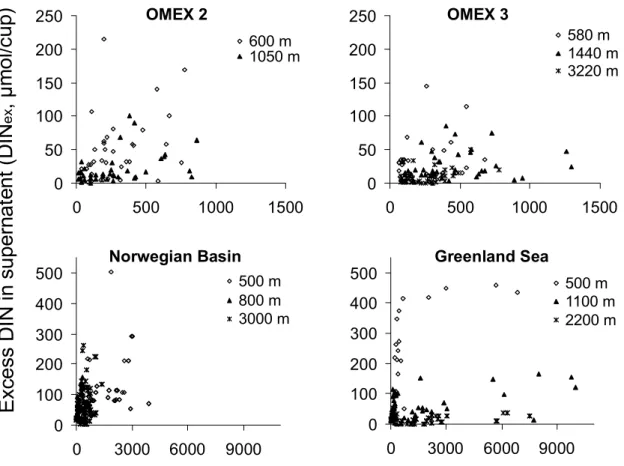
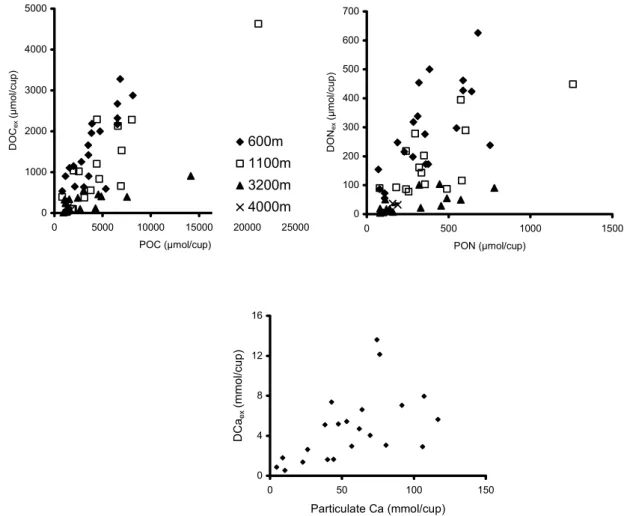
For nitrogen too substantial excess concentrations in su-pernatent were seen. Excess dissolved inorganic nitrogen (DINex=excess NO3+NH+4)was low (ranging from 1.5 to 5.4% of total nitrogen, Fig. 3 and Table 1) and consisted al-most exclusively of NH+4. Excess dissolved organic nitrogen (DONex)accounted by far for the bulk of dissolved nitrogen species and amounted to 45 (±13)% and 16.7 (±2.9)% of to-tal nitrogen fluxes in the traps at 600 m and 4000 m, respec-tively (Fig. 4a). DONexwas linearly related to PON fluxes and showed a decreasing trend as proportion of total nitrogen flux with trap depth.
3.4 Excess carbon in supernatant
A similar trend was observed for excess dissolved organic carbon (DOCex) in supernatent, in that it was linearly re-lated to POC flux and decreased with increasing trap depth (Fig. 4b). Altogether, 30 (±6.6)% and 7 (±3.6)% of total car-bon was found as DOCexat 600 m and 4000 m, respectively. Dissolved inorganic carbon (DIC) was not measured since the cup water was buffered, precluding measurements of the carbonate system. However, an attempt is made to judge the extent of the problem by assuming (as a first approxima-tion) that continual respiration after particles settle in the jars would produce dissolved inorganic carbon (DIC) and nitro-gen (DIN) whereas enzymatic degradation and leaching from particles would give out dissolved organic carbon (DOC) and nitrogen (DON), roughly in the Redfield C:N ratio of 6.6:1. Thus, multiplying the DIN concentration by 6.6 the ammount of DIC produced in the traps would be 55–316 µM, or 2.8– 4.3% of particulate organic carbon (POC) flux and 1.7–3.3% of total organic carbon (POC+DOC) flux.
Excess dissolved Ca (DCaex) was measured to check for inorganic carbon losses from the particles; there was an increase of 3.9–7.9% in supernatant above background dissolved Ca levels (9.9% at 1440 m). As mentioned, in buffered systems alterations in pH, that would indicate changes in the DIC and alkalinity pools due to calcite dis-solution and respiration (that have opposing effects on pH), cannot be used. In unbuffered systems however, a rough cal-culation (made using the “CO2SYS” program of E. Lewis) indicates that these could cancel each other, resulting in a small loss of calcite at constant pH values. For example, the dissolution of calcite in the traps studies (on average 3 mg calcium per 400-ml cup) would produce an alkalinity incre-ment of 350 µeqt/l and DIC change of 175 µM. At a temper-ature of 4◦C, and initial DIC and Alkalinity values of 2100 and 2300 µM, respectively, this would increase pH by 0.2 units. Back-calculating the amount of respiration that would be needed “balance” this (i.e. bring pH back to the original value) yields 111 µM DIC added due to respiration. This is within the range (55–316 µM DIC) estimated to result from respiration in the cups (see previous paragraph). Nonethe-less, these processes would have a small effect on total sol-ubilization losses since most organic carbon is lost as DOC with the calcite losses being relatively small. This approach may be useful in shallow, short-term trap deployments where additional measurements of oxygen depletion could be used to constrain the extent of respiration in the jars.
3.5 Swimmer-related excess dissolved fluxes
For the trap at 600 m, where maximal swimmers were found, there was no correlation between swimmer carbon (a bet-ter estimation of swimmer flux than numbers alone) and DOC or DON values (r2=0.17, n=37). At this depth, swim-mer biomass was low compared to total organic carbon and
194 A. N. Antia: Revising the stochiometry of mixed layer export 0 100 200 300 0 2000 4000 6000 0 300 600 900 1200 1000 m 2000 m 3800 m
47°S; 142°E
0 100 200 300 0 4000 8000 12000 0 300 600 900 1200 800 m 1500 m 3300 m51/54°S; 142°E
0
100
200
300
400
0
2000
4000
6000
0
300
600
900
1200
500 m 800 m 3000 mNorwegian Basin
0
100
200
300
400
0
2000
4000
6000
0
300
600
900
1200
500 m 1100 m 2200 mGreenland Sea
0 100 200 300 400 500 0 2000 4000 6000 0 300 600 900 1200 600 m 1050 m OMEX 2 0 100 200 300 400 500 0 2000 4000 6000 0 300 600 900 1200 580 m 1440 m 3220 m OMEX 3 0 100 200 300 400 0 2000 4000 6000 0 300 600 900 1200 1100 m 2000 m 4500 m34°N; 21°W
0 100 200 300 400 0 2000 4000 6000 0 300 600 900 1200 1100 m 2100 m 3700 m47°N; 21°W
Particulate Silica Flux (PSi,µmol/cup)
ExcessSilicicacid(DSi
ex,µmol/l)
ExcessSilicicacid(DSi
ex,µmol/cup)
Fig. 2. Relationship between particulate biogenic silica (PSi; x-axes) and excess dissolved silicic acid (DSiex, left axes) in sediment trap
A. N. Antia: Revising the stochiometry of mixed layer export 195
Figure 3: Relationship between particulate organic nitrogen (PON) and excess dissolved
inorganic nitrogen (ammonium and nitrate) (DIN
ex) in sediment trap cups at different sites
and depths as listed in table 1.
Particulate Organic Nitrogen Flux (PON, µmol/cup)
E
xc
es
s
D
IN
in
s
up
er
na
te
nt
(
D
IN
, µ
m
o
l/c
up
)
e x0
50
100
150
200
250
0
500
1000
1500
600 m 1050 mOMEX 2
0
50
100
150
200
250
0
500
1000
1500
580 m 1440 m 3220 mOMEX 3
0
100
200
300
400
500
0
3000
6000
9000
500 m 800 m 3000 mNorwegian Basin
0
100
200
300
400
500
0
3000
6000
9000
500 m 1100 m 2200 mGreenland Sea
28
Fig. 3. Relationship between particulate organic nitrogen (PON) and excess dissolved inorganic nitrogen (ammonium and nitrate) (DINex)
in sediment trap cups at different sites and depths as listed in Table 1.
nitrogen fluxes, accounting for a mean of 10.9 (±7.1)% of total carbon (DOC+POC) in the traps. Even assuming that 20% of the swimmer biomass leached into the surrounding seawater, this effect would be negligible on DOC increase. The contribution of swimmers has therefore been neglected and it is assumed that the excess DOC and DON originated only from passively sinking particles.
3.6 Correction of C:N:P, N:Si and POC:PIC ratios
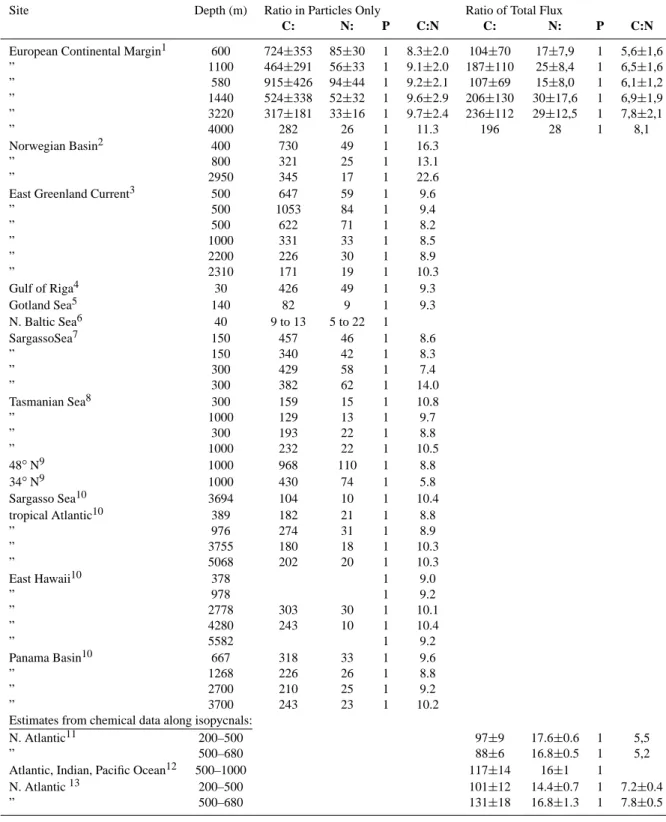
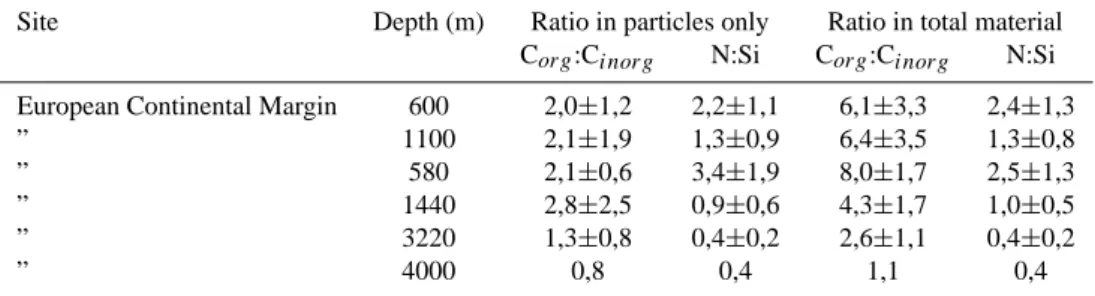
Table 2 summarizes the molar ratios of C:N:P for the traps analyzed in this study as well as other values from the literature. Relying on information from particulate analy-ses only, the C:P and N:P ratios are highly in excess of the Redfield value of 106:1 and 16:1 respectively, even though the scatter in the data is large. Where corrections for the dis-solved fluxes are available for all elements, mean ratios at the base of the mixed layer are in good agreement with the Red-field ratios, increasing with depth to 4000 m. Large shifts in the POC:PIC ratio are seen when accounting for excess dis-solved fluxes, increasing from 2:1 to a mean of 7:1 at 600 m. For nitrogen and silica, similar rates of dissolution result in
large corrections of the absolute flux values but the ratio of N:Si remains unchanged (Table 3).
4 Discussion
The presence of excess dissolved material in the trap super-natent water is the most direct evidence that particles settled within the cups are altered and solubilized during storage. No matter how these excess dissolved concentrations result: from continual particle degradation, passive leaching of ag-gregate pore fluids, through gradual physical breakdown of dead membranes and organic entities, or through chemical dissolution such as for silica and calcium carbonate, a cor-rect estimation of the flux reaching the traps requires correc-tion for this artifact. Determining the contribucorrec-tion of each of these processes to net solubilization is however important in considering traps deployed in differing environments with different conditions of sample storage, treatment and analy-ses. The analyses here is restricted to mid-water traps with low swimmer abundances, where long-term deployments and storage of samples allows a straightforward determination of
196 A. N. Antia: Revising the stochiometry of mixed layer export
Figure 4: Relationship between particulate organic carbon (a) and nitrogen (b) to the excess dissolved concentrations of organic carbon and nitrogen respectively. (c) Relationship between particulate calcium and excess dissolved calcium in trap samples. All data are from the OMEX traps only.
0 1000 2000 3000 4000 5000 0 5000 10000 15000 20000 25000 POC (µmol/cup) DOC ex (µmol/cup) 600m 1100m 3200m 4000m 0 100 200 300 400 500 600 700 0 500 1000 1500 PON (µmol/cup) DON ex (µmol/cup) 0 4 8 12 16 0 50 100 Particulate Ca (mmol/cup) DCa ex (mmol/cup) 150 29
Fig. 4. Relationship between particulate organic carbon (a) and nitrogen (b) to the excess dissolved concentrations of organic carbon and nitrogen respectively. (c) Relationship between particulate calcium and excess dissolved calcium in trap samples. All data are from the OMEX traps only.
excess elements in supernatent. Shallow deployments for merely hours to days in high-swimmer environments would require a different approach, since swimmers are a major source of dissolved elements in such trap samples, and there is no reliable way to separate swimmer contribution of dif-fering elements from that originating from the passive flux. 4.1 Aggregates as “carriers” of dissolved elements The fact that large sinking aggregates, the main vehicles for vertical elemental fluxes (McCave, 1975; Fowler and Knauer, 1986), carry dissolved loads in their interstitial spaces has been recognized for some time. Aggregates are greatly enriched in DOM and inorganic products of rem-ineralisation and dissolution such as phosphate and silicate (Shanks and Trent, 1979; Alldredge, 2000; Brzezinski et al., 1997; see Simon et al., 2002 for a summary). A substantial fraction of the dissolved loads leave the aggregates within the euphotic zone (Kiørboe et al., 2001). Nonetheless, where the rate of remineralisation by aggregate bacteria exceeds uptake
of substrate and loss through outward diffusion, as found by Smith et al. (1992), pore fluids of aggregates are replenished faster than depleted. Fecal pellets, an important aggregate type, also contain large amounts of dissolved organic matter (DOM) that leach out into the surrounding seawater (Urban-Rich, 1999). Packed with bacteria and heterotrophic proto-zoa (Silver and Alldredge, 1981; Simon et al., 2002), these micro-environments are hotspots of microbial activity in the water column and greatly affect the cycling of elements in the water column. Investigating the time-course microbial degradation of fresh diatom aggregates, Grossart and Ploug (2001) found significant carbon and nitrogen contents and high microbial turnover rates after 8 days of incubation, dur-ing which time aggregates in the natural environment would be well below the winter mixed layer.
As Alldredge (2000) points out, the dissolved loads in the interstitial spaces of aggregates must contribute substantially to vertical flux. However, practically all measurements of DOM within aggregates have been done within the upper
A. N. Antia: Revising the stochiometry of mixed layer export 197
Table 2. Atomic carbon:nitrogen:phosphorus (C:N:P) ratios from the particulate fraction only and total (particulate + dissolved) material in sediment traps and from chemical analyses along isopycnals.
Site Depth (m) Ratio in Particles Only Ratio of Total Flux
C: N: P C:N C: N: P C:N
European Continental Margin1 600 724±353 85±30 1 8.3±2.0 104±70 17±7,9 1 5,6±1,6
” 1100 464±291 56±33 1 9.1±2.0 187±110 25±8,4 1 6,5±1,6 ” 580 915±426 94±44 1 9.2±2.1 107±69 15±8,0 1 6,1±1,2 ” 1440 524±338 52±32 1 9.6±2.9 206±130 30±17,6 1 6,9±1,9 ” 3220 317±181 33±16 1 9.7±2.4 236±112 29±12,5 1 7,8±2,1 ” 4000 282 26 1 11.3 196 28 1 8,1 Norwegian Basin2 400 730 49 1 16.3 ” 800 321 25 1 13.1 ” 2950 345 17 1 22.6
East Greenland Current3 500 647 59 1 9.6
” 500 1053 84 1 9.4 ” 500 622 71 1 8.2 ” 1000 331 33 1 8.5 ” 2200 226 30 1 8.9 ” 2310 171 19 1 10.3 Gulf of Riga4 30 426 49 1 9.3 Gotland Sea5 140 82 9 1 9.3 N. Baltic Sea6 40 9 to 13 5 to 22 1 SargassoSea7 150 457 46 1 8.6 ” 150 340 42 1 8.3 ” 300 429 58 1 7.4 ” 300 382 62 1 14.0 Tasmanian Sea8 300 159 15 1 10.8 ” 1000 129 13 1 9.7 ” 300 193 22 1 8.8 ” 1000 232 22 1 10.5 48◦N9 1000 968 110 1 8.8 34◦N9 1000 430 74 1 5.8 Sargasso Sea10 3694 104 10 1 10.4 tropical Atlantic10 389 182 21 1 8.8 ” 976 274 31 1 8.9 ” 3755 180 18 1 10.3 ” 5068 202 20 1 10.3 East Hawaii10 378 1 9.0 ” 978 1 9.2 ” 2778 303 30 1 10.1 ” 4280 243 10 1 10.4 ” 5582 1 9.2 Panama Basin10 667 318 33 1 9.6 ” 1268 226 26 1 8.8 ” 2700 210 25 1 9.2 ” 3700 243 23 1 10.2
Estimates from chemical data along isopycnals:
N. Atlantic11 200–500 97±9 17.6±0.6 1 5,5
” 500–680 88±6 16.8±0.5 1 5,2
Atlantic, Indian, Pacific Ocean12 500–1000 117±14 16±1 1
N. Atlantic13 200–500 101±12 14.4±0.7 1 7.2±0.4
” 500–680 131±18 16.8±1.3 1 7.8±0.5
1This study, 2,3Special Research Project (SFB313), Universtiy of Kiel, available at http://www.ifm.uni-kiel.de/jgofs/dm/ . 4Reigstad et
al. (1999)5Struck et al. (2004). 6Heiskanen et al. (1998)7Oceanic Flux Program of WHOI, (http://www.whoi.edu/science/MCG/ofp/)
198 A. N. Antia: Revising the stochiometry of mixed layer export
Table 3. Ratios of particulate organic carbon: particulate inorganic carbon (POC:PIC) and atomic nitrogen: silica (N:Si) ratios from the particulate fraction only and total (particulate + dissolved) material in sediment traps.
Site Depth (m) Ratio in particles only Ratio in total material Corg:Cinorg N:Si Corg:Cinorg N:Si
European Continental Margin 600 2,0±1,2 2,2±1,1 6,1±3,3 2,4±1,3
” 1100 2,1±1,9 1,3±0,9 6,4±3,5 1,3±0,8
” 580 2,1±0,6 3,4±1,9 8,0±1,7 2,5±1,3
” 1440 2,8±2,5 0,9±0,6 4,3±1,7 1,0±0,5
” 3220 1,3±0,8 0,4±0,2 2,6±1,1 0,4±0,2
” 4000 0,8 0,4 1,1 0,4
water column; the DOM load in sub-surface and deep aggre-gates is unknown. The data presented here provide a first, al-beit indirect, estimate of dissolved elemental concentrations in large particles in the mid- and lower water column. Ag-gregates are thus carriers of significant amounts of dissolved material, here called the “particle-associated dissolved flux”. The data here can be compared to those of Alldredge (2000) who measured POC and DOC on aggregates from 2–20 m water depth. At these shallow depths DOC was on average 31% of total carbon in the particles whereas in trap material at 600 m depth (this study) DOCexwas on average 30% of total carbon in the cups, suggesting that a signifi-cant proportion of labile organic carbon is still being recy-cled within aggregates reaching the base of the mixed layer, and that losses due to leaching, diffusion and assimilation by organisms on and in the aggregates are lower than the net DOC production rates as shown by Smith et al. (1992). Con-siderably lower DOCex, accounting for <10% total carbon, is exported below 1400 m (Fig. 4a). The linear relationship between POC flux and DOCeximplies no significant season-ality in the contribution of dissolved matter to total fluxes, but rather a constant internal aggregate remineralisation by bacteria and protozoa, in proportion to organic matter avail-ability.
4.2 Particle alteration in trap jars
Aside from passive leaching out of large particles, other pro-cesses such as continued microbial degradation, the activ-ity of free hydrolytic enzymes, physical destruction of dead organisms and damaged membranes and chemical dissolu-tion could also contribute to the excess concentradissolu-tions of dis-solved elements measured. Particle breakdown by microbial activity is assumed to be stopped by the addition of poison to the cup solution, but this may not be instantaneous. Al-though at the concentration of mercuric chloride used in this study Lee et al. (1992) reported cessation of microbial activ-ity in a concentrated particle suspension, penetration of the poison into aggregates would be rate-limited by the diffusion coefficient applicable. There is little data on the diffusion constants applicable for aggregates, but these are likely to be considerably slower than for single cells due to the
frac-tal, mucous/gel structure of organic aggregates. Brzezinski et al. (1987) estimated 2 orders of magnitude slower diffu-sivity rates for silica from diatom aggregates than those for elemental silica through a permeous membrane. This con-siderably slower transport for solutes into aggregates could result in some continuation of microbial degradation before poison concentrations in the aggregates become effective.
Free enzymes such as phosphatases and proteases are also concentrated in aggregates and though their activity is strongly inhibited by both mercuric chloride and formalde-hyde at the concentrations used to poison trap samples (Christian and Karl, 1995; Liu et al., 1997), the same time constraints on penetration of poison as discussed above would apply. In as far as free phosphatases degrade larger dissolved organic entities to phosphate and low molecular weight organic material (Hoppe, 2003), they would con-tribute to alteration and not production of dissolved species.
For silica and calcium, where dissolution is controlled both by physico-chemical factors as well as biological degra-dation, dissolution and leaching may continue after microbial activity is stopped. Silica dissolution on organic aggregates is accelerated by destruction of the organic frustule matrix through bacterial protease activity (Bidle and Azam, 2001), and diatomaceous aggregates in the upper water column ac-cumulate silicate in their interstitial spaces at up to 100-fold higher concentrations than in the surrounding seawater (Brzezinski et al., 1997). Although seawater is greatly un-dersaturated with respect to silicic acid, high siliceous fluxes and leaching out of particles cause saturation of silicate in su-pernatent water (Fig. 2), presumably stopping further losses. Bauerfeind and von Bodungen1show the dissolution kinet-ics of silicate in sediment traps with a clear saturation at high particulate silica fluxes similar to that recorded here.
During processing of trap samples (picking of swimmers, splitting and filtering), particles are rinsed with seawater and partially broken, and particularly during filtering the interstitial spaces are bled. However, presuming equilib-rium between the particles and surrounding seawater during 1Bauerfeind, E. and von Bodungen, B.: Loss of biogenic
partic-ulate silicon in sediment trap samples through dissolution – does it matter? Marine Geology, in review, 2005.
A. N. Antia: Revising the stochiometry of mixed layer export 199 the long storage times used here, adding the excess
elemen-tal fluxes in supernatent to the measured particulate flux ac-counts for this loss. Filtration of particles prior to analysis, whether from water bottles, trap jars or in situ pumps, causes loss of interstitial fluids and underestimation (to some as yet unknown degree) of their elemental loads. This “particle-associated dissolved load” is not measured in either the par-ticulate or dissolved pool using current protocols, and is po-tentially missing in estimates of elemental standing stocks and vertical flux. This caveat is common to all analyses of particles in the water column and warrants attention in all biogeochemical studies.
4.3 Factors affecting differences in solubilization
Factors such as fixative/poison type, brine, buffer, and pres-ence of swimmers are likely to affect leaching of intersti-tial fluids. Where data are available (Table 1), traps with similar treatments (e.g. traps in the Greenland Sea, Norwe-gian Sea and European Continental Margin all had mercuric chloride, with no brine addition), similar proportions of ex-cess dissolved phosphorus and silicate were found in super-natent at similar depths. For silicate, traps in the South-ern Ocean showed significantly lower DSiexconcentrations as compared to those from other areas; however, since both the species composition and biogeochemical regimes as well as trap treatment (addition of brine in the Southern Ocean traps) differed, it is difficult to separate these effects. For traps at similar sites and depths (the OMEX traps and data from Honjo and Manganini, 1993), there are factor of 2 dif-ferences in the slopes of dissolved to particulate fluxes of phosphorus and silicon measured (Figs. 1 and 2), with higher proportions of dissolved elements in the mercuric-chloride-poisoned OMEX traps. These may be due to differences in poison/fixative used since formaldehyde is known to stabilize membranes and chitinous structures, possibly making them less permeable for leaching (e.g. Lee et al., 1992). Rather unfortunately, the use of formaldehyde as a fixative, as rec-ommended by the JGOFS protocols (http://usjgofs.whoi.edu/ protocols rpt 19.html) precludes DOC/DON measurements in supernatant, the effect of which can be substantial in the mesopelagic zone.
For silica in particular, the initial slope of DSiex against PSi flux varies both with depth and site. At 51◦S in the Southern Ocean where the large, heavily silicified
Fragillar-iopsis kerguelensis dominated diatom export (Trull et al.,
2001), the silica dissolution was half of that found at other sites at the same depths. Such site-specific differences in dissolution of biogenic silica has been reported by Rickert et al. (2002) who found a factor of 10 lower dissolution of silica in the Southern Ocean as compared to the Norwegian Sea, related to differences in the reactivity of diatom shells. Species-specific differences in the dissolution of diatom frus-tules (Kohly, 1998), and strong differences in reactivity of biogenic silica linked to the structural integrity, organic
coat-ing and detrital minerals are manifested in higher silica con-tents of Southern Ocean sediments as compared to similar latitudes in the North Atlantic (Schl¨uter et al., 2000).
Although in this study swimmer fluxes were low and neg-ligible compared to the passive sinking fluxes, swimmers may strongly falsify results in shallow traps (Steinberg et al., 1998), where swimmer biomass may equal or exceed the pas-sive sinking flux. Addition of brine, that causes zooplankton swimmers to herniate in the traps (Peterson and Dam, 1990), would magnify the problem. Since swimmers, through her-niation, excretion and leaching will introduce large dissolved concentrations that cannot reliably be separated from the fraction originating from sinking particles, swimmer avoid-ance should be a priority. For very short term deployments of shallow traps solubilization may not present a major prob-lem for all eprob-lements, but at present little is know about this problem.
For elements other than those presented here, the rate and degree of dissolution would need to be individually deter-mined. Knauer et al. (1984) showed rapid dissolution of up to >80% and >70% of sedimenting manganese and cad-mium respectively and similarly high dissolution, although proceeding at a slower rate, for zinc. Pohl et al. (2004) found only half those values in their traps. Particle-reactive ele-ments such as iron and thorium are, predictably, not found in supernatant (Pohl et al., 2004). These results imply that the application of Th:POC ratios from traps to estimate fluxes based on radionucleide profiles would require an estimate of the relative losses of these elements to the dissolved phase.
Given the differing stoichiometry of POM and DOM and the different time scales of their production and mineral-isation (Hopkinson and Vallino, 2005) large aggregates as carriers of both particulate and dissolved material should be treated as a single entity requiring a consolidated analytical approach. This would include collection of interstitial waters during filtration with analyses of excess dissolved elements, as has been done in the upper water column in but relatively few studies (Brzezinski et al., 1997; Alldredge 2000). 4.4 “Correcting” for particle solubilization
Correcting for solubilization losses from particles can have severe to negligible effects depending on element and trap depth, both in terms of the absolute values of flux as well as the stoichiometry of settling material (Tables 2 and 3). Whereas at the base of the winter mixed layer at around 500 m, phosphorus would need to be corrected upwards by a factor of up to 10, carbon and nitrogen flux corrections are between factors of 1.4 to 2. Higher dissolution of sil-ica would bring the total silsil-ica fluxes up by a factor of 2 to 2.5. Total calcium fluxes are practically unaffected by sol-ubilization. The “correction factors” are similar to the er-rors due to hydrodynamic biases of moored traps, estimated by water column radioisotope budgets below the mixed layer (Scholten et al., 2001; Yu et al., 2001). For the OMEX traps,
200 A. N. Antia: Revising the stochiometry of mixed layer export for example, Scholten et al. (2001) estimate collection
ef-ficiencies of ca. 38% at 600 m at both mooring sites, 90% at 1050 m at OMEX 2 and 113% and 128% at 1440 m and 3220 m at OMEX 3. As these authors pointed out, these esti-mates are to be treated with caution, since no direct measure-ments in the water column were available at these sites and because of their proximity to the shelf edge, where particu-larly in the deeper traps lateral advection could have caused the “overtrapping” signal. Nonetheless, it should be pointed out that this correction, based on calculated and measured fluxes of230Th, is unaffected by solubilization since thorium has a high affinity for particles and is not found in superna-tent water (Pohl et al., 2004). The factor of 2.5 “correction” based on the thorium budgets for the 600 m traps is simi-lar in magnitude to that for organic carbon and nitrogen and slightly lower than that for phosphorus when accounting for solubilization. Both these effects (solubilization and hydro-dynamic biases) decrease with increasing water depth and, when accounted for, will increase the estimates of mid-water remineralisation rates that have been derived from sediment trap data (e.g. Martin et al., 1987; Antia et al., 2001). These “corrections”, by increasing export estimates, may narrow the gap between measured particle fluxes and those based on subsurface oxygen utilization rates (e.g. Jenkins, 1982). They would also substantially decrease the estimated “lat-eral” or “advective” fluxes that are assumed where an in-crease in flux with depth is measured (e.g. Neuer et al., 1997; Antia et al., 1999) and narrow the observed discrepancy be-tween vertical POC fluxes and sediment community carbon demand (Lampitt et al., 1995; Smith et al., 2001). Central to the need or even ability to correct for solubilization, trap col-lection bias or other artifacts is our confidence in the level of accuracy with which we can measure sinking fluxes and the level of accuracy that is needed for the process to be inves-tigated. With more attention being paid to methodological refinements and calibration of trap behavior under various conditions, a higher level of accuracy can be achieved by applying appropriate protocols for measurement of the col-lected particles.
4.5 Elemental ratios in total (dissolved + particulate) flux The ratio of major elements (organic- and inorganic carbon, nitrogen, phosphorus and silicon) leaving the upper mixed layer is crucial in estimating the net sequestration potential of the biological pump and the global distribution of deep-water nutrient ratios. Biogeochemical models routinely use nitrate fluxes to estimate carbon export (e.g. MacCready and Quay, 2001) relying on the mean global validity of the Redfield sto-ichiometry of C:N uptake in organic matter. Although there is evidence that, at least seasonally, particle formation with a C:N ratio significantly higher than the Redfield Ratio takes place (K¨ortzinger et al., 2001a; Engel et al., 2002) the present analysis indicates that export at the base of the mixed layer does not reflect this in the annual mean, at least in the North
Atlantic. More such investigations are required from other areas.
A large amount of data on the elemental ratios of sink-ing particles arissink-ing from sediment traps (summarized in Ta-ble 2) uniformly shows C:N ratios above the Redfield Ratio at the base of the mixed layer. In a compilation of trap and in situ pump data Schneider et al. (2003) reported particu-late C:N ratios above 8.5 below 500 m depth, increasing by 0.2 per 1000 m. The OMEX data reported here are in agree-ment with this trend for the particulate fraction only. How-ever when corrected for dissolved C, N and P in the traps the elemental ratios are almost exactly 106:16:1 (Table 1). Total C:N ratios not significantly different from the Redfield value (6.1±1.2) at 600 m depth at this site are also in agree-ment with those calculated by K¨ortzinger et al. (2001b) along isopycnals at similar depths in the North Atlantic (6.5±0.2). K¨ortzinger et al. (2001b) in turn revised the previously lower estimate (C:N of 5.1±0.2:1) of Takahashi et al. (1985) by subtracting the contribution of anthropogenic CO2 to total DIC. Total N:P ratios of ca. 16:1 and N:Si ratios of 2.4:1 in sedimenting material at the base of winter mixed layer also agree with long-term means of dissolved nutrients in the mesopelagic zone in the eastern North Atlantic (data from the Levitus Web site http://ingrid.ldeo.columbia.edu/ SOURCES/.LEVITUS/). This shows some consistency in the nutrient stoichiometry of material supply to and reminer-alization within the subsurface layers, whereas the exceed-ingly high N:P ratios estimated in the particulate flux fraction only (averaging N:P of 90:1 at 600 m) deviate substantially from the canonical Redfield value.
The depth scales and relative remineralization profiles of carbon, nitrogen and phosphorus as estimated using numer-ical solutions to large-scale distributions of dissolved nu-trients and oxygen in model studies (e.g. Anderson and Sarmiento, 1994; Schaffer, 1996; Schaffer et al., 1999) sug-gest ratios more in conformity to the globally averaged val-ues reported by Redfield and colleagval-ues than those reported for the particulate flux using sediment traps (Table 3). How-ever, some uncertainty persists as to the changes in these remineralization ratios with depth; whereas Anderson and Sarmiento (1994), Takahashi et al. (1985) and K¨ortzinger et al. (2001b) find near-constant remineralization ratios with depth, Schaffer (1996) and Schaffer et al. (1999) estimate significant fractionation during remineralization of sinking organic matter in the upper 1500 m of the water column, with nutrients being released faster (i.e. shallower) than in-organic carbon. If the efficiency of the biological pump is defined as the amount of carbon per mole of limiting nutrient exported to below the depth of maximal mixing, this effi-ciency will depend on the C:N:P ratio of material exported from the euphotic zone as well as the relative remineral-ization of carbon and nutrients between the base of the eu-photic zone and the depth of maximal annual mixing. The elemental stoichiometry of sinking particles is thus an im-portant variable in the biogenic CO2flux between the ocean
A. N. Antia: Revising the stochiometry of mixed layer export 201 and atmosphere. A preferential remineralization of nutrients
to carbon in the mesopelagic zone would thus imply an ef-ficiency of biological carbon drawdown in excess of that as-sumed using the Redfield ratios. If, by accounting for sol-ubilization losses from sinking particles caught in sediment traps, the changing elemental composition of the sinking flux can be estimated, traps may provide reliable estimates of mesopelagic particle stoichiometry and remineralization ra-tios. Additionally, by providing material to characterize the composition and drivers of flux they are capable of yielding a more mechanistic understanding of upper ocean processes that effect the efficiency of the biological pump than large-scale nutrient fields can be expected to provide.
For calcite, losses from the particles are low and rela-tively constant. Lower solubilization of this inorganic car-bon as compared to the high DOCexconcentrations alters the Corg:Cinorg ratio (rain ratio) of flux at the base of the winter mixed layer (Table 2), that is responsible for net drawdown of atmospheric CO2by the biological pump. Net carbon (se-questration) fluxes at the winter mixed layer at the OMEX site as defined and calculated by Antia et al. (2001) increase by 50% (from 1.47 to 2.22 mgC m−2yr−1)in reponse to the increase in the rain ratio from 2 to 7 at 600 m depth when ac-counting for the paticle-associated dissolved fluxes (Table 2). Integrated over basin-wide or global scales, this methodolog-ical caveat is significant.
Phosphorus fluxes are seldom reported in sediment trap studies, and indeed the extremely high C:P and N:P ratios found in the particulate fraction only (Table 1) are difficult to interpret. Even accounting for the more rapid remineralisa-tion and loss of phosphorus from sinking particles compared to carbon and nitrogen, mid-water phosphate values present a constraint to loss rates that are far below those implied by N:P ratios of over 50:1 at the base of the mixed layer (Ta-ble 2). At the OMEX sites revising the elemental export val-ues to account for particle solubilization brings the valval-ues in agreement with mid-water N:P and N:Si ratios of 16:1 and 3:1, respectively (calculated from the Levitus data set). The ability to measure the N:P and C:P ratios of export is use-ful especially in regions where nitrogen is in chronic under-supply to the euphotic zone, and in coastal regions where phosphorus can limit phytoplankton growth. The commonly assumed excess carbon over nitrogen and nitrogen over phos-phorus in winter mixed layer export reported from sediment traps may largely be an artifact of the measurements though more data are needed to confirm this conclusion from other sites.
Biogeochemical studies investigating the efficiency of the biological pump in atmospheric CO2sequestration concen-trate on the export of carbon to the limiting nutrient in excess of the Redfield value since this would supposedly enhance the oceans’ role in the current climate debate. Should much of the “excess” fixed carbon be labile and respired near the surface, as is believed for the carbon-rich polysaccharide ex-udates of phytoplankton (Passow, 2002) this will have little
effect on net carbon export. Possible sites of over-Redfield carbon export to below the mixed layer are thus most likely in the upwelling and high-productivity regions of the tropical ocean, where annual mixing is shallow and highest net se-questration fluxes are found (Antia et al., 2001). If sediment traps can be used to more reliably estimate the stoichiome-try of export, a range of other analyses in the sedimenting particles they collect could give valuable insight into the bi-ological control of export and regional deviations from the global mean. This warrants attention in further studies.
5 Conclusions
– Elevated concentrations of dissolved elements in sedi-ment trap supernatent points to losses from the sinking particles caught and introduces errors in the total flux measurements if the particulate fraction only is mea-sured. These errors are of the same order as those due to hydrodynamic biases in collection efficiency – The effects of solubilization on measurements of
to-tal elemento-tal fluxes range from negligible for particle-reactive elements such as thorium and iron to substantial for rapidly recycled nutrients such as phosphorus – For the major nutrients the degree of solubilization
de-creases in the order phosphorus, nitrogen, silica and car-bon, and decreases with increasing water depth – Element-specific differences in degree of solubilization
results in errors in estimating the stoichiometry of ex-port when the dissolved fraction is not measured – Correcting for solubilization of the major nutrients
re-sults in revision of the C: N:P ratio of export from strongly phosphorus and slightly nitrogen-poor for the particulate fraction only to conform to the globally valid “Redfield Ratios” for the total (dissolved and particu-late) fraction. This brings trap estimates in agreement with mid-water nutrient budgets and estimates of rem-ineralisation along pycnoclines. The Rain Ratio (or-ganic:inorganic carbon ratio) is also seen to be 4-fold higher at the base of the winter mixed layer when solu-bilization is corrected for.
Acknowledgements. I am grateful to S. Krug and P. Fritsche for
help with nutrient analyses, to K. Nagel and D. Schulz-Bull for DOC/DON analyses and R. Surberg for the dissolved Calcium analyses. I thank T. Trull, R. Peinert and C. Pohl for generously providing trap data in electronic form. Many thanks to the members of the SCOR Working Group 116 (K. Buesseler, T. Trull, S. Fowler, D. Steinberg, ¨O. Gustafson, M. van den Loeff, M. Sarin, W. Gardner) for intensive discussions that contributed to this paper. Discussions with A. K¨ortzinger, C. Lamborg and U. Riebesell and editorial guidance by S. W. A. Naqvi improved the manuscript and are gratefully acknowledged.
202 A. N. Antia: Revising the stochiometry of mixed layer export References
Alldredge, A. L.: Interstitial dissolved organic carbon (DOC) con-centrations within sinking marine aggregates and their poten-tial contribution to carbon flux, Limnology and Oceanography, 45(6), 1245–1253, 2000.
Anderson, L. A. and Sarmiento, J. L.: Redfield Ratios of reminer-alisation determined by nutrient data analysis, Global Biogeo-chemical Cycles, 8, 65–80, 1994.
Antia, A. N., von Bodungen, B., and Peinert, R.: Particle flux across the mid-European continental margin. Deep-Sea Re-search, 46(12), 1999–2024, 1999.
Antia, A. N., Koeve, W., Fischer, G., et al.: Basin-wide particu-late carbon flux in the Atlantic Ocean: regional export patterns and potential for atmospheric CO2sequestration, Global
Biogeo-chemical Cycles, 15, 845–862, 2001.
Armstrong, R. A., Lee, C., Hedges, J. I., Honjo, S., and Wakeham, S. G.: A new, mechanistic model for organic carbon fluxes in the ocean based on the quantitative association of POC with ballast minerals, Deep-Sea Research, 49, 2119–236, 2002.
Bauerfeind, E., Garrity, C., Krumbholz, M., Ramseier, R. O., and Voss, M.: Seasonal variability of sediment trap collections in the northeast water polynya, part 2. biochemical and micro-scopic composition sedimenting matter. Journal of Marine Sys-tems, 10(1–4), 371–389, 1997.
Bidle, K. D. and Azam, F.: Bacterial control of silicon regeneration from diatom detritus: significance of bacterial ectohydrolases and species identity, Limnology and Oceanography, 46, 1606– 1623, 2001.
Bray, S., Trull, T., and Manganini, S.: SAZ project moored sed-iment traps: results of the 1997–1998 deployments, Antarctic CRC Research Report No. 15, 2000.
Brzezinski, M. A., Alldredge, A. A., and O’Bryan, L. M.: Silica cycling within marine snow, Limnology and Oceanography, 42, 1706–1713, 1997.
Buesseler, K. O.: Do upper-ocean sediment traps provide an accu-rate record of particle flux? Nature, 353(6343), 420–423, 1991. Christian, J. R. and Karl, D. M.: Measuring bacterial ectoenzyme
activities in marine waters using mercuric chloride as a preser-vative and a control, Marine Ecology Progress Series, 123, 217– 224, 1995.
Dymond, J. and Collier, R.: The easily soluble fraction of the set-tling particle flux, US GOFS Report No. 10, edited by: Knauer, G. A. and Asper, V., 1989.
Dymond, J. and Collier, R.: Particulate barium fluxes and their rela-tionships to biological productivity, Deep-Sea Research (II), 43, 1283–1308, 1996
Dymond, J. and Collier, R.: Biogenic particle fluxes in the equato-rial Pacific: Evidence for both high and low productivity during the 1982–1983 El Ni˜no, Global Biogeochemical Cycles, 2, 129– 137, 1999.
Engel, A., Goldthwait, S., Passow, U., and Alldredge, A.: Tempo-ral decoupling of carbon and nitrogen dynamics in a mesocosm diatom bloom, Limnology and Oceanography, 47(3), 753–761, 2002.
Fowler, S. W. and Knauer, G. A.: Role of large particles in transport of elements and organic compounds through the oceanic water column, Progress in Oceanography, 16, 147–197, 1986. Gardner, W. D.: Sediment trap dynamics and calibration: A
labora-tory evaluation, Journal of Marine Research, 38, 17–39, 1980
Gardner, W. D., Hinga, K. R., and Marra, J.: Observations on the degradation of biogenic material in the deep ocean with implica-tions on the accuracy of sediment trap fluxes, Journal of Marine Research, 41, 195–214, 1983.
Gardner, W. D.: Sediment trap technology and sampling in the sur-face waters, in: The changing ocean carbon cycle: midterm syn-thesis of the Joint Global Ocean Flux Study, edited by: Hanson, R. B., Ducklow, H. W., and Fields, J. G., Cambridge, 240–281, 2000.
Grasshoff, K., Kremling, K., and Erhardt, M. (Eds.): Methods of seawater analysis, 3rd Ed., Wiley-VCH, Weinheim, 1999. Grossart, H. and Ploug, H.: Microbial degradation of organic
carbon and nitrogen on diatom aggregates, Limnology and Oceanography, 46, 267–277, 2001.
Gust, G., Byrne, R. H., Bernstein, R. E., Betzer, P. R., and Bowles, W.: Particle fluxes and moving fluids: Experience from syn-chronous trap collection in the Sargasso sea, Deep-Sea Research, 39(7–8A), 1071–1083, 1992.
Gust, G., Bowles, W., Giordano, S., and H¨uttel, M.: Particle accu-mulation in a cylindrical sediment trap under laminar and turbu-lent steady flow: An experimental approach, Aquatic Sciences, 58(4), 297–326, 1996.
Hansell, D. A., and Newton, J. A.: Design and evaluation of a “swimmer”-segregating particle interceptor trap, Limnology and Oceanography, 39(6), 1487–1495, 1994.
Heiskanen, A.-S., Haapala, H., and Gundersen, K.: Sedimentation and pelagic retention of particulate C, N and P in the coastal northern Baltic Sea, Estuarine, Coastal and Shelf Science, 46, 703–712, 1998.
Honjo, S., Manganini, S. J., and Cole, J. J.: Sedimentation of bio-genic mater in the deep ocean, Deep-Sea Research, 29, 609–625, 1982.
Honjo, S. and Manganini, S.: Annual biogenic particle fluxes to the interior of the north Atlantic ocean studied at 346◦ N 21◦W and 48◦N 21◦W, Deep-Sea Research, 31, 221–243, 1993.
Honjo, S., Dymond, J., Collier, R., and Manganini, S. J.: Export production of particles to the interior of the equatorial pacific ocean during the 1992 EqPac experiment, Deep-Sea Research, 42(2–3), 831–870, 1995.
Hopkinson, C. S. and Vallino, J. J.: Efficient export of carbon to the deep ocean through dissolved organic matter, Nature, 433, 142–145, 2005.
Hoppe, H-G.: Phosphatase activity in the sea, Hydrobiologia, 493, 187–200, 2003.
Jenkins, W. J.: Oxygen utilization rates in North Atlantic subtropi-cal gyre and primary production in oligotrophic systems, Nature, 300, 246–248, 1982.
K¨ahler, P. and Bauerfeind, E.: Organic particles in a shallow sed-iment trap: Substantial loss to the dissolved phase, Limnology and Oceanography, 46(3), 719–723, 2001.
Kioerboe, T., Ploug, H., and Thygesen, U. H.: Fluid motion and so-lute distribution around sinking aggregates. 1. small-scale fluxes and heterogeneity of nutrients in the pelagic environment, Ma-rine Ecology Progress Series, 211, 1–13, 2001.
Klaas, C. and Archer, D. E.: Association of sinking organic mat-ter with various types of mineral ballast in the deep sea: impli-cations for the rain ratio, Global Biogeochemical Cycles, 116, doi:10.1029/2001GB001765, 2002.
A. N. Antia: Revising the stochiometry of mixed layer export 203
Knauer, G. A., Karl, D. M., Martin, J. H., and Hunter, C. N.: In situ effects of selected preservatives on total carbon, nitrogen and metals collected in sediment traps, Journal of Marine Research, 42(2), 445–462, 1984.
Knauer, G. A. and Asper, V. (Eds.): Sediment trap technology and sampling, US GOFS Planning Report No. 10, 1989.
Knauer, G. A., Redalje, D. G., Harrison, W. G., and Karl, D. M.: New production at the VERTEX time-series site, Deep-Sea Re-search, 37, 1121–1134, 1990.
Kohly, A.: Diatom flux and species composition in the Green-land Sea and the Norwegian Sea in 1991–1992, Marine Geology, 145(3–4), 293–312, 1998.
K¨ortzinger, A., Schulz-Bull, D. E., Petrick, G., and Duinker, J. C.: Evidence for dissolution of fatty acids in sediment traps: impact on flux estimates, J. Geophys. Res., 99, 3407–3415, 1994. K¨ortzinger, A., Koeve, W., K¨ahler, P., and Mintrop, L.: C:N ratios
in the mixed layer during the productive season in the northeast Atlantic Ocean. Deep-Sea Research, 48(3), 661–688, 2001a. K¨ortzinger, A., Hedges, J. I., and Quay, P. D.: Redfield ratios
revis-ited: Removing the biasing effect of anthropogenic CO2,
Lim-nology and Oceanography, 46(4), 964–970, 2001b.
Lampitt, R. S., Raine, R. C. T., Billett, D. S. M., and Rice, A. L.: Material supply to the European continental slope: A budget based on benthic oxygen demand and organic supply, Deep-Sea Research, 42(11–12), 1865–1880, 1995.
Lee, C., and Cronin, C.: Particulate amino acids in the sea: Effects of primary productivity and biological decomposition. Journal of Marine Research, 42(4), 1075–1097, 1984.
Lee, C., Hedges, J. I., Wakeham, S. G., and Zhu, N.: Effectiveness of various treatments in retarding microbial activity in sediment trap material and their effects on the collection of swimmers, Limnology and Oceanography, 37(1), 117–130, 1992.
Liu, P.-C., Lee, K.-K., Tu, C.-C., and Chen, S.-N.: Purifica-tion and characterisaPurifica-tion of a cysteine protease produced by pathogenic luminous Vibrio harveyi, Current Microbiology, 35, 32–39, 1997.
MacCready, P., and Quay, P.: Biological export flux in the southern ocean estimated from a climatological nitrate budget, Deep-Sea Research, 48, 4299–4322, 2001.
Martin, J. H., Knauer, G. A., Karl, D. M., and Broenkow, W. W.: VERTEX: Carbon cycling in the northeast pacific, Deep-Sea Re-search, 34, 267–285, 1987.
McCave, I. N.: Vertical flux of particles in the ocean, Deep-Sea Research, 22, 491–502, 1975.
Neuer, S., Ratmeyer, V., Davenport, R., Fischer, G. and Wefer, G.: Deep water particle flux in the Canary Island region: Seasonal trends in relation to long-term satellite derived pigment data and lateral sources, Deep-Sea Research, 44, 1451–1466, 1997. Noji, T. T., Boersheim, K. Y., Rey, F., and Nortvedt, R.: Dissolved
organic carbon associated with sinking particles can be crucial for estimates of vertical carbon flux, Sarsia, 84(2), 129–135, 1999.
Passow, U. : Transparent exopolymer particles (TEP) in aquatic en-vironments, Progress in Oceanography, 55(3–4), 287–333, 2002. Peterson, W. and Dam, H. G.: The influence of copepod “swim-mers” on pigment fluxes in brine-filed and seawater-filled sedi-ment traps, Limnology and Oceanography, 35, 448–455, 1990. Pohl, C., L¨offler, A., and Hennings, U.: A sediment trap flux study
for trace metals under seasonal aspects in the stratified Baltic Sea
(Gotland Basin; 57◦19.200N; 20◦03.000E), Marine Chemistry, 84, 143–160, 2004.
Redfield, A. C., Ketcham, B. H., and Richards, F. A.: The influence of organisms on the composition of sea-water, in: The Sea, vol.2, edited by: Hill, M. N., Interscience, New York, 1963.
Reigstad, M., Heiskanen, A.-S., and Wassmann, P.: Seasonal and spatial variation of suspended and sedimented nutrients (C,N,P) in the pelagic system of the Gulf of Riga, Journal of Marine Sys-tems, 23, 211–232, 1999.
Rickert, D., Schl¨uter, M., and Wallmann, K.: Dissolution kinet-ics of biogenic silica from the water column to the sediments, Geochimica et Cosmochimica Acta, 66, 439–455, 2002. Schaffer, G.: Biogeochemical cycling in the global ocean. 2. New
Production, Redfield ratios and remineralization in the organic pump, J. Geophys. Res., 101 (C2), 3723–3745, 1996.
Schaffer, G., Bendtsen, J., and Ulloa, O.: Fractionation during rem-ineralization of organic matter in the ocean, Deep-Sea Research, 46, 185–204, 1999.
Schl¨uter, M., Sauter, E. J., Schulz-Bull, D., Balzer, W., and Suess, E.: Organic carbon and biogenic silica cycle of surface sedi-ments: a comparison of northern and southern latitudes of the Atlantic Oceans, in: North Atlantic: A changing environment, edited by: Sch¨afer, P., Ritzuau, W., Schl¨uter, M., and Thiede, J., Springer Heidelberg, 2000.
Schneider, B., Schlitzer, R., Fischer, G. and N¨otig, E.-M.: Depth-dependent elemental compositions of particulate organic matter (POM) in the ocean, Global Biogeochemical Cycles, 17, 1–16, 2003.
Scholten, J., Fietzke, J., Koeve, K., Van der Loeff MR, Mangini, A., Waniek, J., Antia, A. N., and Kuss, J.: Trapping efficien-cies of deep sediment traps in the eastern north Atlantic and in the Arabian sea: Evidence from radionuclide studies, Deep-Sea Research, 48, 243–268, 2001.
Shanks, A. L., and Trent, J. D.: Marine snow: Sinking rates and potential role in vertical flux, Deep-Sea Research, 27, 137–143, 1979.
Silver, M. W. and Alldredge, A. L.: Bathypelagic marine snow: deep-sea algal and detrital community, Journal of Marine Re-search, 39, 501–530, 1981.
Simon, M., Grossart, H., Schweitzer, B. and Ploug, H.: Microbial ecology of organic aggregates in aquatic ecosystems, Aquatic Microbial Ecology, 28(2), 175–211, 2002.
Smith, D. C., Simon, M., Alldredge, A. L., and Azam, F.: Intense hydrolytic enzyme activity on marine aggregates and implica-tions for rapid particle dissolution. Nature, 358, 139–141, 1992. Smith, K. L., Kaufmann, R. S., Baldwin, R. J., and Carlucci, A. F.:
Pelagic-benthic coupling in the abyssal eastern north pacific: An 8-year time-series study of food supply and demand. Limnology and Oceanography, 46(3), 543–556, 2001.
Steinberg, D. K., Pilskaln, C. H., and Silver, M. W.: Contribution of zooplankton associated with detritus to sediment trap “swimmer” carbon in Monterey Bay, CA, Marine Ecology Progress Series, 164, 157–166, 1998.
Struck, U., Pollehne, F., Bauerfeind, E., and von Bodungen, B.: Sources for nitrogen for the vertical particle flux in the Gotland Sea (Baltic Proper)-results from sediment trap studies, Journal of Marine Systems, 45, 91–101, 2004.
204 A. N. Antia: Revising the stochiometry of mixed layer export
Takahashi, T., Broecker, W. S., and Langer, S.: Redfield ratios based on chemical data from isopycnal surfaces, J. Geophys. Res., 90(C4), 6907–6924, 1985.
Trull, T. W., Bray, S. G., Manganini, S. J., Honjo, S., and Francois, R.: Moored sediment trap measurements of carbon export in the subantarctic and polar frontal zones of the Southern Ocean, south of Australia, J. Geophys. Res., 106 (C12), 31 489–31 509, 2001. Urban-Rich, J.: Release of dissolved organic carbon from copepod fecal pellets in the Greenland Sea. Journal of Experimental Ma-rine Biology and Ecology, 232(1), 107–124, 1999.
von Bodungen, B., Wunsch, M., and F¨urderer, H.: Sampling and analysis of suspended particles in the North Atlantic, in: Marine Particles: Analysis and Characterisation, edited by: Hurt, D. W. and Spencer, D. W., Geophysical Monograph Series, American Geophysical Union, Washington, DC, 1991.
Yu, E., Francois, R., Bacon, M. P., and Fleer, A. P.: Fluxes of230Th and231Pa to the deep sea: Implications for the interpretation of excess230Th and231Pa /230Th profiles in sediments, Earth and Planetary Science Letters, 191(3–4), 219–230, 2001.