HAL Id: inserm-03109410
https://www.hal.inserm.fr/inserm-03109410
Submitted on 13 Jan 2021
HAL is a multi-disciplinary open access
archive for the deposit and dissemination of
sci-entific research documents, whether they are
pub-lished or not. The documents may come from
teaching and research institutions in France or
abroad, or from public or private research centers.
L’archive ouverte pluridisciplinaire HAL, est
destinée au dépôt et à la diffusion de documents
scientifiques de niveau recherche, publiés ou non,
émanant des établissements d’enseignement et de
recherche français ou étrangers, des laboratoires
publics ou privés.
Beclin1 circulating levels and accelerated aging markers
in COPD
Frédéric Schlemmer, Laurent Boyer, Thibaud Soumagne, Audrey Ridoux,
Christos Chouaid, Bernard Maitre, Sophie Lanone, Serge Adnot, Etienne
Audureau, Jorge Boczkowski
To cite this version:
Frédéric Schlemmer, Laurent Boyer, Thibaud Soumagne, Audrey Ridoux, Christos Chouaid, et al..
Beclin1 circulating levels and accelerated aging markers in COPD. Cell Death and Disease, Nature
Publishing Group, 2018, 9 (2), pp.156. �10.1038/s41419-017-0178-1�. �inserm-03109410�
C O M M E N T
O p e n A c c e s s
Beclin1 circulating levels and accelerated
aging markers in COPD
Frédéric Schlemmer
1,2, Laurent Boyer
1,3, Thibaud Soumagne
1, Audrey Ridoux
1, Christos Chouaid
1,4, Bernard Maitre
1,2,4,
Sophie Lanone
1, Serge Adnot
1,3, Etienne Audureau
5and Jorge Boczkowski
1,2To the Editor:
Chronic obstructive pulmonary disease (COPD), so far simply defined by persistent airflow limitation mostly due to prolonged tobacco smoking exposure, is now clearly depicted as a heterogeneous and complex disease, with lung but also systemic manifestations such as sarcopenia, osteoporosis, or cardiovascular diseases1. Chronic exposure of lung cells to cigarette smoke can trigger the activation of several cellular processes such as oxidative stress, cellular senescence and autophagy. Induced in response to various stressful situations (e.g. starvation, hypoxia, DNA damage, or infection), autophagy is a major cellular adaptive pathway that, to a certain extent, helps maintain cellular homeostasis through phagolysosomal self-degradation of supernumerary or defective organelles and proteins2. Indeed, autophagy theoretically promotes cellular survival but can also favor cell death when this adaptive process is overwhelmed. The implication of autophagy in the pathogenesis of COPD initially looked controversial, with some data showing autophagy activation that favors apoptotic death of bron-chial epithelial cells3, and some other demonstrating a defective autophagy that may promote cellular senescence4. However, recent studies uncovered the link between cigarette smoke-induced oxidative stress, autophagy-flux impairment, accumulation of autophagic vacuoles/aggre-some-bodies, chronic inflammatory-apoptotic responses, premature senescence, and emphysema progression in the context of chronic cigarette smoke exposure or in COPD patient’s lung tissue5–7
. Although there are still areas of uncertainty, like specific steps and mechanisms by which
autophagy is impaired, strategies aiming to counteract these phenomena have already emerged as a way to prevent or limit the consequences of chronic cigarette-smoke exposure8.
Molecular pathways triggering autophagy are complex and may involve the class III Bcl-2 interacting protein (Beclin1)/phosphoinositol-3-kinase complex, which then participates in the induction and the initial steps of autophagy2. A recent study showed that healthy cen-tenarians have increased circulating Beclin1 protein levels in comparison to a population of young healthy subjects or patients with myocardial infarction9. Thus, as it has been shown that the induction of autophagy may promote longevity, the authors have suggested a rela-tionship between the increased level of this potential biomarker of autophagy and the exceptional longevity of these patients.
Given that cellular senescence is involved in COPD pathophysiology and that autophagy defect may be a trigger of this process, we hypothesized that circulating Beclin1 levels, taken as a reflect of autophagy process efficiency, are reduced in COPD patients. We therefore tested whether circulating Beclin1 levels are reduced in COPD patients and if so, if this reduction is linked to telomere shortening, a hallmark of senescence. Finally, as deficient autophagy may also be implicated in many pathophysiological processes such as cardiovascular dis-eases, neuromuscular disorders, or bone loss, we also tested whether Beclin1 level is linked to systemic mani-festations of COPD. For that, we took advantage of a cohort of 301 participants recruited at the Henri Mondor Teaching Hospital, Creteil France (COPD, n = 100; smokers n = 100 and non-smoker patients n = 101), already thoroughly phenotyped with a special focus on aging-related markers such as arterial stiffness (aortic pulse-wave velocity, PWV), bone mineral density (BMD),
© The Author(s) 2018
Open Access This article is licensed under a Creative Commons Attribution 4.0 International License, which permits use, sharing, adaptation, distribution and reproduction in any medium or format, as long as you give appropriate credit to the original author(s) and the source, provide a link to the Creative Commons license, and indicate if changes were made. The images or other third party material in this article are included in the article’s Creative Commons license, unless indicated otherwise in a credit line to the material. If material is not included in the article’s Creative Commons license and your intended use is not permitted by statutory regulation or exceeds the permitted use, you will need to obtain permission directly from the copyright holder. To view a copy of this license, visithttp://creativecommons.org/licenses/by/4.0/.
Correspondence/Letter: Frédéric. Schlemmer ([email protected])
1
INSERM U955, Institut Mondor de Recherche Biomédicale and Université Paris Est-Créteil (UPEC), Faculté de Médecine, Créteil, France
2
Unité de Pneumologie, APHP, Hôpital Henri Mondor, DHU-ATVB, Créteil, France
Full list of author information is available at the end of the article
appendicular skeletal muscle mass (ASMM), pinch and grip strengths, insulin resistance, renal function, and tel-omere length in circulating leucocytes10. In 280 (COPD n = 92, smokers n = 93, non-smokers n = 95) of the 301 patients for whom a serum sample was available, we performed a quantitative evaluation of circulating Beclin1 protein level (ELISA Kit for Beclin1; cat. no. E98557Hu, Uscn Life Science Inc., Wuhan, China). Descriptive results are given as numbers and percentages for categorical data, and means (±standard deviation) for continuous vari-ables. Unadjusted comparisons of Beclin1 levels between study groups were conducted using one-way ANOVA for overall significance, and post hoc t-tests for pairwise comparisons applying Sidak correction for test multi-plicity. Linear regression was used to compare Beclin1 levels across the three groups while adjusting for age. Associations between Beclin1 and biological parameters were assessed by computing Pearson correlation coeffi-cients. All analyses were performed using Stata 14.1 (StataCorp, USA).
Results
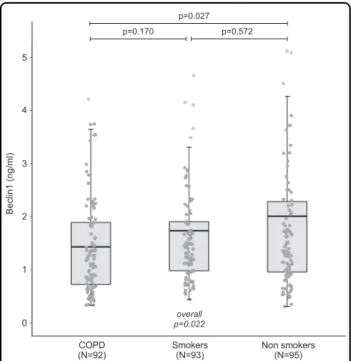
Clinical characteristics (except pulmonary function tests) did not differ across the three groups, but COPD patients had a higher pack-year value compared to control smokers. A statistically significant negative trend was found in serum Beclin1 protein level of non-smokers, smokers, and COPD patients (p = 0.022; Fig. 1). Beclin1 protein level was correlated to age, degree of airway obstruction, telomere length, appendicular skeletal mus-cle mass index, and grip strength (Table 1). None of the 27 chemokines and growth factors tested was correlated to Beclin1 level. After adjustment for age, the statistically significant negative trend between serum Beclin1 protein level in each group persisted (non-smokers: 2.31± 0.23, smokers: 1.66± 0.23, and COPD: 1.52 ± 0.24 ng/mL, respectively; p = 0.036). In COPD patients, Beclin1 pro-tein level was correlated to pulse-oxygen saturation (R = 0.25; p = 0.024), telomere length (R = 0.26; p = 0.014), and TNF-α levels (R = 0.35; p = 0.001).
Discussion
We show a significant decrease in serum Beclin1 protein level, a key regulator of autophagy, in smokers and even more in COPD patients compared to healthy controls. Autophagy induction and apoptosis have been widely described in bronchial and alveolar epithelial cells exposed to cigarette smoke extracts in vitro and in lung tissues of COPD patients3. However, evidence on the implication of Beclin1 in the cellular consequences of cigarette smoke exposure are limited to its capacity to permit autophagic-dependant apoptosis induced by acute cigarette smoke exposure11. Our results suggest another potential role of Beclin1 in the regulation of
autophagy in the specific context of chronic cigarette-smoke exposure. Indeed, accumulation of autophagic vacuoles/agresomes observed in the lungs of patients with severe COPD3already reflects an acquired defect in autophagic process during COPD, attributed to an autophagy-flux impairment that may be accessible to corrective therapies to prevent cellular senescence and emphysema8. Thus, Beclin1 circulating levels decline might also participate to autophagy impairment during COPD.
Furthermore, we show a correlation between the level of circulating Beclin1 and the degree of airflow obstruction, which is consistent with a progressive defect in autophagy during COPD, and also with two features of accelerated aging already associated to COPD, cellular senescence12 and muscle wasting10, respectively eval-uated by telomere length, ASMM and grip strength. Of course, the exact relationship between autophagy and cellular senescence remains unclear13, especially in the specific context of COPD, and the real implication of autophagy in skeletal muscle dysfunction is still deba-ted14. Beclin1 has a pivotal role in the regulation of cell survival, apoptosis, and autophagy, especially via its interaction with anti-apoptotic proteins of the Bcl-2 family (Bcl-2, Bcl-XL, Bcl-w, and Mcl-1), the BH3 domain of Beclin1 important for the binding to the BH3
0 1 2 3 4 5 COPD
(N=92) Smokers(N=93) Non smokers(N=95)
Beclin1 (ng/ml)
p=0.027
p=0.170 p=0.572
overall p=0.022
Fig. 1 Beclin1 levels according to the study groups. Results are shown as boxplots, with each box representing the interquartile range (1st to 3rd quartile, IQR), the line within the box indicating the mean, and the whiskers extending to 1.5 times the IQR above and below the box; the dots represent individual values for each patient
domain of the pro-apoptotic factors Bak, Bad, and Bim to Bcl-XL, and the activation of the Beclin1-interacting complex that generates phosphatidylinositol-3-phos-phate, which promotes autophagosomal membrane nucleation and is indispensable for autophagy15. It now seems necessary to further investigate its potential reg-ulatory role in the process of accelerated aging asso-ciated to chronic cigarette smoke exposure and COPD, at lung but also at systemic level.
In conclusion, although our results need to be con-firmed in other cohorts of COPD patients or with other potential biomarkers of autophagy, they support the hypothesis of a relationship between autophagy deficiency and COPD pathogenesis. They also incite to refine our knowledge on the complex mechanisms linking defective autophagy and cellular senescence in the progressive pathogenesis of COPD and of its systemic manifestations, with a special focus on Beclin1.
Table 1 Main subjects characteristics and Pearson correlation coefficients with Beclin1 level
N Mean (±SD) Correlation coefficient with Beclin1 level p-value*
Age, years 279 59.02 (±7.76) −0.13 0.027
BMI, kg/m2 279 26.03 (±4.69) 0.08 0.182
Pack-years 276 27.61 (±27.62) −0.10 0.088
Pulmonary function parameters
FEV1, % predicted 279 86.56 (±29.20) 0.12 0.039 FVC, % predicted 278 93.59 (±21.49) 0.07 0.263 DLCO, % predicted 227 76.12 (±19.19) −0.01 0.906
PaO2, mmHg 91 77.47 (±10.32) 0.18 0.086
SpO2, % 239 96.59 (±1.35) 0.09 0.178
6-min walking distance, m 239 556.37 (±100.56) 0.05 0.475 Systemic manifestations
Pulse wave velocity, m/s 271 11.55 (±2.32) −0.04 0.488
ASMMI, kg/m2 270 7.49 (±1.34) 0.21 0.001
BMD, total lumbar, g/cm2 275 1.11 (±0.18) 0.03 0.619
BMD, hips, g/cm2 275 0.98 (±0.14) 0.10 0.108
Grip test, kg 244 37.47 (±12.26) 0.13 0.046
Glomerularflow rate, mL/min 261 93.34 (±48.78) 0.02 0.802
HOMA-IR 265 2.65 (±2.81) 0.05 0.465
Biological parameters
Telomere length (T/S) ratio 274 0.42 (±0.11) 0.17 0.005
IL-6, pg/mL 271 18.07 (±15.97) −0.01 0.905 IL-8, pg/mL 271 46.94 (±9.88) −0.09 0.155 TNF-α, pg/mL 271 89.52 (±134.53) 0.07 0.228 MCP-1, pg/mL 271 41.66 (±22.44) −0.02 0.800 N N (%) Mean (±SD) p-value Gender Men 279 185 (66.31%) 1.80 (±1.45) 0.230 Women 94 (33.69%) 1.58 (±1.40) FEV1, % predicted ≥50 279 241 (86.38%) 1.80 (±1.50) 0.035 <50 38 (13.62%) 1.27 (±0.73)
*p-values for Pearson correlation coefficients; bolded results are statistically significant at the p < 0.05 level
BMI body mass index, FEV1 forced expiratory volume in 1 s, % predicted percentage of the predicted value, FVC forced vital capacity, SpO2oxygen saturation by pulse
oximetry, ASMMI appendicular skeletal muscle mass index, BMD bone mineral density, HOMA-IR homeostatic model assessment of insulin resistance, IL interleukin, TNF-α tumor necrosis factor alpha, MCP-1 monocyte chemotactic protein-1, SD standard deviation
Acknowledgements
We gratefully acknowledge Lucie Bizard for helping to perform the ELISA, Elisabeth Marcos for the management of telomere length measurements, and Bruno Housset for his supervision.
Author details
1INSERM U955, Institut Mondor de Recherche Biomédicale and Université Paris
Est-Créteil (UPEC), Faculté de Médecine, Créteil, France.2Unité de Pneumologie, APHP, Hôpital Henri Mondor, DHU-ATVB, Créteil, France.
3
Département de Physiologie-Explorations Fonctionnelles, APHP, Hôpital Henri Mondor, DHU-ATVB, Créteil, France.4Département de Pneumologie et
Pathologie Professionnelle, Centre Hospitalier Intercommunal, DHU-ATVB, Créteil, France.5Département de Santé Publique, Unité de Recherche Clinique
(URC-Mondor), APHP, Hôpital Henri Mondor, IMRB EA7376, Clinical Epidemiology and Aging (CEpiA), Créteil, France
Conflict of interest
The authors declare that they have no conflict of interest. Publisher's note
Springer Nature remains neutral with regard to jurisdictional claims in published maps and institutional affiliations.
Received: 21 July 2017 Revised: 21 November 2017 Accepted: 22 November 2017
References
1. Barnes, P. J. et al. Systemic manifestations and comorbidities of COPD. Eur. Respir. J. 33, 1165–1185 (2009).
2. Choi, A. M. K. et al. Autophagy in human health and disease. N. Engl. J. Med. 368, 1845–1846 (2013).
3. Chen, Z.-H. et al. Egr-1 regulates autophagy in cigarette smoke-induced chronic obstructive pulmonary disease. PLoS ONE 3, e3316 (2008).
4. Fujii, S. et al. Insufficient autophagy promotes bronchial epithelial cell senes-cence in chronic obstructive pulmonary disease. Oncoimmunology 1, 630–641 (2012).
5. Bodas, M. et al. Lactosylceramide-accumulation in lipid-rafts mediate aberrant-autophagy, inflammation and apoptosis in cigarette smoke induced emphysema. Apoptosis 20, 725–739 (2015).
6. Tran, I. et al. Role of cigarette smoke-induced aggresome formation in chronic obstructive pulmonary disease-emphysema pathogenesis. Am. J. Respir. Cell Mol. Biol. 53, 159–173 (2015).
7. Bodas, M. et al. Master autophagy regulator transcription factor EB regulates cigarette smoke-induced autophagy impairment and chronic obstructive pulmonary disease-emphysema pathogenesis. Antioxid. Redox Signal 27, 150–167 (2017).
8. Bodas, M. et al. Augmenting autophagy for prognosis based intervention of COPD-pathophysiology. Respir. Res 18, 83 (2017).
9. Emanuele, E. et al. Can enhanced autophagy be associated with human longevity? Serum levels of the autophagy biomarker beclin-1 are increased in healthy centenarians. Rejuvenation Res 17, 518–524 (2014).
10. Boyer, L. et al. Aging-related systemic manifestations in COPD patients and cigarette smokers. PLoS ONE 10, e0121539 (2015).
11. Kim, H. P. et al. Autophagic proteins regulate cigarette smoke-induced apoptosis: protective role of heme oxygenase-1. Autophagy 4, 887–895 (2008).
12. Savale, L. et al. Shortened telomeres in circulating leukocytes of patients with chronic obstructive pulmonary disease. Am. J. Respir. Crit. Care Med 179, 566–571 (2009).
13. Gewirtz, D. A. Autophagy and senescence: a partnership in search of de fini-tion. Autophagy 9, 808–812 (2013).
14. Hussain, S. N. A. et al. Role of autophagy in COPD skeletal muscle dysfunction. J. Appl. Physiol. 114, 1273–1281 (2013).
15. Levine, B. et al. Bcl-2 family members: dual regulators of apoptosis and autophagy. Autophagy 4, 600–606 (2008).